Saturday Matinee: First Reformed

Synopsis by A24

Reverend Ernst Toller (Ethan Hawke) is a solitary, middle-aged parish pastor at a small Dutch Reform church in upstate New York on the cusp of celebrating its 250th anniversary. Once a stop on the Underground Railroad, the church is now a tourist attraction catering to a dwindling congregation, eclipsed by its nearby parent church, Abundant Life, with its state-of-the-art facilities and 5,000-strong flock. When a pregnant parishioner (Amanda Seyfried) asks Reverend Toller to counsel her husband, a radical environmentalist, the clergyman finds himself plunged into his own tormented past, and equally despairing future, until he finds redemption in an act of grandiose violence. From writer-director Paul Schrader (Taxi Driver; American Gigolo; Affliction) comes a gripping thriller about a crisis of faith that is at once personal, political, and planetary.

Watch the full film on Kanopy.

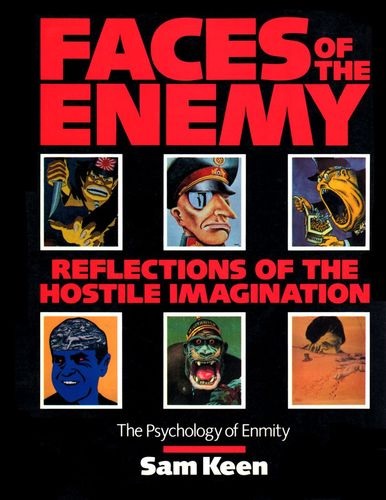
Saturday Matinee: Faces of the Enemy

Description from California Newsreel:

As relevant today as when it was first released, Faces of the Enemy follows social psychologist Sam Keen as he unmasks how individuals and nations dehumanize their enemies to justify the inhumanity of war.

Using archival news footage, public service announcements, and editorial cartoons, Keen unveils the same frightening pattern in conflict after conflict – World War II, the Vietnam War, the Cold War, Islamic and Christian Fundamentalism – and prefigures the current War on Terrorism. First we identify ourselves as victims. Then we blame, demonize and finally dehumanize our adversaries, rationalizing our murder of other human beings.

Faces of the Enemy contends that before a drop of blood is spilled we must ‘think each other to death.’ It is a story replayed on the nightly news, in Islamic Fundamentalists’ characterization of the West as the ‘Great Satan’ and our own stereotyping of Muslims as terrorists. In a revealing examination of the images and iconography of war Keen interviews the nation’s leading editorial cartoonists. They discuss how they use an almost universal language of stereotypes and prejudices to tap into readers’ most visceral emotions.

In a chilling example of the psychological roots of enmity, we meet David Rice, an unemployed welder now an inmate on Death Row. Influenced by far-right propaganda, Rice decided communism was responsible for his personal problems. He bludgeoned to death a family of four whom he (mistakenly) thought were communists. He remains without remorse regarding them as ‘collateral damage’ in a war against the Evil Empire. The Christian Fundamentalist leaders who inspired Rice are only too happy to explain that they are in a holy war against communists and any non-believers.

By contrast, William Broyles, a Viet Nam veteran and author, returned after the war to personalize the individuals who had been his enemies’ to humanize the abstractions. He explains how racist terms and images can be used to turn human beings into monsters. These epithets and images extend the circumstances of war into terrible brutality. But he also explains how we can move beyond these dehumanizing thoughts and seek out the humanity of others.

Psychologists Robert Lifton and Steven Kull explain how war and artificial enemies provide people with the moral and mental certainties they crave, giving them a sense of purpose in a sometimes-ambiguous world. Mythologist Joseph Campbell, providing a note of hope, suggests that underneath the mask of the enemy we ultimately recognize ourselves. This, Campbell further contends, may be the origin of compassion, brotherhood and altruism, in other words the inverse of war.


Watch the full film on Kanopy.

Cyberpunk is Now and No One Knows What to Do With It

By Pattern Theory

Source: Modern Mythology

Cyberpunk broke science fiction. Creeping in alongside the commercialization of the internet, it extrapolated the corruption and dysfunction of its present into a brutal and interconnected future that remained just a heartbeat away. Cyberpunk had an attitude that refused to be tamed, dressed in a style without comparison. Its resurgence shows that little has changed since its inception, and that’s left cyberpunk incapable of discussing our future.

Ghost in the Shell got the live-action treatment in 2017, a problematic remakeof the 1995 adaptation. Some praised its art direction for increasing the visual fidelity of retrofuture anime cityscapes, but the general consensus was that the story failed to apply care and consideration towards human brains and synthetic bodies like Mamoru Oshii had more than two decades before. A few months later came Blade Runner 2049, a sequel to the cyberpunk classic. Critics and fans praised it for high production values, sincere artistic effort, and meticulous direction. Yet something had gone wrong. Director Denis Villeneuve couldn’t shake the feeling that he was making a period movie, not one about the future.

Enough has changed since the 1980s that cyberpunk needs reinvention. New aesthetics. An expanded vocabulary. Code 46 managed this years ago. It rejects a fetish for all things Japanese and embraces China’s economic dominance. Conversations being in English and are soon peppered with Mandarin and Spanish. Life takes place at night to avoid dangerous, unfiltered sunlight. Corporations guide government decisions. Genetics determine freedom of movement and interaction. Climate refugees beg to leave their freeway pastures for the safety of cities.

Code 46 is cyberpunk as seen from 2003, a logical future that is now also outdated.

If Blade Runner established the look, Neuromancer defined cyberpunk’s voice. William Gibson’s debut novel was ahead of the curve by acknowledging the personal computer as a disruptive force when the Cold War was at its most threatening. “Lowlife and high tech” meant the Magnetic Dog Sisters headlining some creep joint across the street from a capsule hotel where console cowboys rip off zaibatsus with their Ono Sendai Cyberdeck. But Gibson’s view of the future would be incomplete without an absolute distrust of Reaganism:

“If I were to put together a truly essential thank-you list for the people who most made it possible for me to write my first six novels, I’d have to owe as much to Ronald Reagan as to Bill Gates or Lou Reed. Reagan’s presidency put the grit in my dystopia. His presidency was the fresh kitty litter I spread for utterly crucial traction on the icey driveway of uncharted futurity. His smile was the nightmare in my back pocket.” — William Gibson

“Fragments of a Hologram Rose” to Mona Lisa Overdrive is a decade of creative labor that was “tired of America-as-the-future, the world as a white monoculture.” The Sprawl is a cyberpunk trilogy where military superpowers failed and technology gave Japan leadership of the global village. Then Gibson wrote Virtual Light and readers witnessed extreme inequality shove the middle class into the gig economy as corporations schemed to profit off natural disasters with proprietary technology.

Gibson knew the sci-fi he didn’t care for would absorb cyberpunk and tame its “dissident influence”, so the genre could remain unchanged. “Punk” is the go-to suffix for emerging subgenres that want to appear subversive while posing a threat to nothing and no one. It’s how “hopepunk” becomes a thing. But to appreciate cyberpunk’s assimilation, look at how it’s presented sincerely.

CD Projekt Red (CDPR), known for the Witcher game series, has spent six years developing what’s arguably the most anticipated video game of the moment, Cyberpunk 2077. Like Gibson, Mike Pondsmith, creator the original “pen-n-paper” RPG, and collaborator on this adaptation of his work, has had his writing absorbed by mainstream sci-fi. CDPR could survive on that 31-year legacy, but they insist they’re taking their time with Cyberpunk 2077 to craft an experience with a distinct political identity that somehow allows players to remain apolitical. In a way this is reflective of CDPR’s reputation as a quality-driven business that’s pro-consumer, but has driven talent away by demanding they work excessive hours and promoting a hostile attitude towards unions. This crunch culture is a problem across the industry.

We’ll soon see how Cyberpunk 2077 developed. What we can infer from its design choices, like giving protagonist V a high-collar jacket seen on the cover of the 2nd edition game book from 1990, is that Cybperpunk 2077 will be familiar. Altered Carbon and Ready Player One share this problem. Altered Carbon is so derivative of first-wave cyberpunk it’s easy to forget its based on a novel from 2002. Ready Player One at least has the courtesy to be shameless in its love of pop culture, proud to proclaim that nothing is more celebrated today than our participation in media franchises without ever considering how that might be a problem.

What’s being suggested, intentionally or not, is that contemporary reality has avoided the machinations of the powerful at a time when technology is wondrous, amusing, and prolific. If only we were so lucky.

238 cities spent more than a year lobbying Amazon, one of two $1 trillion corporations in existence, for privilege of hosting their new office. In November it was announced that Amazon would expand to Crystal City, Virginia and Long Island City, Queens. Plenty of New Yorkers are incensedthat the world’s largest online marketplace will get $3 billion in subsidies, tax breaks, and grants to further disrupt a housing market that takes more from them than any city should allow. Some Amazon employees were so excited to relocate they made down payments on their new homes before the decision went public, telling real estate developers to get this corner of New York readyfor a few thousand transplants. But what of the people already there?

Long Island City is home to the Queensbridge Houses, the largest housing project in the US. Built in 1939, these two buildings are home to more then 6,000 people with an average income of $16,000. That’s far below the $54,000 for Queens residents overall. But neither group is anywhere near the average salary for the 25,000 employees Amazon will bring with them, which will exceed $150,000. How many of those positions will be filled by locals? How many will come from Queensbridge?

Over 800 languages are spoken in Queens, making it the most linguistically diverse place in the world. Those diverse speakers spend over 30% of their income on rent. They risk being priced out of their neighborhoods. Some will be forced out of the city. Has Governor Cuomo considered the threat this deal poses to people’s homes? Has Mayor de Blasio prepared for the inevitable drift to other boroughs once property values spike? Looking at Seattle and San Francisco, there’s no reason to expect local governments to be proactive. So New Yorkers have taken up the fight on their own.

Amazon boss Jeff Bezos toyed with these politicians. He floated the idea that any city could become the next Silicon Valley and they believed him. They begged for his recognition, handed over citizen data, and took part in the $100 billion ritual of subsidizing tech companies.

It was all for nothing. Crystal City is a 20-minute drive from Bezos’ house in Washington DC, where Amazon continues to increase its spending on lobbyists. That’ll seem like a long commute compared to the helicopter ride from Long Island City, the helipad for which is subsidized by the city, to Manhattan, the financial and advertising capital of the world, where Bezos owns four more houses.

The auction for Bezos’ favor was a farce. New York and Virginia give him regular access to people with decision-making power, invaluable data, and institutions that are are sure to expand his empire. These cities were always the only serious options.

Amazon’s plans read like the start of a corporate republic, a cyberpunk trope inspired by company towns. Employers were landlords, retailers, and even moral authorities to workforces too in debt to quit. Many had law enforcement and militias to call on in addition to the private security companies they hired to break labor strikes, investigate attempts at unionization, and maintain a sense of order that resulted in massacres like Ludlow, Colorado.

Amazon is known for labor abuses, monitoring, and tracking speed and efficiency in warehouses without bathroom breaks, where employees have collapsed from heat exhaustion. They sell unregulated facial recognition services to police departments, knowing it misidentifies subjects because of inherent design bias. Companies with a history of privacy abuses have unfettered access to their security devices. They control about half of all e-commerce in the US and, as Gizmodo’s Kashmir Hill found out, it is impossible to live our lives without encountering Amazon Web Services.

It doesn’t take a creative mind to imagine similar exposition being attributed to corporate villains like Cayman Global or Tai Yong Medical.

Rewarding corporations for their bad behavior is just one way the world resembles a fictive dystopia. We also have to face rapid ecological and institutional decay that fractionally adjusts our confidence in stability, feeding a persistent situational anxiety. That should make for broader and bolder conversations about the future, and a few artists have managed to do that.

Keiichi Matsuda is the designer and director behind Hyper-Reality, a short film that portrays augmented reality as a fever dream that influences consumption, and shows how freeing and frightening it is to be cut off from that network. Matsuda’s short film got him an invitation to the World Economic Forum in Davos to “speak truth to power.” What Matsuda witnessed were executives and billionaires pledging responsibility with t-shirts and sustainability, while simultaneously destroying the environment, as an audience of their peers and the press nodded and applauded “this brazen hypocrisy.” So Matsuda took a stanchion to his own installation.

Independence means Matsuda gets to decide how to talk about technology and capitalism, and how to separate his art and business. It also means smaller audiences and fewer productions.

Sam Esmail used a more visible platform to “bring cyberpunk to TV” with Mr. Robot. Like Gibson’s Pattern Recognition, it’s cyberpunk retooled for the present — post-cyberpunk. Esmail never hesitates to place our villains in Mr. Robot. Enron is an influence on logo designs and tactics of evil corps. Google, Verizon, and Facebook are called out for their complicity with the federal government in exposing customer data. AT&T’s Long Lines building, an NSA listening post since the 1970s, plays the role of a corporate data hub that reaches across the county. Even filming locations serve as commentary.

An anti-capitalist slant runs through Mr. Robot, exposing the American dream as a lie and our concept of meritocracy as a tool to protect the oligarchy, presenting hackers as in direct contact with a world of self-isolation and exploitation, those who dare to hope for a future affected by people rather than commerce. And Esmail somehow manages this without interference from NBC.

Blade Runner will get more life as an animeCowboy Bebop is joining Battle Angel Alita in live action. Altered Carbon is in the process of slipping into a new sleeve. There’s no shortage of revivals, remakes, and rehashing of cyberpunk’s past on the way. They’ll get bigger audiences than a short film about submitting to algorithms. More sites will discuss their pros and cons than a mobile tie-in that name-drops Peter Kropotkin and Maria Nikiforova. But in being descriptive and prescriptive, moving to the future and looking for sure footing in the accelerated present, Matsuda’s and Esmail’s work reminds us that cyberpunk needs to be more than just repeating what’s already been said about yuppies, Billy Idol, and the Apple IIc.

We live at a time where 3D printing is so accessible refugees can obtain prosthesis as part of basic aid. People forced to migrate because of an iceless arctic will rely on that assistance. Or we could lower temperatures and slow climate change by spraying the atmosphere with sulfate, an option that might disrupt advertising in low-orbit. Social credit systems are bringing oppressive governments together. Going cashless is altering our expectations of others. Young people earn so little they’re leveraging nude selfies to extend meager lines of credit. Productivity and constant notifications are enough to drive some into a locked room, away from anything with an internet connection. Deepfakes deny women privacy, compromise their identity, and obliterate any sense of safety in exchange for porn. Online communities are refining that same technology, making false video convincing, threatening our sense of reality. Researchers can keep our memories alive in chat bots distilled from social media, but the rich will outlive us all by transfusing bags of teenage blood purchased through PayPal.

In a world that increasingly feels like science fiction it’s important to remind ourselves that writing about the future is writing about the present. Artists worthy of an audience should be unable to look at the embarrassment of inspiration around them and refuse the chance to say something new.

Our age of horror

In this febrile cultural moment filled with fear of the Other, horror has achieved the status of true art

By M M Owen

Source: aeon

In Ray Bradbury’s horror short story, ‘The Next in Line’ (1955), a woman visits the catacombs in Guanajuato, Mexico. Mummified bodies line the walls. Lying awake the next night, haunted by her macabre tour, she finds that her heart ‘was a bellows forever blowing upon a little coal of fear … an ingrown light which her inner eyes stared upon with unwanting fascination’.

Our present era is one in which the heart of culture is blowing hard upon a coal of fear, and the fascination is everywhere. By popular consent, horror has been experiencing what critics feel obliged to label a ‘golden age’. In terms of ticket sales, 2017 was the biggest year in the history of horror cinema, and in 2018, Hereditary and A Quiet Place have been record-breaking successes. In both the United States and the United Kingdom, sales of horror literature are up year over year – an uptick that industry folk partly attribute to the wild popularity of Netflix’s Stranger Things (2016-). And the success isn’t merely commercial. Traditionally a rather maligned genre, these days horror is basking in the glow of critical respectability. As The New York Times remarked this June, horror ‘has never been more bankable and celebrated than it is right now’.

As any historian of the genre will tell you, horror has had previous golden ages. Perhaps ours is just a random quirk of popular taste. But perhaps not. Perhaps we are intoxicated by horror today because the genre is serving a function that others aren’t. Can’t. Horror’s roots run deep, but they twist themselves into forms very modern. The imagination’s conversion of fear into art offers a dark and piercing mirror.

My earliest horror memory is Stay Out of the Basement (1992), one of R L Stine’s Goosebumps series of young adult novels. In the story, a botanist accidently creates a hybrid plant clone of himself. When the clone comes to life, he tries to steal his humanoid self’s life. The botanist’s children unmask the imposter, and in a mess of green blood and plant mush, the clone is felled with an axe. The rescued father disposes of the rest of the mutating plant matter, and the family is all set to live happily ever after. But at the very end, the daughter is standing in the garden and feels a small plant nudging her ankle. The plant whispers to her: ‘Please – help me. I’m your father.’ Stay Out of the Basement is no masterpiece, but I was young, and it struck me cold.

Horror is what anthropologists call biocultural. It is about fears we carry because we are primates with a certain evolved biology: the corruption of the flesh, the loss of our offspring. It is also about fears unique to our sociocultural moment: the potential danger of genetically modifying plants. The first type of fear is universal; the second is more flexible and contextual. Their cold currents meet where all great art does its work, down among the bottomless caves on the seabed of consciousness. Lurking here, a vision of myself paralysed in the dirt, invisible to those I love.

Horror has always been with us. Prehistoric cave paintings are rife with the animal-human hybrids that remain a motif of horror to this day. Every folktale tradition on Earth contains tales of malevolent creatures, petrifying ghosts and graphic violence. The classics are frequently horrifying: in Homer’s Odyssey, when the Cyclops encounters Odysseus’ men, the monster eats them, ‘entrails, flesh and the marrowy bones alike’.

We have always told horror stories, and we always will. Because horror is an artistic expression of an ontological truth: we are creatures formed in no small part by the things to which we are averse. Fear is a base ingredient of consciousness, partaking of brain circuits that are so ancient humans share them with all vertebrate lifeforms. As the neuroscientist Antonio Damasio has described, the whole weird soup of human feeling emerged as a result of our beginning to process whether to ‘approach or avoid … certain places or things or creatures’. Our cognition absorbs reality as a vast spectrum of potential encounters, and horror alchemises the dark end into art.

Thus, evolutionary analyses of horror mention monsters as the genre’s most defining feature. As the philosopher Stephen T Asma puts it, ‘during the formation of the human brain, the fear of being grabbed by sharp claws, dragged into a dark hole and eaten alive was not an abstraction’. For a quarter of a million years – the vast majority of Homo sapiens’ existence as a species – we lived outdoors, with giant hyenas, saber-toothed cats and other carnivores representing a real threat to life. That other ancient health risk, the biological pathogen, manifests itself in the tendency of monsters to be not only violent but also disgusting – feral, oozing blood and saliva, bearing their infectious teeth. From the evolutionary perspective, horror’s vast monstrous menagerie echoes with Paleolithic peril.

Historically, horror’s willingness to play directly to our evolved physiology has seen it earn a low reputation. Western culture was built on a vision of ourselves as above the beasts, above the beastliness of acquiescing helplessly to the demands of the body. But horror can bypass all intellect, extract from us an embarrassingly animalistic response. The skittish physicality of the ‘jump scare’ is a manipulation of what biologists call the startle response, present in all mammals. And cruder horror always contains that other ghastly reminder of our physicality: gore. Gore disgusts us, and the way that gore can be darkly compelling to us disgusts us. Whenever horror is criticised, it is criticised for staging a dark carnival of physicality. Perhaps the only sort of media we moralise more than we do horror is that other mainliner of bodily response, pornography.

Horror’s historical ghettoisation has meant that weightier, smarter horror reliably gets labelled as something else. The finest films of our current golden age have been dubbed ‘elevated horror’ and ‘post-horror’. In literary circles, works of horror seen as sufficiently cerebral get relabelled ‘Gothic’. It’s certainly true that great horror is always about more than gore. But we should be careful not to gentrify the genre by cleansing it of everything but the philosophy.

There are always beings that want to bite us, scratch us, puncture our fragile flesh. There is the terrible old coercion of brute, muscular force, the lethal threat of contagion and infection. There is darkness, disorientation. And looming explicitly or symbolically in all horror is that vast shadow that the anthropologist Ernest Becker said ‘haunts the human animal like nothing else’: death.

‘And he that sat on the cloud thrust in his sickle on the Earth; and the Earth was reaped’. Witness the machinations of that famous slasher, God (Revelation 14:16). Horror encodes the story of our long primate journey, but these biological foundations support the towering edifice of culture. And for millennia, horror merged with our oldest cultural phenomena: religion and folklore. In fact, for most of its history, horror wasn’t really art, as we tend to understand that term today. It certainly wasn’t fiction. Prior to about 1750, in our pivot toward the Enlightenment, the best horror stories can all be found within theology and lore. In Europe, for generations Satan was every bit as petrifying as Pennywise, the murderous clown of Stephen King’s It (1986). Demonic forces were terrifyingly real; in the Bible, Jesus spends almost as much time performing exorcisms as he does healing people. There were widespread societal panics about the threat of werewolves and vampires, and tens of thousands of women were murdered as witches.

This isn’t to judge the credulity of bygone peoples. But the reason that horror – unlike say tragedy, or comedy, or the epic – didn’t exist as an artistic genre until relatively recently is that its deep history is fundamentally pre-scientific. Nothing in the annals of art is as scary as what you’ll find in bygone worldviews. Who needs make-believe scares when everyone you know is awaiting the day of judgment, at which point an angel will sweep a sickle across the Earth and make the blood run for hundreds of miles? It is no coincidence that the Gothic – horror’s regal antecedent – emerged precisely at the moment when lots of people began to believe that God really might be dead. Modern horror is in part the story of what happens when our threatened minds shed a theology. Once holy texts can no longer entirely encode the terrors of being, horror enters fully the arena of art.

However, the old ways cast a long shadow. In the pantheon of genres, horror remains an adolescent, and it has a sort of adolescent relationship with its past: half rebellion, half dependency. On the one hand, more than any other genre, horror loves to thematise the coldest sorts of atheism. ‘All my tales,’ said horror grandee H P Lovecraft, ‘are based on the fundamental premise that common human laws and interests and emotions have no validity or significance in the vast cosmos-at-large.’ In The Silence of the Lambs(1988), amused by what he sees as clear evidence for the absence of any benevolent deity, the charmingly evil Hannibal Lecter ‘collects church collapses, recreationally’.

On the other hand, horror is marked everywhere by the centuries it spent wedded to otherworldly belief systems. In 2018’s biggest horror movie, Hereditary, an obscure figure from demonology possesses a teenage boy and wreaks death upon his family. Much Japanese horror features yūrei, tormented and enraged spirits denied a smooth passage to the afterlife. Horror was a dark, mutant child of the Enlightenment, and yet it can’t shake its pre-scientific genes. Its penchant for lurid supernaturalism is a big reason why, when it fails, it can so easily seem puerile. The modern, skeptical mind whispers: This is just silly. Haven’t we outgrown all this? On Halloween – a celebration of horror’s pre-artistic forms – children are meant to have the most fun.

Why does horror have this double-edged relationship with its religious and spiritual heritage? Perhaps because, for all its modernity, the sheer scale of theological enquiry still reflects the genre’s ambition. As leading horror author Joe Hill told me, horror is what we turn to when we want to explore ‘the biggest and darkest questions’. And even demoted from dogma to metaphor, the old myths offer a fine way to channel those grand subjects of which horror is so fond: good versus evil, the tribulations of the soul, the end of days. Even though it requires our suspension of disbelief, the paranormal presents us with the very real prospect of brittle reason splintering against the mystery of reality.

‘There’s a sense of uncertainty and potential wrongness underlying most of human existence,’ the Canadian author Gemma Files told me. All of humankind’s great mythic narratives know this, and horror doesn’t let us forget it. At the core of the numinous impulse – that oceanic feeling in which horror was submerged for so many centuries – is the strange certainty that reality is unpredictable and inscrutable, that certain things will forever resist the reach of the human mind. Horror will always share in this sense. It may have fallen from heaven, but it still isn’t entirely of this Earth. Cormac McCarthy’s The Road(2006) centres on a father and son as they wander across a blasted, post-apocalyptic America. The horrors are everywhere: they discover, chained in a basement, ‘a man with his legs gone to the hip and the stumps of them blackened and burnt’. The man is being harvested by cannibals, piece by piece. It is a bleak, fallen world, where the memory of a time when trout swam in the streams shimmers with celestial grace. When the father meets an elderly man, he tells him: ‘There is no God and we are his prophets.’

And so what of today? Horror reverberates with fears Paleolithic and God-fearing, but it is also always reacting to its present moment. And it seems reasonable to perceive any swell in the production and popularity of horror – any dawning of a new golden age – as the expression of a culture that is afraid. ‘In anxious times,’ David Bruckner, director of The Ritual (2017) and other horror movies, told me, ‘people are more likely to turn to horror. If you have an uneasy night at the movie theatre, you are sort of answering the call of your times.’

‘I think we’re living in a nightmare, basically.’ So said horror legend Ramsey Campbell, when I asked him why he thinks horror is flourishing right now. This is one of those things that cooler heads will say is your mind deceiving you. By many objective measures, for many people, life today is better than ever. But horror has never been too worried about culture’s long-term trajectory; it is always fixated on how it could all go badly wrong, any minute now. Horror is steeped in worry; its narratives frequently open with the calm before a terrible storm. And every person connected with horror that I interviewed smelled doom on the breeze.

Horror has always made good use of our deep aversion to what Lovecraft called ‘the oldest and strongest kind of fear’: the unknown. This is one of the ways in which horror (like the folktale) can display a sort of archetypal conservatism. In general terms, the best way to survive a horror setting is to be supremely, boringly sensible: don’t talk to strangers, don’t stay the night in a foreign town, don’t go to the aid of anyone who looks sick, don’t go into that crumbling old building. If a very attractive stranger tries to seduce you, it is almost definitely a trap. Respect tradition, do not commit sacrilege, listen to the advice of elderly locals. At the heart of a lot of horror is a conservative craving for the predictable and the known. The unpleasant atonal dissonance you’ll hear in every horror score reflects, through the collapse of harmony, the disintegration of familiar and comforting patterns out there in the world.

Horror, then, thrives on discombobulation. And today, the discombobulation is everywhere. The causes of the anxiety are scattershot, and you already know them. There are those scientific breakthroughs of the sort that get Silicon Valley execs psyched, but which many others find deeply, opaquely perturbing. Take artificial intelligence, whose rise has seen more and more science fiction turn horrific: ‘One day the AIs are going to look back on us the same way we look at fossil skeletons on the plains of Africa,’ says Nathan, a central character in Ex Machina (2015). And even if the robots don’t vanquish poor old Homo sapiens, other sorts of scientific experimentation might. One of the great horror trends of the 21st century has been the zombie, and in all of the best works of zombie fiction, the immediate cause of the outbreak is the same: biological experimentation gone horribly wrong. The zombie is the gnashing, lunging embodiment of that modern terror, the global pandemic. People might not fear Satan anymore, but they sure as hell fear Ebola.

Outside of the lab, there is that slower method of planetary destruction: climate change. ‘Horror,’ the author Jeff VanderMeer told me, ‘is the beauty of the natural world juxtaposed against the way we destroy those natural systems without understanding them.’ VanderMeer’s Southern Reach trilogy (2014), some of my favourite horror novels of all time, diluted my enjoyment of the UK’s recent heatwave and refused to let me forget that what I was basking in were the convulsions of an aching planet. A biosphere cast brutally off-balance forms the setting for M R Carey’s The Girl With All the Gifts(2014), where humanity has been devastated by a fungal infection. Where horror once worried about the weather gods, it now just worries about the weather. Climate change, meanwhile, is a major cause of mass migrations, potent fuel for what leading critic Leslie Klinger described to me as horror’s historical trend of feeding off ‘the invasion of foreigners into previously stable populations’. At a base level, we are in-groupish creatures. I’ve spent time with rural, paganish communities who enjoy a singsong and are sexually unrepressed; none of them tried to burn me alive in a giant wicker man. But horror says: you never knowStick to your own.

If all these fears sound selfish, parochial, insular – don’t get the wrong idea. Horror offers a map of the psyche and, like fear itself, is inherently apolitical. It can easily offset its archetypal conservatism with a radical sort of anarchism. Horror might thematise our fear of the unknown – but it also warns about clinging too stubbornly to the familiar. In a lot of horror, survival is predicated on a capacity to quickly adapt to brutal change. Horror has little time for the conservative sentimentality that swirls around ideas such as institutions and tradition, and even something like the nation-state is often revealed as a sort of frilly, doomed illusion. The protections of social hierarchy or private property are never of any use, and horror loves to punish characters who arrogantly believe that wealth will shield them. In horror, the consolations of the past melt in contact with the white-hot heart of present fear. Conservatism fails because it is revealed that at bottom there is nothing to conserve. As the author Michael Marshall Smith put it to me, great horror often declares: ‘It’s just you versus the monster. Always has been. Always will be.’

In this, lots of horror is intensely universalising. Frequently, a scenario comes down to a simple contest between humankind and something else. Splitting up is a suicidal move in horror; survival often follows an impulse toward communal effort. Similarly universalising is the way that, at extreme moments of threat or fear, a given character’s skin colour or gender or nationality will often be effaced. At horror’s pitch, we perceive a simple human, doing what we all do every day of our lives: struggling to live, to persist, to overcome. In The Babadook(2014), a widowed mother is stalked by an amorphous, black-hatted monster that embodies her grief at losing her husband. The monster – her terrible, life-sucking trauma – threatens to claim her son, and destroy what is left of her family. Late in the film, bloodied and exhausted, the mother faces down the Babadook, yelling: ‘If you touch my son again, I’ll fucking kill you.’ The monster is tamed. It is a show of furious bravery that could be any mother, anywhere; courageous love in the face of total disorder.

It’s easy to romanticise horror, but there are also unsexy, funcitonal reasons why it’s having its moment right now. The streaming revolution has given creators a reliable and direct way to reach a dedicated, self-selecting audience. Trusting this audience, distributors like A24 and Blumhouse have put a great amount of both creative wherewithal and cold hard dollars into horror cinema. The genre has always been reliably profit-turning, but it has also always been prone to the lazy recycling of ideas and tropes. Today, even experimental horror can be profitable. In literature, meanwhile, a revival of interest in horror greats like Shirley Jackson, as well as a slew of Stephen King adaptations, has been a boost for the genre at large.

Yet on their own, these tantalising products would never suffice to make horror soar. Horror has been with us since the dawn of storytelling. It manifests the fears of the human animal, and even today echoes the slippery spiritual suspicion that reality isn’t what it seems. Our world is ripe for upending, and horror expresses that best. Horror can thrive today because ours is a strange and febrile cultural moment. It seems every civilisation has believed they are on the brink of cataclysmic change; such an idea has a weird narcissistic appeal. But today there is everywhere a deep feeling that the horses of disaster are about to plunge in the heavy clay. There is a sort of great loop being completed here: as horror has morphed from theology to art, the ruinous power has moved from the judgment of God to the hand of humans. The end of days in one programmer’s idle tinkering, in one laboratory’s overlooked quarantine protocols. Robert Louis Stevenson, author of The Strange Case of Dr Jekyll and Mr Hyde (1886), wrote, ‘Sooner or later, everyone sits down to a banquet of consequences.’ As a genre, horror is forever pulling up a chair, licking its lips at the feast to come.

Breathing this nervous air, current horror – like the theology that provided its former home – is animated by the full spectrum of human psychology. It is driven by our desire to stop all the clocks, shrink into a bubble of the familiar and the known, reject all things foreign. Equally, current horror is shot through with the bone-deep knowledge that if we can’t adapt, we will perish. Its narratives warn us not to cling to outdated consolations, to recognise that we all face the same monsters, in the end. The world has always been dark and full of terrors, and horror has always known it. The dark pleasure of enjoying horror is all about countenancing this awful truth from within a little bubble of safety. It is about the doppelgängered headspace of loathing the real thing but craving its imaginative facsimile. If the genre of horror has a master virtue, a single human quality that it consistently exalts, it is an old one: bravery. We are certain to need that, wherever we are headed.


With thanks to all the horror authors, editors, screenwriters, directors and critics who generously gave me their time to explore horror: Nick Antosca, Stephen T Asma, David Bruckner, Ramsey Campbell, Noël Carroll, Ellen Datlow, Gemma Files, Steven Gerrard, Joe Hill, Carole Johnstone, Leslie Klinger, John Langan, Lisa Morton, Andy Nyman, Jami O’Brien, Xavier Aldana Reyes, Priya Sharma, David J Skal, Michael Marshall Smith, Eugene Thacker, Paul Tremblay, and Jeff VanderMeer. 
The Age of Ego

By Dan Corjescu

Source: CounterPunch

Hegel’s conception of history taught us that the meaning of history was the liberation of the individual through his or her recognition as a fully autonomous rational person.

Indeed, since the French Revolution, the Age of the Individual has expanded apace even if not always in a straight line.

Today, more than ever, our politics, economics, culture, and society are all, at least nominally, directed at the well being and full recognition of each and everyone of us.

If this is so, then why are so many people still frustrated and unhappy in their daily life?

In part, this state of affairs might be due to our neglecting of the second part of the Hegelian equation: the individual’s place and relationship to others mediated by the State.

The State, according to Hegel, is the representation of universal rationality. Put in another way, the state is the structure which allows individuals to be recognized as full individuals through their participation in it. Each and every individual has a role to play within the state. The fulfillment of that role satisfies our need for recognizing one another and the constant realization that we are not and cannot be just for ourselves but for each other.

A culture, such as ours, which celebrates the socially untethered individual is propagating a fundamental lie. Individuals cannot be fully realized without the cooperation of all other individuals; an essential activity which, in the modern world, is mediated by the state.

Yet, what is the state in the modern world? What has it become? Is it a universalist, rationalist tool for the realization of the greater good?

Certainly not.

Today, the modern state is a tool of elites to ensure their total domination and power over all other classes and groups. It does not matter if the state calls itself “democratic” or a “one party state”. In effect, all states today are “one party” states controlled by their respective elites who are often tied to one another transnationally. We are, all of us, under the thumb of a new global elite who dictates the nature of our social being. “Global Empire” is not an all too fanciful term for the present situation.

And like the Roman Empire before it, it is not a coincidence that many people are turning spiritually inward toward personalistic philosophies of self-help and care. Ironically, even the philosophy of ancient Stoicism is making somewhat of a comeback.

None of this is surprising.

The individual cannot be truly satisfied if he or she is not a participating and consequent member of a polity; of a state. The elites of this world have carefully and calculatedly castrated our social and economic potentialities to do so.

The root of our gnawing unhappiness in our brave new world is simply this: consequential inter-personal participation in the sphere of the political has been vanishing for decades. The ability to effect collective change from below has been diminishing. True collectivity has been consistently denied.

The disassociation of the individual from the polity; in effect the non-existence anywhere of true democracy has led to a hollowing out of the human personality. It is only in concrete social action that we materialize fully as human beings. It is as members of a community who are able to truly guide that community that we find a deep human purpose.

Once again, recalling Hegel and the Greeks before him, it is not enough to exist as economic man symbolically feigning electoral freedom every two or four years ; one must directly participate in the polis.

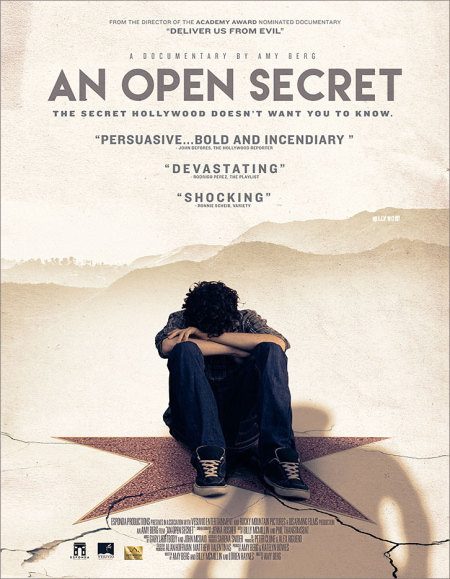
Saturday Matinee: An Open Secret

“An Open Secret” (2014) is a documentary film about Hollywood child sexual abuse directed by Amy Berg (Deliver Us From Evil). The film features interviews with victimized performers, who were targeted when they were young boys (including Corey Feldman and Todd Bridges), as well as industry figures, the predators themselves, and journalists. The documentary originally had a very limited theatrical run and has never had a home video release causing widespread suspicion that there was a campaign to bury the film. Regardless, according to Wikipedia a pirated version was viewed at least 900,000 times. Due to the exposure of Harvey Weinstein and other Hollywood sexual predators, on October 12 2017 the film was made available for free for nine days on Vimeo. Because it went viral, with over 3 million viewings on various social media platforms in two weeks, the free viewing period has been extended until early November.

Watch the full film for free for a limited time here: https://vimeo.com/142444429

Revolutionary Terror: Mark Steven’s ‘Splatter Capital’

By Michael Grasso

Source: We Are the Mutants

Splatter Capital: The Political Economy of Gore Films
By Mark Steven
Repeater Books, 2017

“Splatter confirms and redoubles our very worst fears. It reminds us of what capital is doing to all of us, all of the time—of how predators are consuming our life-substances; of how we are gravely vulnerable against the machinery of production and the matrices of exchange; and of how, as participants of an internecine conflict, our lives are always already precarious.”

—from the Introduction to Splatter Capital

Political readings or interpretations of horror films are nothing new. But in Mark Steven’s 2017 study, Splatter Capital, an explicit connection is made between the bloody gore of what Steven terms “splatter” horror films and the dehumanizing, mutilative forces of global capitalism. Moreover, Steven posits the artistic motivation behind splatter horror as an explicit repudiation of this system: “It is politically committed and its commitment tends toward the anti-capitalist left.” In splatter films, Steven tells us, the images of gory dismemberment do double duty. They both offer a clear metaphor for capitalism’s cruelty, and act as a cathartic revenge in which the bloody legacy of capitalist exploitation is often visited upon its perpetrators and profiteers among the bourgeoisie.

Some definitions are in order here, given that Steven’s schema of genres—“splatter,” “slasher,” “extreme horror”—draws distinctions that might not be apparent even to horror fans. Splatter horror, according to Steven, is all about the violence that can be visited upon the human body and all the abjection that follows. It is machinery tearing apart flesh, blood, and guts: the moment a human body becomes meat. It differs from the personalized and often sexualized “hunt” of the slasher flick. The protagonist in a slasher movie is an individual (often female) resisting violent death at the hands of another individual (often male). In victory against Jason, Freddy, or Michael Myers, this protagonist, in Steven’s words, “restores a social order, which is all too regularly white, middle-class, and suburban.” Splatter horror not only expands the horizons of mutilation and violence allowable in a horror film but systematizes it. The splatter enemy is an implacable, impersonal force, full of shock and awe; its grudge is not personal, but instead overwhelming, inescapable, and, most importantly, class-based.

The language of violence and horror has been with Marxist thought from the beginning. Steven gives us a good précis of Marx’s use of explicitly Gothic (along with bloody and cannibalistic) imagery throughout his works, as well as a splatter-tastic explanation of the exploitation behind surplus value, using an imaginary case study in the manufacturing of chainsaws and knives. The October Revolution in Russia is viewed as a reaction to the inhuman mechanized slaughter of the first World War; Eisenstein’s early filmic paeans to the necessity of revolution such as Strike (1925) demonstrate, thanks to Eisenstein’s pioneering use of montage, capitalism’s role as butcher. Steven also discusses avowed leftist filmmakers from outside the Soviet Union such as Godard, Makavejev, and Pasolini—specifically their use of gore to embody the cruelty of the ruling classes.

As we enter the world of Hollywood film in Chapter Three, Steven examines splatter film as a specifically American reaction to the constant churning crisis of capitalism. Specifically, Steven looks at the two peaks of gore-flecked horror—the mid ’60s through the early ’80s, and the post-Cold War “torture porn” trend of the early ’00s—as expressions of two very important economic and political shifts. The first splatter peak in the ’70s is seen as a clear reaction to the slow, inexorable widening of neoliberal and globalist postindustrial economics and its impact on the American industrial worker. (The aftermath of this trend continues into the 1980s with the evaporation of industry and the establishment of a new information-and-finance-based economy.) The splatter/torture porn trend of the ’00s and beyond is a reaction to the crises of capitalism under a new world order of neocolonialist conflict: the War on Terror, the final disestablishment of the Western industrial base in favor of cheap labor in the developing world, and the new interconnected, networked world’s rulership by speculative capital in the form of the finance sector.

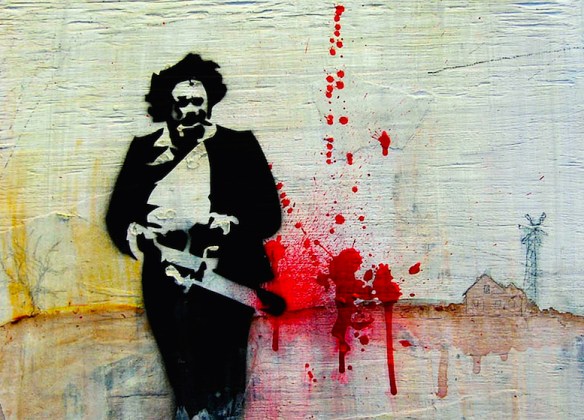
Steven cites too many splatter movies to cover in this review, but central to his thesis is the seminal 1974 Tobe Hooper film, The Texas Chain Saw Massacre. The death of local industry leads Leatherface and family to keep their slaughterhouse traditions alive by carving up and eating young people. These young people, Steven is quick to point out, are only here at all because they were unable to get gas for their car (thanks to the first of two 1970s oil crises). American decline is everywhere; betrayal by global economic forces are central to the trap that’s being laid by the cannibals. (Of course, the carnage of the Vietnam War can’t be overlooked here either, given the visual language of ambush, capture, and torture; Hooper himself has cited this in subsequent interviews.) Steven notes that the victims in The Texas Chain Saw Massacre are representative of a bourgeoisie who don’t know how the sausage is made. It’s important and vital, Steven says, that the cannibalistic side of splatter involves the bourgeoisie being forced to eat members of their own class. It’s Burroughs’s famous “naked lunch“: “the frozen moment when everyone sees what is at the end of every fork.”

As the neoliberal takeover of the world economy begins in earnest in the 1980s, as complex and largely ephemeral systems of mass media and finance take the place of the visceral, grinding monomania of industrial capitalism, splatter horror follows suit. Steven’s analysis of David Cronenberg’s Videodrome (1983) is especially sharp, examining the links between the body horror of the film and the Deleuzian body without organs. Max Renn’s body becomes an endlessly modular media node, able to accommodate video cassettes, to generate and fuse with phallic weapons (used to assassinate and destroy the media forces who’ve made him this way), to mesh and mold and mix with the hard plastic edges of media technology. By the end of the film, Renn is a weapon reprogrammed and re-trained on the very media-industrial complex that made him. More body horror: the cult classic Society (1989) and its shocking conclusion posits the ruling class as a cancerous monster, an amorphous leviathan straight out of a Gilded Age political cartoon, eating and fucking and vomiting, red in tooth and claw and pseudopod. Barriers between bodies break down; the system begins swallowing up all alternate possibilities.

By the time the Cold War is finished, the era of post-9/11 eternal war, of Abu Ghraib and Guantanamo, led to the popular new splatter sub-genre of “torture porn.” Steven identifies the genre’s distinguishing aesthetic feature: the indisputable, systematic, and worldwide victory of capitalism and the hypnotic Spectacle that accompanies it. In this era, there are no longer any alternatives. Everyone, rich and poor, is trapped in the system, and the system reintegrates torture into a worldwide video spectacle. This is embodied in both the global conspiracies of the wealthy in Roth’s Hostel series and in the Jigsaw Killer’s industrially-themed Rube Goldberg devices in the Saw franchise—devices of dismemberment explicitly linked to moral quandaries reminiscent of capitalism’s impossible everyday Hobson’s choices for the working class. The system will go on consuming you, whether you’re unlucky enough to be a splatter film’s victim, or “lucky” enough to wield the power to splatter (for example, Hostel: Part II‘s reversal of fate on the ultra-wealthy hunters, or the Jigsaw Killer’s death from cancer in Saw III—ultimately due to… a lack of health insurance).

Possibly the most intriguing aspect of this already very good book is Steven’s interspersing of personal anecdotes on when and where he discovered some of his favorite horror and genre films. By placing his personal and psychological experience of splatter films front and center, and linking it to his personal growth and increasing political maturity, he demonstrates the personal impact of the political, and the necessity of personal epiphany, mediated by culture, to achieve political awareness. Splatter Capital ultimately is not a book for the already-convinced and committed leftist, the Marxian thinker already well-versed in theory. (Another of Splatter Capital‘s very strong points is how Steven largely eschews jargon and obscurantism for an approachable tone and topic that laypeople can dive into easily.) It is for the fans of these films who’ve always wondered about the ineluctable appeal of visceral, shocking violence on screen, and perhaps why it all feels so strangely familiar.

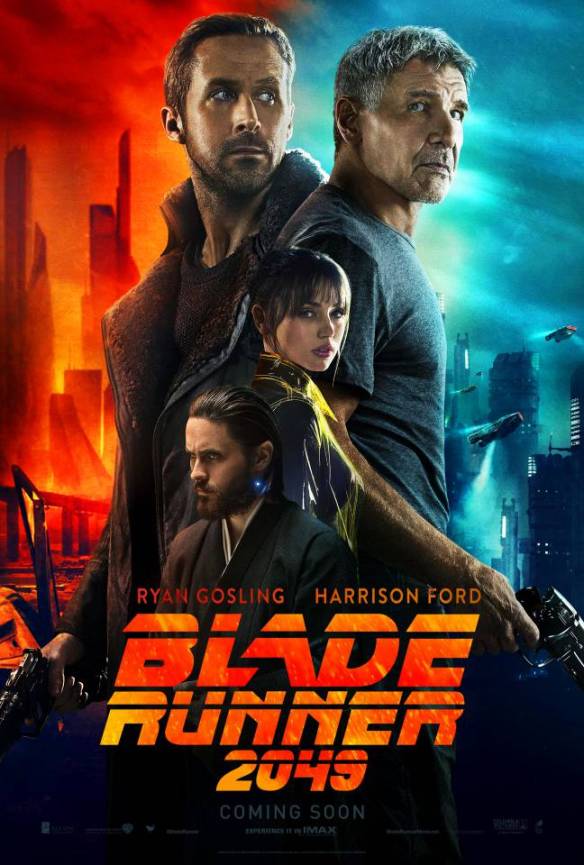
Initial Thoughts on Blade Runner 2049

Upon hearing early reports of a planned Blade Runner sequel a couple years ago, I felt both anticipation and dread. I considered it a singular vision which didn’t necessarily need a sequel, yet could understand the desire to re-immerse oneself in the compelling world it introduced. Re-experiencing the film through its Director’s Cut and Final Cut versions in subsequent years seemed to me as satisfying as watching sequels since even the relatively minor changes had a significant impact on its meaning and the richness of the sound and production design allows for the discovery of new details with every viewing. Also, one’s subjective experience watching even the same movie can be vastly different depending on one’s age and other circumstances.

One of my earliest cinematic memories was seeing the first Star Wars film as a toddler. At around the same time I remember staying up late with my parents to watch the network television premiere of 2001: A Space Odyssey. Though I was too young to fully comprehend those films’ narratives, the spectacle and sounds definitely left an impression and established a lifelong appreciation for the sci-fi genre and it’s mind-expanding possibilities.

Flash forward to an evening sometime in early 1982. After viewing a commercial for Blade Runner I instantly knew it was a movie I had to see. In the short trailer there were glimpses of flying cars over vast cityscapes, the guy that played Han Solo in a trench coat, bizarre humanoid robots within settings as strange yet detailed as 2001: a Space Odyssey. My parents, responsible as they were, refused to give in to incessant demands to see Blade Runner and that Summer I must have been the only kid who reluctantly agreed to see “E.T.” as a compromise. I probably did enjoy it more than I expected to, but might have enjoyed it more had I not viewed it as a weak Blade Runner substitute and if I actually paid attention to the entire film.

Back then our family usually saw films at drive-in theaters and the one we went to that night had two screens, one showing E.T. and the other, to my delight and frustration, happened to be Blade Runner. Even without sound and at a distorted angle I was awestruck by the establishing shots of LA in 2019 (which I glanced over to witness just as E.T.’s ship was landing on the screen in front of us, and for the entire duration of the films my eyes would switch back and forth between screens. Even without understanding anything about the plot of Blade Runner it made the most fantastical elements of E.T. pale in comparison. Judging from the box-office receipts of its theatrical run, the majority must have thought otherwise since Blade Runner earned a relatively meager $28 million while E.T. was the breakout hit of the year with nearly $360 million.

Within a few years I’d see portions of Blade Runner on cable TV at a friend’s house and finally saw the complete film after my family got a VCR and it was one of the first videos I rented. The film served as a gateway to many other interests such as cyberpunk, film noir, electronic music, but most importantly, an appreciation of the novels of Philip K. Dick. Like a psychedelic drug, they inspired philosophical questioning regarding the nature of reality, consciousness, society and what it means to be human.

This background, which is probably not too dissimilar to other stories of obsessive fandom, outlines how one’s immersion in media is rooted not just in the work itself but how it resonates with and shapes aspects of one’s identity and personal narrative as much as other memories. There’s also a nostalgia factor involved because, similar to a souvenir or any object with sentimental value, revisiting such media can recapture a sense of the feelings and sensations associated with the initial experience and sometimes the milieu of the content as well. Nostalgia is a longing for the past, even a past one has never directly experienced, never was and/or never will be, often prompted by loneliness and disconnectedness. Because it can sometimes provide comfort and hope it’s a feeling too often exploited by the marketing industry as well as media producers such as those behind reboots and sequels. Though Blade Runner 2049 may not have been solely created to cash in on nostalgia for the original, as with most big studio sequels it’s still a factor.

The type of nostalgia evoked by Blade Runner is singular, for it envisions a (near and soon to be past) future through the lens of the early eighties combining a pastiche of styles of previous eras. The film also serves as a meditation on the importance of memory and its relation to identity and the human experience. In a sense, being a longtime fan of the film is like having nostalgia for distilled nostalgia. Also unique is the fact that it took 35 years for the sequel to get made, just a couple years shy of the year in which the original takes place. The long delay is largely due to Blade Runner being so far ahead of its time it took over a decade for it to be widely regarded as a science fiction masterwork. Also, it took an additional decade and a half to develop plans for a sequel. But perhaps now is the ideal time for a follow-up as aspects of our world become more dystopian and there’s a greater need for nostalgic escape, even through narratives predicting dystopia.

While the future world of the original Blade Runner was definitely grim, it was also oddly alluring due to it’s depiction of a chaotic globalized culture, exotic yet functional-looking technology and hybrid retro/futuristic aesthetic shaped by sources as diverse as punk rock fashion, Heavy Metal magazine, film noir and Futurism among many others. The imagery of Blade Runner 2049 expands on the original by visualizing how the future (or alternate reality) LA has evolved over the course of 30 years as well as the environmentally and socially devastating impact of trying to sustain a technocratic corporate global system for so long.

Blade Runner opens with shots of oil refineries in the city intercut with close-ups of a replicant’s eye. 2049 opens with a close-up of an eye and transitions to an overhead shot of an endless array of solar panels, indicating a post peak-oil world. Despite the use of cleaner energy, the world of 2049 is far from clean with the entirety of San Diego depicted as a massive dumping ground for Los Angeles. Scavengers survive off the scraps which are recycled into products assembled by masses of orphaned child laborers in dilapidated sweatshop factories.

The Los Angeles of Blade Runner 2049 looks (and is) even colder and more foreboding than before. Gone are the Art Deco-inspired architecture and furnishings, replaced by Brutalist architecture and fluorescent-lit utilitarian interiors (with a few exceptions such as Deckard’s residence, Stelline Corporation headquarters and the Wallace Corporation building). Aerial shots reveal a vast elevated sprawl of uniform city blocks largely consisting of dark flat rooftops with glimmers of light emanating from below, visible only in the deep but narrow chasms between.

One of the more prominant structures is the LAPD headquarters which looks like an armored watchtower, signalling its role as a hub of the future surveillance state panopticon. Though an imposing feature of the city’s skyline, it’s dwarfed by larger structures housing even more powerful institutions. Just as a massive ziggurat owned by the Tyrell Corporation dominated the cityscape of the first film, by 2049 the Wallace Corporation has bought out the Tyrell Corporation and not only claims the ziggurat but has constructed an absurdly large pyramid behind it. Protecting the entire coastline of the city is a giant sea wall, presumably to prevent mass flooding from rising sea levels.

In a referential nod to the original film, city scenes of 2049 display some of the same ads such as Atari, Coca-Cola and Pan Am, but even more distracting are product placements for Sony, one of the companies which produced the new film. Such details might work as “Easter eggs” for fans (and shareholders), but takes away from the verisimilitude of the world depicted in the film where the Wallace Corporation has such seeming dominance over the economy and society in general, it probably wouldn’t leave much room for competition large enough to afford mass advertising.

While the background characters in the city of the first film seemed rude or largely indifferent to one another, 30 years later citizens are more outwardly hostile. This could reflect increasing social tensions from economic stratification as well as hostility towards replicants because the protagonist of this film is openly identified as one. Speaking of which, Ryan Gosling turns in an excellent performance as the new Blade Runner, Officer K (aka Joe, an obvious reference to Joseph K from Kafka’s “The Trial”).

Ironically, the replicants and other forms of AI in 2049 seem a little more self-aware and human-like while the humans and social institutions have become correspondingly android-like. From the perspective of the future CEOs (and some today), both replicants and non-wealthy humans (known as “little people” in cityspeak) exist to be exploited for labor and money and then “retired” when no longer needed. Reflecting this brutal reality are the largely grey and drab color scheme of the landscapes, interiors, and fashions. Adding to the mood is the soundtrack which, while at times evoking the calmer and more subtle Vangelis music of the original, is more often louder and harsher, sometimes blending with the noisy diegetic (background) soundscape.

2049‘s screenplay is almost a meta-sequel, introducing plot elements seemingly designed to address problems and inconsistencies in the original which have been pointed out by fans and critics through the years. Numerous references to Blade Runner, while nostalgic and crowd-pleasing, are almost distracting enough to break the spell of the film (at least for those who’ve re-watched the original enough times to memorize every detail). Fortunately, just as frequently new revelations, concepts and hints at potential new directions pulls one back in. I especially appreciated the further exploration of the origins and impact of false memories and its parallels to the creation and consumption of media and the way the film expanded the scope of the story beyond the city. Also surprising were references to films partly inspired by the works of Philip K. Dick such as Ghost in the Shell, The Matrix, and Her as well as stylistic influences from more contemporary aesthetic subcultures such as glitch and vaporwave.

Like with most sequels, the main draw for fans is the chance to see familiar faces from the original and 2049 doesn’t disappoint too much. Judging from the posters, trailers, interviews, etc. it was clear Harrison Ford would make a return, but unfortunately it wasn’t until after the majority of the duration of the film had passed. Nevertheless, the reappearance of Ford’s character Deckard was memorable, found by Agent K as a disheveled hermit in an abandoned casino surrounded by copious amounts of alcohol and ancient pop culture detritus. Deckard is apparently as much of a drinker as in the first film, but now not just to block out the pain of the past and present but to escape to an idealized past. Though his involvement in the plot seemed too brief it nevertheless plays a pivotal role in resolving the central mystery of the film and providing additional metacommentary.

Ford’s performance is arguably more compelling than his work in the original, though his character’s lack of charisma in the first film could be seen as intentional. Deckard’s character arc in the film, as well as that of Ford’s last two iconic roles from the 80s he reprised, cements his status as our culture’s archetype for the deadbeat father. This seems inevitable in hindsight because for a generation of latchkey kids (many with actual deadbeat dads), stars such as Harrison Ford were virtually surrogate father figures. Thus, it makes sense that the beloved characters Ford drifted away from for so long would be written as variations of a long absent deadbeat parent in their last installments.

An interesting detail about the way Deckard was characterized in the film was how he seemed more in line with a typical baby-boomer today than the gen x-er one would be at that age 32 years from now.  For example, people in their seventies today are probably more likely to be nostalgic for Elvis and Sinatra than a seventy-something person in 2049 who in our actual timeline would have more likely spent formative years listening to grunge or hiphop. A possible subtextual meaning might be that like false memories, nostalgia for media of enduring cultural value transcends lived experience. The referencing of “real” pop-culture figures within the world of the film seemed anachronistic at first, but the way it was done was interesting and worked with the themes and aesthetic (I suppose it’s preferable to having something like Beastie Boys’ “Sabotage” shoe-horned into the film like in the Star Trek reboots). Getting back to the point, in the original Blade Runner, nostalgia permeated the film through its themes, production design, costumes and soundtrack. In Blade Runner 2049, nostalgia is a subtext of repeated callbacks to the original film, Agent K’s idealized retro relationship with his AI girlfriend Joi and Deckard’s hideout within the ruins of a city once associated with fun and glamour. The simulacrum of iconic figures from the past like Elvis and Marilyn Monroe (and Ford) haunting the deserted casino like ghosts reinforces the idea of media and culture’s ability to “implant” memories and resultant nostalgia.

As for the finale, I was disappointed that it was so far from the unconventional conclusion of the showdown between Roy Batty and Deckard. One could argue it’s a reflection of the state of the world (in and of film and reality), but it’d be nice to have a little more creativity and risk-taking. Though viscerally exciting and suspenseful, it wasn’t distinguishable enough from countless modern action films to be truly memorable. More satisfying was the epilogue which paralleled the contemplative nature of the original while reconnecting to the film’s recurring themes.

In a sense, the writers and director of Blade Runner 2049 were in a catch-22 situation. Creating a film too unlike or similar to the original Blade Runner would provoke criticism from fans. What director Denis Villeneuve and co-writers Hampton Fancher and Michael Green have managed to pull off is a balancing act of a film that’s unique in many ways yet interwoven with the original; nostalgic, but not in an obvious or overly sentimental way. Both have their flaws, but while I admire the thought and craft put into the sequel, I prefer the originality, tone, texture and atmosphere of Blade RunnerBlade Runner 2049 will likely satisfy most sci-fi fans, but I’m not sure it proves a sequel was necessary or that it stands alone as a classic.

Though not given the recognition it deserved in its time, Blade Runner was a groundbreaking and visionary film upping the bar for intellectual depth, moral complexity, production design and special effects to a degree not seen since 2001: a Space Odyssey. Its influence can be spotted in countless dystopian science fiction films made since. Though it’s too early to tell how influential Blade Runner 2049 will be, it doesn’t seem to have pushed the genre forward to a similar extent (of course contemporaneous opinions can seem wildly off the mark in hindsight). Regardless, it’s an above-average science fiction film by any reasonable standard so it’s unfortunate that judging from disappointing initial box-office reports, it seems to be following in the footsteps of the first Blade Runner pretty closely in that regard. Time will tell whether it achieves a similar cult status in years to come. Perhaps in 35 years?