By Alan MacLeod
Source: Mint Press News
Most of the world has watched the Israeli assault on Gaza in horror. As tens of thousands have been killed and millions displaced, tens of millions of people around the world have poured onto the streets to demand an end to the violence. But a few select others have taken to the pages of our most influential media to demand an escalation of the violence and that the United States help Israel strike not just Palestine, Syria, and Lebanon but Iran as well.
“I might have once favored a cease-fire with Hamas, but not now,” wrote Bush-era diplomat Dennis Ross in The New York Times, explaining that “if Hamas is perceived as winning, it will validate the group’s ideology of rejection, give leverage and momentum to Iran and its collaborators and put [our] own governments on the defensive.”
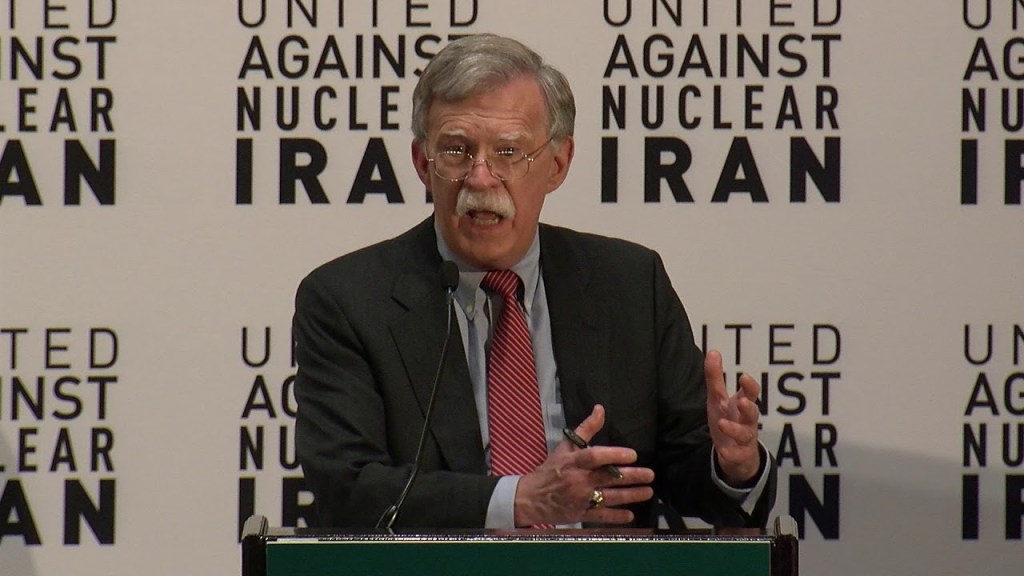
In the wake of Hamas’ October 7 assault, arch-neoconservative official John Bolton was invited on CNN, where he claimed that what we witnessed was really an “Iranian attack on Israel using Hamas as a surrogate” and that the U.S. must immediately respond. When asked whether he had any evidence, given the implications of what he was saying, he shrugged and replied, “This is not a court of law.”
On December 28, Bolton doubled down on his hawkish stance, writing in the pages of Britain’s Daily Telegraph that “The West may now have no option but to attack Iran” – a position he has held for at least a decade.
Meanwhile, in an interview with Saudi state-funded broadcaster Iran International, senior Bush official Mark Wallace bellowed that, “This is Iran’s work. Iran will suffer at the hands of retribution and will suffer the consequences of supporting this terror group and its horrific attack on Israel.” Wallace continued:
No civilized country wants further conflict. But the Iranians are forcing the civilized world’s hand. And you will see a dramatic response soon as the United States, Israel, and our allies begin to position assets around the world in preparation.”
If there was any doubt as to what sort of “dramatic response” Wallace wanted to see, he added a message to Iran’s Islamic Revolutionary Guard Corps: “I look forward to seeing you hanged from the end of one of your own ropes.”
Iran was recently the victim of a deadly terrorist attack. As mourners commemorated the U.S. assassination of Qassem Soleimani, two bombs exploded, killing 91 and injuring hundreds more. In this context, it was understandable why Iranian officials pointed the finger at the U.S. and Israel.
Warmongers, Inc
What these individuals all have in common is that they are board members of United Against Nuclear Iran (UANI), a shadowy but influential organization dedicated to pushing the West toward a military confrontation with the Islamic Republic.
Founded in 2008, the group is led by neoconservative hawks and has close ties to both U.S. and Israeli intelligence. It does not divulge where it receives its copious funding. However, it is known that right-wing Israeli-American billionaire Sheldon Adelson was a source. There is strong circumstantial evidence that Gulf dictatorships may also be bankrolling the group, although UANI has strongly denied this. In 2019, Iran designated UANI as a terrorist organization.
When asked by MintPress what he made of UANI’s recent statements, Eli Clifton, one of the few investigative journalists to have covered the group, said, “It’s very consistent with the positions and advocacy that the organization has taken since its inception.” Adding,
United Against Nuclear Iran does not miss an opportunity to try to bring the United States closer to a military conflict with Iran. And on the other side of the equation, they also have worked very hard to oppose efforts to de-escalate the U.S.-Iran relationship.”
UANI’s board is a who’s who of high state, military and intelligence officials from around the Western world. Among its more notable members include:
- CEO Mark Wallace, former U.S. Ambassador to the United Nations and deputy campaign manager for George W. Bush’s 2004 reelection.
- Chairman Joe Lieberman, former senator and Democratic vice-presidential nominee for the 2000 election.
- Tamir Pardo, Director of the Mossad, 2011-2016.
- Dennis Ross, former State Department Director of Policy Planning and former Middle East Envoy under George H. W. Bush and Bill Clinton.
- Field Marshall Lord Charles Guthrie, ex-Chief of Staff of the U.K. Armed Forces.
- Jeb Bush, former Governor of Florida.
- August Hanning, President of the German Federal Intelligence Service (BND), 1998-2005; State Secretary at the Federal Interior Ministry, 2005-2009.
- Zohar Palti, former head of the Political-Military Bureau, Israeli Ministry of Defense; former Director of Intelligence of the Mossad.
- Frances Townsend, Homeland Security Advisor to President George W. Bush.
- John Bolton, former U.S. National Security Advisor and former U.S. Ambassador to the U.N.
- Roger Noriega, former Assistant Secretary of State for Western Hemisphere Affairs and Ambassador to the Organization of American States.
- Otto Reich, former Assistant Secretary of State for Western Hemisphere Affairs and architect of the 2002 U.S. coup against Venezuela.
- Michael Singh, White House Senior Director for Near East and North African Affairs, 2007-2008.
- Giulio Terzi di Sant-Agata, former Italian Foreign Minister.
- Robert Hill, former Minister of Defense of Australia.
- Jack David, Deputy Assistant Secretary of Defense for Combating Weapons of Mass Destruction, 2004-2006.
- Mark Kirk, U.S. Senator for Illinois, 2010-2017.
- Lt. Gen. Sir Graeme Lamb, ex-Director of U.K. Special Forces and Commander of the British Field Army.
- Norman Roule, former CIA Division Chief and National Intelligence Manager for Iran at the Director of National Intelligence.
- Irwin Cotler, Canadian Minister of Justice and Attorney General, 2003-2006.
- Baroness Pauline Neville-Jones, U.K. Minister of State for Security and Counter Terrorism, 2010-2011.
In addition, notable former board members include ex-CIA Director R. James Woolsey; head of Mossad between 2002 and 2011, Meir Dagan; and one-time chief of British spy agency MI6, Sir Richard Dearlove.
For 15 years, UANI has organized conferences, published reports, and lobbied politicians and governments, all with one goal: pushing a neoconservative line on Iran. “UANI are a force multiplier. They provide at least the veneer of an intellectual infrastructure for the Iran hawk movement. They did not invent being hawkish on Iran, but they sure made it a heck of a lot easier,” Ben Freeman, Director of the Democratizing Foreign Policy Program at the Quincy Institute, told MintPress.
Conflicts and Conflicts of Interest
For such a large, well-financed, and influential organization filled with senior officials, United Against Nuclear Iran keeps its funding sources very quiet. However, in 2015, Clifton was able to obtain a UANI donor list for the 2013 financial year. By far and away, the largest funders were billionaire New York-based investor Thomas Kaplan and multibillionaire Israeli-American casino mogul Sheldon Adelson.
Kaplan, whose $843,000 donation supplied around half the group’s 2013 funding, is a venture capitalist investor concentrating on metals, particularly gold. He is the chairman of Tigris Financial and the Electrum Group LLC. Both of Kaplan’s firms employ UANI CEO Mark Wallace as CEO and COO, respectively.
A 2010 Wall Street Journal article titled “Tigris Financial Goes All-in on Gold” noted that the company had bet billions of dollars on the price of gold rising, more than the reserves of the Brazilian central bank. As Clifton has noted, both Kaplan and Wallace have marketed gold to clients as the perfect commodity to hold if there is increased instability in the Middle East. Therefore, both Kaplan and Wallace stand to make massive sums if the U.S. or Israel were to attack Iran, making their UANI warmongering a gigantic and potentially profitable conflict of interest.
Adelson provided the majority of the rest of UANI’s funding. The world’s 18th-richest individual at the time of his 2021 death, the tycoon turned his economic empire into a political one, supporting ultraconservative causes in both the United States and Israel. Between 2010 and 2020, he and his wife donated more than $500 million to the Republican Party, becoming GOP kingmakers in the process. He would often vet Republican presidential candidates at his casino in Las Vegas, and it was often said that this “Adelson Primary” was almost as important as the public one.
An ardent Zionist, Adelson bankrolled numerous pro-Israel lobby projects, such as AIPAC, One Jerusalem and Taglit Birthright. He also owned Israel Hayom, the country’s most-read newspaper, with 31% of the national share. Relentlessly pro-Netanyahu, it was said that the Israeli prime minister asked his friend Adelson to set up a newspaper to help his political career.
Adelson and his influence have been one of the driving forces of American hostility towards Iran. In 2013, during a conversation with Rabbi Shmuley Boteach, he called for the United States to stop negotiating and drop a nuclear bomb on Iran to show that “we mean business.”
A potential third, even more controversial, source of funding is the Gulf monarchies of Saudi Arabia and the UAE. Leaked emails show UANI officials soliciting support from the Emirati royal family. Both Mark Wallace and Frances Townsend, for example, emailed the Emirati Ambassador to the U.S. detailing cost estimates for upcoming events and inquiring about support from the UAE.
Thomas Kaplan himself is extraordinarily close to the nation. “The country and the leadership of the UAE, I would say, are my closest partners in more facets of my life than anyone else other than my wife,” he told the Emirati outlet, The National News, which also detailed his friendship with Crown Prince of Abu Dhabi, Sheikh Mohamed bin Zayed.
Putting Iran in the Crosshairs
One of United Against Nuclear Iran’s primary activities, Iranian political commenter Ali Alizadeh told MintPress, is to create a worldwide “culture of fear and anxiety for investing in Iran.” The group attempts to persuade businesses to divest from the Islamic Republic and sign their certification pledge, which reads as follows:
The undersigned [Name], the [Title] of [Company] (the “Company”), does hereby certify on behalf of the Company that until the Iranian regime verifiably abandons its drive for nuclear weapons, support for terrorism, routine human rights violations, hostage-taking, and rampant anti-Americanism as state policy, that neither the Company nor any subsidiary or affiliate of the Company, directly or through an agent, representative or intermediary.”
One corporation that UANI targeted was the industrial machinery firm Caterpillar. UANI hectored the firm, even erecting a roadside billboard outside its headquarters in Peoria, IL, insinuating that they were aiding Iran in constructing a nuclear weapon. Caterpillar quickly ordered its Iran projects terminated. Wallace took heart from his group’s victory and warned that other businesses would be targeted.
These have included French companies such as Airbus and Peugeot-Citroen, who were threatened with legal action. In 2019, UANI earned an official rebuke from the Russian Foreign Ministry for attempting to intimidate Russian corporations trading with Tehran. “We think such actions are unacceptable and deeply concerning,” said Foreign Ministry spokesperson Maria Zakharova. “Attempts to pressure and threaten Russian business … are a follow-up on the dishonorable anti-Iranian cause by the U.S. administration,” she added, hinting at collusion between the government and the supposedly non-governmental organization.
Some of UANI’s campaigns have been markedly petty, including pressuring New York City hotels to cancel bookings with Iranian officials (including then-President Mahmoud Ahmadinejad) visiting the city on United Nations business. Others, however, have been devastating to the Iranian economy, such as the SWIFT international money transfer terminating its relationship with Tehran, cutting the country off from the global banking system.
On UANI’s actions against businesses, Freeman said: “It’s effective, and (in some cases, at least) it’s to the detriment of the people of Iran; it’s to the detriment of these companies; and it’s to the detriment of peace in the region.”
While the group presents itself as against a nuclear Iran, UANI was strangely opposed to the Joint Comprehensive Plan of Action (JCPOA) – the deal between Iran and the West that limited the former’s nuclear technology research in exchange for sanctions relief from the latter. As MintPress reported at the time, UANI spent millions on T.V. advertisements trashing the agreement. As Wallace noted, “We have a multi-million-dollar budget, and we are in it for the long haul. Money continues to pour in.”
After the JCPOA was signed, UANI hosted a summit attended by senior Israeli, Emirati, and Bahraini officials, touting its failures. Once UANI’s John Bolton was named Donald Trump’s National Security Advisor, he persuaded the president to withdraw entirely from the deal. Bolton has deep connections to the Mojahedin-e-Khalq (MEK), an exiled Iranian political group widely identified as a terrorist organization. He has, for some time, considered them a government in waiting after the U.S. overthrows the current administration. “Before 2019, we will celebrate in Tehran,” he told the group in 2018, predicting that, with him at the helm, the Trump administration would soon cause the downfall of the Iranian government.
Bolton has long been a hardliner on regime change. “To stop Iran’s bomb, bomb Iran,” read the title of his 2015 New York Times op-ed. Yet this appears to be the dominant position at UANI. In March, Ross published an article in The Atlantic headlined “Iran needs to believe America’s threat,” which demanded that the U.S. “take forceful action to check Tehran’s progress toward a nuclear bomb.” Failure to do so, Ross claimed, would provoke Israel to do so itself – a “much more dangerous scenario,” according to him. Yet only two years previously, Ross called on the U.S. to “give Israel a big bomb” to “deter Iran,” noting that the “best way” to stop the Iranian nuclear program was to supply Israel with its own nukes, thereby taken as a given that Iran was indeed pursuing nuclear weapons itself (a highly questionable claim at the time) and ignoring Israel’s already existing 200+ stockpile of nuclear missiles.
“It doesn’t seem like UANI ever really took seriously the possibility of a diplomatic means to constrain Iran from continuing to increase its enrichment levels and moving towards a nuclear weapon,” Clifton told MintPress. “As a matter of fact, they generally fought tooth and nail against the JCPOA. They are eager to push the United States toward confrontation with Iran using the possibility of Iranian nuclear weapons as a reason,” he added.
Intelligence Connections
That UANI is headed by so many state, military and intelligence leaders begs the question: to what extent is this really a non-governmental organization? “That is one of the dirty secrets of think tanks: they are very often holding tanks for government officials,” Freeman said, adding:
The Trump folks all had to leave office when Biden won, so a lot of them ended up in think tanks for a while, four years, let’s say. And if Trump wins again, they will bounce back into government. And the same is true of Democratic administrations, too.”
The U.S. government also clearly has a longstanding policy of outsourcing much of its work to “private” groups in order to avoid further scrutiny. Many of the CIA’s most controversial activities, for example, have been farmed out to the National Endowment for Democracy (NED), a technically non-governmental organization funded entirely by Washington and staffed with ex-state officials. In recent years, the NED has funneled millions of dollars to protest leaders in Hong Kong, organized an attempted color revolution in Cuba, organized anti-government rock concerts in Venezuela, and propped up dozens of media organizations in Ukraine.
These sorts of institutions blur the line between public and private sectors. But a 2014 legal case raises even more questions about UANI’s connections to the U.S. government. After UANI accused Greek shipping magnate Victor Restis of working with the Iranian government, he sued them for libel. In an unprecedented move for what was a private, commercial lawsuit, Attorney General Eric Holder intervened in the lawsuit, ordering the judge to shut the case down on the grounds that, if it continued, it would expose key U.S. national security secrets. The case was immediately dropped without explanation.
In the past, when the Justice Department has invoked state secrets, a high-ranking state official has offered a public statement as to why. Yet, this time, nothing was offered. Reporters at the time speculated that much of the material Restis wanted to make public was possibly given to UANI by either the CIA or Mossad, which would have revealed a network of collusion between state intelligence agencies and a supposedly independent, private non-profit. Given the glut of ex-Mossad and CIA chiefs at UANI, this speculation is perhaps not as wild as it might seem.
UANI’s funders certainly also have extensive connections to Israel. Kaplan is the son-in-law of Israeli billionaire Leon Recanati and is said to be close with Prime Ministers Naftali Bennet and Yair Lapid. He has also employed a number of Israeli officials at his businesses. An example of this is Olivia Blechner, who, in 2007, left her role as the Director of Academic Affairs at the Israeli Consulate General in New York to become Executive Vice-President of Investor Relations and Research at Kaplan’s Electrum Group – a rather perplexing career move.
Adelson, meanwhile, was given what amounted to an official state funeral in Israel, one that even Prime Minister Netanyahu attended. He was buried on the Mount of Olives in Jerusalem – one of the holiest sites in Judaism and an honor that very few figures receive.
A Network of Regime Change Groups
While United Against Nuclear Iran is already a notable enough organization, it is actually merely part of a large group of shadowy non-governmental groups working to cause unrest and, ultimately, regime change in Iran. These groups all share overlapping goals, funders and key individuals.
One example of this is the Counter Extremism Project (CEP), a non-profit that purports to exist to “combat the growing threat posed by extremist ideologies.” Yet the group focuses largely on Islamist extremism – and only those groups that are enemies of the U.S., Israel and the Gulf Monarchies (about whose extremism and violence the CEP has nothing to say). Ten members of the CEP’s leadership council are also on UANI’s board, including Wallace, who is CEO of both organizations.
Another group headed by Wallace is the Jewish Committee to Support Women Life Freedom in Iran. This organization claims to be focused on improving women’s rights in Iran. It very quickly, however, divulges that this is a vehicle for regime change. On its homepage, for example, it writes:
These freedom fighters continue with no sign of relenting on their calls for regime change. Calls for “Woman Life Freedom” and the removal of Supreme Leader Ayatollah Ali Khamenei echo from rooftops, down street corridors, across campus hallways, and on government billboards. These brave Iranians have expressed their hatred for the ruling clerics not only in their words, but in their actions.”
Seven members of the Jewish Committee to Support Women Life Freedom in Iran’s steering group – including Wallace and Kaplan – also lead UANI.
Mike Wallace, second from right, poses with prominent anti-Iran figures at a lobbying event in Italy, February 2023. Photo | Twitter
Kaplan is well-known as a conservationist. However, his group, Panthera, which works to preserve the world’s 40 known species of big cats, has also been accused of being a secret regime change operation. Panthera has a number of UANI officials on its board or conservation council, including Wallace and Lamb (the ex-director of U.K. Special Forces and Commander of the British Army). Also on the council are Itzhak Dar, former Director of the Israeli Secret Service, Shin Bet, and General David Petraeus, former CIA Director and Commander of the U.S. invasion of Afghanistan.
In 2018, Iranian authorities arrested eight individuals working with Panthera inside the country. All eight were convicted of spying on behalf of the U.S. and Israel. While many in the West decried the trials as politically motivated, any organization led by these figures is bound to cause suspicions.
This is especially the case as Wallace is also a founder of PaykanArtCar, an organization that attempts to use art to, in its words, “advocate for the restoration of human rights and dignity for all in Iran.” All three team members of PaykanArtCar also work at UANI.
The final group in this Iran regime change network is the International Convention for the Future of Iran. Set up by Wallace himself, the organization’s website explains that it exists to “end the repression of the regime and bring true change to Iran.” Further purposes are to “connect the Iranian opposition in exile [i.e., the MEK] with policymakers in the United States and internationally” and to “offer program grants and technical support” to groups working to overthrow the government. However, judging by the lack of updates and the group’s Twitter profile having only 31 followers, it appears that it has not had much success achieving its goals.
In short, then, there exists a network of American NGOs with the mission statements of helping Iran, opposing Iran, preserving Iran, and bombing Iran, all staffed by largely the same ex-U.S. government officials.
Iran, however, is not the only target in Wallace’s sights. It appears that he is also trying to give Turkey similar treatment. Wallace is the CEO of the Turkish Democracy Project, a non-profit established to oppose the rule of President Recep Tayyip Erdoğan, who, it says, has “dramatically altered Turkey’s position in the international community and its status as a free and liberal democracy.” The Turkish Democracy Project denounces what it calls Erdoğan’s “destabilizing actions in and beyond the region, his systemic corruption, support for extremism, and disregard for democracy and human rights.” There are no Turkish people among the Turkish Democracy Project’s leadership. But there are seven UANI board members at the top, calling the shots.
A Lesson From History
The history of Iran has been intimately intertwined with the United States since at least 1953 when Washington orchestrated a successful coup against Prime Minister Mohammad Mosaddegh. Mosaddegh had refused U.S. demands to stamp out Communist influences in his country and had nationalized the nation’s oil. The U.S. installed Shah Mohammad Reza Pahlavi as a puppet ruler. An unpopular and authoritarian ruler, the Shah was overthrown in the Revolution of 1979. Since then, it has become a target for regime change, and its nuclear program is something of an obsession in the West.
Often orchestrated by UANI officials while they were in government, the U.S. has carried out a sustained economic war against Tehran, attempting to collapse its economy. American sanctions have severely hurt Iran’s ability to both buy and sell goods on the open market and have harmed the value of the Iranian rial. As prices and inflation rose rapidly, ordinary people lost their savings.
During the COVID-19 pandemic, the U.S. turned the screw once again, intimidating both businesses and nations into refusing to sell Tehran vital medical supplies. Eventually, the World Health Organization stepped in and directly supplied it with provisions – a factor in the Trump administration’s decision to pull out of the agency.
While U.S. actions have severely harmed the Iranian economy, a future bright spot may come in the form of BRICS, the economic bloc that Iran – along with Egypt, Ethiopia, Saudi Arabia, and the UAE – joined on January 1. American economic power on the global stage appears to be waning. However, This new reality might spur Washington policymakers to reconsider a military option, as UANI desperately wants them to.
It is perfectly reasonable to be worried about Iran – or any country, for that matter – developing atomic bombs. Nuclear weapons pose an existential threat to human civilization, and more actors with access to them increase the likelihood of a devastating confrontation. Already in the region, India, Pakistan, Israel and Russia possess them. But it is only the United States that has ever used them in anger, dropping two on Japan and coming close to doing so in China, Korea and Vietnam. And given the U.S.’ recent track record of attacking countries that do not possess weapons of mass destruction (e.g., Iraq, Libya, Afghanistan) and not touching those who do (such as North Korea), it is entirely understandable why Iran might want one. As Freeman said:
I certainly do not want Iran to get a nuclear weapon. But at the same time, you can also believe that it would be catastrophic if the U.S. were to engage in a war with Iran…And the concern with groups like UANI is that they are taking that [the worry of Iran getting a nuclear weapon] and pushing that argument to a point where it might lead to an active conflict.”
The slaughter in Gaza has been horrifying enough. More than 22,000 people have been killed in the Israeli invasion, and a further 1.9 million displaced. Israel is also simultaneously bombing the West Bank, Syria and Lebanon. The U.S. is facilitating this, sending billions of dollars in weaponry, pledging iron-clad political support to Israel, silencing critics of its actions, and vetoing United Nations resolutions.
But United Against Nuclear Iran is eager to escalate the situation to a vastly greater level, urging Washington to attack a well-armed country of nearly 90 million people, erroneously claiming that Iran is behind every Hamas or Hezbollah action. “This is not a nuclear non-proliferation organization” Clifton said, noting that there are plenty of genuine already existing peace and environmental groups worried about nuclear weapons that either supported the JCPOA or said it did not go far enough. “Their focus is more on working towards regime change in Iran rather than actually supporting efforts that might prevent Iranian nuclear weapons,” he added.
IF UANI gets its way, a conflict with Iran might spark a Third World War. And yet they are receiving virtually no pushback to their ultra-hawkish pronouncements, largely because they operate in the shadows and receive virtually no public scrutiny. It is, therefore, imperative for all those who value peace to quickly change that and expose the organization for what it is.