
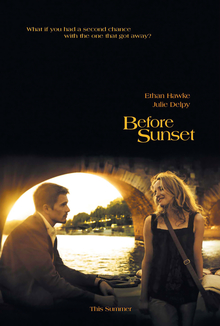
Saturday Matinee: Before Sunset

By Bill Thompson

Source: Bill’s Movie Emporium

Screenplay By: Julie Delpy, Ethan Hawke & Richard Linklater
Directed By: Richard Linklater

You know that you are watching a great movie when Baseball Tonight has taken up most of your night and at about midnight you figure, “Oh, what the heck I’ll start this and watch a little bit before I fall asleep” but next thing you know it’s one thirty in the morning and time has passed you by. That is what happened with my viewing of Before Sunset. I already had a good jumping off point since I loved the preceding Before Sunrise, but loving one movie doesn’t guarantee you’ll love it’s successor. Before Sunset is a different movie, it’s much the same as Before Sunrise, but in important ways it is very different. Before Sunset is engaging to the point of time flying by. It’s not paced fast, it’s paced naturally, yet it moves by at incredible speed because it is one of those rare movies where real time stops while you watch it. Some sort of cosmic speed time takes over and time moves faster than it should. Maybe I sound crazy, but hopefully this is a feeling others have had with some movie, because I know I have had the feeling of the loss of real time with more than a few stellar films.

It’s inevitable that similarities will exist with Before Sunrise, the crew of Before Sunset is essentially the same across the board as it was in Before Sunrise. The same conversational tone remains, the dialogue flows free and easy between the two leads and is highly engaging and smart for the audience to take in. Ethan Hawke and Julie Delpy have the same chemistry as before. They are in sync with one another from the get go and it shows. As with Before Sunrise you have two actors giving brilliant performances that will no doubt go unnoticed by the great masses. Yes, Before Sunset is similar to Before Sunrise, but in so many ways it is very different.

The conversations are still existential in nature, but now they are of a different existentialism. In Before Sunrise the focus was on Jesse and Celine as individuals, how they viewed the world and how the world affected them. Before Sunset changes up their viewpoint in accordance with their older ages and new found maturity. Now they talk in terms of how issues relate to them only in the larger picture. The focus isn’t on them as individuals, rather the focus is on Jesse and Celine and the world. Big issues are still tackled, some of the same issues from Before Sunrise are touched upon again, but now they offer worldly insight as opposed to individual insight.

Before Sunset is a love story and a film about the relationship of Jesse and Celine. But, it’s also not a love story and not about their relationship. It’s important to realize that the film works on both levels. At the same time you have the personal story of these two characters and how they feel about each other, there is the theme of growth in humanity. The movie focuses on the ideas of growing up, how we change and why, what we were like, what we remember and what the future may hold for us just as much as it focuses on the very intimate tale of Jesse and Celine. All the while you are taken by the story of these two maybe meant for each other people, you are also caught up in the larger picture of where humanity stands today in relation to the growth of these two characters.

In a film like Before Sunset it’s easy to overlook the role the director plays. Richard Linklater once again makes his camera another character, we live through his camera because it allows us to become a part of every conversation and moment. But, in Before Sunset his camera isn’t static like it was in Before Sunrise. This time the camera moves, it circles around, it tracks, follows, etc.. The locales aren’t just backgrounds in Before Sunset, because this time Jesse and Celine aren’t in a fantasy world. Before Sunset is real, they have real consequences to deal with and they know it. So does the camera, it never frames them as solitary beings off in their own world. Linklater presents Jesse and Celine as part of the larger world around them, their fantasy night is long over, now they are enmeshed in reality.

If forced to pick, and this is really hard, my favorite aspect of Before Sunset would be the idea of how our past greatly affects us. One missed chance can have serious repercussions just as much as one mistake. Our past leads to problems that will haunt us through all our waking hours, and our past even seeps into our dreams. More than anything our past can lead to an inability to connect. The car ride is the best example of this, filled with many moments where Jesse and Celine want to connect with each other, they reach out to each other but they can’t because of their fear of the consequences of their actions and remembrances of past pain. The car ride displays this idea beautifully, and that is when Hawke and Delpy are at their most powerful, eliciting emotion from each other and from the audience. Cheesy drama isn’t needed, in the simple act of watching one break down and the other try to console but fail we feel for these characters more than any manufactured drama could hope to make us feel.

The ascent up the stairs to Celine’s apartment is handled masterfully. That is when the film begins to mold into whatever shape you have decided to apply to it. Their ascent is full of oodles of bottled up tension, with each and every turn on that stairwell it feels like something should happen, needs to happen, but you know it can’t. This leads into the perfect ending, it is sweet and it is honest. It’s also up to each individual to interpret the oncoming blackness in their own way. Does Jesse leave or doesn’t he? Do they both go back to their false lives or do they finally realize that they were meant for each other and give it a go? You can’t go wrong no matter what way you go, but I tend to believe that Jesse stays and they end up together. I’m sure that is the hopeless romantic in me coming out, but what can I say, I am hopeless after all.

Maybe this is the last we will see of these characters, or maybe Linklater, Hawke and Delpy plan to come back in another nine years. I can only hope that is the case, because those three, along with the rest of the crew, have found a winning combination. If they don’t come back then I am still content, because Before Sunset is a splendid movie, a rarity that doesn’t come along all that often. More would be welcome, but if this is all I get then I couldn’t ask for anything better.


Watch Before Sunrise on tubi here: https://tubitv.com/movies/100055408/before-sunset

Saturday Matinee: A Midnight Clear

By James Berardinelli

Source: ReelViews.net

December 1944 in the Ardennes. The Battle of the Bulge is beginning. The snow is falling gently, coating everything in white. It’s here that the members of a small American Intelligence squad find themselves holed up in an abandoned house under orders from their commander, Major Griffin (John C. McGinley). Their mission: watch, listen, and report back if there are signs of enemy activity. The squad’s leader, Sgt. Will Knott (Ethan Hawke), is doubtful about things from the beginning. He is in command because he has survived thus far while six others haven’t. The oldest soldier, ‘Mother’ Wilkins (Gary Sinise), has suffered a mental breakdown following the long-distance news of the stillborn death of his child. The other four – Bud Miller (Peter Berg), Mel Avakian (Kevin Dillon), Stan Shutzer (Arye Gross), and ‘Father’ Mundy (Frank Whaley) – do their duty, although not all of them are happy about it.

There’s a group of Germans out in the forest – seven of them, as it turns out. Hitler’s war has so depleted the Germany army that they’re left with “old men and boys.” They’re tired and scared and, like many Axis soldiers in Europe, recognize that hope has fled. They don’t want to die so they seek an alternative to fighting. Surrendering to the Americans doesn’t seem like a bad one, as long as they can make it look like they were taken after a battle. The first challenge is to conquer the language barrier, something they attempt not with bullets but by stoking the Christmas spirit. After a tree, a few carols, and an exchange of gifts, the Germans and Americans are able to regard one another with something closer to trust than hostility. Until, of course, it all goes wrong. In war, it seems, that almost always happens.

A Midnight Clear is adapted from the novel of the same name by William Wharton. It is not based on a true story – there are no records of American and German soldiers fraternizing around Christmas during World War II – not in 1942, 1943, of 1944. Wharton may have been inspired in part by an incident from World War I, however. On December 25, 1914, the so-called “Christmas Truce” occurred – a series of unofficial cease-fires along the trenches of the Western Front. French, German, and British soldiers put aside their differences to talk, sing, and toast the season. (The 2005 film Joyeux Noel dramatized this.) There’s an echo of that in A Midnight Clear. Fiction, however, follows history. Once the holiday was over in 1914, many of the men who shook hands killed one another. In A Midnight Clear, the outstretched hand is ultimately cut off. Human nature is a fickle thing – the impulse to reach out to another is counterbalanced by a cold-hearted bloodthirstiness.

A Midnight Clear is a war story but it’s not like any other war story ever made. The characters (well, most of them at least) are nuanced. The situations are fluid and ambiguous. And there are no big battles. At one point, a character remarks that he doesn’t like this kind of war. He doesn’t want to meet the enemy. He wants to shoot them dead from afar, never knowing a thing about them. One of the most impactful aspects of A Midnight Clear is that when the time comes to kill, the targets are no longer faceless.

A Midnight Clear is powerful without being overbearing. It emphasizes the chaotic and nonsensical aspects of war without dragging the viewer into the trenches and burying him/her in mud. The movie is sad in a way that even a powerhouse picture like Platoon didn’t manage. The only villain here is circumstance, unless you count John C. McGinley’s Major Griffin, who is thankfully kept in the background except at the beginning and the end.

Speaking of McGinley, he represents one of two missteps on the part of Keith Gordon’s otherwise fine effort as a writer/director (this was his second film behind the camera). Griffin is written as a two-dimensional asshole and McGinley portrays him with cartoonish fluency. In a film where every other character has as many facets as a well-cut gemstone, Griffin feels like he stumbled into the wrong movie.

The other problem relates to a flashback detailing how the four youngest members of the group lost their virginity. A young woman named Janice (Rachel Griffin) opts to give herself selflessly to these soldiers rather than commit suicide (she’s despondent after learning of the death of her fiancé overseas). It’s a bit of wish-fulfillment that strikes a wrong chord no matter how hard Gordon tries to make the situation sympathetic.

The acting is uniformly strong, featuring a group of performers at the beginning of what would be long and productive careers. A little-known Ethan Hawke (with a previous role in Dead Poets Society) shows the charisma that would make him the go-to actor for many serious-minded directors. Gary Sinise, several years pre-Lt. Dan, makes the psychologically wounded Mother a suitably complex individual. Also featured are Peter Berg, Kevin Dillon, Arye Gross, and Frank Whaley. This may not be a “who’s who” of future A-list stars but it’s a strong roster of men who would become known for their ability to flesh out characters.

The typical movie set in and around Christmas embraces the mood of the season: Peace on Earth and Goodwill to All People. A Midnight Clear has a sharper and less idealistic perspective of things. Viewed through the lens of war, the absurdity of human nature is laid bare. We see the good, the bad, and the ugly – all packaged together in events spanning a few days leading up to December 25. It’s a reminder, as if any is needed, that, despite the birth being celebrated at Christmas, humankind is still very much in need of salvation.

Watch A Midnight Clear on Kanopy here: https://www.kanopy.com/product/midnight-clear

Saturday Matinee: First Reformed

Synopsis by A24

Reverend Ernst Toller (Ethan Hawke) is a solitary, middle-aged parish pastor at a small Dutch Reform church in upstate New York on the cusp of celebrating its 250th anniversary. Once a stop on the Underground Railroad, the church is now a tourist attraction catering to a dwindling congregation, eclipsed by its nearby parent church, Abundant Life, with its state-of-the-art facilities and 5,000-strong flock. When a pregnant parishioner (Amanda Seyfried) asks Reverend Toller to counsel her husband, a radical environmentalist, the clergyman finds himself plunged into his own tormented past, and equally despairing future, until he finds redemption in an act of grandiose violence. From writer-director Paul Schrader (Taxi Driver; American Gigolo; Affliction) comes a gripping thriller about a crisis of faith that is at once personal, political, and planetary.

Watch the full film on Kanopy.