Saturday Matinee: The Projectionist

The Projectionist Is a Biography as a Mirror Reflecting a City’s Change

Abel Ferrara’s documentary excels as kind of cultural microcosm, rich in its broader implications.

By Sam C. Mac

Source: Slant

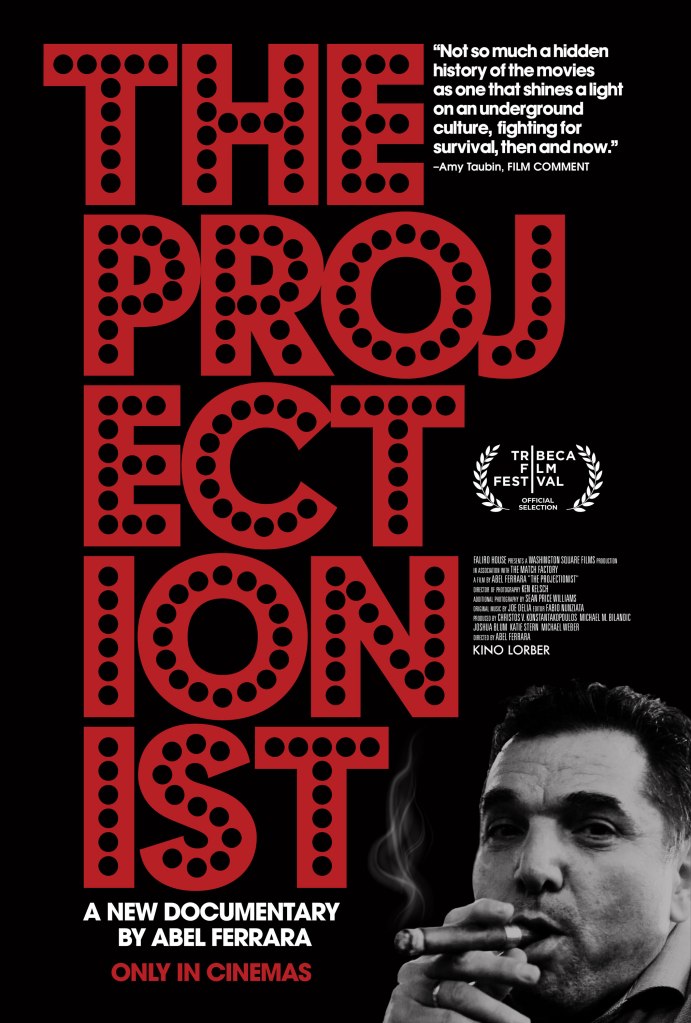
One difference between The Projectionist and Abel Ferrara’s earlier documentaries is the point of focus: Instead of being specifically anchored to the exploration of a particular geography, Ferrara traces an immigrant’s experience of both the culture he comes from and the one that he adopted as his own. Nicolas Nicolaou, who came to the U.S. as a boy and has been working in New York City movie theaters since the 1970s, retains deep ties to his home in Cyprus, where his wife is still living—and where the film begins.

Ferrara uses his typical mosaic approach of rendering an environment to gently cut against Nicolaou’s straightforward narration, in which he chronicles his youth and the social conditions of his hometown, in between casual banter with Ferrara. “It’s a lot of work, Abel,” Nicolaou mutters, while displaying one of the old fishing nets that his father used to use. “And those years, you couldn’t sell fish.” But The Projectionist soon uproots itself, just as Nicolaou’s father once did, and relocates to New York City, where it becomes clear that, in actuality, Ferrara’s latest documentary isn’t all that different from his previous ones.

Though the film is framed as a biography, Ferrara is much more interested in the monumental transformation of space that’s taken place around his subject’s life. In particular, The Projectionist is about the decades of social and political change that have shaped New York through the representative example of the city’s relationship to cinema—both the way it’s been depicted in the movies themselves and as an industry that’s been subjected to various efforts of reformation. Nicolaou’s subjectivity serves essentially the same purpose as Ferrara’s own did in 2010’s Mulberry St., a tribute to the Little Italy neighborhood that he used to call home. But in its mapping of a culture that’s experienced rapid diversification of its population, and the backlash to that progression, The Projectionist also connects to 2017’s Piazza Vittorio.

Nicolaou’s career spans the heyday of the adult movie theater business—which, as Ferrara emphasizes, coincides with the most popular period for arthouse films in New York’s history—through the Giuliani years, and that administration’s clean-up of the city, to a contemporary culture of big corporation’s “colluding” to monopolize, and to put privately owned theaters, like those that Nicolaou runs, out of business. Ferrara clearly has affection for Nicolaou as a kind of mirror image of himself: Both began their careers in New York around the same time, albeit on almost opposite sides of the industry, and both have survived mainly by adapting to the times and trusting their intuition. But there’s also something bittersweet implicit in that comparison: Nicolaou has built a stable, family-run business around his passions (one that his wife manages remotely from Cypus), whereas Ferrara’s path hasn’t been so profitable.

For a lesser filmmaker, the schism between artist and businessman that exists between these two men might evince contempt. But Ferrara’s approach to documentary has always been much less about his personal feelings, or polemical intents, than an intense sense of fascination. The only problem with that driving interest is that, especially when combined with a subject so close to Ferrara’s passion, it can lapse into sentimentality. Indeed, there are too many scenes here of Nicolaou voicing his abiding love and belief in the power of cinema, and without being questioned by Ferrara, most prominently when the former shows off the fancy interior of the Vynl nightclub that he owns and operates out of a building that, prior to its conversation, had been a theater of one kind or another dating back to the 19th century.

Where The Projectionist ultimately excels, however, is as the kind of cultural microcosm that makes Ferrara’s other documentaries feel at once urgent and incredibly rich in their broader implications. In Mulberry St., the transformation of one urban neighborhood becomes a representation of generational changes in modern Italian-American culture writ large, and in Piazza Vittorio, the transactionally motivated societal values of an immigrant-run marketplace in Rome are treated as a metaphor for the social conditions in contemporary Europe. Though painting with a bigger canvas this time—and exercising slightly less precision—Ferrara is able to frame Nicolaou’s experience of the New York movie theater business over the last several decades as one that parallels the director’s struggles in the film industry, and as illustrative of a major city’s radical reshaping of itself.


Watch The Projectionist on hoopla here: https://www.hoopladigital.com/movie/the-projectionist-abel-ferrara/19645989

Saturday Matinee: Recorder: The Marion Stokes Project

By Sheila O’Malley

Source: RogerEbert.com

“The world is too much with us late and soon.” This was true when William Wordsworth wrote it in the early 1800s, and it’s even more true now. There is too much of “the world” to absorb. Opting out is increasingly impossible. Some gas stations have little television screens above the pumps, blasting CNN at you, because apparently the 45 seconds it takes to pump your gas is way too long for any human to be unplugged from the news dump. You sit in waiting rooms, at airport gates, and the television is on, and it’s always news, the nonstop flow of information, propaganda, noise. Is the human brain built to absorb so much of “the world”? How do we filter anything? Matt Wolf’s new documentary, “Recorder: The Marion Stokes Project,” is an interesting meditation on these ideas, as well as a character study of a fascinating news-junkie with a mission.

When Stokes, who started out as a librarian, died in 2012, she left behind a massive archive of video tapes (70,000 in total) of all of the television shows she had recorded over a 35-year period. To create such an archive, she spent all day every day watching television, multiple screens going at any given time, popping tapes in and out. She couldn’t keep up with labeling, so she’d stick a Post-It note on each tape, detailing what was on it. Keeping up with the archive of news was a driving obsession, a compulsion, and she was aided in this by new technology like the VCR.

“Recorder” is a compelling look at one very specific eccentric woman, who lived in the era when news went from local to national, from one time-slot to all day long, and who sensed in this shift something alarming, something new, and who responded by trying to capture all of it, catalog and save. Who was Marion Stokes? She was heavily involved in left-wing politics with her first husband, so much so that she was being groomed for a leadership position in the Communist Party, and she also wanted to emigrate to Cuba. After the marriage fell apart, she became a co-host of “Input,” a Sunday morning talk show on a CBS affiliate in Philadelphia. Her co-host was John Stokes, a wealthy local man: the two of them wanted to create a space where people with different viewpoints could discuss the hot topics of the day. Marion and John fell in love, and got married. (The footage from “Input” shows their chemistry, a chemistry of listening and care with one another’s viewpoints.) Their connection was so intense it shut everyone else out, including their children. Eventually, Marion and John lived as hermits, for decades, devoted to maintaining her ongoing video-taping project, to the exclusion of all else.

Wolf’s approach with this beguiling material is to utilize much of Stokes’ archive, which ends up being an historical survey of the latter half of the 20th century into the first years of the 21st. The Iranian hostage crisis in 1979 started it all. Stokes became aware of how the news was being shaped and molded, with wall-to-wall coverage of the crisis (Mark Bowden describes the media phenomenon in his book about the hostage crisis, Guests of the Ayatollah). She started recording news programs, like the brand-new “Nightline,” and when CNN launched in 1980, her project expanded overnight.

The montage from her tapes, culled from a daunting archive, is a record of an entire era, from news of worldwide importance, like the hostages in Iran, to the story of “Jessica McClure,” the baby trapped in a well who captivated American audiences for days on end. There’s footage of the Elian Gonzalez case, the Challenger explosion, or local news stories like a woman who chose to be buried with her Cadillac. Stokes did not select: she recorded it all. She noticed how small local stories were now blown up to national stories, mainly to keep the 24/7 news business going. Her final tape before she died was of the Sandy Hook massacre.

“Recorder” works on multiple levels. The Marion and John’s apartment—lined with video tapes—looks like an episode of “Hoarders.” Hoarding comes out of anxiety and a desire to control. Any collector understands this. The issue of “hoarding” and “collecting” has deeper elements, though, and it is in this realm that “Recorder” really resonates, especially when it addresses the importance of preservation and archiving. The fantasy is that with the internet, everything can be saved and found, everything is available. This is so far from the truth it’s outrageous that people still seem to believe it. We see the fantasy that “streaming” platforms are going to be this great thing, and of course they are, but the fantasy that everything will be available is just that: a fantasy. With every advance of technology—from VHS to DVD to Blu-ray to streaming—movies have been “lost” in the process, not making the transfer. I will continue to buy physical media, since I do not trust the “landlords.” 

In terms of news programming, what has happened is that if it’s not on the internet, it might as well not exist at all. And so history, context, nuance, even the ability to analyze and compare and contrast, is lost. Local news stations don’t have the capability to save every single segment, and in so many cases, Stokes’ tapes may be the only copy. Some of these programs have never been seen since their first airing.

She kept up this pace for 35 years. Her relationships suffered. She stopped being able to go out. Why did she do this? Was she just an obsessive? Who was this gigantic archive even for? One of her assistants, interviewed in “Recorder,” says he believed she did it “for the betterment of mankind.” Exaggeration? I’m not so sure. Knowledge really is power and Stokes understood that. But let’s not forget the most important detail: Stokes may have stopped working as a librarian early on, but once a librarian, always a librarian. This is what librarians do. They want people to be able to find information, they try to clear the way so people can find what they need. As the daughter of a librarian, the daughter, too, of a collector, I understood Stokes’ drive to save, collate, organize, keep. My father passed down his obsessions to me. Stokes’ work is an urgent reminder of the importance of archives, the importance of preserving those archives so that they can be made available, open to all.


Saturday Matinee: The New Cinema

Watch: Rare 1960s Documentary ‘The New Cinema’ Featuring Roman Polanski, Francis Ford Coppola, George Lucas & More

By Gary Garrison

Source: IndieWire

Hollywood leaves a lot to be desired in terms of innovation. Studios tend to find something that works, and then squeeze out every penny possible. The viability of these brainless practices aside, it takes quite a bit for the town to even consider greenlighting an original property, let alone a complete restructuring.

But a restructuring is exactly what happened in Hollywood in the ‘60s and ‘70s, despite the laborious pace of the shift (compared to what was happening in Europe), and all the resulting resistance. “The New Cinema,” a short documentary produced sometime in the late 1960s (the exact date is unknown) has found new life on the Internet recently and takes an in depth look at the old Hollywood system and the new crowd of directors who were on the verge of starting one of the great cinematic rebirths.

Directed by Gary Young, “The New Cinema” features some great impromptu interviews from the likes of Roman PolanskiAndy WarholDustin HoffmanFrancis Ford Coppola, and the up-and-coming at the time George Lucas. And while the doc is interesting in its own right, it’s amazing to see this particular collection of filmmakers, most of whom would make some of the greatest movies in history.

Saturday Matinee: What the Future Sounded Like

What the Future Sounded Like: Documentary Tells the Forgotten 1960s History of Britain’s Avant-Garde Electronic Musicians

By Josh Jones

Source: Open Culture

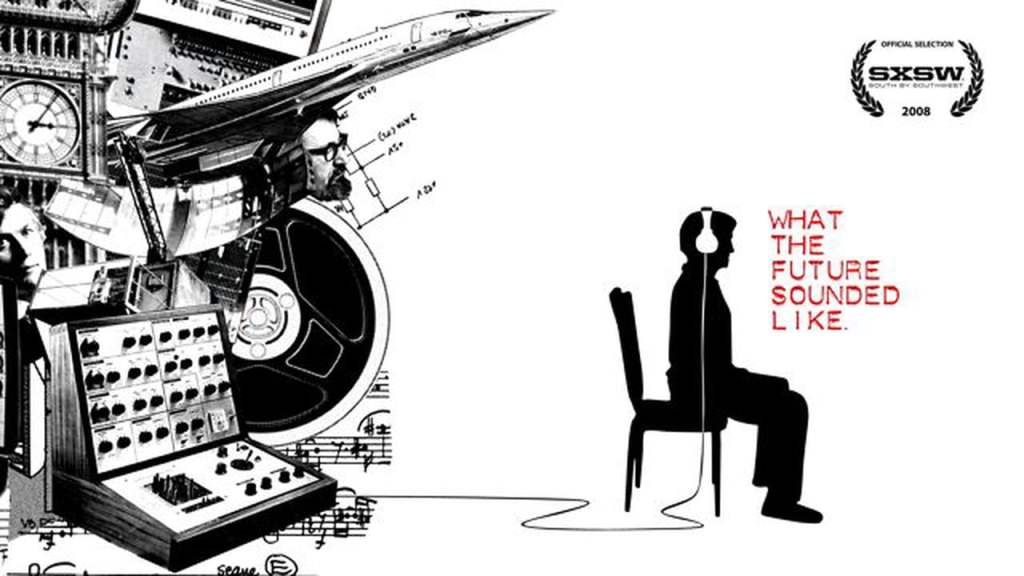
It really is impossible to overstate the fact that most of the music around us sounds the way it does today because of an electronic revolution that happened primarily in the 1960s and 70s (with roots stretching back to the turn of the century). While folk and rock and roll solidified the sound of the present on home hi-fis and coffee shop and festival stages, the sound of the future was crafted behind studio doors and in scientific laboratories. What the Future Sounded Like, the short documentary above, transports us back to that time, specifically in Britain, where some of the finest recording technology developed to meet the increasing demands of bands like the Beatles and Pink Floyd.

Much less well-known are entities like the BBC’s Radiophonic Workshop, whose crew of engineers and audio scientists made what sounded like magic to the ears of radio and television audiences. “Think of a sound, now make it,” says Peter Zinovieff “any sound is now possible, any combination of sounds is now possible.” Zinovieff, London-born son of an émigré Russian princess and inventor of the hugely influential VCS3 synthesizer in 1969, opens the documentary—fittingly, since his technology helped power the futuristic sound of progressive rock, and since, together with the Radiophonic Workshop’s Delia Derbyshire and Brian Hodgson, he ran Unit Delta Plus, a studio group that created and promoted electronic music.

Also appearing in the documentary is Tristram Cary, who, with Zinovieff, founded Electronic Music Studios, one of four makers of commercial synthesizers in the late sixties, along with ARP, Buchla, and Moog. Zinovieff and Carey are not household names in part because they didn’t particularly strive to be, preferring to work behind the scenes on experimental forms and eschewing popular music even as their technology gave birth to so much of it. The aristocratic Zinovieff and pipe-smoking, professorial Carey hardly fit in with the crowd of rock and pop stars they inspired.

In hindsight, however, Zinovieff desires more recognition for their work. “One thing which is odd, is that there’s a missing chapter, which is EMS, in all the books about electronic music. People do not know what incredible mechanical adventures we were up to.” Those adventures included not only creating new technology, but composing never-before-heard music. Both Zinovieff and Carey continue to create electronic scores, and Carey happens to be one of the first adopters in Britain of musique concrète, the proto-electronic music pioneered in the 1940s using tape machines, microphones, filters, and other recording devices, along with found sounds, field recordings, and ad hoc instruments made from non-instrument objects. (See examples of these techniques in the clip above from the 1979 BBC documentary The New Sound of Music.)

Many of the sounds that emerged from Britain’s electronic music founders came out of the detritus of World War II. Carey’s first serious studio design, he says, “coincided with the post-war appearance of an enormous amount of junk from the army, navy, and air force. For someone who knew what to do, and could handle a soldering iron, and could design audio equipment, even if you only had 30 shillings in your pocket, you could get something.” With their knowledge of electronics and hodge-podge of technology, Carey and his compatriots were designing an avant-garde electronic “high modernity,” author Trevor Pinch declares. “I think you can think of people like Tristan Carey as dreaming of a future soundscape of London.” Nowadays, those sounds are as familiar to us as the music piped over the speakers in restaurants and shops. One wonders what the future after the future these pioneers designed will sound like?


Saturday Matinee: Soundtrack to a Coup d’Etat

By Robert Daniels

Source: RogerEbert.com

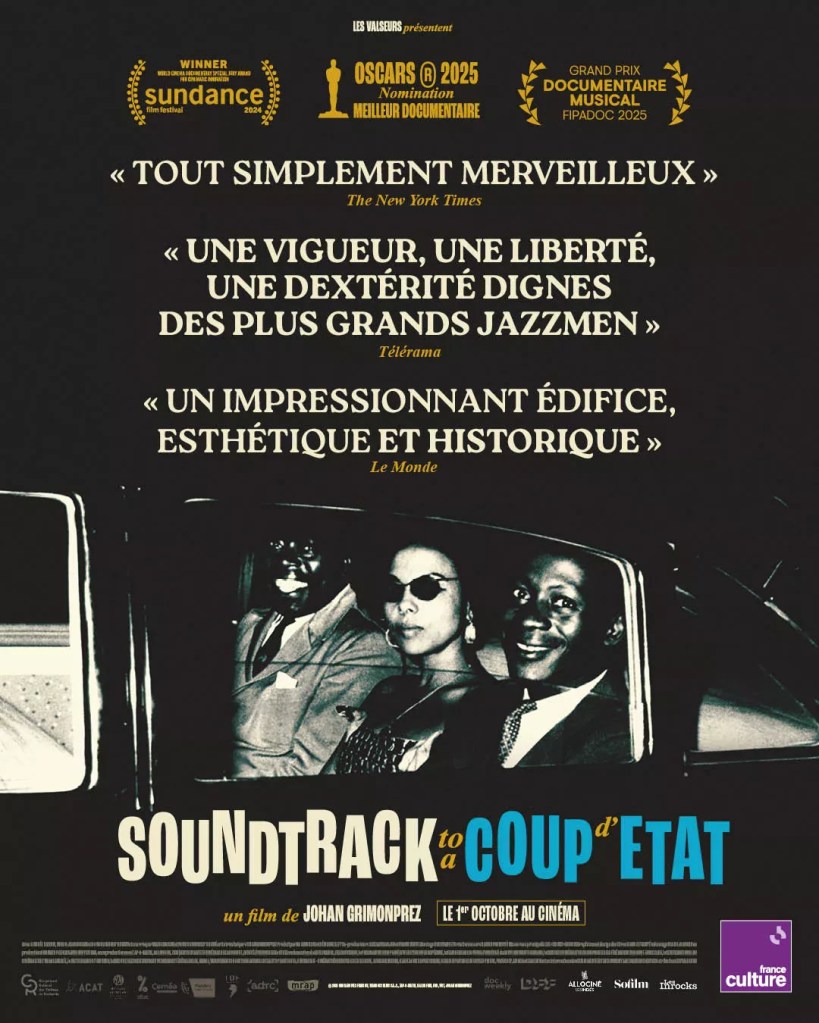
To see the archival footage of Patrice Lumumba, which serves as the backbone to the forceful documentary “Soundtrack to a Coup d’Etat,” is to witness a daring future that, due to the rot of colonialism, tragically never came to pass. The foil to the film’s incisive use of newsreels, excerpts from biographies and political speeches is the kinetic wielding of jazz music.

On October 28, 1960, for instance, Louis Armstrong jubilantly arrived in the Congolese capital of Leopoldville (renamed Kinshasa in 1966) to perform. He came to a country that has always mystified the Euro-centric imagination as part of a U.S. State Department-sponsored tour of Africa. Four months earlier, the Republic of the Congo’s bid for independence had become a living reality. Three months after Armstrong’s performance, with the murder of Lumumba, the dream had already died.

Belgian director Johan Grimonprez’s dense, encyclopedic film “Soundtrack to a Coup d’Etat” does more than tell viewers about the downfall of a revolution, one that conceived of a pan-African movement composed of a dozen countries that gained independence from their colonial overlords. It tells viewers how industrialist countries, primarily in the West, are still picking the bones of a broken promise decades later. 

It’s difficult to watch Grimonprez’s intuitive telling of history without feeling the sinister truth of world history: the major powers of the world only see countries like the Congo as an exploitable resource, not as a sovereign state. To tell this reality, Grimonprez takes a similar path traversed by Raoul Peck, whose documentary “Lumumba: Death of a Prophet” is an incredible portrait of a defiant man. Grimonprez dives into the immense span of available footage and writing about Lumumba and that brief period when the idea of a United States of Africa, as coined by Marcus Garvey, to tell how the Congo gained its independence and lost Lumumba. 

Nevertheless, the use of music sets Grimonprez’s film apart from Peck’s survey. Similar to the improvisational spirit of jazz, “Soundtrack to a Coup d’Etat” isn’t a linear film. It hops and it bops from 1961 to contemporary ads for Tesla and Apple. The same could be said about the murderer’s row of Jazz legends: Nina Simone, Dizzy Gillespie, Duke Ellington, Abbey Lincoln, Max Roach, and Armstrong—who take center stage. Grimonprez isn’t terribly interested in laying the biographical groundwork of these figures; they’re iconic enough to allow their aura to provide the documentary with an inherent mood and presence. That built-in tenor is necessary in a film that requires plenty of reading with excerpts from Maya Angelou’s The Heart of a Woman, Hugh Wilford’s The Mighty Wurlitzer: How the CIA Played America, and In Koli Jean Bofane’s Congo Inc.: Bismarck’s Testament (Bofane reads passages from his book that speak to world powers’ desire to command the country’s uranium supply).

It’s the latter angle that forms the film’s central thesis. True independence for former territories turned countries was always going to be a fraught proposition in the face of colonial powers afraid to part from the unchecked wealth they gained through ultra-violent oppression. Grimonprez, in fact, looks toward Egyptian President Gamal Abdel Nasser’s 1956 nationalization of the Suez Canal from the British as a potential parallel for the kind of reclaiming of natural resources that other African countries like Congo would’ve sought. Nasser is just one of the many predictions Grimonprez bridges as he crafts a comprehensive view to demonstrate how world powers used Cold War fears to justify assassinations and coups. 

The film examines the burgeoning rebellion by these newly independent countries from many angles. For instance, through the analysis of Malcolm X, we find that Asian and African countries possessed outsized power in the UN, whereby anytime they stuck together as a coalition, they could vote down countries like the United States, Belgium, or Britain. And even before she became Lumumba’s chief of protocol, Andrée Blouin, whose home movies and book My Country, Africa are referenced in the film, mobilized African women for political change. As the film informs us, this sense of collective mobilization further frightened world powers. 

That anxiety, posits the film, is why music, specifically jazz, became a conduit for political purposes. Grimonprez can be winking, especially when he introduces the Cabinet of Jazz; he and editor Rik Chaubet can also be spontaneous, weaving in and out from any given performance into a narrativization of history that often recalls a late-night setlist. Ella Fitzgerald’s “Lullaby of the Leaves,” for instance, becomes a playful way to pose Soviet leader Nikita Khrushchev’s 1959 visit to the U.S. to meet President Dwight D. Eisenhower as a meeting between two kindred spirits. On the other hand, Nina Simone visiting Nigeria in 1961 on behalf of the American Society of African Culture, a group whose connection to the CIA was unknown by Simone, demonstrates the underhanded ways these artists were pitted against regimes they supported by menacing imperialists.   

Even when “Soundtrack to a Coup d’Etat,” which runs at a chunky 150 minutes, struggles to maintain a snappy rhythm, this documentary has an enthralling boldness. This film pushes its audience to absorb every note, clip, and quote that crams an entire study of information into an elegant, slick package. “Soundtrack to a Coup d’Etat” succeeds as an intense piece of reclamation and rejuvenation, giving breath to Lumumba’s spirit by sporting the same kind of defiance the political leader espoused.


Watch Soundtrack to a Coup d’Etat on Kanopy here: https://www.kanopy.com/en/kcls/video/14940555

Saturday Matinee: Beside Bowie The Mick Ronson Story

“Beside Bowie-The Mick Ronson Story” Is a Flawed But Essential Documentary For Every Bowie and Mick Ronson Fan

By Michael Fremer

Source: Analog Planet

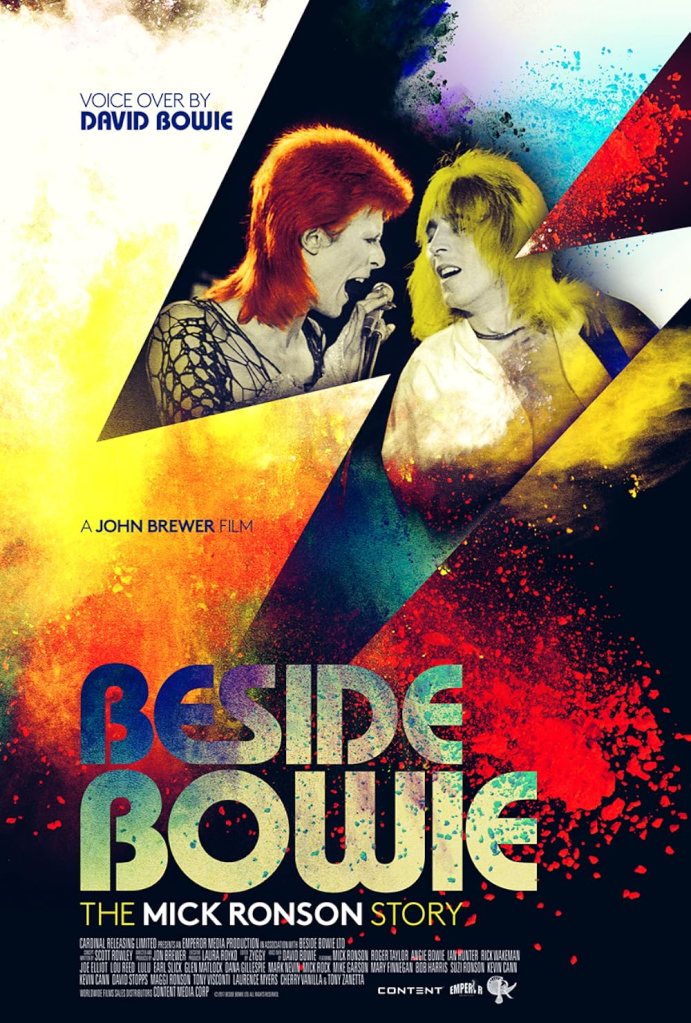
Filmmaker Jon Brewer’s Mick Ronson documentary tells the truly sad story of the wholly under-apprecriated guitarist/arranger Mick Ronson, who is of course best known (if he’s known at all) for his work with David Bowie. That being the case, Brewer spends a great deal of time (too much time) at the beginning of the 101 minute film on the rise of David Bowie before getting to the fall of Mick Ronson, better known to his friends as “Ronno”.

Brewer seems afraid that his film would not find an audience if he didn’t push the Bowie connection, including the cover credit “Voice over by DAVID BOWIE”, which grossly overstates Bowie’s narrative contribution.

Nonetheless, the film does a good job covering Bowie’s early years, his casting about to find his musical identity, his dress-wearing sexual identity swapping, which, according to first wife, American-born Angie, featured onscreen then and now, was more exploitative play-acting than genuine and his connecting up with Tony Visconti who was instrumental (literally) in helping Bowie to fashion his sound.

Visconti, on camera, in an interview that appears to have been filmed some time ago, bemoans noisy recording tape, which you’ll no doubt find amusing, while discussing early recording efforts. The movie moves on to Ronson’s early musical years (he was born in Hull, England, 1946). Ronson was classically trained and played piano, violin and other instruments. Like Visconti, he also could read music. He got the “rock bug” in the early ’60s and began playing local clubs as a member of various groups before setting off for London in 1965.

After kicking around London for a few years and making little headway and less money, he returned to Hull and became a municipal groundskeeper. One of his band mates in a group called The Rats returned to Hull to try to convince the contented gardener to travel back to London to become a member of David Bowie’s backup band. Though hesitant after his previous experiences, Ronson made the trip and the rest, as they say, is a history in desperate need of telling, which this film manages pretty well so I’m not going to further synopsize it.

It’s clear that Ronson was a masterful guitarist with a unique sound that’s in part created by a partly open “Wah Wah” pedal that he matter of factly demonstrates on camera and that by the time Bowie’s semi-breakthrough album Hunky Dory was recorded, he’d learned from Visconti the art of arranging and had become a brilliant one.

Rick Wakeman, who plays piano on that Ken Scott-David Bowie produced classic, says in his on-screen interview that Ronson, not Bowie, was the real co-producer and that his string arrangements on tracks like “Life on Mars” were, as all listeners know, nothing short of brilliant. While “Michael Ronson” receives arranging credit, it’s kind of buried. Unfortunately, Brewer did not get the usually accessible Ken Scott’s input on all of this.

Ronson contributes mightily to the breakthrough album Ziggy Stardust… and again, though he gets arranging credits, he apparently doesn’t get paid for that work. Angie narrates much of what went on during this period when the group first toured America by bus building an audience and spending more money than it took in. Despite his critical contributions to the record and the live performances, Ronson was basically paid a stipend by MainMain Management run by Tony DeFries, who comes across in this film as one of the villains both because he reputedly made more money from Bowie than Bowie himself earned, and because once Bowie moved on from Ronson, DeFries pushed Ronson, almost against his will, to become a “front man”. Ronson could easily have built a successful arranger/producer career. The under-appreciated album Slaughter on 10th Avenue (RCA APL 1-0353) featured a cover shot of Ronson playing a part, but it could very well also sum up his true feelings being pushed to the front when he was really a great side man.

Meanwhile Ronson’s contributions to Lou Reed’s breakthrough album Transformer were also undervalued. There are crucial interviews with Mott the Hoople’s Ian Hunter. Ronson joined his group for a while, later playing with Bob Dylan’s band.

The movie skips over the second Ziggy tour, which was not by bus but rather by airplane. That’s the segment on which I was on the plane, covering the legendary Carnegie Hall concert, Detroit (where I sat next to Iggy Pop) and Chicago. It’s also where I got to meet Mick Ronson, easily the most friendly, approachable, unassuming and charming rock star you could ever hope to meet.

So yes, DeFries comes across as a villain in this story and as is often the case with super-talents, Bowie comes across looking like a user, sad to say.

Speaking of airplanes, I watched this on the flight back from Amsterdam so I can’t get into the technical aspects of the film or the sound, though I did listen on my Jerry Harvey Layla in-ear phones, which are amazing. My conclusion is that while this is a somewhat flawed presentation, it’s one every Mick Ronson fan should see as should every Bowie fan. In fact, It’s indispensable. When it was over, having “met” onscreen, Ronson’s wife and family I was left beyond sad by how this super-talented man, who was never a money-grubber, left this planet too young, under-appeciated and with little money to leave his family.


Watch Beside Bowie: The Mick Ronson Story on hoopla here: https://www.hoopladigital.com/movie/beside-bowie-the-mick-ronson-story-david-bowie/17400506

Saturday Matinee: Urgh! A Music War

By Rob Gonsalves

Source: Rob’s Movie Vault

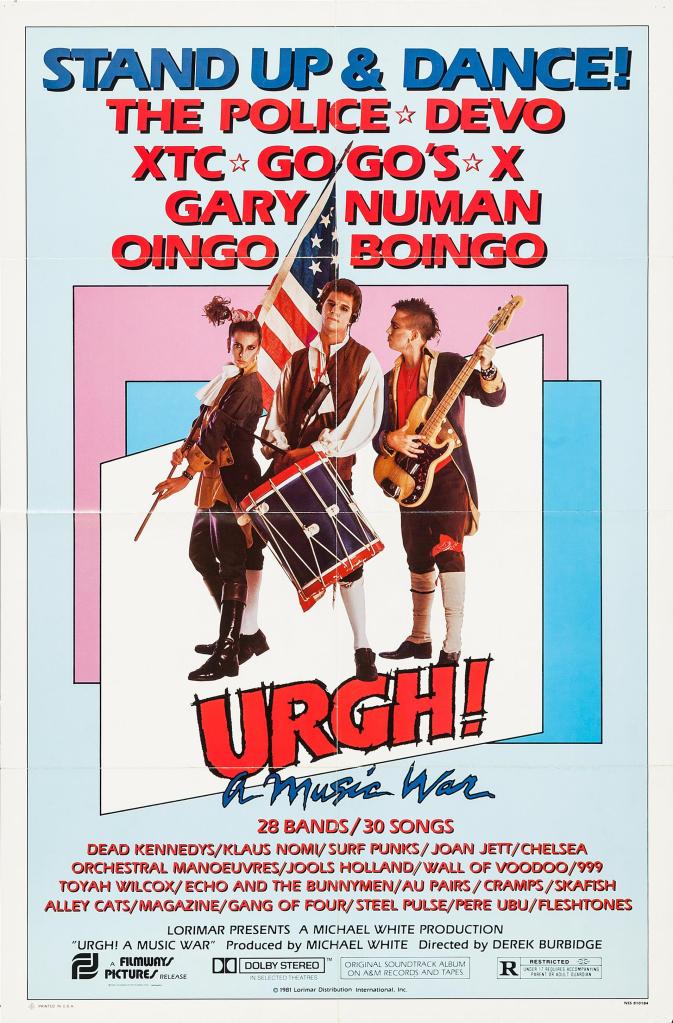
I loved every second of Urgh! A Music War, even when I was baffled. Perhaps especially when I was baffled. How else does one respond to such only-in-the-early-’80s acts as Invisible Sex, who appear onstage in makeshift hazmat suits, or the late Klaus Nomi with his futuro-bizarro getup and his soaring falsetto, or the Surf Punks with their punk-nerd outfits and the simulated sex in an onstage beach shack? Dear God, what a strange and wondrous time for alternative music. This was an era in which the Go-Gos could be sandwiched between the roughhouse punk acts Athletico Spizz 80 and Dead Kennedys and somehow not seem out of place. (Belinda Carlisle, in the Urgh! footage, may be bouncy and happy, but she’s got the prerequisite short punk ‘do.)

Urgh! was filmed in 1980 at a variety of locations (New York, London, France, Los Angeles) as a somewhat scattershot attempt to capture some of the emerging New Wave and punk acts of the day. It can be seen today as an accidental Woodstock, as musically important in its way as Michael Wadleigh’s Oscar-winning documentary was. It catches, for instance, one of XTC’s last live performances (a ripsnorting “Respectable Street,” easily one of the film’s highlights) before Andy Partridge got allergic to the stage life and announced that XTC would no longer do concerts. At the end, when the Police do “Roxanne” (a great performance — man, they kicked ass in concert back in the day) and then “So Lonely,” they invite various groups we’ve seen in the movie: UB40, Skafish, the ivory-tickling Jools Holland, and others; it’s a semi-historic jam.

When the camera moves in on one attractive woman or another in the crowd (which is somewhat often), you can tell that at the time the camera crew was just filming whatever caught their eye (and pants), but seen today it’s a cultural document: It’s fun to see how young women were dressing to go see X or Pere Ubu. From this movie, you might also conclude that the Lollapalooza generation didn’t invent pogo-ing, moshing, and stage-diving; you see it all here (most amusingly, I thought, during sets by the Go-Gos and Oingo Boingo). Urgh! also captures a deadpan-antagonistic time in rock. Many of the punk and New Wave acts here don’t seem to give a fuck whether you like them or not, yet they come to play and they play hard. When Lux Interior of the Cramps sticks his mike in his mouth and staggers around grunting as it hangs out, it’s a primal moment to rival Pete Townshend’s guitar-smashing; it comes from the same basic impulse, anyway.

You notice, too, the high level of joy in these performances. Many of the arrogant young (mostly) men onstage may have been in it to entertain themselves, but they keep things moving. The gyrations here couldn’t be further from the frozen-faced growling of today’s “alternative” rock. Dead Kennedys’ frontman Jello Biafra, spitting out “Bleed for Me,” exhorts the crowd to enjoy the freedom to hear punk rock — while it lasts (the punk rock and the freedom). Biafra has a corrosive staccato gaiety that matches Johnny Rotten at his most splenetic. Kenneth Spiers, lead shouter of Athletico Spizz 80 (doing their novelty hit “Where’s Captain Kirk?”), jumps around spraying the audience, fellow band members, and himself with silly string, then tosses the empty can over his shoulder, not caring if it hits any of his bandmates. Jim Skafish bends himself into art-rock pretzels during “Sign of the Cross,” a nerd’s idea of punk (a lot of the music here is a nerd’s idea of punk, including Devo, represented here with the relentless “Uncontrollable Urge”). Steel Pulse illustrate their song “Ku Klux Klan” with a (black) band member capering onstage in a KKK outfit. Howard Devoto of Magazine — the former Buzzcocks member who bears an uncanny resemblance to Chuck & Buck‘s Mike White — strolls around the stage as if waiting for a bus, a sly inversion of punk flailing that has its own quiet punk wit. In comparison with the carefree showmanship seen in Urgh!, many of today’s acts seem stoic, almost monastic, and far more self-involved and nihilistic than the most insular New Wave warbler.

Half of these groups didn’t seem to go anywhere after 1981, but it’s a treat to go back in time and catch the ones that did make it. Two elder statesmen of film-soundtrack composition, Mark Mothersbaugh of Devo and Danny Elfman of Oingo Boingo, come off here like the sweaty madmen they were back then. Joan Jett (doing an electrifying “Bad Reputation”) looks appealingly almost-chubby, before the label presumably told her to slim down for MTV; the same is true of Belinda Carlisle. Exene Cervenka nonchalantly commands the stage on X’s “Beyond and Back,” as does Gary Numan (tooling around in a little car) on “Down in the Park.” The one-hit wonders and no-hit wonders are equally alluring. I was charmed by Toyah Willcox’s jubilant hopping about, trying to be cool but too happy to pull it off. It’s a shame the exuberant Chelsea weren’t better known. Wall of Voodoo, whose lead singer Stan Ridgway resembles a crank-addled Griffin Dunne, pumps up the defiant “Back in Flesh” (no, not “Mexican Radio” — that would be too obvious). The movie is heavily male, but the female singers — Willcox, Carlisle, Jett — distinguish themselves by their clarity. Joan Jett screams as fiercely as anyone, but you can understand everything she’s saying, whereas many of the male singers rant unintelligibly (which can be its own kind of hostile fuck-you lyricism). The viewer/listener comes away thinking that Jett and the other women have fought too hard to be on that stage to waste the opportunity to be heard; the men, accustomed to being heard, let their words clatter and fall every which way.

Jonathan Demme is thanked in the credits, and much of Urgh! shares the concert-film aesthetic he pioneered in Stop Making Sense and continued in Storefront Hitchcock. Director Derek Burbidge, who made rock videos back then (including “Cars” for Gary Numan and pretty much all the Police’s early MTV highlights), is into simplicity, not flash (a useful approach when catching thirty-odd bands on the fly in three different countries). The bands are given space to work up their own rhythm — the editing doesn’t do it for them. Burbidge is as fond of the mammoth close-up as Sergio Leone ever was, and half of “Roxanne” seems to explore Sting’s nostrils from previously unseen angles. Performers like Lux Interior and Jello Biafra seem to be dripping sweat right onto you. The effect is to take you into the front row.

Urgh! doesn’t (and can’t possibly) have the cohesive brilliance or musical momentum of Stop Making Sense — the styles are simply too varied, throwing you from catatonic New Wave to thrashing punk in an eyeblink. Still, as a record of a moment and a sound, it ranks up there with the best you’ve seen and heard.

Saturday Matinee: The Penultimate Truth About Philip K. Dick

The Penultimate Truth About Philip K. Dick: Documentary Explores the Mysterious Universe of PKD

By Colin Marshall

Source: Open Culture

Even readers not particularly well versed in science fiction know Philip K. Dick as the author of the stories that would become such cinematic visions of a troubled future as Blade RunnerTotal RecallMinority Reportand A Scanner Darkly. Dick’s fans know him better through his 44 novels, 121 short stories, and other writings not quite categorizable as one thing or the other. All came as the products of a creatively hyperactive mind, and one subject to more than its fair share of disturbances from amphetamines, hallucinogens, unconventional beliefs, and what those who write about Dick’s work tend to call paranoia (either justified or unjustified, depending on whom you ask). But Dick, who passed in 1982, channeled this constant churn of visions, theories, convictions, and fears into books like The Man in the High CastleDo Androids Dream of Electric Sheep?Ubik, and VALIS, some of the most unusual works of literature ever to carry the label of science fiction — works that, indeed, transcend the whole genre.

But what must it have felt like to live with the guy? The Penultimate Truth About Philip K. Dick (named after his 1964 novel of humanity tricked into living in underground warrens) seeks out the writer’s friends, colleagues, collaborators, stepdaughter, therapist, and wives (three of them, anyway), assembling a portrait of the man who could create so many textual worlds at once so off-kilter and so tapped into our real worries and obsessions. Each of these interviewees regards differently Dick’s dedication to the pursuits of both literary achievement and psychonautical adventure, his complicated conception of the true nature of reality, his at times unpredictable behavior, and his penchant for encounters with the divine. Director Emeliano Larre and writer Patricio Vega’s 2007 documentary reveals one of the most fascinating personalities in late 20th-century letters, though, as any professor of literature will tell you, we ultimately have to return to the work itself. Fortunately, Dick’s personality ensured that we have a great deal of it, all of it unsettling but greatly entertaining. Readers taken note. You can Download 14 Great Sci-Fi Stories by Philip K. Dick as Free Audio Books and Free eBooks.

Related Content:

Robert Crumb Illustrates Philip K. Dick’s Infamous, Hallucinatory Meeting with God (1974)

Philip K. Dick Previews Blade Runner: “The Impact of the Film is Going to be Overwhelming” (1981)

Colin Marshall hosts and produces Notebook on Cities and Culture and writes essays on literature, film, cities, Asia, and aesthetics. He’s at work on a book about Los AngelesA Los Angeles Primer. Follow him on Twitter at @colinmarshall.