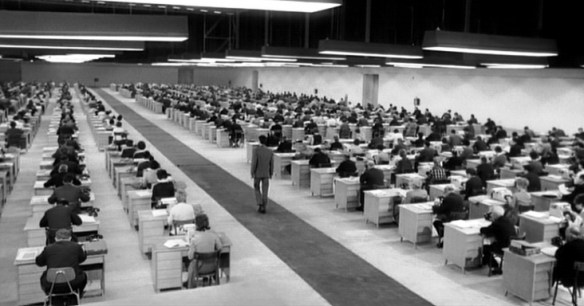
Cause of USA Meltdown and Collapse of Civil Rights

By Denis Rancourt

Source: Dissident Voice

SUMMARY: Societies of social animals, including humans, are dominance hierarchies. Civil rights are codified in law to protect mechanisms of essential counter measures against excessive exploitation of the hierarchy by elite classes, which destabilizes the entire society. Systemic pathology arises when elite classes can change the regulatory codes themselves, including civil rights protections, with impunity. Laws that quash civil rights are pathological in that they impede the system-repair mechanisms that are: free expression, free association, class opposition, and negotiated structural adjustments (otherwise known as democracy). Present anti-speech laws are extreme examples of pathological laws, the application of which is a measure of the degree of totalitarianism in the society. The history of the USA of recent decades is an eminent illustration of the concepts.

*****

The USA meltdown has been decades in the making and is the collateral result of an elite predation that has degraded structural elements needed for a healthy and resilient nation.

The aftermath is “too much regulation at the bottom, not enough at the top”: a pathological legislative and institutional structure in which elite interests have too much freedom to challenge and exploit democratic nation states, whereas middle, working and professional class actors, including small and medium-size private business, are economically, ideologically and politically constrained and suppressed to an excessive degree.

It has been a class war in which the predatory classes have barricaded themselves while inflicting humiliating defeat and loss of power, purpose and identity on the lower-stratum classes, which are incited to fight among themselves within the confines of new rules and the guarded illusion that these rules are an actuation of natural order.

In this way, personal and community motivation and inventiveness are sapped. The very motor of a vibrant modern society is jammed and the entire system becomes a system of debt-ransom extraction and management of globalized exploitation for the benefit of a secluded elite.

In this emergent system of excessive class exploitation, civil rights that protect critics and organizers become a threat against the exploiters rather than needed protections of personal and community emancipation that sustains economic production and innovation.

Allow me to explain, starting from fundamental considerations.

Arguably, the most fundamental statement that a social scientist can make is that humans interact by both violent and non-violent means, both individually and as groups, to establish and maintain societal dominance hierarchies. Call it by any name (tribalism, capitalism, socialism, totalitarianism…) humans always establish, maintain and grow dominance hierarchies, using whatever technology of the day.

The political end-point concept of “anarchy” is the theoretical absence of dominance hierarchy, which has never been ideally achieved and which is evidently unstable against growth of and replacement by dominance hierarchy. The reality of social animals is dominance hierarchy, which spontaneously adapts itself to environmental conditions and to the population size, while integrating accumulated knowledge and technological advances.

Within a dominance hierarchy (within a society), the essential counter against destabilizing excesses of dominance is push-back from individuals and groups — engendered by the individual desire for life, freedom and local influence — which acts in every stratum of the hierarchy.

In historically recent human societies, essential push-back is formalized with written laws that protect the individual against dominance encroachments that would be so severe that they would threaten hierarchical stability by increasing the potential for rebellion. These laws were at times deemed to be God-given and are now referred to as “civil rights”. They include both: (1) protections of the individual and of the nuclear and extended family against arbitrary attacks by the state or by rogue elements, and (2) protections for the individual and groups to seek redress and express grievances.

All laws are evolving codes to organise, stabilize and enforce an ever changing (often growing and complexifying) dominance hierarchy. “Good” laws find a “balance” between the graded benefits of hierarchy and the stratified oppressions against individuals and groups, a balance which stabilizes the whole system against deterioration (“injustice”), complete overhaul (“revolution”), or extinction (“downfall”).

Predictably, the codes themselves are often “hacked” by upper-strata groups that are overly ambitious in seeking additional relative advantages. The hacking upper-strata groups will recklessly change the laws for their own advantage in ways that materially threaten overall stability. This produces “pathological” laws that destabilize the overall hierarchy by driving society towards an intolerable degree of totalitarianism.

A now recognized on-going example is the decades-long elite attack, by taxation and global-finance reforms, against the USA middle class, which has prematurely destabilized the USA-centered global empire and its domestic internal society. The blowback from and defences against the USA’s practice of aggressive global dominance has also contributed, where the latter practice is similarly enabled by hacked foreign-policy and global governance laws.

When law-makers themselves can be bought by selfish elites self-segregated from the broad or domestic society, it is a recipe for disaster. In the USA and Canada law-enactment errors are multiplying, and there are no substantial Senatorial safeguards. Law-makers are formed or trained into compliance by career-enabling elites, rather than informed, principled and concerned about public service. Political parties are systematically controlled and constrained by the highest hierarchical echelons, which control the economy and the media.

When the backbone structure of the dominance hierarchy is thus degraded, as with the present crisis of the middle class, there is an impulse for both societal groups and lawmakers to become frantic and for the barricaded elite to exploit and ride out the storm rather than participate in repair. Every new manifestation of rebellion is interpreted as a fire to be extinguished rather than as necessary pushback needing to be allowed to play out. Decades of built-up fuel in the underbrush and extended drought are conditions for a devastating inferno but our “representatives” are successfully goaded into superficially addressing every new spark and violently suppressing every outbreak rather than dealing with the fundamentals.

Over decades, a complete restructuring of the relation between the state and the economy has been engineered, which, in its oppressive excesses, has led to the present crisis. The assault was accompanied by massive propaganda campaigns regarding the security benefits of government control and the welfare benefits of corporate rule. For example, predatory corporate take-over “investment” in public-service infrastructure is now presented as a good thing that should be actively sought using public funds.

The restructuring included: rolling back taxation of the wealthy while maintaining taxation of the middle and working classes, reducing or eliminating corporate taxation, increasing capital mobility, allowing investment flight, allowing infiltration of government-oversight and regulatory agencies (especially in the finance sector), gutting corporate regulatory agencies while transferring to self-regulatory models, unprecedented ideological control of professional workers in the public service (teachers, police, scientists, public servants, judges…), unrestrained lobby and think-tank influence, and unprecedented limitations (regulatory burdens) imposed on small and medium-size private businesses.

Top-level elite desires and machinations have become embedded into the very institutional structure of the economy and of the “deep state” more than ever previously. This is the result of decadal erosion of democracy and continuous increase of integration of government itself into the hierarchical power structure. The global-scale project is enabled by owned military, surveillance, communication, transportation and resource-extraction technologies; and surveillance and projection-of-power capabilities are unprecedented in history.

The resulting decadal overhaul of Western nations — in the march towards USA-centered globalism and the neutralization of Western middle and professional classes — has built-in deleterious structural features, as follows.

Mega corporations and financiers and their deep-state partners have not only militarily and covertly occupied the exploitable globe, they have also installed predation against the Western middle classes and Western public infrastructures. They have gutted mass education and maintained only elite schools for their managers and engineers. And they have gutted the Western middle and professional class mind and ethos and replaced these with canned concepts devoid of emancipating political thrust. More importantly, the educational and societal-maintenance institutions themselves have been transformed by removing professional independence and responsibility and replacing them with ideological obedience and observance of dictated think-tank-produced mantras.

The consequential suicidal pathology of the system’s operational code is twofold.

First, the new freedom and power of the USA-centered mega entities are used to eviscerate the very nation state whose structure evolved to optimally stabilize the nation-based dominance hierarchy. Even the world structures of international relations are hijacked and eviscerated to a higher degree.

Second, the middle and professional classes palpably lose many of the benefits accrued from accepting hierarchical domination, including loss of influence, and consequently suffer a crisis of identity, meaning and outlook… driven by real economic threat (loss or degradation of job and home).

Macro-economic data reveal the decadal transformation since 1980 but do not explain its source or describe its cultural, psychological and class impact. The data are generally cast as the result of an accident that can be fixed by more of the same from one of the two front parties.1

In the real circumstances of the worsening middle-class crisis, it is natural that grievances are aired and solutions are sought to recover lost status. But at the same time, advocacy and the potential for an organized response are threats to the top-layer elites and embedded deep-state managers who have intentionally driven the system towards greater hierarchical control and increased upper-stratum gain.

That is why the system reacts by removing civil rights and sabotaging any technology or application venture that would enable communication and free association.

Whereas expression and grass-roots political response would repair the edifice, the needed remedy is aggressively quashed by those at the top who judge that the crisis is not one that can truly threaten them, is one that will dissipate with time or can be fixed synthetically, and that the distributed spontaneous solution is unacceptably risky in its potential to expose them.

There results the paradox that the system delays self-repair, builds up the pressure for repair, and creates worsening societal conditions rather than allow the proven natural remedy: free expression, free association, class opposition (based on the actual grievances rather than surrogates), and negotiated structural adjustments.

The pathology of the system in rejecting self-repair can be understood as follows.

Dominance hierarchies are both stable and evolutionarily advantageous only if effective balancing forces against creeping or runaway totalitarianism are admitted. A dominance hierarchy is doomed when its highest codes allow an elite class to have disproportionate power, including the power to modify the highest codes without restraint. In particular, in a society in which the state — controlled by an elite class — effectively has a technological monopoly on lethal force, the balancing mechanism of free expression, free association, and real influence — otherwise known as “democracy” — must be allowed.

It follows that any code that prevents free expression and free association is itself pathological. If all expression and all association are allowed, then the optimal conditions for self-repair are realized and a stable and resilient hierarchical structure will result. Since it is grounded in free expression and free association, then it will be optimally just. Justice is a thus self-organized and maintained hierarchy, not elite-given “equity” within a totalitarian matrix.

For free expression and free association to be meaningful many necessary conditions are implied: access to information, actual institutional transparency, access to the travel and communication infrastructures, absence of imposed barriers to association, absence of controls over personal choices, real opportunity for decent economic conditions that allow significant democratic participation, and the very novel concept of uniform application of just laws… Any rule that in-effect bars a necessary condition is also itself pathological.

I end this essay with a consideration of the special features that make anti-expression laws pathological, in the above sense of preventing self-repair of the societal dominance hierarchy.

The anti-speech laws, whether cast as “hate speech” criminal code provisions, or civil defamation law, or civility “codes of conduct” on campuses, have been manipulatively introduced by the elite because the elite are those most threatened by free speech and free association.

Speech is the means by which individuals use non-violent persuasion to acquire influence in society. It is the means that enables politics. In the USA, where citizens have a beneficial right even to bear arms for any required overthrow of the government2,3, freedom of expression was meant to be absolute, in that the USA constitution does not have a “balancing” clause as is common in other Western jurisdictions.4

Laws that enforce punishment for individual speech allegedly “causing” negative personal reactions in society at large are antithetical to democracy, and are immeasurably harmful to human emancipation and personal development. The above-mentioned examples are such anti-speech laws, notably including defamation law.5 They enforce punishments against individual speech that is alleged to “cause” an emotional or persuasive effect in others, which is deemed an unacceptable effect that must be targeted for elimination by state intervention against the presumed “cause”.

The said “emotional or persuasive effect” alleged to arise from the spoken words, in different laws, includes:

  • being induced to feel “hate” (anger, hostility, animosity) against a group in society
  • being induced to have a negative overall opinion about a specific person
  • being induced to adopt an ideology or political stance deemed impermissible (“hateful”)
  • being induced to commit suicide
  • being induced to participate in actuating a genocide
  • being induced to commit crimes of physical aggression or property damage

The underlying principle of these laws is that the person speaking words carries a punishable liability for what those words might induce in unspecified others, irrespective whether any actual physical crime occurs and irrespective of whether the words determinatively “cause” an actual physical crime. To be clear, under these laws, a judge arbitrarily (without needing evidence beyond the impugned words themselves and their method of delivery) decides whether the words induce deemed undesirable thoughts, opinions and attitudes in unspecified persons at large. Nothing else is required to establish liability or guilt, and by design it is impossible to disprove the charge, nor is an attempt to disprove admitted in court.

No matter how it may be masked with legalese or scholarly rationalization, this is precisely the nature of the anti-speech codes that are: “hate speech” criminal code provisions, anti-blasphemy laws, anti-historical-revisionism laws, anti-obscenity laws, the common law of civil defamation, and campus codes of conduct. One could add any “norms of expressive conduct” law.

For example, in defamation law, the impugned words are presumed to “cause” a low opinion of the plaintiff in the minds of unspecified others at large. In legalese: “general damage to reputation is presumed”. No causation proof is required of the claimant. Intent to harm is irrelevant (malice is presumed). No actual damage (loss of job, etc.) need be established. The words themselves as perceived by the judge are sufficient evidence. The judge must only opine, not on the intended meaning of the words, but on the meaning of the words in the mind of an imaginary listener. Such is civil defamation law, and there is no legal limit on the quantum of damages or the duration of gag orders that may be ordered under penalty of jail.5

These anti-speech laws, of course, are distinguished from laws that address harassment and intimidation of a specific target person (actual victim) or that address chain-of-command orders to commit crimes. They are also distinguished from the tort (law) of injurious falsehood, which “consists of the malicious publication of a falsehood concerning the plaintiff that leads other persons to act in a manner that causes actual loss, damage, or expense to the plaintiff,” irrespective of any effect on “reputation”.6

Thus, the anti-expression laws are eminently pathological from a systemic perspective. They directly impede repair of the dominance hierarchy, without providing any systemic benefit. They achieve this by suppressing the individual impulse to influence by communication, which is the elemental foundation of democracy.

As such, a study of the development of and pervasive use of anti-speech laws informs us both of the intensity of harmful elite efforts to protect illegitimate advantages and of the degree of totalitarianism in society. The present USA (civil) war on “hate expression” and its condoning by large swaths of society is a measure of a high degree of totalitarianism and a concomitant high degree of manipulation of public sentiment. It is an indicator of fundamental internal instability of the kind that accompanies the collapse of an empire.

  1. Our Broken Economy, in One Simple Chart”, by David Leonhardt, The New York Times, 2017-08-07. []
  2. Negroes with Guns”, by Robert F. Williams, 1962 (Martino Publishing, CT, 2013). []
  3. How Nonviolence Protects the State”, by Peter Gelderloos, 2007 (South End Press). []
  4. Towards a Rational Legal Philosophy of Individual Rights”, by Denis Rancourt, Dissident Voice, 2016-11-15. []
  5. Canadian defamation law is noncompliant with international law”, by Denis Rancourt, Ontario Civil Liberties Association, 2016-02-01. (And published in Dissident VoicePart-1Part-2). [] []
  6. Injurious Falsehood”, mcconchie law corporation (legal encyclopedia), accessed on 2017-09-06. []

Initial Thoughts on Blade Runner 2049

Upon hearing early reports of a planned Blade Runner sequel a couple years ago, I felt both anticipation and dread. I considered it a singular vision which didn’t necessarily need a sequel, yet could understand the desire to re-immerse oneself in the compelling world it introduced. Re-experiencing the film through its Director’s Cut and Final Cut versions in subsequent years seemed to me as satisfying as watching sequels since even the relatively minor changes had a significant impact on its meaning and the richness of the sound and production design allows for the discovery of new details with every viewing. Also, one’s subjective experience watching even the same movie can be vastly different depending on one’s age and other circumstances.

One of my earliest cinematic memories was seeing the first Star Wars film as a toddler. At around the same time I remember staying up late with my parents to watch the network television premiere of 2001: A Space Odyssey. Though I was too young to fully comprehend those films’ narratives, the spectacle and sounds definitely left an impression and established a lifelong appreciation for the sci-fi genre and it’s mind-expanding possibilities.

Flash forward to an evening sometime in early 1982. After viewing a commercial for Blade Runner I instantly knew it was a movie I had to see. In the short trailer there were glimpses of flying cars over vast cityscapes, the guy that played Han Solo in a trench coat, bizarre humanoid robots within settings as strange yet detailed as 2001: a Space Odyssey. My parents, responsible as they were, refused to give in to incessant demands to see Blade Runner and that Summer I must have been the only kid who reluctantly agreed to see “E.T.” as a compromise. I probably did enjoy it more than I expected to, but might have enjoyed it more had I not viewed it as a weak Blade Runner substitute and if I actually paid attention to the entire film.

Back then our family usually saw films at drive-in theaters and the one we went to that night had two screens, one showing E.T. and the other, to my delight and frustration, happened to be Blade Runner. Even without sound and at a distorted angle I was awestruck by the establishing shots of LA in 2019 (which I glanced over to witness just as E.T.’s ship was landing on the screen in front of us, and for the entire duration of the films my eyes would switch back and forth between screens. Even without understanding anything about the plot of Blade Runner it made the most fantastical elements of E.T. pale in comparison. Judging from the box-office receipts of its theatrical run, the majority must have thought otherwise since Blade Runner earned a relatively meager $28 million while E.T. was the breakout hit of the year with nearly $360 million.

Within a few years I’d see portions of Blade Runner on cable TV at a friend’s house and finally saw the complete film after my family got a VCR and it was one of the first videos I rented. The film served as a gateway to many other interests such as cyberpunk, film noir, electronic music, but most importantly, an appreciation of the novels of Philip K. Dick. Like a psychedelic drug, they inspired philosophical questioning regarding the nature of reality, consciousness, society and what it means to be human.

This background, which is probably not too dissimilar to other stories of obsessive fandom, outlines how one’s immersion in media is rooted not just in the work itself but how it resonates with and shapes aspects of one’s identity and personal narrative as much as other memories. There’s also a nostalgia factor involved because, similar to a souvenir or any object with sentimental value, revisiting such media can recapture a sense of the feelings and sensations associated with the initial experience and sometimes the milieu of the content as well. Nostalgia is a longing for the past, even a past one has never directly experienced, never was and/or never will be, often prompted by loneliness and disconnectedness. Because it can sometimes provide comfort and hope it’s a feeling too often exploited by the marketing industry as well as media producers such as those behind reboots and sequels. Though Blade Runner 2049 may not have been solely created to cash in on nostalgia for the original, as with most big studio sequels it’s still a factor.

The type of nostalgia evoked by Blade Runner is singular, for it envisions a (near and soon to be past) future through the lens of the early eighties combining a pastiche of styles of previous eras. The film also serves as a meditation on the importance of memory and its relation to identity and the human experience. In a sense, being a longtime fan of the film is like having nostalgia for distilled nostalgia. Also unique is the fact that it took 35 years for the sequel to get made, just a couple years shy of the year in which the original takes place. The long delay is largely due to Blade Runner being so far ahead of its time it took over a decade for it to be widely regarded as a science fiction masterwork. Also, it took an additional decade and a half to develop plans for a sequel. But perhaps now is the ideal time for a follow-up as aspects of our world become more dystopian and there’s a greater need for nostalgic escape, even through narratives predicting dystopia.

While the future world of the original Blade Runner was definitely grim, it was also oddly alluring due to it’s depiction of a chaotic globalized culture, exotic yet functional-looking technology and hybrid retro/futuristic aesthetic shaped by sources as diverse as punk rock fashion, Heavy Metal magazine, film noir and Futurism among many others. The imagery of Blade Runner 2049 expands on the original by visualizing how the future (or alternate reality) LA has evolved over the course of 30 years as well as the environmentally and socially devastating impact of trying to sustain a technocratic corporate global system for so long.

Blade Runner opens with shots of oil refineries in the city intercut with close-ups of a replicant’s eye. 2049 opens with a close-up of an eye and transitions to an overhead shot of an endless array of solar panels, indicating a post peak-oil world. Despite the use of cleaner energy, the world of 2049 is far from clean with the entirety of San Diego depicted as a massive dumping ground for Los Angeles. Scavengers survive off the scraps which are recycled into products assembled by masses of orphaned child laborers in dilapidated sweatshop factories.

The Los Angeles of Blade Runner 2049 looks (and is) even colder and more foreboding than before. Gone are the Art Deco-inspired architecture and furnishings, replaced by Brutalist architecture and fluorescent-lit utilitarian interiors (with a few exceptions such as Deckard’s residence, Stelline Corporation headquarters and the Wallace Corporation building). Aerial shots reveal a vast elevated sprawl of uniform city blocks largely consisting of dark flat rooftops with glimmers of light emanating from below, visible only in the deep but narrow chasms between.

One of the more prominant structures is the LAPD headquarters which looks like an armored watchtower, signalling its role as a hub of the future surveillance state panopticon. Though an imposing feature of the city’s skyline, it’s dwarfed by larger structures housing even more powerful institutions. Just as a massive ziggurat owned by the Tyrell Corporation dominated the cityscape of the first film, by 2049 the Wallace Corporation has bought out the Tyrell Corporation and not only claims the ziggurat but has constructed an absurdly large pyramid behind it. Protecting the entire coastline of the city is a giant sea wall, presumably to prevent mass flooding from rising sea levels.

In a referential nod to the original film, city scenes of 2049 display some of the same ads such as Atari, Coca-Cola and Pan Am, but even more distracting are product placements for Sony, one of the companies which produced the new film. Such details might work as “Easter eggs” for fans (and shareholders), but takes away from the verisimilitude of the world depicted in the film where the Wallace Corporation has such seeming dominance over the economy and society in general, it probably wouldn’t leave much room for competition large enough to afford mass advertising.

While the background characters in the city of the first film seemed rude or largely indifferent to one another, 30 years later citizens are more outwardly hostile. This could reflect increasing social tensions from economic stratification as well as hostility towards replicants because the protagonist of this film is openly identified as one. Speaking of which, Ryan Gosling turns in an excellent performance as the new Blade Runner, Officer K (aka Joe, an obvious reference to Joseph K from Kafka’s “The Trial”).

Ironically, the replicants and other forms of AI in 2049 seem a little more self-aware and human-like while the humans and social institutions have become correspondingly android-like. From the perspective of the future CEOs (and some today), both replicants and non-wealthy humans (known as “little people” in cityspeak) exist to be exploited for labor and money and then “retired” when no longer needed. Reflecting this brutal reality are the largely grey and drab color scheme of the landscapes, interiors, and fashions. Adding to the mood is the soundtrack which, while at times evoking the calmer and more subtle Vangelis music of the original, is more often louder and harsher, sometimes blending with the noisy diegetic (background) soundscape.

2049‘s screenplay is almost a meta-sequel, introducing plot elements seemingly designed to address problems and inconsistencies in the original which have been pointed out by fans and critics through the years. Numerous references to Blade Runner, while nostalgic and crowd-pleasing, are almost distracting enough to break the spell of the film (at least for those who’ve re-watched the original enough times to memorize every detail). Fortunately, just as frequently new revelations, concepts and hints at potential new directions pulls one back in. I especially appreciated the further exploration of the origins and impact of false memories and its parallels to the creation and consumption of media and the way the film expanded the scope of the story beyond the city. Also surprising were references to films partly inspired by the works of Philip K. Dick such as Ghost in the Shell, The Matrix, and Her as well as stylistic influences from more contemporary aesthetic subcultures such as glitch and vaporwave.

Like with most sequels, the main draw for fans is the chance to see familiar faces from the original and 2049 doesn’t disappoint too much. Judging from the posters, trailers, interviews, etc. it was clear Harrison Ford would make a return, but unfortunately it wasn’t until after the majority of the duration of the film had passed. Nevertheless, the reappearance of Ford’s character Deckard was memorable, found by Agent K as a disheveled hermit in an abandoned casino surrounded by copious amounts of alcohol and ancient pop culture detritus. Deckard is apparently as much of a drinker as in the first film, but now not just to block out the pain of the past and present but to escape to an idealized past. Though his involvement in the plot seemed too brief it nevertheless plays a pivotal role in resolving the central mystery of the film and providing additional metacommentary.

Ford’s performance is arguably more compelling than his work in the original, though his character’s lack of charisma in the first film could be seen as intentional. Deckard’s character arc in the film, as well as that of Ford’s last two iconic roles from the 80s he reprised, cements his status as our culture’s archetype for the deadbeat father. This seems inevitable in hindsight because for a generation of latchkey kids (many with actual deadbeat dads), stars such as Harrison Ford were virtually surrogate father figures. Thus, it makes sense that the beloved characters Ford drifted away from for so long would be written as variations of a long absent deadbeat parent in their last installments.

An interesting detail about the way Deckard was characterized in the film was how he seemed more in line with a typical baby-boomer today than the gen x-er one would be at that age 32 years from now.  For example, people in their seventies today are probably more likely to be nostalgic for Elvis and Sinatra than a seventy-something person in 2049 who in our actual timeline would have more likely spent formative years listening to grunge or hiphop. A possible subtextual meaning might be that like false memories, nostalgia for media of enduring cultural value transcends lived experience. The referencing of “real” pop-culture figures within the world of the film seemed anachronistic at first, but the way it was done was interesting and worked with the themes and aesthetic (I suppose it’s preferable to having something like Beastie Boys’ “Sabotage” shoe-horned into the film like in the Star Trek reboots). Getting back to the point, in the original Blade Runner, nostalgia permeated the film through its themes, production design, costumes and soundtrack. In Blade Runner 2049, nostalgia is a subtext of repeated callbacks to the original film, Agent K’s idealized retro relationship with his AI girlfriend Joi and Deckard’s hideout within the ruins of a city once associated with fun and glamour. The simulacrum of iconic figures from the past like Elvis and Marilyn Monroe (and Ford) haunting the deserted casino like ghosts reinforces the idea of media and culture’s ability to “implant” memories and resultant nostalgia.

As for the finale, I was disappointed that it was so far from the unconventional conclusion of the showdown between Roy Batty and Deckard. One could argue it’s a reflection of the state of the world (in and of film and reality), but it’d be nice to have a little more creativity and risk-taking. Though viscerally exciting and suspenseful, it wasn’t distinguishable enough from countless modern action films to be truly memorable. More satisfying was the epilogue which paralleled the contemplative nature of the original while reconnecting to the film’s recurring themes.

In a sense, the writers and director of Blade Runner 2049 were in a catch-22 situation. Creating a film too unlike or similar to the original Blade Runner would provoke criticism from fans. What director Denis Villeneuve and co-writers Hampton Fancher and Michael Green have managed to pull off is a balancing act of a film that’s unique in many ways yet interwoven with the original; nostalgic, but not in an obvious or overly sentimental way. Both have their flaws, but while I admire the thought and craft put into the sequel, I prefer the originality, tone, texture and atmosphere of Blade RunnerBlade Runner 2049 will likely satisfy most sci-fi fans, but I’m not sure it proves a sequel was necessary or that it stands alone as a classic.

Though not given the recognition it deserved in its time, Blade Runner was a groundbreaking and visionary film upping the bar for intellectual depth, moral complexity, production design and special effects to a degree not seen since 2001: a Space Odyssey. Its influence can be spotted in countless dystopian science fiction films made since. Though it’s too early to tell how influential Blade Runner 2049 will be, it doesn’t seem to have pushed the genre forward to a similar extent (of course contemporaneous opinions can seem wildly off the mark in hindsight). Regardless, it’s an above-average science fiction film by any reasonable standard so it’s unfortunate that judging from disappointing initial box-office reports, it seems to be following in the footsteps of the first Blade Runner pretty closely in that regard. Time will tell whether it achieves a similar cult status in years to come. Perhaps in 35 years?


Kafka Warned Us

By

Source: CounterPunch

Kafka’s The Trial can be read in retrospect as a prelude to the Twentieth/Twenty-First century. Although probably not written as prophecy, Kafka’s short unfinished book nevertheless provides a road map to the terrors of the current Surveillance State.

As readers of CounterPunch are all too familiar, modern man, as a single individual, is at the mercy of the modern state and those who, lurking in semi-secrecy, direct it.

Kafka’s The Trial superbly conveys the unease of our current existential situation.

Early one morning, The Trial’s main protagonist, Joseph K, awakes to find that, totally unexpectedly, he has been arrested. Throughout the book he endeavors to find the reason for his arrest without any definite success.

However, what he does discover is a vast semi-secret bureaucracy/organizaton whose inner workings and outward displays of power and decision making remain opaque at best.

Initally, Joseph K, believes that he lives in a “Rechtsstaat” (a state where the rule of law is respected) and thus where it is expected that all civilized norms and laws are upheld.

Yet, he soon comes to see that he has lived in a state of fundamental error and illusion about the true nature of his existence.

What appeared to him as a well ordered and just state is, all of a sudden, revealed to be a capricious omnipotent octopus capable of strangling (in this case literally) anyone deemed to be, for whatever reason, expendable.

All law is suspended or, at least, made a mockery of. All that remains are the inner, turgid demands of power.

Joseph K. is convinced of his innocence. But his conviction is no match for the monolithic power that stands against him. He is eventually crushed, if not by his enemy’s repetitive legal machinations, then by his fatalistic far-reaching administrative power.

In the end, the “Organization” which Joseph K has confronted is almighty and can be controlled by neither appeals to law, logic, or custom. In this, modern man is in a similar situation.

He stands, at any moment, beneath the mercy of a gigantic machinery that, if it wills, can almost casually set into motion his utter annihilation. The devastation and erasure of ones past, present, and future self is an ever-present possible function of the modern state. Advances in technology and organization make such a function all the more easier.

How to combat this greatest threat to humankind’s liberty will make the difference of whether or not future generations live in a world of securely grounded freedom or if they will succumb “like a dog” to the increasingly totalitarian powers of what we call today: the Surveillance State.

Gandhi’s Truth: Ending Human Violence One Commitment at a Time

By Robert J. Burrowes

Gandhi Jayanti – 2 October, the date of Mohandas K. Gandhi’s birth in 1869 and the International Day of Nonviolence – offers an opportunity to reflect on human violence and to ponder ways to end it. There may be a fast way to end human violence but, if there is, Gandhi did not know it. Nor do I. Nor does anyone else that I have read or asked either. But this does not mean there is no way to end human violence.

Human violence has a cause. See ‘Why Violence?’ and ‘Fearless Psychology and Fearful Psychology: Principles and Practice’. It has many manifestations. And it can be ended. But if this is to happen, then many of us must make the commitment to work towards that end. This is because, as Gandhi noted: ‘The future depends on what we do in the present.’

In other words, if human violence is to end, it will happen because individuals and organizations commit themselves to joining the effort to do so. Here is a sample of individuals around the world who have made that commitment, each in their own unique way. You are invited to join them.

HRH Prince Simbwa Joseph was born to a Ugandan Royal Family in Kampala. He abhors violence and is involved in many charities for helping those in need, as well as human rights organisations. He is currently manager of Nsambu and Company Advocates – a law firm and one of the oldest legal chambers in Uganda and East Africa, having been established in 1970. Among other engagements, he is also president of the African Federation Association in Uganda, which is a member of the World Federalist Movement Institute for Global policy. Following negotiations with Prince Simbwa as project manager in 2014, and involving the Ugandan Vice-President in launching the project, the World Sustainability Fund and its partners agreed to provide €1.5m to launch the AFA-WFM permanent office in Kampala in support of efforts to assist Uganda to achieve the UN Millennium Development Goals. In Prince Simbwa’s words: ‘Today the world is on tension due to so many things in social, economic, political disparities and pending nuclear wars. We are concerned as global citizens because if violence or war escalates those whom we call “Nalumanya ne Salumanya” in our local Luganda language (literally meaning “those concerned and less concerned”) shall be trapped equally…. Anti-apartheid icon Nelson Mandela and elder statesman appealed to the world during his lifetime to reinvent Indian freedom fighter Mahatma Gandhi’s nonviolent approach to solving conflicts.’

Lily Thapa is the inspirational founder president, in 1994, of Women for Human Rights, single women group (WHR) in Nepal. WHR is an NGO ‘dedicated to creating an active network of single women on a regional, national and international level. By working exclusively with and for them, WHR is dedicated to addressing the rights of single women and creating a just and equitable society where the lives of single women are strengthened and empowered.’ Rejecting the label ‘widow’, WHR ‘issued a national declaration to use the term “single women” instead of “widow”. The word “widow” (“Bidhwa” in Nepali) carries negativity and disdainful societal views which leaves many single women feeling humiliated and distressed.’ Working to empower women economically, politically, socially and culturally in order to live dignified lives and enjoy the value of human rights, WHR works at the grassroots, district, regional, national, South Asian and international levels. Lily has pointed out that there are ‘285 million single women in the world, among them 115 million fall below the poverty line and 38 million conflict-affected single women have no access to justice; these women are last.’ You can read more about Lily and WHR’s monumental efforts on their website. Recently, Lily was awarded the South Asian ‘Dayawati Modi Stree Shakti Samman’, which is ‘presented annually to a woman who has dared to dream and has the capability to translate that dream into reality’.

John McKenna’s commitment is to end discrimination in all of its forms against those with disabilities. In one recent article, the Australian surveyed the value of recent disability-mitigating technologies becoming available. In his thoughtful article ‘What’s App?’ he assessed the value of technologies that, for example, assist people who are blind, people who have problems with speech, and people with disabilities who are getting older.

In a nonviolent action to draw attention to the horror of drone murders, US grandmother Joy First was one of four nonviolent activists arrested at the Wisconsin Air National Guard Base (Volk Field) during one of the monthly vigils (held for over five years now) by Wisconsin Coalition to Ground the Drones and End the Wars. Volk Field is a critical component of the drone warfare program being conducted by the US government in a number of countries in the Middle East and Africa. At Volk Field personnel are trained to operate the RQ-7 Shadow Drone, which has been used for reconnaissance, surveillance, and target acquisition. You can read more about drone warfare and resistance to it in Joy’s highly informative article ‘Four Citizen Activists Arrested at Volk Field as they Attempt to Identify the Base as a Crime Scene’.

Father Nithiya is the National Programme Coordinator of the Association of Franciscan Families of India (AFFI). Their inspirational work is focused on two campaigns: the Violence of Extreme poverty and hunger and the Right to Food Campaign, as well as the National Campaign to Stop Violence Against Women. In relation to the latter campaign, AFFI has released a DVD and a booklet as a result of a four day intensive national consultation and training organised by them in 2016. Through their vast network of educational, social and medical ministries, AFFI has committed itself to stopping violence against women using various strategies all over the country, especially through their schools and colleges. Identifying ten types of violence against women – gender selection, female foeticide, child marriage, child abuse, harassment at work, prostitution and trafficking, domestic violence and Eve teasing, child labour, effects of alcoholism of men, and unemployment and underemployment of women – the DVD and booklet include analytical data, information about the legal framework and redress mechanisms. The aim is to empower women for their safety and security. Fr. Nithiya has given seminars to teachers and students to raise awareness of how they can stop any form of violence against women in their personal life, in their families, communities and society at large. The aim is to make these AFFI resources available in various Indian languages.

In one of her many engagements, Nobel Peace laureate Mairead Maguire from Northern Ireland continues her ongoing solidarity work in support of the Rohingya, the ethnic group in Burma currently suffering the genocidal assault of the Burmese government and its military forces, the Tatmadaw. In a recent evocative appeal to their fellow laureate Aung San Suu Kyi, signed by Mairead and four other laureates, they asked ‘How many Rohingya have to die; how many Rohingya women will be raped; how many communities will be razed before you raise your voice in defence of those who have no voice? Your silence is not in line with the vision of “democracy” for your country that you outlined to us, and for which we all supported you over the years.’ See ‘Five Nobel Laureates urge Aung San Suu Kyi to defend Rohingya Muslims’.

So if you would like to join the individuals above, as well as those individuals and organizations in 101 countries who have made the commitment to work to end human violence, you can do so by signing the online pledge of ‘The People’s Charter to Create a Nonviolent World’ which, thanks to Antonio Gutiérrez Rodero in Venezuela, is also available in Spanish.

If you also subscribe to Gandhi’s belief that ‘Earth provides enough to satisfy every [person’s] needs, but not every [person’s] greed’, then you might consider participating in ‘The Flame Tree Project to Save Life on Earth’ which he inspired as well.

And if you wish to use nonviolence, as Gandhi developed and employed it, for your campaign or liberation struggle, you will be given clear guidance on how to do so on these websites that draw heavily on his work: Nonviolent Campaign Strategy and Nonviolent Defense/Liberation Strategy.

Will enough people make the commitment to end human violence? Will you? As Gandhi warns us, fear of inadequate outcomes is no excuse for inaction: ‘You may never know what results come of your actions, but if you do nothing there will be no results.’


Biodata: Robert J. Burrowes has a lifetime commitment to understanding and ending human violence. He has done extensive research since 1966 in an effort to understand why human beings are violent and has been a nonviolent activist since 1981. He is the author of ‘Why Violence?’ His email address is flametree@riseup.net and his website is here.

Robert J. Burrowes
P.O. Box 68 Daylesford
Victoria 3460 Australia

Email: flametree@riseup.net

Websites:

http://thepeoplesnonviolencecharter.wordpress.com (Nonviolence Charter) http://tinyurl.com/flametree (Flame Tree Project to Save Life on Earth) http://tinyurl.com/whyviolence (‘Why Violence?’) https://nonviolentstrategy.wordpress.com/ (Nonviolent Campaign Strategy) https://nonviolentliberationstrategy.wordpress.com/ (Nonviolent Defense/Liberation Strategy) http://anitamckone.wordpress.com (Anita: Songs of Nonviolence) http://robertjburrowes.wordpress.com (Robert) https://globalnonviolencenetwork.wordpress.com/ (Global Nonviolence Network)

The Hamilton Hustle

By Matt Stoller

Source: The Baffler

AS DONALD TRUMP SETTLES INTO THE WHITE HOUSE, elites in the political class are beginning to recognize that democracy is not necessarily a permanent state of political organization. “Donald Trump’s candidacy is the first time American politics has left me truly afraid,” wrote Vox cofounder Ezra Klein just before the election. Andrew Sullivan argued in New York magazine that American democracy is susceptible, “in stressful times, to the appeal of a shameless demagogue.” Paul Krugman wrote an entire column on why republics end, citing Trump’s violations of political norms. But if you want to understand the politics of authoritarianism in America, the place to start is not with Trump, but with the cool-kid Founding Father of the Obama era, Alexander Hamilton.

I’m not just talking about the actual founder, though we’ll come back to him. I’m talking about the personage at the center of the Broadway musical, Hamilton.

The show is a Tony Award–winning smash hit, propelling its writer, Lin-Manuel Miranda, to dizzying heights of fame and influence. It is America’s Les Misérables, an achingly beautiful and funny piece of theater about a most unlikely icon of democratic inclusiveness, Alexander Hamilton.

I’m not going to dissect the show itself—the politics of it are what require reexamination in the wake of Trump. However, it should be granted one unqualified plaudit at the outset: Miranda’s play is one of the most brilliant propaganda pieces in theatrical history. And its construction and success tell us a lot about our current political moment. Before it was even written, the play was nurtured at the highest levels of the political establishment. While working through its material, Miranda road-tested song lyrics at the White House with President Obama. When it was performed, Obama, naturally, loved it. Hamilton, he said, “reminds us of the vital, crazy, kinetic energy that’s at the heart of America.” Michelle Obama pronounced it the best art she had ever seen.

The first couple’s comments were just the leading edge of a cultural explosion of praise. Actress Kerry Washington called it “life changing.” Lena Dunham said, “If every kid in America could see Hamilton they would thirst for historical knowledge and then show up to vote.” Saturday Night Live featured a sketch wherein Lorne Michaels begged guest host Miranda for Hamilton tickets (“I can do a matinee!”). It’s perhaps harder to list celebrities who haven’t seen Hamilton than those who have. And in Washington, D.C., politicians who haven’t seen the show are considered uncool.

Admiration for the play crossed the political spectrum. Conservative pop-historian Niall Ferguson opened up a book talk, according to one witness on Twitter, “with a rap set to music inspired by Hamilton.” Former secretaries of the treasury praised it, from Tim Geithner to Jack Lew to Hank Paulson. So did Dick Cheney, prompting Obama to note that the wonder of the play was perhaps the only thing the two men agreed on. Trevor Noah asked if Bernie Sanders, who had just seen the play, ran for president just so he would be able to get tickets. Rahm Emanuel, the mayor of Chicago and former White House chief of staff, raised eyebrows by jetting off to New York City to see a performance of Hamilton the night after Chicago teachers went on strike.

It’s not just that Hamilton is about a founding father, and thus inherently making statements about who we are as a culture. It’s become a status symbol within the Democratic establishment, offering them the chastened consolation that they might still claim solidarity with the nascent American democracy of the eighteenth century that’s stubbornly eluded them in the present-day political scene. Hillary Clinton quoted the play in her speech accepting the Democratic nomination, and told a young voter, “I’ve seen the show three times and I’ve cried every time—and danced hard in my seat.” The play has become a political football in the era of Trump. When Trump’s vice president, Mike Pence, saw the show, one of the cast members read him a special note, written by Miranda and several cast members, asking Pence to protect all of America. Hamilton cast members helped lead the Women’s March in Chicago to protest Trump’s inauguration. Right-wing website Breitbart has a hostile mini-Hamilton beat, noting that the play’s producers specifically requested non-white actors to fill the cast.

And after Trump won, Hamilton became a refuge. Journalist Nancy Youssef tweeted she overheard someone at the Pentagon say, “I am reaffirming my belief in democracy by listening to the Hamilton soundtrack.”

Beast Master

What’s strange about all of this praise is how it presumes that Alexander Hamilton was a figure for whom social justice and democracy were key animating traits. Given how Democrats, in particular, embraced the show and Hamilton himself as a paragon of social justice, you would think that he had fought to enlarge the democratic rights of all Americans. But Alexander Hamilton simply didn’t believe in democracy, which he labeled an American “disease.” He fought—with military force—any model of organizing the American political economy that might promote egalitarian politics. He was an authoritarian, and proud of it.

To assert Hamilton disliked democracy is not controversial. The great historian Henry Adams described an evening at a New York dinner, when Hamilton replied to democratic sentiment by banging the table and saying, “Your people, sir—your people is a great beast!” Hamilton’s recommendation to the Constitutional Convention, for instance, was to have a president for life, and to explicitly make that president not subject to law.

Professional historians generally avoid emphasizing Hamilton’s disdain for the people, at least when they write for the broad public. Better to steer safely clear of the freight train of publicity and money behind the modern Hamilton myth. One exception is amateur historian William Hogeland, who noted in a recent Boston Reviewessay that Hamilton had strong authoritarian tendencies. Hamilton, he wrote, consistently emphasized “the essential relationship between the concentration of national wealth and the obstruction of democracy through military force.”

Indeed, most of Hamilton’s legacy is astonishingly counter-democratic. His central role in founding both the financial infrastructure of Wall Street and a nascent military establishment (which supplanted the colonial system of locally controlled democratic militias) was rooted in his self-appointed crusade to undermine the ability of ordinary Americans to govern themselves. We should be grateful not that Hamilton structured the essential institutions of America to fit his vision, but that he failed to do so. Had he succeeded, we would probably be living in a military dictatorship.

Father of Finance

Viewers of the play Hamilton have a difficult time grasping this point. It just seems outlandish that an important American political official would argue that democracy was an actively bad system. Sure, America’s leadership caste has done plenty on its own to subvert the legal norms and folkways of self-rule, via voting restrictions, lobbying and corruption, and other appurtenances of access-driven self-dealing. But the idea of openly opposing the hallowed ideal of popular self-government is simply inconsistent with the past two hundred years of American political culture. And this is because, in the election of 1800, when Hamilton and his Federalist allies were finally crushed, America repudiated aristocracy and began the long journey toward establishing a democratic political culture and undoing some, though not all, of the damage wrought by Hamilton’s plutocratic-leaning Federalist Party.

Indeed, the shifting popular image of Hamilton is itself a gauge of the relative strength of democratic institutions at any given moment. In the roaring 1920s, when Wall Street lorded it over all facets of our public life, treasury secretary Andrew Mellon put Hamilton’s face on the ten-dollar bill. Mellon was the third richest man in the country, famous for, among other things, having his brother and chairman of one of his coal mining subsidiaries extoll the virtues of using machine guns to enforce labor discipline. Mellon himself, who later presided over the Great Depression, was routinely lauded by big business interests as the “greatest secretary of the treasury since Alexander Hamilton.” Big business leaders in Pittsburgh, such as Andrew Carnegie and Henry Clay Frick, worshipped Hamilton (as well as Napoleon).

During the next decade, as populists put constraints on big money, Hamilton fell into disrepute. In 1925, Franklin Delano Roosevelt, then just a lawyer, recognized Hamilton as an authoritarian, saying that he had in his mind after reading a popular new book on Hamilton and Jefferson “a picture of escape after escape which this nation passed through in those first ten years; a picture of what might have been if the Republic had been finally organized as Alexander Hamilton sought.” By 1947, a post-war congressional report titled “Fascism in Action” listed Hamilton as one intellectual inspiration for the Nazi regime. Hamilton’s name practically became an epithet among Democrats of the New Deal era, which makes it all the more surprising that he is the darling of the modern party.

Within this context, it’s useful to recognize that Hamilton the play is not the real story of Alexander Hamilton; rather, as historian Nancy Isenberg has noted, it’s a revealing parable about the politics of the finance-friendly Obama era. The play is based on Ron Chernow’s eight-hundred-page 2004 biography of Hamilton. Chernow argues that “Hamilton was an abolitionist who opposed states’ rights, favored an activist central government, a very liberal interpretation of the Constitution and executive rather than legislative powers.” Hamilton, he notes, “sounds . . . like a modern Democrat.” The abolition arguments are laughably false; Hamilton married into a slaveholding family and traded slaves himself. But they are only part of a much broader obfuscation of Hamilton’s politics.

No Accidental Coup

To understand how outrageous Chernow’s understanding of Hamilton is, we must go through a few key stories from Hamilton’s life. We should probably start with the Newburgh Conspiracy—Hamilton’s attempt to foment a military coup against the Continental Congress after the Revolution. In 1782 several men tried to organize an uprising against the Continental Congress. The key leader was Robert Morris, Congress’s superintendent of finance and one of Hamilton’s mentors. Morris was the wealthiest man in the country, and perhaps the most powerful financier America has ever known, with the possible exception of J. P. Morgan. His chief subordinate in the plot was a twenty-seven-year-old Hamilton, former aide-de-camp of George Washington and delegate to the Congress.

After the war, army officers, then camped out in Newburgh, New York, had not been paid for years of service. Morris and Hamilton saw in this financial-cum-political crisis an opportunity to structure a strong alliance between the military elite and wealthy investors. Military officers presented a petition to Congress for back pay. Congress tried to pass a tax to pay the soldiers, while also withholding payments owed to bondholders. Hamilton blocked this move. Indeed, according to Hogeland, “when a motion was raised to levy the impost only for the purpose of paying army officers, Hamilton shot it down: all bondholders must be included.” Meanwhile, Morris and Hamilton secretly encouraged General Horatio Gates at Newburgh to organize a mutiny. After unifying investors and the military elite, Morris and Hamilton calculated that the military officer corps would threaten Congress with force unless the Articles of Confederation were amended to allow full federal taxing power by federal officials. This coup attempt would then, they reasoned, force Congress to override state governments that were more democratic in their approach to political economy, and place aristocrats in charge.

According to Hogeland,

In Morris’s plan these taxes, collected not by weak state governments but by a cadre of powerful federal officers, would be earmarked for making hefty interest payments to wealthy financiers—including Morris himself, along with his friends and colleagues—who held millions of dollars in federal bonds, the blue-chip tier of domestic war debt.

The mutiny itself failed due to a public statement by George Washington opposing a military uprising. But in broader terms, the plot succeeded, once Washington promptly warned Congress about the unstable situation and urged that they take drastic action to centralize and federalize the structure of the American republic. Military officers received what would be the equivalent today of multi-million-dollar bonuses, paid largely in federal debt instruments. This effectively institutionalized the elite coalition that Morris and Hamilton sought to weaponize into a tool of destabilization. The newly unified creditors and military officers formed a powerful bloc of aristocratic power within the Congress that pushed hard to dramatically expand federal taxing power. This group “set up [Hamilton’s] career,” Hogeland writes, because by placing him in power over their asset base—a national debt—they would assure a steady stream of unearned income. Chernow obscures Hamilton’s participation in the mutiny, claiming in a rushed disclaimer to preserve his hero’s honor that Hamilton feared a military uprising—but he then proceeds to note that Hamilton “was playing with combustible forces” by attempting to recruit Washington to lead the coup. It’s a howling inconsistency bordering on falsification.

Snobs at the Falls

When Hamilton became Washington’s secretary of the treasury, he swiftly arranged the de facto payoff of the officer group at Newburgh, valuing their bonds at par and paying them the interest streams they wanted. Here was perhaps the clearest signal that the Federalist Party was structured as an alliance between bondholders and military elites, who would use a strong central government as a mechanism to extract money from the farming public. This was Hamiltonian statecraft, and it was modeled on the political system of the Whigs in Great Britain, the party of “monied interests” whose power was anchored by the Bank of England.

Chernow, a longtime Wall Street Journal financial writer, portrays Hamilton as a visionary financial genius who saw beyond the motley array of foolish yeoman farmers who supported his ideological foe Thomas Jefferson. In lieu of the static Jeffersonian vision of a yeoman’s republic, Chernow’s Hamilton is reputed to have created a dynamic, forward-looking national economy—though it’s more accurate to say that Hamilton was simply determined to shore up the enduring basis of a financial and industrial empire. Hillary Clinton even quoted the play paraphrasing Hamilton’s line, “They don’t have a plan—they just hate mine.” But in fact, there were competing modern visions of finance during the period, as Terry Bouton showed in Taming Democracy. And the one we have today—a public central bank, substantial government involvement in credit markets, paper money—has characteristics of both.

True to their own aristocratic instincts and affiliations, Hamilton and his mentor Morris wanted to insulate decision-making from democratic influence. Morris told Congress that redistributing wealth upward was essential so that the wealthy could acquire “those Funds which are necessary to the full Exercise of their Skill and Industry,” and thereby promote progress. While in office, Hamilton granted a group of proto-venture-capitalists monopoly control over all manufacturing in Paterson Falls, New Jersey, the site of some of the most powerful waterfalls on the East Coast. Hamilton, who captained this group of investors, thought it would power a network of factories he would then control. Among the prerogatives enjoyed by the funders of the Paterson Falls project was the authority to condemn lands and charge tolls, powers typically reserved to governments. More broadly, in the fight to establish a for-profit national bank owned and controlled by investors, he placed control over the currency in the hands of the wealthy, linking it to gold and putting private financiers in charge.

Morris and Hamilton sought, as much as possible, to shift sovereign powers traditionally reserved for governments into the hands of new chartered institutions—private corporations and banks—that would be strategically immunized from the democratic “disease.” These were not corporations or banks as we know them; they were quasi-governmental institutions with monopoly power. Jefferson sought to place an anti-monopoly provision in the Constitution precisely because of this well-understood link between monopoly finance and political power.

Chernow portrays this far-reaching debate over the future direction of America’s productive life as a byproduct of Hamilton’s unassailably noble attempt to have the federal government retire the Revolutionary War debt. This is simply false (and a very common lie, expressed with admiration by other prominent Hamilton fans like Alan Greenspan and Andrew Mellon). Hamilton wanted a large permanent debt; he wanted it financed so his backers could extract a steady income from the people by way of federal taxes. To pay off the debt would be to kill the goose laying the golden egg. By constricting the question of democracy to a question of accounting, Chernow misrepresents what was really at stake. It was a fight over democracy, authoritarianism, and political economy—and in many ways, the same one we’re having today.

The Gold Standard and the Iron Fist

In the 1780s and 1790s, Hamilton won this battle, and the effects were catastrophic. Interest rates shot up as a monopoly of finance gathered in the hands of the merchant class. The debt was owned by the wealthy, while ordinary farmers who had fought in the Revolution had to pay the tax in gold that they didn’t have. It was a heavily deflationary policy, and the era after the Revolution saw an economic contraction similar in size to that of the Great Depression, with a foreclosure crisis as severe. According to Bouton, “There were more Pennsylvanians who had property foreclosed by county sheriffs during the post-war decades than there were Pennsylvania soldiers who fought for the Continental Army.”

Protests broke out in the western parts of the country, similar to pre-Revolution-era revolts against the British, who, in extracting revenues for the Crown and its allies, were pursuing the same policies that Hamilton did. These protests were a response not to taxes, but to the specific tax structure Hamilton constructed. Western farmers, though not poor, had little access to cash, so they used whiskey as currency—a medium of exchange that farmers in many cases produced sporadically in backyard stills. Hamilton’s tax was a political attack on these farmers, whom he saw as his political opponents. The levy targeted whiskey because western farmers had converted this commodity into a competitive monetary system. The whiskey levy was also regressive, with a low rate on industrial distillers and a high rate for small farmers, with the goal of driving the farmers out of the whiskey business. Furthermore, Hamilton placed the collection authority for the tax in the hands of the wealthiest big distillers, who could then use it to drive their smaller competitors out of business. This was all intended not only to destroy the political power of small farmers, but to foment a rebellion that Hamilton could then raise an army to crush. And that’s just what happened.

In 1795, Washington and Hamilton raised more than ten thousand troops to march into Western Pennsylvania, the strongest redoubt of opposition to the new tax (known forever after as the Whiskey Rebellion). Washington, halfway through the march and perhaps doubting the wisdom of this use of military power, handed over command to Hamilton, and went home. Entrusted with executive power, Hamilton used indefinite detention, mass arrests, and round-ups; seized property (including food stores for the winter); and had soldiers administer loyalty oaths. He also attempted to collect testimony to use against his political enemies, such as William Findley and Albert Gallatin (who would later be Jefferson’s and Madison’s secretary of the treasury), which he “hoped to use,” as Hogeland writes, “to silence his political opponents by hanging them for treason.” This is the strong-armed tyranny that David Brooks (to take one among countless exemplars of latter-day Hamilton worship) celebrates when he says that Hamilton gave us “the fluid capital markets that are today the engine of world capitalism.” It is also, far from incidentally, what John Yoo cited as precedent when defending George W. Bush’s national security policies.

Similarly, Hamilton’s fights with John Adams in the late 1790s represented one of the most dangerous periods in American history, akin to the McCarthy era on steroids. The latter part of the French Revolution was as shocking to Americans of the early republic as the 1917 Russian Revolution was to their modern successors. It stoked the widespread fear among Federalists that any talk of democracy would lead to similar guillotine-style massacres; they began referring to Jefferson’s supporters as “Jacobins”—an epithet that was the 1790s equivalent of “terrorist” or “communist.” This was the era of the Alien and Sedition Acts, which made criticism of the government a federal crime. But in addition, and more frighteningly, Hamilton constructed the only partisan army in American history (titled the “New Army”) and tried to place himself at the head of it. Only Federalists could be officers. He envisioned himself leading an expedition into Florida and then South America, and mused aloud about putting Virginia “to the test” militarily. Ultimately, Adams—perhaps the most unlikely savior of self-governance in the annals of our history—figured out what Hamilton was doing and blocked him from becoming a New World Napoleon. The New Army was disbanded, and our military established a tradition of nonpartisanship.

Another Near Miss

When Thomas Jefferson won the presidency, he described that year’s presidential election as the “Revolution of 1800,” precisely because it was proof that self-government could work. Unlike the succession from Washington to Adams, this was a change in party control, the first peaceful transfer of power in a republic in modern history. Most popular accounts of the hard-fought 1800 ballot focus on Hamilton’s relationship with John Adams, his endorsement of Jefferson, and the Burr-Jefferson soap opera—and how all of these personal intrigues culminated in an eventual tie among electors. In fact, this is so well known that liberals unhappy with the outcome of the 2016 election tried to convince members of the Electoral College to overturn Trump’s victory, and titled their project “Hamilton electors.”

But there’s a darker story of the 1800 deadlock. It involves the more extreme wing of the Federalist Party, which simply tried to have the election overturned, risking civil war to do so. Federalists were inflamed at a host of purported Republican outrages, including the party’s opposition to the Alien and Sedition Acts and to the creation of the New Army. They also claimed the Republicans were sympathetic to France (with which we were then engaged in a post-Revolutionary “quasi-war”) and abetted domestic disturbances like the Whiskey Rebellion and a similar uprising a few years later known as the Fries’s Rebellion. In 1799, Federalists put forward “the Ross bill” to have the Senate effectively choose the next president by empowering a select committee to disallow electors. The bill was defeated by House members who didn’t want to delegate their authority to the Senate.

Then, after the election, Federalist allies in the lame duck session of Congress were considering, according to Jefferson, “a law for putting the government into the hands of an officer of their own choosing.” Jefferson threatened armed resistance, and both Pennsylvania and Virginia began military preparations. Ultimately, the Federalists backed down. As historian James Lewis pointed out, the election of 1800 produced a peaceful transition of power, but that was not necessarily a likely outcome.

Hamilton lost, but not without bequeathing to later American citizens a starkly stratified political economy. Bouton argues that the defeats of the middle class in the 1780s and 1790s narrowed democracy for everyone. As poor white men found the freedoms for which they fought undermined by a wealthy elite, they in turn “tried to narrow the concept to exclude others.” Much of the turn toward a more reactionary version of white supremacy in the early 1800s, in other words, can be laid at Hamilton’s feet. Later on, Hamilton’s financial elite were ardently in favor of slave power. Manhattan, not any Southern state, was the first political entity to follow South Carolina’s call for secession, because of the merchants’ financial and cultural ties to the slave oligarchy. In other words, Hamilton’s unjust oligarchy of money and aristocracy fomented a more unjust oligarchy of race. The aggrieved rites of ethnic, racial, and cultural exclusion evident in today’s Trump uprising would no doubt spark a shock of recognition among the foes of Hamilton’s plutocracy-in-the-making.

Rites of the Plutocrats

Hamilton had tremendous courage, insight, and brilliance. He is an important Founder, and not just because he structured early American finance. His life sheds light on some deep-rooted anti-democratic forces that have always existed in America, and in particular, on Wall Street. Much of the far-reaching contemporary Hamilton PR offensive is connected to the Gilder Lehman Institute, which is financed by bankers who back the right-wing Club for Growth and American Enterprise Institute (and support Hamilton’s beloved gold standard). Robert Rubin in 2004 started the Hamilton Project at the Brookings Institution, which laid out the framework for the Obama administration’s financial policies. Chernow has made millions on books fawning over J. P. Morgan, the Warburg financial family, and John D. Rockefeller. And thanks largely to the runaway success of Hamilton the musical, Chernow is now, bizarrely, regarded as a court historian of American democracy in the mold of Arthur Schlesinger Jr.

One of Hamilton’s biggest fans is Tim Geithner, the man who presided over the financial crisis and the gargantuan bank bailouts during the Obama presidency. In his 2014 memoir, Stress Test, Geithner wrote admiringly of Hamilton as the “original Mr. Bailout,” and said that “we were going to deploy federal resources in ways Hamilton never imagined, but given his advocacy for executive power and a strong financial system, I had to believe he would have approved.” He argues this was a financial policy decision. In doing so, he evades the pronounced anti-democratic impulses underlying the response to the financial crisis.

As economist Simon Johnson pointed out in a 2009 essay in The Atlantic titled “The Quiet Coup,” what the bailouts truly represented was the seizure of political power by a small group of American financiers. Just as in the founding era, we saw a massive foreclosure crisis and the evisceration of the main source of middle class wealth. A bailout, similar to one that created the national debt, ensured that wealth would be concentrated in the hands of a small group. The Citizens United decision and the ever-increasing importance of money in politics have strong parallels to the property disenfranchisement along class lines that occurred in the post-Revolutionary period. Just as turnout fell to record lows in much of the country in 2014, turnout collapsed after the rebellions were put down. And in another parallel, Occupy Wall Street protesters camped out across the country were evicted by armed guards—a martial response coordinated by banks, the federal government, and many Democratic mayors.

The Obama era looks like an echo of the Federalist power grabs of the 1780s and 1790s, both in its enrichment and glorification of financial elites and its open disdain for anything resembling true economic democracy. The Obama political elite, in other words, celebrates Hamilton not in spite of Hamilton’s anti-democratic tendencies, but because of them.

Set in contrast to the actual life and career of its subject, the play Hamilton is a feat of political alchemy—as is the stunningly successful marketing campaign surrounding it. But our generation’s version of Hamilton adulation isn’t all that different from the version that took hold in the 1920s: it’s designed to subvert democracy by helping the professional class to associate the rise of finance with the greatness of America, instead of seeing in that financial infrastructure the seeds of a dangerous authoritarian tradition.

In 1925, Franklin Roosevelt asked whether there might yet be a Jefferson to lead the forces of democracy against Hamilton’s money power. Perhaps someone—maybe Elizabeth Warren, who pointed out on PBS that Hamilton was a plutocrat—is asking that question again. That said, Hamilton is a great musical. The songs are catchy. The lyrics are beautiful. But the agenda is hidden, because in America, no political leader, not even Donald Trump, can credibly come right out and pronounce democracy a bad thing and agitate for rule by big finance. And the reason for that is that Alexander Hamilton, despite his success in structuring Wall Street, lost the battle against American democracy. Thank God for that.

The Complexity of Cultural Evolution

By Joe Brewer

Source: Resilience

What does the ecological crisis have in common with global poverty? How does politics relate to economics? The study of history? The changing landscape of technology, arts, and culture? Why is there not a coherent School of Social Sciences that brings themes like these together in one place? Answers can only be found by synthesizing two of the most important areas of scientific work in the last 150 years — in the fields of evolutionary studies and complexity science.

All of the most interesting and important topics of concern in the world today (How does consciousness work? What is the human mind? Is it possible to restore health to deteriorated ecosystems? Can we create political systems that promote widespread health and well-being?) involve vast networks of relationships interacting with each other — what are called complex adaptive systems in the lingo of complexity science.

Familiar examples include things like the weather with its inherent unpredictability or a market economy that has no central locus of control. The thing that makes a system “complex” is that patterns arise through the interactions that are not reducible to its constituent parts. You cannot explain the weather simply by describing what water molecules or solar radiation on their own are capable of doing. Neither can you explain an economy by describing how individuals engage in barter or exchange if they happen to be in a market-based society.

Importantly, complex adaptive systems are always far from equilibrium. They are not static. And the only way to make sense of their behavior is to computationally model how the various parts interact with each other dynamically — which leads to the importance of evolution. Emphasis on the word adaptive in complex adaptive systems gives an inkling of Charles Darwin’s Theory of Natural Selection, where the biological traits of an organism that happen to be adaptive in its environment tend to occur more frequently than traits that are not adaptive.

Over time (since living systems are also dynamic), the evolutionary pathway for biology is traced by the intersections of adaptive fitness in environments that might be changing quickly or slowly. All biological systems are complex (they have many interacting parts with emergent phenomena that are not reducible) and they are adaptive (as natural selection plays out in changing environments).

So what does this say about cultural evolution? How can we apply this basic finding from biology to the study of history and economics, politics, and environmental management? Well it turns out that researchers who study cultural evolution — and there are now nearly 2,000 of them in the newly formed Cultural Evolution Society that I was tasked to help create — have brought the mathematical toolkit used in complexity science to the study of cultural change in human and non-human species.

The earliest inklings of this synthesis go back to a debate a century ago when foundations were being laid for the study of population genetics. At that time, statisticians were actively grappling with questions about how to account for genetic variation in biological organisms without the use of digital computers. They developed accounting systems for biological traits that matured continuously through the early-to-mid 20th Century.

In the late 1970’s and early 80’s, there was a group of cultural evolution researchers who translated these statistical tools for the distinct mechanisms of “selection” that play out for behavioral repertoires and other cultural phenomena in human and non-human cultures. Among them were Luigi Cavalli-Sforza and Marcus Feldman at Stanford, Peter J. Richerson at UC-Davis, and Robert Boyd of Arizona State University. These efforts culminated in the publishing of Cultural Transmission and Evolution: A Quantitative Approach in 1981 and Culture and the Evolutionary Process in 1988.

It was during this same time period that the field of complexity research was getting underway — with the multidisciplinary Santa Fe Institute being established in 1984 to explore the mathematical patterns of complex adaptive systems across many domains of study. They organized workshops and symposia on economics, ecology, urban studies, epidemiology, and more to discover how complex systems evolve and change using the mathematical tools of fractal geometry, network science, differential equations, and computational methods.

As I have written elsewhere, the time is urgently upon us to synthesize and apply what is known about complexity and evolution. The fate of humanity literally depends on our ability to do this. In a time of unprecedented exponential change, we must learn to manage complex systems as they evolve in real time.

We need to firstly understand that cultural systems evolve according to Darwinian principles. The interested reader can find many books explaining why this is the case. Here are a few to get you started:

This is a mere sampling — there are now hundreds of books on cultural evolutionary studies that one can dive into. Important for this article is to note that (i) the field of cultural evolution is quite mature at this point in time; (ii) it has advanced rapidly since incorporating mathematical tools used in the study of complexity; and (iii)the world is in flux with tremendous need for this body of knowledge to be brought to bear on our global challenges in the 21st Century.

This is the work of culture design.

The most pressing challenges in the world have foundational cultural components. Global warming arose from the false illusions of human separation from nature and the perception of endless bounty for natural resources at the beginning of the industrial era. Terrorism is cultivated in landscapes where people feel deep-seated anxiety and economic desperation — which arise from particular models of colonial (or post-colonial) exploitation that have unique cultural histories.

Similarly, the spread of rugged individualism as a cultural construct treats human beings as if they are separate from their communities, inherently selfish, and venerable for engaging in psychopathic behaviors like wealth hoarding. In each case, the real state of power is culture and the only viable solutions involve the intentional management of cultural evolutionary change.

But we cannot even start to think this way if we don’t recognize how human cultures operate as complex systems. Only by learning to see that emergent patterns arise through the interactions of constituent parts will we begin to discern how evolutionary change is taking us closer to planetary-scale collapse — and that design practices will be needed that make use of what is now known from cultural evolutionary studies.

Onward, fellow humans.

Profit Maximization is Easy: Invest in Violence

By Robert J. Burrowes

For those of us committed to systematically reducing and, one day, ending human violence, it is vital to understand what is causing and driving it so that effective strategies can be developed for dealing with violence in its myriad contexts. For an understanding of the fundamental cause of violence, see ‘Why Violence?’

However, while we can tackle violence at its source by each of us making and implementing ‘My Promise to Children’, the widespread violence in our world is driven by just one factor: fear or, more accurately, terror. And I am not talking about jihadist terror or even the terror caused by US warmaking. Let me explain, starting from the beginning.

The person who is fearless has no use for violence and has no trouble achieving their goals, including their own defence, without it. But fearlessness is a state that few humans would claim. Hence violence is rampant.

Moreover, once someone is afraid, they will be less likely to perceive the truth behind the delusions with which they are presented. They will also be less able to access and rely on other mental functions, such as conscience and intelligence, to decide their course of action in any context. Worse still, the range of their possible responses to perceived threats will be extremely limited. And they will be more easily mobilised to support or even participate in violence, in the delusional belief that this will make them safe.

For reasons such as these, it is useful for political and corporate elites to keep us in a state of fear: social control is much easier in this context. But so is profit maximization. And the most profitable enterprise on the planet is violence. In essence then: more violence leads to more fear making it easier to gain greater social control to inflict more violence…. And starting early, by terrorizing children, is the most efficient way to initiate and maintain this cycle. See ‘Why Violence?’ and ‘Fearless Psychology and Fearful Psychology: Principles and Practice’.

So, for example, if you think the massive number of police killings of innocent civilians in the United States – see ‘Killed by Police’ and ‘The Counted: People killed by police in the US’ – is a problem, you are not considering it from the perspective of maintaining elite social control and maximizing corporate profit. Police killings of innocent civilians is just one (necessary) part of the formula for maintaining control and maximising profit.

This is because if you want to make a lot of money in this world, then killing or exploiting fellow human beings and destroying the natural world are the three most lucrative business enterprises on the planet. And we are now very good at it, as the record shows, with the planetary death toll from violence and exploitation now well over 100,000 human beings each day, 200 species driven to extinction each day and ecological destruction so advanced that the end of all life (not just human life) on Earth is postulated to occur within decades, if not sooner, depending on the scenario. See, for example, ‘The End of Being: Abrupt Climate Change One of Many Ecological Crises Threatening to Collapse the Biosphere’.

So what forms does this violence take? Here is a daily accounting.

Corporate capitalist control of national economies, held in place by military violence, kills vast numbers of people (nearly one million each week) by starving them to death in Africa, Asia and Central/South America. This is because this ‘economic’ system is designed and managed to allocate resources for military weapons and corporate profits for the wealthy, instead of resources for living.

Wars kill, wound and incapacitate a substantial number of civilians, mostly women and children, as do genocidal assaults, on a daily basis, in countries all over the planet. Wars also kill some soldiers and mercenaries.

Apart from those people we kill every day, we sell many women and children into sexual slavery, we kidnap children to terrorise them into becoming child soldiers and force men, women and children to work as slave labourers, in horrific conditions, in fields and factories (and buy the cheap products of their exploited labour as our latest ‘bargain’).

We condemn millions of people to live in poverty, homelessness and misery, even in industrialized countries where the refugees of western-instigated wars and climate-destroying policies are often treated with contempt. We cause many children to be born with grotesque genetic deformities because we use horrific weapons, like those with depleted uranium, on their parents. We also inflict violence on women and children in many other forms, ranging from ‘ordinary’ domestic violence to genital mutilation.

We ensnare and imprison vast numbers of people in the police-legal-prison complex. See ‘The Rule of Law: Unjust and Violent’. We pay the pharmaceutical industry and its handmaiden, psychiatry, to destroy our minds with drugs and electro-shocking. See ‘Defeating the Violence of Psychiatry’. We imprison vast numbers of children in school in the delusional belief that this is good for them. See ‘Do We Want School or Education?’ And we kill or otherwise exploit animals, mostly for human consumption, in numbers so vast the death toll is probably beyond calculation.

We also engage in an endless assault on the Earth’s biosphere. Apart from the phenomenal damage done to the environment and climate by military violence: we emit gases and pollutants to heat and destroy the atmosphere and destroy its oxygen content. We cut down and burn rainforests. We cut down mangroves and woodlands and pave grasslands. We poison the soil with herbicides and pesticides. We pollute the waterways and oceans with everything from carbon and nitrogenous fertilizers to plastic, as well as the radioactive contamination from Fukushima. And delude ourselves that our token gestures to remedy this destruction constitutes ‘conservation’.

So if you are seeking work, whether as a recent graduate or long-term unemployed person, then the most readily available form of work, where you will undoubtedly be exploited as well, is a government bureaucracy or large corporation that inflicts violence on life itself. Whether it is the military, the police, legal or prison system, a weapons, fossil fuel, banking, pharmaceutical, media, mining, agricultural, logging, food or water corporation, a farm that exploits animals or even a retail outlet that sells poisonous, processed and often genetically-mutilated substances under the label ‘food’ – see ‘Defeating the Violence in Our Food and Medicine’ – you will have many options to help add to the profits of those corporations and government ‘services’ that exist to inflict violence on you, your family and every other living being that shares this biosphere.

Tragically, genuinely ethical employment is a rarity because most industries, even those that seem benign like the education, finance, information technology and electronics industries, usually end up providing skilled personnel, finance, services or components that are used to inflict violence. And other industries such as those in insurance and superannuation, like the corporate banks, usually invest in violence (such as the military and fossil fuel industries): it is the most profitable.

So while many government bureaucracies and corporate industries exist to inflict violence, in one form or another, they can only do so because we are too scared to insist on seeking out ethical employment. In the end, we will take a job as a teacher, corporate journalist or pharmaceutical drug pusher, serve junk food, work in a bank, join the police or military, work in the legal system, assemble a weapons component… rather than ask ourselves the frightening questions ‘Is this nonviolent? Is this ethical? Does it enhance life?’

And yes, I know about structural violence and the way it limits options and opportunities for those of particular classes, races, genders…. But if ordinary people like us don’t consider moral issues and make moral choices, why should governments and corporations?

Moral choices? you might ask in confusion. In this day and age? Well, it might seem old-fashioned but, in fact, while most of us have been drawn along by the events in our life to make choices based on such considerations as self-interest, personal gain and ‘financial security’, there is a deeper path. Remember Gandhi? ‘True morality consists not in following the beaten track, but in finding the true path for ourselves, and fearlessly following it.’

Strange words they no doubt sound in this world where our attention is endlessly taken by all of those high-tech devices. But Gandhi’s words remind us that there is something deeper in life that the violence we have suffered throughout our lives has taken from us. The courage to be ourselves and to seek our own unique destiny.

Do you have this courage? To be yourself, rather than a cog in someone else’s machine? To refuse to submit to the violence that surrounds and overwhelms us on a daily basis?

If you are inclined to ponder these questions, you might also consider making moral choices that work systematically to end the violence in our world: consider participating in ‘The Flame Tree Project to Save Life on Earth’, signing the online pledge of ‘The People’s Charter to Create a Nonviolent World’ and/or helping to develop and implement an effective strategy to resist one or the other of the many threats to our survival using the strategic framework explained in Nonviolent Campaign Strategy.

Of course, these choices aren’t for everyone. As Gandhi observed: ‘Cowards can never be moral.’


Biodata: Robert J. Burrowes has a lifetime commitment to understanding and ending human violence. He has done extensive research since 1966 in an effort to understand why human beings are violent and has been a nonviolent activist since 1981. He is the author of ‘Why Violence?’ His email address is flametree@riseup.net and his website is here.

Robert J. Burrowes P.O. Box 68 Daylesford Victoria 3460 Australia

Email: flametree@riseup.net

Websites:
http://thepeoplesnonviolencecharter.wordpress.com (Nonviolence Charter)
http://tinyurl.com/flametree (Flame Tree Project to Save Life on Earth)
http://tinyurl.com/whyviolence (‘Why Violence?’)
https://nonviolentstrategy.wordpress.com/ (Nonviolent Campaign Strategy)
https://nonviolentliberationstrategy.wordpress.com/ (Nonviolent Defense/Liberation Strategy)
http://anitamckone.wordpress.com (Anita: Songs of Nonviolence)
http://robertjburrowes.wordpress.com (Robert)
https://globalnonviolencenetwork.wordpress.com/ (Global Nonviolence Network)

Crow’s God: Ego Dissolution and the Evolution of the Self

By Gary ‘Z’ McGee

Source: Waking Times

“To fall in love is to create a religion that has a fallible god.” ~Jorge Luis Borges

“Trickster god is god’s God,” Crow says, peering from behind The Branches of Lost Time. These branches are a metaphor for our misremembered synapses. They symbolize our having lost touch with both our own nature and with wild Nature, our forgotten link between cosmos and psyche, our misunderstanding of how we-the-microcosm makes up a vital aspect of We-the-macrocosm.

Crow is here to remind us. But Crow’s medicine is harsh. It is ruthless: a tearing apart, a torn off Band-Aid. For Crow is between worlds like no other creature. His moon-eye sees the light. His sun-eye sees the dark. And his shadow is the grayest thing in the universe: The Middle-gray, the Middle Way, casting itself over and above all things. Smearing out yin-yangs, he reveals how nothing is separate; how everything is connected to everything else in a glorious melting down of black and white, dark and light, life and death, finitude and infinity.

Crow is here to remind us that we need to get over ourselves. He is a black beacon in a room filled with blinding light. He’s the Dark Truth in the sugar-coated ointment. He is here to trick us out of unconsciousness. He is here to crucify the ego. But more importantly, he is here to resurrect it as a mighty tool for the self-actualized Soul.

Ego Dissolution

“Buddha is dead. God is dead. The path is littered with insufferable egos. Even your own ego has an enlightened sword penetrating through its self-righteous heart, and your soul is all the stronger for it.” ~Seven Signs You May Be Unfuckwithable

Don’t worry so much. Ego death doesn’t hurt. What hurts is realizing that you’ve been, as they say in Zen, “tied to a post without a rope.” What hurts is admitting that your ego is nothing more than a front for your multilayered self. What hurts is letting go of your expectations. What hurts is letting go –full stop.

Crow is here to help you let go. Crow’s medicine has just the right amount of humor disguised as honor and compassion disguised as courage to fill up the humble pie disguised as a red pill needed to get you past the blue-pill addiction of your un-mighty ego. Sure, Crow shoves it down your unwilling and reluctant throat with a beak blacker than dark matter and harder than God’s Femur, but he gets the job done with a humor of the most-high.

He’s a necessary amoral agent: Zeno’s Compass, Ockham’s hellraiser. He’s here to flip your worldview on its head, to vivisect the animal of your knowledge, to cut what you think you know about the way the world works in half and pluck out the organs of all the things you take for granted. He’s neither gentle nor comforting, but he is sincere in his exact fierceness. He must be, in order to reveal yourself to yourself. In order to transform your whiny, woe-is-me placation into a mighty self-overcoming revelation.

No easy feat, dissolving egos. But Crow does so with pluck and aplomb, with molten mettle and mercurial moxie. The letting go process is easier if you just give your ego over to him to chew-up (courage), to digest (cocoon) and eventually shit-out (rebirth), but he doesn’t mind stealing it from you like a thief in the night either. Actually, he would prefer pulling it out of you kicking and screaming and begging the gods to save you. He would rather stamp out the little light that blinds you so that you can finally see the bigger light that awakens you.

Don’t worry. On the other side of this beautiful annihilation is a soulful illumination: A Three-eyed Raven. He has come to carry you to a terribly exquisite juxtaposition: the gloriously painful journey of self-overcoming.

Evolution of the Self

“Life is a process of becoming, a combination of states we have to go through. Where people fail is that they wish to elect a state and remain in it. This is a kind of death.” ~Anais Nin

At the fork of in the path, at the crossroads, where yesterday’s you meets today’s you in bardo-perfect juxtaposition, there is a psychosocial reckoning at hand. There is an existential decision to make: get busy adapting and overcoming, or get busy stagnating and succumbing. The cliché phrasing is ‘get busy living or get busy dying,’ but on the Path of the Three-eyed Raven there is room for dying (rebirth) as a steppingstone for growth toward living life more profoundly, adventurously, and on-purpose.

So here you are, in a state of in-between, unmolded clay. You’ve been rocked to your foundations with the realization that you are not your ego, that you’ve only ever been unmolded clay. You’re no longer that, and not yetthis. You’ve emerged from your ego’s death with your soul bloody from a thousand and one cutting questions. Your ego is now a pulsing blister inside you, oozing indifference and apathy even as it begins filling itself with interdependence and empathy. It leaps and bounds inside you, a terribly beautiful wound turned primordial womb that purges pettiness and superfluity even as it begins impregnating itself with the world.

Crow is satisfied, perched up high, licking his razor-sharp beak, filled to bursting with the rigid invulnerability of your ego bulging inside him. But the Three-eyed Raven is anything but satisfied. He sees the Infinite Game being played out. He sees how you are an integral catalyst for the progressive evolution of your species. He is a symbol for your ego’s rebirth. The most wide-awake aspect of you that invulnerably and soulfully flexes out; that individuates and self-actualizes as it perpetually overcomes the vicissitudes of self, and thus the vicissitudes of life.

With Crow’s medicine in one hand and your wide-awake ego in the other; with Crow on one shoulder and the Three-eyed Raven on the other, you are ready to self-overcome. You are ready to existentially crush out. You are ready to bridge the gap between man and overman.

Don’t be afraid of this vulnerable power, though it is both the scariest and most powerful thing in the universe, save for the power of a good sense of humor. Embrace it. Be fearless with it. Use it as a tool to leverage wonder and numinous experience into your life. Use it as medicine for a profoundly sick society. You –the you not drowning in ego pettiness and woe-is-me religious placation– are the one the world has been waiting for.