Everything Is a Weapon: The U.S. Government Is Waging Psychological Warfare on the Nation

By John W. Whitehead & Nisha Whitehead

Source: The Rutherford Institute

Have you ever wondered who’s pulling the strings? … Anything we touch is a weapon. We can deceive, persuade, change, influence, inspire. We come in many forms. We are everywhere.”— U.S. Army Psychological Operations recruitment video

The U.S. government is waging psychological warfare on the American people.

No, this is not a conspiracy theory.

Psychological warfare, according to the Rand Corporation, “involves the planned use of propaganda and other psychological operations to influence the opinions, emotions, attitudes, and behavior of opposition groups.”

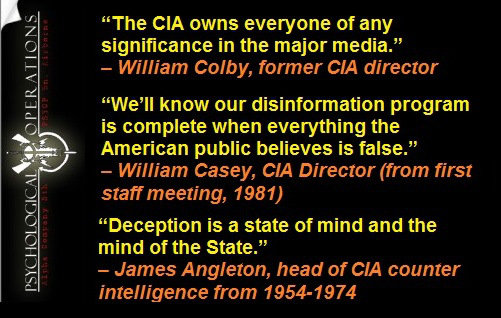
For years now, the government has been bombarding the citizenry with propaganda campaigns and psychological operations aimed at keeping us compliant, easily controlled and supportive of the police state’s various efforts abroad and domestically.

The government is so confident in its Orwellian powers of manipulation that it’s taken to bragging about them. Just recently, for example, the U.S. Army’s 4th Psychological Operations Group, the branch of the military responsible for psychological warfare, released a recruiting video that touts its efforts to pull the strings, turn everything they touch into a weapon, be everywhere, deceive, persuade, change, influence, and inspire.

This is the danger that lurks in plain sight.

Of the many weapons in the government’s vast arsenal, psychological warfare may be the most devastating in terms of the long-term consequences.

As the military journal Task and Purpose explains, “Psychological warfare is all about influencing governments, people of power, and everyday citizens… PSYOP soldiers’ key missions are to influence ‘emotions, notices, reasoning, and behavior of foreign governments and citizens,’ ‘deliberately deceive’ enemy forces, advise governments, and provide communications for disaster relief and rescue efforts.”

Yet don’t be fooled into thinking these psyops (psychological operations) campaigns are only aimed at foreign enemies. The government has made clear in word and deed that “we the people” are domestic enemies to be targeted, tracked, manipulated, micromanaged, surveilled, viewed as suspects, and treated as if our fundamental rights are mere privileges that can be easily discarded.

Aided and abetted by technological advances and scientific experimentation, the government has been subjecting the American people to “apple-pie propaganda” for the better part of the last century.

Consider some of the ways in which the government continues to wage psychological warfare on a largely unsuspecting citizenry.

Weaponizing violence. With alarming regularity, the nation continues to be subjected to spates of violence that terrorizes the public, destabilizes the country’s ecosystem, and gives the government greater justifications to crack down, lock down, and institute even more authoritarian policies for the so-called sake of national security without many objections from the citizenry.

Weaponizing surveillance, pre-crime and pre-thought campaigns. Surveillance, digital stalking and the data mining of the American people add up to a society in which there’s little room for indiscretions, imperfections, or acts of independence. When the government sees all and knows all and has an abundance of laws to render even the most seemingly upstanding citizen a criminal and lawbreaker, then the old adage that you’ve got nothing to worry about if you’ve got nothing to hide no longer applies. Add pre-crime programs into the mix with government agencies and corporations working in tandem to determine who is a potential danger and spin a sticky spider-web of threat assessments, behavioral sensing warnings, flagged “words,” and “suspicious” activity reports using automated eyes and ears, social media, behavior sensing software, and citizen spies, and you having the makings for a perfect dystopian nightmare. The government’s war on crime has now veered into the realm of social media and technological entrapment, with government agents adopting fake social media identities and AI-created profile pictures in order to surveil, target and capture potential suspects.

Weaponizing digital currencies, social media scores and censorship. Tech giants, working with the government, have been meting out their own version of social justice by way of digital tyranny and corporate censorship, muzzling whomever they want, whenever they want, on whatever pretext they want in the absence of any real due process, review or appeal. Unfortunately, digital censorship is just the beginning. Digital currencies (which can be used as “a tool for government surveillance of citizens and control over their financial transactions”), combined with social media scores and surveillance capitalism create a litmus test to determine who is worthy enough to be part of society and punish individuals for moral lapses and social transgressions (and reward them for adhering to government-sanctioned behavior). In China, millions of individuals and businesses, blacklisted as “unworthy” based on social media credit scores that grade them based on whether they are “good” citizens, have been banned from accessing financial markets, buying real estate or travelling by air or train.

Weaponizing compliance. Even the most well-intentioned government law or program can be—and has been—perverted, corrupted and used to advance illegitimate purposes once profit and power are added to the equation. The war on terror, the war on drugs, the war on COVID-19, the war on illegal immigration, asset forfeiture schemes, road safety schemes, school safety schemes, eminent domain: all of these programs started out as legitimate responses to pressing concerns and have since become weapons of compliance and control in the police state’s hands.

Weaponizing entertainment. For the past century, the Department of Defense’s Entertainment Media Office has provided Hollywood with equipment, personnel and technical expertise at taxpayer expense. In exchange, the military industrial complex has gotten a starring role in such blockbusters as Top Gun and its rebooted sequel Top Gun: Maverick, which translates to free advertising for the war hawks, recruitment of foot soldiers for the military empire, patriotic fervor by the taxpayers who have to foot the bill for the nation’s endless wars, and Hollywood visionaries working to churn out dystopian thrillers that make the war machine appear relevant, heroic and necessary. As Elmer Davis, a CBS broadcaster who was appointed the head of the Office of War Information, observed, “The easiest way to inject a propaganda idea into most people’s minds is to let it go through the medium of an entertainment picture when they do not realize that they are being propagandized.”

Weaponizing behavioral science and nudging. Apart from the overt dangers posed by a government that feels justified and empowered to spy on its people and use its ever-expanding arsenal of weapons and technology to monitor and control them, there’s also the covert dangers associated with a government empowered to use these same technologies to influence behaviors en masse and control the populace. In fact, it was President Obama who issued an executive order directing federal agencies to use “behavioral science” methods to minimize bureaucracy and influence the way people respond to government programs. It’s a short hop, skip and a jump from a behavioral program that tries to influence how people respond to paperwork to a government program that tries to shape the public’s views about other, more consequential matters. Thus, increasingly, governments around the world—including in the United States—are relying on “nudge units” to steer citizens in the direction the powers-that-be want them to go, while preserving the appearance of free will.

Weaponizing desensitization campaigns aimed at lulling us into a false sense of security. The events of recent years—the invasive surveillance, the extremism reports, the civil unrest, the protests, the shootings, the bombings, the military exercises and active shooter drills, the lockdowns, the color-coded alerts and threat assessments, the fusion centers, the transformation of local police into extensions of the military, the distribution of military equipment and weapons to local police forces, the government databases containing the names of dissidents and potential troublemakers—have conspired to acclimate the populace to accept a police state willingly, even gratefully.

Weaponizing fear and paranoia. The language of fear is spoken effectively by politicians on both sides of the aisle, shouted by media pundits from their cable TV pulpits, marketed by corporations, and codified into bureaucratic laws that do little to make our lives safer or more secure. Fear, as history shows, is the method most often used by politicians to increase the power of government and control a populace, dividing the people into factions, and persuading them to see each other as the enemy. This Machiavellian scheme has so ensnared the nation that few Americans even realize they are being manipulated into adopting an “us” against “them” mindset. Instead, fueled with fear and loathing for phantom opponents, they agree to pour millions of dollars and resources into political elections, militarized police, spy technology and endless wars, hoping for a guarantee of safety that never comes. All the while, those in power—bought and paid for by lobbyists and corporations—move their costly agendas forward, and “we the suckers” get saddled with the tax bills and subjected to pat downs, police raids and round-the-clock surveillance.

Weaponizing genetics. Not only does fear grease the wheels of the transition to fascism by cultivating fearful, controlled, pacified, cowed citizens, but it also embeds itself in our very DNA so that we pass on our fear and compliance to our offspring. It’s called epigenetic inheritance, the transmission through DNA of traumatic experiences. For example, neuroscientists observed that fear can travel through generations of mice DNA. As The Washington Post reports, “Studies on humans suggest that children and grandchildren may have felt the epigenetic impact of such traumatic events such as famine, the Holocaust and the Sept. 11, 2001, terrorist attacks.”

Weaponizing the future. With greater frequency, the government has been issuing warnings about the dire need to prepare for the dystopian future that awaits us. For instance, the Pentagon training video, “Megacities: Urban Future, the Emerging Complexity,” predicts that by 2030 (coincidentally, the same year that society begins to achieve singularity with the metaverse) the military would be called on to use armed forces to solve future domestic political and social problems. What they’re really talking about is martial law, packaged as a well-meaning and overriding concern for the nation’s security. The chilling five-minute training video paints an ominous picture of the future bedeviled by “criminal networks,” “substandard infrastructure,” “religious and ethnic tensions,” “impoverishment, slums,” “open landfills, over-burdened sewers,” a “growing mass of unemployed,” and an urban landscape in which the prosperous economic elite must be protected from the impoverishment of the have nots. “We the people” are the have-nots.

The end goal of these mind control campaigns—packaged in the guise of the greater good—is to see how far the American people will allow the government to go in re-shaping the country in the image of a totalitarian police state.

The facts speak for themselves.

Whatever else it may be—a danger, a menace, a threat—the U.S. government is certainly not looking out for our best interests, nor is it in any way a friend to freedom.

When the government views itself as superior to the citizenry, when it no longer operates for the benefit of the people, when the people are no longer able to peacefully reform their government, when government officials cease to act like public servants, when elected officials no longer represent the will of the people, when the government routinely violates the rights of the people and perpetrates more violence against the citizenry than the criminal class, when government spending is unaccountable and unaccounted for, when the judiciary act as courts of order rather than justice, and when the government is no longer bound by the laws of the Constitution, then you no longer have a government “of the people, by the people and for the people.”

What we have is a government of wolves.

Our backs are against the proverbial wall.

“We the people”—who think, who reason, who take a stand, who resist, who demand to be treated with dignity and care, who believe in freedom and justice for all—have become undervalued citizens of a totalitarian state that views people as expendable once they have outgrown their usefulness to the State.

Brace yourselves.

As I make clear in my book Battlefield America: The War on the American People and in its fictional counterpart The Erik Blair Diaries, “we the people” have become enemies of the Deep State.

Freedom Rider: Hollywood Propaganda Attack on Venezuela

By Margaret Kimberly

Source: Black Agenda Report

The US is starving and killing Venezuelans in real life and, for your family’s viewing pleasure, on television screens.

“Imperialism is quite bipartisan and liberal Hollywood never saw propaganda it didn’t want to hype.”

“The military intervention of #Venezuela, put ‘on the table’ by @realDonaldTrump and his gang of fanatic supremacists, is supported by the gringo propaganda machine. Here is a fragment of their ‘cultural offerings.’”— Ernesto Villegas, Venezuela Minister of Culture

Americans are loathe to think of themselves as being propagandized.  The idea is inconsistent with notions of exceptional goodness and superiority that are constantly evoked in this country. But government propaganda does not work in a vacuum. It is bolstered by the corporate media and that includes the entertainment industry.

The latest in the story of fictitious CIA agent Jack Ryan is a case in point. The Ryan character appeared in five different feature films before moving to the small screen via Amazon Prime Video. The new season premieres in November and in this latest incarnation Ryan fights to prevent a nuclear armed Venezuela .

The upside down presentation is typical of the perversion of truth so prevalent in the United State. This country is the only one to have used nuclear weapons and still possesses more than any other. It is the United States that recently withdrew unilaterally from decades old nuclear agreements with Russia. Yet Hollywood has woven a tale of Russia, the country which wanted to keep the non-proliferation agreements, as a villain giving nuclear weapons to Venezuela.

“Government propaganda is bolstered by the entertainment industry.”

Venezuela is the victim of United States aggression in reality and now on the screen. The doctrine of “maximum pressure” has killed 40,000 Venezuelans through sanctions that have deprived that nation of food and medical care. That proof of U.S. aggression is known only to those who access independent media sources. The corporate media, even those who are allegedly liberal, parrot Donald Trump administration talking points, even if they otherwise deride the president and his team. Imperialism is quite bipartisan and liberal Hollywood never saw propaganda it didn’t want to hype.

Of course liberals who are usually overcome by Trump derangement syndrome are happy to go along with aggression schemes. Very few Democrats have expressed opposition to the anti-Venezuelan plots hatched by Trump. There is indeed foreign policy collusion but it doesn’t exist in a relationship with a foreign government. The determination to support American hegemony is an important part of the elite consensus.

That obvious truth is also disappeared and is not to be discussed in what passes for polite and “serious” company. According to myth, America is a classless, post-racial meritocracy and accepting of every political viewpoint. Of course it is anything but. The hierarchies are rigid and tenaciously defended.

“The corporate media, even those who are allegedly liberal, parrot Donald Trump administration talking points.”

Propaganda delivered via popular entertainment plays a particularly insidious role in this process. The goal is to change minds and ensure support for any act the government should choose to make. If this particular iteration of the Jack Ryan story isn’t challenged then no act or aggression will be challenged either.Media imagery is very powerful, that is why governments work so closely with corporate media to present their narratives.

Mace Neufeld  created the Jack Ryan film franchise. In 2014 he received a lifetime achievement award from the Israeli Film Festival. Curiously, the event wasn’t held in Israel at all. Instead Beverly Hills was the venue. Neufeld’s co-honoree was Arnon Milchan, a former Mossad operative who parlayed that career into producing hit films such as Twelve Years a Slave.

Israel isn’t alone in this regard. The CIA and the Pentagon both have film liaison offices . Movie credits often end with thanks to the department of defense. That always means that the plot line is approved by the military and the surveillance state.

“Movie credits often end with thanks to the department of defense.”

This grotesque lying on a mass scale cannot be ignored. The propagandists know that repetition plays a huge role in the process of indoctrination. For years Venezuela has been used as a bogeyman to convince people in this country to act against their own interests. “Socialism doesn’t work, just look at Venezuela,” is a statement made to end discussion of free health care or college education or housing or anything else that people need and want. After the 100th New York Times article which says nothing about the U.S. attack but points out that Venezuelans are hungry, the job has been done. Venezuela is now so thoroughly demonized that only a small number of people will come to its defense or even question their government’s policy against that nation.

“Venezuela is now so thoroughly demonized that only a small number of people will come to its defense.”

In 2002 and 2003 the president, the corporate media, and members of Congress all claimed that Iraq possessed chemical weapons. They wanted to make a case for war and they succeeded. Nearly 20 years later there has been no explanation or apology from the guilty parties. The same people claimed that Syria had chemical weapons and advocated for a larger war there. It isn’t hard to believe that a lie about chemicals or nukes in Venezuela could be used to do the same thing if that is what the establishment desired.

Entertainment isn’t harmless. That is why the ruling clique work together to ensure that they all stay on message. They haven’t spent millions of dollars honing the false message that Venezuela is a failed state with evil leadership for no reason. Venezuela’s culture minister, Ernesto Villegas, hits the nail squarely on the head when he describes this latest insult as “crass war propaganda masquerading as entertainment.”  If the U.S. should take military action or continue its regime change efforts, the plot will have succeeded. A few well informed people will speak out but the masses will either support an atrocity or ignore any horror that their leadership cares to visit upon the Venezuelan people. Washington and Hollywood are still working hand in hand.


Margaret Kimberley’s Freedom Rider column appears weekly in BAR, and is widely reprinted elsewhere. She maintains a frequently updated blog as well at http://freedomrider.blogspot.com . Ms. Kimberley lives in New York City, and can be reached via e-Mail at Margaret.Kimberley(at)BlackAgendaReport.com.

Surgical Totalitarianism

By Dan Corjescu

Source: Dissident Voice

You don’t have to control everything to be in total control.

In the modern world this seeming paradox is a systemic reality.

In the past, classic totalitarian governments sought to literally control every aspect of biopower.

As it turned out, this was a very inefficient and self-defeating way to maintain and increase scientific knowledge and technology, capital accumulation, and total effective power over the long term.

Modern totalitarian arrangements are far more culturally efficacious, superficially unobtrusive, stylistically democratic, and, most importantly, surgically precise.

In addition, modern totalitarian elites not only demand de facto control over society as such, but they also desire, as part of their inner ideological ethos, the exercise of that power to reproduce itself under maximum conditions of ease, pleasure, and comfort. Thus, the creation and maintenance of a consumerist society both materially and ideologically aids in the reproduction of neo-totalitarian power.

A consumerist society is to a large extent a self regulating mechanism for the constant pursuit of public spectacle and private stimulation. The senses and general life instincts are caught in a web of the pursuance of small pleasures. In this way, pleasure itself becomes an insidiously saccharine form of domination. Yet, from time to time, consumerist relations must be guided, reinforced, and given new goals and reflationary impetus from above.

The political structure in modern, surgical totalitarianism is set up in such a way as to give the appearance of active participation, psychological inclusion, and periodic mass mobilization. However, all consequential decision-making takes place behind this fraudulent structure and represents the true “commanding heights” of power. The political superstructure serves, at best, as perennial decoy and public delusion.

The modern “commanding heights” of power require massive amounts of data. It is through the acquisition, manipulation, and active forward interpretation of information that surgical totalitarianism is able to pick and choose its battles. At its most extreme, new “realities” are creatively and cynically constructed from its daily catch of strategic knowledge. The goal is always the same: distract, delude, deflate any possible challenge to the system through active suppression, co-optation (the preferred method), and, or, complete elimination.

In this way, any possible threats can be foreseen relatively far in advance and organizational strategies can be conceived for either their containment and/or elimination. The surgical nature of these methods allows for the relative negative freedom of civil society to generally evolve and reproduce itself in partial self-awareness in so far as it continues to demonstrate no substantive subversive tendencies to liquidate either the material reality and/or ideological superstructure of its own dependency on neo-totalitarian forms of power.

In the end, the system presents itself as perversely elegant, efficient, self-perpetuating, and, even, on a physical level, pleasant.

All bodily pleasures are on offer. Entertainment becomes incarceration. All is seemingly permitted while nothing is truly allowed. Power is diaphanous as it is all consuming. Critical dissent is tolerated because the mechanisms of mass blindness are secure.

It would be and has been a crucial mistake for Marxists of all kinds to think that capitalism is the root cause of the modern day pursuit of total power. On the contrary, surgical totalitarianism utilizes capitalism as just another source of power but not its ultimate ground. Power precedes capitalism. Hierarchy encodes the means and forces of production no matter what they are just as hierarchy projects a self-sustaining superstructure to deceive and deflect its potential challengers. Capitalism is but a modern day tool of hierarchical power. The real enemy is not capital but surreptitious hierarchy.

The true source of this state of affairs is the lust for control under any societal forms. Its origins are without doubt evolutionary. Aristotle famously defined human beings as “Zoon Politikon” or “social animal”. Yes, we are indeed social. But the “Zoon” or animal part of that equation warps that sociality into the insatiable desire to control and to dominate others. Ultimately, the Hobbesian origins of mankind from an age long state of “nastiness and brutishness” is, in part, to blame that man persists in being as a wolf to other men: Homo homini lupus est.

Our age of horror

In this febrile cultural moment filled with fear of the Other, horror has achieved the status of true art

By M M Owen

Source: aeon

In Ray Bradbury’s horror short story, ‘The Next in Line’ (1955), a woman visits the catacombs in Guanajuato, Mexico. Mummified bodies line the walls. Lying awake the next night, haunted by her macabre tour, she finds that her heart ‘was a bellows forever blowing upon a little coal of fear … an ingrown light which her inner eyes stared upon with unwanting fascination’.

Our present era is one in which the heart of culture is blowing hard upon a coal of fear, and the fascination is everywhere. By popular consent, horror has been experiencing what critics feel obliged to label a ‘golden age’. In terms of ticket sales, 2017 was the biggest year in the history of horror cinema, and in 2018, Hereditary and A Quiet Place have been record-breaking successes. In both the United States and the United Kingdom, sales of horror literature are up year over year – an uptick that industry folk partly attribute to the wild popularity of Netflix’s Stranger Things (2016-). And the success isn’t merely commercial. Traditionally a rather maligned genre, these days horror is basking in the glow of critical respectability. As The New York Times remarked this June, horror ‘has never been more bankable and celebrated than it is right now’.

As any historian of the genre will tell you, horror has had previous golden ages. Perhaps ours is just a random quirk of popular taste. But perhaps not. Perhaps we are intoxicated by horror today because the genre is serving a function that others aren’t. Can’t. Horror’s roots run deep, but they twist themselves into forms very modern. The imagination’s conversion of fear into art offers a dark and piercing mirror.

My earliest horror memory is Stay Out of the Basement (1992), one of R L Stine’s Goosebumps series of young adult novels. In the story, a botanist accidently creates a hybrid plant clone of himself. When the clone comes to life, he tries to steal his humanoid self’s life. The botanist’s children unmask the imposter, and in a mess of green blood and plant mush, the clone is felled with an axe. The rescued father disposes of the rest of the mutating plant matter, and the family is all set to live happily ever after. But at the very end, the daughter is standing in the garden and feels a small plant nudging her ankle. The plant whispers to her: ‘Please – help me. I’m your father.’ Stay Out of the Basement is no masterpiece, but I was young, and it struck me cold.

Horror is what anthropologists call biocultural. It is about fears we carry because we are primates with a certain evolved biology: the corruption of the flesh, the loss of our offspring. It is also about fears unique to our sociocultural moment: the potential danger of genetically modifying plants. The first type of fear is universal; the second is more flexible and contextual. Their cold currents meet where all great art does its work, down among the bottomless caves on the seabed of consciousness. Lurking here, a vision of myself paralysed in the dirt, invisible to those I love.

Horror has always been with us. Prehistoric cave paintings are rife with the animal-human hybrids that remain a motif of horror to this day. Every folktale tradition on Earth contains tales of malevolent creatures, petrifying ghosts and graphic violence. The classics are frequently horrifying: in Homer’s Odyssey, when the Cyclops encounters Odysseus’ men, the monster eats them, ‘entrails, flesh and the marrowy bones alike’.

We have always told horror stories, and we always will. Because horror is an artistic expression of an ontological truth: we are creatures formed in no small part by the things to which we are averse. Fear is a base ingredient of consciousness, partaking of brain circuits that are so ancient humans share them with all vertebrate lifeforms. As the neuroscientist Antonio Damasio has described, the whole weird soup of human feeling emerged as a result of our beginning to process whether to ‘approach or avoid … certain places or things or creatures’. Our cognition absorbs reality as a vast spectrum of potential encounters, and horror alchemises the dark end into art.

Thus, evolutionary analyses of horror mention monsters as the genre’s most defining feature. As the philosopher Stephen T Asma puts it, ‘during the formation of the human brain, the fear of being grabbed by sharp claws, dragged into a dark hole and eaten alive was not an abstraction’. For a quarter of a million years – the vast majority of Homo sapiens’ existence as a species – we lived outdoors, with giant hyenas, saber-toothed cats and other carnivores representing a real threat to life. That other ancient health risk, the biological pathogen, manifests itself in the tendency of monsters to be not only violent but also disgusting – feral, oozing blood and saliva, bearing their infectious teeth. From the evolutionary perspective, horror’s vast monstrous menagerie echoes with Paleolithic peril.

Historically, horror’s willingness to play directly to our evolved physiology has seen it earn a low reputation. Western culture was built on a vision of ourselves as above the beasts, above the beastliness of acquiescing helplessly to the demands of the body. But horror can bypass all intellect, extract from us an embarrassingly animalistic response. The skittish physicality of the ‘jump scare’ is a manipulation of what biologists call the startle response, present in all mammals. And cruder horror always contains that other ghastly reminder of our physicality: gore. Gore disgusts us, and the way that gore can be darkly compelling to us disgusts us. Whenever horror is criticised, it is criticised for staging a dark carnival of physicality. Perhaps the only sort of media we moralise more than we do horror is that other mainliner of bodily response, pornography.

Horror’s historical ghettoisation has meant that weightier, smarter horror reliably gets labelled as something else. The finest films of our current golden age have been dubbed ‘elevated horror’ and ‘post-horror’. In literary circles, works of horror seen as sufficiently cerebral get relabelled ‘Gothic’. It’s certainly true that great horror is always about more than gore. But we should be careful not to gentrify the genre by cleansing it of everything but the philosophy.

There are always beings that want to bite us, scratch us, puncture our fragile flesh. There is the terrible old coercion of brute, muscular force, the lethal threat of contagion and infection. There is darkness, disorientation. And looming explicitly or symbolically in all horror is that vast shadow that the anthropologist Ernest Becker said ‘haunts the human animal like nothing else’: death.

‘And he that sat on the cloud thrust in his sickle on the Earth; and the Earth was reaped’. Witness the machinations of that famous slasher, God (Revelation 14:16). Horror encodes the story of our long primate journey, but these biological foundations support the towering edifice of culture. And for millennia, horror merged with our oldest cultural phenomena: religion and folklore. In fact, for most of its history, horror wasn’t really art, as we tend to understand that term today. It certainly wasn’t fiction. Prior to about 1750, in our pivot toward the Enlightenment, the best horror stories can all be found within theology and lore. In Europe, for generations Satan was every bit as petrifying as Pennywise, the murderous clown of Stephen King’s It (1986). Demonic forces were terrifyingly real; in the Bible, Jesus spends almost as much time performing exorcisms as he does healing people. There were widespread societal panics about the threat of werewolves and vampires, and tens of thousands of women were murdered as witches.

This isn’t to judge the credulity of bygone peoples. But the reason that horror – unlike say tragedy, or comedy, or the epic – didn’t exist as an artistic genre until relatively recently is that its deep history is fundamentally pre-scientific. Nothing in the annals of art is as scary as what you’ll find in bygone worldviews. Who needs make-believe scares when everyone you know is awaiting the day of judgment, at which point an angel will sweep a sickle across the Earth and make the blood run for hundreds of miles? It is no coincidence that the Gothic – horror’s regal antecedent – emerged precisely at the moment when lots of people began to believe that God really might be dead. Modern horror is in part the story of what happens when our threatened minds shed a theology. Once holy texts can no longer entirely encode the terrors of being, horror enters fully the arena of art.

However, the old ways cast a long shadow. In the pantheon of genres, horror remains an adolescent, and it has a sort of adolescent relationship with its past: half rebellion, half dependency. On the one hand, more than any other genre, horror loves to thematise the coldest sorts of atheism. ‘All my tales,’ said horror grandee H P Lovecraft, ‘are based on the fundamental premise that common human laws and interests and emotions have no validity or significance in the vast cosmos-at-large.’ In The Silence of the Lambs(1988), amused by what he sees as clear evidence for the absence of any benevolent deity, the charmingly evil Hannibal Lecter ‘collects church collapses, recreationally’.

On the other hand, horror is marked everywhere by the centuries it spent wedded to otherworldly belief systems. In 2018’s biggest horror movie, Hereditary, an obscure figure from demonology possesses a teenage boy and wreaks death upon his family. Much Japanese horror features yūrei, tormented and enraged spirits denied a smooth passage to the afterlife. Horror was a dark, mutant child of the Enlightenment, and yet it can’t shake its pre-scientific genes. Its penchant for lurid supernaturalism is a big reason why, when it fails, it can so easily seem puerile. The modern, skeptical mind whispers: This is just silly. Haven’t we outgrown all this? On Halloween – a celebration of horror’s pre-artistic forms – children are meant to have the most fun.

Why does horror have this double-edged relationship with its religious and spiritual heritage? Perhaps because, for all its modernity, the sheer scale of theological enquiry still reflects the genre’s ambition. As leading horror author Joe Hill told me, horror is what we turn to when we want to explore ‘the biggest and darkest questions’. And even demoted from dogma to metaphor, the old myths offer a fine way to channel those grand subjects of which horror is so fond: good versus evil, the tribulations of the soul, the end of days. Even though it requires our suspension of disbelief, the paranormal presents us with the very real prospect of brittle reason splintering against the mystery of reality.

‘There’s a sense of uncertainty and potential wrongness underlying most of human existence,’ the Canadian author Gemma Files told me. All of humankind’s great mythic narratives know this, and horror doesn’t let us forget it. At the core of the numinous impulse – that oceanic feeling in which horror was submerged for so many centuries – is the strange certainty that reality is unpredictable and inscrutable, that certain things will forever resist the reach of the human mind. Horror will always share in this sense. It may have fallen from heaven, but it still isn’t entirely of this Earth. Cormac McCarthy’s The Road(2006) centres on a father and son as they wander across a blasted, post-apocalyptic America. The horrors are everywhere: they discover, chained in a basement, ‘a man with his legs gone to the hip and the stumps of them blackened and burnt’. The man is being harvested by cannibals, piece by piece. It is a bleak, fallen world, where the memory of a time when trout swam in the streams shimmers with celestial grace. When the father meets an elderly man, he tells him: ‘There is no God and we are his prophets.’

And so what of today? Horror reverberates with fears Paleolithic and God-fearing, but it is also always reacting to its present moment. And it seems reasonable to perceive any swell in the production and popularity of horror – any dawning of a new golden age – as the expression of a culture that is afraid. ‘In anxious times,’ David Bruckner, director of The Ritual (2017) and other horror movies, told me, ‘people are more likely to turn to horror. If you have an uneasy night at the movie theatre, you are sort of answering the call of your times.’

‘I think we’re living in a nightmare, basically.’ So said horror legend Ramsey Campbell, when I asked him why he thinks horror is flourishing right now. This is one of those things that cooler heads will say is your mind deceiving you. By many objective measures, for many people, life today is better than ever. But horror has never been too worried about culture’s long-term trajectory; it is always fixated on how it could all go badly wrong, any minute now. Horror is steeped in worry; its narratives frequently open with the calm before a terrible storm. And every person connected with horror that I interviewed smelled doom on the breeze.

Horror has always made good use of our deep aversion to what Lovecraft called ‘the oldest and strongest kind of fear’: the unknown. This is one of the ways in which horror (like the folktale) can display a sort of archetypal conservatism. In general terms, the best way to survive a horror setting is to be supremely, boringly sensible: don’t talk to strangers, don’t stay the night in a foreign town, don’t go to the aid of anyone who looks sick, don’t go into that crumbling old building. If a very attractive stranger tries to seduce you, it is almost definitely a trap. Respect tradition, do not commit sacrilege, listen to the advice of elderly locals. At the heart of a lot of horror is a conservative craving for the predictable and the known. The unpleasant atonal dissonance you’ll hear in every horror score reflects, through the collapse of harmony, the disintegration of familiar and comforting patterns out there in the world.

Horror, then, thrives on discombobulation. And today, the discombobulation is everywhere. The causes of the anxiety are scattershot, and you already know them. There are those scientific breakthroughs of the sort that get Silicon Valley execs psyched, but which many others find deeply, opaquely perturbing. Take artificial intelligence, whose rise has seen more and more science fiction turn horrific: ‘One day the AIs are going to look back on us the same way we look at fossil skeletons on the plains of Africa,’ says Nathan, a central character in Ex Machina (2015). And even if the robots don’t vanquish poor old Homo sapiens, other sorts of scientific experimentation might. One of the great horror trends of the 21st century has been the zombie, and in all of the best works of zombie fiction, the immediate cause of the outbreak is the same: biological experimentation gone horribly wrong. The zombie is the gnashing, lunging embodiment of that modern terror, the global pandemic. People might not fear Satan anymore, but they sure as hell fear Ebola.

Outside of the lab, there is that slower method of planetary destruction: climate change. ‘Horror,’ the author Jeff VanderMeer told me, ‘is the beauty of the natural world juxtaposed against the way we destroy those natural systems without understanding them.’ VanderMeer’s Southern Reach trilogy (2014), some of my favourite horror novels of all time, diluted my enjoyment of the UK’s recent heatwave and refused to let me forget that what I was basking in were the convulsions of an aching planet. A biosphere cast brutally off-balance forms the setting for M R Carey’s The Girl With All the Gifts(2014), where humanity has been devastated by a fungal infection. Where horror once worried about the weather gods, it now just worries about the weather. Climate change, meanwhile, is a major cause of mass migrations, potent fuel for what leading critic Leslie Klinger described to me as horror’s historical trend of feeding off ‘the invasion of foreigners into previously stable populations’. At a base level, we are in-groupish creatures. I’ve spent time with rural, paganish communities who enjoy a singsong and are sexually unrepressed; none of them tried to burn me alive in a giant wicker man. But horror says: you never knowStick to your own.

If all these fears sound selfish, parochial, insular – don’t get the wrong idea. Horror offers a map of the psyche and, like fear itself, is inherently apolitical. It can easily offset its archetypal conservatism with a radical sort of anarchism. Horror might thematise our fear of the unknown – but it also warns about clinging too stubbornly to the familiar. In a lot of horror, survival is predicated on a capacity to quickly adapt to brutal change. Horror has little time for the conservative sentimentality that swirls around ideas such as institutions and tradition, and even something like the nation-state is often revealed as a sort of frilly, doomed illusion. The protections of social hierarchy or private property are never of any use, and horror loves to punish characters who arrogantly believe that wealth will shield them. In horror, the consolations of the past melt in contact with the white-hot heart of present fear. Conservatism fails because it is revealed that at bottom there is nothing to conserve. As the author Michael Marshall Smith put it to me, great horror often declares: ‘It’s just you versus the monster. Always has been. Always will be.’

In this, lots of horror is intensely universalising. Frequently, a scenario comes down to a simple contest between humankind and something else. Splitting up is a suicidal move in horror; survival often follows an impulse toward communal effort. Similarly universalising is the way that, at extreme moments of threat or fear, a given character’s skin colour or gender or nationality will often be effaced. At horror’s pitch, we perceive a simple human, doing what we all do every day of our lives: struggling to live, to persist, to overcome. In The Babadook(2014), a widowed mother is stalked by an amorphous, black-hatted monster that embodies her grief at losing her husband. The monster – her terrible, life-sucking trauma – threatens to claim her son, and destroy what is left of her family. Late in the film, bloodied and exhausted, the mother faces down the Babadook, yelling: ‘If you touch my son again, I’ll fucking kill you.’ The monster is tamed. It is a show of furious bravery that could be any mother, anywhere; courageous love in the face of total disorder.

It’s easy to romanticise horror, but there are also unsexy, funcitonal reasons why it’s having its moment right now. The streaming revolution has given creators a reliable and direct way to reach a dedicated, self-selecting audience. Trusting this audience, distributors like A24 and Blumhouse have put a great amount of both creative wherewithal and cold hard dollars into horror cinema. The genre has always been reliably profit-turning, but it has also always been prone to the lazy recycling of ideas and tropes. Today, even experimental horror can be profitable. In literature, meanwhile, a revival of interest in horror greats like Shirley Jackson, as well as a slew of Stephen King adaptations, has been a boost for the genre at large.

Yet on their own, these tantalising products would never suffice to make horror soar. Horror has been with us since the dawn of storytelling. It manifests the fears of the human animal, and even today echoes the slippery spiritual suspicion that reality isn’t what it seems. Our world is ripe for upending, and horror expresses that best. Horror can thrive today because ours is a strange and febrile cultural moment. It seems every civilisation has believed they are on the brink of cataclysmic change; such an idea has a weird narcissistic appeal. But today there is everywhere a deep feeling that the horses of disaster are about to plunge in the heavy clay. There is a sort of great loop being completed here: as horror has morphed from theology to art, the ruinous power has moved from the judgment of God to the hand of humans. The end of days in one programmer’s idle tinkering, in one laboratory’s overlooked quarantine protocols. Robert Louis Stevenson, author of The Strange Case of Dr Jekyll and Mr Hyde (1886), wrote, ‘Sooner or later, everyone sits down to a banquet of consequences.’ As a genre, horror is forever pulling up a chair, licking its lips at the feast to come.

Breathing this nervous air, current horror – like the theology that provided its former home – is animated by the full spectrum of human psychology. It is driven by our desire to stop all the clocks, shrink into a bubble of the familiar and the known, reject all things foreign. Equally, current horror is shot through with the bone-deep knowledge that if we can’t adapt, we will perish. Its narratives warn us not to cling to outdated consolations, to recognise that we all face the same monsters, in the end. The world has always been dark and full of terrors, and horror has always known it. The dark pleasure of enjoying horror is all about countenancing this awful truth from within a little bubble of safety. It is about the doppelgängered headspace of loathing the real thing but craving its imaginative facsimile. If the genre of horror has a master virtue, a single human quality that it consistently exalts, it is an old one: bravery. We are certain to need that, wherever we are headed.


With thanks to all the horror authors, editors, screenwriters, directors and critics who generously gave me their time to explore horror: Nick Antosca, Stephen T Asma, David Bruckner, Ramsey Campbell, Noël Carroll, Ellen Datlow, Gemma Files, Steven Gerrard, Joe Hill, Carole Johnstone, Leslie Klinger, John Langan, Lisa Morton, Andy Nyman, Jami O’Brien, Xavier Aldana Reyes, Priya Sharma, David J Skal, Michael Marshall Smith, Eugene Thacker, Paul Tremblay, and Jeff VanderMeer. 

Why We’re Blind to the System Destroying Us

By Jonathan Cook

Source: Information Clearing House

I rarely use this blog to tell readers what they should believe. Rather I try to indicate why it might be wise to distrust, at least without very good evidence, what those in power tell us we should believe.

We have well-known sayings about power: “Knowledge is power”, and “Power tends to corrupt, while absolute power tends to corrupt absolutely.” These aphorisms resonate because they say something true about how we experience the world. People who have power – even very limited power they hold on licence from someone else – tend to abuse it, sometimes subtly and unconsciously, and sometimes overtly and wilfully.

If we are reasonably self-aware, we can sense the tendency in ourselves to exploit to our advantage whatever power we enjoy, whether it is in our dealings with a spouse, our children, a friend, an employee, or just by the general use of our status to get ahead.

This isn’t usually done maliciously or even consciously. By definition, the hardest thing to recognise are our own psychological, emotional and mental blind spots – and the biggest, at least for those born with class, gender or race privileges, is realising that these too are forms of power.

Nonetheless, these are all minor forms of power compared to the power wielded collectively by the structures that dominate our societies: the financial sector, the corporations, the media, the political class, and the security services.

But strangely most of us are much readier to concede the corrupting influence of the relatively small power of individuals than we are the rottenness of vastly more powerful institutions and structures. We blame the school teacher or the politician for abusing his or her power, while showing a reluctance to do the same about either the education or political systems in which they have to operate.

Similarly, we are happier identifying the excessive personal power of a Rupert Murdoch than we are the immense power of the corporate empire behind him and on which his personal wealth and success depend.

And beyond this, we struggle most of all to detect the structural and ideological framework underpinning or cohering all these discrete examples of power.

Narrative control

It is relatively easy to understand that your line manager is abusing his power, because he has so little of it. His power is visible to you because it relates only to you and the small group of people around you.

It is a little harder, but not too difficult, to identify the abusive policies of your firm – the low pay, cuts in overtime, attacks on union representation.

It is more difficult to see the corrupt power of large institutions, aside occasionally from the corruption of senior figures within those institutions, such as a Robert Maxwell or a Richard Nixon.

But it is all but impossible to appreciate the corrupt nature of the entire system. And the reason is right there in those aphorisms: absolute power depends on absolute control over knowledge, which in turn necessitates absolute corruption. If that were not the case, we wouldn’t be dealing with serious power – as should be obvious, if we pause to think about it.

Real power in our societies derives from that which is necessarily hard to see – structures, ideology and narratives – not individuals. Any Murdoch or Trump can be felled, though being loyal acolytes of the power-system they rarely are, should they threaten the necessary maintenance of power by these interconnected institutions, these structures.

The current neoliberal elite who effectively rule the planet have reached as close to absolute power as any elite in human history. And because they have near-absolute power, they have a near-absolute control of the official narratives about our societies and our “enemies”, those who stand in their way to global domination.

No questions about Skripals

One needs only to look at the narrative about the two men, caught on CCTV cameras, who have recently been accused by our political and media class of using a chemical agent to try to murder Sergei Skripal and his daughter Yulia back in March.

I don’t claim to know whether Alexander Petrov and Ruslan Boshirov work for the Russian security services, or whether they were dispatched by Vladimir Putin on a mission to Salisbury to kill the Skripals.

What is clear, however, is that the British intelligence services have been feeding the British corporate media a self-serving, drip-drip narrative from the outset – and that the media have shown precisely no interest at any point in testing any part of this narrative or even questioning it. They have been entirely passive, which means their readers – us – have been entirely passive too.

That there are questions about the narrative to be raised is obvious if you turn away from the compliant corporate media and seek out the views of an independent-minded, one-time insider such as Craig Murray.

A former British ambassador, Murray is asking questions that may prove to be pertinent or not. But at this stage, when all we have to rely on is what the intelligence services are selectively providing, these kinds of doubts should be driving the inquiries of any serious journalist covering the story. But as is so often the case, not only are these questions not being raised or investigated, but anyone like Murray who thinks critically – who assumes that the powerful will seek to promote their interests and avoid accountability – is instantly dismissed as a conspiracy theorist or in Putin’s pocket.

That is no meaningful kind of critique. Many of the questions that have been raised – like why there are so many gaps in the CCTV record of the movements of both the Skripals and the two assumed assassins – could be answered if there was an interest in doing so. The evasion and the smears simply suggest that power intends to remain unaccountable, that it is keeping itself concealed, that the narrative is more important than the truth.

And that is reason enough to move from questioning the narrative to distrusting it.

Ripples on a lake

Journalists typically have a passive relationship to power, in stark contrast to their image as tenacious watchdog. But more fundamental than control over narrative is the ideology that guides these narratives.  Ideology ensures the power-system is invisible not only to us, those who are abused and exploited by it, but also to those who benefit from it.

It is precisely because power resides in structures and ideology, rather than individuals, that it is so hard to see. And the power-structures themselves are made yet more difficult to identify because the narratives created about our societies are designed to conceal those structures and ideology – where real power resides – by focusing instead on individuals.

That is why our newspapers and TV shows are full of stories about personalities – celebrities, royalty, criminals, politicians. They are made visible so that we do not notice the ideological structures we live inside that are supposed to remain invisible.

News and entertainment are the ripples on a lake, not the lake itself. But the ripples could not exist without the lake that forms and shapes them.

Up against the screen

If this sounds like hyperbole, let’s stand back from our particular ideological system – neoliberalism – and consider earlier ideological systems in the hope that they offer some perspective. At the moment, we are like someone standing right up against an IMAX screen, so close that we cannot see that there is a screen or even guess that there is a complete picture. All we see are moving colours and pixels. Maybe we can briefly infer a mouth, the wheel of a vehicle, a gun.

Before neoliberalism there were other systems of rule. There was, for example, feudalism that appropriated a communal resource – land – exclusively for an aristocracy. It exploited the masses by forcing them to toil on the land for a pittance to generate the wealth that supported castles, a clergy, manor houses, art collections and armies. For several centuries the power of this tiny elite went largely unquestioned.

But then a class of entrepreneurs emerged, challenging the landed artistocracy with a new means of industrialised production. They built factories and took advantage of scales of economy that slightly widened the circle of privilege, creating a middle class. That elite, and the middle-class that enjoyed crumbs from their master’s table, lived off the exploitation of children in work houses and the labour of a new urban poor in slum housing.

These eras were systematically corrupt, enabling the elites of those times to extend and entrench their power. Each elite produced justifications to placate the masses who were being exploited, to brainwash them into believing the system existed as part of a natural order or even for their benefit. The aristocracy relied on a divine right of kings, the capitalist class on the guiding hand of the free market and bogus claims of equality of opportunity.

In another hundred years, if we still exist as a species, our system will look no less corrupt – probably more so – than its predecessors.

Neoliberalism, late-stage capitalism, plutocratic rule by corporations – whatever you wish to call it – has allowed a tiny elite to stash away more wealth and accrue more power than any feudal monarch could ever have dreamt of. And because of the global reach of this elite, its corruption is more endemic, more complete, more destructive than any ever known to mankind.

A foreign policy elite can destroy the world several times over with nuclear weapons. A globalised corporate elite is filling the oceans with the debris from our consumption, chopping down the forest-lungs of our planet for palm-oil plantations so we can satisfy our craving for biscuits and cake. And our media and intelligence services are jointly crafting a narrative of bogeymen and James Bond villains – both in Hollywood movies, and in our news programmes – to make us fearful and pliable.

Assumptions of inevitability

Most of us abuse our own small-power thoughtlessly, even self-righteously. We tell ourselves that we gave the kids a “good spanking” because they were naughty, rather than because we established with them early on a power relationship that confusingly taught them that the use of force and coercion came with a parental stamp of approval.

Those in greater power – from minions in the media to executives of major corporations – are no different. They are as incapable of questioning the ideology and the narrative – how inevitable and “right” our neoliberal system is – as the rest of us. But they play a vital part in maintaining and entrenching that system nonetheless.

David Cromwell and David Edwards of Media Lens have provided two analogies – in the context of the media – that help explain how it is possible for individuals and groups to assist and enforce systems of power without having any conscious intention to do so, and without being aware that they are contributing to something harmful. Without, in short, being aware that they are conspiring in the system.

The first:

When a shoal of fish instantly changes direction, it looks for all the world as though the movement was synchronised by some guiding hand. Journalists – all trained and selected for obedience by media all seeking to maximise profits within state-capitalist society – tend to respond to events in the same way.

The second:

Place a square wooden framework on a flat surface and pour into it a stream of ball bearings, marbles, or other round objects. Some of the balls may bounce out, but many will form a layer within the wooden framework; others will then find a place atop this first layer. In this way, the flow of ball bearings steadily builds new layers that inevitably produce a pyramid-style shape. This experiment is used to demonstrate how near-perfect crystalline structures such as snowflakes arise in nature without conscious design.

The system – whether feudalism, capitalism, neoliberalism – emerges out of the real-world circumstances of those seeking power most ruthlessly. In a time when the key resource was land, a class emerged justifying why it should have exclusive rights to control that land and the labour needed to make it productive. When industrial processes developed, a class emerged demanding that it had proprietary rights to those processes and to the labour needed to make them productive.

Our place in the pyramid

In these situations, we need to draw on something like Darwin’s evolutionary “survival of the fittest” principle. Those few who are most hungry for power, those with least empathy, will rise to the top of the pyramid, finding themselves best-placed to exploit the people below. They will rationalise this exploitation as a divine right, or as evidence of their inherently superior skills, or as proof of the efficiency of the market.

And below them, like the layers of ball bearings, will be those who can help them maintain and expand their power: those who have the skills, education and socialisation to increase profits and sell brands.

All of this should be obvious, even non-controversial. It fits what we experience of our small-power lives. Does bigger power operate differently? After all, if those at the top of the power-pyramid were not hungry for power, even psychopathic in its pursuit, if they were caring and humane, worried primarily about the wellbeing of their workforce and the planet, they would be social workers and environmental activists, not CEOs of media empires and arms manufacturers.

And yet, base your political thinking on what should be truisms, articulate a worldview that distrusts those with the most power because they are the most capable of – and committed to – misusing it, and you will be derided. You will be called a conspiracy theorist, dismissed as deluded. You will be accused of wearing a tinfoil hat, of sour grapes, of being anti-American, a social warrior, paranoid, an Israel-hater or anti-semitic, pro-Putin, pro-Assad, a Marxist.

None of this should surprise us either. Because power – not just the people in the system, but the system itself – will use whatever tools it has to protect itself. It is easier to deride critics as unhinged, especially when you control the media, the politicians and the education system, than it is to provide a counter-argument.

In fact, it is vital to prevent any argument or real debate from taking place. Because the moment we think about the arguments, weigh them, use our critical faculties, there is a real danger that the scales will fall from our eyes. There is a real threat that we will move back from the screen, and see the whole picture.

Can we see the complete picture of the Skripal poisoning in Salisbury; or the US election that led to Trump being declared president; or the revolution in Ukraine; or the causes and trajectory of fighting in Syria, and before it Libya and Iraq; or the campaign to discredit Jeremy Corbyn as leader of the Labour party; or the true implications of the banking crisis a decade ago?

Profit, not ethics

Just as a feudal elite was driven not by ethics but by the pursuit of power and wealth through the control of land; just as early capitalists were driven not by ethics but by the pursuit of power and wealth through the control of mechanisation; so neoliberalism is driven not by ethics but the pursuit of power and wealth through the control of the planet.

The only truth we can know is that the western power-elite is determined to finish the task of making its power fully global, expanding it from near-absolute to absolute. It cares nothing for you or your grand-children. It is a cold-calculating system, not a friend or neighbour. It lives for the instant gratification of wealth accumulation, not concern about the planet’s fate tomorrow.

And because of that it is structurally bound to undermine or discredit anyone, any group, any state that stands in the way of achieving its absolute dominion.

If that is not the thought we hold uppermost in our minds as we listen to a politician, read a newspaper, watch a film or TV show, absorb an ad, or engage on social media, then we are sleepwalking into a future the most powerful, the most ruthless, the least caring have designed for us.

Step back, and take a look at the whole screen. And decide whether this is really the future you wish for your grand-children.


The Doors of Perception: Why Americans Will Believe Almost Anything

By Tim O’Shea

Source: Information Clearing House

Aldous Huxley’s inspired 1954 essay detailed the vivid, mind-expanding, multisensory insights of his mescaline adventures. By altering his brain chemistry with natural psychotropics, Huxley tapped into a rich and fluid world of shimmering, indescribable beauty and power. With his neurosensory input thus triggered, Huxley was able to enter that parallel universe glimpsed by every mystic and space captain in recorded history. Whether by hallucination or epiphany, Huxley sought to remove all bonds, all controls, all filters, all cultural conditioning from his perceptions and to confront Nature or the World or Reality first-hand – in its unpasteurized, unedited, unretouched infinite rawness.

Those bonds are much harder to break today, half a century later. We are the most conditioned, programmed beings the world has ever known. Not only are our thoughts and attitudes continually being shaped and molded; our very awareness of the whole design seems like it is being subtly and inexorably erased. The doors of our perception are carefully and precisely regulated.

It is an exhausting and endless task to keep explaining to people how most issues of conventional wisdom are scientifically implanted in the public consciousness by a thousand media clips per day. In an effort to save time, I would like to provide just a little background on the handling of information in this country. Once the basic principles are illustrated about how our current system of media control arose historically, the reader might be more apt to question any given story in today’s news.

If everybody believes something, it’s probably wrong. We call that

CONVENTIONAL WISDOM

In America, conventional wisdom that has mass acceptance is usually contrived. Somebody paid for it. Examples:

    • Pharmaceuticals restore health
    • Vaccination brings immunity
    • The cure for cancer is just around the corner
    • Menopause is a disease condition
    • Childhood is a disease condition
    • When a child is sick, he needs immediate antibiotics
    • When a child has a fever he needs Tylenol
    • Hospitals are safe and clean
    • America has the best health care in the world.
    • Americans have the best health in the world.
    • The purpose of Health Care is health.
    • Milk is a good source of calcium.
    • You never outgrow your need for milk.
    • Vitamin C is ascorbic acid.
    • Aspirin prevents heart attacks.
    • Heart drugs improve the heart.
    • Back and neck pain are the only reasons for spinal adjustment.
    • No child can get into school without being vaccinated.
    • The FDA thoroughly tests all drugs before they go on the market.
    • Pregnancy is a serious medical condition
    • Infancy is a serious medical condition
    • Chemotherapy and radiation are effective cures for cancer
    • When your child is diagnosed with an ear infection, antibiotics should be given immediately ‘just in case’
    • Ear tubes are for the good of the child.
    • Estrogen drugs prevent osteoporosis after menopause.
    • Pediatricians are the most highly trained of al medical specialists.
    • The purpose of the health care industry is health.
    • HIV is the cause of AIDS.
    • AZT is the cure.
    • Without vaccines, infectious diseases will return
    • Fluoride in the city water protects your teeth
    • Flu shots prevent the flu.
    • Vaccines are thoroughly tested before being placed on the Mandated Schedule.
    • Doctors are certain that the benefits of vaccines far outweigh any possible risks.
    • There is a terrorist threat in the US.
    • The NASDAQ is a natural market controlled by supply and demand.
    • Chronic pain is a natural consequence of aging.
    • Soy is your healthiest source of protein.
    • Insulin shots cure diabetes.
    • After we take out your gall bladder you can eat anything you want
    • Allergy medicine will cure allergies.
    • Your government provides security.
    • The Iraqis blew up the World Trade Center.
          Wikipedia is completely open, unbiased, and interactive

This is a list of illusions, that have cost billions to conjure up. Did you ever wonder why most people in this country generally accept most of the above statements?

PROGRAMMING THE VIEWER

Even the most undiscriminating viewer may suspect that TV newsreaders and news articles are not telling us the whole story. The slightly more lucid may have begun to glimpse the calculated intent of standard news content and are wondering about the reliability and accuracy of the way events are presented. For the very few who take time to research beneath the surface and who are still capable of abstract thought, a somewhat darker picture begins to emerge. These may perceive bits of evidence of the profoundly technical science behind much of what is served up in daily media.

Events taking place in today’s world are enormously complex. An impossibly convoluted tangle of interrelated and unrelated occurrences happens simultaneously, often in dynamic conflict. To even acknowledge this complexity contradicts a fundamental axiom of media science: Keep It Simple.

In real life, events don’t take place in black and white, but in a thousand shades of grey. Just discovering the actual facts and events as they transpire is difficult enough. The river is different each time we step into it. By the time a reasonable understanding of an event has been apprehended, new events have already made that interpretation obsolete. And this is not even adding historical, social, or political elements into the mix, which are necessary for interpretation of events. Popular media gives up long before this level of analysis.

Media stories cover only the tiniest fraction of actual events, but stupidly claim to be summarizing “all the news.”

The final goal of media is to create a following of docile, unquestioning consumers. To that end, three primary tools have historically been employed:

deceit
dissimulation
distraction

Over time, the sophistication of these tools of propaganda has evolved to a very structured science, taking its cues in an unbroken line from principles laid down by the Father of Spin himself, Edward L Bernays, over a century ago, as we will see.

Let’s look at each tool very briefly:


DECEIT

Deliberate misrepresentation of fact has always been the privilege of the directors of mass media. Their agents – the PR industry – cannot afford random objective journalism, interpreting events as they actually take place. This would be much too confusing for the average consumer, who has been spoonfed his opinions since the day he was born. No, we can’t have that. In all the confusion, the viewer might get the idea that he is supposed to make up his own mind about the significance of some event or other. The end product of good media is single-mindedness. Individual interpretation of events does not foster the homogenized, one-dimensional lemming outlook.

For this reason, events must have a spin put on them – an interpretation, a frame of reference. Subtleties are omitted; all that is presented is the bottom line. The minute that decision is made – what nuance to put on a story – we have left the world of reporting and have entered the world of propaganda. By definition, propaganda replaces faithful reporting with deceitful reporting.

Here’s an obvious example from the past: the absurd and unremitting allegations of Saddam’s weapons of mass destruction as a rationale for the invasion of Iraq. Of course none were ever found, but that is irrelevant. We weren’t really looking for any weapons – but the deceit served its purpose – get us in there. Later the ruse can be abandoned and forgotten; its usefulness is over. And nobody will notice. Characterization of Saddam as a murderous tyrant was decided to be an insufficient excuse for invading a sovereign nation. After all, there are literally dozens of murderous tyrants the world over, going their merry ways. We can’t be expected to police all of them.

So it was decided that the murderous tyrant thing, though good, was not enough. To whip a sleeping people into war consciousness has historically involved one additional prerequisite: threat. Saddam must therefore be not only a baby-killing maniac; he must be a threat to the rest of the world, especially America. Why? Because he has weapons of mass destruction. For almost two years, this myth was assiduously programmed into that lowest common denominator of awareness which Americans substitute for consciousness. Even though the myth has now been openly dismissed by the Regime itself, the majority of us still believe it.

Hitler used the exact same tack with the Czechs and Poles at the beginning of his rampage. These peaceful peoples were not portrayed as an easy mark for the German war machine – no, they were a threat to the Fatherland itself. Just like the unprovoked Chinese annihilation of the peaceful Tibetan civilization in the 1940s. Or like Albania in the Dustin Hoffman movie. Such threats must be crushed by all available force, under the pretext used by every strong nation in history to subjugate a weaker one.

With Iraq, the fact that UN inspectors never came up with any of these dread weapons before Saddam was captured – this fact was never mentioned again. That one phrase – WMD WMD WMD – repeated ad nauseam month after month had served its purpose – whip the people into war mode. It didn’t have to be true; it just had to work. A staggering indicator of how low the general awareness had sunk is that this mantra continued to be used as our license to invade Iraq long after our initial assault. If Saddam had any such weapons, probably a good time to trot them out would be when a foreign country is moving in, wouldn’t you say?

No weapons were ever found, of course, nor will they be. So confident was the PR machine in the general inattention to detail commonly exhibited by the comatose American people that they didn’t even find it necessary to plant a few mass weapons in order to justify the invasion. It was almost insulting. Now nobody asks any more. In 2010 a poll of US soldiers in Iraq showed 60% believed the Iraqis blew up the World Trade Center.

So we see that a little deceit goes a long way. All it takes is repetition. Lay the groundwork and the people will buy anything. After that just ride it out until they seem doubtful again. Then onto the next deceit.

SELLING WAR

Did you ever wonder how all the war leaders down through history were able to persuade armies of thousands as individuals to leave their homes and families and risk their lives for vague, obscure reasons? How do they sell that? How do you get people to go off to war?

With rare exceptions, it’s been the same formula right down the line: sell idealistic young men the lie of the glory of war, defending their country and home from some imaginary enemy, some contrived foreign threat, from a place of alien culture. Then any oppposition to the ‘war effort’ are then lily-livered, unpatriotic, etc. Patriotism – the last refuge of a scoundrel.

Hermann Goering summarized it eloquently at Nuremberg:

    ‘Why of course the people don’t want war. Why should some poor slob on a farm want to risk his life in a war when the best he can get out of it is to come back to his farm in one piece? Naturally the common people don’t want war; neither in Russia, nor in England, nor in America, nor in Germany. That is understood. But after all, it is the leaders of the country who determine policy, and it is always a simple matter to drag the people along, whether it is a democracy, or a fascist dictatorship, or a parliament, or a communist dictatorship. Voice or no voice the people can always be brought to the bidding of the leaders. That is easy. All you have to do is to tell them they are being attacked, and denounce the pacifists for lack of patriotism and exposing the country to danger. It works the same in any country.’

This technique holds true right up to the present time, intensified exponentially by the magnitude of incessant, pervasive online media. Worked great for Bush and Obama in their marketing of war.

DISSIMULATION

A second tool that is commonly used to create mass intellectual torpor is dissimulation. Dissimulation simply means to pretend not to be something you are. Like phasmid insects who can disguise themselves as leaves or twigs, pretending not to be insects. Or bureaucrats and who pretend not to be acting primarily out of self-interest, but rather in the public interest. To pretend not to be what you are.

Public servant, indeed.

Whether it’s the Bush/Obama in Iraq or Hitler in Germany, aggressors do not present themselves as marauding invaders initiating hostilities, but instead as defenders against external threats.

Freedom-annihilating edicts like the Homeland Security Act and the Patriot Act – still the law of the land – do not represent themselves as the negation of every principle the Founding Fathers laid down, or as shaky pretexts for looting the country, but rather as public services, benevolent and necessary new rules to ensure our SECURITY against various imagined enemies. To pretend to be what you are not: dissimulation.

Other examples of dissimulation we see today include:

    • pretending like the world’s resources are not finite
    • pretending like more and more government will not further stifle an already struggling economy
    • pretending like programs favoring “minorities” are not just a different form of racism
    • pretending like drug laws are necessary for national security
    • pretending like passing more and more laws every year is not geared ultimately for the advancement of the law enforcement, security, and prison industries
    • pretending there is a bioterrorist threat in the US today
    • pretending there is a terrorist threat in the US today
    pretending the present regime has not benefited from every program that came out of 9/11

To pretend not to be what you are: dissimulation.

DISTRACTION

A third tool necessary to media in order to keep the public from thinking too much is distraction. Bread and circuses worked for Caesar in old Rome. Marie Antoinette offered cake when there was no bread. The people need to be kept quiet while the small group in power carries out its agenda, which always involves fortifying its own position.

Virtually all new policies of the regimes since 9/11 may be explained by plugging in one of four beneficiaries:

    • Oil
    • Pharmaceuticals
    • War gear
          Security industry

Every act, every political event, every bill introduced, every public statement of the present administration has promoted one or more of these huge sectors. More oil, more drugs, more weapons, more security.

But the people mustn’t be allowed to notice things like that. So they must be smokescreened by other stuff, blatant obvious stuff which is really easy to understand and which they think has a greater bearing on their day to day life. A classic axiom of propaganda is that people shouldn’t be allowed to think too much about what the government is doing in their name. After all, there’s more to life than politics, right? So while the power group has its cozy little wars and agendas going on, the people need to have their attention diverted.

All the strongmen of history would have given their eyeteeth to have at their disposal the number and types of distractions available to today’s regimes:

    • TV sports, its orchestrated frenzy and spectacle, where the fix is usually in

Super Sunday

the endless succession of unspeakably boring, inane movies, short on plot, long on CGI, re-working the same 20 premises, over and over

the wanton sexless flash of ‘talent shows’ with their uninspired lack of talent, a study in split second phony images

colossally dull TV programs which serve the secondary purpose of instilling proper robot attitudes into people who have little other instruction in life values

the artistic Mojave of modern music, with its soulless cyber-droning, a constant quest for the nadir of reptilian brain stimulation, devoid of lyrical competence, instrumental proficiency, or human passion

the ever-retreating promise of financial success, switched now to the trappings and toys that suggest success, available to anyone with a credit card

organized superstitions of all varieties, with their requisite pseudo-spiritual trappings

the constant sensationalization of crimes and “issues” throughout the world whose collective goal is the humble and grateful acknowledgement of “how good we’ve really got it”

dwelling for months on the minutiae of unsupported allegations of impropriety, preferably sexual, of a celebrity personality

non-events presented as events, brought to life by media alone, employing one of the Big Three hooks: sex, blood, and racism

With these ceaseless noisy, banal distractions, the forces promoting the general decline in intelligence and awareness jubilantly engulf us on all sides. Media science holds the advantage: as people get dumber and dumber year by year, it gets easier and easier to keep them dumb. The only challenge is that their threshold keeps getting lower. So in order to keep their attention, messages have to become more obvious and blatant, taking nothing for granted.

Here are some indicators of our declining intelligence:

    • – flagrant errors of grammar and spelling rampant in advertising, which go unnoticed

– declining SAT scores and the arbitrary resetting of Average, which has occurred at least twice in the past 8 years, in order to cover up how dumb our kids are really getting

– forcing the the dumbed-down Common Core philosophy upon American elementary schools

– increased volume and decreased speed of the voices of newsreaders on radio and TV

– the limited vocabulary and clichéd speech allowed in radio programs; the obvious lack of education and requisite pedestrian mentality required of the corporate simians who are featured on radio

– increasing illiteracy of high school graduates, both written and spoken

– the unwritten policy requiring school teachers, especially math and English teachers, to pass students who have failing marks, especially if they’re a certain race or other, so that the school won’t “look bad”

– decreasing requirements for masters theses and PhD dissertations in both length and content

– increasing oversimplification of movie and TV plot lines – absence of subtlety in conceptual and dramatic content; blatant moralizing of compliant robot values

– the speed at which images on TV are flashed, giving the viewer barely enough time to recognize which sledgehammer idea they are referring to before the next one appears, about 2 seconds later. That way there is no possible way the brain can follow a train of thought in any kind of depth. From childhood the brain learns that it is not to be tasked with understanding abstractions or concepts of any subtlety from the information presented. All the brain has to do is react to the incessant bombardment of fragmented ADD-generating visual stimuli without trying to derive sense or logic from it. This is why TV should be watched only with the sound off, since it has generally the same educational value as a lava lamp.

– the enormous proportion of time spent by TV channels telling the viewer what will be shown in the future, leaving no time for actually delivering what they have already endlessly promised in the recent past, which should be airing at the present moment.

– newspaper articles that are not written by reporters but that are scientifically crafted phrase by canny phrase by the PR industry and placed into the columns of syndication in the guise of ‘hard news’

– the recent removal of the basic science prerequisites for US chiropractic schools, which had been in place for 50 years

– Jerky, clumsy news clips, loaded with coarse innuendo and nonsequitur, ridiculously brief: most news clips evoke only the most superficial suggestion of events which may or may not have transpired, resulting generally in the transfer of no information

– the downward spiral of the level of ordinary conversations, which are commonly just exercises in stringing together random clichés from the very finite stock of endlessly repeated homogeneous bytes. It’s as though we’re only allowed to have 50 thoughts, and most conversation is just linking these 50 programmed audio clips together in a different order: America becomes our own private Sicily

– in popular music the overriding absence of melody, lyric, chord complexity, or instrumental competence

– increase in mandating neurotoxic drugs and vaccines with new laws and regulations

TERRORISTS ARE US?

Imagine for a moment that 9/11 was a put-up job engineered for the sole purpose of cementing the current regime into power and frightening the bovine populace into surrendering even more of what little freedom they have left. Hypothetical situation now, just work with me a little. Imagine there never were any dissident crazed terrorists representing Osama or Saddam, but instead a highly disciplined though slightly whacked-out team of military special forces, programmed somehow to think they were doing something valuable for some faction or other. A put-up job, from the inside.

So then imagine that all the violence and stress perpetrated on the collective American psyche since 9/11 about war, bioterrorism, and security has all been completely unnecessary. And that all the trillions of dollars of extra security and wasted time in airports and borders was also totally unnecessary because there never were any terrorists, except us. And all the shrill media articles and “stories” that support the few underlying events have been unnecessary, their prime purpose being self promotion. Think how much our quality of life has suffered. What if all this stress has been totally unnecessary?

Many of our best people have come to precisely these conclusions. Once you got past the initial hurdle of being able to consider the unthinkable possibility that the present regime could be so obsessed with gaining political advantage that they would actually blow up 3000 of our own people, the rest falls into place. Over the top? Not such a stretch really when you compare the thousands that have been sacrificed to the whims of other blood-mad tyrants the world over, throughout all of recorded history. Exactly how are we any better?

WHAT DO WE REALLY KNOW?

When it comes to a discussion of what’s going on in the world, the honest individual must admit that he has almost no idea. When was the last time Obama invited you into the Green Room for a private chat with Cheney and Hagel about the future of big oil? When did Bill Gates last invite you up to his Redmond digs for a wine and cheese brainstorming session about the next Big Thing? Or when did your neighbor who lives three blocks away from you call you up to tell you about the unfulfilled plans of his father who just found out he’s dying of cancer? How many life stories of the world’s seven billion people do you know anything about?

This is to say nothing of fluid events which are coming in and out of existence every day between the nations of the world that only the few ever hear about. What is really going on? Much more effort is spent covering up and packaging actual events that are taking place than in trying to accurately report and evaluate them. These are questions of epistemology: what can we know? The answer is: very little, if our only source of information is the superficial everyday media. The few people who buy books don’t read them. Passive absorption of pre-interpreted already-figured-out data is the preferred method

HOW IT ALL GOT STARTED

But wait, we’re getting ahead of ourselves. Let’s back up a minute. In their book Trust Us We’re Experts, Stauber and Rampton pull together some compelling data describing the science of creating public opinion in America. They trace modern public influence back to the early part of the last century, highlighting the work of guys like Edward L. Bernays, the Father of Spin.

From his own amazing 1920s books – Propaganda, and Crystallizing Public Opinion – we learn how Edward L. Bernays took the ideas of his famous uncle Sigmund Freud himself, and applied them to the emerging science of mass persuasion. The only difference was that instead of using these principles to uncover hidden themes in the human unconscious, the way Freudian psychology does, Bernays studied these same ideas in order to learn how to mask agendas and to create illusions that deceive and misrepresent, for marketing purposes.

THE FATHER OF SPIN

Edward L. Bernays dominated the PR industry until the 1940s, and was a significant force for another 50 years after that. (Tye) During that time, Bernays took on hundreds of diverse assignments to create a public perception about some idea or product. A few examples:

As a neophyte with the Committee on Public Information, one of Bernays’ first assignments was to help sell the First World War to the American public with the idea to “Make the World Safe for Democracy.” (Ewen) We’ve seen this phrase in every war and US military involvement since that time.

A few years later, Bernays set up a stunt to popularize the notion of women smoking cigarettes. In organizing the 1929 Easter Parade in New York City, Bernays showed himself as a force to be reckoned with. He organized the Torches of Liberty Brigade in which suffragettes marched in the parade smoking cigarettes as a mark of women’s liberation. After that one event, women would be able to feel secure about destroying their own lungs in public, the same way that men have always done.

Bernays popularized the idea of bacon for breakfast.

Not one to turn down a challenge, he set up the liaison between the tobacco industry and the American Medical Association that lasted for nearly 50 years. They proved to all and sundry that cigarettes were beneficial to health. Just look at ads in old issues of Life, Look, Time or Journal of the American Medical Association from the 40s and 50s in which doctors are recommending this or that brand of cigarettes as promoting healthful digestion, or whatever.

He also invented the slogan Safety First, creating an industry which was founded on our obsession with the illusion of safety

During the next several decades Bernays and his colleagues evolved the principles by which masses of people could be generally swayed through messages repeated over and over, hundreds of times per week.

Once the economic power of media became apparent, other countries of the world rushed to follow our lead. But Bernays remained the gold standard. He was the source to whom the new PR leaders across the world would always defer. Even Josef Goebbels, Hitler’s minister of propaganda, author of the Final Solution, was an avid student of Edward Bernays. Using Bernays principles, Goebbels developed the popular rationale he would use to convince the Germans that the Final Solution was the only option to purify their race. (Stauber)

This is the reach of Bernays.

SMOKE AND MIRRORS

As he saw it, Bernays’ job was to reframe an issue; to create a desired image that would put a particular product or concept in a desirable context. He never saw himself as a master hoodwinker, but rather as a beneficent servant of humanity, providing a valuable service. Bernays described the public as a ‘herd that needed to be led.’ And this herdlike thinking makes people “susceptible to leadership.” Bernays never deviated from his fundamental axiom to “control the masses without their knowing it.” The best PR happens with the people unaware that they are being manipulated.

Stauber describes Bernays’ rationale like this:

“the scientific manipulation of public opinion was necessary to overcome chaos and conflict in a democratic society.” — Trust Us, p 42

These early mass persuaders postured as performing a moral service for humanity in general. Democracy was too good for people; they needed to be told what to think, because they were incapable of rational thought by themselves. Here’s a paragraph from Bernays’ Propaganda:

“Those who manipulate the unseen mechanism of society constitute an invisible government which is the true ruling power of our country. We are governed, our minds molded, our tastes formed, our ideas suggested largely by men we have never heard of. This is a logical result of the way in which our democratic society is organized. Vast numbers of human beings must cooperate in this manner if they are to live together as a smoothly functioning society. In almost every act of our lives whether in the sphere of politics or business in our social conduct or our ethical thinking, we are dominated by the relatively small number of persons who understand the mental processes and social patterns of the masses. It is they who pull the wires that control the public mind.”

A tad different from Thomas Jefferson’s view on the subject:

“I know of no safe depository of the ultimate power of the society but the people themselves; and if we think them not enlightened enough to exercise that control with a wholesome discretion, the remedy is not take it from them, but to inform their discretion.”

Inform their discretion. Bernays believed that only a few possessed the necessary insight into the Big Picture to be entrusted with this sacred task. And luckily, he saw himself as one of that elect.

Josef Goebbels, an avid student of Bernays, in turn had another apt pupil of his own: Adolf Hitler:

    “What good fortune for those in power that the people do not think… It gives us a very special, secret pleasure to see how unaware the people around us are of what is really happening to them…Through clever and constant application of propaganda, people can be made to see paradise as hell, and also the other way around, to consider the most wretched sort of life as paradise.”

HERE COMES THE MONEY

Once the possibilities of applying Freudian psychology to mass media were glimpsed, Bernays soon had more corporate clients than he could handle. Global corporations fell all over themselves courting the new Image Makers. There were dozens of goods and services and ideas to be sold to a susceptible public. Over the years, these players have had the money to make their images happen. A few examples:

    • Philip Morris
    • Pfizer
    • Union Carbide
    • Allstate
    • Monsanto (Bayer)
    • Eli Lilly
    • tobacco industry
    • Ciba Geigy
    • lead industry
    • Coors
    • DuPont
    • Shell Oil
    • Chlorox
    • Standard Oil
    • Procter & Gamble
    • Boeing
    • Dow Chemical
    • General Motors
    • Goodyear
          General Mills


THE PLAYERS

Dozens of PR firms have emerged to answer the demand for spin control. Among them:

    • Burson-Marsteller
    • Edelman
    • Hill & Knowlton
    • Kamer-Singer
    • Ketchum
    • Mongovin, Biscoe, and Duchin
    • BSMG
          Ruder-Finn

Though world-famous within the PR industry, these are names we don’t know, and for good reason. The best PR goes unnoticed. They are invisible. For decades they have created the opinions that most of us were raised with, on virtually any issue which has the remotest commercial value, including:

    • pharmaceutical drugs
    • vaccines
    • medicine as a profession
    • alternative medicine
    • fluoridation of city water
    • chrorine
    • household cleaning products
    • tobacco
    • dioxin
    • global warming
    • leaded gasoline
    • cancer research and treatment
    • pollution of the oceans
    • forests and lumber
    • images of celebrities, including damage control
    • crisis and disaster management
    • genetically modified foods
    • aspartame
    • food additives; processed foods
    • dental amalgams
    • biotechnology and GMO
          autism


LESSON #1

Bernays learned early on that the most effective way to create credibility for a product or an image was by “independent third-party” endorsement. For example, if General Motors were to come out and say that global warming is a hoax thought up by some liberal tree-huggers, people would suspect GM’s motives, since GM’s fortune is made by selling automobiles. If however some independent research institute with a very credible sounding name like the Global Climate Coalition comes out with a scientific report that says global warming is really a fiction, people begin to get confused and to have doubts about the original issue.

So that’s exactly what Bernays did. With a policy inspired by genius, he set up “more institutes and foundations than Rockefeller and Carnegie combined.” (Stauber p 45) Quietly financed by the industries whose products were being evaluated, these “independent” research agencies would churn out “scientific” studies and press materials that could create any image their handlers wanted. Such front groups are given high-sounding names like:

    • Temperature Research Foundation
    • International Food Information Council
    • Consumer Alert
    • The Advancement of Sound Science Coalition
    • Air Hygiene Foundation
    • Industrial Health Federation
    • International Food Information Council
    • Manhattan Institute
    • Center for Produce Quality
    • Tobacco Institute Research Council
    • Cato Institute
    • American Council on Science and Health
    • Global Climate Coalition
          Alliance for Better Foods

Sound pretty legit, don’t they? All are bought and paid for.

As Stauber explains, these organizations and hundreds of others like them are front groups whose sole mission is to advance the image of the global corporations who fund them, like those listed above. This is accomplished in part by an endless stream of ‘press releases’ announcing “breakthrough” research to every radio station and newspaper in the country. (Robbins) Many of these canned reports read like straight news, and indeed are purposely molded in the news format. This saves journalists the trouble of researching the subjects on their own, especially on topics about which they know very little. Entire sections of the release or in the case of video news releases, the whole thing can be just lifted intact, with no editing, given the byline of the reporter or newspaper or TV station – and voil&agrave! Instant news – copy and paste. Written by corporate PR firms.

Does this really happen? Every single day, since the 1920s when the idea of theNews Release was first invented by Ivy Lee. (Stauber, p 22) Sometimes as many as half the stories appearing in an issue of the Wall St. Journal are based solely on such PR press releases… (22) These types of stories are mixed right in with legitimately researched stories. Unless you have done the research yourself, you won’t be able to tell the difference. So when we see new “research” being cited, we should always first suspect that the source is another industry-backed front group. A common tip-off is the word “breakthrough.”

THE LANGUAGE OF SPIN

As 1920s spin pioneers like Ivy Lee and Edward Bernays gained more experience, they began to formulate rules and guidelines for creating public opinion. They learned quickly that mob psychology must focus on emotion, not facts. Since the mob is incapable of rational thought, motivation must be based not on logic but on presentation. Here are some of the axioms of the new science of PR:

    • technology is a religion unto itself
    • if people are incapable of rational thought, real democracy is dangerous
    • important decisions should be left to experts
    • never get too technical; but keep repeating the word “science”
    • when reframing issues, stay away from substance; create images
          never state a clearly demonstrable lie

Words are very carefully chosen for their emotional impact. Here’s an example. A front group called the International Food Information Council handles the public’s natural aversion to genetically modified foods. Trigger words are repeated all through the text. Now in the case of GM foods, the public is instinctively afraid of these experimental new creations which have suddenly popped up on our grocery shelves since the ;ate 90s and which are said to alter our DNA. The IFIC wants to reassure the public of the safety of GM foods. So it avoids words like:

    • Frankenfoods
    • Hitler
    • chemical
    • experimental
    • manipulate
    • money
    • unsafe
    • scientists
    • radiation
    • roulette
    • gene-splicing
    • unpredictable
          random

Instead, good PR for GM foods contains words like:

    • hybrids
    • natural
    • science
    • beauty
    • choice
    • bounty
    • cross-breeding
    • diversity
    • earth
    • farmer
    • organic
          wholesome

It’s just basic Freud/Tony Robbins/NLP word association. The fact that GM foods are not hybrids that have been subjected to the slow and careful scientific methods of real cross-breeding doesn’t really matter. This is pseudoscience, not science. Form is everything and substance just a passing myth. (Trevanian)

Who do you think funds the International Food Information Council? Take a wild guess. Right – Monsanto, DuPont, Frito-Lay, Coca Cola, Nutrasweet – those in a position to make fortunes from GM foods. (Stauber p 20)

CHARACTERISTICS OF GOOD PROPAGANDA

As the science of mass control evolved, PR firms developed further guidelines for effective copy. Here are some of the gems:

dehumanize the attacked party by labeling and name calling

speak in glittering generalities using emotionally positive words

when covering something up, don’t use plain English; stall for time; distract

get endorsements from celebrities, churches, sports figures, street people – anyone who has no expertise
in the subject

the ‘plain folks’ ruse: us billionaires are just like you

when minimizing outrage, don’t say anything memorable – platitudes are best

when minimizing outrage, point out the benefits of what just happened

when minimizing outrage, avoid moral issues

Keep this list. Start watching for these techniques. Not hard to find – look at today’s paper or tonight’s TV news. See what they’re doing; these guys are good!

SCIENCE FOR HIRE

PR firms have become very sophisticated in the preparation of news releases. They have learned how to attach the names of famous scientists to research that those scientists have not even looked at. (Stauber, p 201) It’s a common practice. In this way, the editors of newspapers and TV news shows are themselves often unaware that an individual release is a total PR fabrication. Or at least they have “deniability,” right?

Stauber tells the amazing story of how leaded gas came into the picture. In 1922, General Motors discovered that adding lead to gasoline gave cars more horsepower. When there was some concern about safety, GM paid the Bureau of Mines to do some fake “testing” and publish spurious research that ‘proved’ that inhalation of lead was harmless. Enter Charles Kettering.

Founder of the world famous Sloan-Kettering Memorial Institute for medical research, Charles Kettering also happened to be an executive with General Motors. By some strange coincidence, we soon have Sloan-Kettering issuing reports stating that lead occurs naturally in the body and that the body has a way of eliminating low level exposure. Through its association with The Industrial Hygiene Foundation and PR giant Hill & Knowlton, Sloane-Kettering opposed all anti-lead research for years. (Stauber p 92). Without organized scientific opposition, for the next 60 years more and more gasoline became leaded, until by the 1970s, 90% or our gasoline was leaded.

Finally it became too obvious to hide that lead was a major carcinogen, which they knew all along, and leaded gas was phased out in the late 1980s. But during those 60 years, it is estimated that some 30 million tons of lead were released in vapor form onto American streets and highways. 30 million tons. (Stauber)

That is PR, my friends.

JUNK SCIENCE

In 1993 a guy named Peter Huber wrote a new book and coined a new term. The book was Galileo’s Revenge and the term was junk science. Huber’s shallow thesis was that real science supports technology, industry, and progress. Anything else was suddenly junk science. Not surprisingly, Stauber explains how Huber’s book was supported by the industry-backed Manhattan Institute.

Huber’s book was generally dismissed not only because it was so poorly written, but because it failed to realize one fact: true scientific research begins with no conclusions. Real scientists are seeking the truth because they do not yet know what the truth is.

True scientific method goes like this:

1. form a hypothesis

2. make predictions for that hypothesis

3. test the predictions

4. reject or revise the hypothesis using the test results

5. describe the limitations of the present position

6. always ask the next question

Boston University scientist Dr. David Ozonoff explains that ideas in science are themselves like “living organisms, that must be nourished, supported, and cultivated with resources for making them grow and flourish.” (Stauber p 205) Great ideas that don’t get this financial support because the commercial angles are not immediately obvious – these ideas wither and die.

Another way you can often distinguish real science from phony is that real science points out flaws in its own research. Phony science pretends there were no flaws.

THE REAL JUNK SCIENCE

Contrast this with modern PR and its constant pretensions to sound science. Corporate sponsored research, whether it’s in the area of drugs, GM foods, or chemistry begins with predetermined conclusions. It is the job of the scientists then to prove that these conclusions are true, because of the economic upside that proof will bring to the industries paying for that research. This invidious approach to science has shifted the entire focus of research in America during the past 50 years, as any true scientist is likely to admit. If a drug company is spending 10 million dollars on a research project to prove the viability of some new drug, and the preliminary results start coming back about the dangers of that drug, what happens? Right. No more funding. The well dries up. What is being promoted under such a system? Science? Or rather Entrenched Medical Error?

Stauber documents the increasing amount of corporate sponsorship of university research. (206) This has nothing to do with the pursuit of knowledge. Scientists lament that research has become just another commodity, something bought and sold. (Crossen)

THE TWO MAIN TARGETS OF “SOUND SCIENCE”

It is shocking when Stauber shows how the vast majority of corporate PR today opposes any research that seeks to protect public health and the environment

It’s a funny thing that most of the time when we see the phrase “junk science,” it is in a context of defending something that threatens either the environment or our health. This makes sense when one realizes that money changes hands only by selling the illusion of health and the illusion of environmental protection or the illusion of health. True public health and real preservation of the earth’s environment have very low market value.

Stauber thinks it ironic that industry’s self-proclaimed debunkers of junk science are usually non-scientists themselves. (255) Here again they can do this because the issue is not science, but the creation of images.

THE LANGUAGE OF ATTACK

When PR firms attack legitimate environmental groups and alternative medicine people, they again use special words which will carry an emotional punch:

    • outraged
    • sound science
    • junk science
    • sensible
    • scaremongering
    • responsible
    • phobia
    • hoax
    • alarmist
          hysteria

Our riflemen are sharpshooters – theirs are snipers.

The next time you are reading a newspaper article about an environmental or health issue, note how the author shows bias by using the above terms. This is the result of very specialized training. It is a very disciplined art and science.

Another standard PR tactic is to use the rhetoric of the environmentalists themselves to defend a dangerous and untested product that poses an actual threat to the environment. This we see constantly in the PR smokescreen that surrounds genetically modified foods. They talk about how GM foods are necessary to grow more food and to end world hunger, when the reality is that GM foods actually have lower yields per acre than natural crops. (Stauber p 173) The grand design sort of comes into focus once you realize that almost all GM foods have been created by the sellers of herbicides and pesticides so that those plants can withstand greater amounts of herbicides and pesticides. (see The Magic Bean)

THE MIRAGE OF PEER REVIEW

Publish or perish is the classic dilemma of every research scientist. That means whoever expects funding for the next research project had better get the current research paper published in the best scientific journals. And we all know that the best scientific journals, like JAMA, New England Journal, British Medical Journal, etc. are peer-reviewed. Peer review means that any articles which actually get published, between all those full color drug ads and pharmaceutical centerfolds, have been reviewed and accepted by some really smart guys with a lot of credentials. The assumption is, if the article made it past peer review, the data and the conclusions of the research study have been thoroughly checked out and bear some resemblance to physical reality.

But there are a few problems with this hot little set up. First off, money.

Even though prestigious venerable medical journals pretend to be so objective and scientific and incorruptible, the reality is that they face the same type of being called to account that all glossy magazines must confront: don’t antagonize your advertisers. Those full-page drug ads in the best journals cost millions, Jack. How long will a pharmaceutical company pay for ad space in a magazine that prints some very sound scientific research paper that attacks the safety of the drug in the centerfold? Think about it. The editors may lack moral fibre, but they aren’t stupid.

Another problem is the conflict of interest thing. There’s a formal requirement for all medical journals that any financial ties between an author and a product manufacturer be disclosed in the article. In practice, it never happens. A study done in 1997 of 142 medical journals did not find even one such disclosure. (Wall St. Journal, 2 Feb 99)

A 1998 study from the New England Journal of Medicine found that 96% of peer reviewed articles had financial ties to the drug they were studying. (Stelfox, 1998) Big shock, huh? Any disclosures? Yeah, right. This study should be pointed out whenever somebody starts getting too pompous about the objectivity of peer review, like they often do.

Then there’s the outright purchase of space. A drug company may simply pay $100,000 to a journal to have a favorable article printed. (Stauber, p 204)

Fraud in peer review journals is nothing new. In 1987, the New England Journal ran an article that followed the research of R. Slutsky MD over a seven year period. During that time, Dr. Slutsky had published 137 articles in a number of peer-reviewed journals. NEJM found that in at least 60 of these 137, there was evidence of major scientific fraud and misrepresentation, including:

    • reporting data for experiments that were never done
    • reporting measurements that were never made
          reporting statistical analyses that were never done (Engler)

Dean Black PhD, describes what he the calls the Babel Effect that results when this very common and frequently undetected scientific fraud in peer-reviewed journals is quoted by other researchers, who are in turn re-quoted by still others, and so on.

Want to see something that sort of re-frames this whole discussion? Check out the McDonald’s ads which routinely appear in the Journal of the American Medical Association. Then keep in mind that this is the same publication that for almost 50 years ran cigarette ads proclaiming the health benefits of tobacco. (Robbins)

Very scientific, oh yes.

KILL YOUR TV?

Hope this chapter has given you a hint to start reading newspaper and magazine articles a little differently, and perhaps start watching TV news shows with a slightly different attitude than you had before. Always ask, what are they selling here, and who’s selling it? And if you actually follow up on Stauber & Rampton’s book and check out some of the other resources below, you might even glimpse the possibility of advancing your life one quantum simply by ceasing to subject your brain to mass media. That’s right – no more newspapers, no more TV news, no more Time magazine or People magazine Newsweek.

You could actually do that. Just think what you could do with the extra time alone.

Really feel like you need to “relax” or find out “what’s going on in the world” for a few hours every day? Think about the news of the past couple of years for a minute. Do you really suppose the major stories that have dominated headlines and TV news have been “what is going on in the world?” Do you actually think there’s been nothing going on besides the contrived tech slump, the contrived power shortages, the re-filtered accounts of foreign violence and disaster, even the new accounts of US retribution in the Middle East, making Afghanistan safe for democracy, bending Saddam to our will, etc., and all the other non-stories that the puppeteers dangle before us every day? What about when they get a big one, like with OJ or Monica Lewinsky or the Oklahoma city bombing? Or now with the Neo-Nazi aftermath of 9/11. Or the contrived war against Iraq? Do we really need to know all that detail, day after day? Do we have any way of verifying all that detail, even if we wanted to? What is the purpose of news? To inform the public? Hardly.

The sole purpose of news is to keep the public in a state of fear and uncertainty so that they’ll watch again tomorrow to see how much worse things got and to be subjected to the same advertising.

Oversimplification? Of course. That’s the hallmark of mass media mastery – simplicity. The invisible hand. Like Edward Bernays said, the people must be controlled without them knowing it.

Consider this: what was really going on in the world all that time they were distracting us with all that stupid vexatious daily smokescreen? We have no way of knowing. And most of it doesn’t even concern us even if we could know it. Fear and uncertainty — that’s what keeps people coming back for more.

If this seems like a radical outlook, let’s take it one step further:

What would you lose from your life if you stopped watching TV and stopped reading newspapers and glossy magazines altogether?

Whoa!

Would your life really suffer any financial, moral, intellectual, spiritual, or academic loss from such a decision?

Do you really need to have your family continually absorbing the illiterate, amoral, phony, culturally bereft, desperately brainless values of the people featured in the average nightly TV program? Are these fake, programmed robots “normal”?

Do you need to have your life values constantly spoon fed to you?

Are those shows really amusing, or just a necessary distraction to keep you from looking at reality, or trying to figure things out yourself by doing a little independent reading? Or perhaps from having a life?

Name one example of how your life is improved by watching TV news and reading the evening paper or the glossy magazines. What measurable gain is there for you?

What else could we be doing with all this freed-up time that would actually expand awareness?

PLANET OF THE APES?

There’s no question that as a nation, we’re getting dumber year by year. Look at the presidents we’ve been choosing lately. Ever notice the blatant grammar mistakes so ubiquitous in today’s advertising and billboards? Literacy is marginal in most American secondary schools. Three-fourths of California high school seniors can’t read well enough to pass their exit exams. (SJ Mercury 20 Jul 01) If you think other parts of the country are smarter, try this one: hand any high school senior a book by Dumas or Jane Austen, and ask them to open to any random page and just read one paragraph out loud. Go ahead, do it. SAT scales are arbitrarily shifted lower and lower to disguise how dumb kids are getting year by year. ADD: A Designer Disease At least 10% have documented “learning disabilities,” which are reinforced and rewarded by special treatment and special drugs. Ever hear of anyone failing a grade any more?

Or observe the intellectual level of the average movie which these days may only last one or two weeks in the theatres, especially if it has insufficient explosions, chase scenes, silicone, fake martial arts, and cretinesque dialogue. Doesn’t anyone else notice how badly these 30 or 40 “movie stars” we keep seeing over and over in the same few plots must now overact to get their point across to an ever-dimming audience?

Radio? Consider the low mental qualifications of the falsely animated corporate simians they hire as DJs — seems like they’re only allowed to have 50 thoughts, which they just repeat at random. And at what point did popular music cease to require the study of any musical instrument or theory whatsoever, not to mention lyric? Perhaps we just don’t understand this emerging art form, right? The Darwinism of MTV – apes descended from man.

Ever notice how most articles in any of the glossy magazines sound like they were all written by the same guy? And this writer just graduated from junior college? And yet he has all the correct opinions on social issues, no original ideas, and that shallow, smug, homogenized corporate omniscience, which enables him to assure us that everything is fine…

All this is great news for the PR industry – makes their job that much easier. Not only are very few paying attention to the process of conditioning; fewer are capable of understanding it even if somebody explained it to them.

TEA IN THE CAFETERIA

Let’s say you’re in a crowded cafeteria, and you buy a cup of tea. And as you’re about to sit down you see your friend way across the room. So you put the tea down and walk across the room and talk to your friend for a few minutes. Now, coming back to your tea, are you just going to pick it up and drink it? Remember, this is a crowded place and you’ve just left your tea unattended for several minutes. You’ve given anybody in that room access to your tea.

Why should your mind be any different? Turning on the TV, or uncritically absorbing mass publications every day – these activities allow access to our minds by “just anyone” – anyone who has an agenda, anyone with the resources to create a public image via popular media. As we’ve seen above, just because we read something or see something on TV doesn’t mean it’s true or worth knowing. So the idea here is, like the tea, perhaps the mind is also worth guarding, worth limiting access to it.

This is the only life we get. Time is our total capital. Why waste it allowing our potential, our scope of awareness, our personality, our values to be shaped, crafted, and boxed up according to the whims of the mass panderers? There are many important issues that are crucial to our physical, mental, and spiritual well-being which require time and study. If it’s an issue where money is involved, objective data won’t be so easy to obtain. Remember, if everybody knows something, that image has been bought and paid for.

Real knowledge takes a little effort, a little excavation down at least one level below what “everybody knows.”

Copyright MMXV – Dr Tim O’Shea

References

Stauber & Rampton – Trust Us, We’re Experts – Tarcher/Putnam 2001

Ewen, Stuart – PR!: A Social History of Spin – Basic Books 1996

Tye, Larry – The Father of Spin: Edward L. Bernays and the Birth of Public Relations – Crown Publishers, Inc. 2001

Bernays, E – Propaganda – Liveright 1928

King, R – Medical journals rarely disclose researchers’ ties – Wall St. Journal, February 2, 1999

Engler, R et al. – Misrepresentation and Responsibility in Medical Research – New England Journal of Medicine v 317 p 1383, November 26, 1987

Black, D, PhD – Health At the Crossroads – Tapestry 1988

Trevanian – Shibumi, 1983

Crossen, C – Tainted Truth: The Manipulation of Fact in America, 1996

Robbins, J – Reclaiming Our Health – Kramer 1996

Huxley, A – The Doors of Perception: Heaven and Hell – Harper and Row 1954

O’Shea, T – Genetically Modified Foods: A Short Introduction

The Search for Meaning in Modern Life

By Kingsley L. Dennis

Source: Waking Times

Every good story about a search begins with a tale. So, here’s one; it’s a tale about a magician who gave a dinner for his neighbours.

There was once a Magician who built a house near a large and prosperous village. One day he invited all the people of the village to dinner. ‘Before we eat,’ he said, ‘we have some entertainments.’

Everyone was pleased, and the Magician provided a first-class conjuring show, with rabbits coming out of hats, flags appearing from nowhere, and one thing turning into another. The people were delighted. Then the Magician asked: ‘Would you like dinner now, or more entertainments?’

Everyone called for entertainments, for they had never seen anything like it before; at home there was food, but never such excitement as this. So, the Magician changed himself into a pigeon, then into a hawk, and finally into a dragon. The people went wild with excitement.

He asked them again, and they wanted more. And they got it. Then he asked them if they wanted to eat, and they said that they did. So the Magician made them feel that they were eating, diverting their attention with a number of tricks, through his magical powers.

The imaginary eating and entertainments went on all night. When it was dawn, some of the people said, ‘We must go to work.’ So the Magician made those people imagine that they went home, got ready for work, and actually did a day’s work

In short, whenever anyone said that he had to do something, the Magician made him think first that he was going to do it, then, that he had done it and finally that he had come back to the Magician’s house.

Finally, the Magician had woven such spells over the people of the village that they worked only for him while they thought that they were carrying on with their ordinary lives. Whenever they felt a little restless he made them think that they were back at dinner at his house, and this gave them pleasure and made them forget.

And what happened to the Magician and the people, in the end? Do you know, I cannot tell you, because he is still busily doing it, and the people are still largely under his spell.

Modern life is much like this tale – we live under a magician’s spell – and the magician is called Modernity. Modernity, especially as it emerged in western, industrialized cultures, created a system that put a spell on us. And this spell is principally promoted through our mainstream medias. Whether rationally, instinctively, or deep in our hearts, most of us know that something is not right about how human societies are managed. Human life is not yet in balance. And too many people still live in fear.

We are manipulated by our mainstream medias at unprecedented levels, and constantly fed with a controlled flow of information. This process is the old mind of humanity, still operating through control, censorship, and consumerism. In this way our contemporary societies are increasingly centered around emotion to a degree that allows people to be entertained as well as manipulated like never before. What we may be less aware of is that the human being is driven by an evolutionary energy that manifests through mental, emotional, and physical/sexual processes. This energy can be used to develop and drive us forward, or it can be hampered, blocked, and manipulated into slowing down our development. Mental, emotional, and physical/sexual energies are all necessary components of the social human being. If we take just a casual look at our mainstream media, entertainment, and social attractions/distractions we will readily see that these are the very areas which are targeted by the ‘culture of spectacle’ that is modern society.

Ancient religious-spiritual traditions have long talked about such ‘energy predators’ that are said to feed off from unstable human mental and emotional states. The early gnostic Christians referred to some of these as the Archons; various North American Indian tribes refer to Wetiko/Wendigo; Don Juan in the Carlos Castenada books refers to the Predators; and South American shamans have long talked of spirits that feed off from and fragment the vulnerable human inner state/soul.

We must wonder why it is that our modern cultures promote entertainments that manipulate and play upon excessively distorted images of mental and emotional anguish as well as exaggerated portrayals of sexuality. Furthermore, we are bombarded daily with images of death. In fact, a recent study into western media announced that the most repeated word in media is ‘death.’ Further, it revealed that in the first twelve years of a child’s life they would have been subjected to around 20,000 murders through television news and programs, films, online content, and video games. These forms of stimulation directly target a person’s mental, emotional, and physical states, which in turn hampers the operation of harmonious, developmental energies.

Modern life is increasingly a life addicted to high stimulation. Yet by its very nature it also creates anxiety. Many people are forced, or seduced, into lives that are continually stressful and busy. There is no room for the spaces, the intervals, of internal reflection. Yet similar to how music is not music without the intervals, so is life not a life without those internal spaces.

We spend our days trying to grasp at life, trying to understand it, often with ways that are not adequate. It is like trying to capture the ocean with a bucket. The ocean stands magnificently before us, and yet so many of us in modern societies are running around anxiously with empty buckets in our hands. We’ve been told that only full buckets are of any use – full buckets represent usefulness and progress.

Here is another story:

A man had two large pots, each hung on an end of a pole which he carried across his neck. One of the pots had a crack in it, and while the other pot was perfect and always delivered a full portion of water at the end of the long walk from the stream to his house, the cracked pot arrived only half full.

For a full two years this went on daily, with the man delivering only one and a half pots full of water to his house. Of course, the perfect pot was proud of its accomplishments, feeling accepted and appreciated. But the poor cracked pot was ashamed of its own imperfection, and miserable that it was able to accomplish only half of what it had been made to do. After two years of what it perceived to be a bitter failure, it spoke to the man one day by the stream.

“I am ashamed of myself, and I want to apologize to you.”

“Why?” asked the man. “What are you ashamed of?”

“I have been able, for these past two years, to deliver only half my load because this crack in my side causes water to leak out all the way back to your house. Because of my flaws, you have to do all of this work, and you don’t get full value from your efforts.” the pot said.

The man felt sorry for the old cracked pot, and in his compassion, he said, “As we return to my house, I want you to look at the beautiful flowers along the path. It will make you feel better.”

Indeed, as they went up the hill, the old cracked pot took notice of the sun warming the beautiful wild flowers on the side of the path, and this made it feel a little happier. But at the end of the path, it still felt bad because it had leaked out half its load, and so again the Pot apologized to the man for its failure.

The man said to the pot, “Did you notice that there were flowers only on your side of your path, but not on the other pot’s side? That’s because I have always known about your flaw, and I took advantage of it. I planted flower seeds on your side of the path, and every day while we walk back from the stream, you’ve been watering them. For two years I have been able to pick these beautiful flowers to take home to my wife. With you being just the way you are, you have given beauty and meaning to me every day.”

The way we are can give us beauty and meaning every day, and yet it seems we are living in a world of decreasing meaning. Our modern systems strive for perfection – for progress and efficiency – yet there is less and less happiness.

And the situation is worse in modern western cultures where so many people are seemingly dissatisfied even when they have acquired most things to keep them happy. Perhaps a society that provides superficial comfort produces conditions that do not develop people or cause them to turn an inward gaze or to question notions of their meaning and existence. It is important that other cultures do not follow this western model of superficial consumerism.

It is unfortunate that the meaning of life is often a meaningless question to so many people. Seeking the ‘unnamable’ might sound like madness to many people, and certainly there is little place for it in modern societies that prize themselves on progress. And yet a life that seeks meaning is its own adventure. The ‘unnamable’ does not need to be named – only recognized internally. The external world is not the only reality that exists for us.

The attitude of the modern-day person to the ‘world outside’ has largely been one of hostility – we have been conquering the external world for the most part of human history, instead of mastering our own inner nature. This hostile attitude ignores the reality that all life is interdependent and that our lives are a projection of our inner realities – that is, our fears, anxieties, and insecurities become projected into the world the same as our hopes, visions, and dreams. Whatever we project externally eventually becomes our sense of reality.

We all share a collective reality, despite our cultural differences. Although it alters depending upon where we were born and in which cultures we live, the methods each modern system uses are basically the same – we are provided with beliefs, cultural references, and norms and attitudes. The writer Doris Lessing referred to this as ‘The prisons we choose to live inside.’ And within these psychological prisons many people, as well as the institutions of the modern world, have rejected the wisdom of sages, mystics, philosophers, and even the voices of creative artists. They prefer instead the superficial trappings, entertainments, and technological distractions of the consumerist marketplace. Now, I wish to be clear here – I am not anti-technology. In fact, I am a great supporter of it; but not at the expense of the human vision. Despite the technological progress of the external world, there must always be a developed interior world to observe, reflect, and to question it. Without this, the exterior life is unleashed without values. Without an interior life to seek for significance, what gives meaning to our lives?

So, what is the ‘interior life’? There are no instruction sets for how to live a human life – and we live in a world where more and more people are at a loss to know either why they live or why they die. In life we must strive to examine the human condition.

Modernity has attempted to reinterpret the human condition – to see it as an external drive for progress – and this has resulted in a separation from our need to seek an essential inner self. This modern project has sought to divorce the human being from their imperative to find meaning in existence. The human project, if we wish to call it that, can never be ‘completed’ – it is an eternal quest to always be becoming. Here is a quote I would like to share:

‘When you have found yourself you can have knowledge. Until then you can only have opinions. Opinions are based on habit and what you conceive to be convenient to you. The study of the Interior Life requires self-encounter along the way. You have not met yourself yet. The only advantage of meeting others in the meantime is that one of them may present you to yourself. Before you do that, you will possibly imagine that you have met yourself many times. But the truth is that when you do meet yourself, you come into a permanent endowment and bequest of knowledge that is like no other experience on earth.’ ~TARIQAVI

What we are truly seeking for – and what the interior life can show us – is power over ourselves: not for power over others.

The world is in need of soulful healing, not power-seeking through corruption and manipulation. The world requires healed, integrated, and balanced people; for that which we lack in ourselves we shall always find lacking in the world outside. Also, there are many external forces in the world that are trying to make us live not according to our own sense but according to dominant social narratives. We are told that we must live according to certain social narratives that generally benefit those systems that have no interest in the human soul. And when we deny ourselves such essential nutrients we find that we have a discomfort within us. People are taking increasing amounts of antidepressants, or stimulants; as well as relaxants – we take drugs to bring us up and other drugs to take us down. We are open and vulnerable to the energies of discouragement. Here is a tale about the price of discouragement:

Once the word spread that the devil was pulling out of his business and was arranging to sell-off all his tools of the trade to the highest bidder. The night of the sale all the tools were arranged for the bidders to view. What a motley crew it was! There were sinister tools of hatred, jealousy, envy, malice, treachery, plus all the other elements of evil. Yet besides these there also was an instrument that seemed harmless, a wedge-shaped instrument that appeared worn out, shabby, and yet was priced so much higher than all others. Someone asked the devil what was the name of such a poor-looking instrument.

‘Discouragement,’ answered the Devil.

‘And why is the price so high for such a non-malicious sounding instrument? asked the bidder.

‘Because,’ spoke the Devil, ‘this instrument is more useful to me than any other. I can enter the consciousness of a human being when all other ways fail me and once inside through the discouragement of that person I can do whatever I please. The instrument is worn out because I use it almost everywhere and as very few people know about this I can continue to successfully achieve my goals.’

And as the price of discouragement was so very, very high even today it remains a tool in the property of the Devil.

The price of discouragement is a price too many people are paying – and it is a high price (as the devil knows!)

It is a common situation that we tell people at work we are happy when for much of the time we are not. We buy more and more items to feel happiness within ourselves or to buy happiness in others. People in modern cultures continue to accumulate goods and possessions whilst feeling empty within. Such consumerism empties our pockets and fails to fill our souls. And not only our physical lives become crowded with belongings but our psychological spaces too. We are crowded with those belongings that have accumulated as psychological attachments: the beliefs, ideologies, nationalisms, opinions, likes, dislikes, and all the rest. We are often cluttered in our minds by belonging to this and that and all the other things that we cling to or that cling to us. And this is where some of the disruptions are, and will continue to come from, because our belongings are now breaking apart. As our social, cultural, economic, and work lives go through change and transformation – as they are currently doing – then the clinging to old ‘belongings’ will only serve to cause greater confusion and disorientation. Already it seems as if we are living in a world that is displaying increasing outward signs of craziness and psychopathic tendencies. We must ensure that the world never has more critics than visionaries, or more complainers than positive doers. We must ensure that we do not lose sight of our frameworks for meaning.

Pre-modern societies, for example, lived within their own frameworks of meaning. Not all questions had their answers, yet mysteries and the mysterious at least had a home in which they could exist. We often live today within an atmosphere of meaningless questions and contradictory answers. The pursuit of meaning is being replaced by the pursuit of progress. Progress may alleviate some of our suffering and pains, yet it shall never compensate for the lack of fulfillment we feel inside, for this requires metaphysical or transcendental nourishment. Any notion of the spiritual, or the metaphysical, is often considered not essential to our daily life, and we are taught to dismiss it. Modernity’s task was thus seen as freeing us from the illusions of transcendence. And yet the desire, or the need, for some Absolute remains deep within us and can never be totally eradicated. Perhaps it is this contradiction that lies at the heart of our contemporary distress.

Modern life also tries to eradicate, or at least hide, all sense of enigma. Yet it is precisely these enigmas that make our lives rich in wonder and awe. To attempt to abolish them is an act of great ignorance and hubris. Unanswerable questions must be embraced and not rejected. Mystery and the mysterious must be allowed a space to thrive and enthrall us. It is this sense of mystery that keeps us curious, and curiosity is one of our driving, motivating forces.

Modern societies may well praise their sophisticated intellectual culture, yet it comes at the cost of having a deteriorated spiritual culture. That which belongs to the experience of the human soul is considered not only incommunicable, but rather dangerous to communicate. In the end, life’s mysteries are kept out of sight because they cannot be fully known and thus controlled. There is a spell upon us, and we are being distracted from the essential. Here is another tale:

A lion was captured and imprisoned in a reserve where, to his surprise, he found other lions that had been there for many years, some even their whole life having been born in captivity. The newcomer soon became familiar with the activities of the other lions, and observed how they were arranged in different groups.

One group was dedicated to socializing, another to show business, whilst yet another group was focused on preserving the customs, culture and history from the time the lions were free. There were church groups and others that had attracted the literary or artistic talent. There were also revolutionaries who devoted themselves to plot against their captors and against other revolutionary groups. Occasionally, a riot broke out and one group was removed or killed all the camp guards and so that they had to be replaced by another set of guards. However, the newcomer also noticed the presence of a lion that always seemed to be asleep. He did not belong to any group and was oblivious to them all. This lion appeared to arouse both admiration and hostility from the others. One day the newcomer approached this solitary lion and asked him which group he belonged to.

‘Do not join any group,’ said the lion. ‘Those poor ones deal with everything but the essential.’

‘And what is essential?’ asked the newcomer.

‘It is essential to study the nature of the fence’

A whole society can be distracted. There is a pertinent analogy here to how, in 256AD, the Persian army took Antioch from the Roman Empire. Many of the inhabitants were attending the roman theatre and were oblivious to the enemy archers who had climbed up behind them into the stands. The actors down below had seen the enemy archers and were desperately trying to warn them with hand signals…but the audience did not understand, thinking it part of the entertainment – until it was too late. They were amused up to the point of death. Perhaps we too, in the words of social critic Neil Postman, are ‘Amusing ourselves to Death.’

Understanding Our Place In The World

The only genuine freedom is to be found by turning within ourselves. The human being is naturally an imaginative and creative creature. Reality may be harsh and painful, yet it is also the realm of so much wonder and awe. We may live our lives playing in the mud, yet our minds can reach the stars. Our science can reach into the molecule as well as penetrate into the formation of the universe. Our mystics and sages can reach into the pulsating heart of the cosmos. The human being has an inner dimension that needs to be investigated and which, in turn, is timeless.

It is my view that the role of imagination – the interpenetration of the interior world – is crucial. It is what fuses together that which is above to that which is below. It is also a channel for intuition; and it is through intuition that we get closer to the essential. The inward gaze forever attempts to reveal the role of the human being, and what makes us human. It is about trying to understand our place in the world and our shifting views of the world. And right now, we find ourselves at a crucial point in human history.

Life on this planet is undergoing a great change. There is a revolution coming as people, especially the young people, develop their ways of communication, collaboration, and a new consciousness. We are seeing examples of empathy and compassion from young people around the world, as well as innovation, creativity, and inspired motivation. I have stated before that we are shifting into an epoch where new value sets will emerge as the dominant traits.

[1] And some of these values are already being expressed within our younger generations. I refer to these as the ‘C’ values of Connection – Communication – Collaboration – Consciousness – Compassion. Such changes will come into our lives, yet not overnight. It is not like flicking on a light switch. I expect it will be a process where much soul-searching and the questioning of our meanings and values will have to occur beforehand. However, it is not all about violence and thuggery, despite what our mainstream news may be showing us. There is a change emerging across the planet, and this change shall arise from within, through a new understanding of the human spirit, and of our place not only in our local cultures but also within a shared, planetary home. These are critical times of transition – and of momentous importance to us.It is important to recognize that we are undergoing a shift from localized cultures into a period of becoming planetary citizens. Nationalisms will need to become secondary, or put aside altogether, as we come closer together as a global species. And this significant transition is dissolving our securities, our belief systems, and our models of reality. Everything around us is beginning to shake – and so is the earth, literally. We can no longer remain within the old narratives. We are in need of new worldviews, both as individuals as well as within our communities and societies. What we now need is genuine and sincere far-reaching vision. And in our mainstream cultures we are also lacking hope and trust, especially in our socio-political systems. What is now essential is hope and trust in humanity, and in the richness and resilience of the human spirit. We are on the cusp of a different world coming into being, and at its centre shall be the human heart and soul. There can be no genuine, lasting future if it is based solely on the exterior life – it must be driven by the values that come from the interior of the human being.

To be prepared for the future world that is now emerging before us we must adapt our thinking and our consciousness to all possibilities. What we first need is a genuine change of mind:

God decided to come down to Earth for a quick look at how creation was coming along.

God approached Earth and happened to look at a big tree full of howling monkeys. As God looked down, one of the monkeys happened to look up and saw God.

The monkey became excited and started to shout: ‘I see God…..I see God!’

None of the other monkeys paid any attention. Some thought the monkey was crazy or perhaps just a religious fanatic. They went on about their daily lives of collecting food, taking care of their young, fighting with each other, etc., etc. Not getting any attention, our monkey decided to try to get attention from God, and said:

‘God, Almighty, You are the Beneficent, the Merciful, please help me!’

In an instant, the monkey was transformed into a man living in his own human community. Everything changed, except for one thing: the monkey’s mind. The monkey immediately realized that could be a problem.

‘Well, thank you God, but what about my mind?’

‘That,’ said God, ‘you will have to change yourself.’ 

As in this story, we have the human form. The next step is for us to assume the responsibility for the correct level of consciousness. It is as simple and as difficult as that.

We have to accept the responsibility for our own choices and actions; and also, how we choose to respond to events. Everything begins and ends with ourselves, and anything other than this is an excuse, no matter how plausible it may seem to us. As creative, imaginative beings we invent and innovate. At the same time, we are masters at inventing our own false stories and imaginings that self-deceive. In this regard we must choose carefully where we wish to put our attention, time, and efforts. After all, when we visit a beautiful garden do we choose to sit by the roses and savour their sweet smell, or to sit amidst the weeds that prick us? It is important to gift ourselves moments of joy, for joy is an infectious energy – and it shares easily too.

It is up to us to choose those moments, events, and circumstances to engrave upon our memories and heart. It is also about choosing what things to forget. Most of the things we encounter or accumulate we would be best to give up, or give away. We should only keep the few, thus ensuring the quality and integrity of those things we keep close to us. Here is another tale:

An Arabian legend tells of two friends who were travelling through the desert and at one point they fell into disagreement about the trip whereby one of the friends slaps the other across the face.

The friend who had been slapped said nothing, only wrote in the sand: ‘Today my best friend slapped me in the face.’

Both friends continued on their journey and eventually arrived at an oasis where there were baths to refresh themselves. The friend who had been slapped jumped into the large baths yet soon found himself starting to drown. The other friend immediately jumped in after him and saved him. After recovering the first man took a pen and wrote on a stone: ‘Today my best friend saved my life.’

Intrigued, the friend asked: ‘Why is it that after I hurt you, you wrote in the sand and now after saving you, you write on a stone?

Smiling, the other friend replied: ‘When a good friend offends us, we write in the sand where the wind of forgetfulness and forgiveness will be responsible for clearing it off; on the other hand, when something great happens to us, we burn it into stone in memory of the heart where no wind in the world can erase it.’

We build up and develop our own interior world by all the small things and moments we choose to engrave upon our heart, spirit, and soul. We can choose those things we wish to line our forward path with.

Choosing Our Path

We should not be afraid to talk about things of the spirit – to be present with spirit and to live with it in our everyday moments. As Bob Dylan says, those who are not busy being born are busy dying. We are representatives of the spirit, and so should seek to be present to this, without the urge for external showing-off. There is no need for acting weird or strange; to wear odd clothes or follow customs antagonistic to the culture in which we are living. We may think and feel differently, and have experiences that are beyond the accepted, normal ken. Yet to revert to odd external behavior only shows that we are unable to internalize and stabilize these experiences and energies. To all purposes, there is nothing wrong in appearing normal to the outside world. To engage with the spirit, we may have to first learn how to be still, without being bored. There are already enough active distractions in the world as it is – why add more?

It is a normal request to ask for ‘practical things.’ People want to find activities, acts, exercises, and rituals to help them along their own path of development. And the world offers many of these things, in varying degrees of genuineness, sincerity, and effectiveness. Yet sometimes being given an action to attend to belittles the process of the initial search. For me personally, I am unable to give specific remedies for the search for meaning, other than to say that a person must first experience what this longing, this need, feels like. We are catalysts for our own search for meaning, and each path is walked differently. To begin with, we must learn how to articulate this need. This will then begin the course of one’s life that will forever alter what comes after. We are compelled to trust our instincts, our intuition, and to take the appropriate response. We are not here in this life to live like ghosts amongst the phantasms of the world. We always have an internal choice, and this should not force us to surrender into the abyss of mass insanity. As the story goes,

There was once a wise and powerful king who ruled in a remote city of a far kingdom. And the king was feared for both his might and his love of wisdom. At the heart of the city was a well whose water was cool and crystalline, and all the inhabitants drank from this well, even the king and his courtiers, because there was no other well in the city. One night, while everyone was asleep, a witch entered the city and poured seven drops of a strange liquid into the well, and said:

‘From now on, anyone who drinks this water will go crazy.’

The next morning all the inhabitants drank the water from the well, except the king and his lord chamberlain, and very soon everyone went mad, as the witch had foretold. During that day, all people went through the narrow streets and public places whispering to each other:
‘The king is mad. Our king and his lord chamberlain have lost their reason. Naturally, we cannot be ruled by a mad king. We must dethrone him!’

That night, the king ordered a golden cup of water from the well to be brought to him. And when they brought the cup the king and his lord chamberlain drank heavily from it. Soon after that there was great rejoicing in that distant city of a far kingdom because the king and his lord chamberlain had regained their reason.

We must be fearless in committing to the inner path we have chosen, so long as we harm no other. The genuine inner path is a subtle one. At times it can seem as if nothing is happening – as if we are going nowhere. Perhaps the path itself is a search for no-place and no-where. And yet we can rest assured that the inner path is active in each moment, in all times. And the search for this can bring meaning to us as we engage with the modern world. Amidst the distractions and entertainments on offer it is possible to remain focused with our own internal meaningful enjoyment. And this inner joy brings with it its own sacred moments.

It will do us good to remember that life lies beyond reason, and is a sacred thing. And we should allow this sacred presence into our lives, with joy, respect, and even a little humour. After all, just a little bit of joy, respect, and humour can go a long, long way – and we have far to travel.


References:

[1] See The Phoenix Generation: A New Era of Connection, Compassion & Consciousness

The Value of Everything

By James Howard Kunstler

Source: Kunstler.com

We are looking more and more like France on the eve of its revolution in 1789. Our classes are distributed differently, but the inequity is just as sharp. America’s “aristocracy,” once based strictly on bank accounts, acts increasingly hereditary as the vapid offspring and relations of “stars” (in politics, showbiz, business, and the arts) assert their prerogatives to fame, power, and riches — think the voters didn’t grok the sinister import of Hillary’s “it’s my turn” message?

What’s especially striking in similarity to the court of the Bourbons is the utter cluelessness of America’s entitled power elite to the agony of the moiling masses below them and mainly away from the coastal cities. Just about everything meaningful has been taken away from them, even though many of the material trappings of existence remain: a roof, stuff that resembles food, cars, and screens of various sizes.

But the places they are supposed to call home are either wrecked — the original small towns and cities of America — or replaced by new “developments” so devoid of artistry, history, thought, care, and charm that they don’t add up to communities, and are so obviously unworthy of affection, that the very idea of “home” becomes a cruel joke.

These places were bad enough in the 1960s and 70s, when the people who lived in them at least were able to report to paying jobs assembling products and managing their distribution. Now those people don’t have that to give a little meaning to their existence, or cover the costs of it. Public space was never designed into the automobile suburbs, and the sad remnants of it were replaced by ersatz substitutes, like the now-dying malls. Everything else of a public and human associational nature has been shoved into some kind of computerized box with a screen on it.

The floundering non-elite masses have not learned the harsh lesson of our time that the virtual is not an adequate substitute for the authentic, while the elites who create all this vicious crap spend millions to consort face-to-face in the Hamptons and Martha’s Vineyard telling each other how wonderful they are for providing all the artificial social programming and glitzy hardware for their paying customers.

The effect of this dynamic relationship so far has been powerfully soporific. You can deprive people of a true home for a while, and give them virtual friends on TV to project their emotions onto, and arrange to give them cars via some financing scam or other to keep them moving mindlessly around an utterly desecrated landscape under the false impression that they’re going somewhere — but we’re now at the point where ordinary people can’t even carry the costs of keeping themselves hostage to these degrading conditions.

The next big entertainment for them will be the financial implosion of the elites themselves as the governing forces of physics finally overcome all the ruses and stratagems of the elites who have been playing games with money. Professional observers never tires of saying that the government can’t run out of money (because they can always print more of it) but they can certainly destroy the value of that money and shred the consensual confidence that allows it to operate as money.

That’s exactly what is about to commence at the end of the summer when the government runs out of cash-on-hand and congress finds itself utterly paralyzed by party animus to patch the debt ceiling problem that disables new borrowing. The elites may be home from the Hamptons and the Vineyard by then, but summers may never be the same for them again.

The Deep State may win its war against the pathetic President Trump, but it won’t win any war against the imperatives of the universe and the way that expresses itself in the true valuation of things. And when the moment of clarification arrives — the instant of cosmic price discovery — the clueless elites will have to really and truly worry about the value of their heads.