Facebook Wants You to Know if You’re Getting Your News From the Wrong Government

By Jim Naureckas

Source: FAIR

There’s a famous polling experiment that asked people in the Cold War-era US:

Do you think the United States should let Communist newspaper reporters from other countries come in here and send back to their papers the news as they see it?

When this question was posed on its own, only 36 percent of respondents said yes. But a separate sample was first asked:

Do you think a Communist country like Russia should let American newspaper reporters come in and send back to America the news as they see it?

When the questions were asked together—reminding people that restrictions on press freedom could be placed on their own country’s journalists, as well as on those of an official enemy—support for allowing access to Communist reporters doubled to 73 percent. (Ninety percent said that US reporters should be allowed to report freely from Russia—suggesting that only a relatively narrow slice of the population openly subscribed to the principle of free speech for me but not for thee.)

I thought of this experiment when Rania Khalek (who’s written for FAIR) told me that the viral video company she works for, In the Now, was taken off Facebook because of its indirect connection to the Russian government. (A majority stake in In the Now’s parent company, Maffick Media, is owned by a subsidiary of RT—a Moscow-based media group that, although organized as a private entity, is funded by the Russian government.)

Facebook suspended the page of In the Now, along with three other pages run by Maffick—the current affairs channel Soapbox, the environment-oriented Waste-Ed and the history-focused BackThen—after the social media giant was asked about the RT-connected pages by CNN. CNN (2/18/19), in turn, reported it was tipped off to the In the Now/RT connection by the Alliance for Securing Democracy, a group based at US government–funded German Marshall Fund.

In the Now is back on Facebook again—after a ten-day suspension—and returned with this rather user-unfriendly description:

In the Now is a brand of Maffick which is owned and operated by Anissa Naouai and Ruptly GmbH, a subsidiary of RT.

That’s not particularly helpful if you want to know what In the Now does, of course, but disclosure is good, right? For the goose but not the gander, apparently: Among the US-funded institutions with Facebook pages are, well, the German Marshall Fund. Its description just reads, “Strengthening Transatlantic Cooperation.” Will that page be taken down until the Fund acknowledges where its money comes from?

How about the PBS NewsHour, also funded by the US government? No mention of that on Facebook: Just, “On air and online, the PBS NewsHour provides in-depth analysis of the issues that matter to you.”

NPR’s Facebook page seems to go out of its way to conceal the fact that it’s US government–supported, calling itself “a privately supported, not-for-profit membership organization.” Maybe the P stands for “Private”?

Even straightforward propaganda outlets of the US government don’t have to identify themselves as such on Facebook. Take Radio Free Europe/Radio Liberty, set up at the height of the Cold War to broadcast the US government’s version of reality behind the Iron Curtain—and still going strong almost 70 years later. Its “About” on Facebook reads:

Uncensored news. Responsible and open debate. Specialized coverage of Russia, Ukraine, Central Asia, Caucasus, Iran, Balkans, South Asia, Eastern Europe.

For those who go the extra mile and click on “See More” under “Who We Are,” you do get this misleading semi-acknowledgement:

RFE/RL is registered with the IRS as a private, nonprofit Sec. 501(c)3 corporation, and is funded by a grant from the US Congress through the United States Agency for Global Media (USAGM) as a private grantee. RFE/RL‘s editorial independence is protected by US law.

Yes, RFE/RL is organized as a private entity—just like RT is. But just as the head of RT is also the head of the Russian state international news agency, the head of RFE/RL is appointed by the head of the USAGM—a government official picked by the president. That’s a funny kind of “independence.”

The Facebook page of Voice of America, the US government’s main broadcast outlet, is even squirrelier. There doesn’t seem to be any acknowledgement at all that VoA is connected to the US government—just the slogan, “The news may be good or bad. We shall tell you the truth”; the claim that it has “the world’s most interesting stories”; and information on how you can “have the best of VoA News delivered directly to your inbox each day.”

If you’re thinking that Facebook—90 percent of whose customers are not in the United States—should treat Russian-backed outlets differently than US-backed outlets because the US supports peace and democracy, or doesn’t use social media to try to manipulate other nations…. Well, this is why it’s important to get your information from a variety of sources.

But it’s not just US outlets that get to conceal their government funding on Facebook. The BBC doesn’t mention that it’s controlled and funded by the British government—only that its “mission is to enrich your life. To inform, educate and entertain.”

At Al Jazeera English’s Facebook page, you learn, “We are the voice of the voiceless”—not that they are owned by the monarchy of Qatar.

Facebook needs to have one rule for whether government-funded outlets need to disclose their connections. And it needs to apply that rule consistently.


Thinking about American Totalitarianism

By Dan Corjescu

Source: CounterPunch

Totalitarianism evolves.

Yet what remains the same through time is the attempt at total control.

Today, control is veiled not overt.

Control weaves its way both totally and surgically into our everyday lives.

Totally, in the master narrative it weaves about “living in a democracy”.

Today, no one lives in a true democracy.

Elections, parties, political personalities are all fraudulent constructions hiding real power.

The media and the entertainment industry are focused on creating a consumerist-nationalist imaginary where shopping and waving the flag are effective daily remedies to ward off any uncomfortable existential doubts.

Both business and the nation still reign in the hearts and minds of millions as the “true Gods”.

The revolution of the “multitude” is far, far away.

Empire, American Empire, is neither setting, fading, or waning. On the contrary, its tentacles stretch throughout every conceivable path and production of biopower.

The expansion of American power that began in earnest after the Great War has continued unabated.

The world is more American now than it has ever been.

Surgically, America through its unrivaled mastery of technology, organization, and capital can pick and choose the actors and actions it wills to manipulate or eliminate.

American global networks of surveillance and suppression have grown and deepened. The threat of world revolution and terror are convenient stories to both mobilize and mesmerize the multitude.

A Hitler and/or a Bin-Laden will always conveniently appear when needed.

Consumption, in all its forms, is the only ideology and it is highly effective since it is based on basic biological processes. The pleasure centers of the brain have lent themselves to the construction of a life of bodily gratification. Thus the ideological celebration of the body has become the new ideological prison of the mind. Nietzsche’s “last man” is the middling subject of our present day totalitarianism.

The majority live their lives dedicated to the pursuit of pleasure and are of no threat or consequence. They are “well adjusted” to the “eternal” run of things. Those who are less so, can be easily handled with marginalization, demonization, psychiatry, and if all else fails, surreptitious elimination.

What are the ultimate goals of power? Its naked reproduction. Power is its own justification. The members may change, but the goal of power’s eternal maintenance remains the same.

Yes, we are allowed to talk, read, go to church, temple, or mosque and even demonstrate but any true chance at deviation from the total control of a society blinded by physical bliss and intoxicated by triumphant and progressivist narratives is precluded from the beginning.

Yet, in the end, change will come. But it will be a change that will serve the interests of those for whom total power is the ultimate aim. The world’s inherent fluidity will run and be directed through their rigid hands.

Death of Free Speech leads to Fascism

By Dmitry Orlov

Source: Club Orlov

Freedom of speech is rather important. If people do not feel free to express their thoughts, then all they can do is endlessly repeat what has been said before, creating an echo chamber which no new understandings can ever penetrate. What they repeat may have been a tissue of lies from the outset, or it may have been true or relevant once, but will become outdated and, essentially, as good as a lie.

Lies beget ignorance. Ignorance begets fear. Fear begets hatred. And hatred begets violence. The ability to speak our minds and to listen to others—even those who are said to be our enemies—is what separates us from wild beasts. Deprive us of this right, and sure as rain we degenerate into subhumans who claw at the ground, howl at the moon and gnaw on raw human flesh… or something like that.

The practice of free speech is quite a demanding art. Just being able to make intelligible sounds with your mouth or to poke at a keyboard in a way that pleases the spell-checker makes you no more an expert practitioner of free speech than does the ability to get up from your chair and walk to the bathroom make you a ballet dancer. Free speech encompasses the expression of fact and opinion. Facts cannot be fake, or you can stand accused of libel or of spreading disinformation. Opinion cannot be incendiary, or you can stand accused of undermining public order.

To be on the safe side, free speech should not contain performatives—speech acts that seek to alter the state of the world. Calls to action, unsolicited advice, coercion, intimidation, threats, personal categorizations and the like can all reasonably be banned without hurting the exercise of free speech at all. Demagoguery—attempts to manipulate public sentiment by exploiting popular desires, fears and prejudices—is rather unhelpful, although to some extent unavoidable. Some forms of free speech should be rightfully privileged over the rest: the literary arts (both fiction and nonfiction), cinematography, music, visual and performance arts are at the top; political slogans shouted over swine-toned music at an audience of sloppy drunks are definitely near the bottom.

The quality of society is directly proportional to the quality of its exercise of free speech, and to assure high quality some form of quality control is usually called for. Governments often have to backstop this need by legislating against certain forms of speech. The older standard against incendiary speech or speech that may cause a panic—shouting “Fire!” in a crowded theater—is justified as a matter of public safety. Newer standards against hate speech and discrimination are on shakier ground. They are essentially gag orders that drive the exercise of certain forms of speech underground, thereby making it harder to regulate and more dangerous. The expectation that banning “hate speech” will prevent hatred is unrealistic; nor is the expectation that haters can be compelled to do their hating in silence. Likewise, banning discriminatory speech can only suppress overt expressions of discrimination but not the behavior itself, making it more intractable, since nothing short of a lobotomy can prevent people from discriminating against those they find disagreeable.

Aside from government-provided backstops (which are blunt, inaccurate instruments) most of what provides for high-quality free speech is self-control and, to the extent that it is needed, self-censorship. Essentially, every negative form of free speech—disinformation, libel, demagoguery, manipulation, incendiary rhetoric, etc.—reduce the level of respect and trust between the speaker and the audience. Taken to an extreme, the concept of free speech itself becomes superfluous as everybody manifests their ignorance while spouting their worthless opinions without bothering to listen to anyone else—because everyone else is equally ignorant and their opinions are equally worthless and meaningless. The only thing that can prevent this backslide into worthlessness and meaninglessness is high standards of social adequacy.

But how can such high standards persist in a world of trolls and bots, of concocted false narratives endlessly blasted out at full volume, where a thought that is significantly longer than a tweet simply cannot be expressed? How can they be enforced if the modern value system requires tolerance, nondiscrimination and inclusiveness toward all—including the most miserable miscreants—lowering the price of admission to public discourse to zero? Surprisingly, it can, and it does persist: some writers find their readers and some performers find their audiences—somehow. Their numbers aren’t huge, but then, since quality is almost always inversely proportional to quantity, their small numbers don’t matter that much.

In fact, these numbers are so small that to ascribe any sort of significant agency to those who pay attention, or to those to whom they pay attention. The proper and essential function of free speech is not to somehow remake the world in one’s own image (you should consider yourself lucky if you can bring about a change in yourself, never mind make a difference in your own family or neighborhood). Its function is to keep you sane and grounded and to prevent you from cascading down through lies, ignorance, fear, hatred and violence, eventually degenerating into wild beasts who claw at the ground, howl at the moon and chew on each other…

The concocted false narratives endlessly blasted out at full volume make such work difficult. The narratives that are designed to generate a misplaced sense of agency are perhaps the most difficult veil to shred. No matter how many times I try to explain that the US is not a democracy and that it doesn’t matter who is president, these facts seem to just bounce off people’s heads. When I try to explain certain facts about technology—for instance, that wind and solar power unfortunately just don’t work and that the countries that pursue them are setting themselves up for economic disaster, but that for all of its dangers nuclear power does seem to have a very important future (although only in certain countries)—in response people demand to know whether or not I am “in favor” of nuclear power.

What a ridiculous question! That’s like you asking your flush toilet what it thinks of sewage treatment or your office chair whether it is in favor of a sedentary lifestyle. Just like the office chair and the toilet you and I, with respect to nuclear power, are not subjects but objects. If you are reading this, then you are willy-nilly in favor of nuclear power, because if the nuclear reactors were off your screen would be blank and you’d be sitting in the dark with the heat or the air conditioning not working. But that’s a false choice—simply because it isn’t on offer—any more than an office chair or a toilet can decide whether it wishes to be sat on or not.

And now there is another development that is making the exercise of free speech even more difficult: the phenomenon of “deplatforming.” Various companies, including Twitter, Facebook, PayPal, Patreon and various others, have taken it upon themselves to become arbiters of free speech and interpreters of the First Amendment. Their conceit is that their user base forms a “community” upon which they are entitled to impose “community standards.” In fact, they are privately owned for-profit companies and their clients are individuals or other companies, not communities. They may try to argue that they are publishers of some sort, and publishers are entitled to maintaining an editorial policy, but there is an unbridgeable gap between the editorial process and just typing some text and clicking “publish.” In fact, what they are attempting to do is perhaps best described as vigilante censorship. The most that they are entitled to do is refer their users for prosecution if there is reason to believe that their users have violated specific laws.

I became aware of this new “deplatforming” menace a couple of months ago, when some of my readers started abandoning Patreon after it deplatformed certain people. Prior to that my readership on Patreon had been growing nicely, but then the growth stalled. I’ll never know—and don’t really care—what was behind these decisions, since I don’t see them as legitimate. Typical parting comments from my readers were:

“You crossed the line with censorship and I cannot support this company.”

“I believe in freedom of speech. Censorship is not a virtue. Shame on you.”

“Patreon should not be a moral arbiter. You are supposed to be a payment platform.”

“This site cannot be trusted to support free speech.”

In short, Patreon’s censorship, which it disingenuously called “community standards,” was costing me money, and so I complained:

“Your editorial policy is costing me money. Since Patreon is just a paywalled blogging platform I don’t understand why you should have an editorial policy at all. If you find that your clients are violating state or federal laws you should refer them for prosecution; if not, I honestly do not understand what gives you the reason or the right, or the legal competence, to act as interpreters of the First Amendment.”

The answer I got back was rather terse: “…we do not disclose any details surrounding creator page removals…” First, that isn’t an answer to my question. Second, it shows a remarkable degree of contempt for any sort of fairness. Secret tribunals that result in “removals,” that are based on vague, private, arbitrary rules, that refuse to disclose the basis of their decisions, that cause financial losses but refuse acknowledge them or to compensate for them… doesn’t that sound just a tiny bit fascist?

And so I set up a SubscribeStar account where I publish all the same materials as on Patreon, and to which my readers have been gradually migrating. SubscribeStar is not quite as feature-rich as Patreon (yet) and it has been banned by PayPal (not a big loss; my readers seem to hate PayPal) but it does have the advantage of being honest: it is simply a blogging platform integrated with a paywall.

Meanwhile, the “deplatforming” has only grown worse. Most recently, CNN aired a public denunciation of RT (which it accused of being Russian), and based on this denunciation Facebook saw it fit to ban RT from Soapbox, Waste-Ed, Backthen as well shut down a personal project “In The Now” by the American journalist Anissa Naouai (because she works for RT). These were projects with millions of subscribers and billions of views. CNN’s denunciation was phrased as follows: these projects influence America’s young people! The bloody Russians are at it again, contaminating “our precious bodily fluids”!

None of this has anything at all to do with Russia, or the Russian government, or Putin personally. RT is government-financed, but so is BBC (which, it has now been admitted, lied about the fake chemical attacks in Syria’s Douma, causing Trump to unleash a volley of cruise missiles on Syria, most of which, luckily, the Syrians managed to shoot down). But while the British may lie as they wish (and provoke war crimes as a result) the Russians aren’t allowed to say anything at all—because they are Russian.

To understand the rationale behind this bout of Russophobia, it is important to understand that it has nothing to do with “containing Russia” or anything of the sort (that project has already failed). Instead, Russophobia neatly serves the internal political needs of the US and other Western countries. Two trends—the gradual suppression of free speech and the gradual dehumanization of Russians—go hand in hand. Free speech can be suppressed because of “Russian trolls” and election results can be manually rearranged as needed because of “Russian meddling.”

What makes such measures necessary? The West is experiencing an entire series of crises that is beginning to form the classical pattern defined by Lenin as the revolutionary situation: the elites can no longer rule as before while their subjects can no longer live as before. Western establishment (primarily its Deep State component) is forced to confront this problem. How can it preserve its power and maintain control, all without changing course or even swapping out it deeply unpopular public-facing figureheads? It has decided to deal with this crisis by suppressing the public will. Since such suppression is incompatible with maintaining the fiction of democratic governance, democracy has got to go. That’s where the Russians come in handy: if the voters don’t vote as programmed, then an entire election can be annulled because of “Russian meddling.” “Russian trolls” and Russian “fake news” are helpful too: they offer an excuse for suppressing free speech.

Having a phantom enemy is very helpful. First, there is nothing like the fear of an external enemy to force people to rally around their ruling elites. Second, since the enemy is a phantom, there is no danger of defeat in an actual war. But there is another danger: in the process of vilifying this phantom enemy, Russians as an ethnos are being progressively dehumanized. And the problem is that dehumanizing the enemy always results in degeneracy—not of the enemy, but of the dehumanizers themselves. Inevitably, it is the dehumanizers who end up running around on all fours, howling at the moon and having each other for dinner. Lies engender ignorance; ignorance engenders fear; fear engenders hatred; hatred engenders violence. At some point a horrific crime against Russians will take place, which will baptize both the Western elites and their Untermenschen in Russian blood, tying them together with bonds of criminal complicity. (This scenario has already been tested out in Eastern Ukraine.)

Before our eyes the most reactionary and the most chauvinistic and homicidal parts of Western financial elites are transforming Western “democracy” into a model terrorist dictatorship. But it is very hard to see what they could possibly hope to achieve other than the physical destruction of their own populations—if that can be considered an achievement. Perhaps their actual achievement will be in being able to carry out this destruction without having their own populations even notice that it is happening, lost as they are in a world of delusions fashioned out of false narratives endlessly blasted at them at high volume. We should feel lucky that a few voices are still able to pierce through the Bedlam, although we don’t know for how much longer. In the meantime, take a look around. This is what fascism looks like.

Cyberpunk is Now and No One Knows What to Do With It

By Pattern Theory

Source: Modern Mythology

Cyberpunk broke science fiction. Creeping in alongside the commercialization of the internet, it extrapolated the corruption and dysfunction of its present into a brutal and interconnected future that remained just a heartbeat away. Cyberpunk had an attitude that refused to be tamed, dressed in a style without comparison. Its resurgence shows that little has changed since its inception, and that’s left cyberpunk incapable of discussing our future.

Ghost in the Shell got the live-action treatment in 2017, a problematic remakeof the 1995 adaptation. Some praised its art direction for increasing the visual fidelity of retrofuture anime cityscapes, but the general consensus was that the story failed to apply care and consideration towards human brains and synthetic bodies like Mamoru Oshii had more than two decades before. A few months later came Blade Runner 2049, a sequel to the cyberpunk classic. Critics and fans praised it for high production values, sincere artistic effort, and meticulous direction. Yet something had gone wrong. Director Denis Villeneuve couldn’t shake the feeling that he was making a period movie, not one about the future.

Enough has changed since the 1980s that cyberpunk needs reinvention. New aesthetics. An expanded vocabulary. Code 46 managed this years ago. It rejects a fetish for all things Japanese and embraces China’s economic dominance. Conversations being in English and are soon peppered with Mandarin and Spanish. Life takes place at night to avoid dangerous, unfiltered sunlight. Corporations guide government decisions. Genetics determine freedom of movement and interaction. Climate refugees beg to leave their freeway pastures for the safety of cities.

Code 46 is cyberpunk as seen from 2003, a logical future that is now also outdated.

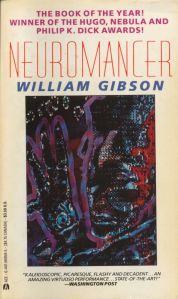
If Blade Runner established the look, Neuromancer defined cyberpunk’s voice. William Gibson’s debut novel was ahead of the curve by acknowledging the personal computer as a disruptive force when the Cold War was at its most threatening. “Lowlife and high tech” meant the Magnetic Dog Sisters headlining some creep joint across the street from a capsule hotel where console cowboys rip off zaibatsus with their Ono Sendai Cyberdeck. But Gibson’s view of the future would be incomplete without an absolute distrust of Reaganism:

“If I were to put together a truly essential thank-you list for the people who most made it possible for me to write my first six novels, I’d have to owe as much to Ronald Reagan as to Bill Gates or Lou Reed. Reagan’s presidency put the grit in my dystopia. His presidency was the fresh kitty litter I spread for utterly crucial traction on the icey driveway of uncharted futurity. His smile was the nightmare in my back pocket.” — William Gibson

“Fragments of a Hologram Rose” to Mona Lisa Overdrive is a decade of creative labor that was “tired of America-as-the-future, the world as a white monoculture.” The Sprawl is a cyberpunk trilogy where military superpowers failed and technology gave Japan leadership of the global village. Then Gibson wrote Virtual Light and readers witnessed extreme inequality shove the middle class into the gig economy as corporations schemed to profit off natural disasters with proprietary technology.

Gibson knew the sci-fi he didn’t care for would absorb cyberpunk and tame its “dissident influence”, so the genre could remain unchanged. “Punk” is the go-to suffix for emerging subgenres that want to appear subversive while posing a threat to nothing and no one. It’s how “hopepunk” becomes a thing. But to appreciate cyberpunk’s assimilation, look at how it’s presented sincerely.

CD Projekt Red (CDPR), known for the Witcher game series, has spent six years developing what’s arguably the most anticipated video game of the moment, Cyberpunk 2077. Like Gibson, Mike Pondsmith, creator the original “pen-n-paper” RPG, and collaborator on this adaptation of his work, has had his writing absorbed by mainstream sci-fi. CDPR could survive on that 31-year legacy, but they insist they’re taking their time with Cyberpunk 2077 to craft an experience with a distinct political identity that somehow allows players to remain apolitical. In a way this is reflective of CDPR’s reputation as a quality-driven business that’s pro-consumer, but has driven talent away by demanding they work excessive hours and promoting a hostile attitude towards unions. This crunch culture is a problem across the industry.

We’ll soon see how Cyberpunk 2077 developed. What we can infer from its design choices, like giving protagonist V a high-collar jacket seen on the cover of the 2nd edition game book from 1990, is that Cybperpunk 2077 will be familiar. Altered Carbon and Ready Player One share this problem. Altered Carbon is so derivative of first-wave cyberpunk it’s easy to forget its based on a novel from 2002. Ready Player One at least has the courtesy to be shameless in its love of pop culture, proud to proclaim that nothing is more celebrated today than our participation in media franchises without ever considering how that might be a problem.

What’s being suggested, intentionally or not, is that contemporary reality has avoided the machinations of the powerful at a time when technology is wondrous, amusing, and prolific. If only we were so lucky.

238 cities spent more than a year lobbying Amazon, one of two $1 trillion corporations in existence, for privilege of hosting their new office. In November it was announced that Amazon would expand to Crystal City, Virginia and Long Island City, Queens. Plenty of New Yorkers are incensedthat the world’s largest online marketplace will get $3 billion in subsidies, tax breaks, and grants to further disrupt a housing market that takes more from them than any city should allow. Some Amazon employees were so excited to relocate they made down payments on their new homes before the decision went public, telling real estate developers to get this corner of New York readyfor a few thousand transplants. But what of the people already there?

Long Island City is home to the Queensbridge Houses, the largest housing project in the US. Built in 1939, these two buildings are home to more then 6,000 people with an average income of $16,000. That’s far below the $54,000 for Queens residents overall. But neither group is anywhere near the average salary for the 25,000 employees Amazon will bring with them, which will exceed $150,000. How many of those positions will be filled by locals? How many will come from Queensbridge?

Over 800 languages are spoken in Queens, making it the most linguistically diverse place in the world. Those diverse speakers spend over 30% of their income on rent. They risk being priced out of their neighborhoods. Some will be forced out of the city. Has Governor Cuomo considered the threat this deal poses to people’s homes? Has Mayor de Blasio prepared for the inevitable drift to other boroughs once property values spike? Looking at Seattle and San Francisco, there’s no reason to expect local governments to be proactive. So New Yorkers have taken up the fight on their own.

Amazon boss Jeff Bezos toyed with these politicians. He floated the idea that any city could become the next Silicon Valley and they believed him. They begged for his recognition, handed over citizen data, and took part in the $100 billion ritual of subsidizing tech companies.

It was all for nothing. Crystal City is a 20-minute drive from Bezos’ house in Washington DC, where Amazon continues to increase its spending on lobbyists. That’ll seem like a long commute compared to the helicopter ride from Long Island City, the helipad for which is subsidized by the city, to Manhattan, the financial and advertising capital of the world, where Bezos owns four more houses.

The auction for Bezos’ favor was a farce. New York and Virginia give him regular access to people with decision-making power, invaluable data, and institutions that are are sure to expand his empire. These cities were always the only serious options.

Amazon’s plans read like the start of a corporate republic, a cyberpunk trope inspired by company towns. Employers were landlords, retailers, and even moral authorities to workforces too in debt to quit. Many had law enforcement and militias to call on in addition to the private security companies they hired to break labor strikes, investigate attempts at unionization, and maintain a sense of order that resulted in massacres like Ludlow, Colorado.

Amazon is known for labor abuses, monitoring, and tracking speed and efficiency in warehouses without bathroom breaks, where employees have collapsed from heat exhaustion. They sell unregulated facial recognition services to police departments, knowing it misidentifies subjects because of inherent design bias. Companies with a history of privacy abuses have unfettered access to their security devices. They control about half of all e-commerce in the US and, as Gizmodo’s Kashmir Hill found out, it is impossible to live our lives without encountering Amazon Web Services.

It doesn’t take a creative mind to imagine similar exposition being attributed to corporate villains like Cayman Global or Tai Yong Medical.

Rewarding corporations for their bad behavior is just one way the world resembles a fictive dystopia. We also have to face rapid ecological and institutional decay that fractionally adjusts our confidence in stability, feeding a persistent situational anxiety. That should make for broader and bolder conversations about the future, and a few artists have managed to do that.

Keiichi Matsuda is the designer and director behind Hyper-Reality, a short film that portrays augmented reality as a fever dream that influences consumption, and shows how freeing and frightening it is to be cut off from that network. Matsuda’s short film got him an invitation to the World Economic Forum in Davos to “speak truth to power.” What Matsuda witnessed were executives and billionaires pledging responsibility with t-shirts and sustainability, while simultaneously destroying the environment, as an audience of their peers and the press nodded and applauded “this brazen hypocrisy.” So Matsuda took a stanchion to his own installation.

Independence means Matsuda gets to decide how to talk about technology and capitalism, and how to separate his art and business. It also means smaller audiences and fewer productions.

Sam Esmail used a more visible platform to “bring cyberpunk to TV” with Mr. Robot. Like Gibson’s Pattern Recognition, it’s cyberpunk retooled for the present — post-cyberpunk. Esmail never hesitates to place our villains in Mr. Robot. Enron is an influence on logo designs and tactics of evil corps. Google, Verizon, and Facebook are called out for their complicity with the federal government in exposing customer data. AT&T’s Long Lines building, an NSA listening post since the 1970s, plays the role of a corporate data hub that reaches across the county. Even filming locations serve as commentary.

An anti-capitalist slant runs through Mr. Robot, exposing the American dream as a lie and our concept of meritocracy as a tool to protect the oligarchy, presenting hackers as in direct contact with a world of self-isolation and exploitation, those who dare to hope for a future affected by people rather than commerce. And Esmail somehow manages this without interference from NBC.

Blade Runner will get more life as an animeCowboy Bebop is joining Battle Angel Alita in live action. Altered Carbon is in the process of slipping into a new sleeve. There’s no shortage of revivals, remakes, and rehashing of cyberpunk’s past on the way. They’ll get bigger audiences than a short film about submitting to algorithms. More sites will discuss their pros and cons than a mobile tie-in that name-drops Peter Kropotkin and Maria Nikiforova. But in being descriptive and prescriptive, moving to the future and looking for sure footing in the accelerated present, Matsuda’s and Esmail’s work reminds us that cyberpunk needs to be more than just repeating what’s already been said about yuppies, Billy Idol, and the Apple IIc.

We live at a time where 3D printing is so accessible refugees can obtain prosthesis as part of basic aid. People forced to migrate because of an iceless arctic will rely on that assistance. Or we could lower temperatures and slow climate change by spraying the atmosphere with sulfate, an option that might disrupt advertising in low-orbit. Social credit systems are bringing oppressive governments together. Going cashless is altering our expectations of others. Young people earn so little they’re leveraging nude selfies to extend meager lines of credit. Productivity and constant notifications are enough to drive some into a locked room, away from anything with an internet connection. Deepfakes deny women privacy, compromise their identity, and obliterate any sense of safety in exchange for porn. Online communities are refining that same technology, making false video convincing, threatening our sense of reality. Researchers can keep our memories alive in chat bots distilled from social media, but the rich will outlive us all by transfusing bags of teenage blood purchased through PayPal.

In a world that increasingly feels like science fiction it’s important to remind ourselves that writing about the future is writing about the present. Artists worthy of an audience should be unable to look at the embarrassment of inspiration around them and refuse the chance to say something new.

Bust the Trust: Now is the Time to Break Up Amazon

By Andy Laties with additional reporting by Sander Hicks

Source: The New York Megaphone

Standing at the cash register at an Upper West Side independent bookstore I used to run, I once noted the frequent passage of cars painted all over with Amazon’s “And You’re Done” logo. These same-day delivery vehicles were Amazon’s way of pushing back against the resurgence of New York City independent bookselling in progress. Soon, the cars were joined by a Columbus Circle location of the Amazon Books chain. That brick-and-mortar store gave lie to Amazon’s long-standing rhetoric that physical bookstores were doomed.

I have competed with Amazon for twenty years. A couple years ago, we indies were finally winning. 2015 was a great year. More independent stores were opening than closing: Books Are Magic, Greenlight, Word Up, Stories, Archestratus Books & Foods, Astoria Bookshop and Quimby’s. New locations for Book Culture, McNally Jackson, WORD and Books of Wonder were in the works. That trend was mirrored nationally. While our numbers had fallen from 4,000 to 1,500, between 1995 and 2005, now we were pushing 2,000 bookstores again.

Why do indy bookstores matter so much? Well, here’s one way to put it, from the writer Ocean Vuong, “The way I see it, whenever someone walks into a bookstore, they are walking into the future of their cultural and intellectual life. A bookseller collaborates with who you are in order to show you a way forward towards more of yourself, a way you might not have known existed for you–but is still entirely your own. Amazon, with its algorithms, can only show you where you’ve been, can only give you the calcified mirror of your past. In a bookstore, you get a human being who is also a mapmaker of possibility.”


A PEOPLE’S HISTORY OF AMAZON

Amazon itself had started as a New York City project. But retailers don’t collect sales tax on out-of-state shipments. So when hedge fund boy wonder Jeff Bezos rounded up his one million in in start-up capital, he left New York City behind. He launched his company in the lightly-populated Washington State. Bezos planned a national mail-order operation that wouldn’t have to collect sales tax in any other state, especially populous New York and California. Thus, most customers would enjoy a six percent or more cost reduction on each sale.

We indie businesses fought together for twenty years to force Amazon to collect sales tax. And we won. I’m proud of what we fierce indies did to force Amazon to pay sales tax. These taxes fund public services like Medicaid and the local fire department. But Amazon had evolved during the battle, and like that strangling kudzu vine you thought you killed last Fall, it grew back even bigger in the Spring. Instead of dying, Amazon turned into that monster plant from Little Shop of Horrors.

After our victories at the state and national levels, there was no longer any reason for Bezos to base his company in Seattle. That’s one reason Amazon is expanding with a big new HQ2 planned for Crystal City, VA. They recently planned to come back to New York City, but chickened out due to the public criticisms about Amazon’s lucrative tax breaks.

Ten years ago, Amazon used to be an innovative book-seller online. Today, They work for CIA, NSA, they help do facial recognition for ICE. They are bidding to create a “new brain” for the Pentagon, in the little-known “JEDI” program. With Jeff Bezos’s ownership of the Washington Post, they are simultaneously powerful DC lobbyists, defense contractors, spies, and a leading DC media vehicle. Amazon is one juggernaut of unbridled corporate and war-making power.

Amazon developed its Amazon Web Services (AWS), the highly profitable, cloud-hosting division, out of the software and hardware infrastructure that runs its online retail operation. Recent headlines tell the tale of how Amazon monetized AWS. Technology Review reported, “Amazon is the Invisible Backbone Behind ICE’s Immigration Crackdown” And Business Insider let us know that “Amazon is Launching a ‘Secret’ Cloud Service for the CIA.” “‘Alexa, Drop a Bomb’: Amazon Wants in on US Warfare” reveals the plans between Amazon and the Pengaton, for the new JEDI program, as reported by Truthout.

The new Amazon wants to become a leading merchant of death, specializing in robotic drones, while moonlighting as web host for ICE and CIA. Its planned “Washington D.C. footprint” is just across the highway from the Pentagon. The failed effort to come into Queens was offering “twenty-five-thousand jobs.” But who can count how many jobs Amazon has killed, and how many retail stores have closed, due to Amazon artificially lowering prices? (A recent article in Yale Law School journal makes the case that Amazon might be on the road to being a monopoly, since it artificially lowers prices to kill competition.) Amazon promises to add jobs in NYC, but recently committed to making those jobs non-union. Workers at Amazon warehouses complain of onerous conditions at low wages, in which bathroom breaks are rare, and workers sometimes have to urinate into plastic bottles.

Amazon is super convenient. It’s true. But Amazon’s retail customers will feel angst and regret once they learn their dollars pay for robotic drone warfare and racial profiling of immigrants.

Recently, the American Booksellers Association reported that Amazon could be a monopoly. They control 75% of all online retail bookselling, the way that Standard Oil controlled the oil industry, before it was broken up as a monopoly, in 1911.

Let’s resist this new version of the Amazon monopoly. Amazon is an arms dealer and corporate spy. Let’s advocate that the Federal Trade Commission dismember the Amazon octopus. Let’s support a movement that is fired up to do “trust-busting.”

For our safety, it’s time to break up Amazon.


Andrew Laties is the author of Rebel Bookseller: Why Indie Businesses Stand for Everything You Want to Fight For, from Free Speech to Buying Local to Building Communities. He currently co-owns Book and Puppet Company, in Easton, Pennsylvania.

‘Highly Disturbing’: Facebook Blocks Viral Video Outlets Critical of US Foreign Policy and Corporate Media

Journalists and free speech advocates are calling out the social media giant for shuttering the pages after CNN inquired about Berlin-based media company Maffick’s funding from the Russian government

By Jessica Corbett

Source: Common Dreams

Journalists and advocates of press freedoms are once more directing outrage and criticism at Facebook for selectively censoring pages on its platform and refusing to explain the reason behind a decision that appears to many as a clear double standard applied to outlets critical of U.S. foreign policy and corporate interests.

Facebook is under fire for shuttering four pages managed by the Berlin-based news and media company Maffick, after CNN reporters asked the social media giant about Maffick not disclosing that it is partly funded by the Russian government.

CNN held its report—titled “Russia is backing a viral video company aimed at American millennials“—until Friday, when Facebook blocked Soapbox, Waste-Ed, Backthen, and In The Now.

American-Lebanese journalist Rania Khalek, a contributor to Soapbox and In The Now who was interviewed by CNN, outlined the controversy in a lengthy, widely shared series of tweets. Monday morning, Khalek added an update to the Twitter thread:

As CNN outlined in its report, which was updated and corrected on Monday:

Company records [for Maffick] in Germany show that 51 percent of the company is owned by Ruptly [a subsidiary of RT, which is funded by the Russian government]. The remaining 49 percent is controlled by former RT presenter Anissa Naouai, who is Maffick’s CEO. The records were first reported by the German outlet T-online and later by the Alliance for Securing Democracy, which brought it to CNN‘s attention. The Alliance for Securing Democracy is part of the German Marshall Fund, which receives funding from the U.S., German, and other governments. The Alliance for Securing Democracy says that while it is part of the German Marshall Fund, the ASD itself does not receive any funding from the GMF, and gets its money from private family funds and grants but not from government funding.

In the Now was originally a television show on RT, hosted by Naouai. It has more than 3 million followers on Facebook,” CNN noted. The other three pages “have more than 30 million video views, though they’ve only been operating for a few months.”

What kind of content did they produce? Khalek offered a number of examples, including:

In an interview with CNN, Maffick chief operating officer J. Ray Sparks emphasized that Maffick is editorially independent from RT—which the U.S. government has forced to register as a foreign agent—and pointed out that it is “standard industry practice” not to disclose ownership of a media producer on a Facebook page.

However, as Kevin Gosztola—who cohosts a podcast with Khalek—noted in an article published Saturday on Shadowproof, “Although Khalek and Sparks detailed their editorial independence at Maffick extensively, [CNN correspondent Drew] Griffin remained incredulous at the reality that officials working at the Kremlin are not dictating what specific stories should be covered.”

“Similarly to NPR, PBS, BBC, DW, CBC, AJ+, and many other media companies, Maffick is supported in part by government funding. Likewise while we haven’t posted funding details on our Facebook pages etc, neither have any of our international peers,” Maffick said in a statement that charges the company was singled out for “one reason and one reason only: The government that helps fund our company is Russia.”

“We did not violate any of Facebook’s policies whatsoever. None of our content promotes disinformation or fake news. Yet CNN pressured Facebook into unprecedented censorship in a desperate attempt to milk ratings by stoking hysteria over Russia,” the statement continues, calling on Facebook to reinstate its pages and “articulate clear, consistent policies and protocols regarding obligatory funding disclosures which will be applied evenly across all pages.”

Since Friday, Khalek and others who often linked to her initial thread have turned to another major social media platform—Twitter—to raise alarm about the role of the ASD and the communication CNN subsequently had with Facebook:

Although Facebook’s rules don’t require pages to disclose parent companies, a spokesperson told CNN in a statement that the social media company planned to reach out to Maffick page administrators “to ask that they disclose this additional information and their affiliation with their parent company to get back on the platform.”

The move by Facebook comes after the company temporarily took down one of Khalek’s videos for Soapbox—about “how Israel uses Palestine as a weapons testing laboratory”—in late December, and only restored it after public outcry. Facebook also was intensely criticized last year for censoring the left-leaning Latin American news network teleSUR English, funded by the Venezuelan government and others, as well as a video about Christopher Columbus’ brutal legacy produced by Double Down News.


The Stomach-Churning Violence of the Agrochemical Oligopoly

By Colin Todhunter

Source: OffGuardian

As humans, we have evolved with the natural environment over millennia. We have learned what to eat and what not to eat, what to grow and how to grow it and our diets have developed accordingly. We have hunted, gathered, planted and harvested. Our overall survival as a species has been based on gradual, emerging relationships with the seasons, insects, soil, animals, trees and seeds. And out of these relationships, we have seen the development of communities whose rituals and bonds have a deep connection with food production and the natural environment.

However, over the last couple generations, agriculture and food production has changed more than it had done over previous millennia. These changes have involved massive social upheaval as communities and traditions have been uprooted and have entailed modifying what we eat, how we grow our food and what we apply to it. All of this has been driven by geopolitical concerns and powerful commercial interests with their proprietary chemicals and patented seeds. The process of neoliberal globalisation is accelerating the process as farmers are encouraged to produce for global supply chains dominated by transnational agribusiness.

Certain crops are now genetically engineered, the range of crops we grow has become less diverse, synthetic biocides have been poured on crops and soil and our bodies have been subjected to a chemical bombardment. We have arrived at a point where we have lost touch with our deep-rooted microbiological and social connection with nature and have developed an arrogance that has placed ‘man’ above the environment and all other species. One of the consequences is that we have paid an enormous price in terms of the consequent social, environmental and health-related devastation.

Despite the promise and potential of science, it has too often in modern society become a tool of vested interests, an ideology wrapped in the vestiges of authority and the ‘superstition’ that its corporate-appointed priesthood should not be challenged nor questioned. Instead of liberating humankind, it has now too often become a tool of deception in the hands of agribusiness conglomerates which make up the oligopoly that controls what is an increasingly globalised system of modern food and agriculture.

These corporations have successfully instituted the notion that the mass application of biocides, monocropping and industrial agriculture are necessary and desirable. They are not. However, these companies have used their science and propaganda to project certainty in order to hide the fact that they have no real idea what their products and practices are doing to human health or the environment (and in cases when they do know, they do their best to cover it up or hide behind the notion of ‘commercial confidentiality’).

Based on their limited, tainted studies and co-opted version of science, they say with certainty that, for example, genetically engineered food and glyphosate are ‘safe’. And when inconvenient truths do emerge, they will mobilise their massive lobbying resources to evade regulations, they will seek to hide the dangers of their products or they will set out to destroy scientists whose findings challenge their commercial bottom line.

Soil microbiologists are still trying to fully comprehend soil microbes and how they function as anintegrated network in relation to plants. The agrochemical sector has little idea of how their biocides have affected soils. It merely churns out public relations spin that their inputs are harmless for soil, plants and human health. Such claims are not based on proper, in-depth, long-term studies. They are based on a don’t look, don’t find approach or a manipulation of standards and procedures that ensure their products make it on to the commercial market and stay there.

And what are these biocides doing to us as humans? Numerous studies have linked the increase in pesticide us with spiralling rates of ill health. Kat Carrol of the National Health Federation is concerned about the impacts on human gut bacteria that play a big role in how organs function and our neurological health. The gut microbiome can contain up to six pounds of bacteria and is what Carroll calls ‘human soil’. She says that with their agrochemicals and food additives, powerful companies are attacking this ‘soil’ and with it the sanctity of the human body.

And her concerns seem valid. Many important neurotransmitters are located in the gut. Aside from affecting the functioning of major organs, these transmitters affect our moods and thinking. Feed gut bacteria a cocktail of biocides and is it any surprise that many diseases are increasing?

For instance, findings published in the journal ‘Translational Psychiatry’ provide strong evidence that gut bacteria can have a direct physical impact on the brain. Alterations in the composition of the gut microbiome have been implicated in a wide range of neurological and psychiatric conditions, including autism, chronic pain, depression, and Parkinson’s Disease.

Environmental campaigner Dr Rosemary Mason has written extensively on the impacts of agrochemicals (especially glyphosate) on humans, not least during child and adolescent development. In her numerous documents and papers, she cites a plethora of data and studies that link the use of agrochemicals with various diseases and ailments. She has also noted the impact of these chemicals on the human gut microbiome.

The science writer Mo Costandi discusses the importance of gut bacteria and their balance. In adolescence the brain undergoes a protracted period of heightened neural plasticity, during which large numbers of synapses are eliminated in the prefrontal cortex and a wave of ‘myelination’ sweeps across this part of the brain. These processes refine the circuitry in the prefrontal cortex and increase its connectivity to other brain regions. Myelination is also critical for normal, everyday functioning of the brain. Myelin increases a nerve fibre’s conduction velocity by up to a hundred times, and so when it breaks down, the consequences can be devastating.

Other recent work shows that gut microbes control the maturation and function of microglia, the immune cells that eliminate unwanted synapses in the brain; age-related changes to gut microbe composition might regulate myelination and synaptic pruning in adolescence and could, therefore, contribute to cognitive development. Upset those changes, and, As Mason argues, there are going to be serious implications for children and adolescents. Mason places glyphosate at the core of the ailments and disorders currently affecting young people in Wales and the UK in general.

Yet we are still being subjected to an unregulated cocktail of agrochemicals which end up interacting with each other in the gut. Regulatory agencies and governments appear to work hand in glove with the agrochemical sector.

Carol Van Strum has released documents indicating collusion between the manufacturers of dangerous chemicals and regulatory bodies. Evaggelos Vallianatos has highlighted the massive fraud surrounding the regulation of biocides and the wide scale corruption at laboratories that were supposed to test these chemicals for safety. Many of these substances were not subjected to what was deemed proper testing in the first place yet they remain on the market. The late Shiv Chopra also highlighted how various dangerous products were allowed on the commercial market and into the food chain due to collusion between these companies and public officials.

Powerful transnational corporations are using humanity as their collective guinea pig. But those who question them, or their corporate science, are automatically labelled anti-science and accused of committing crimes against humanity because they are preventing their products from being commercialised ‘to help the poor or hungry’. Such attacks on critics by company mouthpieces who masquerade as public officials, independent scientists or independent journalists are mere spin. They are, moreover, based on the sheer hypocrisy that these companies (owned and controlled by elite interests) have humanity’s and the environment’s best interests at heart.

Many of these companies have historically profited from violence. Unfortunately, that character of persists. They directly profit on the back of militarism, whether as a result of the US-backed ‘regime change’ in Ukraine or the US invasion of Iraq. They also believe they can cajole (poison) nature by means of chemicals and bully governments and attack critics, while rolling out propaganda campaigns for public consumption.

Whether it involves neocolonialism and the destruction of indigenous practices and culturesunder the guise of ‘development’, the impoverishment of farmers in India, the twisting and writing of national and international laws, the destruction of rural communities, the globalisation of bad food and illness, the deleterious impacts on health and soil, the hollowing out of public institutions and the range of human rights abuses we saw documented during The Monsanto Tribunal, what we are witnessing is structural violence in many forms.

Pesticides are in fact “a global human rights concern” and are in no way vital to ensuring food security. Ultimately, what we see is ignorance, arrogance and corruption masquerading as certainty and science.

…when we wound the planet grievously by excavating its treasures – the gold, mineral and oil, destroy its ability to breathe by converting forests into urban wastelands, poison its waters with toxic wastes and exterminate other living organisms – we are in fact doing all this to our own bodies… all other species are to be enslaved or driven to extinction if need be in the interests of human ‘progress’… we are part of the same web of life –where every difference we construct artificially between ‘them’ and ‘us’ adds only one more brick to the tombstone of humankind itself.”
from Micobes of the World Unite! by Satya Sager

Jacques Ellul: A Prophet for Our Tech-Saturated Times

Read his works to understand how we’ve been caught in technology’s nightmarish hold.

By Andrew Nikiforuk

Source: The Tyee

By now you have probably read about the so-called “tech backlash.”

Facebook and other social media have undermined what’s left of the illusion of democracy, while smartphones damage young brains and erode the nature of discourse in the family.

Meanwhile computers and other gadgets have diminished our attention spans along with our ever-failing connection to reality.

The Foundation for Responsible Robotics recently created a small stir by asking if “sexual intimacy with robots could lead to greater social isolation.”

What could possibly go wrong?

The average teenager now works about two hours of every day — for free — providing Facebook and other social media companies with all the data they need to engineer young people’s behaviour for bigger Internet profits.

Without shame, technical wonks now talk of building artificial scientists to resolve climate change, poverty and, yes, even fake news.

The media backlash against Silicon Valley and its peevish moguls, however, typically ends with nothing more radical than an earnest call for regulation or a break-up of Internet monopolies such as Facebook and Google.

The problem, however, is much graver, and it is telling that most of the backlash stories invariably omit any mention of technology’s greatest critic, Jacques Ellul.

The ascent of technology

Ellul, the Karl Marx of the 20th century, predicted the chaotic tyranny many of us now pretend is the good and determined life in technological society.

He wrote of technique, about which he meant more than just technology, machines and digital gadgets but rather “the totality of methods rationally arrived at and having absolute efficiency” in the economic, social and political affairs of civilization.

For Ellul, technique, an ensemble of machine-based means, included administrative systems, medical tools, propaganda (just another communication technique) and genetic engineering.

The list is endless because technique, or what most of us would just call technology, has become the artificial blood of modern civilization.

“Technique has taken substance,” wrote Ellul, and “it has become a reality in itself. It is no longer merely a means and an intermediary. It is an object in itself, an independent reality with which we must reckon.”

Just as Marx deftly outlined how capitalism threw up new social classes, political institutions and economic powers in the 19th century, Ellul charted the ascent of technology and its impact on politics, society and economics in the 20th.

My copy of Ellul’s The Technological Society has yellowed with age, but it remains one of the most important books I own. Why?

Because it explains the nightmarish hold technology has on every aspect of life, and also remains a guide to the perplexing determinism that technology imposes on life.

Until the 18th century, technical progress occurred slowly and with restraint. But with the Industrial Revolution it morphed into something overwhelming due in part to population, cheap energy sources and capitalism itself.

Since then it has engulfed Western civilization and become the globe’s greatest colonizing force.

“Technique encompasses the totality of present-day society,” wrote Ellul. “Man is caught like a fly in a bottle. His attempts at culture, freedom, and creative endeavour have become mere entries in technique’s filing cabinet.”

Ellul, a brilliant historian, wrote like a physician caught in the middle of a plague or physicist exposed to radioactivity. He parsed the dynamics of technology with a cold lucidity.

Yet you’ve probably never heard of the French legal scholar and sociologist despite all the recent media about the corrosive influence of Silicon Valley.

His relative obscurity has many roots. He didn’t hail from Paris, but rural Bordeaux. He didn’t come from French blue blood; he was a “meteque.”

He didn’t travel much, criticized politics of every stripe and was a radical Christian.

But in 1954, just a year before American scientists started working on artificial intelligence, Ellul wrote his monumental book, The Technological Society.

The dense and discursive work lays out in 500 pages how technique became for civilization what British colonialism was for parts of 19th-century Africa: a force of total domination.

In the book Ellul explains in bold and uncompromising terms how the logic of technological innovation conquered every aspect of human culture.

Ellul didn’t regard technology as inherently evil; he just recognized that it was a self-augmenting force that engineered the world on its terms.

Machines, whether mechanical or digital, aren’t interested in truth, beauty or justice. Their goal is to make the world a more efficient place for more machines.

Their proliferation combined with our growing dependence on their services inevitably led to an erosion of human freedom and unintended consequences in every sphere of life.

Ellul was one of the first to note that you couldn’t distinguish between bad and good effects of technology. There were just effects and all technologies were disruptive.

In other words, it doesn’t matter if a drone is delivering a bomb or book or merely spying on the neighbourhood, because technique operates outside of human morality: “Technique tolerates no judgment from without and accepts no limitations.”

Facebook’s mantra “move fast and break things” epitomizes the technological mindset.

But some former Facebook executives such as Chamath Palihapitiya belatedly realized they have engineered a force beyond their control. (“The short-term dopamine-driven feedback loops that we have created are destroying how society works,” Palihapitiya has said.)

That, argued Ellul, is what technology does. It disrupts and then disrupts again with unforeseen consequences, requiring more techniques to solve the problems created by latest innovations.

As Ellul noted back in 1954, “History shows that every technical application from its beginnings presents certain unforeseeable secondary effects which are more disastrous than the lack of the technique would have been.”

Ellul also defined the key characteristics of technology.

For starters, the world of technique imposes a rational and mechanical order on all things. It embraces artificiality and seeks to replace all natural systems with engineered ones.

In a technological society a dam performs better than a running river, a car takes the place of the pedestrians — and may even kill them — and a fish farm offers more “efficiencies” than a natural wild salmon migration.

There is more. Technique automatically reduces actions to the “one best way.” Technical progress is also self-augmenting: it is irreversible and builds with a geometric progression.

(Just count the number of gadgets telling you what to do or where to go or even what music to play.)

Technology is indivisible and universal because everywhere it goes it shows the same deterministic face with the same consequences. And it is autonomous.

By autonomous, Ellul meant that technology had become a determining force that “elicits and conditions social, political and economic change.”

The role of propaganda

The French critic was the first to note that technologies build upon each other and therefore centralize power and control.

New techniques for teaching, selling things or organizing political parties also required propaganda.

Here again Ellul saw the future.

He argued that propaganda had to become as natural as breathing air in a technological society, because it was essential that people adapt to the disruptions of a technological society.

“The passions it provokes — which exist in everybody — are amplified. The suppression of the critical faculty — man’s growing incapacity to distinguish truth from falsehood, the individual from the collectivity, action from talk, reality from statistics, and so on — is one of the most evident results of the technical power of propaganda.”

Faking the news may have been a common practice on Soviet radio during Ellul’s day, but it is now a global phenomenon leading us towards what Ellul called “a sham universe.”

We now know that algorithms control every aspect of digital life and have subjected almost aspect of human behaviour to greater control by techniques whether employed by the state or the marketplace.

But in 1954 Ellul saw the beast emerging in infant form.

Technology, he wrote, can’t put up with human values and “must necessarily don mathematical vestments. Everything in human life that does not lend itself to mathematical treatment must be excluded… Who is too blind to not see that a profound mutation is being advocated here.”

He, too, warned about the promise of leisure provided by the mechanization and automatization of work.

“Instead of being a vacuum representing a break with society,” our leisure time will be “literally stuffed with technical mechanisms of compensation and integration.”

Good citizens today now leave their screens at work only to be guided by robots in their cars that tell them the most efficient route to drive home.

At home another battery of screens awaits to deliver entertainments and distractions, including apps that might deliver a pizza to the door.

Stalin and Mao would be impressed — or perhaps disappointed — that so much social control could be exercised with such sophistication and so little bloodletting.

Ellul wasn’t just worried about the impact of a single gadget such as the television or the phone but “the phenomenon of technical convergence.”

He feared the impact of systems or complexes of techniques on human society and warned the result could only be “an operational totalitarianism.”

“Convergence,” he wrote, “is a completely spontaneous phenomenon, representing a normal stage in the evolution of technique.”

Social media, a web of behavioural and psychological systems, is just the latest example of convergence.

Here psychological techniques, surveillance techniques and propaganda have all merged to give the Russians and many other groups a golden opportunity to intervene in the political lives of 126 million North Americans.

Social media has achieved something novel, according to former Facebook engineer Sam Lessin.

For the first time ever a political candidate or party can “effectively talk to each individual voter privately in their own home and tell them exactly what they want to hear… in a way that can’t be tracked or audited.”

In China the authorities have gone one step further. Using the Internet the government can now track the movements of every citizen and rank their political trustworthiness based on their history of purchases and associations. It is, of course, a fantastic “counterterrorism” tool.

The Silicon Valley moguls and the digerati promised something less totalitarian. They swore that social media would help citizens fight bad governments and would connect all of us.

Facebook, vowed the pathologically adolescent Mark Zuckerberg, would help the Internet become “a force for peace in the world.”

But technology obeys its own rules and prefers “the psychology of tyranny.”

The digerati also promised that digital technologies would usher in a new era of decentralization and undo what mechanical technologies have already done: centralize everything into big companies, big boxes and big government.

Technology assuredly fragments human communities, but in the world of technique centralization remains the norm.

“The idea of effecting decentralization while maintaining technical progress is purely utopian,” wrote Ellul.

Towards ‘hypernormalization’

It is worth noting that the word “normal” didn’t come into currency until the 1940s along with technological society.

In many respects global society resembles the Soviet Union just prior to its collapse when “hypernormalization” ruled the day.

A recent documentary defined what hypernormalization did for Russia: it “became a society where everyone knew that what their leaders said was not real, because they could see with their own eyes that the economy was falling apart. But everybody had to play along and pretend that it was real because no one could imagine any alternative.”

In many respects technology has hypernormalized a technological society in which citizens exercise less and less control over their lives every day and can’t imagine anything different.

Throughout his life Ellul maintained that he was “neither by nature, nor doctrinally, a pessimist, nor have I pessimistic prejudices. I am concerned only with knowing whether things are so or not.”

He called a spade a spade, and did not sugarcoat his observations.

If you are growing more anxious about our hypernormalized existence and are wondering why you own a phone that tracks your every movement, then read The Technological Society.

Ellul believed that the first act of freedom a citizen can exercise is to recognize the necessity of understanding technique and its colonizing powers.

Resistance, which is never futile, can only begin by becoming aware and bearing witness to the totalitarian nature of technological society.

Ellul believed that Christians had a special duty to condemn the worship of technology, which has become society’s new religion.

To Ellul, resistance meant teaching people how to be conscious amphibians, with one foot in traditional human societies, and to purposefully choose which technologies to bring into their communities.

Only citizens who remain connected to traditional human societies can see, hear and understand the disquiet of the smartphone blitzkrieg or the Internet circus.

Children raised by screens and vaccinated only by technology will not have the capacity to resist, let alone understand, this world any more than someone born in space could appreciate what it means to walk in a forest.

Ellul warned that if each of us abdicates our human responsibilities and leads a trivial existence in a technological society, then we will betray freedom.

And what is freedom but the ability to overcome and transcend the dictates of necessity?

In 1954, Ellul appealed to all sleepers to awake.

Read him. He remains the most revolutionary, prophetic and dangerous voice of this or any century.