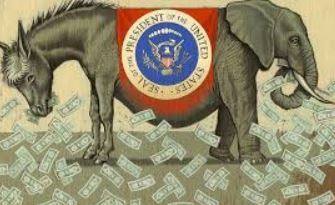
The ‘Values,’ ‘Vision,’ and ‘Democracy’ of an Inauthentic Opposition

Average Americans, whose economic survival is threatened, have no political party to represent them, including deceptive Democrats who claim to be their champions and blame others when their deception fails, says Paul Street.

By Paul Street

Source: Consortium News

Never underestimate the capacity of the United States’ Inauthentic Opposition Party, the corporate Democrats, for self-congratulatory delusion and the externalization of blame.

Look, for example, at the Democratic National Committee’s (DNC) recently filed 66-page lawsuit against Russia, WikiLeaks, and the 2016 Donald Trump campaign. The document accuses Russia of “mount[ing] a brazen attack on the American democracy,” “destabilize[ing] the U.S. political environment” on Trump’s (and Russia’s) behalf, and “interfering with our democracy….”

“The [RussiaGate] conspiracy,” the DNC Complaint says, “undermined and distorted the DNC’s ability to communicate the [Democratic] party’s values and vision to the American electorate” and “sowed discord within the Democratic Party at a time when party unity was essential…”

Yes, Russia, like numerous other nations living under the global shadow of the American Superpower, may well have tried to have some surreptitious say in 2016 U.S. presidential election. (Why wouldn’t the Kremlin have done that, given the very real and grave threats Washington and its Western NATO allies have posed for many years to post-Soviet-era Russian security and peace in Eastern Europe?)

Still, charging Russia with interfering with US-“American democracy” is like me accusing the Washington Capital’s star left winger Alex Ovechkin of interfering with my potential career as a National Hockey League player (I’m middle aged and can’t skate backwards). The U.S. doesn’t have a functioning democracy to undermine, as numerous careful studies (see this,this,this,this,this,this,this,this, and this) have shown.

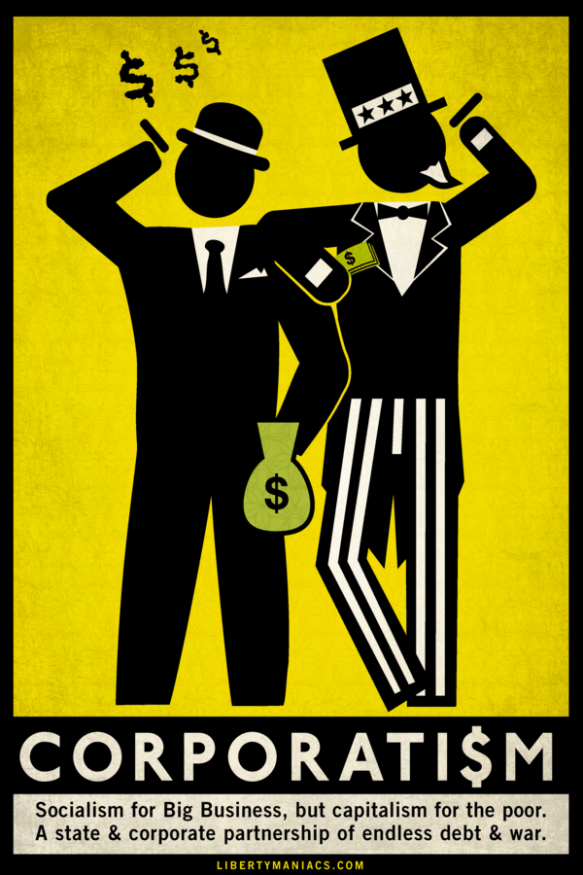
We have, rather, a corporate and financial oligarchy, an open plutocracy. U.S.-Americans get to vote, yes, but the nation’s “unelected dictatorship of money” reigns nonetheless in the United States, where, as leading liberal political scientists Benjamin Page (Northwestern) and Marin Gilens (Princeton) find, “government policy…reflects the wishes of those with money, not the wishes of the millions of ordinary citizens who turn out every two years to choose among the preapproved, money-vetted candidates for federal office.”

Our Own Oligarchs

Russia and WikiLeaks “destabilized the U.S. political environment”? Gee, how about the 20 top oligarchic U.S. mega-donors who invested more than $500 million combined in disclosed campaign contributions (we can only guess at how much “dark,” that is undisclosed, money they gave) to candidates and political organizations in the 2016 election cycle? The 20 largest organizational donors also gave a total of more than $500 million. The foremost plutocratic election investors included hard right-wing billionaires like casino owner Sheldon Adelson ($83 million disclosed to Republicans and right-wing groups), hedge-fund manager Paul Singer ($26 million to Republicans and the right), hedge fund manager Robert Mercer ($26 million) and packaging mogul Richard Uihlein ($24 million).

How about the multi-billionaire Trump’s own real estate fortune, which combined with the remarkable free attention the corporate media oligopoly granted him to help catapult the orange-tinted fake-populist beast past his more traditional Republican primary opponents? And what about the savagely unequal distribution of wealth and income in Barack Obama’s America, so extreme in the wake of the Great Recession that Hillary’s primary campaign rival Bernie Sanders could credibly report that the top tenth of the upper U.S.1% possessed nearly as much wealth as the nation’s bottom 90%? Such extreme disparity helped doom establishment, Wall Street- and Goldman Sachs-embroiled candidates like Jeb Bush, Marco Rubio, and Mrs. Clinton in 2016. Russia and WikiLeaks did not create that deep, politically- and neoliberal-policy-generated socioeconomic imbalance.

Double Vision

And just what were the Democratic Party “values and vision” that Russia, Trump, and WikiLeaks supposedly prevented the DNC and the Clinton team from articulating in 2016? As the distinguished political scientist and money-politics expert Thomas Ferguson and his colleagues Paul Jorgensen and Jie Chen noted in an important study released three months ago, the Clinton campaign “emphasized candidate and personal issues and avoided policy discussions to a degree without precedent in any previous election for which measurements exist….it deliberately deemphasized issues in favor of concentrating on what the campaign regarded as [Donald] Trump’s obvious personal weaknesses as a candidate.” Strangely enough, the Twitter-addicted reality television star Trump had a lot more to say about policy than the former First Lady, U.S. Senator, and Secretary of State Hillary Clinton, a wonkish Yale Law graduate.

The Democrats “values and vision” in 2016 amounted pretty much to the accurate but hardly inspiring or mass-mobilizing notion that Donald Trump was an awful person who was unqualified for the White House. Clinton ran almost completely on candidate character and quality. This was a blunder of historic proportions, given Clinton’s own highly problematic character brand. Any campaign needs a reasonably strong policy platform to stand on in case of candidate difficulties.

By Ferguson, Jorgenson, and Chen’s account, Hillary’s peculiar policy silence was about U.S. oligarchs’ campaign money. Thanks to candidate Trump’s bizarre nature and his declared isolationism and nationalism, Clinton achieved remarkable campaign finance success with normally Republican-affiliated capitalist sectors less disposed to abide the standard, progressive-sounding policy rhetoric of Democratic Party candidates than their more liberal counterparts.

One ironic but “fateful consequence” of her curious connection to conservative business interests was her “strategic silence about most important matters of public policy. … Misgivings of major contributors who worried that the Clinton campaign message lacked real attractions for ordinary Americans were rebuffed. The campaign,” Ferguson, Jorgenson, and Chen wrote, “sought to capitalize on the angst within business by vigorously courting the doubtful and undecideds there, not in the electorate.”

Other Clinton mistakes included failing to purchase television ads in Michigan, failing to set foot in Wisconsin after the Democratic National Convention, and getting caught telling wealthy New York City campaign donors that Trump’s white supporters were “a basket of” racist, sexist, nativist, and homophobic “deplorables.” This last misstep was a Freudian slip of the neoliberal variety. It reflected and advanced the corporate Democrats’ longstanding alienation of and from the nation’s rural and industrial and ex-industrial “heartland.”

Fake Progressives

As left historian Nancy Fraser noted after Trump was elected, the Democrats, since at least the Bill Clinton administration, had joined outwardly progressive forces like feminism, antiracism, multiculturalism, and LGBTQ rights to “financial capitalism.” This imparted liberal “charisma” and “gloss” to “policies that …devastated…what were once middle-class lives” by wiping out manufacturing, weakening unions, slashing wages, and increasing the “precarity of work.”

To make matters worse, Fraser rightly added, the “progressive neoliberal” blue-and digital-zone Democrats “compounded” the “injury of deindustrialization” with “the insult of progressive moralism,” which rips red-and analog-zone whites as culturally retrograde (recall candidate Obama’s problematic 2008 reflection on how rural and small-town whites “cling to religion and guns”) and yet privileged by the simple color of their skin.

Such insults from elite, uber-professional class neo-liberals like Obama (Harvard Law) and the Clintons (Yale Law) would sting less in the nation’s “flyover zones” if the those uttering them had not spent their sixteen years in the White House governing blatantly in accord with the wishes of Wall Street, Silicon Valley, and the leading multinational corporations. Like Bill Clinton’s two terms, the Obama years were richly consistent with Sheldon Wolin’s early 2008 description of the Democrats as an “inauthentic opposition” whose dutiful embrace of “centrist precepts” meant they would do nothing to “substantially revers[e] the drift rightwards” or “significantly alter the direction of society.”

The fake-“progressive” Obama presidency opened with the expansion of Washington’s epic bailout of the very parasitic financial elites who recklessly sparked the Great Recession (this with no remotely concomitant expansion of federal assistance to the majority middle- and working-class victims), the abandonment of campaign pledges to restore workers’ right to organize (through the immediately forgotten Employee Free Choice Act), and the kicking of Single Payer health care advocates to the curb as Obama worked with the big drug and insurance syndicates to craft a corporatist, profit-friendly health insurance reform. Obama’s second term ended with him doggedly (if unsuccessfully) championing the arch-authoritarian global-corporatist Trans Pacific Partnership.

This Goldman Sachs and Citigroup-directed policy record was no small part of what demobilized the Democrats’ mass electoral base in ways that “destabilized the U.S. political environment” to the benefit of the reactionary populist Trump, whose Mercer family-backed proto-fascistic strategist and Svengali Steve Bannon was smartly attuned to the Democrats’ elitist class problem.

There was a major 2016 presidential candidate who ran with genuinely progressive “values and vision” – Bernie Sanders. The most remarkable finding in Ferguson, Jorgenson, and Chen’s study is that the self-declared “democratic socialist” Sanders came tantalizingly close to winning the Democratic presidential nomination with no support from Big Business. The small-donor Sanders campaign was “without precedent in American politics not just since the New Deal, but across virtually the whole of American history … a major presidential candidate waging a strong, highly competitive campaign whose support from big business was essentially zero.”

Sanders was foiled by the big-money candidate Clinton’s advance control of the Democratic National Committee and convention delegates. Under a formal funding arrangement it worked up with the Democratic National Committee (DNC) in late September of 2015, the depressing “lying neoliberal warmonger” Hillary’s campaign was granted advance control of all the DNC’s “strategic decisions.” The Democratic Party’s presidential caucuses and primaries were rigged against Sanders in ugly ways that provoked a different lawsuit last year – a class-action suit against the DNC on behalf of Sanders’ supporters. The complaint was dismissed by a federal judge who ruled on the side of DNC lawyers by agreeing that the DNC was within its rights to violate their party’s charter and bylaws by selecting its candidate in advance of the primaries.

How was that for the noble “values and vision” that “American democracy” inspires atop the not-so leftmost of the nation’s two major and electorally viable political parties?

Under Cover of Russia-gate

That’s what “sowed discord within the Democratic Party at a time when party unity was essential…” Russia didn’t do it. Neither did WikiLeaks or the Trump campaign. The Clinton campaign and the Democratic Party establishment – themselves funded by major U.S. oligarchs like San Francisco hedge-fund billionaire Tom Steyer– did that on their own.

Could Sanders – the most popular politician in the U.S. (something rarely reported in a “mainstream” corporate media that could barely cover his giant campaign rallies even as it obsessed over Trump’s every bizarre Tweet) – have defeated the orange-tinted beast in the general election? Perhaps, though much of the oligarchic funding Hillary got would have gone to Trump if “socialist” Bernie had been the Democratic nominee. It is unlikely that Sanders could have accomplished much as president in a nation long controlled by the capitalist oligarchy in numerous ways that go far beyond campaign finance alone.

Meanwhile, under the cover of RussiaGate, the still-dismal and dollar-drenched corporate-imperial Democrats seem content to continue tilting to the center-right, purging Sanders-style progressives from the party’s leadership and citing the party’s special election victories (Doug Jones and Conor Lamb) against deeply flawed and Trump-backed Republicans in two bright-red voting districts (the state of Alabama and a fading Pennsylvania canton) as proof that tepid neoliberal centrism is still (even after Hillary’s stunning defeat) the way to go.

Along the way, the Inauthentic Opposition’s candidate roster for the upcoming Congressional mid-term election is loaded with an extraordinary number of contenders with U.S. military and intelligence backgrounds, consistent with Congressional Democrats repeated votes to give massive military and surveillance-state funds and power to a president they consider (accurately enough) unbalanced and dangerous.

The trick, the neoliberal “CIA Democrats” think, is to run conservative, Wall Street-backed imperial and National Security State veterans who pretend (see Eric Draitser’s recent piece on “How Clintonites Are Manufacturing Faux Progressive Congressional Campaigns”) to be aligned with majority-progressive left-of-center policy sentiments and values. It’s still very much their party.

Whatever happens during the next biennial electoral extravaganza, “the crucial fact” remains, in Wolin’s words nine years ago, “that for the poor, minorities, the working class and anti-corporatists there is no opposition party working on their behalf” in the United States – the self-declared homeland and headquarters of global democracy.


Paul Street is an independent radical-democratic policy researcher, journalist, historian, author and speaker based in Iowa City, Iowa, and Chicago, Illinois.  He is the author of seven books. His latest is They Rule: The 1% v. Democracy (Paradigm, 2014)

Disarming the Weapons of Mass Distraction

By Madeleine Bunting

Source: Rise Up Times

“Are you paying attention?” The phrase still resonates with a particular sharpness in my mind. It takes me straight back to my boarding school, aged thirteen, when my eyes would drift out the window to the woods beyond the classroom. The voice was that of the math teacher, the very dedicated but dull Miss Ploughman, whose furrowed grimace I can still picture.

We’re taught early that attention is a currency—we “pay” attention—and much of the discipline of the classroom is aimed at marshaling the attention of children, with very mixed results. We all have a history here, of how we did or did not learn to pay attention and all the praise or blame that came with that. It used to be that such patterns of childhood experience faded into irrelevance. As we reached adulthood, how we paid attention, and to what, was a personal matter and akin to breathing—as if it were automatic.

Today, though, as we grapple with a pervasive new digital culture, attention has become an issue of pressing social concern. Technology provides us with new tools to grab people’s attention. These innovations are dismantling traditional boundaries of private and public, home and office, work and leisure. Emails and tweets can reach us almost anywhere, anytime. There are no cracks left in which the mind can idle, rest, and recuperate. A taxi ad offers free wifi so that you can remain “productive” on a cab journey.

Even those spare moments of time in our day—waiting for a bus, standing in a queue at the supermarket—can now be “harvested,” says the writer Tim Wu in his book The Attention Merchants. In this quest to pursue “those slivers of our unharvested awareness,” digital technology has provided consumer capitalism with its most powerful tools yet. And our attention fuels it. As Matthew Crawford notes in The World Beyond Your Head, “when some people treat the minds of other people as a resource, this is not ‘creating wealth,’ it is transferring it.”

There’s a whiff of panic around the subject: the story that our attention spans are now shorter than a goldfish’s attracted millions of readers on the web; it’s still frequently cited, despite its questionable veracity. Rates of diagnosis attention deficit hyperactivity disorder in children have soared, creating an $11 billion global market for pharmaceutical companies. Every glance of our eyes is now tracked for commercial gain as ever more ingenious ways are devised to capture our attention, if only momentarily. Our eyeballs are now described as capitalism’s most valuable real estate. Both our attention and its deficits are turned into lucrative markets.

There is also a domestic economy of attention; within every family, some get it and some give it. We’re all born needing the attention of others—our parents’, especially—and from the outset, our social skills are honed to attract the attention we need for our care. Attention is woven into all forms of human encounter from the most brief and transitory to the most intimate. It also becomes deeply political: who pays attention to whom?

Social psychologists have researched how the powerful tend to tune out the less powerful. One study with college students showed that even in five minutes of friendly chat, wealthier students showed fewer signs of engagement when in conversation with their less wealthy counterparts: less eye contact, fewer nods, and more checking the time, doodling, and fidgeting. Discrimination of race and gender, too, plays out through attention. Anyone who’s spent any time in an organization will be aware of how attention is at the heart of office politics. A suggestion is ignored in a meeting, but is then seized upon as a brilliant solution when repeated by another person.

What is political is also ethical. Matthew Crawford argues that this is the essential characteristic of urban living: a basic recognition of others.

And then there’s an even more fundamental dimension to the politics of attention. At a primary level, all interactions in public space require a very minimal form of attention, an awareness of the presence and movement of others. Without it, we would bump into each other, frequently.

I had a vivid demonstration of this point on a recent commute: I live in East London and regularly use the narrow canal paths for cycling. It was the canal rush hour—lots of walkers with dogs, families with children, joggers as well as cyclists heading home. We were all sharing the towpath with the usual mixture of give and take, slowing to allow passing, swerving around and between each other. Only this time, a woman was walking down the center of the path with her eyes glued to her phone, impervious to all around her. This went well beyond a moment of distraction. Everyone had to duck and weave to avoid her. She’d abandoned the unspoken contract that avoiding collision is a mutual obligation.

This scene is now a daily occurrence for many of us, in shopping centers, station concourses, or on busy streets. Attention is the essential lubricant of urban life, and without it, we’re denying our co-existence in that moment and place. The novelist and philosopher, Iris Murdoch, writes that the most basic requirement for being good is that a person “must know certain things about his surroundings, most obviously the existence of other people and their claims.”

Attention is what draws us out of ourselves to experience and engage in the world. The word is often accompanied by a verb—attention needs to be grabbed, captured, mobilized, attracted, or galvanized. Reflected in such language is an acknowledgement of how attention is the essential precursor to action. The founding father of psychology William James provided what is still one of the best working definitions:

It is the taking possession by the mind, in clear and vivid form, of one out of what seem several simultaneously possible objects or trains of thought. Focalization, concentration, of consciousness are of its essence. It implies withdrawal from some things in order to deal effectively with others.

Attention is a limited resource and has to be allocated: to pay attention to one thing requires us to withdraw it from others. There are two well-known dimensions to attention, explains Willem Kuyken, a professor of psychology at Oxford. The first is “alerting”— an automatic form of attention, hardwired into our brains, that warns us of threats to our survival. Think of when you’re driving a car in a busy city: you’re aware of the movement of other cars, pedestrians, cyclists, and road signs, while advertising tries to grab any spare morsel of your attention. Notice how quickly you can swerve or brake when you spot a car suddenly emerging from a side street. There’s no time for a complicated cognitive process of decision making. This attention is beyond voluntary control.

The second form of attention is known as “executive”—the process by which our brain selects what to foreground and focus on, so that there can be other information in the background—such as music when you’re cooking—but one can still accomplish a complex task. Crucially, our capacity for executive attention is limited. Contrary to what some people claim, none of us can multitask complex activities effectively. The next time you write an email while talking on the phone, notice how many typing mistakes you make or how much you remember from the call. Executive attention can be trained, and needs to be for any complex activity. This was the point James made when he wrote: “there is no such thing as voluntary attention sustained for more than a few seconds at a time… what is called sustained voluntary attention is a repetition of successive efforts which bring back the topic to the mind.”

Attention is a complex interaction between memory and perception, in which we continually select what to notice, thus finding the material which correlates in some way with past experience. In this way, patterns develop in the mind. We are always making meaning from the overwhelming raw data. As James put it, “my experience is what I agree to attend to. Only those items which I notice shape my mind—without selective interest, experience is an utter chaos.”

And we are constantly engaged in organizing that chaos, as we interpret our experience. This is clear in the famous Gorilla Experiment in which viewers were told to watch a video of two teams of students passing a ball between them. They had to count the number of passes made by the team in white shirts and ignore those of the team in black shirts. The experiment is deceptively complex because it involves three forms of attention: first, scanning the whole group; second, ignoring the black T-shirt team to keep focus on the white T-shirt team (a form of inhibiting attention); and third, remembering to count. In the middle of the experiment, someone in a gorilla suit ambles through the group. Afterward, half the viewers when asked hadn’t spotted the gorilla and couldn’t even believe it had been there. We can be blind not only to the obvious, but to our blindness.

There is another point in this experiment which is less often emphasized. Ignoring something—such as the black T-shirt team in this experiment—requires a form of attention. It costs us attention to ignore something. Many of us live and work in environments that require us to ignore a huge amount of information—that flashing advert, a bouncing icon or pop-up.

In another famous psychology experiment, Walter Mischel’s Marshmallow Test, four-year-olds had a choice of eating a marshmallow immediately or two in fifteen minutes. While filmed, each child was put in a room alone in front of the plate with a marshmallow. They squirmed and fidgeted, poked the marshmallow and stared at the ceiling. A third of the children couldn’t resist the marshmallow and gobbled it up, a third nibbled cautiously, but the last third figured out how to distract themselves. They looked under the table, sang… did anything but look at the sweet. It’s a demonstration of the capacity to reallocate attention. In a follow-up study some years later, those who’d been able to wait for the second marshmallow had better life outcomes, such as academic achievement and health. One New Zealand study of 1,000 children found that this form of self-regulation was a more reliable predictor of future success and wellbeing than even a good IQ or comfortable economic status.

What, then, are the implications of how digital technologies are transforming our patterns of attention? In the current political anxiety about social mobility and inequality, more weight needs to be put on this most crucial and basic skill: sustaining attention.

*

I learned to concentrate as a child. Being a bookworm helped. I’d be completely absorbed in my reading as the noise of my busy family swirled around me. It was good training for working in newsrooms; when I started as a journalist, they were very noisy places with the clatter of keyboards, telephones ringing and fascinating conversations on every side. What has proved much harder to block out is email and text messages.

The digital tech companies know a lot about this widespread habit; many of them have built a business model around it. They’ve drawn on the work of the psychologist B.F. Skinner who identified back in the Thirties how, in animal behavior, an action can be encouraged with a positive consequence and discouraged by a negative one. In one experiment, he gave a pigeon a food pellet whenever it pecked at a button and the result, as predicted, was that the pigeon kept pecking. Subsequent research established that the most effective way to keep the pigeon pecking was “variable-ratio reinforcement.” Give the pigeon a food pellet sometimes, and you have it well and truly hooked.

We’re just like the pigeon pecking at the button when we check our email or phone. It’s a humiliating thought. Variable reinforcement ensures that the customer will keep coming back. It’s the principle behind one of the most lucrative US industries: slot machines, which generate more profit than baseball, films, and theme parks combined. Gambling was once tightly restricted for its addictive potential, but most of us now have the attentional equivalent of a slot machine in our pocket, beside our plate at mealtimes, and by our pillow at night. Even during a meal out, a play at the theater, a film, or a tennis match. Almost nothing is now experienced uninterrupted.

Anxiety about the exponential rise of our gadget addiction and how it is fragmenting our attention is sometimes dismissed as a Luddite reaction to a technological revolution. But that misses the point. The problem is not the technology per se, but the commercial imperatives that drive the new technologies and, unrestrained, colonize our attention by fundamentally changing our experience of time and space, saturating both in information.

In much public space, wherever your eye lands—from the back of the toilet door, to the handrail on the escalator, or the hotel key card—an ad is trying to grab your attention, and does so by triggering the oldest instincts of the human mind: fear, sex, and food. Public places become dominated by people trying to sell you something. In his tirade against this commercialization, Crawford cites advertisements on the backs of school report cards and on debit machines where you swipe your card. Before you enter your PIN, that gap of a few seconds is now used to show adverts. He describes silence and ad-free experience as “luxury goods” that only the wealthy can afford. Crawford has invented the concept of the “attentional commons,” free public spaces that allow us to choose where to place our attention. He draws the analogy with environmental goods that belong to all of us, such as clean air or clean water.

Some legal theorists are beginning to conceive of our own attention as a human right. One former Google employee warned that “there are a thousand people on the other side of the screen whose job it is to break down the self-regulation you have.” They use the insights into human behavior derived from social psychology—the need for approval, the need to reciprocate others’ gestures, the fear of missing out. Your attention ceases to be your own, pulled and pushed by algorithms. Attention is referred to as the real currency of the future.

*

In 2013, I embarked on a risky experiment in attention: I left my job. In the previous two years, it had crept up on me. I could no longer read beyond a few paragraphs. My eyes would glaze over and, even more disastrously for someone who had spent their career writing, I seemed unable to string together my thoughts, let alone write anything longer than a few sentences. When I try to explain the impact, I can only offer a metaphor: it felt like my imagination and use of language were vacuum packed, like a slab of meat coated in plastic. I had lost the ability to turn ideas around, see them from different perspectives. I could no longer draw connections between disparate ideas.

At the time, I was working in media strategy. It was a culture of back-to-back meetings from 8:30 AM to 6 PM, and there were plenty of advantages to be gained from continuing late into the evening if you had the stamina. Commitment was measured by emails with a pertinent weblink. Meetings were sometimes as brief as thirty minutes and frequently ran through lunch. Meanwhile, everyone was sneaking time to battle with the constant emails, eyes flickering to their phone screens in every conversation. The result was a kind of crazy fog, a mishmash of inconclusive discussions.

At first, it was exhilarating, like being on those crazy rides in a theme park. By the end, the effect was disastrous. I was almost continuously ill, battling migraines and unidentifiable viruses. When I finally made the drastic decision to leave, my income collapsed to a fraction of its previous level and my family’s lifestyle had to change accordingly. I had no idea what I was going to do; I had lost all faith in my ability to write. I told friends I would have to return the advance I’d received to write a book. I had to try to get back to the skills of reflection and focus that had once been ingrained in me.

The first step was to teach myself to read again. I sometimes went to a café, leaving my phone and computer behind. I had to slow down the racing incoherence of my mind so that it could settle on the text and its gradual development of an argument or narrative thread. The turning point in my recovery was a five weeks’ research trip to the Scottish Outer Hebrides. On the journey north of Glasgow, my mobile phone lost its Internet connection. I had cut myself loose with only the occasional text or call to family back home. Somewhere on the long Atlantic beaches of these wild and dramatic islands, I rediscovered my ability to write.

I attribute that in part to a stunning exhibition I came across in the small harbor town of Lochboisdale, on the island of South Uist. Vija Celmins is an acclaimed Latvian-American artist whose work is famous for its astonishing patience. She can take a year or more to make a woodcut that portrays in minute detail the surface of the sea. A postcard of her work now sits above my desk, a reminder of the power of slow thinking.

Just as we’ve had a slow eating movement, we need a slow thinking campaign. Its manifesto could be the German poet Rainer Maria Rilke’s beautiful “Letters to a Young Poet”:

To let every impression and the germ of every feeling come to completion inside, in the dark, in the unsayable, the unconscious, in what is unattainable to one’s own intellect, and to wait with deep humility and patience for the hour when a new clarity is delivered.

Many great thinkers attest that they have their best insights in moments of relaxation, the proverbial brainwave in the bath. We actually need what we most fear: boredom.

When I left my job (and I was lucky that I could), friends and colleagues were bewildered. Why give up a good job? But I felt that here was an experiment worth trying. Crawford frames it well as “intellectual biodiversity.” At a time of crisis, we need people thinking in different ways. If we all jump to the tune of Facebook or Instagram and allow ourselves to be primed by Twitter, the danger is that we lose the “trained powers of concentration” that allow us, in Crawford’s words, “to recognize that independence of thought and feeling is a fragile thing, and requires certain conditions.”

I also took to heart the insights of the historian Timothy Snyder, who concluded from his studies of twentieth-century European totalitarianism that the way to fend off tyranny is to read books, make an effort to separate yourself from the Internet, and “be kind to our language… Think up your own way of speaking.” Dropping out and going offline enabled me to get back to reading, voraciously, and to writing; beyond that, it’s too early to announce the results of my experiment with attention. As Rilke said, “These things cannot be measured by time, a year has no meaning, and ten years are nothing.”

*

A recent column in The New Yorker cheekily suggests that all the fuss about the impact of digital technologies on our attention is nothing more than writers’ worrying about their own working habits. Is all this anxiety about our fragmenting minds a moral panic akin to those that swept Victorian Britain about sexual behavior? Patterns of attention are changing, but perhaps it doesn’t much matter?

My teenage children read much less than I did. One son used to play chess online with a friend, text on his phone, and do his homework all at the same time. I was horrified, but he got a place at Oxford. At his interview, he met a third-year history undergraduate who told him he hadn’t yet read any books in his time at university. But my kids are considerably more knowledgeable about a vast range of subjects than I was at their age. There’s a small voice suggesting that the forms of attention I was brought up with could be a thing of the past; the sustained concentration required to read a whole book will become an obscure niche hobby.

And yet, I’m haunted by a reflection: the magnificent illuminations of the eighth-century Book of Kells has intricate patterning that no one has ever been able to copy, such is the fineness of the tight spirals. Lines are a millimeter apart. They indicate a steadiness of hand and mind—a capability most of us have long since lost. Could we be trading in capacities for focus in exchange for a breadth of reference? Some might argue that’s not a bad trade. But we would lose depth: artist Paul Klee wrote that he would spend a day in silent contemplation of something before he painted it. Paul Cézanne was similarly known for his trance like attention on his subject. Madame Cézanne recollected how her husband would gaze at the landscape, and told her, “The landscape thinks itself in me, and I am its consciousness.” The philosopher Maurice Merleau-Ponty describes a contemplative attention in which one steps outside of oneself and immerses oneself in the object of attention.

It’s not just artists who require such depth of attention. Nearly two decades ago, a doctor teaching medical students at Yale was frustrated at their inability to distinguish between types of skin lesions. Their gaze seemed restless and careless. He took his students to an art gallery and told them to look at a picture for fifteen minutes. The program is now used in dozens of US medical schools.

Some argue that losing the capacity for deep attention presages catastrophe. It is the building block of “intimacy, wisdom, and cultural progress,” argues Maggie Jackson in her book Distracted, in which she warns that “as our attentional skills are squandered, we are plunging into a culture of mistrust, skimming, and a dehumanizing merging between man and machine.” Significantly, her research began with a curiosity about why so many Americans were deeply dissatisfied with life. She argues that losing the capacity for deep attention makes it harder to make sense of experience and to find meaning—from which comes wonder and fulfillment. She fears a new “dark age” in which we forget what makes us truly happy.

Strikingly, the epicenter of this wave of anxiety over our attention is the US. All the authors I’ve cited are American. It’s been argued that this debate represents an existential crisis for America because it exposes the flawed nature of its greatest ideal, individual freedom. The commonly accepted notion is that to be free is to make choices, and no one can challenge that expression of autonomy. But if our choices are actually engineered by thousands of very clever, well-paid digital developers, are we free? The former Google employee Tristan Harris confessed in an article in 2016 that technology “gives people the illusion of free choice while architecting the menu so that [tech giants] win, no matter what you choose.”

Despite my children’s multitasking, I maintain that vital human capacities—depth of insight, emotional connection, and creativity—are at risk. I’m intrigued as to what the resistance might look like. There are stirrings of protest with the recent establishment of initiatives such as the Time Well Spent movement, founded by tech industry insiders who have become alarmed at the efforts invested in keeping people hooked. But collective action is elusive; the emphasis is repeatedly on the individual to develop the necessary self-regulation, but if that is precisely what is being eroded, we could be caught in a self-reinforcing loop.

One of the most interesting responses to our distraction epidemic is mindfulness. Its popularity is evidence that people are trying to find a way to protect and nourish their minds. Jon Kabat-Zinn, who pioneered the development of secular mindfulness, draws an analogy with jogging: just as keeping your body fit is now well understood, people will come to realize the importance of looking after their minds.

I’ve meditated regularly for twenty years, but curious as to how this is becoming mainstream, I went to an event in the heart of high-tech Shoreditch in London. In a hipster workspaces with funky architecture, excellent coffee, and an impressive range of beards, a soft-spoken retired Oxford professor of psychology, Mark Williams, was talking about how multitasking has a switching cost in focus and concentration. Our unique human ability to remember the past and to think ahead brings a cost; we lose the present. To counter this, he advocated a daily practice of mindfulness: bringing attention back to the body—the physical sensations of the breath, the hands, the feet. Williams explained how fear and anxiety inhibit creativity. In time, the practice of mindfulness enables you to acknowledge fear calmly and even to investigate it with curiosity. You learn to place your attention in the moment, noticing details such as the sunlight or the taste of the coffee.

On a recent retreat, I was beside a river early one morning and a rower passed. I watched the boat slip by and enjoyed the beauty in a radically new way. The moment was sufficient; there was nothing I wanted to add or take away—no thought of how I wanted to do this every day, or how I wanted to learn to row, or how I wished I was in the boat. Nothing but the pleasure of witnessing it. The busy-ness of the mind had stilled. Mindfulness can be a remarkable bid to reclaim our attention and to claim real freedom, the freedom from our habitual reactivity that makes us easy prey for manipulation.

But I worry that the integrity of mindfulness is fragile, vulnerable both to commercialization by employers who see it as a form of mental performance enhancement and to consumer commodification, rather than contributing to the formation of ethical character. Mindfulness as a meditation practice originates in Buddhism, and without that tradition’s ethics, there is a high risk of it being hijacked and misrepresented.

Back in the Sixties, the countercultural psychologist Timothy Leary rebelled against the conformity of the new mass media age and called for, in Crawford’s words, an “attentional revolution.” Leary urged people to take control of the media they consumed as a crucial act of self-determination; pay attention to where you place your attention, he declared. The social critic Herbert Marcuse believed Leary was fighting the struggle for the ultimate form of freedom, which Marcuse defined as the ability “to live without anxiety.” These were radical prophets whose words have an uncanny resonance today. Distraction has become a commercial and political strategy, and it amounts to a form of emotional violence that cripples people, leaving them unable to gather their thoughts and overwhelmed by a sense of inadequacy. It’s a powerful form of oppression dressed up in the language of individual choice.

The stakes could hardly be higher, as William James knew a century ago: “The faculty of voluntarily bringing back a wandering attention, over and over again, is the very root of judgment, character, and will.” And what are we humans without these three?

Big Pharma, Big Oil and Big Banks Meet the Definition of Terrorists

Common threads persist throughout definitions of terrorism: violence, injury or death, intimidation, intentionality, multiple targets and political motivation. Big pharma, big oil and big banks meet them all.

By Paul Buchheit

Source: Mint Press News

Various definitions of terrorism have been proposed in recent years, by organizations such as the FBI, the State DepartmentHomeland Security, and the ACLU. Some common threads persist throughout the definitions: violence, injury or death, intimidation, intentionality, multiple targets, political motivation. All the criteria are met by pharmaceutical and oil and financial companies. They have all injured and intimidated the American public, and caused people to die, with intentionality shown by their refusal to acknowledge evidence of their misdeeds, and political motives clear in their lobbying efforts, where among all U.S. industries Big Pharma is #1, Big Oil is #5, and Securities/Investment #8.

The terror inflicted on Americans is real, and is documented by the facts to follow.

Big Pharma: Qualifying for Trump’s Call for Capital Punishment for Drug Dealers

In a Time Magazine article a young man named Chad Colwell says “I got prescribed painkillers, Percocet and Oxycontin, and then it just kind of took off from there.” Time adds: “Prescriptions gave way to cheaper, stronger alternatives. Why scrounge for a $50 pill of Percocet when a tab of heroin can be had for $5?” About 75% of heroin addicts used prescription opioids before turning to heroin.

Any questions about Big Pharma’s role in violence and death in America have been answered by the Centers for Disease Control and the American Journal of Public Health. Any doubts about Big Pharma’s intentions to intimidate the public have been put to rest by the many occasions of outrageous price gouging. And any uncertainty about political pressure is removed by its #1 lobbying ranking.

As for malicious intentions, Bernie Sanders noted, “We know that pharmaceutical companies lied about the addictive impacts of opioids they manufactured.” Purdue Pharma knew all about the devastating addictive effects of its painkiller Oxycontin, and even pleaded guilty in 2007 to misleading regulators, doctors, and patients about the drug’s risk. Now Purdue and other drug companies are facing a lawsuitfor “deceptively marketing opioids” and ignoring the misuse of their drugs.

No jail for the opioid pushers, though, just slap-on-the-wrist fines that can be made up with a few price increases. But partly as a result of Pharma-related violence, Americans are suffering “deaths of despair”— death by drugs, alcohol and suicide. Suicide is at its highest level in 30 years.

Big Oil: Decades of Terror

Any doubts about the ecological terror caused by fossil fuel companies have been dispelled by the World Health Organization, the American Lung Association, the United Nations, the Pentagon, cooperating governments, and independent research groups, all of whom agree that human-induced climate change is killing people.

The oil industry’s intentionality and political motives have been demonstrated by their refusal to admit the known truth, starting with Exxon, which has covered up its own climate research for 40 years, and continuing through multi-million dollar lobbying efforts by Amoco, the US Chamber of Commerce, General Motors, Koch Industries, and other corporations in their effort to dismantle the Kyoto Protocol against global warming.

Big Banks: Leaving Suicidal Former Homeowners Behind

Any doubts about the violence stemming from the 2008 mortgage crisis have been resolved by studies of recession-caused suicides. Both the British Journal of Psychiatry and the National Institutes of Healthfound definite links between the recession and the rate of suicides.

As with Big Pharma and Big Oil, intentionality and political motives are evident in the banking industry’s lobbying efforts on behalf of deregulation — leading to the same conditions that threatened American homeowners in 2008. There has also been a surge in the number of non-bank lenders, who are less subject to regulation.

Making it all worse are private developers, who make most of their profits by building fancy homes for the rich. And by avoiding affordable housing. Since the recession, Blackstone and other private equity firms — with government subsidies — have been buying up foreclosed houses, holding them till prices appreciate, and in the interim renting them back at exorbitant prices.

This is leaving more and more Americans out in the cold — literally. A head of household in the U.S. needs to make $21.21 an hour to afford a two-bedroom apartment at HUD standards, much more than the $16.38 they actually earn. Since the recession, the situation has continually worsened. From 2010 to 2016 the number of housing units priced for very low-income families plummeted 60 percent.

Here’s the big picture: Since the 1980s there’s been a massive redistribution of wealth from middle-class housing to the investment portfolios of people with an average net worth of $75 million. It’s not hard to understand the “deaths of despair” caused by the terror inflicted on people losing their homes.


What Lies Beyond Capitalism and Socialism?

By Charles Hugh Smith

Source: Of Two Minds

The status quo, in all its various forms, is dominated by incentives that strengthen the centralization of wealth and power.

As longtime readers know, my work aims to 1) explain why the status quo — the socio-economic-political system we inhabit — is unsustainable, divisive, and doomed to collapse under its own weight and 2) sketch out an alternative Mode of Production/way of living that is sustainable, consumes far less resources while providing for the needs of the human populace — not just for our material daily bread but for positive social roles, purpose, hope, meaning and opportunity, needs that are by and large ignored or marginalized in the current system.

One cognitive/emotional roadblock I encounter is the nearly universal assumption that there are only two systems: the State (government) or the Market (free trade/ free enterprise). This divide plays out politically as the Right (capitalism, favoring markets) and the Left (socialism, favoring the state). Everything from Communism to Libertarianism can be placed on this spectrum.

But what if the State and the Market are the sources of our unsustainability? What if they are intrinsically incapable of fixing what’s broken?

The roadblock here is adherents to one camp or the other are emotionally attached to their ideological choice, to the point that these ideological attachments have a quasi-religious character.

Believers in the market as the solution to virtually any problem refuse to accept any limits on the market’s efficacy, and believers in greater state power/control refuse to accept any limits on the state’s efficacy.

I often feel like I’ve been transported back to the 30 Years War between Catholics and Protestants in the 1600s.

I’ve written numerous books that (in part) cover the inherent limits of markets and the state, so I’ll keep this brief. Markets are based on two premises: 1) profits are the key motivator of human activity and 2) whatever is scarce can be replaced by something that is abundant (for example, when we’ve wiped out all the wild Bluefin tuna, we can substitute farmed catfish.)

But what about work that creates value but isn’t profitable? This simply doesn’t compute in the market mentality. Neither does the fact that wiping out the wild fisheries disrupts an ecosystem that is essentially impossible to value in terms that markets understand: in a market, the supply and the demand in this moment set the price and thus the value of everything.

But ecosystems simply cannot be valued by the price set in the moment by current supply and demand.

As for the state, its ontological imperative is to concentrate power, and since wealth is power, this means concentrating political and financial power. Once bureaucracies have concentrated power, insiders focus on securing budgets and benefits, and limiting transparency and accountability, as these endanger the insiders’ power, security and perquisites.

Both of these systems share a single quasi-religious ideology: a belief that endless economic growth is an intrinsic good, for it is the ultimate foundation of all human prosperity. In other words, we can only prosper and become more secure if we’re consuming more of everything: resources, credit, energy, and so on.

The second shared ideological faith is that centralizing wealth and power are not just inevitable but good. In other words, Left and Right share a single quasi-religious belief that centralization is not just inevitable but positive; the only difference is in who should hold the concentrated wealth/power, private owners or the state.

This ideology assumes a winner take most structure of winners and losers, with the winnings being concentrated in the hands of a few at the top of the Winners. Thus rising inequality and divisiveness are assumed to be the natural state of any economy.

This ideology underpins the entire status quo spectrum. The “growth at any cost is good” part of the single ideology underpinning the status quo is captured by the 1960 Soviet-era film Letter Never Sent; in its haunting, surreal final scene, a character envisions a grand wilderness untouched by human hands transformed into an industrial wasteland of belching chimneys and sprawling factories. This was not a nightmare–this was the Soviet dream, and indeed, the dream of the “growth at any cost is good” West.

Simply put, the status quo of markets and states is incapable of DeGrowth, i.e. consuming less of everything, including credit, “money”, profits, taxes—everything that fuels both the state and the market. As I have taken pains to explain, it doesn’t matter if a factory is owned by private owners or the state: the mandate of capital is to grow. If capital doesn’t grow, the resulting losses will sink the enterprise—including the state itself.

What lies beyond “growth at any cost” capitalism and socialism? My answer is the self-funded community economy, a system that is self-funded (i.e. no need for a central bank or Treasury) with a digital currency that is created and distributed for the sole purpose of funding work that addresses scarcities in local communities.

I outline this system in my book A Radiocally Beneficial World: Automation, Technology and Creating Jobs for All.

Rather than concentrate power in the hands of state insiders, this system distributes power to communities are participants. Rather than concentrate the power to create currency for the benefit of banks and the state, this system distributes the power to create currency for the sole benefit of those working on behalf of the community, on projects prioritized by the community.

This community economy recognizes that some work is valuable but not profitable. The profit-driven market will never do this work, and the central state is (to use Peter Drucker’s term) the wrong unit size to ascertain each community’s needs and scarcities.

Clearly, we need a socio-economic-political system that has the structure to not just grasp the necessity of DeGrowth and positive social roles (work benefiting the greater community) but to embrace these goals as its raison d’etre (reason to exist).

Human activity is largely guided by incentives, both chemical incentives in our brains and incentives presented by the society/economy we inhabit. In the current system, concentrating power and wealth in the hands of the few at the expense of the many and wasting resources / destroying ecosystems are incentivized if the activity is profitable to some enterprise or deemed necessary by the state.

In the current system, the state incentivizes protecting its wealth and power and the security/benefits of its insiders, and markets incentivize maximizing profits by any means available.

As I have explained many times in the blog and my books, we inhabit a state-cartel economy: the most profitable form of enterprise is the quasi-monopoly or cartel that limits supply and competition in order to extract the maximum profit from its customers.

Monopolies (or quasi-monopolies such as Google, which holds a majority share of global search revenues, excluding China) and cartels quickly amass profits which they then use to secure protection of their cartel from the state via lobbying, campaign contributions, etc. The elites controlling the state benefit from this arrangement, and so the system inevitably becomes a state-cartel system dominated by the state and private sector cartels and incentives that benefit the wealth and power of these institutions.

Once we understand the inevitability of this marriage of state and cartel, we understand socialism and capitalism–the State and Markets–are the yin and yang of one system. Reformers may recognize some of the inherent limits of the state and the market, but they believe these problems can be solved by tweaking policies–in systems-speak, modifying the parameters of the existing subsystems of lawmaking, the judiciary, regulatory agencies, and so on.

But as Donella Meadows explained in her classic paper, Leverage Points: Places to Intervene in a System tweaking the parameters doesn’t actually change the system. For that, we must add a new feedback loop.

The status quo, in all its various forms, is dominated by incentives that strengthen the centralization of wealth and power, increase inequality and divisiveness and the permanent expansion of consumption and credit. That this path leads to implosion / collapse does not compute because the status quo is constructed on the fundamental assumption that permanent growth/expansion of consumption, credit, wealth and state power is not just possible but necessary.

As many of us have labored to show, the financial system has been pushed to unprecedented extremes to maintain the illusion that rapid growth of consumption and credit can be maintained essentially forever.

We need an alternative system that’s built on sustainable incentives and feedback loops so we have a new blueprint to follow as the current arrangement unravels in the next decade or two.

Security and prosperity are worthy goals, but the means to achieve them, as well as the definition of security / prosperity, must be reworked from the ground up. We need to include positive social roles and meaningful work as essential components of security/prosperity.

My conception of a Third / Community Economy does not replace either the state or the free-enterprise market; rather, it does what neither of the existing structures can do. It adds opportunity, purpose, positive social roles and earned income for those left out of the state/cartel/market economy.

How To Recognize When Your Society Is Suffering A Dramatic Decline


By Brandon Smith

Source: Alt-Market.com

When historians and analysts look at the factors surrounding the collapse of a society, they often focus on the larger events and indicators — the moments of infamy. However, I think it’s important to consider the reality that large scale societal decline is built upon a mixture of elements, prominent as well as small. Collapse is a process, not a singular event. It happens over time, not overnight. It is a spectrum of moments and terrible choices, set in motion in most cases by people in positions of power, but helped along by useful idiots among the masses. The decline of a nation or civilization requires the complicity of a host of saboteurs.

So, instead of focusing on the top down approach, which is rather common, let’s start from the foundations of our culture to better understand why there is clear and definable destabilization.

Declining Moral Compass

There is always a conflict between personal gain and personal conscience — this is the nature of being human. But in a stable society, these two things tend to balance out. Not so during societal decline, as personal gain (and even personal comfort and gratification) tends to greatly outweigh the checks and balances of moral principles.

People often mistake the term “morality” to be a religious creation, but this is not what I am necessarily referring to. The concepts of “good” and “evil” are archetypal — that is to say they are psychologically inherent in most human beings from the moment of birth. This is not a matter of faith, but a matter of fact, observed by those in the field of psychology and anthropology over the course of a century of study.  How we relate to these concepts can be affected by our environment and upbringing, but for the most part, our moral compass is psychologically ingrained. It is up to us to either follow it or not follow it.

Watching how people handle this choice is a bit of hobby of mine, and I do take notes. You can learn a lot about the state of your environment by observing what people around you tend to do when faced with the conflict of personal gain versus personal conscience. It is saddening to admit that even though I live in rural America, where you are more likely to find self-reliance and cultural stability, I can still see a faltering nation bleeding through.

I have seen supposedly good people act dishonestly in business agreements. I have seen local institutions scam hardworking citizens. I have seen a court system rife with bias and a “good old boy” attitude of favoritism. I have seen local companies pretend to be benevolent contributors to the community while at the same time running constant frauds and rackets. I have even seen a few people within the liberty movement itself put the movement at risk with their own avarice, gluttony, narcissism and sociopathy.

Again, it is important to make a note of such people and institutions, for as the system continues its downward spiral it is these people that will present the greatest threat to the innocent.

As Carl Jung notes in his book The Undiscovered Self, there is always a contingent of latent sociopaths and psychopaths within any culture; usually about 10% of the population. In normal times, they, at least most of them, are forced into moral acclimation by the rest of the populace. But in times of decline, they seem to leak out of the woodwork like a slimy fungus. During heightened collapse, they no longer have to pretend to be upstanding and they show their true colors.

Most dangerous is when latent sociopaths or full blown sociopaths assume roles of leadership or power during the worst of times. With everyone distracted by their own plight, these people can become a cancer, infecting everything with their narcissistic pursuits and causing destruction in their wake.

Disinterest In Rewarding Conscience

During wider cultural collapse, it can become “fashionable” to see acts of principle as something to be scoffed at or ridiculed or to even see them as threats to the status quo. The concept of “going along to get along” takes precedence over doing what is right even when it is hard; this attitude is not relegated to the less honest people within society.

As a system collapses, a fog of apathy can result. Good people can become passive, scrambling to their individual corner of the world and hoping evil times will simply pass them by. The phrase “I just want to put all this behind me” is spoken regularly; but as we ignore the trespasses of terrible men and women, we also enable them. How? Because by doing nothing we allow them to continue their criminality, and we subject future persons and generations to victimization.

When doing the right thing is treated as laughable or “crazy” by what seems like a majority in the midst of widespread corruption, you are truly in the middle of a great decline.

In Christian circles, the idea of “the remnant” is sometimes spoken of. In Christian terms, this usually represents a minority of true believers surviving a tumultuous and immoral era. I see “the remnant” not so much as a contingent of Christians alone, but as a contingent of people that continue to maintain their principles and conscience when faced with unprecedented adversity. In the worst of times, these people remain stalwart, even if they are ridiculed for it.

Disinterest In Independent Effort

It is said that in this world there are two kinds of people — leaders and followers.  I’m not so sure about that, but I can see why this philosophy is promoted; it helps evil people in power stay in power by encouraging passive acceptance.

I would say that there are in fact two kinds of people in this world — people who want to control others and the people that just want to be left alone. In life sometimes we are both leaders and followers; we just have to be sure that when we lead we lead by example and not by force, and when we follow, we follow someone worth a damn.

In any case, passivity is not a solution to determining our roles in society. In most situations, independent action is required by every person to make the world a better place. Yet, in an era of systemic crisis, it is usually independent effort that is the first thing to go out the window. Millions upon millions of people wait around for someone, anyone, to tell them what they should be doing and how they should be doing it. In this way, society finds itself in stasis, frozen in a position of inaction.  Poisonous collectivism wins through mass aggression, but also through mass passivity.

In fact, when individualists do take action they can be admonished for it during times of societal breakdown, even if their actions have the potential to solve a problem. The idea that one man or woman (or a small group of people) could do anything about anything is sneered at as “fantasy” or “delusion.”  But mass movements of citizens working towards a practical goal are rare, and even more rare is when these movements are not controlled or manipulated to benefit the established order. It is not mass movements that change the world for the better, but individual people and small organizations of the dedicated, acting without permission and without administration.

It is these individuals and small groups that, over time and through relentless effort, inspire a majority to do what is necessary and right. It is these people that inspire others to finally take leadership in their own lives.

Individual Self-Isolation

I write often on the plight of the individual and individual rights within society, and I continue to see the factor of the individual as the most important element in any culture. A culture based on protecting and nurturing individualism and voluntarism is the only culture, in my view, that will ever be successful at avoiding full spectrum collapse. That said, the downside to overt individualism is the danger of self isolation. That is to say, when true individuals only concern themselves with their personal circumstances and ignore the circumstances of the rest of the world, they eventually set themselves up to be crushed by that world.

Organization on a voluntary basis is not only healthy but vital in the longevity of a society. The more people turn in on themselves and only care about their own general conditions, the easier it is for evil people to do evil things unnoticed. Also, self isolation in the wake of collapse sets individuals up for failure, as no one is capable of surviving without at least some help from a wider pool of knowledge and talents.

In a system based on corruption, the establishment will encourage self isolation as a means to control the populace. Or, they will offer a false choice, between self isolation versus mindless collectivism. The truth is there is always a middle ground. Voluntary organization and individualism are not mutually exclusive. I call this the “difference between community and collectivism.” A community does not supplant the individual, while a collective requires the complete erasure of individual pursuits and thought.

If you find yourself surrounded by people who refuse any organization, even practical and voluntary organization in the face of instability, then your society may be in the latter stages of a collapse.

Disaster Denial

Even as a crisis or collapse unfolds, if a society actually reels or reacts to it and takes note of the problem, there is hope for that society. If, however, that society willfully ignores the danger and denies it exists when presented with overwhelming evidence, then that society will likely suffer complete disintegration and will probably have to start all over from scratch — hopefully with a set of principles and ideals based on conscience and honor.

The strength of a culture can be measured by its willingness to self reflect. Its survival can be determined by its willingness to accept its flaws when they arise and its willingness to repair the damage done. Self-aware societies are difficult to corrupt or control. Only in denial can people be easily manipulated and enslaved.

If you cannot accept the reality of the abyss, you cannot move to avoid it or prepare yourself to survive the fall. I see this issue as perhaps the single most important element in the fight to save the portions of our society worth saving. Educating people on the blatant facts behind our own national decline can dissolve the wall of denial, and perhaps we will find when disaster strikes that there are far more awake and aware individuals ready to act than we originally thought.

Why America’s Major News-Media Must Change Their Thinking

By Eric Zuesse

Source: Strategic Culture Foundation

America’s ‘news’-media possess the mentality that characterizes a dictatorship, not a democracy. This will be documented in the linked-to empirical data which will be subsequently discussed. But, first, here is what will be documented by those data, and which will make sense of these data:

In a democracy, the public perceive their country to be improving, in accord with that nation’s values and priorities. Consequently, they trust their government, and especially they approve of the job-performance of their nation’s leader. In a dictatorship, they don’t. In a dictatorship, the government doesn’t really represent them, at all. It represents the rulers, typically a national oligarchy, an aristocracy of the richest 0.1% or even of only the richest 0.01%. No matter how much the government ‘represents’ the public in law (or “on paper”), it’s not representing them in reality; and, so, the public don’t trust their government, and the public’s job-rating of their national leader, the head-of-state, is poor, perhaps even more disapproval than approval. So, whereas in a democracy, the public widely approve of both the government and the head-of-state; in a dictatorship, they don’t.

In a dictatorship, the ‘news’-media hide reality from the public, in order to serve the government — not the public. But the quality of government that the regime delivers to its public cannot be hidden as the lies continually pile up, and as the promises remain unfulfilled, and as the public find that despite all of the rosy promises, things are no better than before, or are even becoming worse. Trust in such a government falls, no matter how much the government lies and its media hide the fact that it has been lying. Though a ‘democratic’ election might not retain in power the same leaders, it retains in power the same regime (be it the richest 0.1%, or the richest 0.01%, or The Party, or whatever the dictatorship happens to be). That’s because it’s a dictatorship: it represents the same elite of power-holding insiders, no matter what. It does not represent the public. That elite — whatever it is — is referred to as the “Deep State,” and the same Deep State can control more than one country, in which case there is an empire, which nominally is headed by the head-of-state of its leading country (this used to be called an “Emperor”), but which actually consists of an alliance between the aristocracies within all these countries; and, sometimes, the nominal leading country is actually being led, in its foreign policies, by wealthier aristocrats in the supposedly vassal nations. But no empire can be a democracy, because the residents in no country want to be governed by any foreign power: the public, in every land, want their nation to be free — they want democracy, no dictatorship at all, especially no dictatorship from abroad.

In order for the elite to change, a revolution is required, even if it’s only to a different elite, instead of to a democracy. So, if there is no revolution, then certainly it’s the same dictatorship as before. The elite has changed (and this happens at least as often as generations change), but the dictatorship has not. And in order to change from a dictatorship to a democracy, a revolution also is required, but it will have to be a revolution that totally removes from power the elite (and all their agents) who had been ruling. If this elite had been the nation’s billionaires and its centi-millionaires who had also been billionaire-class donors to political campaigns (such as has been proven to be the case in the United States), then those people, who until the revolution had been behind the scenes producing the bad government, need to be dispossessed of their assets, because their assets were being used as their weapons against the public, and those weapons need (if there is to be a democracy) to be transferred to the public as represented by the new and authentically democratic government. If instead the elite had been a party, then all of those individuals need to be banned from every sort of political activity in the future. But, in either case, there will need to be a new constitution, and a consequent new body of laws, because the old order (the dictatorship) no longer reigns — it’s no longer in force after a revolution. That’s what “revolution” means. It doesn’t necessarily mean “democratic,” but sometimes it does produce a democracy where there wasn’t one before. The idea that every revolution is democratic is ridiculous, though it’s often assumed in ‘news’-reports. In fact, coups (which the U.S. Government specializes in like no other) often are a revolution that replaces a democracy by a dictatorship (such as the U.S. Government did to Ukraine in 2014, for example, and most famously before that, did to Iran in 1953). (Any country that perpetrates a coup anywhere is a dictatorship over the residents there, just the same as is the case when any invasion and occupation of a country are perpetrated upon a country. The imposed stooges are stooges, just the same. No country that imposes coups and/or invasions/occupations upon any government that has not posed an existential threat against the residents of that perpetrating country, supports democracy; to the exact contrary, that country unjustifiably imposes dictatorships; it spreads its own dictatorship, which is of the imperialistic type, and any government that spreads its dictatorship is evil and needs to be replaced — revolution is certainly justified there.)

This is how to identify which countries are democracies, and which ones are not: In a democracy, the public are served by the government, and thus are experiencing improvement in their lives and consequently approve of the job-performance of their head-of-state, and they trust the government. But in a dictatorship, none of these things is true.

In 2014, a Japanese international marketing-research firm polled citizens in each of ten countries asking whether they approve or disapprove of the job-performance of their nation’s head-of-state, and Harvard then provided an English-translated version online for a few years, then eliminated that translation from its website; but, fortunately, the translation had been web-archived and so is permanent here (with no information however regarding methodology or sampling); and it shows the following percentages who approved of the job-performance of their President or other head-of-state in each of the given countries, at that time:

China (Xi)          90%

Russia (Putin)      87%

India (Modi)        86%

South Africa (Zuma) 70%

Germany (Merkel)    67%

Brazil (Roussef)    63%

U.S. (Obama)        62%

Japan (Abe)         60%

UK (Cameron)        55%

France (Hollande)   48%

In January 2018, the global PR firm Edelman came out with the latest in their annual series of scientifically polled surveys in more than two dozen countries throughout the world, tapping into, actually, some of the major criteria within each nation indicating whether or not the given nation is more toward the dictatorship model, or more toward the democracy model. The 2018 Edelman Trust Barometer survey showed that “Trust in Government” (scored and ranked on page 39) was 44% in Russia, and is only 33% in the United States. Trust in Government is the highest in China: 84%. The U.S. and Russia are the nuclear super-powers; and the U.S. and China are the two economic super-powers; so, these are the world’s three leading powers; and, on that single measure of whether or not a country is democratic, China is the global leader (#1 of 28), Russia is in the middle (#13 of 28), and U.S. ranks at the bottom of the three, and near the bottom of the entire lot (#21 of 28). (#28 of 28 is South Africa, which, thus — clearly in retrospect — had a failed revolution when it transitioned out of its apartheid dictatorship. That’s just a fact, which cannot reasonably be denied, given this extreme finding. Though the nation’s leader, Zuma, was, according to the 2014 Japanese study, widely approved by South Africans, his Government was overwhelmingly distrusted. This distrust indicates that the public don’t believe that the head-of-state actually represents the Government. If the head-of-state doesn’t represent the Government, the country cannot possibly be a democracy: the leader might represent the people, but the Government doesn’t.)

When the government is trusted but the head-of-state is not, or vice-versa, there cannot be a functioning democracy. In other words: if either the head-of-state, or the Government, is widely distrusted, there’s a dictatorship at that time, and the only real question regarding it, is: What type of dictatorship is this?

These figures — the numbers reported here — contradict the ordinary propaganda; and, so, Edelman’s trust-barometer on each nation’s ‘news’-media (which are scored and ranked on page 40) might also be considered, because the natural question now is whether unreliable news-media might have caused this counter-intuitive (in Western countries) rank-order. However, a major reason why this media-trust-question is actually of only dubious relevance to whether or not the given nation is a democracy, is that to assume that it is, presumes that trust in the government can be that easily manipulated — it actually can’t. Media and PR can’t do that; they can’t achieve it. Here is a widespread misconception: Trust in government results not from the media but from a government’s having fulfilled its promises, and from the public’s experiencing and seeing all around themselves that they clearly have been fulfilled; and lying ‘news’-media can’t cover-up that reality, which is constantly and directly being experienced by the public.

However, even if trust in the ‘news’-media isn’t really such a thing as might be commonly hypothesized regarding trust in the government, here are those Edelman findings regarding the media, for whatever they’re worth regarding the question of democracy-versus-dictatorship: Trust in Media is the highest, #1, in China, 71%; and is 42% in #15 U.S.; and is 35% in #20 Russia. (A July 2017 Marist poll however found that only 30% of Americans trust the media. That’s a stunning 12% lower than the Edelman survey found.) In other words: Chinese people experience that what they encounter in their news-media becomes borne-out in retrospect as having been true, but only half of that percentage of Russians experience this; and U.S. scores nearer to Russia than to China on this matter. (Interestingly, Turkey, which scores #7 on trust-in-government, scores #28 on trust-in-media. Evidently, Turks find that their government delivers well on its promises, but that their ‘news’-media often deceive them. A contrast this extreme within the Edelman findings is unique. Turkey is a special case, regarding this.)

I have elsewhere reported regarding other key findings in that 2018 Edelman study.

According to all of these empirical findings, the United States is clearly not more of a democracy than it is a dictatorship. This particular finding from these studies has already been overwhelmingly (and even more so) confirmed in the world’s only in-depth empirical scientific study of whether or not a given country is or is not a “democracy”: This study (the classic Gilens and Page study) found, incontrovertibly, that the U.S. is a dictatorship — specifically an aristocracy, otherwise commonly called an “oligarchy,” and that it’s specifically a dictatorship by the richest, against the public.

Consequently, whenever the U.S. Government argues that it intends to “spread democracy” (such as it claims in regards to Syria, and to Ukraine), it is most-flagrantly lying — and any ‘news’-medium that reports such a claim without documenting (such as by linking to this article) its clear and already-proven falsehood (which is more fully documented here than has yet been done anywhere, since the Gilens and Page study is here being further proven by these international data), is no real ‘news’-medium at all, but is, instead, a propaganda-vehicle for the U.S. Government, a propaganda-arm of a dictatorship — a nation that has been overwhelmingly proven to be a dictatorship, not a democracy.

Russia and the War Party

By Carl Boggs

Source: CounterPunch

The steady deterioration of American political discourse seems to have reached its lowest ebb in historical memory, visible in the rightward shift of both Democrats and Republicans.  One sign is the frenzied Democratic assault on Republicans from the right, especially in foreign policy.  Another is the resounding silence on the most crucial problems facing humanity: threat of catastrophic war, nuclear arms race, ecological crisis, health-care debacle, the worsening miseries of global capitalism.   Tabloid-style spectacles have increasingly filled media space.  Still another sign is the intensifying anti-Russia hysteria promoted by unhinged liberals in Congress and the corporate media, reminiscent of the worst McCarthyism.

Another example of this descent into absurdity is the book Russian Roulette, by liberals Michael Isikoff and David Corn – Beltway writers whose shrill anti-Russian crusade has received highest accolades by the New York Times and such promoters of the permanent warfare state as Rachel Maddow (whose gushing endorsement is on the back cover).  The subtitle – “The Inside Story of Putin’s War on America and the Election of Donald Trump” – reveals the political obsession of Democrats (and plenty of Republicans) for the past eighteen months, to the exclusion of most everything else.   More than anything, the volume illustrates the staggering level of ignorance in the U.S. about Russian history and politics, crude propaganda easily displacing coherent analysis.  (A more general – and devastating – review of Russian Routlette by Paul Street appeared earlier in CP.)

Russian Roulette is filled with 300 pages of meticulous detail – Trump’s (actual, planned, or failed) business dealings in Russia, endless goings and comings of shady characters and “operatives”, electronic transactions across the great divide, a litany of speeches, conferences, dinners and other activities, computer hacking and trolling schemes, breathless tales of lurid behavior, Russians clandestinely entering the U.S., reports on secret files, and of course the menacing specter of Russian “oligarchs”.  All this is believed to demonstrate Putin’s ruthless war against America, his supreme goal being to “destroy our democracy”, instill chaos, and neutralize U.S. as well as European geopolitical power.  As we have been ritually informed by CNN and kindred venues, cyber warfare (for now) is the Russians’ preeminent mode of combat – and it has been so devastatingly effective as to paralyze normal American politics.  It was cyber warfare, moreover, that delivered the 2016 presidential election to the Russia-loving Trump.

Trump, it turns out, was guilty of the most grievous sin: he went so far as to mention the possibility of cooperative relations with Russia, the idea being to help fight terrorism and better manage the nuclear threat. His other crime was to question the neocon/Democratic/Clintonite agenda of regime change in Syria – an agenda (still alive) that could bring military confrontation with a nuclear state. Trump’s fanciful hope meant that he had to be a willing “stooge” of Putin and his nefarious plots.

It turns out that the myriad claims, charges, and allegations set forth by Isikoff and Corn amount to little of substance – surely nothing to prove that Putin has been conducting warfare against the U.S., or that Russians had decisively influenced the 2016 presidential election.  Evidence that Trump conspired in any way with Putin or his imagined assemblage of henchmen, former KGB agents, cyberwarriors, and oligarchs is similarly lacking.   Yet, for the authors the only way Hillary Clinton could have lost the presidency that was rightfully hers was because the Russians intervened, with help from the treacherous Wikileaks, the authors writing: “Never before had a president’s election been so closely linked to the intervention of a foreign power.”

According to Isikoff and Corn, the scheming Russians managed to infiltrate party machinery, elections, and the Internet, deploying squads of cyberwarriors from the notorious Internet Research Agency and other sites.  They also placed ads in Facebook and other social-media sites.  How many American voters were even exposed to such fare, much less swayed by it, cannot be established, but vague popular awareness of this Russian skullduggery did not appear until the Mueller investigation called attention to it more than a year after the election.  No one denies the actuality of Russian trolling and hacking enterprises. The problem for the authors here is that such operations are so universally practiced as to be rather commonplace, while it has yet to be shown they can alter election outcomes in the U.S.. Moreover, in this area of intelligence work (as in so many others) the U.S. has long been unchallenged world champion.

The authors describe Putin as an “autocratic, repressive, and dangerous Russian leader” who routinely kills his political enemies and crushes dissent.  Such oversimplified descriptions of Putin and the Russian scene in general are set forth as established truths, no discussion or evidence needed.  Why a duly-elected leader (with 76 percent of the vote earlier this year) can be so ritually dismissed as a ruthless tyrant Isikoff and Corn never get around to explaining.  Were election irregularities or illegalities reported?   Were voters threatened or coerced?   Is Putin any more authoritarian than the vast majority of leaders around the world?  Would Netanyahu in Israel, Macron in France, or Merkel in Germany (all elected by much slimmer margins) be described as simple despots?

As for Trump, Russian Roulette seeks to demonstrate that the candidate and then president somehow “aided and abetted Moscow’s attack on American democracy.” That’s right: the White House served as a willing, secret accomplice in Putin’s criminal schemes.  So many Trump associates –Paul Manafort, General Michael Flynn, Carter Page, et. al. – had indeed previously traveled to Russia, talked and dined with Russians, and (gasp) seemed to want something of a cordial relationship with business and other interests there.  (Why this should have been shocking is hard to fathom, since in 2016 and 2017 the Russian Federation was still an integral part of the global capitalist economy and the U.S. has been doing plenty of business there since the early 1990s.)

The authors’ unfounded generalizations are based mainly on three sources, most crucially the all-important (but phony) Christopher Steele “dossier” that was said to implicate Trump in a variety of offenses and scandals that even Isikoff and Corn admit is comprised of “sensational and uncorroborated claims” – that is, fake news.  They argue, further, that Putin hacked DNC communications and passed along damning emails to Wikileaks, but investigation (by William Binney and others) suggests they were more likelyleaked than hacked; Julian Assange firmly denies that the files (never viewed by the FBI) came from any state actor.  The establishment media paid little attention to the damning content of these emails, so their impact on the election in any case could not have amounted to much.  Even the Mueller Committee report earlier this year, which indicted 13 Russian trolls and hackers, conceded they had no appreciable impact on the 2016 election results.

In Russian Roulette the authors seem infatuated with the American “intelligence community” – purported last word on the question of Russian interference — writing confidently but misleadingly: “The intelligence community has identified Moscow as the culprit in the hacks of Democrats in October [2016].”  One cannot help wondering what sort of “community” Isikoff and Corn have in mind.

By “intelligence community” do they include the NSA, an agency that has been spying on Americans and the world with impunity for years while a spokesperson (James Clapper) lied about it before Congress?  Could they be referring to the CIA, active for decades in clandestine and illegal operations such as unwarranted surveillance, sabotage, torture, drone strikes on civilians, and regime change (by military force, not just computer meddling) in Vietnam, Iran, Guatemala, Chile, Yugoslavia, Iraq, Libya, Ukraine, and too many other countries to list here, all aided and abetted by flagrant lies and cover-ups?  Perhaps they have in mind the FBI, an agency long dedicated to destroying popular movements (Civil Rights, anti-war, etc.) through COINTELPRO and other illegal operations.  Or the DEA (Drug Enforcement Administration), which for decades has squandered hundreds of billions of dollars on a futile but disastrous and racist War on Drugs, filling jails with people targeted, harassed, jailed, and ruined for the crime of using banned substances?

Can Isikoff and Corn actually take seriously the murky claims of the most Orwellian surveillance apparatus in history?  Do they believe that this “community” is subject to any meaningful oversight and accountability?  Their remarkably clueless account – basic to virtually every narrative in Russian Roulette – reveals an astonishing disconnect from postwar American (and world) history.

The central Isikoff/Corn thesis is not only devoid of factual support but is totally inverted: the present state of affairs is exactly the opposite of what they argue.  There has been no “Putin’s war on America”, but rather sustained U.S. (and NATO) warfare against Russia – political, economic, ideological, military – since 2000, if not earlier.  The Russians occupy the other, targetedend of the power spectrum, obvious to any serious observer.  Who has invoked harsh and repeated economic sanctions on whom?  Who has militarily encircled and targeted whom?  Who has deployed nuclear weapons at whose border?  Who has financed and orchestrated a hostile coup adjacent to whose territory?  Who has carried out non-stop ideological hysteria against whom?

In the world as it now exists, it is worth asking whether Russia could plausibly assume the role of imperial aggressor in its dealings with the world’s leading superpower?   Consider that in 2017 the total Russian GDP as barely 1.5 trillion dollars, roughly one-twelfth that of the U.S. ($19.5 trillion) and not even one-tenth that of the European Union ($14 trillion).  Military spending breaks down accordingly: nearly one trillion for the U.S. and $250 billion for NATO compared to $61 billion for Russia.  As for intelligence operations, the imbalance worsens – a budget of six billion dollars for the FSB and military GRU combined, compared to $75 billion for Washington not counting another $45 billion for the DEA and DHS (Department of Homeland Security) in tandem.

In fact Russia, despite its nuclear prowess, does not have the leverage and resources to threaten American (much less broader Western) geopolitical objectives – the real “threat” coming from the stubborn fact of Russian independence that was squelched during the Clintonite 1990s, when Washington used its power to reduce post-Soviet Russia to puppet status under Boris Yeltsin.   During the Yeltsin period the U.S. was never content with simple “meddling” in Russian affairs: it propped up a weak president, dismantled the public infrastructure, coddled an emergent stratum of oligarchs, and then spent $2.5 billion to sway the 1996 election in favor of a weak and unpopular Yeltsin.  Only with Putin’s emergence in 1999 did the nation regain a semblance of independence, restoring economic and political sovereignty, much to the disgust of Western ruling interests.

American intrusion into domestic Russian affairs is never explored by Isikoff and Corn, as it would undermine their one-sided tract. Nor do the authors have much to say about the post-Soviet eastward march of NATO, which allowed the U.S. and its allies to partially encircle Russia with both nuclear and conventional forces. The opening salvo of this strangulation gambit was President Bill Clinton’s “humanitarian” war against Serbia ending with the 1999 U.S./NATO bombings.   This was followed by President George W. Bush’s decision to scrap the crucial ABM Treaty with Russia in 2002 before invading Iraq in 2003.  CIA and State Department efforts to orchestrate regime change in Ukraine, ultimately achieved in 2014, came soon thereafter.

The ongoing Western campaign of economic warfare, media propaganda, and military provocations directed at Russia has only served to bolster Putin’s legitimacy, as shown by his overwhelming support in the 2018 election.  Yet Isikoff and Corn can write: “He [Putin] was a Russian nationalist to the core.  He wanted to extend Russian power. . . [as] an autocrat in the long tradition of Russian strongmen and had little interest in joining the club of Western liberal democracies – or winning its approval.”  Given the rampant imperial behavior of Washington and its European partners, Putin would have to be certifiably insane to respond in a manner that would permit further Western encroachments.

It is the expansionist U.S./NATO alliance that has maliciously targeted Russia, not the other way around.  Putin is surely a nationalist, but why not?  That just means he will fight for Russian national integrity against Western efforts to isolate and destabilize the country.  Any cyberwarfare activities launched by the Russians will appear to the rational observer as quite intelligible, a proven method to gain information about the plans of a vastly superior adversary overflowing with anti-Russia venom.

Like other Russia-bashing ideologues, Isikoff and Corn see terrible “oligarchs” everywhere, all naturally cozy with Putin. We have references to “Putin and his oligarch friends,” as if large-scale business interests could somehow have nothing to do with government.  They note that payments to IRA trolls “were being made through a holding company owned by Yevgeny Prigozhin, a Russian oligarch and restaurateur close to the Russian president and known as ‘Putin’s chef”.”  Along with this disturbing revelation we are told that a “clique of [oligarchic] hardliners was able to outgun Russian moderates – a group including Yury Kovalchuk, billionaire owner of Rossiya bank and friend of the president “known as Putin’s banker”.  It would be a mistake to overlook the infamous Aras Agalarov, a real-estate mogul identified as “Putin;s Builder”.  Left out was any reference to “Putin’s Gardener”.

The authors deftly uncover a clique of diabolical oligarchs colluding with Putin to launch attacks on the West.  It might be useful to clarify the meaning of “oligarch”. One generally held definition is that they are exceedingly wealthy and powerful business and financial elites – the same interests that Washington zealously supported in Russia during the 1990s. These would be aligned with the very corporate and banking interests that dominate the global capitalist system, everywhere seeming to enjoy close relations with their governments.  American oligarchs (multibillionaires) in fact far outnumber their Russian counterparts – 565 to 96 – and possess many times the wealth and influence.  Further, if Washington really despises oligarchs, why did it install billionaire Petro Poroshenko as Ukraine ruler after the 2014 coup?

For Isikoff and Corn, Hillary Clinton might have been a terribly flawed candidate, but her loss nonetheless would not have occurred in the absence of “Putin’s underhanded intervention”.  No one questions whether Russian trolls and hackers were active in 2016 – or that Facebook ads were placed – but no evidence of their actual effectiveness has been presented, much less their capacity to determine an election outcome.

As they righteously celebrate the virtues of multiculturalism, diversity, and tolerance, liberal Democrats – now more than ever a neocon party of war – have come to embrace just the opposite: fierce hostility against other nations and cultures, smug provincialism, a recycled McCarthyism that spews hatred at even the slightest dissent from super-patriotic orthodoxy.  They pretend victim status when they are the ones targeting, attacking, smearing, and warmongering.

Worse yet, to satisfy their narrow political agendas they are perfectly ready to risk military confrontation with a nuclear power – a conflict that could lead to unprecedented global catastrophe.  Nowhere in this parochial text do the authors express the slightest concern for the horrors that might result from years of U.S./European hostility toward Russia.  Despite an unlevel economic and political playing-field, it is worth remembering that in nuclear matters Russia has rough parity with the West.  This might deter the neocons of both parties or it might not, the sad reality being is that liberal Democrats exemplified by Isikoff and Corn have little to offer the world beyond continuous war shrouded in a flimsy, desperate identity politics.


Carl Boggs is the author of The Hollywood War Machine, with Tom Pollard (second edition, forthcoming), and Drugs, Power, and Politics, both published by Paradigm.     


NYT: Don’t Be Progressive, Be a ‘Liberal’

By Jim Naureckas

Source: FAIR

A New York Times op-ed by political scientist (and former Bob Kerrey aide) Greg Weiner (7/13/18) may well be the New York Times–iest op-ed ever.

Its ostensible subject is why Democrats should call themselves “liberals” and not “progressives.” But in making that case, it hits most of the main points of the New York Times‘ ideology—one that has guided the paper since the late 19th century.

First and foremost, it’s a defense of the status quo. “The basic premise of liberal politics,” Weiner writes, “is the capacity of government to do good, especially in ameliorating economic ills.” But not too much good, mind you:  “A liberal can believe that government can do more good or less,” he stresses. Weiner draws a contrast with progressives: “Where liberalism seeks to ameliorate economic ills, progressivism’s goal is to eradicate them.”

So Lyndon Johnson’s Great Society is cited negatively as an example of “a progressive effort to remake society by eradicating poverty’s causes”—in the process supporting  “community action” and  financing the “political activism”—presented without explanation as a self-evident evil.  The explanation, presumably, is that the poor should remain passive as they remain poor, gratefully accepting the handouts that “alleviate” their plight, as “cutting checks,” as Weiner puts it, is “something government does competently.”

Coupled with this anxiety about “eradicating poverty’s causes” is the confident assurance that the truth is always somewhere in the middle. “Unlike liberalism, progressivism is intrinsically opposed to conservation,” Weiner warns:

Nothing structurally impedes compromise between conservatives, who hold that the accumulated wisdom of tradition is a better guide than the hypercharged rationality of the present, and liberals, because both philosophies exist on a spectrum.

Conservatives make better partners for liberals than progressives, because “one can debate how much to conserve.” But you can’t debate how much to progress, apparently: “Progressivism is inherently hostile to moderation because progress is an unmitigated good.”

In other words: Equality and justice, sure, but let’s not rush into things, is the “liberal’s” advice. He endorses “policies [that] develop gradually and command wide consensus—at least under normal circumstances.” (Progressives have an unnerving desire to “depress the accelerator.”)

Something that doesn’t change is the right wing of the left’s attraction to redbaiting. Weiner praises “the Cold War liberal who stood for social amelioration and against Soviet Communism,” a figure who “was often maligned by progressives.” Without coming out and accusing progressives of Stalinism, he describes progressives’ response to critics as “a passive-aggressive form of re-education,” one that “supersedes the rights of its opponents.” The example he gives of this is the “progressive indifference to the rights of those who oppose progressive policies in areas like sexual liberation”—an odd arena to cite, since the main “rights” that opponents of “sexual liberation” have demanded in recent years are the “right” of small businesses to discriminate against gay customers and the “right” to check the chromosome status of people who use public restrooms.


You can send a message to the New York Times at letters@nytimes.com  (Twitter:@NYTimes). Please remember that respectful communication is the most effective.