“One Long Discomfort”: The Legacy and Future of David Lindsay’s ‘A Voyage to Arcturus’

By Ben Schwartz

Source: We Are the Mutants

Ballantine “Adult Fantasy” edition, 1973, with cover art by Bob Pepper

David Lindsay’s masterpiece A Voyage to Arcturus was first published in London in 1920 by Methuen & Co. It came dressed in a simple red cloth cover; no dust jacket, just the title and author’s name debossed into the front. This first printing sold less than 600 copies, and so Arcturus didn’t come to the US until Macmillan brought it out in 1964. In 1968, Ballantine picked it up after the massive success of the publisher’s Lord of the Rings paperbacks, and, for the first time ever, the cover featured bespoke art, painted by Bob Pepper. The printing predated Ballantine’s influential Adult Fantasy series, edited by Lin Carter, but was eventually given honorary membership, with later printings carrying the unicorn stamp and benefiting from the cachet the series possessed.

With the late-1960s Lord of the Rings phenomenon leading the charge, speculative fiction, and Arcturus with it, rode into the public consciousness on about as high a tide as it has ever had. Lindsay’s biographer Bernard Sellin notes that Ballantine’s edition “[had]… overtaken all the accumulated efforts of forty years” in terms of circulating Lindsay’s first novel. But he’s quick to point out that Lindsay’s audience is still limited, and that “The average, sensual reader is in serious danger of being disappointed in Lindsay.” Sellin wrote this in 1981 and, with a weird choice of words, envisions a “‘superior race’ of readers, anxious to go beyond the plot” of Arcturus and grasp what it’s really about. Today, in 2018, Lindsay’s potential audience, superior or otherwise, struggles against a vanishing text.

In the UK, Gollancz brought out an Arcturus reissue in the ’40s (the “novel… is regarded by some of those who have read it as a work of genius,” the cover read), which was subsequently routed into their “Rare Works of Imaginative Fiction” reissues in the early ’60s. Today, the label keeps it alive in its “Fantasy Masterworks” series as an affordable paperback. A high quality limited edition from Savoy Books was the high point of its publication history, but that small batch is fifteen years gone now.

In the states, the novel languishes in Print on Demand Hell. Most readily available copies are ill-starred editions from nebulous outfits bearing names like CreateSpace and Wilder Publications, featuring non sequitur cover images that look like refugees from a Windows ME screensaver folder: a field of wheat, a macro of autumn leaves, an anonymous, slightly-out-of-focus Roman ruin. Even outside of PoD territory there are some seriously janky efforts, leprous with typos: the first printing of Arcturus from Bison Press misspelled the word “Commemorative” on its own cover, and newer printings still contain fistfuls of errors.

And this is a book that counts Clive Barker, Alan Moore, Michael Moorcock, and Jeff Vandermeer among its admirers. C.S. Lewis called it the “real father” of his Space Trilogy. Pathological anti-genre lit critic Harold Bloom’s sole piece of published fiction—ever—is a pseudo-sequel to Arcturus called A Voyage to Lucifer. Colin Wilson, who became a literary sensation with publication of his The Outsider in 1956, put it in his curriculum while teaching and wrote multiple essays about Lindsay. These and other enthusiasts have tended the flame over the years, keeping the book visible to the small cadre of readers that are likely to respond to it. But will Arcturus ever grow beyond that niche audience?

It may be helpful to explain what readers find when they pick up the novel. On a superficial level, A Voyage to Arcturus is a spacefaring adventure of a strong, competent hero, same as you’d find in any number of time-yellowed pulp paperbacks. After a few strange chapters spent on earth, our hero, Maskull, and his two companions, Nightspore and Krag, journey to Tormance, a planet orbiting Arcturus, which in the book is a binary star with two suns, Branchspell and Alppain. Maskull wakes alone in a fantastical desert on Tormance, and quickly becomes embroiled in this new world. There are rocket ships, tentacle arms, dreamlike landscapes—Tormance is prodigious when it comes to landscapes: like Ifdawn Marest, a place of crags and mountains that are constantly sinking and shooting up in fatal, vertiginous thousand-foot shifts; or Matterplay, a valley so replete with life energy that new beings literally pop into existence, fully formed; or the Sinking Sea, whose water varies in density from place to place and which Maskull navigates by riding a giant, semi-living treelike creature. The evocative names of places and people have a distinctly Amazing Stories vibe: Disscourn, Panawe, Corpang, the Lusion Plain.

Maskull sets out ostensibly looking for Nightspore and Krag. But as he proceeds, it becomes clear that his purpose on Tormance is tied to that of a being called Surtur, who draws Maskull northward with a slow, insistent drumbeat that only he can hear. Every chapter sees Maskull enter a new region of Tormance, each with its own particular landscape and specific philosophical culture—a sort of Gulliver’s Travels recast as a troubling, darkly symbolic dream. Ifdawn Marest lives violently, crudely, simply—its residents engage in contests of mind control to dominate, torture, and kill one another. The land of Sant houses vain ascetics who have renounced all the physical pleasures of the world. In Matterplay, Maskull encounters the last of the phaen, an ancient race composed not of men or women but a third, primordial gender. Names of other supreme beings are revealed: some mention Muspel, but many talk of Crystalman, possibly another god, or maybe just another name for Surtur—the Tormancians’ accounts vary. But when people die on Tormance, their faces twist into a nauseating smile known as Crystalman’s grin. The precise cosmology always remains just out of focus, however, and this refusal to resolve comes to drive Maskull forward more than the thought of finding his companions. And through this driving impetus, Maskull finds each place, each philosophy, exposed as limited, false, incomplete. This falseness usually results in an explosion of ugly violence, and Maskull, often as not, is perpetrating it.

And so the book proceeds, like some dark, cosmic picaresque, until Maskull reaches Surtur’s Ocean, the northernmost ocean of Tormance. He reunites with Krag, who seems to be expecting him. Krag takes the physically failing Maskull on a raft out to sea, on a journey to Muspel, which Maskull learns is the name of the “true world,” the world outside the corruption of illusory things. As they sail along, Maskull, exhausted and spent, dies, which somehow releases Nightspore back into being. Then Krag lets Nightspore off at a lone edifice in the sea. As he ascends through it, Nightspore stops at a succession of windows that show him the nature of reality: there is Muspel, Surtur’s world, the impartial, pure, true world that most are prevented from seeing by the illusory world of Crystalman, who is not an aspect of Surtur but an embodiment of deceit and distraction. Violence, art, love, talk, work, play—all of these are tools Crystalman uses to ensnare the spark of Muspel contained in each living thing, preventing that life from returning to the world it came from. All the inhabitants of Tormance and their multifarious philosophies were blinded to this truth by Crystalman—and that’s why, when they died, their faces contorted into Crystalman’s Grin, the signature of his triumph over their souls.

Arcturus ends with the resurrected/transmogrified/newborn Nightspore descending the tower and meeting up with Krag again, who reveals that he is Surtur, and that his name on earth is Pain. Nightspore steps back onto the raft and the two sail away into the darkness, presumably to continue their struggle against Crystalman, on earth or elsewhere. It’s a powerful, striking, triumphless ending—a metaphysical cliffhanger that opens up long avenues of thought.

Anybody reading with their internal aerial up and receiving would have noticed something going on with Arcturus before the final chapters, but they are only the biggest among many clues that make it clear the novel is more than a weightless adventure yarn. Maskull is an off-putting protagonist. He’s animated less by personality and more by some psychic decree outside of his control (authorial or otherwise). He’s got the wrong proportions for a standard hero: Lindsay describes him as “a kind of giant, but of broader and more robust physique than most giants,” with a full beard, short bristling hair, and features that are “thick and heavy, coarsely modeled, like those of a wooden carving”—and yet with eyes sparkling with “intelligence and audacity.” He’s impulsive, driven, and violent—and key to the dark energy that propels Arcturus away from genre pulp into deeper, thornier territory.

Much early speculative fiction created vistas of longing; they showed better worlds, nobler peoples, purer ways of living. The Lord of the Rings set the standard in this regard but it was hardly alone, and not the first. The Worm Ouroboros, Lud-in-the-Mist, Time and the Gods are others—all committed to beauty and magic and bravery as antidotes to our own world. They didn’t deny their correlation to accepted reality, but they actively opposed aspects of that reality by showing us better versions. Arcturus, rather than look outward over the hills of faerie, turns inward, drills down until it exposes its fundamental vision of existence, and that vision is a searing one. Its aspect is fire, and whereas most speculative fiction is aspirational, Arcturus is agonized; reality is, like the unearthly wound Maskull receives from Krag, “one long discomfort,” a galaxy of damnation:

Millions of grotesque, vulgar, ridiculous, sweetened individuals – once Spirit – were calling out from their degradation and agony for salvation from Muspel…

Arcturus the planet isn’t meant to be “real” like Minas Tirith or Lud-in-the-Mist or Witchland are meant to be real. Instead of creating another world, Lindsay showed us our own; refracted through the alien metaphors of Tormance, yes, but nevertheless recognizable. As anthropologist Loren Eiseley notes in his introduction to the Ballantine edition, Arcturus is really “a long earth journey.” There’s a dystopia in Lindsay’s novel, though the dystopia is not political or societal, but metaphysical. It’s not a nightmare city, but a nightmare world; not a corrupt government, but a corrupt soul. Maskull’s vicious, driving nature allows him to open that final door for readers.

Naturally, this dark, anguished, philosophical heart impacted Arcturus’ initial sales. In 1920, science fiction seemed impossibly far from literary “respectability.” There was a strong undercurrent of literary speculative fiction at the time, but it wasn’t universally popular and certainly not accepted by the establishment. Arcturus came blazing fully-formed into the world, subverting tropes that had barely been established. And you can imagine potential readers either avoiding Arcturus because of those tropes, or dropping it because it didn’t thoroughly conform to nascent genre conventions. Arcturus did itself no commercial favors by tapping SF in the name of art. It made itself a black sheep among black sheep.

Sellin ends his ’81 overview of Linday’s life and work as all essays on Arcturus and Lindsay end: with hope for a wider readership in the future. But I predict Arcturus will continue to be preserved by a small but vocal readership—no more. I think it has already assumed the strange, somewhat sour mantle of an “influential” classic, one whose most visible legacy will always be the way it presaged so much that came after. Once you read Arcturus, you’re always finding chunks of it here and there, like burning fragments of an exploded spaceship smoldering in a field. Its Mariana Trench pessimism turns up in Harlan Ellison and, with a paranoiac twist, in Philip K. Dick. Its deep exploration of reality through violence and sexuality bring to mind A Clockwork Orange, Dhalgren; and Maskull’s surrender into a metaphysical system vaster than himself hits on core conceits in much of Pynchon. And most obviously, science fiction as metaphor for our own world, our own souls, was a shocking and (to some) ugly experiment in Arcturus—but today it’s as common as grass.

I think the novel’s admirers want recognition for Arcturus because Lindsay’s life is always painted as one of frustration, where recognition for his accomplishments was continually withheld. And that’s true. But he also created a masterwork, and it seems weird to quibble with immortality, no matter how it comes. Even today, Lindsay’s first novel stands out in any literary landscape, casting a long shadow: an architecture phased in from a parallel dimension both alien and familiar.
Saturday Matinee: The Selfish Ledger

“The Selfish Ledger” (2016) is a leaked internal Google video by Nick Foster, the head of design at Google’s research-and-development division, X. It draws on theories of evolutionary biology to explain how the collective data history of all devices could be used  by an AI “ledger” similar to how genes shape characteristics of future generations. As explained by Foster:

“User-centered design principles have dominated the world of computing for many decades, but what if we looked at things a little differently? What if the ledger could be given a volition or purpose rather than simply acting as a historical reference? What if we focused on creating a richer ledger by introducing more sources of information? What if we thought of ourselves not as the owners of this information, but as custodians, transient carriers, or caretakers?…By thinking of user data as multigenerational, it becomes possible for emerging users to benefit from the preceding generation’s behaviors and decisions.”

This database of human behavior can be mined for patterns, and “sequenced” like the human genome, making future behaviors and decisions easier to predict and direct. According to Google the video was designed to be provocative and did not relate to any products in development. Watch it yourself and decide.

How false flag operations are carried out today

By Philip M. Giraldi

Source: Intrepid Report

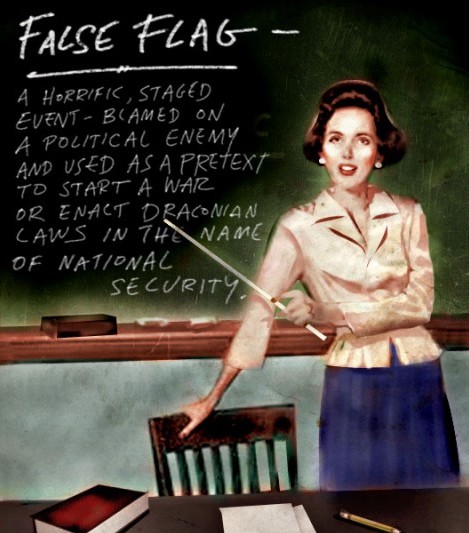
False Flag is a concept that goes back centuries. It was considered to be a legitimate ploy by the Greeks and Romans, where a military force would pretend to be friendly to get close to an enemy before dropping the pretense and raising its banners to reveal its own affiliation just before launching an attack. In the sea battles of the eighteenth century among Spain, France and Britain hoisting an enemy flag instead of one’s own to confuse the opponent was considered to be a legitimate ruse de guerre, but it was only “honorable” if one reverted to one’s own flag before engaging in combat.

Today’s false flag operations are generally carried out by intelligence agencies and non-government actors including terrorist groups, but they are only considered successful if the true attribution of an action remains secret. There is nothing honorable about them as their intention is to blame an innocent party for something that it did not do. There has been a lot of such activity lately and it was interesting to learn by way of a leak that the Central Intelligence Agency (CIA) has developed a capability to mimic the Internet fingerprints of other foreign intelligence services. That means that when the media is trumpeting news reports that the Russians or Chinese hacked into U.S. government websites or the sites of major corporations, it could actually have been the CIA carrying out the intrusion and making it look like it originated in Moscow or Beijing. Given that capability, there has been considerable speculation in the alternative media that it was actually the CIA that interfered in the 2016 national elections in the United States.

False flags can be involved in other sorts of activity as well. The past year’s two major alleged chemical attacks carried out against Syrian civilians that resulted in President Donald Trump and associates launching 160 cruise missiles are pretty clearly false flag operations carried out by the rebels and terrorist groups that controlled the affected areas at the time. The most recent reported attack on April 7 might not have occurred at all, according to doctors and other witnesses who were actually in Douma. Because the rebels succeeded in convincing much of the world that the Syrian government had carried out the attacks, one might consider their false flag efforts to have been extremely successful.

The remedy against false flag operations such as the recent one in Syria is, of course, to avoid taking the bait and instead waiting until a thorough and objective inspection of the evidence has taken place. The United States, Britain and France did not do that, preferring instead to respond to hysterical press reports by “doing something.” If the U.N. investigation of the alleged attack turns up nothing, a distinct possibility, it is unlikely that they will apologize for having committed a war crime.

The other major false flag that has recently surfaced is the poisoning of Sergei Skripal and his daughter Yulia in Salisbury, England, on March 4. Russia had no credible motive to carry out the attack and had, in fact, good reasons not to do so. The allegations made by British Prime Minister Theresa May about the claimed nerve agent being “very likely” Russian in origin have been debunked, in part through examination by the U.K.’s own chemical weapons lab. May, under attack even within her own party, needed a good story and a powerful enemy to solidify her own hold on power so false flagging something to Russia probably appeared to be just the ticket as Moscow would hardly be able to deny the “facts” being invented in London. Unfortunately, May proved wrong and the debate ignited over her actions, which included the expulsion of twenty-three Russian diplomats, has done her severe damage. Few now believe that Russia actually carried out the poisoning and there is a growing body of opinion suggesting that it was actually a false flag executed by the British government or even by the CIA.

The lesson that should be learned from Syria and Skripal is that if “an incident” looks like it has no obvious motive behind it, there is a high probability that it is a false flag. A bit of caution in assigning blame is appropriate given that the alternative would be a precipitate and likely disproportionate response that could easily escalate into a shooting war.

Is the U.S. Government Evil? You Tell Me

By John W. Whitehead

Source: The Rutherford Institute

“The greatest evil is not now done … in concentration camps and labour camps. In those we see its final result. But it is conceived and ordered (moved, seconded, carried, and minuted) in clean, carpeted, warmed and well-lighted offices, by quiet men with white collars and cut fingernails and smooth-shaven cheeks who do not need to raise their voices. Hence, naturally enough, my symbol for Hell is something like the bureaucracy of a police state or the office of a thoroughly nasty business concern.” ― C.S. Lewis, The Screwtape Letters

Is the U.S. government evil?

You tell me.

This is a government that treats its citizens like faceless statistics and economic units to be bought, sold, bartered, traded, tracked, tortured, and eventually eliminated once they’ve outgrown their usefulness.

This is a government that treats human beings like lab rats to be caged, branded, experimented upon, and then discarded and left to suffer from the after-effects.

This is a government that repeatedly lies, cheats, steals, spies, kills, maims, enslaves, breaks the laws, overreaches its authority, and abuses its power at almost every turn.

This is a government that wages wars for profit, jails its own people for profit, and then turns a blind eye and a deaf ear while its henchmen rape and kill and pillage.

No, this is not a government that can be trusted to do what is right or moral or humane or honorable but instead seems to gravitate towards corruption, malevolence, misconduct, greed, cruelty, brutality and injustice.

This is not a government you should trust with your life, your loved ones, your livelihood or your freedoms.

This is the face of evil, disguised as a democracy, sold to the people as an institution that has their best interests at heart.

Don’t fall for the lie.

The government has never had our best interests at heart.

Endless wars. The government didn’t have our best interests at heart when it propelled us into endless oil-fueled wars and military occupations in the Middle East that wreaked havoc on our economy, stretched thin our military resources and subjected us to horrific blowback.

A police state. There is no way the government had our best interests at heart when it passed laws subjecting us to all manner of invasive searches and surveillance, censoring our speech and stifling our expression, rendering us anti-government extremists for daring to disagree with its dictates, locking us up for criticizing government policies on social media, encouraging Americans to spy and snitch on their fellow citizens, and allowing government agents to grope, strip, search, taser, shoot and kill us.

Battlefield America. Certainly the government did not have our best interests at heart when it turned America into a battlefield, transforming law enforcement agencies into extensions of the military, conducting military drills on domestic soil, distributing “free” military equipment and weaponry to local police, and desensitizing Americans to the menace of the police state with active shooter drills, color-coded terror alerts, and randomly conducted security checkpoints at “soft” targets such as shopping malls and sports arenas.

School-to-prison pipeline. It would be a reach to suggest that the government had our best interests at heart when it locked down the schools, installing metal detectors and surveillance cameras, adopting zero tolerance policies that punish childish behavior as harshly as criminal actions, and teaching our young people that they have no rights, that being force-fed facts is education rather than indoctrination, that they are not to question governmental authority, that they must meekly accept a life of censorship, round-the-clock surveillance, roadside blood draws, SWAT team raids and other indignities.

Secret human experimentation. One would also be hard-pressed to suggest that the American government had our best interests at heart when it conducted secret experiments on an unsuspecting populace—citizens and noncitizens alike—making healthy people sick by spraying them with chemicals, injecting them with infectious diseases and exposing them to airborne toxins. The government reasoned that it was legitimate (and cheaper) to experiment on people who did not have full rights in society such as prisoners, mental patients, and poor blacks.

As the Associated Press reports, “The late 1940s and 1950s saw huge growth in the U.S. pharmaceutical and health care industries, accompanied by a boom in prisoner experiments funded by both the government and corporations. By the 1960s, at least half the states allowed prisoners to be used as medical guinea pigs … because they were cheaper than chimpanzees.”

In Alabama, for example, 600 black men with syphilis were allowed to suffer without proper medical treatment so that the government could study the natural progression of untreated syphilis. In California, older prisoners were implanted with testicles from livestock and executed convicts so the government could test their virility.

In Connecticut, mental patients were injected with hepatitis so the government could study the disease. In Maryland, sleeping prisoners had a pandemic flu virus sprayed up their noses so the government could monitor their symptoms. In Georgia, two dozen “volunteering” prison inmates had gonorrhea bacteria pumped directly into their urinary tracts through the penis so the government could work on a cure.

In Michigan, male patients at an insane asylum were exposed to the flu so the government could experiment with a flu vaccine. In Minnesota, 11 public service employee “volunteers” were injected with malaria, then starved for five days, so the government could study the impact.

In New York, prisoners at a reformatory prison were split into two groups to determine how a deadly stomach virus was spread: the first group was made to swallow an unfiltered stool suspension, while the second group merely breathed in germs sprayed into the air. In Staten Island, children with mental retardation were given hepatitis orally and by injection to see if they could then be cured.

Unfortunately, these incidents are just the tip of the iceberg when it comes to the atrocities the government has inflicted on an unsuspecting populace in the name of secret experimentation.

For instance, there was the U.S. military’s secret race-based testing of mustard gas on more than 60,000 enlisted men (African-Americans, Japanese-Americans, Hispanics, etc.). As NPR reports, “All of the World War II experiments with mustard gas were done in secret and weren’t recorded on the subjects’ official military records. Most do not have proof of what they went through. They received no follow-up health care or monitoring of any kind. And they were sworn to secrecy about the tests under threat of dishonorable discharge and military prison time, leaving some unable to receive adequate medical treatment for their injuries, because they couldn’t tell doctors what happened to them.”

And then there was the CIA’s Cold War-era program, MKULTRA, in which the government began secretly experimenting on hundreds of unsuspecting American civilians and military personnel by dosing them with LSD, some having the hallucinogenic drug secretly slipped into their drinks, so that the government could explore its uses in brainwashing and controlling targets. The CIA spent nearly $20 million on its MKULTRA program, reportedly as a means of programming people to carry out assassinations and, to a lesser degree, inducing anxieties and erasing memories, before it was supposedly shut down.

Similarly, the top-secret Montauk Project, the inspiration for the hit Netflix series Stranger Things, allegedly was working to develop mind-control techniques that would then be tested out on locals in a nearby village, triggering crime waves or causing teenagers to congregate.

Sounds like the stuff of conspiracy theorists, I know, but the government’s track record of treating Americans like lab rats has been well-documented, including its attempts to expose whole communities to various toxins as part of its efforts to develop lethal biological weapons and study their impact and delivery methods on unsuspecting populations.

In 1949, for instance, the government sprayed bacteria into the Pentagon’s air handling system, then the world’s largest office building. In 1950, special ops forces sprayed bacteria from Navy ships off the coast of Norfolk and San Francisco, in the latter case exposing all of the city’s 800,000 residents.

In 1953, government operatives staged “mock” anthrax attacks on St. Louis, Minneapolis, and Winnipeg using generators placed on top of cars. Local governments were reportedly told that “‘invisible smokescreen[s]’ were being deployed to mask the city on enemy radar.” Later experiments covered territory as wide-ranging as Ohio to Texas and Michigan to Kansas.

In 1965, the government’s experiments in bioterror took aim at Washington’s National Airport, followed by a 1966 experiment in which army scientists exposed a million subway NYC passengers to airborne bacteria that causes food poisoning.

Now one might argue that this is all ancient history and that the government today is different from the government of yesteryear, but has the U.S. government really changed?

Ask yourself: Has the government become any more humane, any more respectful of the rights of the citizenry? Has it become any more transparent or willing to abide by the rule of law? Has it become any more truthful about its activities? Has it become any more cognizant of its appointed role as a guardian of our rights?

Or, having mastered the Orwellian art of Doublespeak and followed the Huxleyan blueprint for distraction and diversion, has the government simply gotten craftier and more conniving, better able to hide its nefarious acts and dastardly experiments under layers of secrecy, legalism and obfuscations?

Consider this: after revelations about the government’s experiments spanning the 20th century spawned outrage, the government began looking for human guinea pigs in other countries, where “clinical trials could be done more cheaply and with fewer rules.”

In Guatemala, prisoners and patients at a mental hospital were infected with syphilis, “apparently to test whether penicillin could prevent some sexually transmitted disease.” More recently, U.S.-funded doctors “failed to give the AIDS drug AZT to all the HIV-infected pregnant women in a study in Uganda even though it would have protected their newborns.” Meanwhile, in Nigeria, children with meningitis were used to test an antibiotic named Trovan. Eleven children died and many others were left disabled.

What kind of government perpetrates such horrific acts on human beings, whether or not they are American citizens?

Is there any difference between a government mindset that justifies experimenting on prisoners because they’re “cheaper than chimpanzees” and a government that sanctions jailhouse strip searches of individuals charged with minor infractions simply because it’s easier on a jail warden’s workload?

John Lennon was right: “We’re being run by maniacs for maniacal ends.”

Unfortunately, the more things change, the more they stay the same.

Just recently, for example, a Fusion Center in Washington State (a Dept. of Homeland Security-linked data collection clearinghouse that shares information between state, local and federal agencies) inadvertently released records on remote mind control tactics (the use of “psycho-electronic” weapons to control people from a distance or subject them to varying degrees of pain).

Mind you, there is no clear evidence to suggest that these particular documents were created by a government agency. Then again, the government—no stranger to diabolical deeds or shady experiments carried out an unsuspecting populace—has done it before.

After all, this is a government that has become almost indistinguishable from the evil it claims to be fighting, whether that evil takes the form of terrorism, torture, drug traffickingsex trafficking, murder, violence, theft, pornography, scientific experimentations or some other diabolical means of inflicting pain, suffering and servitude on humanity.

For too long now, the American people have been persuaded to barter their freedoms for phantom promises of security and, in the process, have rationalized turning a blind eye to all manner of government wrongdoing—asset forfeiture schemes, corruption, surveillance, endless wars, SWAT team raids, militarized police, profit-driven private prisons, and so on—because they were the so-called lesser of two evils.

No matter how you rationalize it, the lesser of two evils is still evil.

There’s a scene in The Third Man, Carol Reed’s influential 1949 film starring Joseph Cotten and Orson Welles in which a rogue war profiteer (Harry Lime) views human carnage with a callous indifference, unconcerned that the diluted penicillin he’s been trafficking underground has resulted in the tortured deaths of young children.

Challenged by his old friend Holly Martins to consider the consequences of his actions, Lime responds, “In these days, old man, nobody thinks in terms of human beings. Governments don’t, so why should we?”

“Have you ever seen any of your victims?” asks Martins.

“Victims?” responds Lime, as he looks down from the top of a Ferris wheel onto a populace reduced to mere dots on the ground. “Look down there. Tell me. Would you really feel any pity if one of those dots stopped moving forever? If I offered you twenty thousand pounds for every dot that stopped, would you really, old man, tell me to keep my money, or would you calculate how many dots you could afford to spare?”

Lime’s callous indifference is no different from the U.S. government’s calculating cost-benefit analyses.

In the eyes of the government, “we the people” are chump change.

So why do Americans keep believing the government has their best interests at heart?

Why do Americans keep trusting the government?

Why do Americans pretend not to know what is so obvious to anyone with eyes and ears and a conscience?

As Carl Sagan recognized, “If we’ve been bamboozled long enough, we tend to reject any evidence of the bamboozle. We’re no longer interested in finding out the truth. The bamboozle has captured us. It’s simply too painful to acknowledge, even to ourselves, that we’ve been taken. Once you give a charlatan power over you, you almost never get it back.”

We should never have trusted the government in the first place.

That’s why the Founders came up with a Bill of Rights. They recognized that without binding legal protections affirming the rights of the people, the newly instituted American government would be no better than the old British despot.

It was Thomas Jefferson who warned, “In questions of power then, let no more be heard of confidence in man, but bind him down from mischief by the chains of the Constitution.”

Unfortunately, we didn’t heed the warning.

As I make clear in my book Battlefield America: The War on the American Peoplethe government has ripped the Constitution to shreds and left us powerless in the face of its power grabs, greed and brutality.

So how do you fight back?

How do you fight injustice? How do you push back against tyranny? How do you vanquish evil?

You don’t fight it by hiding your head in the sand.

Stop being apathetic. Stop being neutral. Stop being accomplices.

Start recognizing evil and injustice and tyranny for what they are. Demand government transparency. Vote with your feet (i.e., engage in activism, not just politics). Refuse to play politics with your principles. Don’t settle for the lesser of two evils.

As British statesman Edmund Burke warned, “The only thing necessary for the triumph of evil is for good men [and women] to do nothing.”

It’s time for good men and women to do something. And soon.

Social Media Behemoths Sweep Alternative News into the Memory Hole

By Kurt Nimmo

Source: Another Day in the Empire

The squabbling between self-identified progressives and conservatives continues as social media transforms itself into a news, information, and opinion gatekeeper.

All information that contradicts the establishment narrative will either be downgraded into obscurity or excluded outright on social media.

Take for instance ThinkProgress, the Soros-financed news website, a project of the Center for American Progress Action Fund welded to the infrastructure of the Democrat party. On May 2, it complained that a bias study at Facebook will be run by conservatives, that is to say establishment Republicans, notably former Arizona Congress critter Jon Kyl.

ThinkProgress believes there is no such thing as bias aimed at conservatives—it’s the liberals who are routinely downgraded at Facebook while so-called conservatives are free to post what progressives characterize as an evil and poisonous ideology.

According to Libby Watson at Splinter News, conservatives are involved in “grift,” flimflamming poor Mark Zuckerberg with untrue claims of bias against the likes of Breitbart News.

It’s all part of a never ending and hugely counterproductive “culture war” that has raged between the ostensible right and left going on thirty years now. Ms. Watson manages to squeeze identity politics into her screed.

“The conservative movement has done a remarkable job over the last half century to bellow and bully its way into having its most ridiculous and reality-divorced concerns taken seriously,” she writes. “It lies about and distorts everything: about tax cuts, about Benghazi and her emails, about immigration, about healthcare, about Diamond and Silk. The further Facebook descends down the path of letting that screaming white face of faux outrage dictate how they run their platform, the harder it’s going to be for them to get away from them.”

The progressive news website Common Dreams complains it has weathered “significant drops in traffic since Google and Facebook began changing algorithms and talking openly about their new attempts to control the kind of news content users see. According to internal data and Google Analytics, traffic to Common Dreams from Google searches fell by 34 percent after the powerful search giant unveiled its new search protocol in April 2017.”

Meanwhile, on the other side of the yawning divide, Brent Bozell, founder of the Media Research Center, rallied around 60 conservatives and fired off an open letter to the social media giants demanding transparency, clarity on the definition of hate speech, equality for conservatives, and respect for the First Amendment.

“Social media censorship and online restriction of conservatives and their organizations have reached a crisis level,” the open letter states. “Facebook CEO Mark Zuckerberg’s hearings on Capitol Hill only served to draw attention to how widespread this problem has become. Conservative leaders now have banded together to call for equal treatment on tech and social media.”

Both liberals and conservatives are missing the point.

Facebook and Google will continue and enlarge the effort to gatekeep information that does not jive with the establishment narrative, be it from the right or left.

The internet and web upended the establishment’s carefully constructed propaganda machine—the CIA’s “Mighty Wurlitzer” under its Operation Mockingbird beginning in the early 1950s—deeply embedded within corporate media.

Beginning with Friendster, MySpace, and like projects in the early 2000s and eventually morphing into the corporate behemoths Facebook, YouTube, and Twitter, social media platforms have extended the reach of alternative media, much to the displeasure of the establishment. Its preferred propaganda conduits have withered and this has seriously hampered its ability to control the narrative.

Both the right and left need to nurture their own social media platforms and drive traffic there.

Of course, this will not be as effective as plugging into the massive matrix of social connectivity provided by the corporate tech giants, but the alternative is to be marginalized and eventually swept into the memory hole as the context of “extremism” narrows and constricts expression, excluding all but the most token disagreement with the establishment narrative.

However, I’m not sure we’re up to it.

The elite has done a remarkable job of using the time tested divide and conquer concept, endlessly pitting the so-called right against the amorphously defined left and vice versa. Liberals and conservatives continue to fight over frivolous ideological points as the funny money asset-driven economy prepares to implode and the mission of infinity war expands to the point where it endangers life on planet Earth.

US Collapse – the Spectacle of Our Time

By Finnian Cunningham

Source: Axis of Logic

May you live in interesting times, goes the Chinese proverb. Few can doubt that we are indeed living in such an interesting time. Big changes are afoot in the world, it seems.

None more so than the collapsing of the American Empire.

The US is going through an historic “correction” in the same way that the Soviet Union did some 30 years ago when the latter was confronted with the reality of its unsustainable political and economic system. (That’s not meant to imply, however, that socialism is unviable, because arguably the Soviet Union had fatally strayed from its genuine socialist project into something more akin to unwieldy state capitalism.)

In any case, all empires come to an end eventually. History is littered with the debris of countless empires. Why should the American Empire be any different? It’s not. Only arrogant “American exceptionalism” deludes itself from the reality.

The notable thing is just how in denial the political class and the US news media are about the unfolding American crisis.

This is partly where the whole “Russiagate” narrative comes into play. Blaming Russia for allegedly destabilizing US politics and society is a cover for denial over the internal rot facing the US.

Some may scoff at the very idea of an “American Empire”. That’s something Europeans did, not us, goes the apologist for US power. The quick retort to that view is to point out that the US has over 1,000 military bases in more than 100 countries around the world. If that is not a manifestation of empire then what is?

For seven decades since the Second World War, “Pax Americana” was the grandiose name given to US imperial design for the global order. The period was far from peaceful as the vainglorious name suggests. Dozens of wars, proxy conflicts and violent subversions were carried by the US on every continent in order to maintain its empire. The so-called “global policeman” was more often a “global thug”.

That US empire is now teetering at the cusp of an emerging multipolar world order led by China, Russia and other rising powers.

When US leaders complain about China and Russia “reshaping the global order” to reflect their interests what the American leaders are tacitly admitting is the coming end of Washington’s presumed hegemony.

Rather than accepting the fate of demise, the US is aggressively resisting by denigrating China and Russia’s power as somehow illegitimate. It’s the classic denial reaction of a sore loser.

So, what are the telltale signs that the US is indeed undergoing a seminal “correction” — or collapse?

The heyday of American capitalism is well passed. The once awesome productive system is a skeleton of its former self. The rise of massive social poverty alongside obscene wealth among a tiny elite is a sure sign that the once mighty American economy is chronically moribund. The country’s soaring $20 trillion national debt is another symptom of chronic atrophy.

Recent self-congratulatory whooping by President Trump of “economic recovery” is like the joy felt from looking at a mirage. The roaring stock market is an elite phenomenon which can just as easily slump over night.
What the champagne bubbles can’t disguise is the structural failing of US capitalism to reverse exploding inequality and endemic poverty across America. The national prowess of US capitalism has been superseded by global capitalism where American corporations among others scour the planet for cheap labor and tax havens. There is no going back to a supposed golden age, no matter how much Trump crows about “America First”.

The other side of the coin from historic US economic demise is the concomitant rise in its militarism as a way to compensate for its overall loss of power.

It is no coincidence that since the end of the Cold War following the dissolution of the Soviet Union, US military interventions around the world have erupted with increased frequency and duration. The US is in a veritable permanent state of war actively deploying its forces simultaneously in several countries, particularly in the oil-rich Middle East.

Washington of course gives itself a fig leaf cover by calling its surge in militarism a “war on terror” or “defending allies”. But, increasingly, US war conduct is seen for what it plainly is — violation of international law and the sovereignty of nations for the pursuit of American imperial interests.

In short, the US is patently lashing out as a rogue regime. There’s no disguising that fiendish fact.

In addition to waging wars, bombing countries, sponsoring terrorist proxies and assassinating enemies at will with drones, Washington is increasingly threatening others with military aggression. In recent months, North Korea and Iran have been openly threatened based on spurious claims. Russia and China have also been explicitly warned of American aggression in several strategic documents published by the Trump administration.

The grounds for American belligerence are baseless. As noted, the real motive is to do with compensating for its own inherent political, economic and social crises. That then amounts to American leaders inciting conflicts and wars, which is in itself a grave violation of international law — a crime against peace, according to Nuremberg principles.

The American Empire is failing and flailing. This is the spectacle of our time. The Western mainstream news media are either blind, ignorant or complicit in denying the historic collapse. Such media are indulging reckless fantasies of the US political class to distract from the potential internal implosion. Casting around for scapegoats to “explain” the deep inherent problems, the political class are using Russia and alleged Russian “interference” as a pretext.

World history has reached a foreboding cross-roads due to the collapsing of the American Empire. Can we navigate a safe path forward avoiding catastrophic war that often accompanies the demise of empires?

A lot, it seems, depends on ordinary American people becoming politically organized to challenge their dysfunctional system run by and for the elites. If the American people cannot hold their elites to account and break their corrupt rule, overhauling it with something more equitable and democratic, then the world is in peril of being plunged into total war. We can only but wish our American brothers and sisters solidarity and success.

Agrochemicals and Institutional Corruption: Pleading with the Slave Master Will Not Set You Free

By Colin Todhunter

Source: CounterPunch

Environmental campaigner Dr Rosemary Mason has just written to President of the European Commission Jean-Claude Juncker, Vice President of the European Commission Frans Timmermans and Health Commissioner Vytenis Andruikaitis. As set out below, she asks these top officials some very pertinent questions about the EU’s collusion with the agrochemical corporations.

1) In authorising glyphosate on behalf of the Glyphosate Task Force led by Monsanto, why did President Juncker fail to state the European Chemicals Agency’ (ECHA) risk assessment in full?

2) Why did the EU collude with corporations that made nerve gases in WW2 for chemical warfare and for use in the Nazi concentration camps? These firms continued to use similar chemicals in agriculture to poison ‘pests’, beneficial insects, birds and people.

3) Could it be that is it is because biocides regulations in the EU are merely designed to make corporations money and are ultimately controlled by the agrochemical industry?

4) Why did Monsanto, the European Food Safety Authority (EFSA), the ECHA and the industry-funded UK Science Media Centre suppress the paper by Gilles-Eric Seralini of the two-year rat feeding study of GM crops and Roundup that produced organ damage and tumours at four months?

5) Do the commissioners know that Cancer Research UK was hijacked by the Agrochemical Industry in 2010 with the full knowledge of the UK government? Michael Pragnell, former Chairman of Cancer Research UK (CRUK), was founder of Syngenta and former chairman of industry lobby group CropLife International. The CRUK website says that there is no convincing evidence that pesticides cause cancer. Instead, CRUK links cancer to life style choices and individual behaviour and blames alcohol use, obesity and smoking.

6) Why did the EU regulators and David Cameron, on behalf of the British government, ignore the Letter from America in 2014 from nearly 60 million citizens, warning you not to authorise GM crops and Roundup because of their toxicity to human health and the environment?

7) Where have all the insects and birds gone as a result of intensive chemical agriculture? The UK, Germany, France, Denmark and Canada are rapidly losing biodiversity. US farmland growing GM Roundup Ready crops has become a biological desert.

8) Did Monsanto and President Juncker conceal the ECHA harmonised classification of glyphosate as “toxic to aquatic life with long-lasting effects” because it would explain the accelerating deterioration of coral in the Great Barrier Reef?

Mason concludes her letter by reiterating the damning advisory opinion of the International Monsanto Tribunal delivered in 2017. She also sent the commissioners a recent letter signed by 23 prominent organisations criticising the EU’s decision to renew the license for glyphosate and outlining Monsanto’s undue influence over decision making.

Along with her letter, Mason sent a 22-page document containing detailed information on:

* The European Commission’s flawed renewal of the license for glyphosate

* The causes of decline in coral cover on the Great Barrier Reef

* European legislation existing for the benefit of the agrochemical industry

* Contamination by glyphosate and neonicotinoid insecticides causing dramatic declines in insects and birds

* Glyphosate being present everywhere

* The International Monsanto Tribunal and various alarming reports on pesticides, their use and impacts

To date, there has been no response from the commissioners to Mason.

In 2003, the World Wide Fund for Nature (UK) concluded that every person it tested across the UK was contaminated by a cocktail of highly toxic chemicals, which were banned from use during the 1970s. Over the years, Mason has cited a range of sources to show the harmful impact of pesticides and that the amount and range of pesticide residues on British food is increasing annually. She also notes a massive rise in the use of glyphosate between 2012 and 2014 alone.

In her many detailed documents and letters (which contains her own views on all the questions she poses above to the commissioners) she has sent to officials over the years, Mason offers sufficient evidence to show that the financial and political clout of a group of powerful agrochemical/agribusiness corporations ensure that its interests are privileged ahead of public health and the environment to the detriment of both. Mason has gone to great lengths to describe the political links between industry and various government departments, regulatory agencies and key committees that have effectively ensured that ‘business as usual’ prevails.

The corporations which promote industrial agriculture and the agrochemicals Mason campaigns against have embedded themselves deeply within the policy-making machinery at both national and international levels. From the flawed narrative that industrial agriculture is necessary to feed the world to providing lavish research grants and the capture of important policy-making institutions, global agribusiness has secured a bogus ‘thick legitimacy’ within policymakers’ mindsets and mainstream discourse.

By referring to the Monsanto Tribunal, Mason implies that governments, individuals and civil groups that collude with corporations to facilitate ecocide and human rights abuses resulting from the actions of global agribusiness corporations should be hauled into court. Perhaps it is only when officials and company executives are given lengthy jail sentences for destroying health and the environment that some change will begin to happen.

From Rachel Carson onward, the attempt to roll back the power of these corporations and their massively funded lobby groups has had limited success. Some 34,000 agrochemicals remain on the market in the US, many of which are there due to weak regulatory standards or outright fraud, and from Argentina to Indonesia, the devastating impact of the industrial chemical-dependent model of food and agriculture on health and the environment has been documented by various reports and writers at length.

What is worrying is that these corporations are being facilitated by the World Bank’s ‘enabling the business of agriculture’, duplicitous trade deals like the US-India Knowledge Initiative on Agriculture, the Gates Foundation’s ‘opening up’ of African agriculture and the bypassing of democratic procedures at sovereign state levels to impose seed monopolies and proprietary inputs on farmers and to incorporate them into a global supply chain dominated by these powerful companies.

For the reasons set out in my previous piece, pleading with public officials to roll back the actions and influence of agrochemical/agribusiness corporations may have no more impact than appealing to a slave master to set you free.

Ultimately, the solution relies on people coming together to challenge a system of neoliberal capitalism that by design facilitates the institutionalised corruption that we see along with the destruction of self-sufficiency and traditional food systems. At the same time, alternatives must be promoted based on localisation, the principles of a politically-oriented model of agroecology (outlined here, here and here) and a food system that serves the public good not private greed.


Colin Todhunter is an extensively published independent writer and former social policy researcher based in the UK and India.

Fake News Is Fake Amerika