There is undoubtedly an information war raging. There are intentional liars, people who witlessly repeat these lies, poor research, and opinions spun to look as if it is research. To sort the ever increasing amount of information from disinformation, there are a few simple methods people can use.
But above all, people must personally dedicate themselves to following the truth no matter where it brings them, having the courage to accept a reality that may not necessarily mesh with their current perception. The inability to do this will render moot all other means of determining the veracity of any given report or piece of analysis.
Find the Original Source
This is fundamental. When anyone, anywhere makes a claim, whether it is in a historical documentary or book, or regarding current events, one must find the original source. Where did this information come from? Is it a direct quote? If so, can this quote be verified? If the quote is “alleged” or “leaked” or otherwise second-hand information or the sources never revealed, it is impossible to verify and therefore impossible to consider as verified.
Often conversations relayed by second-hand sources serve as the basis of propaganda. It is essentially the process of placing words into the mouths of people who never said anything of the sort. Media that repeatedly uses quotes that are impossible to verify may be engaged in disinformation.
If the quote is confirmed, that alone does not mean that what was said was “true.” It simply means that someone made a statement – the veracity of which must be determined through other means. Finding the source of a claim often helps shatter long-held myths. This is particularly true in regards to historical matters.
Follow the Money
All protests, political movements, and armed struggles require immense amounts of resources to start, perpetuate, and most importantly to succeed. They also require leadership. If one finds themselves reading reports of events that do not mention funding or the names of specific leaders, either those reporting on the events don’t have these facts and should make note that such information is both missing and essential to find, or misdirection and disinformation is at play.
Omitting these facts has been done intentionally across the Western media to obfuscate Western involvement particularly in “political uprisings” and “armed rebellions” that are made to appear spontaneous and indigenous but are in fact long-planned, foreign-backed conspiracies. The so-called “Arab Spring” is perhaps the most notorious example of this, where the Western media failed intentionally and repeatedly to identify the funding and individuals involved in both street protests and subsequent armed attacks on security agencies across the Middle East and North Africa (MENA) region.
Had the public carefully read through reports, and followed the money, they would have found a combination of US State Department money and the Anglo-American-backed Muslim Brotherhood behind each and every “uprising” across the Middle East, with Al Qaeda forming the subsequent armed groups that overran Libya and are currently leading attempts to overthrow the government of Syria.
Look at What People Do, Not at What They Say…
There are media reports, government press releases, op-eds, analysis, and policy papers of every kind. Many times, these various sources contradict each other. How does one go about determining which is true and which is disinformation? It is quite simple, don’t simply listen to what reporters, analysts, and policymakers say, look at what they and those they have influence over are doing.
The United States claims that it is fighting the so-called “Islamic State” (ISIS) in Syria. However, if we “follow the money” and realize that it is impossible for ISIS to sustain its fighting capacity within Syria or Iraq alone, and requires an immense amount of resources from abroad to continue its operations, we realize those resources are undoubtedly passing through territory the US and its allies in fact control.
That the US is not interdicting these vital supplies, including additional fighters, weapons, and cash, is proof that claims in the media and amid government press releases that the US is “fighting ISIS” are false.
Conversely, in veteran journalist Seymour Hersh’s 2007 New Yorker article, “The Redirection,” he stated explicitly, citing US and Saudi officials, that the West and its regional allies planned to use sectarian extremists affiliated with Al Qaeda to wage a regional proxy war against Syria and Iran. This also so happens to be precisely what is now playing out across the MENA region. Hersh’s analysis can be tracked down through his sources, by following the money – as only state-sponsorship can explain Al Qaeda and ISIS’ fighting capacity in Syria, Iraq, and beyond – and by simply looking at what is now unfolding across the region.
None of what the current corporate media or government press releases say can be verified in a similar manner, and certainly, none of what is said by the West currently, matches what is actually happening on the ground.
Finally, let us consider policy papers released by corporate-funded think tanks like the Brookings Institution. Such policy papers have repeatedly laid out plans for arming extremists, incrementally invading and occupying Syria, and eventually toppling the Syrian government. This too, is precisely what we see happening on the ground, though the Western media and Western representatives claim the cause is not a premeditated Western conspiracy, but a series of coincidences and unfortunate turns of fate.
Final Thoughts
The truth is hard to arrive at, not only because people intentionally seek to fool others, but because often, many unintentionally fool themselves. Reality can be unpleasant. Watching a nation be destroyed can be heartbreaking and the desire to insulate oneself from the pain through cognitive dissonance can be overwhelming. However, one of the greatest maxims in human conflict is to truly know yourself and know your enemy. Truth isn’t just a matter of virtue, it is a factor that will make the difference between victory and defeat.
If victory over the forces of greed and hegemony is truly our goal, then we must face the facts no matter how unpleasant. Our failure to do so will cost us everything – and those driven by greed and hegemony know. That is why they have invested so much in clouding reality and obfuscating the truth. We must invest more in seeing through this clouded reality, and discover the truth, no matter how unpleasant.
an event or scene regarded in terms of its visual impact
“Now the death of God combined with the perfection of the image has brought us to a whole new state of expectation. We are the image.” ~John Ralston Saul, Voltaire’s Bastards
“Magical thinking is the currency not only of celebrity culture, but also of totalitarian culture.” ~Chris Hedges, Empire of Illusion
Welcome to the spectacle. Or perhaps I should say the kind of spectacle that has become the face of entertainment that pervades our westernized cultures. The way that the spectacle succeeds is that it isn’t so much about fooling us into believing its lies as real, but rather that it is we who ask to be fooled. We seek to suspend our sense of reality, to pursue a space of escape. The spectacle pulls us in because we lend our willingness to its agenda. If we are honest, in this post-truth age, we will admit to living in an age of spectacle. And it is from this that many of us receive our interpretation of reality. Since the middle of the 20th century onwards the ‘western spectacle’ has been in the form of media advertisement and propaganda. We may think that we’ve only recently arrived at the age of the spectacle, where Disneylandification is becoming the norm, and Super Bowls are interspersed with scantily-clad singers, and TV programs appear in the slots between advertisers. Yet the whole spectacle show has been a form of function creep ever since telecommunications first emerged as a social phenomenon. The image has been with humanity since the first dawn of our arising; from cave paintings to hieroglyphics to cuneiform clay tablets. The major difference is that today the spectacle of the image has not only gone global, but it has also gotten inside of our heads.
Western cultures especially (and the US specifically) have now made the image, the spectacle, and hence the illusion so grand, so vivid, and so persuasively realistic that they are becoming our basis of reality. We swing from one illusion to the alternative, which is still yet another grand spectacle; just as we swing from the political left to the right, believing each side is distinctly different. Yet each is a part of the same bubble that customizes our lives – they form a part of our news, our heroes, our tragedies, and our dreams. We now serve a mosaic of ideals carefully crafted as a patchwork of phantom performances. Nothing is ever real anymore except the painful extremes that pervade our daily existence: the violence, the suffering, the deprivation, the inequality, the disease. Only these fragments that create great pain become the real, and from these many of us seek refuge in a plenitude of diversions, distractions, and triviality.
Western civilization has chosen to be played out upon a grand stage where the performance – of invented storylines and scripts – runs the show. We move through social realities that are an entanglement of signs, virtual connections, and social media status. It’s all about who is going to be the next ‘influencer’? We are encouraged to project back into the world our entertainment-mediatized fantasies. People begin to act out their imaginary landscapes, often in violent and distorted ways, as young students massacre their classmates before going to eat at McDonalds. This is the hyperreal that distorts a stable reality, making it harder to gain a grounded perspective on things. People are increasingly being guided by the false totems of media-militarized-entertainment.
The media spectacle gives us our modern guiding images. This is similar to how in the Middle Ages images depicted in stained glass windows and paintings of religious torment or salvation acted to control and influence the social behavior of our ancestors. For many of us the white-bearded god above is dead, so we have media depictions of heroes, adventurers, McGyvers, celebrity-cosmetic makeovers, beauty pageants, talk shows and reality television to be our social guides. An illusory sensate reality has been erected that runs on pseudo-lives and phantom performances. Such phantom performances mask our personal failures and conveniently hide them behind a curtain of the unreal. People prefer to watch the rich and famous on television rather than face the domestic unhappiness of their own lives. Why have ice when you can have bubblegum-flavored ice-cream?
Luckily for those of us who live in the west we inhabit a world of easy-correction where we can make ourselves better if we buy certain products, ingest certain foods, and hang-out in the right yoga gyms. For every situation there is seemingly a commercial solution. We have not been abandoned, after all. In the realm of hyperreality, our fantasies are no longer an impediment to success. On the contrary, our fantasies are the portals through which we enter. All we need is for the world of the media to give us our dream. Everybody has talent, as the reality shows tell us – ‘Britain’s Got Talent,’ ‘America’s Got Talent:’ in fact, we’ve all got talent! We are all of us hidden unique performers, and the world ‘out there’ is begging for our arrival. This is not to be confused with the manipulation by greedy commercial enterprises that are ready to discard you as soon as your ‘talent’ no longer sells.
Yet the truth of the matter is that the spectacle of celebrity culture seeks commodities, not real individuals or souls. It doesn’t want that we seek for any form of transcendence, illumination, or real growth. It is a world that seeks only those that feed the phantom and encourage others to do the same. It is the ‘real’ that gets pushed into a black hole – to become a figment of the imagination, whilst imaginary dreams take its place. Celebrity culture thrives from the very lack of inner reflection. There is no ‘going within’ unless it is a form of medication going down our throats. If we are brutally honest, the celebrity spectacle is an ugly specter that can be as cruel as it is superficial.
The Spectacle of Celebrity Culture
No one achieves celebrity status on their own. It is a stage performance that requires a hoard of cultural enablers; from media, marketers, promoters, agents, handlers, and a host of hungry and gullible people. It is a veritable stage of actors, with each person in it to gain something for themselves. They either seek attention, satisfaction, fame, wealth, or a combination of these. Celebrity culture has come to dominate how many of us define our sense of belonging. It has come to define how we relate to the world around us, and in this respect has disfigured our notions of social belonging and community. Celebrity culture funds and feeds our own movies inside our heads as we invent our roles and behavior. It is a culture in which very few participants are even real for a day.
We idolize celebrities and often project them as idealized forms of ourselves. And yet through this substitution we move further away from any real self-actualization. The transcendent – the Real – does not do substitutes. By throwing our fantasies onto others we are diminishing our own power. In the words of one serious journalist,
We are chained to the flickering shadows of celebrity culture, the spectacle of the arena and the airwaves, the lies of advertising, the endless personal dramas, many of them completely fictional, that have become the staple of news, celebrity gossip, New Age mysticism, and pop psychology …in contemporary culture the fabricated, the inauthentic, and the theatrical have displaced the natural, the genuine, and the spontaneous, until reality itself has been converted into stagecraft. 1
We are subtly pushed through the well-structured stagecraft whilst all the time thinking that it is real. Our contemporary ‘death of the gods’ has been replaced by a divine adoration of celebrities and celebrity culture. Celebrity items, like holy relics, are paraded, idolized, and sold for vast sums. People rush for autographs, only to sell them later on eBay to make an unhealthy profit. Celebrity personal possessions are sold off at prestigious auction houses for astronomical prices, so aging people can wear the clothes of their idols. The glitzy suit that Elvis wore before dying in a Las Vegas toilet; or the dress that Marilyn Monroe wore to show her knickers to the world above a subway vent. Everything is up for grabs – the profane is made sacred, and then sacrificed as celebrity talismans. It all engenders a performance of hysteria, leading sometimes to stalking, or what is nowadays referred to as ‘trolling,’ as celebrity private photos are hacked and shared online. It’s happened to Emma Watson, Jennifer Lawrence, Kate Upton, Jessica Alba, Kate Hudson, Scarlett Johansson…and the list goes on, and on, and on.
The world of celebrity culture thrusts us into a moral void. People are valued by their appearance and their skin-deep beauty rather than their humanity. Such a culture focuses upon onanistic desires and ways for self-gratification. The cult of self ‘has within it the classic traits of psychopaths: superficial charm, grandiosity, and self-importance; a need for constant stimulation, a penchant for lying, deception, and manipulation, and the inability to feel remorse or guilt.’2 The cult of self also promotes the right to get whatever we wish, and celebrity media plays into this, often at the cost of the celebrity who suffers from social media harassment and online trolling. Celebrity public life is not a sacred space; instead, it has become a theatre of performance that is open for all spectators. And those spectators who surround themselves with celebrity culture tend to live in the present, fed by an endless stream of packaged information. They live by credit promises, ignorant to the future prospect of unmanageable debt. They are hostage to a culture that keeps them enthralled, like a television commercial replete with pleasing jingles. They navigate their purchases through well-known brands, eyeing the famous logos as guides. It is an image-saturated reality, bright and tantalizing, offering comfort and satisfaction upon all levels – until the credit runs out. Then the person becomes an outlaw to the very system that fattened them up like foie gras ducks.
These are the trivial diversions that for many are necessary, and which exist in cultures that prize shallow entertainment above substance. We may wonder whether the consumerist celebrity culture is a compensation for the loss of our true freedom regarding the human spirit and our well-being. And celebrities too are often trapped within their own fairy-tale prisons. They are skillfully controlled by their handlers and pushed in front of the media – all this to compensate for the insatiable appetites of those thirsty spectators that swarm upon celebrity culture. We are tantalizingly shown that even us, the humble spectators, can triumph in fame through the lens of reality television. The celebrity machinery oils itself on the media-creation of third and fourth-rate celebrities that have their fifteen minutes of fame – crammed together on desert islands, stuffing insects into their mouths as they bad-mouth their once beloved ‘best-friend’ and vote them off the show. Reality survival, it seems, comes at a cost. And then when they finally emerge into the ‘real world’ of the hyperreal they throng and mingle with other reality-stars under the glare of media spotlight in the vain hope that together they can populate an illusory world of the celebrity.
The world of reality television is another limb on the body of phantom performance. In the last decade a multitude of reality shows have cropped up on our television screens; and they all have one thing in common – they involve being constantly watched. Popular shows such as Big Brother put strangers to live together with round-the-clock constant surveillance. These strangers are even videoed in their beds as they sleep or fondle and kiss with other contestants. Sex lives are ogled over alongside the tears and on-screen breakdowns. Then the television psychologists are wheeled out to offer ‘expert commentary’ on the contestant’s state for mass consumption. Yet underneath all this glamour and glitz is the subtle message that intrusive surveillance is a normal feature of contemporary societies. In fact, it even masquerades as something cool that can be shared online, and which can make us famous. However, the brute reality is that such reality shows normalize what would otherwise be blatant non-constitutional intervention. And yet such shows make surveillance not only routine but a potentially enjoyable part of our modern lives. We are being conditioned into monitoring and sharing our own lives for others to see. Our phantom performances can make any one of us into an enviable star.
Social media is now rife with home-grown videos where everyone from toddler to teenager to retiree is making their performances visible to the image-hungry collective. Selfies too are the new fashionable rage as we perform in front of ourselves. This trend has become so pervasive that each year the number of selfie-related deaths has been increasing. In 2015 more people died from taking selfies than from shark attacks.[i] A dedicated online Wikipedia page has been established to record some of the ongoing ‘selfie-deaths.’ Here are a few examples:
Two young men died in the Ural Mountains after they pulled the pin from a live hand grenade to take a selfie. The phone with the picture remained as evidence of the circumstance of their deaths. (Russia, January 2015)
An 18-year-old died when she attempted to take the “ultimate selfie”, posing with a friend on top of a train in the north-eastern Romanian city of Iași when her leg touched a live wire above which electrocuted her with 27,000 volts. (Romania, May 2015)
A 19-year-old from Houston died after trying to take an Instagram selfie while holding a loaded gun to his head. He accidentally fired the gun and shot himself in the throat. (USA, September 2015)
A 17-year-old student, Andrey Retrovsky from Vologda, Russia, fell to his death attempting to take a selfie while hanging from a rope from a nine-story building. The rope snapped. Retrovsky was known for taking ‘extreme’ selfies and posting them to his Instagram account. (Russia, September 2015)
Selfie deaths, it seems, are global – and not a rare occurrence. Our phantom performances come at a cost. In a world where the image is iconic, more and more people are losing themselves in a reality where a sense of achievement comes from catching the ‘ultimate selfie.’
The drive for inner fulfilment, transcendence, and growth has been wavered aside in favor of the pixilated image. We fear not being seen. We dread being anonymous. Even being a spectral ghost is preferable to being dead.
We Are the Image
The new perspective on the world is pixilated. We are awash with images without substance and which are routinely fetishized as iconic. Signs are lacking immanence; they are fleeting and transient like never before. That is why corporations spend millions trying to find an image logo that will stick around long enough to be implanted into our minds. Images are becoming signs to the disappearance of the real. Images are the new believable reality; now no one cares that the original behind the image has quietly slipped away. The world exists as if in a play of phantom appearances. The image has taken centerstage within the space of the new real. We are now the image.
Yet the danger here is that in being given the image with its glamour and glitz we are in return giving up our critical and intellectual tools that help us cope with a complex world. Where once we had the faculty of separating illusion from reality we now have a simplified hyperreal world where everything can be explained away by a platitude of post-truth phrases. Does it even matter anymore that Las Vegas with its illusion of France with the mock Eiffel Tower, or its pseudo-canals of Venice, are far from the reality of France or Venice? How many people care? Or that the fantasy worlds within the various Disney theme parks are merging with the entertainment-saturated lives outside? Would it truly matter if we were all living within a controlled environment as depicted within the film The Truman Show? Or maybe, just maybe, such films are actually trying to tell us something – to wake us up?
The danger now is that our cultural spectacles – our celebrity culture and spectral images – are making any other alternative seem dull to us. It may be that in an age of simplified gratification any complex reality is boring. What the ‘real’ presents us with may no longer be enough. In its place we are perhaps seeking a false magic.
We have lost touch with that essential something that can work like magic in our lives. As one thinker recently stated:
We live in changing times whereby humanity is undergoing a transformation…We need to understand phenomena at deeper levels, and not just accept what we are told, or what is fed to us through well-structured social institutions and channels. We must learn to accept that our thinking is a great tangible spiritual force for change. 2
The notion that our ideas, our vision, our projections onto the world can be a ‘great tangible spiritual force for change’ is eluding us. Never before has it been so important to trust in the power of the human spirit, and to put forth, with honesty and integrity, the innate human power. The alternative is that we slide into the slipstream of our own phantom performances – we become the image.
Extract from the book Bardo Times: hyperreality, high-velocity, simulation, automation, mutation – a hoax?
Endnotes
1 Hedges, Chris. 2010. Empire of Illusion: The End of Literacy and the Triumph of Spectacle. New York: Nation Books, p15
2 Gulbekian, S.E. 2004. In the Belly of the Beast: Holding Your Own in Mass Culture. Charlottesville, VA: Hampton Roads, p251
When people are confronted with the idea of “mind control” they often think of something out of television or film media; a lone prisoner tortured, chemically dazed and conditioned into a hollow zombie as his captors squeeze information from him or use him to complete a task he would not normally do or morally accept. And while there is actually some truth to this kind of Hollywood depiction, as is evidenced in the exposure of government programs like MK Ultra, the most insidious forms of mind control are far more subtle.
Governments and the elitists behind them do not necessarily need to physically cage, drug and brutalize people in order to influence how they behave. All they need to do is manage their perceptions, expectation and assumptions. This can be accomplished with large portions of the public, rather than one person at a time.
The elites have always been fascinated with the idea of mass hypnotism. In the 18th century Franz Mesmer was famous for entertaining European royalty with displays of what he called “animal magnetism”, which included what we now know as hypnosis of individuals and groups. Mesmerism has since become synonymous with the attempt to befuddle people and dictate their actions while in a kind of trance. Hypnotism is still a very active subject in psychiatric circles and the US government took avid interest in hypnotism as a weapon during their MK Ultra experiments in the 1950s.
People involved in the field of hypnotism are quick to point out that a hypnotized person cannot be made to do something that goes against their code of ethics, but this is not exactly the whole story. A hypnotist makes suggestions that the subject chooses to follow (or refuses to follow) while in a trance state, however, what if they can be convinced (or fooled) through hypnosis into believing that a particular action is in their best interest in spite of their moral code or sense of self preservation?
This type of control over a subject can and has been accomplished in hypnotic therapy, and examples of “covert” hypnotherapy are also on record, including the example of an Ohio divorce attorney that used covert hypnotism against multiple female clients and is suspected of using it against some court employees to disarm their psyches and then rape them without memory of the incident.
About two thirds of any given population are capable of being hypnotized to varying degrees. Stanford University has been avidly searching for a brain pattern that acts as a fingerprint for those that are more prone to hypnotic influence, and they believe they have found certain factors involving areas of the brain that handle heightened focus and attention. Reduced peripheral awareness also helps to increase the subject’s vulnerability to hypnosis and vastly increases suggestibility.
These conditions can in fact be encouraged in large crowds of people. Consider this for a moment – What daily activity is the average person involved in that hyperfocuses their attention on a single point in space for long periods of time and removes almost all of their peripheral awareness? If you said “cell phone use” then you win a chicken dinner. Beyond creating an artificial and constant low dose of dopamine in the human brain leading to addiction, cell phones and other small electronic devices actually create the perfect conditions for a person to be hypnotized as they rip them away from all peripheral awareness and make them highly suggestible to those who know how to use covert methods.
To reiterate, a hypnotic state can be induced in large groups of people for extended periods of time with the correct long term stimulus. Watch here as mentalist Darren Brown hypnotizes or “brainwashes” an entire shopping mall of people into raising their hands exactly when he wants them to without them being aware of why they are doing it. Notice that around two thirds of the crowd complies.
Hypnotic suggestions last as long as the subjects continue to believe that the suggestions are correct. Hypnotism is essentially an agreement between the hypnotist and the persons being hypnotized that a particular belief is true (even if it is not). In the case of a victim of an attack, the person may want to believe that the traumatic event did not happen, and thus they can be convinced through hypnosis to forget it. In the case of a group of people, the hypnotist would have to identify an idea or fear that they all share and WANT to believe is real, and then exploit it.
I think some of the political applications of this are obvious.
The false left/right paradigm is a perfect Petri dish for obtaining or manufacturing the consent of the masses to be hypnotized. They WANT to believe that their team, which they have willingly joined, is the correct team and that the leadership of that team has their best interests at heart. They want to believe that the actions of their party, through legislation or direct means, are always rational and morally sound. And, even when the leaders of their party do things which are completely contrary to the beliefs and morals of the people who make up the party, those people still want to believe that there must be some logical reason behind these decisions that they do not yet grasp.
Beyond this, the threat of the “other party” or team is an ever constant stimulus in the form of fear. We watch the scripted battles of these two fabricated teams play out in elaborate forms of Kabuki theater, yet nothing ever really changes except that the global elites grow more powerful. Still, many people actually believe these battles to be real, and invest immense amounts of energy and focus into them as if the fate of the world is being decided within the antics of a political soap opera.
When people are afraid or hyperfocused on an outside threat, they once again become more suggestible. This is why mainstream political discussions focus less on understanding of the threat (the “How” and the “Why”) and more on perpetuating the threat. With understanding of the enemy (or false enemy), the threat can be assessed and fear is reduced, even if the threat is real. Without understanding, fear only increases. Political powers seek to constantly remind us that threats exist without allowing us the benefit of context. They do not want us to have an in-depth knowledge of the mechanics behind the threats.
We are told that our system works in a particular way that seems logical, but it only makes sense to us so long as we want to believe that the system functions as we were taught. We have to have blind faith that what we were initially told was absolutely true. The question is, why should we? Isn’t it better to remain skeptical of most things and to study what is handed to us? If we’re given a strange elixir by an utter stranger and we’re told to “drink up!”, would we not question what’s in the frothing brew and what it does? Would we not investigate?
In the case of information and proclamations some people would not investigate, because it is more comfortable to believe the lies, or perhaps because they will be rewarded for going along with the status quo. Only when we become willing to sacrifice comfort, when we stop wanting to accept everything we are told at face value and start questioning the reality that is handed to us, only then will the mass hypnosis we were once influenced by lose its power.
The hypnosis of the elites requires ever increasing forms of distraction and stimulation in order to keep the public entranced. The creation of fear and confusion is vital to the execution of mass mind control, and this is a factor that many people absolutely refuse to recognize or take into consideration. The idea that the elites would build a system only to then deliberately destroy it is just too much for many to fathom. But again, what better way to hyperfocus an entire population and make them malleable to suggestions that they would not normally consider otherwise?
In past articles I have outlined the incredible array of similarities between global elitist groups and the behaviors and character traits of narcissistic sociopaths (also known as narcopaths or psychopaths). I have even theorized that globalists are actually a highly organized group of narcopaths who recruit other narcopaths into the fold. Many high-level narcopaths are intuitively knowledgeable on the dynamics of suggestibility and the human psyche. I would call this their primary survival trait.
Narcopaths are well known for creating confusion around them in order to gain control of the people in their lives or the people in a room. They are also known for being willing to build up certain routines and acclimating people around them to a particular environment, only to suddenly disrupt it all as a means to stun their victims and create subservience. It is important to realize that these people do NOT necessarily care about stability. In fact, they often will actively sabotage stability to obtain something they care about more – control.
The strategies that individual narcopaths exhibit on a small scale are simply magnified thousands of times when we talk about the behaviors of the global elitists. People who consider themselves rational are hard pressed to comprehend this kind of behavior, but there is a devious tactical logic to it. Mind control of others can be achieved by keeping those people infinitely off-balance. Conjuring moments of tenuous peace, and then striking with cycles of unpredictable crisis. Before we know it, many years of instability have gone by and the organized narcopaths in power have gained even more control. We wonder where all that time went, and why we were not able to change things? It is because we have been hypnotized into inaction, or the wrong actions in the name of meaningless political stagecraft.
Real mind control and mass hypnosis requires, as already mentioned, our consent, but it is consent that is conned out of us. It is conned out of us by fake leaders with intentions and actions that do not match their promises. It is conned out of us by a system that breeds conformity of thought and tells us that those who think outside the widely accepted norm are aberrant and “crazy”. It is conned out of us by our own weaknesses – our desire to go along to get along, our fear of confronting the crowd and telling them they are wrong, our fear of losing what we think is stability, or our fear of being on our own.
Real mind control is not about torture and force, it is about quietly induced acceptance. We can remove our consent from the hypnotists anytime we wish, but we have to be willing to stop ignoring certain realities. We have to be willing to feel the pain that comes when we recognize we have been conned and controlled in the past, and we have to revel in our ability to refuse to conform. It must become a part of who we are – the people who do not take what we are told at face value. The people that question almost everything. The people who cannot be mesmerized.
“Politicians are more likely than people in the general population to be sociopaths. I think you would find no expert in the field of sociopathy/psychopathy/antisocial personality disorder who would dispute this… That a small minority of human beings literally have no conscience was and is a bitter pill for our society to swallow — but it does explain a great many things, shamelessly deceitful political behavior being one.”—Dr. Martha Stout, clinical psychologist and former instructor at Harvard Medical School
There is no difference between psychopaths and politicians.
Nor is there much of a difference between the havoc wreaked on innocent lives by uncaring, unfeeling, selfish, irresponsible, parasitic criminals and elected officials who lie to their constituents, trade political favors for campaign contributions, turn a blind eye to the wishes of the electorate, cheat taxpayers out of hard-earned dollars, favor the corporate elite, entrench the military industrial complex, and spare little thought for the impact their thoughtless actions and hastily passed legislation might have on defenseless citizens.
Charismatic politicians, like criminal psychopaths, exhibit a failure to accept responsibility for their actions, have a high sense of self-worth, are chronically unstable, have socially deviant lifestyles, need constant stimulation, have parasitic lifestyles and possess unrealistic goals.
It doesn’t matter whether you’re talking about Democrats or Republicans.
Political psychopaths are all largely cut from the same pathological cloth, brimming with seemingly easy charm and boasting calculating minds. Such leaders eventually create pathocracies: totalitarian societies bent on power, control, and destruction of both freedom in general and those who exercise their freedoms.
Once psychopaths gain power, the result is usually some form of totalitarian government or a pathocracy. “At that point, the government operates against the interests of its own people except for favoring certain groups,” author James G. Long notes. “We are currently witnessing deliberate polarizations of American citizens, illegal actions, and massive and needless acquisition of debt. This is typical of psychopathic systems, and very similar things happened in the Soviet Union as it overextended and collapsed.”
In other words, electing a psychopath to public office is tantamount to national hara-kiri, the ritualized act of self-annihilation, self-destruction and suicide. It signals the demise of democratic government and lays the groundwork for a totalitarian regime that is legalistic, militaristic, inflexible, intolerant and inhuman.
Incredibly, despite clear evidence of the damage that has already been inflicted on our nation and its citizens by a psychopathic government, voters continue to elect psychopaths to positions of power and influence.
According to investigative journalist Zack Beauchamp, “In 2012, a group of psychologists evaluated every President from Washington to Bush II using ‘psychopathy trait estimates derived from personality data completed by historical experts on each president.’ They found that presidents tended to have the psychopath’s characteristic fearlessness and low anxiety levels — traits that appear to help Presidents, but also might cause them to make reckless decisions that hurt other people’s lives.”
The willingness to prioritize power above all else, including the welfare of their fellow human beings, ruthlessness, callousness and an utter lack of conscience are among the defining traits of the sociopath.
When our own government no longer sees us as human beings with dignity and worth but as things to be manipulated, maneuvered, mined for data, manhandled by police, conned into believing it has our best interests at heart, mistreated, jailed if we dare step out of line, and then punished unjustly without remorse—all the while refusing to own up to its failings—we are no longer operating under a constitutional republic.
Worse, psychopathology is not confined to those in high positions of government. It can spread like a virus among the populace. As an academic study into pathocracy concluded, “[T]yranny does not flourish because perpetuators are helpless and ignorant of their actions. It flourishes because they actively identify with those who promote vicious acts as virtuous.”
People don’t simply line up and salute. It is through one’s own personal identification with a given leader, party or social order that they become agents of good or evil.
Much depends on how leaders “cultivate a sense of identification with their followers,” says Professor Alex Haslam. “I mean one pretty obvious thing is that leaders talk about ‘we’ rather than ‘I,’ and actually what leadership is about is cultivating this sense of shared identity about ‘we-ness’ and then getting people to want to act in terms of that ‘we-ness,’ to promote our collective interests. . . . [We] is the single word that has increased in the inaugural addresses over the last century . . . and the other one is ‘America.’”
The goal of the modern corporate state is obvious: to promote, cultivate, and embed a sense of shared identification among its citizens. To this end, “we the people” have become “we the police state.”
We are fast becoming slaves in thrall to a faceless, nameless, bureaucratic totalitarian government machine that relentlessly erodes our freedoms through countless laws, statutes, and prohibitions.
Any resistance to such regimes depends on the strength of opinions in the minds of those who choose to fight back. What this means is that we the citizenry must be very careful that we are not manipulated into marching in lockstep with an oppressive regime.
But what does this really mean in practical terms?
It means holding politicians accountable for their actions and the actions of their staff using every available means at our disposal: through investigative journalism (what used to be referred to as the Fourth Estate) that enlightens and informs, through whistleblower complaints that expose corruption, through lawsuits that challenge misconduct, and through protests and mass political action that remind the powers-that-be that “we the people” are the ones that call the shots.
Remember, education precedes action. Citizens need to the do the hard work of educating themselves about what the government is doing and how to hold it accountable. Don’t allow yourselves to exist exclusively in an echo chamber that is restricted to views with which you agree. Expose yourself to multiple media sources, independent and mainstream, and think for yourself.
For that matter, no matter what your political leanings might be, don’t allow your partisan bias to trump the principles that serve as the basis for our constitutional republic. As Beauchamp notes, “A system that actually holds people accountable to the broader conscience of society may be one of the best ways to keep conscienceless people in check.”
That said, if we allow the ballot box to become our only means of pushing back against the police state, the battle is already lost.
Resistance will require a citizenry willing to be active at the local level.
Yet as I point out in my book Battlefield America: The War on the American People, if you wait to act until the SWAT team is crashing through your door, until your name is placed on a terror watch list, until you are reported for such outlawed activities as collecting rainwater or letting your children play outside unsupervised, then it will be too late.
This much I know: we are not faceless numbers. We are not cogs in the machine. We are not slaves.
We are human beings, and for the moment, we have the opportunity to remain free—that is, if we tirelessly advocate for our rights and resist at every turn attempts by the government to place us in chains.
The Founders understood that our freedoms do not flow from the government. They were not given to us only to be taken away by the will of the State. They are inherently ours. In the same way, the government’s appointed purpose is not to threaten or undermine our freedoms, but to safeguard them.
Until we can get back to this way of thinking, until we can remind our fellow Americans what it really means to be free, and until we can stand firm in the face of threats to our freedoms, we will continue to be treated like slaves in thrall to a bureaucratic police state run by political psychopaths.
This is a chart of an informal kleptocracy which cloaks itself in the faux finery of democracy and a (rigged) “market” economy.
Back in the day, nations that didn’t qualify as either developed (First World) or developing (Second World) were by default Third World, impoverished, corrupt and what we now refer to as failed states–governments that were incapable of improving the lives of their people and the machinery of governance, generally as a result of corruption and self-serving elites, i.e. kleptocracies.
Is the U.S. slipping into Third World status? While many scoff at the very question, others citing the rise of homelessness, entrenched pockets of abject poverty and the decaying state of infrastructure might nod “yes.”
These are not uniquely Third World problems, they’re symptoms of a status quo that’s fast losing First World capabilities. What characterizes Third World/Failing States isn’t just poverty, crumbling infrastructure and endemic corruption; at a systems level these are the key dynamics in Third World/Failing States:
1. The status quo protects insiders at the expense of everyone else.
2. There is no real accountability; failure has no consequences, bureaucrats are never fired for incompetence, reforms are watered down or neutered by institutional sclerosis.
3. Pay-to-play is the most cost-effective way to influence policy or evade consequences.
4. The status quo is incapable of differentiating between complexity that serves the legitimate purposes of transparency and accountability and complexity that serves no purpose beyond guaranteeing insiders’ paper-shuffling jobs. As a consequence, complexity that adds no value chokes the economy and the government.
5. There are two sets of laws: one for insiders and the super-wealthy, and another harsher set for everyone else.
6. The super-wealthy fear nothing because the system functions to serve their interests.
7. The super-wealthy and state insiders control the media’s narratives and the machinery of governance to serve their interests. Reforms are in name only; the faces of elected officials change but nothing changes structurally.
8. Insiders, well-paid pundits and the technocrats serving the corporate and state elites believe the status quo is just fine because they’re doing fine; they are blind to the soaring inequality, systemic corruption, stupendous waste and the impossibility of real reform.
Does America’s status quo protect insiders at the expense of everyone else? Yes. As for the other seven characteristics: yes, yes, yes, yes, yes, yes and yes.
And lets’ not forget #9: the vast majority of the economic gains flow to the elite at the very top of the wealth-power pyramid: is this true in the U.S.? Definitively yes. Just look at this chart: this is a chart of an informal kleptocracy which cloaks itself in the faux finery of democracy and a (rigged) “market” economy.
That’s the very definition of a Third World failed state.
“What I find [ominous] is how seldom, today, we see the phrase ‘the 22nd century.’ Almost never. Compare this with the frequency with which the 21st century was evoked in popular culture during, say, the 1920s.”
The 2010s are almost over. And it doesn’t quite feel right.
When the end of 2009 came into view, the end of the 2000s felt like a relatively innocuous milestone. The current moment feels so much more, what’s the word?
Ah, yes: dystopian.
Looking back, “dystopia” might have been the watchword of the 2010s. Black Mirror debuted close to the beginning of the decade, and early in its run, it was sometimes critiqued for how over-the-top it all felt. Now, at the end of the decade, it’s regularly critiqued as made obsolete by reality.
And it’s not just prestige TV like Black Mirror reflecting the decade’s mood of incipient collapse. Of the 2010s top 10 highest-grossing films, by my count at least half involve an apocalypse either narrowly averted or, in fact, taking place (I’m looking at you, Avengers movies).
People have reasons to wallow. I get it. The existential threat of climate change alone — and seeing efforts to mitigate it slow down precisely as it becomes more pressing — could fuel whole libraries of dystopian fiction.
Meanwhile, our current tech landscape — the monopolies, the wild spread of disinformation, the sense that your most private data could go public whenever, with no recourse, all the things that risk making Black Mirror feel quaint — truly feels dystopian.
We enjoy watching distant, imaginary dystopias because they distract us from oncoming, real dystopias.
Since no one in a position to actually do something about our dystopian reality seems to be admitting it — no business leaders, politicians or legacy media — it makes sense that you might get catharsis of acknowledgment from pop culture instead. And yet, the most popular end-of-the-world fiction isn’t about actual imminent threats from climate or tech. It’s about Thanos coming to snap half of life out of existence. Or Voldemort threatening to destroy us Muggles.
Maybe that kind of pop culture, which acknowledges dystopia but not the actual threats we currently face, gives us a feeling of control: Sure, Equifax could leak my social security number and face zero consequences, but there are no Hunger Games. Wow — it really could be so much worse! Maybe we enjoy watching distant, imaginary dystopias because they distract us from oncoming, real dystopias.
But let’s look at those actual potential dystopias for a moment and think about what we need to do to avert them.
I’d suggest the big four U.S. tech giants — Amazon, Facebook, Apple, Google — each have a distinct possible dystopia associated with them. If we don’t turn around our current reality, we will likely get all four — after all, for all the antagonistic rhetoric among the giants, they are rather co-dependent. Let’s look at what we might have, ahem, look forward to — unless we demand the tech giants deliver on the utopia they purportedly set out to achieve when their respective founders raised their rounds of millions. I would argue not only that we can, but that we must hold them accountable.
“Mad Max,” or, slowly then all at once: starring Apple
“‘How did you go bankrupt?’ Bill asked. ‘Two ways,’ Mike said. ‘Gradually and then suddenly.’”
—Ernest Hemingway, The Sun Also Rises.
When you think of Mad Max, you probably think of an irradiated, post-apocalyptic desert hellscape. You’re also not thinking of Mad Max.
In the original 1979 film, the apocalypse hasn’t quite yet happened. There’s been a substantial social breakdown, but things are getting worse in slow motion. There are still functioning towns. Our protagonist, Max, is a working-class cop; and while there’s reason to believe a big crash is coming, or has even begun, society is still hanging on. (It’s only in the sequels that we’re well into the post-apocalyptic landscape people are thinking of when they say “Mad Max.”)
A relatively subtle dystopia, where things gradually decline in the background, is also a good day-to-day description of a society overrun by algorithms, even without the attention-grabbing mega-scandals of a Cambridge Analytica or massive data breach. A kind of dystopia “light” — and Apple is its poster child.
After all, Apple has a genuinely better track record than some of the other tech giants on a few key privacy issues. But it’s also genuinely aware of the value of promulgating that vision of itself — and that can lead Apple users into danger.
In January, Apple purchased a multistory billboard outside the Consumer Electronics Show in Las Vegas, with this message: “What happens on your iPhone, stays on your iPhone.” Sounds great — but it’s deeply misleading, and as journalist Mark Wilson noted, Apple’s mismatch between rhetoric and behavior fuels the nightmare that is our current data security crisis:
“[iPhone] contents are encrypted by default […] But that doesn’t stop the 2 million or so apps in the App Store from spying on iPhone users and selling details of their private lives. “Tens of millions of people have data taken from them — and they don’t have the slightest clue,” says [the] founder of [the] cybersecurity firm Guardian […] The Wall Street Journal studied 70 iOS apps […] and found several that were delivering deeply private information, including heart rate and fertility data, to Facebook.” [Emphasis mine.]
A tech giant that is claiming it’s the path to salvation, while effectively creating a trap for those who believe it, sounds ironically familiar given Apple’s famous evocation of Big Brother.
After all, when people talk about habit-forming technology in terms so terrifying they’ve convinced Silicon Valley executives to limit their children’s access to their own products, let’s be real: They’re talking about iPhones.
When academic child psychology researcher Jean Twenge talks about a possible teenage mental health epidemic fueled by social media, we know what’s at the heart of it: She’s talking about iPhones.
All those aforementioned horror stories, and a huge slice of those algorithms you’ve heard so much about, are likely first reaching you on smartphones that, with world market share above 50%, are largely, you guessed it, iPhones. (And none of these stories even mention Apple workers at overseas at facilities like Foxconn who create our iPhones and who really are living in a kind of explicit dystopia.)
What happens on your iPhone almost certainly doesn’t stay on your iPhone. But who created that surveillance capitalism running it all in the first place?
Enter Google.
“Black Mirror:” “Nosedive,” or, welcome to surveillance capitalism: starring Google
“We know where you are. We know where you’ve been. We can more or less know what you’re thinking about.”
You’ve probably heard it before: “if you’re not paying, you’re the product.” This is usually in reference to ostensibly “free” services like Facebook or Gmail. It’s a creepy thought. And, according to Shoshana Zuboff, professor emeritus at Harvard and economic analyst of what she’s termed “surveillance capitalism,” the selling of your personal information undermines autonomy. It’s worse than you being the product: “You are not the product. You are the abandoned carcass.”
Google, according to Zuboff, is the original inventor of Surveillance Capitalism. In their early “Don’t Be Evil” days, the idea of accessing people’s private Google searches and selling them was considered unthinkable. Then Google realized it could use search data for targeting purposes — and never stopped creating opportunities to surveil their users:
“Google’s new methods were prized for their ability to find data that users had opted to keep private and to infer extensive personal information that users did not provide. These operations were designed to bypass user awareness. […]In other words, from the very start Google’s breakthrough depended upon a one-way mirror: surveillance.”
Twenty years later, surveillance capitalism has become so ubiquitous that it’s hard to live in Western society without being surveilled constantly by private actors.
As far as I know, no mass popular culture has really yet captured this reality, but one small metaphor that kind of hits on its effects is a Black Mirror episode called “Nosedive.”
In “Nosedive,” everyday people’s lived experience is very clearly the picked-apart carcass for an entire economic and social order; a kind of surveillance-driven social credit score affects every aspect of your daily life, from customer service to government resources to friendships, all based on your app usage and, most creepily, how other people rate you in the app.
If surveillance capitalism has been the engine powering our economy in the background for nearly two decades, it’s now having a coming-out party. Increasingly, Google isn’t just surveilling us in private — with its “designing smart cities” initiatives, the company will literally be making city management decisions instead of citizens: Sidewalk Labs, a Google sister company, plans to develop “the most innovative district in the entire world” in the Quayside neighborhood of Toronto, and Google itself is planning on siphoning every bit of data about how Quayside residents live and breathe and move via ubiquitous monitoring sensors that will likely inform — for a fee naturally — how other cities will develop.
If surveillance capitalism has been the engine powering our economy in the background for nearly two decades, it’s now having its coming-out party.
Much like Apple, Google takes pains to present itself as a conscientious corporate citizen. They might be paternalistic, or antidemocratic — but they have learned it’s important to their brand that they’re seen as responsive to their workers and the broader public, largely thanks to the courageous and persistent effort of their workers and consumer advocates in civil society.
Not so much with Amazon.
“Elysium,” or, dystopia for some, Prime Day for others: starring Amazon
“[The New York Times] claims that our intentional approach is to create a soulless, dystopian workplace where no fun is had and no laughter heard. Again, I don’t recognize this Amazon and I very much hope you don’t either.” —Jeff Bezos, August 17, 2015 letter to staff after the New York Times investigation into working conditions at the company.
In 2015, Jeff Bezos felt the need to set the record straight: The New York Times was wrong about Amazon. Working there did not feel like a dystopia.
The years since have only validated the New York Times story, which focused on life for coders and executives at Amazon. Notably, when the Times and other investigative journalists have probed life for the far more numerous warehouse workers employed by Amazon, Bezos has largely stayed silent.
In fact, the further down the corporate ladder you get at Amazon, the more likely it seems that Jeff Bezos will stay quiet on any controversy. Just this month, in a report published almost exactly four years after Bezos’ “Amazon is not a dystopia” declaration, the New York Times has uncovered almost a dozen previously unreported deaths allegedly caused by Amazon’s decentralized delivery network. Rather than defend itself out loud, Amazon has kept quiet while repeating the same argument in the courts: Those delivery people aren’t Amazon workers at all, and thus Amazon is not liable.
Amazon, like every major tech giant, has a key role in the dystopia of surveillance capitalism — the monopolylike market share of Amazon Web Services, and Amazon’s involvement in increasingly ubiquitous facial recognition software, represent their own deeply dystopian trends. But the most visible dystopia Amazon creates, for all to see, is dystopia in the workplace.
In many ways, Amazon is the single company that best explains the appeal of an Andrew Yang figure to a certain slice of economically alienated young voters. When speaking near Amazon’s HQ in Seattle, Yang explicitly talked about the surveillance of Amazon workers, and how reliable those jobs are in any case:
“All the Amazon employees [here] are like, ‘Oh shit, is Jeff watching me right now?’… [Amazon will] open up a fulfillment warehouse that employs, let’s call it 20,000 people. How many retail workers worked at the malls that went out of business because of Amazon? [The] greatest thing would be if Jeff Bezos just stood up one day and said, ‘Hey, the truth is we are one of the primary organizations automating away millions of American jobs.’ […] I have friends who work at Amazon and they say point-blank that ‘we are told we are going to be trying to get rid of our own jobs.’”
You can flat-out disagree with Yang’s proposed solutions, but a lot of his appeal stems from the fact that he’s diagnosing a problem that broad swaths of people don’t feel is being talked about. Yang validates his supporters’ concerns that they are, in fact, living in a dystopia of the corporate overlord variety.
In the movie Elysium, most work is done in warehouses, under constant surveillance, with workers creating the very automation systems that surveil and punish them. The movie takes place in a company townlike setting, with no such thing as a class system or social mobility. Meanwhile, the ruling class in Elysium lives in space, having left everyone else behind to work on Earth, a planet now fully ravaged by climate change.
That might sound particularly far-fetched, but given Bezos’ explicit intention to colonize space because “we are in the process of destroying this planet,” it suddenly doesn’t feel so off the mark. And in an era where Governors and Mayors openly genuflect to Amazon, preemptively giving up vast swaths of democratic powers for the mere possibility that Amazon might host an office building there, it’s hard not to feel like we’re already in an Elysium-flavored dystopia.
Amazon has their dystopia picked out, flavor and all. But what happens when the biggest social network in the world can’t decide which dystopia it wants to be when it grows up?
Pick a dystopia — any dystopia!: starring Facebook
“Understanding who you serve is always a very important problem, and it only gets harder the more people that you serve.”
—Mark Zuckerberg, 2014 interview with the New York Times.
Ready Player One is one of the more popular recent dystopian novels.
The bleak future it depicts is relatively straightforward: In the face of economic and ecological collapse, the vast majority of human interaction and commercial activity happens over a shared virtual reality space called Oasis.
In Oasis, the downtrodden masses compete in enormous multiplayer video games, hoping to win enough prizes and gain sufficient corporate sponsorship to scrape out a decent existence. Imagine a version of The Matrix, where people choose to constantly log into unreality because actual reality has gotten so unbearably terrible, electing to let the real world waste away. Horrific.
Ready Player One is also the book that Oculus founder and former Facebook employee Palmer Luckey used to give new hires, working on virtual reality to get them “excited” about the “potential” of their work.
Sound beyond parody? In so many ways, Facebook is unique among the tech giants: It’s not hiding the specter of dystopia. It’s amplifying dystopia.
It’s hard to pick a popular dystopia Facebook isn’t invested in.
28 Days Later, or any of the various other mass-violence-as-disease horror movies like The Happening? Facebook has been used to spread mass genocidal panics far more terrifying than any apocalyptic Hollywood film.
What about the seemingly way out there dystopias — something like THX-1138 or a particularly gnarly Black Mirror episode where a brain can have its thoughts directly read, or even electronically implanted? It won’t comfort you to know that Facebook just acquired CTRL-Labs, which is developing a wearable brain-computer interface, raising questions about literal thought rewriting, brain hacking, and psychological “discontinuity.”
Roger McNamee, an early Zuckerberg advisor and arguably its most important early investor, has become unadorned about it: Facebook has become a dystopia. It’s up to the rest of us to catch up.
We spent the 2010s on dystopia—let’s spend the 2020s on utopia instead
“Plan for the worst, hope for the best, and maybe wind up somewhere in the middle.” —Bright Eyes, “Loose Leaves”
People generally seem to think dystopias are possible, but utopias are not. No one ridicules you for conceiving of a dystopia.
I think part of that is because it gives us an easy out. Dystopias paralyze us. They overwhelm. They make us feel small and powerless. Envisioning Dystopia is like getting married anticipating the divorce. All we can do is make sure it’s amicable.
Is there room for a utopian counterweight? There’s not only room, there’s an urgent need if we want to look forward (as opposed to despondently) to the 22nd century. We cannot avert or undo dystopias without believing in their counterparts.
But we need to make the utopian alternative feel real, accessible, and achievable. We need to be rooting not for the lesser of two evils, but for something actually good.
Dystopias — real, about-to-unfold dystopias — have been averted before. The threat of nuclear apocalypse during the Cold War. The shrinking hole in the ozone layer (which is both distinct from, and has lessons to teach us about, the climate crisis). We didn’t land in utopia, but it was only by hitching our wagons to a utopian vision that we averted the worst.
In 2017, cultural historian Jill Lepore penned a kind of goodbye letter to dystopian fiction, calling for a renewal of utopian imagination. “Dystopia,” she lamented, “used to be a fiction of resistance; it’s become a fiction of submission.” Dystopian narratives once served as stark warnings of what might be in store for us if we do nothing, spurring us on to devise a brighter future. Today, dystopian fiction is so prevalent and comes in so many unsavory flavors that our civic imaginations are understandably confined to identifying the one we deem most likely to inevitably happen, and to come to terms with it.
But we don’t have to.
A new decade is on the way. Let’s spend the 2020s exercising our utopian imaginations — the muscles we use to envision dystopia are now all too-well-developed, and a body that only exercises one set of muscles quickly grows off-balance.
Dystopias disempower. We are tiny, inconsequential — how could we do anything about them? Utopias, on the other hand, are rhetorical devices calling upon us to build. They invite our participation. Because a utopia where we don’t matter is a contradiction in terms.
Let’s envision a world where those creating algorithms are thinking not only about their reach, but also about their impact. A world in which we are not the carcass left behind by surveillance capitalism. A world in which calling for ethical norms and standards is in itself a utopian act.
Let’s spend the next decade fighting for what we actually want: A world in which the powerful few are held to a higher standard; an industry in which ethics aren’t an afterthought, and the phrase “unintended consequences” doesn’t absolve actors from the fall out of their very deliberate acts.
Let’s actualize the utopia which, ironically enough, the tech giants themselves so enthusiastically promised us when they set out to change the world.
Let’s spend this next decade asking for what we actually want.
If you want a vision of the future, don’t imagine “a boot stamping on a human face — for ever,” as Orwell suggested in 1984. Instead, imagine that human face staring mesmerized into the screen of some kind of nifty futuristic device on which every word, sound, and image has been algorithmically approved for consumption by the Defense Advanced Research Projects Agency (“DARPA”) and its “innovation ecosystem” of “academic, corporate, and governmental partners.”
The screen of this futuristic device will offer a virtually unlimited range of “non-divisive” and “hate-free” content, none of which will falsify or distort the “truth,” or in any way deviate from “reality.”
Western consumers will finally be free to enjoy an assortment of news, opinion, entertainment, and educational content (like this Guardian podcast about a man who gave birth, or MSNBC’s latest bombshell about Donald Trump’s secret Russian oligarch backers) without having their enjoyment totally ruined by discord-sowing alternative journalists like Aaron Maté or satirists like myself.
“Fake news” will not appear on this screen. All the news will be “authentic.” DARPA and its partners will see to that. You won’t have to worry about being “influenced” by Russians, Nazis, conspiracy theorists, socialists, populists, extremists, or whomever.
Persons of Malicious Intent will still be able to post their content (because of “freedom of speech” and all that stuff), but they will do so down in the sewers of the Internet where normal consumers won’t have to see it.
Anyone who ventures down there looking for it (i.e., such “divisive” and “polarizing” content) will be immediately placed on an official DARPA watchlist for “potential extremists,” or “potential white supremacists,” or “potential Russians.”
Once that happens, their lives will be over (ie, the lives of the potentially extremist fools who have logged onto whatever dark web platform will still be posting essays like this, not the lives of the Persons of Malicious Intent, who never had any lives to begin with, and who by that time will probably be operating out of some heavily armed, off-the-grid compound in Idaho).
Their schools, employers, and landlords will be notified. Their photos and addresses will be published online. Anyone who ever said two words to them (or, God help them, appears in a photograph with them) will have 24 hours to publicly denounce them, or be placed on DARPA’s watchlist themselves.
Meanwhile, up where the air is clean, Western consumers will sit in their cubicles, or stagger blindly down the sidewalk like zombies, or come barrel-assing at you on their pink corporate scooters, staring down at the screens of their devices, where normal reality will be unfolding.
They will stare at their screens at their dinner tables, in restaurants, in bed, and everywhere else. Every waking hour of their lives will be spent consuming the all-consuming, smiley, happy, global capitalist Spectacle, every empty moment of which will be monitored and pre-approved by DARPA.
…or whatever ass-puckering apocalyptic panic the global capitalist ruling classes determine they need to foment that day, we will know that this news has been algorithmically vetted and approved by DARPA and its corporate, academic, and government partners, and thus, is absolutely “real” and “true,” or we wouldn’t be seeing it on the screen of our devices.
Fake news and social media posts are such a threat to U.S. security that the Defense Department is launching a project to repel ‘large-scale, automated disinformation attacks’…the Defense Advanced Research Projects Agency (DARPA) wants custom software that can unearth fakes hidden among more than 500,000 stories, photos, video and audio clips. If successful, the system after four years of trials may expand to detect malicious intent and prevent viral fake news from polarizing society…”
What could be more reassuring than the knowledge that DARPA and its corporate partners will be scanning the entire Internet for content created with “malicious intent,” or which has the potential to “polarize” society, and making sure we never see that stuff? If they can’t do it, I don’t know who can.
Anyway, according to the Bloomberg article, DARPA and its corporate partners won’t have the system up and running in time for the 2020 elections, so the Putin-Nazis will probably win again.
Which means we are looking at four more years of relentless Russia and fascism hysteria, and fake news and divisive content hysteria, and anti-Semitism and racism hysteria, and … well, basically, general apocalyptic panic over anything and everything you can possibly think of.
Believe me, I know, that prospect is exhausting … but the global capitalist ruling classes need to keep everyone whipped up into a shrieking apoplectic frenzy over anything other than global capitalism until they can win the War on Populism and globally implement the New Normality, after which the really serious reality policing can finally begin.
I don’t know, call me crazy, or a Person of Malicious Intent, but I think I’d prefer that boot in the face.
ɪˈluːʒ(ə)n/ noun
an instance of a wrong or misinterpreted perception of a sensory experience.
a deceptive appearance or impression.
a false idea or belief.
We live in a society in which spurious realities are manufactured by the media, by governments, by big corporations, by religious groups, political groups. I ask, in my writing, ‘What is real?’ Because unceasingly we are bombarded with pseudo realities manufactured by very sophisticated people using very sophisticated electronic mechanisms. ~Philip K. Dick
On the face of it, life is unruly – it is too complex, too dirty, too full of uncertainties and unknowns that would only disturb the masses. People, after all, need to be comforted. That’s why another reality is conjured up that is manufactured by the media. Philip K. Dick asks what is real as we are under the bombardment and assault of pseudo realities. We may ask ourselves the same question, what is real? Perhaps our perfect crime has been to hide the real so well that our modern societies have ventured beyond the illusion of reality itself. The perfect crime is the perfect cover up. The power to make better choices comes from the power to have information. Information has been the life-blood of our societies and cultures and has been guarded tenaciously throughout the centuries. Whether sacred ‘divine’ knowledge or information on how to improve one’s life in general; they have all been guarded by various institutions throughout our history. From priest kings to shamans; from religious figures to scientists; from life-coaches to gurus; and from governments to mainstream media – information has always come at a price, if it has come at all.
Information was something traditionally given to people in a controlled manner. The masses were provided information generally in-keeping with their level of intelligence as well as their need to know. And traditionally, both these factors were notoriously kept low. Anthropologists tend to agree that homo sapiens has conquered the globe due to its flexible ability to cooperate on a mass scale and with strangers. And historians add to this by saying that human societies have proved so successful because they are able to socially organize themselves and survive as long as order is maintained. That is, the unified elites have always been able to dominate the disorderly masses. The masses remain disorganized if they lack sufficient access to credible information. And that is where the cult of information and the spectacle of entertainment enter into the picture.
Modern life has become inundated with information, and it has spilled over into the hands of the masses. The age of illiterate masses listening to their local church sermons to receive the word of divine guidance is long gone. The Gutenberg Press managed to signal the end to the monopoly on scribes. Books began to bring new and inspiring information to the masses whom were quickly learning to read. And then something enormously powerful happened at the end of the 20th century – the communication channels were multiplied, and people began to talk back, in droves. People were no longer only receivers of information as in the past; they could now produce the information themselves and share it with a potential audience of millions around the globe. The planetary talking box was opened, and people were finding they had voices. And that is when propaganda stepped up a notch to become even more of a hardcore science and governmental tool.
In our not so distant past, if you wanted to seize political power in a country then normally your first step would be to control the army and the police; that is, the institutions of brute force. Today though it is only in the less ‘democratic’ countries where dictatorships still use such overt force when trying a coup d’etat. The real war is the war of minds. The day after the fall of Khrushchev in the former Soviet Union the editors of Pravda, Izvestiia, and the heads of the radio and television were replaced but the army wasn’t called out. More recently, after the failed coup attempt in Turkey, in July 2016, the incumbent government came down heavy on what it considered to be the country’s alternative media. In the immediate aftermath, 148 journalists and media workers were jailed, and 169 media and publishing outlets were closed down under the state of emergency.[i] And that was just the beginning. In any society it is important who controls the news information, and how it is dispersed. Yet since we now live in an ‘Internet Age’ of global communication and information networks, it is increasingly harder by the day to keep a tight control on things. In a sense, Pandora’s Box has already opened. And if there is so much information out there then how do you maintain order? The best answer is – provide more of it. Provide so much information that people are drowning in it. And then add some more to discredit what is already out there. People are then not only swimming in information but begin to drown in it. And the rest – well, that’s entertainment!
The Illusion of Truth
A spectral illusion is created through our mainstream media and news in order to offer a simplified vision of the world to us. It is Us vs. Them; Good vs. Bad; Developed vs. Undeveloped; Legal vs. Illegal; and all the rest of these bland dichotomies that are brandished as deep truths.
We have an ‘official culture’ that functions as the ether. We are immersed in it even if we are not aware, as fish in the sea do not always debate the water. This official culture creates the signs and symbols that affectively dictates our slice of reality: money, credit, status, intellect, policy, major sports, lesser sports, celebrities, good film, bad film, popular book, ignored book, love, sexy, seduction, disappointment, etc, etc. We buy into all these terms so deeply that it is no surprise to learn that we are a cultural species in therapy. We have been brought up and ‘educated’ to protect ourselves with the illusion of truth. Everything withdraws behind its own appearance, so that things appear to take place even when they do not. This is the great absence in our lives – excuses riddled with illusion, hiding through false appearance. We are left to decipher the world, to try and pull back the illusionary curtains. The crime of life is its incompleteness – a living absence that gnaws at us. We drift between second-hand news as ghosts drift between walls. If everyone believes in a lie, it doesn’t stop it from being a lie, or make it into a truth.
The illusion is often what many people want to hear, rather than the brutalities, or mundane reality, of life. It is as if we prefer bland information and filtered news, or celebrity gossip, as a complement to one’s own sense of restricted reality. Most modern societies thrive by the cultivation of illusion. In the end, such cultures of illusion may succeed in robbing the masses of their perceptual abilities to separate illusion from truth. As journalist Chris Hedges notes – ‘not since the Soviet and fascist dictatorships, and perhaps the brutal authoritarian control of the Catholic Church in the Middle Ages, has the content of information been as skillfully and ruthlessly controlled and manipulated.’1 Our so-called developed societies manufacture and peddle their illusion of reality as much as they can. And any denouncement or doubt upon this illusion is immediately met by a systemic defense that labels the critics as conspiracy theorists, anarchists, or anti-social. In other words, those who question the cultural narrative (a.k.a. illusion) are branded as deluded. Reality, it seems, is that which the majority believe.
It has been said that when a culture, and its people, become unmoored from reality then they retreat into a world of fantasy. And then this fantasy mode can invert meanings, truths, and all sense of what is going on. Such collective illusions – or ‘bubble realities’- can feed the populace on trigger words and phrases like war on terror or yes, we can or make us great again, and within these narrow hypnotic parameters all critical thought, ambiguity, and conscious observation vanish. And when the people can no longer distinguish between what is truth and what is fiction (make-believe), then reality gets usurped and the fantasy world takes over.
An epidemic of information can just as easily turn into a pandemic of misinformation. In many ways it already has. Information has always been used as a tool of psychological warfare as it forms a part of state-sponsored operations that serve as a new back door into peoples’ minds. Once false information is planted inside of our minds then it becomes harder to be objective or to make clear distinctions. Such information can then easily be hash-tagged, trended, and go viral. Going viral is now a common word, used to denote things, both positive and negative, that have gained rapid, and often unexpected, popularity. The word viral used to signify the behavior of a virus; that is, a small, infectious agent. The analogy is an apt one – agents of infection are now constantly roaming our information networks and entering into our minds. Information we receive is likely to be infected with a ‘viral agent’ just like coughing can and does spread the common cold. And one of the largest spreaders of ‘thought viruses’ today is social media. The social media, with customized targeting of news and adverts, is increasingly reinforcing the opinions, viewpoints, and beliefs we have already chosen to accept rather than presenting us with challenging new ones. We end up reinforcing our own bubbles of perception instead of expanding them.
The criteria and legitimacy of truth has been substituted by the promotion of incredulous untruths throughout our media systems. We now have a serious credibility issue with our major social institutions – media, politics, education, and finance. The mainstream media now represents the triumphant illusionism; the ambiguity of the spectacle that deceives and anaesthetizes the imagination. The gradual, uniform bombardment of information has succeeded in leveling out difference and now much of the content comes across as being almost the same. Diversity is just a superficial sleight-of-hand distraction. It doesn’t really matter which mainstream news channel a person tunes into; they are all getting their information from a very limited selection of sources. Information is dispersed from a very tightly centralized sphere of power.
Media Centralization
These days most western media organizations are owned by only a handful of giant conglomerates, such as Comcast; Disney; Time Warner; News Corp; Viacom; Vivendi Universal; and Bertelsmann. Over the years they have continued to absorb rival companies – called mergers – that expand their broadcasting reach. For example, the average person is not very likely to have heard of Charter Communications. Are they famous? Are they big? They are the second-largest cable operator in the United States, just behind Comcast, and the third largest pay-TV operator. In 2015 Charter bought out Time-Warner Cable in a deal valued at 78.7 billion dollars. Now that’s big. After the corporations, perhaps the next biggest information sources are the journalistic press companies, such as Associated Press and Reuters News. Are they objective?
In the US especially, television journalism has become a masquerade. Much of our news is personalized tidbits, intimate stories of stars, politicians, and the celebrity elite that are passed off as news in order to distract us. Such crass journalism seeks out not stories of depth or worth but a fantasy play of personalities. And the more ‘larger-than-life’ the stories then the more chance they have of success and of being taken into people’s hearts. Stories that reflect these ‘celebrity’ personalities get media attention, especially when saturated in gossip, relationships, or domestic struggles. Personalities are less adored when they go marching against fracking practices or oil pipeline proposals. Somehow it just doesn’t feel right that a beautiful star from a movie franchise should be protesting in a jumpsuit and sneakers in the rain. The two images just don’t go together well in people’s heads.
Information itself has now become its own form of stagecraft. And most of the news in today’s modern world is booby-trapped.
Newsflash: News is Fake
Today’s information and news is more about perception management than it is about educating the people. Influencing minds is more favorable, and more lucrative, than informing them. The end result is both more guaranteed and more controlled. Open information has always been a dangerous thing, as religious and social institutions have long known. Controlled information seeks to create contrived headlines, censored and cut images, and sanitized news. And as consumers of such news, we are accepting and buying into an encroaching unrealism. It is a world of substitution that subverts the mind. It is often easier to confuse and misinform than it is to inculcate opinion.
Today we are faced with a new type of news. We have entered a mirror hall of journalism where fake news and alternative facts are further obscuring the veneer of truth by tampering with the already fragile and fragmented sense of reality. The malady of the unreal is spreading like a pandemic. Fake is the new ‘new’!
In the last couple of years, the meme of ‘alternative facts’ has been gaining ground, especially in political talk. It is a convenient way of brushing off inconvenient news as well as appearing to discredit the source of the information. Not only that, it is also a deliberate way to add confusion to the issue. Once people begin to question the validity of reported news and the ‘facts of the truth’ then no one can be sure again of what is real or not. This appeared to be a political tactic during the 2016 US presidential campaign, especially on the part of the Republican nominee Donald Trump (who subsequently became president). Not only did Trump like to refer to inconvenient news as ‘alternative facts’ but he also cultivated a habit (whether consciously or not) of contradicting himself and being inconsistent in his policies. In the end, it proved confusing for journalists to pin him down, and social media was rife with a flood of contradictory statements, opinions, and criticism. Nobody really knew what Trump stood for, either politically or personally; and in the end not only did it not seem to matter to many, but the uncertainty and confusion most likely worked in his favor.
In a similar manner, it was noted by astute commentators that the Putin government in Russia also plays the ‘uncertainty card’ by playing all sides of the political game. In his documentary Hypernormalization Adam Curtis points out that the Putin regime backed and supported many of their political opponents and critical factions, unbeknown to the factions themselves, and then exposed this tactic publicly. The result was that credibility in the political domain was eroded and in its wake was left uncertainty and confusion. The role of ‘truth’ was no longer viable. It is hard for anyone to discern what is real and what is credible information when the playing field is deliberately manipulated with misinformation. A similar strategy has been used by governmental spy agencies the world over. In fact, it would be fair to say that a great deal of mainstream information currently in circulation is misinformation. That is, it has been tampered, doctored, censored, or falsified. Perhaps the only real ‘truth’ is that which comes through personal experience. The rest is a fabrication of the world. The recent much-publicized phenomenon of ‘fake news’ is not something new, only that once upon a time it was under controlled dispersion and called mainstream news.
Nowadays, that which is classed as knowledge is more often data-information that has been agreed upon for general dissemination. We find in our daily news that extracts from an upcoming political speech have been ‘leaked’ to the press. Why is it that the press seems to know what’s upcoming in almost all of the political speeches? It’s obvious to any half-serious observer that political offices pass on parts of their upcoming speeches deliberately to test the waters with their content and to prepare the public of what is to come. Leaky channels are just another name for information channels these days.
These all-too-often instances of leaks, or ‘legitimate’ news dissemination, are nothing when compared to the state-sponsored infiltrations from government agencies. The so-called ‘Russiagate’ scandal is just another mix of hypocrisy and misinformation. It shows a shameless level of hypocrisy in that it is well-known, and documented, that countries such as the US and China have a horde of cyber-technicians infiltrating online forums, chat sites, web gatherings, blogs, etc, and deliberately seeding and spreading a range of calculated (mis)information. This information may be pro-government propaganda, deliberate misinformation, alternative ‘facts,’ or downright post-truth irregularities aimed at confusing the infosphere. The information highways are an open playing field where many actors, agencies, and agendas are vying for presence, infiltration, and dominance. The game is now on in the digital realms – and it’s all about the management of perception. It’s hard to judge just exactly who is saying what, or why.
Who is saying what?
It is going to be increasingly likely that the news you read online or from your favorite newspaper will not have been written by whom you thought it was. Take a look at this example:
Thomas Keehn didn’t allow a single run as Stags defeated Good Counsel 1-0 on Wednesday. Keehn allowed just two hits and induced a fly out from Walker to end the game.
The pitching was strong on both sides. Thomas Keehn struck out nine, while Orie sat down three.
Stags captured the lead in the second inning.
A single by Grass in the second inning was a positive for Good Counsel.
Keehn earned the win for Stags. He went seven innings, giving up zero runs, two hits, and striking out nine. Orie took the loss for Good Counsel. He tossed six innings, giving up one run, three hits, and striking out three.
Timmy Pyne went 2-for-2 at the plate to lead Stags in hits.[ii]
Maybe not the most prosaic of pieces; and it certainly will not win any literary prizes. Yet I doubt that the author will care, for it is neither a he nor a she – it is an algorithm. It was written by a powerful artificial intelligence engine, named ‘Quill,’ that was created by Narrative Science, Inc; a company set up to produce automated articles in a variety of areas, including sports, business, and politics. This intelligence software can generate a news story approximately every thirty seconds. Many of their automated articles are already published and used by widely known and respected websites that prefer not to disclose this fact. A quick way to find articles produced by ‘Quill’ is to do a search using the following words – ‘Powered by Narrative Science and GameChanger Media’ – as I just did to find the above extract. The idea that people write all the news stories is just another illusion. At a 2011 industry conference the co-founder of Narrative Science, Kristian Hammond, predicted that the number of news articles that would be written by algorithms within fifteen years would be over ninety percent.2
On their homepage website Narrative Science boldly claim that:
Narrative Science is humanizing data like never before, with technology that interprets your data, then transforms it into Intelligent Narratives at unprecedented speed and scale. With Narrative Science, your data becomes actionable—a powerful asset you can use to make better decisions, improve interactions with customers and empower your employees.[iii]
So, our data information is being humanized ‘like never before’ by taking out the human element – how’s that? Well, it’s just another illusion – a great sleight-of-hand and the deft art of perception management. Yet whilst it’s hard to totally agree with the above prediction that in the near future over ninety percent of our news will be written by algorithms, it does show how those in the industry perceive our ever-decreasing human future.
My own sense is that with the continued rise of social media there will be a healthy civil journalism from the people on the ground. There is also likely to be an increase in alternative news gathering and dissemination. Yet it does beg the question of whether we will be able to discern the difference between human-generated news and an algorithm. How would you know that something you read online was written by an algorithm or not? And this takes us to the issue of trust, which is likely to be a growing area of concern in the years ahead. As the illusion of our information intensifies, the notion of trusted networks and trusted sources will become paramount. And trust is a matter of discernment.
During these years we will need to strengthen our senses of discernment. To have discernment means that we have an active critical faculty – and that means being alert. Alert to the sources of our news, opinions, and cultural reporting. And especially alert to what is being told (or fed) to us through our leaky political channels. We need to be alert and observe how the information is being played out through our mainstream institutional channels. Most of the news and information that will be on ‘public display’ in these years will be directed at an emotional level. And much of this too will be a pendulum swing between trite entertainment and emotional fear. The saturated world of information in which we now live can be a rich source for us or it can be a distracting circus. It is our responsibility to decide which one we wish to make it.
We need to really see what’s going on, and to see through the show. We have to take out the trash before it has a chance to enter into our minds. Working on being the grounded observer is subtler than we may ever suspect. And in our increasingly carnivalesque cultures it is ever more needed, and a counterbalance to the sparkling spectacles that beguile us. The spectacle, I suspect, is about to get a lot more expressive.



 By Brandon Smith

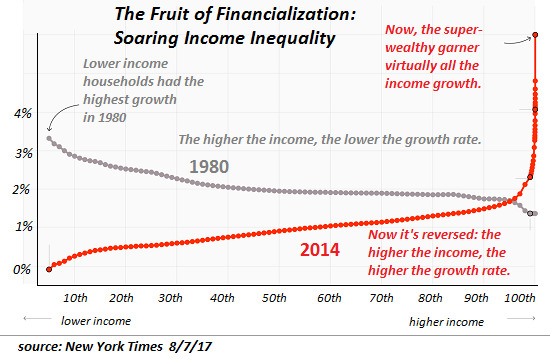


 After the Crash