The Mainstream Has Failed

disobey

By Charles Hugh Smith

Source: Of Two Minds

The good news is there is a way to avoid failure and stagnation: avoid the mainstream like the plague.

The mainstream became mainstream because it worked: the mainstream advice to “go to college and you’ll get a good job” worked, the mainstream financial plan of buying a house to build equity to pass on to your children worked, the mainstream of government regulation worked to the public’s advantage at modest cost to taxpayers and the mainstream media, despite being cozy with government agencies such as the C.I.A. and operating as a profit machine for the families that owned the newspapers, radio stations, etc., functioned as a basically honest broker of information and reporting.

Now, the mainstream has failed. Mainstream career advice now leads to crushing debts and career stagnation, mainstream financial planning generates high risks, mainstream government regulations are costly and burdensome, and the mainstream media is little more than a corporate-owned mouthpiece of propaganda and distributor of infotainment that is sold as “news.”

Does anyone actually believe the mainstream political process isn’t broken? Those who claim it isn’t broken are either well-paid shills just doing their job or they’re delusional.

The mainstream American diet now leads to chronic disease and early death.Supersized portions, large amounts of sugar and/or salt in virtually every packaged food item, heavy doses of low-quality fats in almost all mainstream fast foods–these have become mainstream at a very high cost in diminished health and reduced years of life free of chronic disease and pain.

The mainstream level of fitness contributes to chronic disease and early death.The mainstream lifestyle is one in which people passively watch a few daredevils pursue extreme sports on a variety of digital screens, passively “consume” music rather than learning to play music themselves, passively consume “news” rather than being engaged in community activities that make news, and so on.

The mainstream healthcare system is structured so it is incapable of promoting health. As my longtime friend GFB recently asked, “Who is happy with the current healthcare system?” Certainly not the doctors and nurses or the patients. Perhaps Big Pharma is happy as a result of their enormous profits (more of which is spent on marketing the latest marginally useful and often dangerous drug than on R&D), but even Big Pharma has legitimate complaints about the cost and time required to get a potentially life-changing drug (such as immunotherapy drugs) through the pipeline.

But the real problem is the soaring costs of the system will eventually collapse the entire economy. The same can be said of the soaring costs of increasingly marginal higher education, the soaring costs of increasingly marginal weapons systems, and so on.

medical-costs6-16a

The mainstream healthcare system is incapable of promoting health or restraining costs:

bankrupt-healthcare

The other problem with the mainstream is that any attempt to structurally reform these broken systems will trigger collapse. The mainstream systems are now so fragile that any significant change will cause them to implode. I explain why in my book Why Our Status Quo Failed and Is Beyond Reform.

The good news is there is a way to avoid failure and stagnation: avoid the mainstream like the plague. Stop eating packaged and fast foods, eat restaurant meals only occasionally, prepare 90% of your meals at home with real ingredients, including lots of fresh vegetables. Walk at least one mile/2 kilometers a day, start bicycling instead of driving (where possible), start doing yoga, tai chi, etc. every day, turn any 6-foot square floor area into your home gym–get lean.

Stop watching sports and start doing sports (appropriate to your age and climate, of course).

As for fashioning a sustainable career–don’t count on a college degree to work some sort of magic. I describe a more proactive approach to forging a sustainable career in my book Get a Job, Build a Real Career and Defy a Bewildering Economy.

Don’t accept “standards of care” that include addictive pain-killers and powerful meds that require another six meds with their own side-effects to counter the side-effects of the first med. Do you own research, get a second opinion. Discover what you can do to help heal yourself first.

Stop “consuming” mainstream media except in small, limited portions and consume even these portions with a skeptical eye and ear for propaganda and rigged numbers that supports failed mainstream narratives.

We are what we do every day. Step out of the mainstream and stay out of the mainstream and opportunities that are unavailable to those who passively accept the mainstream as “all there is” will emerge.

As Douglas MacArthur observed, “There is no security on this earth; there is only opportunity.”

If you’re interested in avoiding the mainstream of failure and stagnation, please consider these quotes drawn from my extensive list of Aphorisms:

“We are what we repeatedly do.” (Aristotle)

“Do the thing and you shall have the power.” (Ralph Waldo Emerson)

“Any intelligent fool can make things bigger, more complex, and more violent. It takes a touch of genius and a lot of courage to move in the opposite direction.” (E.F. Schumacher)

“He who will not risk cannot win.” (John Paul Jones)

For Purely Technical Reasons

peak-oil

By Dmitry Orlov

Source: Club Orlov

It is tempting for us to think that our technological choices—whether we choose to live in a city, a suburb or out in the country; whether we want to drive a pick-up truck, a gasoline-electric hybrid or ride a bicycle; whether we take a train, drive long distances or fly—are determined by our tastes. We may flatter ourselves that we are in control, and that our choices are reflective of our enlightened, environmentally conscious values. This view rests on a foundation of circular reasoning: we behave in enlightened ways because we are enlightened, and we are enlightened because, to wit, we behave in enlightened ways. As to why what we consider enlightened is in fact enlightened rather than a question of possibly questionable personal taste—that is not to be discussed: de gustibus non est disputandum.

But there is an alternative viewpoint, which seems more realistic in many ways, because it rests on a foundation of physical, technical specifics rather than fickle and arbitrary consumer preference, whim or taste. From this viewpoint, our technology and associated lifestyle choices are dictated by the technical requirements of their underlying technologies, both physical (the operation of the energy industry, the transportation industry, etc.) and political (the operation of political machines that segregate society by net worth and income, relegating wage-earners to a global disenfranchised underclass).

A few years ago I found out that I needed to replace the diesel engine on my boat (the old one blew up definitively) and looked at a number of options, one of which was to replace it with an electric motor and a large bank of batteries. The electric option was touted as being quiet, non-polluting, and having just enough range to get in and out of the marina and to get back to dock if the wind died during a typical daysail. It turned out to be more than twice as expensive as a replacement diesel engine. As to what one might do to take such a boat any great distance (that involves many hours of motoring) the solution is to… add a diesel engine hooked up to a very large alternator, at triple the cost of just replacing the diesel. And so I just replaced the diesel.

Diesel engines have a lot of positive qualities: they can run continuously for tens of thousands of hours; they can be rebuilt many times just by replacing the bearings, the cylinder sleeves, the piston rings and the valves; they are exceptionally reliable; the fuel they use is energy-dense. For these reasons, they are found throughout freight and construction industries and are used for small-scale power generation. They can be very large: the larger ships have engines that are as big as houses, with ladders welded to their cylinder walls, so that servicemen can climb down into them to service them after the cylinder head and the piston assembly are pulled out using an overhead shop crane. Small diesel engines make a lot less sense, and the silliest of them are the ones found on small yachts. There are many aspects of their design that make them silly, but there is also an overriding reason: they use the wrong fuel.

You see, diesel is a precious commodity, used in the transportation industry (by trucks, locomotives and ships), and in construction equipment, with no alternative that is feasible. A cousin of diesel fuel is jet fuel—another petroleum distillate—that is used to power jet engines, again, with no alternative that is feasible. And then there is a fuel that is only really useful as a small engine fuel: gasoline, that is. Gasoline engines beyond a certain size become much more trouble than they are worth.

Each barrel of crude oil can be distilled and refined into a certain amount of diesel and jet fuel, a certain amount of gasoline, some tar and some far less useful substances such as naphtha. The diesel is spoken for, because it literally moves the world; but if enough small engines cannot be found to burn all the gasoline that is produced, it becomes a waste product and has to be flared off at the oil refinery, at a loss. Indeed, prior to Henry Ford coming up with the brilliant plan to build cars cheap enough for his workers to afford, gasoline was dumped into rivers just to get rid of it, because while everyone burned kerosene (a distillate, like jet fuel and diesel) in lamps, cars remained playthings of the rich, and there simply wasn’t a market for any great quantities of gasoline.

Therefore, it became very important to find ways to sell gasoline, by finding enough uses for it, no matter how superfluous they happened to be. And although some people think that the private automobile is a symbol of luxury and freedom and feel the thrill of the open road, the reason they think that is because these ideas were implanted in their heads by the people who were tasked with finding a market for gasoline. Alongside cars, great effort was put into marketing all sorts of other small engines: for lawn mowers, jet skis, motorcycles, ATVs, boat outboard motors… The only semi-industrial use of gasoline is in chainsaws, small generators and air compressors, service and delivery vehicles, and outboard engines.

And so people were sold on the idea of driving their own car, whether they needed to or not, and spending lots of time stuck in traffic—all so that they would pay for gasoline. By causing all that excess traffic congestion, they also created the need to widen roads and highways, generating demand for another borderline useless petroleum product: road tar. And since there was a problem with cramming all these cars into cities (where cars are generally not needed if the cities are laid out using proper urban design, with sufficient numbers of tram, light rail and subway lines, etc.) the solution was to move everybody out to the suburbs. And so the reason half of the US population now lives in suburbia and drives has nothing to do with their needs, and everything to do with the need to sell them gasoline.

Some people may react negatively to the idea that their suburban castle and their magic chariot are all just part of a plan to make them spend much of their life paying for the right to dispose of toxic waste in unsafe ways. Rest assured, their preprogrammed negative reaction is part of the plan. Every effort has been made to program people to think that this waste disposal job—carried out at one’s own expense—is, in fact, something that should be considered a sign of success. The most efficient way to motivate a slave to perform is to convince him that he is free. To this end, driving is celebrated in music and film and portrayed as a way of life. Calling it what it is—being a slave to a machine—is bound to cause cognitive dissonance, all the more so because driving a lot destroys one’s mind: in the immortal words of a character from the movie Repo Man, ”The more you drive, the less intelligent you become.” In this respect, most of the people living in the US are far past the point of no return, and it is pointless to attempt to impart to them any ideas that are discordant with the dead-end lifestyle into which they have been unconsciously coerced.

Getting back to electric vehicles, such as what my boat would have ended up if I were gullible and made of money: they are obviously a defective idea. Their range is limited, they take longer to charge than it takes to fill a gas tank, and they use expensive and dangerous lithium-ion batteries that need periodic replacement. There is not enough lithium available to continue making batteries for laptops and smartphones (which periodically burst into flames), never mind providing for a giant expansion of battery-building to support lots of electric cars. Perhaps most importantly, they shrink the market for gasoline. So, what’s the reason behind the push?

It certainly isn’t part of any particular effort to electrify transportation in general, because no electric solution exists for ships or planes, and electrifying rail freight is an impossibly expensive proposition. It certainly isn’t part of an effort to cut greenhouse gas emissions, because most of the ways electricity is currently generated is by burning coal and natural gas—and will be, while supplies last, because electricity is hard to store, and no matter how many solar arrays and wind farms are installed something will be needed to power the electric grid on overcast, windless days.

No, the push for electric cars is motivated by a different sort of technology—political technology. You see, the oil age is drawing to a close. Last year the oil companies only discovered 1 barrel of oil for every 10 barrels they produced; at the turn of the century it was closer to 1 for every 4. At the same time, most of the easy-to-get-at oil has already been produced, and now it takes 1 barrel’s worth of energy to produce something like 10 barrels, whereas at the dawn of the age of oil it was closer to 1 for every 100 barrels. Such a low level of net energy production is turning out to be insufficient to maintain an industrial civilization, and as a result economic growth has largely stalled out. And although large investments in oil production have succeeded in keeping large volumes of oil flowing, for now, this is turning out to be an ineffective way to invest money, with many energy companies, once so profitable, now unable to pay the interest on their debt. And even though constant injections of free money are currently keeping developed economies from cratering into bankruptcy, it has been clear for some time that each additional dollar of debt produces significantly less than a dollar’s worth of economic growth. Growing debt within a growing economy can be very nice; but if the economy isn’t growing as fast, it’s fatal.

As the oil age winds down, personal transportation, in the form of the automobile, is bound to once again become a plaything of the very rich. But then, when it comes to electric cars, it already is! And I don’t mean Tesla: the most commonly used electric vehicle worldwide is the golf cart. And who uses golf carts? Members of golf clubs; guests at resorts; residents of posh gated communities; employees at corporate and academic campuses… And what do all these people have in common? They are all members of the salaried elite; they are definitely not members of the wage-earning class. To them, the electric car offers a way of preserving a semblance of the status quo for themselves while setting themselves apart (in their own minds) from all of the gasoline-burning riffraff. Let the great unwashed in the flyover states, with their pickup trucks complete with gun racks, burn what’s left of the gasoline while overdosing on synthetic opiates while the salaried elites and individuals of high net worth, ensconced in their campuses and gated communities, will create a different future for themselves, replete with wind turbines, solar panels and electric cars (until they all get shot by all those they have disenfranchised).

Life on Earth is Dying

deadearth

By Robert J. Burrowes

On the day that you read this article, 200 species of life on Earth (plants, birds, animals, fish, amphibians, insects, reptiles) will cease to exist. Tomorrow, another 200 species will vanish forever.

The human onslaught to destroy life on Earth is unprecedented in Earth’s history. Planet Earth is now experiencing its sixth mass extinction event and Homo sapiens sapiens is the cause. Moreover, this mass extinction event is accelerating and is so comprehensive in its impact
that the piecemeal measures being taken by the United Nations, international agencies and governments constitute a tokenism that is breathtaking in the extreme.

And it is no longer the case that mainly ‘invisible’ species are
vanishing: those insects, amphibians and small animals about which you had never even heard, assuming they have been identified and given a name by humans.

You and I are on the brink of driving to extinction some of the most iconic species alive today. For a photo gallery of threatened species, some of which are ‘critically endangered’, see ‘World’s wildlife being pushed to the edge by humans – in pictures‘.

If you want to read more about some aspects of the extinction threat, you can do so in these recent reports: ‘World Wildlife Crime Report: Trafficking in protected species‘ and ‘2016 Living Planet Report‘ which includes these words: ‘The main statistic from the report … shows a 58% decline between 1970 and 2012. This means that, on average, animal populations are roughly half the size they were 42 years ago.’

And if you want to read just one aspect of what is happening in the world’s oceans, this recent UN report will give you something to ponder:
New UN report finds marine debris harming more than 800 species, costing countries millions‘.

Of course, some of what is happening is related to the ongoing climate catastrophe and there isn’t any good news on that front. See ‘What’s Happening in the Arctic is Astonishing‘.

But not everything that is going badly wrong is well known either. Did you know that we are destroying the Earth’s soil? See ‘Only 60 Years of Farming Left If Soil Degradation Continues‘.

And did you realise that even nitrogen is now a huge problem too? See ‘Scientists shine a spotlight on the overlooked menace of nitrogen‘.

Of course, military violence has devastating consequences on the Earth’s ecosystems too, destroying land, water and atmosphere (not to mention killing human beings) in the fight over resources. You will get no joy from the article ‘Iraq’s oil inferno – government inaction in the face of eco-terrorism
or the website of the Toxic Remnants of War Project. But every single aspect of military spending is ultimately used to destroy. It has no other function.

While 2.5 billion human beings do not have enough to eat. See ‘One in three people suffers malnutrition at global cost of $3.5 trillion a year‘.

As you read all this, you might say ‘Not me’! But you are wrong. You don’t have to be an impoverished African driven to killing elephants for their tusks so that you can survive yourself. You don’t have to be a farmer who is destroying the soil with synthetic poisons. You don’t have to be a soldier who kills and destroys or a person who works for a corporation that, one way to another, forces peasants off their land.

You just have to be an ‘ordinary’ person who pays your military taxes and consumes more than your share of world resources while participating without challenge in the global system of violence and exploitation managed by the global elite.

‘Why is this?’ you might ask.

This is because the primary driver of the human-induced mass extinction is not such things as some people hunting a particular lifeform to extinction, horrendous though this is. In fact, just two things drive most species over the edge: our systematic destruction of land habitat – forests, grasslands, wetlands, peatlands, mangroves… – in our endless effort to capture more of the Earth’s wild places for human use (whether it be residential, commercial, mining, farming or military) and our destruction of waterways and the ocean habitat by dumping into them radioactive contaminants, carbon dioxide, a multitude of poisons and chemical pollutants, and even plastic.

And do you know what drives this destruction of land and water habitats? Your demand for consumer products, all of which are produced by using land and water habitats, and the resources derived from them, often far from where you live. The most basic products, such as food and clothing, are produced on agricultural land, sometimes created by destroying rainforests, or taken from the ocean (where overfishing has savagely depleted global fish stocks). But in using these resources, we have ignored the needs of the land, oceans and the waterways for adequate regenerative inputs and recovery time.

We also participate, almost invariably without question or challenge, in the inequitable distribution of resources that compels some impoverished people to take desperate measures to survive through such means as farming marginal land or killing endangered wildlife.

So don’t sit back waiting for some miracle by the United Nations, international agencies or governments to solve this problem. It cannot happen for the simple reason that these organizations are all taking action within the existing paradigm that prioritizes corporate profit and military violence over human equity and ecological sustainability.

Despite any rhetoric to the contrary, they are encouraging
overconsumption by industrialized populations and facilitating the inequitable distribution of income and wealth precisely because this benefits those who control these organizations, agencies and governments: the insane corporate elites who are devoid of the capacity to see any value beyond the ‘bottom line’. See ‘The Global Elite is Insane‘.

If you want action on the greatest challenge human beings have ever faced – to avert our own extinction by learning to live in harmony with our biosphere and equity with our fellow humans – then I encourage you to take personal responsibility.

If you do, you need to act. At the simplest level, you can make some difficult but valuable personal choices. Like becoming a vegan or vegetarian, buying/growing organic/biodynamic food, and resolutely refusing to use any form of poison or to drive a car or take an airline flight.

But if you want to take an integrated approach, the most powerful way you can do this is to systematically reduce your own personal consumption while increasing your self-reliance. Anita McKone and I have mapped out a fifteen-year strategy for doing this in ‘The FlameTree Project to Save Life on Earth‘. You might also consider signing the online pledge of ‘The People’s Charter to Create a Nonviolent World‘  which obviously includes nonviolence towards our fellow species.

One of the hidden tragedies of modern human existence is that we have been terrorized into believing that we are not personally responsible. See ‘The Delusion “I Am Not Responsible“‘.

For a fuller explanation, see ‘Why Violence?‘ and ‘Fearless Psychology and Fearful Psychology: Principles and Practice‘.

It isn’t true but few people feel powerful enough to make a difference.

And every time you decide to do nothing and to leave it to someone else,  you demonstrate why no-one else should do anything either.

Extinction beckons. What will you do?


Biodata: Robert J. Burrowes has a lifetime commitment to understanding and ending human violence. He has done extensive research since 1966 in an effort to understand why human beings are violent and has been a nonviolent activist since 1981. He is the author of ‘Why Violence?‘ His email address is flametree@riseup.net and his website is at http://robertjburrowes.wordpress.com


Robert J. Burrowes
P.O. Box 68
Daylesford
Victoria 3460
Australia
Email: flametree@riseup.net

Websites:
Nonviolence Charter
Flame Tree Project to Save Life on Earth
‘Why Violence?’
Nonviolent Campaign Strategy
Nonviolent Defense/Liberation Strategy
Anita: Songs of Nonviolence
Robert Burrowes
Global Nonviolence Network

Being Our Experience

Seer

By Iam Saums with contributions from Zen Gardner

Source: ZenGardner.com

“Until we choose our own experience of life, we will never truly live.”

Common Thread:

There are over six billion unique interpretations of life in the three-dimensional construct we experience as reality.  Although human beings have the popular inclination to gravitate toward a common one to which we are bound, our true vision and nature is remarkably multiplicit.  We inevitably subject ourselves to inner and peripheral conditioning to toe the line of reality.  We become social echoes for an engineered existence that is distorted, elusive, obscure and unconscious.  Our desire for social amusement, comfort, identity, purpose and security significantly outweighs our quest to fulfill our being, creativity, destiny, love and truth.

Foundation of Illusion:

We are programmed to believe that our intelligence is the sole benefactor of our survival.  Our insatiable fascination with ourselves and our place in the world distracts us from all that is sacred.  Eventually, we exchange our passion to live with an addiction to buy.  Our genuine experiences that empower and enrich us are superseded by virtual events recorded on a sales receipt.  The measure of our fulfillment is in the quantity of our entertainment instead of the quality of our experience.  Society turns on a worthless dime, promising a wealth of abundance, happiness and meaning, though rarely ever delivers.

Wired for Reason:

We are multi-dimensional beings with eternal possibilities and infinite potential.  Our indoctrination into the complex principles and structures of the standard reality conditions, hypnotizes and manipulates us into the human imprisonment of instinct, reaction and survival.  We are akin to a clipper ship with unfastened sails, bouncing upon the social seas of happenstance.  Our body and brain is our hardware and our software is a two-dimensional program of instinct and intellect.  We are dependent upon and obliviously tethered to knowledge and logic, conditioned to be simulations in a paradigm of thought, threat and fear.

Playing the Angles:

All of us are brainwashed and spellbound by the multi-faceted filters of our own perceptions.  We are frequently presented with opportunities to choose how we behold our experience of life.  Most of us view the world through an elaborate tapestry of our analysis, fears, judgements, and wants.  Rarely do we observe the world as it truly is.  We see it the way we would like it to be.  We live from these personal fantasies and push the agendas of our positions in the pursuit of making the common reality ever more comfortable, compliant or convenient to our own desires.  We engage with an illusion of what is instead of its authenticity.

The World We Enable:

Our personal power is in our creativity, compassion, consciousness, love and transformation.  Yet, we express it most often with our drama, judgement, opinion and outrage.  It isn’t that we are purely oblivious to our truth and purpose.  We are products of the societal ethics to which we eagerly acquiesce.  It seems easier to abandon our own unique experience, existence and perception as an inauthentic and noble sacrifice instead of claiming and living the life only we were meant.  We are so powerful as human beings.  Yet, we commit to killing our lives everyday with our denial, disinterest, doubt and obedience to the enslavement of reality.

“Lay down your right.  Lay down your wrong.  Lay down the lie.  To which you belong.”

The Human God:

The human invention of God we accept and are expected to believe is primarily one of judgement, vengeance and wrath.  It is the fear beyond the myth that captivates our allegiance.  The intoxication of this false power seduces us into emulation and imitation.  Though we often fail to see the most glaring truth of this “divine” influence.  The raw power of our unattended ego imposes an experience and perception of cynicism, resignation and ridicule for anything that is not of our own clever design.  We adopt a defense of disapproval, drama, opinion and rumor rather than be present to the possibilities of acceptance, compassion and understanding.

Vital Signs:

The medical field identifies the vitality of our existence by taking our pulse, analyzing our response to stimuli, observing our breath in different areas of our body and listening to our heart.  When we meet these basic criteria, we are given a label of health and an acknowledgment of life.  Yet, the true measurement of living is found in our potential, expression and willingness to make a difference.  The true meaning of life is to serve others as much or more than ourselves for the sake of service.  When we choose to exercise this opportunity, we instantly transform our experience into one of community, purpose and possibility.

In Purpose:

Most of us live our lives in the absence of purpose.  We have a tendency to throw havoc to the wind and see what returns to us.  More often than not very little does, at least to our desire.  Unfortunately, purpose isn’t primarily exercised let alone existent in our society.  The very nature of reality does not support or sustain the extraordinary.  Our personal focus depends solely upon the what, how and why of our experience.  These are the crucial elements of our potential to empower our lives.  When we bring purpose to every facet of our experience, we express creativity, consciousness, enlightenment and transformation.

The Truth of False Power:

Each one of us has our own unique experience of life defined by our choices, the focus of our energy, the perception(s) we embrace and the destiny we fulfill.  There is no one else in this world that could or should degrade, discredit, judge or question the authenticity, intent, meaning, and worth of our experiences.  All who do simply endeavor to conceal or protect their own fears, inadequacies, insecurities and weaknesses.  We have been raised in a social environment of defense that is of great peril to the coincidental targets of our expression.  The force of the false power we project upon others ultimately diminishes the truth of our own.

Being Our Experience:

There is nothing more significant in our life than who we are being.  In a reality where being-ness has been swept under the proverbial rug of contemporary society, it is truly the only saving grace for the present and future of all.  Who we are being creates, expresses and sustains the quality of our commitment.  Our vision, empowerment, purpose and stand inspires how we truly live our lives.  Of us it requires our creativity, confidence, courage and trust to manifest our greatest experience.  Only through us will the power of our experience transcend the boundaries of reality and society and transform the world.

“The greatest experiences we will ever have are the ones we choose to create.”

Depicting Perpetual Crimes committed by Corporate Culture and its Mainstream Media

index-1-229x300

Russian Novels Combating Global Capitalist Nightmare

By Andre Vltchek

Source: Dissident Voice

Imagine Moscow being taken over by some international corporate cartel. By a monster which has its own factories and office buildings, security services, private prisons, re-education (‘training’) centers, and its obedient mass media outlets. Imagine that it also has detailed databases on almost everyone who really matters in the capital.

Imagine that human lives suddenly don’t matter. People are only expected to produce and consume; they become fully disposable.

Imagine that the once greatly educated Russia with its legendary artists and philosophers is gradually getting reduced to an unimaginably primitive level. Suddenly, there is US pop trash flying about everywhere, and the greatest entertainment for the masses comes from watching countless television ‘reality shows’, including those that graphically depict, candidly, how both men and women are shitting and pissing in the capital’s public toilets.

That’s what you get when reading a witty, provocative and thoroughly outrageous novel by Sergei Minaev, called R.A.B.; 521 pages of it!

In all his novels, including Soulless, The Telki, Media Sapiens and R.A.B., Minaev masterfully depicts the perpetual crimes committed by corporate culture and its mainstream media. Brutally and candidly he describes an apocalyptic society constructed on the soulless, merciless and murderous principles of the modern Western-style capitalist system.

In such a world, nothing is sacred anymore. The ‘elites’ are having great fun hunting on the outskirts of the city, not for some animals, but for homeless people living in abandoned pipelines (R.A.B.). A US mainstream television news channel, together with its local counterpart, manage to trigger a military conflict between Georgia and Russia, after hiring several combat helicopters and retired soldiers, killing real people, just in order to increase their ratings. And several terrorist attacks in Moscow are being paid for and staged by other big media conglomerates (Media Sapiens).

Minaev is not crying; he is definitely far from being a ‘bleeding heart’. He is tough and cynical. His characters are mostly ruthless super-yuppies from Moscow, go-getters, living a fast life, taking drugs, partying in luxury clubs, having sex literally with everything that moves (Soulless).

But they get burned, destroyed, brought to near suicide.

They have no ideology, no political views. They laugh at, they insult everything and everybody, but deep inside they are actually suffering from a horrible void, from emptiness. In those rare moments of honesty, they admit to each other and to themselves, that they are actually still longing for at least ‘something pure and decent’, uncorrupted by the global market-fundamentalist regime and its ‘values’ and ‘culture’.

*****

In R.A.B. Minaev goes much further. His yuppies (paradoxically, the mid and upper-level managers) start a rebellion against the system. They go on strike, march through the streets, and build barricades. They begin demanding social justice. They burn down their own offices.

They do it after their Russian toy-producing company (and other companies all over the city) gets swallowed by a US-based multi-national corporation, which immediately begins dismantling all social benefits, while injecting uncertainty and fear into the workplace. A multi-national also opens a horrid toy factory on the outskirts of Moscow, which then employs desperate immigrants from the Central Asian republics.

The privately-owned mass media outlets first confront the protesters, and then follow up with pro-corporate propaganda and in the end the corporate security services and the army. Many people disappear. Others are locked up in the offices and secret prisons of the corporations, and tortured. Those who survive become ‘unemployable’, their names permanently on the blacklist.

But what does Minaev really call for? Is it a true revolution?

Yes and no. He does not believe that in the countries that have been conquered by market fundamentalism and by unbridled consumerism, a ‘real revolution’ is possible. He does not think that the people there have any ideals or any zeal left. At the same time, at least some of his characters are clearly unwilling to surrender.

It is chilling to read R.A.B. while at the same time those ‘rebellions’ in Greece, France, Spain and the U.K. are taking place.

One of the main characters of R.A.B. confronts the demonstrators: It is not a revolution! You are all parts of the system. You just want a better deal for yourself. Through this rebellion, you are actually negotiating with the cartel of the corporations. If you get what you are asking for, you’ll happily remain where you are and carry on as if nothing happened.

*****

Then Minaev does exactly what no Western writer would dare to do. He begins to argue that to destroy the system, there has to be an armed struggle. Otherwise no real change could ever be achieved.

The suppressed rebellion of the yuppies eventually triggers much a wider movement, and soon there are real battles raging in several provincial capitals.

The end of the novel is open. The main character of R.A.B. is destroyed. He loses the love of his life (in desperation she commits suicide); he has no job, no money and no place to go. But he is still alive. Russia is still alive. It is obvious that no matter what, it will never accept this monstrous system that was forced on it by the West.

*****

It all may sound like an insane fantasy, but. in fact, what Minaev writes about is not too far from the nightmares that Russia was descending into right after Gorbachev allowed the country (USSR) to fall apart, and then Yeltsin introduced unbridled privatization and gave unprecedented concessions to foreign corporations. During that period, Russia went through something that could be easily described as a social genocide. Life expectancy dropped to the levels of war-torn countries in Africa. Lawlessness ruled. All ideals were ridiculed and spat at. A big number of Russian intellectuals were bought and organized by the West into countless NGO’s. The lowest grade of Western pop and entertainment torpedoed Russian culture. During those dark days, the West finally succeeded in bringing Russia to its knees.

Not even two decades later, a new Russia is once again proud, strong and confident.

It rose to its feet, it began successfully producing again, and it underwent a tremendous and positive social transformation.

Just one week ago I returned from the Russian Far East, from the cities of Vladivostok, Khabarovsk and Petropavlovsk Kamchatski. Wherever I went, I witnessed new and impressive infrastructure. I encountered a confident, hard working nation, which was working hard to restore at least some of the socialist structures and benefits that it used to enjoy in the past.

The new, present-day Russia is much closer to China; much more impressed by the Chinese system, than by what it was forced to adopt in the past; during the “pro-Western era” which is now generally considered to be synonymous to a national disaster.

Russian writers played an important role in describing the horrors of the Gorbachev/Yeltsin years, and of the brutal global economic, political and ‘cultural’ regime injected by the West to all the corners of the Planet. From an outrageous Eduard Limonov’s novel It’s Me, Eddie to Minaev’s R.A.B., Russian literature has been daring, insulting, direct and brutally honest.

While Limonov and Minaev sell millions of copies of their books at home, their work is virtually unknown in the West. I found no English translations when searching on Amazon.com, and elsewhere.

In his New York-based Eddie, Limonov is calling openly for terrorist acts against the Western regime, while some of Minaev’s characters also believe in an armed struggle, although of a more conventional type.

Nothing is spared. When the US toy-producing corporation demands a special tax from its employees in Russia, for “helping out those poor children in the Third World”, the main character of R.A.B. thinks: “well, they can now use that money to buy coffins for children they employ and kill in Indonesia or Thailand”. When the tax goes slightly up, he comments: “now they will have enough funds to dig at least a few mass graves”.

All this is simply too outrageous for Western readers. Or more precisely, the ‘book business’ most likely ‘thinks’ that it is.

The fact remains that despite what is constantly repeated by Western propaganda, those who read Russian can clearly see and appreciate that Russian literature is actually much more free, daring and rebellious than its counterpart in the West.

When several Russian bestselling novelists are calling openly for combat against the global regime (the same regime which is, until now, at least partially, controlling the economy of their country), one has no choice but to be impressed by the level of freedom in the country which allows such work to be published and then promoted.

But in the West, you would never know all this, unless you spoke Russian. It is because in the West (and in its ‘client’ states and colonies) you are being extremely well ‘protected’ from such uncomfortable (and the regime would even say ‘dangerous’) thoughts!


André Vltchek is a novelist, filmmaker, and investigative journalist. He has covered wars and conflicts in dozens of countries. His latest book is Exposing Lies of the Empire.

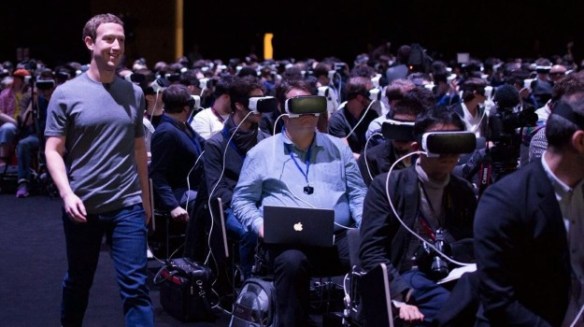
The world wide cage

zuckerberg_VR_people-625x350

Technology promised to set us free. Instead it has trained us to withdraw from the world into distraction and dependency

By Nicholas Carr

Source: Aeon

It was a scene out of an Ambien nightmare: a jackal with the face of Mark Zuckerberg stood over a freshly killed zebra, gnawing at the animal’s innards. But I was not asleep. The vision arrived midday, triggered by the Facebook founder’s announcement – in spring 2011 – that ‘The only meat I’m eating is from animals I’ve killed myself.’ Zuckerberg had begun his new ‘personal challenge’, he told Fortune magazine, by boiling a lobster alive. Then he dispatched a chicken. Continuing up the food chain, he offed a pig and slit a goat’s throat. On a hunting expedition, he reportedly put a bullet in a bison. He was ‘learning a lot’, he said, ‘about sustainable living’.

I managed to delete the image of the jackal-man from my memory. What I couldn’t shake was a sense that in the young entrepreneur’s latest pastime lay a metaphor awaiting explication. If only I could bring it into focus, piece its parts together, I might gain what I had long sought: a deeper understanding of the strange times in which we live.

What did the predacious Zuckerberg represent? What meaning might the lobster’s reddened claw hold? And what of that bison, surely the most symbolically resonant of American fauna? I was on to something. At the least, I figured, I’d be able to squeeze a decent blog post out of the story.

The post never got written, but many others did. I’d taken up blogging early in 2005, just as it seemed everyone was talking about ‘the blogosphere’. I’d discovered, after a little digging on the domain registrar GoDaddy, that ‘roughtype.com’ was still available (an uncharacteristic oversight by pornographers), so I called my blog Rough Type. The name seemed to fit the provisional, serve-it-raw quality of online writing at the time.

Blogging has since been subsumed into journalism – it’s lost its personality – but back then it did feel like something new in the world, a literary frontier. The collectivist claptrap about ‘conversational media’ and ‘hive minds’ that came to surround the blogosphere missed the point. Blogs were crankily personal productions. They were diaries written in public, running commentaries on whatever the writer happened to be reading or watching or thinking about at the moment. As Andrew Sullivan, one of the form’s pioneers, put it: ‘You just say what the hell you want.’ The style suited the jitteriness of the web, that needy, oceanic churning. A blog was critical impressionism, or impressionistic criticism, and it had the immediacy of an argument in a bar. You hit the Publish button, and your post was out there on the world wide web, for everyone to see.

Or to ignore. Rough Type’s early readership was trifling, which, in retrospect, was a blessing. I started blogging without knowing what the hell I wanted to say. I was a mumbler in a loud bazaar. Then, in the summer of 2005, Web 2.0 arrived. The commercial internet, comatose since the dot-com crash of 2000, was up on its feet, wide-eyed and hungry. Sites such as MySpace, Flickr, LinkedIn and the recently launched Facebook were pulling money back into Silicon Valley. Nerds were getting rich again. But the fledgling social networks, together with the rapidly inflating blogosphere and the endlessly discussed Wikipedia, seemed to herald something bigger than another gold rush. They were, if you could trust the hype, the vanguard of a democratic revolution in media and communication – a revolution that would change society forever. A new age was dawning, with a sunrise worthy of the Hudson River School.

Rough Type had its subject.

The greatest of the United States’ homegrown religions – greater than Jehovah’s Witnesses, greater than the Church of Jesus Christ of Latter-Day Saints, greater even than Scientology – is the religion of technology. John Adolphus Etzler, a Pittsburgher, sounded the trumpet in his testament The Paradise Within the Reach of All Men (1833). By fulfilling its ‘mechanical purposes’, he wrote, the US would turn itself into a new Eden, a ‘state of superabundance’ where ‘there will be a continual feast, parties of pleasures, novelties, delights and instructive occupations’, not to mention ‘vegetables of infinite variety and appearance’.

Similar predictions proliferated throughout the 19th and 20th centuries, and in their visions of ‘technological majesty’, as the critic and historian Perry Miller wrote, we find the true American sublime. We might blow kisses to agrarians such as Jefferson and tree-huggers such as Thoreau, but we put our faith in Edison and Ford, Gates and Zuckerberg. It is the technologists who shall lead us.

Cyberspace, with its disembodied voices and ethereal avatars, seemed mystical from the start, its unearthly vastness a receptacle for the spiritual yearnings and tropes of the US. ‘What better way,’ wrote the philosopher Michael Heim in ‘The Erotic Ontology of Cyberspace’ (1991), ‘to emulate God’s knowledge than to generate a virtual world constituted by bits of information?’ In 1999, the year Google moved from a Menlo Park garage to a Palo Alto office, the Yale computer scientist David Gelernter wrote a manifesto predicting ‘the second coming of the computer’, replete with gauzy images of ‘cyberbodies drift[ing] in the computational cosmos’ and ‘beautifully laid-out collections of information, like immaculate giant gardens’.

The millenarian rhetoric swelled with the arrival of Web 2.0. ‘Behold,’ proclaimed Wired in an August 2005 cover story: we are entering a ‘new world’, powered not by God’s grace but by the web’s ‘electricity of participation’. It would be a paradise of our own making, ‘manufactured by users’. History’s databases would be erased, humankind rebooted. ‘You and I are alive at this moment.’

The revelation continues to this day, the technological paradise forever glittering on the horizon. Even money men have taken sidelines in starry-eyed futurism. In 2014, the venture capitalist Marc Andreessen sent out a rhapsodic series of tweets – he called it a ‘tweetstorm’ – announcing that computers and robots were about to liberate us all from ‘physical need constraints’. Echoing Etzler (and Karl Marx), he declared that ‘for the first time in history’ humankind would be able to express its full and true nature: ‘we will be whoever we want to be.’ And: ‘The main fields of human endeavour will be culture, arts, sciences, creativity, philosophy, experimentation, exploration, adventure.’ The only thing he left out was the vegetables.

Such prophesies might be dismissed as the prattle of overindulged rich guys, but for one thing: they’ve shaped public opinion. By spreading a utopian view of technology, a view that defines progress as essentially technological, they’ve encouraged people to switch off their critical faculties and give Silicon Valley entrepreneurs and financiers free rein in remaking culture to fit their commercial interests. If, after all, the technologists are creating a world of superabundance, a world without work or want, their interests must be indistinguishable from society’s. To stand in their way, or even to question their motives and tactics, would be self-defeating. It would serve only to delay the wonderful inevitable.

The Silicon Valley line has been given an academic imprimatur by theorists from universities and think tanks. Intellectuals spanning the political spectrum, from Randian right to Marxian left, have portrayed the computer network as a technology of emancipation. The virtual world, they argue, provides an escape from repressive social, corporate and governmental constraints; it frees people to exercise their volition and creativity unfettered, whether as entrepreneurs seeking riches in the marketplace or as volunteers engaged in ‘social production’ outside the marketplace. As the Harvard law professor Yochai Benkler wrote in his influential book The Wealth of Networks (2006):

This new freedom holds great practical promise: as a dimension of individual freedom; as a platform for better democratic participation; as a medium to foster a more critical and self-reflective culture; and, in an increasingly information-dependent global economy, as a mechanism to achieve improvements in human development everywhere.

Calling it a revolution, he said, is no exaggeration.

Benkler and his cohort had good intentions, but their assumptions were bad. They put too much stock in the early history of the web, when the system’s commercial and social structures were inchoate, its users a skewed sample of the population. They failed to appreciate how the network would funnel the energies of the people into a centrally administered, tightly monitored information system organised to enrich a small group of businesses and their owners.

The network would indeed generate a lot of wealth, but it would be wealth of the Adam Smith sort – and it would be concentrated in a few hands, not widely spread. The culture that emerged on the network, and that now extends deep into our lives and psyches, is characterised by frenetic production and consumption – smartphones have made media machines of us all – but little real empowerment and even less reflectiveness. It’s a culture of distraction and dependency. That’s not to deny the benefits of having easy access to an efficient, universal system of information exchange. It is to deny the mythology that shrouds the system. And it is to deny the assumption that the system, in order to provide its benefits, had to take its present form.

Late in his life, the economist John Kenneth Galbraith coined the term ‘innocent fraud’. He used it to describe a lie or a half-truth that, because it suits the needs or views of those in power, is presented as fact. After much repetition, the fiction becomes common wisdom. ‘It is innocent because most who employ it are without conscious guilt,’ Galbraith wrote in 1999. ‘It is fraud because it is quietly in the service of special interest.’ The idea of the computer network as an engine of liberation is an innocent fraud.

I love a good gizmo. When, as a teenager, I sat down at a computer for the first time – a bulging, monochromatic terminal connected to a two-ton mainframe processor – I was wonderstruck. As soon as affordable PCs came along, I surrounded myself with beige boxes, floppy disks and what used to be called ‘peripherals’. A computer, I found, was a tool of many uses but also a puzzle of many mysteries. The more time you spent figuring out how it worked, learning its language and logic, probing its limits, the more possibilities it opened. Like the best of tools, it invited and rewarded curiosity. And it was fun, head crashes and fatal errors notwithstanding.

In the early 1990s, I launched a browser for the first time and watched the gates of the web open. I was enthralled – so much territory, so few rules. But it didn’t take long for the carpetbaggers to arrive. The territory began to be subdivided, strip-malled and, as the monetary value of its data banks grew, strip-mined. My excitement remained, but it was tempered by wariness. I sensed that foreign agents were slipping into my computer through its connection to the web. What had been a tool under my own control was morphing into a medium under the control of others. The computer screen was becoming, as all mass media tend to become, an environment, a surrounding, an enclosure, at worst a cage. It seemed clear that those who controlled the omnipresent screen would, if given their way, control culture as well.

‘Computing is not about computers any more,’ wrote Nicholas Negroponte of the Massachusetts Institute of Technology in his bestseller Being Digital (1995). ‘It is about living.’ By the turn of the century, Silicon Valley was selling more than gadgets and software: it was selling an ideology. The creed was set in the tradition of US techno-utopianism, but with a digital twist. The Valley-ites were fierce materialists – what couldn’t be measured had no meaning – yet they loathed materiality. In their view, the problems of the world, from inefficiency and inequality to morbidity and mortality, emanated from the world’s physicality, from its embodiment in torpid, inflexible, decaying stuff. The panacea was virtuality – the reinvention and redemption of society in computer code. They would build us a new Eden not from atoms but from bits. All that is solid would melt into their network. We were expected to be grateful and, for the most part, we were.

Our craving for regeneration through virtuality is the latest expression of what Susan Sontag in On Photography (1977) described as ‘the American impatience with reality, the taste for activities whose instrumentality is a machine’. What we’ve always found hard to abide is that the world follows a script we didn’t write. We look to technology not only to manipulate nature but to possess it, to package it as a product that can be consumed by pressing a light switch or a gas pedal or a shutter button. We yearn to reprogram existence, and with the computer we have the best means yet. We would like to see this project as heroic, as a rebellion against the tyranny of an alien power. But it’s not that at all. It’s a project born of anxiety. Behind it lies a dread that the messy, atomic world will rebel against us. What Silicon Valley sells and we buy is not transcendence but withdrawal. The screen provides a refuge, a mediated world that is more predictable, more tractable, and above all safer than the recalcitrant world of things. We flock to the virtual because the real demands too much of us.

‘You and I are alive at this moment.’ That Wired story – under headline ‘We Are the Web’ – nagged at me as the excitement over the rebirth of the internet intensified through the fall of 2005. The article was an irritant but also an inspiration. During the first weekend of October, I sat at my Power Mac G5 and hacked out a response. On Monday morning, I posted the result on Rough Type – a short essay under the portentous title ‘The Amorality of Web 2.0’. To my surprise (and, I admit, delight), bloggers swarmed around the piece like phagocytes. Within days, it had been viewed by thousands and had sprouted a tail of comments.

So began my argument with – what should I call it? There are so many choices: the digital age, the information age, the internet age, the computer age, the connected age, the Google age, the emoji age, the cloud age, the smartphone age, the data age, the Facebook age, the robot age, the posthuman age. The more names we pin on it, the more vaporous it seems. If nothing else, it is an age geared to the talents of the brand manager. I’ll just call it Now.

It was through my argument with Now, an argument that has now careered through more than a thousand blog posts, that I arrived at my own revelation, if only a modest, terrestrial one. What I want from technology is not a new world. What I want from technology are tools for exploring and enjoying the world that is – the world that comes to us thick with ‘things counter, original, spare, strange’, as Gerard Manley Hopkins once described it. We might all live in Silicon Valley now, but we can still act and think as exiles. We can still aspire to be what Seamus Heaney, in his poem ‘Exposure’, called inner émigrés.

A dead bison. A billionaire with a gun. I guess the symbolism was pretty obvious all along.

Saturday Matinee: VR Short Double Feature

“Uncanny Valley” (2015, dir. Federico Heller) uses a documentary format and virtual reality scenarios to depict a frightening world in which damaged individuals rely on VR as a means to escape their depressing social reality while being used by the state.

“Hyper-Reality” (2016, dir. Keiichi Matsuda) depicts an average day in the life of a struggling precariat woman, that is, until she’s gang stalked by virtual and physical predators.

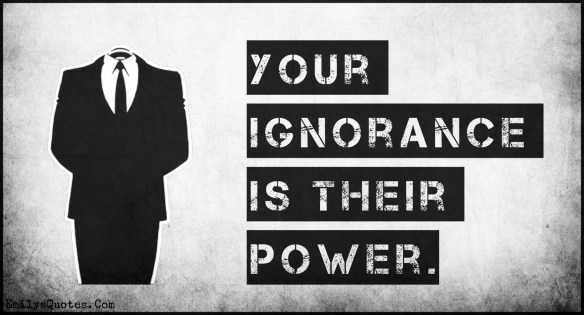
Thinking Dangerously in the Age of Normalized Ignorance

your-ignorance-is-their-power

By Henry Giroux

Source: CounterPunch

What happens to a society when thinking is eviscerated and is disdained in favor of raw emotion? [1] What happens when political discourse functions as a bunker rather than a bridge? What happens when the spheres of morality and spirituality give way to the naked instrumentalism of a savage market rationality? What happens when time becomes a burden for most people and surviving becomes more crucial than trying to lead a life with dignity? What happens when domestic terrorism, disposability, and social death become the new signposts and defining features of a society? What happens to a social order ruled by an “economics of contempt” that blames the poor for their condition and wallows in a culture of shaming?[2] What happens when loneliness and isolation become the preferred modes of sociality? What happens to a polity when it retreats into private silos and is no longer able to connect personal suffering with larger social issues? What happens to thinking when a society is addicted to speed and over-stimulation? What happens to a country when the presiding principles of a society are violence and ignorance? What happens is that democracy withers not just as an ideal but also as a reality, and individual and social agency become weaponized as part of the larger spectacle and matrix of violence?[3]

The forces normalizing and contributing to such violence are too expansive to cite, but surely they would include: the absurdity of celebrity culture; the blight of rampant consumerism; state-legitimated pedagogies of repression that kill the imagination of students; a culture of immediacy in which accelerated time leaves no room for reflection; the reduction of education to training; the transformation of mainstream media into a mix of advertisements, propaganda, and entertainment; the emergence of an economic system which argues that only the market can provide remedies for the endless problems it produces, extending from massive poverty and unemployment to decaying schools and a war on poor minority youth; the expanding use of state secrecy and the fear-producing surveillance state; and a Hollywood fluff machine that rarely relies on anything but an endless spectacle of mind-numbing violence. Historical memory has been reduced to the likes of a Disney theme park and a culture of instant gratification has a lock on producing new levels of social amnesia.

As we learned in the recent debate between Donald Trump and Hilary Clinton (a billionaire and millionaire), ignorance is the DNA of authoritarianism, serving to subvert the truth and obscure the workings of power. Willful ignorance has become a normalized political tool and form of public pedagogy that both provides the foundation for what Noam Chomsky labels as the rise of the “stupid party” and which works incessantly to create a “stupid nation.”[4]Trump, of course, proves that stupidity is in fashion and deeply entrenched within the larger culture while Hilary capitalizes on her penchant for disingenuousness by claiming support for policies she really disdains, i.e., stating she will raise taxes on her buddies from Goldman Sachs and other members of the financial elite. Hardly believable from a woman who “has earned millions of dollars from speeches to Wall Street banks and investment firms (and) was paid $675,000 for a series of speeches to Goldman Sachs.”[5] No hints of the radical imagination here, or the truth for that matter. Only the politics of stupidity and evasion and a media spectacle supporting the celebration of corrupted and limited and pathologized political horizons.

Manufactured ignorance also makes invisible the corruption of the financial elite, allowing them to plunder resources and define the accumulation of capital as a divine blessing. It gets worse. Manufactured ignorance aided by the voracious seductions of commodified corporate-driven disimagination machine that promotes a culture of empty pleasures through and endless regime of consuming and discarding. American society is now dominated by a pervasive commodified landscape of disimagination machines that extends from Hollywood movies and video games to mainstream television, magazines, news, and the social media. These mind-numbing desiring machines which thrive on speed and sensation function mostly as workstations of ignorance to create a fog of distractions that promote forms of social amnesia that erase from memory and public discourse the structural, systemic and social forces that reinforce what can be called organized powerlessness and massive human suffering. This is the stuff of a politics of disappearance that erases the presence of the poor, unemployed, the “approximately 11 million Americans cycle[d] through jails and prisons each year,” black youth, immigrants, ecological disasters, class warfare, acts of state sponsored terrorism, the rise of the police state, and the rise of the warfare state.[6] As the machinery of social death accelerates, America’s most precious investment, youth, also disappear. As neoliberal disimagination machines such as Fox News make clear youth as a social investment no longer count in a society that disdains long term investments and their messy calls for being included in the script of democracy. As such, the current war on youth is about erasing the future, at least any alternative future and any notion of imagination that might summon one into view.

When coupled with an age of precarity and endless uncertainty in which young people have few decent jobs, are strangulated by debt, face a future of career-less jobs, and isolation, young people have little room for politics because they are more concerned with trying to survive rather than engaging in political struggles, or imagining a different future. At the same time, armies of the unemployed or underemployed are caught in a spiral of receding wages, diminished social provisions, and increasingly find themselves paralyzed by anxiety and free-floating anger. In such situations, thinking and informed action become more difficult while a politics wedded to economic and social justice is eviscerated. Moreover, politics becomes toxic when dominated by unapologetic discourses of racism and hatred and is on full display in the Trump campaign. Tapping into such anger and redirecting away from the real problems that produce it has become the central script in the rise of the new authoritarians. This poisonous discourse gains momentum and accelerates as it moves between white supremacist incantations of Trump and his zealots and the deceptive vocabulary of Hillary Clinton and her financial elite backers who embrace a savage neoliberalism with its false claims to freedom, choice, and the virtues of militarization. Civic death is on full display as the ideals of democracy disappear in an election in which authoritarianism in its various forms rules without apology. As thinking dangerously and acting with civic courage wanes, state violence, disposability and voicelessness become the dominant registers of an authoritarian politics that has intensified in American life producing neo-fascist movements in American society that have moved from the fringes to the center of political life.

Tragedy looms large in American society as the forces that promote powerlessness and voicelessness intensify among those elements of the population struggling just to survive the symbolic violence of a culture of cruelty and the material violence of a punishing state. The issue of losing one’s voice either to the forces of imposed silencing or state repression weaken dissent and open the door to the seductions of a dogmatism that speaks in the language of decline, making America great again, while touting the coded vocabulary of white nationalism and racial purity. How else to explain Trump’s call for imposing racial profiling as a way to boost the notion of law and order.

Thinking undangerously is the first step in the triumph of formalism over substance, theater over politics, and the transformation of politics into a form of celebrity culture. The refusal to think works in the service of a form of voicelessness, which is another marker of what it means to be powerless. Within this moral and political vacuum, the codes, rhetoric, and language of white supremacy is on the rise wrapped in the spectacle of fear-mongering and implied threats of state repression. In this instance, emotion become more important than reason, ideas lose their grip on reality, and fashion becomes a rationale for discarding historical memory, informed arguments, and critical thought. Reflection no longer challenges the demands of commonsense. In the mainstream media, the endless and unapologetic proliferation of lies become fodder for higher ratings, informed by suffocating pastiche of talking heads, all of whom surrender to “the incontestable demands of quiet acceptance.”[7]Within such an environment, the truth of an event is not open to public discussion or informed judgment at least in the official media apparatuses producing, distributing and circulating ideas that parade as commonsense. As a result, all that remains is the fog of ignorance and the haze of political and moral indifference.

Americans occupy a historical moment in which it is crucial to think dangerously, particularly since such thinking has the power to shift the questions, provide the tools for offering historical and relational contexts, and “push at the frontiers…of the human imagination.”[8]Stuart Hall is right in insisting that thinking dangerously is crucial “to change the scale of magnification. … to break into the confusing fabric that ‘the real’ apparently presents, and find another way in. So it’s like a microscope and until you look at the evidence through the microscope, you can’t see the hidden relations.”[9] In this instance, the critical capacity for thinking becomes dangerous when it can intervene in the “continuity of commonsense, unsettle strategies of domination,” and work to promote strategies of transformation.[10]

As Adorno observes, such thinking “speaks for what is not narrow-minded—and commonsense most certainly is.”[11] As such, dangerous thinking is not only analytical in its search for understanding and truth, it is also critical and subversive, always employing modes of self and social critique necessary to examine its own grounds and those poisonous fundamentalisms in the larger society haunting the body politic. As Michael Payne observes, thinking dangerously (or critical theory in this instance) should be cast in the language of hints, dialogue, and an openness to other positions, rather than be “cast in the language of orders.”[12] Of course, this is not to suggest that thinking dangerously guarantees action, but at the same time, any action that distances itself from such thinking is bound to fail.

In an age when shouting, rage, and unchecked emotions shape public discourse, self-reflection becomes a liability and suppresses the axiom that critical thought should function to “lift…human beings above the evidence of our senses and sets appearances apart from the truth.”[13]   Salmon Rushdie is right in viewing thinking dangerously as a type of political necessity whose purpose is to “push boundaries and take risks and so, at times, to change the way we see the world.”[14] As Hannah Arendt noted, thoughtfulness, the ability to think reflectively and critically is fundamental to radical change and a necessity in a functioning democracy. Put differently, formative cultures that make such thinking possible along with the spaces in which dialogue, debate, and dissent can flourish are essential to producing critically literate and actively engaged citizens.

Unfortunately, thinking undangerously cuts across ideological and political divides. For instance, there is a new kind of historical and social amnesia overtaking some elements of resistance in the United States. Many progressives have forgotten the lessons of earlier movements for real change extending from the anti-Vietnam War and Black Freedom movements to the radical feminist and gay rights movements of the sixties. History as a repository of learning with vast resources to enable people to build on historical legacies, develop mass movements, and take seriously the pedagogical task of consciousness raising, is in decline. Too much of contemporary politics has become more personal, often reducing agency to the discourses and highly charged emotions of trauma. These historical legacies of resistance did not limit their politics to a call recognition and security within the confines of isolated political issues. Instead, they called for a radical transformation of capitalist and other authoritarian societies. Moroever, they understood that the truth of domination lie in understanding the totality of a society and how various issues were connected to each other. George Monbiot exemplifies this issue in arguing against responding to the varied crisis associated with neoliberalism as if they emerged in isolation—a response that contributes to neoliberalism’s anonymity. He writes:

Its anonymity is both a symptom and cause of its power. It has played a major role in a remarkable variety of crises: the financial meltdown of 2007?8, the offshoring of wealth and power, of which the Panama Papers offer us merely a glimpse, the slow collapse of public health and education, resurgent child poverty, the epidemic of loneliness, the collapse of ecosystems, the rise of Donald Trump. But we respond to these crises as if they emerge in isolation, apparently unaware that they have all been either catalyzed or exacerbated by the same coherent philosophy; a philosophy that has – or had – a name. What greater power can there be than to operate namelessly?[15]

This politics of the disconnect is exacerbated by the fact that mass social movements run the risk of undermining by a politics that has collapsed into the personal. For example, for too many progressives personal pain represents a retreat into an interiority that focuses on trauma. Robin Kelley provides a caveat here in pointing out that all too often “managing trauma does not require dismantling structural racism” and the larger issues of “oppression, repression, and subjugation” get replaced with “words such as PTSD, micro-aggressions, and triggers.” [16] Kelley is not suggesting that the pain of personal suffering be ignored. Instead, he warns “against … the consequences of framing all grievances in the ‘language of personaltrauma.’”[17]

Personal trauma in this case can begin with legitimate calls for spaces free of racism, sexual harassment, and various other forms of hidden but morally and politically unacceptable assaults. And at its best, such a politics functions as an entry into political activism; but when it becomes less a justifiable starting point than an endpoint it begins to sabotage any viable notion of radical politics. Kelley is right in insisting that “trauma can easily slip into thinking of ourselves as victims and objects rather than agents.”[18] Moreover, the language of safe spaces, personal trauma, and triggers can easily become a topsy-turvy discursive universe of trick mirrors and trapdoors that end up reproducing a politics of intimidation and conformity, while forgetting that pedagogical practices and a corresponding politics in the service of dramatic transformation are always unsettling and discomforting.

Progressives must avoid at all cost is the rebirth of a politics in which how we think and act is guaranteed by the discourses of origins, personal experience, and biology. When individuals become trapped within their own experiences, the political imagination weakens, and a politics emerges that runs the risk of inhabiting a culture of exclusion and hardness that shuts down dialogue, undermines compassion, kills empathy, makes it more difficult to listen to and learn from others. A politics that puts an emphasis on personal pain can become blind to its own limitations and can offer falsely a guaranteed access to the truth and a comforting embrace of a discourse of political certainty.

In such cases, the walls go up again as the discourses of biology and exclusion merge to guard the frontiers of moral righteousness and political absolutism. Put differently, the registers of militarization are on full display in such alleged sites of resistance such as higher education where a growing culture of political purity marks out a space in which the personal becomes the only politics there is housed within a discourse of “weaponized sensitivity” and “armed ignorance.”[19] The first causality of armed ignorance is a kind of thoughtfulness that embraces empathy for the other, a willingness to enter into public discussion, and dialogue with those who exist outside of the bunkers of imagined communities of exclusion. Leon Wieseltier is right in arguing that “grievance is sometimes the author of blindness, or worse.”[20]

Under such conditions, empathy wanes and only extends as far as recognizing those who mirror the self, one that endlessly narrates itself on the high ground of an unassailable moralism and stultifying orbits of self-interests. In addition, politics collapses into the privatized orbits of a crude essentialism that disdains forms of public discourse in which boundaries break down and the exercise of public deliberation is viewed as fundamental to a substantive democracy. Of course, there is more at work here than what might be called the atrophy of critical thought, self-reflection, and theory, there is also the degeneration of agency itself.

What does thinking look like when it is transformed into a pedagogical parasite on the body of democracy? At one level, it becomes toxic, blinding the ideological warriors to their own militant ignorance and anti-democratic rhetoric. At the same time, it shuts down any attempt to develop public spheres that connect rather than separate advocates of a politics walled in by suffocating notions of essentialism dressed up in the appeal to orthodoxy parading as revolutionary zeal. What must be remembered is that thinking undangerously mimics a pedagogy of repression that falsely assumes a revolutionary stance when in fact everything about it is counter-revolutionary. In the end this suggests a kind of theoretical helplessness, a replacing of the courage to think dangerously with the discourse of denunciation and a language overflowing with the comforting binary of good and evil.

There is more at risk here than legitimating the worse forms of thoughtlessness, there is also the intolerable potential for both the moral collapse of politics and the undermining of any vestige of democracy. Thinking dangerously as a critical enterprise is about both a search for the truth and a commitment to the recognition that no society is ever just enough and hence is fundamental to the always unfinished struggle, making the impossible all the more possible. Not one or the other but both. Such thinking should be used to both understand and engage the major upheavals people face and to connect such problems to larger political, structural, and economic issues.

Thinking dangerously can make the pedagogical more political by mapping the full range of how power is used and how it can be made accountable in all of its uses. Thinking dangerously is about more than doing a critical reading of screen culture and other texts, it is also about how knowledge, desire, and values become invaluable tools in the service of economic and political justice, how language provides the framework for dealing with power and what it means to develop a sense of compassion for others and the planet. Dangerous thinking is more than a mode of resistance, it is the basis for a formative and pedagogical culture of questioning and politics that takes seriously how the imagination can become central to the practice of freedom, justice, and democratic change.

Notes.

[1] This essay draws upon a number of ideas in Henry A. Giroux,Dangerous Thinking in the Age of the New Authoritarianism (New York: Routledge, 2015).

[2] I have borrowed this term from Jeffrey St. Clair, “The Economics of Contempt,” Counterpunch (May 23, 2014).

[3] Brad Evans and I have taken up the issue of violence in its various valences in Brad Evans and Henry A. Giroux, Disposable Futures: The Seduction of Violence in the Age of the Spectacle (San Francisco: City Lights Books, 2015). Also, see Henry A. Giroux, America’s Addiction to Terrorism (New York: Monthly Review Press, 2016).

[4] Noam Chomsky, “Corporations and the Richest Americans Viscerally Oppose the Common good,” Alternet (Sep9tember 29, 2014). Online: http://www.alternet.org/visions/chomsky-corporations-and-richest-americans-viscerally-oppose-common-good

[5] Chris Cillizza , “The New York Times just perfectly explained Hillary Clinton’s Goldman Sachs speech problem,” The WashingtonPost (February 26, 2016). Online:https://www.washingtonpost.com/news/the-fix/wp/2016/02/26/the-new-york-times-just-perfectly-explained-why-hillary-clintons-answers-on-her-paid-speeches-dont-work/

[6] Rebecca Gordon, “There Oughta Be a Law…Should Prison Really Be the American Way?,” TomDispatch.com (September 25, 2016). Online: http://www.tomdispatch.com/blog/176190/tomgram%3A_rebecca_gordon%2C_arresting_our_way_to_%22justice%22/

[7] Brad Evans and Julien Reid, “The Promise of Violence in the Age of Catastrophe,” Truthout (January 5, 2014. Online: http://truth-out.org/opinion/item/20977-the-promise-of-violence-in-the-age-of-catastrophe

[8] Arundhati Roy, Power Politics (Cambridge, Ma: South End Press, 2001), P. 1

[9] Stuart Hall and Les Back, “In Conversation: At Home and Not at Home”, Cultural Studies, Vol. 23, No. 4, (July 2009), pp. 664-665.

[10] I have taken this phrases from an interview with Homi Bhaba in Gary Olson and Lynn Worsham, “Staging the Politics of Difference: Homi Bhabha’s Critical Literacy JAC ((1999), p. 9.

[11] Zygmunt Bauman, Liquid Life (London: Polity Press, 2005), p.139.

[12] Michael Payne, “What Difference Has Theory Mad? From Freud to Adam Phillips,” College Literature 32:2 (Spring 2005), p. 7.

[13] Ibid., Bauman, Liquid Life, 151.

[14] Salman Rushdie, “Whither Moral Courage?” The New York Times, (April 28, 2013)

[15] George Monbiot, “Neoliberalism – the ideology at the root of all our problems,” The Guardian, (April 15, 2016) Online: http://www.theguardian.com/books/2016/apr/15/neoliberalism-ideology-problem-george-monbiot

[16] Robin D.G. Kelley, “Black Study, Black Struggle – final response,”Boston Review, (March 7, 2016). Online: http://bostonreview.net/forum/black-study-black-struggle/robin-d-g-kelley-robin-d-g-kelleys-final-response

[17] Ibid., Robin D.G. Kelley, “Black Study, Black Struggle – final response.” Boston Review.,

[18] Robin D.G. Kelley, “Black Study, Black Struggle,” Boston Review,(March 7, 2016) Online: https://bostonreview.net/forum/robin-d-g-kelley-black-study-black-struggle

[19] The notion of weaponized sensitivity is from Lionel Shriver, “Will the Left Survive the Millennials?” New York Times (September 23, 2016). Online. http://www.nytimes.com/2016/09/23/opinion/will-the-left-survive-the-millennials.html. Armed ignorance was coined by my colleague Brad Evans in a personal correspondence.

[20] Leon Wieseltier, “How voters’ personal suffering overtook reason – and brought us Donald Trump,” Washington Post, (June 22, 2016). Online: https://www.washingtonpost.com/posteverything/wp/2016/06/22/how-voters-personal-suffering-overtook-reason-and-brought-us-donald-trump/

 

Henry A. Giroux currently holds the McMaster University Chair for Scholarship in the Public Interest in the English and Cultural Studies Department and a Distinguished Visiting Professorship at Ryerson University. His most recent books are America’s Education Deficit and the War on Youth (Monthly Review Press, 2013) and Neoliberalism’s War on Higher Education (Haymarket Press, 2014). His web site is www.henryagiroux.com.