Are We Living Haunted Lives?

By Kingsley L. Dennis

Source: Waking Times

‘Fear has many eyes
And can see things underground’
~Cervantes, Don Quixote

The world as we know it has gone from being flat to round; from being the center of the universe to the center of the solar system; from being animistic and supernatural to raw in tooth and claw; from being particle-atomic to wavy-quantum. And now we are disappearing into the digital domains of virtual-augmented spaces and false information, bombarded with the spectacle and the image. And somewhere in the midst of all this is the human soul, still largely wrapped and unopened. If there’s a crime here then it is that we’ve allowed ourselves to become haunted – to live haunted lives that lack significance and meaning.

The ‘objects’ or values that we have attempted to live by, or that we pursue, – such as power, truth, understanding, dreams, work, love, and the rest – have all seemingly vanished into some warped, elusive reality where the presence of these things no longer tangibly exist. However, the doubt, uncertainty, and pain of their absence – or ‘fake presence’ – are indeed real enough to affect us deeply. We seek the already disappeared and stalk their substitutes.

We are now close to the stage where we end up just acting out our fantasies upon the phantasmal theatre of our lives and thinking it is reality. This theatre, or screen, of fantasies and the fantastical is like the cave wall in Plato’s allegory where the flickering shadows that move across are taken to be the real. In an updating of Plato’s famous allegory we no longer have shadows projected upon the cave wall; they are now projected upon the green screens that form the back-drop for computer-generated imagery (CGI) that adorn our movies, television programs, and video games.

Whole societies, notably in the technologically-advanced western world, are arranging for our lives to be enacted amidst a scenery backdrop of events and issues artificially projected for us as CGI onto a fake canvas. Within this encroaching visual world, full of misinformation that influences our worldview, we are made to believe in a different kind of reality. It is a reality that is uncertain and insecure, and that requires for us to hold deep obedience to our state institutions to protect us. And within this projection of reality, meanings are provided for us as ready-made meals. In other words, full of too much salt, saturated fats, and laziness.

These socially manufactured meanings are provided as a substitute for the genuine lack. Of these choices offered we often take our pick, as consumers in a marketplace. It may be career, wealth, fame, achievement, or a combination of these and more. Yet the manufactured consent in our sense of meaning, no matter how thoroughly pursued and potentially obtained, is still not genuine. And like the ready-made meal, it soon leaves us with a continued hunger. The illusion of meaning is a vital illusion, yet it still remains an illusion. We may say then that the world we have come to know is a great spectacle of illusion and play; of movement, distraction, simulation, and excess. Yet rather than critically confronting the illusions and distractions we are cleverly persuaded to indulge in them.

The world we share now is also shared with our collective doubts, fears, anger, and frustrations. And these new emotions upon the global stage are blurring our picture of the world and its future. Whilst there are many of us who are excited and genuinely inspired by this increased complexity and diversity there has been a cultural backlash, in the western nations especially, to cover this up with a sheen of simplicity through generic news, bland reporting, and excruciatingly trivial entertainment. This clash of the complex with the simple is creating an odd reality where things just don’t feel right anymore.

We are participants on a ride through the flippant and the flimsy, the significant and the necessary, as we are expected to find our foothold – our human soul – in a world seemingly on the verge of insanity. In such a world, Disneyland may seem to some as the greatest of sanctuaries; whilst to rest of us it stands as a superficial sign of our times.

Most of us do not have the capacity to verify the truth claims of the mainstream media and yet we are more than willing it accept the veracity of their claims. We suspend our own disbelief by trusting in others, especially when it comes to authority and experts. In other words, we have been conditioned to respect the positions of authority and ‘the expert,’ often without critical thought.

And this is the context which frames the telling of his-story and also our-stories. The singer-songwriter Lou Reed once sang, ‘Don’t believe anything you hear and only half of what you see.’ Documentary film-maker Adam Curtis discusses this phenomenon of how the mainstream media projects a simplified, fake reality in his film HyperNormalization (2016). The term hypernormaliztion was taken from an account of life in the Soviet Union during the twenty years before it collapsed. In this account everyone knew the system was failing but they couldn’t envision any alternative and so everyone is resigned to maintaining the pretence of a functioning society. Over time this delusion is accepted as real, an effect termed as hypernormalization. In other words, when the fake is finally accepted as the real then we are living in a hypernormalized state. Does this sound familiar?

The question is – does Reality ever take place?

Our bodies of authority, our mainstream media channels, and our centers of learning – that is, a majority of our significant institutions – have turned, or are in the process of turning, into advertising gimmicks. They peddle publicity and propaganda as endless programs stuck on a loop. They serve to produce the appearance of reality; yet they fail to represent a sense of reality. And this fundamental difference has produced a feeling of living haunted lives. We wander as ghosts in liminal zones, hungry for meaning.

In this sense of loss we no longer seem to know, or distinguish, between oppositions. Almost all of our value systems are based on relative terms – good, bad, my history, your history, etc. Often, the values we take to be ‘our values’ were inculcated in us depending upon which culture we happened to be born into. It is true there are some values more universally shared – such as thou shalt not kill – but the majority of them are culturally relative. Take for instance, sex before marriage – good or bad? Same-sex partnerships? Freedom of religious speech? Eating pork? Eating rats? Democrats or Republicans? Labour or Conservative? Which is good and which is bad? In the case of political parties it is neither – they are false oppositions. More than that, they are also distractions. When you’re arguing (sorry, debating) over political parties you are not observing the system behind them that created this false lack of choice in the first place. False oppositions plague our haunted hinterland. We don’t see this if we are the aimless ghosts, or the walking dead. It’s not pleasant – it’s eerie. And we are in eerie times.

Modernity in its current form is haunted by a sense of loss; of not knowing where it is heading. There are a great many aspects of our age that are in disruption and dislocation. All forms of stability are in question; old and incumbent patterns and models are in dispute; and too many people are experiencing moods of despair and anguish. It is as if our human civilization has come loose from its moorings and is now adrift upon the waters of uncertainty, insignificance, and the loss of meaning.

And so it seems that our civilization is careering dangerously close to some kind of blind spot where we no longer can tell what is true or false anymore. Truth is replaced by a fake substitute and the false becomes a parody of the truth. They are the haunted spaces where the mist drifts by. It’s like a Zen joke. It’s the same as a voice whispering in the darkness saying there is no such thing as a voice whispering in the darkness. They couldn’t have written a better riddle if they had tried.

So what went wrong? Where did it all go? What is it, in fact?

A profound sense of unease has crept into many of us, and also into our social systems, our cultures, our art, our news, and into the very collective soul of humanity. It is an eeriness; an uncertain disquiet – almost an unsettling foreboding. Something has come loose, and we’re not sure what it is. Further still, most of us are fairly certain that those institutions supposedly ‘looking after our best interests’, or running the show – whether they be governmental bodies, financial elites, or shadowy organizations and cabals – are not really in control or are sure either. It feels as if something is amiss, and we just can’t quite put our finger on it. Welcome to our haunted modernity.

We have disarray over a consensus concerning climate chaos, stock market panics and economic crashes, offshore tax evasions and leaked documents, political scandals, pandemic threats and contested vaccines, state and terrorist violence, congenital anxiety and existential fear – a whole cauldron of terror, dread, disquiet, nervousness, angst, and what-the-hell-is-going-on collective confusion is bubbling both under and over in many of our societies.

We have been infiltrated with a virus and it is infecting not only our bodies but our very minds. It’s a pure mind-bending virus and it’s playing havoc with our insecurities and indulging in our sense of lostness. The Spanish have a phrase for this state – “de perdidos al río” – and it roughly translates as from lost to the river. It may not make complete literal sense in English but that’s just it; you can get the sense of it and its vagueness is exactly where we are – from lost to the river!

In such ‘haunted lives’ we can easily become accustomed to metaphysical anguish as just another pain. It is like a pulled muscle or a sprained ankle; something unpleasant and yet we continue to move around with it. In the end we learn how to direct and project this metaphysical anguish onto other things – we choose intoxicating entertainment, sports, and other cultural pastimes and diversions. Angst just becomes a factor that appears to come as a default setting with our species. There is the danger that we become accepting of the ghostly flimsiness to life, which ends up being hypernormalized so that the sense of absence of something real becomes the new reality. There is the dangerous potential here for a state of indifference to emerge and seep into our cultures, which then becomes an ennui-creep into the world until…oh, well, what does it matter anyway?

During these years of disarray and turbulence it is essential that we create meaning for ourselves, otherwise the ‘distant algorithmic’ universe that runs the life around us will create a deep sense of alienation. In a world of scrambled code and big data, transcendence will seem another chimera not within grasp or even real. Or, at worse, the very notion of transcendence will seem the delirium of unstable minds – for those people not able to ‘get real’ with the world of Now.

In this instance, transcendence will appear as a form of spiritual autism. And yet the notion of going beyond ourselves, of developing our capacities for higher perception, are the saving grace inherent within our human species. We are incomplete, and this haunts us, and yet it should also give us meaning and a higher aim in life in knowing that there is further to go. In knowing that there are tools within us for creating, shaping, and cultivating these finer faculties. In being haunted we are also being reminded of what is lacking and this urge should compel us to find a solution within ourselves. We are in fact being ‘haunted into remembrance.’

However, for many of us a haunted modernity offers us a conditioned life where there is little or no space for transcendence. In such social and cultural hauntings there are no navigable locations. We have stepped into an unsouling from the wilderness. We are compelled to walk on.

Cause of USA Meltdown and Collapse of Civil Rights

By Denis Rancourt

Source: Dissident Voice

SUMMARY: Societies of social animals, including humans, are dominance hierarchies. Civil rights are codified in law to protect mechanisms of essential counter measures against excessive exploitation of the hierarchy by elite classes, which destabilizes the entire society. Systemic pathology arises when elite classes can change the regulatory codes themselves, including civil rights protections, with impunity. Laws that quash civil rights are pathological in that they impede the system-repair mechanisms that are: free expression, free association, class opposition, and negotiated structural adjustments (otherwise known as democracy). Present anti-speech laws are extreme examples of pathological laws, the application of which is a measure of the degree of totalitarianism in the society. The history of the USA of recent decades is an eminent illustration of the concepts.

*****

The USA meltdown has been decades in the making and is the collateral result of an elite predation that has degraded structural elements needed for a healthy and resilient nation.

The aftermath is “too much regulation at the bottom, not enough at the top”: a pathological legislative and institutional structure in which elite interests have too much freedom to challenge and exploit democratic nation states, whereas middle, working and professional class actors, including small and medium-size private business, are economically, ideologically and politically constrained and suppressed to an excessive degree.

It has been a class war in which the predatory classes have barricaded themselves while inflicting humiliating defeat and loss of power, purpose and identity on the lower-stratum classes, which are incited to fight among themselves within the confines of new rules and the guarded illusion that these rules are an actuation of natural order.

In this way, personal and community motivation and inventiveness are sapped. The very motor of a vibrant modern society is jammed and the entire system becomes a system of debt-ransom extraction and management of globalized exploitation for the benefit of a secluded elite.

In this emergent system of excessive class exploitation, civil rights that protect critics and organizers become a threat against the exploiters rather than needed protections of personal and community emancipation that sustains economic production and innovation.

Allow me to explain, starting from fundamental considerations.

Arguably, the most fundamental statement that a social scientist can make is that humans interact by both violent and non-violent means, both individually and as groups, to establish and maintain societal dominance hierarchies. Call it by any name (tribalism, capitalism, socialism, totalitarianism…) humans always establish, maintain and grow dominance hierarchies, using whatever technology of the day.

The political end-point concept of “anarchy” is the theoretical absence of dominance hierarchy, which has never been ideally achieved and which is evidently unstable against growth of and replacement by dominance hierarchy. The reality of social animals is dominance hierarchy, which spontaneously adapts itself to environmental conditions and to the population size, while integrating accumulated knowledge and technological advances.

Within a dominance hierarchy (within a society), the essential counter against destabilizing excesses of dominance is push-back from individuals and groups — engendered by the individual desire for life, freedom and local influence — which acts in every stratum of the hierarchy.

In historically recent human societies, essential push-back is formalized with written laws that protect the individual against dominance encroachments that would be so severe that they would threaten hierarchical stability by increasing the potential for rebellion. These laws were at times deemed to be God-given and are now referred to as “civil rights”. They include both: (1) protections of the individual and of the nuclear and extended family against arbitrary attacks by the state or by rogue elements, and (2) protections for the individual and groups to seek redress and express grievances.

All laws are evolving codes to organise, stabilize and enforce an ever changing (often growing and complexifying) dominance hierarchy. “Good” laws find a “balance” between the graded benefits of hierarchy and the stratified oppressions against individuals and groups, a balance which stabilizes the whole system against deterioration (“injustice”), complete overhaul (“revolution”), or extinction (“downfall”).

Predictably, the codes themselves are often “hacked” by upper-strata groups that are overly ambitious in seeking additional relative advantages. The hacking upper-strata groups will recklessly change the laws for their own advantage in ways that materially threaten overall stability. This produces “pathological” laws that destabilize the overall hierarchy by driving society towards an intolerable degree of totalitarianism.

A now recognized on-going example is the decades-long elite attack, by taxation and global-finance reforms, against the USA middle class, which has prematurely destabilized the USA-centered global empire and its domestic internal society. The blowback from and defences against the USA’s practice of aggressive global dominance has also contributed, where the latter practice is similarly enabled by hacked foreign-policy and global governance laws.

When law-makers themselves can be bought by selfish elites self-segregated from the broad or domestic society, it is a recipe for disaster. In the USA and Canada law-enactment errors are multiplying, and there are no substantial Senatorial safeguards. Law-makers are formed or trained into compliance by career-enabling elites, rather than informed, principled and concerned about public service. Political parties are systematically controlled and constrained by the highest hierarchical echelons, which control the economy and the media.

When the backbone structure of the dominance hierarchy is thus degraded, as with the present crisis of the middle class, there is an impulse for both societal groups and lawmakers to become frantic and for the barricaded elite to exploit and ride out the storm rather than participate in repair. Every new manifestation of rebellion is interpreted as a fire to be extinguished rather than as necessary pushback needing to be allowed to play out. Decades of built-up fuel in the underbrush and extended drought are conditions for a devastating inferno but our “representatives” are successfully goaded into superficially addressing every new spark and violently suppressing every outbreak rather than dealing with the fundamentals.

Over decades, a complete restructuring of the relation between the state and the economy has been engineered, which, in its oppressive excesses, has led to the present crisis. The assault was accompanied by massive propaganda campaigns regarding the security benefits of government control and the welfare benefits of corporate rule. For example, predatory corporate take-over “investment” in public-service infrastructure is now presented as a good thing that should be actively sought using public funds.

The restructuring included: rolling back taxation of the wealthy while maintaining taxation of the middle and working classes, reducing or eliminating corporate taxation, increasing capital mobility, allowing investment flight, allowing infiltration of government-oversight and regulatory agencies (especially in the finance sector), gutting corporate regulatory agencies while transferring to self-regulatory models, unprecedented ideological control of professional workers in the public service (teachers, police, scientists, public servants, judges…), unrestrained lobby and think-tank influence, and unprecedented limitations (regulatory burdens) imposed on small and medium-size private businesses.

Top-level elite desires and machinations have become embedded into the very institutional structure of the economy and of the “deep state” more than ever previously. This is the result of decadal erosion of democracy and continuous increase of integration of government itself into the hierarchical power structure. The global-scale project is enabled by owned military, surveillance, communication, transportation and resource-extraction technologies; and surveillance and projection-of-power capabilities are unprecedented in history.

The resulting decadal overhaul of Western nations — in the march towards USA-centered globalism and the neutralization of Western middle and professional classes — has built-in deleterious structural features, as follows.

Mega corporations and financiers and their deep-state partners have not only militarily and covertly occupied the exploitable globe, they have also installed predation against the Western middle classes and Western public infrastructures. They have gutted mass education and maintained only elite schools for their managers and engineers. And they have gutted the Western middle and professional class mind and ethos and replaced these with canned concepts devoid of emancipating political thrust. More importantly, the educational and societal-maintenance institutions themselves have been transformed by removing professional independence and responsibility and replacing them with ideological obedience and observance of dictated think-tank-produced mantras.

The consequential suicidal pathology of the system’s operational code is twofold.

First, the new freedom and power of the USA-centered mega entities are used to eviscerate the very nation state whose structure evolved to optimally stabilize the nation-based dominance hierarchy. Even the world structures of international relations are hijacked and eviscerated to a higher degree.

Second, the middle and professional classes palpably lose many of the benefits accrued from accepting hierarchical domination, including loss of influence, and consequently suffer a crisis of identity, meaning and outlook… driven by real economic threat (loss or degradation of job and home).

Macro-economic data reveal the decadal transformation since 1980 but do not explain its source or describe its cultural, psychological and class impact. The data are generally cast as the result of an accident that can be fixed by more of the same from one of the two front parties.1

In the real circumstances of the worsening middle-class crisis, it is natural that grievances are aired and solutions are sought to recover lost status. But at the same time, advocacy and the potential for an organized response are threats to the top-layer elites and embedded deep-state managers who have intentionally driven the system towards greater hierarchical control and increased upper-stratum gain.

That is why the system reacts by removing civil rights and sabotaging any technology or application venture that would enable communication and free association.

Whereas expression and grass-roots political response would repair the edifice, the needed remedy is aggressively quashed by those at the top who judge that the crisis is not one that can truly threaten them, is one that will dissipate with time or can be fixed synthetically, and that the distributed spontaneous solution is unacceptably risky in its potential to expose them.

There results the paradox that the system delays self-repair, builds up the pressure for repair, and creates worsening societal conditions rather than allow the proven natural remedy: free expression, free association, class opposition (based on the actual grievances rather than surrogates), and negotiated structural adjustments.

The pathology of the system in rejecting self-repair can be understood as follows.

Dominance hierarchies are both stable and evolutionarily advantageous only if effective balancing forces against creeping or runaway totalitarianism are admitted. A dominance hierarchy is doomed when its highest codes allow an elite class to have disproportionate power, including the power to modify the highest codes without restraint. In particular, in a society in which the state — controlled by an elite class — effectively has a technological monopoly on lethal force, the balancing mechanism of free expression, free association, and real influence — otherwise known as “democracy” — must be allowed.

It follows that any code that prevents free expression and free association is itself pathological. If all expression and all association are allowed, then the optimal conditions for self-repair are realized and a stable and resilient hierarchical structure will result. Since it is grounded in free expression and free association, then it will be optimally just. Justice is a thus self-organized and maintained hierarchy, not elite-given “equity” within a totalitarian matrix.

For free expression and free association to be meaningful many necessary conditions are implied: access to information, actual institutional transparency, access to the travel and communication infrastructures, absence of imposed barriers to association, absence of controls over personal choices, real opportunity for decent economic conditions that allow significant democratic participation, and the very novel concept of uniform application of just laws… Any rule that in-effect bars a necessary condition is also itself pathological.

I end this essay with a consideration of the special features that make anti-expression laws pathological, in the above sense of preventing self-repair of the societal dominance hierarchy.

The anti-speech laws, whether cast as “hate speech” criminal code provisions, or civil defamation law, or civility “codes of conduct” on campuses, have been manipulatively introduced by the elite because the elite are those most threatened by free speech and free association.

Speech is the means by which individuals use non-violent persuasion to acquire influence in society. It is the means that enables politics. In the USA, where citizens have a beneficial right even to bear arms for any required overthrow of the government2,3, freedom of expression was meant to be absolute, in that the USA constitution does not have a “balancing” clause as is common in other Western jurisdictions.4

Laws that enforce punishment for individual speech allegedly “causing” negative personal reactions in society at large are antithetical to democracy, and are immeasurably harmful to human emancipation and personal development. The above-mentioned examples are such anti-speech laws, notably including defamation law.5 They enforce punishments against individual speech that is alleged to “cause” an emotional or persuasive effect in others, which is deemed an unacceptable effect that must be targeted for elimination by state intervention against the presumed “cause”.

The said “emotional or persuasive effect” alleged to arise from the spoken words, in different laws, includes:

  • being induced to feel “hate” (anger, hostility, animosity) against a group in society
  • being induced to have a negative overall opinion about a specific person
  • being induced to adopt an ideology or political stance deemed impermissible (“hateful”)
  • being induced to commit suicide
  • being induced to participate in actuating a genocide
  • being induced to commit crimes of physical aggression or property damage

The underlying principle of these laws is that the person speaking words carries a punishable liability for what those words might induce in unspecified others, irrespective whether any actual physical crime occurs and irrespective of whether the words determinatively “cause” an actual physical crime. To be clear, under these laws, a judge arbitrarily (without needing evidence beyond the impugned words themselves and their method of delivery) decides whether the words induce deemed undesirable thoughts, opinions and attitudes in unspecified persons at large. Nothing else is required to establish liability or guilt, and by design it is impossible to disprove the charge, nor is an attempt to disprove admitted in court.

No matter how it may be masked with legalese or scholarly rationalization, this is precisely the nature of the anti-speech codes that are: “hate speech” criminal code provisions, anti-blasphemy laws, anti-historical-revisionism laws, anti-obscenity laws, the common law of civil defamation, and campus codes of conduct. One could add any “norms of expressive conduct” law.

For example, in defamation law, the impugned words are presumed to “cause” a low opinion of the plaintiff in the minds of unspecified others at large. In legalese: “general damage to reputation is presumed”. No causation proof is required of the claimant. Intent to harm is irrelevant (malice is presumed). No actual damage (loss of job, etc.) need be established. The words themselves as perceived by the judge are sufficient evidence. The judge must only opine, not on the intended meaning of the words, but on the meaning of the words in the mind of an imaginary listener. Such is civil defamation law, and there is no legal limit on the quantum of damages or the duration of gag orders that may be ordered under penalty of jail.5

These anti-speech laws, of course, are distinguished from laws that address harassment and intimidation of a specific target person (actual victim) or that address chain-of-command orders to commit crimes. They are also distinguished from the tort (law) of injurious falsehood, which “consists of the malicious publication of a falsehood concerning the plaintiff that leads other persons to act in a manner that causes actual loss, damage, or expense to the plaintiff,” irrespective of any effect on “reputation”.6

Thus, the anti-expression laws are eminently pathological from a systemic perspective. They directly impede repair of the dominance hierarchy, without providing any systemic benefit. They achieve this by suppressing the individual impulse to influence by communication, which is the elemental foundation of democracy.

As such, a study of the development of and pervasive use of anti-speech laws informs us both of the intensity of harmful elite efforts to protect illegitimate advantages and of the degree of totalitarianism in society. The present USA (civil) war on “hate expression” and its condoning by large swaths of society is a measure of a high degree of totalitarianism and a concomitant high degree of manipulation of public sentiment. It is an indicator of fundamental internal instability of the kind that accompanies the collapse of an empire.

  1. Our Broken Economy, in One Simple Chart”, by David Leonhardt, The New York Times, 2017-08-07. []
  2. Negroes with Guns”, by Robert F. Williams, 1962 (Martino Publishing, CT, 2013). []
  3. How Nonviolence Protects the State”, by Peter Gelderloos, 2007 (South End Press). []
  4. Towards a Rational Legal Philosophy of Individual Rights”, by Denis Rancourt, Dissident Voice, 2016-11-15. []
  5. Canadian defamation law is noncompliant with international law”, by Denis Rancourt, Ontario Civil Liberties Association, 2016-02-01. (And published in Dissident VoicePart-1Part-2). [] []
  6. Injurious Falsehood”, mcconchie law corporation (legal encyclopedia), accessed on 2017-09-06. []

Initial Thoughts on Blade Runner 2049

Upon hearing early reports of a planned Blade Runner sequel a couple years ago, I felt both anticipation and dread. I considered it a singular vision which didn’t necessarily need a sequel, yet could understand the desire to re-immerse oneself in the compelling world it introduced. Re-experiencing the film through its Director’s Cut and Final Cut versions in subsequent years seemed to me as satisfying as watching sequels since even the relatively minor changes had a significant impact on its meaning and the richness of the sound and production design allows for the discovery of new details with every viewing. Also, one’s subjective experience watching even the same movie can be vastly different depending on one’s age and other circumstances.

One of my earliest cinematic memories was seeing the first Star Wars film as a toddler. At around the same time I remember staying up late with my parents to watch the network television premiere of 2001: A Space Odyssey. Though I was too young to fully comprehend those films’ narratives, the spectacle and sounds definitely left an impression and established a lifelong appreciation for the sci-fi genre and it’s mind-expanding possibilities.

Flash forward to an evening sometime in early 1982. After viewing a commercial for Blade Runner I instantly knew it was a movie I had to see. In the short trailer there were glimpses of flying cars over vast cityscapes, the guy that played Han Solo in a trench coat, bizarre humanoid robots within settings as strange yet detailed as 2001: a Space Odyssey. My parents, responsible as they were, refused to give in to incessant demands to see Blade Runner and that Summer I must have been the only kid who reluctantly agreed to see “E.T.” as a compromise. I probably did enjoy it more than I expected to, but might have enjoyed it more had I not viewed it as a weak Blade Runner substitute and if I actually paid attention to the entire film.

Back then our family usually saw films at drive-in theaters and the one we went to that night had two screens, one showing E.T. and the other, to my delight and frustration, happened to be Blade Runner. Even without sound and at a distorted angle I was awestruck by the establishing shots of LA in 2019 (which I glanced over to witness just as E.T.’s ship was landing on the screen in front of us, and for the entire duration of the films my eyes would switch back and forth between screens. Even without understanding anything about the plot of Blade Runner it made the most fantastical elements of E.T. pale in comparison. Judging from the box-office receipts of its theatrical run, the majority must have thought otherwise since Blade Runner earned a relatively meager $28 million while E.T. was the breakout hit of the year with nearly $360 million.

Within a few years I’d see portions of Blade Runner on cable TV at a friend’s house and finally saw the complete film after my family got a VCR and it was one of the first videos I rented. The film served as a gateway to many other interests such as cyberpunk, film noir, electronic music, but most importantly, an appreciation of the novels of Philip K. Dick. Like a psychedelic drug, they inspired philosophical questioning regarding the nature of reality, consciousness, society and what it means to be human.

This background, which is probably not too dissimilar to other stories of obsessive fandom, outlines how one’s immersion in media is rooted not just in the work itself but how it resonates with and shapes aspects of one’s identity and personal narrative as much as other memories. There’s also a nostalgia factor involved because, similar to a souvenir or any object with sentimental value, revisiting such media can recapture a sense of the feelings and sensations associated with the initial experience and sometimes the milieu of the content as well. Nostalgia is a longing for the past, even a past one has never directly experienced, never was and/or never will be, often prompted by loneliness and disconnectedness. Because it can sometimes provide comfort and hope it’s a feeling too often exploited by the marketing industry as well as media producers such as those behind reboots and sequels. Though Blade Runner 2049 may not have been solely created to cash in on nostalgia for the original, as with most big studio sequels it’s still a factor.

The type of nostalgia evoked by Blade Runner is singular, for it envisions a (near and soon to be past) future through the lens of the early eighties combining a pastiche of styles of previous eras. The film also serves as a meditation on the importance of memory and its relation to identity and the human experience. In a sense, being a longtime fan of the film is like having nostalgia for distilled nostalgia. Also unique is the fact that it took 35 years for the sequel to get made, just a couple years shy of the year in which the original takes place. The long delay is largely due to Blade Runner being so far ahead of its time it took over a decade for it to be widely regarded as a science fiction masterwork. Also, it took an additional decade and a half to develop plans for a sequel. But perhaps now is the ideal time for a follow-up as aspects of our world become more dystopian and there’s a greater need for nostalgic escape, even through narratives predicting dystopia.

While the future world of the original Blade Runner was definitely grim, it was also oddly alluring due to it’s depiction of a chaotic globalized culture, exotic yet functional-looking technology and hybrid retro/futuristic aesthetic shaped by sources as diverse as punk rock fashion, Heavy Metal magazine, film noir and Futurism among many others. The imagery of Blade Runner 2049 expands on the original by visualizing how the future (or alternate reality) LA has evolved over the course of 30 years as well as the environmentally and socially devastating impact of trying to sustain a technocratic corporate global system for so long.

Blade Runner opens with shots of oil refineries in the city intercut with close-ups of a replicant’s eye. 2049 opens with a close-up of an eye and transitions to an overhead shot of an endless array of solar panels, indicating a post peak-oil world. Despite the use of cleaner energy, the world of 2049 is far from clean with the entirety of San Diego depicted as a massive dumping ground for Los Angeles. Scavengers survive off the scraps which are recycled into products assembled by masses of orphaned child laborers in dilapidated sweatshop factories.

The Los Angeles of Blade Runner 2049 looks (and is) even colder and more foreboding than before. Gone are the Art Deco-inspired architecture and furnishings, replaced by Brutalist architecture and fluorescent-lit utilitarian interiors (with a few exceptions such as Deckard’s residence, Stelline Corporation headquarters and the Wallace Corporation building). Aerial shots reveal a vast elevated sprawl of uniform city blocks largely consisting of dark flat rooftops with glimmers of light emanating from below, visible only in the deep but narrow chasms between.

One of the more prominant structures is the LAPD headquarters which looks like an armored watchtower, signalling its role as a hub of the future surveillance state panopticon. Though an imposing feature of the city’s skyline, it’s dwarfed by larger structures housing even more powerful institutions. Just as a massive ziggurat owned by the Tyrell Corporation dominated the cityscape of the first film, by 2049 the Wallace Corporation has bought out the Tyrell Corporation and not only claims the ziggurat but has constructed an absurdly large pyramid behind it. Protecting the entire coastline of the city is a giant sea wall, presumably to prevent mass flooding from rising sea levels.

In a referential nod to the original film, city scenes of 2049 display some of the same ads such as Atari, Coca-Cola and Pan Am, but even more distracting are product placements for Sony, one of the companies which produced the new film. Such details might work as “Easter eggs” for fans (and shareholders), but takes away from the verisimilitude of the world depicted in the film where the Wallace Corporation has such seeming dominance over the economy and society in general, it probably wouldn’t leave much room for competition large enough to afford mass advertising.

While the background characters in the city of the first film seemed rude or largely indifferent to one another, 30 years later citizens are more outwardly hostile. This could reflect increasing social tensions from economic stratification as well as hostility towards replicants because the protagonist of this film is openly identified as one. Speaking of which, Ryan Gosling turns in an excellent performance as the new Blade Runner, Officer K (aka Joe, an obvious reference to Joseph K from Kafka’s “The Trial”).

Ironically, the replicants and other forms of AI in 2049 seem a little more self-aware and human-like while the humans and social institutions have become correspondingly android-like. From the perspective of the future CEOs (and some today), both replicants and non-wealthy humans (known as “little people” in cityspeak) exist to be exploited for labor and money and then “retired” when no longer needed. Reflecting this brutal reality are the largely grey and drab color scheme of the landscapes, interiors, and fashions. Adding to the mood is the soundtrack which, while at times evoking the calmer and more subtle Vangelis music of the original, is more often louder and harsher, sometimes blending with the noisy diegetic (background) soundscape.

2049‘s screenplay is almost a meta-sequel, introducing plot elements seemingly designed to address problems and inconsistencies in the original which have been pointed out by fans and critics through the years. Numerous references to Blade Runner, while nostalgic and crowd-pleasing, are almost distracting enough to break the spell of the film (at least for those who’ve re-watched the original enough times to memorize every detail). Fortunately, just as frequently new revelations, concepts and hints at potential new directions pulls one back in. I especially appreciated the further exploration of the origins and impact of false memories and its parallels to the creation and consumption of media and the way the film expanded the scope of the story beyond the city. Also surprising were references to films partly inspired by the works of Philip K. Dick such as Ghost in the Shell, The Matrix, and Her as well as stylistic influences from more contemporary aesthetic subcultures such as glitch and vaporwave.

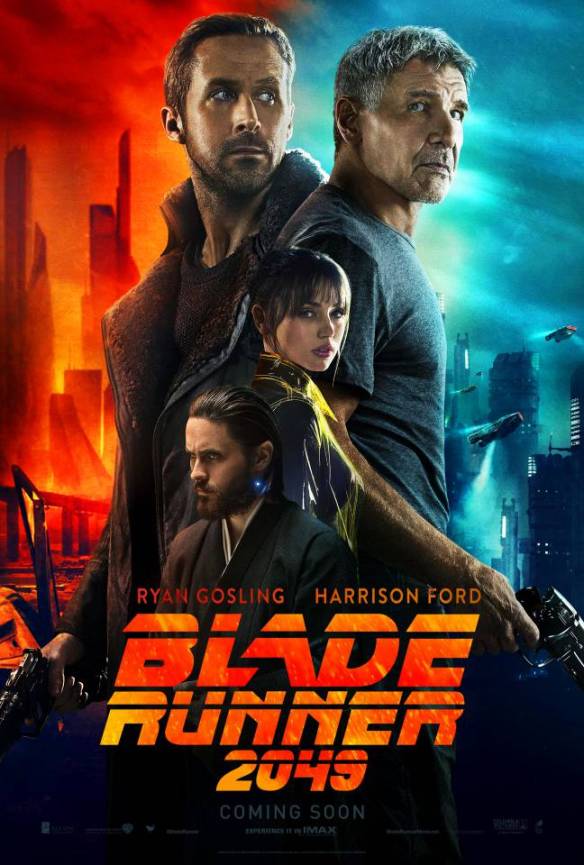
Like with most sequels, the main draw for fans is the chance to see familiar faces from the original and 2049 doesn’t disappoint too much. Judging from the posters, trailers, interviews, etc. it was clear Harrison Ford would make a return, but unfortunately it wasn’t until after the majority of the duration of the film had passed. Nevertheless, the reappearance of Ford’s character Deckard was memorable, found by Agent K as a disheveled hermit in an abandoned casino surrounded by copious amounts of alcohol and ancient pop culture detritus. Deckard is apparently as much of a drinker as in the first film, but now not just to block out the pain of the past and present but to escape to an idealized past. Though his involvement in the plot seemed too brief it nevertheless plays a pivotal role in resolving the central mystery of the film and providing additional metacommentary.

Ford’s performance is arguably more compelling than his work in the original, though his character’s lack of charisma in the first film could be seen as intentional. Deckard’s character arc in the film, as well as that of Ford’s last two iconic roles from the 80s he reprised, cements his status as our culture’s archetype for the deadbeat father. This seems inevitable in hindsight because for a generation of latchkey kids (many with actual deadbeat dads), stars such as Harrison Ford were virtually surrogate father figures. Thus, it makes sense that the beloved characters Ford drifted away from for so long would be written as variations of a long absent deadbeat parent in their last installments.

An interesting detail about the way Deckard was characterized in the film was how he seemed more in line with a typical baby-boomer today than the gen x-er one would be at that age 32 years from now.  For example, people in their seventies today are probably more likely to be nostalgic for Elvis and Sinatra than a seventy-something person in 2049 who in our actual timeline would have more likely spent formative years listening to grunge or hiphop. A possible subtextual meaning might be that like false memories, nostalgia for media of enduring cultural value transcends lived experience. The referencing of “real” pop-culture figures within the world of the film seemed anachronistic at first, but the way it was done was interesting and worked with the themes and aesthetic (I suppose it’s preferable to having something like Beastie Boys’ “Sabotage” shoe-horned into the film like in the Star Trek reboots). Getting back to the point, in the original Blade Runner, nostalgia permeated the film through its themes, production design, costumes and soundtrack. In Blade Runner 2049, nostalgia is a subtext of repeated callbacks to the original film, Agent K’s idealized retro relationship with his AI girlfriend Joi and Deckard’s hideout within the ruins of a city once associated with fun and glamour. The simulacrum of iconic figures from the past like Elvis and Marilyn Monroe (and Ford) haunting the deserted casino like ghosts reinforces the idea of media and culture’s ability to “implant” memories and resultant nostalgia.

As for the finale, I was disappointed that it was so far from the unconventional conclusion of the showdown between Roy Batty and Deckard. One could argue it’s a reflection of the state of the world (in and of film and reality), but it’d be nice to have a little more creativity and risk-taking. Though viscerally exciting and suspenseful, it wasn’t distinguishable enough from countless modern action films to be truly memorable. More satisfying was the epilogue which paralleled the contemplative nature of the original while reconnecting to the film’s recurring themes.

In a sense, the writers and director of Blade Runner 2049 were in a catch-22 situation. Creating a film too unlike or similar to the original Blade Runner would provoke criticism from fans. What director Denis Villeneuve and co-writers Hampton Fancher and Michael Green have managed to pull off is a balancing act of a film that’s unique in many ways yet interwoven with the original; nostalgic, but not in an obvious or overly sentimental way. Both have their flaws, but while I admire the thought and craft put into the sequel, I prefer the originality, tone, texture and atmosphere of Blade RunnerBlade Runner 2049 will likely satisfy most sci-fi fans, but I’m not sure it proves a sequel was necessary or that it stands alone as a classic.

Though not given the recognition it deserved in its time, Blade Runner was a groundbreaking and visionary film upping the bar for intellectual depth, moral complexity, production design and special effects to a degree not seen since 2001: a Space Odyssey. Its influence can be spotted in countless dystopian science fiction films made since. Though it’s too early to tell how influential Blade Runner 2049 will be, it doesn’t seem to have pushed the genre forward to a similar extent (of course contemporaneous opinions can seem wildly off the mark in hindsight). Regardless, it’s an above-average science fiction film by any reasonable standard so it’s unfortunate that judging from disappointing initial box-office reports, it seems to be following in the footsteps of the first Blade Runner pretty closely in that regard. Time will tell whether it achieves a similar cult status in years to come. Perhaps in 35 years?


As Babies are Prescribed Pharmaceuticals, Have We Reached Dystopia?

Tablets Pills Baby

By Joe Jarvis

Source: The Daily Bell

Would you let a five-year-old smoke a joint? I certainly hope not. Yet that would probably be less harmful than loading kids up on pharmaceuticals.

Currently, over a million American children UNDER SIX YEARS OLD are taking psychiatric drugs. Babies are literally being doped up by the pharmaceutical industry. Over 274,000 babies UNDER ONE-YEAR-OLD are given drugs, mostly for anxiety.

Anxiety drugs for babies. Have they tried motherly love? Or is that just an old fashioned, outdated concept?

You know, I like to mention society’s similarity to Orwell’s 1984. And surely the growing police state, war on drugs, and endless military campaigns–where the enemy seems to change daily–are reminiscent of the fictional dictatorship of Big Brother.

But it seems the powers that be are working tirelessly to blend together the dystopia of 1984, with that of Aldous Huxley’s Brave New World.

In that dystopia, there is no police state or war. Society has been perfectly designed by scientists, inspired by Ford’s assembly line. Babies are grown in the lab, cloned to all look alike, depending on their class. Parents are an embarrassing relic of the past. How silly to think a child needs family when they have the state!

The lower castes are deprived of oxygen as embryos to stunt their mental development. In America, they use fluoride in the drinking water instead.

In Brave New World, children listen to 24-hour propaganda in their cribs. Betas hear:

Alpha children wear grey. They work much harder than we do, because they’re so frightfully clever. I’m really awfully glad I’m a Beta, because I don’t work so hard. And then we are much better than the Gammas and Deltas. Gammas are stupid. They all wear green, and Delta children wear khaki. Oh no, I don’t want to play with Delta children. And Epsilons are still worse.

White pride, black pride, gay pride, national pride. Pride is not meant for accidents of birth. You should be proud of accomplishments and achievements, not genetics and geography. Perhaps someone has been whispering in these radicalized children’s ears.

And how jealous the Department of Education must be of the incubators of Brave New World! They have to sometimes wait years to indoctrinate children. But at least the government gets to drug them up at a young age! And if the TV is left on, most of the programming is done for them.

Of course, the adults are drugged up in Brave New World as well, just like in America. If anyone feels the least bit anxious, nervous, sad–or any other troublesome emotion–they get “soma.” It’s the perfect mix of drugs with only pleasant feelings and no ill side effects.

The 1 in 6 Americans on antidepressants, antipsychotics, and anti-anxiety medication still have to put up with side effects.

The 50 million plus Americans on psychiatric medication sometimes kill themselves, or go mad and kill others. I guess the government is still working out the kinks. Or it’s just another creative blending of 1984 and Brave New World. In the former, the proles must be properly terrified.

And there is one more thing I can remember from Brave New World that strikes eerily similar to modern America.

At what age does the public education system start teaching sex ed? Kindergarteners in some states receive “age appropriate”–according to the government–sexual education. Some studies suggest teen pregnancies rise in areas where sex ed is taught at younger ages.

How young is too young for a sex change? Kids can now choose between 43 genders, or make up a new one! It’s like Mr. Potato head, but with their own bodies. And they will be given corresponding drugs to enhance the “natural” changes.

In the classrooms of Brave New World:

“We had Elementary Sex for the first forty minutes,” she answered. “But now it’s switched over to Elementary Class Consciousness.”

The Director walked slowly down the long line of cots. Rosy and relaxed with sleep, eighty little boys and girls lay softly breathing…

He let out the amazing truth. For a very long period before the time of Our Ford, and even for some generations afterwards, erotic play between children had been regarded as abnormal (there was a roar of laughter); and not only abnormal, actually immoral (no!): and had therefore been rigorously suppressed.

Drugging the population, programming citizens with propaganda, sexualizing children, creating class divisions.

These dystopian novels were meant to be warnings, not instruction manuals.


Kafka Warned Us

By

Source: CounterPunch

Kafka’s The Trial can be read in retrospect as a prelude to the Twentieth/Twenty-First century. Although probably not written as prophecy, Kafka’s short unfinished book nevertheless provides a road map to the terrors of the current Surveillance State.

As readers of CounterPunch are all too familiar, modern man, as a single individual, is at the mercy of the modern state and those who, lurking in semi-secrecy, direct it.

Kafka’s The Trial superbly conveys the unease of our current existential situation.

Early one morning, The Trial’s main protagonist, Joseph K, awakes to find that, totally unexpectedly, he has been arrested. Throughout the book he endeavors to find the reason for his arrest without any definite success.

However, what he does discover is a vast semi-secret bureaucracy/organizaton whose inner workings and outward displays of power and decision making remain opaque at best.

Initally, Joseph K, believes that he lives in a “Rechtsstaat” (a state where the rule of law is respected) and thus where it is expected that all civilized norms and laws are upheld.

Yet, he soon comes to see that he has lived in a state of fundamental error and illusion about the true nature of his existence.

What appeared to him as a well ordered and just state is, all of a sudden, revealed to be a capricious omnipotent octopus capable of strangling (in this case literally) anyone deemed to be, for whatever reason, expendable.

All law is suspended or, at least, made a mockery of. All that remains are the inner, turgid demands of power.

Joseph K. is convinced of his innocence. But his conviction is no match for the monolithic power that stands against him. He is eventually crushed, if not by his enemy’s repetitive legal machinations, then by his fatalistic far-reaching administrative power.

In the end, the “Organization” which Joseph K has confronted is almighty and can be controlled by neither appeals to law, logic, or custom. In this, modern man is in a similar situation.

He stands, at any moment, beneath the mercy of a gigantic machinery that, if it wills, can almost casually set into motion his utter annihilation. The devastation and erasure of ones past, present, and future self is an ever-present possible function of the modern state. Advances in technology and organization make such a function all the more easier.

How to combat this greatest threat to humankind’s liberty will make the difference of whether or not future generations live in a world of securely grounded freedom or if they will succumb “like a dog” to the increasingly totalitarian powers of what we call today: the Surveillance State.

Gandhi’s Truth: Ending Human Violence One Commitment at a Time

By Robert J. Burrowes

Gandhi Jayanti – 2 October, the date of Mohandas K. Gandhi’s birth in 1869 and the International Day of Nonviolence – offers an opportunity to reflect on human violence and to ponder ways to end it. There may be a fast way to end human violence but, if there is, Gandhi did not know it. Nor do I. Nor does anyone else that I have read or asked either. But this does not mean there is no way to end human violence.

Human violence has a cause. See ‘Why Violence?’ and ‘Fearless Psychology and Fearful Psychology: Principles and Practice’. It has many manifestations. And it can be ended. But if this is to happen, then many of us must make the commitment to work towards that end. This is because, as Gandhi noted: ‘The future depends on what we do in the present.’

In other words, if human violence is to end, it will happen because individuals and organizations commit themselves to joining the effort to do so. Here is a sample of individuals around the world who have made that commitment, each in their own unique way. You are invited to join them.

HRH Prince Simbwa Joseph was born to a Ugandan Royal Family in Kampala. He abhors violence and is involved in many charities for helping those in need, as well as human rights organisations. He is currently manager of Nsambu and Company Advocates – a law firm and one of the oldest legal chambers in Uganda and East Africa, having been established in 1970. Among other engagements, he is also president of the African Federation Association in Uganda, which is a member of the World Federalist Movement Institute for Global policy. Following negotiations with Prince Simbwa as project manager in 2014, and involving the Ugandan Vice-President in launching the project, the World Sustainability Fund and its partners agreed to provide €1.5m to launch the AFA-WFM permanent office in Kampala in support of efforts to assist Uganda to achieve the UN Millennium Development Goals. In Prince Simbwa’s words: ‘Today the world is on tension due to so many things in social, economic, political disparities and pending nuclear wars. We are concerned as global citizens because if violence or war escalates those whom we call “Nalumanya ne Salumanya” in our local Luganda language (literally meaning “those concerned and less concerned”) shall be trapped equally…. Anti-apartheid icon Nelson Mandela and elder statesman appealed to the world during his lifetime to reinvent Indian freedom fighter Mahatma Gandhi’s nonviolent approach to solving conflicts.’

Lily Thapa is the inspirational founder president, in 1994, of Women for Human Rights, single women group (WHR) in Nepal. WHR is an NGO ‘dedicated to creating an active network of single women on a regional, national and international level. By working exclusively with and for them, WHR is dedicated to addressing the rights of single women and creating a just and equitable society where the lives of single women are strengthened and empowered.’ Rejecting the label ‘widow’, WHR ‘issued a national declaration to use the term “single women” instead of “widow”. The word “widow” (“Bidhwa” in Nepali) carries negativity and disdainful societal views which leaves many single women feeling humiliated and distressed.’ Working to empower women economically, politically, socially and culturally in order to live dignified lives and enjoy the value of human rights, WHR works at the grassroots, district, regional, national, South Asian and international levels. Lily has pointed out that there are ‘285 million single women in the world, among them 115 million fall below the poverty line and 38 million conflict-affected single women have no access to justice; these women are last.’ You can read more about Lily and WHR’s monumental efforts on their website. Recently, Lily was awarded the South Asian ‘Dayawati Modi Stree Shakti Samman’, which is ‘presented annually to a woman who has dared to dream and has the capability to translate that dream into reality’.

John McKenna’s commitment is to end discrimination in all of its forms against those with disabilities. In one recent article, the Australian surveyed the value of recent disability-mitigating technologies becoming available. In his thoughtful article ‘What’s App?’ he assessed the value of technologies that, for example, assist people who are blind, people who have problems with speech, and people with disabilities who are getting older.

In a nonviolent action to draw attention to the horror of drone murders, US grandmother Joy First was one of four nonviolent activists arrested at the Wisconsin Air National Guard Base (Volk Field) during one of the monthly vigils (held for over five years now) by Wisconsin Coalition to Ground the Drones and End the Wars. Volk Field is a critical component of the drone warfare program being conducted by the US government in a number of countries in the Middle East and Africa. At Volk Field personnel are trained to operate the RQ-7 Shadow Drone, which has been used for reconnaissance, surveillance, and target acquisition. You can read more about drone warfare and resistance to it in Joy’s highly informative article ‘Four Citizen Activists Arrested at Volk Field as they Attempt to Identify the Base as a Crime Scene’.

Father Nithiya is the National Programme Coordinator of the Association of Franciscan Families of India (AFFI). Their inspirational work is focused on two campaigns: the Violence of Extreme poverty and hunger and the Right to Food Campaign, as well as the National Campaign to Stop Violence Against Women. In relation to the latter campaign, AFFI has released a DVD and a booklet as a result of a four day intensive national consultation and training organised by them in 2016. Through their vast network of educational, social and medical ministries, AFFI has committed itself to stopping violence against women using various strategies all over the country, especially through their schools and colleges. Identifying ten types of violence against women – gender selection, female foeticide, child marriage, child abuse, harassment at work, prostitution and trafficking, domestic violence and Eve teasing, child labour, effects of alcoholism of men, and unemployment and underemployment of women – the DVD and booklet include analytical data, information about the legal framework and redress mechanisms. The aim is to empower women for their safety and security. Fr. Nithiya has given seminars to teachers and students to raise awareness of how they can stop any form of violence against women in their personal life, in their families, communities and society at large. The aim is to make these AFFI resources available in various Indian languages.

In one of her many engagements, Nobel Peace laureate Mairead Maguire from Northern Ireland continues her ongoing solidarity work in support of the Rohingya, the ethnic group in Burma currently suffering the genocidal assault of the Burmese government and its military forces, the Tatmadaw. In a recent evocative appeal to their fellow laureate Aung San Suu Kyi, signed by Mairead and four other laureates, they asked ‘How many Rohingya have to die; how many Rohingya women will be raped; how many communities will be razed before you raise your voice in defence of those who have no voice? Your silence is not in line with the vision of “democracy” for your country that you outlined to us, and for which we all supported you over the years.’ See ‘Five Nobel Laureates urge Aung San Suu Kyi to defend Rohingya Muslims’.

So if you would like to join the individuals above, as well as those individuals and organizations in 101 countries who have made the commitment to work to end human violence, you can do so by signing the online pledge of ‘The People’s Charter to Create a Nonviolent World’ which, thanks to Antonio Gutiérrez Rodero in Venezuela, is also available in Spanish.

If you also subscribe to Gandhi’s belief that ‘Earth provides enough to satisfy every [person’s] needs, but not every [person’s] greed’, then you might consider participating in ‘The Flame Tree Project to Save Life on Earth’ which he inspired as well.

And if you wish to use nonviolence, as Gandhi developed and employed it, for your campaign or liberation struggle, you will be given clear guidance on how to do so on these websites that draw heavily on his work: Nonviolent Campaign Strategy and Nonviolent Defense/Liberation Strategy.

Will enough people make the commitment to end human violence? Will you? As Gandhi warns us, fear of inadequate outcomes is no excuse for inaction: ‘You may never know what results come of your actions, but if you do nothing there will be no results.’


Biodata: Robert J. Burrowes has a lifetime commitment to understanding and ending human violence. He has done extensive research since 1966 in an effort to understand why human beings are violent and has been a nonviolent activist since 1981. He is the author of ‘Why Violence?’ His email address is flametree@riseup.net and his website is here.

Robert J. Burrowes
P.O. Box 68 Daylesford
Victoria 3460 Australia

Email: flametree@riseup.net

Websites:

http://thepeoplesnonviolencecharter.wordpress.com (Nonviolence Charter) http://tinyurl.com/flametree (Flame Tree Project to Save Life on Earth) http://tinyurl.com/whyviolence (‘Why Violence?’) https://nonviolentstrategy.wordpress.com/ (Nonviolent Campaign Strategy) https://nonviolentliberationstrategy.wordpress.com/ (Nonviolent Defense/Liberation Strategy) http://anitamckone.wordpress.com (Anita: Songs of Nonviolence) http://robertjburrowes.wordpress.com (Robert) https://globalnonviolencenetwork.wordpress.com/ (Global Nonviolence Network)

The social pathology of the Las Vegas Massacre

By Patrick Martin

Source: WSWS.org

In yet another eruption of savage impersonal violence, at least 59 people were killed and 527 people wounded as an outdoor music festival on the Las Vegas Strip, attended by more than 20,000, was suddenly converted into a war zone.

The alleged gunman, Stephen Paddock, used multiple semi-automatic weapons that had been converted to fully automatic use, through an attachment known as a bump-stock device—available for a mere $40 per weapon—as he opened fire on the helpless crowd from his vantage point on the 32nd floor of the Mandalay Bay hotel and casino. He took his own life after the rampage.

Paddock could lay down a field of fire on a military scale, nearly 100 rounds per minute. He was found in possession of about 20 weapons, many of them high-powered semi-automatics, along with additional ammunition. The first minutes of gunfire triggered a smoke alarm that allowed police to locate Paddock far more quickly than through a search of the huge 3,300-room hotel, a fact that suggests that the toll of death and injury could have been much higher.

The gunman’s motives are unknown, and his identity sheds little light on what drove him on this murderous course. Paddock was 64 years old, shared a comfortable home with his female companion, and was, according to some reports, financially well-off. One of his brothers described Paddock as a real estate multi-millionaire. He had a pilot’s license and owned two small planes. He had no known associations with any political or religious group.

There is a family history of mental illness—Paddock’s father, Richard Hoskins Paddock, was a bank robber and diagnosed as a psychopath. He was on the FBI’s 10 Most Wanted List for nearly a decade. But Stephen Paddock had no contact with his father after he was seven years old, and there are no reports that he exhibited mental illness or received any treatment for it.

As in virtually all such shootings, the gunman knew none of the wounded and killed. They did not exist for him as individuals. Paddock saw the concert-goers packed below him in a parking lot not as fellow human beings, but as objects to be destroyed. The victims were the random targets of the uncontrolled and impersonal hatred of a gunman indifferent to their fate and the lifelong suffering that awaits their surviving family and friends.

Clearly, this was not the act of a normal person. Some form of mental illness, even if not previously diagnosed, must be involved in Paddock’s crime. But there is certainly a socially induced element in this terrible event. The frequency of these occurrences cannot be explained in purely individual and personal terms. The Las Vegas massacre is a peculiarly American crime, arising out of the social pathology of a deeply troubled society.

What is the social context of this latest episode of domestic mass killing? The United States has been at war more or less continuously for the past 27 years. The US government has treated tens of millions of people in the Middle East, Afghanistan, and Africa as targets for extermination through bombs, bullets, and drone-fired missiles. These wars have penetrated deeply into American culture, celebrated endlessly in film, television, music and even sport.

Social relations within the United States, characterized by the growth of economic inequality on a scale that exceeds any previous era in American history, fuel a culture of indifference, and even outright contempt for human life.

One telling detail: on the day that the media was filled with reports about the worst mass shooting in American history, the stock market continued its relentless march upwards, with new records for the Dow-Jones Industrial Average and other indexes. Wall Street is celebrating in anticipation of the Trump administration pushing through the biggest tax cut for corporate America and the super-rich in history.

The damage inflicted on American society by constant war and deepening social inequality has found expression in an endless series of events like the mass shooting in Las Vegas. With only 5 percent of the world’s population, the US accounts for 30 percent of the mass shootings. And the scale of such horrors is increasing: the four worst mass shootings, in terms of casualty toll, and six of the seven worst, have taken place since 2007.

Corporate media pundits and government officials are incapable of more than perfunctory expressions of shock and dismay over such atrocities, which recur with appalling frequency in the United States. Even uttering such rote statements seems to be too much to ask of President Trump, whose remarks Monday morning were both banal and palpably insincere. How can anyone take seriously a foul-mouthed misogynist and pathological liar as he begins a sentence with the words, “Scripture teaches us”?

As for his moronic statement that the killings in Las Vegas were “pure evil,” such a characterization explains nothing. It doesn’t even explain Trump himself, who gave a speech two weeks ago at the United Nations where he threatened to use nuclear weapons to incinerate the 27 million inhabitants of North Korea. Yet CNN, ever the sycophant, described his televised remarks on Las Vegas as “pitch perfect.”

Trump is to visit Las Vegas Wednesday, one day after an equally stage-managed and bogus display of compassion set for Puerto Rico. There he will view the devastation inflicted by Hurricane Maria, while pursuing his Twitter feud with local government officials who have dared to criticize the poorly executed federal response to the catastrophe.

During the 16 years since the 9/11 attacks, during which the US government has been supposedly engaged in a “war on terror,” an average of one American per year has been killed by a foreign terrorist. During the same period, at least 10,000 Americans have been killed every year by other Americans. Mass shootings like Virginia Tech, Newtown, Orlando and now Las Vegas have killed six times as many Americans as all the terrorist attacks in that period.

Further investigation into the circumstances of the Las Vegas tragedy is vital. But one conclusion can surely be drawn: what happened late Sunday night outside the Mandalay Bay hotel was a manifestation of a deep sickness in American society.

Profit Maximization is Easy: Invest in Violence

By Robert J. Burrowes

For those of us committed to systematically reducing and, one day, ending human violence, it is vital to understand what is causing and driving it so that effective strategies can be developed for dealing with violence in its myriad contexts. For an understanding of the fundamental cause of violence, see ‘Why Violence?’

However, while we can tackle violence at its source by each of us making and implementing ‘My Promise to Children’, the widespread violence in our world is driven by just one factor: fear or, more accurately, terror. And I am not talking about jihadist terror or even the terror caused by US warmaking. Let me explain, starting from the beginning.

The person who is fearless has no use for violence and has no trouble achieving their goals, including their own defence, without it. But fearlessness is a state that few humans would claim. Hence violence is rampant.

Moreover, once someone is afraid, they will be less likely to perceive the truth behind the delusions with which they are presented. They will also be less able to access and rely on other mental functions, such as conscience and intelligence, to decide their course of action in any context. Worse still, the range of their possible responses to perceived threats will be extremely limited. And they will be more easily mobilised to support or even participate in violence, in the delusional belief that this will make them safe.

For reasons such as these, it is useful for political and corporate elites to keep us in a state of fear: social control is much easier in this context. But so is profit maximization. And the most profitable enterprise on the planet is violence. In essence then: more violence leads to more fear making it easier to gain greater social control to inflict more violence…. And starting early, by terrorizing children, is the most efficient way to initiate and maintain this cycle. See ‘Why Violence?’ and ‘Fearless Psychology and Fearful Psychology: Principles and Practice’.

So, for example, if you think the massive number of police killings of innocent civilians in the United States – see ‘Killed by Police’ and ‘The Counted: People killed by police in the US’ – is a problem, you are not considering it from the perspective of maintaining elite social control and maximizing corporate profit. Police killings of innocent civilians is just one (necessary) part of the formula for maintaining control and maximising profit.

This is because if you want to make a lot of money in this world, then killing or exploiting fellow human beings and destroying the natural world are the three most lucrative business enterprises on the planet. And we are now very good at it, as the record shows, with the planetary death toll from violence and exploitation now well over 100,000 human beings each day, 200 species driven to extinction each day and ecological destruction so advanced that the end of all life (not just human life) on Earth is postulated to occur within decades, if not sooner, depending on the scenario. See, for example, ‘The End of Being: Abrupt Climate Change One of Many Ecological Crises Threatening to Collapse the Biosphere’.

So what forms does this violence take? Here is a daily accounting.

Corporate capitalist control of national economies, held in place by military violence, kills vast numbers of people (nearly one million each week) by starving them to death in Africa, Asia and Central/South America. This is because this ‘economic’ system is designed and managed to allocate resources for military weapons and corporate profits for the wealthy, instead of resources for living.

Wars kill, wound and incapacitate a substantial number of civilians, mostly women and children, as do genocidal assaults, on a daily basis, in countries all over the planet. Wars also kill some soldiers and mercenaries.

Apart from those people we kill every day, we sell many women and children into sexual slavery, we kidnap children to terrorise them into becoming child soldiers and force men, women and children to work as slave labourers, in horrific conditions, in fields and factories (and buy the cheap products of their exploited labour as our latest ‘bargain’).

We condemn millions of people to live in poverty, homelessness and misery, even in industrialized countries where the refugees of western-instigated wars and climate-destroying policies are often treated with contempt. We cause many children to be born with grotesque genetic deformities because we use horrific weapons, like those with depleted uranium, on their parents. We also inflict violence on women and children in many other forms, ranging from ‘ordinary’ domestic violence to genital mutilation.

We ensnare and imprison vast numbers of people in the police-legal-prison complex. See ‘The Rule of Law: Unjust and Violent’. We pay the pharmaceutical industry and its handmaiden, psychiatry, to destroy our minds with drugs and electro-shocking. See ‘Defeating the Violence of Psychiatry’. We imprison vast numbers of children in school in the delusional belief that this is good for them. See ‘Do We Want School or Education?’ And we kill or otherwise exploit animals, mostly for human consumption, in numbers so vast the death toll is probably beyond calculation.

We also engage in an endless assault on the Earth’s biosphere. Apart from the phenomenal damage done to the environment and climate by military violence: we emit gases and pollutants to heat and destroy the atmosphere and destroy its oxygen content. We cut down and burn rainforests. We cut down mangroves and woodlands and pave grasslands. We poison the soil with herbicides and pesticides. We pollute the waterways and oceans with everything from carbon and nitrogenous fertilizers to plastic, as well as the radioactive contamination from Fukushima. And delude ourselves that our token gestures to remedy this destruction constitutes ‘conservation’.

So if you are seeking work, whether as a recent graduate or long-term unemployed person, then the most readily available form of work, where you will undoubtedly be exploited as well, is a government bureaucracy or large corporation that inflicts violence on life itself. Whether it is the military, the police, legal or prison system, a weapons, fossil fuel, banking, pharmaceutical, media, mining, agricultural, logging, food or water corporation, a farm that exploits animals or even a retail outlet that sells poisonous, processed and often genetically-mutilated substances under the label ‘food’ – see ‘Defeating the Violence in Our Food and Medicine’ – you will have many options to help add to the profits of those corporations and government ‘services’ that exist to inflict violence on you, your family and every other living being that shares this biosphere.

Tragically, genuinely ethical employment is a rarity because most industries, even those that seem benign like the education, finance, information technology and electronics industries, usually end up providing skilled personnel, finance, services or components that are used to inflict violence. And other industries such as those in insurance and superannuation, like the corporate banks, usually invest in violence (such as the military and fossil fuel industries): it is the most profitable.

So while many government bureaucracies and corporate industries exist to inflict violence, in one form or another, they can only do so because we are too scared to insist on seeking out ethical employment. In the end, we will take a job as a teacher, corporate journalist or pharmaceutical drug pusher, serve junk food, work in a bank, join the police or military, work in the legal system, assemble a weapons component… rather than ask ourselves the frightening questions ‘Is this nonviolent? Is this ethical? Does it enhance life?’

And yes, I know about structural violence and the way it limits options and opportunities for those of particular classes, races, genders…. But if ordinary people like us don’t consider moral issues and make moral choices, why should governments and corporations?

Moral choices? you might ask in confusion. In this day and age? Well, it might seem old-fashioned but, in fact, while most of us have been drawn along by the events in our life to make choices based on such considerations as self-interest, personal gain and ‘financial security’, there is a deeper path. Remember Gandhi? ‘True morality consists not in following the beaten track, but in finding the true path for ourselves, and fearlessly following it.’

Strange words they no doubt sound in this world where our attention is endlessly taken by all of those high-tech devices. But Gandhi’s words remind us that there is something deeper in life that the violence we have suffered throughout our lives has taken from us. The courage to be ourselves and to seek our own unique destiny.

Do you have this courage? To be yourself, rather than a cog in someone else’s machine? To refuse to submit to the violence that surrounds and overwhelms us on a daily basis?

If you are inclined to ponder these questions, you might also consider making moral choices that work systematically to end the violence in our world: consider participating in ‘The Flame Tree Project to Save Life on Earth’, signing the online pledge of ‘The People’s Charter to Create a Nonviolent World’ and/or helping to develop and implement an effective strategy to resist one or the other of the many threats to our survival using the strategic framework explained in Nonviolent Campaign Strategy.

Of course, these choices aren’t for everyone. As Gandhi observed: ‘Cowards can never be moral.’


Biodata: Robert J. Burrowes has a lifetime commitment to understanding and ending human violence. He has done extensive research since 1966 in an effort to understand why human beings are violent and has been a nonviolent activist since 1981. He is the author of ‘Why Violence?’ His email address is flametree@riseup.net and his website is here.

Robert J. Burrowes P.O. Box 68 Daylesford Victoria 3460 Australia

Email: flametree@riseup.net

Websites:
http://thepeoplesnonviolencecharter.wordpress.com (Nonviolence Charter)
http://tinyurl.com/flametree (Flame Tree Project to Save Life on Earth)
http://tinyurl.com/whyviolence (‘Why Violence?’)
https://nonviolentstrategy.wordpress.com/ (Nonviolent Campaign Strategy)
https://nonviolentliberationstrategy.wordpress.com/ (Nonviolent Defense/Liberation Strategy)
http://anitamckone.wordpress.com (Anita: Songs of Nonviolence)
http://robertjburrowes.wordpress.com (Robert)
https://globalnonviolencenetwork.wordpress.com/ (Global Nonviolence Network)