Why America’s Major News-Media Must Change Their Thinking

By Eric Zuesse

Source: Strategic Culture Foundation

America’s ‘news’-media possess the mentality that characterizes a dictatorship, not a democracy. This will be documented in the linked-to empirical data which will be subsequently discussed. But, first, here is what will be documented by those data, and which will make sense of these data:

In a democracy, the public perceive their country to be improving, in accord with that nation’s values and priorities. Consequently, they trust their government, and especially they approve of the job-performance of their nation’s leader. In a dictatorship, they don’t. In a dictatorship, the government doesn’t really represent them, at all. It represents the rulers, typically a national oligarchy, an aristocracy of the richest 0.1% or even of only the richest 0.01%. No matter how much the government ‘represents’ the public in law (or “on paper”), it’s not representing them in reality; and, so, the public don’t trust their government, and the public’s job-rating of their national leader, the head-of-state, is poor, perhaps even more disapproval than approval. So, whereas in a democracy, the public widely approve of both the government and the head-of-state; in a dictatorship, they don’t.

In a dictatorship, the ‘news’-media hide reality from the public, in order to serve the government — not the public. But the quality of government that the regime delivers to its public cannot be hidden as the lies continually pile up, and as the promises remain unfulfilled, and as the public find that despite all of the rosy promises, things are no better than before, or are even becoming worse. Trust in such a government falls, no matter how much the government lies and its media hide the fact that it has been lying. Though a ‘democratic’ election might not retain in power the same leaders, it retains in power the same regime (be it the richest 0.1%, or the richest 0.01%, or The Party, or whatever the dictatorship happens to be). That’s because it’s a dictatorship: it represents the same elite of power-holding insiders, no matter what. It does not represent the public. That elite — whatever it is — is referred to as the “Deep State,” and the same Deep State can control more than one country, in which case there is an empire, which nominally is headed by the head-of-state of its leading country (this used to be called an “Emperor”), but which actually consists of an alliance between the aristocracies within all these countries; and, sometimes, the nominal leading country is actually being led, in its foreign policies, by wealthier aristocrats in the supposedly vassal nations. But no empire can be a democracy, because the residents in no country want to be governed by any foreign power: the public, in every land, want their nation to be free — they want democracy, no dictatorship at all, especially no dictatorship from abroad.

In order for the elite to change, a revolution is required, even if it’s only to a different elite, instead of to a democracy. So, if there is no revolution, then certainly it’s the same dictatorship as before. The elite has changed (and this happens at least as often as generations change), but the dictatorship has not. And in order to change from a dictatorship to a democracy, a revolution also is required, but it will have to be a revolution that totally removes from power the elite (and all their agents) who had been ruling. If this elite had been the nation’s billionaires and its centi-millionaires who had also been billionaire-class donors to political campaigns (such as has been proven to be the case in the United States), then those people, who until the revolution had been behind the scenes producing the bad government, need to be dispossessed of their assets, because their assets were being used as their weapons against the public, and those weapons need (if there is to be a democracy) to be transferred to the public as represented by the new and authentically democratic government. If instead the elite had been a party, then all of those individuals need to be banned from every sort of political activity in the future. But, in either case, there will need to be a new constitution, and a consequent new body of laws, because the old order (the dictatorship) no longer reigns — it’s no longer in force after a revolution. That’s what “revolution” means. It doesn’t necessarily mean “democratic,” but sometimes it does produce a democracy where there wasn’t one before. The idea that every revolution is democratic is ridiculous, though it’s often assumed in ‘news’-reports. In fact, coups (which the U.S. Government specializes in like no other) often are a revolution that replaces a democracy by a dictatorship (such as the U.S. Government did to Ukraine in 2014, for example, and most famously before that, did to Iran in 1953). (Any country that perpetrates a coup anywhere is a dictatorship over the residents there, just the same as is the case when any invasion and occupation of a country are perpetrated upon a country. The imposed stooges are stooges, just the same. No country that imposes coups and/or invasions/occupations upon any government that has not posed an existential threat against the residents of that perpetrating country, supports democracy; to the exact contrary, that country unjustifiably imposes dictatorships; it spreads its own dictatorship, which is of the imperialistic type, and any government that spreads its dictatorship is evil and needs to be replaced — revolution is certainly justified there.)

This is how to identify which countries are democracies, and which ones are not: In a democracy, the public are served by the government, and thus are experiencing improvement in their lives and consequently approve of the job-performance of their head-of-state, and they trust the government. But in a dictatorship, none of these things is true.

In 2014, a Japanese international marketing-research firm polled citizens in each of ten countries asking whether they approve or disapprove of the job-performance of their nation’s head-of-state, and Harvard then provided an English-translated version online for a few years, then eliminated that translation from its website; but, fortunately, the translation had been web-archived and so is permanent here (with no information however regarding methodology or sampling); and it shows the following percentages who approved of the job-performance of their President or other head-of-state in each of the given countries, at that time:

China (Xi)          90%

Russia (Putin)      87%

India (Modi)        86%

South Africa (Zuma) 70%

Germany (Merkel)    67%

Brazil (Roussef)    63%

U.S. (Obama)        62%

Japan (Abe)         60%

UK (Cameron)        55%

France (Hollande)   48%

In January 2018, the global PR firm Edelman came out with the latest in their annual series of scientifically polled surveys in more than two dozen countries throughout the world, tapping into, actually, some of the major criteria within each nation indicating whether or not the given nation is more toward the dictatorship model, or more toward the democracy model. The 2018 Edelman Trust Barometer survey showed that “Trust in Government” (scored and ranked on page 39) was 44% in Russia, and is only 33% in the United States. Trust in Government is the highest in China: 84%. The U.S. and Russia are the nuclear super-powers; and the U.S. and China are the two economic super-powers; so, these are the world’s three leading powers; and, on that single measure of whether or not a country is democratic, China is the global leader (#1 of 28), Russia is in the middle (#13 of 28), and U.S. ranks at the bottom of the three, and near the bottom of the entire lot (#21 of 28). (#28 of 28 is South Africa, which, thus — clearly in retrospect — had a failed revolution when it transitioned out of its apartheid dictatorship. That’s just a fact, which cannot reasonably be denied, given this extreme finding. Though the nation’s leader, Zuma, was, according to the 2014 Japanese study, widely approved by South Africans, his Government was overwhelmingly distrusted. This distrust indicates that the public don’t believe that the head-of-state actually represents the Government. If the head-of-state doesn’t represent the Government, the country cannot possibly be a democracy: the leader might represent the people, but the Government doesn’t.)

When the government is trusted but the head-of-state is not, or vice-versa, there cannot be a functioning democracy. In other words: if either the head-of-state, or the Government, is widely distrusted, there’s a dictatorship at that time, and the only real question regarding it, is: What type of dictatorship is this?

These figures — the numbers reported here — contradict the ordinary propaganda; and, so, Edelman’s trust-barometer on each nation’s ‘news’-media (which are scored and ranked on page 40) might also be considered, because the natural question now is whether unreliable news-media might have caused this counter-intuitive (in Western countries) rank-order. However, a major reason why this media-trust-question is actually of only dubious relevance to whether or not the given nation is a democracy, is that to assume that it is, presumes that trust in the government can be that easily manipulated — it actually can’t. Media and PR can’t do that; they can’t achieve it. Here is a widespread misconception: Trust in government results not from the media but from a government’s having fulfilled its promises, and from the public’s experiencing and seeing all around themselves that they clearly have been fulfilled; and lying ‘news’-media can’t cover-up that reality, which is constantly and directly being experienced by the public.

However, even if trust in the ‘news’-media isn’t really such a thing as might be commonly hypothesized regarding trust in the government, here are those Edelman findings regarding the media, for whatever they’re worth regarding the question of democracy-versus-dictatorship: Trust in Media is the highest, #1, in China, 71%; and is 42% in #15 U.S.; and is 35% in #20 Russia. (A July 2017 Marist poll however found that only 30% of Americans trust the media. That’s a stunning 12% lower than the Edelman survey found.) In other words: Chinese people experience that what they encounter in their news-media becomes borne-out in retrospect as having been true, but only half of that percentage of Russians experience this; and U.S. scores nearer to Russia than to China on this matter. (Interestingly, Turkey, which scores #7 on trust-in-government, scores #28 on trust-in-media. Evidently, Turks find that their government delivers well on its promises, but that their ‘news’-media often deceive them. A contrast this extreme within the Edelman findings is unique. Turkey is a special case, regarding this.)

I have elsewhere reported regarding other key findings in that 2018 Edelman study.

According to all of these empirical findings, the United States is clearly not more of a democracy than it is a dictatorship. This particular finding from these studies has already been overwhelmingly (and even more so) confirmed in the world’s only in-depth empirical scientific study of whether or not a given country is or is not a “democracy”: This study (the classic Gilens and Page study) found, incontrovertibly, that the U.S. is a dictatorship — specifically an aristocracy, otherwise commonly called an “oligarchy,” and that it’s specifically a dictatorship by the richest, against the public.

Consequently, whenever the U.S. Government argues that it intends to “spread democracy” (such as it claims in regards to Syria, and to Ukraine), it is most-flagrantly lying — and any ‘news’-medium that reports such a claim without documenting (such as by linking to this article) its clear and already-proven falsehood (which is more fully documented here than has yet been done anywhere, since the Gilens and Page study is here being further proven by these international data), is no real ‘news’-medium at all, but is, instead, a propaganda-vehicle for the U.S. Government, a propaganda-arm of a dictatorship — a nation that has been overwhelmingly proven to be a dictatorship, not a democracy.
The New York Times takes on the social media “hordes”

By Andre Damon

Source: WSWS.org

Since late 2016, the New York Times, working together with the US intelligence agencies and the Democratic Party, has been engaged in a campaign to promote internet censorship in the guise of targeting “fake news” and “Russian propaganda.”

In waging this campaign, the Times’ motives are both political and pecuniary. Speaking for a ruling elite that sees the growth of social opposition on all sides and expects far worse, the Times has promoted censorship to remove opportunities for the working class to organize outside the framework of official politics.

In addition, the Times, for the most part a clearinghouse for staid and predigested state propaganda, is seeking to carve back market share it has lost to online publications that carry out genuine investigative journalism and oppose the lies peddled by the US government and media.

In recent months, this campaign has entered a new and malignant phase. Increasingly dropping the pretext of “Russian meddling,” the Times is now directly attacking its main target: the fact that the internet, and in particular social media, helps empower the population to access oppositional sources of news and have their voices heard in public.

Among the Times’ latest broadsides against freedom of expression is an article by its “State of the Art” columnist Farhad Manjoo headlined “For Two Months, I Got My News From Print Newspapers. Here’s What I Learned.” The piece, supposedly written as a first-hand account of a journalist turning off social media and only reading the news from print newspapers, is—in an unusually literal sense—a piece of lying propaganda from beginning to end.

As the Columbia Journalism Review pointed out, during the period in which he supposedly stopped using social media, Manjoo managed to post on Twitter virtually every day. “Manjoo remained a daily, active Twitter user throughout the two months he claims to have gone cold turkey, tweeting many hundreds of times, perhaps more than 1,000,” the Review pointed out.

Manjoo’s blatant falsifying of his own social media use is hardly the most sinister aspect of his piece. However, it expresses something essential about the Times’ notion of “reporting”: its writers feel they can say anything and get away with it, so long as their claims conform to the dictates of the establishment and the intelligence agencies whose interests determine what is and what is not reported in the US media.

The columnist’s dishonesty about his own activities provides much needed context for his article as a whole, which is little more than a long-form denunciation of a reading public that feels compelled to obtain its news from sources not massaged by the CIA-vetted hacks at the New York Times. In the process, Manjoo gives his unqualified blessings to the pronouncements of his own publication and castigates anyone who would question them as a member of an ignorant “herd,” whose opinions ought to be suppressed.

During his pretended sojourn into the desert of print media, Manjoo said he learned to value having the news spoon-fed to him by “professionals,” without having to worry about whether what he was reading was true or false.

As he puts it, “It takes professionals time to figure out what happened, and how it fits into context… This was the surprise blessing of the newspaper. I was getting news a day old, but in the delay between when the news happened and when it showed up on my front door, hundreds of experienced professionals had done the hard work for me.”

He continues, “Now I was left with the simple, disconnected and ritualistic experience of reading the news, mostly free from the cognitive load of wondering whether the thing I was reading was possibly a blatant lie.”

Here, we assume, the reader is supposed to heave a sigh of relief. How soothing not to have to think for oneself! The author’s surrender of his critical faculties supposedly did wonders for his health and general well being. Not only did he become “less anxious,” but he had the time to “take up pottery” and “became a more attentive husband and father”! Wonderful! And so much more wonderful if he hadn’t actually made up the story about his abstinence from social media.

Manjoo’s condemnation of critical thinking aside, the real core of the piece is a scathing denunciation of the public, which he describes as a “herd” and a “crowd,” and which, moreover, is empowered to express its rotten opinions by the sinister power of social media.

“Avoid social [media],” he declares. “Technology allows us to burrow into echo chambers, exacerbating misinformation and polarization and softening up society for propaganda.”

The statements posted by the “online hordes” are not “quite news, and more like a never-ending stream of commentary, one that does more to distort your understanding of the world than illuminate it,” Manjoo adds. “On social networks … People don’t just post stories—they post their takes on stories, often quoting key parts of a story to underscore how it proves them right.”

People are posting “their takes on stories!” The horror! Instead of just consuming the news as worked over by the Times, complete with big lies (“weapons of mass destruction”) and small ones (its technology columnist giving up Twitter for two months), social media allows users to critically examine the stories they read. In other words, the internet allows the public to bypass the monopoly of “professional” falsifiers and “gatekeepers” like Manjoo, Judith Miller, Thomas Friedman and the like.

The author’s only hope is that “the government” and “Facebook” will soon “fix” this problem. The clear implication is that once social media is “fixed,” the “herd,” “crowd,” and “hordes” will no longer be allowed to pollute cyberspace by questioning the pronouncements of the New York Times. Manjoo’s self-righteous pontifications, worthy of Polonius (if Polonius were also a liar), would be comical if they were not so ominous. Faced with a growing wave of social struggles, the ruling elite is preparing censorship on a massive scale. Having succeeded in dramatically reducing traffic to left-wing web sites, the technology giants and intelligence agencies are proceeding to the next phase: censoring all expressions of social opposition, in particular by the working class, on social media.

Philip K. Dick and the Fake Humans

(Editor’s note: on this 36th anniversary of the passing of Philip K. Dick, it seems an appropriate time to note the relevance of his work to our current dystopia as Henry Farrell does in the following essay. Unfortunately the author is less astute regarding the ways in which the dystopias of Orwell and Huxley are equally relevant to our current milieu.)

By Henry Farrell

Source: Boston Review

This is not the dystopia we were promised. We are not learning to love Big Brother, who lives, if he lives at all, on a cluster of server farms, cooled by environmentally friendly technologies. Nor have we been lulled by Soma and subliminal brain programming into a hazy acquiescence to pervasive social hierarchies.

Dystopias tend toward fantasies of absolute control, in which the system sees all, knows all, and controls all. And our world is indeed one of ubiquitous surveillance. Phones and household devices produce trails of data, like particles in a cloud chamber, indicating our wants and behaviors to companies such as Facebook, Amazon, and Google. Yet the information thus produced is imperfect and classified by machine-learning algorithms that themselves make mistakes. The efforts of these businesses to manipulate our wants leads to further complexity. It is becoming ever harder for companies to distinguish the behavior which they want to analyze from their own and others’ manipulations.

This does not look like totalitarianism unless you squint very hard indeed. As the sociologist Kieran Healy has suggested, sweeping political critiques of new technology often bear a strong family resemblance to the arguments of Silicon Valley boosters. Both assume that the technology works as advertised, which is not necessarily true at all.

Standard utopias and standard dystopias are each perfect after their own particular fashion. We live somewhere queasier—a world in which technology is developing in ways that make it increasingly hard to distinguish human beings from artificial things. The world that the Internet and social media have created is less a system than an ecology, a proliferation of unexpected niches, and entities created and adapted to exploit them in deceptive ways. Vast commercial architectures are being colonized by quasi-autonomous parasites. Scammers have built algorithms to write fake books from scratch to sell on Amazon, compiling and modifying text from other books and online sources such as Wikipedia, to fool buyers or to take advantage of loopholes in Amazon’s compensation structure. Much of the world’s financial system is made out of bots—automated systems designed to continually probe markets for fleeting arbitrage opportunities. Less sophisticated programs plague online commerce systems such as eBay and Amazon, occasionally with extraordinary consequences, as when two warring bots bid the price of a biology book up to $23,698,655.93 (plus $3.99 shipping).

In other words, we live in Philip K. Dick’s future, not George Orwell’s or Aldous Huxley’s. Dick was no better a prophet of technology than any science fiction writer, and was arguably worse than most. His imagined worlds jam together odd bits of fifties’ and sixties’ California with rocket ships, drugs, and social speculation. Dick usually wrote in a hurry and for money, and sometimes under the influence of drugs or a recent and urgent personal religious revelation.

Still, what he captured with genius was the ontological unease of a world in which the human and the abhuman, the real and the fake, blur together. As Dick described his work (in the opening essay to his 1985 collection, I Hope I Shall Arrive Soon):

The two basic topics which fascinate me are “What is reality?” and “What constitutes the authentic human being?” Over the twenty-seven years in which I have published novels and stories I have investigated these two interrelated topics over and over again.

These obsessions had some of their roots in Dick’s complex and ever-evolving personal mythology (in which it was perfectly plausible that the “real” world was a fake, and that we were all living in Palestine sometime in the first century AD). Yet they were also based on a keen interest in the processes through which reality is socially constructed. Dick believed that we all live in a world where “spurious realities are manufactured by the media, by governments, by big corporations, by religious groups, political groups—and the electronic hardware exists by which to deliver these pseudo-worlds right into heads of the reader.” He argued:

the bombardment of pseudo-realities begins to produce inauthentic humans very quickly, spurious humans—as fake as the data pressing at them from all sides. My two topics are really one topic; they unite at this point. Fake realities will create fake humans. Or, fake humans will generate fake realities and then sell them to other humans, turning them, eventually, into forgeries of themselves. So we wind up with fake humans inventing fake realities and then peddling them to other fake humans.

In Dick’s books, the real and the unreal infect each other, so that it becomes increasingly impossible to tell the difference between them. The worlds of the dead and the living merge in Ubik (1969), the experiences of a disturbed child infect the world around him in Martian Time-Slip (1964), and consensual drug-based hallucinations become the vector for an invasive alien intelligence in The Three Stigmata of Palmer Eldritch (1965). Humans are impersonated by malign androids in Do Androids Dream of Electric Sheep? (1968) and “Second Variety” (1953); by aliens in “The Hanging Stranger” (1953) and “The Father-Thing” (1954); and by mutants in “The Golden Man” (1954).

This concern with unreal worlds and unreal people led to a consequent worry about an increasing difficulty of distinguishing between them. Factories pump out fake Americana in The Man in the High Castle (1962), mirroring the problem of living in a world that is not, in fact, the real one. Entrepreneurs build increasingly human-like androids in Do Androids Dream of Electric Sheep?, reasoning that if they do not, then their competitors will. Figuring out what is real and what is not is not easy. Scientific tools such as the famous Voight-Kampff test in Do Androids Dream of Electric Sheep? (and Blade Runner, Ridley Scott’s 1982 movie based loosely on it) do not work very well, leaving us with little more than hope in some mystical force—the I Ching, God in a spray can, a Martian water-witch—to guide us back toward the real.

We live in Dick’s world—but with little hope of divine intervention or invasion. The world where we communicate and interact at a distance is increasingly filled with algorithms that appear human, but are not—fake people generated by fake realities. When Ashley Madison, a dating site for people who want to cheat on their spouses, was hacked, it turned out that tens of thousands of the women on the site were fake “fembots” programmed to send millions of chatty messages to male customers, so as to delude them into thinking that they were surrounded by vast numbers of potential sexual partners.

These problems are only likely to get worse as the physical world and the world of information become increasingly interpenetrated in an Internet of (badly functioning) Things. Many of the aspects of Joe Chip’s future world in Ubik look horrendously dated to modern eyes: the archaic role of women, the assumption that nearly everyone smokes. Yet the door to Joe’s apartment—which argues with him and refuses to open because he has not paid it the obligatory tip—sounds ominously plausible. Someone, somewhere, is pitching this as a viable business plan to Y Combinator or the venture capitalists in Menlo Park.

This invasion of the real by the unreal has had consequences for politics. The hallucinatory realities in Dick’s worlds—the empathetic religion of Do Androids Dream of Electric Sheep?, the drug-produced worlds of The Three Stigmata of Palmer Eldritch, the quasi–Tibetan Buddhist death realm of Ubik—are usually experienced by many people, like the television shows of Dick’s America. But as network television has given way to the Internet, it has become easy for people to create their own idiosyncratic mix of sources. The imposed media consensus that Dick detested has shattered into a myriad of different realities, each with its own partially shared assumptions and facts. Sometimes this creates tragedy or near-tragedy. The deluded gunman who stormed into Washington, D.C.’s Comet Ping Pong pizzeria had been convinced by online conspiracy sites that it was the coordinating center for Hillary Clinton’s child–sex trafficking ring [likewise, the masses may have been convinced by mainstream media that a real child-sex trafficking ring never existed].

Such fractured worlds are more vulnerable to invasion by the non-human. Many Twitter accounts are bots, often with the names and stolen photographs of implausibly beautiful young women, looking to pitch this or that product (one recent academic study found that between 9 and 15 percent of all Twitter accounts are likely fake). Twitterbots vary in sophistication from automated accounts that do no more than retweet what other bots have said, to sophisticated algorithms deploying so-called “Sybil attacks,” creating fake identities in peer-to-peer networks to invade specific organizations or degrade particular kinds of conversation.

Twitter has failed to become a true mass medium, but remains extraordinarily important to politics, since it is where many politicians, journalists, and other elites turn to get their news. One research project suggests that around 20 percent of the measurable political discussion around the last presidential election came from bots. Humans appear to be no better at detecting bots than we are, in Dick’s novel, at detecting replicant androids: people are about as likely to retweet a bot’s message as the message of another human being. Most notoriously, the current U.S. president recently retweeted a flattering message that appears to have come from a bot densely connected to a network of other bots, which some believe to be controlled by the Russian government and used for propaganda purposes.

In his novels Dick was interested in seeing how people react when their reality starts to break down. A world in which the real commingles with the fake, so that no one can tell where the one ends and the other begins, is ripe for paranoia. The most toxic consequence of social media manipulation, whether by the Russian government or others, may have nothing to do with its success as propaganda. Instead, it is that it sows an existential distrust. People simply do not know what or who to believe anymore. Rumors that are spread by Twitterbots merge into other rumors about the ubiquity of Twitterbots, and whether this or that trend is being driven by malign algorithms rather than real human beings.

Such widespread falsehood is especially explosive when combined with our fragmented politics. Liberals’ favorite term for the right-wing propaganda machine, “fake news,” has been turned back on them by conservatives, who treat conventional news as propaganda, and hence ignore it. On the obverse, it may be easier for many people on the liberal left to blame Russian propaganda for the last presidential election than to accept that many voters had a very different understanding of America than they do.

Dick had other obsessions—most notably the politics of Richard Nixon and the Cold War. It is not hard to imagine him writing a novel combining an immature and predatory tycoon (half Arnie Kott, half Jory Miller) who becomes the president of the United States, secret Russian political manipulation, an invasion of empathy-free robotic intelligences masquerading as human beings, and a breakdown in our shared understanding of what is real and what is fake.

These different elements probably would not cohere particularly well, but as in Dick’s best novels, the whole might still work, somehow. Indeed, it is in the incongruities of Dick’s novels that salvation is to be found (even at his battiest, he retains a sense of humor). Obviously, it is less easy to see the joke when one is living through it. Dystopias may sometimes be grimly funny—but rarely from the inside.

Corporate giant Unilever demands crackdown on oppositional Internet content

By Will Morrow

Source: WSWS.org

The drive to censor the Internet took another step this week with a public statement by Keith Weed, the chief marketing officer for the London-based multinational Unilever, threatening to withdraw advertising from social media platforms if they fail to suppress “toxic content.”

Weed reportedly told an annual leadership meeting of the Interactive Advertising Bureau in Palm Desert, California that the company “will not invest in platforms or environments” that “create divisions in society, and promote anger or hate.” He added, “We will prioritize investing only in responsible platforms that are committed to creating a positive impact in society.”

Excerpts of Weed’s remarks—the most explicit of their kind from a major corporate executive—were leaked to several media outlets, including the Wall Street Journal and the Guardian. They were immediately featured on NBC News and other major American news outlets on Sunday. The Journal’s report was accompanied by an interview with Weed.

The coordinated release was designed to escalate the propaganda offensive by the Democratic Party and US intelligence agencies, together with the corporate media, for Internet censorship. The fraudulent premise for this assault on freedom of speech, both in the US and across Europe, is the claim that political opposition and social tensions are the product not of poverty, inequality and policies of austerity and militarism, but of “fake news” spread by Russia through social media.

Weed’s statements preceded yesterday’s US Senate Select Committee on Intelligence hearing, which witnessed a series of hysterical denunciations of Russia by politicians and intelligence agents. The Democratic vice-chairman of the committee, Mark Warner of Virginia, declared that Russia “utilized our social media platforms to push and spread misinformation at an unprecedented scale.”

Facebook responded to Weed’s threats by declaring, “[W]e fully support Unilever’s commitments and are working closely with them.” The Journal stated that Unilever “has already held discussions” with Facebook, Google, Twitter, Snap and Amazon “to share ideas about what each can do to improve.”

Weed absurdly framed his demand for censorship, made on behalf of a multibillion-dollar global corporation, as the expression of popular anger over the supposed spread of “fake news.” He referred to research showing a decline in trust in social media and a “perceived lack of focus” in the form of “illegal, unethical and extremist behavior and material on” social media platforms. Speaking to the Wall Street Journal, he claimed to be articulating the concerns of consumers over “fake news” and “Russians influencing the US election.”

In reality, the intervention by Unilever—a consumer products behemoth with a market capitalization of $157 billion and annual revenues of $65 billion, more than the gross domestic product of many countries—only highlights the economic and political forces driving the censorship campaign: an alliance of the military/intelligence apparatus, giant technology firms and the corporate-financial oligarchy.

Unilever’s annual marketing outlays of nearly $9 billion place it in the top five companies in that category globally. It owns dozens of brands used by some 2.5 billion people around the world, including Dove soap, Rexona deodorant and food products Cornetto, Magnum and Lipton. Weed’s statements amount to a declaration that Unilever will use this economic power to filter what the world’s population can and cannot read online.

This is in line with a long and reactionary tradition. Large advertisers played a significant role in enforcing the McCarthyite witch hunt of socialist and left-wing figures in the US during the late 1940s and 1950s. General Motors, DuPont, Reynolds Tobacco and other major companies were backers of the notorious anticommunist periodical Counterattack, which published names of suspected communist sympathizers and forced the removal of targeted performers and critical content from programs they sponsored.

In one of many such cases, the blacklisted Jean Muir was dropped from the television show “The Aldrich Family” after General Foods, the program’s sponsor, told NBC it would not sponsor programs featuring “controversial persons.”

In another development, Susan Wojcicki, the CEO of YouTube (owned by Google’s parent company, Alphabet), told a Code Media conference in Los Angeles that Facebook “should get back to baby pictures and sharing.” The statement is a reference to Facebook’s announcement last month that it is deprioritizing news content on its News Feed in favor of “personal moments.” The change is one of a number of recent measures to prevent Facebook users from accessing news and analysis outside of officially sanctioned corporate outlets.

UK Home Secretary Amber Rudd on Tuesday released a government-developed application that uses machine-learning algorithms to automatically detect ISIS-related content in videos so that it can be censored.

The BBC wrote that the tool was seen by the government as a way to demonstrate that its “demand for a clampdown on extremist activity was not unreasonable.” Rudd stated, “The technology is there. There are tools out there that can do exactly what we’re asking for,” i.e., identifying and censoring video content. The new application will be provided free of charge to smaller video hosting companies, and the government will consider making its use legally mandatory.

The Washington Post, which along with the New York Times has been at the forefront of the censorship campaign, linked the UK government’s announcement to the intervention of Unilever, writing that it came “amid mounting pressure on social media companies to do more to remove extremist content from their platforms.”

Untying PropOrNot: Who They Are … and a Look at 2017’s Biggest Fake News Story

By George Eliason, an American journalist living in Ukraine.

Source: Washington’s Blog

Preface by Washington’s Blog: A leading cybersecurity expert has publicly said that Mr. Eliason’s research as  presented in this article does not violate the law.  Washington’s Blog does not express an opinion about whether or not the claims set forth in this article are accurate or not. Make up your own mind.

A little over a year ago, the deep-state graced the world with Propornot. Thanks to them, 2017 became the year of fake news. Every news website and opinion column now had the potential to be linked to the Steele dossier and Trump collusion with Russia. Every journalist was either with us or against us. Every one that was against us became Russia’s trolls.

Fortunately for the free world, the anonymous group known as Propornot that tried to “out” every website as a potential Russian colluder, in the end only implicated themselves.

Turnabout is fair play and that’s always the fun part, isn’t it? With that in mind, I know the dogs are going to howl this evening over this one.

The damage Propornot did to scores of news and opinions websites in late 2016-2017 provides the basis of a massive civil suit. I mean huge, as in the potential is there for a tobacco company sized  class-action sized lawsuit. I can say that because I know a lot about a number of entities that are involved and the enormous amount of money behind them.

How serious is this? In 2016, a $10,000 reward was put out for the identities of Propornot players. No one has claimed it yet, and now, I guess no one will. There are times in your life that taking a stand has a cost. To make sure the story gets out and is taken seriously, this is one of those times.

If that’s what it takes for you to understand the danger Propornot and the groups around them pose to everyone you love, if you understand it, everything will have been well worth it.

In this article, you’ll meet some of the people staffing Propornot. You’ll meet the people and publications that provide their expenses and cover the logistics. You’ll meet a few of the deep state players. We’ll deal with them very soon. They need to see this as the warning shot over the bow and start playing nice with regular people.  After that, you’ll meet the NGO’s that are funding and orchestrating all of it. How am I doing so far?

The image that you see is the clincher or game winner that supplies the necessary proof up front and the direct path to Propornot. This was a passive scan of propornot.com showing the administrative dashboard belongs to the InterpreterMag.com as shown on the left of the image. On the right, it shows that uploads to Propornot.com come from InterpreterMag.com and is a product of that publication.

Now we have the first layer of Propornot, fake news, and our 1st four contestants. We havea slew of new media organizations that are influenced by, or feeding Propornot. Remember, fake news got off the ground and got its wings because of the attention this website received from the Washington Post in Dec. 2016.

At the Interpreter Mag level, here are the people:

  • Michael Weiss is the Editor-in-Chief at the InterpreterMag.com. According to his Linkd profile, he is also a National Security Analyst for CNN since Jul 2017 as well as an Investigative Reporter for International Affairs for CNN since Apr 2017. He has been a contributor there since 2015. He has been a Senior Editor at The Daily Beast since Jun 2015.

With the lengthy CNN cred’s, how much involvement does CNN have in fake news? Yes, I know, but we’re talking about Propornot.

  • James Miller’s bio at the InterpreterMag.com includes Managing Editor of The Interpreter where he reports on Russia, Ukraine, and Syria. James runs the “Under The Black Flag” column at RFE/RL which provides news, opinion, and analysis about the impact of the Islamic State extremist group in Syria, Iraq, and beyond. He is a contributor at Reuters, The Daily Beast, Foreign Policy, and other publications. He is an expert on verifying citizen journalism and has been covering developments in the Middle East, specifically Syria and Iran, since 2009. Follow him on Twitter: @MillerMENA- Miller even works for the US Embassy in Kiev “diplo-page” the Kiev Post.

The Interpreter is a product of the Atlantic Council. The Digital Forensics Research Lab has been carrying the weight in Ukrainian-Russian affairs for the Atlantic Council. Fellows working with the Atlantic Council in this area include:

  • Bellingcat- Aric Toler and Eliot Higgins- This linked article shows how an underwear salesman became one of the most important faces of the deep state.  Don’t laugh, the image is really appropriate. Higgins’ insecurity runs so deep because of his failures that Higgins tries to get publications censured that question his author-i-tie.
  • Anne Applebaum
  • StopFake- Irena Chalupa- Chalupa is the sister to the same Alexandra Chalupa that brought the term Russian hacking to worldwide attention. Irena Chalupa is a nonresident fellow with the Atlantic Council’s Dinu Patriciu Eurasia Center. She is also a senior correspondent at Radio Free Europe/Radio Liberty (RFE/RL), where she has worked for more than twenty years. Ms. Chalupa previously served as an editor for the Atlantic Council, where she covered Ukraine and Eastern Europe. Irena Chalupa is also the news anchor for Ukraine’s propaganda channel Stopfake.org She is a Ukrainian Diaspora leader. The Chalupa’s are the 1st family of Ukrainian propaganda. She works with and for Ukrainian Intelligence through the Atlantic Council, Stopfake, and her sisters Andrea (Euromaidanpr) and Alexandra.

The strand that ties this crew together is they all work for Ukrainian Intelligence. If you hit the links, the ties are documented very clearly. We’ll get to that point again shortly, but let’s go further:

Propornot-> Atlantic Council -> Broadcasting Board of Governors (BBG)

Who are the BBG? According to Wikipedia- “The Broadcasting Board of Governors (BBG) is an independent agency of the United States government. According to its website, its mission is to “inform, engage, and connect people around the world in support of freedom and democracy. The BBG supervised Voice of America (VOA), Radio Free Europe/Radio Liberty, Radio y Television Marti, Radio Free Asia, and the Middle East Broadcast Networks.

The board of the BBG was eliminated and replaced with a single appointed chief executive officer as part of the National Defense Authorization Act for Fiscal Year 2017, which was passed in December 2016.”

On January 1, 2016, the  Interpreter became a special project of RFE/RL and under the oversight of the BBG. The Secretary of State had a seat on the board of the BBG until December 2016. Why the change?

During the 2016 election, the BBG developed a major conflict of interest. At least two BBG board members worked actively for the Hillary Clinton presidential campaign. These government officials were working against the president-elect after the election. It looks like it didn’t go unnoticed. In the following linked article, it shows that they should be investigated for their part in an attempted coup.

From a Nov 7, 2016, article– “Karen Kornbluh is helping refine and to get Hillary Clinton’s message out. ” All of them are names to watch if Clinton wins — and key jobs at the FCC and other federal agencies are up for grabs.”

According to her bio: Karen founded the New America Foundation’s Work and Family Program and is a senior fellow for Digital Policy at the Council on Foreign Relations. Karen has written extensively about technology policy, women, and family policy for The AtlanticThe New York Times and The Washington PostNew York Times columnist David Brooks cited her Democracy article “Families Valued,” focused on “juggler families” as one of the best magazine articles of 2006.

Michael Kempner is the founder, President and Chief Executive Officer of MWW Group, a staunch Hillary Clinton supporter, and may get a greater role if she is elected.  Kempner is a member of the Public Relations Hall of Fame. Michael Kempner hired Anthony Weiner after the sexting scandal broke in 2011.

Jeff Shell, chairman of the BBG and  Universal Filmed Entertainment is supporting a secondary role by being an honor roll donor to the Atlantic Council. While the BBG is supposed to be neutral it has continuously helped increase tensions in Eastern Europe. While giving to the Atlantic Council may not be illegal while in his position, currently, the Atlantic Council’s main effort is to ignite a war with Russia. This may set up a major conflict of interest.

According to journalist Robert Parry “The people that will be taking senior positions and especially in foreign policy believe “This consensus is driven by a broad-based backlash against a president who has repeatedly stressed the dangers of overreach and the need for restraint, especially in the Middle East.”

Parry goes on to say that at the forefront of this is the Atlantic Council, a think tank associated with NATO. Their main goal is a major confrontation with nuclear-armed Russia.”

So, to make sense of all this, most of the people listed would have held cabinet positions in a Hillary Clinton presidency. If the Interpreter is a project of RFE/RL then the decision to go ahead with Propornot would have to go across their desk. That includes then Sec of State, John Kerry.

The unasked question of why would a US Government Agency do this (?) needs to be addressed. All the people listed above were actively working for Clinton to get her elected and throw Donald Trump’s campaign off the rails.

After the election, they were going to take care of Clinton’s “deplorables” by dissecting alternative media. I wrote about this before the election and I warned several major new sites what they could expect. I was right on the money. After she lost, it was already in motion. The deplorable media didn’t fall into a particular political pattern other than they did not promote Hillary Clinton.

The purpose of Propornot has been to get people to demand freedom of speech be rolled back. This was/is to be done by destroying fact-based media. If you read further, the entire plan is laid out starting from 2015 when it started coming together.

These people want reality shaped on what the perceived majority (louder) group believes to be true, regardless of what the facts are. Perception based reality is only a Facebook like away from killing one person or elevating another to hero status regardless of what they have done.

That little statement about the free speech rally says it all. It’s something that would hardly be noticed unless you were looking for it because it is part of the meta-data.

Now you can say it’s only a sentence and who cares? Nobody communicates through metadata do they? Wasn’t that what Propornot was all about? Yes, they do communicate through metadata. That’s why I look at it.

Do you see it? No? Look again. There in the metadata, at the bottom of the image is an ad for a job. Go for it and remember to mention the header. It could just as easily be hacking instructions, or a do not disturb sign. That’s why it pays to really research carefully.

The Boston ‘Free Speech’ Rally was billed by the social networks and MSM as a fascist rally. It was really a Free Speech Rally. What they learned is that with just a little nudge, they can make you demand nationalist repression. Nice going Boston!

Hey, is this starting to sound a little conspiratorial? If it is, we need ruskie hackers with Guy Fawkes masks to make this work. They have to admit to changing international politics through hacking in 2016, belong to a foreign country, code in Russian, and use spear phishing techniques to lure people in. Let’s not forget that they also have to work for some form of Intelligence.

Most importantly, they have to work with and influence all of the people above. They will definitely impact US foreign policy toward Russia. Let’s raise the stakes even more. The hackers have to answer to whoever is funding a lot of the illegal and immoral activities.

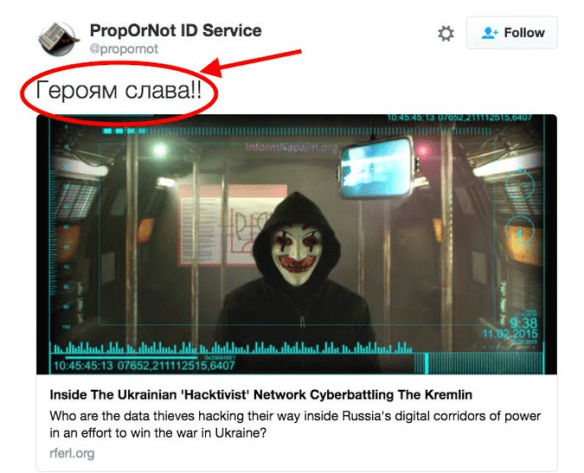
They are not even savvy enough to stay clear of outing each other. This is the Pravy Sektor hacker RUH8.  The common thread for these hackers is clear if you read the linked material on the profiles that make up these organizations. They work for Bellingcat, Informnapalm, the Atlantic Council, Ukrainian Intel, and the Diaspora.

In a follow-up article, I have reason to ask if they were given access to United States Government Top Secret Secure Servers. I’m not kidding.

In a Euromaidan Press article dated November 2nd, 2016, the hackers state enthusiastically “Ukrainian hackers have a rather high level of work. So the help of the USA… I don’t know, why would we need it? We have all the talent and special means for this. And I don’t think that the USA or any NATO country would make such sharp movements in international politics.”

And we have a winner. In 2016 the sharp movement in international politics was caused by…survey says….hacking!!!!

According to Donna Brazille, the Democratic Party servers were hacked multiple times and the hacking didn’t stop until December 2016. At this juncture, we should be able to agree that Seth Rich leaked the information to Wikileaks. But, now we are talking about other hacks. In the above linked article, these hacker specifically say their favorite route is spear phishing email accounts.

In the article, you’ll also see they work directly for Ukrainian Intel. Bellingcat works directly for Ukrainian Intel and works with them and the Atlantic Council. Stopfake is a product of Irena Chalupa who works for RFE/RL, the Atlantic Council and the Ukrainian government. Stopfake works directly with them and is a product of the Ukrainian government. Crowdstrike has an ongoing relationship with Ukrainian Intel and these particular hackers. Crowdstrike conjured up Fancy Bear. Well say, hello to the real fancy bear of 2016 (*fancybear is technically a set of tools and not people).

This means that former Secretary of State John Kerry approved of Ukrainian Intelligence hackers having access to servers inside a US Government Agency because of Propornot and the Atlantic Councils reliance on the hackers.

How are the Ukrainian hackers tied into Propornot at any level? James Miller isn’t shy about using their work. Propornot relies on the work of the Atlantic Council, Aric Toler, Aaron Weisburd, Clint Watts, and Joel Harding. The Ukrainian hackers work directly with InformNapalm and are the go-to resource for most of the people involved and all of the people just named.

Below we have assessed the details of the reports from InformNapalm, and have expanded on their investigation. — James Miller

Americans are attacking Americans for a foreign country for what amounts to pennies. We’ll deal with them again soon.

Who does the Atlantic Council work for? It’s the same people that staff RFE/RL.

“On 29 January 2016 in Washington, U.S.A., Ukrainian World Congress (UWC) President Eugene Czolij and Atlantic Council President and CEO Frederick Kempe officially signed a Memorandum of Agreement to renew the cooperation between the UWC and the Atlantic Council, that began in September 2014.

In accordance with this Memorandum, the UWC will continue its cooperation with the Atlantic Council on implementing the “Ukraine in Europe Initiative”, which aims to galvanize international support for an independent, sovereign and territorially integral Ukraine, including Crimea. This initiative is also intended to support reforms in Ukraine and its EuroAtlantic integration, and to counter Russian disinformation.”

This one little paragraph spells out clearly what I have shown in detail throughout this article.

The Ukrainian World Congress is represented in the US Congress by the Ukrainian Caucus headed up by ISIS supporter and Nazi cheerleader Marcy Kaptur. Her Ukrainian Caucus represents people  with political positions that scared Adolf Hitler in WWII.

The obvious takeaway is that a lawsuit is a bare minimum that needs to happen. People need to be investigated for crimes against the state. When we take a closer look at who had potential access to top-secret servers, that will become painfully obvious.

These people have tried and are trying to rip the fabric of society in pieces. At the very least, they have earned a good tarring…and feathering. When you look at the financial end of this a lawsuit in the billions would barely touch it.

Just one company the Ukrainian Diaspora started for this is valued over 100 million dollars. This will need to be a class action suit with a cease and desist to the BBG.

In early 2015, almost 2 years before most people took the idea of censorship seriously, I documented its inception. In the same way, it happens with many of the biggest stories of our times, I stumbled onto it by accident.

In early March 2015, Ukrainian Information Policy designer Joel Harding laid out what to expect going forward in the following statements: “In military IIO operations center on the ability to influence foreign audiences, US, and global audiences, and adversely affect enemy decision making through an integrated approach. Even current event news is released in this fashion. Each portal is given messages that follow the same themes because it is an across the board mainstream effort that fills the information space entirely when it is working correctly.

The purpose of “Inform and Influence Operations”  is not to provide a perspective, opinion, or lay out a policy. It is defined as the ability to make audiences “think and act” in a manner favorable to the mission objectives. This is done through applying perception management techniques which target the audiences emotions, motives, and reasoning.

These techniques are not geared for debate. It is to overwhelm and change the target psyche.

Using these techniques information sources can be manipulated and those that write, speak, or think counter to the objective are relegated as propaganda, ill-informed, or irrelevant.”- Harding

While the above sounds gloriously overoptimistic, Harding, along with his little band of Kremlin Troll hunters personally started developing the idea of organizations capable of blackballing journalists and publications in a way that could not be construed as censorship.

From another March 2015 articleA “Disinformation Charter” for Media and BloggersTop-down censorship should be avoided. But rival media, from Al-Jazeera to the BBC, Fox and beyond, need to get together to create a charter of acceptable and unacceptable behavior. Vigorous debate and disagreement qre ,of course, to be encouraged—but media organizations that practice conscious deception should be excluded from the community. A similar code can be accepted by bloggers and other online influencers.

This “Disinformation Charter” for responsible behavior (Ministry of Truth?) he describes is to fight “conscious deception” can only be weighed against how he describes Propaganda. “The word is frequently used to describe any news emerging one’s opponent.”– Harding

Journalists that need to be excluded are those “our side” label as propagandists or active measure agents.”

Harding’s connections in media are very large. Through his friend Mathew Armstrong, Harding had access to and the ear of the board of the Broadcasting Board of Governors (BBG). The BBG board is staffed by the who’s who of network and radio broadcast, print media and shortwave CEO’s and heavy hitters. They are behind RFE/RL (Radio Free Europe/ Radio Liberty).

On the other end of this in 2015, Joel Harding was assembling a group of miscreants to attack the social networks of different journalist and publications. The crude logic behind a direct assault was that by developing, training, and overseeing vast troll networks they could speak over their opposition (people that their employers wanted to be silenced) and subdue dissident online conversation and control the information.

Where this wasn’t feasible, they set up hack and harass attacks at various publication to get them to stop publishing hard-hitting journalists. This still hasn’t been effective because it caused publishers to dig in and harden their internet properties instead.

The softer more indirect approach Harding pushed in March 2015 quickly developed into the unified media strategy he wanted for the US and Europe. Control the information and don’t allow contradicting information or news into the media stream. When it does get in, call it propaganda.

Enter Propornot.


The truth about « fake news »

While NATO was busy setting up a vast network with which to accuse Russia of perpetuating propaganda from the Soviet era, Washington was suddenly swamped by a wave of hysteria. In an attempt to discredit the new US President, the dominant media accuse him of talking rubbish – in response, the President accuses them of propagating fake news. This cacophony is amplified by the swift development of the social media, which had once been intended for use as weapons of the State Department against nationalist regimes, but which today are popular forums used to combat abuse by all kinds of elites – with Washington at the top of the list.

By Thierry Meyssan

Source: Voltaire Network

As soon as the announcement of his surprise election was made public, and even before he had access to the White House, the immense majority of US and NATO media began screaming about the negligence and insanity of President Trump. Battle was joined between the media class and the new President, with each side accusing the other of propagating fake news.

Almost everywhere in the NATO countries – and only in these countries – political representatives began denouncing fake news. This was intended to reveal the supposed influence of Russian propaganda within the « Western democracies ». The State which has been the most seriously impacted by this campaign is France, whose President Emmanuel Macron recently announced the drafting of a law specifically aimed at fighting these « attacks on democracy », but only during « an electoral period ».

The fact that the English expression fake news is maintained in all the languages of the NATO countries attests to the Anglo-Saxon origin of the problem, when in fact the phrase designates a phenomenon as old as the world – false information.

At the origin of the campaign against « fake news » – NATO

In 2009, at the NATO summit in Strasbourg-Kehl, President Obama announçed his intention of creating an Alliance « Strategic Communication » service [1]. It took six years to implement, using elements of the 77th Brigade of the British Land Army and the 361st Civil Affairs Brigade of the United States Land Army (based in Germany and Italy).

At first, their mission was to counter communications accusing the US deep state of having itself organised the attacks of 9/11, then those accusing the Anglo-Saxons of having planned the « Arab Springs » and the war against Syria — such communications were termed « conspiracy theories ». However, the situation evolved rapidly in such a way as to convince the populations of the Alliance that Russia was continuing to apply propaganda from the Soviet era – and thus that NATO was still useful.

Finally, in April 2015, the European Union created a « Work Group for Strategic Communications – East » (East StratCom Task Force). Every week, this group addresses a report on Russian propaganda to thousands of journalists. For example, its last edition (dated 11 January 2018) accuses Sputnik of pretending that the Copenhagen zoo feeds its predators with abandoned household pets. Lord help us, the « democracies » are under attack ! Clearly, it is difficult for these specialists to find meaningful examples of Russian interference. In August of the same year, NATO inaugurated its « Centre for Strategic Communication » in Riga (Latvia). The following year, the US State Department created a Global Engagement Center which works on the same principles.

How Facebook, Hillary Clinton’s pet obsession, turned against her

In 2009, Secretary of State Hillary Clinton, at the instigation of Jared Cohen (leading member of the Policy Planning Staff ), persuaded herself that it was possible to overthrow the Islamic Republic of Iran by manipulating the social media. This theory did not have the desired affect. However, two years later, in 2011, the same Jared Cohen — since become the the CEO of Google Ideas — managed to mobilise the youth of Cairo. Although the « revolution » of Tahrir Square had not swayed the opinion of the Egyptian people, the myth of the extension of the American way of life via Facebook was born. As a result, the State Department sponsored a number of associations and assemblies to promote Facebook.

However, the US Presidential election of 2016 was a shock. An outsider, real estate promoter Donald Trump, eliminated all his rivals one by one, including Hillary Clinton, and was swept into the White House, having benefited from the advice of Facebook. For the first time, the dream of the Muse of professional politicians became reality, but worked against her. Overnight, Facebook was demonised by the dominant Press.

It became evident on this occasion that it is possible to artificially create crowd movements with the social media, but that after a few days, media users regain their senses. This is the constant fact for all systems of information manipulation — they are fleeting. The only form of lie which makes it possible to create long-term behaviour patterns supposes that one has forced the citizens into a form of minor engagement, in other words, that one has brainwashed them [2].

Indeed, Facebook understood this very well, creating its « Politics & Government Outreach Program » and handing it over to the care of Katie Harbath. It was intended to create collective emotions in favour of one client or another, but does not seek to organise lasting campaigns [3]. This is why President Macron proposes to legislate the social media only during electoral periods. He was himself elected thanks to a brief disorder created jointly by a weekly newspaper and Facebook against his rival François Fillon — an operation orchestrated by Jean-Pierre Jouyet [4]. Furthermore, Emmanuel Macron’s fear that next time the social media may be used against him fits with NATO’s desire to demonstrate the continuity of USSR-Russia propaganda. As an example of manipulation, Macron therefore cites an interview with Sputnik concerning his private life and the publishing of an allegation concerning a foreign bank account.

The Christopher Steele Report

During the US Presidential campaign, Hillary Clinton’s team ordered an inquiry on Donald Trump from an ex-agent of the British Secret Services, Christopher Steele. Ex-chief of MI6’s « Russia House », he was known for his scandalous and always unverifiable allegations. After having accused Vladimir Putin, without proof, of having commanded the poisoning of Alexander Litvinenko by Polonium 210, he accused him of having caught Donald Trump in a sex trap and blackmailing him. The Steele Report was then discretely handed to various journalists, politicians and master spies, and finally published [5].

This is the source of the hypothesis according to which, seeking to get his puppet elected and hamper the election of Hillary Clinton, the lord of the Kremlin had ordered « his » media to buy publicity on Facebook and spread lies about the ex-Secretary of State – a hypothesis which may be supported by a conversation between the Australian ambassador in London with one of Donald trump’s advisors [6]. It doesn’t matter that Russia Today and Sputnik only spent a total of a few thousand dollars for publicity which rarely concerned Mrs. Clinton, the US ruling class is persuaded that they turned back the popular tide in favour of the Democrat candidate and her 1.2 billion dollar campaign. In Washington, people persist in believing that technological inventions can be used to manipulate the human race.

It is no longer a question of noting that Donald Trump and his partisans ran their campaign on Facebook because the totality of the written and audiovisual Press was hostile to them, but pretending that Facebook was manipulated by Russia in order to prevent the election of the Muse of Washington.

The legal privilege of Google, Facebook and Twitter

By seeking to prove the interference of Moscow, the US Press underlined the exorbitant privilege enjoyed by Google, Facebook and Twitter — these three companies are not considered responsible for their content. From the point of view of US law, they are no more than transporters of information (common carrier).

The experiments carried out by Facebook, which demonstrated the possibility of creating collective emotions on one hand, and the legal non-responsibility of this company on the other, attest to an anomaly in the system.

Particularly since the privilege enjoyed by Google, Facebook and Twitter is clearly undue. Indeed, these three companies act in at least two different ways to modify the content they transport. First of all, they unilaterally censor certain messages, either via the direct intervention of their personnel, or mechanically, via hidden algorithms. Then they promote their vision of the truth to the detriment of other points of view (fact-checking).

For example, in 2012, Qatar ordered from Google Ideas, already directed by Jared Cohen, the creation of software which would make it possible to follow the progression of defections in the Syrian Arab Army. The point was to show that Syria was indeed a dictatorship, and that the people were beginning to revolt. But it very quickly became clear that this vision of affairs was false. The number of soldiers who defected never rose above 25,000 in an army of 450,000 men. This is why, after having promoted the software, Google discretely retired it.

Conversely, for seven years, Google promoted articles which relayed communiqués from the Syrian Observatory for Human Rights (SOHD). Day after day, they gave the exact count of the number of victims in both camps. Of course, these figures are imaginary – it is impossible for anyone to count them. Never, in a time of war, has a state been able to determine, on a daily basis, the number of soldiers killed in combat and the civilians killed behind the lines. And yet, in the United Kingdom, the SOHD claims to know what the people who live there, in Syria, cannot know.

Far from being just the common carriers, Google, Facebook and Twitter are the forgers of the information they transport, and as such, they ought to be counted legally responsible for their content.

The rules of the freedom of expression

Let’s imagine that the efforts of NATO and those of President Macron against Russia in terms of audiovisual Internet traffic meet with failure. It is nonetheless necessary to enter these new medias into general law.

The principles which regulate the freedom of expression are only legitimate if they are identical for all citizens and for all media. This is not the case today. While the general law applies, there is no specific rule concerning denial or the right to reply for the messages on Internet and the social media.

As always in the history of information, the old medias attempt to sabotage the new. Thus I remember the violent editorial that the French daily Le Monde dedicated in 2002 to my work on the Internet concerning the responsibility for the attacks of 9/11. What shocked the newspaper just as much as my conclusions was that the Voltaire Network was free from the financial obligations of which it felt prisoner [7]. This is the same corporatist attitude that it demonstrates again, fifteen years later, with its service, Le Decodex. Rather than developing a critique of the articles or videos of the new medias, Le Monde proposes to note the reliability of its rival Internet sites. Of course, only the sites issued by their paper colleagues find grace in their eyes, all the others are judged less trustworthy.

To shore up the campaign against the social media, the Fondation Jean-Jaures (that is to say the foundation of the Socialist Party linked to the National Endowment for Democracy) has published an imaginary poll [8]. With a display of numbers, it aims to demonstrate that unsophisticated people – the working classes and the partisans of the National Front – are gullible. It claims that 79 % of French people believe in one conspiracy theory or another. As proof of their naïveté, it points out that 9 % of them are convinced that the Earth is flat.

However, neither myself nor any of my French friends consulted by Internet have ever met any of our compatriots who believe that the Earth is flat. The figure is obviously invented and discredits the entire study. As it happens, although it is linked to the Socialist Party, the Fondation Jean-Jaures still has Gerard Collomb as its general secretary – Collomb has since become President Macron’s Minister for the Interior. This same foundation had already published, two years ago, a study aimed at discrediting the political opponents of the system that it already qualified as « conspiracy theorists » [9].


Translation
Pete Kimberley


Freedom Rider: Oligarch Jeff Bezos

By Margaret Kimberley

Source: Intrepid Report

Amazon CEO Jeff Bezos has a net worth of $105 billion and is the richest man in the world. But he is not just the richest man at this moment in history. He is the richest person who has ever lived. As of 2017 he and seven other billionaires had a collective net worth equal to that of the poorest 3.6 billion people on earth.

These figures have been in the news of late but without much useful analysis. The corporate media refuse to state what is obvious. Namely that inequality is worse around the world precisely because these super rich people demand it.

While pundits and politicians go on breathlessly about oligarchs in Russia, they seldom take a look at the wealthiest in their own backyard and the control they exert over the lives of millions of people. When Amazon announced it would choose a site for its new headquarters, cities across the country began a furious race to the bottom. Amazon is not alone in the thievery department. Major corporations like Walmart always request and receive public property and public funds in order to do business.

Some 235 cities have put themselves in the running for this dubious venture. Chicago is willing to give Amazon $1.3 billion in payroll taxes that prospective employees would ordinarily pay that city. If Chicago wins this booby prize, Amazon employees would pay taxes to their employer and not to the government. This is truly cutting out the middle man and makes real the rule of, by, and for the wealthiest.

The potential for public outrage isn’t lost on unprincipled politicians. Some cities now refuse to reveal how much they plan to give away. But the news to date is disheartening with Boston offering $75 million while Houston is willing to part with $268 million. Amazon says it will hire 50,000 people but their business model already pays employees so little that many of them qualify for public assistance, despite being employed.

The United States is as much of an oligarchy as countries it usually disparages but it is far more dishonest about its true nature. All talk of democracy is a lie as the rich get richer, by an additional $1 trillion in 2017, and wield more and more power over the lives of everyone else.

The Bezos juggernaut is not restricted to theft of public money. He is also the sole owner of the Washington Post, one of the most influential newspapers in the country. Bezos owns a newspaper that is an organ of the ruling elite and he also has a $600 million contract to provide the Central Intelligence Agency with cloud computing services.

The Washington Post was the force behind Propaganda or Not, an effort to destroy left wing voices like those at Black Agenda Report. Under the guise of fighting Russia and so-called fake news, the Bezos owned Post began the censorship campaign that has put the left’s presence on the Internet in such jeopardy.

Politicians outdo one another giving away public resources to the richest man on the planet who also owns a major newspaper and services the surveillance state. If it can be said that any one person rules the world, Bezos would be obvious choice. No one in Chicago, Boston, Houston or any of the other cities giving away the store ever voted for Jeff Bezos. All talk of democracy is a sham as long as the richest people take from the rest of humanity.

The effort to make government an irrelevance is thoroughly bipartisan. Republicans and Democrats alike are willing to turn over government coffers to Bezos and his ilk and the rights of the people be damned.

Whoever wins this tarnished brass ring ought to be consigned to political defeat. The mayor, aldermen, city council members or whoever else brings disaster to their locality should be punished for aiding and abetting the theft. If these cities can give to the richest man who ever lived, they can surely use public money to help their residents right now. But they will never do that because they are all bought off and compromised. They are either cynical or afraid to go against the real rulers of the country.

Bezos may look like the villain in a James Bond movie but there is nothing funny about him. He is deadly serious and so are his intentions. In a Bezos run world, every worker will be impoverished, every level of government will subsidize corporations, and anyone who speaks out will be discredited and under surveillance.

The last thing any city needs is a new Amazon headquarters. We need an end to billionaire rule in this country and around the world. That will be the salvation of the people, not more sweatshops run by wealthy people who steal from everyone else.


Margaret Kimberley’s Freedom Rider column appears weekly in BAR, and is widely reprinted elsewhere. She maintains a frequently updated blog as well as at freedomrider.blogspot.com. Ms. Kimberley lives in New York City, and can be reached via e-Mail at Margaret.Kimberley(at)BlackAgendaReport.com.

Governments and corporations escalate Internet censorship and attacks on free speech

By Andre Damon

Source: WSWS.org

The year 2018 has opened with an international campaign to censor the Internet. Throughout the world, technology giants are responding to the political demands of governments by cracking down on freedom of speech, which is inscribed in the US Bill of Rights, the European Convention on Human Rights, and countless international agreements.

Bloomberg, the financial news service, published a blog post titled “Welcome to 2018, the Year of Censored Social Media,” which began with the observation, “This year, don’t count on the social networks to provide its core service: an uncensored platform for every imaginable view. The censorship has already begun, and it’ll only get heavier.”

Developments over the past week include:

  • On January 1, the German government began implementation of its “Network Enforcement Law,” which threatens social media companies with fines of up to €50 million if they do not immediately remove content deemed objectionable. Both German trade groups and the United Nations have warned that the law will incentivize technology companies to ban protected speech.
  • On January 3, French President Emmanuel Macron vowed to introduce a ban during election cycles on what he called “fake news” in a further crackdown on free speech on top of the draconian measures implemented under the state of emergency. The moves by France and Germany have led to renewed calls for a censorship law applying to the entire European Union.
  • On December 28, the New York Times reported that Facebook had deleted the account of Ramzan Kadyrov, the head of the Chechen Republic, nominally because he had been added to a US sanctions list. As the American Civil Liberties Union pointed out, this creates a precedent for giving the US government essentially free rein to block freedom of expression all over the world simply by putting individuals on an economic sanctions list.
  • This week, Iranian authorities blocked social media networks, including Instagram, which were being used to organize demonstrations against inequality and unemployment.
  • Facebook has continued its crackdown on Palestinian Facebook accounts, removing over 100 accounts at the request of Israeli officials.

These moves come in the wake of the decision by the Trump administration to abolish net neutrality, giving technology companies license to censor and block access to websites and services.

In August, the World Socialist Web Site first reported that Google was censoring left-wing, anti-war, and progressive websites. When it implemented changes to its search algorithms, Google claimed they were politically neutral, aimed only at elevating “more authoritative content” and demoting “blatantly misleading, low quality, offensive or downright false information.”

Now, no one can claim that the major technology giants are not carrying out a widespread and systematic campaign of online censorship, in close and active coordination with powerful states and intelligence agencies.

In the five months since the WSWS released its findings, Google’s censorship of left-wing, anti-war, and progressive web sites has only intensified.

Even though the World Socialist Web Site‘s readership from direct entries and other websites has increased, Google’s effort to isolate the WSWS through the systematic removal of its articles from search results has continued to depress its search traffic. Search traffic to the WSWS, which fell more than any other left-wing site, has continued to trend down, with a total reduction of 75 percent, compared to a 67 percent decline in August.

Alternet.org’s search traffic is now down 71 percent, compared to 63 percent in August. Consortium News’s search traffic is down 72 percent, compared to 47 percent in August. Other sites, including Global Research and Truthdig, continue to see significantly depressed levels of search traffic.

In its statement to commemorate the beginning of the new year, the World Socialist Web Site noted, “The year 2018—the bicentenary of Marx’s birth—will be characterized, above all, by an immense intensification of… class conflict around the world.” This prediction has been confirmed in the form of mass demonstrations in Iran, the wildcat strike by auto workers in Romania and growing labour militancy throughout Europe and the Middle East.

The ruling elites all over the world are meeting this resurgence of class struggle with an attempt to stifle and suppress freedom of expression on the Internet, under the false pretence of fighting “fake news” and “foreign propaganda.”

The effort to muzzle social opposition by the working class must be resisted.

On January 16, 2018, the World Socialist Web Site will host a live video discussion on Internet censorship, featuring journalist and Truthdig contributor Chris Hedges and WSWS International Editorial Board Chairperson David North.

The discussion will explore the political context of the efforts to censor the Internet and abolish net neutrality, examine the pretexts used to justify the suppression of free speech (i.e., “fake news”), and discuss political strategies to defend democratic rights. Hedges and North will also field questions from on-line listeners.

We urge all of our readers to register to participate in this immensely important discussion, and to help publicize it to friends and co-workers.


The webinar will be streamed live by the WSWS on YouTube and Facebook on Tuesday, January 16 at 7:00 pm ( EST). For more information, time zone conversions and to register, click here.


Fight Google’s censorship!

Google is blocking the World Socialist Web Site from search results.

To fight this blacklisting:
Share this article with friends and coworkers