Strategy and Conscience: Subverting Elite Power So We End Human Violence

Fragment of “Butcher to the World” by Sue Coe.

By Robert J. Burrowes

Given the overwhelming evidence that activist efforts are failing to halt the accelerating rush to extinction precipitated and maintained by dysfunctional human behavior, it is worth reflecting on why this is happening.

Of course, you might say that the rush to extinction is being slowed. But is it? Even according to BP’s chief economist: ‘despite the extraordinary growth in renewables in recent years, and the huge policy efforts to encourage a shift away from coal into cleaner, lower carbon fuels, there has been almost no improvement in the power sector fuel mix over the past 20 years. The share of coal in the power sector in 1998 was 38% – exactly the same as in 2017…. this is one area where at the global level we haven’t even taken one step forward, we have stood still: perfectly still for the past 20 years.’ See Analysis – Spencer Dale, group chief economist.

And, to choose another measure that highlights our lack of ‘progress’: species extinctions proceed at a rate of 200 each day, which is vastly greater than the long-term background rate, with another 26,000 species already identified as ‘under threat’. See Red list research finds 26,000 global species under extinction threat.

But it wouldn’t matter what measure you analyzed – efforts to prevent cataclysmic nuclear war, to halt the many ongoing wars, to contain and reverse the prevalent and grotesque economic exploitation, to end slavery or the sex trafficking of women and children, to halt or even slow the rampant destruction of the biosphere, including the rainforests and oceans – we are rapidly losing ground (and often despite some apparent gains such as adoption of the ‘Treaty on the Prohibition of Nuclear Weapons’ by many non-nuclear states on 7 July 2017).

Not only are we destroying the rainforests – currently at the rate of 80,000 acres each day: see ‘Measuring the Daily Destruction of the World’s Rainforests’ – and oceans – see The state of our oceans in 2018 (It’s not looking good!)’ – as a fellow long-standing nonviolent activist, Kelvin Davies, recently observed to me: the oceans and remaining rainforests are ‘being emptied of life’ as impoverished people, forced to the economic margin, hunt remaining wildlife, including tropical fish, for food and/or trafficking.

Before we blame impoverished people for their destruction however, it is the consumption by those of us in industrialized countries that is generating the adverse circumstances in which they are forced to survive. For one simple example of this, related to our diet alone, see ‘Emissions impossible: How big meat and dairy are heating up the planet’.

Of course, you might object that it is not activist efforts that are responsible for the failure to halt elite violence and our complicity in it. It is the failure of corporatized society to seriously consider and respond intelligently to the scientific and other evidence in relation to all of the violence in its many manifestations. However, any explanation of this nature fails to understand and appreciate why progressive change has always occurred in the past.

Social progress is the result of people of conscience strategically challenging elite power in such a way that new norms become so widely accepted that elites are compelled to work within them. This has always been essential for the simple reason that elites are insane and have never acted sensibly, whatever the issue. Elites have only ever orchestrated events to maximize their own power, profit and privilege whatever the cost to the rest of us and the Earth itself. Hence, violence, war, grotesque economic exploitation and ecological destruction are rampant across the planet; that is the way elites want it; that is what maximizes elite power, profit and privilege. See ‘The Global Elite is Insane Revisited’.

As an aside: if you aren’t convinced that the global elite is insane, then perhaps you might ponder the possible implications of the recent call by US President Donald Trump, for the creation of a new Space Force as a sixth branch of the U.S. military – ‘We must have American dominance in space’ – in violation of the Outer Space Treaty of 1967. See ‘Trump Orders Establishment of Space Force as Sixth Military Branch’.

While this enterprise, if it gets Congressional approval, would be staggeringly profitable to the global elite while further gutting social and environmental programs to pay for it, the proposal also raises the possibility, as Professor Karl Grossman graphically expressed it (given that there is no way to have the envisaged weapons in space without nuclear power) that ‘the heavens are going to be littered with radioactive debris’ for millennia (but in substantially greater amounts than is already there). See ‘Trump’s Space Force: Military Profiteering’s Final Frontier’ and ‘Star Wars Redux: Trump’s Space Force’.

Of course, if you want even more evidence of elite insanity, then look no further than the current hysteria generated by Donald Trump’s supposed ‘treason’ for having a meeting with Russian president Vladimir Putin in Helsinki with the intention of improving mutual understanding and the prospects of peace between the two countries. For a sample of the literature that discusses this summit intelligently, which you won’t find in the corporate media, see US Media is Losing Its Mind Over Trump-Putin Press Conference, ‘Is President Trump A Traitor Because He Wants Peace With Russia?’, ‘Helsinki Talks – How Trump Tries To Rebalance The Global Triangle’ and Trump, The Manchurian Candidate: “Conspiracy” to Destabilize the Trump Presidency.

Some informed and thoughtful analysts believe this could lead to an elite coup to remove Trump from the US presidency. See Coming Coup Against Trump and The Coming Coup to Overthrow President Trump: Sedition at the Highest Levels.

So, to consolidate the information presented above, let me encapsulate the nature of geopolitics in one paragraph:

The military forces of the United States are not intended to defend the United States against military attack. The military forces of the countries in NATO are not intended to defend the respective member countries against military attack. The military forces of the United States and NATO are controlled by the global elite and used by the global elite to aggressively attack, in violation of all relevant national and international laws, any country that seeks independent control and development of its resources, particularly fossil fuels, strategic minerals and water. The global elite, which is in total control of the global economy and world affairs generally, does this in order to expand its own power, profit and privilege. It does this no matter what the cost to any individual (outside the elite), people, country and the biosphere. Why does the global elite do all of this? The global elite does this because it is completely insane.

Hence, to return to my point about the driver of social progress historically: Did the trans-Atlantic slave trade end because elites decided to halt the practice? Did gains for some women during the 21st century occur because elites committed themselves to ending patriarchal privilege? Did the British walk out of their colony in India because the British elite suddenly perceived the injustice of their violence and exploitation?

Despite the successes of activists of earlier generations, however, those of us who identify as activists of this generation are failing, quite comprehensively, to respond intelligently, powerfully and strategically to the vast challenges posed by an elite that has expanded its capacity to intimidate, outflank and overwhelm us (which is why, incidentally, slavery is now far more widespread than during any earlier period in human history, violence against women still manifests in a grotesque variety of forms all over the planet and even India has strayed monstrously from Gandhi’s vision).

In essence, strategic lessons learned by earlier generations of activists are forgotten or ignored as we stumble powerlessly to the extinction that is shortly to claim us all.

While I could write at some length about our shortcomings as activists in the era of perpetual violence and war, grotesque economic exploitation and pervasive climate and environmental destruction, I would like to focus on what I regard as the two key issues: strategy and conscience.

The global elite is deeply entrenched and manages world affairs, particularly through its capitalist economy. The global elite has developed over hundreds of years during which time it has fully and deeply penetrated all of the major power structures in world society, most of which it created (or moulded during their creation), so that the primary levers of power in the modern world – key financial institutions such as central banks, the major asset management corporations and the giant corporations in key industries (such as, but not limited to, the banking and weapons industries) – as well as the instruments through which its policies are implemented – including governments, military forces (both national and as ‘military contractors’ or mercenaries), key ‘intelligence’ agencies, legal systems and police forces, key nongovernment organizations such as the Vatican, and the academic, educational, media, medical, psychiatric and pharmaceutical industries – are all fully responsive to elite control.

More precisely than this, as explained in his forthcoming book ‘Giants: The Global Power Elite’, Professor Peter Phillips identifies the world’s top seventeen asset management firms, each with more than one trillion dollars of investment capital under management, as the giants of world capitalism. The total capital under management on behalf of all seventeen corporations is in excess of $US41.1 trillion; it represents the wealth invested for profit by thousands of millionaires, billionaires and corporations. These seventeen giants operate in nearly every country in the world and are ‘the central institutions of the financial capital that powers the global economic system’. They invest in anything considered profitable, ranging from ‘agricultural lands on which indigenous farmers are replaced by power elite investors’ to public assets to war.

Phillips goes on to note that the global elite develops and coordinates its policies through a variety of private planning fora such as the Group of Thirty, the Trilateral Commission and the Atlantic Council which determine the policies and issue the instructions for their implementation by transnational governmental institutions like the G7, G20, International Monetary Fund, World Trade Organization and the World Bank. Elite policies are also implemented following instruction of the relevant agent, including governments, in the context. These agents then do as they are instructed.

Or, if they do not, they are overthrown. Just ask any independently-minded government over the past century. For a list of governments overthrown by the global elite using its military and ‘intelligence’ agencies since World War II, see William Blum’s book ‘Killing Hope: U.S. Military and CIA Interventions Since World War II’ or, for just the list, see ‘Overthrowing other people’s governments: The Master List’.

As a result of coordination through the above elite fora, for example, gigantic media, public relations and entertainment corporations are used to reinforce elite dogma promulgated through national educational institutions so that most western humans become powerless consumers of elite product, informational and material, as the elite pursues ever-increasing profit, power and privilege. Oblivious to the way in which they are caught up in the elite drive to make us consume, even most western activists are major consumers, failing to limit their consumption in line with some appreciation of the per capita ecological carrying capacity of the Earth.

Hence, as should be obvious by now, with a deeply entrenched global elite in total control of major economic/financial, political, military, legal and social (including educational and media) power structures, only a comprehensive and sophisticated strategy has any prospect of succeeding, whatever the issue, and certainly the fundamental one: elite power.

In other words, if we want to end war (or even just one war), halt exacerbation of the climate catastrophe (in a region, country or the world), end environmental destruction on a vast range of fronts, terminate economic exploitation including (modern) slavery, end the sex trafficking of women and children, end the military occupation of Palestine, Tibet, West Papua… then we are going to have to think, plan and act strategically, which includes engaging and mobilizing, in a focused way, a significant proportion of the human population. Simply ‘campaigning’ on the basis of a few ideas and tactics that we think worked in the past, is not enough. Campaigning without strategy – and all that strategic thinking, including a penetrating analysis of the very nature of society and its power structure, entails – is a waste of time.

This is why most work of virtually all ‘activist’ NGOs is useless. They work within the elite-designed and managed global power structure, fearfully self-limiting their actions in accordance with elite-approved processes, such as those ‘within the law’ and lobbying elite-controlled governments and institutions, as well as international organizations such as the UN. By participating in elite-controlled processes, our dissent is absorbed and dissipated, as the elite intend.

This is the great achievement, from an elite perspective, of ‘democracy’: to the extent that people can be persuaded to participate in the delusion that democracy exists (anywhere on Earth) and that voting and lobbying changes anything important, they are unwitting victims of elite-manipulated processes and propaganda.

This also explains why virtually all NGOs invariably end up promoting elite-sponsored delusions such as, for example, those in relation to the climate catastrophe which talk of an ‘end of century’ timeframe (about 70 years more than we actually have), staying within 2 (or 3 or 1.5) degrees Celsius above the pre-industrial level (rather than the .5 degrees that is actually necessary) and, the most fundamental delusion of all, that we must substitute renewable energy for fossil fuels (which is certainly necessary), rather than (in addition) profoundly reduce – by at least 80% – consumption generally, involving both energy and resources of every kind – water, household energy, transport fuels, metals, meat, paper and plastic – while dramatically expanding our individual and community self-reliance if all environmental concerns are to be effectively addressed.

But elite-sponsored delusions are widely promulgated by its corporate media on a vast range of issues with only the rarest ‘activist’ NGO, concerned to focus on what it defines as its primary mission, taking a stand on these apparently ‘separate’ issues. So, for example, elite-sponsored delusions that are widely promulgated by its corporate media convince huge numbers of people that US-NATO wars against impoverished and militarily-primitive countries are in ‘self defense’ and that terrorists are a genuine threat to ‘national security’. At a more mundane level, elite-sponsored delusions propagated through its corporate media promote everything from genetically-mutilated, poisoned and junk food to psychiatric drugs. See ‘Defeating the Violence of Psychiatry’. These products are also highly profitable but because their insanity includes lacking any sense of morality, elites are unconcerned about the damage they inflict on us in these regards just as in all others.

Some grassroots activist groups are more politically savvy than NGOs but usually still lack comprehensive and sophisticated strategies. On rare occasions, it should be noted, one of these campaigns or national liberation struggles succeeds, because of such factors as the raw power of nonviolent action (even without strategy) or because they could rely on the NIMBY (Not In My Back Yard) effect to facilitate mobilization of significant numbers of people in a local area.

However, the global elite is unconcerned about the occasional local ‘setback’ which does not adversely impact its global agenda and where minor gains by grassroots activists can, if necessary, be subsequently reversed (including by simply violating the law, as the elite routinely does with impunity). Consider again, the above example of Trump’s call to violate the 1967 Outer Space Treaty or routine violation of legally-declared (and sometimes World Heritage-listed) national parks in Africa, Asia and Central/South America as major corporations seek to exploit oil and mineral wealth. The law is designed to intimidate and impede us; it is rarely used in an attempt to hold elites accountable and has little, if any, impact when it does: a corporation may, occasionally, be fined (an expense against generating monstrous profit). Fundamentally, elites are above the law: they draft it to defend their interests against the rest of us.

But to reiterate the main point: given the sheer number of (sometimes even large-scale) mobilizations on one issue after another around the world that achieve nothing of substance in relation to the issue itself (consider the demonstrations against the imminent war on Iraq, held in over 600 cities around the world and involving as many as 30 million people, on 15 February 2003), it is painfully clear that most grassroots activists have no conception of strategy either, including the appropriate strategic focus for their tactics.

And this applies equally to those national liberation activists in occupied countries such as Palestine, Tibet and West Papua, as well as those activists living in the many countries, such as Cambodia and the Democratic Republic of the Congo, run by dictatorships or where the elected government, such as that of Brazil, has been removed in a coup.

As touched on above, however, lack of sound strategy (including the structural analysis on which it must be based) is not the only shortcoming in our efforts to halt elite (or even our own) violence.

In the past, a primary motivator of activists, and particularly the great ones such as Mohandas K. Gandhi, was their conscience: The ‘inner voice’ that called them to action on both the personal and political levels.

But there is more to conscience than being called to action. So what is so important about conscience? Conscience is the mind function that asks the deeper questions such as ‘What is the right way to go about this?’, ‘How must I behave if I am to model what I ask of others?’ and ‘How will we design this campaign so that its conduct helps to create the world we envision?’ (rather than the simpler question ‘How will we win this campaign?’).

Moreover, living by one’s conscience requires courage: This includes making strategic choices to take significant or, occasionally, even great risks when elite violence threatens to intimidate a struggle into submission and silence.

It was his unyielding conscience, deeply guiding his personal and political behaviour (including his commitment to nonviolence and his extraordinarily austere lifestyle), and his superlative understanding of strategy that made Gandhi the great activist that he was. Why?

Because Gandhi’s nonviolence was based on certain premises derived from his conscience – including the importance of the truth, the sanctity and unity of all life, and the unity of means and end – his strategy was always conducted within the framework of his desired political, social, economic and ecological vision for society as a whole and not limited to the purpose of any immediate campaign.

It is for this reason that Gandhi’s approach to strategy is so important. He is always taking into account the ultimate end of all nonviolent struggle – a just, peaceful and ecologically sustainable society of self-realized human beings – not just the outcome of this campaign. He wants each campaign to contribute to the ultimate aim, not undermine vital elements of the long-term and overarching struggle to create a world without violence.

So what do we do?

If you would like to better understand why so many human beings, including those within the elite, are devoid of anything resembling a conscience, you can do so by reading what happened to them as a child in Why Violence? and Fearless Psychology and Fearful Psychology: Principles and Practice.

If you are interested in acting in ways that maximize the chance that elite opponents and their agents will reflect, deeply, on what they are doing, while fundamentally changing the power relationship between you and your opponents, then you are welcome to consider acting strategically in the way that Gandhi did. Whether you are engaged in a peace, climate, environment or social justice campaign or a national liberation struggle, the 12-point strategic framework and principles are the same. See Nonviolent Campaign Strategy and Nonviolent Defense/Liberation Strategy.

The strategic aims and a core list of strategic goals to end war and to end the climate catastrophe, for example, are identified in Campaign Strategic Aims’ and the strategic aims and a core list of strategic goals to defeat a political or military coup, remove a military occupation, remove a dictatorship or defeat a genocidal assault are identified here: Liberation Strategic Aims’.

If you would like a straightforward explanation of ‘Nonviolent Action: Why and How it Works’ and an introduction to what it means to think strategically, try reading about the difference between ‘The Political Objective and Strategic Goal of Nonviolent Actions’.

If you anticipate violent repression by a ruthless opponent, make sure that you plan and implement any nonviolent action as history has taught us: ‘Nonviolent Action: Minimizing the Risk of Violent Repression’.

If you are interested in nurturing children to live by their conscience and to gain the courage necessary to resist elite violence fearlessly, while living sustainably despite the entreaties of capitalism to over-consume, then you are welcome to make ‘My Promise to Children’. After all, capitalism and other dysfunctional political, economic and social structures only thrive because of our dysfunctional parenting which robs children of their conscience and courage, among many other qualities, while actively teaching them to over-consume as compensation for having vital emotional needs denied. See ‘Love Denied: The Psychology of Materialism, Violence and War’.

Why this emphasis on children you might ask? For good reason. It is dysfunctional human behavior that got us into this civilizational mess and allowed the emergence of exploitative social, political and economic structures. So if we do not emphasize the importance of profoundly changing the way in which we nurture children so that they behave functionally in context, everything else we do to preserve humanity and the biosphere must ultimately fail. The onslaught of our dysfunctional species will simply overwhelm the biosphere, sooner or later, whether it is this generation or the next.

But we don’t have to settle for improving our parenting. We can improve our own functionality and access our conscience and courage too. How? See ‘Putting Feelings First’.

If you are already guided by your conscience to act powerfully in response to elite violence, you might also consider joining those participating in The Flame Tree Project to Save Life on Earth, which outlines a simple plan for people to systematically reduce their consumption while progressively increasing their self-reliance, and consider signing the online pledge of ‘The People’s Charter to Create a Nonviolent World’.

You may believe that you can halt elite violence without engaging your conscience (and the deep internal search that this requires) and without using Gandhian nonviolent strategy. Even if you are right, the key question is then this: Is the world you will get any better than this one?

And don’t forget the timeframe. Major historical struggles, including those noted above, took decades (whatever the merits and shortcomings of their strategies) or, as in most cases, are ongoing. How long do you want to wait before you invest time in learning how to think, plan and act strategically when the future of humanity and the biosphere is now at stake?

So, to conclude: The global elite controls all significant human affairs and even exercises almost total control over the individual lives of human beings. Because the global elite is insane and its psychological (and hence behavioral) dysfunctionality is of a particular kind, it cannot pull back from its existing regime of violence and exploitation, even in response to imperatives from the biosphere.

In this circumstance our choice is simple: near-term human extinction based on our unwitting complicity in elite violence or a conscientious, courageous and strategic response that fundamentally undermines elite power.

This will require a significant number of interrelated nonviolent strategies that each tackle elite violence in one context or another.

You are welcome to consider the options presented just above for your own involvement.


Biodata: Robert J. Burrowes has a lifetime commitment to understanding and ending human violence. He has done extensive research since 1966 in an effort to understand why human beings are violent and has been a nonviolent activist since 1981. He is the author of ‘Why Violence?’ http://tinyurl.com/whyviolence His email address is flametree@riseup.net and his website is here. http://robertjburrowes.wordpress.com

Robert J. Burrowes
P.O. Box 68
Daylesford, Victoria 3460
Australia

Email: flametree@riseup.net

Websites:
Nonviolence Charter
Flame Tree Project to Save Life on Earth
‘Why Violence?’
Feelings First
Nonviolent Campaign Strategy
Nonviolent Defense/Liberation Strategy
Anita: Songs of Nonviolence
Robert Burrowes
Global Nonviolence Network

Slow suicide and the abandonment of the world

By Edward Curtin

Source: Intrepid Report

“The condition of alienation, of being asleep, of being unconscious, of being out of one’s mind, is the condition of the normal man. Society highly values its normal man. It educates children to lose themselves and to become absurd, and thus to be normal. Normal men have killed perhaps 100,000,000 of their fellow normal men in the last fifty years. Our behavior is a function of our experience. We act the way we see things. If our experience is destroyed, our behavior will be destructive. If our experience is destroyed, we have lost our own selves.”—R.D. Laing, The Politics of Experience, 1967

“The artist is the man who refuses initiation through education into the existing order, remains faithful to his own childhood being, and thus becomes ‘a human being in the spirit of all times, an artist.’”—Norman O. Brown, Life Against Death

Most suicides die of natural causes, slowly and in silence.

But we hear a lot about the small number of suicides, by comparison, who kill themselves quickly by their own hands. Of course their sudden deaths elicit shock and sadness since their deaths, usually so unexpected even when not a surprise, allow for no return. Such sudden once-and-for-all endings are even more jarring in a high-tech world where people are subconsciously habituated to thinking that everything can be played back, repeated, and rewound, even lives.

If the suicides are celebrities, the mass media can obsess over why they did it. How shocking! Wasn’t she at the peak of her career? Didn’t he finally seem happy? And then the speculative stories will appear about the reasons for the rise or fall of suicide rates, only to disappear as quickly as the celebrities are dropped by the media and forgotten by the public.

The suicides of ordinary people will be mourned privately by their loved ones in their individual ways and in the silent recesses of their hearts. A hush will fall over their departures that will often be viewed as accidental.

And the world will roll on as the earth absorbs the bodies and the blood. “Where’s it all going all this spilled blood,” writes the poet Jacques Prévert. “Murder’s blood . . . war’s blood . . . blood of suicides . . . the earth that turns and turns with its great streams of blood.”

Of such suicides Albert Camus said, “Dying voluntarily implies you have recognized, even instinctively, the ridiculous character of that habit [of living], the absence of any profound reason for living, the insane character of that daily agitation, and the uselessness of suffering.” He called this feeling the absurd, and said it was widespread and involved the feeling of being an alien or stranger in a world that couldn’t be explained and didn’t make sense. Assuming this experience of the absurd, Camus wished to explore whether suicide was a solution to it. He concluded that it wasn’t.

Like Camus, I am interested in asking what is the meaning of life. “How to answer it?” he asked in The Myth of Sisyphus. He added that “the meaning of life is the most urgent of questions.” But I don’t want to explore his line of reasoning to his conclusions, whether to agree or disagree. I wish, rather, to explore the reasons why so many people choose to commit slow suicide by immersing themselves in the herd mentality and following a way of life that leads to inauthenticity and despair; why so many people so easily and early give up their dreams of a life of freedom for a proverbial mess of pottage, which these days can be translated to mean a consumer’s life, one focused on staying safe by embracing conventional bromides and making sure to never openly question a system based on systemic violence in all its forms; why, despite all evidence to the contrary, so many people embrace getting and spending and the accumulation of wealth in the pursuit of a chimerical “happiness” that leaves them depressed and conscience dead. Why so many people do not rebel but wish to take their places on this ship of fools.

So what can we say about the vast numbers of people who commit slow suicide by a series of acts and inactions that last a long lifetime and render them the living dead, those whom Thoreau so famously said were the mass of people who “lead lives of quiet desperation”? Is the meaning of life for them simply the habit of living they fell into at the start of life before they thought or wondered what’s it all about? Or is it the habit they embraced after shrinking back in fear from the disturbing revelations thinking once brought them? Or did they ever seriously question their place in the lethal fraud that is organized society, what Tolstoy called the Social Lie? Why do so many people kill their authentic selves and their consciences that could awaken them to break through the social habits of thought, speech, and action that lead them to live “jiffy lube” lives, periodically oiled and greased to smoothly roll down the conventional highway of getting and spending and refusing to resist the murderous actions of their government?

An unconscious despair rumbles beneath the frenetic surface of American society today. An unspoken nothingness. I think the Italian writer Robert Calasso says it well: “The new society is an agnostic theocracy based on nihilism.” It’s as though we are floating on nothing, sustained by nothing, in love with nothing—all the while embracing any thing that a materialistic, capitalist consumer culture can throw at us. We are living in an empire of illusions, propagandized and self-deluded. Most people will tell you they are stressed and depressed, but will often add—“who wouldn’t be with the state of the world”—ignoring their complicity through the way they have chosen compromised, conventional lives devoid of the spirit of rebellion.

I keep meeting people who, when I ask them how they are, will respond by saying, “I’m hanging in there.”

Don’t common sayings intimate unconscious truths? Hang—among its possible derivatives is the word “habit” and the meaning of “coming to a standstill.” Stuck in one’s habits, dangling over nothing, up in the air, going nowhere, hanging by a string. Slow suicides. The Beatles’ sang it melodically: “He’s a real nowhere man/Sitting in his nowhere land/Making all his nowhere plans for nobody/Doesn’t have a point of view/Knows not where he’s going to/Isn’t he a bit like you and me.” It’s a far cry from having “the world on a string,” as Harold Arlen wrote many years before.

Maybe if we listen to how people talk or what popular culture throws up, we will learn more through creative associations than through all the theories the experts have to offer.

There have been many learned tomes over the years trying to explain the act of suicide, an early and very famous one being Emile Durkheim’s groundbreaking sociological analysis Suicide (1897). In thousands of books and articles other thinkers have approached the subject from various perspectives—psychological, philosophical, biological, etc. They contain much truth and a vast amount of data that appeal to the rational mind seeking general explanations. But in the end, general explanations are exactly that—general—while a mystery usually haunts the living whose loved ones have killed themselves.

But what about the slow suicides, those D. H. Lawrence called the living dead (don’t let “the living dead eat you up”), those who have departed the real world for a conscienceless complacency from which they can cast aspersions on those whose rebellious spirits give them little rest. Where are the expert disquisitions about them?

We’ve had more than a century of pseudo-scientific studies of suicide and the world has gotten much worse. More than a century of psychotherapy and people have grown progressively more depressed. Large and increasing numbers are drugged to the teeth with pharmaceutical drugs and television and the Internet and cell phones and shopping and endless talk about food and diets and sports and nothing. Talk to talk, surface to surface. Pundits pontificate daily in streams of endless bullshit for which they are paid enormous sums as they smile with their fake whiter-than-white teeth flashing from their makeup masks. People actually listen to these fools to “inform” themselves. They even watch television news and think they know what is happening in the world. We are drowning in a “universe of disembodied data,” as playwright John Steppling has so aptly phrased it. People obsessively hover over their cell phones, searching for the key that will unlock the cells they have locked themselves in. Postliteracy, mediated reality, and digital dementia have become the norm. Minds are packaged and commodified. Perhaps you think I exaggerate, but I feel that madness is much more the norm today than when Laing penned his epigraphic comment.

Not stark raving screaming madness, just a slow, whimpering acceptance of an insane society whose very fabric is toxic and which continues its God-ordained mission of spreading death and destruction around the world in the name of freedom and democracy, while so many of its walking dead citizens measure out their lives with coffee spoons. A nice madness, you could say, a pleasant, depressed and repressed madness. A madness in which people might say with T. S. Eliot’s J. Alfred Prufrock (if they still read or could remember): “I have measured out my life with coffee spoons . . . And I have seen the eternal Footman hold my coat, / and snicker, / And in short, I was afraid.”

But why are so many so afraid? Everyone has fears, but so many normal people seem extremely fearful, so fearful they choose to blend into the social woodwork so they don’t stand out as dissenters or oddballs. They kill their authentic selves; become conscience-less. And they do this in a society where their leaders are hell-bent on destroying the world and who justify their nuclear madness at every turn. I think Laing was right that this goes back to our experience. When genuine experience is denied or mystified (it’s now disappeared into digital reality), real people disappear. Laing wrote:

In order to rationalize our industrial-military complex, we have to destroy our capacity to see clearly any more what is in front of, and to imagine what is beyond, our noses. Long before a thermonuclear war can come about, we have had to lay waste our sanity. We begin with the children. It is imperative to catch them in time. Without the most thorough and rapid brainwashing their dirty minds would see through our dirty tricks. Children are not yet fools, but we shall turn them into imbeciles like ourselves, with high I. Q.s if possible. From the moment of birth, when these forces of violence, called love, as its mother and father, as their parents and their parents before them, have been. These forces are mainly concerned with destroying most of it potentialities, and on the whole this enterprise is successful. By the time the new human is fifteen or so, we are left with a being like ourselves, a half-crazed creature more or less adjusted to a mad world. This is normality in our present age. Love and violence, properly speaking, are polar opposites. Love lets the other be, but with affection and concern. Violence attempts to constrain the other’s freedom, to force him to act in the way we desire, but with ultimate lack of concern, with indifference to the other’s own existence or destiny. We are effectively destroying ourselves by violence masquerading as love . . . We live equally out of our bodies and out of our minds.

So yes, I do think most people are victims. No one chooses their parents, or to be born into poverty, or to be discriminated against for one’s race, etc. No one chooses to have their genuine experience poisoned from childhood. No one chooses to be born into a mad society. This is all true. Some are luckier than others. Suicides, fast and slow, are victims. But not just victims. This is not about blame, but understanding. For those who commit to lives of slow suicide, to the squelching of their true selves and their consciences in the face of a rapacious and murderous society, there is always the chance they can break with the norm and go sane. Redemption is always possible. But it primarily involves overcoming the fear of death, a fear that manifests itself in the extreme need to preserve one’s life, so-called social identity, and sense of self by embracing social conventions, no matter how insane they may be or whether or not they bring satisfaction or fulfillment. Whether or not they give life a meaning that goes deep.

But for those who have taken their lives and are no longer among us, hope is gone. But we can learn from their tragedies if we are truthful. For them the fear of life was primary, and death seemed like an escape from that fear. Life was too much for them. Why? We must ask. So they chose a life-in-death approach through fast suicide. Everyone is joined to them in that fear, just as everyone is joined by the fear of death. It is a question of which dominates, and when, and how much courage we can muster to live daringly. The fear of death leads one to constrict one’s life in the safe surround of conventional society in the illusion that such false security will save one in the end. Death is too much for them. So they accept a death-in-life approach that I call slow suicide.

But in the end as in the beginning and throughout our lives, there is really no escape. The more alive we are, the closer death feels because really living involves risks and living outside the cocoon of the social lie. Mr. Pumpkin Head might seize you, whether he is conceived as your boss, an accident, disease, social ostracism, or some government assassin. But the deader we feel, the further away death seems because we feel safe. Pick your poison.

But better yet, perhaps there is no need to choose if we can regain our genuine experience that parents and society, for different reasons, conspire to deny us. Could the meaning of our lives be found, not in statements or beliefs, but in true experience? Most people think of experience as inner or outer. This is not true. It is a form of conventional brainwashing that makes us schizoid. It is the essence of the neuro-biological materialism that reduces humans to unfree automatons. Proffered as the wisdom of the super intelligent, it is sheer stupidity.

All experience is in-between, not the most eloquent of phrasing, I admit, but accurate. Laing, a psychiatrist, puts it in the same way as do the mystics and those who embrace the Tao. He says, “The relation of my experience to behavior is not that of inner to outer. My experience is not inside my head. My experience of this room is outside in this room. To say that my experience is intrapsychic is to presuppose that there is a psyche that my experience is in. My psyche is my experience, my experience is my psyche.” Reverie, imagination, prayer, dream, etc., are as much outer as inner, they are modalities of experience that exist in-between. We live in-between, and if we could experience that, we would realize the meaning of life and our connection to all living beings, including those our government massacres daily, and we would awaken our consciences to our complicity in the killing. We would realize that the victims of the American killing machine are human beings like us; are us, and we, them. We would rebel.

Thoreau said a life without principle was not worth living. Yet for so many of the slow suicides the only principals they ever had were those they had in high school. Such word confusion is understandable when illiteracy is the order of the day and spelling passé. Has anyone when in high school ever had Thoreau’s admonition drummed into his head: “The ways by which you may get money almost without exception lead downward. To have done anything by which you earned money merely is to have been truly idle or worse.” Of course not, since getting a “good” living is never thought to involve living in an honest, inviting, and honorable way. It is considered a means to an end, the end being a consumer’s paradise. “As for the means of living,” Thoreau added, “it is wonderful how indifferent men of all classes are about it, even reformers, so called—whether they inherit, or earn, or steal it.” Is it any wonder so many people end up committing slow suicide? “Is it that men are too much disgusted with their own experience to speak of it?”

What the hell–TGIH!

I believe the story has it that when he was in jail for refusing the poll tax that supported slavery and the Mexican-American war, Thoreau was visited by his friend Ralph Waldo Emerson, who asked him, “Henry, what are you doing in there?” To which Thoreau responded, “Ralph, what are you doing out there?” Today, however, most folks don’t realize that being outside their cells is being in them, and such imprisonment is far from principled. That’s not a text message they’re likely to receive.

I recently met a woman, where or when I can’t recall. It might have been when walking on the open road or falling in a dreaming hole. She told me “if you look through a window, you can see the world outside. If you look in a mirror, you can see yourself outside. If you look into the outside world, you can see everyone inside out. When the inside is seen outside and the outside is seen inside, you will know what you face. Everything becomes simple then,” as she looked straight through me and my face fell off.

Crisis in Consciousness: Change and the Individual

By Graham Peebles

Source: Dissident Voice

Our society is besieged by a series of interconnected crises. Millions of people around the world know this and are crying out for change, for a different way of living, for justice, peace and freedom.

Political leaders, Prime Ministers, Presidents and the like, are apparently incapable of responding to these demands; they do not understand the depth of the anguish or the complex interconnected nature of the problems. Instead of presenting new possibilities and working for peace and social harmony, they do all they can to maintain the divisive status quo and act in accordance with the past. But life is not static, it cannot be contained within any ideology – religious, political/economic or social – all must change to accommodate the new. And ‘the new’ is now flooding our world, stimulating change, demanding response and accommodation.

The world and the individual are one; for substantive change to occur this basic fact must be acknowledged; responsibility for the world rests firmly with each and every one of us. If we are to heal the planet and create harmony in the world change is imperative, but it must first of all take place within the individual. Over the last 40 years or so a gentle, yet profound shift in attitudes has indeed been taking place within large numbers of people; the increased level of social-political participation and in many nations revolt against historical injustice and suppression testify to this development. Whilst this is extremely positive, urgent and fundamental change is required if the many issues facing humanity are to be overcome and a new way of living set in motion.

What are the crises facing humanity: The environmental catastrophe and war conventional and nuclear – global poverty, inequality, terrorism, the displacement of people, and, festering beneath all of these, the socio-economic systems under which we all live. These issues, and they are but the most pressing, are the effects of certain ideals and conditioned ways of thinking; they are the results of the underlying crisis, what we might term the Crisis in Consciousness, or the Crisis of Love. Not sentimental, emotional love, but love as a unifying force for liberation and change. Love as the Sword of Cleavage, as the exposer of all that is false, unjust and corrupt in our world.

‘Society’, large or small, is a reflection of the consciousness of those who constitute that society; it is formed by the values, relationships and behaviour consistently and predominantly expressed by the people within it. Such expressions are to a large degree the result of socio-psychological conditioning, poured into the minds of everyone from birth by parents and peers, friends and educators, the media and political propaganda. This conditioning pollutes the mind, distorts behaviour and creates a false sense of self. It colours every relationship and forms the corrupt foundations upon which our lives are set. From this polluted centre, filled as it is with selfishness, competition, nationalism and religious ideologies, action proceeds and the divisive pollution of the mind is externalized. Where there is division conflict follows, violent conflict or psychological conflict, community antagonism or regional disputes.

For lasting change to take place, for peace and justice to flower, we must do all we can to break free of this inhibiting conditioning and in so doing cease to add to the collective pollution. The instrument of release in this battle is awareness: Observation and awareness are synonymous. In choiceless observation there is awareness – awareness of the values, motives and ideals conditioning behaviour. In the light of such awareness, unconscious patterns are revealed, and through a process of non-engagement can, over time, be negated and allowed to fall away.

Realizing unity

Through competition, fear and ‘ism’s of all kinds we have divided life up; separated ourselves from the natural environment and from one another. The prevailing economic system encourages such divisions; individuals are forced to compete with one another, as are cities, regions and nations. Competition feeds notions of separation and nationalism, ‘America First’ and Brexit being two loud examples of countries, or certain factions within these countries, following a policy which they mistakenly believe to be in their nation’s interest, meaning their economic interest. Such divisions work against the natural order of things by strengthening the illusion of separation.

The natural environment is an integrated whole, humanity is One and an essential part of that whole; the realization of unity in human affairs, however, is dependent upon social justice, and this is impossible within the constraints of the current economic model, which is inherently unjust. Neo-Liberalism is a major source of the psychological and sociological conditioning which is polluting the mind and society; creative alternatives that challenge the orthodoxy, which proclaims ‘there is no alternative’, must be cultivated and explored.

New criteria need to be established for any alternative economic model; the acknowledgment that human need is universal and should be universally met, and that nobody ‘deserves’ to live a life of suffering and hardship simply because of their place and family of birth. Sharing is a key principle of the time; it must be placed at the heart of our lives and of any new socio-economic structures. Not just sharing of the natural ‘God-given’ resources of the world, but of space, ideas, knowledge and skills, all should be distributed based on need, not bought and sold based on wealth and power. The recognition that humanity is one is crucial in bringing about the needed transformation in consciousness; sharing flows quite naturally from the acknowledgment of this fact and by its expression encourages a shift in attitudes away from the individual towards the group, thus strengthening social cohesion and unity.

Sharing, justice and freedom are vibrant expressions of Love and the Crisis in Consciousness is itself the consequence of a Lack of Love. Like virtually every aspect of life, love has been perverted, distorted and trivialized. Love is not desire, it is not dependent on anything or anyone for its being: Love is the nature of life itself. Remove the psychological clutter and Love will shine forth, bringing clarity and lasting change, within the individual and by extension society.

Overcoming the Myth of Authority

By Gary Z McGee

Source: The Mind Unleashed

“For thousands hacking at the branches there is one striking the root.” ~Henry David Thoreau

If, as Albert Einstein said, “unthinking respect for authority is the greatest enemy of truth,” then it stands to reason that we should think critically toward, rather than blindly believe in, authority. No matter who or what that authority might be.

Whether it’s an eccentric physicist with wild hair or an authoritarian president demanding respect without giving it. Whether it’s a flat-earther challenging the very foundations of physics, or an overreaching cop high on false power. Belief in authority is a huge psychological hang-up for our species. It’s an evolutionary impediment of monumental proportions.

Even as we daily self-overcome, so too should we daily overcome the myth of authority. It’s a myth because it’s foremost a story. It’s a story we’ve all fallen for –hook, line, and sinker. It’s a story that most of us were culturally conditioned to believe in. It’s a story that most of us take as a given, but certainly should not. For, ultimately, “it’s just the way things are” is a cowardly copout.

Rather than cowardice, rather than willful ignorance, complacency, and intellectual laziness, we should challenge the myth of authority –across the board. We should be ruthless with our skepticism, like a scientist regarding his own hypothesis, like peer-reviewed interrogators keeping the science of others honest.

Because the art of life, especially an examined life that’s well-lived, is scientific, logical, and reasonable. It strikes at the heart of the orthodoxy, whatever that may be. It undermines the Powers That Be, whoever they may be. And that’s likely to upset more than a few blind worshippers, myopic rule-followers, and willfully ignorant law-abiding citizens. So be it. Upset their precious apple-cart anyway. Especially if that apple-cart is outdated, violent, and based upon parochial reasoning and fear. As Oscar Wilde stated, “Disobedience was man’s original virtue.”

Overcoming authoritarianism:

“As soon as the generals and the politicos can predict the motions of your mind, lose it. Leave it as a sign to mark the false trail, the way you didn’t go. Be like the fox who makes more tracks than necessary, some in the wrong direction. Practice resurrection.” ~Wendell Berry

The problem with belief in authority is that it leads to the idea that we need to give a group of people permission to control us. And, as Lord Byron taught us, power given to an authority tends to become corrupt.

The problem with power is not the intent behind it. The problem with power is that it tends to corrupt the one wielding it regardless of their intent. So, since we all know that power tends to corrupt whether one has good or bad intentions, and since we know that we will all seek power anyway, it behooves us to be mercilessly circumspect both with our own power and against the power of others.

It stands to reason that we should not ignorantly give power to an authority by blindly believing it. We should instead challenge authority first, and trust it second, if at all. The best way to use our power is to use it against authority by ruthlessly questioning it. It’s a social leveling mechanism par excellence. As a wise, young sixth grader once said, “Question authority, including the authority that told you to question authority.”

Otherwise, people will fight and murder and commit genocide and ecocide for the so-called authority that they “believe” in. But they might not have fought so violently and thoughtlessly had they simply taken the power dynamic into deep consideration, nonviolently challenged that perceived dynamic, and then moved on smartly with their lives.

The best way to maintain a healthy skepticism, and not devolve into an ignorant, sycophantic, violent mess, is to take things into consideration and question them rather than blindly believe in them.

Overcoming tribalism:

“To be modern is to let imagination and invention do a lot of the work once done by tradition and ritual.” ~Adam Gopnik

By becoming worldly patriots instead of patriotic nationalists, we turn the tables on xenophobia, apathy, and blind nationalism, and we become more compassionate and empathetic towards other cultures. When we celebrate diversity instead of trying to cram the square peg of cultural affiliation into the round hole of colonialism, we turn the tables on the monkey-mind’s one-dimensional moral tribalism and we usher in Joshua Greene’s multi-dimensional concept of metamorality.

By reinforcing global citizenry rather than nationalism, we turn the tables on both our lizard brains and the Powers That Be. Like Joshua Greene says in Moral Tribes, “We need a kind of thinking that enables groups with conflicting moralities to live together and prosper. In other words, we need a metamorality. We need a moral system that resolves disagreements among groups with different moral ideals, just as ordinary first-order morality resolves disagreements among individuals with different selfish interests.”

Going Meta with morality launches us into a big-picture perspective. We’re shot out of the box of outdated tribal thinking and into a realm of higher consciousness, where our inherent tribalism gets countered by an updated logic and reasoning. We gain the holistic vision of “over eyes” (like the astronaut Overview Effect), where societal delusions and cultural abstractions dissolve into interconnectedness and interdependence.

Overcoming magical thinking:

“Every fact of science was once damned. Every invention was considered impossible. Every discovery was a nervous shock to some orthodoxy. Every artistic innovation was denounced as fraud and folly. The entire web of culture and ‘progress,’ everything on earth that is man-made and not given to us by nature, is the concrete manifestation of some man’s refusal to bow to Authority. We would own no more, know no more, and be no more than the first apelike hominids if it were not for the rebellious, the recalcitrant, and the intransigent.” ~Robert Anton Wilson

Overcoming magical thinking is vital for the healthy and progressive evolution of our species. Healthy progress depends upon courageous individuals capable of challenging authority. Especially authorities that are based in magical thinking.

If we don’t have the courage to challenge an authority that preaches magical thinking, then we are doomed to become a victim to their magical thinking. It’s for this reason, above all, that authority should be challenged.

Refusing to bow to an authority is not without its consequences. But upsetting an authority should not be avoided at the expense of progress. Progress should be embraced at the risk of upsetting an authority.

Otherwise, there would be no progress. We would remain stuck in parochial, magical thinking. We would become a stagnant –or worse, devolving– species. To avoid unhealthy stagnation and entropic devolution, we need courageous individuals who refuse to bow to authority and instead choose to ruthlessly question and nonviolently challenge that authority.

Without those who are willing to disobey, we are lost. Without them, we are left with cowardly conformists, xenophobic nationalists, complacent pacifists, dogmatic believers relying upon blind faith, and tyrannical powermongers using their power to control others. In short: we are left with magical thinking over logic and reasoning.

So, I implore you, if you would be courageous, reasonable, healthy, progressive human beings: challenge Authority. Strategically disobey. Nonviolently revolt. Lovingly crush out. Tenderly recondition the cultural conditioning of others lest they collapse in upon their own cognitive dissonance. Dare to pull the blindfold from your brother’s eyes lest they unwittingly force the blindfold back upon you.

Above all, practice self-overcoming. Otherwise, power –either yours or someone else’s– will overcome you. Be just as circumspect with your own power as you are toward the power of others.

Authorities will come and go. As they should. Your own authority will wax and wane. As it should. The balance of power within the human condition is vital for the healthy and progressive evolution of our species. And nothing balances out power better than the courage to challenge authority. The biblical courage of David pales in comparison to the individual who bravely challenges the modern-day Goliath of entrenched authority.

US Collapse – the Spectacle of Our Time

By Finnian Cunningham

Source: Axis of Logic

May you live in interesting times, goes the Chinese proverb. Few can doubt that we are indeed living in such an interesting time. Big changes are afoot in the world, it seems.

None more so than the collapsing of the American Empire.

The US is going through an historic “correction” in the same way that the Soviet Union did some 30 years ago when the latter was confronted with the reality of its unsustainable political and economic system. (That’s not meant to imply, however, that socialism is unviable, because arguably the Soviet Union had fatally strayed from its genuine socialist project into something more akin to unwieldy state capitalism.)

In any case, all empires come to an end eventually. History is littered with the debris of countless empires. Why should the American Empire be any different? It’s not. Only arrogant “American exceptionalism” deludes itself from the reality.

The notable thing is just how in denial the political class and the US news media are about the unfolding American crisis.

This is partly where the whole “Russiagate” narrative comes into play. Blaming Russia for allegedly destabilizing US politics and society is a cover for denial over the internal rot facing the US.

Some may scoff at the very idea of an “American Empire”. That’s something Europeans did, not us, goes the apologist for US power. The quick retort to that view is to point out that the US has over 1,000 military bases in more than 100 countries around the world. If that is not a manifestation of empire then what is?

For seven decades since the Second World War, “Pax Americana” was the grandiose name given to US imperial design for the global order. The period was far from peaceful as the vainglorious name suggests. Dozens of wars, proxy conflicts and violent subversions were carried by the US on every continent in order to maintain its empire. The so-called “global policeman” was more often a “global thug”.

That US empire is now teetering at the cusp of an emerging multipolar world order led by China, Russia and other rising powers.

When US leaders complain about China and Russia “reshaping the global order” to reflect their interests what the American leaders are tacitly admitting is the coming end of Washington’s presumed hegemony.

Rather than accepting the fate of demise, the US is aggressively resisting by denigrating China and Russia’s power as somehow illegitimate. It’s the classic denial reaction of a sore loser.

So, what are the telltale signs that the US is indeed undergoing a seminal “correction” — or collapse?

The heyday of American capitalism is well passed. The once awesome productive system is a skeleton of its former self. The rise of massive social poverty alongside obscene wealth among a tiny elite is a sure sign that the once mighty American economy is chronically moribund. The country’s soaring $20 trillion national debt is another symptom of chronic atrophy.

Recent self-congratulatory whooping by President Trump of “economic recovery” is like the joy felt from looking at a mirage. The roaring stock market is an elite phenomenon which can just as easily slump over night.
What the champagne bubbles can’t disguise is the structural failing of US capitalism to reverse exploding inequality and endemic poverty across America. The national prowess of US capitalism has been superseded by global capitalism where American corporations among others scour the planet for cheap labor and tax havens. There is no going back to a supposed golden age, no matter how much Trump crows about “America First”.

The other side of the coin from historic US economic demise is the concomitant rise in its militarism as a way to compensate for its overall loss of power.

It is no coincidence that since the end of the Cold War following the dissolution of the Soviet Union, US military interventions around the world have erupted with increased frequency and duration. The US is in a veritable permanent state of war actively deploying its forces simultaneously in several countries, particularly in the oil-rich Middle East.

Washington of course gives itself a fig leaf cover by calling its surge in militarism a “war on terror” or “defending allies”. But, increasingly, US war conduct is seen for what it plainly is — violation of international law and the sovereignty of nations for the pursuit of American imperial interests.

In short, the US is patently lashing out as a rogue regime. There’s no disguising that fiendish fact.

In addition to waging wars, bombing countries, sponsoring terrorist proxies and assassinating enemies at will with drones, Washington is increasingly threatening others with military aggression. In recent months, North Korea and Iran have been openly threatened based on spurious claims. Russia and China have also been explicitly warned of American aggression in several strategic documents published by the Trump administration.

The grounds for American belligerence are baseless. As noted, the real motive is to do with compensating for its own inherent political, economic and social crises. That then amounts to American leaders inciting conflicts and wars, which is in itself a grave violation of international law — a crime against peace, according to Nuremberg principles.

The American Empire is failing and flailing. This is the spectacle of our time. The Western mainstream news media are either blind, ignorant or complicit in denying the historic collapse. Such media are indulging reckless fantasies of the US political class to distract from the potential internal implosion. Casting around for scapegoats to “explain” the deep inherent problems, the political class are using Russia and alleged Russian “interference” as a pretext.

World history has reached a foreboding cross-roads due to the collapsing of the American Empire. Can we navigate a safe path forward avoiding catastrophic war that often accompanies the demise of empires?

A lot, it seems, depends on ordinary American people becoming politically organized to challenge their dysfunctional system run by and for the elites. If the American people cannot hold their elites to account and break their corrupt rule, overhauling it with something more equitable and democratic, then the world is in peril of being plunged into total war. We can only but wish our American brothers and sisters solidarity and success.

Our Bigoted Brains

Photo credit: Art Killing ApathyBigotry,

By Eleanor Goldfield

Source: Popular Resistance

If you’ve ever moved beyond small talk and vapid pleasantries in conversation then you’ve likely dealt with the infuriating occurrence of trying to convince someone of a fact they just don’t want to accept. Beyond just avoiding the information, they almost seem hardwired to reject your proof in a phenomenon that I like to call “fact fear.” I noticed a sharp rise in fact fear during the 2016 elections and levels continue to hover at disturbing heights today. So, what gives? Are we really in a new era of idiocy or are we just seeing our particularly vapid and anti-intellectual culture ping off the most base and stubborn aspects of the human psyche? Both, I think.

Daniel Patrick Moynihan famously said, “You are entitled to your own opinions but not your own facts.” But in the post-truth, anti-intellectual, “I read it in a blog post so it must be true” era, our opinions and beliefs run the ever-growing risk of being founded on complete bullshit. Filter bubbles (which we covered in Episode 132) and digital spheres protect us from ideas and facts outside our own personal shit heaps and only serve up the information we want to see – which is not always factually accurate. Our culture of quick “news” and a growing lack of intellectual curiosity drive us further into an echo chamber of our own ideas – facts and information be damned. In turn, a false but far from flimsy crust solidifies around our minds –- and the soft light of truth and knowledge can’t get in.

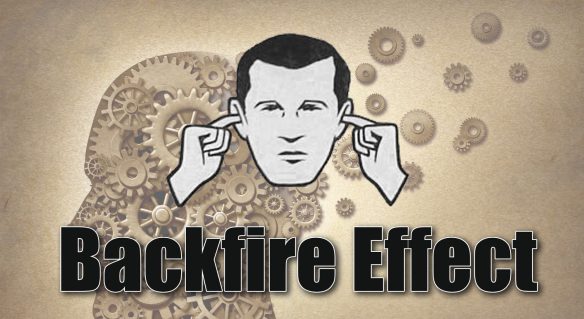
Our brains are wired to find comfort behind that crust. In what’s known as the backfire effect, our minds reject new information that clashes with our belief systems and opinions. As David McRaney, author of the books You Are Not So Smart and You Are Now Less Dumb explains it: “Once something is added to your collection of beliefs, you protect it from harm. You do this instinctively and unconsciously when confronted with attitude-inconsistent information. Just as confirmation bias shields you when you actively seek information, the backfire effect defends you when the information seeks you, when it blindsides you. Coming or going, you stick to your beliefs instead of questioning them. When someone tries to correct you, tries to dilute your misconceptions, it backfires and strengthens those misconceptions instead. Over time, the backfire effect makes you less skeptical of those things that allow you to continue seeing your beliefs and attitudes as true and proper.” In other words, that crust acts as a shield for facts that threaten your beliefs. And you’ve probably seen this in action online. Someone posts something like “climate change isn’t real” so you face palm and proceed to post ample proof that they’re wrong and that in fact, climate change is very real. The problem is that with each fact you post, the crust hardens – for both you AND the other person. Of course, it doesn’t help that you can find just as much if not more bullshit online than you can actual truth but much of it is actually tied to the inherent laziness of our brains. “The more difficult it becomes to process a series of statements, the less credit you give them overall…In experiments where two facts were placed side by side, subjects tended to rate statements as more likely to be true when those statements were presented in simple, legible type than when printed in a weird font with a difficult-to-read color pattern. Similarly, a barrage of counterarguments taking up a full page seems to be less persuasive to a naysayer than a single, simple, powerful statement.”

So does this mean that we should just stop pointing out when someone is wrong? That we should let all kinds of ridiculous notions from lizard people to “homeless people are dangerous” slide? Of course not. Rather, it means that if we want to educate and engage, if we want people to wake the fuck up then we have to consider how the human mind works – and how it doesn’t. Furthermore, our goal shouldn’t be to win an argument as if to suggest that as soon as we win the argument, justice is at hand. Indeed, if your goal is to simply be right, the religious zeal with which you defend your ideas will only turn you into the very monster you are trying to slay. Being right, in other words, is not the point. Progress is not a church. We are not looking for converts. Our aim should always be to engage and empower; to share our knowledge and embrace the knowledge of others. Seek and speak truth – then act on it. And do not think that because you found a nugget of information you hold moral superiority over those who don’t know it. Our minds are just as susceptible to that crust as anyone else’s. We are not special or better. Indeed, we must constantly question our opinions, compare them with facts and new information. By that I mean actual facts, not “alt facts” sourced from a single Google search or indeed even something from a “trusted” publication.

In an interview last March with Robert Scheer of Truthdig, author Joel Whitney discusses the 60 year history of fake news and how it was used in the Cold War era to sew distrust and hatred of all things “commie” and Russian. Major and well-trusted media outlets were a part of the propaganda ring and Whitney notes “that the fearful political atmosphere at the time led to “secrecy being used to preside over and rule over the free press — which we’re supposed to be the champions of.” “They drank the Kool-Aid and thought they were saving freedom,” Scheer agrees. The discussion underscores the need for analysis of Cold War-era media as a way to avoid propagandized journalism today. Scheer says, “I look at the current situation, where we don’t even have a good communist enemy, so we’re inventing Russia as a reborn communist power enemy.” “I call it superpolitics,” Whitney concludes, “where essentially there’s something that’s so evil and so frightening that we have to change how our democratic institutions work.” The latest red scare is but one example of how easy it is to mold minds when you use something like the hatred of Trump as a trigger. Blend some tried and true anti-Russia sentiment in there and you’ve got yourself a brand spanking new enemy – one that allows you to further mold those democratic institutions just as seamlessly as the minds you’ve now crusted and convinced. Russia aside, the same propaganda games go for mass media collusion on everything from fracking to the military industrial complex. For example, leaked email messages show that a writer from the LA times colluded with the CIA not only in terms of getting the CIA’s OK on forthcoming stories but actually offered to write stories for them that would put a positive spin on such issues as drone warfare, saying it would be quote “reassuring to the public” and a “good opportunity” for the CIA. Various other email messages show that the same was true for a list of other media outlets.

All this to say, if I may borrow a phrase: no investigation, no right to speak. Do your own research before you claim to know something. Incidentally this will also help steel you from the rumor mill AND infiltrators. Whether it’s taking someone to task on a rumor or engaging someone in discourse, be vigilant. Be vigilant in your drive, your actions, and be primarily vigilant in your own thinking. Release the flimsy beliefs that would just as soon sink you as keep you afloat. Arm yourself with knowledge and reach out to build and to engage, not to win a Facebook tiff. Consider the goal of engagement and empowerment rather than just being right. Consider the reaction you would have if someone came at you with a barrage of links followed by “read a fucking book, asshole!” You’d more than likely write them off as an unhinged asshole even if their information is solid. Try asking a question or perhaps as Ben Franklin suggested, ask them for a favor, something small that seeds trust, pinging off the human psychology that seeks appreciation and the feel of community. Push past political theory and get down to human connection – to start with. For instance, anarchists in several communities will often engage with would-be white supremacists via the common ground of distrust and disgust in the system. They’ll sit and talk; discuss the pitfalls of a system that’s left them behind and from there grow to a discourse on the roots of their discontent, i.e. not black people. In other words, knock on the door rather than trying to break down the wall. Because that wrought iron shit crust is stronger than steel.

Finally, keep in mind that this won’t always work and nor should it. We have to accept that in our grandiose imaginings of the revolution, many people will either be against us or sitting at home praying we all just shut up. But again, if you’re not looking for converts, if you’re engaging to empower, you’ll not only find more people willing to talk to you, you’ll also more than likely learn something in the process. You might even pick something up that’ll put a dent in your own mental crust.

Time To Make Life Hard For The Rich

By Hamilton Nolan

Source: Splinter

It is time for polite, respectable, rational people to start saying what has become painfully obvious: It is time to stop respecting the rich, and start stealing from them. In earnest.

Inequality is eating America alive. It has been growing for decades. To say that “the American dream is dead” is no longer a poetic exaggeration—it is an accurate description of 40 years of wage stagnation and declining economic mobility that has produced a generation that cannot expect to live better than their parents did. Not because of devastating war or plague, but because of a very specific set of rules governing a very specific economic system that encourages the accumulation of great wealth among a tiny portion of the population, to the detriment of the vast majority of people. Our political and business leaders have chosen to embrace a system that favors capital over labor. A system in which the more you already have, the more you make, and the less you have, the harder it is to build wealth. It is a system designed to increase inequality. It is functioning exactly as designed. And now, it is about to get worse.

How long are people supposed to tolerate being smacked in the face? By the rich? Who already have more than enough? It is not as though the fact that inequality is a crisis is a fact that snuck up on anyone. Economists have seen the trend for decades, and the general public has been well aware of it since at least the financial crisis. Obama called it “the defining challenge of our time.” Thomas Piketty became a rock star by writing a very dry book about it. It’s not an underground thing. It is well known and well understood by the people in control of the institutions with the power to change it. The response to this dire situation by the Republican Party, which a wholly owned subsidiary of the American capital-holding class, has been to pass a tax bill that will horribly exacerbate economic inequality in this country. It is a considered decision to make a bad situation worse. It is a deliberate choice—during a time when the rich already have too much—to take from the poor in order to give the rich (including members of Congress and the President) more. That is not a metaphor. That is the reality. That is what the Republican party is about to accomplish on behalf of the donor class, calling it “middle class tax relief” in the face of mathematical proof to the contrary. Even to my cynical ass, the sheer fuck you-ness of this action towards the majority of the country is breathtaking. This is not just a failure to solve a severe problem; it is the expenditure of vast amounts of political capital to make the severe problem worse so that a tiny handful of people will get wealthier than anyone needs to be.

Ideally, in a democracy, elected leaders reflecting the interests of the people would pass taxes and regulations to reverse the growing inequality here. For that to happen, we would need to end gerrymandering and reform campaign finance and probably abolish the Senate and the Electoral College, and that’s just for starters. It is not imminent, in other words. Our broken political system, which is designed to reward money with political power, is actually moving in the opposite direction of a solution. Who is suffering because of this? Most Americans. Certainly the bottom 50% are acutely suffering—money that would have been in their paychecks has been instead funneled upwards into the pockets of the rich. Every desperate family that has found themselves coming up short for rent or food or medicine, every American who has downgraded her dreams and aspirations because they became financially implausible, has been directly harmed by the political and economic class war perpetuated by the rich, even if they cannot see the perpetrators with their own eyes. I think that people have been more than patient in the face of this slow-moving crisis. In 2009, when the markets crashed and millions were laid off, nobody rioted and kidnapped the financiers and burned their homes. The outcome of that lack of direct action is the situation we find ourselves in today.

Violence against people is morally wrong and a bad way to solve problems. But capital is different. One thing that would help to create the political environment conducive to solving the inequality problem would be to make the cost of accumulating all that capital too high to be worth it. In other words, to create a downside to being too rich. I have personally stood in a room full of hedge fund titans and billionaire investors warning one another explicitly that inequality must be addressed lest the U.S. become a place like Latin America, where rich people are forced to live behind walls, surrounded by armed guards, because of the very real risks from the rage of the poor. Rich people in this country do not want to live like that. If they see that they must stop being so greedy in order to enjoy their own freedom, they will stop being so greedy. Those conditions have to be created by people who want justice.

Our situation is absurd. Not since the Gilded Age has it been more clear that a few people have too much. Furthermore, the people with too much are investing in political clout to give themselves more. It’s just wrong. If the government won’t help, we have to help ourselves. Sticking up a billionaire on the street for $100 is not going to do it. But one can imagine other ways that angry Americans might express their dissatisfaction with our current division of wealth: A large-scale online attack against the holdings of the very rich; yachts sunk in harbors; unoccupied vacation homes in the Hamptons mysteriously burned to the ground. Sotheby’s auctions swarmed by vandals, Art Basel attacked by spraypaint-wielding mobs, protests on the doorsteps of right-wing think tanks, venomous words directed at millionaires as they dine in fancy restaurants. People have a right to life and safety, but property does not. A life spent screwing the little people so that you can acquire lots of stuff loses its allure when you know that all that stuff will be smashed to pieces by angry little people. It is not hard to put together a list of those who should be targeted—Forbes publishes it every year. Likewise, public campaign finance records give us a pretty good idea of exactly who is funding the politicians who are perpetuating this economic war on behalf of the rich.

It is nice to imagine a grand, well-targeted computer hack that would neatly transfer billions of dollars out of the accounts of, say, the Walton family and into a charity account that would disburse the money to the poor in untraceable ways. That seems far-fetched. Realistically, what people can do now is to start thinking about ways to make it uncomfortable to be too rich. Socially uncomfortable and otherwise. When the accumulation of great wealth ceases to be a praiseworthy endeavor and instead becomes viewed as a sick, greedy pastime whose only reward is the hatred of your fellow citizens and the inability to live comfortably without fear of your excessive property being destroyed, rich people will rethink their goals. Until then, inequality will keep rising, and everything, for most people, will continue to slowly, slowly get worse.

The Cost of Resistance


(Museum of the Revolution, León, Nicaragua)

By Chris Hedges

Source: TruthDig

Resistance entails suffering. It requires self-sacrifice. It accepts that we may be destroyed. It is not rational. It is not about the pursuit of happiness. It is about the pursuit of freedom. Resistance accepts that even if we fail, there is an inner freedom that comes with defiance, and perhaps this is the only freedom, and true happiness, we will ever know. To resist evil is the highest achievement of human life. It is the supreme act of love. It is to carry the cross, as the theologian James Cone reminds us, and to be acutely aware that what we are carrying is also what we will die upon.

Most of those who resist—Sitting Bull, Emma Goldman, Malcolm X and Martin Luther King Jr.—are defeated, at least in the cold calculation of the powerful. The final, and perhaps most important quality of resistance, as Cone writes, is that it “inverts the world’s value system.” Hope rises up out of defeat. Those who resist stand, regardless of the cost, with the crucified. This is their magnificence and their power.

The seductive inducements to conformity—money, fame, prizes, generous grants, huge book contracts, hefty lecture fees, important academic and political positions and a public platform—are scorned by those who resist. The rebel does not define success the way the elites define success. Those who resist refuse to kneel before the idols of mass culture and the power elites. They are not trying to get rich. They do not want to be part of the inner circle of the powerful. They accept that when you stand with the oppressed you get treated like the oppressed.

The inversion of the world’s value system makes freedom possible. Those who resist are free not because they have attained many things or high positions, but because they have so few needs. They sever the shackles used to keep most people enslaved. And this is why the elites fear them. The elites can crush them physically, but they cannot buy them off.

The power elites attempt to discredit those who resist. They force them to struggle to make an income. They push them to the margins of society. They write them out of the official narrative. They deny them the symbols of status. They use the compliant liberal class to paint them as unreasonable and utopian.

Resistance is not, fundamentally, political. It is cultural. It is about finding meaning and expression in the transcendent and the incongruities of life. Music, poetry, theater and art sustain resistance by giving expression to the nobility of rebellion against the overwhelming forces, what the ancient Greeks called fortuna, which can never ultimately be overcome. Art celebrates the freedom and dignity of those who defy malignant evil. Victory is not inevitable, or at least not victory as defined by the powerful. Yet in every act of rebellion we are free. It was the raw honesty of the blues, spirituals and work chants that made it possible for African-Americans to endure.

Power is a poison. It does not matter who wields it. The rebel, for this reason, is an eternal heretic. He or she will never fit into any system. The rebel stands with the powerless. There will always be powerless people. There will always be injustice. The rebel will always be an outsider.

Resistance requires eternal vigilance. The moment the powerful are no longer frightened, the moment the glare of the people is diverted and movements let down their guard, the moment the ruling elites are able to use propaganda and censorship to hide their aims, the gains made by resisters roll backward. We have been steadily stripped of everything that organized working men and women—who rose up in defiance and were purged, demonized and killed by the capitalist elites—achieved with the New Deal. The victories of African-Americans, who paid with their bodies and blood in making possible the Great Society and ending legal segregation, also have been reversed.

The corporate state makes no pretense of addressing social inequality or white supremacy. It practices only the politics of vengeance. It uses coercion, fear, violence, police terror and mass incarceration as social control. Our cells of resistance have to be rebuilt from scratch.

The corporate state, however, is in trouble. It has no credibility. All the promises of the “free market,” globalization and trickle-down economics have been exposed as a lie, an empty ideology used to satiate greed. The elites have no counterargument to their anti-capitalist and anti-imperialist critics. The attempt to blame the electoral insurgencies in the United States’ two ruling political parties on Russian interference, rather than massive social inequality—the worst in the industrialized world—is a desperate ploy. The courtiers in the corporate press are working feverishly, day and night, to distract us from reality. The moment the elites are forced to acknowledge social inequality as the root of our discontent is the moment they are forced to acknowledge their role in orchestrating this inequality. This terrifies them.

The U.S. government, subservient to corporate power, has become a burlesque. The last vestiges of the rule of law are evaporating. The kleptocrats are pillaging and looting like barbarian hordes. Programs instituted to protect the common good—public education, welfare and environmental regulations—are being dismantled. The bloated military, sucking the marrow out of the nation, is unassailable. Poverty is a nightmare for half the population. Poor people of color are gunned down with impunity in the streets. Our prison system, the world’s largest, is filled with the destitute. And presiding over the chaos and the dysfunction is a political P.T. Barnum, a president who, while we are being fleeced, offers up one bizarre distraction after another, much like Barnum’s Feejee mermaid—the head and torso of a monkey sewed to the back half of a fish.

There is no shortage of artists, intellectuals and writers, from Martin Buber and George Orwell to James Baldwin, who warned us that this dystopian era was fast approaching. But in our Disneyfied world of intoxicating and endless images, cult of the self and willful illiteracy, we did not listen. We will pay for our negligence.

Søren Kierkegaard argued that it was the separation of intellect from emotion, from empathy, that doomed Western civilization. The “soul” has no role in a technocratic society. The communal has been shattered. The concept of the common good has been obliterated. Greed is celebrated. The individual is a god. The celluloid image is reality. The artistic and intellectual forces that make transcendence and the communal possible are belittled or ignored. The basest lusts are celebrated as forms of identity and self-expression. Progress is defined exclusively by technological and material advancement. This creates a collective despair and anxiety that feeds and is fed by glitter, noise and false promises of consumer-culture idols. The despair grows ever-worse, but we never acknowledge our existential dread. As Kierkegaard understood, “the specific character of despair is precisely this: it is unaware of being despair.”

Those who resist are relentlessly self-critical. They ask the hard questions that mass culture, which promises an unachievable eternal youth, fame and financial success, deflects us from asking. What does it mean to be born? What does it mean to live? What does it mean to die? How do we live a life of meaning? What is justice? What is truth? What is beauty? What does our past say about our present? How do we defy radical evil?

We are in the grip of what Kierkegaard called “sickness unto death”—the numbing of the soul by despair that leads to moral and physical debasement. Those who are ruled by rational abstractions and an aloof intellectualism, Kierkegaard argued, are as depraved as those who succumb to hedonism, cravings for power, violence and predatory sexuality. We achieve salvation when we accept the impediments of the body and the soul, the limitations of being human, yet despite these limitations seek to do good. This burning honesty, which means we always exist on the cusp of despair, leaves us, in Kierkegaard’s words, in “fear and trembling.” We struggle not to be brutes while acknowledging we can never be angels. We must act and then ask for forgiveness. We must be able to see our own face in the face of the oppressor.

The theologian Paul Tillich did not use the word “sin” to mean an act of immorality. He, like Kierkegaard, defined sin as estrangement. For Tillich, it was our deepest existential dilemma. Sin was our separation from the forces that give us ultimate meaning and purpose in life. This separation fosters the alienation, anxiety, meaninglessness and despair that are preyed upon by mass culture. As long as we fold ourselves inward, embrace a perverted hyper-individualism that is defined by selfishness and narcissism, we will never overcome this estrangement. We will be separated from ourselves, from others and from the sacred.

Resistance is not only about battling the forces of darkness. It is about becoming a whole and complete human being. It is about overcoming estrangement. It is about the capacity to love. It is about honoring the sacred. It is about dignity. It is about sacrifice. It is about courage. It is about being free. Resistance is the pinnacle of human existence.