How Real Mind Control Works

By Brandon Smith

Source: Alt-Market.com

When people are confronted with the idea of “mind control” they often think of something out of television or film media; a lone prisoner tortured, chemically dazed and conditioned into a hollow zombie as his captors squeeze information from him or use him to complete a task he would not normally do or morally accept. And while there is actually some truth to this kind of Hollywood depiction, as is evidenced in the exposure of government programs like MK Ultra, the most insidious forms of mind control are far more subtle.

Governments and the elitists behind them do not necessarily need to physically cage, drug and brutalize people in order to influence how they behave. All they need to do is manage their perceptions, expectation and assumptions. This can be accomplished with large portions of the public, rather than one person at a time.

The elites have always been fascinated with the idea of mass hypnotism. In the 18th century Franz Mesmer was famous for entertaining European royalty with displays of what he called “animal magnetism”, which included what we now know as hypnosis of individuals and groups. Mesmerism has since become synonymous with the attempt to befuddle people and dictate their actions while in a kind of trance. Hypnotism is still a very active subject in psychiatric circles and the US government took avid interest in hypnotism as a weapon during their MK Ultra experiments in the 1950s.

People involved in the field of hypnotism are quick to point out that a hypnotized person cannot be made to do something that goes against their code of ethics, but this is not exactly the whole story. A hypnotist makes suggestions that the subject chooses to follow (or refuses to follow) while in a trance state, however, what if they can be convinced (or fooled) through hypnosis into believing that a particular action is in their best interest in spite of their moral code or sense of self preservation?

This type of control over a subject can and has been accomplished in hypnotic therapy, and examples of “covert” hypnotherapy are also on record, including the example of an Ohio divorce attorney that used covert hypnotism against multiple female clients and is suspected of using it against some court employees to disarm their psyches and then rape them without memory of the incident.

About two thirds of any given population are capable of being hypnotized to varying degrees. Stanford University has been avidly searching for a brain pattern that acts as a fingerprint for those that are more prone to hypnotic influence, and they believe they have found certain factors involving areas of the brain that handle heightened focus and attention. Reduced peripheral awareness also helps to increase the subject’s vulnerability to hypnosis and vastly increases suggestibility.

These conditions can in fact be encouraged in large crowds of people. Consider this for a moment – What daily activity is the average person involved in that hyperfocuses their attention on a single point in space for long periods of time and removes almost all of their peripheral awareness? If you said “cell phone use” then you win a chicken dinner. Beyond creating an artificial and constant low dose of dopamine in the human brain leading to addiction, cell phones and other small electronic devices actually create the perfect conditions for a person to be hypnotized as they rip them away from all peripheral awareness and make them highly suggestible to those who know how to use covert methods.

To reiterate, a hypnotic state can be induced in large groups of people for extended periods of time with the correct long term stimulus. Watch here as mentalist Darren Brown hypnotizes or “brainwashes” an entire shopping mall of people into raising their hands exactly when he wants them to without them being aware of why they are doing it. Notice that around two thirds of the crowd complies.

Hypnotic suggestions last as long as the subjects continue to believe that the suggestions are correct. Hypnotism is essentially an agreement between the hypnotist and the persons being hypnotized that a particular belief is true (even if it is not). In the case of a victim of an attack, the person may want to believe that the traumatic event did not happen, and thus they can be convinced through hypnosis to forget it. In the case of a group of people, the hypnotist would have to identify an idea or fear that they all share and WANT to believe is real, and then exploit it.

I think some of the political applications of this are obvious.

The false left/right paradigm is a perfect Petri dish for obtaining or manufacturing the consent of the masses to be hypnotized. They WANT to believe that their team, which they have willingly joined, is the correct team and that the leadership of that team has their best interests at heart. They want to believe that the actions of their party, through legislation or direct means, are always rational and morally sound. And, even when the leaders of their party do things which are completely contrary to the beliefs and morals of the people who make up the party, those people still want to believe that there must be some logical reason behind these decisions that they do not yet grasp.

Beyond this, the threat of the “other party” or team is an ever constant stimulus in the form of fear.  We watch the scripted battles of these two fabricated teams play out in elaborate forms of Kabuki theater, yet nothing ever really changes except that the global elites grow more powerful.  Still, many people actually believe these battles to be real, and invest immense amounts of energy and focus into them as if the fate of the world is being decided within the antics of a political soap opera.

When people are afraid or hyperfocused on an outside threat, they once again become more suggestible. This is why mainstream political discussions focus less on understanding of the threat (the “How” and the “Why”) and more on perpetuating the threat.  With understanding of the enemy (or false enemy), the threat can be assessed and fear is reduced, even if the threat is real. Without understanding, fear only increases. Political powers seek to constantly remind us that threats exist without allowing us the benefit of context.  They do not want us to have an in-depth knowledge of the mechanics behind the threats.

We are told that our system works in a particular way that seems logical, but it only makes sense to us so long as we want to believe that the system functions as we were taught.  We have to have blind faith that what we were initially told was absolutely true.  The question is, why should we?  Isn’t it better to remain skeptical of most things and to study what is handed to us?  If we’re given a strange elixir by an utter stranger and we’re told to “drink up!”, would we not question what’s in the frothing brew and what it does?  Would we not investigate?

In the case of information and proclamations some people would not investigate, because it is more comfortable to believe the lies, or perhaps because they will be rewarded for going along with the status quo.  Only when we become willing to sacrifice comfort, when we stop wanting to accept everything we are told at face value and start questioning the reality that is handed to us, only then will the mass hypnosis we were once influenced by lose its power.

The hypnosis of the elites requires ever increasing forms of distraction and stimulation in order to keep the public entranced. The creation of fear and confusion is vital to the execution of mass mind control, and this is a factor that many people absolutely refuse to recognize or take into consideration. The idea that the elites would build a system only to then deliberately destroy it is just too much for many to fathom. But again, what better way to hyperfocus an entire population and make them malleable to suggestions that they would not normally consider otherwise?

In past articles I have outlined the incredible array of similarities between global elitist groups and the behaviors and character traits of narcissistic sociopaths (also known as narcopaths or psychopaths).  I have even theorized that globalists are actually a highly organized group of narcopaths who recruit other narcopaths into the fold. Many high-level narcopaths are intuitively knowledgeable on the dynamics of suggestibility and the human psyche. I would call this their primary survival trait.

Narcopaths are well known for creating confusion around them in order to gain control of the people in their lives or the people in a room. They are also known for being willing to build up certain routines and acclimating people around them to a particular environment, only to suddenly disrupt it all as a means to stun their victims and create subservience. It is important to realize that these people do NOT necessarily care about stability. In fact, they often will actively sabotage stability to obtain something they care about more – control.

The strategies that individual narcopaths exhibit on a small scale are simply magnified thousands of times when we talk about the behaviors of the global elitists. People who consider themselves rational are hard pressed to comprehend this kind of behavior, but there is a devious tactical logic to it. Mind control of others can be achieved by keeping those people infinitely off-balance. Conjuring moments of tenuous peace, and then striking with cycles of unpredictable crisis. Before we know it, many years of instability have gone by and the organized narcopaths in power have gained even more control.  We wonder where all that time went, and why we were not able to change things? It is because we have been hypnotized into inaction, or the wrong actions in the name of meaningless political stagecraft.

Real mind control and mass hypnosis requires, as already mentioned, our consent, but it is consent that is conned out of us. It is conned out of us by fake leaders with intentions and actions that do not match their promises. It is conned out of us by a system that breeds conformity of thought and tells us that those who think outside the widely accepted norm are aberrant and “crazy”. It is conned out of us by our own weaknesses – our desire to go along to get along, our fear of confronting the crowd and telling them they are wrong, our fear of losing what we think is stability, or our fear of being on our own.

Real mind control is not about torture and force, it is about quietly induced acceptance. We can remove our consent from the hypnotists anytime we wish, but we have to be willing to stop ignoring certain realities. We have to be willing to feel the pain that comes when we recognize we have been conned and controlled in the past, and we have to revel in our ability to refuse to conform. It must become a part of who we are – the people who do not take what we are told at face value. The people that question almost everything. The people who cannot be mesmerized.

The Pathocracy of the Deep State: Tyranny at the Hands of a Psychopathic Government

By John W. Whitehead

Source: The Rutherford Institute

Politicians are more likely than people in the general population to be sociopaths. I think you would find no expert in the field of sociopathy/psychopathy/antisocial personality disorder who would dispute this… That a small minority of human beings literally have no conscience was and is a bitter pill for our society to swallow — but it does explain a great many things, shamelessly deceitful political behavior being one.”—Dr. Martha Stout, clinical psychologist and former instructor at Harvard Medical School

Twenty years ago, a newspaper headline asked the question: “What’s the difference between a politician and a psychopath?

The answer, then and now, remains the same: None.

There is no difference between psychopaths and politicians.

Nor is there much of a difference between the havoc wreaked on innocent lives by uncaring, unfeeling, selfish, irresponsible, parasitic criminals and elected officials who lie to their constituents, trade political favors for campaign contributions, turn a blind eye to the wishes of the electorate, cheat taxpayers out of hard-earned dollars, favor the corporate elite, entrench the military industrial complex, and spare little thought for the impact their thoughtless actions and hastily passed legislation might have on defenseless citizens.

Psychopaths and politicians both have a tendency to be selfish, callous, remorseless users of others, irresponsible, pathological liars, glib, con artists, lacking in remorse and shallow.

Charismatic politicians, like criminal psychopaths, exhibit a failure to accept responsibility for their actions, have a high sense of self-worth, are chronically unstable, have socially deviant lifestyles, need constant stimulation, have parasitic lifestyles and possess unrealistic goals.

It doesn’t matter whether you’re talking about Democrats or Republicans.

Political psychopaths are all largely cut from the same pathological cloth, brimming with seemingly easy charm and boasting calculating minds. Such leaders eventually create pathocracies: totalitarian societies bent on power, control, and destruction of both freedom in general and those who exercise their freedoms.

Once psychopaths gain power, the result is usually some form of totalitarian government or a pathocracy. “At that point, the government operates against the interests of its own people except for favoring certain groups,” author James G. Long notes. “We are currently witnessing deliberate polarizations of American citizens, illegal actions, and massive and needless acquisition of debt. This is typical of psychopathic systems, and very similar things happened in the Soviet Union as it overextended and collapsed.”

In other words, electing a psychopath to public office is tantamount to national hara-kiri, the ritualized act of self-annihilation, self-destruction and suicide. It signals the demise of democratic government and lays the groundwork for a totalitarian regime that is legalistic, militaristic, inflexible, intolerant and inhuman.

Incredibly, despite clear evidence of the damage that has already been inflicted on our nation and its citizens by a psychopathic government, voters continue to elect psychopaths to positions of power and influence.

According to investigative journalist Zack Beauchamp, “In 2012, a group of psychologists evaluated every President from Washington to Bush II using ‘psychopathy trait estimates derived from personality data completed by historical experts on each president.’ They found that presidents tended to have the psychopath’s characteristic fearlessness and low anxiety levels — traits that appear to help Presidents, but also might cause them to make reckless decisions that hurt other people’s lives.”

The willingness to prioritize power above all else, including the welfare of their fellow human beings, ruthlessness, callousness and an utter lack of conscience are among the defining traits of the sociopath.

When our own government no longer sees us as human beings with dignity and worth but as things to be manipulated, maneuvered, mined for data, manhandled by police, conned into believing it has our best interests at heart, mistreated, jailed if we dare step out of line, and then punished unjustly without remorse—all the while refusing to own up to its failings—we are no longer operating under a constitutional republic.

Instead, what we are experiencing is a pathocracy: tyranny at the hands of a psychopathic government, which “operates against the interests of its own people except for favoring certain groups.”

Worse, psychopathology is not confined to those in high positions of government. It can spread like a virus among the populace. As an academic study into pathocracy concluded, “[T]yranny does not flourish because perpetuators are helpless and ignorant of their actions. It flourishes because they actively identify with those who promote vicious acts as virtuous.”

People don’t simply line up and salute. It is through one’s own personal identification with a given leader, party or social order that they become agents of good or evil.

Much depends on how leaders “cultivate a sense of identification with their followers,” says Professor Alex Haslam. “I mean one pretty obvious thing is that leaders talk about ‘we’ rather than ‘I,’ and actually what leadership is about is cultivating this sense of shared identity about ‘we-ness’ and then getting people to want to act in terms of that ‘we-ness,’ to promote our collective interests. . . . [We] is the single word that has increased in the inaugural addresses over the last century . . . and the other one is ‘America.’”

The goal of the modern corporate state is obvious: to promote, cultivate, and embed a sense of shared identification among its citizens. To this end, “we the people” have become “we the police state.”

We are fast becoming slaves in thrall to a faceless, nameless, bureaucratic totalitarian government machine that relentlessly erodes our freedoms through countless laws, statutes, and prohibitions.

Any resistance to such regimes depends on the strength of opinions in the minds of those who choose to fight back. What this means is that we the citizenry must be very careful that we are not manipulated into marching in lockstep with an oppressive regime.

Writing for ThinkProgress, Beauchamp suggests that “one of the best cures to bad leaders may very well be political democracy.”

But what does this really mean in practical terms?

It means holding politicians accountable for their actions and the actions of their staff using every available means at our disposal: through investigative journalism (what used to be referred to as the Fourth Estate) that enlightens and informs, through whistleblower complaints that expose corruption, through lawsuits that challenge misconduct, and through protests and mass political action that remind the powers-that-be that “we the people” are the ones that call the shots.

Remember, education precedes action. Citizens need to the do the hard work of educating themselves about what the government is doing and how to hold it accountable. Don’t allow yourselves to exist exclusively in an echo chamber that is restricted to views with which you agree. Expose yourself to multiple media sources, independent and mainstream, and think for yourself.

For that matter, no matter what your political leanings might be, don’t allow your partisan bias to trump the principles that serve as the basis for our constitutional republic. As Beauchamp notes, “A system that actually holds people accountable to the broader conscience of society may be one of the best ways to keep conscienceless people in check.”

That said, if we allow the ballot box to become our only means of pushing back against the police state, the battle is already lost.

Resistance will require a citizenry willing to be active at the local level.

Yet as I point out in my book Battlefield America: The War on the American People, if you wait to act until the SWAT team is crashing through your door, until your name is placed on a terror watch list, until you are reported for such outlawed activities as collecting rainwater or letting your children play outside unsupervised, then it will be too late.

This much I know: we are not faceless numbers. We are not cogs in the machine. We are not slaves.

We are human beings, and for the moment, we have the opportunity to remain free—that is, if we tirelessly advocate for our rights and resist at every turn attempts by the government to place us in chains.

The Founders understood that our freedoms do not flow from the government. They were not given to us only to be taken away by the will of the State. They are inherently ours. In the same way, the government’s appointed purpose is not to threaten or undermine our freedoms, but to safeguard them.

Until we can get back to this way of thinking, until we can remind our fellow Americans what it really means to be free, and until we can stand firm in the face of threats to our freedoms, we will continue to be treated like slaves in thrall to a bureaucratic police state run by political psychopaths.

Is the U.S. Becoming a Third World Nation?

By Charles Hugh Smith

Source: Of Two Minds

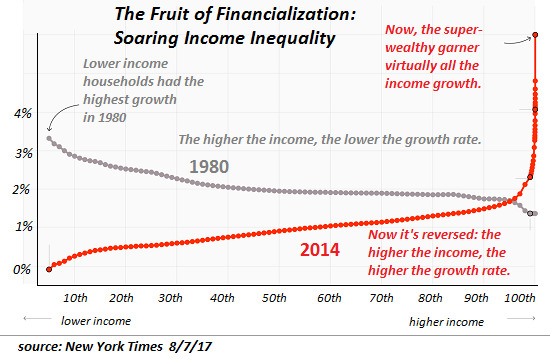
This is a chart of an informal kleptocracy which cloaks itself in the faux finery of democracy and a (rigged) “market” economy.

Back in the day, nations that didn’t qualify as either developed (First World) or developing (Second World) were by default Third World, impoverished, corrupt and what we now refer to as failed states–governments that were incapable of improving the lives of their people and the machinery of governance, generally as a result of corruption and self-serving elites, i.e. kleptocracies.

Is the U.S. slipping into Third World status? While many scoff at the very question, others citing the rise of homelessness, entrenched pockets of abject poverty and the decaying state of infrastructure might nod “yes.”

These are not uniquely Third World problems, they’re symptoms of a status quo that’s fast losing First World capabilities. What characterizes Third World/Failing States isn’t just poverty, crumbling infrastructure and endemic corruption; at a systems level these are the key dynamics in Third World/Failing States:

1. The status quo protects insiders at the expense of everyone else.

2. There is no real accountability; failure has no consequences, bureaucrats are never fired for incompetence, reforms are watered down or neutered by institutional sclerosis.

3. Pay-to-play is the most cost-effective way to influence policy or evade consequences.

4. The status quo is incapable of differentiating between complexity that serves the legitimate purposes of transparency and accountability and complexity that serves no purpose beyond guaranteeing insiders’ paper-shuffling jobs. As a consequence, complexity that adds no value chokes the economy and the government.

5. There are two sets of laws: one for insiders and the super-wealthy, and another harsher set for everyone else.

6. The super-wealthy fear nothing because the system functions to serve their interests.

7. The super-wealthy and state insiders control the media’s narratives and the machinery of governance to serve their interests. Reforms are in name only; the faces of elected officials change but nothing changes structurally.

8. Insiders, well-paid pundits and the technocrats serving the corporate and state elites believe the status quo is just fine because they’re doing fine; they are blind to the soaring inequality, systemic corruption, stupendous waste and the impossibility of real reform.

Does America’s status quo protect insiders at the expense of everyone else? Yes. As for the other seven characteristics: yes, yes, yes, yes, yes, yes and yes.

And lets’ not forget #9: the vast majority of the economic gains flow to the elite at the very top of the wealth-power pyramid: is this true in the U.S.? Definitively yes. Just look at this chart: this is a chart of an informal kleptocracy which cloaks itself in the faux finery of democracy and a (rigged) “market” economy.

That’s the very definition of a Third World failed state.

Related Video:

Agents of Empire

By Michael Krieger

Source: Liberty Blitzkrieg

The corporate revolution will collapse if we refuse to buy what they are selling – their ideas, their version of history, their wars, their weapons, their notion of inevitability.

– Arundhati Roy

Last week, Hillary Clinton called Tulsi Gabbard (and Jill Stein) Russian assets on a podcast. More specifically:

“I’m not making any predictions, but I think they’ve got their eye on someone who’s currently in the Democratic primary and are grooming her to be the third-party candidate. She’s the favorite of the Russians,” said Clinton, apparently referring to Rep. Gabbard, who’s been accused of receiving support from Russian bots and the Russian news media. “They have a bunch of sites and bots and other ways of supporting her so far.” She added: “That’s assuming Jill Stein will give it up, which she might not because she’s also a Russian asset. Yeah, she’s a Russian asset—I mean, totally. They know they can’t win without a third-party candidate. So I don’t know who it’s going to be, but I will guarantee you they will have a vigorous third-party challenge in the key states that they most needed.”

Tulsi subsequently responded to this slanderous accusation with a series of devastating blows.

Her tweets set off a firestorm, and even if you’re as disillusioned by presidential politics as myself, you couldn’t help but cheer wildly that someone with a major political platform finally stated without any hint of fear or hesitation exactly what so many Americans across the ideological spectrum feel.

Of course, this has far wider implications than a high profile feud between these two. The “let’s blame Russia for Hillary’s loss” epidemic of calculated stupidity driven by Ellen-Democrats and their mouthpieces across corporate mass media began immediately after the election. I know about it on a personal level because this website was an early target of the neoliberal-led new McCarthyism courtesy of a ridiculous and libelous smear in the Washington Post over Thanksgiving weekend 2016 (see: Liberty Blitzkrieg Included on Washington Post Highlighted Hit List of “Russian Propaganda” Websites).

This is when it became clear it wasn’t just political operatives pushing fake news about Russian influence, but that “respected” mass media would be leading the charge for them. The rest is pretty much history. MSNBC, CNN, The Washington Post, etc have been spewing outlandish Russiagate nonsense for three years straight, and despite the complete failure of special counsel Robert Mueller to find any evidence of Trump-Russia collusion, these agents of empire refuse to stop. The whole charade seems more akin to an intelligence operation than journalism, which shouldn’t be surprising given the proliferation of former intelligence agents throughout mass media in the Trump era.

Here’s a small sampling via Politico’s 2018 article: The Spies Who Came in to the TV Studio

Former CIA Director John Brennan (2013-17) is the latest superspook to be reborn as a TV newsie. He just cashed in at NBC News as a “senior national security and intelligence analyst” and served his first expert views on last Sunday’s edition of Meet the Press. The Brennan acquisition seeks to elevate NBC to spook parity with CNN, which employs former Director of National Intelligence James Clapper and former CIA Director Michael Hayden in a similar capacity. Other, lesser-known national security veterans thrive under TV’s grow lights. Almost too numerous to list, they include Chuck Rosenberg, former acting DEA administrator, chief of staff for FBI Director James B. Comey, and counselor to former FBI Director Robert S. Mueller III; Frank Figliuzzi, former chief of FBI counterintelligence; Juan Zarate, deputy national security adviser under Bush, at NBC; and Fran Townsend, homeland security adviser under Bush, at CBS News. CNN’s bulging roster also includes former FBI agent Asha Rangappa; former FBI agent James Gagliano; Obama’s former deputy national security adviser Tony Blinken; former House Intelligence Committee Chairman Mike Rogers; senior adviser to the National Security Council during the Obama administration Samantha Vinograd; retired CIA operations officer Steven L. Hall; and Philip Mudd, also retired from the CIA.

Americans like to sneer at more transparently unfree societies around the world, but when you think about the disturbing implications of former spooks delivering news to the public, one can’t help but conclude that mass media in 2019 looks like a gigantic propaganda campaign targeting U.S. citizens. Moreover, as can be seen by the recent attacks by Clinton and her allies in the media on Gabbard, they aren’t easing up.

Which brings us to the crux of the issue. Why are they doing this? Why is Clinton, with zero evidence whatsoever, falsely calling a sitting U.S. Congresswoman, a veteran with two tours in Iraq, and someone polling at only 2% in the Democratic primary a “Russian asset.” Why are they so afraid of Tulsi Gabbard?

It’s partly personal. Tulsi was one of only a handful of congressional Democrats to set aside fears of the Clintons and their mafia-like network to endorse Bernie Sanders early in 2016. In fact, she stepped down from her position as vice-chairman of the Democratic National Committee to do so. This is the sort of thing a petty narcissist like Hillary Clinton could never forgive, but it goes further.

Tulsi’s mere presence on stage during recent debates has proven devastating for the Ellen Degeneres wing of the Democratic party. She effectively ended neoliberal darling Kamala Harris’ chances by simply telling the truth about her horrible record, something no one else in the race had the guts to do.

In other words, Tulsi demolished Kamala Harris and put an end to her primary chances by simply telling the truth about her on national television. This is how powerful the truth can be when somebody’s actually willing to stand up and say it. It’s why the agents of empire — in charge of virtually all major institutions — go out of their way to ensure the American public is exposed to as little truth as possible. It’s also why they lie and scream “Russia” instead of debating the actual issues.

But this goes well beyond Tulsi Gabbard. Empire requires constant meddling abroad as well as periodic regime change wars to ensure compliant puppets are firmly in control of any country with any geopolitical significance. The 21st century has been littered with a series of disastrous U.S. interventions abroad, while the country back home continues to descend deeper into a neo-feudal oligarchy with a hunger games style economy. As such, an increasing number of Americans have begun to question the entire premise of imperial foreign policy.

To the agents of empire, dominant throughout mainstream politics, mega corporations, think-tanks and of course mass media, this sort of thought crime is entirely unacceptable. In case you haven’t noticed, empire is a third-rail of U.S. politics. If you dare touch the issue, you’ll be ruthlessly smeared, without any evidence, as a Russian agent or asset. There’s nothing logical about this, but then again there typically isn’t much logic when it comes to psychological operations. They depend on manipulation and triggering specific emotional responses.

There’s a reason people like Hillary Clinton and her minions just yell “Russia” whenever an individual with a platform criticizes empire and endless war. They know they can’t win an argument if they debate the actual issues, so a conscious choice was made to simply avoid debate entirely. As such, they’ve decided to craft and spread a disingenuous narrative in which anyone critical of establishment neocon/neoliberal foreign policy is a Russia asset/agent/bot. This is literally all they’ve got. These people are telling you 2+2=5 and if you don’t accept it, you’re a traitorous, Putin-loving nazi with a pee pee tape. And these same people call themselves “liberal.”

Importantly, it isn’t just a few trollish kooks doing this. It’s being spread by some of the most powerful people and institutions in the country, including of course mass media.

For example:

https://twitter.com/ibrahimpols/status/1185571046738579456

This inane verbal vomit is considered “liberal” news in modern America, a word which has now lost all meaning. Above, we witness a collection of television mannequins questioning the loyalty of a U.S. veteran who continues to serve in both Congress and the national guard simply because she dared call out America’s perpetually failing foreign policy establishment.

To conclude, it’s now clear dissent is only permitted so long as it doesn’t become too popular. By polling at 2% in the primary, it appears Gabbard became too popular, but the truth is she’s just a vessel. What’s really got the agents of empire concerned is we may be on the verge of a tipping point within the broader U.S. population regarding regime change wars and empire. This is why debate needs to be shut down and shut down now. A critical mass of citizens openly questioning establishment foreign policy cannot be permitted. Those on the fence need to be bullied and manipulated into thinking dissent is equivalent to being a traitor. The national security state doesn’t want the public to even think about such topics, let alone debate them.

Ultimately, if you give up your capacity for reason, for free-thought and for the courage to say what you think about issues of national significance, you’ve lost everything. This is what these manipulators want you to do. They want you to shut-up, to listen to the “experts” who destroy everything they touch, and to be a compliant subject as opposed to an active, empowered citizen. The answer to such a tactic is to be more bold, more informed and more ethical. They fear truth and empowered individuals more than anything else. Stand up tall and speak your mind. Pandering to bullies never works.

How To Defeat The Empire

By Caitlin Johnstone

Source: CaitlinJohnstone.com

One of the biggest and most consistent challenges of my young career so far has been finding ways to talk about solutions to our predicament in a way that people will truly hear. I talk about these solutions constantly, and some readers definitely get it, but others will see me going on and on about a grassroots revolution against the establishment narrative control machine and then say “Okay, but what do we do?” or “You talk about problems but never offer any solutions!”

Part of the difficulty is that I don’t talk much about the old attempts at solutions we’ve already tried that people have been conditioned to listen for. I don’t endorse politicians, I don’t advocate starting a new political party, I don’t support violent revolution, I don’t say that capitalism contains the seeds of its own destruction and the proletariat will inevitably rise up against the bourgeoisie, and in general I don’t put much stock in the idea that our political systems are in and of themselves sufficient for addressing our biggest problems in any meaningful way.

What I do advocate, over and over and over again in as many different ways as I can come up with, is a decentralized guerrilla psywar against the institutions which enable the powerful to manipulate the way ordinary people think, act and vote.

I talk about narrative and propaganda all the time because they are the root of all our problems. As long as the plutocrat-controlled media are able to manufacture consent for the status quo upon which those plutocrats built their respective empires, there will never be the possibility of a successful revolution. People will never rebel against a system while they’re being successfully propagandized not to. It will never, ever happen.

Most people who want drastic systematic changes to the way power operates in our society utterly fail to take this into account. Most of them are aware to some extent that establishment propaganda is happening, but they fail to fully appreciate its effects, its power, and the fact that it’s continually getting more and more sophisticated. They continue to talk about the need for a particular political movement, for this or that new government policy, or even for a full-fledged revolution, without ever turning and squarely focusing on the elephant in the room that none of these things will ever happen as long as most people are successfully propagandized into being uninterested in making them happen.

It’s like trying to light a fire without first finding a solution to the problem that you’re standing under pouring rain. Certainly we can all agree that a fire is sorely needed because it’s cold and wet and miserable out here, but we’re never going to get one going while the kindling is getting soaked and we can’t even get a match lit. The first order of business must necessarily be to find a way to protect our fire-starting area from the downpour of establishment propaganda.

A decentralized guerrilla psywar against the propaganda machine is the best solution to this problem.

By psywar I mean a grassroots psychological war against the establishment propaganda machine with the goal of weakening public trust in pro-empire narratives. People only believe sources of information that they trust, and propaganda cannot operate without belief. Right now trust in the mass media is at an all-time low while our ability to network and share information is at an all-time high. Our psywar is fought with the goal of using our unprecedented ability to circulate information to continue to kill public trust in the mass media, not with lies and propaganda, but with truth. If we can expose journalistic malpractice and the glaring plot holes in establishment narratives about things like war, Julian Assange, Russia etc, we will make the mass media look less trustworthy.

By decentralized I mean we should each take responsibility for weakening public trust in the propaganda machine in our own way, rather than depending on centralized groups and organizations. The more centralized an operation is, the easier it is for establishment manipulators to infiltrate and undermine it. This doesn’t mean that organizing is bad, it just means a successful grassroots psywar won’t depend on it. If we’re each watching for opportunities to weaken public trust in the official narrative makers on our own personal time and in our own unique way using videos, blogs, tweets, art, paper literature, conversations and demonstrations, we’ll be far more effective.

By guerrilla I mean constantly attacking different fronts in different ways, never staying with the same line of attack for long enough to allow the propagandists to develop a counter-narrative. If they build up particularly strong armor around one area, put it aside and expose their lies on an entirely different front. The propagandists are lying constantly, so there is never any shortage of soft targets. The only consistency should be in attacking the propaganda machine as visibly as possible.

As far as how to go about that attack, my best answer is that I’m leading by example here. I’m only ever doing the thing that I advocate, so if you want to know what I think we should all do, just watch what I do. I’m only ever using my own unique set of skills, knowledge and assets to attack the narrative control engine at whatever points I perceive to be the most vulnerable on a given day.

So do what I do, but keep in mind that each individual must sort out the particulars for themselves. We’ve each got our own strengths and abilities that we bring to the psywar: some of us are funny, some are artistic, some are really good at putting together information and presenting it in a particular format, some are good at finding and boosting other people’s high-quality attacks. Everyone brings something to the table. The important thing is to do whatever will draw the most public interest and attention to what you’re doing. Don’t shy away from speaking loud and shining bright.

It isn’t necessary to come up with your own complete How It Is narrative of exactly what is happening in our world right now; with the current degree of disinformation and government opacity that’s too difficult to do with any degree of completion anyway. All you need to do is wake people up in as many ways as possible to the fact that they’re being manipulated and deceived. Every newly opened pair of eyes makes a difference, and anything you can do to help facilitate that is energy well spent.

Without an effective propaganda machine, the empire cannot rule. Once we’ve crippled public trust in that machine, we’ll exist in a very different world already, and the next step will present itself from there. Until then, the attack on establishment propaganda should be our foremost priority.

Slow-Motion US/UK Killing of Julian Assange

By Stephen Lendmen

Source: StephenLendmen.org

Establishment media are in cahoots with US/UK ruling regimes against Assange for the “crime” of truth-telling journalism abhorred in the West — totalitarian rule where these societies are heading.

In mid-October, UN special rapporteur on torture Nils Melzer denounced Assange’s judicial lynching and egregious mistreatment, saying the following:

“What has the man done? He has disclosed an enormous amount of information that governments want to remain secret, most infamously the ‘Collateral Murder’ video, which, in my view, is evidence for war crimes.”

“What is the scandal in this case is that everyone focuses on Julian Assange. Here is someone who exposes evidence for war crimes, including torture and murder, and he is under this constant pressure.”

“I am absolutely convinced he will not receive a fair trial in Virginia, and he will remain in prison under inhumane conditions for the rest of his life.”

Tulsi Gabbard is the only US presidential aspirant expressing support for journalist Assange, as well as whistleblowers Chelsea Manning, Edward Snowden, and others like them, opposing their “prosecution like criminals.”

If elected president, she’d drop charges against them, she said, calling for greater “protect(ion) (of) our civil liberties,” adding:

Assange’s arrest in Britain “poses a great threat to our freedom of the press and to our freedom of speech” — the same true about how Chelsea Manning, Snowden, and other whistleblowers are mistreated.

What happened to them “could happen to you. It could happen to any of us,” she stressed.

Bipartisan politicians in the US and UK, along with establishment media, refuse to support Assange’s struggle for justice.

On Monday, he appeared in London’s Westminster Magistrates Court. Showing the effects of egregious mistreatment since unlawfully dragged from the city’s Ecuadorian embassy and imprisoned under harsh conditions, he was too physically and emotionally shattered to participate in his defense.

He’s an investigative journalist/whistleblower, publishing material supplied by sources believed to be credible, unidentified for their protection.

WikiLeaks is not an intelligence operation. Nor it it connected to Russia or any other country. Claims otherwise are fabricated.

Assange earlier explained that WikiLeaks has the right “to publish newsworthy content. Consistent with the US Constitution, we publish material that we can confirm to be true,” he stressed.

US charges against him are fabricated and malicious, what no legitimate tribunal would accept.

Justice Department lawyer James Lewis falsely accused him of “spying,” lied saying he’s “not a journalist,” turned truth on its head claiming his actions were “criminal in both the US and UK” — the above Big Lies how all fascist police states operate.

Assange attorney Mark Summers called for dismissal of Washington’s illegitimate extradition request, saying:

According to the 2003 UK/US extradition treaty, it “shall not be granted if the offense for which extradition is requested is a political offense,” adding:

The unjustifiable persecution of Assange and Chelsea Manning is “part of an avowed war on whistleblowers to include investigative journalists and publishers.”

Summers requested a three-month delay of Assange’s February 25 extradition hearing because “we need more time” to prepare a proper defense, given the “enormity” of issues involved, requiring “evidence gathering that would test most lawyers.”

Operating as an imperial tool, judge Vanessa Baraitser denied the request, saying the extradition hearing will proceed as schedule on February 25 at Woolwich Magistrates Court near Belmarsh Prison.

Its public gallery has three seats, assuring Assange’s judicial lynching will be virtually closed to public scrutiny.

Barely able to stand and speak after months of barbaric mistreatment, when asked if there’s “anything (he) would like to say, he replied barely audibly that he doesn’t “understand how this is equitable,” adding:

Imperial USA “had 10 years to prepare (its judicial lynching). I can’t remember anything. I can’t access any of my written work.”

“It’s very difficult to do anything with such limited resources against a superpower intent on” an illegitimate crucifixion. “I can’t think properly” from the barbaric ordeal he’s endured.

Baraitser dismissively replied that “conditions of your detainment are not the subject of this court.”

Following the hearing, WikiLeaks editor-in-chief Kristinn Hrafnsson called for the case against Assange to “be thrown out immediately,” adding:

“Not only is it illegal on the face of the (extradition) treaty, the US has conducted illegal operations against Assange and his lawyers which are the subject of a major investigation in Spain.”

John Pilger witnessed Monday’s spectacle, saying “(t)he whole thing is a grotesque absurdity. There is an extradition law between this country and the United States.”

“It states specifically that someone cannot be extradited if the offenses are political.”

“The source of this is a rogue (US) state — a state that ignores its own laws and international laws and the laws of this country.”

Summers called Assange’s crucifixion “a political attempt to signal to journalists the consequences of publishing information” ruling regimes want suppressed.

“It’s legally unprecedented…part of an avowed war on (truth-telling) whistleblowers to include investigative journalists and publishers.”

In cahoots with the Trump regime, police state Britain is killing Assange slowly, wanting him, whistleblowers like Chelsea Manning, and other truth-tellers silenced.

What’s going on is the hallmark of totalitarian rule – controlling the message, eliminating what conflicts with it, notably on major geopolitical issues.

Losing the right of free expression endangers all others. When truth-telling and dissent are considered threats to national security, free and open societies no longer exist – the slippery slope America and other Western societies are heading on.

Sandy Hook and the Murder of the First Amendment

By Kurt Nimmo

Source: Another Day in the Empire

Let me begin by saying I have no idea what happened at Sandy Hook Elementary School on December 14, 2012.

However, since 9/11, I have questioned the veracity of many news reports and claims issued by officialdom about terrorism and mass shootings. The government and its media have been caught hundreds of times lying about or twisting news stories, so I believe skepticism is entirely warranted.

That said, I am now convinced the First Amendment is a dead letter. I have felt that way for some time. Recent events put a capstone on my previous arguments that much of the Bill of Rights is dead. This was recently underscored by the persecution of activist and author Jim Fetzer for writing a book that claims the massacre at Sandy Hook never happened.

On Thursday, Rolling Stone reported:

A Wisconsin jury has ruled that James Fetzer, a retired professor from the University of Minnesota Duluth, must pay [Leonard] Pozner $450,000 for accusing him of forging his son Noah’s death certificate. Fetzer is the coauthor of Nobody Died at Sandy Hook, which alleges that Pozner faked his son’s birth certificate and that the Obama administration staged the shooting in an effort to pass legislation on gun control.

The ruling and “award” granted to the plaintiff will undoubtedly drive Fetzer to financial ruin if it is not overturned on appeal—and I predict it will stand. This court case is a pivotal moment for those who work to eradicate free speech, a right granted to those who make controversial statements or write books some people find objectionable.

From Digital Media Law:

The right to speak guaranteed by the First Amendment to the U.S. Constitution includes the right to voice opinions, criticize others, and comment on matters of public interest. It also protects the use of hyperbole and extreme statements when it is clear these are rhetorical ploys. Accordingly, you can safely state your opinion that others are inept, stupid, jerks, failures, etc. even though these statements might hurt the subject’s feelings or diminish their reputations. Such terms represent what is called “pure opinions” because they can’t be proven true or false. As a result, they cannot form the basis for a defamation claim.

It is Fetzer’s opinion Pozner lied about the death of his son and falsified his death certificate. The incident has a number of unanswered questions, including Facebook posts about the shooting that appeared the day before the event. The corporate media narrative on the shooting was changed several times. Military experts claimed it would have been impossible for a skinny 19-year old Adam Lanza to have shot so many people in such a short period of time.

If the government really wanted to put the entire case to rest and dispel what it calls malicious conspiracy theories, it would explain why, as Dr. Wayne Carver, the medical examiner overseeing the case, said during a news conference parents were not allowed to identify their murdered children. They were shown photographs instead. This is highly unusual and suspicious.

I’m not saying Lanza isn’t responsible. I’m saying there are numerous unanswered questions swept neatly into the memory hole by the government and its media. In short, the government is responsible for engendering conspiracy theories by not resolving key issues in this case and many others.

Getting to the bottom of Sandy Hook, however, is not the point here. The point is: as a citizen born with inalienable natural rights including speech, you will not be permitted to propose theories on certain topics the state has demarcated as off-limits and punishable if a “tinfoil hate conspiracy theorist” deviates from official narratives, many which are lies designed to emotionally manipulate people and gain consensus under false pretense to further degrade your right to speak and write on crucial issues.

The Fetzer trial is a big win for the ruling elite. For years now, it has worked tirelessly to characterize investigative journalism outside limits imposed by the government as criminal—and now, according to the FBI, as terrorism.

Jim Fetzer and Alex Jones are the first to be subjected to Soviet-like show trials for the crime of disagreeing with the state. More will follow in due course.

How to Avert a Digital Dystopia

By Jumana Abu-Ghazaleh

Source: OneZero

“What I find [ominous] is how seldom, today, we see the phrase ‘the 22nd century.’ Almost never. Compare this with the frequency with which the 21st century was evoked in popular culture during, say, the 1920s.”

—William Gibson, famed science-fiction author, in an interview on dystopian fiction.

The 2010s are almost over. And it doesn’t quite feel right.

When the end of 2009 came into view, the end of the 2000s felt like a relatively innocuous milestone. The current moment feels so much more, what’s the word?

Ah, yes: dystopian.

Looking back, “dystopia” might have been the watchword of the 2010s. Black Mirror debuted close to the beginning of the decade, and early in its run, it was sometimes critiqued for how over-the-top it all felt. Now, at the end of the decade, it’s regularly critiqued as made obsolete by reality.

And it’s not just prestige TV like Black Mirror reflecting the decade’s mood of incipient collapse. Of the 2010s top 10 highest-grossing films, by my count at least half involve an apocalypse either narrowly averted or, in fact, taking place (I’m looking at you, Avengers movies).

People have reasons to wallow. I get it. The existential threat of climate change alone — and seeing efforts to mitigate it slow down precisely as it becomes more pressing — could fuel whole libraries of dystopian fiction.

Meanwhile, our current tech landscape — the monopolies, the wild spread of disinformation, the sense that your most private data could go public whenever, with no recourse, all the things that risk making Black Mirror feel quaint — truly feels dystopian.

We enjoy watching distant, imaginary dystopias because they distract us from oncoming, real dystopias.

Since no one in a position to actually do something about our dystopian reality seems to be admitting it — no business leaders, politicians or legacy media — it makes sense that you might get catharsis of acknowledgment from pop culture instead. And yet, the most popular end-of-the-world fiction isn’t about actual imminent threats from climate or tech. It’s about Thanos coming to snap half of life out of existence. Or Voldemort threatening to destroy us Muggles.

Maybe that kind of pop culture, which acknowledges dystopia but not the actual threats we currently face, gives us a feeling of control: Sure, Equifax could leak my social security number and face zero consequences, but there are no Hunger Games. Wow — it really could be so much worse! Maybe we enjoy watching distant, imaginary dystopias because they distract us from oncoming, real dystopias.

But let’s look at those actual potential dystopias for a moment and think about what we need to do to avert them.

I’d suggest the big four U.S. tech giants — Amazon, Facebook, Apple, Google — each have a distinct possible dystopia associated with them. If we don’t turn around our current reality, we will likely get all four — after all, for all the antagonistic rhetoric among the giants, they are rather co-dependent. Let’s look at what we might have, ahem, look forward to — unless we demand the tech giants deliver on the utopia they purportedly set out to achieve when their respective founders raised their rounds of millions. I would argue not only that we can, but that we must hold them accountable.

“Mad Max,” or, slowly then all at once: starring Apple

“‘How did you go bankrupt?’ Bill asked. ‘Two ways,’ Mike said. ‘Gradually and then suddenly.’”

—Ernest Hemingway, The Sun Also Rises.

When you think of Mad Max, you probably think of an irradiated, post-apocalyptic desert hellscape. You’re also not thinking of Mad Max.

In the original 1979 film, the apocalypse hasn’t quite yet happened. There’s been a substantial social breakdown, but things are getting worse in slow motion. There are still functioning towns. Our protagonist, Max, is a working-class cop; and while there’s reason to believe a big crash is coming, or has even begun, society is still hanging on. (It’s only in the sequels that we’re well into the post-apocalyptic landscape people are thinking of when they say “Mad Max.”)

A relatively subtle dystopia, where things gradually decline in the background, is also a good day-to-day description of a society overrun by algorithms, even without the attention-grabbing mega-scandals of a Cambridge Analytica or massive data breach. A kind of dystopia “light” — and Apple is its poster child.

After all, Apple has a genuinely better track record than some of the other tech giants on a few key privacy issues. But it’s also genuinely aware of the value of promulgating that vision of itself — and that can lead Apple users into danger.

In January, Apple purchased a multistory billboard outside the Consumer Electronics Show in Las Vegas, with this message: “What happens on your iPhone, stays on your iPhone.” Sounds great — but it’s deeply misleading, and as journalist Mark Wilson noted, Apple’s mismatch between rhetoric and behavior fuels the nightmare that is our current data security crisis:

“[iPhone] contents are encrypted by default […] But that doesn’t stop the 2 million or so apps in the App Store from spying on iPhone users and selling details of their private lives. “Tens of millions of people have data taken from them — and they don’t have the slightest clue,” says [the] founder of [the] cybersecurity firm Guardian […] The Wall Street Journal studied 70 iOS apps […] and found several that were delivering deeply private information, including heart rate and fertility data, to Facebook.” [Emphasis mine.]

A tech giant that is claiming it’s the path to salvation, while effectively creating a trap for those who believe it, sounds ironically familiar given Apple’s famous evocation of Big Brother.

After all, when people talk about habit-forming technology in terms so terrifying they’ve convinced Silicon Valley executives to limit their children’s access to their own products, let’s be real: They’re talking about iPhones.

When academic child psychology researcher Jean Twenge talks about a possible teenage mental health epidemic fueled by social media, we know what’s at the heart of it: She’s talking about iPhones.

All those aforementioned horror stories, and a huge slice of those algorithms you’ve heard so much about, are likely first reaching you on smartphones that, with world market share above 50%, are largely, you guessed it, iPhones. (And none of these stories even mention Apple workers at overseas at facilities like Foxconn who create our iPhones and who really are living in a kind of explicit dystopia.)

What happens on your iPhone almost certainly doesn’t stay on your iPhone. But who created that surveillance capitalism running it all in the first place?

Enter Google.

“Black Mirror:” “Nosedive,” or, welcome to surveillance capitalism: starring Google

“We know where you are. We know where you’ve been. We can more or less know what you’re thinking about.”

—Google’s then-CEO Eric Schmidt, in a 2011 interview.

You’ve probably heard it before: “if you’re not paying, you’re the product.” This is usually in reference to ostensibly “free” services like Facebook or Gmail. It’s a creepy thought. And, according to Shoshana Zuboff, professor emeritus at Harvard and economic analyst of what she’s termed “surveillance capitalism,” the selling of your personal information undermines autonomy. It’s worse than you being the product: “You are not the product. You are the abandoned carcass.”

Google, according to Zuboff, is the original inventor of Surveillance Capitalism. In their early “Don’t Be Evil” days, the idea of accessing people’s private Google searches and selling them was considered unthinkable. Then Google realized it could use search data for targeting purposes — and never stopped creating opportunities to surveil their users:

“Google’s new methods were prized for their ability to find data that users had opted to keep private and to infer extensive personal information that users did not provide. These operations were designed to bypass user awareness. […]In other words, from the very start Google’s breakthrough depended upon a one-way mirror: surveillance.”

Twenty years later, surveillance capitalism has become so ubiquitous that it’s hard to live in Western society without being surveilled constantly by private actors.

As far as I know, no mass popular culture has really yet captured this reality, but one small metaphor that kind of hits on its effects is a Black Mirror episode called “Nosedive.”

In “Nosedive,” everyday people’s lived experience is very clearly the picked-apart carcass for an entire economic and social order; a kind of surveillance-driven social credit score affects every aspect of your daily life, from customer service to government resources to friendships, all based on your app usage and, most creepily, how other people rate you in the app.

If surveillance capitalism has been the engine powering our economy in the background for nearly two decades, it’s now having a coming-out party. Increasingly, Google isn’t just surveilling us in private — with its “designing smart cities” initiatives, the company will literally be making city management decisions instead of citizens: Sidewalk Labs, a Google sister company, plans to develop “the most innovative district in the entire world” in the Quayside neighborhood of Toronto, and Google itself is planning on siphoning every bit of data about how Quayside residents live and breathe and move via ubiquitous monitoring sensors that will likely inform — for a fee naturally — how other cities will develop.

If surveillance capitalism has been the engine powering our economy in the background for nearly two decades, it’s now having its coming-out party.

Much like Apple, Google takes pains to present itself as a conscientious corporate citizen. They might be paternalistic, or antidemocratic — but they have learned it’s important to their brand that they’re seen as responsive to their workers and the broader public, largely thanks to the courageous and persistent effort of their workers and consumer advocates in civil society.

Not so much with Amazon.

“Elysium,” or, dystopia for some, Prime Day for others: starring Amazon

“[The New York Times] claims that our intentional approach is to create a soulless, dystopian workplace where no fun is had and no laughter heard. Again, I don’t recognize this Amazon and I very much hope you don’t either.” —Jeff Bezos, August 17, 2015 letter to staff after the New York Times investigation into working conditions at the company.

In 2015, Jeff Bezos felt the need to set the record straight: The New York Times was wrong about Amazon. Working there did not feel like a dystopia.

The years since have only validated the New York Times story, which focused on life for coders and executives at Amazon. Notably, when the Times and other investigative journalists have probed life for the far more numerous warehouse workers employed by Amazon, Bezos has largely stayed silent.

In fact, the further down the corporate ladder you get at Amazon, the more likely it seems that Jeff Bezos will stay quiet on any controversy. Just this month, in a report published almost exactly four years after Bezos’ “Amazon is not a dystopia” declaration, the New York Times has uncovered almost a dozen previously unreported deaths allegedly caused by Amazon’s decentralized delivery network. Rather than defend itself out loud, Amazon has kept quiet while repeating the same argument in the courts: Those delivery people aren’t Amazon workers at all, and thus Amazon is not liable.

Amazon, like every major tech giant, has a key role in the dystopia of surveillance capitalism — the monopolylike market share of Amazon Web Services, and Amazon’s involvement in increasingly ubiquitous facial recognition software, represent their own deeply dystopian trends. But the most visible dystopia Amazon creates, for all to see, is dystopia in the workplace.

In many ways, Amazon is the single company that best explains the appeal of an Andrew Yang figure to a certain slice of economically alienated young voters. When speaking near Amazon’s HQ in Seattle, Yang explicitly talked about the surveillance of Amazon workers, and how reliable those jobs are in any case:

“All the Amazon employees [here] are like, ‘Oh shit, is Jeff watching me right now?’… [Amazon will] open up a fulfillment warehouse that employs, let’s call it 20,000 people. How many retail workers worked at the malls that went out of business because of Amazon? [The] greatest thing would be if Jeff Bezos just stood up one day and said, ‘Hey, the truth is we are one of the primary organizations automating away millions of American jobs.’ […] I have friends who work at Amazon and they say point-blank that ‘we are told we are going to be trying to get rid of our own jobs.’”

You can flat-out disagree with Yang’s proposed solutions, but a lot of his appeal stems from the fact that he’s diagnosing a problem that broad swaths of people don’t feel is being talked about. Yang validates his supporters’ concerns that they are, in fact, living in a dystopia of the corporate overlord variety.

In the movie Elysium, most work is done in warehouses, under constant surveillance, with workers creating the very automation systems that surveil and punish them. The movie takes place in a company townlike setting, with no such thing as a class system or social mobility. Meanwhile, the ruling class in Elysium lives in space, having left everyone else behind to work on Earth, a planet now fully ravaged by climate change.

That might sound particularly far-fetched, but given Bezos’ explicit intention to colonize space because “we are in the process of destroying this planet,” it suddenly doesn’t feel so off the mark. And in an era where Governors and Mayors openly genuflect to Amazon, preemptively giving up vast swaths of democratic powers for the mere possibility that Amazon might host an office building there, it’s hard not to feel like we’re already in an Elysium-flavored dystopia.

Amazon has their dystopia picked out, flavor and all. But what happens when the biggest social network in the world can’t decide which dystopia it wants to be when it grows up?

Pick a dystopia — any dystopia!: starring Facebook

“Understanding who you serve is always a very important problem, and it only gets harder the more people that you serve.”

—Mark Zuckerberg, 2014 interview with the New York Times.

Ready Player One is one of the more popular recent dystopian novels.

The bleak future it depicts is relatively straightforward: In the face of economic and ecological collapse, the vast majority of human interaction and commercial activity happens over a shared virtual reality space called Oasis.

In Oasis, the downtrodden masses compete in enormous multiplayer video games, hoping to win enough prizes and gain sufficient corporate sponsorship to scrape out a decent existence. Imagine a version of The Matrix, where people choose to constantly log into unreality because actual reality has gotten so unbearably terrible, electing to let the real world waste away. Horrific.

Ready Player One is also the book that Oculus founder and former Facebook employee Palmer Luckey used to give new hires, working on virtual reality to get them “excited” about the “potential” of their work.

Sound beyond parody? In so many ways, Facebook is unique among the tech giants: It’s not hiding the specter of dystopia. It’s amplifying dystopia.

It’s hard to pick a popular dystopia Facebook isn’t invested in.

Surveillance capitalism? Google invented it, but Facebook has taken it to a whole new level with its social and emotional contagion experiments and relentless tracking of even nonusers.

1984? Sure, Facebook says, quietly patenting technology that lets your phone record you without warning.

Brave New World? Lest we forget, Facebook literally experimented with making depression contagious in 2014.

28 Days Later, or any of the various other mass-violence-as-disease horror movies like The Happening? Facebook has been used to spread mass genocidal panics far more terrifying than any apocalyptic Hollywood film.

What about the seemingly way out there dystopias — something like THX-1138 or a particularly gnarly Black Mirror episode where a brain can have its thoughts directly read, or even electronically implanted? It won’t comfort you to know that Facebook just acquired CTRL-Labs, which is developing a wearable brain-computer interface, raising questions about literal thought rewriting, brain hacking, and psychological “discontinuity.”

Roger McNamee, an early Zuckerberg advisor and arguably its most important early investor, has become unadorned about it: Facebook has become a dystopia. It’s up to the rest of us to catch up.

We spent the 2010s on dystopia—let’s spend the 2020s on utopia instead

“Plan for the worst, hope for the best, and maybe wind up somewhere in the middle.” —Bright Eyes, “Loose Leaves”

People generally seem to think dystopias are possible, but utopias are not. No one ridicules you for conceiving of a dystopia.

I think part of that is because it gives us an easy out. Dystopias paralyze us. They overwhelm. They make us feel small and powerless. Envisioning Dystopia is like getting married anticipating the divorce. All we can do is make sure it’s amicable.

Is there room for a utopian counterweight? There’s not only room, there’s an urgent need if we want to look forward (as opposed to despondently) to the 22nd century. We cannot avert or undo dystopias without believing in their counterparts.

But we need to make the utopian alternative feel real, accessible, and achievable. We need to be rooting not for the lesser of two evils, but for something actually good.

Dystopias — real, about-to-unfold dystopias — have been averted before. The threat of nuclear apocalypse during the Cold War. The shrinking hole in the ozone layer (which is both distinct from, and has lessons to teach us about, the climate crisis). We didn’t land in utopia, but it was only by hitching our wagons to a utopian vision that we averted the worst.

In 2017, cultural historian Jill Lepore penned a kind of goodbye letter to dystopian fiction, calling for a renewal of utopian imagination. “Dystopia,” she lamented, “used to be a fiction of resistance; it’s become a fiction of submission.” Dystopian narratives once served as stark warnings of what might be in store for us if we do nothing, spurring us on to devise a brighter future. Today, dystopian fiction is so prevalent and comes in so many unsavory flavors that our civic imaginations are understandably confined to identifying the one we deem most likely to inevitably happen, and to come to terms with it.

But we don’t have to.

A new decade is on the way. Let’s spend the 2020s exercising our utopian imaginations — the muscles we use to envision dystopia are now all too-well-developed, and a body that only exercises one set of muscles quickly grows off-balance.

Dystopias disempower. We are tiny, inconsequential — how could we do anything about them? Utopias, on the other hand, are rhetorical devices calling upon us to build. They invite our participation. Because a utopia where we don’t matter is a contradiction in terms.

Let’s envision a world where those creating algorithms are thinking not only about their reach, but also about their impact. A world in which we are not the carcass left behind by surveillance capitalism. A world in which calling for ethical norms and standards is in itself a utopian act.

Let’s spend the next decade fighting for what we actually want: A world in which the powerful few are held to a higher standard; an industry in which ethics aren’t an afterthought, and the phrase “unintended consequences” doesn’t absolve actors from the fall out of their very deliberate acts.

Let’s actualize the utopia which, ironically enough, the tech giants themselves so enthusiastically promised us when they set out to change the world.

Let’s spend this next decade asking for what we actually want.