The Unraveling Quickens

By Charles Hugh Smith

Source: Of Two Minds

Even if we don’t measure the erosion of intangible capital, the social and political consequences of this impoverishment are manifesting in all sorts of ways.

The central thesis of my new book Will You Be Richer or Poorer? is the financial “wealth” we’ve supposedly gained (or at least a few of us have gained) in the past 20 years has masked the unraveling of our intangible capital: the resilience of our economy, our social capital, i.e. our ability to find common ground and solve real-world problems, our sense that the playing field, while not entirely level, is not two-tiered, and our sense of economic security–have all been shredded.

The unraveling of everything that actually matters is quickening. While every “news” outlet cheerleads the stock market (“The Dow soared today as investor optimism rose… blah blah blah”), our “leadership” and our media don’t even attempt to measure what’s unraveling, much less address the underlying causes.

The hope is that if we ignore what’s unraveling, it will magically go away. But that’s not how reality works.

The unraveling is gathering momentum because prices have been pushing higher while wages lag, feeding the rising precariousness and inequality of our economy. The connection between people losing ground and social disorder/disunity has been well established by historians such as Peter Turchin Ages of Discord and David Hackett Fischer The Great Wave: Price Revolutions and the Rhythm of History.

In our era, trust in the legitimacy of our institutions is unraveling because the statistics presented as “facts” are so clearly designed to support the status quo narrative that everything’s getting better every day in every way rather than the politically unwelcome reality that the bottom 95% are losing ground and whatever they do earn and own is increasingly at risk from forces outside their control.

Economic decay leads to social and political disorder / disunity. The sudden rise of vast homeless encampments is one manifestation of the social fabric unraveling. In the political realm, the insanity of accusing Democratic candidates of being “Russian agents” matches the hysterical destructiveness of the McCarthy era in the 1950s.

It all starts with economic decay, so let’s look at some charts. Here’s a chart of income inequality which helps drive wealth inequality.

Note that the only group that benefited from the past 20 years of speculative bubbles is the top 1%. The whole idea that inflating bubbles creates a “wealth effect” that “trickles down” is preposterous, as evidenced by the decline of the middle 60% of households while the speculators and owners of bubble-assets skimmed the vast majority of income gains.

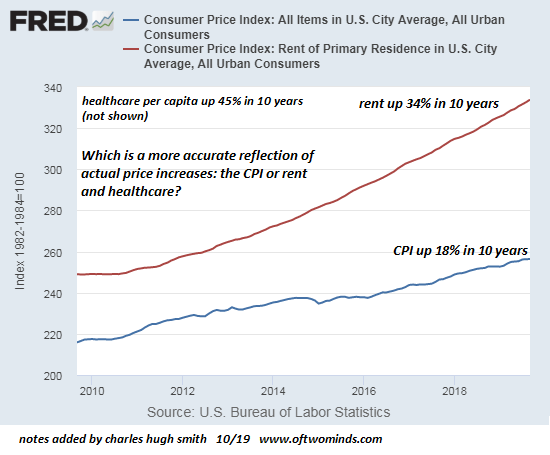
Meanwhile, we’re told inflation is less than 2% annually while rising costs have outpaced meager wage increases. What’s a more realistic measure of real-world inflation–the official Consumer Price Index (CPI) at 18% over ten years or rent and healthcare at 34% and 45%?

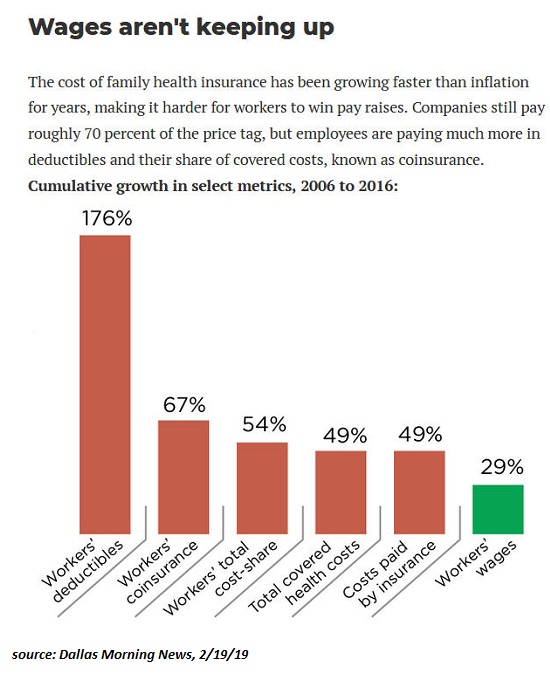
According to the Chapwood Index, real-world inflation in urban America is running 9% to 13% annually. This is more in line with reality than the bogus CPI, as evidenced by this chart of wages and healthcare costs:

Even if we don’t measure the erosion of intangible capital, the social and political consequences of this impoverishment are manifesting in all sorts of ways: large-scale social disorder is breaking out around the globe, and the political middle ground has completely vanished: no matter which way an issue is decided, one camp will refuse to accept the outcome.

The only way forward with any chance of success is to start by acknowledging the decay of our economy due to rampant financialization, legalized looting, the pathologies of “winner take most” speculation and the realities of a two-tiered system in which entrenched elites are “more equal” than the rest of us, economically, socially and politically. We have to accept the limits of technology to reverse the unraveling and assess the damage that’s already been done to our shared capital.

Acting as if the system is working just fine and the problem is perception/optics is accelerating the unraveling.

Automatons – Life Inside the Unreal Machine

By Kingsley L. Dennis

Source: Waking Times

ɔːˈtɒmət(ə)n/

noun

a moving mechanical device made in imitation of a human being.

a machine which performs a range of functions according to a predetermined set of coded instructions.

used in similes and comparisons to refer to a person who seems to act in a mechanical or unemotional way.

“Don’t you wish you were free, Lenina?”

“I don’t know what you mean. I am free. Free to have the most wonderful time. Everybody’s happy nowadays.”

He laughed. “Yes, ‘Everybody’s happy nowadays.’ We have been giving the children that at five. But wouldn’t you like to be free to be happy in some other way, Lenina? In your own way, for example; not in everybody else’s way.”

“I don’t know what you mean,” she repeated.

Aldous Huxley, Brave New World

Are we turning into a mass of unaware sleepwalkers? Our eyes are seemingly open and yet we are living as if asleep and the dream becomes our waking lives. It seems that more and more people, in the highly technologized nations at least, are in danger of succumbing to the epidemic of uniformity. People follow cycles of fashions and wear stupid clothes when they think it is the ‘in thing;’ and hyper-budget films take marketing to a whole new level forcing parents to rush out to buy the merchandise because their kids are screaming for it. And if one child in the class doesn’t have the latest toy like all their classmates then they are ostracized for this lack. Which means that poor mummy and daddy have to make sure they get their hands on these gadgets. Put the two items together – zombies and uniformity – and what do you get? Welcome to the phenomenon of Black Fridays, which have become the latest manifestation of national Zombie Days.

Unless you’ve been living in a cave somewhere (or living a normal, peaceful existence) then you will know what this event is – but let me remind you anyway of what a Black Friday is. It is a day when members of the public are infected with the ‘must buy’ and ‘act like an idiot’ virus that turns them into screaming, raging hordes banging on the doors of hyper-market retailers hours before they open. Many of these hordes sleep outside all night to get early entry. Then when the doors are finally opened they go rushing in fighting and screaming as if re-enacting a scene from Games of Thrones. Those that do survive the fisticuffs come away with trolleys full of boxes too big to carry. This display of cultural psychosis, generally named as idiocracy, is also a condition nurtured by societies based on high-consumption with even higher inequalities of wealth distribution. In other words, a culture conditioned to commodity accumulation will buy with fervour when things are cheap. This is because although conditioned to buy, they lack the financial means to satiate this desire. Many people suffer from a condition which psychologists have named as ‘miswanting,’ which means that we desire things we don’t like and like things we don’t desire. What this is really saying is that we tend to ‘want badly’ rather than having genuine need. What we are witnessing in these years is an epidemic of idiocracy and its propagating faster than post-war pregnancies. And yet we are programmed by our democratic societies to not think differently. In this respect, many people also suffer from a condition known as ‘confirmation bias.’

Confirmation bias is our conditioned tendency to pick and choose that information which confirms our pre-existing beliefs or ideas. Two people may be able to look at the same evidence and yet they will interpret it according to how it fits into and validates their own thinking. That’s why so many debates go nowhere as people generally don’t wish to be deviated away from those ideas they have invested so much time and effort in upholding. It’s too much of a shock to realize that what we thought was true, or valid, is not the case. To lose the safety and security of our ideas would be too much for many people. It is now well understood in psychology that we like to confirm our existing beliefs; after all, it makes us feel right!

Many of our online social media platforms are adhering to this principle by picking and choosing those items of news, events, etc that their algorithms have deemed we are most likely to want to see. As convenient as it may seem, it is unlikely to be in our best interests in the long term. The increasing automation of the world around us is set to establish a new ecology in our hyperreality. We will be forced to acknowledge that algorithms and intelligent software will soon, if it isn’t already, be running nearly everything in our daily lives. Historian Yuval Harari believes that ‘the twenty-first century will be dominated by algorithms. “Algorithm” is arguably the single most important concept in our world. If we want to understand our life and our future, we should make every effort to understand what an algorithm is.’1 Algorithms already follow our shopping habits, recommend products for us, pattern recognize our online behavior, help us drive our cars, fly our planes, trade our economies, coordinate our public transport, organize our energy distribution, and a lot, lot more that we are just not really aware of. One of the signs of living in a hyperreality is that we are surrounded by an invisible coded environment, written in languages we don’t understand, making our lives more abstracted from reality.

Modern societies are adapting to universal computing infrastructures that will usher in new arrangements and relations. Of course, these are only the early years, although there is already a lot of uncertainty and unpredictability. As it is said, industrialization didn’t turn us into machines and automation isn’t going to turn us into automatons. Which is more or less correct; after all, being human is not that simple. Yet there will be new dependencies and relations forming as algorithms continue to create and establish what can be called ‘pervasive assistance.’ Again, it is a question of being alert so that we don’t feel compelled just to give ourselves over to our algorithms. The last thing we want is for a bunch of psychologists trying to earn yet more money from a new disease of ‘algorithmic dependency syndrome’ or something similar.

It needs stating that by automating the world we also run the risk of being distanced from our own responsibilities. And this also implies, importantly, the responsibility we have to ourselves – to transcend our own limitations and to develop our human societies for the better. We should not forget that we are here to mature as a species and we should not allow the world of automation to distract us from this. Already literature and film have portrayed such possibilities. Examples are David Brin’s science-fiction novel Kiln People (2002 – also adapted into the film Surrogates, 2009), which clearly showed how automation may provide a smokescreen for people to disappear behind their surrogate substitutes.

Algorithms are the new signals that code an unseen territory all around us. In a world of rapidly increasing automation and digital identities we’ll have to keep our wits about us in order to retain what little of our identities we have left. We want to make sure that we don’t get lost in our emoji messages, our smilies of flirtation; or, even worse, loose our life in the ‘death cult’ of the selfies. Identities by their very nature are constructs; in fact, we can go so far as to call them fake. They are constructed from layers of ongoing conditioning which a person identifies with. This identity functions as a filter to interpret incoming perceptions. The limited degree of perceptions available to us almost guarantees that identities fall into a knowable range of archetypes. We would be wise to remember that who we are is not always the same as what we project. And yet some people on social media are unable to distinguish their public image from their personal identity, which starts to sound a bit scary. Philosopher Jean Baudrillard, not opposed to saying what he thought, stated it in another way:

We are in a social trance: vacant, withdrawn, lacking meaning in our own eyes. Abstracted, irresponsible, enervated. They have left us the optic nerve, but all the others have been disabled…All that is left is the mental screen of indifference, which matches the technical in-difference of the images.2

Baudrillard would probably be the first to agree that breathing is often a disguise to make us think that someone is alive. After all, don’t we breathe automatically without thinking about it?

We must not make the human spirit obsolete just because our technological elites are dreaming of a trans-human future. Speaking of such futures, inventor and futurist Ray Kurzweil predicts that in the 2030s human brains will be able to connect to the cloud and to use it just like we use cloud computing today. That is, we will be able to transfer emails and photos directly from the cloud to our brain as well as backing up our thoughts and memories. How will this futuristic scenario be possible? Well, Kurzweil says that nanobots – tiny robots constructed from DNA strands – will be swimming around in our brains. And the result? According to Kurzweil we’re going to be funnier, sexier, and better at expressing our loving sentiments. Well, that’s okay then – nanobot my brain up! Not only will being connected to the computing cloud make us sexier and funnier humans, it will even take us closer to our gods says Kurzweil – ‘So as we evolve, we become closer to God. Evolution is a spiritual process. There is beauty and love and creativity and intelligence in the world – it all comes from the neocortex. So we’re going to expand the brain’s neocortex and become more godlike.’It’s hard to argue with such a bargain – a few nanobots in our brain to become godlike? I can imagine a lot of people will be signing up for this. There may even be a hefty monthly charge for those wanting more than 15GB of back-up headspace. Personally, I prefer the headspace that’s ad infinitum and priceless. I hope I’m not in the minority.

Looking at the choices on offer so far it seems that there is the zombie option, which comes with add-on idiocracy (basic model), and the trans-human nanobot sexy-god upgrade (pricy). But then let’s not forget that in an automated world it may be the sentient robots that come out on top. Now, that would be an almost perfect demonstration of a simulation reality.

Life in Imitation

There are those who believe that self-awareness is going to be the end game of artificial intelligence – the explosive ‘wow factor’ that really throws everything into high gear. The new trend now is deep machine-learning to the point where machines will program not only themselves but also other machines. Cognitive computer scientists are attempting to recapture the essence of human consciousness in the hope of back-engineering this complexity into machine code. It’s a noble endeavor, if not at least for their persistence. The concern here is that if machines do finally achieve sentience then the next thing that we’ll need to roll out will be machine psychologists. Consciousness, after all, comes at a price. There is no free lunch when it comes to possessing a wide-awake brain. With conscious awareness comes responsibilities, such as values, ethics, morality, compassion, forgiveness, empathy, goodness, and good old-fashioned love. And I personally like the love part (gives me a squishy feeling every time).

It may not actually be the sentient robots we need to worry about; it’s the mindless ones we need to be cautious of (of course, we could say the same thing about ourselves). One of the methods used in training such robots is, in the words of their trainers, to provide them with enough ‘intrinsic motivation.’ Not only will this help the robots to learn their environments, it is also hoped that it will foster attention in them to acquire sufficient situational awareness. If I were to write a science-fiction scenario on this I would make it so that the sentient robots end up being more human than we are, and humans turn into their automated counterparts. Funny, maybe – but more so in the funny-bone hurting sort of way rather than the laugh-out-loud variety. Or perhaps it’s already been done. It appears that we are attempting to imbue our devices with qualities we are also striving to possess for ourselves. Humans are naturally vulnerable; it is part of our organic make-up. Whatever we create may inherit those vulnerabilities. However, this here is not a discussion on the pros and cons of smart machines and artificial intelligence (there are many more qualified discussions on that huge topic).

While we are creating, testing, worrying, or arguing over machines and their like we are taking our attention away from the center – ourselves. The trick of surviving in the ‘unreal machine’ of life is by becoming more human, the very antithesis of the robotic. Technology can assist us in interacting and participating to a better degree with our environments. The question, as always, is the uses to which such tools are put – and by whom. Such tools can help us realize our dreams, or they can entrap us in theirs. Algorithms, smart machines, intelligent infrastructure, and automated processes: these are all going to come about and be a part of our transforming world. And in many respects, they will make life more comfortable for us. Yet within this comfort zone we still need to strive and seek for our betterment. We should not allow an automated environment to deprive us of our responsibility, and need, to find meaning and significance in our world. Our technologies should force us to acknowledge our human qualities and to uplift them, and not to turn us into an imitation of them.

Another metaphor for the simulated ‘robotic’ creature is the golem. The golem legend speaks of a creature fashioned from clay, a Cabbalistic motif which has appeared frequently in literary and cinematic form (such as Frankenstein). The Cabbalistic automaton that is the golem, which means ‘unformed,’ has often been used to show the struggle between mechanical limitation and human feelings. This struggle depicts the tension that combines cogs and consciousness; the entrapment in matter and the spirit of redemption and liberation. This is a myth that speaks of the hubris in humanity fashioning its own creatures and ‘magically’ bestowing life upon them. It is the act of creating a ‘sacred machine’ from the parts and pieces of a material world and then to imbue them with human traits. And through this human likeness they are required to fulfil human chores and work as slaves. Sounds familiar? The Cabbalistic humanoid – the sentient robot – is forever doomed, almost like the divine nature of Man trapped within the confines and limitations of a material reality. They represent the conflict of being torn between a fixed fate and freedom.

Our material reality may be the ultimate unreal machine. We are the cogs, the clay golem, the imperfect creature fashioned by another. Our fears of automation may only be a reflection of our own automation. We struggle to express some form of release whilst unaware that the binds that mechanize us are forever tightening.

We have now shifted through the zombie-idiocracy model (basic), the trans-human nanobot sexy-god model (pricy), to arrive at the realization that it is us – and not our sentient robots – that are likely to be the automaton (tragic). And this is the biblical fall from grace; the disconnection from our god(s). We have come loose from Central Source and we have lost our way.

We are now living in the hyperreal realm where zombies, cyborgs, and golem robots all reside – but it is not the place for the genuine human. Things are going to have to change. Not only do we have to retain our humanity, we also must remain sane. With our continuing modern technologies, our augmented reality and bioengineering, the difference between fiction and reality will blur even further. And this blurring is likely to become more prominent as people increasingly try to reshape reality to fit around their own imaginative fictions. Staying sane, grounded, and balanced is going to be a very, very good option for the days to come.

We are going to be sharing our planetary space with the new smart machines. I am reminded of the Dr. Seuss book Horton Hears a Who! that has the refrain, ‘a person’s a person no matter how small.’ Size doesn’t count – but being human does. And staying human in these years will be the hard task allotted to us.

Alt Media was Exposing Epstein Corruption as ABC was Covering it Up—Who’s the Real Fake News?

Prince Andrew with Jeffrey Epstein

By Matt Agorist

Source: Free Thought Project

One of the largest stories in the news this week was the ABC anchor who was recorded on a hot microphone ranting about how the network suppressed her story on Jeffrey Epstein and his ties to the elite — three years ago. While this admission was certainly noteworthy, it should come as no surprise. Over the past few years, the mainstream media, in general, has refused to report on any of Epstein’s ties to current and past government officials, Hollywood insiders, and even royalty. Now, as the “Epstein didn’t kill himself” memes storm the internet, it has all of the sudden become “cool” to finally talk about this insidious group of power elite predators. However, those of us in the alternative media have been talking about this stuff for years — before it was cool — and we were called conspiracy theorists for doing so.

In 2016, the Pizzagate conspiracy took the internet by storm and created a slew of unprovable theories that never materialized. While the mainstream media was shouting down the Pizzagate crowd, TFTP and others were reporting on the real child sex trafficking conspiracy involving Epstein and his friends like the Clintons. As we reported in 2016, flight logs showed that Bill Clinton allegedly took numerous flights on the “Lolita Express” (Epstein’s private jet) to “orgy island” (Epstein’s private island in the Caribbean) to engage in sex with underage girls.

Epstein is also tied to the current president Donald Trump. Indeed, prior to taking the White House, billionaire Donald Trump dished out praise for Epstein back in 2002, telling New York Magazine for an article, in hindsight, peculiarly titled, “Jeffrey Epstein: International Moneyman of Mystery,”

“I’ve known Jeff for 15 years. Terrific guy. He’s a lot of fun to be with. It is even said that he likes beautiful women as much as I do, and many of them are on the younger side. No doubt about it — Jeffrey enjoys his social life.”

When we were reporting on these provable facts years ago, the mainstream media was suppressing them. Even Prince Andrew was tied to this convicted pedophile. In fact, one piece of evidence submitted during a lawsuit against Epstein last year was a photo of Prince Andrew with his arm around the underage victim, Virginia Roberts who claims that was she was both forced to have sex with Epstein and that she was “loaned out” to perform sex acts on his friends.

The photo resurfaced last year during the trials, yet it was entirely ignored by the mainstream. Coincidentally, any ties to the Royal Family have been ignored by the mainstream despite the evidence.

Why is that?

“The Palace found out that we had her whole allegations about Prince Andrew and threatened us a million different ways,” Amy Robach, ‘Good Morning America’ Co-Host and Breaking News Anchor at ABC was recorded saying on a hot mic in the now viral video.

As ABC was taking marching orders from the Royal family to cover for a convicted pedophile, those of us in the trenches of alternative media were putting out reports left and right. The Miami Herald is arguably one of the largest purveyors and investigators in the Epstein corruption case, putting out bombshell after bombshell over the last few years. Sadly, however, most of it was ignored.

As TFTP has reported, Epstein is a convicted child molester and sexually abused no less than 40 underage girls. Despite this fact, Alexander Acosta protected him while serving as a U.S. Attorney in Florida.

Instead of going to prison for life, as he should’ve considering the evidence against him, Epstein only got 13 months and was allowed to stay in the Palm Beach County Jail in his own private cell where he was allowed to leave the prison six days a week for “work release.”

Instead of being investigated for letting this convicted pedophile off with a wrist slap, Acosta was appointed by Trump to Secretary of Labor. During his appointment hearing in 2017, Acosta defended the way he handled the Epstein case.

“At the end of the day, based on the evidence, professionals within a prosecutor’s office decide that a plea — that guarantees that someone goes to jail, that guarantees that someone register generally and that guarantees other outcomes — is a good thing,” he said.

As the Alternative Media was screaming from the rooftops — literally, we did a podcast on this last year —  that this man let a pedophile off with a wrist slap and was then appointed a high position in the government, the mainstream media ignored it once again. Only after Epstein was arrested did Acosta’s role become something the mainstream media would talk about. The coverage almost immediately led to this pedophile helper’s resignation.

When the Hollywood #metoo movement blew up, the mainstream media focused solely on a few people while ignoring Epstein’s ties to any of it. However, pining away with pertinent information were the folks at the Antimedia, showing the connections. 

When Epstein was being sued in Federal Court last year, the mainstream was again silent. But TFTP contributor, founder of the Conscience Resistance, and Houston mayoral candidate Derrick Broze was in Florida — standing in front of Epstein’s mansion — trying to get this information out to the public.

Yet again, the algorithms, the “fact checkers” and thought controllers acted almost in unison to silence these platforms. A month after TFTP published Broze’s extensive investigative work, our entire social media network across Facebook and Twitter, consisting of nearly 7 million followers, was surreptitiously wiped off the face of the internet. 

None of the information we have put out in regard to Epstein over the past few years has been wrong. Alternative media has had their finger on the pulse of the Epstein corruption for years, yet we have been shoved into the fringes by the mainstream. Coincidence?

Sadly, however, although it appears that they are finally reporting on the Epstein corruption, the mainstream media is still pussyfooting all over it. They are more concerned with Epstein’s death in jail than the actual connections to these elite child traffickers, many of whom are still free.

Whitney Webb with Mint Press News has been following the Epstein case down into the deepest crawls of the establishment and has been asking hard questions, like how the hell is Ghislaine Maxwell — who is alleged to have helped Epstein traffic these children — still walking around a free person? If you want a true glimpse into how deep the rabbit hole goes, you can take a look at their in depth coverage, here. 

The sleight of hand tactics employed by the mainstream are becoming more and more apparent as we progress through time. It is no surprise that they have earned the nickname “dinosaur media.” Let’s hope that those who help to protect society’s worst, who victimize and prey on innocent children, will one day find their platforms used for this protection, extinct, just like the dinosaurs.

It’s the DNC, Stupid: Democratic Party, Not Russia, Has Delegitimized the Democratic Process

By Elizabeth Vos

Source: Consortium News

Establishment Democrats and those who amplify them continue to project blame for the public’s doubt in the U.S. election process onto outside influence, despite the clear history of the party’s subversion of election integrity. The total inability of the Democratic Party establishment’s willingness to address even one of these critical failures does not give reason to hope that the nomination process in 2020 will be any less pre-ordained.

The Democratic Party’s bias against Sen. Bernie Sanders during the 2016 presidential nomination, followed by the DNC defense counsel doubling down on its right to rig the race during the fraud lawsuit brought against the DNC, as well as the irregularities in the races between former DNC Chairwoman Debbie Wasserman Schultz and Tim Canova, indicate a fatal breakdown of the U.S. democratic process spearheaded by the Democratic Party establishment. Influences transcending the DNC add to concerns regarding the integrity of the democratic process that have nothing to do with Russia, but which will also likely impact outcomes in 2020.

The content of the DNC and Podesta emails published by WikiLeaks demonstrated that the DNC acted in favor of Hillary Clinton in the lead up to the 2016 Democratic primary. The emails also revealed corporate media reporters acting as surrogates of the DNC and its pro-Clinton agenda, going so far as to promote Donald Trump during the GOP primary process as a preferred “pied-piper candidate.” One cannot assume that similar evidence will be presented to the public in 2020, making it more important than ever to take stock of the unique lessons handed down to us by the 2016 race.

Social Media Meddling

Election meddling via social media did take place in 2016, though in a different guise and for a different cause from that which are best remembered. Twitter would eventually admit to actively suppressing hashtags referencing the DNC and Podesta emails in the run-up to the 2016 presidential election. Additional reports indicated that tech giant Google also showed measurable “pro-Hillary Clinton bias” in search results during 2016, resulting in the alleged swaying of between 2 and 10 millions voters in favor of Clinton.

On the Republican side, a recent episode of CNLive! featured discussion of the Cambridge Analytica scandal, in which undecided voters were micro-targeted with tailored advertising narrowed with the combined use of big data and artificial intelligence known collectively as “dark strategy.” CNLive! Executive Producer Cathy Vogan noted that SCL, Cambridge Analytica’s parent company, provides data, analytics and strategy to governments and military organizations “worldwide,” specializing in behavior modification. Though Cambridge Analytica shut down in 2018, related companies remain.

The Clinton camp was hardly absent from social media during the 2016 race. The barely-legal activities of Clintonite David Brock were previously reported by this author to have included $2 million in funding for the creation of an online “troll army” under the name Shareblue. The LA Times described the project as meant to “to appear to be coming organically from people and their social media networks in a groundswell of activism, when in fact it is highly paid and highly tactical.” In other words, the effort attempted to create a false sense of consensus in support for the Clinton campaign.

In terms of interference in the actual election process, the New York City Board of Elections was shown to have purged over one hundred thousand Democratic voters in Brooklyn from the rolls before the 2016 primary, a move that the Department of Justice found broke federal law. Despite this, no prosecution for the breach was ever attempted.

Though the purge was not explicitly found to have benefitted Clinton, the admission falls in line with allegations across the country that the Democratic primary was interfered with to the benefit of the former secretary of state. These claims were further bolstered by reports indicating that voting results from the 2016 Democratic primary showed evidence of fraud.

DNC Fraud Lawsuit

The proceedings of the DNC fraud lawsuit provide the most damning evidence of the failure of the U.S. election process, especially within the Democratic Party. DNC defense lawyers argued in open court for the party’s right to appoint candidates at its own discretion, while simultaneously denying any “fiduciary duty” to represent the voters who donated to the Democratic Party under the impression that the DNC would act impartially towards the candidates involved.

In 2017, the Observer reported that the DNC’s defense counsel argued against claims that the party defrauded Sanders’ supporters by favoring Clinton, reasoning that Sanders’ supporters knew the process was rigged. Again: instead of arguing that the primary was neutral and unbiased in accordance with its charter, the DNC’s lawyers argued that it was the party’s right to select candidates.

The Observer noted the sentiments of Jared Beck, the attorney representing the plaintiffs of the lawsuit:

…“People paid money in reliance on the understanding that the primary elections for the Democratic nominee —nominating process in 2016 were fair and impartial, and that’s not just a bedrock assumption that we would assume just by virtue of the fact that we live in a democracy, and we assume that our elections are run in a fair and impartial manner. But that’s what the Democratic National Committee’s own charter says. It says it in black and white.”

The DNC defense counsel’s argument throughout the course of the DNC fraud lawsuit doubled down repeatedly in defense of the party’s right to favor one candidate over another, at one point actually claiming that such favoritism was protected by the First Amendment. The DNC’s lawyers wrote:

“To recognize any of the causes of action that Plaintiffs allege would run directly contrary to long-standing Supreme Court precedent recognizing the central and critical First Amendment rights enjoyed by political parties, especially when it comes to selecting the party’s nominee for public office.” [Emphasis added]

The DNC’s shameless defense of its own rigging disemboweled the most fundamental organs of the U.S. body politic.  This no indication that the DNC will not resort to the same tactics in the 2020 primary race,

Tim Canova’s Allegations

If Debbie Wasserman Schultz’s role as disgraced chairwoman of the DNC and her forced 2016 resignation wasn’t enough, serious interference was also alleged in the wake of two contests between Wasserman Schultz and professor Tim Canova in Florida’s 23rd congressional district. Canova and Wasserman Schultz first faced off in a 2016 Democratic primary race, followed by a 2018 general congressional election in which Canova ran as an independent.

Debacles followed both contests, including improper vote counts, illegal ballot destruction, improper transportation of ballots, and generally shameless displays of cronyism. After the controversial results of the initial primary race against Wasserman Schultz, Canova sought to have ballots checked for irregularities, as the Sun-Sentinel reported at the time:

“[Canova] sought to look at the paper ballots in March 2017 and took Elections Supervisor Brenda Snipes to court three months later when her office hadn’t fulfilled his request. Snipes approved the destruction of the ballots in September, signing a certification that said no court cases involving the ballots were pending.”

Ultimately, Canova was granted a summary judgment against Snipes, finding that she had committed what amounted to multiple felonies. Nonetheless, Snipes was not prosecuted and remained elections supervisor through to the 2018 midterms.

Republicans appear no more motivated to protect voting integrity than the Democrats, with The Nation reporting that the GOP-controlled Senate blocked a bill this week that would have “mandated paper-ballot backups in case of election machine malfunctions.”

Study of Corporate Power

A 2014 study published by Princeton University found that corporate power had usurped the voting rights of the public: “Economic elites and organized groups representing business interests have substantial independent impacts on U.S. government policy, while average citizens and mass-based interest groups have little or no independent influence.”

In reviewing this sordid history, we see that the Democratic Party establishment has done everything in its power to disrespect voters and outright overrule them in the democratic primary process, defending their right to do so in the DNC fraud lawsuit. We’ve noted that interests transcending the DNC also represent escalating threats to election integrity as demonstrated in 2016.

Despite this, establishment Democrats and those who echo their views in the legacy press continue to deflect from their own wrongdoing and real threats to the election process by suggesting that mere discussion of it represents a campaign by Russia to attempt to malign the perceptionof the legitimacy of the U.S. democratic process.

Hillary Clinton’s recent comments to the effect that Congresswoman Tulsi Gabbard is being “groomed” by Russia, and that the former Green Party Presidential candidate Dr. Jill Stein is a “Russian asset”, were soon echoed by DNC-friendly pundits. These sentiments externalize what Gabbard called the “rot” in the Democratic party outward onto domestic critics and a nation across the planet.

Newsweek provided a particularly glaring example of this phenomenon in a recent op-ed penned by columnist Naveed Jamali, a former FBI double agent whose book capitalizes on Russiagate. In an op-ed titled: Hillary Clinton Is Right. Tulsi Gabbard Is A Perfect Russian Asset – And Would Be A Perfect Republican Agent,” Jamali argued:

“Moscow will use its skillful propaganda machine to prop up Gabbard and use her as a tool to delegitimize the democratic process.” [Emphasis added]

Jamali surmises that Russia intends to “attack” our democracy by undermining the domestic perception of its legitimacy. This thesis is repeated later in the piece when Jamali opines: “They want to see a retreat of American influence. What better way to accomplish that than to attack our democracy by casting doubt on the legitimacy of our elections.” [Emphasis added]

The only thing worth protecting, according to Jamali and those who amplify his work (including former Clinton aide and establishment Democrat Neera Tanden), is the perception of the democratic process, not the actual functioning vitality of it. Such deflective tactics ensure that Russia will continue to be used as a convenient international pretext for silencing domestic dissent as we move into 2020.

Given all this, how can one expect the outcome of a 2020 Democratic Primary — or even the general election – to be any fairer or transparent than 2016?


Elizabeth Vos is a freelance reporter, co-host of CN Live! and regular contributor to Consortium News. 

How Far Will They Go?

By James Howard Kunstler

Source: Kunstler.com

CBS-News carried another bucket of muddy water for the coup team Sunday night with a lead 60 Minutes agit-prop story on Maria Butina, an ambitious Russian cutie who worked the American NRA circuit in the most public manner imaginable to make herself into a sex-bomb celebrity at the exact moment in history when the US Deep State wished to reinforce the fantasy, as Lesley Stahl put it, that “Russia was interfering in our electoral process.”

Of course, Ms. Stahl and her shifty producers left out half the story: how Maria Butina was manipulated by her FBI-handler and sometime-boyfriend, Patrick Byrne, the former Overstock.com CEO who had been employed by the Bureau over the years on other undercover assignments. They didn’t mention him or seek to understand his role in the operation. But they gave plenty of air-time to the DOJ lawyer, John C Demers, who prosecuted Ms. Butina, and never bothered to ask Demers why Butina was not charged with espionage — perhaps because nothing remotely like that occurred.

How media giants like Ms. Stahl can keep mouthing this malarkey designed to stoke a new cold war is one of the great mysteries of our national psychology these days. You’d think they’d learned something from the train wreck of the Mueller Investigation, the Brett Kavanaugh fiasco, and the current debacle of Adam Schiff’s imploding Ukraine whistleblower caper — namely, that spouting lies will eventually get you found-out and disgraced.

But the coup team is now dangerously stuck tripling and quadrupling down on its fairy tale narrative as the reckoning of its dark deeds approaches and its star players await their turns on the witness stand. Half the country has been waiting patiently for authorities-of-standing to put an end to this Hitchcockian campaign of seditious fog that has driven us close to the brink of a second civil war. That half of the country has actually been reading the evidence of this treason and sedition — underwritten by Hillary Clinton and her allies — on the back-channels of the Internet. None of that evidence has been posted through the main media outlets wholly owned by the coup team, gospel to the other half of America, and soon millions of credulous bystanders who got high on three years of CIA-issued RussiaGate Kool-Aid will get the surprise of their lives when they discover how deeply they were played.

The CIA and the FBI are in a fight for their lives now. The evidence shows pretty clearly that these rogue agencies conducted all the election “meddling” of 2016 and that the RussiaGate hysteria was an engineered smokescreen to hide their tracks and cover their asses when the certainty of a Hillary election triumph nauseatingly resolved unfavorably in the cold, gray dawn of 11/8/16. Despite the chatter about an “insurance policy,” they were quite unprepared for the exposure that loomed.

They also badly underestimated the resources of what is now a very sturdy alt.media which has managed to weave the real story of what happened over the past three years into a shocking tapestry of massive subversion and treachery. A big part of the true story is how amazingly incompetent the RussiaGate coupsters were. Did they really believe they could conceal the ties between their agencies and Glenn Simpson’s Fusion GPS operation, and its feckless front man, British ex-spy Christopher Steele, and the whole outfit’s connection to Hillary Clinton and the Democratic National Committee? Did they suppose they could pass off Stephan Halper and Joseph Mifsud as Russian agents when the two have consorted with US and allied intelligence for decades? The US Department of Defense even holds Mr. Halper’s million-dollar pay stubs and Mr. Mifsud appears in photographs of every Western cloak-and-dagger cocktail get-together of spook officialdom for the last twenty years.

The latest, and most desperate gambit is the UkraineGate whistleblower, a CIA employee blatantly playing errand-boy for his mentor John Brennan and deeply tied to 2016 election shenanigans emanating from Ukraine, featuring his former employer, ex-Vice-President Joe Biden. This shadowy figure, pegged as Eric Ciaramella, 33, may shortly find himself in a grand jury chamber answering for his role in this charade. Ciaramella has just been hung out to dry by his sponsor, Rep. Adam Schiff in a desperate attempt to dissociate himself from the huggermugger within his House Intel Committee that preceded the falsely blown whistle.

It’s not an overstatement to say that many of the figures behind this gigantic web of lies and deceit ought to answer charges up to and including treason. The question is whether Messers Barr & Durham have the cojones to cater the banquet of consequences that this huge cast of characters should be made to feast from. Another question is whether these desperate characters and the agencies they represent will go all the way now and attempt to enlist the military brass in an outright overthrow of the executive. There are already intimations of this. It would be answered by the kind of civil violence that has broken out in other parts of world where other Deep States have worn out their welcome — and their legitimacy.

Surviving on the Battlefield in the Information War

By Tony Cartalucci

Source: New Eastern Outlook

There is undoubtedly an information war raging. There are intentional liars, people who witlessly repeat these lies, poor research, and opinions spun to look as if it is research. To sort the ever increasing amount of information from disinformation, there are a few simple methods people can use.

But above all, people must personally dedicate themselves to following the truth no matter where it brings them, having the courage to accept a reality that may not necessarily mesh with their current perception. The inability to do this will render moot all other means of determining the veracity of any given report or piece of analysis.

Find the Original Source

This is fundamental. When anyone, anywhere makes a claim, whether it is in a historical documentary or book, or regarding current events, one must find the original source. Where did this information come from? Is it a direct quote? If so, can this quote be verified? If the quote is “alleged” or “leaked” or otherwise second-hand information or the sources never revealed, it is impossible to verify and therefore impossible to consider as verified.

Often conversations relayed by second-hand sources serve as the basis of propaganda. It is essentially the process of placing words into the mouths of people who never said anything of the sort. Media that repeatedly uses quotes that are impossible to verify may be engaged in disinformation.

If the quote is confirmed, that alone does not mean that what was said was “true.” It simply means that someone made a statement – the veracity of which must be determined through other means. Finding the source of a claim often helps shatter long-held myths. This is particularly true in regards to historical matters.

Follow the Money

All protests, political movements, and armed struggles require immense amounts of resources to start, perpetuate, and most importantly to succeed.  They also require leadership. If one finds themselves reading reports of events that do not mention funding or the names of specific leaders, either those reporting on the events don’t have these facts and should make note that such information is both missing and essential to find, or misdirection and disinformation is at play.

Omitting these facts has been done intentionally across the Western media to obfuscate Western involvement particularly in “political uprisings” and “armed rebellions” that are made to appear spontaneous and indigenous but are in fact long-planned, foreign-backed conspiracies. The so-called “Arab Spring” is perhaps the most notorious example of this, where the Western media failed intentionally and repeatedly to identify the funding and individuals involved in both street protests and subsequent armed attacks on security agencies across the Middle East and North Africa (MENA) region.

Had the public carefully read through reports, and followed the money, they would have found a combination of US State Department money and the Anglo-American-backed Muslim Brotherhood behind each and every “uprising” across the Middle East, with Al Qaeda forming the subsequent armed groups that overran Libya and are currently leading attempts to overthrow the government of Syria.

Look at What People Do, Not at What They Say…

There are media reports, government press releases, op-eds, analysis, and policy papers of every kind. Many times, these various sources contradict each other. How does one go about determining which is true and which is disinformation? It is quite simple, don’t simply listen to what reporters, analysts, and policymakers say, look at what they and those they have influence over are doing.

The United States claims that it is fighting the so-called “Islamic State” (ISIS) in Syria. However, if we “follow the money” and realize that it is impossible for ISIS to sustain its fighting capacity within Syria or Iraq alone, and requires an immense amount of resources from abroad to continue its operations, we realize those resources are undoubtedly passing through territory the US and its allies in fact control.

That the US is not interdicting these vital supplies, including additional fighters, weapons, and cash, is proof that claims in the media and amid government press releases that the US is “fighting ISIS” are false.

Conversely, in veteran journalist Seymour Hersh’s 2007 New Yorker article, “The Redirection,” he stated explicitly, citing US and Saudi officials, that the West and its regional allies planned to use sectarian extremists affiliated with Al Qaeda to wage a regional proxy war against Syria and Iran. This also so happens to be precisely what is now playing out across the MENA region. Hersh’s analysis can be tracked down through his sources, by following the money – as only state-sponsorship can explain Al Qaeda and ISIS’ fighting capacity in Syria, Iraq, and beyond – and by simply looking at what is now unfolding across the region.

None of what the current corporate media or government press releases say can be verified in a similar manner, and certainly, none of what is said by the West currently, matches what is actually happening on the ground.

Finally, let us consider policy papers released by corporate-funded think tanks like the Brookings Institution. Such policy papers have repeatedly laid out plans for arming extremists, incrementally invading and occupying Syria, and eventually toppling the Syrian government. This too, is precisely what we see happening on the ground, though the Western media and Western representatives claim the cause is not a  premeditated Western conspiracy, but a series of coincidences and unfortunate turns of fate.

Final Thoughts 

The truth is hard to arrive at, not only because people intentionally seek to fool others, but because often, many unintentionally fool themselves. Reality can be unpleasant. Watching a nation be destroyed can be heartbreaking and the desire to insulate oneself from the pain through cognitive dissonance can be overwhelming. However, one of the greatest maxims in human conflict is to truly know yourself and know your enemy. Truth isn’t just a matter of virtue, it is a factor that will make the difference between victory and defeat.

If victory over the forces of greed and hegemony is truly our goal, then we must face the facts no matter how unpleasant. Our failure to do so will cost us everything – and those driven by greed and hegemony know. That is why they have invested so much in clouding reality and obfuscating the truth. We must invest more in seeing through this clouded reality, and discover the truth, no matter how unpleasant.

The Key to a Sustainable Economy Is 5,000 Years Old

By Ellen Brown

Source: Truthdig

We are again reaching the point in the business cycle known as “peak debt,” when debts have compounded to the point that their cumulative total cannot be paid. Student debt, credit card debt, auto loans, business debt and sovereign debt are all higher than they have ever been. As economist Michael Hudson writes in his provocative 2018 book, “…and forgive them their debts,” debts that can’t be paid won’t be paid. The question, he says, is how they won’t be paid.

Mainstream economic models leave this problem to “the invisible hand of the market,” assuming trends will self-correct over time. But while the market may indeed correct, it does so at the expense of the debtors, who become progressively poorer as the rich become richer. Borrowers go bankrupt and banks foreclose on the collateral, dispossessing the debtors of their homes and their livelihoods. The houses are bought by the rich at distress prices and are rented back at inflated prices to the debtors, who are then forced into wage peonage to survive. When the banks themselves go bankrupt, the government bails them out. Thus the market corrects, but not without government intervention. That intervention just comes at the end of the cycle to rescue the creditors, whose ability to buy politicians gives them the upper hand. According to free-market apologists, this is a natural cycle akin to the weather, which dates all the way back to the birth of modern economics in ancient Greece and Rome.

Hudson counters that those classical societies are not actually where our financial system began, and that capitalism did not evolve from bartering, as its ideologues assert. Rather, it devolved from a more functional, sophisticated, egalitarian credit system that was sustained for two millennia in ancient Mesopotamia (now parts of Iraq, Turkey, Kuwait and Iran). Money, banking, accounting and modern business enterprise originated not with gold and private trade, but in the public sector of Sumer’s palaces and temples in the third century B.C. Because it involved credit issued by the local government rather than private loans of gold, bad debts could be periodically forgiven rather than compounding until they took the whole system down, a critical feature that allowed for its remarkable longevity.

The True Roots of Money and Banking

Sumer was the first civilization for which we have written records. Its notable achievements included the wheel, the lunar calendar, our numerical system, law codes, an organized hierarchy of priest-kings, copper tools and weapons, irrigation, accounting and money. It also produced the first written language, which took the form of cuneiform figures impressed on clay. These tablets were largely just accounting tools, recording the flow of food and raw materials in the temple and palace workshops, as well as IOUs (mainly to these large public institutions) that had to be preserved in writing to be enforced. This temple accounting system allowed for the coordinated flow of credit to peasant farmers from planting to harvesting, and for advances to merchants to engage in foreign trade.

In fact, it was the need to manage accounts for a large labor force under bureaucratic control that is thought to have led to the development of writing. The people willingly accepted this bureaucratic control because they viewed the gods as having decreed it. According to their cuneiform writings, humans were genetically engineered to work the fields and the mines after certain lower gods tasked with that hard labor rebelled.

Usury, or the charging of interest on loans, was an accepted part of the Mesopotamian credit system. Interest rates were high and remained unchanged for two millennia. But Mesopotamian scholars were well aware of the problem of “debts that can’t be paid.” Unlike in today’s academic economic curriculum, Hudson writes:

Babylonian scribal students were trained already c. 2000 BC in the mathematics of compound interest. Their school exercises asked them to calculate how long it took a debt at interest of 1/60th per month to double. The answer is 60 months: five years. How long to quadruple? 10 years. How long to multiply 64 times? 30 years. It must’ve been obvious that no economy can grow in keeping with this rate of increase.

Sumerian kings solved the problem of “peak debt” by periodically declaring “clean slates,” in which agrarian debts were forgiven and debtors were released from servitude to work as tenants on their own plots of land. The land belonged to the gods under the stewardship of the temple and the palace and could not be sold, but farmers and their families maintained leaseholds to it in perpetuity by providing a share of their crops, service in the military and labor in building communal infrastructure. In this way, their homes and livelihoods were preserved, an arrangement that was mutually beneficial, since the kings needed their service.

Jewish scribes, who spent time in captivity in Babylon in the sixth century B.C, adapted these laws in the year or jubilee, which Hudson argues was added to Leviticus after the Babylonian captivity. According to Leviticus 25:8-13, a Jubilee Year was to be declared every 49 years, during which debts would be forgiven, slaves and prisoners freed and their property leaseholds restored. As in ancient Mesopotamia, property ownership remained with Yahweh and his earthly proxies. The Jubilee law effectively banned the outright sale of land, which could only be leased for up to 50 years (Leviticus 25:14-17). The Levitican Jubilee represented an advance over the Mesopotamian “clean slates,” Hudson says, in that it was codified into law rather than relying on the whim of the king. But its proclaimers lacked political power, and whether the law was ever enforced is unclear. It served as a moral rather than a legal prescription.

Ancient Greece and Rome adopted the Mesopotamian system of lending at interest, but without the safety valve of periodic “clean slates,” since the creditors were no longer the king or the temple, but private lenders. Unfettered usury resulted in debt bondage and forfeiture of properties, consolidation into large landholdings, a growing wedge between rich and poor, and the ultimate destruction of the Roman Empire.

As for the celebrated development of property rights and democracy in ancient Greece and Rome, Hudson argues that they did not actually serve the poor. They served the rich, who controlled elections, just as rich donors do today. Taking power away from local governments by privatizing once-communal lands allowed private creditors to pass laws by which they could legally confiscate property when their debtors could not pay. “Free markets” meant the freedom to accumulate massive wealth at the expense of the poor and the state.

Hudson maintains that when Jesus Christ preached “forgiveness of debts,” he was also talking about economic debt, not just moral transgressions. When he overturned the tables of the money changers, it was because they had turned a house of prayer into “a den of thieves.” But creditors’ rights had by then gained legal dominance, and Christian theologians lacked the power to override them. Rather than being a promise of economic redemption in this life, forgiveness of debts thus became a promise of spiritual redemption in the next.

How to Pull Off a Modern Debt Jubilee

Such has been the fate of debtors in modern Western economies. But in some modern non-Western economies, vestiges of the debt write-off solution remain. In China, for instance, nonperforming loans are often carried on the books of state-owned banks or canceled rather than putting insolvent debtors and banks into bankruptcy. As Dinny McMahon wrote in June in an article titled “China’s Bad Data Can Be a Good Thing”:

In China, the state stands behind the country’s banks. As long as authorities ensure those banks have sufficient liquidity to meet their obligations, they can trundle along with higher delinquency levels than would be regarded safe in a market economy.

China’s banking system, like that of ancient Mesopotamia, is largely in the public sector, so the state can back its banks with liquidity as needed. Interestingly, the Chinese state also preserves the ancient Near Eastern practice of retaining ownership of the land, which citizens can only lease for a period of time.

In Western economies, most banks are privately owned and heavily regulated, with high reserve and capital requirements. Bad loans mean debtors are put into foreclosure, jobs and capital infrastructure are lost, and austerity prevails. The Trump administration is now aggressively pursuing a trade war with China in an effort to level the playing field by forcing it into the same austerity regime, but a more productive and sustainable approach might be for the U.S. to engage in periodic debt jubilees itself.

The problem with that solution today is that most debts in Western economies are owed not to the government but to private creditors, who will insist on their contractual rights to payment. We need to find a way to pay the creditors while relieving the borrowers of their debt burden.

One possibility is to nationalize insolvent banks and sell their bad loans to the central bank, which can buy them with money created on its books. The loans can then be written down or voided out. Precedent for this policy was established with “QE1,” the Fed’s first round of quantitative easing, in which it bought unmarketable mortgage-backed securities from banks with liquidity problems.

Another possibility would be to use money generated by the central bank to bail out debtors directly. This could be done selectively, by buying up student debt or credit card debt or car loans bundled as “asset-backed securities,” then writing the debts down or off, for example. Alternatively, debts could be relieved collectively with a periodic national dividend or universal basic income paid to everyone, again drawn from the deep pocket of the central bank.

Critics will object that this would dangerously inflate the money supply and consumer prices, but that need not be the case. Today, virtually all money is created as bank debt, and it is extinguished when the debt is repaid. That means dividends used to pay this debt down would be extinguished, along with the debt itself, without adding to the money supply. For the 80% of the U.S. population now carrying debt, loan repayments from their national dividends could be made mandatory and automatic. The remaining 20% would be likely to save or invest the funds, so this money too would contribute little to consumer price inflation; and to the extent that it did go into the consumer market, it could help generate the demand needed to stimulate productivity and employment. (For a fuller explanation, see Ellen Brown, “Banking on the People,” 2019).

In ancient Mesopotamia, writing off debts worked brilliantly well for two millennia. As Hudson concludes:

To insist that all debts must be paid ignores the contrast between the thousands of years of successful Near Eastern clean slates and the debt bondage into which [Greco-Roman] antiquity sank. … If this policy in many cases was more successful than today’s, it is because they recognized that insisting that all debts must be paid meant foreclosures, economic polarization and impoverishment of the economy at large.

Phantom Performances – The Rise of the Spectacle

By Kingsley L. Dennis

Source: Waking Times

ˈspɛktək(ə)l/

noun

a visually striking performance or display

an event or scene regarded in terms of its visual impact

“Now the death of God combined with the perfection of the image has brought us to a whole new state of expectation. We are the image.” ~John Ralston Saul, Voltaire’s Bastards

“Magical thinking is the currency not only of celebrity culture, but also of totalitarian culture.” ~Chris Hedges, Empire of Illusion

Welcome to the spectacle. Or perhaps I should say the kind of spectacle that has become the face of entertainment that pervades our westernized cultures. The way that the spectacle succeeds is that it isn’t so much about fooling us into believing its lies as real, but rather that it is we who ask to be fooled. We seek to suspend our sense of reality, to pursue a space of escape. The spectacle pulls us in because we lend our willingness to its agenda. If we are honest, in this post-truth age, we will admit to living in an age of spectacle. And it is from this that many of us receive our interpretation of reality. Since the middle of the 20th century onwards the ‘western spectacle’ has been in the form of media advertisement and propaganda. We may think that we’ve only recently arrived at the age of the spectacle, where Disneylandification is becoming the norm, and Super Bowls are interspersed with scantily-clad singers, and TV programs appear in the slots between advertisers. Yet the whole spectacle show has been a form of function creep ever since telecommunications first emerged as a social phenomenon. The image has been with humanity since the first dawn of our arising; from cave paintings to hieroglyphics to cuneiform clay tablets. The major difference is that today the spectacle of the image has not only gone global, but it has also gotten inside of our heads.

Western cultures especially (and the US specifically) have now made the image, the spectacle, and hence the illusion so grand, so vivid, and so persuasively realistic that they are becoming our basis of reality. We swing from one illusion to the alternative, which is still yet another grand spectacle; just as we swing from the political left to the right, believing each side is distinctly different. Yet each is a part of the same bubble that customizes our lives – they form a part of our news, our heroes, our tragedies, and our dreams. We now serve a mosaic of ideals carefully crafted as a patchwork of phantom performances. Nothing is ever real anymore except the painful extremes that pervade our daily existence: the violence, the suffering, the deprivation, the inequality, the disease. Only these fragments that create great pain become the real, and from these many of us seek refuge in a plenitude of diversions, distractions, and triviality.

Western civilization has chosen to be played out upon a grand stage where the performance – of invented storylines and scripts – runs the show. We move through social realities that are an entanglement of signs, virtual connections, and social media status. It’s all about who is going to be the next ‘influencer’? We are encouraged to project back into the world our entertainment-mediatized fantasies. People begin to act out their imaginary landscapes, often in violent and distorted ways, as young students massacre their classmates before going to eat at McDonalds. This is the hyperreal that distorts a stable reality, making it harder to gain a grounded perspective on things. People are increasingly being guided by the false totems of media-militarized-entertainment.

The media spectacle gives us our modern guiding images. This is similar to how in the Middle Ages images depicted in stained glass windows and paintings of religious torment or salvation acted to control and influence the social behavior of our ancestors. For many of us the white-bearded god above is dead, so we have media depictions of heroes, adventurers, McGyvers, celebrity-cosmetic makeovers, beauty pageants, talk shows and reality television to be our social guides. An illusory sensate reality has been erected that runs on pseudo-lives and phantom performances. Such phantom performances mask our personal failures and conveniently hide them behind a curtain of the unreal. People prefer to watch the rich and famous on television rather than face the domestic unhappiness of their own lives. Why have ice when you can have bubblegum-flavored ice-cream?

Luckily for those of us who live in the west we inhabit a world of easy-correction where we can make ourselves better if we buy certain products, ingest certain foods, and hang-out in the right yoga gyms. For every situation there is seemingly a commercial solution. We have not been abandoned, after all. In the realm of hyperreality, our fantasies are no longer an impediment to success. On the contrary, our fantasies are the portals through which we enter. All we need is for the world of the media to give us our dream. Everybody has talent, as the reality shows tell us – ‘Britain’s Got Talent,’ ‘America’s Got Talent:’ in fact, we’ve all got talent! We are all of us hidden unique performers, and the world ‘out there’ is begging for our arrival. This is not to be confused with the manipulation by greedy commercial enterprises that are ready to discard you as soon as your ‘talent’ no longer sells.

Yet the truth of the matter is that the spectacle of celebrity culture seeks commodities, not real individuals or souls. It doesn’t want that we seek for any form of transcendence, illumination, or real growth. It is a world that seeks only those that feed the phantom and encourage others to do the same. It is the ‘real’ that gets pushed into a black hole – to become a figment of the imagination, whilst imaginary dreams take its place. Celebrity culture thrives from the very lack of inner reflection. There is no ‘going within’ unless it is a form of medication going down our throats. If we are brutally honest, the celebrity spectacle is an ugly specter that can be as cruel as it is superficial.

The Spectacle of Celebrity Culture

No one achieves celebrity status on their own. It is a stage performance that requires a hoard of cultural enablers; from media, marketers, promoters, agents, handlers, and a host of hungry and gullible people. It is a veritable stage of actors, with each person in it to gain something for themselves. They either seek attention, satisfaction, fame, wealth, or a combination of these. Celebrity culture has come to dominate how many of us define our sense of belonging. It has come to define how we relate to the world around us, and in this respect has disfigured our notions of social belonging and community. Celebrity culture funds and feeds our own movies inside our heads as we invent our roles and behavior. It is a culture in which very few participants are even real for a day.

We idolize celebrities and often project them as idealized forms of ourselves. And yet through this substitution we move further away from any real self-actualization. The transcendent – the Real – does not do substitutes. By throwing our fantasies onto others we are diminishing our own power. In the words of one serious journalist,

We are chained to the flickering shadows of celebrity culture, the spectacle of the arena and the airwaves, the lies of advertising, the endless personal dramas, many of them completely fictional, that have become the staple of news, celebrity gossip, New Age mysticism, and pop psychology …in contemporary culture the fabricated, the inauthentic, and the theatrical have displaced the natural, the genuine, and the spontaneous, until reality itself has been converted into stagecraft. 1

We are subtly pushed through the well-structured stagecraft whilst all the time thinking that it is real. Our contemporary ‘death of the gods’ has been replaced by a divine adoration of celebrities and celebrity culture. Celebrity items, like holy relics, are paraded, idolized, and sold for vast sums. People rush for autographs, only to sell them later on eBay to make an unhealthy profit. Celebrity personal possessions are sold off at prestigious auction houses for astronomical prices, so aging people can wear the clothes of their idols. The glitzy suit that Elvis wore before dying in a Las Vegas toilet; or the dress that Marilyn Monroe wore to show her knickers to the world above a subway vent. Everything is up for grabs – the profane is made sacred, and then sacrificed as celebrity talismans. It all engenders a performance of hysteria, leading sometimes to stalking, or what is nowadays referred to as ‘trolling,’ as celebrity private photos are hacked and shared online. It’s happened to Emma Watson, Jennifer Lawrence, Kate Upton, Jessica Alba, Kate Hudson, Scarlett Johansson…and the list goes on, and on, and on.

The world of celebrity culture thrusts us into a moral void. People are valued by their appearance and their skin-deep beauty rather than their humanity. Such a culture focuses upon onanistic desires and ways for self-gratification. The cult of self ‘has within it the classic traits of psychopaths: superficial charm, grandiosity, and self-importance; a need for constant stimulation, a penchant for lying, deception, and manipulation, and the inability to feel remorse or guilt.’2 The cult of self also promotes the right to get whatever we wish, and celebrity media plays into this, often at the cost of the celebrity who suffers from social media harassment and online trolling. Celebrity public life is not a sacred space; instead, it has become a theatre of performance that is open for all spectators. And those spectators who surround themselves with celebrity culture tend to live in the present, fed by an endless stream of packaged information. They live by credit promises, ignorant to the future prospect of unmanageable debt. They are hostage to a culture that keeps them enthralled, like a television commercial replete with pleasing jingles. They navigate their purchases through well-known brands, eyeing the famous logos as guides. It is an image-saturated reality, bright and tantalizing, offering comfort and satisfaction upon all levels – until the credit runs out. Then the person becomes an outlaw to the very system that fattened them up like foie gras ducks.

These are the trivial diversions that for many are necessary, and which exist in cultures that prize shallow entertainment above substance. We may wonder whether the consumerist celebrity culture is a compensation for the loss of our true freedom regarding the human spirit and our well-being. And celebrities too are often trapped within their own fairy-tale prisons. They are skillfully controlled by their handlers and pushed in front of the media – all this to compensate for the insatiable appetites of those thirsty spectators that swarm upon celebrity culture. We are tantalizingly shown that even us, the humble spectators, can triumph in fame through the lens of reality television. The celebrity machinery oils itself on the media-creation of third and fourth-rate celebrities that have their fifteen minutes of fame – crammed together on desert islands, stuffing insects into their mouths as they bad-mouth their once beloved ‘best-friend’ and vote them off the show. Reality survival, it seems, comes at a cost. And then when they finally emerge into the ‘real world’ of the hyperreal they throng and mingle with other reality-stars under the glare of media spotlight in the vain hope that together they can populate an illusory world of the celebrity.

The world of reality television is another limb on the body of phantom performance. In the last decade a multitude of reality shows have cropped up on our television screens; and they all have one thing in common – they involve being constantly watched. Popular shows such as Big Brother put strangers to live together with round-the-clock constant surveillance. These strangers are even videoed in their beds as they sleep or fondle and kiss with other contestants. Sex lives are ogled over alongside the tears and on-screen breakdowns. Then the television psychologists are wheeled out to offer ‘expert commentary’ on the contestant’s state for mass consumption. Yet underneath all this glamour and glitz is the subtle message that intrusive surveillance is a normal feature of contemporary societies. In fact, it even masquerades as something cool that can be shared online, and which can make us famous. However, the brute reality is that such reality shows normalize what would otherwise be blatant non-constitutional intervention. And yet such shows make surveillance not only routine but a potentially enjoyable part of our modern lives. We are being conditioned into monitoring and sharing our own lives for others to see. Our phantom performances can make any one of us into an enviable star.

Social media is now rife with home-grown videos where everyone from toddler to teenager to retiree is making their performances visible to the image-hungry collective. Selfies too are the new fashionable rage as we perform in front of ourselves. This trend has become so pervasive that each year the number of selfie-related deaths has been increasing. In 2015 more people died from taking selfies than from shark attacks.[i] A dedicated online Wikipedia page has been established to record some of the ongoing ‘selfie-deaths.’ Here are a few examples:

Two young men died in the Ural Mountains after they pulled the pin from a live hand grenade to take a selfie. The phone with the picture remained as evidence of the circumstance of their deaths. (Russia, January 2015)

An 18-year-old died when she attempted to take the “ultimate selfie”, posing with a friend on top of a train in the north-eastern Romanian city of Iași when her leg touched a live wire above which electrocuted her with 27,000 volts. (Romania, May 2015)

A 19-year-old from Houston died after trying to take an Instagram selfie while holding a loaded gun to his head. He accidentally fired the gun and shot himself in the throat. (USA, September 2015)

A 17-year-old student, Andrey Retrovsky from Vologda, Russia, fell to his death attempting to take a selfie while hanging from a rope from a nine-story building. The rope snapped. Retrovsky was known for taking ‘extreme’ selfies and posting them to his Instagram account. (Russia, September 2015)

Selfie deaths, it seems, are global – and not a rare occurrence. Our phantom performances come at a cost. In a world where the image is iconic, more and more people are losing themselves in a reality where a sense of achievement comes from catching the ‘ultimate selfie.’

The drive for inner fulfilment, transcendence, and growth has been wavered aside in favor of the pixilated image. We fear not being seen. We dread being anonymous. Even being a spectral ghost is preferable to being dead.

We Are the Image

The new perspective on the world is pixilated. We are awash with images without substance and which are routinely fetishized as iconic. Signs are lacking immanence; they are fleeting and transient like never before. That is why corporations spend millions trying to find an image logo that will stick around long enough to be implanted into our minds. Images are becoming signs to the disappearance of the real. Images are the new believable reality; now no one cares that the original behind the image has quietly slipped away. The world exists as if in a play of phantom appearances. The image has taken centerstage within the space of the new real. We are now the image.

Yet the danger here is that in being given the image with its glamour and glitz we are in return giving up our critical and intellectual tools that help us cope with a complex world. Where once we had the faculty of separating illusion from reality we now have a simplified hyperreal world where everything can be explained away by a platitude of post-truth phrases. Does it even matter anymore that Las Vegas with its illusion of France with the mock Eiffel Tower, or its pseudo-canals of Venice, are far from the reality of France or Venice? How many people care? Or that the fantasy worlds within the various Disney theme parks are merging with the entertainment-saturated lives outside? Would it truly matter if we were all living within a controlled environment as depicted within the film The Truman Show? Or maybe, just maybe, such films are actually trying to tell us something – to wake us up?

The danger now is that our cultural spectacles – our celebrity culture and spectral images – are making any other alternative seem dull to us. It may be that in an age of simplified gratification any complex reality is boring. What the ‘real’ presents us with may no longer be enough. In its place we are perhaps seeking a false magic.

We have lost touch with that essential something that can work like magic in our lives. As one thinker recently stated:

We live in changing times whereby humanity is undergoing a transformation…We need to understand phenomena at deeper levels, and not just accept what we are told, or what is fed to us through well-structured social institutions and channels. We must learn to accept that our thinking is a great tangible spiritual force for change. 2

The notion that our ideas, our vision, our projections onto the world can be a ‘great tangible spiritual force for change’ is eluding us. Never before has it been so important to trust in the power of the human spirit, and to put forth, with honesty and integrity, the innate human power. The alternative is that we slide into the slipstream of our own phantom performances – we become the image.


Extract from the book Bardo Times: hyperreality, high-velocity, simulation, automation, mutation – a hoax?

Endnotes 

Hedges, Chris. 2010. Empire of Illusion: The End of Literacy and the Triumph of Spectacle. New York: Nation Books, p15

 Gulbekian, S.E. 2004. In the Belly of the Beast: Holding Your Own in Mass Culture. Charlottesville, VA: Hampton Roads, p251

[i] See http://www.telegraph.co.uk/technology/11881900/More-people-have-died-by-taking-selfies-this-year-than-by-shark-attacks.html