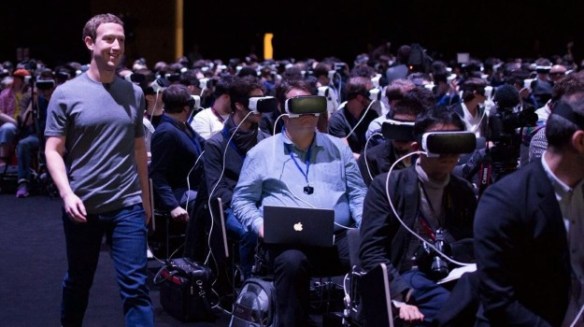
The world wide cage

zuckerberg_VR_people-625x350

Technology promised to set us free. Instead it has trained us to withdraw from the world into distraction and dependency

By Nicholas Carr

Source: Aeon

It was a scene out of an Ambien nightmare: a jackal with the face of Mark Zuckerberg stood over a freshly killed zebra, gnawing at the animal’s innards. But I was not asleep. The vision arrived midday, triggered by the Facebook founder’s announcement – in spring 2011 – that ‘The only meat I’m eating is from animals I’ve killed myself.’ Zuckerberg had begun his new ‘personal challenge’, he told Fortune magazine, by boiling a lobster alive. Then he dispatched a chicken. Continuing up the food chain, he offed a pig and slit a goat’s throat. On a hunting expedition, he reportedly put a bullet in a bison. He was ‘learning a lot’, he said, ‘about sustainable living’.

I managed to delete the image of the jackal-man from my memory. What I couldn’t shake was a sense that in the young entrepreneur’s latest pastime lay a metaphor awaiting explication. If only I could bring it into focus, piece its parts together, I might gain what I had long sought: a deeper understanding of the strange times in which we live.

What did the predacious Zuckerberg represent? What meaning might the lobster’s reddened claw hold? And what of that bison, surely the most symbolically resonant of American fauna? I was on to something. At the least, I figured, I’d be able to squeeze a decent blog post out of the story.

The post never got written, but many others did. I’d taken up blogging early in 2005, just as it seemed everyone was talking about ‘the blogosphere’. I’d discovered, after a little digging on the domain registrar GoDaddy, that ‘roughtype.com’ was still available (an uncharacteristic oversight by pornographers), so I called my blog Rough Type. The name seemed to fit the provisional, serve-it-raw quality of online writing at the time.

Blogging has since been subsumed into journalism – it’s lost its personality – but back then it did feel like something new in the world, a literary frontier. The collectivist claptrap about ‘conversational media’ and ‘hive minds’ that came to surround the blogosphere missed the point. Blogs were crankily personal productions. They were diaries written in public, running commentaries on whatever the writer happened to be reading or watching or thinking about at the moment. As Andrew Sullivan, one of the form’s pioneers, put it: ‘You just say what the hell you want.’ The style suited the jitteriness of the web, that needy, oceanic churning. A blog was critical impressionism, or impressionistic criticism, and it had the immediacy of an argument in a bar. You hit the Publish button, and your post was out there on the world wide web, for everyone to see.

Or to ignore. Rough Type’s early readership was trifling, which, in retrospect, was a blessing. I started blogging without knowing what the hell I wanted to say. I was a mumbler in a loud bazaar. Then, in the summer of 2005, Web 2.0 arrived. The commercial internet, comatose since the dot-com crash of 2000, was up on its feet, wide-eyed and hungry. Sites such as MySpace, Flickr, LinkedIn and the recently launched Facebook were pulling money back into Silicon Valley. Nerds were getting rich again. But the fledgling social networks, together with the rapidly inflating blogosphere and the endlessly discussed Wikipedia, seemed to herald something bigger than another gold rush. They were, if you could trust the hype, the vanguard of a democratic revolution in media and communication – a revolution that would change society forever. A new age was dawning, with a sunrise worthy of the Hudson River School.

Rough Type had its subject.

The greatest of the United States’ homegrown religions – greater than Jehovah’s Witnesses, greater than the Church of Jesus Christ of Latter-Day Saints, greater even than Scientology – is the religion of technology. John Adolphus Etzler, a Pittsburgher, sounded the trumpet in his testament The Paradise Within the Reach of All Men (1833). By fulfilling its ‘mechanical purposes’, he wrote, the US would turn itself into a new Eden, a ‘state of superabundance’ where ‘there will be a continual feast, parties of pleasures, novelties, delights and instructive occupations’, not to mention ‘vegetables of infinite variety and appearance’.

Similar predictions proliferated throughout the 19th and 20th centuries, and in their visions of ‘technological majesty’, as the critic and historian Perry Miller wrote, we find the true American sublime. We might blow kisses to agrarians such as Jefferson and tree-huggers such as Thoreau, but we put our faith in Edison and Ford, Gates and Zuckerberg. It is the technologists who shall lead us.

Cyberspace, with its disembodied voices and ethereal avatars, seemed mystical from the start, its unearthly vastness a receptacle for the spiritual yearnings and tropes of the US. ‘What better way,’ wrote the philosopher Michael Heim in ‘The Erotic Ontology of Cyberspace’ (1991), ‘to emulate God’s knowledge than to generate a virtual world constituted by bits of information?’ In 1999, the year Google moved from a Menlo Park garage to a Palo Alto office, the Yale computer scientist David Gelernter wrote a manifesto predicting ‘the second coming of the computer’, replete with gauzy images of ‘cyberbodies drift[ing] in the computational cosmos’ and ‘beautifully laid-out collections of information, like immaculate giant gardens’.

The millenarian rhetoric swelled with the arrival of Web 2.0. ‘Behold,’ proclaimed Wired in an August 2005 cover story: we are entering a ‘new world’, powered not by God’s grace but by the web’s ‘electricity of participation’. It would be a paradise of our own making, ‘manufactured by users’. History’s databases would be erased, humankind rebooted. ‘You and I are alive at this moment.’

The revelation continues to this day, the technological paradise forever glittering on the horizon. Even money men have taken sidelines in starry-eyed futurism. In 2014, the venture capitalist Marc Andreessen sent out a rhapsodic series of tweets – he called it a ‘tweetstorm’ – announcing that computers and robots were about to liberate us all from ‘physical need constraints’. Echoing Etzler (and Karl Marx), he declared that ‘for the first time in history’ humankind would be able to express its full and true nature: ‘we will be whoever we want to be.’ And: ‘The main fields of human endeavour will be culture, arts, sciences, creativity, philosophy, experimentation, exploration, adventure.’ The only thing he left out was the vegetables.

Such prophesies might be dismissed as the prattle of overindulged rich guys, but for one thing: they’ve shaped public opinion. By spreading a utopian view of technology, a view that defines progress as essentially technological, they’ve encouraged people to switch off their critical faculties and give Silicon Valley entrepreneurs and financiers free rein in remaking culture to fit their commercial interests. If, after all, the technologists are creating a world of superabundance, a world without work or want, their interests must be indistinguishable from society’s. To stand in their way, or even to question their motives and tactics, would be self-defeating. It would serve only to delay the wonderful inevitable.

The Silicon Valley line has been given an academic imprimatur by theorists from universities and think tanks. Intellectuals spanning the political spectrum, from Randian right to Marxian left, have portrayed the computer network as a technology of emancipation. The virtual world, they argue, provides an escape from repressive social, corporate and governmental constraints; it frees people to exercise their volition and creativity unfettered, whether as entrepreneurs seeking riches in the marketplace or as volunteers engaged in ‘social production’ outside the marketplace. As the Harvard law professor Yochai Benkler wrote in his influential book The Wealth of Networks (2006):

This new freedom holds great practical promise: as a dimension of individual freedom; as a platform for better democratic participation; as a medium to foster a more critical and self-reflective culture; and, in an increasingly information-dependent global economy, as a mechanism to achieve improvements in human development everywhere.

Calling it a revolution, he said, is no exaggeration.

Benkler and his cohort had good intentions, but their assumptions were bad. They put too much stock in the early history of the web, when the system’s commercial and social structures were inchoate, its users a skewed sample of the population. They failed to appreciate how the network would funnel the energies of the people into a centrally administered, tightly monitored information system organised to enrich a small group of businesses and their owners.

The network would indeed generate a lot of wealth, but it would be wealth of the Adam Smith sort – and it would be concentrated in a few hands, not widely spread. The culture that emerged on the network, and that now extends deep into our lives and psyches, is characterised by frenetic production and consumption – smartphones have made media machines of us all – but little real empowerment and even less reflectiveness. It’s a culture of distraction and dependency. That’s not to deny the benefits of having easy access to an efficient, universal system of information exchange. It is to deny the mythology that shrouds the system. And it is to deny the assumption that the system, in order to provide its benefits, had to take its present form.

Late in his life, the economist John Kenneth Galbraith coined the term ‘innocent fraud’. He used it to describe a lie or a half-truth that, because it suits the needs or views of those in power, is presented as fact. After much repetition, the fiction becomes common wisdom. ‘It is innocent because most who employ it are without conscious guilt,’ Galbraith wrote in 1999. ‘It is fraud because it is quietly in the service of special interest.’ The idea of the computer network as an engine of liberation is an innocent fraud.

I love a good gizmo. When, as a teenager, I sat down at a computer for the first time – a bulging, monochromatic terminal connected to a two-ton mainframe processor – I was wonderstruck. As soon as affordable PCs came along, I surrounded myself with beige boxes, floppy disks and what used to be called ‘peripherals’. A computer, I found, was a tool of many uses but also a puzzle of many mysteries. The more time you spent figuring out how it worked, learning its language and logic, probing its limits, the more possibilities it opened. Like the best of tools, it invited and rewarded curiosity. And it was fun, head crashes and fatal errors notwithstanding.

In the early 1990s, I launched a browser for the first time and watched the gates of the web open. I was enthralled – so much territory, so few rules. But it didn’t take long for the carpetbaggers to arrive. The territory began to be subdivided, strip-malled and, as the monetary value of its data banks grew, strip-mined. My excitement remained, but it was tempered by wariness. I sensed that foreign agents were slipping into my computer through its connection to the web. What had been a tool under my own control was morphing into a medium under the control of others. The computer screen was becoming, as all mass media tend to become, an environment, a surrounding, an enclosure, at worst a cage. It seemed clear that those who controlled the omnipresent screen would, if given their way, control culture as well.

‘Computing is not about computers any more,’ wrote Nicholas Negroponte of the Massachusetts Institute of Technology in his bestseller Being Digital (1995). ‘It is about living.’ By the turn of the century, Silicon Valley was selling more than gadgets and software: it was selling an ideology. The creed was set in the tradition of US techno-utopianism, but with a digital twist. The Valley-ites were fierce materialists – what couldn’t be measured had no meaning – yet they loathed materiality. In their view, the problems of the world, from inefficiency and inequality to morbidity and mortality, emanated from the world’s physicality, from its embodiment in torpid, inflexible, decaying stuff. The panacea was virtuality – the reinvention and redemption of society in computer code. They would build us a new Eden not from atoms but from bits. All that is solid would melt into their network. We were expected to be grateful and, for the most part, we were.

Our craving for regeneration through virtuality is the latest expression of what Susan Sontag in On Photography (1977) described as ‘the American impatience with reality, the taste for activities whose instrumentality is a machine’. What we’ve always found hard to abide is that the world follows a script we didn’t write. We look to technology not only to manipulate nature but to possess it, to package it as a product that can be consumed by pressing a light switch or a gas pedal or a shutter button. We yearn to reprogram existence, and with the computer we have the best means yet. We would like to see this project as heroic, as a rebellion against the tyranny of an alien power. But it’s not that at all. It’s a project born of anxiety. Behind it lies a dread that the messy, atomic world will rebel against us. What Silicon Valley sells and we buy is not transcendence but withdrawal. The screen provides a refuge, a mediated world that is more predictable, more tractable, and above all safer than the recalcitrant world of things. We flock to the virtual because the real demands too much of us.

‘You and I are alive at this moment.’ That Wired story – under headline ‘We Are the Web’ – nagged at me as the excitement over the rebirth of the internet intensified through the fall of 2005. The article was an irritant but also an inspiration. During the first weekend of October, I sat at my Power Mac G5 and hacked out a response. On Monday morning, I posted the result on Rough Type – a short essay under the portentous title ‘The Amorality of Web 2.0’. To my surprise (and, I admit, delight), bloggers swarmed around the piece like phagocytes. Within days, it had been viewed by thousands and had sprouted a tail of comments.

So began my argument with – what should I call it? There are so many choices: the digital age, the information age, the internet age, the computer age, the connected age, the Google age, the emoji age, the cloud age, the smartphone age, the data age, the Facebook age, the robot age, the posthuman age. The more names we pin on it, the more vaporous it seems. If nothing else, it is an age geared to the talents of the brand manager. I’ll just call it Now.

It was through my argument with Now, an argument that has now careered through more than a thousand blog posts, that I arrived at my own revelation, if only a modest, terrestrial one. What I want from technology is not a new world. What I want from technology are tools for exploring and enjoying the world that is – the world that comes to us thick with ‘things counter, original, spare, strange’, as Gerard Manley Hopkins once described it. We might all live in Silicon Valley now, but we can still act and think as exiles. We can still aspire to be what Seamus Heaney, in his poem ‘Exposure’, called inner émigrés.

A dead bison. A billionaire with a gun. I guess the symbolism was pretty obvious all along.

Saturday Matinee: VR Short Double Feature

“Uncanny Valley” (2015, dir. Federico Heller) uses a documentary format and virtual reality scenarios to depict a frightening world in which damaged individuals rely on VR as a means to escape their depressing social reality while being used by the state.

“Hyper-Reality” (2016, dir. Keiichi Matsuda) depicts an average day in the life of a struggling precariat woman, that is, until she’s gang stalked by virtual and physical predators.

Who Lost: A Biased Media, Pundits, Pollsters, Political Parties, Warmongers, the Corporatocracy, Pay-to-Play Grifters, Neoliberals

1596525_630x354

Editor’s Note: While the parties mentioned may have lost in the short run, it’s likely they’ll soon regroup for future assaults on humanity and the planet.

By Charles Hugh Smith

Source: Of Two Minds

Fake Progressives are perfectly fine with soaring inequality and corrupt governance, as long as everyone’s public utterances are politically correct.

Sometimes who lost is more important than who won. Let’s review who lost the election:

1. Let’s start with the Corporatocracy, which expected to once again wield unlimited influence by funding political campaigns with millions of dollars in contributions and speaking fees.

2. A biased mainstream media. My mom-in-law was watching CBS all night, so that’s what we watched. All the pundits/anchors spoke in the hushed tones of a funeral. For two hours, the only images of campaign workers shown were the sad faces of Clinton supporters; not one image of jubilant Trump supporters was broadcast until Trump gave his acceptance speech.

When one of the talking heads noted that Hillary never generated the enthusiasm of the Sanders or Trump campaigns, his comment was followed by a stony silence. That he had given voice to a self-evident truth was not welcome.

3. Mainstream punditry: they got it wrong from the start and remained close-minded and arrogant in their postured superiority.

The punditry applied a double standard to Trump and Hillary. Trump’s speeches and ethically questionable history were judged by moral standards, and he was declared unfit.

Hillary’s actions, on the other hand, were judged by strictly legalistic standards: well, you can’t indict her, so she’s fit for office.

Dear punditry: you can’t use double standards to promote your biases and retain any shred of credibility.

4. Pollsters. Having rigged the polls via over-sampling and under-sampling, they were laughably wrong. Here is a typical headline from election night, from the New York Times: Trump Takes Florida, Closing In on a Stunning Upset.

Only the pollsters and the MSM were stunned.

5. Political parties. As my friend G.F.B. observed, both parties ran 20th century campaigns in the 21st century. Both parties lost for this reason; both are hopelessly out of touch with a rapidly changing America.

Democrats upset with losing should look at their party’s system of Super-Delegates that squelched Bernie Sander’s bid.

6. Warmongers. Many Americans are sick and tired of interventionist, globalist warmongering. The only possible way they could register their opposition to warmongering was to vote for Trump.

7. Pay-to-Play Grifters. Let the investigations, indictments, prosecutions and convictions begin as soon as Trump is sworn in.

8. Neoliberals. Globalization boils down to freeing mobile capital to rove the globe for opportunities to strip-mine cheap resources, assets and labor and then move on, leaving ruined communities behind.

9. Bonus loser: Fake Progressives. Fake Progressives are perfectly fine with soaring inequality and corrupt governance, as long as everyone’s public utterances are politically correct. So the oppressor class is acceptable as long as they speak respectfully while stepping on your neck.

Real Progressives see jobs and community as solutions, not welfare and central planning. Real Progressives see the eradication of warmongering Imperial pretensions and corrupt pay-to-play grifting as the essential projects of liberty and democracy.

The real Hunger Games: the Capitalist recipe to maximise profits while ‘having fun’

peacekeeper

By Sky Wanderer

Source: Investment Watch

Introduce a political economy upon the arbitrary axiom that Capitalism is the one and only economic system for mankind, and introduce a narcissistic moral philosophy that you as a Capitalist represent unsurpassable objective moral virtues.

You as a Capitalist hire politicians to implement policy as per your moral and economic philosophy and redefine ‘democracy’ as the political system to sustain Capitalism. Then from such position of self-established authority, abolish unions and all labour-representation, thus force your employees into a race-to-the-bottom contest to compete for jobs by accepting lower and lower wages.

Give decent jobs and benefits to only those who belong to your noble circles. For everyone else reintroduce slavery in the form of “workfare”. The goal is that you pay the lowest wages for jobs done by the fittest slaves, who will survive the contest. If you wish, you can call the contest “real Hunger Games”.

To speed up the process, extend the race-to-the-bottom into global scope so that you will have access to the cheapest and fittest labour everywhere on the planet. Never mind that your slaves will have to live out of a suitcase and every time when you lay them off and labour demand calls them elsewhere, they will have to relocate to yet another continent.

To further accelerate the process, make good use of your 3rd-world colonies, your Mideast colonising wars and your secretly sponsored mercenaries (ISIS). Via your “leftist” assistants, organise a massive refugee crisis to import the cheapest possible workforce via your war-refugees and economic migrants. These migrants are the fittest contestants who – glad just to escape your bombs – will worship you as their saviours and will work for you for literally zero payment. The migrants will not only boost your profits to sky-high levels but will rapidly pull down the overall wages of your domestic employees.

Meanwhile keep increasing the prices so your slaves can’t pay for food, energy, heat and shelter from their next-to-zero incomes. If some of them attempt to survive by taking bank-loans to acquire shelter, education and meet other basic needs, but they can’t repay the loans from their low incomes, you can just evict them from their homes via your banks.

When you made them homeless this way, make sure their ugly presence won’t spoil the beauty of your city. Install pretty anti-homeless spikes, so when they crush onto the pavement they will die, and you can just collect their bodies. To project your capitalist moral virtues into eternity, incorporate the beauty of your anti-homeless spikes into the modern concept of art and beauty.

Introduce private banking to enable yourself to creating new money when you wish. This way you can easily indebt the entire society, soon you can even purchase the whole planet.

Meanwhile dismantle public healthcare, so those of your slaves who are still alive but get sick, will die without treatment. Eliminate (privatise) all affordable public services, destroy the public sphere, abolish all public spaces and welfare benefits. To have a dandy excuse for such policy, make sure to keep the country in ever increasing debt by taking countless £ billions of government loans, and transfer the responsibility of these odious debts onto your slaves. Refer to these debts as the reason for the crisis, then refer to the crisis as the reason for these debts, then refer to the debts and the crisis as the reason for austerity and spending cuts. Then you can increase the public debt again and continue the same loop ad infinitum.

Make sure your very own mainstream media and academia would never reveal the truth that the never-ending crisis and mass-unemployment are due to your private banking and debt- and profit-mongering dysfunctional capitalist system, and keep the real disastrous indicators of the state of economy in secret.

Instead of admitting the truth, use the divide et impera strategy to make your victims blame themselves and one another. To increase the fun, produce reality shows where the still active part of your slaves will blame the disabled and the unemployed, meanwhile make the local poor blame the immigrant poor for the overall misery that you inflicted. Then establish offices where the local poor dressed as fancy clerks will evict the immigrant poor, meanwhile watch how all of them are begging for their lives until they give up and commit suicide.

Enjoy!

Distrust of 2016’s Hackable Election Is a Media Landslide With Just One Solution: Hand-counted Paper Ballots

jf-7

By Bob Fitrakis and Harvey Wasserman

Source: FreePress.org

Finally, the major for-profit media is approaching consensus that it’s easy to hack U.S. political elections. Even candidates Hillary Clinton and Donald Trump are raising unprecedented doubts – from very different directions – about the reliability of the upcoming vote count.

Ultimately, there is just one solution: universal hand-counted paper ballots, with carefully protected voter registration rolls, and a transparent chain of custody.

The corporate media and the Democrats are obsessed with the “Russians.” Donald Trump rants about a mythological army of voters voting multiple times.

But the real threat to our election system comes from private for-profit corporations that register voters, control voter databases, then count and report the vote with secret proprietary software and zero transparency, accountability, or recourse.

After ignoring or attacking the reportage since Florida 2000 of Bev Harris, Greg Palast, freepress.org and numerous others, the corporate media seems finally to be getting the message: under the current system, any American election – even the one for president – can be stripped and flipped by a tiny handful of electronic hackers working anywhere from the Kremlin to a party HQ to a state governor’s office to a teenager’s garage.

Here is some of what the mainstream media is finally admitting. In an article posted on July 28, 2016, NBC News pointed out that our elections are vulnerable to hacking because they “are not part of the vast ‘critical infrastructure protection’ safety net set up by the Department of Homeland Security.”

CBS News wrote August 10, 2016, about “the hackers at Symantec Security Response” who demonstrated how “Election Day results could be manipulated by an affordable device you can find online.”

Former national coordinator for counter-terrorism Richard Clarke, reporting for ABC News on August 19, 2016, analyzed the particular security problems related to battleground states like Ohio and Florida: “In 2000 and 2004, there were only a handful of battleground states that determined which presidential candidate had enough Electoral College votes to win. A slight alteration of the vote in some swing precincts in swing states might not raise suspicion. Smart malware can be programmed to switch only a small percentage of votes from what the voters intended. That may be all that is needed, and that malware can also be programmed to erase itself after it does its job, so there might be no trace it ever happened.” Clarke was on the White House National Security Council during both Bill Clinton’s and George W. Bush’s administrations.

Zeynep Tufekci, an associate professor at the North Carolina School of Information and Library Science, in his August 12, 2016 New York Times op-ed “The Election Won’t Be Rigged but It Could Be Hacked,” wrote: “The mere existence of this discussion is cause for alarm. The United States needs to return, as soon as possible, to a paper-based, auditable voting system in all jurisdictions that still use electronic-only, unverifiable voting machines.”

On August 30, 2016, the Washington Post wrote: “Deleting or altering data on voter rolls could cause mayhem on Election Day disenfranchising some voters. Many voting machines themselves also are vulnerable, especially touch-screen systems that do not create a paper record as a guard against fraud or manipulation.” The Post also supplied a list of the 15 states with the most vulnerable voting systems.

The list of those now admitting the obvious includes the Boston Globe, The Atlantic, USA Today, The Guardian, Mother Jones, and Politico, some of which have previously mocked those of us reporting on this issue. Most important has been the highly influential The Hill, which weighed in on May 2, 2016 with “Election fraud feared as hackers target voter records.” The lede was straightforward: “A series of data breaches overseas are spurring concerns that hackers could manipulate elections in the United States.”

Trump advisor Roger Stone wrote a column in The Hill with the headline: “Can the 2016 Elections Be Rigged? You Bet.” He also referred to our latest summary volume, “The Strip & Flip Selection of 2016: Five Jim Crows & Electronic Election Theft,” as “a must-read book on the strip and flip techniques used to rig these machines.”

But in the 2016 primary election, there are other must-reads as well. Perhaps the most important is Election Justice USA’s report entitled “Democracy Lost: A Report on the Fatally Flawed 2016 Democratic Primaries.” This report cites six major areas of election irregularities in this year’s 26 primary elections:

1) Targeting voter suppression

2) Registration tampering

3) Illegal voter purges

4) Exit poll discrepancies

5) Evidence for voting machine tampering

6) The security (or lack thereof) of various voting machines types.

In their 96-page report, Election Justice researchers documented how Hillary Clinton’s campaign benefited from these “various types of fraud.” Their conclusion: “Based on this work, Election Justice USA has established an upper estimate of 184 pledged delegates lost by Senator Bernie Sanders as a consequence of specific irregularities and instances of fraud.”

Election Justice’s well-documented estimate that Sanders lost 184 delegates means that if the election had been conducted fairly, the Senator from Vermont would now be the Democratic nominee.

Another document essential to understanding election irregularities that allowed Hillary Clinton to capture the Democratic Party nomination is a paper co-authored by Axel Geijsel of Tilburg University in the Netherlands and Rodolfo Cortes Barragan of Stanford University. Their analysis found that primary election results in states with the most vulnerable and hackable voting machines and without a paper trail overwhelmingly favored Hillary Clinton 65 percent to 35 percent. Sanders led Clinton 51 percent to 49 percent in states where the vote count could be verified with a paper trail.

The correlation between the increased Clinton vote and the increased vulnerability of the voting machines has been avoided like the plague by the corporate media.

Equally important to read is mathematician Richard Charnin’s blog. Charnin is a man the mainstream media often attacks – but not with mathematical formulas to rebut Charnin’s detailed analysis. Rather they attack him because, like the vast majority of Americans, he believes that John F. Kennedy was not killed by a lone gunman. In 2016, official Democratic primary vote counts compared to exit poll results were significantly outside the margin of error in 12 of 26 states. Charnin concluded that the probability of those official vote tallies being correct are one in 78 billion. There were no such discrepancies in this year’s Republican primaries.

Now 16 years after the theft of the presidency in Florida 2000, and a dozen since it was done again in Ohio 2004, the corporate media are approaching consensus that it is indeed very easy to strip millions of legitimate citizens from the voting rolls, and then to hack electronic voting machines and computerized central tabulators to flip the official final outcome.

The threat to this year’s election does not come from non-existent armies of mythological hordes voting multiple times. It comes from the private partisan companies with their secret proprietary software that control the voter rolls, the electronic machines, and ultimately the final outcome at all levels of government. The mega-corporations are the ones that flipped George W. Bush into the White House and Hillary Clinton into the Democratic nomination, not to mention manipulating countless Senate, House, and state and local elections along the way.

For a hopelessly vulnerable electronic election system which is flawed, hackable and riggable from top to bottom, there is just one solution: transparent unhackable voter rolls, and universal hand-counted paper ballots open to public scrutiny from the precinct level to the final official tallies, as dutifully reported by our slowly awakening corporate media.


Bob Fitrakis & Harvey Wasserman are co-authors of The Strip & Flip Selection of 2016: Five Jim Crows & Electronic Election Theft, available at www.freepress.org and www.solartopia.org, where Bob’s Fitrakis Files and Harvey’s Solartopia! can also be found.

American Psycho: Sex, Lies and Politics Add Up to a Terrifying Election Season

hillary-trump

By John W. Whitehead

Source: The Rutherford Institute

“I have all the characteristics of a human being: blood, flesh, skin, hair; but not a single, clear, identifiable emotion, except for greed and disgust. Something horrible is happening inside of me and I don’t know why. My nightly bloodlust has overflown into my days. I feel lethal, on the verge of frenzy. I think my mask of sanity is about to slip.”—Patrick Bateman in American Psycho

When it comes to sexual predators, there should be no political bright line test to determine who gets a free pass and who goes to jail based on which candidate is better suited for office.

Yet almost 20 years after Bill Clinton became the first and only sitting president to be sued for sexual harassment and impeached for lying under oath about his sexual escapades while in office, the Left and the Right are still playing politics with women’s rights.

I should know.

As one of Paula Jones’ lawyers in her sexual harassment lawsuit against Bill Clinton (Hillary Clinton infamously and erroneously accused me of being part of a “vast right-wing conspiracy”), I saw first-hand how quickly Hillary Clinton and the nation’s leading women’s rights groups demonized any woman who dared to accuse Bill Clinton of sexual misconduct while turning a blind eye to a long list of incidents involving groping, propositioning, and pressuring women for sexual favors.

Trust me, it was a very long list.

As journalist Marjorie Williams documented in “Clinton and Women” for Vanity Fair:

“The man in question [Bill Clinton] has been sued for sexual harassment over an episode that allegedly included dropping his trousers to waggle his erect penis at a woman who held a $6.35-an-hour clerical job in the state government over which he presided. Another woman has charged that when she asked him for a job he invited her into his private office, fondled her breasts, and placed her hand on his crotch. A third woman confided to friends that when she was a 21-year-old intern she began an affair with the man… Actually, it was less an affair than a service contract, in which she allegedly dashed into his office, when summoned, to perform oral sex on him… Let us not even mention the former lover who was steered to a state job; or the law-enforcement officers who say the man used them to solicit sexual partners for him; or his routine use of staff members, lawyers, and private investigators to tar the reputation of any woman who tries to call him to account for his actions.”

I also witnessed first-hand the hypocrisy of the Religious Right, which was eager to stand in judgment over Clinton for his marital infidelity, while at the same time turning a blind eye to the indiscretions of other conservative politicians in their midst.

Fast forward 20 years, and the women’s rights groups that were silent when Bill Clinton was being outed as a sexual predator have suddenly found their voice and their outrage in the face of accusations that Donald Trump groped and kissed women without their consent. Likewise, the religious groups that were aghast over Clinton’s sexual immorality have somehow created a sliding scale of sin that allows them to absolve Trump of his own indiscretions.

It’s like being in the Twilight Zone.

Only instead of Rod Serling’s imaginary “land of both shadow and substance, of things and ideas,” we’re trapped in an all-too-real land of politics and lies, where freedom and integrity play second fiddle to ambition and greed.

Nothing is real.

This year’s presidential contest and its candidates have, through their double-talking and lies, pulled back the curtain to reveal that what we see is all part of an elaborate hoax, a cruel game where “we the people” are just pawns to be used, abused, discarded and demonized when convenient.

Consider if you will: Bill Clinton was accused of using various and sundry women for sex. For years, he lied about his affairs and accused his accusers of smear campaigns. Only when caught red-handed, did he finally admit—sort of—to having sexual relations with certain women. At no time did he ever apologize for abusing his authority and disrespecting women.

Trump not only is accused of making sexual advances on various women, but he also used Clinton’s sexual victims to score points off Hillary.

And Hillary, in turn, has used and abused both Clinton and Trump’s sexual victims in order to advance her own political ambitions.

As Melinda Henneberger and Dahlia Lithwick wrote for Slate back in 2008:

Hillary Clinton the candidate has largely benefited from her husband’s extracurricular activities… Sure, her husband’s behavior has humiliated her. But she has also helped him humiliate the women he’s been involved with… One of the most troubling things about Hillary Clinton is that she is never above cashing in on [the politics of victimization].

Are you starting to get it yet?

All this talk about sexual predators is just so much political maneuvering to score points off one another. Neither Hillary Clinton nor Donald Trump care one whit about the victims of sexual harassment.

Frankly, they don’t seem to care much about the rest of the populace, either.

For all intents and purposes, we’re all victims of a perverse, perverted, psychotic mindset that views the citizenry as lesser beings: lacking in value, unworthy of respect, and completely undeserving of the legal rights and protections that should be afforded to all Americans.

In the eyes of Bill, Hillary, Donald and the powers-that-be, we’re all little more than “bimbos,” “trailer trash,” “nuts and sluts,” “loony toons,” “fat pigs, dogs, slobs and disgusting animals.”

In other words, we’re all Paula Jones. And Gennifer Flowers. And Juanita Broaddrick.  And Kathleen Willey. And Eileen Wellstone. And Cristy Zercher. And Connie Hamzy. And Monica Lewinsky. For that matter, we’re all Jill Harth. And Cassandra Searles. And Jessica Leeds. And Kristin Anderson, too

This is what happens when politics is allowed to trump principle: “we the people” lose.

The women’s movement lost when it chose politics over principle, then and now.

Women have been suffering because of that choice ever since. As feminist Jessica Valenti acknowledged in the Washington Post, “For women in America, equality is still an illusion. We’re basking in a ‘girl power’ moment that doesn’t exist—it’s a mirage of equality that we’ve been duped into believing is the real thing. Because despite the indisputable gains over the years, women are still being raped, trafficked, violated and discriminated against—not just in the rest of the world, but here in the United States… It’s time to stop fooling ourselves. For all our ‘empowered’ rhetoric, women in this country aren’t doing nearly as well as we’d like to think.”

The Religious Right lost when it chose politics over principle, then and now.

By compromising their values, they have made themselves completely irrelevant in matters of public policy. “As an organized and potent force in national politics, the Christian right has faded into nothingness,” policy analyst Paul Waldman concluded for the Washington Post. “It now exists for nothing more than to be patted on the head and sent on its way with an encouragement to vote in November.”

The media—through its careful crafting of news stories to advance one politician over another—chose politics over principle, then and now. Barring a few exceptions, they have become little more than mouthpieces for the corporate elite.

The citizenry is faced with a choice right now: to be distracted by mudslinging and circus politics or to forge a new path for the nation that rejects politics in favor of locally-based, transformative grassroots activism.

“Perhaps you think that by voting at least you’re doing your small part, making your small contribution. But contributing toward what?” asks commentator Dan Sanchez.

Sanchez continues:

Candidates are package deals. Any candidate will violate the rights of some, even if they respect or defend the rights of others. Objectors say it’s about going in the general right direction, making choices out of which the good outweighs the bad, that do a net amount of good, that is good “on balance.” But that is collectivist speak. There is no “good on balance” for the people whose lives are run over by the candidate you empowered: for the child who is bombed by Hillary’s foreign policy, for the man who is shot by Trump’s police state, or the people Gary Johnson and Bill Weld kept in cages when they were governors.

Sanchez is right: the act of voting is indeed futile.

Voting in this political climate merely advances the agenda of the police state and affirms the government’s pillaging, raping, killing, bombing, stealing, shooting and many acts of tyranny and injustice.

Mark my words: no matter who wins this election, the predators of the police state will continue to wreak havoc on our freedoms, our communities, and our lives.

After all, police officers are still shooting unarmed citizens. Government agents—including local police—are still being armed to the teeth and encouraged to act like soldiers on a battlefield. Bloated government agencies are still fleecing taxpayers. Government technicians are still spying on our emails and phone calls. And government contractors are still making a killing by jailing Americans for profit and waging endless wars abroad.

Are any of these issues being discussed right now? Not a single one.

It boggles the mind.

How is it possible that out of 318 million Americans in this country, we have been saddled with two candidates whose personal baggage and troubled histories make them utterly unfit for office anywhere but in the American police state?

We need to stop being victimized by these political predators.

As I make clear in my book Battlefield America: The War on the American People, I’m not just talking about the ones running for office, but the ones who are running the show behind the scenes—the shadow government—comprised of unelected government bureaucrats whose powers are unaffected by elections, unaltered by populist movements, and beyond the reach of the law.

Stop voting for their puppet candidates. Stop tolerating their long list of abuses. Stop making excuses for a system that long ago ceased to be legitimate. Most of all, stop playing by their rules and make them start playing by ours.

My fear is that we are nearing the point of no return.

“We the people”—men and women alike— have been victims of the police state for so long that not many Americans even remember what it is to be truly free anymore. Worse, few want to shoulder the responsibility that goes along with maintaining freedom.

Yet as John Adams warned, “A government once changed from Freedom, can never be restored. Liberty, once lost, is lost forever.

There is no way to erase the scars left by the government’s greed for money and power, its disregard for human life, its corruption and graft, its pollution of the environment, its reliance on excessive force in order to ensure compliance, its covert activities, its illegal surveillance, and its blatant disdain for the rule of law.

Still, we can forge a new path.

There is so much work to be done in order to right what is wrong with our nation, and there is so little time to fix what has been broken.

Let’s not waste any more time on predator politics. Let’s get to work.

Pokémon and the Age of Augmented Hyper-Surreality

maxresdefault

By Luther Blissett

Imagine walking to a park in a fairly average medium-sized city on a warm Summer day. There you see groups, pairs and individuals of different ages and races slowly milling about, some with dogs, some with baby carriages. Approaching closer, you realize nearly everyone in the park other than yourself is staring intently at their phone, occasionally tapping and swiping the screen. It seems odd, though not completely out of the ordinary in this day and age. Then, off in the distance at the far end of the park, someone shouts what sounds like a word in an alien language or dialect triggering a crowd to rapidly swarm towards the general area; most speed-walking or jogging but all aiming their phones at the same destination. Soon everyone in the vicinity of the park (except yourself a few vagrants and junkies of a less tech-savvy sort) surges towards the center of the swarm of over a hundred participants as if sucked into a vortex. As quickly as it started, the crowd disperses and an “normalcy” resumes, albeit temporarily since the pattern repeats continuously at half hour to one hour intervals throughout different areas of the park.

This dream-like scenario is an outsider’s description of a Pokémon Go session on a typical Summer weekend at Bellevue Downtown Park. The crowd might have been slightly larger than usual due to the balmy weather, but numerous videos posted on YouTube indicate such occurrences aren’t completely anomalous.

An example:

Still, the relative newness and novelty of the experience doesn’t make it feel any less like being in a dystopian narrative such as a Philip K. Dick novel or an episode of Charlie Brooker’s “Black Mirror”. However, the sense of social displacement and alienation for non-gamers is dampened by nearly a decade of collective exposure to increasingly advanced internet-enabled cellphones whose ubiquity and usage has steadily increased over the years.

Prior to the release of Pokémon Go more people have been spending increasing hours using smartphones for talking, texting, email, news, entertainment and social media, selfies, etc. In the context of modern industrial society it’s almost an aberration to be without a device, or to not be heavily reliant on one. What sets Pokémon Go apart is its ability to simulate a fusion of material and virtual worlds by depicting through phone screens digital sprites superimposed on real-time images of physical environments to its users.

Just as shamans would use entheogens to peer behind the veil of reality, augmented reality allows users to perceive additional veils over reality. This is not necessarily a bad thing because there’s potential for “digital veils” to assist us in seeing what certain interests might prefer to keep hidden. For example, what if everyone could literally see the interests orchestrating a politician’s rise to power? What if we could walk into any store and instantly know which products were made by war-profiteers, polluters, and/or sweatshop owners? Would people want to know? How much of an impact would it have on decisions and actions in the context of a media environment inundated with heavily financed government/corporate PR and marketing? Of course, even without augmented reality the virtual realm affects the “real world”, most notably with the economic dominance of the tech industry as well as the social, political and economic havoc wreaked by hackers; but rarely is such influence immediately manifested as when crowds swarm newly spawned Pokémon sprites.

In many ways, Pokémon Go was the ideal vehicle to bring augmented reality to the masses. Many apps have utilized it for different purposes such as navigating, translating, finding dates, viewing celestial objects, narrating self-guided tours, weather forecasting, image enhancement, etc., but only Pokémon was able to use the technology to bring a fictional universe closer to life by creating a cross-generational craze. Alfie Brown of ROAR Magazine, characterized virtual Pokémon as the perfect example of what Jacques Lacan called the objet petit a, a fetishized yet ephemeral and unobtainable object of desire, a key concept behind consumerist neoliberalism’s push towards cheap, chronically obsolete, ephemeral and now digital goods and services.

But what makes Pokémon creatures so desirable? In regard to children, they seem naturally drawn towards cute and brightly colored cartoon characters. The mechanics of the game taps into natural tendencies to collect things and to display one’s collection to others (a phenomenon South Park astutely critiqued on episodes lampooning World of Warcraft and “freemiums”). In consumer societies children and adults are prone to feeling prestige and power from the size and perceived value of their collections; however, children are mostly limited in terms of the acquisitive power: video games elicit a rare opportunity to gain more prestige and power than adults have in real life.

As for older folks, there’s a variety of additional interconnected factors. For teens and young adults, peer pressure alone might be enough to hook some people, but the mainstreaming of geek culture no doubt plays a part, making fandom, quirkiness and technological obsession more accepted and valued. The transition to adulthood also happens to be a time when there’s increased pressure to establish one’s sense of identity, become more independent and to succeed academically and professionally. Games are a means of escape from such pressures (as real life opportunities for economic advancement continue to dwindle) while at the same time functioning as structured activities for social interaction and, more broadly, to build communities. For adults, reasons may include all of those previously mentioned in addition to fascination with technology, bonding with younger friends and family, the feeling of being part of a global phenomena, or nostalgia for the original Pokémon games, for example.

Returning to Pokémon Go’s more dystopian aspects, the game has been used as a tool by the unscrupulous for crimes such as robbery and sexual assault. Though crowds created by Pokémon Go spawning areas or “gyms” (locations where players battle each other in teams to increase their avatars’ abilities) have been a benefit to some local businesses, residential neighbors in some cases view game players as unwanted loiterers invading their privacy. There have also been news reports of video game battles escalating to physical brawls and innocent gamers being racially profiled as suspicious threats.

As with most online tools, there’s a risk of the app and users being exploited for surveillance, social control, to extract money and personal data, etc. Modern media literacy requires an understanding of how businesses benefit from our use of game and service apps (especially “free” ones) and how intentional or unknowing misuse of collected data could serve government/corporate/criminal interests. Augmented reality games are an exciting new media with potential to be used in novel and fun ways, but we should be vigilant of its potential to influence beliefs as well as decisions regarding how we spend time and resources.

Pokémon Go is at the forefront of the increasing power of tech companies such as Google and Niantic (the software developer behind Pokémon Go) to control and use information to manipulate the masses. Such power in itself is disturbing, but more sensational examples might include news reports of car accidents caused by drivers mindlessly following Google Maps off the road or colliding into other cars while playing Pokémon Go. Such cases may seem absurd but they prompt a number of important questions. Why do some prioritize and trust mediated information over their own senses? As online personas increase in perceived importance, at what lengths will people go to sustain it and would it be at the expense of others things (such as personal safety)? Are we becoming addicted to cognitive “skinner boxes” with our needs perpetually triggered and gratified by apps? In an increasingly hyperreal world in which the boundary between the real and virtual becomes more permeable, what new hazards await?

Roaming Charges: a Wikileak is a Terrible Thing to Waste

img_0135

By Jeffrey St. Clair

Source: CounterPunch

+ I’ve spent the week greedily consuming the treats offered up by Wikileaks’s excavation of John Podesta’s inbox. Each day presents juicy new revelations of the venality of the Clinton campaign. In total, the Podesta files provide the most intimate and unadulterated look at how politics really works in late-capitalist America since the release of the Nixon tapes.

+ There’s a big difference, though. With Nixon, the stakes seemed greater, the banter more Machiavellian, the plots and counter-plots darker and more cynical.

+ The Podesta email tranches show the inner mechanics of a much more mundane, petty and banal political machine. Instead of shaping a campaign around an ideological movement, the Clinton operation resembles the packaging of a political mutual fund, a balanced, low-risk portfolio of financial interests, captive NGOs and dependent demographic sectors.

+ The red meat in the emails can be found in the disclosures of the internal rivalries, self-aggrandizement and sycophancy of hired guns and consultants, especially as they gravitate toward Podesta, whose chilly presence looms behind the scenes like the ghost of Thomas Cromwell.

+ The three prevailing obsessions of the Podesta emails: raising money, containing the contamination of the Clinton Foundation and screwing Bernie Sanders. There’s barely any hint of anxiety over Trump. In fact, they relish his every false move, almost as if each faltering step had been pre-visualized, if not orchestrated.

+ If possible, the press corps comes off worse than Team Clinton. Almost every reporter is revealed as pliable, servile and so lazy that they basically beg the Clinton PR shop to write their stories for them.

+ The press has reiterated this obsequiousness over the course of the last seven days with what can only be described as an orgy of coverage of the Trump sex tapes and assorted scandals. By all accounts, the Trump campaign is dead and has been for weeks. The 24/7 obsession now amounts to a kind of political corpse abuse. Forsaken in this feeding frenzy has been any serious attention at all to the Wikileaks email dump, except to echo Clinton camp assertions that they were the victims of a Russian plot to tilt the election to Trump. If so, the Russians have proved even more incompetent than we thought them to be.

+ Of course, the Russian diversion is a convenient excuse for the lapdog press having missed one major scandal after another that has been staring them in the face for months, if not years.

+ Significantly, the email dump also proves what many of us have long suspected: that there are no walls separating the Clinton campaign, its foundation and Super Pacs and the DNC itself. Those supposedly distinct entities are, in fact, all part of one vast, interconnected organization–a syndicate, if you will, that has deftly evaded campaign finance laws (created by Democrats) and rigged its own primary process to ensure a pre-ordained winner.

+ The key thing to remember about the DNC is that it has been under the complete control of the Clintons and their operatives since the 1990s. Obama never cleaned house and installed his own people, a lapse that proved fatal to his own political and legislative agenda. The Clintons’ loyalty to Obama was always paper-thin and conditioned on whether it would advance their own interests: Hillary’s pursuit of the presidency and Bill’s maniacal quest for lucrative speaking fees.

+ It was no surprise that Bill unloaded on ObamaCare a few days ago, calling it the “craziest thing in the world.” The Clintons want to efface Obama’s legacy and replace it with their own, the same way the Pharaohs of ancient Egypt smashed the images of the previous ruler and replaced it with their own visage.

+ So what follows are a few of my favorite revelations from Podesta’s inbox, starting with an email where Podesta is joking about a fundraiser on Martha’s Vineyard. John Podesta: “I didn’t think wet works meant pool parties at the Vineyard.” Another Clinton murder? Check the drain for trace evidence?

+ I can picture the invitation: “HRC Pool Party: Donate or Drown!”

+ Rightwing websites, of course, are taking this as proof, HRC, murdered Scalia.

+ Peter Berlios reminded me of the global outrage when Trump’s special friend, Vladimir Putin, used a similar expression in regard to the Chechens: “We will wet them even in the shit house.”

+ By the way, John Podesta owned 75,000 shares in Leonidio LLC, a firm linked to who? Yes, Vladimir Putin.

+ Podesta’s correspondent in this exchange is Steve Elmendorf, a longtime Democratic powerbroker who was Dick Gephardt’s chief of staff. Over the years, Elmendorf has perfected the art, crucial to any Democratic candidate, of seducing progressive sectors of the party to dutifully line up behind a neoliberal candidate. A few years ago, he explained his strategic thinking this way:

“The bloggers and online donors represent an important resource for the party, but they are not representative of the majority you need to win elections. The trick will be to harness their energy and their money without looking like you are a captive of the activist left.”

+ Bill Richardson is the famously irascible former Governor of New Mexico, who served as Energy Secretary and UN ambassador during Bill Clinton’s second term. The relationship soured when the governor broke ranks and endorsed Barack Obama in 2008. Richardson and the Clintons have been feuding ever since. Indeed, Bill once described the antagonism as a “permanent” state of hostilities.

In August of 2015, Podesta took it on his own initiative to negotiate a detente between the two men. Apparently, Hillary was furious at Podesta’s impertinence. She doesn’t forgive. Podesta writes back urging her to consider the political consequences, especially with Hispanics in must-win western states like Colorado and New Mexico, where Richardson still has pull.

“I had heard that you were upset that I encouraged a call between [Bill Clinton] and Richardson to bury the hatchet. I did that at the request of Jose Villarreal who pushed me and made the point that Richardson is still on TV a lot, especially on Univision and Telemundo and not withstanding the fact that he can be a dick, it was worth getting him in a good place. Probably worth a quick call to ask him to stay stout and publicly endorse, but if it’s too galling, don’t bother.”

+ Even someone as close to the Clintons as Podesta keeps running into the couple’s aversion to apologizing for anything. After issuing a non-apology apology on her email server scandal, Podesta gripes to his number two, Neera Tanden: “No good deed goes unpunished. Press takeaway was the whine of but ‘she really didn’t apologize to the American people. I am beginning to think Trump is on to something.”

Tanden notes: “Everyone wants her to apologize. And she should. Apologies are like her Achilles heel…This apology thing has become like a pathology. I can only imagine what’s happening in the campaign. Is there some way I can be helpful here? I know if I just email her she will dismiss it out of hand.”

Podesta replies tersely: “You should email her. She can say she’s sorry without apologizing to the American people. Tell her to say it and move on, why get hung on this.”

+ Few figures in the Podesta emails come off as more appalling than Neera Tanden, whose primary mission, perhaps the only thing she is really competent at, is detecting even minor deviations from obedience to Clintonian orthodoxy. No one agitates her more than Bernie and his Sandernistas, who she seems ready to dial up a drone strike against at a moment’s notice. She’s the Lee Atwater of neoliberalism, without Atwater’s malign intelligence and sense of humor.

+ Here’s Neera in panic mode over a Wall Street Journal piece on Hillary’s email server quoting an anonymous White House as saying Clinton may have “screwed up” on the matter. Tanden gets so worked up that she seems ready to target Obama: “WH crapping on her is going to send this into orbit.”

+ During one of her speeches-for-hire, Hillary promised Wall Street tycoons that she would block marijuana legalization (don’t want to cut into those tobacco stocks). Here’s her archly worded back and forth with Xerox’s CEO, Ursula Burns, following March 2014 speech. Clinton used Wall Street lingo to express her opposition to ending pot prohibition “in all senses of the word.” Who says she doesn’t have a sense of humor?

URSULA BURNS: So long means thumbs up, short means thumbs down; or long means I support, short means I don’t. I’m going to start with — I’m going to give you about ten long-shorts.

SECRETARY CLINTON: Even if you could make money on a short, you can’t answer short.

URSULA BURNS: You can answer short, but you got to be careful about letting anybody else know that. They will bet against you. So legalization of pot?

SECRETARY CLINTON: Short in all senses of the word.

+ When served with subpoena for records on Benghazi, a seriously agitated Robbie Mook asks, “We’re not releasing EVERYTHING, right?”

+ Among the things the Clinton damage control team must deal with: “Tony Rodham hustling gold mining deals in Haiti.”

+ I wonder if they considered setting up a special squad to deal with Clinton Hustler Eruptions?

+ Mark Siegel, the former executive director of the DNC, emailed Podesta on the eve of the Convention outlining strategies to entice the “self-righteous (Bernie) ideologues” to “work their asses off for Hillary.”

+ “Let’s throw Bernie a bone,” Siegel recommends, in the form of reducing the number of super delegates in 2020 primary campaign. Perhaps “Bernie Bones” could be come a new treat at Ben & Jerry’s?

+ Hillary’s closest advisor and most intimate confident is Huma Abedin. No one more aggressively enforces Hillary’s own wishes or guards her privacy. Abedin, who we must assume is speaking directly for Hillary, is adamant that Hillary continue with her strategy of avoiding press conferences. Each time Hillary answers a few questions at one of her events, the message gets lost, Huma frets. “Can we survive not answering questions from press at message events?”

Podesta swats down this notion emphatically.

“If she thinks we can get to Labor Day without taking press questions, I think that’s suicidal. We have to find some mechanism to let the stream [sic] out of the pressure cooker.”

Not a huge deal, Huma. If HRC is compelled to answer, she can just lie the way she usually does. Hillary’s a natural.

+ One email to Podesta from Hillary’s account in August of 2014 provides confirmation for what we’ve long suspected: Clinton was well aware that Qatar and Saudi Arabia are the principle funders of ISIS in Iraq and Syria:

“While this military/para-military operation is moving forward, we need to use our diplomatic and more traditional intelligence assets to bring pressure on the governments of Qatar and Saudi Arabia, which are providing clandestine financial and logistic support to [ISIS] and other radical Sunni groups in the region.”

+ There’s a reason I started calling MSNBC MSDNC. Here we have an email from a producer of “All In with Chris Hayes” slobbering all over Hillary Clinton in an attempt to secure an appearance on Hayes’ tendentious show:

“Hey Adrienne,

Thanks for your help in getting Karen on with Chris the other night. I have a question for you. As you guys have probably seen, we’ve been airing a ‘Hillary Clinton for Millennials’ segment on our program every night this past week.”

“The point of the segment is basically to inform young people about all of the crap and nonsense that Sec. Clinton and President Clinton (but mostly Sec. Clinton) had to face back in the 90s when President Clinton was running for office…everything from cookie-gate to stand-by-your-man-gate to Hillarycare.”

“The point isn’t to dwell on the past but the point is to talk about this amazing, intelligent woman who probably faced more nonsense back in the day because she is a woman…and she continues to have to face it. She is smarter than most men and more qualified than most men to be president.”

This kind of shameless groveling makes Sean Hannity seem like an objective reporter.

+ How to deal with the Sanders phenomenon haunted even veteran political operators on Team Clinton. Here’s an exchange from January 6, 2016 between Mandy Grunwald and Jennifer Palmieri:

Palmieri: “I liked messing with Bernie on wall street at a staff level for the purposes of muddying the waters and throwing them off their game a bit. But don’t know that it is most effective contrast for her. Seems like we are picking the fight he wants to have.”

Grunwald: “Bernie wants a fight on Wall Street. We should not give him one.”

+ Here’s an excerpt from the Clinton campaing’s press policy, cautioning against allowing coverage of the anemic turnouts at Hillary rallies: “‘Less than a 100 people at a rally? No cell phones! No press!”

+ The emails in 2015 show increasing fear that Elizabeth Warren’s freelance attacks on the big banks and investment houses will alienate the tycoons and moguls who fund the DNC. Nancy Pelosi (Net Worth: $58 million) & Co. scurry to reassure Wall Street: “Elizabeth Warren doesn’t speak for Dem Party!”

+ HRC HQ knew she needed to run against a candidate like Trump. It was her only hope of winning the election & they went to work to make it so. It unnerved some her allies, one of whom wrote Podesta: “Right now I am petrified that Hillary is almost totally dependent on Republicans nominating Trump.”

As the World Burns

+ When there’s no opposition to a war, it will go on forever. See Afghanistan, 15 years and counting. Barbara Lee was the lone vote against it then and one of the few who remember it now. The Authorization for Unilateral Military Force, which launched the Afghan War, has been involved 30 times now for other interventions. Lee should get some kind of peace prize, though not the one awarded to Kissinger, Peres and Obama.

+ Russian meddling in US elections? Yet to be proven. US role in trying to overthrow more than 50 governments worldwide in last 65 years? Fact.

+ Twelve Bush officials sign letter denouncing Trump. Get ready for the Fourth Bush Term!

+ Obama announced this week that Russia will pay a price for hacking into the DNC’s computers, implying that some kind of cyber-attack will be launched on the Kremlin. What’s Obama going to do to the person who leaked the Trump tape or Trump’s tax return? Drone them?

+ Chris Christie, now a wanted man, calls Trump’s comments on kissing and grouping unsuspecting women “completely indefensible “. This is rich coming from a man who publicly humiliates women at his press conferences and then mocked, demonized and locked up a nurse named Kaci Hickox, who had shown the humanity to actually treat Ebola victims.

+ Instead of being subjected to condescending Western philanthropy, Haiti desperately needs to be allowed to chart the course of their own reconstruction. Be sure to read Mark Schuller’s important piece in this week’s CounterPunch.

+ Where’s the feminist outrage over the noxious Jeffrey Goldberg being tapped as the new editor-in-chief of The Atlantic? Judy Miller got run out of the reporting biz for her yellow journalism. Goldberg gets promoted for his! Sexism?

+ With Jeffrey Goldberg helming the Atlantic and Hillary heading for White House, everything is aligning for next big bang war. Good morning, Teheran!

+ Glenn Beck is tortured by a simple question: should he or shouldn’t he vote for Hillary Clinton? When he comes to a resolution perhaps can make his announcement live on Rachel Maddow Show? All together now, follow the bouncing bombs…

+ It took Nixon to go to China, and Donald J. Trump to destroy the GOP from the inside-out. Credit where credit is due. The Donald is fragging the entire GOP establishment, from Paul Ryan to John McCain, as his campaign goes down in flames.

+ Those freaking out over Trump’s joke about jailing Hillary have never shown the slightest angst about her policy of assassinating people, including American citizens, by drone without trial, hearing or indictment.

+ Trump didn’t rise from the swamps of the GOP. He is a monster created, promoted and advertised by the media. Even now they feast on him.

+ Of course, if Trump didn’t exist, the Clintons would have had to invent him. In a way, they did, elevating Trump as the “pied-piper candidate.”

+ Here’s the revolting Curt Schilling, another Pervert for Jesus.

+ Bernie Sanders took off enough time this week from campaigning for Hillary to broadcast this platitude: “When the Founding Fathers were writing the Constitution, I’m pretty sure they weren’t thinking ‘Let’s make sure billionaires can buy elections.’”

But Bernie your old buddy Howard Zinn would have told you that is exactly what the Founding “Fathers” were thinking, which is why they only permitted white land-owning men to enjoy the franchise and doubled down by allowing the southern land barons to keep, breed and sell their slaves to buy elections.

+ The Democrats’ decision to reduce the entire closing chapter of the campaign to a rather prudish emphasis on sexual politics represents a retreat from the party’s frail commitment to tolerance and sexual liberation. Of course, it also protects Hillary from having to grapple with her entangled record on trade, economics, criminal justice and militarism. Just wait for the renewed attacks on rap music, heavy metal, and “Game of Thrones.” Will Tipper Gore be named Culture Czar?

+ Few people know where more of the Clintons’ skeletons are buried than Ken Silverstein, the founder of CounterPunch and one of the best investigative journalists around. As pre-Halloween treat, he unearths a few here regarding the Clinton foundation’s deplorable escapades in Colombia. Silverstein quotes a Colombian union organizer as saying:

“They are doing nothing for workers. I don’t even know what they are doing in this country other than exploiting poverty and extracting money.”

+ Every President needs an Axis of Evil to justify their existence (and those all important defense contracts). Here’s Hillary’s. Read it and bleed.

+ Still, people see through her. Latest WSJ/NBC poll from Ohio, taken after the Trump sex tape and the St. Louis debate, shows HRC still below 50%…with WOMEN voters!

+ Someone sent me a link to a story claiming nervously that while Russia Prepares for War, the US Sleeps. Sleeps? Making Russia prepare for war (and sink billions it doesn’t have into a weapons production that will never come close to rivaling the Pentagon’s armory of mass destruction) has been the point of US foreign policy toward Russia for the last 60 years. Putin is walking blindly into same quagmire that doomed the Soviet Union. (See Andrew Cockburn’s indispensable The Threat. The book may be out of print, but it’s central thesis isn’t.)

+ When Human Rights Watch isn’t clamoring for a humanitarian cruise missile intervention or sabotaging the peace deal in Colombia, it can actually produce some compelling documents, such as this important report on the human toll of the war on drugs. The gist of the report is that every 25 seconds someone is the United States is arrested on simple possession of drugs for their own personal use, totaling more than 1.5 million arrests every year. Each day, there are more than 137,000 people in the US in prison or jail on possession charges, with tens of thousands of others under detention, house arrest or some form of probation.

+ The truly deplorable Joy Behar slimes Bill Clinton’s accusers as “tramps.” I guess that means they should feel grateful that Bill mauled them.

+ Perhaps Trump was just besotted with too much Fitzgerald. After all, he does live in a penthouse as big as the Ritz: “Hard to sit here and be close to you and not kiss you.” (Tender is the Night). Nah…

+ The Washington Post frantically conspired to kill off Nate Parker’s incandescent new film on the Nat Turner slave revolt, Birth of a Nation. After weeks of unrelenting negative publicity, the box office results were meager. The Post couldn’t help but gloat, publishing a stupid little piece by Caitlin Gibson titled: “The Big Debate Over ‘Birth of a Nation’ is Over: Audiences Just weren’t that Interested.”

+ Imagine the Post’s verdict on the greatest American novel: “The big debate over Moby-Dick is over. Only sold 500 copies upon release. Likely never hear from that author again…”

+ The concerted effort to destroy Parker and his film reminds me of the sabotaging of Welles’ Magnificent Ambersons (where a third of the footage was actually dumped in the Pacific Ocean) and John Huston’s fiercely anti-war film of Crane’s Red Badge of Courage, which MGM studios mutilated, cutting the film from its original 2-hour length and adding maudlin voice over narration (See Lillian Ross’s Picture for the gory details.)

+ The announcement that Bob Dylan has won the Nobel Prize for Literature induced much carping from uptight academics about the alleged degeneration of the award. How dare they honor a rock singer? My question is what took them so long? The crusty Nobel committee should have recognized the role of popular music at least 35 years ago and given the prize to Bob Marley. Even Dylan would probably admit that Smokey Robinson should have been in line ahead of him.

+ Still Dylan deserves the recognition. He’s the greatest white blues singer and probably the best songwriter of the rock era. My favorites from across the decades: Masters of War, Highway 61 Revisited, Just Like Tom Thumb Blues, Stuck Inside of Mobile With the Memphis Blues Again, I Want You, All Along the Watchtower, The Man in Me, Forever Young, I Shall be Released, If You See Her Say Hello, This Wheel’s on Fire, Tears of Rage, Hurricane, Precious Angel, Blind Willie McTell, Julius & Ethyl, Heart of Mine, Don’t Fall Apart on Me Tonight, Dark Eyes, Everything is Broken, Love Sick, Not Dark Yet.

+ But I hope he tells the committee to shove it, as did Jean-Paul Sartre. If not, I trust he will stay in character and mumble Dylanesque obscurities to a mystified audience.

+ Wikileaks reports that Keith Richards was on the short list for Nobel Prize in Chemistry. Robbed!