ATOMIC BOMBINGS AT 75: Scholars Speak Out Against ‘Unnecessary’ Attacks


The bombing of Nagasaki as seen from the town of Koyagi, about 13 km south, taken 15 minutes after the bomb exploded. In the foreground, life seemingly went on unaffected. (Wikipedia)

Japan was ready to surrender, making the atomic bombings of Hiroshima on Aug. 6, 1945, and Nagasaki two days later, totally unnecessary and morally indefensible, say a panel of scholars in two video discussions.

By Consortium News

The debate over the atomic bombings—a controversy that forced the Smithsonian Institution to abandon its Enola Gay exhibit 25 years ago—continues unabated in America today as we approach the 75th anniversary of the incineration of Hiroshima and Nagasaki.

Four historians, each of whom has written extensively on the topic, discussed the documentary evidence and explored the current state of knowledge about the bombings in two sessions with TV, print, radio, and internet journalists from around the world.

Among other points, they argue that the bombings were unnecessary as Japan was ready to surrender as long as they could keep the emperor (which the U.S. eventually allowed them to do); that U.S. generals, including Dwight Eisenhower and Douglas MacArthur, were opposed to the bombings; and that a real aim of the attacks was to send a message to the Soviet Union and not to avert a U.S. invasion, which was still months away.

The historians taking part are:

Gar Alperovitz, formerly a Fellow of Kings College Cambridge, the Institute of Politics at Harvard, and Lionel Bauman Professor of Political Economy at the University of Maryland, is the author of Atomic Diplomacy: Hiroshima and Potsdam and The Decision to Use the Atomic Bomb. He is currently a Principal of The Democracy Collaborative, an independent research institution in Washington, D.C.

Martin Sherwin, University Professor of History, George Mason University, is author of A World DestroyedHiroshima and Its Legacies winner of the Society of Historians of American Foreign Relation’s Bernath Book Prize, co-author with Kai Bird of American Prometheus: The Triumph and Tragedy of J. Robert Oppenheimer winner of the 2006 Pulitzer Prize for biography, and Gambling with Armageddon: Nuclear Roulette from Hiroshima to the Cuban Missile Crisis, forthcoming in September 2020.

Kai Bird, Executive Director, CUNY Graduate Center’s Leon Levy Center for Biography, co-author (with Martin Sherwin) of Pulitzer Prize-winning American Prometheus: The Triumph and Tragedy of J. Robert Oppenheimer, co-editor (with Lawrence Lifschultz) Hiroshima’s Shadow, and author The Chairman: John J. McCloy and the Making of the American Establishment.

Peter Kuznick, Professor of History, Director, Nuclear Studies Institute, American University, co-author (with Akira Kimura), Rethinking the Atomic Bombings of Hiroshima and Nagasaki: Japanese and American Perspectives, co-author (with Oliver Stone) of The New York Times best-selling The Untold History of the United States (books and documentary film series), and author “The Decision to Risk the Future: Harry Truman, the Atomic Bomb and the Apocalyptic Narrative.”

Former news executive at NPR, NBC, and CBS and professor emeritus at the University of Missouri Barbara Cochran moderated both sessions. The questioning in the first press briefing began with Owen Ullmann, former world news editor at USA Today, and current executive editor of International Economy Magazine, followed by former Washington Post columnist and current John S. and James L. Knight Chair in Public Affairs Journalism at the University of Maryland Dana Priest, Walter Pincus, former reporter/columnist at The Washington Post and contributing senior national security columnist at the Cipher Brief, Pablo Pardo of El Mundo, and Yuliya Olhovskaya of Channel One Russia. The second briefing was kicked off by New York Times Tokyo station chief Motoko Rich, Masato Tainaka of Asahi Shimbun, and Miya Tanaka of Kyodo News.

The two press briefings, one for the Western press, and the other for journalists in Asia, can be seen here:

Twitter QAnon Purge Gives Bigger Monopoly to Corporate Media

By Tony Cartalucci

Source: Land Destroyer

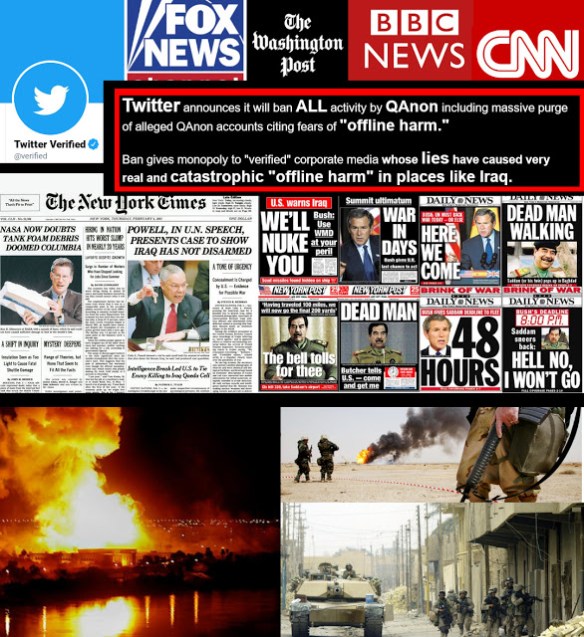
News outlets like CNN reported on Twitter’s move to purge the QAnon movement from its platform.

Articles like, “Twitter cracks down on QAnon accounts,” would claim Twitter fears QAnon’s rhetoric online could eventually lead to “offline harm.”

There is no doubt that QAnon has been behind absurd conspiracy theories and verified lies circulating online – suspiciously absurd. Banning it from Twitter because of alleged fears its activity will lead to “offline harm” is even more absurd .
Despite making absurd claims that demonstrably never materialize or providing evidence that is later revealed to be clearly fabricated, nothing QAnon has done differs from what the corporate media does on a daily basis. In many ways they are one in the same – dividing and distracting the public while US special interests advance their agenda unnoticed and unopposed.
QAnon allegedly made false claims that Hillary Clinton’s arrest was imminent – she was never arrested. Conversely, the corporate media regularly claims that various world leaders in nations targeted by Western regime change have “fled,” are “dead,” or otherwise “ousted from power” – with lies spread by the Western media over the alleged “fates” of still incumbent leaders like Syrian President Bashar Al-Assad, Venezuela’s President Nicolás Maduro, and North Korean leader Kim Jong-un coming to immediate mind.
The Western corporate media also helps sell various wars of aggression.

This includes the US invasion of Afghanistan in 2001, the US invasion of Iraq in 2003, US interventions in Libya and Syria from 2011 onward and US-backed regime change in Ukraine in 2013-2014.

Collectively these conflicts have killed over a million people and driven millions more from their homes. This “offline harm” – the direct result of lies told by the Western corporate media – has not only gone completely unaddressed by Twitter – it is enabled by Twitter.
Twitter – along with other US tech giants like Facebook and Google – aided the US government in sowing chaos across North Africa and the Middle East in 2011, precipitating wars that are still raging today, claiming lives, and effecting “offline harm” impacting millions of people.
The banning of the more absurd QAnon movement will pave the way for other purges – eventually eliminating any alternative to the corporate media and its demonstrably dangerous and dishonest narratives. QAnon’s absurdity will make it easy for Twitter to justify its ban, but the momentum toward greater censorship across Western social media will eventually impact accounts and movements previously difficult to justify banning.
US-based “social media” platforms – Twitter, Facebook, YouTube, etc. – are no longer truly social media. They are clearly transforming into centralized programed media where corporate monopolies create content that is consumed, removing the public, independent organizations, and competitors’ role in creating content, contributing to discussions, offering alternative views, and interacting with one another.
It is important that this fact be fully recognized and exposed as well as the creation of alternative platforms – especially overseas where US-based “social media” has been fully weaponized and used to undermine sociopolitical and economic stability.

Saturday Matinee: Afghanistan War Exposed: An Imperial Conspiracy

Every American Should Watch Abby Martin’s New Afghanistan War Documentary

Abby Martin’s new documentary, “Afghanistan War Exposed: An Imperial Conspiracy,” is a tour de force, a must watch for every American seeking a holistic understanding of American’s longest-running war.

By MintPress News Desk

The perpetual occupation of Afghanistan has become so normalized that it mostly serves as background noise to most Americans. It’s even jokingly referred to as the “Forever War,” accepted as just another constant reality. A soldier dies now and again, a couple of dozen civilians get killed in another bombing. It’s never enough to stir the population to pressure Washington enough to stop it. And the endless war drags on.

From George W. Bush to Barack Obama, to Donald Trump, every U.S. president has promised to end the war. But their plans to bring the troops home inevitably require first sending more troops to the country. You can’t look at all this rhetoric and reality and not conclude that the United States wants to stay in Afghanistan forever. And there is a reason, despite an unresolvable military quagmire, that the Empire won’t let go of Afghanistan.

In this latest “Empire Files” documentary, journalist Abby Martin covers reveals the reality of  America’s Wars in Afghanistan, from the CIA construct of the 1980s through today’s senseless stalemate. MintPress brings you documentary in its entirety, published with permission from filmmaker Abby Martin.

In An Insane World, Madness Looks Moderate And Sanity Looks Radical

By Caitlin Johnstone

Source: CaitlinJohnstone.com

There are no moderate, mainstream centrists in the US-centralized empire. They do not exist.

It’s not that moderate, mainstream centrism is an inherently impossible position. In a healthy world, that’s exactly what the predominant worldview would be. But we do not live in a healthy world.

There are no moderate, mainstream centrists anywhere in the tight alliance of nations which function as a single empire on foreign policy, because that functional empire is built upon murder, terrorism, exploitation, oppression, ecocide and the stockpiling of armageddon weapons.

People who support the status quo of this empire are called “moderates”, but, just like the so-called “moderate rebels” of Syria, they are in fact violent extremists.

This is the reality of living in a world that is profoundly psychologically unhealthy. If you make a career out of facilitating wars which cause explosives to be dropped from the sky on top of innocent human beings causing their bodies to be ripped to shreds and buried in rubble, then you are treated as an exemplar of ideal leadership and rewarded with prestigious positions in politics, punditry, book publishing and think tankery. If you oppose those same wars, you are marginalized and smeared as at best an extremist whack job and at worst a literal traitor conducting psyops for a foreign government.

Because the plutocratic class owns the political class which advances depraved plutocratic agendas and the media class which normalizes and justifies those agendas, a mainstream consensus has been forcibly manufactured that maintaining the oppressive, exploitative, omnicidal, ecocidal status quo is a good and sane thing to do. Voices which point out that this is bat shit crazy are marginalized and ignored when possible and smeared and demonized when necessary.

The ability of our plutocratic rulers and their lackeys to do this is the only reason why defenders of the status quo get to call themselves “centrists” and “moderates”. It’s not because their position is middle-of-the-road in any way whatsoever, it’s because they stand in alignment with the consensus that has been deliberately artificially manufactured and shoved into the mainstream by sheer force of narrative control.

This consensus manufacturing is then carried home by a glitch in human cognition known as status quo bias, which causes us to tend toward holding to the familiar as a default preference and perceive the risk of losing what we have as far less favorable than the reward gaining something better. Psychology Today explains:

Research from Kahneman and Tversky suggests that losses are twice as psychologically harmful as gains are beneficial. In other words, individuals feel twice as much psychological pain from losing $100 as pleasure from gaining $100. One interpretation is that in order for an individual to change course from their current state of affairs is that the alternative must be perceived as twice as beneficial. This highlights the challenges we may face when considering a change to our usual way of doing things.

When military members are considering their choices as their contract comes to an end, many consider re-enlisting simply because they are unaware of the many opportunities that exist for them. Even when we understand our current path is no longer beneficial or no longer makes us happy, we must still overcome the natural urge to stay on the path unless the alternative is sufficiently attractive. In order for us to readily pursue an alternate path, we must believe that the alternative is clearly superior to the current state of affairs.

The status quo effect is pervasive in both inconsequential and major decisions. Oftentimes we are held back by what we believe to be the safe option, simply because it is the default. Bearing in mind our natural propensity for the status quo will enable us to recognize the allure of inertia and more effectively overcome it.

Status quo bias is further exacerbated in our current predicament by the fact that so many people are now so close to the brink of financial ruin and so terrified of what can happen to them if things change in a sudden and unpredictable way. The result of this is that now you’ve got the majority of people in the most dominant country on earth supporting the “slow incremental change” philosophy of so-called centrism, which in practice has always ended up meaning no change whatsoever. Meanwhile our ecosystem is dying and the US is escalating nuclear tensions with Russia and China and everyone’s getting more and more crazy and miserable under the oppressive and exploitative status quo.

Did you ever climb a tree when you were a kid and get stuck because you were afraid to climb down? It’s a common experience for a lot of us. You get lost in the joy of the climb and so pleased with yourself in how well you’re doing, then suddenly you notice that the branches are getting a lot thinner and the wind is starting to sway you back and forth, and suddenly you look down and get terrified.

Maybe you called out for your mother and she came out and told you to climb down, calling up “Well you can’t stay up there!” And you knew she was right, but in that moment the idea of looking down and letting go of the thin branches you were clinging to felt so much scarier than just staying put in your precarious and unsustainable position.

That’s exactly where we’re at right now with status quo bias in our current predicament. People know things need to change, but they’re in such a precarious position that the risk of change feels far too scary to take the leap and force a deviation from our trajectory toward disaster.

But that is our only choice if we are to survive as a species. We know we were able to climb down from whatever trees we got stuck in as kids, and we know that our mother was as right then as that small inner voice inside us is now: we can’t stay here. We’ve got to wake up from the status quo narrative management and find a way to get down from our precarious and unsustainable position to the stable ground of sanity.


Corporate Media Looks to Purveyors of State Violence Abroad to Condemn State Violence at Home

By Loretta Graceffo

Source: FAIR.org

Anti-racist protests have swept across the country over the past month, demanding justice for George Floyd, police accountability and the defunding of law enforcement.

In response to these uprisings, President Donald Trump publicly toyed with the idea of deploying active-duty military to American cities—a proposal that most corporate media, with a few glaring exceptions, have condemned as an abuse of power.

However, when we look at who media have called upon to denounce the Trump administration’s response, a revealing pattern emerges. Rather than providing a platform for protesters, who were met by heavily armed law enforcement toting chemical agents and flashbang grenades, media decided to turn to the enforcers of state violence abroad: the US national security apparatus. Several outlets asked current and former intelligence officials to weigh in on Trump’s response, utilizing their testimony to equate the crackdowns with those in other countries:

  • Washington Post (6/2/20): “CIA Veterans Who Monitored Crackdowns Abroad See Troubling Parallels in Trump’s Handling of Protests”
  • Independent (6/2/20): “I Asked Police, Veterans and a Former CIA Agent What They Think of Trump’s Response to the Protests. Even They Are Horrified.”
  • International Business Times (6/3/20): “George Floyd White House Protest: Donald Trump Acting Like Dictator During Racial Tensions, Intelligence and Defense Officials Warn.”

These articles are correct in pointing out that Trump’s militarized suppression of dissent at home has “troubling parallels” with authoritarian crackdowns abroad. The testimony of US state officials, especially former ones, can aid the public in taking cognizance of these parallels, given that they are responsible for enforcing similar crackdowns around the world. But because media present these sources uncritically and refuse to include vital context, they fail to examine our own empire, and ultimately make all the wrong connections.

Whitewashing war on dissent

In response to the Trump administration’s handling of the protests, the Post article includes a quote from Marc Polymeropoulos, who spent 26 years in the CIA:

“It reminded me of what I reported on for years in the Third World,” Polymeropoulos said on Twitter. Referring to the despotic leaders of Iraq, Syria and Libya, he said: “Saddam. Bashar. Qaddafi. They all did this.”

While it’s true that Trump’s response has been militant, these articles present this reaction as a disturbing departure from otherwise morally sound US leadership throughout history. Trump may be the first US president to tweet the words, “When the looting starts, the shootings starts,” but despite media’s historical amnesia, violent government crackdowns on anti-racist protests in the US have always been the norm, not the exception.

Take, for example, the FBI’s COINTELPRO program, which targeted thousands of activists through tactics like psychological warfare, blackmail and assasination. Or when the Philadelphia Police Department dropped a bomb on a residential neighborhood in order to disband a Black liberation group, killing nearly a dozen people and leaving hundreds of residents homeless. More recently, the FBI’s counterterrorism division has labeled “Black identity extremists” as a domestic terror threat, due to their “perceptions of police brutality against African Americans.”

By relying on CIA testimony, media shift the focus away from the tyranny in our own backyard in favor of pointing fingers at the “despotic leaders” of “the Third World”—never mind the fact that the US has no qualms with oppressive leadership in the Middle East when it aligns with our interests, as evidenced by our alliance with Saudi Arabia.

The articles by the Post and International Business Times both include a quote from Rep. Abigail Spanberger, who tweeted, in response to Trump’s crackdowns on protests: “As a former CIA officer, I know this playbook.” Her tweet goes on to compare his actions to those “undertaken by authoritarian regimes throughout the world.”

Of course Spanberger, as a former CIA official, knows this playbook—it’s one that the CIA practically wrote themselves. In 1973, it sponsored a coup that overthrew Chile’s democratically elected socialist government, installing the autocratic Augusto Pinochet, who rounded up, tortured and executed thousands of political dissidents. The CIA also opposed democratic forces in Zaire and backed the corrupt dictator Mobutu, whose decades-long regime regularly tortured and murdered its critics. And in the early 2010s, the Pentagon armed and trained Turkish mercenary forces, who went on to commit a litany of war crimes, including beheading Kurds in Northern Syria.

But the Post presents Spanberger’s intimate knowledge of this “playbook” as a result of her experience “monitoring democratic regression” and “societal unraveling” in the Global South. Another CIA analyst, Gail Helt, is described as “responsible for tracking developments in China and Southeast Asia.”

Nowhere in these articles is there any admission that the US national security apparatus does not just “track developments” abroad—it also plays a monumental role in shaping those developments, often using the same tactics of brutality and repression they claim to oppose.

Endless wars come home

By looking to state agents for moral authority and failing to provide any context that would impugn the CIA’s legitimacy, media espouses US imperialism by default, and reaffirms the chauvinistic belief that we have the right to impose our will on other countries by any means necessary.

The Post includes a quote from Brett McGurk, who helped institutionalize America’s bloody imperial occupation of Iraq, and pushed for the euphemistic “surge” which saw an additional 30 thousand US troops deployed to Iraq in 2007:

“The imagery of a head of state in a call with other governing officials saying, ‘Dominate the streets, dominate the battlespace’ — these are iconic images that will define America for some time,” said McGurk…. “It makes it much more difficult for us to distinguish ourselves from other countries we are trying to contest” or influence, he said.

But whether or not the US has ever had the credibility required to shape other countries’ policies—let alone present ourselves as a model of freedom and democracy—remains largely unexamined.

This is especially evident in the piece by Post, which claims that the Trump administration’s response characterized “US cities as a foreign war zone” and includes an anecdote about a US intelligence official “venturing into downtown Washington…as if taking measure of the street-level mood in a foreign country.”

The Independent describes “helicopters with US Army markings flying low over protesters,” a technique that one of the pilots they interviewed says is “for use against enemy insurgents overseas, not Americans protesting on the streets of Washington.”

In other words, when Defense Secretary Mark T. Esper urged governors to “dominate the battlespace” to end the unrest in cities, it was wrong only because he was talking about American cities.

The Independent article later includes a quote from ex–CIA officer Patrick Skinner, who has previously provided valuable insight into the ways that fascist maneuvers abroad inevitably make their way home. Skinner correctly condemns a dangerous “mentality among police that they are soldiers in a ‘war on crime.’”

If media had any real interest in exposing the reciprocity between urban policing at home and counterinsurgency abroad, as these articles supposedly propose, this would have been a good time for them to delve into the many ways in which the American carceral state and our endless wars in the Middle East are intrinsically connected.

Perhaps they could include that the tactic used to murder George Floyd—the knee on the neck—has also been used by the Israeli Defense Forces, who are bankrolled by the US and frequently provide training for American cops, including those in Minnesota.  (As many have pointed out, there are stark parallels between the police murder of George Floyd and the police murder of Iyad Halak, an unarmed, autistic Palestinian man whose killing has sparked protests in Jerusalem.)

Or media could mention other tactics that police, many of whom are military veterans, have picked up over years of continuous warfare: the use of torture to get confessions, stop- and-frisk searches targeting blacks and Latinos, and invasive surveillance techniques aimed at Muslim residents. Also relevant is the fact that, since the 1990s, the military has given police departments billions of dollars worth of surplus equipment—including tanks, grenade launchers and assault weapons—with a requirement that they make use of it within a year.

When done right, international analysis in times of domestic upheaval can shed light on the shared, global struggle for liberation against US occupation and militarism—a movement which spans from Minneapolis to Palestine.

But, as is inevitable when they uncritically look to the CIA for “expertise” on freedom and human rights, media come to an entirely different conclusion: It’s normal, necessary and perhaps even noble—after all, it is in the name of democracy—for our military tanks to line the streets of the Middle East. But when those same military tanks invade DC, New York or Minneapolis, they’ve gone too far.

Sidelining activists to uplift the state

This reliance on state agents to shape the narrative is also a staple of network Sunday morning political talk shows. In the two weeks after the police murder of George Floyd, FAIR analyzed every episode of ABC’s This WeekCBS’s Face the NationCNN’s State of the UnionFox News Sunday, and NBC’s Meet the Press. Across all networks, only one show featured an interview with someone affiliated with Black Lives Matter in its coverage of the protests. However, every network found time to interview current and former members of the US national security apparatus, resulting in 12 appearances altogether.

Among these guests was Chad Wolf, secretary of the Department of Homeland Security, who was asked to weigh in on the protests by ABC’s This Week (6/7/20) and Fox News Sunday (6/7/20). He spoke in support of Trump’s call to send active-duty troops to quell the uprisings—a predictable stance, given that, as one of the architects of the family separation policy, Wolf’s response to undocumented migration has been to take at least 4,000 children away from their parents and imprison them in cages. Despite this horrifying resume, NBC and Fox still saw it fit to give him a platform on national television to share his thoughts on state violence.

One of the guests featured on CNN’s State of the Union (5/31/20) was Robert O’Brien, the US National Security advisor, who has long defended the  indefensible—including Trump’s pardon of war criminals, and the assassination of Iranian military leader Qassem Solemani. Like Wolf, he denied the irrefutable fact that US law enforcement is intertwined with systematic racism—a declaration that was barely challenged by CNN’s Jake Tapper.

Only moments after defending Trump’s militaristic response to the uprisings, O’Brien favorably compared the US attitude towards the protests with other countries: “That’s the difference between us and our foreign adversaries. We’re going to allow people to protest.” Given that the US has arrested at least 10,000 protesters (AP6/4/20), this seems like a dubious distinction.

This is not to say there’s no value in interviewing former intelligence officials; some have provided valuable insight on the military/industrial complex, and many have provided critical information as whistleblowers.

Much more frequently, however, these interviews serve only to legitimize US authoritarianism abroad and whitewash state violence at home. As protesters take to the streets, facing tear gas, rubber bullets and arrest for demanding change, perhaps instead of uplifting the voices of state officials, media should hand the microphone to the people.

Russiagate’s Last Gasp

By Ray McGovern

Source: Consortium News

On Friday The New York Times featured a report based on anonymous intelligence officials that the Russians were paying bounties to have U.S. troops killed in Afghanistan with President Donald Trump refusing to do anything about it.  The flurry of Establishment media reporting that ensued provides further proof, if such were needed, that the erstwhile “paper of record” has earned a new moniker — Gray Lady of easy virtue.

Over the weekend, the Times’ dubious allegations grabbed headlines across all media that are likely to remain indelible in the minds of credulous Americans — which seems to have been the main objective. To keep the pot boiling this morning, The New York Times’ David Leonhardt’s daily web piece, “The Morning” calls prominent attention to a banal article by a Heather Cox Richardson, described as a historian at Boston College, adding specific charges to the general indictment of Trump by showing “how the Trump administration has continued to treat Russia favorably.” The following is from Richardson’s newsletter on Friday:

— “On April 1 a Russian plane brought ventilators and other medical supplies to the United States … a propaganda coup for Russia;

— “On April 25 Trump raised eyebrows by issuing a joint statement with Russian President Vladimir Putin commemorating the 75th anniversary of the historic meeting between American and Soviet troops on the bridge of the Elbe River in Germany that signaled the final defeat of the Nazis;

— “On May 3, Trump called Putin and talked for an hour and a half, a discussion Trump called ‘very positive’;

— “On May 21, the U.S. sent a humanitarian aid package worth $5.6 million to Moscow to help fight coronavirus there.  The shipment included 50 ventilators, with another 150 promised for the next week; …

— “On June 15, news broke that Trump has ordered the removal of 9,500 troops from Germany, where they support NATO against Russian aggression. …”

Historian Richardson added:

“All of these friendly overtures to Russia were alarming enough when all we knew was that Russia attacked the 2016 U.S. election and is doing so again in 2020.  But it is far worse that those overtures took place when the administration knew that Russia had actively targeted American soldiers. … this bad news apparently prompted worried intelligence officials to give up their hope that the administration would respond to the crisis, and instead to leak the story to two major newspapers.”

Hear the siren? Children, get under your desks!

The Tall Tale About Russia Paying for Dead U.S. Troops

Times print edition readers had to wait until this morning to learn of Trump’s statement last night that he was not briefed on the cockamamie tale about bounties for killing, since it was, well, cockamamie.

Late last night the president tweeted: “Intel just reported to me that they did not find this info credible, and therefore did not report it to me or the VP. …”

For those of us distrustful of the Times — with good reason — on such neuralgic issues, the bounty story had already fallen of its own weight. As Scott Ritter pointed out yesterday:

“Perhaps the biggest clue concerning the fragility of the New York Times’ report is contained in the one sentence it provides about sourcing — “The intelligence assessment is said to be based at least in part on interrogations of captured Afghan militants and criminals.” That sentence contains almost everything one needs to know about the intelligence in question, including the fact that the source of the information is most likely the Afghan government as reported through CIA channels. …”

And who can forget how “successful” interrogators can be in getting desired answers.

Russia & Taliban React

The Kremlin called the Times reporting “nonsense … an unsophisticated plant,” and from Russia’s perspective the allegations make little sense; Moscow will see them for what they are — attempts to show that Trump is too “accommodating” to Russia.

A Taliban spokesman called the story “baseless,” adding with apparent pride that “we” have done “target killings” for years “on our own resources.”

Russia is no friend of the Taliban.  At the same time, it has been clear for several years that the U.S. would have to pull its troops out of Afghanistan.  Think back five decades and recall how circumspect the Soviets were in Vietnam.  Giving rhetorical support to a fraternal Communist nation was de rigueur and some surface-to-air missiles gave some substance to that support.

But Moscow recognized from the start that Washington was embarked on a fool’s errand in Vietnam. There would be no percentage in getting directly involved.  And so, the Soviets sat back and watched smugly as the Vietnamese Communists drove U.S. forces out on their “own resources.” As was the case with the Viet Cong, the Taliban needs no bounty inducements from abroad.

Besides, the Russians knew painfully well — from their own bitter experience in Afghanistan, what the outcome of the most recent fool’s errand would be for the U.S.  What point would they see in doing what The New York Times and other Establishment media are breathlessly accusing them of?

CIA Disinformation; Casey at Bat

Former CIA Director William Casey said:  “We’ll know when our disinformation program is complete, when everything the American public believes is false.”

Casey made that remark at the first cabinet meeting in the White House under President Ronald Reagan in early 1981, according to Barbara Honegger, who was assistant to the chief domestic policy adviser.  Honegger was there, took notes, and told then Senior White House correspondent Sarah McClendon, who in turn made it public.

If Casey’s spirit is somehow observing the success of the disinformation program called Russiagate, one can imagine how proud he must be.  But sustained propaganda success can be a serious challenge.  The Russiagate canard has lasted three and a half years.  This last gasp effort, spearheaded by the Times, to breathe more life into it is likely to last little more than a weekend — the redoubled efforts of Casey-dictum followers notwithstanding.

Russiagate itself has been unraveling, although one would hardly know it from the Establishment media.  No collusion between the Trump campaign and Russia.  Even the sacrosanct tenet that the Russians hacked the DNC emails published by WikiLeaks has been disproven, with the head of the DNC-hired cyber security firm CrowdStrike admitting that there is no evidence that the DNC emails were hacked — by Russia or anyone else.

How long will it take the Times to catch up with the CrowdStrike story, available since May 7?

The media is left with one sacred cow: the misnomered “Intelligence Community” Assessment of Jan. 6, 2017, claiming that President Putin himself ordered the hacking of the DNC. That “assessment” done by “hand-picked analysts” from only CIA, FBI and NSA (not all 17 intelligence agencies of the “intelligence community”) reportedly is being given close scrutiny by U. S. Attorney John Durham, appointed by the attorney general to investigate Russiagate’s origins.

If Durham finds it fraudulent (not a difficult task), the heads of senior intelligence and law enforcement officials may roll.  That would also mean a still deeper dent in the credibility of Establishment media that are only too eager to drink the Kool Aid and to leave plenty to drink for the rest of us.

Do not expect the media to cease and desist, simply because Trump had a good squelch for them last night — namely, the “intelligence” on the “bounties” was not deemed good enough to present to the president.

(As a preparer and briefer of The President’s Daily Brief  to Presidents Reagan and HW Bush, I can attest to the fact that — based on what has been revealed so far — the Russian bounty story falls far short of the PDB threshold.)

Rejecting Intelligence Assessments

Nevertheless, the corporate media is likely to play up the Trump administration’s rejection of what the media is calling the “intelligence assessment” about Russia offering — as Rachel Maddow indecorously put it on Friday — “bounty for the scalps of American soldiers in Afghanistan.”

I am not a regular Maddow-watcher, but to me she seemed unhinged — actually, well over the top.

The media asks, “Why does Trump continue to disrespect the assessments of the intelligence community?”  There he goes again — not believing our “intelligence community; siding, rather, with Putin.”

In other words, we can expect no let up from the media and the national security miscreant leakers who have served as their life’s blood.  As for the anchors and pundits, their level of sophistication was reflected yesterday in the sage surmise of Face the Nation’s Chuck Todd, who Aaron Mate reminds us, is a “grown adult and professional media person.”  Todd asked guest John Bolton: “Do you think that the president is afraid to make Putin mad because maybe Putin did help him win the election, and he doesn’t want to make him mad for 2020?”

“This is as bad as it gets,” said House Speaker Nancy Pelosi yesterday, adding the aphorism she memorized several months ago: “All roads lead to Putin.”  The unconscionably deceitful performance of Establishment media is as bad as it gets, though that, of course, was not what Pelosi meant.  She apparently lifted a line right out of the Times about how Trump is too “accommodating” toward Russia.

One can read this most recent flurry of Russia, Russia, Russia as a reflection of the need to pre-empt the findings likely to issue from Durham and Attorney General William Barr in the coming months — on the theory that the best defense is a pre-emptive offense.  Meanwhile, we can expect the corporate media to continue to disgrace itself.

Vile

Caitlin Johnstone, typically, pulls no punches regarding the Russian bounty travesty:

“All parties involved in spreading this malignant psyop are absolutely vile, but a special disdain should be reserved for the media class who have been entrusted by the public with the essential task of creating an informed populace and holding power to account. How much of an unprincipled whore do you have to be to call yourself a journalist and uncritically parrot the completely unsubstantiated assertions of spooks while protecting their anonymity? How much work did these empire fluffers put into killing off every last shred of their dignity? It boggles the mind.

It really is funny how the most influential news outlets in the Western world will uncritically parrot whatever they’re told to say by the most powerful and depraved intelligence agencies on the planet, and then turn around and tell you without a hint of self-awareness that Russia and China are bad because they have state media.

Sometimes all you can do is laugh.”

Four Reasons Civilization Won’t Decline: It Will Collapse

By Craig Collins

Source: CounterPunch

As modern civilization’s shelf life expires, more scholars have turned their attention to the decline and fall of civilizations past.  Their studies have generated rival explanations of why societies collapse and civilizations die.  Meanwhile, a lucrative market has emerged for post-apocalyptic novels, movies, TV shows, and video games for those who enjoy the vicarious thrill of dark, futuristic disaster and mayhem from the comfort of their cozy couch.  Of course, surviving the real thing will become a much different story.

The latent fear that civilization is living on borrowed time has also spawned a counter-market of “happily ever after” optimists who desperately cling to their belief in endless progress.  Popular Pollyannas, like cognitive psychologist Steven Pinker, provide this anxious crowd with soothing assurances that the titanic ship of progress is unsinkable.  Pinker’s publications have made him the high priest of progress.[1] While civilization circles the drain, his ardent audiences find comfort in lectures and books brimming with cherry-picked evidence to prove that life is better than ever, and will surely keep improving.  Yet, when questioned, Pinker himself admits, “It’s incorrect to extrapolate that the fact that we’ve made progress is a prediction that we’re guaranteed to make progress.”[2]

Pinker’s rosy statistics cleverly disguise the fatal flaw in his argument.  The progress of the past was built by sacrificing the future—and the future is upon us.  All the happy facts he cites about living standards, life expectancy, and economic growth are the product of an industrial civilization that has pillaged and polluted the planet to produce temporary progress for a growing middle class—and enormous profits and power for a tiny elite.

Not everyone who understands that progress has been purchased at the expense of the future thinks that civilization’s collapse will be abrupt and bitter.  Scholars of ancient societies, like Jared Diamond and John Michael Greer, accurately point out that abrupt collapse is a rare historical phenomenon.  In The Long Descent, Greer assures his readers that, “The same pattern repeats over and over again in history.  Gradual disintegration, not sudden catastrophic collapse, is the way civilizations end.”  Greer estimates that it takes, on average, about 250 years for civilizations to decline and fall, and he finds no reason why modern civilization shouldn’t follow this “usual timeline.”[3]

But Greer’s assumption is built on shaky ground because industrial civilization differs from all past civilizations in four crucial ways.  And every one of them may accelerate and intensify the coming collapse while increasing the difficulty of recovery.

Difference #1:  Unlike all previous civilizations, modern industrial civilization is powered by an exceptionally rich, NON-renewable, and irreplaceable energy source—fossil fuels.  This unique energy base predisposes industrial civilization to a short, meteoric lifespan of unprecedented boom and drastic bust.  Megacities, globalized production, industrial agriculture, and a human population approaching 8 billion are all historically exceptional—and unsustainable—without fossil fuels.  Today, the rich easily exploited oilfields and coalmines of the past are mostly depleted.  And, while there are energy alternatives, there are no realistic replacements that can deliver the abundant net energy fossil fuels once provided.[4]  Our complex, expansive, high-speed civilization owes its brief lifespan to this one-time, rapidly dwindling energy bonanza.

Difference #2:  Unlike past civilizations, the economy of industrial society is capitalist.  Production for profit is its prime directive and driving force.  The unprecedented surplus energy supplied by fossil fuels has generated exceptional growth and enormous profits over the past two centuries.  But in the coming decades, these historic windfalls of abundant energy, constant growth, and rising profits will vanish.

However, unless it is abolished, capitalism will not disappear when boom turns to bust.  Instead, energy-starved, growth-less capitalism will turn catabolic.  Catabolismrefers to the condition whereby a living thing devours itself.  As profitable sources of production dry up, capitalism will be compelled to turn a profit by consuming the social assets it once created.  By cannibalizing itself, the profit motive will exacerbate industrial society’s dramatic decline.

Catabolic capitalism will profit from scarcity, crisis, disaster, and conflict.  Warfare, resource hoarding, ecological disaster, and pandemic diseases will become the big profit makers.  Capital will flow toward lucrative ventures like cybercrime, predatory lending, and financial fraud; bribery, corruption, and racketeering; weapons, drugs, and human trafficking.  Once disintegration and destruction become the primary source of profit, catabolic capitalism will rampage down the road to ruin, gorging itself on one self-inflicted disaster after another.[5]

Difference #3:  Unlike past societies, industrial civilization isn’t Roman, Chinese, Egyptian, Aztec, or Mayan.  Modern civilization is HUMAN, PLANETARY, and ECOCIDAL.  Pre-industrial civilizations depleted their topsoil, felled their forests, and polluted their rivers.  But the harm was far more temporary and geographically limited. Once market incentives harnessed the colossal power of fossil fuels to exploit nature, the dire results were planetary.  Two centuries of fossil fuel combustion have saturated the biosphere with climate-altering carbon that will continue wreaking havoc for generations to come.  The damage to Earth’s living systems—the circulation and chemical composition of the atmosphere and the ocean; the stability of the hydrological and biogeochemical cycles; and the biodiversity of the entire planet—is essentially permanent.

Humans have become the most invasive species ever known.  Although we are a mere .01 percent of the planet’s biomass, our domesticated crops and livestock dominate life on Earth.  In terms of total biomass, 96 percent of all the mammals on Earth are livestock; only 4 percent are wild mammals.  Seventy percent of all birds are domesticated poultry, only 30 percent are wild.  About half the Earth’s wild animals are thought to have been lost in just the last 50 years.[6]  Scientists estimate that half of all remaining species will be extinct by the end of the century.[7] There are no more unspoiled ecosystems or new frontiers where people can escape the damage they’ve caused and recover from collapse.

Difference #4:  Human civilization’s collective capacity to confront its mounting crises is crippled by a fragmented political system of antagonistic nations ruled by corrupt elites who care more about power and wealth than people and the planet.  Humanity faces a perfect storm of converging global calamities.  Intersecting tribulations like climate chaos, rampant extinction, food and freshwater scarcity, poverty, extreme inequality, and the rise of global pandemics are rapidly eroding the foundations of modern life.

Yet, this fractious and fractured political system makes organizing and mounting a cooperative response nearly impossible.  And, the more catabolic industrial capitalism becomes, the greater the danger that hostile rulers will fan the flames of nationalism and go to war over scarce resources.  Of course, warfare is not new.  But modern warfare is so devastating, destructive, and toxic that little would remain in its aftermath.  This would be the final nail in civilization’s coffin.

Rising From the Ruins?

How people respond to the collapse of industrial civilization will determine how bad things get and what will replace it. The challenges are monumental.  They will force us to question our identities, our values, and our loyalties like no other experience in our history.  Who are we?  Are we, first and foremost, human beings struggling to raise our families, strengthen our communities, and coexist with the other inhabitants of Earth?  Or do our primary loyalties belong to our nation, our culture, our race, our ideology, or our religion?  Can we put the survival of our species and our planet first, or will we allow ourselves to become hopelessly divided along national, cultural, racial, religious, or party lines?

The eventual outcome of this great implosion is up for grabs.  Will we overcome denial and despair; kick our addiction to petroleum; and pull together to break the grip of corporate power over our lives?  Can we foster genuine democracy, harness renewable energy, reweave our communities, re-learn forgotten skills, and heal the wounds we’ve inflicted on the Earth?  Or will fear and prejudice drive us into hostile camps, fighting over the dwindling resources of a degraded planet?  The stakes could not be higher.

Notes.

[1] His books include: The Better Angels of Our Nature and Enlightenment Now: The Case for Reason, Science, Humanism, and Progress.

[2] King, Darryn. “Steven Pinker on the Past, Present, and Future of Optimism” (OneZero, Jan 10, 2019) https://onezero.medium.com/steven-pinker-on-the-past-present-and-future-of-optimism-f362398c604b

[3] Greer, John Michael.  The Long Descent (New Society Publishers, 2008): 29.

[4] Heinberg, Richard. The End Of Growth. (New Society, 2011): 117.

[5] For more on catabolic capitalism see: Collins, Craig. “Catabolism: Capitalism’s Frightening Future,”CounterPunch (Nov. 1, 2018). https://www.counterpunch.org/2018/11/01/catabolism-capitalisms-frightening-future/

[6] Carrington, Damian. “New Study: Humans Just 0.01% Of All Life But Have Destroyed 83% Of Wild Mammals,” The Guardian (May 21, 2018). https://www.theguardian.com/environment/2018/may/21/human-race-just-001-of-all-life-but-has-destroyed-over-80-of-wild-mammals-study

[7] Ceballos, Ehrlich, Barnosky, Garcia, Pringle & Palmer. “Accelerated Modern Human-Induced Species Losses: Entering The 6th Mass Extinction,” Science Advances. (June 19, 2015). http://advances.sciencemag.org/content/1/5/e1400253

Is Coronavirus a bioweapon?

By David Swanson

Source: Let’s Try Democracy

The Washington Post’s article opposing such a conclusion admits the following: The lab in Wuhan “was researching coronaviruses transmitted by bats.” And “[a]n annual State Department report released last year said China had engaged ‘in biological activities with potential dual-use applications.’” And that at least one expert worried about potential outbreaks from that lab. And that other experts had discussed the possibility of Coronavirus being a bioweapon but found no proof.

Francis Boyle’s video arguing the case that Coronavirus is a bioweapon points to three articles from scientific journals. The first describes the virus in terms that Boyle, but not the authors, considers a dead giveaway. How is a non-expert to judge?

The second article, one of whose authors is from the Institute in Wuhan and one of whose funders is China, describes work at the University of North Carolina at Chapel Hill, which Boyle views as aggressive work to make a virus more deadly, the authors clearly maintain was defensive, but indisputably was “dual-use” as most such research seems unavoidably to be. Boyle thinks Wuhan acquired this research by funding and participating in it through the good services of UNC which got its deadly cells from Fort Detrick.

The third article has the same connections to Wuhan and China that the second one does, but comes from Australia instead of North Carolina.

Boyle thinks that bioweapons researchers in Australia and North Carolina did work that contributed to the current disaster, regardless of what they may have intended or wanted or wished for. I think there’s ample evidence that bioweapons researchers around the world are engaged in a deadly and counterproductive game that develops weapons in the name of trying to defeat them.

Does the evidence show that this virus must have come from a lab and not from bats via other animals with no human role other than habitat destruction and a keystone-cops response to the outbreak? I don’t know. I think the evidence is overwhelming in that regard when it comes to Lyme Disease. I think so, too, when it comes to Anthrax. I’ve not seen such powerful evidence with regard to AIDS and would have to see it before jumping to that conclusion.

But what exactly is the distinction between a lab acquiring a disease from bats, studying it, and accidentally letting it loose, versus a lab acquiring a disease from another lab, modifying it to make it worse in the name of preventing it, and accidentally letting it loose? When does it become a bioweapon?

Developing biological weapons in order to develop vaccines to counter them is done in exactly the same way, whether it’s for defense or offense. In an offensive attack, the vaccines are needed to protect the attacking troops. And the development of these weapons is very difficult and expensive. The most likely source of biological weapons in a terrorist attack is a government lab that developed the stuff for “defense.” A possible source for any disease that looks like a bioweapon is the same.

Of course it might not be. I have not the slightest expertise on the matter. But we know that governments are working on bioweapons, and we know that they don’t want it discussed, and we know that corporate and state media alike avoid things that governments don’t want discussed. Still, people are finding the decency in some cases to do better in trying to survive coronavirus than what their governments are telling them to do. Perhaps people can also do better than their governments want them to in researching the origins.

It just might turn out that the United States and China are both right to blame each other, and that the internationalism of academics — such a force for good in other contexts — creates plenty of blame to go around.