Western ‘Civilization’ Is Doomed to Aggressive Collapse, and by its Own Hand

By Gary D. Barnett

Source: GaryDBarnett.com

“Western civilization is a loaded gun pointed at the head of this planet.”

~ Terence McKenna

The word civilization from Latin is civis, which means citizen, and civitas, which means city-stateIt is seen as ‘enlightened culture’ instead of barbarism. A more modern take on the Latin root of this word would be a society which has developed a writing system, government, production of surplus food, division of labor, and ‘urbanization.’ The two trouble spots here are the false belief in the necessity of government and of urbanization. Both indicate collectivism instead of the individual and independent rule, in what should properly be a voluntary society. Regardless, a so-called ‘civil society’ today is what would be thought of as a mature, progressive, and non-barbarous state of ‘superiority.’ The ancient Greeks clarified this as far back as the fifth century BCE, and felt themselves above others who were not as worthy in their minds. As time passed, a citizen was not just a resident of a particular area, but in reality, became the property of the State, or more accurately, a lifetime indentured servant.

A common truth that should be recognized, is that in order to be a citizen in the modern world, one must be considered of secondary importance to the State or nation, and therefore a pawn or slave of that State or nation. After all, initially, ‘citizenship’ is decided simply by state of birth, or by parent’s state of birth. Each individual has no say in their original and usually lifetime citizenship, and this classification, as in herd animals, is a label decided by the ruling political class. This is not any indication of freedom, as should be quite obvious, but is a pronouncement of inferiority to rule, which negates from birth the individual in favor of the State. There is no need to get further into the particulars of this type of human ownership in this discussion, but sufficed to say, how can one be considered to be free when born a slave?

The subject here is the fate of what is considered Western Civilization, and why it is doomed to not only failure, but complete collapse as a political and ruling force. In fairness, all civilizations eventually fail, and in my opinion, this is mainly due to the false belief that a system of top-down rule, restrictive laws, and completely concentrated co-existence, is necessary for sustained survival. While the division of labor is extremely useful in many if not most aspects of modern life, total concentration of populations is not  mandatory for civilization to survive and prosper. But it is the desired outcome by those who rule, (consider ‘smart cities’) because it allows for easier control over the masses of common people, who always far outnumber the ruling class, and are therefore considered a continuous threat to their power.

The ‘West’ has claimed to be the most superior, most benevolent, most enlightened, and most powerful group of nation-states for centuries, but it is coming apart at the seams so quickly that its influence and grip on the rest of the world could end in short order. But is that the designed plan, or is it due to outrageous arrogance, criminal excess at every level of existence, devastation of the monetary and economic systems, widespread brutal aggression, or all the above?

Western civilization is certainly on the brink of extinction, and the sought after replacement is that of a technocratic world governing system run by the very few. It seems the further man supposedly advances, the more backward is his pretend progress. Certainly, and positively in the U.S, intelligence levels and the ability to think critically have all but disappeared; this in a time when western society is ‘claimed’ to be the most ‘educated.’ In fact, the exact opposite is the case, as schooling in this country has caused mass ignorance and stupidity over generations, all by design. In order to control the people, the West decided long ago to purposely dumb down the common population, and indoctrinate them to such an extent, as to make impotent the idea of individual legitimate thought, and any ability to question authority. This tactic by the State was successful in its mission, but also successful in creating its own demise. This is quite the irony, but then that is the way of the madness of humanity.

Consider our current reality for a moment, and then consider the outcome of this political experiment. This nation, although never totally free, was one of wonder for a good portion of its history. 170 years ago, nearly 100% literacy was common, classical education was brilliant, and children were intelligent, driven, responsible, and grown up by the time they were in their mid-teens or before. Most all were entrepreneurs and understood moral principles, self-responsibility, and the importance of family. They based their lives on logic and reason, and due to these attitudes, were incredibly valuable to the building of independent, honest, virtuous, and vital societies. If one is to compare that to today’s population, an awakening should immediately occur.

Currently, this country is in the midst of a complete and total mental breakdown of the masses, in that they are not, generally speaking, responsible for themselves, and are dependent on an evil and heinous government. The intellectual capabilities of the general population have descended into the realm of effective illiteracy of the majority, regardless of age. Hate is the new norm accepted by the proletariat, sexual perversion is in full view of all, and promoted by the State. Theft, looting, property destruction, and violence at every turn, are openly ignored, while being sanctioned by government and its complicit mouthpieces in the rotten media. Constant war is tolerated, the murdering military is lauded as heroes, while truthtellers are shamed, threatened, and ostracized, and in some cases eliminated. ‘Reverse’ racism is rampant and applauded, while society has become married to victimization as a way of life. Self-esteem, confidence, responsible behavior, empathy, and the drive to succeed have disappeared from view. Total government control, destruction of wealth of all but the super-rich, blanket surveillance, lockdowns, ludicrous and immoral mandates, mass bio-weapon tyranny, tremendous property theft, and purposeful murder of innocents is routine, and mostly ignored. Entire towns and cities are being intentionally destroyed, thousands burned to death with microwave or directed energy weapons, or by other atrocious means, while those affected clamor for more government assistance, instead of eliminating the criminal and murderous State that is at the heart of all this barbarous madness.

The governing systems of Western societies have no intention, and never have, to free or protect the people, as the only goal sought by these evil ruling monsters, is power and control of all by brute force, lies, propaganda, and murder. Western civilization will be purposely relegated to the dustbin of history; the result being the swift and merciless destruction of life and all societal cohesion. Without mass dissent and non-compliance, bogus ‘climate change,’ currency destruction, digitization of all aspects of life, concentration of populations, famine, property theft, war, and transhumanism, will lead to even more perverse behavior, idiocy, and mass indifference of the majority.

This will signal the end of an era, and the beginning of a permanent hell on earth. This was caused by the masses of collective hordes ignoring their responsibility to themselves, in favor of the expectation of total dependence instead of individual excellence. No one can hide from reality forever, as it will eventually catch up and swallow you whole.

The State cannot rule successfully unless the people voluntarily allow it, and choose to surrender to obedience and a life of slavery. Only people who will accept and be convinced of truth, and have the courage to act on that truth, can be of use to freedom. All others, those who do not want to know the truth, those who continue to cling to the State’s false narratives, and who seek a master, should be absolutely avoided, as they will never help or improve themselves, and therefore will be of no value to those who seek real freedom.

“Violence is not necessary to destroy a civilization. Each civilization dies from indifference toward the unique values which created it.”

 ~ Nicolas Gomez Davila, 1913-1994, Columbian writer

Reality Tunnels: How to Control & Re-Program Your Mind

By Jack Fox-Williams

Source: Waking Times

When I was in secondary school, a teacher showed me an animated optical illusion in which a dancer appears to be spinning in one direction. I was adamant that the dancer was spinning clockwise, while my teacher insisted it was spinning counterclockwise. She then told me that you could change the direction of the dancer by focusing on the feet. I gazed with meditative fixation, and suddenly, to my amazement, the dancer started spinning counterclockwise! My teacher explained that since there are no visual cues for three-dimensional depth, your mind can determine what direction the dancer spins.

At that moment, I realised that reality is a construct of the mind, and we all potentially see the same world differently. I may have put it in less eloquent terms than that (considering I was only a teenager), but there was a fundamental shift in my understanding. The illusion made me realise that the notion of ‘objective truth’ was essentially arbitrary since our subjective beliefs mediate sensory experience.

My teacher and I could have argued for hours, days or weeks as to which direction the dancer was spinning; science couldn’t have proven either of us correct since it was a matter of perception rather than ‘truth’. In ‘reality’, the dancer was spinning in both directions, but since the brain has a natural tendency to classify, categorise and catalogue information in binary terms (up/down, left/right, black/white, clockwise/counterclockwise), the animated optical illusion appears monodirectional.

There are numerous examples of this in our day-to-day lives, like when we fail to appreciate other people’s viewpoints because we perceive the world differently. We believe we are right despite the multiple (if not infinite) interpretations about the nature of reality.

What are Reality Tunnels?

The countercultural guru Timothy Leary coined the term ‘reality-tunnel’ to describe our filtered perceptions of the world. Robert Anton Wilson later developed the concept to describe “pre-composed patterns of thinking which limit and distort the perception of reality by reducing complexity and options.”1 According to Wilson, reality-tunnels shape our phenomenological sense of self, editing out experiences that do not support our beliefs while focusing on those which do.2

An advocate for capitalism, for example, will gather facts to support the view that capitalism is the most effective socioeconomic model, discarding any information that runs contrary to this viewpoint. Similarly, a Marxist will construct arguments based on select information to support the view that communism is the best system, often neglecting evidence that contradicts their position.

As the psychedelic scholar Ido Hartogsohn states, “all of us harbour established ideas about minorities, religions, nationalities, the sexes, the right ways to think, act, feel govern, eat, drink, and what not. Reality tunnels act to help us fortify these ideas against challenging information.”3 In this sense, there is a crossover between the concept of reality-tunnels and confirmation bias, the latter described as the “human tendency to notice and assign significance to observations that confirm existing beliefs while filtering out or rationalising away observations that do not fit with prior beliefs and expectations.”4 The phenomenon of confirmation bias helps explain why people who ascribe to a reality-tunnel are oblivious. Most people believe their worldview corresponds to the “one true objective reality,” however, Wilson emphasises that many reality tunnels are artistic creations, a culmination of biological, cultural and environmental inputs.5

The notion that reality is shaped by the conditions of the human mind is not new. The 18th-century German philosopher Immanuel Kant proposed in his Critique of Pure Reason that experience is based “on the perception of external objects and a priori knowledge.”6 We receive information about the external world through our five senses, which is then processed by the brain, allowing us to conceptualise its contents. When I look at an object, such as a chair or a table, I have no understanding of its external nature. The qualities that enable me to denote the meaning of the object, such as shape, colour, size etc., have no objective existence; they are merely by-products of the brain.

The French psychoanalyst and psychiatrist Jacques Lacan proposed his theory distinguishing between ‘The Real’ and the ‘Symbolic’. Lacan argued that ‘The Real’ is the “imminent unified reality which is mediated through symbols that allow it to be parsed into intelligible and differentiated segments.”7 However, the ‘Symbolic’, which is primarily subconscious, is “further abstracted into the imaginary (our actual beliefs and understandings of reality). These two orders ultimately shape how we come to understand reality.”8

The Harvard sociologist, Talcott Parsons, uses the word gloss to describe how our minds come to perceive reality. According to Parsons, we are taught how to “put the world” together by others who subscribe to a consensus reality based on shared beliefs, norms and associations.9 A gloss constitutes a total system of language and/or perception. For example, the word ‘house’ is a gloss since we lump together a series of isolated phenomena – floor, ceiling, window, lights, rugs, etc. – and turn it into a totality of meaning.

The author and anthropologist Carlos Castaneda commented on this notion, stating, “we have to be taught to put the world together in this way. A child reconnoitres the world with few preconceptions until he is taught to see things in a way that corresponds to the descriptions everybody agrees on. The world is an agreement. The system of glossing seems to be somewhat like walking… we learn we are subject to the syntax of language and the mode of perception it contains.”10

The French philosopher Jacques Derrida stated that our understanding of objects (and the words which denote them) are only understood in relation to how they are contextually related to other objects (and denotive words).11

We can break free from prescribed reality-tunnels by using objects and language in unusual or disjointed ways, thereby creating new discursive meanings, associations and connotations. This was the aim and outcome of certain art movements such as Dadaism and Surrealism, as well as Brion Gysin and William Burroughs’ cut-up method.12

The famous ethnobotanist and psychonaut, Terence McKenna, argued that ideology and culture are tools “which give other people control over one’s experience and identity since they lead individuals to shape their identity according to pre-conceived forms. If a person identifies with commercial brands or with popular ideas of what is beautiful, true or important, they give away their power to other people.”13 McKenna once said that you should not see “culture and ideology as your friends,” implying that you should understand reality on your own terms rather than buying into “pre-packaged ideological and cultural ideals” such as communism, capitalism, democracy or some form of totalitarianism.14 Belief in itself, argued McKenna, was “limiting to the individual, because every time you believe in something you are automatically precluded from believing its opposite. By believing something, you are virtually shutting yourself from all contradictory information, thus once again performing the sin of imposing a rigid simplified structure upon an infinitely complex reality.”15

Much like McKenna, Wilson recommends that a “fully functioning human ought to be aware of their reality tunnel and be able to keep it flexible enough to accommodate and, to some degree, empathise with different ‘game rules’, different cultures.”16 According to Wilson, constructivist thinking, which considers how social and cultural processes determine our perception of the world, constitutes an exercise in metacognition, enabling us to become aware of how reality tunnels are never truly objective, thereby decreasing the “chance that we will confuse our map of the world with the actual world.”17

How Your Reality Tunnel Is Formed

The constraints of human biology partially limit our models of reality. As Wilson states, our DNA “evolved from standard primate DNA and still has a 98% similarity to chimpanzee (and 85% similarity to the DNA of the South American Spider Monkey). We have the same gross anatomy as other primates, the same nervous system and the same sense organs. While our highly developed pre-frontal cortex enables us to perform ‘higher’, more complex mental tasks than other primates, our perceptions remain largely within the primate norm.”18

The neural apparatus produced by our genetic coding helps create what ethologists call the umwelt, or “world-field.” Birds, reptiles and insects occupy a separate umwelt or reality-tunnel to primates (ourselves, included). For example, bees are able to perceive floral patterns in ultraviolet light, which we cannot (unless certain technologies are utilised). Canine, feline and primate reality-tunnels remain similar enough that friendship and communication can occur between these different species, however, a snake (for example) occupies such a different reality tunnel that their behaviour appears entirely alien.

As Wilson argues, the belief that human umwelt reveals “reality” or “deep-reality” is as “naïve as the notion that a yardstick shows more reality than a voltmeter or that ‘my religion is better than your religion’. Neurogenetic chauvinism has no more scientific justification than national or sexual chauvinisms.”19 He goes so far as to suggest that “no animal, including the domesticated primate, can smugly assume the world created by its senses and brain equal in all respects the ‘real world’ or the ‘only real world’.”20

Reality-tunnels are also influenced by “imprint vulnerability,” periods in our lives when early childhood/adolescent experiences “bond neurons into reflex networks which remain for life.”21 The psychological researchers, Lorenz and Tinbergen, won a Nobel Prize in 1973 for their research into imprinting, which demonstrated that “the statistically normal snow-goose imprints its mother, as distinct from any other goose, shortly after birth. This imprint creates a ‘bond’ and the gosling attaches itself to the mother in every possible way.”22 These imprints can be imposed onto literally anything. Lorenz observed a case in which a gosling, in the absence of its mother, imprinted a ping-pong ball. It followed the ping-pong ball around and, on reaching adulthood, “attempted to mount the ball sexually.”23

Wilson estimates that the age at which we are imprinted with language determines lifelong programs of “cleverness” (verbal intelligence) and “dumbness” (verbal unintelligence), since linguistic models enable us to articulate mental processing, evaluate complex ideas and communicate with those around us.24 Furthermore, how and when our first sexual experiences are imprinted can “determine lifelong programs of heterosexuality, brash promiscuity or monogamy etc.”25 In more obscure imprints, such as celibacy, foot-fetishism and sadomasochism, the “bounded brain circuitry seems quite as mechanical as the imprint which bounded the gosling to the ping-pong ball.”26

These examples suggest that experiences during childhood, when the brain exhibits optimal ‘neuroplasticity’ (a term used to refer to malleability of neural networks in the brain), can shape our reality tunnels far into adulthood. As Sigmund Freud proposed, many “rational” thoughts and behaviours are typically the result of “repressed” memories, impulses and desires, which dwell in the murky depths of the unconscious mind.27

Furthermore, reality-tunnels are shaped by social conditioning, the “sociological process of training in a society to respond in a manner generally approved by the society in general and peer groups within society.”28 Manifestations of social conditioning are multifarious but include nationalism, education, employment, entertainment, popular culture, spirituality and family life. Unlike imprinting, which usually requires only one powerful experience to set permanently into the neural networks of the brain, conditioning requires “many repetitions of the same experience and does not set permanently.”29

The processes of social conditioning vary greatly, depending on the cultural environment to which one is exposed. For example, an individual born in a Muslim country (such as Saudi Arabia) will likely believe in the teachings of the Quran and adhere to certain religious norms, customs and traditions. However, individuals born in a Western capitalist/consumerist country, or an Eastern country with Hindu or Buddhist traditions, will adhere to different cultural and behavioural codes.

Reality-tunnels are also formed through the process of learning. Much like conditioning, learning requires repetition, but it also requires motivation. Therefore, it plays “less of a role in human perception and belief than genetics and imprinting and even less than conditioning does.”30 Learning marks a major difference between how mammals, reptiles, insects and birds perceive the world. For example, snakes share the same reality tunnel since they merely act on biologically determined reflexes, with only minor imprinted differences. Mammals show “more conditioned and learned differences in their reality tunnels.”31

Humans demonstrate a higher aptitude for learning due to our highly developed cortex and frontal lobes as well as our prolonged infancy. This variability functions as “the greatest evolutionary strength of the human race” since it enables us to pass down knowledge from one generation to the next. But it also means that we can become brainwashed and label other people who do not share our beliefs as “mad,” “anti-social,” or “blasphemous.” In fact, it could be said that the majority of all wars are the result of two (or more) opposing reality tunnels fighting for supremacy. This is particularly evident in the case of religious conflict, where people kill each other in the name of “God.”

Tunnel Vision: The Politicisation of Reality

The rise of “identity politics” in the 21st century perfectly demonstrates how reality-tunnels prevent us from considering alternative perspectives and viewpoints. During the last decade, the political domain has become increasingly polarised as the left and right engage in a battle for cultural supremacy. Such polarisation was apparent in the Brexit referendum of 2016, in which 51.9% of the British public voted to leave the European Union while 48.1% voted to remain.32 The marginal success of the ‘leave’ campaign highlighted the strong division between both sides of the political spectrum. The former stressed the importance of the Union in promoting social and economic stability, while the latter emphasised the importance of national identity, sovereignty and independence.

The rhetoric employed by both the ‘leave’ and ‘remain’ campaign was so binary in its articulation that neither side engaged in meaningful dialogue; instead, the referendum became a series of baseless slogans, mottos and catchphrases – an advertising campaign designed to appeal to target demographics. The referendum was more about two separate reality-tunnels competing for ideological supremacy than a balanced analysis of benefits and risks.

The US presidential election of 2016 was a similar drama of competing reality-tunnels, shaped by masterful spin doctors and hidden persuaders who exploited modern advertising techniques to capture specific demographics based on class, age, sex, religion, geographical location and other criteria.

Donald Trump was well-known for his campaign slogan ‘Make America Great Again’ and other catchphrases that employed a lexicon of patriotism, populism and protectionism to appeal to those on the right. On the other hand, Hillary Clinton used the slogan ‘Stronger Together’ to evoke feelings of unity, compassion, and solidarity. The election became a battle between two contrasting reality-tunnels, grounded in meaningless rhetoric and hyperbole.

Another example of politicisation is the Covid-19 crisis, with the public divided into two camps – those who supported measures such as lockdowns versus the other side that rejected many of these same measures. Political polarisation demolished a sane balanced approach to the crisis, exacerbated and intensified by the ongoing political divide across the media landscape.

‘Echo Chambers’ & Identity Politics

Social media has fuelled identity politics by enabling groups and movements to generate an online presence and have real-world impacts. According to independent scholar and author Ilaria Bifarini, this results in the emergence of ‘echo chambers’ in which internet users “find information that validates their pre-existing opinions and activates confirmation bias.”33 This mechanism, says Bifarini, “strengthens one’s beliefs and radicalises them, without adding anything to information and knowledge. The result is the ideological extremism that we are observing today and in which we are taking part, where political debates have been replaced by supporters and verbal violence.”34

Another way this happens, for example, is how Google’s online video sharing and social media platform YouTube utilises algorithmic data to show users similar content to their prior engagements – content they are likely to engage with in the future, thus creating a feedback loop in which they are exposed to media reinforcing their political preferences.35 As media scholars Brooke E. Auxier and Jessica Vitak state, “many social media platforms structure their content-feeds based on what an algorithm determines to be the ‘top’ or most ‘relevant’ stories. While these tools may help users control their information and news environments – making consumption more manageable and mitigating information overload – it is possible that these tailoring tools will expose users to redundant information and singular viewpoints.”36

Both sides of the political spectrum fail to engage in meaningful discussion when they are entrapped in a single reality-tunnel, the stability of which is threatened by competing narratives. Instead, political dialogue becomes characterised by inflammatory insults, name-calling and defamation.

Loaded language – such as ‘virtue signallers’, ‘snowflakes’, ‘racist’, ‘transphobic’, ‘Islamophobic’, ‘hetero-normative’, ‘privileged’ – enables identity groups to protect the integrity of their reality-tunnel by excluding those who hold a different opinion. In the same way that religious cult leaders isolate their members from the outside world, so too do identity groups orientate themselves around a closed belief system, which is immune to criticism, contention or challenge.

In order to facilitate a more meaningful discussion, it is important that both sides learn to break free from the constraints of their reality-tunnel.

Rising Above the Fray

In his book Prometheus Rising, Robert Anton Wilson provides various techniques for challenging dominant reality tunnels. Writing in the early 1980s, Wilson suggested that “if you are a liberal, subscribe to the [conservative magazine] National Review… Each month try to enter their reality-tunnel for a few hours while reading their articles. If you are a conservative, subscribe to New York Review of Books for a year and try to get into their headspace for a few hours a month. If you are a rationalist, subscribe to Fate Magazine for a year. If you are an occultist, join the Committee for the Scientific Investigation of Claims of the Paranormal and read their journal, The Sceptical Inquirer, for a year.”37

To put a modern ‘spin’ on this exercise, if you follow conservative thinkers online such as Jordan Peterson or Ben Shapiro, expose yourself to leftist thinkers such as Slavoj Zizek or Noam Chomsky, and do the opposite if you are on the left. Subscribe to internet channels that do not align with your reality-tunnel. By performing this exercise, you will find that you can think about political issues in a more balanced, neutral and multidimensional way, free from the constraints of ideological dogma.

You can use the same technique with religion. In one exercise, Wilson says, “become a pious Roman Catholic. Explain in three pages why the Church is still infallible and holy despite Popes like Alexander VI (the Borgia Pope), Pious XII (ally of Hitler), etc.”38 Then explain why the Church is an immoral and outdated institution; also write three pages detailing why you believe this to be the case. If you have the time, you can perform the same exercise with other religions such as Hinduism, Buddhism, and even Satanism. Explain why these religions hold the key to the ‘true’ nature of ‘reality’ and then refute yourself by providing a counterargument.

You can use the same technique to become more conspiratorial in your thinking. In one exercise, Wilson says, “start collecting evidence that your phone is bugged. Everyone gets a letter occasionally that is slightly damaged. Assume that somebody is opening your mail and clumsily revealing it. Look around for evidence that your co-workers or neighbours think you’re a bit queer and are planning to have you committed to a mental hospital.”39 Observe how these assumptions influence your perception of other people and their behaviour – it won’t be long before you find evidence to support your paranoid thinking!

Once you have sufficiently experimented with this reality-tunnel, “try living a whole week with the program, ‘Everybody likes me and tries to help me achieve all of my goals’.”40 Then try living a whole month with the program, “I have chosen to be aware of this particular reality.”41 Then try living a day with the program, “I am God playing at being a human being. I created every reality I notice.”42 Then try living forever with the metaprogram, “Everything works out more perfectly than I plan it.”43 By adopting these different reality-tunnels, you will notice how malleable your perceptual faculties really are – the world can become a place of conspiracy and collusion or a place of benevolence and positivity, depending on how you view it.

Wilson provides another interesting exercise to expand the boundaries of consciousness, in which you “list at least 15 similarities between New York (or any large city) and an insect colony, such as a bee-hive or termite hill. Contemplate the information in the DNA loop, which created both of these enclaves of high coherence and organisation, in primate and insect societies.”44 Then, “Read the Upanishads and every time you see the word ‘Atman’ or ‘World Soul’, translate it as DNA blueprint. See if it makes sense to you that way.”45 According to Wilson, “Contemplating these issues usually triggers Jungian synchronicities. See how long after reading this chapter you encounter an amazing coincidence – e.g., seeing DNA on a license plate, having a copy of the Upanishads given to you unexpectedly…”46

Experimenting with different reality tunnels is a necessary practice if one wishes to challenge dominant narratives, perspectives and viewpoints and expand the boundaries of human consciousness. As we find ourselves in a post-modern ‘information age’, where an increasing number of political factions compete for informational authority, we are exposed to the hidden forces of propaganda more than ever before.

Every time we log into Facebook, Twitter, Instagram and YouTube, we allow ourselves to be manipulated by a complex system of algorithms that generates content based on our likes, dislikes, and even our differences. In order to escape the trappings of ideological dogma, we must become conscious of our biological, social and environmental conditioning and adopt a more multidimensional way of thinking.

Understanding about ‘reality-tunnels’ becomes instrumental in achieving true inner liberation since it enables us to think about the mind as a form of technological software that can be continually updated and reorganised. We achieve a state of metacognition, an awareness of one’s thought processes and an understanding of the patterns behind them. It is what the pioneering mind explorer John Lilly called our capacity for “metaprogramming,” the creation, revision, and reorganisation of mental programs.47

Although we are constrained by the limitations of biological programming (to a certain extent), the creativity of human consciousness is infinite, a maze of endless possibilities and potentialities waiting to be explored. As the Buddha said, “All that we are is the result of all that we have thought. It is founded on thought. It is based on thought.”48

Footnotes

1. Hartogsohn, I. (2015). The Psychedelic Society Revisited: On Reducing Valves, Reality Tunnels and the Question of Psychedelic Culture, Psychedelic Press, 3
2. ultrafeel.tv/reality-tunnel-how-beliefs-and-expectations-create-what-you-experience-in-life
3. Op cit., Hartogsohn, I. (2015), 4
4. en.wikipedia.org/wiki/Confirmation_bias 
5. Anton Wilson, R. (1983). Prometheus Rising, Tempe, Arizona: New Falcon
6. en.wikipedia.org/wiki/Immanuel_Kant
7. en.wikipedia.org/wiki/Reality_tunnel
8. Ibid
9. Parsons, T. (1951). The Social System, Glencoe, Illinois: The Free Press, 1951
10. Sam Keen, Castaneda interview, Psychology Today, December 1972
11. Derrida, J. (1978). ‘Genesis’ and ‘Structure’ and Phenomenology, in Writing and Difference, Routledge.
12. en.wikipedia.org/wiki/Dada
13. Op cit., Hartogsohn, I. (2015), 1
14. Ibid, 2
15. Anton Wilson, R. (1990). Quantum Psychology: How Brain Software Programs You & Your World, New Falcon Publications
16. en.wikipedia.org/wiki/Reality_tunnel 
17. Quantum Psychology, 74
18. Ibid, 74
19. Ibid, 75
20-24. Ibid, 76
25-26. Ibid, 76-77
27. Wollheim, R. (1971). Freud, Fontana Press
28. en.wikipedia.org/wiki/Social_conditioning 
29. Quantum Psychology, 77
30. Ibid
32. Ibid
33. Bifarini, I. Cognitive bias and echo chambers: The social media trap, www.academia.edu/40650380/Cognitive_bias_and_echo_chambers_The_social_media_trap
34. Ibid
35. Nguyen, C. Echo Chamber and Epistemic Bubbles, www.academia.edu/36634677/Echo_Chambers_and_Epistemic_Bubbles 
36. Auxier, B. and Vitak (2019). Factors Motivating Customization and Echo Chamber Creation Within Digital News Environments. Social Media and Society, April-June 2019
37. Prometheus Rising, 83
38. Ibid, 159
39. Ibid, 241
40-43. Ibid, 242
44-46. Ibid, 190
47. Lilly, John C. Programming & Metaprogramming in the Human Biocomputer, New York: The Julian Press, Inc., 1967
48. The Dhammapada

“The Cost Of Sanity, In This Society, Is A Certain Level Of Alienation”

By Caitlin Johnstone

Source: CaitlinJohnstone.com

The late psychonaut/philosopher Terence McKenna once said “The cost of sanity, in this society, is a certain level of alienation,” and I think my regular readers will immediately and experientially understand exactly what he was talking about.

It’s not always easy to be on the outside of consensus reality. Our entire society, after all, has been built upon consensus–upon a shared agreement about what specific mouth sounds mean, on what money is and how it works, on how we should all behave toward each other in public spaces, and on what normal human behavior in general looks like.

We all share a learned agreement that we picked up from our culture in early childhood that it’s normal and acceptable to stand around with your hands in your pockets and babble about the weather to anyone who gets too close to you, for example, whereas it would be considered weird and disruptive to stand around slathered in Cheese Whiz shrieking the word “Poop!” But we could just as easily reverse that consensus on behavioral norms tomorrow, and as long as we all agreed to it we could do it without missing a beat.

In exactly the same way, there exists a general consensus about what’s going on in our world at the moment. There’s a general consensus that we live in the kind of society we were taught about in school: a free and democratic nation which maybe did some not so great things in the past, but is now a supremely virtuous beacon of light on this earth that kicked Hitler’s ass and then surfed into the present day on a wave of truth and sensible fiscal policy. There’s a general consensus that the news reporters on our screens paint us a more or less accurate picture of world affairs, that there are a lot of Bad Guys in our world with whom the Good Guys in our government are fighting, and that most of our nation’s problems are caused by the people in the other political party.

This consensus is grounded in delusion. It is insanity.

In reality, of course, we live in a world where our understanding of the world is constantly being deceitfully manipulated by oligarchic media propaganda and the utterances of oligarch-owned politicians. Where elections are mostly just a live action role-playing game which allows the rabble to pretend that they have some degree of influence over the things that their government does. Where our government routinely forms alliances with the worst Bad Guys on the planet while manufacturing consent to topple governments whose downfall would be utterly disastrous. Where our nation’s problems have almost nothing to do with half its population disagreeing with our personal ideology, and practically everything to do with the loose international alliance of plutocrats and government agencies who actually run things behind the facade of the comings and goings of official elected governments.

Sanity means seeing this as it is, rather than subscribing to the mass delusion of the consensus worldview. Which, as you probably already know, can make it difficult to relate to others in some ways. Conversations about politics often either get heated very rapidly when you challenge a tightly-held orthodoxy or dead-end in awkwardness. Friendships can end. Family relationships can be ruined. Collective narratives about you can be woven and circulated within your social circle which have nothing to do with how you actually see things.

And that’s just if you talk about your worldview. If you keep your views to yourself, as many do, that’s just another kind of alienation. It’s to stand outside of public political discourse completely, unable to participate out of fear of the backlash you’d receive from your friends, loved ones and acquaintances if you started talking about Trump as a symptom rather than the disease, or said that Corbyn is being targeted by a transparently bogus smear campaign, or said that Russia’s interventions in world affairs are clearly dwarfed by America’s by orders of magnitude. The specific heresies will vary depending upon the social circle, but the inability to voice them necessarily comes with the same sense of alienation.

But the alternative to that sense of alienation is to live a lie. It’s to climb back inside the distorted funhouse-mirror reality tunnel of the establishment narrative control matrix and plug yourself back into the same delusions that everyone else is living. Most of us couldn’t even do that if we wanted to. Even if we could the intense mental gymnastics we’d have to perform just to avoid the discomfort of cognitive dissonance would make it not worth the effort.

We close ourselves off from a full sense of participation in our society when we depart from the consensus worldview, but in closing that door we open so many more. Because, as it turns out, all that effort that people pour into staying on the same wavelength as everyone else closes them off to a vast spectrum of potential human experience. The allure of the mass delusion is that you need to devote yourself to being plugged into it in order to achieve what the mass delusion defines as “success”, but in so doing you lose the ability to leap down psychological and experiential rabbit holes of consciousness that those still jacked into the matrix can’t even imagine. And in so doing you open up the possibility for an immensely more fulfilling and enjoyable life that has really deeply explored the more intimate questions about what it means to be a human being on this planet.

Jiddu Krishnamurti once said, “It is no measure of health to be well-adjusted to a profoundly sick society.” And a profoundly sick society is indeed what we have here. The alienation which we experience is an alienation from something that isn’t worth belonging to anyway.

I began this essay with a quote from one of the celebrated thought leaders of the psychedelic movement, and I think the question of what we can do to cope with the alienation McKenna spoke of is best answered by ending with a quote from another such leader, Timothy Leary:

“Admit it. You aren’t like them. You’re not even close. You may occasionally dress yourself up as one of them, watch the same mindless television shows as they do, maybe even eat the same fast food sometimes. But it seems that the more you try to fit in, the more you feel like an outsider, watching the ‘normal people’ as they go about their automatic existences. For every time you say club passwords like ‘Have a nice day’ and ‘Weather’s awful today, eh?’, you yearn inside to say forbidden things like ‘Tell me something that makes you cry’ or ‘What do you think deja vu is for?’. Face it, you even want to talk to that girl in the elevator. But what if that girl in the elevator (and the balding man who walks past your cubicle at work) are thinking the same thing? Who knows what you might learn from taking a chance on conversation with a stranger? Everyone carries a piece of the puzzle. Nobody comes into your life by mere coincidence. Trust your instincts. Do the unexpected. Find the others.”

The Varieties of Psychonautic Experience: Erik Davis’s ‘High Weirdness’

Art by Arik Roper

By Michael Grasso

Source: We Are the Mutants

High Weirdness: Drugs, Esoterica, and Visionary Experience in the Seventies
By Erik Davis
Strange Attractor Press/MIT Press, 2019

Two months ago, I devoured Erik Davis’s magisterial 2019 book High Weirdness: Drugs, Esoterica, and Visionary Experience in the Seventies the same weekend I got it, despite its 400-plus pages of sometimes dense, specialist prose. And for the past two months I have tried, in fits and starts, to gather together my thoughts on it—failing every single time. Sometimes it’s been for having far too much to say about the astonishing level of detail and philosophical depth contained within. Sometimes it’s been because the book’s presentation of the visionary mysticism of three Americans in the 1970s—ethnobotanist and psychonaut Terence McKenna, parapolitical trickster Robert Anton Wilson, and paranoid storyteller-mystic Philip K. Dick—has hit far too close to home for me personally, living in the late 2010s in a similarly agitated political (and mystical) state. In short, High Weirdness has seemed to me, sitting on my bookshelf, desk, or in my backpack, like some cursed magical grimoire out of Weird fiction—a Necronomicon or The King in Yellow, perhaps—and I became obsessed with its spiraling exploration of the unfathomable universe above and the depthless soul below. It has proven itself incapable of summary in any linear, rationalist way.

So let’s dispense with rationalism for the time being. In the spirit of High Weirdness, this review will try to weave an impressionistic, magical spell exploring the commonalities Davis unveils between the respective life’s work and esoteric, drug-aided explorations of McKenna, Wilson, and Dick: explorations that were an attempt to construct meaning out of a world that to these three men, in the aftermath of the cultural revelations and revolutions of the 1960s that challenged the supposed wisdom and goodness of American hegemony, suddenly offered nothing but nihilism, paranoia, and despair. These three men were all, in their own unique ways, magicians, shamans, and spiritualists who used the tools at their disposal—esoteric traditions from both East and West; the common detritus of 20th century Weird pop culture; technocratic research into the human mind, body, and soul; and, of course, psychedelic drugs—to forge some kind of new and desperately-needed mystical tradition in the midst of the dark triumph of the Western world’s rationalism.

A longtime aficionado of Weird America, Davis writes in the introduction to High Weirdness about his own early encounters with Philip K. Dick’s science fiction, the Church of the SubGenius, and other underground strains of the American esoteric in the aftermath of the ’60s and ’70s. As someone who came late in life to a postgraduate degree program (High Weirdness was Davis’s doctoral dissertation for Rice University’s Religion program, as part of a curriculum focus on Gnosticism, Esotericism, and Mysticism), I find it incredibly easy to identify with Davis’s desire to tug at the edges of his longtime association with and love for the Weird in a scholarly context. This book’s scholarly origins do not make High Weirdness unapproachable to the layperson, however. While Davis does delve deeply into philosophical and spiritual theorists and the context of American mysticism throughout the book, he provides succinct and germane summaries of this long history, translating the work of thinkers as diverse as early 20th century psychologist and student of religious and mystical experience William James to contemporary theorists such as Peter Sloterdijk and Mark Fisher. Davis’s introduction draws forth in great detail the long tradition of admitting the ineffable, the scientifically-inexplicable, into the creation of subjective, individual mystical experiences.

Primary among Davis’s foundational investigations, binding together all three men profiled in the book, is a full and thorough accounting of the question, “Why did these myriad mystical experiences all occur in the first half of the 1970s?” It’s a fairly common historical interpretation to look at the Nixon years in America as a hangover from the cultural revolution of the late 1960s, a retrenchment of Nixon’s “silent majority” of middle- and working-class whites vs. the perceived chaos of a militant student movement and identity-based politics among racial and sexual minorities. Davis admits that the general mystical seeking that went on in the early ’70s is a reaction to this revanchism. And while he quotes Robert Anton Wilson’s seeming affirmation of this idea—“The early 70s were the days when the survivors of the Sixties went a bit nuts”—his interest in the three individuals at the center of his study allows him to delve deeper, offering a more profound explanation of the politics and metaphysics of the era. In the immediate aftermath of the assassinations, the political and social chaos, and the election of Nixon in 1968, there was an increased tendency among the younger generation to seek alternatives to mass consumption culture, to engage in what leftist philosopher Herbert Marcuse would term “the Great Refusal.” All three of the figures Davis focuses on in this book, at some level or another, decided to opt out of what their upbringings and conformist America had planned for them, to various levels of harm to their livelihoods and physical and mental health. This refusal was part of an awareness of what a suburban middle-class life had excised from human experience: a sense of meaning-making, of a more profound spirituality detached from the streams of traditional mainline American religious life.

To find something new, the three men at the center of High Weirdness were forced to become bricoleurs—cobbling together a “bootstrap witchery,” in Davis’s words—from real-world occult traditions (both Eastern and Western); from the world of Cold War technocratic experimentation with cybernetics, neuroscience, psychedelics, and out-and-out parapsychology; and from midcentury American pop culture, including science fiction, fantasy, comic books, and pulp fiction. Davis intriguingly cites Dick’s invention of the term “kipple” in his 1968 novel Do Androids Dream of Electric Sheep? as a key concept in understanding how this detritus can be patched together and brought new life. Given Dick’s overall prescience in predicting our 21st century world of social atomization and disrepair, this seems a conceptual echo worth internalizing a half-century later. If the late 1960s represented a mini-cataclysm that showed a glimpse of what a world without the “Black Iron Prison” might look like, those who graduated to the 1970s—the ones who “went a bit nuts”—needed to figure out how to survive by utilizing the bits and scraps left behind after the sweeping turbulence blew through. In many ways, McKenna, Wilson, and Dick are all post-apocalyptic scavengers.

All three men used drugs extensively, although not necessarily as anthropotechnics specifically designed to achieve enlightenment (Davis notes that Dick in particular had preexisting psychological conditions that, in conjunction with his prodigious use of amphetamines in the 1960s, were likely one explanation for his profound and sudden breaks with consensus reality in the ’70s). But we should also recognize (as Davis does) that McKenna, Wilson, and Dick were also, in many ways, enormously privileged. As well-educated scions of white America, born between the Great Depression and the immediate aftermath of World War II, they had the luxury to experiment with spirituality, psychedelic drugs, and technology to various degrees while holding themselves consciously separate from the mainstream institutions that would eventually co-opt and recuperate many of these strains of spirituality and individual seeking into the larger Spectacle. As Davis cannily notes, “Perhaps no one can let themselves unravel into temporary madness like straight white men.” But these origins also help explain the expressly technocratic bent of many of their hopes (McKenna) and fears (Wilson and Dick). Like their close confederate in Weirdness, Thomas Pynchon (who spent his early adulthood working for defense contractor Boeing, an experience which allowed him a keener avenue to his literary critiques of 20th century America), all three men were adjacent to larger power structures that alternately thrilled and repelled them, and which also helped form their specific esoteric worldviews.

It would be a fool’s errand to try to summarize the seven central chapters of the book, which present in great detail Terence (and brother Dennis) McKenna’s mushroom-fueled experiences contacting a higher intelligence in La Chorrera, Colombia in 1971, Robert Anton Wilson’s LSD-and-sex-magick-induced contact with aliens from the star Sirius in 1973 and ’74 as detailed in his 1977 book Cosmic Trigger: The Final Secret of the Illuminati, and Philip K. Dick’s famous series of mystical transmissions and revelations in February and March of 1974, which influenced not only his fiction output for the final eight years of his life but also his colossal “Exegesis,” which sought to interpret these mystical revelations in a Christian and Gnostic context. Davis’s book is out there and I can only encourage you to buy a copy, read these chapters, and revel in their thrilling detail, exhilarating madness, and occasional absurdity. Time and time again, Davis, like a great composer of music, returns to his greater themes: the environment that created these men gave them the tools and technics to blaze a new trail out of the psychological morass of Cold War American culture. At the very least, I can present some individual anecdotes from each of the three men’s mystical experiences, as described by Davis, that should throw some illumination on how they explored their own psyches and the universe using drugs, preexisting religious/esoteric ritual, and the pop cultural clutter that had helped shape them.

Davis presents a chapter focusing on each man’s life leading up to his respective spiritual experiences, followed by a chapter (in the case of Philip K. Dick, two) on his mystical experience and his reactions to it. For Terence McKenna and his brother Dennis, their research into organic psychedelics such as the DMT-containing yagé (first popularized in the West in the Cold War period by William S. Burroughs), alternately known as oo-koo-hé or ayahuasca, led them to South America to find the source of these natural, indigenous entheogens. But at La Chorrera in Colombia they instead met the plentiful and formidable fungus Psilocybe cubensis. In their experiments with the mushroom, Terence and Dennis tuned into perceived resonances with long-dormant synchronicities within their family histories, their childhood love of science fiction, and with the larger universe. Eventually, Dennis, on a more than week-long trip on both mushrooms and ayahuasca, needed to be evacuated from the jungle, but not before he had acted as a “receiver” for cryptic hyper-verbal transmissions, the hallucinogens inside him a “vegetable television” tuned into an unseen frequency—a profound shamanic state that Terence encouraged. The language of technology, of cybernetics, of science is never far from the McKenna brothers’ paradigm of spirituality; the two boys who had spent their childhoods reading publications like Analog and Fate, who had spent their young adulthoods studying botany and science while deep in the works of Marshall McLuhan (arguably a fellow psychedelic mystic who, like the McKennas and Wilson, was steeped in a Catholic cultural tradition), used the language they knew to explain their outré experiences.

Wilson spent his 20s as an editor for Playboy magazine’s letters page and had thus been exposed to the screaming gamut of American political paranoia (while contributing to it in his own inimitable prankster style). He had used this parapolitical wilderness of mirrors, along with his interest in philosophical and magickal orientations such as libertarianism, Discordianism, and Crowleyian Thelema as fuel for both the Illuminatus! trilogy of books written with Robert Shea (published in 1975), and his more than year-long psychedelic-mystical experience in 1973 and 1974, during which he claimed to act as a receiver on an “interstellar ESP channel,” obtaining transmissions from the star Sirius. His experiences as detailed in Cosmic Trigger involve remaining in a prolonged shamanic state (what Wilson called the “Chapel Perilous,” a term redolent with the same sort of medievalism as the McKenna brothers’ belief that they would manifest the Philosopher’s Stone at La Chorrera), providing Wilson with a constant understanding of the universe’s playfully unnerving tendency towards coincidence and synchronicity. Needless to say, the experiences of one Dr. John C. Lilly, who was also around this precise time tuned into ostensible gnostic communications from a spiritual supercomputer, mesh effortlessly with Wilson’s (and Dick’s) experiences thematically; Wilson even used audiotapes of Lilly’s lectures on cognitive meta-programming to kick off his mystical trances. Ironically, it was UFO researcher and keen observer of California’s 1970s paranormal scene Jacques Vallée who helped to extract Wilson out of the Chapel Perilous—by retriggering his more mundane political paranoia, saying that UFOs and other similar phenomena were instruments of global control. In Davis’s memorable words, “Wilson did not escape the Chapel through psychiatric disenchantment but through an even weirder possibility.”

Philip K. Dick, who was a famous science fiction author at the dawn of the ’70s, had already been through his own drug-induced paranoias, political scrapes, and active Christian mystical seeking. Unlike McKenna and Wilson, Dick was a Protestant who had stayed in close contact with his spiritual side throughout adulthood. In his interpretation of his mystical 2-3-74 experience, Dick uses the language and epistemology of Gnostic mystical traditions two millennia old. Davis also notes that Dick used the plots of his own most overtly political and spiritual ’60s output to help him understand and interpret his transcendent experiences. Before he ever heard voices or received flashes of information from a pink laser beam or envisioned flashes of the Roman Empire overlapping with 1970s Orange County California, Dick’s 1960s novels, specifically The Three Stigmata of Palmer Eldritch (1965) and Ubik (1969), had explored the very nature of reality and admitted the possibility of a Gnostic universe run by unknowable, cruel demiurges. Even in these hostile universes, however, there exists a messenger of hope and mercy who seeks to destroy the illusion of existence and bring relief. These existing pieces of cultural and religious “kipple,” along with the parasocial aspects of Christian belief that were abroad in California at the time, such as the Jesus People movement (the source of the Ichthys fish sign that triggered the 2-3-74 experience), gave Dick the equipment he needed to make sense of the communications he received and the consoling realization that he was not alone, that he was instead part of an underground spiritual movement that acted as a modern-day emanation of the early Christian church.

After learning about these three figures’ shockingly similar experiences with drug-induced contact with beyond, the inevitable question emerges: what were all these messages, these transmissions from beyond, trying to convey? One common aspect of all three experiences is how cryptic they are (and how difficult and time-consuming it was for each of these men to interpret just what the messages were saying). It’s also a little sobering to discover through Davis’s accounts how personal all three experiences were, whether it’s Terence and Dennis’s private fraternal language during the La Chorrera experiment, or mysterious phone calls placed back in time to their mother in childhood, or a lost silver key that Dennis was able to, stage-magician-like, conjure just as they were discussing it, or the message Philip K. Dick received to take his son Christopher to the doctor for an inguinal hernia that could have proven fatal. But alongside these personal epiphanies, there is also always an undeniable larger social and political context, especially as both Wilson and Dick saw their journeys in 1973 and 1974 as a way to confront and deal with the intense paranoia around Watergate and the fall of Richard Nixon (in his chapter setting the scene of the ’70s, Davis calls Watergate “a mytho-poetic perversion of governance”). In every case, the message from beyond requires interpretation, meaning-making, and, in Davis’s terminology, “constructivism.” The reams of words spoken and written by all three men analyzing their respective mystical experiences are an essential part of the experience. And these personal revelations all are attempts by the three men to make sense of the chaos of both their personal lives and their existence in an oppressive 20th century technocratic society: to inject some sense of mystery into daily existence, even if it took the quasi-familiar and, yes, somewhat comforting form of transmissions from a mushroom television network or interstellar artificial intelligence.

Over the past nine months I’ve spent much of my own life completing (and recovering from the process of completing) a Master’s degree. My own academic work, focusing on nostalgia’s uses in binding together individuals and communities with their museums, tapped into my earliest memories of museum visits in the late 1970s, when free education was seemingly everywhere (and actually free), when it was democratic and diverse, when it was an essential component of a rapidly-disappearing belief in social cohesion. In a lot of ways, my work at We Are the Mutants over the past three years is the incantation of a spell meant to conjure something new and hopeful from the “kipple” of a childhood suffused in disposable pop culture, the paranormal and “bootstrap witchery,” and science-as-progress propaganda. At the same time, over the past three years the world has been at the constant, media-enabled beck and call of a figure ten times more Weird and apocalyptic and socially malignant than any of Philip K. Dick’s various Gnostic emanations of Richard Nixon.

Philip K. Dick believed he was living through a recapitulation of the Roman Empire, that time was meaningless when viewed from the perspective of an omniscient entity like VALIS. In the correspondences and synchronicities I have witnessed over the past few months—in the collapse of political order and the revelation of profound, endemic corruption behind the scenes of the ruling class—this sense of recurring history has sent me down a similar set of ecstatic and paranoid corridors as McKenna, Wilson, and Dick. The effort to find meaning in a world that once held some inherent structure in childhood but has become, in adulthood, a hollow facade—a metaphysical Potemkin village—is profoundly unmooring. But meaning is there, even if we need technics such as psychedelic drugs, cybernetics (Davis’s final chapter summarizing how the three men’s mystical explorations fed into the internet as we know it today is absolutely fascinating), and parapolitical activity to interpret it. On this, the 50th anniversary of the summer of 1969, commonly accepted as the moment the Sixties ended, with echoes of moon landings and Manson killings reverberating throughout the cultural theater, is it any wonder that the appeal of broken psychonauts trying to pick up the pieces of a shattered world would appeal to lost souls in 2019? High Weirdness as a mystical tome remains physically and psychically close to me now, and probably will for the remainder of my life; and if the topics detailed in this review intrigue you the way they do me, it will remain close to you as well.

Saturday Matinee: Metamorphosis

(In memory of Terence McKenna, November 16, 1946 – April 3, 2000)

CHAOS AND THE WORLD SOUL

By Richard Kadrey

Source: Wired

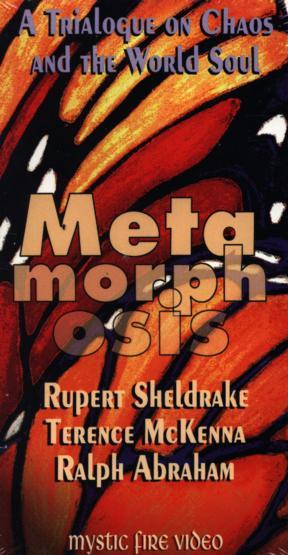
METAMORPHOSIS – A video “trialogue” featuring Ralph Abraham, Terence McKenna, and Rupert Sheldrake – is part shamanic journey and part New Physics 101. It’s mostly talk, with touches of simple computer graphics and music adorning the presentation. But what talk it is. We’ve got Abraham, a mathematician and the godfather of chaos theory; McKenna, a shamanologist, ethnopharmacologist, and psychedelic philosopher; and Sheldrake, a radical biologist and originator of the idea of “morphic resonance,” a memory embedded in all natural systems. Their free-form discussion ranges from drug experiments to the anima mundi (world soul), chaos and complexity, and the effects of language and imagination on the shape of the universe – all in search of a new field theory that encompasses art, science, and philosophy.

In this particular chaotic system, McKenna is the strange attractor around which Abraham and Sheldrake orbit. The three unite in a quest for knowledge and an exchange about the sciences they’ve studied. Sheldrake talks passionately about trying to redefine biology in terms of living organisms, not the abstract dead things found in textbooks and labs. Abraham, not surprisingly, explains how protests over the Vietnam War lead him to leave his sheltered academic life, pursue meditation in the Himalayas, and study chaos theory.

With McKenna as the ringleader (and biggest talker), imagination and chaos are the principal themes. Chaos, as McKenna describes it, is a science to study, an opportunity to reshape the world by looking through the lens of nonlinear processes, and a metaphor to help us think about our place in the universe. In McKenna’s words, chaos “is telling us that the intimation of mysticism, the intimation of a possibility of transcendence, is all firmly grounded in science.”

This is heady stuff. Though you half expect the psychedelic proselytizing to drift off into some kind of Birkenstock-and-bean-sprout dead end, the rigor, intelligence, and wit of these three minds keep the ideas sharp and fast. For anyone interested in the edge of science, this video is both entertaining and inspiring.

Anarchy vs. Statism: Uncontrolled Order Over Controlled Chaos

23b9159be655ca9b54290bca42db5736

By Gary ‘Z’ McGee

Source: Waking Times

“Knowledge makes a man unfit to be a slave.” ~Frederick Douglas

Caught up, as we are, in the politics of statism, it is often extremely difficult to see the forest for the trees. We’re often so busy pretending to think outside the box that we lose track of what’s “the box” and what’s not. We’re so inured by this system of exploitation that it’s often too easy to kiss each other with lies rather than smack each other with the truth.

Meanwhile, complacency sets in and inertia takes hold. Apathy takes root and ignorance becomes “bliss.” Our lives go on and we placate each other with such cowardly platitudes as, “It’s just the way things are,” or “Why fight it? There’s nothing we can do.” Bullshit!

This is not the way things are. This unhealthy system (statism) has separated you from the way things are (natural anarchy). Why fight? Derrick Jensen said it best, “We are the governors as well as the governed. This means that all of us who care about life need to force accountability onto those who do not.” You think there’s nothing you can do about it? Well, you could begin by educating yourself on what the difference between statism and anarchy really is.

Statism is controlled chaos under the illusion of order. Anarchy is uncontrolled chaos under the delusion of chaos. That’s the difference in a nutshell. But if the nutshell doesn’t suffice, please read on.

Controlled Chaos Under the Illusion of Order (Statism)

“Chaos is what we’ve lost touch with. This is why it is given a bad name. It is feared by the dominant archetype of our world, which is Ego, which clenches because its existence is defined in terms of control.” ~Terence McKenna

Statism is bureaucratic order. When order becomes bureaucratic it becomes an abstraction of an abstraction. It loses the essence of real order because it is in the throes of an “order” pigeonholed by fallible men claiming to hold infallible truths that become ill-conceived laws that generally don’t coincide with cosmic laws. Deception becomes rampant in such an illusory state. And the innocent people who are conditioned, brainwashed, and propagandized to no-end by such an illusory bamboozlement become easily manipulated into believing that man-made laws must be followed. Sometimes even at the expense of cosmic laws that should not be avoided.

Statism is the result of an obsolete idea (that has somehow (stupidly) withstood the test of time) held by a group with outdated notions of power lording such power over an ignorant majority. The small group of individuals harboring outdated notions of power want to remain in power –no matter how misguided, immoral, or downright stupid their notion of power is. And so they manipulate the hierarchical nature of statist dogma to keep themselves entrenched in their parochial seats of power, usually at great expense (exploitation, structural violence, violent expropriation, debt slavery, andenvironmental rape) to others.

Under their deceptive controlled chaos and unhealthy illusion of order, all healthy order falls in polluted disarray. Unnecessary poverty is rampant. Avoidable wars are waged. Needless divisive racism and xenophobic jingoism is rife. Preventable pollutants destroy the land, poison the air, and toxify the oceans. All because of the idiotic statist notion of order, which is nothing more than controlled chaos, which is nothing more than an unhealthy hierarchy high on its own ignorant understanding of power, which leaves the world bleeding and dying at its feet.

It matters not the state; any state pushing its statist dogma onto otherwise free human beings is fundamentally unhealthy and is the opposite of liberty. In fact, it is disguised tyranny. Which is ten-times worse than naked tyranny, because naked tyranny is easily thwarted and thus easily denied by the majority. But the disguised tyranny of the state is not so easily thwarted, for it becomes diabolically entrenched in the mind of the majority of conditioned men, deceiving them into believing the Great Lie, as Nietzsche wisely put it, “State is the name of the coldest of all cold monsters. Coldly it lies; and this lie slips from its mouth: ‘I, the state, am the people.’” Indeed. Such a lie is not easily untold. Much cognitive dissonance must be navigated in order to dissolve it. Cognitive dissonance can cripple even the most intelligent and most open-minded of men.

If the State is the name of the coldest of all cold monsters, then Anarchy is the name of the freest of all free liberators. Anarchy slays the beast that is the state by “being so absolutely free that its very existence is an act of rebellion (Albert Camus).” Anarchy is the only way to deal with the “unfree world” erected by the disguised tyranny of the state.

Uncontrolled Order Under the Illusion of Chaos (Anarchy)

“The multitudes have a tendency to accept whoever is master. Their very mass weighs them down with apathy. A mob easily adds up to obedience. You have to stir them up, push them, treat the men rough using the very advantage of their deliverance, hurt their eyes with the truth, throw light at them in terrible handfuls.” ~Victor Hugo

Anarchy is cosmic order. When order is uncontrolled and allowed to flow, then a healthy equilibrium becomes manifests. It only seems chaotic because the majority of us have been conditioned by statism to think that a world without man-made laws is a world in chaos. Nothing could be further from the truth. On a long enough timeline most man-made laws become irrelevant. Unless they coincide with cosmic laws. As James Russell Lowell surmised, “Time makes ancient good uncouth.” This means that what once seemed right and just and lawful eventually goes out of date, and if we cannot let go of it, if we cannot update our outdated values, we become uncouth, immoral, or even downright stupid for withholding them.

Such is our plight against the heavy shadow of the state. The state is without a doubt an “ancient good” deemed uncouth by the passage of time. And it is on us as rational, healthy, and free human beings, who are attempting to progressively evolve on an ever-changing planet, to discard such parochial values. Indeed, as Eliezer Yudkowsky proclaimed, “You are personally responsible for becoming more ethical than the society you grew up in.”

As it stands, becoming more ethical than the society we grew up in means shedding the too-heavy, overreaching, unhealthy, unsustainable armor of the state and donning the anarchist cape of vulnerable courage. It means adapting to, and overcoming, a world that must continue to change in order to remain healthy. It means embracing the flexible courage of anarchy in the face of the inflexible cowardice of the state. In short, it means becoming healthier than the society we grew up in. Which is easy, really. Because the society we grew up in is fundamentally unhealthy. It means being proactive about finding a cure for the sickness within society. The sickness is statism. The cure is anarchy. It means undeceiving ourselves. It means holding those accountable who deceive, and who are still deceived. It means getting power over power by using our updated understanding of prestigious power to trump their outdated understanding of violent and exploitative power.

There is a way to have our progressive evolution and our freedom as well. It’s not a “you can’t have your cake and eat it too” situation. It’s a freedom begets freedom situation. It’s a situation of ‘I want to be free so that I have a better chance of helping others be free.’ Because with enough people free, who also honor the freedom of others, the less likely the chances are that tyranny and slavery become a problem. Alas, as Voltaire quipped, “It is difficult to free fools from the chains they revere.”

But the problem is the way power is perceived. Statism has conditioned us to think that power means having money, stockpiling possessions and gaining wealth through the violent exploitation of others in a vicious cycle of one-upmanship. Statism preaches the use of exploitative and violent power as its unhealthy dogma. Anarchy advocates the use of cooperative nonviolent power through reciprocity. Because power can be healthy. Power balanced with humility and humor is healthy. Healthy power is moral. Healthy power is prestigious. It is nonviolent. It balances itself out in healthy accord with the natural order of things. It is harmonious with Cosmic Law, The Golden Rule, The Golden Mean, The Golden Ratio, The Nonaggression Principle, and Ubuntu. Indeed. Healthy power is naturally anarchic and egalitarian.

The conclusion? The uncontrolled order of anarchy is healthier than the controlled chaos of statism. It’s healthier not only because its eco-centric freedom trumps the statist’s egocentric tyranny, but also because it frees the independent individual into a deeper freedom, into realizing his/her own interdependent nature, despite a codependent state. Interdependence is what we’ve lost touch with. Anarchy is given a bad name because of this, because interdependence is antithetical (even deemed chaotic) to the codependency of the state (which is nothing more than controlled chaos). But anarchy bridges the gap between nature and the human soul, and thus connects thesis to antithesis, which then becomes the synthesis of interdependence.

In the end, the uncontrolled order (cosmic law) will win out, whether or not our species is still around to experience it. However, if we continue to kowtow to the controlled chaos of unhealthy states, then we will not survive. But if we can learn to embrace anarchy, we will give both ourselves, and the environment that sustain us, a fighting chance at survival. Just remember, as Marcus Aurelius said, “The best revenge is not to be like your enemy.” Have no illusions. The enemy is the state.


Saturday Matinee: Technocalypse

technocalyps_dvd_cover

“Technocalyps” (2006) is a documentary by Frank Theys examining the transhumanist movement and development of the sciences of interest to them including genetics, robotics, nanotechnology, and artificial intelligence. Features interviews with philosophers, writers and researchers including Raymond Kurzweil, Kirkpatrick Sale, Natasha Vita More, Robert Anton Wilson and Terence McKenna among others.

Saturday Matinee: Hemp Doc Double Feature

MV5BMjE4ODY2OTI5N15BMl5BanBnXkFtZTcwNTk0OTcxMQ@@._V1_SX214_AL_MV5BMjA3Mzk5NDQ1OV5BMl5BanBnXkFtZTcwOTQwMjIyMQ@@._V1_SX214_AL_The Hemp Revolution (1995) covers the history, cultivation and usage of hemp including food, fuel, building material and medicine. It also explores some of the factors behind the prohibition of hemp production in the U.S. in 1938 (including pressure from the petro-chemical industry). The impressive roster of interview subjects featured in the film includes such notable figures as Dr. Andrew Weil, Dr. Lester Grinspoon, Terence McKenna, Peter Dale Scott, and Prof. Sheri Tonn among many others.

The Emperor of Hemp (1999) documents the life of Jack Herer, his struggle for the decriminalization of cannabis and hemp and his legacy. It’s also an overview of his seminal book The Emperor Wears No Clothes: The Official Hemp Bible including the history and many utilizations of hemp, the conspiracy against it, and a rallying cry to end its prohibition.