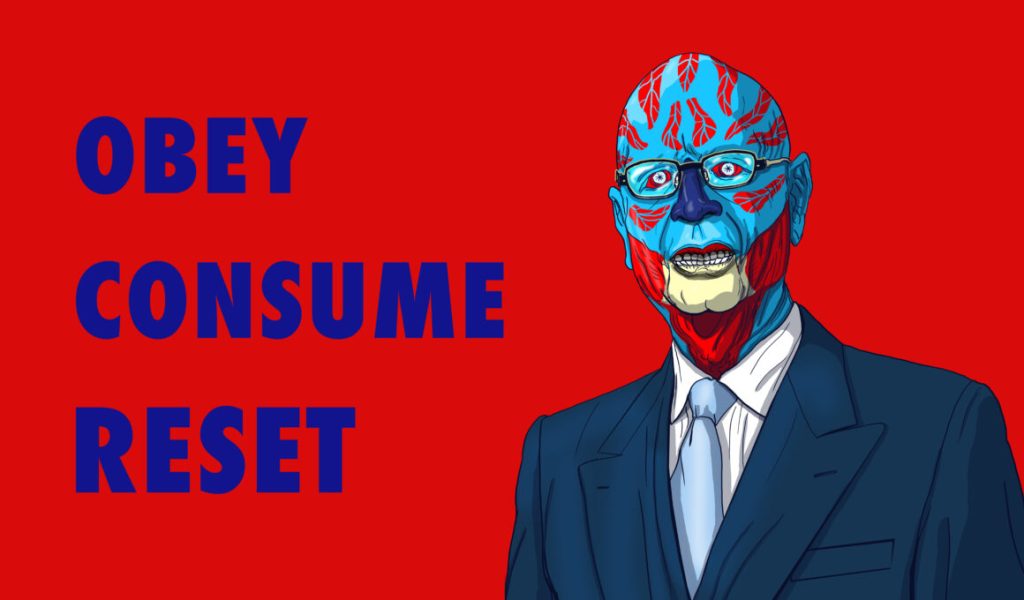
Strategically Resisting the New Dark Age: The 7 Days Campaign to Resist The Great Reset

By Robert J. Burrowes

Measured by the Christian calendar, the period of about 500 years from the fall of the Roman Empire until the end of the first millennium was a time characterized by economic, intellectual and cultural decline in the European Christian world. In retrospect, it is now referred to as ‘the Dark Age’, even as other cultures, including that of Islam but those in other parts of the world too, thrived during this period.

Since March 2020, a number of fine analysts have carefully documented the true nature of what is happening to our world under cover of what the World Health Organization has labeled the ‘Covid-19 pandemic’.

And among these fine analysts, who have investigated ‘The Great Reset’ promoted by the World Economic Forum as well as other initiatives such as those related to transhumanism, eugenics and Cyber Polygon, there is a strong consensus that does not coincide with propaganda released by elite agents in international organizations, national governments and the corporate media.

In essence, these critiques document extensive evidence of an elite coup that seeks to comprehensively restructure human society into a technocratic dystopia in which such previously fundamental concepts as human identity, human liberty, human rights (such as freedom of speech, assembly and movement), human privacy and human volition are not just notions of the past but are beyond the comprehension of the typical ‘transhuman’.

To reiterate, for the bulk of the human population left alive, concepts such as ‘free will’ and ‘freedom’ will no longer exist as ideas, let alone as aspirations or realities. You can access a number of these insightful critiques here: Resources.

So whether we label this world envisaged by the elite as a ‘brave new world’, ‘1984’, the second ‘Dark Age’, a ‘technocratic dystopia’ or, more simply, ‘slavery’ matters little because, whatever the label, what lies immediately ahead is a human future not worth living.

And so resistance is imperative. But unless this resistance is strategic it will not achieve the outcome we seek.

Why? Because this elite coup has been decades in the planning and so resistance that is not carefully designed and rigorously implemented will not succeed. The elite is too well organized for haphazard acts of resistance to have any impact. Hence, there is no point simply reiterating the need for resistance. Only a strategically-focused campaign of nonviolent resistance – such as that outlined below – has any serious prospect of succeeding.

So what does it mean to resist strategically?

Resisting strategically means that we understand the power structures and relationships in society and particularly the way in which the global elite has the power to control us. The elite has power to control us through a number of means. For example, it can control what most people fear, think and believe by ensuring that its international organizations, governments, medical establishments, pharmaceutical industry and corporate media (including corporate social media) present a particular ‘package’ of information which, in this case, focuses on the supposed danger of the SARS-Cov-2 ‘virus’ and the importance of going along with a wide range of measures (including lockdowns, business closures, social distancing, mask-wearing, contact tracing and injections) while also censoring media outlets and authors that publish the truth.

Beyond controlling the narrative, however, the global elite has many other means at its disposal to control  us, many of which are being expanded with the progressive rollout of measures associated with implementation of the fourth industrial revolution (which is fundamentally what the World Economic Forum’s ‘Great Reset’ is about).

These additional means include the deployment of 5G which, apart from the horrific impact this will have on life generally as this electromagnetic radiation further contaminates the biosphere, will enable comprehensive surveillance, digital ID (possibly implanted in your brain: see ‘Beware the Transhumanists: How “Being Human” Is Being Re-Engineered by the Elite’s Coup’) linked to your bank account and health records, a social credit ID that will end up dictating every facet of your life, the digitization of money as well as robotization of the workforce and the military.

And if you don’t normally follow technological developments in the military and how warfare is rapidly ‘advancing’ at great detriment to us all, now complicated by elements intrinsic to the ‘Great Reset’, you will get an unpleasant taste in ‘Joint All-Domain Command and Control (JADC2)’, ‘Countering the “China Threat” – At What Price?’ and ‘War from Sea and Space: Hiding Empire in the 21st Century’.

But, of course, there is more. Much more. In the words of Dr Joseph Mercola: ‘The Great Reset’ means the complete transformation of everything from ‘government, energy and finance to food, medicine, real estate, policing – even how we interact with our fellow human beings. The globalist technocracy is using the COVID-19 pandemic to bypass democratic accountability, override opposition, accelerate their agenda and to impose it on the public against our will.’ See ‘Who Pressed the Great Reset Button?’

For a more detailed summary of the essential elements of this coup, see ‘Corrupt Science and Elite Power: Your Techno-Slavery is Now Imminent’. For a summary of the enormous and increasing costs, see ‘The Elite’s COVID-19 Coup Against a Terrified Humanity: Resisting Powerfully’. And for the evidence of the coup’s adverse impact on human survival prospects, see ‘The Elite’s COVID-19 Coup to Destroy Humanity that is also Fast-Tracking Four Paths to Human Extinction’.

So while these measures are being implemented and thus increasing the capacity of the global elite to control us, we do not have to cooperate. Moreover, we can resist it very effectively and encourage those we know who are also concerned about what is happening to resist effectively as well.

And, in the end, our success or failure will be determined by one simple factor: Are we able to mobilize enough people to act strategically as suggested below?

How Can We Resist Effectively?

Well, as mentioned above, effective resistance requires us to nonviolently noncooperate with those measures that give the global elite the power to control us. That is, we need to focus our resistance so that it undermines the power of the elite. Sound difficult? Believe it or not, it isn’t really.

Let me elaborate a little.

As I have explained on a number of occasions, for example, there is little point organizing a massive protest demonstration unless these mass mobilizations give people who attend (and/or those who hear about them) clear guidance on actions to take to effectively resist once they leave the demonstration. This is because demonstrations, no matter how large, have little impact in themselves (beyond building a sense of solidarity). For example, on 15 February 2003, the largest demonstration in human history – involving 30,000,000 people in 600 cities around the world protesting the impending US invasion of Iraq – took place. And what did it achieve? The ‘Global War on Terror’ goes on still with no evidence to suggest that resistance on that day or since has had the impact we might have hoped.

My point then is simple. We either resist The Great Reset in a way that undermines the power of the elite to conduct this coup or we enter a world in which those still living will wonder about the value of being alive.

So what can we do?

Here is a list of the key actions from each day of the ‘7 Days Campaign to Resist The Great Reset’.

  1. Refuse Covid-19 tests and experimental injections: Choose Natural Health.
  2. Don’t buy 5G upgrades: Resist the fourth industrial revolution.
  3. Boycott Corporate & Government Media: Choose free and truthful media & social media.
  4. Pay with Cash & Switch to Community Owned Banks.
  5. Don’t Wear Masks or Social Distance.
  6. Keep your small business open in lockdown. Buy from small businesses. Don’t use contact tracing QR codes.
  7. Don’t pay Covid-19 related fines: Risk becoming a prisoner of conscience. Seek support.

You can download the posters/leaflets, each with an explanation and references, at the link above. Each leaflet explains why this particular action is important in undermining elite power so that those who receive it (whether by email, in their letterbox or as they attend or walk past a nonviolent action designed for the purpose) clearly understand the value of undertaking this action (every day, not just one day). If you are interested in organizing activities of this type locally, you can also download the ‘Campaign Overview’ at the link above which offers a simple explanation of how to get more people involved.

If you want more information (including a fuller analysis and other resources) and the complete list of the 29 strategic goals of the campaign, you can access everything at ‘We Are Human, We Are Free’.

And you can join the ‘We Are Human, We Are Free’ Telegram group here.

Conclusion

Under cover of a non-existent ‘pandemic’, the global elite is now engaged in an elaborately planned endeavour to take complete control of human life and human society using measures clearly outlined in the literature related to ‘The Great Reset’, the fourth industrial revolution, transhumanism, eugenics and Cyber Polygon.

There is also considerable evidence that increasing numbers of people are weary of the elite-driven response over the past 18 months and that a proportion of these people are now openly sceptical about the official narrative.

But only the rarest person knows how to resist effectively.

And yet if we are to defeat this elite coup, we must mobilize millions of people to noncooperate with fundamental elements of it.

Otherwise the New Dark Age will not be an age from which transhumans will be emotionally and intellectually equipped to emerge, no matter how long they are given. Why? Because the transhumans the elite is intent on creating will not think or feel for themselves; they will have no Self-will to drive their behaviour. They will be programmed to be willing slaves for life.

The time during which human beings can still make choices is rapidly drawing to a close. We must use that time to choose resistance that makes a difference, and invite others to make that choice too.

Robert J. Burrowes has a lifetime commitment to understanding and ending human violence. He has done extensive research since 1966 in an effort to understand why human beings are violent and has been a nonviolent activist since 1981. He is the author of ‘Why Violence?’ His email address is flametree@riseup.net and his website is here.

Freedom Rider: The “Resistance” Is Silent on Julian Assange

By Margaret Kimberly

Source: Black Agenda Report

Liberals are just as much true believers in imperialism as the right wing they claim to oppose.

“Attacking the person who revealed war crimes is compliance in the service of the state.”

Ever since Donald Trump was elected president we have heard a lot about people who call themselves the “resistance.” That word has very significant meaning and should not be used frivolously. The enslaved Haitian people resisted the French 200 years ago. Harriet Tubman resisted and so did Tecumseh. Brave people all over the world have resisted colonial invasion, occupation, and racist violence.

But resistance for the anti-Trump group doesn’t amount to very much. They are united in dislike of Donald Trump, but only some of the time. They call him a fascist, but they mute themselves when his fascism supports the bipartisan imperialist consensus.

The so-called resistance have been conspicuously silent ever since Julian Assange was arrested after Ecuador withdrew his asylum from its London embassy. Under the guise of defending the press, this same group became hysterical when Trump had a stupid argument with a CNN reporter.They are enraged when he refers to the media as “enemies of the people.” But when publisher and journalist Julian Assange was snatched up by the U.S. and its vassal states they either said nothing or condemned a man whose actions are the very embodiment of resistance.

“This same group became hysterical when Trump had a stupid argument with a CNN reporter.”

Julian Assange now sits in a London prison awaiting extradition hearings. The United States government convened a grand jury in 2017 which handed down a secret indictment against him. He is charged with conspiracy to commit computer intrusionin relation to Chelsea Manning’s 2010 revelation of United States war crimes in Iraq. The Collateral Murder video shows army soldiers killing civilians, returning for a “double tap” killing of first responders, and laughing about their massacre. Anyone who revealed these horrors is a hero and should be supported without any ifs, ands or buts.

The United Kingdom played its usual role of partner in crime for the U.S. Fellow puppet state Australia refused to protect its citizen. Ecuador made off with a cool $4 billion in IMF loans. There is so much corruption to oppose but one wouldn’t know that with all the cheering on behalf of the surveillance state.

“Anyone who revealed these horrors is a hero.”

This resistance is little more than a collective hissy fit from dead ender Democrats who insist on following a party that can’t even reliably stay in office.  They have spent the last three years railing against Trump but bite their tongues when he commits an act that reeks of fascist ideology.

The kindest thing that can be said is that they have been hypnotized by a combination of Democratic Party and corporate media lies. It is very difficult to determine the truth in a culture saturated with all the deformities of an imperial state in panic mode. One has to act as a detective and know which web sites to read or whom to follow on social media in order to learn anything outside of the confines of state propaganda. Ever since election night in November 2016 the public have been subjected to a relentless campaign meant to deflect righteous anger away from the Democrats while furthering imperialist goals at the same time.

Julian Assange has become the poster child for the big lie. His leaks of Democratic National Committee emails are blamed for Hillary Clinton’s defeat. But there was no computer hack of the DNC at all. Assange received leaked materials from an insider and used Wikileaks to publish it.

“His leaks of Democratic National Committee emails are blamed for Hillary Clinton’s defeat.”

But that is only a partial explanation. The reality is far worse. Liberals are just as much true believers in imperialism as the right wing they claim to oppose.They are nothing if not consistent. When the Trump administration announced the coup attempt against the Venezuelan government the resistance didn’t resist at all.

Instead they repeated talking points from the New York Timesand National Public Radio which labeled the elected Venezuelan president a brutal dictator. They didn’t question the United States claim of a right to undo the will of people in another country. Some gave wishy washy criticism of military intervention but none of them questioned an intervention which is fascist by any definition.

“Liberals are just as much true believers in imperialism as the right wing they claim to oppose.”

These people will never defend Julian Assange. According to their world view he doesn’t deserve to be defended. He revealed government secrets, which runs counter to their support of the imperialist state, and they think he deprived them of a second Clinton presidency.

Now we know who is for real and who is a phony. Chelsea Manning sits in jail for a second time because she refused to testify before the grand jury which indicted Assange. There are people all over the world occupying Venezuelan embassies and consulates in order to protect them from the would be usurpers. That is resistance. Attacking the person who revealed war crimes is compliance in the service of the state. Perhaps this group needs a new name. They should be honest and call themselves the conformists. That would be truth in advertising.


Margaret Kimberley’s Freedom Rider column appears weekly in BAR, and is widely reprinted elsewhere. She maintains a frequently updated blog as well at http://freedomrider.blogspot.com . Ms. Kimberley lives in New York City, and can be reached via e-Mail at Margaret.Kimberley(at)BlackAgendaReport.com.     

The Cost of Resistance


(Museum of the Revolution, León, Nicaragua)

By Chris Hedges

Source: TruthDig

Resistance entails suffering. It requires self-sacrifice. It accepts that we may be destroyed. It is not rational. It is not about the pursuit of happiness. It is about the pursuit of freedom. Resistance accepts that even if we fail, there is an inner freedom that comes with defiance, and perhaps this is the only freedom, and true happiness, we will ever know. To resist evil is the highest achievement of human life. It is the supreme act of love. It is to carry the cross, as the theologian James Cone reminds us, and to be acutely aware that what we are carrying is also what we will die upon.

Most of those who resist—Sitting Bull, Emma Goldman, Malcolm X and Martin Luther King Jr.—are defeated, at least in the cold calculation of the powerful. The final, and perhaps most important quality of resistance, as Cone writes, is that it “inverts the world’s value system.” Hope rises up out of defeat. Those who resist stand, regardless of the cost, with the crucified. This is their magnificence and their power.

The seductive inducements to conformity—money, fame, prizes, generous grants, huge book contracts, hefty lecture fees, important academic and political positions and a public platform—are scorned by those who resist. The rebel does not define success the way the elites define success. Those who resist refuse to kneel before the idols of mass culture and the power elites. They are not trying to get rich. They do not want to be part of the inner circle of the powerful. They accept that when you stand with the oppressed you get treated like the oppressed.

The inversion of the world’s value system makes freedom possible. Those who resist are free not because they have attained many things or high positions, but because they have so few needs. They sever the shackles used to keep most people enslaved. And this is why the elites fear them. The elites can crush them physically, but they cannot buy them off.

The power elites attempt to discredit those who resist. They force them to struggle to make an income. They push them to the margins of society. They write them out of the official narrative. They deny them the symbols of status. They use the compliant liberal class to paint them as unreasonable and utopian.

Resistance is not, fundamentally, political. It is cultural. It is about finding meaning and expression in the transcendent and the incongruities of life. Music, poetry, theater and art sustain resistance by giving expression to the nobility of rebellion against the overwhelming forces, what the ancient Greeks called fortuna, which can never ultimately be overcome. Art celebrates the freedom and dignity of those who defy malignant evil. Victory is not inevitable, or at least not victory as defined by the powerful. Yet in every act of rebellion we are free. It was the raw honesty of the blues, spirituals and work chants that made it possible for African-Americans to endure.

Power is a poison. It does not matter who wields it. The rebel, for this reason, is an eternal heretic. He or she will never fit into any system. The rebel stands with the powerless. There will always be powerless people. There will always be injustice. The rebel will always be an outsider.

Resistance requires eternal vigilance. The moment the powerful are no longer frightened, the moment the glare of the people is diverted and movements let down their guard, the moment the ruling elites are able to use propaganda and censorship to hide their aims, the gains made by resisters roll backward. We have been steadily stripped of everything that organized working men and women—who rose up in defiance and were purged, demonized and killed by the capitalist elites—achieved with the New Deal. The victories of African-Americans, who paid with their bodies and blood in making possible the Great Society and ending legal segregation, also have been reversed.

The corporate state makes no pretense of addressing social inequality or white supremacy. It practices only the politics of vengeance. It uses coercion, fear, violence, police terror and mass incarceration as social control. Our cells of resistance have to be rebuilt from scratch.

The corporate state, however, is in trouble. It has no credibility. All the promises of the “free market,” globalization and trickle-down economics have been exposed as a lie, an empty ideology used to satiate greed. The elites have no counterargument to their anti-capitalist and anti-imperialist critics. The attempt to blame the electoral insurgencies in the United States’ two ruling political parties on Russian interference, rather than massive social inequality—the worst in the industrialized world—is a desperate ploy. The courtiers in the corporate press are working feverishly, day and night, to distract us from reality. The moment the elites are forced to acknowledge social inequality as the root of our discontent is the moment they are forced to acknowledge their role in orchestrating this inequality. This terrifies them.

The U.S. government, subservient to corporate power, has become a burlesque. The last vestiges of the rule of law are evaporating. The kleptocrats are pillaging and looting like barbarian hordes. Programs instituted to protect the common good—public education, welfare and environmental regulations—are being dismantled. The bloated military, sucking the marrow out of the nation, is unassailable. Poverty is a nightmare for half the population. Poor people of color are gunned down with impunity in the streets. Our prison system, the world’s largest, is filled with the destitute. And presiding over the chaos and the dysfunction is a political P.T. Barnum, a president who, while we are being fleeced, offers up one bizarre distraction after another, much like Barnum’s Feejee mermaid—the head and torso of a monkey sewed to the back half of a fish.

There is no shortage of artists, intellectuals and writers, from Martin Buber and George Orwell to James Baldwin, who warned us that this dystopian era was fast approaching. But in our Disneyfied world of intoxicating and endless images, cult of the self and willful illiteracy, we did not listen. We will pay for our negligence.

Søren Kierkegaard argued that it was the separation of intellect from emotion, from empathy, that doomed Western civilization. The “soul” has no role in a technocratic society. The communal has been shattered. The concept of the common good has been obliterated. Greed is celebrated. The individual is a god. The celluloid image is reality. The artistic and intellectual forces that make transcendence and the communal possible are belittled or ignored. The basest lusts are celebrated as forms of identity and self-expression. Progress is defined exclusively by technological and material advancement. This creates a collective despair and anxiety that feeds and is fed by glitter, noise and false promises of consumer-culture idols. The despair grows ever-worse, but we never acknowledge our existential dread. As Kierkegaard understood, “the specific character of despair is precisely this: it is unaware of being despair.”

Those who resist are relentlessly self-critical. They ask the hard questions that mass culture, which promises an unachievable eternal youth, fame and financial success, deflects us from asking. What does it mean to be born? What does it mean to live? What does it mean to die? How do we live a life of meaning? What is justice? What is truth? What is beauty? What does our past say about our present? How do we defy radical evil?

We are in the grip of what Kierkegaard called “sickness unto death”—the numbing of the soul by despair that leads to moral and physical debasement. Those who are ruled by rational abstractions and an aloof intellectualism, Kierkegaard argued, are as depraved as those who succumb to hedonism, cravings for power, violence and predatory sexuality. We achieve salvation when we accept the impediments of the body and the soul, the limitations of being human, yet despite these limitations seek to do good. This burning honesty, which means we always exist on the cusp of despair, leaves us, in Kierkegaard’s words, in “fear and trembling.” We struggle not to be brutes while acknowledging we can never be angels. We must act and then ask for forgiveness. We must be able to see our own face in the face of the oppressor.

The theologian Paul Tillich did not use the word “sin” to mean an act of immorality. He, like Kierkegaard, defined sin as estrangement. For Tillich, it was our deepest existential dilemma. Sin was our separation from the forces that give us ultimate meaning and purpose in life. This separation fosters the alienation, anxiety, meaninglessness and despair that are preyed upon by mass culture. As long as we fold ourselves inward, embrace a perverted hyper-individualism that is defined by selfishness and narcissism, we will never overcome this estrangement. We will be separated from ourselves, from others and from the sacred.

Resistance is not only about battling the forces of darkness. It is about becoming a whole and complete human being. It is about overcoming estrangement. It is about the capacity to love. It is about honoring the sacred. It is about dignity. It is about sacrifice. It is about courage. It is about being free. Resistance is the pinnacle of human existence.

The Seeds of Anti-Capitalist Revolt Found in Everyday Resistance: A Review of Guerrillas of Desire – Notes on Everyday Resistance and Organizing to Make a Revolution Possible by Kevin Van Meter (AK Press, 2017)

By Scott Campbell

Source: Institute for Anarchist Studies

Back when I first began selling my labor for a wage in the wasteland of suburbia’s strip malls, I can recall the tedium of stocking shelves, summoning up insincere courtesy in the face of entitled customers and obnoxious bosses, comparing the stacks of money counted at the end of the day with the totals on our paychecks, and feigning adherence to whatever motivational façade management cooked up to mask the reality of our exploitation.

Yet I also remember, much more vividly and fondly, the latent and occasionally eruptive defiance among my co-workers. This included the constant collective complaining about the job, taking more and longer-than-approved breaks, working as little as possible, fudging time sheets, stealing, and the intermittent screaming matches with the boss in the middle of the store. Underpinning all these actions was an unspoken but broadly understood code of silence when it came to such transgressions and, when appropriate, expressions of support for them.

At the time, I didn’t think much about this, it was just how things happened and I’ve encountered similar experiences to varying degrees in every workplace since. Our actions weren’t guided by a political framework nor was there any attempt to organize them in a directed manner. It was more a spontaneous, innate reaction to experiencing the coercion of capitalism. I had cause to reflect upon this anew while reading Kevin Van Meter’s new book, Guerrillas of Desire: Notes on Everyday Resistance and Organizing to Make a Revolution Possible, published by AK Press and the Institute for Anarchist Studies.

In the preface, Van Meter observes that the question motivating him is not “What is to be done?” but “How do people become what they are?” Throughout the course of the book he seeks to provide an answer by locating power in the resistance of workers, apart from any political ideology or organization. Whether and how that inherently anti-capitalist refusal of work develops into revolt or rebellion are the questions he compellingly urges us to reflect and act upon.

To reach that point, Guerrillas of Desire ambitiously takes on multiple tasks that feed into and build on one another. Van Meter initiates a dialogue between anarchism and Autonomist Marxism that leads to a reconceptualization of the working class, bolstered in part by a historical accounting of workplace actions such as the ones I recounted. He labels these “everyday resistance,” committed by “guerrillas of desire,” and proposes a focus on those deeds as the entry point for organizing revolutionary resistance to capitalism. The impetus for this initiative, concisely carried out in under 160 pages, is his proposal that the current approach to organizing is conceptually flawed and therefore destined to fail. “Guerrillas of Desire offers a contentious hypothesis: the fundamental assumption underlying Left and radical organizing, including many strains of anarchism, is wrong. I do not mean organizationally dishonest, ideologically inappropriate, or immoral. I mean empirically incorrect” (13). The incorrect basis for current organizing is the assumption that the poor and working classes are unorganized and passive and that it therefore rests upon activists and organizations to educate and mobilize them for their own sakes. Van Meter instead proposes that there is in fact informal organization and resistance occurring, it is just of a sort that does not fit within the Left’s organizing vision and therefore goes unseen, unrecognized, and unincorporated into political theories, analysis, and action.

To provide a political frame for understanding the “everyday resistance” of the working class, Van Meter draws upon anarchism’s mutual aid – the material and emotional cooperation and reciprocal support that exists in societies – with Autonomist Marxism’s self-valorization – autonomous working class action that counters the state and capitalism, primarily the refusal of work in its myriad forms. Combined together and reinforcing one another, mutual aid and the refusal of work comprise the “everyday resistance” of the working class.

These phenomena also give definition to what is meant by “working class,” which Van Meter defines as “autonomous from both capitalism and the official organization of the Left, broadly including all those who work under capitalism, based in relationships between workers rather than as a structural component of the economy or sociological category” (32). Rather than being premised on income, occupation, or union membership, the working class under Van Meter’s formulation is made up of all those who must perform work under capitalism – be it waged or unwaged, in the factory, home, office, bedroom, affective, or social spheres. However, when they are not taking action in response to their subjugation under capitalism, these people are just workers. They become a class through the process of struggling against the conditions imposed upon them by capitalism. This struggle initially takes the form of everyday resistance based on mutual aid and the refusal of work. It is everyday resistance that unites individual workers as a class because such resistance, even when performed by one person, requires at a bare minimum the tacit complicity of co-workers and preferably their active collaboration.These acts and the social relationships they create and depend on lay the groundwork for the broader and overt organizing against capitalism more commonly interpreted as working class struggle. Using this framework as offered by Van Meter, we can understand the working class as composed of the relationships forged among workers actively in resistance against capitalism.Without anti-capitalist struggle, the working class does not exist.

After laying this theoretical groundwork, the bulk of the book traces the various forms of resistance by slaves, peasants, and workers in the industrial and social factories (the expansion of capitalist logic from the factory into society at large, in particular in service, immaterial, and reproductive work), creating a lineage and legacy of working class resistance against the various formations of capitalism that spans centuries. “Viewing the working class broadly to include slaves and peasants as well as students, homemakers, immigrants, and factory and office workers reveals the breadth of struggle and generalized revolt against work that continues to be imposed” (128). In doing so, Van Meter further builds the framework of the working class as being formed through its self-activity against the demands and deprivations of capitalism.

The historical survey brings the discussion into the present, where Van Meter offers a proposal to address his initial hypothesis that the Left is carrying out its organizing work in an incorrect way. His suggestion is for the organizers of today and in the future to begin their work by “reading the struggles” already underway in the form of everyday resistance. Through investigation and documentation by organizers, new relationships may be fostered with guerillas of desire that allow everyday resistance to expand into larger and more overt forms of autonomous anti-capitalist struggle. He proposes that the seeds of the new, liberatory worlds sought by anarchism and Autonomist Marxism are to be found in the everyday resistances that are already occurring rather than in the latest organizing manual or official Left strategy document..

While impressed after reading through this formulation, I was left with lingering questions. It remained unclear how, for instance, everyday resistance morphed into more overt, organized resistance and the part organizers positioning themselves as readers of struggle played in such a development. The personal anecdotes he provided on stepping back from ideological assumptions and reorienting towards the collective experiences of communities during his work in Long Island were helpful. It brought to mind the story of Marxist-Leninist intellectuals heading off to the Chiapan jungle with grand plans of starting a peasant guerrilla force. Only when they arrived, they found the population had no time or interest in their grandiose ideology. It was only when they dropped their assumptions and worked within the community to understand its needs, concerns and own history of resistance that the Zapatistas emerged. That, however, is a rather specific and exceptional example. I feel Van Meter’s proposal to begin organizing from within everyday resistance based on the notion that it will lead to more overt resistance could benefit from further articulation and direction.

Similarly, the focus on work as existing solely within the capitalist sphere left me curious as to his vision of the place of non-leisure activity under capitalism or even after capitalism. The refusal of the work that maintains capitalism is indispensable. Yet I would not advocate the refusal of work that maintains communal and personal well-being or builds autonomous organization, or writes books reviews in spare time, for example. Certainly, Van Meter would not advocate that either, but it remains a matter necessitating clarification and one that I believe extends beyond an issue of semantics.

Despite those questions, Guerrillas of Desire is aspirational in its scope and contains ideas and proposals worthy of consideration by radicals reflecting on how to engage in the current moment. In a time when mobilizing and organizing around class has fallen off the radar of many, it is a welcome reminder of the importance of paying attention to the working class and the integral role working class struggle plays in resistance to capitalism, alongside the currently more prevalent resistances to capitalist white supremacy, heteropatriarchy, colonization, environmental destruction and more.

Van Meter assists in this advocacy by accessibly presenting an updated Autonomist Marxist perspective of the working class, expanding it, breathing life into, and imbuing it with its own power, separate from both capitalism and the official Left. As such, he allows readers who may toil in a variety of ways under capitalism to see themselves within the working class, conceptualize their activities as part of a broader resistance with a rich history, and inspire them to build on that legacy.


Scott Campbell is a radical writer and translator based in California. He is part of the collectives that publish the websites El Enemigo Común and It’s Going Down. His personal site is fallingintoincandescence.com

Guerrillas of Desire is available here!


Newsletter: From Neoliberal Injustice To Economic Democracy

By Kevin Zeese and Margaret Flowers

Source: Dissident Voice

The work to transform society involves two parallel paths: resisting harmful systems and institutions and creating new systems and institutions to replace them. Our focus in this article is on positive work that people are doing to change current systems in ways that reduce the wealth divide, meet basic needs, ensure sustainability, create economic and racial justice and provide people with greater control over their lives.

When we and others organized the Occupation of Washington, DC in 2011, we subtitled the encampment ‘Stop the Machine, Create a New World’, to highlight both aspects of movement tasks — resistance and creation. One Popular Resistance project, It’s Our Economy, reports on economic democracy and new forms of ownership and economic development.

Throughout US history, resistance movements have coincided with the growth of economic democracy alternatives such as worker cooperatives, mutual aid and credit unions. John Curl writes about this parallel path in “For All the People,” which we summarized in “Cooperatives and Community Work are Part of American DNA.”

Mahatma Gandhi’s program of nonviolent resistance, satyagraha, had two components: obstructive resistance and constructive programs. Gandhi promoted Swaraj, a form of “self-rule” that would bring independence not just from the British Empire but also from the state through building community-based systems of self-sufficiency. He envisioned economic democracy at the village level. With his approach, economics is tied to ethics and justice — an economy that hurts the moral well-being of an individual or nation is immoral and business and industry should be measured not by shareholder profit but by their impact on people and community.

Today, we suffer from an Empire Economy. We can use Swaraj to break free from it. Many people are working to build a new economy and many cities are putting in place examples of economic democracy. One city attempting an overall transformation is Cooperation Jackson in Jackson, Mississippi.

Economic Democracy in response to neoliberalism

In his new book, Out of the Wreckage: A New Politics for an Age of Crisis, George Monbiot argues that a toxic ideology of greed and self–interest resulting in extreme competition and individualism rules the current economic and political culture. It is built on a misrepresentation of human nature. Evolutionary biology and psychology show that humans are actually supreme altruists and cooperators.  Monbiot argues that the economy and government can be radically reorganized from the bottom up, enabling people to take back control and overthrow the forces that have thwarted human ambitions for a more just and equal society.

In an interview with Mark Karlin, Monbiot describes how neolibealism arose over decades, beginning in the 1930s and 40s with John Maynard Keynes, Friedrich Hayek and others, and is now losing steam, as ideologies do. Monbiot says we need a new “Restoration Story.”

We are in the midst of writing that new story as people experience the injustice of the current system with economic and racial inequality, destruction of the environment and never ending wars. Indeed, we are further ahead in creating the new Restoration Story than we realize.

Cooperatives

New research from the University of Wisconsin–Madison’s Center for Cooperatives (UWCC) has found there are 39,594 cooperatives in the United States, excluding the housing sector, and there are 7 million employer businesses that remain “potential co-op candidates.” These cooperatives account for more than $3 trillion in assets, more than $500 billion in annual revenue and sustain nearly two million jobs. This May, the Office of Management and Budget approved including coop questions in the Economic Census so that next year the US should have more accurate figures. The massive growth of cooperatives impacts many segments of the economy including banking, food, energy, transit and housing among others.

In cooperatives, workers or consumers decide directly how their business operate and work together to achieve their goals; it is a culture change from the competitive extreme capitalist view dominated by self-interest.

In Energy Democracy: Advancing Equity in Clean Energy Solutions, editors Denise Fairchild and Al Weinrub describe energy cooperatives that are creating a new model for how we organize the production and distribution of energy, which is decentralized, multi-racial and multi-class.

Lyn Benander of Co-op Power, a network of many cooperatives in New England and New York, writes that they transform not just energy but also their communities:

First, people come together across class and race to make change in their community by using their power as investors, workers, consumers, and citizens ready to take action together. Then, they work together to build community-owned enterprises with local capital and local jobs to serve local energy needs. It’s a proven strategy for making a real difference.

In Lancaster, CA, the mayor has turned the town into a solar energy capital where they produce power not just for themselves, but also to sell to other cities. They are also moving to create manufacturing jobs in electric buses, which more cities are buying, and energy storage. Research finds that rooftop solar and net-metering programs reduce electricity prices for all utility customers, not just those with solar panels. The rapid growth of rooftop solar is creating well-paying jobs at a rate that’s 17 times faster than the total U.S. economy. Rooftop solar, built on existing structures, such as homes and schools, puts energy choices in the hands of customers rather than centralized monopolies, thereby democratizing energy.

Including housing cooperatives would greatly increase the number of cooperatives. According to the National Association of Housing Cooperatives, “Housing cooperatives offer the more than one million families who live in them several benefits such as: a collective and democratic ownership structure, limited liability, lower costs and non-profit status.”  Residents of a mobile home park in Massachusetts decided to create a housing cooperative to put the residents in charge of the community when the owner planned to sell it.

Related to this are community land trusts. A section of land is owned in a trust run as a non-profit that represents the interests of local residents and businesses. Although the land is owned by the trust, buildings can be bought and sold. The trust lowers prices and can prevent gentrification.

Universal Basic Income

Another tool gaining greater traction is a universal basic income.  James King writes in People’s Policy Project that “. . . a universal basic income (UBI) – a cash payment made to every person in the country with no strings attached – is becoming increasingly popular in experimental policy circles. . . payments  [would be] large enough to guarantee a minimum standard of living to every person independent of work. In the US, that would be roughly $12,000 per person based on the poverty line.”

The wealth divide has become so extreme in the United States that nearly half of all people are living in poverty. A small UBI would provide peace of mind, financial security and the possibility of saving money and building some wealth. A report by the Roosevelt Institute, this week, found that a conservative analysis of the impact of a UBI of $1,000 per month would grow the economy by 12.56 percent after an eight-year implementation, this translates to a total growth of $2.48 trillion.

Public Finance

Another major area of economic democracy is the finance sector. At the end of 2016 there were 2,479 credit unions with assets under 20 million dollars in the United States. Members who bank in credit unions are part of a cooperative bank where the members vote for the board and participate in other decisions.

Another economic democracy approach is a public bank where a city, state or even the national government creates a bank using public dollars such as taxes and fee revenues. Public banks save millions of dollars that are usually paid in fees to Wall Street banks, and the savings can be used to fund projects such as infrastructure, transit, housing, healthcare and education, among other social needs. Public banks can also partner with community banks or credit unions to fund local projects. This could help to offset one of the negative impacts of Dodd-Frank, which has been a reduction in community banks. In testimony, the Secretary of Treasury, Stephen Munchin, said we could “end up in a world where we have four big banks in this country.”

North Dakota is the only state with a public bank, and it has the most diverse, locally-owned banking system in the country. Stacey Mitchell writes that “North Dakota has six times as many locally owned financial institutions per person as the rest of the nation. And these local banks and credit unions control a resounding 83 percent of deposits in the state, more than twice the 30 percent market share such banks have nationally.” Public banking campaigns are making progress in many parts of the country, among them are Oakland, Los Angeles, Philadelphia, Santa Fe, and other areas.

Mutual Aid

When crises occur, no matter what their cause, people can work together cooperatively and outside of slow and unresponsive state systems to meet their needs. This is happening in Athens, Greece, which has been wracked by financial crisis and austerity for years. People have formed “networks of resistance” that meet in community assemblies organized around needs of the community, such as health care and food. They started with time banks as a base for a new non-consumer society.

Similar efforts are underway in Puerto Rico following the devastation of Hurricane Maria. A group called El Llamado is coordinating more than 20 mutual aid efforts, and providing political education and support for self-organizing at the same time.

As George Monbiot describes it, this is consistent with the truth about what human beings are:

We survived despite being weaker and slower than both our potential predators and most of our prey. We did so through developing, to an extraordinary degree, a capacity for mutual aid. As it was essential to our survival, this urge to cooperate was hard-wired into our brains through natural selection.

As we face more crises, whether in lack of access to health care, education, housing, food or economic and climate disasters, let’s remember that we have the capacity to meet our needs collectively.  In fact, every day, people are putting in place a new economic democracy that allows people to participate based on economic and racial justice as well as real democracy. As these alternatives are put in place, they may become dominant in our economy, communities and politics and bring real democracy and security to our lives.


Kevin Zeese and Margaret Flowers are co-directors of Popular Resistance. Read other articles by Kevin Zeese and Margaret Flowers.

FIGHTING FOR OKINAWA — MY HOME, NOT A MILITARY BASE

By Moé Yonamine

Source: Rethinking Schools

My family moved to the United States from Okinawa when I was 7. But Okinawa is still home — and I’m hurt and angered at how the United States and Japan continue to treat Okinawa as little more than a colonial outpost. As a teacher, I’m even more dismayed at how the conventional school curriculum keeps young people in this country ignorant about the abuse, but also about the resistance, in my home islands.

“They are burying our beautiful ocean,” read the recent message from my mother in Okinawa, as though she was grieving the loss of a loved one. After decades of protest by Okinawan people to completely get rid of all U.S. military bases that occupy a fifth of the Ryukyu Island chain, the United States and Japan signed a treaty to evacuate one of the most contested bases located in the center of the main island, Futenma Marine Corps (MCAS) base. In exchange for the removal, both governments announced that they would construct a floating military base off the northeast coast of Henoko. Okinawans expressed vehement opposition, with a majority voting in a referendum for the complete removal of all bases. Still the construction continued and the people persisted in protest — marching for miles down main streets, creating human chains for peace, linking arms around military bases, elders repeatedly lying down in front of bulldozers. Governor Takeshi Onaga demanded the Japanese government terminate the heliport construction and city mayors prevented access of U.S. military construction vehicles through their districts — later overturned by federal court order last December sought by the Japanese federal government.

Today, the concrete seawalls are finished, and soon, rocks will be crushed and sand will pile high, burying the tropical, clear waters. The Japanese government and U.S. military continue to pursue the construction of the runway, despite community complaints of environmental damage and pollution, endangerment to sea life, harm to the fishing and tourism industry, as well as the ongoing threat to cultural survival and island sovereignty. On July 6th the Ryukyu Shimpo announced that the Japanese government would not return the land occupied by MCAS Futenma to the Okinawan people. The U.S. and Japan added a condition to the promise for Futenma’s removal: The Naha International Airport must be made available for the U.S. military any time they declare an emergency. When Governor Onaga rejected this demand, the U.S. military withdrew its promise to remove Futenma. Japanese Defense Minister Tomomi Inada stated, “If the requisite conditions for the return of Futenma are not met, it will not be returned.” In a surge of anger, pain and frustration, word spread quickly in Okinawa across social media.

Devastated at the sacrifice of my home, I turned to the news here in the United States, and there was not one story about Okinawa on any major network. Frustrated, I recalled my conversation with an elderly grandmother I met at a peace rally in my neighborhood when I went home last summer. When I told her I was a teacher in the United States, she told me that the best thing we as teachers can do is to teach kids about what’s happening in Okinawa and how we want a world without war. She said, “They need to know our story so they can stand up with us.”

But when I turn to a typical U.S. textbook, I see how students are ill-equipped to understand what’s happening in Okinawa. For example, in Holt McDougal’s widely used The Americans, there are a mere three paragraphs about Okinawa under the section, “The Atomic Bomb Ends the War.”

Discussion of Okinawa begins and ends with a skewed description of the Battle of Okinawa during WWII: “In April 1945, U.S. Marines invaded Okinawa,” it begins. “By the time the fighting ended on June 21, 1945, more than 7,600 Americans had died. But the Japanese paid an even greater price — 110,000 lives — in defending Okinawa.” Okinawans are completely invisible in this account of the war, the bloodiest battle in the history of the Pacific, where our islands were used as a battleground between the United States and Japan. The highest cost was in Okinawan lives, where more than a third of the population was killed within three months — almost 150,000 — and more than 92 percent were left homeless. The majority of today’s families — including mine — have experienced grief and loss of loved ones.What The Americans does not teach is that Okinawa was once an independent kingdom, was colonized by Japan, then controlled by the United States for 27 years, and finally became a Japanese prefecture. At the end of the war, the U.S. military stripped Japan of its constitution and replaced it with one that took away Japan’s right to have an offensive military. Henceforth, the United States would “protect” Japan, and create bases throughout Japanese territory. However, three-quarters of all U.S. bases on Japanese territory are on Okinawa, even though Okinawa makes up only .6 percent of Japan’s total landmass. Okinawa’s main island is just 62 miles long; and its width averages one mile.

MCAS Futenma was constructed in the middle of our skinny island — creating environmental destruction, air pollution and noise pollution, blocking direct access to roads in a densely populated community, and exposing survivors and families to the sights and sounds of war. Frequent violent crimes against women and children continue to bring hundreds of thousands of protesters together demanding justice and humanity — and the complete removal of U.S. military bases.

Not only do commercial textbooks fail to equip students to understand what’s happening in Okinawa, the mainstream school curriculum does not help students understand issues affecting island people more broadly. I have seen time and time again the shock when my high school students in Portland, Oregon, learn about the U.S. military’s long-standing nuclear testing in the Marshall Islands, the environmental damage to Vieques in Puerto Rico, or the history of U.S. military trainings on indigenous Hawaiian soil. Many of my students are confused when they learn that Guam is a “U.S. territory,” has the highest per capita U.S. military enlistment, has a huge U.S. base presence, but its people have no right to vote in U.S. elections. When I talk about the International Women’s Network Against Militarism, students wonder why women from places with high U.S. military presence — the Philippines, South Korea, Hawai’i, Puerto Rico, Guam and Okinawa — gather regularly to talk and organize.

When people say to me, “Why are Okinawans complaining? We’re there to protect you,” I want them to learn our whole history and to know our colonized story. When people ask, “Why don’t Okinawans complain to the Japanese government?” I want them to know about the history of our people’s movements to demand our rights. When people say, “So what? It’s just one little island,” I want them to know this is my home; it’s sacred — these are my loved ones. What’s more, our story of struggle today represents issues affecting so many island people.

The elderly grandmother from the peace rally told me that we must teach the children “that we have been fighting because we have always wanted peace but now we need the world to fight with us. Go back and tell our story.” Our story though, is much more than three short paragraphs in a textbook. It is a story about a people’s determination for sovereignty in the face of imperialism, resilience in midst of colonization, and perseverance for peace as survivors of war. Our story is urgent and it is a call for global action in the name of peace and justice. The history of Okinawa is a story of resistance but also a call to the world.


Moé Yonamine (moe@rethinkingschools.org) teaches at Roosevelt High School in Portland, Oregon, and is an editor of Rethinking Schools magazine. Yonamine is part of a network of Zinn Education Project teachers developing original people’s history curriculum. She is the author of “The Other Internment: Teaching the Hidden Story of Japanese Latin Americans During WWII,” “‘ANPO: Art X War’: A Film Tackles the U.S. Occupation of Japan,” a film review with teaching activities of “ANPO: Art X War,” a documentary about visual resistance to U.S. military bases in Japan, and “Uchinaaguchi: The Language of My Heart.”

Globalisation: Hyperstition, Surveillance, and the Empire of Reason

By S.C. Hickman

Source: Techno Occulture

Edmund Berger in his essay Underground Streams speaking of various tactics used by the Situationists, Autonomia, and the Carnivalesque:

“Like the Situationists the Autonomia would engage with the tradition of the Carnivalesque alongside a Marxist political analysis. Bakhtin had described the carnival as “political drama without footlights,” where the dividing line between “symbol and reality” was extremely vague, and the Autonomia had embodied this approach through their media-oriented tactics of detournement. But under a regime of emergency laws a great portion of the Autonomia was sent to prison or into exile, leaving its legacy through an extensive network of radical punk and anarchist squats and social centers.”

One of the things we notice is that the Autonomia movement actually struck a nerve at the heart of Power and forced their hand, which obligingly reacted and used their power over and dominion of the Security System to screen out, lock up, and exclude this threat. That’s the actual problem that will have to be faced by any emancipatory movement in the present and future: How to create a movement that can be subversive of the system, and yet chameleon like not rouse the reactionary forces to the point of invoking annihilation or exclusionary measures?

A movement toward bottom-up world building, hyperstition, and exit from this Statist system will have to do it on the sly utilizing a mirror world strategy that can counter the State and Public Security and Surveillance strategies.  Such Counter-Worlds of Exit and Hyperstitional instigation will need to work the shadow climes of the energetic unconscious, triggering a global movement from the shadows rather than in direct opposition.

In many ways as I think we need a politics of distortion, allure, and sincerity, one that invents a hyperstitional hyperobject among the various multidimensional levels of our socio-cultural systems, calling forth the energetic forces at the heart of human desire and intellect, bypassing the State and Corporate filters and Security Systems of power and control. Such a path will entail knowing more about the deep State’s secret Security apparatus and Surveillance methodologies, technologies, and tactics than most thinkers are willing to acknowledge or even apprehend. Like the Hacker movements of the 90’s up to Anonymous one will need to build shadow worlds that mimic the stealth weapons of the State and Corporate Global apparatus and assemblages; but with one caveat – these weapons are non-violent “weapons of the mind”, and go unseen and unrecognized by the State Security Systems at Local and Global levels.

A global system of mass, warrantless, government surveillance now imperils privacy and other civil liberties essential to sustaining the free world. This project to unilaterally, totally control information flow is a product of complex, ongoing interplay between technological, political, legal, corporate, economic, and social factors, including research and development of advanced, digital technologies; an unremitting “war on terror”; relaxed surveillance laws; government alliances with information technology companies; mass media manipulation; and corporate globalism. One might say it as the Googling of the World.

The United Stats internally hosts 17 intelligence agencies under the umbrella known as the Security Industrial Complex. They are also known for redundancy, complexities, mismanagement and waste. This “secret state” occupies 10,000 facilities across the U.S. Over the past five years the total funding budget exceeded half a trillion dollars. The notion of globalization which has its roots in the so called universalist discourses of the Enlightenment had as its goal one thing: to impose a transparent and manageable design over unruly and uncontrollable chaos: to bring the world of humans, hitherto vexingly opaque, bafflingly unpredictable and infuriatingly disobedient and oblivious to human wishes and objectives, into order: a complete, incontestable and unchallenged order. Order under the indomitable rule of Reason.1

This Empire of Reason spreads its tentacles across the known world through networks and statecraft, markets and tradecraft, war and secrecy, drugs and pharmakon.  The rise of the shadow state during Truman’s era began a process that had already been a part of the Corporate worldview for decades. The monopoly and regulation of a mass consumption society was and always will be the goal of capitalist market economies. In our time the slow and methodical spread of the American surveillance state and apparatus has shaped the globalist agenda. Because of it the reactionary forces of other state based control systems such as Russia and China are exerting their own power and surveillance systems as counters to Euro-American hegemony.

Surveillance is a growing feature of daily news, reflecting its rapid rise to prominence in many life spheres. But in fact surveillance has been expanding quietly for many decades and is a basic feature of the modern world. As that world has transformed itself through successive generations, so surveillance takes on an ever changing character. Today, modern societies seem so fluid that it makes sense to think of them being in what Bauman terms a ‘liquid’ phase. Always on the move, but often lacking certainty and lasting bonds, today’s citizens, workers, consumers and travelers also find that their movements are monitored, tracked and traced. Surveillance slips into a liquid state.

As Bauman relates it liquid surveillance helps us grasp what is happening in the world of monitoring, tracking, tracing, sorting, checking and systematic watching that we call surveillance. Such a state of affairs engages with both historical debates over the panopticon design for surveillance as well as contemporary developments in a globalized gaze that seems to leave nowhere to hide, and simultaneously is welcomed as such. But it also stretches outwards to touch large questions sometimes unreached by debates over surveillance. It is a conversation in which each participant contributes more or less equally to the whole. (Bauman)

Our network society has installed its own “superpanopticon” (Mark Poster). Such a system is ubiquitous and invisible to the mass of users. As Poster states it “The unwanted surveillance of one’s personal choice becomes a discursive reality through the willing participation of the surveilled individual. In this instance the play of power and discourse is uniquely configured. The one being surveilled provides the information necessary.” For Poster, this supply of self-surveillance is provided through consumer transactions stored and immediately retrievable via databases in their constitution of the subject as a “sum of the information in the fields of the record that applies to that name.” The database compiles the subject as a composite of his or her online choices and activities as tracked by IFS. This compilation is fixed on media objects (images, text, MP3s, Web pages, IPs, URLs) across the deluge of code that can be intercepted through keyword pattern recognition and private lists of “threatening” URLs.2

Our so called neoliberal society has erased the Public Sphere for the atomized world of total competition in a self-regulated market economy devoid of politics except as stage-craft. As authors in the Italian autonomist movements have argued for the past fifty and more years, this “total subsumption” of capital upon the life-sphere has been accomplished through “material” and “immaterial” means.  According to these authors, capital in late capitalism and neoliberalism has attempted to progressively colonize the entire life-sphere. Resistance, they argue, comes through the “reserves” to capital that remain as the social and intellectual foundation from which capital draws, including through “immaterial labor” using digital means. Gradually during modernity, such theorists have argued, life itself has been taken as a target for capitalist subsumption, through the cooptation of communication, sexual and familial relationships (Fortunati 1995), education, and every other sphere of human activity, with economic exchange and survival as the ultimate justification for all relationships.3

Capital’s “apparatus of capture” has become increasingly efficient and broad in its appropriation of selves as subjects of its political economy through the combination of appropriating governmental functions such as: buying off political actors and agencies, cutting public funding to modernist institutions and infrastructures, redefining the agenda of education and other cultural institutions toward capitalist values, owning and narrowing the focus of the media, forcing family structures and individuals to adapt to scarcity economies, and using government police and surveillance forces and economic pressures to crush resistance. In short, it is said that neoliberalism has advanced by the totalitarian institutionalization of national and international capitalism, one nation after another, using domestic means to force compliance in domestic markets and using international pressures (economic, military, cultural) to do the same to other countries, cultures, and peoples. (Day, pp. 126-127)

The increased accuracy (or believed accuracy) of increased surveillance and feedback targeting through the collection of social big data and its analyses and social and political uses (ranging from drone predators to state surveillance in both democratic and communist/ authoritarian governments to consumer targeting— for example, the targeting done by Target Corporation, as described in a 2012 New York Times article [Duhigg 2012])— belong to a conjoined mechanism of cybernetic and neoliberal governmentality, which crosses governmental and corporate databases and organizations. Social big data seeks to demarcate trends, which then directly or indirectly act as norms, which further consolidate individual and group action within market-determined norms (Rouvroy 2013). People are forced into competition, into a “freedom” that is monitored and checked within systems of feedback control. As Norbert Weiner suggested in the Cold War period (Wiener 1954, 1961), communicative control can be used toward a discourse of “rationality”; a rationality that is seen as proper to a given political economy. The documentary indexing of the subject provides the codes for the subject’s social positioning and expressions by others and by itself. Thanks to networked, mobile devices, the subject can attempt to continuously propose him- or herself to the world as the subject of documentary representation. (Day, pp. 132-133)

Those of us in the West who use mobile devices are becoming hooked into an elaborate datasociety in which every aspect of our lives is conditioned to enforce a self-regulatory system of choices and taboos. The surveillance is done at the level of individuals, who are monitored and whose actions are predicted throughout key moments of their consumption or production, marking changes in trends and phase states, and recalculating the trajectory of entities according to these new parameters and relationships. Our algorithmic society is splicing us all into a grid of total control systems from which it will become increasingly difficult to extricate ourselves.

As Douglas Rushkoff said recently digital technology is programmed. This makes it biased toward those with the capacity to write the code. In a digital age, we must learn how to make the software, or risk becoming the software. It is not too difficult or too late to learn the code behind the things we use—or at least to understand that there is code behind their interfaces. Otherwise, we are at the mercy of those who do the programming, the people paying them, or even the technology itself.4 More and more our mass society is being programmed through an immaterial grid of datafied compliance and surveillance that captures our desires and regulates our choices. In some ways we’ve become the mindless generation, unable to stand back from the immersive worlds of our technosphere in which we live and breath. We’ve become enamored with our Mediatainment Industrial Complex that encompasses us to the point that those being born now will not know there ever was a word without gadgets. In fact we’ve all become gadgets in a market world of science fiction, our desires captured by the very gadgets we once thought would free us from the drudgery of time. Instead we’ve been locked within a world without time, a timeless realm in which the very truth of history has been sucked out of it and instead we live in a mythic time of no time, prisoners of a cartoon world of endless entertainment and false desires. In such a world the virtual has become actual, we wander through life caught in the mesh of a fake world of commodity cartoons, citizens of a dreamland turned nightmare. Shall we ever wake up?

Modern radical thought has always seen subjectivation as an energetic process: mobilization, social desire and political activism, expression, participation have been the modes of conscious collective subjectivation in the age of the revolutions. But in our age, energy is running out and desire, which has given modern social dynamics their soul, is absorbed in the black hole of virtualization and financial games, as Jean Baudrillard argues in his 1976 book, Symbolic Exchange and Death. In this book, Baudrillard analyzes the hyperrealistic stage of capitalism, and the instauration of the logic of simulation.

The end of the spectacle brings with it the collapse of reality into hyperrealism, the meticulous reduplication of the real, preferably through another reproductive medium such as advertising or photography. Through reproduction from one medium into another the real becomes volatile, it becomes the allegory of death, but it also draws strength from its own destruction, becoming the real for its own sake, a fetishism of the lost object which is no longer the object of representation, but the ecstasy of denegation and its own ritual extermination: the hyperreal. […]

The reality principle corresponds to a certain stage of the law of value. Today the whole system is swamped by indeterminacy, and every reality is absorbed by the hyperreality of the code and simulation. The principle of simulation governs us now, rather that the outdated reality principle. We feed on those forms whose finalities have disappeared. No more ideology, only simulacra. We must therefore reconstruct the entire genealogy of the law of value and its simulacra in order to grasp the hegemony and the enchantment of the current system. A structural revolution of value. This genealogy must cover political economy, where it will appear as a second-order simulacrum, just like all those that stake everything on the real: the real of production, the real of signification, whether conscious or unconscious.

Capital no longer belongs to the order of political economy: it operates with political economy as its simulated model. The entire apparatus of the commodity law of value is absorbed and recycled in the larger apparatus of the structural law of value, this becoming part of the third order of simulacra. Political economy is thus assured a second life, an eternity, within the confines of an apparatus in which it has lost all its strict determinacy, but maintains an effective presence as a system of reference for simulation. (Baudrillard 1993a: 71-72, 2).5

We’ve all become simulations now. It’s not our bodies that matter in this digital universe of data, but rather the dividual traces we leave across the virtualized world that can be manipulated to produce profit. In the sphere of semiocapitalism, financial signs are not only signifiers pointing to particular referents. The distinction between sign and referent is over. The sign is the thing, the product, the process. The “real” economy and financial expectations are no longer distinct spheres. In the past, when riches were created in the sphere of industrial production, when finance was only a tool for the mobilization of capital investment in the field of material production, recovery could not be limited to the financial sphere. It also took employment and demand. Industrial capitalism could not grow if society did not grow. Nowadays, we must accept the idea that financial capitalism can recover and thrive without social recovery. Social life has become residual, redundant, irrelevant. (Bifo)

Those of us of an older generation still remember what existed the other side of the virtual screen, but the mass of young being born now will not have that luxury and their minds will be completely immersed in this new virtual actuality with no sense of the Outside.

While those on the Left still ponder outmoded political worlds the world of capital has abandoned both the political and the social. It’s time to wake up … I wanted to say, “before it’s too late”. My problem, my despair is that it is already too late. And, yet, I continue throwing out my little posts in hopes that someone is listening, that someone will awaken from their dogmatic slumber and act… is that you?


  1. Bauman, Zygmunt; Lyon, David. Liquid Surveillance: A Conversation (PCVS-Polity Conversations Series) (pp. 79-80). Wiley. Kindle Edition.
  2. Raiford Guins. Edited Clean Version: Technology and the Culture of Control (Kindle Locations 1304-1308). Kindle Edition.
  3. Day, Ronald E.. Indexing It All: The Subject in the Age of Documentation, Information, and Data (History and Foundations of Information Science) (p. 126). The MIT Press. Kindle Edition.
  4. Douglas Rushkoff. Program or Be Programmed (Kindle Locations 1363-1367). Kindle Edition.
  5. Berardi, Franco Bifo. After the Future (Kindle Locations 2276-2294). AK Press. Kindle Edition.

Love, Western Nihilism and Revolutionary Optimism


By Andre Vltchek

Source: Dissident Voice

How dreadfully depressing life has become in almost all of the Western cities! How awful and sad.

It is not that these cities are not rich; they are. Of course, things are deteriorating there, the infrastructure is crumbling and there are signs of social inequality, even misery, at every corner. But if compared to almost all other parts of the world, the wealth of the Western cities still appears to be shocking, almost grotesque.

The affluence does not guarantee contentment, happiness or optimism. Spend an entire day strolling through London or Paris, and pay close attention to people. You will repeatedly stumble over passive aggressive behavior, over frustration and desperate downcast glances, over omnipresent sadness.

In all those once great [imperialist] cities, what is missing is life. Euphoria, warmth, poetry and yes – love – are all in extremely short supply there.

Wherever you walk, all around, the buildings are monumental, and boutiques are overflowing with elegant merchandize. At night, bright lights shine brilliantly. Yet the faces of people are gray. Even when forming couples, even when in groups, human beings appear to be thoroughly atomized, like the sculptures of Giacometti.

Talk to people, and you’ll most likely encounter confusion, depression, and uncertainty. ‘Refined’ sarcasm, and sometimes a bogus urban politeness are like thin bandages that are trying to conceal the most horrifying anxieties and thoroughly unbearable loneliness of those ‘lost’ human souls.

Purposelessness is intertwined with passivity. In the West, it is increasingly hard to find someone that is truly committed: politically, intellectually or even emotionally. Big feelings are now seen as frightening; both men and women reject them. Grand gestures are increasingly looked down upon, or even ridiculed. Dreams are becoming tiny, shy and always ‘down to earth’, and even those are lately extremely well concealed. Even to daydream is seen as something ‘irrational’ and outdated.

*****

To a stranger who comes from afar, it appears to be a sad, unnatural, brutally restrained and, to a great extent, a pitiful world.

Tens of millions of adult men and women, some well educated, ‘do not know what to do with their lives’. They take courses or go ‘back to school’ in order to fill the void, and to ‘discover what they want to do’ with their lives. It is all self-serving, as there appear to be no greater aspirations. Most of the efforts begin and end with each particular individual.

Nobody sacrifices himself or herself for others, for society, for humanity, for the cause, or even for the ‘other half’, anymore. In fact, even the concept of the ‘other half’ is disappearing. Relationships are increasingly ‘distant’, each person searching for his or her ‘space’, demanding independence even in togetherness. There are no ‘two halves’; instead there are ‘two fully independent individuals’, co-existing in a relative proximity, sometimes physically touching, sometimes not, but mostly on their own.

In the Western capitals, the egocentricity, even total obsession with one’s personal needs, is brought to a surreal extreme.

Psychologically, it can only be described as a twisted and pathological world.

Surrounded by this bizarre pseudo reality, many otherwise healthy individuals eventually feel, or even become, mentally ill. Then, paradoxically, they embark on seeking ‘professional help’, so they can re-join the ranks of the ‘normal’, read ‘thoroughly subdued’ citizens. In most cases, instead of continuously rebelling, instead of waging personal wars against the state of things, the individuals who are still at least to some extent different, get so frightened by being in the minority that they give up, surrender voluntarily, and identify themselves as ‘abnormal’.

Short sparks of freedom experienced by those who are still capable of at least some imagination, of dreaming about a true and natural world, get rapidly extinguished.

Then, in a short instant, everything gets irreversibly lost. It may appear as some horror film, but it is not. It is the true reality of life in the West.

I cannot function in such an environment for more than a few days. If forced, I could last in London or Paris for two weeks at most, but only while operating on some ‘emergency mode’, unable to write, to create and to function ‘normally’. I cannot imagine ‘being in love’ in a place like that. I cannot imagine writing a revolutionary essay there. I cannot imagine laughing, loudly, happily, freely.

While briefly working in London, Paris or New York, the coldness, purposelessness, and chronic lack of passion and of all basic human emotions, is having a tremendously exhausting effect on me, derailing my creativity and drowning me in useless, pathetic existentialist dilemmas.

After one week there, I’m simply beginning to get influenced by that terrible environment: I’m starting to think about myself excessively, ‘listening to my feelings’, instead of considering the feelings of the others. My duties towards humanity get neglected. I put on hold everything that I otherwise consider essential. My revolutionary edge loses its sharpness. My optimism begins to evaporate. My determination to struggle for a better world begins to weaken.

This is when I know: it is time to run, to run away. Fast, very fast! It is time to pull myself from the stale emotional swamp, to slam the door behind the intellectual bordello, and to escape from the terrifying meaninglessness that is dotted with injured, even wasted lives.

I cannot fight for those people from within, only from outside. Our way of thinking and feeling do not match. When they get out and visit ‘my universe’, they bring with them resilient prejudices: they do not register what they see and hear, they stick to what they were indoctrinated with, for years and decades.

For me personally there are not many significant things that I can do in Western cities. Periodically I come to sign one or two book contracts, to open my films, or to speak briefly at some university, but I don’t see any point of doing much more. In the West, it is hard to find any meaningful struggle. Most struggles there are not internationalist; instead they are selfish, West-oriented in nature. Almost no true courage, no ability to love, no passion, and no rebellion remain. On closer examination, there is actually no life there; no life as we human beings used to perceive it, and as we still understand it in many other parts of the world.

*****

Nihilism rules. Was this mental state, this collective illness something that has been inflicted on purpose by the regime? I don’t know. I cannot yet answer this question. But it is essential to ask, and to try to understand.

Whatever it is, it is extremely effective – negatively effective but effective nevertheless.

Carl Gustav Jung, a renowned Swiss psychologist and psychiatrist, diagnosed Western culture as ‘pathological’, right after WWII. But instead of trying to comprehend its own abysmal condition, instead of trying to get better, even well, Western culture is actually made to expand, to rapidly spread to many other parts of the world, dangerously contaminating healthy societies and nations.

It has to be stopped. I say it because I do love this life, the life, which still exists outside the Western realm; I’m intoxicated with it, obsessed with it. I live it to the fullest, with great delight, enjoying every moment of it.

I know the world, from the ‘Southern Cone’ of South America, to Oceania, the Middle East, to the most god-forsaken corners of Africa and Asia. It is a truly tremendous world, full of beauty and diversity, and hope.

The more I see and know, the more I realize that I absolutely cannot exist without a struggle, without a good fight, without great passions and love, and without purpose; basically without all that the West is trying to reduce to nothing, to make irrelevant, obsolete and ridiculous.

My entire being is rebelling against the awful nihilism and dark pessimism that is being injected almost everywhere by Western culture. I’m violently allergic to it. I refuse to accept it. I refuse to succumb to it.

I see people, good people, talented people, wonderful people, getting contaminated, having their lives ruined. I see them abandoning great battles, abandoning their great loves. I see them choosing selfishness and their ‘space’ and ‘personal feelings’ over deep affection and inseparability, opting for meaningless careers over great adventures of epic battles for humanity and a better world.

Lives are being ruined one by one, and by millions, every moment and every day. Lives that could have been full of beauty, full of joy, of love, full of adventure, of creativity and uniqueness, of meaning and purpose, but instead are reduced to emptiness, to nothingness, in brief: to thorough meaninglessness. People living such lives are performing tasks and jobs by inertia, respecting without questioning all behavior patterns ordered by the regime, and obeying countless grotesque laws and regulations.

They cannot walk on their own feet anymore. They have been made fully submissive. It is over for them.

That is because the courage of the people in the West has been broken. It is because they have been reduced to a crowd of obedient subjects, submissive to the destructive and morally defunct Empire.

They have lost the ability to think for themselves. They have lost courage to feel.

As a result, because the West has such an enormous influence on the rest of the world, the entire humanity is in grave danger, is suffering, and is losing its natural bearing.

*****

In such a society, a person overflowing with passion, a person fully committed and true to his or her cause can never be taken seriously. It is because in a society like this, only deep nihilism and cynicism are accepted and respected.

In such a society, a revolution or a rebellion could hardly go beyond the pub or a living room couch.

A person, who is still capable of loving in such an emotionally constipating and twisted environment, is usually seen as a buffoon, even as a ‘suspicious and sinister element’. It is common for him or for her to be ridiculed and rejected.

Obedient and cowardly masses hate those who are different. They distrust people who stand tall and who are still capable of fighting, people who know perfectly well what their goals are, people who do and not just talk, and those who find it easy to throw their entire life, without the slightest hesitation, at the feet of a beloved person or an honorable cause.

Such individuals terrify and irritate those suave, submissive and shallow crowds in Western capitals. As a punishment, they get deserted and divorced, ostracized, socially exiled and demonized. Some end up getting attacked, even thoroughly destroyed.

The result is: there is no culture, anywhere on Earth, so banal and so obedient as that which is now regulating the West. Lately, nothing of revolutionary intellectual significance is flowing from Europe and North America, as there are hardly any detectable unorthodox ways of thinking or perceptions of the world there.

The dialogues and debates are flowing only through fully anticipated and well-regulated channels, and needless to say they fluctuate only marginally and through the fully ‘pre-approved’ frequencies.

*****

What is on the other side of the barricade?

I don’t want to glorify our revolutionary countries and movements.

I don’t even want to write that we are the “exact opposite” of that entire nightmare that has been created by the West. We are not. And we are far from being perfect.

But we are alive if not always well. We are standing, trying to advance this wonderful ‘project’ called humanity, attempting to save our planet from Western imperialism, its nihilist gloom, as well as absolute environmental disaster.

We are considering many different ways forward. We have never rejected socialism and Communism, and we are studying various moderate and controlled forms of capitalism. The advantages and disadvantages of the so-called ‘mixed economy’ are being discussed and evaluated.

We fight, but because we are much less brutal, orthodox and dogmatic than the West, we often lose, as we recently (and hopefully only temporarily) lost in Brazil and Argentina. We also win, again and again. As this essay goes to print, we are celebrating in Ecuador and El Salvador.

Unlike in the West, in such places like China, Russia and Latin America, our debates about the political and economic future are vibrant, even stormy. Our art is engaged, helping to search for the best humanist concepts. Our thinkers are alert, compassionate and innovative, and our songs and poems are great, full of passion and fire, overflowing with love and longing.

Our countries do not steal from anyone; they don’t overthrow governments in the opposite parts of the world, they do not undertake massive military invasions. What we have is ours; it is what we have created, produced and sown with our own hands. It is not always much, but we are proud of it, because no one had to die for it, and no one had to be enslaved.

Our hearts are purer. They are not always absolutely pure, but purer than those in the West are. We do not abandon those whom we love, even if they fall, get injured, or cannot walk any longer. Our women do not abandon their men, especially those who are in the middle of fighting for a better world. Our men do not abandon their women, even when they are in deep pain or despair. We know whom and what we love, and we know whom and what we hate: in this we rarely get ‘confused’.

We are much simpler than those living in the West. In many ways, we are also much deeper.

We respect hard work, especially work that helps to improve the lives of millions, not just our own lives, or the lives of our families.

We try to keep our promises. We don’t always succeed in keeping them, as we are only humans, but we are trying, and most of the times we are managing to.

Things are not always exactly like this, but often they are. And when “things are like this”, it means that there is at least some hope and optimism and often even great joy.

Optimism is essential for any progress. No revolution could succeed without tremendous enthusiasm, as no love could. No revolution and no love could be built on depression and defeatism.

Even in the middle of the ashes to which imperialism has reduced our world, a true revolutionary and a true poet can always at least find some hope. It will not be easy, not easy at all, but definitely not impossible. Nothing is ever lost in this life for as long as our hearts are beating.

*****

The state in which our world is right now is dreadful. It often feels that one more step in a wrong direction, another false turn, and everything will finally collapse, irreversibly. It is easy, extremely easy, to give up, to throw everything up into the air, and to land on a couch with a six-pack of beer, or to simply declare “there is nothing that can be done”, and then resume one’s meaningless life routine.

Western nihilism has already done its devastating work: it has landed tens of millions of thinking beings on their proverbial couches of defeatism. It has spread pessimism and gloom, and a general belief that things can never improve anymore. It has maneuvered people into refusing to ‘accept labels’, into rejecting progressive ideologies, and into a pathological distrust of any power. The “all politicians are the same” slogan could be translated clearly into: “We all know that our Western rulers are gangsters, but do not expect anything else from those in other parts of the world.” “All people are the same” reads: “The West has been plundering and murdering hundreds of millions, but don’t expect anything better from Asians, Latin Americans or Africans”.

This irrational, cynical negativism already domesticated in virtually all countries of the West, has successfully been exported to many colonies, even to such places as Afghanistan, where people have been suffering incessantly from crimes committed by the West.

Its goal is evident: to prevent people from taking action and to convince them that any rebellion is futile. Such attitudes are brutally choking all hopes.

In the meantime, collateral damage is mounting. Metastases of the passivity and nihilistic cancers which are being spread by the Western regime are already attacking even that very human ability to love, to commit to a person or to a cause, and to stand by one’s pledges and obligations.

In the West and in its colonies, courage has lost its entire luster. The Empire has managed to reverse the whole scale of human values, which was firmly and naturally in place on all the continents and in all cultures, for centuries and millennia. All of a sudden, submission and obedience have come to vogue.

It often feels that if the trend is not reversed soon, people will increasingly start to live like mice: constantly scared, neurotic, unreliable, depressed, passive, unable to identify true greatness, and unwilling to join those who are still pulling our world and humanity forward.

Billions of lives will get wasted. Billions of lives are already being wasted.

Some of us write about invasions, coups and dictatorships imposed by the Empire. However, almost nothing is being written about this tremendous and silent genocide that is breaking the human spirit and optimism, throwing entire nations into a dark depression and gloom. But it is taking place, even as these lines are being penned. It is happening everywhere, even in such places as London, Paris and New York, or more precisely, especially there.

In those unfortunate places, fear of great emotions has already been deeply rooted. Originality, courage and determination are now evoking fear. Great love, great gestures and unorthodox dreams are all observed with panic and mistrust.

But no progress, no evolution is possible without entirely unconventional ways of thinking, without the revolutionary spirit, without great sacrifices and discipline, without commitment, and without that most powerful and most daring set of emotions, which is called love.

The demagogues and propagandists of the Empire want us to believe that ‘something ended’; they want us to accept defeat.

Why should we? There is no defeat anywhere on the horizon.

There are only two separate realities, two universes, into which our world had been shattered into: one of Western nihilism, another of revolutionary optimism.

I have already described the nihilism, but what do I imagine when I dream about that better, different world?

Do I envision red flags and people forming closed ranks, charging against some lavish palaces and stock exchanges? Do I hear loud revolutionary songs blasted from loudspeakers?

I actually do not. What comes to my mind is essentially very quiet and natural, human and warm.

There is a park near the old train station in the city of Granada, Nicaragua. I visited it some time ago. There, several old trees are throwing fantastic shadows on the ground, providing a desirable shade. Into a few big metal columns are engraved the most beautiful poems ever written in this country, while in between those columns stand simple but solid park benches. I sat on one of them. Not far from me, a couple of ageing lovers was holding hands, reading cheek to cheek from an open book. They were so close that they appeared to be forming a simple and totally self-sufficient universe. Above them were the shining verses written by Ernesto Cardenal, one of my favorite Latin American poets.

I also recall two Cuban doctors, sitting on a very different bench, thousands of miles away, chatting and laughing next to two goodhearted and corpulent nurses, after performing a complex surgery in Kiribati, an island nation ‘lost’ in the middle of South Pacific.

I remember many things, but they are never monumental, only human. Because that is what revolution really is, I think: a couple of ageing peasants in a beautiful public park, both of them in love, holding hands, reading poetry to each other. Or two doctors travelling to the end of the world, just in order to save lives, far from the spotlight and fame.

And I always remember my dear friend, Eduardo Galeano, one of the greatest revolutionary writers of Latin America, telling me in Montevideo, about his eternal love for his wonderful lady called “Reality”.

Then I think: no, we cannot lose. We are not going to lose. The enemy is mighty and many people are weak and scared, but we will not allow the world to be converted into a mental asylum. We’ll fight for each and every person who has been affected, and drowned in gloom.

We’ll expose the abnormality and perversity of Western nihilism. We’ll fight it with our revolutionary enthusiasm and optimism, and we will use the greatest weapons, such as poetry and love.


Andre Vltchek is a philosopher, novelist, filmmaker and investigative journalist. He has covered wars and conflicts in dozens of countries. Three of his latest books are the revolutionary novel Aurora and two bestselling works of political non-fiction: Exposing Lies Of The Empire and Fighting Against Western Imperialism. View his other books here. Watch his Rwanda Gambit, a documentary about Rwanda and DRCongo. He continues to work around the world and can be reached through his website and Twitter. Read other articles by Andre.