Philip K. Dick and the Fake Humans

(Editor’s note: on this 36th anniversary of the passing of Philip K. Dick, it seems an appropriate time to note the relevance of his work to our current dystopia as Henry Farrell does in the following essay. Unfortunately the author is less astute regarding the ways in which the dystopias of Orwell and Huxley are equally relevant to our current milieu.)

By Henry Farrell

Source: Boston Review

This is not the dystopia we were promised. We are not learning to love Big Brother, who lives, if he lives at all, on a cluster of server farms, cooled by environmentally friendly technologies. Nor have we been lulled by Soma and subliminal brain programming into a hazy acquiescence to pervasive social hierarchies.

Dystopias tend toward fantasies of absolute control, in which the system sees all, knows all, and controls all. And our world is indeed one of ubiquitous surveillance. Phones and household devices produce trails of data, like particles in a cloud chamber, indicating our wants and behaviors to companies such as Facebook, Amazon, and Google. Yet the information thus produced is imperfect and classified by machine-learning algorithms that themselves make mistakes. The efforts of these businesses to manipulate our wants leads to further complexity. It is becoming ever harder for companies to distinguish the behavior which they want to analyze from their own and others’ manipulations.

This does not look like totalitarianism unless you squint very hard indeed. As the sociologist Kieran Healy has suggested, sweeping political critiques of new technology often bear a strong family resemblance to the arguments of Silicon Valley boosters. Both assume that the technology works as advertised, which is not necessarily true at all.

Standard utopias and standard dystopias are each perfect after their own particular fashion. We live somewhere queasier—a world in which technology is developing in ways that make it increasingly hard to distinguish human beings from artificial things. The world that the Internet and social media have created is less a system than an ecology, a proliferation of unexpected niches, and entities created and adapted to exploit them in deceptive ways. Vast commercial architectures are being colonized by quasi-autonomous parasites. Scammers have built algorithms to write fake books from scratch to sell on Amazon, compiling and modifying text from other books and online sources such as Wikipedia, to fool buyers or to take advantage of loopholes in Amazon’s compensation structure. Much of the world’s financial system is made out of bots—automated systems designed to continually probe markets for fleeting arbitrage opportunities. Less sophisticated programs plague online commerce systems such as eBay and Amazon, occasionally with extraordinary consequences, as when two warring bots bid the price of a biology book up to $23,698,655.93 (plus $3.99 shipping).

In other words, we live in Philip K. Dick’s future, not George Orwell’s or Aldous Huxley’s. Dick was no better a prophet of technology than any science fiction writer, and was arguably worse than most. His imagined worlds jam together odd bits of fifties’ and sixties’ California with rocket ships, drugs, and social speculation. Dick usually wrote in a hurry and for money, and sometimes under the influence of drugs or a recent and urgent personal religious revelation.

Still, what he captured with genius was the ontological unease of a world in which the human and the abhuman, the real and the fake, blur together. As Dick described his work (in the opening essay to his 1985 collection, I Hope I Shall Arrive Soon):

The two basic topics which fascinate me are “What is reality?” and “What constitutes the authentic human being?” Over the twenty-seven years in which I have published novels and stories I have investigated these two interrelated topics over and over again.

These obsessions had some of their roots in Dick’s complex and ever-evolving personal mythology (in which it was perfectly plausible that the “real” world was a fake, and that we were all living in Palestine sometime in the first century AD). Yet they were also based on a keen interest in the processes through which reality is socially constructed. Dick believed that we all live in a world where “spurious realities are manufactured by the media, by governments, by big corporations, by religious groups, political groups—and the electronic hardware exists by which to deliver these pseudo-worlds right into heads of the reader.” He argued:

the bombardment of pseudo-realities begins to produce inauthentic humans very quickly, spurious humans—as fake as the data pressing at them from all sides. My two topics are really one topic; they unite at this point. Fake realities will create fake humans. Or, fake humans will generate fake realities and then sell them to other humans, turning them, eventually, into forgeries of themselves. So we wind up with fake humans inventing fake realities and then peddling them to other fake humans.

In Dick’s books, the real and the unreal infect each other, so that it becomes increasingly impossible to tell the difference between them. The worlds of the dead and the living merge in Ubik (1969), the experiences of a disturbed child infect the world around him in Martian Time-Slip (1964), and consensual drug-based hallucinations become the vector for an invasive alien intelligence in The Three Stigmata of Palmer Eldritch (1965). Humans are impersonated by malign androids in Do Androids Dream of Electric Sheep? (1968) and “Second Variety” (1953); by aliens in “The Hanging Stranger” (1953) and “The Father-Thing” (1954); and by mutants in “The Golden Man” (1954).

This concern with unreal worlds and unreal people led to a consequent worry about an increasing difficulty of distinguishing between them. Factories pump out fake Americana in The Man in the High Castle (1962), mirroring the problem of living in a world that is not, in fact, the real one. Entrepreneurs build increasingly human-like androids in Do Androids Dream of Electric Sheep?, reasoning that if they do not, then their competitors will. Figuring out what is real and what is not is not easy. Scientific tools such as the famous Voight-Kampff test in Do Androids Dream of Electric Sheep? (and Blade Runner, Ridley Scott’s 1982 movie based loosely on it) do not work very well, leaving us with little more than hope in some mystical force—the I Ching, God in a spray can, a Martian water-witch—to guide us back toward the real.

We live in Dick’s world—but with little hope of divine intervention or invasion. The world where we communicate and interact at a distance is increasingly filled with algorithms that appear human, but are not—fake people generated by fake realities. When Ashley Madison, a dating site for people who want to cheat on their spouses, was hacked, it turned out that tens of thousands of the women on the site were fake “fembots” programmed to send millions of chatty messages to male customers, so as to delude them into thinking that they were surrounded by vast numbers of potential sexual partners.

These problems are only likely to get worse as the physical world and the world of information become increasingly interpenetrated in an Internet of (badly functioning) Things. Many of the aspects of Joe Chip’s future world in Ubik look horrendously dated to modern eyes: the archaic role of women, the assumption that nearly everyone smokes. Yet the door to Joe’s apartment—which argues with him and refuses to open because he has not paid it the obligatory tip—sounds ominously plausible. Someone, somewhere, is pitching this as a viable business plan to Y Combinator or the venture capitalists in Menlo Park.

This invasion of the real by the unreal has had consequences for politics. The hallucinatory realities in Dick’s worlds—the empathetic religion of Do Androids Dream of Electric Sheep?, the drug-produced worlds of The Three Stigmata of Palmer Eldritch, the quasi–Tibetan Buddhist death realm of Ubik—are usually experienced by many people, like the television shows of Dick’s America. But as network television has given way to the Internet, it has become easy for people to create their own idiosyncratic mix of sources. The imposed media consensus that Dick detested has shattered into a myriad of different realities, each with its own partially shared assumptions and facts. Sometimes this creates tragedy or near-tragedy. The deluded gunman who stormed into Washington, D.C.’s Comet Ping Pong pizzeria had been convinced by online conspiracy sites that it was the coordinating center for Hillary Clinton’s child–sex trafficking ring [likewise, the masses may have been convinced by mainstream media that a real child-sex trafficking ring never existed].

Such fractured worlds are more vulnerable to invasion by the non-human. Many Twitter accounts are bots, often with the names and stolen photographs of implausibly beautiful young women, looking to pitch this or that product (one recent academic study found that between 9 and 15 percent of all Twitter accounts are likely fake). Twitterbots vary in sophistication from automated accounts that do no more than retweet what other bots have said, to sophisticated algorithms deploying so-called “Sybil attacks,” creating fake identities in peer-to-peer networks to invade specific organizations or degrade particular kinds of conversation.

Twitter has failed to become a true mass medium, but remains extraordinarily important to politics, since it is where many politicians, journalists, and other elites turn to get their news. One research project suggests that around 20 percent of the measurable political discussion around the last presidential election came from bots. Humans appear to be no better at detecting bots than we are, in Dick’s novel, at detecting replicant androids: people are about as likely to retweet a bot’s message as the message of another human being. Most notoriously, the current U.S. president recently retweeted a flattering message that appears to have come from a bot densely connected to a network of other bots, which some believe to be controlled by the Russian government and used for propaganda purposes.

In his novels Dick was interested in seeing how people react when their reality starts to break down. A world in which the real commingles with the fake, so that no one can tell where the one ends and the other begins, is ripe for paranoia. The most toxic consequence of social media manipulation, whether by the Russian government or others, may have nothing to do with its success as propaganda. Instead, it is that it sows an existential distrust. People simply do not know what or who to believe anymore. Rumors that are spread by Twitterbots merge into other rumors about the ubiquity of Twitterbots, and whether this or that trend is being driven by malign algorithms rather than real human beings.

Such widespread falsehood is especially explosive when combined with our fragmented politics. Liberals’ favorite term for the right-wing propaganda machine, “fake news,” has been turned back on them by conservatives, who treat conventional news as propaganda, and hence ignore it. On the obverse, it may be easier for many people on the liberal left to blame Russian propaganda for the last presidential election than to accept that many voters had a very different understanding of America than they do.

Dick had other obsessions—most notably the politics of Richard Nixon and the Cold War. It is not hard to imagine him writing a novel combining an immature and predatory tycoon (half Arnie Kott, half Jory Miller) who becomes the president of the United States, secret Russian political manipulation, an invasion of empathy-free robotic intelligences masquerading as human beings, and a breakdown in our shared understanding of what is real and what is fake.

These different elements probably would not cohere particularly well, but as in Dick’s best novels, the whole might still work, somehow. Indeed, it is in the incongruities of Dick’s novels that salvation is to be found (even at his battiest, he retains a sense of humor). Obviously, it is less easy to see the joke when one is living through it. Dystopias may sometimes be grimly funny—but rarely from the inside.

Thought Police for the 21st Century

By Chris Hedges

Source: TruthDig

The abolition of net neutrality and the use of algorithms by Facebook, Google, YouTube and Twitter to divert readers and viewers from progressive, left-wing and anti-war sites, along with demonizing as foreign agents the journalists who expose the crimes of corporate capitalism and imperialism, have given the corporate state the power to destroy freedom of speech. Any state that accrues this kind of power will use it. And for that reason I traveled last week to Detroit to join David North, the chairperson of the international editorial board of the World Socialist Web Site, in a live-stream event calling for the formation of a broad front to block an escalating censorship while we still have a voice.

“The future of humanity is the struggle between humans that control machines and machines that control humans,” Julian Assange, the founder of WikiLeaks, said in a statement issued in support of the event. “Between the democratization of communication and usurpation of communication by artificial intelligence. While the Internet has brought about a revolution in people’s ability to educate themselves and others, the resulting democratic phenomena has shaken existing establishments to their core. Google, Facebook and their Chinese equivalents, who are socially, logistically and financially integrated with existing elites, have moved to re-establish discourse control. This is not simply a corrective action. Undetectable mass social influence powered by artificial intelligence is an existential threat to humanity. While still in its infancy, the trends are clear and of a geometric nature. The phenomena differs in traditional attempts to shape cultural and political phenomena by operating at scale, speed and increasingly at a subtlety that eclipses human capacities.”

In late April and early May the World Socialist Web Site, which identifies itself as a Trotskyite group that focuses on the crimes of capitalism, the plight of the working class and imperialism, began to see a steep decline in readership. The decline persisted into June. Search traffic to the World Socialist Web Site has been reduced by 75 percent overall. And the site is not alone. AlterNet’s search traffic is down 71 percent, Consortium News’ traffic is down 72 percent. And the situation appears to be growing worse.

The reductions coincided with the introduction of algorithms imposed by Google to fight “fake news.” Google said the algorithms are designed to elevate “more authoritative content” and marginalize “blatantly misleading, low quality, offensive or downright false information.” It soon became apparent, however, that in the name of combating “fake news,” Google, Facebook, YouTube and Twitter are censoring left-wing, progressive and anti-war sites. The 150 most popular search terms that brought readers to the World Socialist Web Site, including “socialism,” “Russian Revolution” and “inequality,” today elicit little or no traffic.

Monika Bickert, head of global policy management at Facebook, told the U.S. Senate Committee on Commerce, Science, and Transportation in a hearing Wednesday that Facebook employs a security team of 10,000—7,500 of whom “assess potentially violating content”—and that “by the end of 2018 we will more than double” it to over 20,000. Social media companies are intertwined with and often work for U.S. intelligence agencies. This army of censors is our Thought Police.

The group, Bickert said, includes “a dedicated counterterrorism team” of “former intelligence and law-enforcement officials and prosecutors who worked in the area of counterterrorism.” She testified that artificial intelligence automatically flags questionable content. Facebook, she said, does not “wait for these … bad actors to upload content to Facebook before placing it into our detection systems.” The “propaganda” that Facebook blocks, she said, “is content that we identify ourselves before anybody” else can see it. Facebook, she said, along with over a dozen other social media companies has created a blacklist of 50,000 “unique digital fingerprints” that can prevent content from being posted.

“We believe that a key part of combating extremism is preventing recruitment by disrupting the underlying ideologies that drive people to commit acts of violence,” she told the committee. “That’s why we support a variety of counterspeech efforts.”

“Counterspeech” is a word that could have been lifted from the pages of George Orwell’s dystopian novel “1984.”

Eric Schmidt, who is stepping down this month as the executive chairman of Google’s parent company, Alphabet, has acknowledged that Google is creating algorithms to “de-rank” Russian-based news websites RT and Sputnik from its Google News services, effectively blocking them. The U.S. Department of Justice forced RT America, on which I host a show, “On Contact,” that gives a voice to anti-imperialist and anti-capitalist voices, to register as a “foreign agent.” Google removed RT from its “preferred” channels on YouTube. Twitter has blocked the Russian news service agencies RT and Sputnik from advertising.

This censorship is global. The German government’s Network Enforcement Act fines social media companies for allegedly objectionable content. French President Emmanuel Macron has vowed to remove “fake news” from the internet. Facebook and Instagram erased the accounts of Ramzan Kadyrov, the dictator of the Chechen Republic, because he is on a U.S. sanctions list. Kadyrov is certainly repugnant, but this ban, as the American Civil Liberties Union points out, empowers the U.S. government to effectively censor content. Facebook, working with the Israeli government, has removed over 100 accounts of Palestinian activists. This is an ominous march to an Orwellian world of Thought Police, “Newspeak” and “thought-crime” or, as Facebook likes to call it, “de-ranking” and “counterspeech.”

The censorship, justified in the name of combating terrorism by blocking the content of extremist groups, is also designed to prevent a distressed public from accessing the language and ideas needed to understand corporate oppression, imperialism and socialism.

“Don’t you see that the whole aim of Newspeak is to narrow the range of thought?” Orwell wrote in “1984.” “In the end we shall make thought-crime literally impossible, because there will be no words in which to express it. Every concept that can ever be needed will be expressed by exactly one word, with its meaning rigidly defined and all its subsidiary meanings rubbed out and forgotten. … Every year fewer and fewer words, and the range of consciousness always a little smaller. …”

Corporate capitalism, and the ideology that justifies it—neoliberalism, the free market, globalization—no longer has any credibility. All of the utopian promises of globalization have been exposed as lies. Allowing banks and corporations to determine how we should order human society and govern ourselves did not spread global wealth, raise the living standards of workers or implant democracy across the globe. The ideology, preached in business schools and by pliant politicians, was a thin cover for the rapacious greed of the elites, elites who now control most of the world’s wealth.

The ruling elites know they are in trouble. The Republican and Democratic parties’ abject subservience to corporate power is transparent. The insurgencies in the two parties that saw Bernie Sanders nearly defeat the seemingly preordained Democratic nominee, Hillary Clinton, and the election of Donald Trump terrify the elites. The elites, by attacking critics and dissidents as foreign agents for Russia, are seeking to deflect attention from the cause of these insurgencies—massive social inequality. Critics of the corporate state and imperialism, already pushed to the margins, are now dangerous because the elites no longer have a viable counterargument. And so these dissidents must be silenced.

“What’s so specifically important about this is that in a period of growing political radicalization among young people, among workers, they start to look for oppositional information, they become interested in socialism, revolution, terms like ‘equality,’ those terms which previously would bring thousands of readers to the World Socialist Web Site, now were bringing no readers to the World Socialist Web Site,” North said. “In other words, they were setting up a quarantine between those who may be interested in our site and the WSWS. From being a bridge, Google was becoming a barrier, a guard preventing access to our site.”

The internet, with its ability to reach across international boundaries, is a potent tool for connecting workers across the earth who are fighting the same enemy—corporate capitalism. And control of the internet, the elites know, is vital to suppress information and consciousness.

“There is no national solution to the problems of American capitalism,” North said. “The effort of the United States is to overcome this through a policy of war. Because what, ultimately, is imperialism? The inability to solve the problems of the nation-state within national borders drives the policy of war and conquest. That is what is emerging. Under conditions of war, the threat of war, conditions of growing and immeasurable inequality, democracy cannot survive. The tendency now is the suppression of democracy. And just as there is no national solution for capitalism, there is no national solution for the working class.”

“War is not an expression of the strength of the system,” North said. “It is an expression of profound and deep crisis. Trotsky said in the Transitional Program: ‘The ruling elites toboggan with eyes closed toward catastrophe.’ In 1939, they went to war, as in 1914, aware of the potentially disastrous consequences. Certainly, in 1939, they knew what the consequences of war were: War brings revolution. But they could not see a way out. The global problems which exist can only be solved in one of two ways: the capitalist, imperialist solution is war and […] fascism. The working-class solution is socialist revolution. This is, I think, the alternative we’re confronted with. So, the question that has come up, in the broadest sense, [is] what is the answer to the problems we face? Building a revolutionary party.”

“There is going to be, and there is already unfolding, massive social struggles,” North said. “The question of social revolution is not utopian. It is a process that emerges objectively out of the contradictions of capitalism. I think the argument can be made—and I think we made this argument—that really, since 2008, we have been witnessing an acceleration of crisis. It has never been solved, and, indeed, the massive levels of social inequality are themselves not the expression of a healthy but [instead] a deeply diseased socioeconomic order. It is fueling, at every level, social opposition. Of course, the great problem, then, is overcoming the legacy of political confusion, produced, as a matter of fact, by the defeats and the betrayals of the 20th century: the betrayal of the Russian Revolution by Stalinism; the betrayals of the working class by social democracy; the subordination of the working class in the United States to the Democratic Party. These are the critical issues and lessons that have to be learned. The education of the working class in these issues, and the development of perspective, is the most critical point … the basic problem is not an absence of courage. It is not an absence of the desire to fight. It is an absence of understanding.”

“Socialist consciousness must be brought into the working class,” North said. “There is a working class. That working class is open now and receptive to revolutionary ideas. Our challenge is to create the conditions. The workers will not learn this in the universities. The Marxist movement, the Trotskyist movement, must provide the working class with the intellectual, cultural tools that it requires, so that it understands what must be done. It will provide the force, it will provide the determination, the emotional and passionate fuel of every revolutionary movement is present. But what it requires is understanding. And we will, and we are seeking to defend internet freedom because we want to make use of this medium, along with others, to create the conditions for this education and revival of revolutionary consciousness to take place.”


The Nunes Memo Only Partially “Vindicates” Trump, But it Fully Indicts the FBI and the FISA Court

By Thomas L. Knapp

Source: The Fifth Column

On February 2, US president Donald Trump approved public release of a memo from the US House Intelligence Committee concerning FBI malfeasance in its applications for warrants to surveil Carter Page, a former member of his campaign team.

The following day, Trump triumphantly tweeted that the memo “totally vindicates” him in the ongoing “Russiagate” probe. It doesn’t really do that — proving a negative is always difficult — but it does add a great deal of credibility to his charge that the probe is a politically driven witch hunt rather than a serious criminal investigation.

According to the memo, the FBI based the probable cause claim in its multiple surveillance applications to Foreign Intelligence Surveillance Court judge on two pieces of “evidence”:

1) A “minimally corroborated” (the FBI’s own words) dossier of political opposition research on Donald Trump, compiled by a British former spy in the pay of Trump’s political opponents; and

2) A Yahoo! News article based — although the FBI denied it — on leaks from that same foreign operative.

The memo also claims that at no point did the FBI apprise the judge of the political origins or “minimal corroboration” of the memo.

If these claims are true, then what happened was the equivalent of crazy Uncle J. Edgar going before a judge and using a picture of me with a Frisbee [TM] in the air behind me, taken by my angry ex-wife, as probable cause to believe that I’m from Mars, then asking for a warrant to search my garage for flying saucers.

As you may recall, this is the same FBI which (and the same FBI director who) amassed mountains of evidence that Trump’s opponent in the 2016 presidential election had committed multiple felonies in her grossly negligent handling of classified information as Secretary of State, yet recommended against prosecuting her because, well, she’s Hillary Clinton.

And as you may also recall, this is the same FISA court that, between 1979 and 2013 approved 35,434 warrant requests and denied 12.

How many of those 35,434 requests were backed by evidence no more substantial than that described in the Nunes memo?

How much more dumb and evidenceless did those 12 denied requests have to be to not get a pass?

And why did the same Republican Congress which just released this memo recently vote to renew Section 702 of the Foreign Intelligence Surveillance Act, giving even more expansive powers to organizations which have clearly used those powers abusively and without regard to even minimal standards of evidence?

Inquiring minds want to know.

Did Trump and/or his campaign team “collude” with the Russian government to manipulate the 2016 presidential election? I don’t know. But I do know that disguising a circus as an investigation isn’t likely  to shed real light on the matter.


Thomas L. Knapp (Twitter: @thomaslknapp) is director and senior news analyst at the William Lloyd Garrison Center for Libertarian Advocacy Journalism (thegarrisoncenter.org). He lives and works in north central Florida.

The Cost of Resistance


(Museum of the Revolution, León, Nicaragua)

By Chris Hedges

Source: TruthDig

Resistance entails suffering. It requires self-sacrifice. It accepts that we may be destroyed. It is not rational. It is not about the pursuit of happiness. It is about the pursuit of freedom. Resistance accepts that even if we fail, there is an inner freedom that comes with defiance, and perhaps this is the only freedom, and true happiness, we will ever know. To resist evil is the highest achievement of human life. It is the supreme act of love. It is to carry the cross, as the theologian James Cone reminds us, and to be acutely aware that what we are carrying is also what we will die upon.

Most of those who resist—Sitting Bull, Emma Goldman, Malcolm X and Martin Luther King Jr.—are defeated, at least in the cold calculation of the powerful. The final, and perhaps most important quality of resistance, as Cone writes, is that it “inverts the world’s value system.” Hope rises up out of defeat. Those who resist stand, regardless of the cost, with the crucified. This is their magnificence and their power.

The seductive inducements to conformity—money, fame, prizes, generous grants, huge book contracts, hefty lecture fees, important academic and political positions and a public platform—are scorned by those who resist. The rebel does not define success the way the elites define success. Those who resist refuse to kneel before the idols of mass culture and the power elites. They are not trying to get rich. They do not want to be part of the inner circle of the powerful. They accept that when you stand with the oppressed you get treated like the oppressed.

The inversion of the world’s value system makes freedom possible. Those who resist are free not because they have attained many things or high positions, but because they have so few needs. They sever the shackles used to keep most people enslaved. And this is why the elites fear them. The elites can crush them physically, but they cannot buy them off.

The power elites attempt to discredit those who resist. They force them to struggle to make an income. They push them to the margins of society. They write them out of the official narrative. They deny them the symbols of status. They use the compliant liberal class to paint them as unreasonable and utopian.

Resistance is not, fundamentally, political. It is cultural. It is about finding meaning and expression in the transcendent and the incongruities of life. Music, poetry, theater and art sustain resistance by giving expression to the nobility of rebellion against the overwhelming forces, what the ancient Greeks called fortuna, which can never ultimately be overcome. Art celebrates the freedom and dignity of those who defy malignant evil. Victory is not inevitable, or at least not victory as defined by the powerful. Yet in every act of rebellion we are free. It was the raw honesty of the blues, spirituals and work chants that made it possible for African-Americans to endure.

Power is a poison. It does not matter who wields it. The rebel, for this reason, is an eternal heretic. He or she will never fit into any system. The rebel stands with the powerless. There will always be powerless people. There will always be injustice. The rebel will always be an outsider.

Resistance requires eternal vigilance. The moment the powerful are no longer frightened, the moment the glare of the people is diverted and movements let down their guard, the moment the ruling elites are able to use propaganda and censorship to hide their aims, the gains made by resisters roll backward. We have been steadily stripped of everything that organized working men and women—who rose up in defiance and were purged, demonized and killed by the capitalist elites—achieved with the New Deal. The victories of African-Americans, who paid with their bodies and blood in making possible the Great Society and ending legal segregation, also have been reversed.

The corporate state makes no pretense of addressing social inequality or white supremacy. It practices only the politics of vengeance. It uses coercion, fear, violence, police terror and mass incarceration as social control. Our cells of resistance have to be rebuilt from scratch.

The corporate state, however, is in trouble. It has no credibility. All the promises of the “free market,” globalization and trickle-down economics have been exposed as a lie, an empty ideology used to satiate greed. The elites have no counterargument to their anti-capitalist and anti-imperialist critics. The attempt to blame the electoral insurgencies in the United States’ two ruling political parties on Russian interference, rather than massive social inequality—the worst in the industrialized world—is a desperate ploy. The courtiers in the corporate press are working feverishly, day and night, to distract us from reality. The moment the elites are forced to acknowledge social inequality as the root of our discontent is the moment they are forced to acknowledge their role in orchestrating this inequality. This terrifies them.

The U.S. government, subservient to corporate power, has become a burlesque. The last vestiges of the rule of law are evaporating. The kleptocrats are pillaging and looting like barbarian hordes. Programs instituted to protect the common good—public education, welfare and environmental regulations—are being dismantled. The bloated military, sucking the marrow out of the nation, is unassailable. Poverty is a nightmare for half the population. Poor people of color are gunned down with impunity in the streets. Our prison system, the world’s largest, is filled with the destitute. And presiding over the chaos and the dysfunction is a political P.T. Barnum, a president who, while we are being fleeced, offers up one bizarre distraction after another, much like Barnum’s Feejee mermaid—the head and torso of a monkey sewed to the back half of a fish.

There is no shortage of artists, intellectuals and writers, from Martin Buber and George Orwell to James Baldwin, who warned us that this dystopian era was fast approaching. But in our Disneyfied world of intoxicating and endless images, cult of the self and willful illiteracy, we did not listen. We will pay for our negligence.

Søren Kierkegaard argued that it was the separation of intellect from emotion, from empathy, that doomed Western civilization. The “soul” has no role in a technocratic society. The communal has been shattered. The concept of the common good has been obliterated. Greed is celebrated. The individual is a god. The celluloid image is reality. The artistic and intellectual forces that make transcendence and the communal possible are belittled or ignored. The basest lusts are celebrated as forms of identity and self-expression. Progress is defined exclusively by technological and material advancement. This creates a collective despair and anxiety that feeds and is fed by glitter, noise and false promises of consumer-culture idols. The despair grows ever-worse, but we never acknowledge our existential dread. As Kierkegaard understood, “the specific character of despair is precisely this: it is unaware of being despair.”

Those who resist are relentlessly self-critical. They ask the hard questions that mass culture, which promises an unachievable eternal youth, fame and financial success, deflects us from asking. What does it mean to be born? What does it mean to live? What does it mean to die? How do we live a life of meaning? What is justice? What is truth? What is beauty? What does our past say about our present? How do we defy radical evil?

We are in the grip of what Kierkegaard called “sickness unto death”—the numbing of the soul by despair that leads to moral and physical debasement. Those who are ruled by rational abstractions and an aloof intellectualism, Kierkegaard argued, are as depraved as those who succumb to hedonism, cravings for power, violence and predatory sexuality. We achieve salvation when we accept the impediments of the body and the soul, the limitations of being human, yet despite these limitations seek to do good. This burning honesty, which means we always exist on the cusp of despair, leaves us, in Kierkegaard’s words, in “fear and trembling.” We struggle not to be brutes while acknowledging we can never be angels. We must act and then ask for forgiveness. We must be able to see our own face in the face of the oppressor.

The theologian Paul Tillich did not use the word “sin” to mean an act of immorality. He, like Kierkegaard, defined sin as estrangement. For Tillich, it was our deepest existential dilemma. Sin was our separation from the forces that give us ultimate meaning and purpose in life. This separation fosters the alienation, anxiety, meaninglessness and despair that are preyed upon by mass culture. As long as we fold ourselves inward, embrace a perverted hyper-individualism that is defined by selfishness and narcissism, we will never overcome this estrangement. We will be separated from ourselves, from others and from the sacred.

Resistance is not only about battling the forces of darkness. It is about becoming a whole and complete human being. It is about overcoming estrangement. It is about the capacity to love. It is about honoring the sacred. It is about dignity. It is about sacrifice. It is about courage. It is about being free. Resistance is the pinnacle of human existence.

To Liberate Cambodia

By Robert J. Burrowes

A long-standing French protectorate briefly occupied by Japan during World War II, Cambodia became independent in 1953 as the French finally withdrew from Indochina. Under the leadership of Prince Norodom Sihanouk, Cambodia remained officially neutral, including during the subsequent US war on Indochina. However, by the mid-1960s, parts of the eastern provinces of Cambodia were bases for North Vietnamese Army and National Liberation Front (NVA/NLF) forces operating against South Vietnam and this resulted in nearly a decade of bombing by the United States from 4 October 1965. See ‘Bombs Over Cambodia: New Light on US Air War’.

In 1970 Sihanouk was ousted in a US-supported coup led by General Lon Nol. See ‘A Special Supplement: Cambodia’. The following few years were characterized by an internal power struggle between Cambodian elites and war involving several foreign countries, but particularly including continuation of the recently commenced ‘carpet bombing’ of Cambodia by the US Air Force.

On 17 April 1975 the Communist Party of Kampuchea (CPK), otherwise known as the Khmer Rouge, took control of Cambodia. Following four years of ruthless rule by the Chinese-supported Khmer Rouge, initially under Pol Pot, they were defeated by the Vietnamese army in 1979 and the Vietnamese occupation authorities established the People’s Republic of Kampuchea (PRK), installing Heng Samrin and other pro-Vietnamese Communist politicians as leaders of the new government. Heng was succeeded by Chan Sy as Prime Minister in 1981.

Following the death of Chan Sy, Hun Sen became Prime Minister of Cambodia in 1985 and, despite a facade of democracy, he and the Cambodian People’s Party (CPP) have been in power ever since. This period has notably included using the army to purge a feared rival in a bloody coup conducted in 1997. Hun Sen’s co-Prime Minister, Prince Norodom Ranariddh, was ousted and fled to Paris while his supporters were arrested, tortured and some were summarily executed.

The current main opposition party, the Cambodia National Rescue Party (CNRP) was founded in 2012 by merging the Sam Rainsy Party and the Human Rights Party. Emblematic of Cambodia’s ‘democratic’ status, more than two dozen opposition members and critics have been locked up in the past year alone and the CNRP leader, Kem Sokha, known for his nonviolent, politically tolerant views, is currently imprisoned at a detention centre in Tboung Khmum Province following his arrest on 3 September 2017 under allegations of treason, espionage and for orchestrating anti-government demonstrations in 2013-2014. These demonstrations were triggered by widespread allegations of electoral fraud during the Cambodian general election of 2013. See ‘Sokha arrested for “treason”, is accused of colluding with US to topple the government’.

On 16 November 2017 the CNRP was dissolved by Cambodia’s highest court and 118 of its members, including Sokha and exiled former leader Sam Rainsy, were banned from politics for five years.


Cambodian Society

Socially, Cambodia is primarily Khmer with ethnic populations of Chinese, Vietnamese, Cham, Thai and Lao. It has a population of 16 million people. The pre-eminent religion is Buddhism. The adult literacy rate is 75%; few Cambodians speak a European language limiting access to western literature. Most students complete 12 years of (low quality public) school but tertiary enrollment is limited. As in all countries, education (reinforced by state propaganda through the media) serves to intimidate and indoctrinate students into obedience of elites. Discussion of national politics in a school class is taboo and such discussions are rare at tertiary level. This manifests in the narrow range of concerns that mobilize student action: personal outcomes such as employment opportunities. Issues such as those in relation to peace, the environment and refugees do not have a significant profile. In short, the student population generally is neither well informed nor politically engaged.

However, many other issues engage at least some Cambodians, with demonstrations, strikes and street blockades being popular tactics, although the lack of strategy means that outcomes are usually limited and, despite commendable nonviolent discipline in many cases, violent repression is not effectively resisted. Issues of concern to workers, particularly low wages in a country with no minimum wage law, galvanize some response. See, for example, ‘Protests, Strikes Continue in Cambodia: Though their occupations differ, Cambodian workers are united in their push for a living wage’. Garment workers are a significant force because their sector is important to the national economy. Land grabbing and lack of housing mobilize many people but usually fail to attract support beyond those effected. See, for example, ‘Housing Activists Clash With Police in Street Protest’. Environmental issues, such as deforestation and natural resource depletion, fail to mobilize the support they need to be effective.

Having noted that, however, Cambodian activists require enormous courage to take nonviolent action as the possibility of violent state repression in response to popular mobilization is a real one, as illustrated above and documented in the Amnesty International report ‘Taking to the streets: Freedom of peaceful assembly in Cambodia’ from 2015.

Perhaps understandably, given their circumstances, international issues, such as events in the Middle East, North Korea and the plight of the Rohingya in neighbouring Myanmar are beyond the concern of most Cambodians.

Economically, Cambodians produce traditional goods for small local households with industrial production remaining low in a country that is still industrializing. Building on agriculture (especially rice), tourism and particularly the garment industry, which provided the basis for the Cambodian export sector in recent decades, the dictatorship has been encouraging light manufacturing, such as of electronics and auto-parts, by establishing ‘special economic zones’ that allow cheap Cambodian labour to be exploited. Most of the manufacturers are Japanese and despite poor infrastructure (such as lack of roads and port facilities), poor production management, poor literacy and numeracy among the workers, corruption and unreliable energy supplies, Cambodian factory production is slowly rising to play a part in Japan’s regional supply chain. In addition, Chinese investment in the construction sector has grown enormously in recent years and Cambodia is experiencing the common problem of development being geared to serve elite commercial interests and tourists rather than the needs (such as affordable housing) of ordinary people or the environment. See ‘China’s construction bubble may leave Cambodia’s next generation without a home’.

Environmentally, Cambodia does little to conserve its natural resources. For example, between 1990 and 2010, Cambodia lost 22% of its forest cover, or nearly 3,000,000 hectares, largely to logging. There is no commitment to gauging environmental impact before construction projects begin and the $US800m Lower Sesan 2 Dam, in the northeast of the country, has been widely accused of being constructed with little thought given to local residents (who will be evicted or lose their livelihood when the dam reservoir fills) or the project’s environmental impact.

Beyond deforestation (through both legal and illegal logging) then, environmental destruction in Cambodia occurs as a result of large scale construction and agricultural projects which destroy important wildlife habitats, but also through massive (legal and illegal) sand mining – see ‘Shifting Sand: How Singapore’s demand for Cambodian sand threatens ecosystems and undermines good governance’ – poaching of endangered and endemic species, with Cambodian businesses and political authorities, as well as foreign criminal syndicates and many transnational corporations from all over the world implicated in the various aspects of this corruptly-approved and executed destruction.

In the words of Cambodian researcher Tay Sovannarun: ‘The government just keeps doing business as usual while the rich cliques keep extracting natural resources and externalizing the cost to the rest of society.’ Moreover, three members of the NGO Mother Nature – Sun Mala, Try Sovikea and Sim Somnang – recently served nearly a year in prison for their efforts to defend the environment and the group was dissolved by the government in September 2017. See ‘Environmental NGO Mother Nature dissolved’.


Cambodian Politics

Politically, Cambodians are largely naïve with most believing that they live in a ‘democracy’ despite the absence of its most obvious hallmarks such as civil and political rights, the separation of powers including an independent judiciary, free and fair elections, the right of assembly and freedom of the press (with the English-language newspaper The Cambodia Daily recently closed down along with some radio stations). And this is an accurate assessment of most members of the political leadership of the CNRP as well.

Despite a 30-year record of political manipulation by Hun Sen and the CPP – during which ‘Hun Sen has made it clear that he does not respect the concept of free and fair elections’: see ‘30 Years of Hun Sen: Violence, Repression, and Corruption in Cambodia’ – which has included obvious corruption of elections through vote-rigging but also an outright coup in 1997 and the imprisonment or exile of opposition leaders since then, most Cambodians and their opposition leaders still participate in the charade that they live in a ‘democracy’ which could result in the defeat of Hun Sen and the CPP at a ‘free and fair’ election. Of course, there are exceptions to this naïveté, as a 2014 article written by Mu Sochua, veteran Cambodian politician and former minister of women’s affairs in a Hun Sen government, demonstrates. See ‘Crackdown in Cambodia’.

Moreover, as Sovannarun has noted: most Cambodians ‘still think international pressure is effective in keeping the CPP from disrespecting democratic principles which they have violated up until this day. Right now they wait for US and EU sanctions in the hope that the CPP will step back.’ See, for example, ‘The Birth of a Dictator’. He asks: ‘Even assuming it works, when will Cambodians learn to rely on themselves when the ruling party causes the same troubles again? Are they going to ask for external help like this every time and expect their country to be successfully democratized?’

The problem, Sovannarun argues, is that ‘Cambodians in general do not really understand what democracy is. Their views are very narrow. For them, democracy is just an election. Many news reports refer to people as “voters” but in Khmer, this literally translates as “vote owners” as if people cannot express their rights or power beside voting.’

Fortunately, recent actions by the CPP have led to opposition leaders and some NGOs finally declaring the Hun Sen dictatorship for what it is. See, for example, ‘The Birth of a Dictator’. But for Sovannarun, ‘democratization ended in 1997. The country should be regarded as a dictatorship since then. The party that lost the election in 1993 still controlled the national military, the police and security force, and the public administration, eventually using military force to establish absolute control in 1997. How is Cambodia still a democracy?’

However, recent comprehensive research undertaken by Global Witness goes even further. Their report Hostile Takeover ‘sheds light on a huge network of secret deal-making and corruption that has underpinned Hun Sen’s 30-year dictatorial reign of murder, torture and the imprisonment of his political opponents’. See ‘Hostile Takeover: The corporate empire of Cambodia’s ruling family’ and ‘Probe: Companies Worth $200M Linked to Cambodian PM’s Family’.

So what are the prospects of liberating Cambodia from its dictatorship?

To begin, there is little evidence to suggest that leadership for any movement to do so will come from within formal political ranks. Following the court-ordered dissolution of the CNRP on 16 November 2017 – see ‘Cambodia top court dissolves main opposition CNRP party’ – at the behest of Hun Sen, ‘half of their 55 members of parliament fled the country’. And this dissolution was preceded by actions that had effectively neutralized the opposition, with two dozen opposition members (including CNRP leader Kem Sokha) and critics imprisoned in the past year alone, as reported above, and the rapid flight of Opposition Deputy President Mu Sochua on 3 October after allegedly being notified by a senior official that her arrest was imminent. See ‘Breaking: CNRP’s Mu Sochua flees country following “warning” of arrest’. But while Mu Sochua called for a protest gathering after she had fled, understandably, nobody dared to protest: ‘Who dares to protest if their leader runs for their life?’ Sovannarun asks.

Of course, civil society leadership is fraught with danger too. Prominent political commentator and activist Kem Ley, known for his trenchant criticism of the Hun Sen dictatorship, was assassinated on 10 July 2016 in Phnom Penh. See ‘Shooting Death of Popular Activist Roils Cambodia’ and ‘Q&A With Kem Ley: Transparency on Hun Sen Family’s Business Interests is Vital’. Ley was the third notable activist to be killed following the union leader Chea Vichea in 2004 – see ‘Who Killed Chea Vichea?’ – and environmental activist Wutty Chut in 2012. See ‘Cambodian Environmental Activist Is Slain’. But they are not the only activists to suffer this fate.

In addition, plenty of politicians, journalists and activists have been viciously assaulted by the security forces and members of Hun Sen’s bodyguard unit – see, for example, ‘Dragged and Beaten: The Cambodian Government’s Role in the October 2015 Attack on Opposition Politicians’ – and/or imprisoned by the dictatorship. See ‘Cambodia: Quash Case Against 11 Opposition Activists: No Legal Basis for Trumped-Up Charges, Convictions, and Long Sentences’. In fact, Radio Free Asia keeps a record of ‘Cambodian Opposition Politicians and Activists Behind Bars’ for activities that the dictatorship does not like, including defending human rights, land rights and the natural environment.

Moreover, in another recent measure of the blatant brutality of the dictatorship, Hun Sen publicly suggested that opposition politicians Sam Rainsy and Kem Sokha ‘would already be dead’ had he known they were promising to ‘organise a new government’ in the aftermath of the highly disputed 2013 national election result. See ‘Rainsy and Sokha “would already be dead”: PM’. He also used a government-produced video to link the CNRP with US groups in fomenting a ‘colour revolution’ in Cambodia. See ‘Government ups plot accusations with new video linking CNRP and US groups to “colour revolutions”’.

In one response to Hun Sen’s ‘would already be dead’ statement, British human rights lawyer Richard Rogers, who had filed a complaint asking the International Criminal Court (ICC) to investigate the Cambodian ruling elite for widespread human rights violations in 2014, commented that it was simply more evidence of the government’s willingness to persecute political dissidents. ‘It shows that he is willing to order the murder of his own people if they challenge his rule’. Moreover: ‘These are not the words of a modern leader who claims to lead a democracy.’ See ‘Rainsy and Sokha “would already be dead”: PM’. Whether Hun Sen is even sane is a question that no-one asks.

So what can Cambodians do? Fortunately, there is a long history of repressive regimes being overthrown by nonviolent grassroots movements. And nonviolent action has proven powerfully effective in Cambodia as the Buddhist monk Maha Gosananda, and his supporters demonstrated on their 19-day peace walk from Siem Reap to Phnom Penh through war ravaged Khmer Rouge territory in Cambodia in May 1993, defying the expectations of the United Nations Transitional Authority in Cambodia (UNTAC) coordinators at the time that they would be killed by the Khmer Rouge. See ‘Maha Gosananda, a true peace maker’. However, for the Hun Sen dictatorship to be removed, Cambodians will be well served by a thoughtful and comprehensive strategy that takes particular account of their unique circumstances.

A framework to plan and implement a strategy to remove the dictatorship is explained in Nonviolent Defense/Liberation Strategy with Sovannarun’s Khmer translation of this strategy here.

This strategic framework explains what is necessary to remove the dictatorship and, among consideration of many vital issues, elaborates what is necessary to maintain strategic coordination when leaders are at high risk of assassination, minimize the risk of violent repression while also ensuring that the movement is not hijacked by government or foreign provocateurs whose purpose is to subvert the movement by destroying its nonviolent character – see, for example, ‘Nonviolent Action: Minimizing the Risk of Violent Repression’ – as well as deal with foreign governments (such as those of China, the European Union, Japan and the USA) who (categorically or by inaction) support the dictatorship, sometimes by supplying military weapons suitable for use against the domestic population.

Sovannarun is not optimistic about the short-term prospects for his country: Too many mistakes have been repeated too often. But he is committed to the nonviolent struggle to liberate Cambodia from its dictatorship and recognizes that the corrupt electoral process cannot restore democracy or enable Cambodians to meaningfully address the vast range of social, political, economic and environmental challenges they face.


Biodata: Robert J. Burrowes has a lifetime commitment to understanding and ending human violence. He has done extensive research since 1966 in an effort to understand why human beings are violent and has been a nonviolent activist since 1981. He is the author of ‘Why Violence?’ His email address is flametree@riseup.net and his website is here.

Websites:
Nonviolence Charter
Flame Tree Project to Save Life on Earth
‘Why Violence?’
Feelings First
Nonviolent Campaign Strategy
Nonviolent Defense/Liberation Strategy
Anita: Songs of Nonviolence
Robert Burrowes
Global Nonviolence Network

The Public Are All Alone: Understanding How the Enemy of Your Enemy Is Not Your Friend

By Eric Zuesse

Source: Strategic Culture Foundation

In political matters, the public are taught to believe that some political Party is ‘good’, and that the others are “bad”; but the reality in recent times, at least in the United States, has instead been that both Parties are rotten to the core (as will be clear from the linked documentation provided here).

Belief in this myth (that the opposition between Parties is between ‘good’ ‘friend’ versus ‘bad’ ‘enemy’) is based upon the common adage that “The enemy of my enemy is my friend.” One side is believed, and ones that contradict it are disbelieved — considered to be lying, distorting: bad. But, maybe, both (or all) Parties are deceiving; maybe all of them are enemies of the public, but just in different ways; maybe each of them is trying to control the country in the interests of (and so to obtain the most financial support from) the aristocracy, while all of them are actually against the public.

Can it really be false that “The enemy of my enemy is my friend?” Not only can be, but often is. And no one is able to vote intelligently without recognizing this fundamental political fact.

It’s true between entire nations, too — not only within nations.

For example: Hitler and Stalin were enemies of each other, but neither of them was a friend of America (except that Stalin did more than anyone else to defeat Hitler, and thereby saved the world, though the U.S. — far less a factor than the U.S.S.R. was in defeating Hitler — still refuses to acknowledge the fact that Stalin did more than anyone else did to prevent the entire world’s becoming dictatorships; so, whatever democracy exists today, is a result of that dictator, Stalin, even more than it’s a result of either FDR or Churchill).

What about internally, then?

Hillary Clinton and Donald Trump became enemies of each other, but neither of them had ever really been a friend of the American public: both of them were instead liars who would, and did, do everything they could to grab control (on the aristocracy’s behalf, who financed their respective campaigns) over what is supposed to be our Government, in a democracy. That’s just a sad fact about reality, which both of America’s political Parties deny (because they both need those voters, not merely those mega-donations; they need the public to believe that the Party cares about them).

Most of the American public have been successfully deceived by the ‘news’media, and by the ‘history’-books (likewise published by agents for the aristocracy), to believe that the U.S. Government serves the public-interest, and not the interest of the centi-millionaires and especially billionaires, who finance political campaigns. But it’s no truer than it’s true that the enemy of your enemy is necessarily your friend: both enemies of each other can be your enemies, too. The difference here is that the enmity between the aristocracy and the public is basically intrinsic, whereas the enmities between (Republican versus Democratic, or any other divisions between) aristocrats, are basically personal — these are matters of business, instead of matters of state. They are, in a sense, different business-plans — competing business-plans. But they are all assisting the aristocracy, to control the public, so as to advance the interests of the aristocracy. They’re all competing for the aristocracy’s support, and deceiving for the public’s support. Two blatant recent examples displaying this were America’s invasion in 2003 that destroyed Iraq, and America’s invasion in 2011 that destroyed Libya. Did either of those invasions advance the interests of the American public? But the owners of Lockheed Martin and other ‘defense’ contractors blossomed after 9/11. In fact: U.S. arms-exports are at record highs.

The now-proven reality in America is that the U.S. Government really does represent those billionaires and centi-millionaires, and not the public. It’s a now-proven reality, that the U.S. isn’t a democracy but a dictatorship — albeit, a two-Party one, with a real competition between billionaire and centi-millionaire Republicans on the one hand, versus billionaire and centi-millionaire Democrats on the other. But all billionaires and centi-millionaires are takers (that’s how they came to be super-rich, even the ones who didn’t inherit it from their parents), who (notwithstanding any ‘charity’ they may establish to avoid taxes while extending their control) receive from the public far more than they give to the public; and, so, there is actually an intrinsic class-war — not at all like Karl Marx famously said, between the bourgeoisie (including small-business owners) versus the proletariat (including some centi-millionaires and billionaires who became super-wealthy from being movie-stars or athletic stars and who don’t necessarily actually control any business at all, and so they’re “proletariats”), but instead between the aristocracy versus the public: the ancient and permanent class-conflict. It’s the entire aristocracy-of-wealth (which is maybe half of the nation’s wealth) that’s arrayed against the public (the poorer 99+% of the people). (In fact, Marx — the promoter of the view that the bourgeoisie are the public’s enemies — had aristocratic sponsors, and he would have remained obscure and died poor, if he had instead blamed the aristocracy, not “the bourgeoisie” — which is mainly the middle class — as being the exploiting-class. Marx, too, was an agent of aristocracy. He succeeded and became famous because he had aristocratic sponsors. Otherwise, his name would have simply been forgotten.)

Anyway, the American public are now alone. No Government represents our interests. It’s now been proven that America’s Government doesn’t represent us; and it’s not even the business of any other Government in the world to represent us; so, no foreign government does, either. No Government represents us.

In order to understand any aristocracy, one must understand what gives rise to almost all wars, because almost all wars throughout history have been between contending aristocracies — between the aristocracies of different nations. Each aristocracy needs to be able to fool its national public, to believe that they’re fighting against the foreign public, when, in fact, they’re fighting against the foreign aristocracy, and they’re fighting for the home-nation’s aristocracy — they are, almost always, fighting for one aristocracy, against another aristocracy. Any public who would know that this is the reality, would just as soon commit a democratic revolution, against the local aristocracy, as go to war for the local one, against the foreign ones. This is the reason why, in every dictatorship, the local centi-millionaires and billionaires buy up all of the ‘news’media that inform, or (on essential matters) misinform, their audiences about international relations, and about who did what to whom and why. They hire only ‘reporters’ who comply with whatever deceptions the owners feel to be necessary, in order to be able to attract sponsorships from other aristocrats’ corporations and ‘charities’. But, the aristocrats themselves are actually all in this together, because their mutually shared enemy is the public. Without deceiving the public about essential matters, no national news-medium would be able to attract the sponsorships it needs in order to grow, or even to survive.

The public thinks it’s fighting an international war, when, in fact, they’re fighting for the local aristocracy (and its allied aristocracies), against foreign aristocracies (and their allied aristocracies). This has been true since the dawn of human civilization. Only the weapons are bigger now, and the alliances (in the World Wars) are now global. (But, of course, if there is another World War, then all of human civilization will immediately end, and not long thereafter, all human and most other forms of life will also end.)

An excellent example of the real class-war, and of its international nature, is James Bamford’s 3 April 2012 masterful and pioneering article in Wired, “Shady Companies With Ties to Israel Wiretap the U.S. for the NSA”. He documented that even very high-up people in America’s NSA were kept out of the loop when joint U.S.-and-Israeli intelligence-agencies and private corporations were creating the present 1984-ish, “Big Brother” reality, in (at least) those countries (but, actually, the Sauds, and probably a few others, were also on the inside — the aristocracies not merely of those two countries, U.S. and Israel, are in the alliance).

The “Deep State” isn’t merely one nation’s aristocracy and its agents; it is basically a form of actually international gang-warfare. That’s what got us into invading and destroying Iraq 2003, Libya 2011, Syria 2012-, Ukraine (by coup 2014), and so many other nations. It wasn’t done in order to serve the American public’s interests. That’s just the standard lie — and it keeps going on, and on. Maybe until we invade Russia.

The Age of Ego

By Dan Corjescu

Source: CounterPunch

Hegel’s conception of history taught us that the meaning of history was the liberation of the individual through his or her recognition as a fully autonomous rational person.

Indeed, since the French Revolution, the Age of the Individual has expanded apace even if not always in a straight line.

Today, more than ever, our politics, economics, culture, and society are all, at least nominally, directed at the well being and full recognition of each and everyone of us.

If this is so, then why are so many people still frustrated and unhappy in their daily life?

In part, this state of affairs might be due to our neglecting of the second part of the Hegelian equation: the individual’s place and relationship to others mediated by the State.

The State, according to Hegel, is the representation of universal rationality. Put in another way, the state is the structure which allows individuals to be recognized as full individuals through their participation in it. Each and every individual has a role to play within the state. The fulfillment of that role satisfies our need for recognizing one another and the constant realization that we are not and cannot be just for ourselves but for each other.

A culture, such as ours, which celebrates the socially untethered individual is propagating a fundamental lie. Individuals cannot be fully realized without the cooperation of all other individuals; an essential activity which, in the modern world, is mediated by the state.

Yet, what is the state in the modern world? What has it become? Is it a universalist, rationalist tool for the realization of the greater good?

Certainly not.

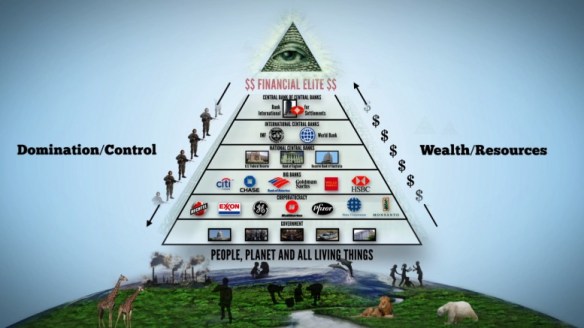
Today, the modern state is a tool of elites to ensure their total domination and power over all other classes and groups. It does not matter if the state calls itself “democratic” or a “one party state”. In effect, all states today are “one party” states controlled by their respective elites who are often tied to one another transnationally. We are, all of us, under the thumb of a new global elite who dictates the nature of our social being. “Global Empire” is not an all too fanciful term for the present situation.

And like the Roman Empire before it, it is not a coincidence that many people are turning spiritually inward toward personalistic philosophies of self-help and care. Ironically, even the philosophy of ancient Stoicism is making somewhat of a comeback.

None of this is surprising.

The individual cannot be truly satisfied if he or she is not a participating and consequent member of a polity; of a state. The elites of this world have carefully and calculatedly castrated our social and economic potentialities to do so.

The root of our gnawing unhappiness in our brave new world is simply this: consequential inter-personal participation in the sphere of the political has been vanishing for decades. The ability to effect collective change from below has been diminishing. True collectivity has been consistently denied.

The disassociation of the individual from the polity; in effect the non-existence anywhere of true democracy has led to a hollowing out of the human personality. It is only in concrete social action that we materialize fully as human beings. It is as members of a community who are able to truly guide that community that we find a deep human purpose.

Once again, recalling Hegel and the Greeks before him, it is not enough to exist as economic man symbolically feigning electoral freedom every two or four years ; one must directly participate in the polis.

3 Characteristics of a True Political Awakening

By Sigmund Fraud

Source: Waking Times

History is written by the winners, or so they say, but there is an agreed upon version of our story that is taught to us in school and reinforced in everyday life by the media and government propagandists. Coasting through life haphazardly believing in this standardized version of reality is a form of consciousness, a contemporary way of relating to a world where the individual is consumed by the group, and truth becomes evermore out of reach.

The typical level of political awareness in our society is fairly basic, simplified and incomplete, but it serves as a functional trap for the mind and the imagination, pigeon-holing individuals into a conformist. This psychological trap preys upon two basic human traits: conservatism and progressivism. And because these traits are biologically hardwired into the human psyche, they are exploited as a fissure to create disharmony and division amongst the public.

Many people only rise to a level of political consciousness which allows them to understand their predisposition to one or the other of these traits. Awareness often ends here, with extreme devotion to one side of the publicized political spectrum.

The truth is that human societies have always needed an even distribution of people with each of these ideological tendencies in order to achieve a balance between our need for external and internal control, protection and care. Political awakening involves rising above the prescribed psychology of division, into a position of appreciation of the qualities which unite us all.

This idea is enumerated in the following three characteristics of true political awakening.

Trust in the Statist System Collapses

To continue to trust and support a consistently abusive master is often referred to as Stockholm Syndrome. When a person experiences a true and deep political awakening, it is not longer possible to excuse any of the crushing affronts to human rights and human dignity that are intrinsic to state power.

State power is historically abusive. The manipulation of our money supply, endless wars, wasting of public resources, corruption, permitting the destruction of the natural world, terrorizing citizens with abusive police and punitive tax codes, and limiting prosperity with regulatory overkill are all standard operating procedure for the state.

In a statist world, the awakening individual is tasked with the challenge of seeing through all of this in order to free the mind and see the greater possibilities for freedom and cooperation in the human story.

So-Called Leaders Are Seen as Puppets of Division

Watching the pendulum of public opinion and discourse swing violently back and forth between the merits of two political parties is comical once you’ve recognized just how predictable and destructive it is. We are goaded into engaging in the divisiveness, encouraged by the rhetoric of the political establishment.

It is our unity they fear most. Falling into the trap of politically dogmatic ideological fortifications is more dangerous to our society than just about anything else, and the truly politically awake fly above the argumentative mentality of those who are trapped in the two-party paradigm.

The Recognition that Politics is Heavily Influenced by Powerful Forces

If politics is the arena of government, and government is clearly influenced by corporate interests, intelligence agencies and deep state operators, and supranational organizations, then it makes no sense to pretend that we have power in the political system.  It makes no sense to pretend as though politicians are acting in the true interest of actual people. It makes no sense to pretend that we can save ourselves by calling on members of the state to represent us in their corrupt scene.

It is commonly known that politicians are beholden to special interests, and while they never talk openly about this influence, so many people carry on with the charade that politicians can wield  power over these organization, for the benefit of the plebs. They cannot, for these forces are beyond their control. The politically awakened understand that the plots against humanity extend way beyond the political scene.

Final Thoughts

Unity is the one thing that any political elite has always feared the most. Without smashing down the perceived barriers in contemporary political consciousness we can only expect our society to become more fractured, chaotic and dangerous. Trust in that which deceives and harms us is simply not possible for the truly politically awakened.