ARCHITECTS OF POWER: HOW THE GLOBAL ELITE PROFIT FROM EXTREME INEQUALITY & PRE-EMPT THE BACKLASH

By Dr. Tim Coles

Source: Waking Times

There is a new, mega-rich global elite consisting of a small number of billionaires and multibillionaires. Many of them made their money in the technology sector. Others play financial markets or inherit fortunes. They are wealthier and more powerful than some entire nation-states.

The British Ministry of Defence (MoD) says:

“Whilst there have always been differences between the wealthier, better educated and the less privileged, these differences appear likely to widen in the coming decades.”

The mega-rich deliberately order the world in ways that guarantee their wealth by institutionalising inequality. Occasionally, this is admitted. In 1997, a book published by the Royal Institute for International Affairs in the UK acknowledged:

“The present international order may not be the best of all possible worlds, but for one of the ‘fat cats of the West’ enjoying a privileged position in an international society that is structured and organised in ways which perpetuate those privileges, there are good reasons for not pursuing radical change.”

This is also true of internal policymaking. The third richest man in the world, Warren Buffett (worth over $80bn), confirmed this: “There’s been class warfare for the last 20 years, and my class has won.” This echoes his statement in 2006, just prior to the global financial crisis: “There’s class warfare all right… but it’s my class, the rich class, that’s making war, and we’re winning.” Around the same time, the liquidity firm Citigroup circulated an investor memo, stating: “Society and governments need to be amenable to disproportionately allow/encourage the few to retain that fatter profit share.” More recently, the UK MoD admitted: “In the coming decades, the very highest earners will almost certainly remain rich, entrenching the power of a small elite. Vested interests could reduce the prospect of economic reforms that would benefit the poorest.”

Consider the enormous concentration of wealth and power that results from this imbalance.

Ever-Increasing Power

Global and national inequality is staggering and getting worse. By 2011, a mere 147 – mainly US and European – corporations owned and controlled 40% of world trade and investment. Just four corporations influence the profitability and power of these 147: McGraw-Hill, which owns Standard & Poor’s ratings agency; Northwestern Mutual, owner of the indexer Russell Investments; the CME Group, which owns 90% of the Dow Jones market index; and Barclay’s bond fund index. Evaluative decisions by analysts at these firms affect the wealth and performance of each of the 147 giants.

That’s corporate wealth concentration. But what about wealth concentration among individuals?

There are 7.7 billion people in the world. Of those, just 2,153 are billionaires. According to Forbes, their combined wealth totals $8.7 trillion. The list of billionaires reflects where power is most concentrated: in the US. While China and Europe’s number of billionaires declined in the previous 12 months, the US and Brazil gained billionaires. The US is home to 607 billionaires or 0.000001% of the population. It is worth noting that President Donald Trump was a billionaire before he came to power. Trump has cut taxes for his fellow billionaires. As an indication of continued wealth concentration, consider the wealth disparity among the billionaire class itself. He Xiangjian, founder of the Midea Group, is the joint-50th richest person, worth over $19.8bn. Jeff Bezos, by comparison, the founder of Amazon, is the richest man in the world, worth over $131bn – more than six times He Xiangjian.

Part of the problem has been the US-led imposition of an economic dogma called “neoliberalism” (which is neither new nor liberal) on much of the rest of the world.

Neoliberalism can be roughly defined as:

1) Financialisation, i.e., allowing investors to make money from money as opposed to tangible things;

2) Deregulating financial services;

3) Taking out government insurance policies so that working people bail out financial institutions;

4) Cutting taxes for the wealthy;

5) Privatising public services to reduce social mobility;

6) Imposing austerity to make markets more attractive to investors.

Neoliberalism has cut taxes for the super-rich, enabling them to hold onto their wealth at the expense of others. According to Oxfam, the average rate of personal income tax for the wealthy was 62% in 1970. In 2013, it was 38%. In the UK, the poorest 10% pay a higher proportion of their income in taxes than the richest 10%. Global GDP, i.e., how much money there is in the world, is $80 trillion. But, of this, $7.6 trillion is untaxed. In the decade since the financial crisis, the number of billionaires doubled. This reveals that the system rewards greed. In 2017, 43 people owned as much wealth as half the world’s poorest. In 2018, the number was 26.

To put all this into perspective, Jeff Bezos owns as much wealth as the poorest fifty countries. When it comes to more ‘developed’ nations, Bezos’s wealth equals the entire GDP of Hungary. Consider how Bezos makes his money. Amazon is a corporation that primarily advertises and delivers products. The innovation, design, and investment in and of those products is the work of others. Amazon treats “workers like robots” by spying on them, discouraging unions, offering insecure contracts, and encouraging long hours. Amazon is also notorious for paying little or no corporation tax. Amazon is an online retailer. The Internet was developed by the US Defense Department in the 1960s as ARPANET, with public money. The satellites that enable online transactions are first and foremost military hardware. Not only did Amazon take advantage of state-funded innovation, but it also rewards government investors by selling the CIA cloud technology and the Pentagon artificial intelligence.

Bezos is far from being the only one. Bill Gates’s Microsoft and the late Steve Jobs’s Apple, which became the first trillion-dollar company, also enjoy low taxes, technologies developed with government grants, and procurement contracts.

Consider also the immoral activities of other hi-tech nouvelle méga riche. Without making it clear to users, Facebook founder Mark Zuckerberg (worth $66bn) has made his money by selling personal data to insurers and advertisers. Scientists have used Facebook in social media experiments without the knowledge or consent of users in an effort to see how memes affect mood.

Other mega-rich, including the hedge fund manager Robert Mercer of Renaissance Technologies, used Facebook to market political candidates. Other tech billionaires include Google founders Larry Page and Sergey Brin. Google technology was funded by the CIA’s venture capital firm In-Q-Tel. Also relying on technologies developed by the Pentagon with workers’ tax dollars, the company cooperates with the National Security Agency to spy on citizens and it has even enabled US assassination programmes.

Consequences

How do the billionaires get away with it, and what are the social and political consequences? The examples below are from the US, but it should be noted that the US exports its mega-wealth model.

A study by Martin Gilens and Benjamin I. Page on plutocracy (government by the rich) notes that the rich buy political parties. Politicians draft and/or vote for laws that help the rich. The authors analysed 1,779 policy issues in the US and conclude that “average citizens and mass-based interest groups have little or no independent influence.” Unlike the public, “economic elites and organised groups representing business interests have substantial independent impacts on US government policy.” Other research into wealth inequality in the US finds that “[c]ertain policies, such as the decreased support for unions and tax cuts favouring the relatively well-off and corporations, have benefitted a small minority of the population at the expense of the majority and have thus contributed to widening income inequality.”

At the turn of the last century, 9% of American families owned 71% of the nation’s wealth. The elite of the day included familiar names: John D. Rockefeller (oil), J.P. Morgan (banking), W. Averell Harriman (industry), and so on. Things balanced out after the Second World War, with the majority of Americans becoming middle class. Gradually, state controls over the economy were removed, and the situation reverted to the inequality of bygone centuries.

Since the 1970s, the US middle class has been shrinking. Until recently, the middle classes of Asia grew, precisely because strong Asian economies (notably China, South Korea, and Singapore) either retained some state controls or refused to adopt the US neoliberal model.

Alan B. Krueger, a labour economist and key Obama advisor, explains that, “since the 1970s income has grown more for families at the top of the income distribution than in the middle, and it has shrunk for those at the bottom.” Between 1979 and 2007, the top 1% ((multi)millionaires and (multi)billionaires) enjoyed a 278% increase in their after-tax incomes. But 60% of Americans saw their incomes rise by just 40%, which when adjusted for rising living costs means stagnation. Krueger notes that during that period, $1.1 trillion of annual income was moved to the top 1%. “Put another way, the increase in the share of income going to the top 1% over this period exceeds the total amount of income that the entire bottom 40 percent of households receives.”

The exportation of this model means that Australia, Britain, and Canada became what the billionaire-dollar liquidity firm Citigroup calls “plutonomies,” economies in which the rich drive luxury goods markets such as jewellery, fashion, cruises, and sports cars: hence the recent entry of celebrity Kylie Jenner into the billionaire class. The Citigroup document also notes that in plutonomies the top 1% owns 40% as much wealth as the bottom 95%. No matter where you live, you can’t escape the institutional structures that create inequality.

The US military exists, in part, to maintain the unjust status quo. Yet, it acknowledges the dangers of dominance: “A global populace that is increasingly attuned and sensitive to disparities in economic resources and the diffusion of social influence,” thanks in part to the very technologies that enrich the rich, “will lead to further challenges to the status quo and lead to system rattling events,” like Brexit or the Yellow Vest protestors in France.

The mega-rich and international think tanks and forums they sponsor are beginning to reluctantly accept that their status quo political puppets might get voted out of office and give way to so-called far-left or far-right parties unless they address wealth inequality.

New Paradigms of Control

The question, then, is how to deal with the restless and disaffected majority while not radically altering the system and taking away the privileges of the elite. In 1961, US President John F Kennedy said: “If a free society cannot help the many who are poor, it cannot save the few who are rich.” In the 1980s, World Economic Forum founder Klaus Schwab said: “Economic globalisation has entered a critical phase. A mounting backlash against its effects… is threatening a very disruptive impact on economic activity and social stability in many countries… This can easily turn into revolt.” More recently, he said: “Today, we face a backlash against that system and the elites who are considered to be its unilateral beneficiaries.” Likewise, the billionaire Johann Rupert of Cartier jewellery (one of the many luxury services driving plutonomies) said: “We are destroying the middle classes at this stage and it will affect us.” Similarly, the British MoD discusses “[m]anagement of societal inequalities,” as opposed to the elimination of social inequality.

Many of the new elites make people redundant by automating the workplace. While Amazon still relies on human shelf-stackers and delivery drivers, it uses an increasing number of physical robots to stack shelves and algorithmic robots to assist online customers. Likewise, Facebook and Google’s content filters rely on heavy automation. This is creating precarious employment conditions. According to the Washington Post (which is owned by Bezos): “…the modern emerging workforce of tech, urbanised professionals, and ‘gig economy’ labourers all represent an entirely new political demographic.” Politicians then “focus more on education, research and entrepreneurship, and less on regulations and the priorities of labour unions.”

But there are many problems. For one thing, the financial services economy, which markets everything, has made “education” a form of unsustainable debt. The quality of US education is notoriously low by world standards, and many young people are “overqualified” for menial jobs, like delivering for Uber or stacking shelves in Amazon warehouses. The UK MoD acknowledges that, “Freelance work is… often low-paid, lacking the benefits and security of formal employment and, therefore, the growth of the gig economy could increase inequality.”

The crisis of what to do with a young, indebted, restless population automated out of steady work by – and competing with – algorithms and physical robots has been considered for at least 50 years.

Traditionally, ‘education’ meant brainwashing children to work in menial jobs for life in adulthood. But as the economy changes and employment becomes less stable, new methods of ‘education’ for re-skilling adults are required. In the late 1960s, future political advisor Zbigniew Brzezinski authored a book in which he advocated for lifelong learning as a way of re-skilling an aging population that finds its employment opportunities diminished, as small-to-medium-sized businesses get overtaken by tech giants. Around the same time, the British Labour Party (when it was a real labour party) introduced the Open University with the aim of providing lifelong learning. Likewise, in the 1980s, futurist Alvin Toffler envisaged an “electronic village” in which flexible working hours and lifelong learning would be required in a hi-tech economy.

To keep the poor from rioting while trapping them in a system that works for those who design it, today’s multibillionaire elites help to privatise public services and education by offering scholarships and infrastructure investments. In doing so, they train poor people to work for their system by developing others’ technology skills while hiding their own taxable wealth in charity foundations.

Howard G. Buffett is the son of Warren. While enjoying largely tax-free wealth that further impoverishes the global poor, the Buffetts, via Howard’s foundation, invest in dams and irrigation in the poorest nations of Africa. Bezos’s foundation awards scholarships for STEM courses (Science, Technology, Engineering, Mathematics). Zuckerberg’s foundation seeks “to find new ways to leverage technology, community-driven solutions, and collaboration to accelerate progress in Science, Education, and within our Justice & Opportunity work.”

Conclusion

By using free online services, we have allowed ourselves to be the products that tech giants sell to advertisers. By not organising to raise taxes on the mega-wealthy, we have underfunded our public services. By not keeping an eye on who’s funding what, we’ve allowed our political parties to hoover up donations from elites. By failing to understand the economy, we’ve allowed a new normal of instability and political uncertainty to flourish to the advantage of asset managers and hedge fund investors. As the US pursues global domination, this model will continue to be exported. It’s time to wake up.
Consent that’s manufactured by propaganda is not informed consent

By Caitlin Johnstone

Source: Intrepid Report

A March 9 Twitter post by Secretary of State Tony Blinken reads as follows: “We will never hesitate to use force when American lives and vital interests are at stake, but we will do so only when the objectives are clear and achievable, consistent with our values and laws, and with the American people’s informed consent – together with diplomacy.”

Like pretty much everything ever said by Blinken, and indeed by every US secretary of state, this is an absolute lie.

Firstly, US military force is never used to protect “American lives” in modern times, unless you count the lives of US troops and mercenaries in foreign lands they have no business occupying in the first place. The US military is never used to defend American lives against an invading enemy force; that simply does not happen in our current world order. It is only ever used to protect the agenda of unipolar planetary domination, which would be the “vital interests” which Blinken obliquely refers to above.

Secondly, Blinken’s claim that the Biden administration will never use military force without “the American people’s informed consent” has already been blatantly invalidated by Biden’s airstrikes on Syria last month. The American people never gave their consent to those airstrikes, informed or uninformed. A nation the US invaded (Syria) was bombed because troops are being attacked in a second nation the US invaded (Iraq) on the completely unproven claim that a third country against whom the US is currently waging economic warfare (Iran) supported those attacks. At no time were the people asked for their consent to this, and at no time was any attempt made to ensure that they were informed of the situation before it happened.

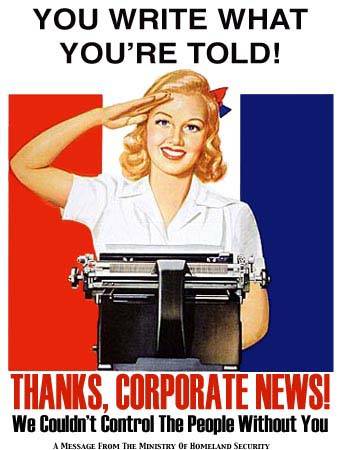
Thirdly, US military force is never, ever conducted with the American people’s informed consent. Literally never. Consent is always manufactured for US wars by lies and mass media propaganda, one hundred percent of the time, without exception. The bigger the military operation, the more egregious the deceit used to manufacture consent for it. Even in relatively “peaceful” times when the US is merely raining dozens of bombs and missiles per day on foreign soil, Americans are subject to a nonstop deluge of distorted and outright false narratives about their military and the nations it targets for destruction.

Consent that has been artificially manufactured by propaganda is not informed consent, any more than sex with someone who’s been dosed with rohypnol is consensual sex. US imperialism does not rely on informed consent, it relies on disinformed consent; consent for it is manufactured by disinformation. Informed consent plays no role whatsoever in the use of US military force, nor indeed in any other major aspect of the behavior of the US or its allies.

Every aspect of the US-centralized power alliance is propped up by a relentless deluge of mass-scale psyops. Imperialism, capitalism, electoral politics; consent for all its key pillars is constantly being manufactured by the plutocratic news media, by television, by movies. All of the most influential generators of modern mainstream thought and culture are heavily influenced by a plutocratic class which has a vested interest in keeping power out of the hands of the people.

This is the only thing keeping us from moving into a healthy new paradigm where we collaborate with each other toward a healthy world based on truth and beauty instead of competing with each other over who can create the most profitable pieces of future landfill. No hard obstacles are in place stopping us; our cages only exist between our ears. It is only because powerful people are manipulating our minds to their advantage that we have not already used the power of our numbers to create a healthy, harmonious and enjoyable earth.

It’s important to be aware of the fact that our consent has been manufactured for this mess, because it means we never gave them our informed consent, which means no existing power structures have any legitimacy at all. They have power because they stole our power from us, and it is our prerogative to take it back. We do not need to go through the political systems they have rigged to their advantage or the ideological spectrum of acceptable debate that they have confined mainstream discourse to. We can just take it.

This will only happen after we have freed ourselves in sufficient numbers from their mass-scale psychological manipulations, which will only happen after we have prioritized weakening public trust in their propaganda operations and waking the mainstream public up to the truth. Once a sufficient number of people have been awakened from their propaganda-induced slumber, we can reclaim our world from the sociopathic manipulators without firing a shot, just by standing up to our true size and flexing our giant muscles.

I sincerely believe this will happen, and that it will happen fairly soon. Then we will extract their rapey fingers from our minds and create something truly amazing together.

The Number Of Billionaires In America Has Absolutely Exploded During The Pandemic

By Michael Snyder

Source: Investment Watch Blog

For the wealthy and the ultra-wealthy, happy days are here again.  Even though we have just been through one of the most difficult 12 months in our history, the number of billionaires has increased dramatically during this pandemic.  That seems rather odd, but there is no denying that the rich have gotten even richer during this crisis.  In fact, Forbes revealed this week that the number of billionaires has risen by about 30 percent over the past year…

The number of newly minted and reissued billionaires soared last year, Forbes reported Tuesday in its annual ranking, a staggering accumulation of personal wealth that stands in sharp contrast with the widespread economic struggles unleashed by the coronavirus pandemic.

The number of billionaires on Forbes’ 35th annual ranking swelled by 660 to 2,755 — a roughly 30 percent jump from a year ago — and 493 of them are first-timers. Seven of eight are richer than they were before the pandemic. Forbes calculates net worth by using stock prices and exchange rates from March 5.

Of course thanks to the reckless policies of our leaders, a billion dollars does not go nearly as far as it once did.

But still, a billion dollars is a whole lot of money.

Needless to say, the biggest reason why the number of billionaires has exploded is because we have been witnessing one of the greatest stock market rallies in history.

A year ago, the Dow Jones Industrial Average was sitting at about 23,000.

Today, it is above 33,000, and some analysts expect it to shoot quite a bit higher throughout the rest of 2021.

Stock prices have never been more detached from economic reality as they have been over the past 12 months, and they have only risen so high because of unprecedented intervention by the Federal Reserve and because of extremely wild spending by the federal government.

Many have warned that the party will inevitably come to a crashing end at some point, but it hasn’t happened yet.

So for now, the market optimists look like champions.

And now that Joe Biden is in the White House, the corporate media is telling us that we are on the verge of a grand new era of American prosperity.  The corporate media insists that the pandemic will soon be behind us thanks to the vaccines, and the talking heads on television envision a return to the good old days very quickly.

In fact, Barron’s is already declaring that the “U.S. economy might be stronger than it’s ever been”.

And CNN is trying to convince us that “America’s economy could be heading for a golden era of growth”.

Really?

If the U.S. economy is actually improving, then why are new claims for unemployment benefits going up?

The number of Americans filing first-time unemployment benefits unexpectedly rose last week, according to the Labor Department.

Data released Thursday showed 744,000 Americans filed first-time jobless claims in the week ended April 3. Analysts surveyed by Refinitiv were expecting 680,000 filings. The previous week’s total was revised higher by 9,000 to 728,000.

If economic conditions were getting better, that number should be going the other way.

Even I didn’t expect a number this bad.

Prior to 2020, the all-time record high for new unemployment claims in a single week was 695,000.  That record was established in October 1982, and it stood all the way until the COVID pandemic hit the U.S. early last year.

Sadly, we have been above 695,000 almost every single week since then.

The numbers compiled by the states tell us that nearly three-quarters of a million Americans filed new claims for unemployment benefits last week.  That is an absolutely catastrophic number.  Nobody should be talking about a “golden era of growth” or claiming that the “economy might be stronger than it’s ever been” until we get that number back down to pre-pandemic levels.

And right now, we are at a level that is about three times as high as pre-pandemic levels.

Look, the truth is that anyone that tells you that unemployment is low in the United States is lying to you.

According to John Williams of shadowstats.com, if honest numbers were being used the unemployment rate in the United States would be 25.7 percent right now.

That is the sort of number that we would expect to see during an economic depression, and the truth is that we are in an economic depression.

Over the past year, more than 70 million new claims for unemployment benefits have been filed, and approximately 4 million U.S. businesses have gone out of existence permanently.

But don’t worry, the stock market is hovering near all-time record highs and the corporate media is telling you that everything is going to be wonderful now that Joe Biden is in control.

Come on man!

You can’t really believe that stuff that they are shoveling.

With each passing day, more Americans are losing their jobs, more Americans are falling out of the middle class, and the cost of living just keeps going up even higher.

In fact, we just learned that global food prices have now gone up for 10 months in a row

The global food-price rally that’s stoking inflation worries and hitting consumers around the world shows little sign of slowing.

Even with grain prices taking a breather on good crop prospects, a United Nations gauge of global food costs rose for a 10th month in March to the highest since 2014. Last month’s advance was driven by a surge in vegetable oils amid stronger demand and tight inventories, according to Abdolreza Abbassian, a senior economist at the UN’s Food and Agriculture Organization.

I am going to continue to watch global food prices very carefully, because I believe that it will be a very important trend in the months and years ahead.

But for now, the good news is that at least economic conditions are relatively stable.

Yes, things are not nearly as good as they were before the pandemic, but at least they are not getting a whole lot worse.

So even though things are not great, we should enjoy this period of relative stability while we still can, because it definitely will not last.

Jeff Bezos Embodies the Cruel Autocracy of Neoliberal Capitalism

Amazon CEO and richest-man-in-the-world Jeff Bezos wants you to work as much as he does—for one millionth of the pay

By Branko Marcetic

Source: In These Times

“Is Jeff Bezos a horrible boss and is that good?” That was the question posed by Forbes magazine in 2013, a sentiment that helps explain why Amazon’s founder and CEO is detested by the Left for his oligarchic ambitions, while simultaneously admired by America’s capitalist class for his business success. Ironically, Bezos is also loathed by former President Donald Trump, while celebrated by many liberals for so-called resistance.

But with Bezos and his $115 billion fortune laying claim to the title of richest man on Earth, and with Amazon playing an increasingly influential role in public life, it is worth asking: What does Jeff Bezos stand for?

A gifted child born to a teen mom, Bezos grew up not knowing his biological father, who was once one of the top-rated unicyclists in Albuquerque, N.M. Instead, Bezos was raised by the man his mother soon married: Miguel Bezos, who had fled Cuba and the Communist revolution, which had shuttered the elite private Jesuit school he attended, as well as his family’s lumberyard.

Journalists have speculated whether Bezos’ near-pathological competitiveness is a product of his early abandonment, similar to that of fellow tech overlord Steve Jobs. No doubt equally formative was Bezos’ adoptive father, who told Brad Stone, author of The Everything Store: Jeff Bezos and the Age of Amazon, that their home life was ​“permeated” by complaints about totalitarian governments of both the Right and the Left.

Bezos envisioned the concept of an ​“everything store” while working for a Wall Street hedge fund in the 1990s. He opened Amazon in 1994 as an online bookshop, a pragmatic starting point. Bezos gave the company his own $10,000 cash injection, took out interest-free loans, and received $245,000 from his parents and family trust.

Many of Amazon’s controversial labor practices can be traced to these early years as a plucky start-up. Amazon’s small team ran on tireless ambition to live up to the company’s customer-focused promise — key to its eventual market domination. Stone reports that, to meet Bezos’ ​“get big fast” directive, employees devoted themselves completely, working long, unusual, frenzied hours. One early warehouse worker who biked to work simply forgot about his improperly parked car, eventually discovering it had been ticketed, towed and sold at auction.

Such a relentless pace is one thing for a small group of true believers but is quite another when applied to low-wage workers just making ends meet. By 2011, Amazon’s workplace culture became known through a series of headline-grabbing reports that have come to define its public image: badly paid, ceaselessly surveilled, overworked workers, struggling to maintain a breakneck pace.

Bezos created a culture in which everyone from the lowest peon to the highest-ranking executive is expected to match his own devotion, an approach that resulted in spectacular levels of staff turnover by the early 2000s. A declared enemy of ​“social cohesion,” Bezos pushed his underlings to reject compromise and instead fiercely debate and criticize colleagues when they disagreed. One former employee described it as ​“purposeful Darwinism.” Known for withering put-downs — ​“Are you lazy or just incompetent?” ​“Did I take my stupid pills today?”—Bezos also isn’t above pulling out his phone or, in some cases, simply leaving the room when an employee fails to impress.

The flipside of Bezos’ intellect is a cold, clinical approach to human relations. Bezos described himself as a ​“professional dater” during his Wall Street days, trying to improve what he called his ​“women flow” — a riff on the Wall Street term ​“deal flow.”

“He was not warm,” one person who knew Bezos during his Wall Street days told the East Bay Express in 2014. ​“It was like he could be a Martian for all I knew.”

Bezos’ pitiless leadership style bled out beyond the Amazon boardroom as he used the company’s growing market share to bully book publishers into his terms. The company launched the ​“Gazelle Project”—as in, go after publishers ​“the way a cheetah would pursue a sickly gazelle” — allowing Amazon to undercut its competition at the cost of little to no profit for smaller publishers.

As Amazon inched closer to Bezos’ original vision, it began lobbying efforts in 2000 and became more transparently political by 2011, spending millions to defeat an internet sales tax and playing hardball with state governments, threatening to shutter Amazon facilities if its wishes went unfulfilled. In 2013, Amazon began lobbying Congress to cut corporate taxes.

The same year, Bezos bought the Washington Post, invested in Business Insider and donated to the publisher of the libertarian magazine Reason. Though Bezos argues his purchase of the Post was motivated by ​“a love affair [with] the printed word” and a desire to support American democracy, others suspect Bezos’ interest in media is related to bad press following a scathing Lehman Brothers report in 2000, which sent Amazon’s stock price tumbling.

Leading up to the Post purchase, Bezos was increasingly displaying what early Amazon investor Nick Hanauer called his ​“libertarian politics.” In addition to spending $100,000 in 2010 on a campaign to defeat a proposed Washington state tax on high-income earners, Bezos put hundreds of thousands of dollars toward boosting charter schools and other neoliberal education reforms.

Bezos’ political involvement reached a new apogee in 2019 during the re-election bid of Seattle’s socialist city councilwoman, Kshama Sawant, who called Bezos ​“our enemy” and tried to pass a head tax to fund housing for those displaced by Amazon’s Seattle footprint. Amazon spent $1.5 million against Sawant and other progressive candidates, a record at the local level, with more than a dozen of the company’s executives contributing to Sawant’s opponent. (Sawant won re-election anyway.)

As for Bezos’ endgame? A Trekkie since childhood, he has long dreamed of funding space exploration, a mission pursued by other superrich moguls (such as Elon Musk) in the face of the climate emergency. Opening the doors of his secretive Blue Origin aerospace company to journalists for the first time in 2016, Bezos told the New York Times he envisioned a future of ​“millions of people living and working in space,” exploiting the natural resources of surrounding planets and rezoning Earth ​“as light industrial and residential.”

Ironically, as Bezos pours the wealth he wrung out of exhausted, low-wage Amazon workers into space exploration, Amazon is busy hastening the very planetary collapse Bezos claims he’s trying to prevent — by silencing workers who speak out against Amazon’s assistance to oil and gas companies.

Let’s imagine, however, that Bezos, who accumulates $9 million an hour, lived in a world with Bernie Sanders’ 8% wealth tax (just on fortunes over $10 billion). A single year would see $9 billion flow from Bezos’ treasure trove into government coffers, more than enough to cover the 10-year cost of Elizabeth Warren’s universal child care plan ($1.7 billion) and maintain safe drinking water under Sanders’ plan ($6 billion).

Bezos’ career is a testament to the cruel autocracy and senseless misallocation of resources that our neoliberal capitalist system enables. But his opulence also reveals that the wealth exists to build a fairer and more equitable society — if redistributed. Bezos may loathe social cohesion, but in a world organized around democracy rather than the whims of space-billionaires, it’s something we may well be able to achieve.

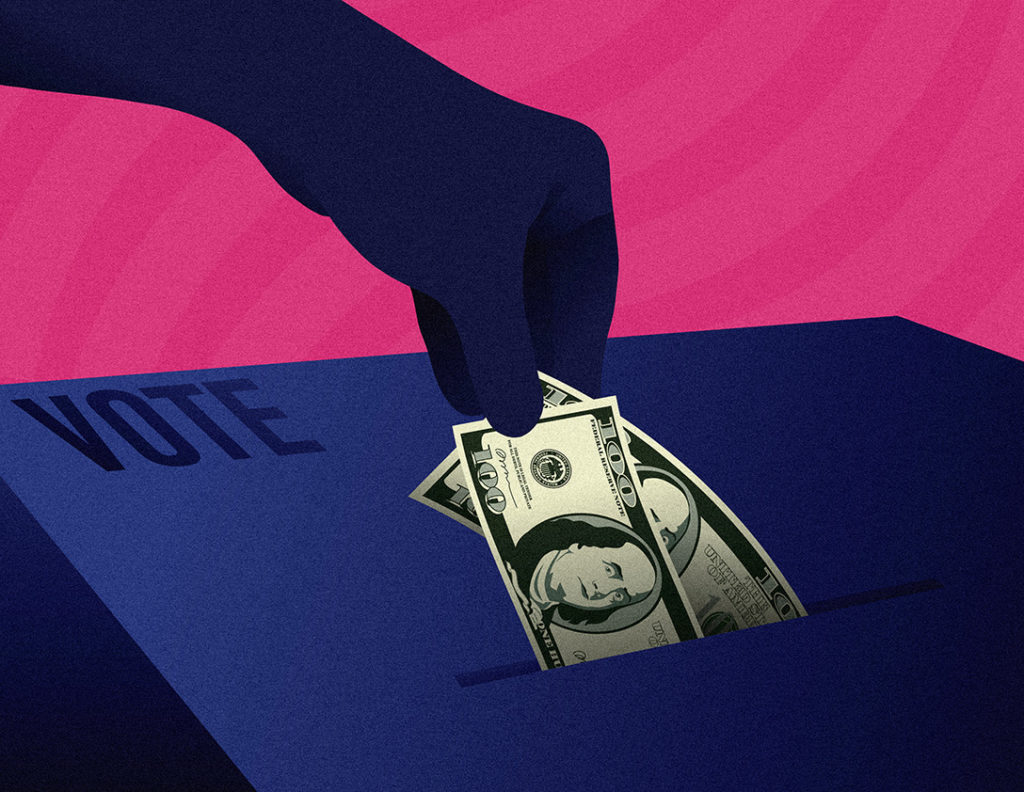
With Over $1 Billion Spent, Domestic Dark Money Dwarfs All Foreign Influence on 2020 Election

While unapproved foreign interference is a major scandal, corporations and the ultra-wealthy essentially buying elections is simply (big) business as usual.

By Alan Mcleod

Source: Mint Press News

WASHINGTON — A newly declassified report from the National Intelligence Council (NIC) alleges that a range of U.S. enemies — including Russia, Venezuela, Cuba, Iran and Hezbollah — all attempted to interfere in the 2020 election.

The scope of the supposed interference was relatively minor, amounting to attempts to push false narratives around Democratic nominee Joe Biden, with state media outlets questioning Biden’s credibility or sending out emails meant to confuse or intimidate American voters.

The report offered no evidence for the allegations, arguing that “doing so could endanger sensitive sources and methods and imperil the intelligence community’s ability to collect foreign intelligence.” However, the NIC insisted, the classified report included such evidence and came to the same conclusions.

Despite the lack of substance, and the fact that the intelligence community has continually published outlandish claims about foreign actors’ nefarious roles (which were later rolled back), the report’s release became a major international story, dominating the news cycle and featuring prominently in The New York TimesCNNMSNBCABC NewsThe Guardian and many other outlets.

The report generated outrage on social media. Movie director turned political activist Rob Reiner summed up the mood among many: “No surprise. Putin launched a massive disinformation campaign in 2020 to help Trump. This time he failed to get him elected. But he was more than successful at poisoning our Democracy. Evidence: Jan.6. To restore faith, Trump must be prosecuted,” he tweeted.

Home cooking in a big, dark kitchen

Receiving far less attention was a report published at the same time by the Center for Responsive Politics, which revealed enormous election interference from corporate dark money. More than $1 billion worth of secret donations were made during the 2020 election. This included around $660 million in contributions to big-money political groups, more than $300 million in advertising, and $88 million in FEC-reported spending.

Few people, even political junkies, know the names of these organizations. But dark-money groups — organizations trying to influence politics that do not disclose the source of their funding, such as Duty & Honor and America Votes — have considerably more influence over who rules the United States than do any foreign leaders.


Sauce for the goose?

The largest of these groups in terms of political spending is One Nation America, a Republican organization masterminded by former White House Deputy Chief of Staff Karl Rove. The organization spent over $125 million during the last election cycle.

However, it was the Democrats who benefitted the most from dark money sourced from wealthy, shadowy donors. Democrats outraised the GOP by well over two-to-one, with Biden’s bid attracting more than six times the amount of money from anonymous sources than did Trump’s. Given the relatively close race, it is entirely plausible that this massive cash injection swung the balance in favor of the 78-year-old Delawarean and away from the incumbent.


Putting “meddling” in perspective

In 2016, the St. Petersburg-based “troll farm” the Internet Research Agency is said to have spent around $100,000 in online ads targeting American readers. But four years later, the Center for Responsive Politics calculates that opaque non-profits shelled out $132 million on the same thing — more than a thousand times as much.

In politics, money talks. Since 2000, the party spending the most cash has won between 85% and 98% of all House and 71% and 85% of all Senate races, depending on the year. Election 2020 was by far the costliest election in history, coming in at $14.4 billion. That figure is more than double the price of the 2016 election, which cost around $6.5 billion. The six most expensive Senate races of all time occurred in this cycle. Democrats comfortably outraised and outspent Republicans in 2020.

The two Senate elections in Georgia — regular and special, which both went to runoffs that saw Democrats Jon Ossoff and Raphael Warnock elected — wound up with nearly $830 million spent on the two races alone. Democrats relied on hefty donations from tech companies like Apple, Microsoft, Facebook, and AT&T, while Republicans counted on support from financial firms like Goldman Sachs and Bank of America and from money from the Koch Brothers.

This disparity in coverage between the two reports suggests that, while unapproved foreign interference is a major scandal, corporations and the ultra-wealthy essentially buying elections is simply (big) business as usual.

The American Terror State

By Donald Monaco

Source: Global Research

On February 26, 2021, imperial President Joe Biden ordered the bombing of “Iranian backed militias” in Syria. Biden’s action was rationalized as “retaliation” for rocket attacks on American troops in Iraq that killed a mercenary contractor and injured a U.S. soldier.  

Missing from coverage in the corporate media was any mention of the illegal U.S. military occupation of Iraq and Syria.  The occupation was simply airbrushed from discussion.  By so doing, reality is inverted.  Victim is portrayed as aggressor and aggressor as victim.

From the standpoint of international law, aggressive military action taken by occupation forces cannot be termed self-defense.  Yet political elites and media propagandists finesse basic truths by detaching U.S. forces from the context of illegal invasion and occupation.  They assume the military has a ‘right’ to be deployed anywhere in the world.

Paradoxically, the militias assaulted by the United States have been fighting ISIS, once again exposing the ‘war on terror’ as a massive lie.  The same militia forces Biden attacked were once led by Iranian General Soleimani, who was assassinated by Trump, further demonstrating the genuine purpose of military deployment which is to destabilize regimes targeted as unfriendly, meaning not subservient to the Washington.

Almost simultaneously, the Biden administration signaled that there would be no punishment of Saudi crown prince Mohammed bin Salman, who was identified by the CIA as having given the order to assassinate Washington Post journalist, Jamal Khashoggi.

Also, unsurprisingly, the Biden administration announced that it would appeal a British magistrate’s decision not to extradite Julian Assange to the United States for prosecution under the espionage act.  Assange languishes in a British prison pending the appeal.  His transgression? Exposing U.S. war crimes in Iraq.

The pattern is clear.  Any action that supports U.S. global hegemony is justified, while any opposition is criminalized and repressed.

The core mission of the American terror state is to make the world safe for U.S. corporate profiteering.  A corollary imperative is to prevent any challenge to U.S. global domination.

First, the United States is a permanent warfare state that fights perpetual wars for perpetual profits.  The profits accrue to the “merchants of death” who sell their wares within the iron triangle of a military-industrial-complex that guarantees a massive return on capital investments.  The process is known as “military Keynesianism.”  Corporations such as Lockheed Martin, Raytheon, General Dynamics, and Boeing provide the arms for a global military empire to defend the global corporate empire.  Profits also flow to members of congress who own stock in the defense industry.

The permanent warfare state also allows profits to accumulate for corporations that exploit the world’s land, labor, and resources by protecting their access to foreign markets.  Corporations such as World Mineral Inc, Peabody Energy, Rio Tinto, General Motors, Lithium Americas, AES, and Blackberry Ltd in the mineral extraction industry, Exxon Mobile, ConocoPhillips, and Chevron in the energy industry, Apple, Amazon, Alphabet, and Microsoft in the technology industry, General Motors, Ford, and Tesla in the automotive industry, Johnson & Johnson, Merck, and Pfizer in the pharmaceutical industry, and Walmart, Amazon, and Costco in the retail industry all operate in the global market.

Commercial banks such as JP Morgan Chase, Citigroup, Bank of America in the banking industry, Wall Street investment firms led by JP Morgan, Goldman Sachs, and Morgan Stanley in the financial industry, and private equity firms such as The Blackstone Group, The Carlyle Group, Kohlberg Kravis Roberts Co, and TPG Capital in the investment management industry finance global corporate transactions.

U.S. Fortune 500 companies made $14.2 trillion in revenues during 2020 and held an estimated $2.6 trillion offshore to avoid paying taxes.  The largest American corporations made billions of dollars in profits while laying off thousands of workers during the coronavirus lockdown.  Billionaires Jeff Bezos, Elon Musk, Warren Buffett, and their cohorts increased their net worth by half a trillion dollars during a pandemic that saw 8 million people join the ranks of 38.1 million poor Americans.  Another 93.6 million live close to the poverty level in the richest nation on earth.

Second, any country that wants to control its own land, labor, and resources by implementing an agenda of economic nationalism becomes a barrier to free trade, globalization, and the neoliberal economic paradigm that emphasizes privatization and deregulation of economies for the benefit of private capital.  Countries that do not throw themselves open to foreign investment are punished by crippling economic sanctions imposed by the U.S. Department of Treasury.

Third, the neoliberal economic agenda of free market privatization drives the neoconservative political agenda of American global hegemony as justified by Bush Jr.’s “Preemptive War on Terror,” Obama’s “Humanitarian Intervention,” Trump’s “America First,” and Biden’s “Advancement of Democracy” ideologies.

Neoconservatives dominate the foreign policy establishment.  Besides protecting U.S. empire, they are rabidly pro-Israel.  The neocons conflate the interests of the United States with the interests of Israel, ignoring George Washington’s admonition to avoid “foreign entanglements.”  They want the United States to go to war with Iran, as they understand that the destruction of resistance to Zionist colonization in Palestine can only be accomplished by defeating Tehran.

Other Middle Eastern and North African countries that supported the Palestinian cause and had large reserves of oil coveted by empire, were decimated by implementation of a neoconservative plan to attack seven Muslim countries in five years, beginning with Iraq and ending with Iran.

George W. Bush, the Texas oil man, Dick Cheney, former Chief Executive Officer of Halliburton, and a rat’s nest of neoconservatives led by Paul Wolfowitz, Douglas Feith, Richard Perle, and I. Lewis Libby decimated Iraq.

Barack Obama, the University of Chicago law professor and Nobel Peace Prize winner and neoconservative Secretary of State Hillary Clinton, destroyed Syria and turned Libya into a failed state that resulted in the enslavement of Black Africans.

Donald Trump, the real estate mogul and celebrity show host and Mike Pompeo, neoconservative war hawk and Secretary of State, continued the occupations of Syria, Iraq, and Afghanistan, supported Saudi Arabia’s genocidal war in Yemen, recognized Israel’s annexation of the Syrian Golan Heights, moved the U.S. embassy to the occupied city of Jerusalem and offered the Palestinians the “Deal of the Century” that was promptly rejected.

Despite his rhetoric, Trump failed to stand-up to the military-industrial-complex by ending ongoing U.S. wars.

Finally, Joe Biden, a self-professed Zionist, supported every U.S. war to come down the pike during his tenure as U.S. senator and vice-president, making him a warmonger.

The policies of empire are planned in the corridors of the Council on Foreign Relations, Heritage Foundation, Rand Corporation, Center for Strategic and International Studies, American Enterprise Institute and a myriad array of pro-war institutes that function within the policy formulation network financed by the corporate rich.

The matrix of power in the United States is strikingly transparent.  The corporate rich own the country.  The political class protects their property and their empire by pursuing the interests of oligarchic masters as defined by ‘experts’ in the policy formulation network.  Academic and media elites rationalize the need for an empire that is never called by its proper name.

The costs of empire paid by the American people are staggering.

A study conducted by the Watson Institute of International & Public Affairs at Brown University concluded that the United States has spent $6.4 trillion on war since 9/11.

The National Defense Authorization Act of 2021 allocated $740 Billion for the military and prohibited President Trump from withdrawing troops from Afghanistan and Iraq.  Joseph Biden works within in the same institutional framework that enmeshed his predecessor.  The Biden administration is considering troop re-deployment to confront Russia and China.  But no return of troops to the United States is contemplated.

The United States currently has over 1.3 million active-duty troops, with 450,000 stationed on over 800 military bases in 70 countries around the world. Special military operations are being conducted in 141 countries.  U.S. global military presence escalated under both the Obama and Trump administrations.

As U.S. military presence increases around the world, so do the crimes of empire.  Obama prosecuted drone warfare that killed approximately 5,000 innocent civilians.  Trump escalated drone strikes.   Obama launched 1,878 attacks during his eight years in office.  Trump ordered 2,243 strikes during his four-year tenure in the White House while concealing deaths that occurred as the result of attacks.

Since 9/11 the U.S. has killed an estimated 6 million people in wars in Iraq, Afghanistan, Pakistan, Libya, Syria, Somalia, and Yemen.  At least 37 million people have been displaced by U.S. wars.  The U.S. has bombed 9 countries since 9/11 adding to the list of 24 other nations it bombed after World War II.  Exactly 80 countries have been subjected to U.S. counter-terrorism operations during the “war on terror.”  Behind the statistics lies an ocean of human suffering.

The monumental questions of peace and war in the United States will not be decided by an election.  They will ultimately be decided by a revolt.  The shell-game of American politics wherein populist rhetoric is used to conceal plutocratic governance is bankrupt.

The United States is a militarized terror state.  The magnitude of violence perpetrated by the U.S. government has become so routine that perpetual war is normalized.  The question remains, how long will the American people continue to be slaves of a terror state?

The Raging Twenties: A New Map of Dystopia

Pepe Escobar’s new book Raging Twenties: Great Power Politics Meets Techno-Feudalism tells the story of a new phase of the U.S. empire.

By Pepe Escobar

Source: Consortium News

The Raging Twenties started with a murder: a missile strike on Gen. Soleimani at Baghdad airport on Jan. 3, 2020. Almost simultaneously, that geopolitical lethality was amplified when a virus cannibalized virtually the whole planet.

It’s as if Time has been standing still – or imploded – ever since. We cannot even begin to imagine the consequences of the anthropological rupture caused by SARS-CoV-2.

Throughout the process, language has been metastasizing, yielding a whole new basket of concepts while solidifying others. Circuit breaker. Biosecurity. Negative feedback loops. State of exception. Necropolitics. New Brutalism. Hybrid Neofascism. New Viral Paradigm.

This new terminology collates to the lineaments of a new regime, actually a hybrid mode of production: turbo-capitalism re-engineered as Rentier Capitalism 2.0, where Silicon Valley behemoths take the place of estates, and also The State. That is the “techno-feudal” option, as defined by economist Cedric Durand.

Squeezed and intoxicated by information performing the role of a dominatrix, we have been presented with a new map of Dystopia, packaged as a “new normal”, featuring cognitive dissonance, a bio-security paradigm, the inevitability of virtual work, social distancing as a political program, info-surveillance, and triumphant Trans-humanism.

A sanitary shock was superimposed over the ongoing economic shock – where financialization always takes precedence over the real economy.

But then the glimpse of a rosy future was offered towards more “inclusive” capitalism, in the form of a Great Reset, designed by a tiny plutocratic oligarchy duly self-appointed as Saviors.

All of these themes evolve along the 25 small chapters of this book, interacting with the larger geopolitical chessboard.

SARS-CoV-2 accelerated what was already a swing of the power center of the world towards Asia.

Since WWII, a great deal of the planet lived as cogs of a tributary system, with the Hegemon constantly transferring wealth and influence to itself – via what analyst Ray McGovern describes as SS (security state) enforcing the will of the MICIMATT (Military-Industrial-Congressional-Intelligence-Media-Academia-Think-Tank) complex.

This world-system is irretrievably fading out – especially due to the interpolations of the Russia-China strategic partnership. And that’s the other overarching theme of this book.

As a proposal to escape our excess hyper-reality show, this book does not offer recipes, but trails: configurations where there’s no masterplan, but multiple entryways and multiple possibilities.

These trails are networked to the narrative of a possible, emerging new configuration, in the anchoring essay titled “Eurasia, The Hegemon and the Three Sovereigns.”

In a running dialogue, you will have Michel Foucault talking to Lao Tzu, Marcus Aurelius talking to Vladimir Putin, philosophy talking to geoeconomics – all the while attempting to defuse the toxic interaction of the New Great Depression and variations of Cold War 2.0.

With the exception of the anchoring essay, this is a series of columns, arranged chronologically, originally published here on Consortium News/Washington D.C., Asia Times/Hong Kong and Strategic Culture/Moscow, widely republished and translated across the Global South.

They come from a global nomad. Since the mid 1990s I have lived and work between (mostly) East and West. With the exception of the first two months of 2020, I spent the bulk of the Raging Twenties in Asia, in Buddhist land.

So you will feel that the scent of these words is inescapably Buddhist, but in many aspects even more Taoist and Confucianist. In Asia we learn that the Tao transcends everything as it provides serenity. There’s much we can learn from humanism, stripped-off metaphysics.

2021 may be even fiercer than 2020. Yet nothing condemns us to be lost in a wilderness of mirrors while, as Ezra Pound wrote,

a tawdry cheapness

shall reign throughout our days.

The hidden “secret” of this book may be actually a yearning – that we’re able to muster our inner strength and choose a Taoist trail to ride the whale.

For those who don’t use Amazon, here is a mini-guide on how to order Raging Twenties: Great Power Politics Meets Techno-Feudalism.

Is the American Dream Still Alive? (Infographic)

Source: Strategic Culture Foundation

The post-WWII United States was at the peak of its soft power. One of its pillars was the American Dream. Every American could expect that his children would be better off – better off in every respect: healthier, longer-lived, better educated, happier, richer – than he was. Seventy years later, this dream seems to be blown to bits.