After the Crash

Dispatches From a Long Recovery (Est. 10/2024)

After the Crash

Cyberpunk is Dead

By John Semley

Source: The Baffler

“It was an embarrasser; what did I want? I hadn’t thought that far ahead. Me, caught without a program!”
—Bruce Bethke, “Cyberpunk” (1983)

Held annually in a downtown L.A. convention center so massive and glassy that it served as a futurist backdrop for the 1993 sci-fi action film Demolition Man and as an intergalactic “Federal Transport Hub” in Paul Verhoeven’s 1997 space-fascism satire Starship Troopers, the Electronic Entertainment Expo, a.k.a. “E3,” is the trade show of the future. Sort of.

With “electronic entertainment” now surpassing both music and movies (and, indeed the total earnings of music and movies combined), the future of entertainment, or at least entertainment revenue, is the future of video games. Yet it’s a future that’s backward-looking, its gaze locked in the rearview as the medium propels forward.

Highlights of E3’s 2019 installment included more details around a long-gestating remake of the popular PlayStation 1-era role-playing game Final Fantasy VII, a fifth entry in the demon-shooting franchise Doom, a mobile remake of jokey kids side-scroller Commander Keen, and playable adaptations of monster-budget movie franchises like Star Wars and The Avengers. But no title at E3 2019 garnered as much attention as Cyberpunk 2077, the unveiling of which was met with a level of slavish mania one might reserve for a stadium rock concert, or the ceremonial reveal of an efficacious new antibiotic.

An extended trailer premiere worked to whet appetites. Skyscrapers stretched upward, slashed horizontally with long windows of light and decked out with corporate branding for companies called “DATA INC.” and “softsys.” There were rotating wreaths of bright neon billboards advertising near-futuristic gizmos and gee-gaws, and, at the street level, sketchy no-tell motels and cars of the flying, non-flying, and self-piloting variety. In a grimy, high-security bunker, a man with a buzzcut, his face embedded with microchips, traded blows with another, slightly larger man with a buzzcut, whose fists were robotically augmented like the cyborg Special Forces brawler Jax from Mortal Kombat. The trailer smashed to its title, and to wild applause from congregated gamers and industry types.

Then, to a chug-a-lug riff provided by Swedish straight-edge punkers Refused (recording under the nom de guerre SAMURAI) that sounded like the sonic equivalent of a can of Monster energy drink, an enormous freight-style door lifted, revealing, through a haze of pumped-out fog, a vaguely familiar silhouette: a tall, lean-muscular stalk, scraggly hair cut just above the shoulders. Over the PA system, in smoothly undulating, bass-heavy movie trailer tones, a canned voice announced: “Please welcome . . . Keanu Reeves.” Applause. Pitchy screams. Hysterics in the front row prostrating themselves in Wayne’s World “we’re not worthy!” fashion. “I gotta talk to ya about something!” Reeves roared through the din. Dutifully reading from a teleprompter, he plugged Cyberpunk 2077’s customizable characters and its “vast open world with a branching storyline,” set in “a metropolis of the future where body modification has become an obsession.”

More than just stumping for Cyberpunk 2077, Reeves lent his voice and likeness to the game as a non-playable character (NPC) named “Johnny Silverhand,” who is described in the accompanying press materials as a “legendary rockerboy.” A relative newbie to the world of blockbuster Xbox One games, Reeves told the audience at E3 that Cyberpunk piqued his interest because he’s “always drawn to fascinating stories.” The comment is a bit rich—OK, yes, this is a trade show pitch, but still—considering that such near-futuristic, bodily augmented, neon-bathed dystopias are hardly new ground for Reeves. His appearance in Cyberpunk 2077 serves more to lend the game some genre cred, given Reeves’s starring roles in canonical sci-fi films such as Johnny Mnemonic (1995) and the considerably more fantastic Matrix trilogy (1999-2003)—now quadrilogy; with an anticipated fourth installment announced just recently. Like many of E3 2019’s other top-shelf titles, Cyberpunk 2077 looked forward by reflecting back, conjuring its tech-noir scenario from the nostalgic ephemera of cyberpunk futures past.

This was hardly lost among all the uproar and excitement. Author William Gibson, a doyenne of sci-fi’s so-called “cyberpunk” subgenre, offered his own withering appraisal of Cyberpunk 2077, tweeting that the game was little more than a cloned Grand Theft Auto, “skinned-over with generic 80s retro-future” upholstery. “[B]ut hey,” Gibson added, a bit glibly, “that’s just me.” One would imagine that, at least in the burrows of cyberpunk fandom, Gibson’s criticism carries considerable weight.

After all, the author’s 1984 novel Neuromancer is a core text in cyberpunk literature. Gibson also wrote the screenplay for Johnny Mnemonic, adapted from one of his own short stories, which likewise developed the aesthetic and thematic template for the cyberpunk genre: future dystopias in which corporations rule, computer implants (often called “wetware”) permit access to expansive virtual spaces that unfold before the user like a walk-in World Wide Web, scrappy gangs of social misfits unite to hack the bad guys’ mainframes, and samurai swords proliferate, along with Yakuza heavies, neon signs advertising noodle bars in Kanji, and other fetish objects imported from Japanese pop culture. Gibson dissing Cyberpunk 2077 is a bit like Elvis Presley clawing out of his grave to disparage the likeness of an aspiring Elvis impersonator.

Gibson’s snark speaks to a deeper malaise that has beset cyberpunk. A formerly lively genre that once offered a clear, if goofy, vision of the future, its structures of control, and the oppositional forces undermining those authoritarian edifices, it has now been clouded by a kind of self-mythologizing nostalgia. This problem was diagnosed as early as 1991 by novelist Lewis Shiner, himself an early cyberpunk-lit affiliate.

“What cyberpunk had going for it,” Shiner wrote in a New York Times op-ed titled “Confessions of an Ex-Cyberpunk, “was the idea that technology did not have to be intimidating. Readers in their teens and 20’s responded powerfully to it. They were tired of hearing how their home computers were tempting them into crime, how a few hackers would undermine Western civilization. They wanted fiction that could speak to the sense of joy and power that computers gave them.”

That sense of joy had been replaced, in Shiner’s estimation, by “power fantasies” (think only of The Matrix, in which Reeves’s moonlighting hacker becomes a reality-bending god), which offer “the same dead-end thrills we get from video games and blockbuster movies” (enter, in due time, the video games and blockbuster movies). Where early cyberpunk offerings rooted through the scrap heap of genre, history, and futurist prognostication to cobble together a genre that felt vital and original, its modern iterations have recourse only to the canon of cyberpunk itself, smashing together tropes, clichés, and old-hat ideas that, echoing Gibson’s complaint, feel pathetically unoriginal.

As Refused (in their pre-computer game rock band iteration) put it on the intro to their 1998 record The Shape of Punk to Come: “They told me that the classics never go out of style, but . . . they do, they do.”

Blade Ran

The word was minted by author Bruce Bethke, who titled a 1980 short story about teenage hackers “Cyberpunk.” But cyberpunk’s origins can be fruitfully traced back to 1968, when Philip K. Dick published Do Androids Dream of Electric Sheep?, a novel that updated the speculative fiction of Isaac Asimov’s Robot series for the psychedelic era. It’s ostensibly a tale about a bounty hunter named Rick Deckard chasing rogue androids in a post-apocalyptic San Francisco circa 1992. But like Dick’s better stories, it used its ready-made pulp sci-fi premise to flick at bigger questions about the nature of sentience and empathy, playing to a readership whose conceptions of consciousness were expanding.

Ridley Scott brought Dick’s story to the big screen with a loose 1982 film adaptation, Blade Runner, which cast Harrison Ford as Deckard and pushed its drizzly setting ahead to 2019. With its higher order questions about what it means to think, to feel, and to be free—and about who, or what, is entitled to such conditions—Blade Runner effectively set a cyberpunk template: the billboards, the neon, the high-collared jackets, the implants, the distinctly Japanese-influenced mise-en-scène extrapolated from Japan’s 1980s-era economic dominance. It is said that William Gibson saw Blade Runner in theaters while writing Neuromancer and suffered something of a crisis of conscience. “I was afraid to watch Blade Runner,” Gibson told The Paris Review in 2011. “I was right to be afraid, because even the first few minutes were better.” Yet Gibson deepened the framework established by Blade Runner with a crucial invention that would come to define cyberpunk as much as drizzle and dumpsters and sky-high billboards. He added another dimension—literally.

Henry Case, Gibson establishes early on, “lived for the bodiless exultation of cyberspace.” As delineated in Neuromancer, cyberspace is an immersive, virtual dimension. It’s a fully realized realm of data—“bright lattices of logic unfolding across that colorless void”—which hackers can “jack into” using strapped-on electrodes. That the matrix is “bodiless” is a key concept, both of Neuromancer and of cyberpunk generally. It casts the Gibsonian idea of cyberspace against another of the genre’s hallmarks: the high-tech body mods flogged by Keanu Reeves during the Cyberpunk 2077 E3 demo.

Early in Neuromancer, Gibson describes these sorts of robotic, cyborg-like implants and augmentations. A bartender called Ratz has a “prosthetic arm jerking monotonously” that is “cased in grubby pink plastic.” The same bartender has implanted teeth: “a webwork of East European steel and brown decay.” Gibson’s intense, earthy descriptions of these body modifications cue the reader into the fundamental appeal of Neuromancer’s matrix, in which the body itself becomes utterly immaterial. Authors from Neal Stephenson (Snow Crash) to Ernest Cline (Ready Player One, which is like a dorkier Snow Crash, if such a thing is conceivable), further developed this idea of what theorist Fredric Jameson called “a whole parallel universe of the nonmaterial.”

As envisioned in Stephenson’s Snow Crash, circa 1992, this parallel universe takes shape less as some complex architecture of unfathomable data, and more as an immersive, massively multiplayer online role-playing game (MMORPG). Stephenson’s “Metaverse”—a “moving illustration drawn by [a] computer according to specifications coming down the fiber-optic cable”—is not a supplement to our real, three-dimensional world of physical bodies, but a substitute for it. Visitors navigate the Metaverse using virtual avatars, which are infinitely customizable. As Snow Crash’s hero-protagonist, Hiro Protagonist (the book, it should be noted, is something of a satire), describes it: “Your avatar can look any way you want it to . . . If you’re ugly, you can make your avatar beautiful. If you’ve just gotten out of bed, your avatar can still be wearing beautiful clothes and professionally applied makeup. You can look like a gorilla or a dragon or a giant talking penis in the Metaverse.”

Beyond Meatspatial Reasoning

The Metaverse seems to predict the wide-open, utopian optimism of the internet: that “sense of joy and power” Lewis Shiner was talking about. It echoes early 1990s blather about the promise of a World Wide Web free from corporate or government interests, where users could communicate with others across the globe, forge new identities in chat rooms, and sample from a smorgasbord of lo-res pornographic images. Key to this promise was, to some extent, forming new identities and relationships by leaving one’s physical form behind (or jacked into a computer terminal in a storage locker somewhere).

Liberated from such bulky earthly trappings, we’d be free to pursue grander, more consequential adventures inside what Gibson, in Neuromancer, calls “the nonspace of the mind.” Elsewhere in cyberpunk-lit, bodies are seen as impediments to the purer experience of virtuality. After a character in Cory Doctorow’s Down and Out in the Magic Kingdom unplugs from a bracingly real simulation immersing him in the life of Abraham Lincoln, he curses the limitations of “the stupid, blind eyes; the thick, deaf ears.” Or, as Case puts it in Neuromancer, the body is little more than “meat.”

In Stephenson’s Metaverse, virtual bodies don’t even obey the tedious laws of physics that govern our non-virtual world. In order to manage the high amount of pedestrian traffic within the Metaverse and prevent users from bumping around endlessly, the complicated computer programming permits avatars simply to pass through one another. “When things get this jammed together,” Hiro explains, “the computer simplifies things by drawing all of the avatars ghostly and translucent so you can see where you’re going.” Bodies—or their virtual representations—waft through one another, as if existing in the realm of pure spirit. There is an almost Romantic bent here (Neuromancer = “new romancer”). If the imagination, to the Romantics, opened up a gateway to deep spiritual truth, here technology serves much the same purpose. Philip K. Dick may have copped something of the 1960s psychedelic era’s ethos of expanding the mind to explore the radiant depths of the individual soul, spirit, or whatever, but cyberpunk pushed that ethos outside, creating a shared mental non-space accessible by anyone with the means—a kind of Virtual Commons, or what Gibson calls a “consensual hallucination.”

Yet outside this hallucination, bodies still persist. And in cyberpunk, the physical configurations of these bodies tend to express their own utopian dimension. Bruce Bethke claimed that “cyberpunk” resulted from a deliberate effort to “invent a new term that grokked the juxtaposition of punk attitudes and high technology.” Subsequent cyberpunk did something a bit different, not juxtaposing but dovetailing those “punk attitudes” with high-tech. (“Low-life, high-tech” is a kind of a cyberpunk mantra.) Neuromancer’s central heist narrative gathers a cast of characters—hacker Henry Case, a cybernetically augmented “Razorgirl” named Molly Millions, a drug-addled thief, a Rastafari pilot—that can be described as “ragtag.” The major cyberpunk blockbusters configure their anti-authoritarian blocs along similar lines.

In Paul Verhoeven’s cyberpunk-y action satire Total Recall, a mighty construction worker-cum-intergalactic-spy (Arnold Schwarzenegger) joins a Martian resistance led by sex workers, physically deformed “mutants,” little people, and others whose physical identities mirror their economic alienation and opposition to a menacing corporate-colonial overlord named Cohaagen.

In Johnny Mnemonic, Keanu Reeves’s businesslike “mnemonic courier” (someone who ferries information using computer implants embedded in the brain) is joined by a vixenish bodyguard (Dina Meyer’s Jane, herself a version of Neuromancer’s Molly Millions), a burly doctor (Henry Rollins), and a group of street urchin-like “Lo-Teks” engaged in an ongoing counterinsurgency against the mega-corporation Pharmakom. Both Mnemonic and Recall rely on cheap twists, in which a figure integral to the central intrigue turns out to be something ostensibly less- or other-than-human. Total Recall has Kuato, a half-formed clairvoyant mutant who appears as a tumorous growth wriggling in the abdomen of his brother. Even more ludicrously, Mnemonic’s climax reveals that the Lo-Teks’ leader is not the resourceful J-Bone (Ice-T), but rather Jones, a computer-augmented dolphin. In cyberpunk, the body’s status as “dead meat” to be transcended through computer hardware and neurological implantation offers a corollary sense of freedom.

The idea of the cybernetic body as a metaphor for the politicized human body was theorized in 1985, cyberpunk’s early days, by philosopher and biologist Donna Haraway. Dense and wildly eclectic, by turns exciting and exasperating, Haraway’s “Cyborg Manifesto” is situated as an ironic myth, designed to smash existing oppositions between science and nature, mind and body. Haraway was particularly interested in developing an imagistic alternative to the idea of the “Goddess,” so common to the feminism of the time. Where the Goddess was backward-looking in orientation, attempting to connect women to some prelapsarian, pre-patriarchal state of nature, the cyborg was a myth of the future, or at least of the present. “Cyborg imagery,” she writes, “can suggest a way out of the maze of dualisms in which we have explained our bodies and our tools to ourselves.” Part machine and part flesh, Haraway visualizes the cyborg as a being that threatens existing borders and assumes responsibility for building new ones.

Though they are not quite identical concepts, Haraway’s figure of the cyborg and the thematics of cyberpunk share much in common. A character like Gibson’s Molly Millions, for example, could be described as a cyborg, even if she is still essentially gendered as female (the gender binary was one of the many “dualisms” Haraway believed the cyborg could collapse). Cyborgs and cyberpunk are connected in their resistance to an old order, be it political and economic (as in Neuromancer, Johnny Mnemonic, etc.) or metaphysical (as in Haraway). The cyborg and the cyberpunk both dream of new futures, new social relationships, new bodies, and whole new categories of conceptions and ways of being.

The historical problem is that, for the most part, these new categories and these new relationships failed to materialize, as cyberpunk’s futures were usurped and commodified by the powers they had hoped to oppose.

Not Turning Japanese

In an introduction to the Penguin Galaxy hardcover reissue of Neuromancer, sci-fi-fantasy writer Neil Gaiman ponders precisely how the 1980s cyberpunk visions came to shape the future. “I wonder,” he writes, “to what extent William Gibson described a future, and how much he enabled it—how much the people who read and loved Neuromancer made the future crystallize around his vision.”

It’s a paradox that dogs most great sci-fi writers, whose powers for Kuato-style clairvoyance have always struck me as exaggerated. After all, it’s not as if, say, Gene Roddenberry literally saw into the future, observed voice-automated assistants of the Siri and Alexa variety, and then invented his starship’s speaking computers. It’s more that other people saw the Star Trek technology and went along inventing it. The same is true of Gibson’s matrix or Stephenson’s Metaverse, or the androids of Asimov and Dick. And the realization of many technologies envisioned by cyberpunk—including the whole concept of the internet, which now operates not as an escapist complement to reality, but an essential part of its fabric, like water or heat—has occurred not because of scrappy misfits and high-tech lowlifes tinkering in dingy basements, but because of gargantuan corporate entities. Or rather, the cyberpunks have become the corporate overlords, making the transition from the Lo-Teks to Pharmakom, from Kuato to Cohaagen. In the process, the genre and all its aspirations have been reduced to so much dead meat. This is what Shiner was reacting to when, in 1991, he renounced his cyberpunk affiliations, or when Bruce Bethke, who coined the term, began referring to “cyberpunk” as “the c-word.”

The commodification of the cool is a classic trick of capitalism, which has the frustrating ability to mutate faster than the forces that oppose it. Yet even this move toward commodification and corporatization is anticipated in much cyberpunk. “Power,” for Neuromancer’s Henry Case, “meant corporate power.” Gibson goes on: “Case had always taken it for granted that the real bosses, the kingpins in a given industry, would be both more and less than people.” For Case (and, it follows, Gibson, at least at the time of his writing), this power had “attained a kind of immortality” by evolving into an organism. Taking out one-or-another malicious CEO hardly matters when lines of substitutes are waiting in the wings to assume the role.

It’s here that cyberpunk critiques another kind of body. Not the ruddy human form that can be augmented and perfected by prosthetics and implants, but the economic body. Regarding the economy as a holistic organism—or a constituent part of one—is an idea that dates back at least as far as Adam Smith’s “invisible hand.” The rhetoric of contemporary economics is similarly biological. An edifying 2011 argument in Al Jazeera by Paul Rosenberg looked at the power of such symbolic conceptions of the economy. “The organic metaphor,” Rosenberg writes, “tells people to accept the economy as it is, to be passive, not to disturb it, to take a laissez faire attitude—leave it alone.”

This idea calls back to another of cyberpunk’s key aesthetic influences: the “body economic” of Japan in the 1980s. From the 2019 setting of 1982’s Blade Runner, to the conspicuous appearance of yakuza goons in Gibson’s stories, to Stephenson’s oddly anachronistic use of “Nipponese” in Snow Crash, cyberpunk’s speculative futures proceed from the economic ascendency of 1980s Japan, and the attendant anxiety that Japan would eventually eclipse America as an economic powerhouse. This idea, that Japan somehow is (or was) the future, has persisted all the way up to Cyberpunk 2077’s aesthetic template, and its foregrounding of villains like the shadowy Arasaka Corporation. It suggests that, even as it unfolds nearly sixty years from our future, the blockbuster video game is still obsessed with a vision of the future past.

Indeed, it’s telling that as the robust Japanese economy receded in the 1990s, its burly body giving up the proverbial ghost, that Japanese cinema became obsessed with avenging spirits channeled into the present by various technologies (a haunted video cassette in Hideo Nakata’s Ringu, the internet itself in Kiyoshi Kurosawa’s Kairo, etc.). But in the 1980s, Japan’s economic and technologic dominance seemed like a foregone conclusion. In a 2001 Time article, Gibson called Japan cyberpunk’s “de facto spiritual home.” He goes on:

I remember my first glimpse of Shibuya, when one of the young Tokyo journalists who had taken me there, his face drenched with the light of a thousand media-suns—all that towering, animated crawl of commercial information—said, “You see? You see? It is Blade Runner town.” And it was. It so evidently was.

Gibson’s analysis features one glaring mistake. His insistence that “modern Japan simply was cyberpunk” is tethered to its actual history as an economic and technological powerhouse circa the 1980s, and not from its own science-fictional preoccupations. “It was not that there was a cyberpunk movement in Japan or a native literature akin to cyberpunk,” he writes. Except there so evidently was.

The Rusting World

Even beyond the limp, Orwellian connotations, 1984 was an auspicious year for science-fiction. There was Neuromancer, yes. But 1984 also saw the first collected volume of Akira, a manga written and illustrated by Katsuhiro Otomo. Originally set, like Blade Runner, in 2019, Akira imagines a cyberpunk-y Neo-Tokyo, in which motorcycle-riding gangs do battle with oppressive government forces. Its 1988 anime adaptation was even more popular, in both Japan and the West. (The film’s trademark cherry red motorcycle has been repeatedly referenced in the grander cyberpunk canon, appearing in Steven Spielberg’s film adaptation of Ready Player One and, if pre-release hype is to believed, in Cyberpunk 2077 itself.) In 2018, the British Film Institute hailed Akira, accurately, as “a vital cornerstone of the cyberpunk genre.”

Japan has plenty of other, non-Akira cyberpunk touchstones. As a cinematic subgenre, Japanese cyberpunk feels less connected to the “cyber” and more to the spirit of “punk,” whether in the showcasing of actual Japanese punk rock bands (as in 1982’s Burst City) or the films’ own commitment to a rough-hewn, low-budget, underground aesthetic. Chief among the latter category of films is Shinya Tsukamoto’s Tetsuo: The Iron Man, which was shot on 16mm over a grueling year-and-a-half, mostly in and around Tetsuo actress and cinematographer Kei Fujiwara’s apartment, which also housed most of the film’s cast and crew.

Unlike the Western cyberpunk classics, Tsukamoto’s vision of human-machine hybridization is demonstrably more nightmarish. The film follows two characters, credited as the Salaryman (Tomorowo Taguchi) and the Guy (a.k.a. “The Metal Fetishist,” played by writer/director/producer/editor Tsukamoto himself), bound by horrifying mutations, which see their flesh and internal organs sprouting mechanical hardware.

In its own way, Tetsuo works as a cyberpunk-horror allegory for the Japanese economy. As the Salaryman and the Fetishist learn to accept the condition of their mechanization, they merge together, absorbing all the inorganic matter around them, growing enormously like a real-world computer virus or some terrifying industrial Katamari. Their mission resonates like a perverse inversion of Japan’s post-industrial promise. As Tsukamoto’s Fetishist puts it: “We can rust the whole world and scatter it into the dust of the universe.”

Like Haraway’s development of the cyborg as a metaphoric alternative to the New Age “goddess,” Tetsuo’s titular Iron Man can offer a similar corrective. If cyberpunk has become hopelessly obsessed with its own nostalgia, recycling all its 1980s bric-a-brac endlessly, then we need a new model. Far from the visions of Gibson, in which technology provides an outlet for a scrappy utopian impulse that jeopardizes larger corporate-political dystopias, Tetsuo is more pessimistic. It sees the body—both the individual physical body and the grander corpus of political economy—as being machine-like. Yet, as Rosenberg notes in his Al Jazeera analysis of economic rhetoric, it may be more useful to conceive of the economy not as a “body” or an organism but as a machine. The body metaphor is conservative, “with implications that tend toward passivity and acceptance of whatever ills there may be.” Machines, by contrast, can be fixed, greased, re-oriented. They are, unlike bodies, a thing separate from us, and so subject to our designs.

Cybernetic implants and cyborg technology are not some antidote to corporate hegemony. The human does not meld with technology to transcend the limitations of humanity. Rather, technology and machinery pose direct threats to precisely that condition. We cannot, in Tsukamoto’s film, hack our way to a better future, or technologically augment our way out of collective despair. Technology—and the mindless rush to reproduce it—are, to Tsukamoto, the very conditions of that despair. Even at thirty years old, Tetsuo offers a chilling vision not of the future, or of 1980s Japan, but of right now: a present where the liberating possibilities of technology have been turned inside-out; where hackers become CEOs whose platforms bespoil democracy; where automation offers not the promise of increased wealth and leisure time, but joblessness, desperation, and the wholesale redundancy of the human species; where the shared hallucination of the virtual feels less than consensual.

There’s nothing utopian about the model of cyberpunk developed in Tetsuo: The Iron Man. It is purely dystopian. But this defeatism offers clarity. And in denying the collaborative, collectivist, positive vision of a technological future in favor of a vision of identity-destroying, soul-obliterating horror, Tsukamoto’s stone-cold classic of Japanese cyberpunk invites us to imagine our own anti-authoritarian, anti-corporate arrangements. The enduring canon of American-style cyberpunk may have grown rusty. It has been caught, as Bethke put it in his genre-naming story, “without a program.” But the genre’s gnarlier, Japanese iterations have plenty to offer, embodying sci-fi’s dream of imagining a far-off future as a deep, salient critique of the present. It is only when we accept this cruel machinery of the present that we can freely contemplate how best to tinker with its future.

Left to peddle such a despairing vision in a packed-out L.A. convention center, even cyberpunk’s postmortem poster boy Keanu Reeves would be left with little to say but a resigned, bewildered, “Woah . . .”
Saturday Matinee: Radio Free Albemuth

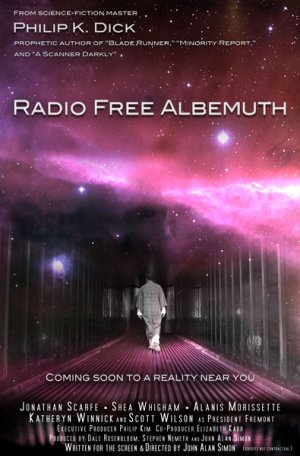
In light of Philip K. Dick’s birthday tomorrow (he would have been 90), it’s an appropriate time to visit (or revisit) the film adaptation of his posthumously published novel “Radio Free Albemuth”. Being a longtime PKD fan and one of the film’s Kickstarter contributors, I admittedly wouldn’t be a completely objective critic, but after having seen it a few times its achievements and shortcomings become more apparent.

Like the novel it’s based on, Radio Free Albemuth is one of the most personal of Philip K. Dick’s narratives, featuring the most faithful retelling of his 2-3-74 experiences. Filmed on a shoestring budget by John Alan Simon the movie has a fitting late 70s/early 80s aesthetic. Much of the dialogue is straight out of the novel but I personally would have wanted a more streamlined and nuanced script with less tangential details and exposition, though the actors across the board do a commendable job delivering their lines as naturally and believably as possible. The many dream sequences could have benefited from a higher budget and better visual consistency, but were able to accomplish what was needed for the plot. The prison scenes near the end seemed a bit rushed and not reflective of the oppressiveness of actual prisons, though that was probably largely due to budgetary reasons as well.

Despite its flaws, I still find the film engaging and worth recommending. Aspects of the story may come across to modern audiences as cheesy but still works on a meta level. In our sophisticated real life corporate techno-dystopia, the idea of individuals trying to incite revolution through subliminal messaging embedded in pop songs requires a suspension of disbelief. However in a more general general sense, countless creators through history (including writers and filmmakers) have made attempts to subvert society and culture with varying and impossible to quantify results.

Watch the full film on Hoopla here: https://www.hoopladigital.com/title/11350683

Saturday Matinee: The Man Who Fell to Earth

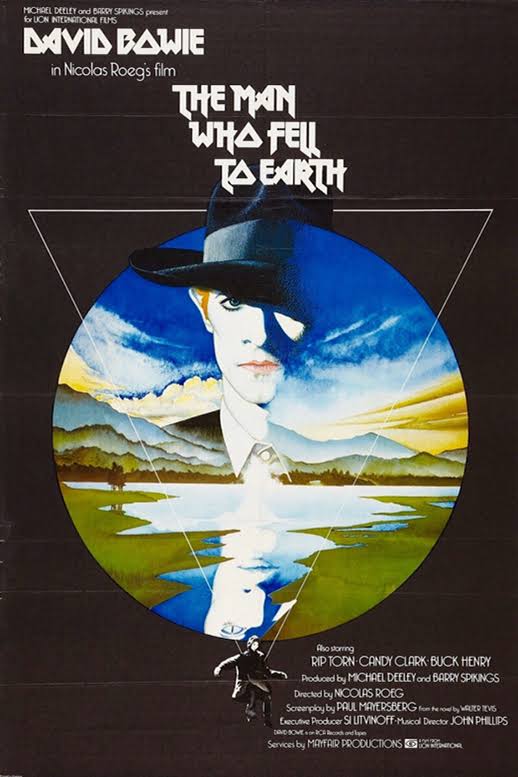
“The Man Who Fell to Earth” (1976) is a British science fiction film directed by Nicolas Roeg, written by Paul Mayersberg, and based on Walter Tevis’s 1963 novel of the same name. David Bowie (in his first feature film role) stars as an extraterrestrial who crash lands in New Mexico while on a mission to save his home planet. Going by the name of Thomas Newton, he soon meets Oliver Farnsworth (Buck Henry), Mary-Lou (Candy Clark) and Dr. Nathan Bryce (Rip Torn), who become his closest allies. Due to personal and professional betrayals, Newton’s secret is revealed and he’s captured by a government agency. While imprisoned he’s subject to tortuous medical tests which break his spirit, replacing his more “alien” personality traits with those of a modern American.

In Philip K. Dick’s novel VALIS, fictionalized versions of Dick and K. W. Jeter become obsessed with Valis, a film starring musician Eric Lampton. This plot element was based on Dick and Jeter’s real obsession with The Man Who Fell to Earth.

Watch the full film here: https://m2m.tv/watch/the-man-who-fell-to-earth/films


Philip K. Dick and the Fake Humans

(Editor’s note: on this 36th anniversary of the passing of Philip K. Dick, it seems an appropriate time to note the relevance of his work to our current dystopia as Henry Farrell does in the following essay. Unfortunately the author is less astute regarding the ways in which the dystopias of Orwell and Huxley are equally relevant to our current milieu.)

By Henry Farrell

Source: Boston Review

This is not the dystopia we were promised. We are not learning to love Big Brother, who lives, if he lives at all, on a cluster of server farms, cooled by environmentally friendly technologies. Nor have we been lulled by Soma and subliminal brain programming into a hazy acquiescence to pervasive social hierarchies.

Dystopias tend toward fantasies of absolute control, in which the system sees all, knows all, and controls all. And our world is indeed one of ubiquitous surveillance. Phones and household devices produce trails of data, like particles in a cloud chamber, indicating our wants and behaviors to companies such as Facebook, Amazon, and Google. Yet the information thus produced is imperfect and classified by machine-learning algorithms that themselves make mistakes. The efforts of these businesses to manipulate our wants leads to further complexity. It is becoming ever harder for companies to distinguish the behavior which they want to analyze from their own and others’ manipulations.

This does not look like totalitarianism unless you squint very hard indeed. As the sociologist Kieran Healy has suggested, sweeping political critiques of new technology often bear a strong family resemblance to the arguments of Silicon Valley boosters. Both assume that the technology works as advertised, which is not necessarily true at all.

Standard utopias and standard dystopias are each perfect after their own particular fashion. We live somewhere queasier—a world in which technology is developing in ways that make it increasingly hard to distinguish human beings from artificial things. The world that the Internet and social media have created is less a system than an ecology, a proliferation of unexpected niches, and entities created and adapted to exploit them in deceptive ways. Vast commercial architectures are being colonized by quasi-autonomous parasites. Scammers have built algorithms to write fake books from scratch to sell on Amazon, compiling and modifying text from other books and online sources such as Wikipedia, to fool buyers or to take advantage of loopholes in Amazon’s compensation structure. Much of the world’s financial system is made out of bots—automated systems designed to continually probe markets for fleeting arbitrage opportunities. Less sophisticated programs plague online commerce systems such as eBay and Amazon, occasionally with extraordinary consequences, as when two warring bots bid the price of a biology book up to $23,698,655.93 (plus $3.99 shipping).

In other words, we live in Philip K. Dick’s future, not George Orwell’s or Aldous Huxley’s. Dick was no better a prophet of technology than any science fiction writer, and was arguably worse than most. His imagined worlds jam together odd bits of fifties’ and sixties’ California with rocket ships, drugs, and social speculation. Dick usually wrote in a hurry and for money, and sometimes under the influence of drugs or a recent and urgent personal religious revelation.

Still, what he captured with genius was the ontological unease of a world in which the human and the abhuman, the real and the fake, blur together. As Dick described his work (in the opening essay to his 1985 collection, I Hope I Shall Arrive Soon):

The two basic topics which fascinate me are “What is reality?” and “What constitutes the authentic human being?” Over the twenty-seven years in which I have published novels and stories I have investigated these two interrelated topics over and over again.

These obsessions had some of their roots in Dick’s complex and ever-evolving personal mythology (in which it was perfectly plausible that the “real” world was a fake, and that we were all living in Palestine sometime in the first century AD). Yet they were also based on a keen interest in the processes through which reality is socially constructed. Dick believed that we all live in a world where “spurious realities are manufactured by the media, by governments, by big corporations, by religious groups, political groups—and the electronic hardware exists by which to deliver these pseudo-worlds right into heads of the reader.” He argued:

the bombardment of pseudo-realities begins to produce inauthentic humans very quickly, spurious humans—as fake as the data pressing at them from all sides. My two topics are really one topic; they unite at this point. Fake realities will create fake humans. Or, fake humans will generate fake realities and then sell them to other humans, turning them, eventually, into forgeries of themselves. So we wind up with fake humans inventing fake realities and then peddling them to other fake humans.

In Dick’s books, the real and the unreal infect each other, so that it becomes increasingly impossible to tell the difference between them. The worlds of the dead and the living merge in Ubik (1969), the experiences of a disturbed child infect the world around him in Martian Time-Slip (1964), and consensual drug-based hallucinations become the vector for an invasive alien intelligence in The Three Stigmata of Palmer Eldritch (1965). Humans are impersonated by malign androids in Do Androids Dream of Electric Sheep? (1968) and “Second Variety” (1953); by aliens in “The Hanging Stranger” (1953) and “The Father-Thing” (1954); and by mutants in “The Golden Man” (1954).

This concern with unreal worlds and unreal people led to a consequent worry about an increasing difficulty of distinguishing between them. Factories pump out fake Americana in The Man in the High Castle (1962), mirroring the problem of living in a world that is not, in fact, the real one. Entrepreneurs build increasingly human-like androids in Do Androids Dream of Electric Sheep?, reasoning that if they do not, then their competitors will. Figuring out what is real and what is not is not easy. Scientific tools such as the famous Voight-Kampff test in Do Androids Dream of Electric Sheep? (and Blade Runner, Ridley Scott’s 1982 movie based loosely on it) do not work very well, leaving us with little more than hope in some mystical force—the I Ching, God in a spray can, a Martian water-witch—to guide us back toward the real.

We live in Dick’s world—but with little hope of divine intervention or invasion. The world where we communicate and interact at a distance is increasingly filled with algorithms that appear human, but are not—fake people generated by fake realities. When Ashley Madison, a dating site for people who want to cheat on their spouses, was hacked, it turned out that tens of thousands of the women on the site were fake “fembots” programmed to send millions of chatty messages to male customers, so as to delude them into thinking that they were surrounded by vast numbers of potential sexual partners.

These problems are only likely to get worse as the physical world and the world of information become increasingly interpenetrated in an Internet of (badly functioning) Things. Many of the aspects of Joe Chip’s future world in Ubik look horrendously dated to modern eyes: the archaic role of women, the assumption that nearly everyone smokes. Yet the door to Joe’s apartment—which argues with him and refuses to open because he has not paid it the obligatory tip—sounds ominously plausible. Someone, somewhere, is pitching this as a viable business plan to Y Combinator or the venture capitalists in Menlo Park.

This invasion of the real by the unreal has had consequences for politics. The hallucinatory realities in Dick’s worlds—the empathetic religion of Do Androids Dream of Electric Sheep?, the drug-produced worlds of The Three Stigmata of Palmer Eldritch, the quasi–Tibetan Buddhist death realm of Ubik—are usually experienced by many people, like the television shows of Dick’s America. But as network television has given way to the Internet, it has become easy for people to create their own idiosyncratic mix of sources. The imposed media consensus that Dick detested has shattered into a myriad of different realities, each with its own partially shared assumptions and facts. Sometimes this creates tragedy or near-tragedy. The deluded gunman who stormed into Washington, D.C.’s Comet Ping Pong pizzeria had been convinced by online conspiracy sites that it was the coordinating center for Hillary Clinton’s child–sex trafficking ring [likewise, the masses may have been convinced by mainstream media that a real child-sex trafficking ring never existed].

Such fractured worlds are more vulnerable to invasion by the non-human. Many Twitter accounts are bots, often with the names and stolen photographs of implausibly beautiful young women, looking to pitch this or that product (one recent academic study found that between 9 and 15 percent of all Twitter accounts are likely fake). Twitterbots vary in sophistication from automated accounts that do no more than retweet what other bots have said, to sophisticated algorithms deploying so-called “Sybil attacks,” creating fake identities in peer-to-peer networks to invade specific organizations or degrade particular kinds of conversation.

Twitter has failed to become a true mass medium, but remains extraordinarily important to politics, since it is where many politicians, journalists, and other elites turn to get their news. One research project suggests that around 20 percent of the measurable political discussion around the last presidential election came from bots. Humans appear to be no better at detecting bots than we are, in Dick’s novel, at detecting replicant androids: people are about as likely to retweet a bot’s message as the message of another human being. Most notoriously, the current U.S. president recently retweeted a flattering message that appears to have come from a bot densely connected to a network of other bots, which some believe to be controlled by the Russian government and used for propaganda purposes.

In his novels Dick was interested in seeing how people react when their reality starts to break down. A world in which the real commingles with the fake, so that no one can tell where the one ends and the other begins, is ripe for paranoia. The most toxic consequence of social media manipulation, whether by the Russian government or others, may have nothing to do with its success as propaganda. Instead, it is that it sows an existential distrust. People simply do not know what or who to believe anymore. Rumors that are spread by Twitterbots merge into other rumors about the ubiquity of Twitterbots, and whether this or that trend is being driven by malign algorithms rather than real human beings.

Such widespread falsehood is especially explosive when combined with our fragmented politics. Liberals’ favorite term for the right-wing propaganda machine, “fake news,” has been turned back on them by conservatives, who treat conventional news as propaganda, and hence ignore it. On the obverse, it may be easier for many people on the liberal left to blame Russian propaganda for the last presidential election than to accept that many voters had a very different understanding of America than they do.

Dick had other obsessions—most notably the politics of Richard Nixon and the Cold War. It is not hard to imagine him writing a novel combining an immature and predatory tycoon (half Arnie Kott, half Jory Miller) who becomes the president of the United States, secret Russian political manipulation, an invasion of empathy-free robotic intelligences masquerading as human beings, and a breakdown in our shared understanding of what is real and what is fake.

These different elements probably would not cohere particularly well, but as in Dick’s best novels, the whole might still work, somehow. Indeed, it is in the incongruities of Dick’s novels that salvation is to be found (even at his battiest, he retains a sense of humor). Obviously, it is less easy to see the joke when one is living through it. Dystopias may sometimes be grimly funny—but rarely from the inside.

Four Kinds of Dystopia

welcome_to_dystopia_by_crystalryu

By Darren Allen

Source: ExpressiveEgg.org

The twentieth century saw four basic visions of hell on earth, or dystopia. These were:

Orwellian. Rule by autocratic totalitarian people, party or elite group, limitation of choice, repression of speech and repression of minorities, belief in order, routine and rational-morality. Control by enclosure, fear and explicit violence. Violent repression of dissent (via ‘the party line’). Erotic physicality and sexual freedom suppressed via control of sexual impulses. Control of thought by explicitly policing language (Orwellian Newspeak).

Huxleyan Rule by democratic totalitarian systems, excess of choice, limitation of access to speech platforms, assimilation of minorities, belief in emotional-morality, ‘imagination’ and flexibility, and control by desire, debt and implicit threat of violence. No overt control of dissent (system selects for system-friendly voices). Erotic physicality and sexual freedom suppressed via promotion of pornographic sensuality and dissolution. Control of thought by implicitly enclosing language within professional boundaries (Illichian Newspeak, or Uniquack).

Kafkaesque Rule by bureaucracy. Control of populace via putting them into writing, forcing people to spend free time on bureaucratic tasks, thereby inducing tractable stress and the schizoid, self-regulating self-consciousness (anxiety about low marks, unlikes, official judgements and the like) that bureaucratic surveillance engenders. Generation of a system which structurally rewards those who seek an indirect relationship with their fellows or who, through fear of life, seek to control it through the flow of paperwork.

Phildickian Rule by replacing reality with an abstract, ersatz virtual image of it. This technique of social control began with literacy*—and the creation of written symbols, which devalued soft conscious sensuous inspiration, fostered a private (reader-text) interaction with society, created the illusion that language is a thing, that meaning can be stored, owned and perfectly duplicated, that elite-language is standard and so on—and ended with virtuality—the conversion of classrooms, offices, prisons, shops and similar social spaces into ‘immersive’ on-line holodecks which control and reward participants through permanent, perfect surveillance, the stimulation of positive and negative emotion, offers of godlike powers, and threats to nonconformists of either narco-withdrawal or banishment to an off-line reality now so degraded by the demands of manufacturing an entire artificial universe, that only hellish production-facilities, shoddy living-units and prisons can materially function there.

The reader can decide for herself under which of above we currently struggle to eke out a life worth living. I would like to suggest that all modern societies are both Kafkaesque and Phildickian with either a Huxleyan or Orwellian overarching framework; modern, western, capitalist societies tend to be basically Huxleyan (HKP) and pre-modern, eastern, communist countries tend to be basically Orwellian (OKP).

The reason why ideological managers** (academics, film directors, journalists, etc) prefer to have two (or more) dystopian systems is that it makes us seem like the goodies and them the baddies. Communism is to blame for their foodbanks and breadlines, but capitalism has nothing to do with ours (or vice versa). Sure our masses have the same miserable lives as theirs, reel under the same bureaucratic insanity, stumble around the same shoddy unreal worlds, and witness the same catastrophic destruction of nature and beauty as theirs do, but at least we’ve got democracy! / at least our families stick together! / at least the trains run on time! / at least GTA 9 is coming out soon / at least the Olympics will cheer us up (delete as appropriate).


This is an adapted extract from The Apocalypedia.


* Obviously I’m not suggesting that literacy is inherently or completely dystopian, but it is the beginning of a dangerous and distorting process, which starts with societies demanding literacy for participation — and devaluing orality and improvised forms of expression — and ends with the complete eradication of reality. This danger and distortion increases with every step towards virtuality (print, perspective, photography, television, internet) until, by the time we reach VR, there remains no possibility of reverie, transcendence, humanity, meaning or genuine creativity, all of which become suspect.

** And of course for those who depend on their illusions.

Future Crimes

precrime-777x437

By John Steppling

Source: CounterPunch

“Precrime Analytical Wing: Contains the precognitives and the machinery needed to hear and analyze their predictions of future crimes.”

Philip K. Dick, Minority Report

“I must confess that over the past few years I have been gravely disappointed with the white moderate. I have almost reached the regrettable conclusion that the Negro’s great stumbling block in his stride toward freedom is not the White Citizen’s Counciler or the Ku Klux Klanner, but the white moderate, who is more devoted to “order” than to justice; who prefers a negative peace which is the absence of tension to a positive peace which is the presence of justice…”

Martin Luther King

“The intellectuals are the dominant group’s ‘deputies,’ exercising the subaltern functions of social hegemony and political government”.

Gramsci

There was a jaw dropping but not unexpected article at The Guardian this week. It was actually part of a series of pieces at that paper that have sought to manufacture a legacy for Obama, the outgoing president, since his actual legacy is one of imperialist foreign policy, CIA support of jihadists, right wing coups, and most acutely, perhaps, a massive subverting of free speech and civil liberties. What Robert Parry has called a ‘war on dissent’. The Guardian piece took the form of asking novelists, public intellectuals {sic} and TV hacks what they perceived to be Obama’s legacy — and even the use of that word, *legacy* is a loaded indicator of the direction this piece was headed. What struck me most was not the predictable support for Obama policy (more on that later) but the utter banality of the writing. There were writers in this group who I have admired (Richard Ford for one, Marilynne Robinson, as well) but the sentiments were so stupefyingly superficial, so fatuous and fawning that it was hard not to see this as a kind of mini referendum on the state of Western culture.

Joyce Carol Oates (for whom ten words is usually better than the right word) described Obama as…“Brilliant and understated, urbane, witty, compassionate, composed..”. Siri Hutsvedt (who honestly I had to look up…finding her most notable achievement was being married to Paul Auster) wrote…“For eight years, we have been represented by an elegant, well-spoken, funny, highly educated, moderate, morally upright, preternaturally calm black man”. Richard Ford wrote…“This cold morning, when I think about Obama, immersed in what must be a decidedly mixed brew of emotions – mixed about his deeds, mixed about his effects on the US, decidedly mixed about our future – I’m confident he is thinking, right to his last minute in the office, as the president, and not much about, or for, himself. That’s what I expected when I voted for him – that he’d be a responsible public servant who’d try to look out for the entire country.” I know, I know, but that’s what he wrote. Look it up if you don’t believe me. Perhaps this is what a career of University teaching does to one. Edmund White called him one of our great presidents (love the use of *our*).

Jane Smiley, who at the least mentioned TPP and drones, but ended with…“As a national leader, he has engendered more chaos, but it is necessary chaos – a loud and meaningful return to the question of what constitutes the real America.” A necessary chaos? The fuck does that mean? I ask that sincerely, sort of. By the time I reached the end of this saccharine mind numbing bathos I thought back to the 1968 Democratic Convention and to Esquire Magazine, in its golden era, who sent William Burroughs, Jean Genet, Terry Southern and John Sack to cover the convention. I thought back to Robert Bly and his organizing of Writers against the Vietnam war. The readings he gave with Galway Kinnell and Ginsburg, and a dozen others. And to the way Bly spoke of art and the role of art in a society. In an interview with Michael Ventura, around the time of the Iraq invasion…

Bly:I don’t think we believe that a Great Mother is lying to us. It’s a father who’s lying to us. Thee whole system, in a way, is a father system.Ventura: It’s a patriarchy, so it’s a father who’s lying.Bly: Exactly. And we eventually get the sense that our ownfather is lying to us. { } Whenever you have a culture completely run by grosscapitalism, all of the gods are driven away. Well, then what?What does that mean when those gods are not present?

Later Bly says…

“When I talk about the world being mad, I tell people,“You won’t believe how bad television is going to be in ten years.You’re going to literally have to protect your children from it.”And we’re not going to be able to change that. The only thingwe can do is recognize that it’s mad, and reach inside ourselvesand bring out our own genuine madness in the form of art,and then teach our children to do the same.”

In 68, a corporate owned magazine, and hardly a socialist magazine, thought it reasonable to ask Genet or Burroughs to discuss a political convention. I mean even Norman Mailer wrote intelligently on Kennedy for Esquire, and Mailer isn’t exactly Gramsci. My point is, or I hope my first point, is that it is not always crucial to demand ideological analysis. For art’s radical nature is outside ideology. Just speaking from a radical perspective, an anti bourgeois perspective, can be enough. But in 1968 the U.S. still had artists. What artist could you invite today? What public intellectual? The Guardian picked Sarah Churchwell (who again, I’d never heard of) who wrote…

“The Obamas changed the rules for what it means to inhabit the White House, and not only because they were the first black family to do so. They were also the first modern family to do so, to be informal yet classy, upright yet kind, and, most important, themselves.”

That’s it then, just be yourself. But the lesson here, if there is one, is that the radical tradition in American life has been rendered invisible. Just as the history of labor and unions and strikes has been erased. There are plenty of great artists out there, actually. Tons of intellectuals, but they aren’t invited by corporate media. Was anyone from Black Agenda Report asked to comment? Or from, well, CounterPunch? Was Harry Belefonte asked? The manufacturing of an image of a culture, rather than an actual culture, is what organs of disinformation such as The Guardian are in the business of doing. And this is also what Hollywood does, of course. Look at the stuff that gets on in the flagship theatres of the U.S. What is the season at Lincoln Center? Does it matter? No, it really doesn’t. And running across all of this discussion is the question of class. In fact, that may be the most important aspect in all of this. The working class voice is erased. In total. And this is hugely significant. Even fifty years ago the stages of American theatres were filled by work from playwrights who did not have MFAs. Novels were written by criminals and outsiders. This is no less true, really, in the U.K. From Brendan Behan to Martin Amis is the road travelled. Now of course one can site exceptions to this, I think anyway. There are always celebrity outsiders, branded renegades. Usually this takes the form of a confessional. My time on oxycodone while writing Sit Coms. I was a teenage prostitute and was addicted to anti depressants, but then I found a higher power. But god forbid you express condemnation of the bourgeoisie. For that is the greatest of all crimes.

When I worked in Hollywood, I felt the class estrangement acutely. But I did get work and had some modest success. And I remember when a major cable producer of the era asked me, during a pitch meeting, for the names of writers I thought would be good to employ for an anthology series they wanted to put together. I said, well, Iceberg Slim (Robert Beck) and John Rechy. A silence fell on the room. I was very very naive. Hollywood today seems infested with lawyers, former political interns, and business school graduates. Most from Ivy league schools. And the world that is manufactured is one that reflects their class. And the effect this has had is to alienate the younger artists who do not come from affluent backgrounds. It has also normalized the a vision of the world that belongs to perhaps ten per cent of the population. The rest are strangers in their own land. Strangers to the official sanctioned culture. And in that sense, Hollywood has sort of merged with Madison Avenue.

The class divide is being starkly revealed this last few months. And it has also served to put in stark relief the real impetus of U.S. foreign policy (and to domestic policy, too, only not as drastically). After WW2 and the formation of the CIA, the shaping of a political intention was being finalized. This came from George Kennan and the Dulles Brothers. And Henry Kissinger was the premier exemplar of this thinking. Kissinger, who supported the Shah and his death squads in Iran, and chaired the Presidential Commission on Central America in the 1980s,(employing Ollie North) and which unleashed an unimaginable terror on that region, and who orchestrated the Pinochet coup in Chile to protect ITT and, as a side bar, to teach a lesson to any government not readily obedient. This has been the seamless and never changing foreign policy of the U.S. for seventy some years. Punish the disobedient (meaning anything smacking of socialism or any nation even the tiniest bit resistant to Western business) and to continue toward global hegemony, and at the same time perpetuating conflicts which make both defense contractors and giant service providers such as Halliburton a lot of money.

The U.S. has cultivated compliant nations (Australia, the U.K. most notably) to enforce its policy (think East Timor, Iraq and Libya et al) and now owns a complient organization with international standing: NATO. And NATO serves as a legitimizing international (sic) institution of pacification.

John Pilger writes…

“The other day, an Indonesian friend took me to his primary school where, in October 1965, his teacher was beaten to death, suspected of being a communist.
The murder was typical of the slaughter of more than a million people: teachers, students, civil servants, peasants. Described by the CIA as “one of the worst mass murders of the 20th century”, it brought to power the dictator Suharto, the west’s man. Within a year of the bloodbath, Indonesia’s economy was redesigned in America, giving western capital access to vast mineral wealth, markets and cheap labour. “

Stephan Gowans writes…

“The United States had waged a long war against Syria from the very moment the country’s fiercely independent Arab nationalist movement came to power in 1963. Assad and his father Hafez al-Assad were committed to that movement. Washington sought to purge Arab nationalist influence from the Syrian state and the Arab world more broadly. It was a threat to Washington’s agenda of establishing global primacy and promoting business-friendly investment climates for US banks, investors and corporations throughout the world.”

The rise of the neo cons, which rather officially began with Project for a New American Century (just prior to Bush Jr’s presidency) was really just an extension of that original plan for global domination. At that time this was articulated by a seething nearly hysterical hatred of the Soviet Union. And the structural aspect of this remains in place with today’s rabid and massive propaganda campaign directed at Putin. And indeed even on the left one hears the echoes of a Russophobic sensibility. It is as if these faux leftists can not allow a critique of U.S. imperialism (in Syria for example) without off handedly smearing Russia, too. One need only look at who is surrounding whom with military bases. And the same holds true, with slightly less hysteria, for China.

In 2012 Ed Herman, speaking in a radio interview, said

“…humanitarian intervention {has} been used strictly for the interests of the United States and other Western powers and Israel. Strictly. So there’s no intervention in Saudi Arabia or Israel or Yemen or Bahrain. There was none in Egypt…And there was Egypt, here you had a miserable dictator for decades, and then you had an uprising where a lot of people were being beaten and killed in the streets, and you never had Mrs. Clinton ever asking for any application of humanitarian intervention. Not once. Never. They’re getting away with the most unbelievable double standard imaginable.”

This is, none of it, new. And yet, despite the obvious record of Obama in furthering exactly this world vision, the liberal organs of *real* news continue to paint their revisionist narratives of American heroism and goodness. And it is breathtaking in a way to read this new class of quisling artist, the court eunuchs for the Democratic Party establishment. And Obama’s apparent anger and petulance belies, certainly, descriptions such as ‘preternaturally calm’, and ‘dignified’. But there is a thread of liberal guilt running through this as well. Obama’s race (and his perfect wife and kids — and one longs for Ron Reagan Jr or to go back to James Madison’s son John, and shit, even the Bush girls might be a relief from these Stepford children.) is the psychological glue for a visibly excessive adoration. And this is a white liberal class that is haunted, I suspect, in their heart of hearts, by the knowledge of their own privilege and that that privilege has resulted in oceans of blood, and the knowledge, if they were ever to question themselves, that they would sell out anyone to retain that privilege. They love Obama and Obama is black, therefore…etc.

As Ajamu Baraka noted

“In the face of the Neo-McCarthyism represented by this legislation and the many other repressive moves of the Obama administration to curtail speech and control information — from the increased surveillance of the public to the use of the espionage act to prosecute journalists and whistleblowers — one would reasonably assume that forces on the left would vigorously oppose the normalization of authoritarianism, especially in this period of heightened concerns about neo-fascism.
Unfortunately, the petit-bourgeois “latte left” along with their liberal allies have been in full collaboration with the state for the past eight years, with the predictable result that no such alarm was issued, nor has any critique or even debate been forthcoming.”

The openly Imperialist U.S. state has tortured, illegally kidnapped, and simply murdered both leaders of sovereign states as well as countless innocent victims. That Samantha Power’s motorcade in rushing through a village in Cameroon happened to run over a ten year old boy, and didn’t stop — this barely made the evening news at all (but hey, they did send the family fifteen hundred dollars by way of an apology). They have acted covertly to destabilize governments and have manufactured enemies at a rate that is staggering to contemplate. Obama’s tight relationship with the most odious autocratic and murderous country on earth, Saudi Arabia, speaks to the cynicism of the political elite.

And yet, the artistic communities by and large continue to focus on identity issues (once they have attended to their career moves and spoken with their agents), most of which affect their own class. The dire suffering of the poor makes good voyeuristic source material, but the segregation of classes is enforced zealously. Token exceptions are simply that.

How is it possible to become so alarmed by Trump, while supporting Democrats? Those millions on the street protesting the looming invasion of Iraq must have noticed that every single Democrat in government voted FOR the invasion (save for the honorable Barbara Lee). And yet here they all are wringing their hands in dismay that Hillary lost. Here they are constantly repeating the litanies of Trump evil and never noticing the crimes of earlier democratic presidents and administrations. So, yes Trump’s appointments are awful. But I refuse to even dig into that until a discussion of Obama’s appointments are dissected. First came Rahm Emanuel, former memeber of the IDF, all around thug and bully and lover of never ending war to help expand Israeli power. Penny Pritzker, heiress and elitist and friend to the 1%, or Robert Rubin or Tim Geithner (!!!) or Tom Daschle, the senator from Citibank. I’m just scratching the surface. Joe Biden and Hillary Clinton. The point is that I am coming to feel that almost any focus on Trump feels misplaced. Certainly now it does since he isn’t even president yet. The deconstruction of liberal Obama is far from complete and the propaganda apparatus is working overtime to rewrite not just recent history, but the present. And the anti Russian propaganda is so absurd, so transparent, that this feels far more important than the predictable stupidity of Trump. I mean Obama is massing troops near the Russian border. Obama is ramping up the building of purpose built navel bases near China. Obama is still looking to prosecute Chelsea Manning and every other whistleblower. And he is still signing draconian legislation to curb free speech and institutionalize legitimacy for the new McCarthyism. Talking about Trump is a form of forgetting. I can’t do it. And if there is an easier target for parody or even non parodic narrative than Donald Trump, I havent met them. And easy is never an act of rigorous self examination.

Thomas Bates writes, discussing Gramsci…

“Gramsci retained a skepticism towards these alienated fils de bourgeois, a
skepticism which was not, however, mere prejudice, but was an historical
judgment informed by the experience of the Italian labor movement. How was
one to explain the passing of entire groups of left-wing intellectuals into the
enemy camp? More precisely, how was one to explain the phenomena of socialists
entering into bourgeois governments and of revolutionary syndicalists
entering into the nationalist and then the Fascist movement? Gramsci viewed
these puzzling events as the continuation on a mass scale of the ‘trasformismo’
of the nineteenth century. The “generation gap” within the ruling class had resulted
in a large influx of bourgeois youth into the popular movements, especially
during the turbulent decade of the 1890’s. But in the war-induced crisis
of the Italian State in the early twentieth century, these prodigal children
returned to the fold…”

And Gramsci adds..

“The bourgeoisie fails to educate its youth (struggle of generations). The youth
allow themselves to be culturally attracted by the workers, and right away
they … try to take control of them (in their “unconscious” desire to impose
the hegemony of their own class on the people), but during historical crises
they return to the fold.”

White affluent self identifying liberals believe they are the decision makers. That is their destiny. They believe that. One must build a new culture. Not endlessly ratify a decrepit and atrophying one. One must stop perceiving *liberals* as being on the side of change. For they are not. Guy Debord began his situationist masterpiece (1967) by quoting Feuerbach, Preface to the second edition of The Essence of Christianity:

“But certainly for the present age, which prefers the sign to the thing signified, the copy to the original, representation to reality, the appearance to the essence… illusion only is sacred, truth profane. Nay, sacredness is held to be enhanced in proportion as truth decreases and illusion increases, so that the highest degree of illusion comes to be the highest degree of sacredness. “


John Steppling is an original founding member of the Padua Hills Playwrights Festival, a two-time NEA recipient, Rockefeller Fellow in theatre, and PEN-West winner for playwriting. Plays produced in LA, NYC, SF, Louisville, and at universities across the US, as well in Warsaw, Lodz, Paris, London and Krakow. Taught screenwriting and curated the cinematheque for five years at the Polish National Film School in Lodz, Poland. A collection of plays, Sea of Cortez & Other Plays was published in 1999, and his book on aesthetics, Aesthetic Resistance and Dis-Interest was published this year by Mimesis International.

Hybrid Landscapes – From Posthistoric to Posthuman

spiritual-phenomena-other-dimensions

By Kingsley L. Dennis

Source: Reality Sandwich

The collective psyche seems to be in the grip of a powerful archetypal dynamic in which the long-alienated modern mind is breaking through, out of the contractions of its birth process, out of what Blake called its “mind-forg’d manacles,” to rediscover its intimate relationship with nature and the larger cosmos.
Richard Tarnas

Reality, it seems, has been deregulated, and nothing is business as usual anymore….as ancient mapmakers used to mark on the watery unknown, “Here be dragons”
Erik Davis

Here be dragons, indeed. Our human exploration is swinging through a momentum that includes knowledge of the finer forces at work within the cosmos, which includes how we experiment in our interactions with not only the environment but also our bodies. In this article I will explore these themes, looking at memes of meta-programming to post-body scenarios – all in the framework of a human search along the sacred path of understanding our very selves.

American writer Philip K. Dick is famous mostly for his science-fiction books that question the nature and validity of our reality-matrix. In “The Android and the Human,” a speech that Dick gave in the early 1970s, he spoke about this blurring of the boundaries between body and environment:

[O]ur environment, and I mean our man-made world of machines, artificial constructs, computers, electronic systems, interlinking homeostatic components – all of this is in fact beginning more and more to possess what the earnest psychologists fear the primitive sees in his environment: animation. In a very real sense our environment is becoming alive, or at least quasi-alive, and in ways specifically and fundamentally analogous to ourselves.1 

The human-body-environment is increasingly being reconfigured as a site for a new magical animism, as distinct from the previous archaic notion of animism. Writer-philosopher Erik Davis has referred to this as a sort of ‘techno-animism’ whereby we give life to our technologies based on our imaginations.2 This new configuration is no longer anymore about technologies and us, but rather our technological bodies that now inhabit our ‘techno-imaginal’ realm. The body is becoming back into vogue as a site for experience and experimentation, as a vessel that interacts, intercedes, and interprets the sacred-mystical reality-matrix that encloses us. As modern quantum science has now aptly demonstrated, we do not inhabit a subject-object type of us-and-it world.[1] All materiality is enmeshed within a quantum entangled universe, and our bodies are somatically communicating with this energy field simultaneously.

Much of the western spiritual (Gnostic) mystical practice is interpreted as a somatically felt experience. The body is the instrument that receives and grounds the experience, whether it be in terms of the ‘great flash’, ‘illuminating light’ or the ‘bodily rush.’ The body is the human instrument for attracting and centralizing (receiving, transcribing, and sometimes transferring) the developmental energy. There are many ‘bodies’ in spiritual-mystic traditions, including the etheric, the spiritual, the ecstatic, the subtle, the higher, and others, so that the purely physical-material body is recognized as the densest and least mobile of them all. As cultural historian Morris Berman has noted, the body in history has always been a site/sight of focus.3 It has helped define the experience of the Self/Other, the Outer/Inner, and to be a material vessel for the spiritual impulse. Our earlier ancestors, who exhibited more of an animist relationship to the world, saw less distinction between the physical body and its environment. The rise of the philosophy of dualism and the mind-body split, which was supported by the mechanistic worldview, saw our modern societies further strengthen the mind/body rift. This was publicly endorsed by Orthodox/organized religions that have been quick to spurn and even demonize the body. Many so-called ‘modern’ societies around the world have, at one time or another, attempted to suppress the power and expression of the human body. The body has always been a site for the convergence of power and control. Perhaps no one in recent times has done more to expose this body-power relationship than the work of French philosopher Michel Foucault.[2] Foucault has deconstructed, in the body of work that he refers to as a critical history of modernity, how the body has been fought over as a site of power. The physical body is a location of resistance against the establishment; it is a fixed place where an individual can be located, found, and held accountable. If we cannot escape from our bodies then, it seems, we are forever within the system. The body-in-system has always been taken to represent the form of something, as a socially tangible entity. We have bodies in terms of social institutions, such as the body politic, or the social body, the scientific body, the medical body, or the body of an organization, etc. The once sacred site of the body, which was the vessel for somatic spiritual experiences, has become the subject of control and suppression.

In Gnostic terms the body’s site of power has been referred to as those of the ‘sleepers’ and ‘wakers.’ The ‘sleepers’ being those whose conscious self has yet to break through the layers of the body’s social conditioning. The spiritual-somatic experience has been seen as a threat to hierarchical societies because it exists beyond their bounds of power. This is one reason why ecstatic experiences – whether through spiritual or other means – have been suppressed, outlawed, and discredited by religions and mainstream institutions alike. Ecstatic experiences that can break down human thinking patterns and conditioning structures are unnerving for institutions of social-political power. How can you control, regulate, and discipline a body/energy/experience that has no physical location? Such intangible forces, such as the power of baraka,[3] is positively infectious and beyond bounds. As Berman notes,

The goal of the Church (any church) is to obtain a monopoly on this vibratory experience, to channel it into its own symbol system, when the truth is that the somatic response is not the exclusive property of any given religious leader or particular set of symbols. 4 

The spiritual-occult renaissance of the 20th century strove to rejuvenate and strengthen the presence of the somatic experience. This intangible flow of spiritual blessing, grace, and power is also a resurging undercurrent in the sacred revival.

In more recent times there has been an increasing focus on what is termed the innate consciousness (of the body), and which has been revealed through such techniques as muscle testing. It is innate because it is inborn (born in and of the body), and it is instinctual. Somatic consciousness then is another word for our intuitive intelligence. As I discussed in a previous book,[4] many of those now being born into the world are displaying a stronger sense of intuitive intelligence. However, in our modern haste we have, in the words of French philosopher Bruno Latour, never really been modern at all since we continue to exist in an anthropological matrix where nature and culture cannot be neatly divided. As Latour points out, this matrix is composed of hybrids where natural/cultural, real/imagined, and subject/object merge. Moreover, this hybridity is being further enforced and coalesced through genetic engineering, implants, virtual reality, and NBIC sciences (Nanotechnology, Biotechnology, Information technology and Cognitive science). Latour is right in saying that humanity has never exited from what he refers to as our pre-modern ancestors’ world. We are, and always have been, a hybrid of body-mind-environment. Yet unlike Latour, I contest that we are modern – or rather we are past the post of post-modern, in how we are merging our lives into a new hybrid fusion.

Our ancestors made no such division between nature and society because their state of consciousness did not allow them to – they simply did not perceive it. However, the state of human consciousness today is far different in its capability and lucidity to perceive and acknowledge the relationship with our external world. Saying this, of course, in our development ‘to be modern’ we left behind the sacred component of perceiving just how entangled our reality truly is. Yet the succeeding ‘post-modern’ stage then worked on breaking down these ‘perceptions of containment.’ As William Irwin Thompson says,

The project of Modernism was to expel preindustrial magic and mysticism and stabilize consciousness in materialism, but the projects of postmodernism have broken down the walls that once contained us in a solidly materialistic and confidently middle class worldview. 5 

This breakdown has now moved into a more advanced stage with the advent of the internet and digital technologies. We have now entered what Thompson refers to as the ‘astral plane, a bardo realm, in which everything is out there at once, a technologized form of the collective unconscious…a place where the physical body is either dead or absent.’ 6

Thompson prefers to view this technologized-bardo realm, where the physical body is either dead or absent, not as post-modern but as postcivilization – or even posthistoric.7 We are in a new phase of planetary culture where we are no longer simply reacting to emerging technologies, but rather our evolving state of consciousness is drawing forth these new technologies. In other words, it is as if new technologies come into being in accordance with shifting states of human consciousness. Like a good magician, we are pulling new technological innovations out of the hat of our collective consciousness – archetypes into manifestation. Whereas modernity was about ‘coming to our senses’ in a rather conservative way, the posts we have passed now – whether they be modern, civilization, or historic – are about shifting beyond our senses. As one well-placed commentator put it,

The human being’s organism is producing a new complex of organs in response to such a need. In this age of the transcending of time and space, the complex of organs is concerned with the transcending of time and space. What ordinary people regard as sporadic and occasional bursts of telepathic or prophetic power are…nothing less than the first stirrings of these same organs.8 

As a new historical phase unfolds within the human species – as part of a shift toward a planetary civilization – it appears that new needs are pushing out – or birthing – novel organs or faculties within the human being.

This brings to mind the Richard Tarnas quote that headed up this article, where he stated that the once alienated (read ‘sacred’) mind is now breaking through, as if in a birth process, out of what Blake called its “mind-forg’d manacles,” to ‘rediscover its intimate relationship with nature and the larger cosmos.’ Note that Tarnas said ‘rediscover,’ suggesting it is a recovery, a revival, and not a new birth. The sacred revival of which I speak is literally carving out a new topography for itself.

Hybrid Landscapes

Our millennial era is still trying to decide how to define and view the physical biological body. At this stage the landscape is literally littered with a thousand voices, all howling ‘for the ancient heavenly connection to the starry dynamo in the machinery of night.[5] Some voices see the human body as a hindrance upon the evolutionary journey toward an immortal society that is destined for the stellar neighbourhood. Others view it as a field for experimentation; to tinker and adapt toward a genetically modified hybrid. There are still others who see the body as a site to blur the boundaries between the digital and physical worlds. And then there are those voices who view the biological body as undergoing its own intrinsic in-built modification, or upgrade, through a self-adapting nervous system, programmed by emerging DNA programs hitherto latent.

In the latter part of the 20th century we had a wave of trends that all converged upon the body-mind-spirit matrix. These streams included the physical (bodily) research fields of cybernetics, computer programming, and artificial intelligence. These streams then interwove with the mind-spirit tropes of psychedelic experimentation (LSD, peyote, etc), mystical philosophies (Gurdjieff, Castaneda, etc) and transcendental movements. You would literally need a whole book dedicated to this topic alone to even begin to make a credible dent into this yellow brick road bricolage of body-mind-spirit convergences. Just to give a slight taste from the tip of the iceberg I will ever so briefly mention how the computer metaphor gave rise to notions of programming – and meta-programming – the human body as a biocomputer. This image was reinforced by Dr. John C. Lilly’s bookProgramming and Metaprogramming in the Human Biocomputer that described some of his experiments on human consciousness and human-dolphin communication. Meta-programming became a core theme of the writings of Timothy Leary and Robert Anton Wilson who produced such works as Exo-Psychology: A Manual on the Use of the Human Nervous System According to the Instructions of the Manufacturers and Prometheus Rising respectively. Both these works discuss an eight-circuit model of consciousness that is part of a path in neurological evolution. Both authors, Leary especially, took it upon themselves to evolve a philosophy stating that the future evolution of human civilization was encoded in our DNA. Hence, the new sacred technology is our nervous system itself, and our DNA is already hard-wired for evolutionary mutation. Similarly, running through some of these streams were the ideas of Caucasian mystic G. I. Gurdjieff who spoke of the human being in terms of a ‘man-machine’ that was asleep to life and could be triggered into wakeful activation. Leary, as if in Gurdjieffian overtones, would call for humanity to ‘wake up, mutate, and ascend.’9 The new sacred magic had mutated into practices (rituals) to reprogram the apparatus that receives, according to the authors, our biofields as well as human consciousness; namely, DNA. Interestingly, recent advances in quantum biology have outlined how DNA emits biophotons that produces a coherent biological field that may be susceptible to impact and influence (read ‘reprogramming’ here).10[6]

Whether or not the new game in town was actively to epigenetically re-program the DNA through a fusion of transcendental and/or psychedelic practices, it was very much about work on oneself. Gurdjieff’s program of study – called The Fourth Way – was a kind of blend of Eastern dervish yoga with western scientism. As Gurdjieff famously proclaimed – Take the understanding of the East and the knowledge of the West and then seek. This blend of eastern understanding and western knowledge became known amongst its adherents simply as The Work. The western melting pot of sacred angst and survivalist spirituality saw an emergence of similar tropes such as E.J. Gold’s The Human Biological Machine as a Transformational Apparatus. The western playing field in the second half of the 20th century was open to the new Great Game – and it involved inner spaces and the body-mind matrix. Robert S. de Ropp aptly called it the Master Game in his book Master Game: Pathways to Higher Consciousness Beyond the Drug Experience. For a sense of what was bubbling up around this Master Game sacred revival, in the US especially, one needs to understand a history of the Esalen Institute, co-founded by Michael Murphy and Richard Price on the Californian shores.[7] An excellent, if exhaustive, study of the body-mind matrix based upon the fizzy, fired-up tropes of the time is Michael Murphy’s Future of the Body: Explorations into the Further Evolution of Human Nature. These explorations, however, were all based upon expanding and amplifying the potentials of our current human biological body-mind. That was before the computer trope really got going – and science-fiction became research grant.

The rise of the robots literally happened after the Dartmouth Summer Research Project on Artificial Intelligence (AI), in the summer of 1956, announced the beginning of the AI field. College campuses and defence departments suddenly began the earnest journey along the stony research road that finally spawned the controversial concept of consciousness upload. One of the more vocal supporters of this ‘mind-in-machine’ notion is robotics researcher Hans Moravec. Moravec, whose books include Mind Children and Robot, outlines a future where the human mind can be uploaded as a precursor to full artificial intelligence. Similarly, cognitive scientist Marvin Minksy (who was one of the 1956 gang who coined the AI field) espoused a philosophy that saw no fundamental difference between humans and machines – as put forward in such works as his Society of Mind. Artificial Intelligence is uncannily consistent with the Christian belief in resurrection and immortality – does this make AI research into a sacred, god-like enterprise? It does make us wonder. Historian of technology David F. Noble notes also that the AI project is imbued with its own trajectory of transcendence:

The thinking machine was not, then, an embodiment of what was specifically human, but of what was specifically divine about humans – the immortal mind…the immortal mind could evolve independently into ever higher forms of artificial life, reunited at last with its origin, the mind of God.11

Other streams have been quick to spring up around this fertile theme, including several futurist movements and their manifestos. These have included, but not limited to, the Upwingers (F. M. Esfandiary), Extropians, Transhumanists; and then later came the high-profile members that announced the Technological Singularity.

F.M. Esfandiary’s ‘Upwingers Manifesto’ (by now Esfandiary was known as FM-2030) announced in the 1970s our glorious moment in human evolution. According to their manifesto:

We UpWingers are resigned to nothing. We consider no human problems irreversible – no goals unattain-able. For the first time in history we have the ability, the resources, the genius to resolve ALL our age-old problems. Attain ALL our boldest visions.[8]

Similarly, in the 1980s Max Moore and Natasha Vita-More expounded on Extropian principles which later came to be formulated as: Perpetual Progress; Self-Transformation; Practical Optimism; Intelligent Technology; Self-Direction; and Rational Thinking. And for the Moores, Intelligent Technology meant ‘Applying science and technology creatively and courageously to transcend “natural” but harmful, confining qualities derived from our biological heritage, culture, and environment.’ [9] The Transhumanist movement is still going strong and is not definable to any one particular group, although Humanity Plus (H+) is one of its most recognized institutions. There are streams and sub-groups under the transhumanist umbrella, and yet they all share a similar goal in viewing the human condition as being open to transformation through the use of sophisticated technologies. In other words, the goal is to give humanity a technological upgrade to its current bodily and mental capacities.

From Gurdjieff’s ‘man-machine,’ to Moravec and Minsky, to Max and Natasha Vita-More and Ray Kurzweil, the list goes on. And recently we have had the call for a new speciation along the homo sapiens evolutionary line – into Homo evolutis. In their TED talk and subsequent book Homo Evolutis Juan Enriquez and Steve Gullans present how we have already gone through twenty-five speciation events before arriving at our current species. Enriquez and Gullans consider it an anomaly to think that no other humanoid will ever evolve; and so they ask the question – ‘what would the next human species look like?’ They say that ‘We are transitioning from a hominid that is conscious of its environment into one that drastically shapes its own evolution…We are entering a period of hypernatural evolution…Homo evolutis.’12 This brings us back again to Latour’s concept of the anthropological matrix where nature and culture is mixed together without clear boundaries. With the NBIC sciences of nanotechnology, biotechnology, information technology and cognitive science we are meshing our genetic and cultural DNA. We are 3-D printing buildings as well as human body parts. We are now as a species consciously and deliberately experimenting, shaping, and morphing our environments, as well as journeying and mapping our inner spaces. We are the inhabitants and psychonauts of hybrid landscapes. And yet why should all this be part of an observation on the sacred revival? Because this transmutation of the human condition is what we, as a sentient sapien species, have always been doing.

Our early ancestors were obsessed with the transmutation of the human body-mind as far back as 35,000 years ago. The existence of rock paintings of therianthropes (shape-shifting forms from human to animal) that date back 35,000 years are speculated to be the early origins of human religious traditions. The symbolic paintings and drawings on cave walls and traces of ancient rituals which appear throughout the Palaeolithic era display a ‘primitive’ people in touch with the unseen realm. They display a fascination with a creative world beyond that of the human reality-matrix. These numerous examples of sacred, ritualistic art show how early humans were communing with a transcendental realm which modern humans have never stopped attempting to access. Noted anthropologist David Lewis-Williams has built a theory which explains how the people of the Upper Palaeolithic era harnessed altered states of consciousness to fashion their society, and used such imagery as a means of establishing and defining social relationships.13 The rock art of shape-shifting therianthropes also suggests a ‘primitive’ spiritual belief in the human soul as being connected to that of an animal or another being. Here we have a clear indication of our early ancestors creating sacred ritual around the transmutation and transcending of the human body-mind matrix. And this, in a nutshell, is part of the wisdom stream of shamanism.

It appears then that the human body-mind matrix has always, since earliest known cultural records, been a site for practicing sacred transcendentalism not far off from current transhumanist notions. As a species ‘in-transmutation’ we are increasingly having out-of-body experiences that meld cosmic consciousness with cultural artefacts. From the published out-of-body flights of Robert Monroe[10] to the rise in channelled texts and audio, we have passed beyond our senses into a totally different multifaceted realm. We are not wanderers in an anthropological matrix but waves and particles in a holographic field where each flash and speck contains and reflects the whole. Enmeshed and entangled within this field-matrix we are akin to the famous Buddhist Indra’s Net analogy:

Far away in the heavenly abode of the great god Indra, there is a wonderful net that has been hung by some cunning artificer in such a manner that it stretches out infinitely in all directions. In accordance with the extravagant tastes of deities, the artificer has hung a single glittering jewel in each “eye” of the net, and since the net itself is infinite in all dimensions, the jewels are infinite in number. There hang the jewels, glittering like stars of the first magnitude, a wonderful sight to behold. If we now arbitrarily select one of these jewels for inspection and look closely at it, we will discover that in its polished surface there are reflected all the other jewels in the net, infinite in number. Not only that, but each of the jewels reflected in this one jewel is also reflecting all the other jewels, so that there is an infinite reflecting process occurring.14

We are also reflections of ourselves in other universes as our reality-matrix bends and curves throughout countless cosmic contortions. According to physicist Paul Davis we co-exist alongside countless billions of other universes ‘some almost identical to ours, others wildly different, inhabited by myriads or near carbon-copies of ourselves in a gigantic, multifoliate reality of parallel worlds.’15 We no longer know what it means to live in a dualistic subject/object type of world. Our dualistic prison walls have disintegrated around us like a simulacrum or, in more popular parlance, like a rebooting video game.

We have already passed the post into a posthistoric era. Almost everything is up for grabs, which makes this era one of spectacular possibilities as well as gravest dangers. It would appear to any off-world observer that we are in the midst of a western slipstream of creative nihilism that is creeping its way around the fringes of tech-geekism and apocryphal-apocalyptic mysticism that says Take Nothing for Granted! As the ancient mapmakers used to scribe over unknown watery territories, Here be dragons – and here indeed they be, like lounging lizards waiting to lick at our heels. These are adventurous times as we innovate with outer form, and forge ahead into the inner spaces of essence. These are the features that adorn the sacred – the multifaceted faces of the body-mind-nature matrix that weaves the cosmic with the social, and which collapses the wave of duality. Lifepass the post is where we experiment with ourselves, as a species, and as a vessel of consciousness. And this, if done in a right relationship within our reality-matrix, is at its core a sacred art. Our cultural canvas is a palimpsest upon which new fictions and artefacts are engraved. And these fictions are the channels through which the sacred revival is raising its head and smiling the seven rays of emanation.

1 Cited in Davis, Erik (1998) Techgnosis: myth, magic and mysticism in the age of information. New York, Three Rivers Press, p187

2 Davis, Erik (1998) Techgnosis: myth, magic and mysticism in the age of information. New York, Three Rivers Press

3 Berman, Morris (1990) Coming to Our Senses: Body and Spirit in the Hidden History of the West. New York, HarperCollins.

4 Berman, Morris (1990) Coming to Our Senses: Body and Spirit in the Hidden History of the West. New York, HarperCollins, p146

5 Thompson, William Irwin (1998) Coming Into Being: Artifacts and Texts in the Evolution of Consciousness. New York, St. Martin’s Griffin, p307

6 Thompson, William Irwin (1998) Coming Into Being: Artifacts and Texts in the Evolution of Consciousness. New York, St. Martin’s Griffin, p307

7 Thompson, William Irwin (1998) Coming Into Being: Artifacts and Texts in the Evolution of Consciousness. New York, St. Martin’s Griffin.

8 Shah, I. (1982) The Sufis. London: Octagon, p54

9 Leary, Timothy (1988) Info-Psychology. New Mexico, New Falcon Publications.

10 Ho, Mae-Wan (1998) The Rainbow and the Worm: The Physics of Organisms. Singapore, World Scientific.

11 Noble, David F. (1999) The Religion of Technology: The Divinity of Man and the Spirit of Invention. London, Penguin, p148-9

12 Enriquez, Juan and Gullans, Steve (2011) Homo Evolutis. TED Books – ebook only.

13 Lewis-Williams, David (2004) The Mind in the Cave: Consciousness and the Origins of Art. London, Thames & Hudson.

14Cited in Davis, Erik (1998) Techgnosis: myth, magic and mysticism in the age of information. New York, Three Rivers Press, p319

15 Cited in Thompson, William Irwin (1998) Coming Into Being: Artifacts and Texts in the Evolution of Consciousness. New York, St. Martin’s Griffin, p217        


[1] See Dawn of the Akashic Age: New Consciousness, Quantum Resonance, and the Future of the World by Ervin Laszlo and Kingsley L. Dennis

[2] See especially Michel Foucault’s Discipline and Punish.

[3] Baraka, a prominent concept in Islamic mysticism, refers to a flow of grace and spiritual power that can be transmitted.

[4] See The Phoenix Generation: A New Era of Connection, Compassion, and Consciousness

[5] Taken from part 1 of Allen Ginsberg’s poem Howl

[6] See also Dennis, Kingsley L. (2010) ‘Quantum Consciousness: Reconciling Science and Spirituality Toward Our Evolutionary Future(s)’, World Futures, 66: 7, 511 — 524

[7] See Esalen: America and the Religion of No Religion by Jeffrey J. Kripal

[8] http://transhumanism.org/index.php/WTA/more/upwingers/

[9] https://web.archive.org/web/20131015142449/http://extropy.org/principles.htm

6 The Enlightened Madness of Philip K. Dick: The Black Iron Prison and Wetiko

images

(Editor’s note: Today happens to mark the anniversary of the birth of Philip K. Dick on December 16, 1928.)

By Paul Levy

There is something terribly wrong in our world. The Native American people have a term—wetiko—that can really help us to contextualize and get more of a handle on the ever-unfolding catastrophe playing out all over our planet. As my research deepens, I am continually amazed that so many different spiritual wisdom traditions, as well as creative artists, are each in their own unique ways, pointing out wetiko. Wetiko—which can be likened to a virus of the mind—works through our unconscious blind spots, which is to say that it depends upon our unawareness of its covert operations within our own minds to keep itself in business. There is no one definitive model that fully delineates the elusive workings of wetiko disease, but when all of these unique articulations are seen together, a deeper picture begins to get in focus that can help us to see it. Seeing how wetiko works—both out in the world and within our own minds—is its worst nightmare, for once we see how it is playing us, its gig is up.

Recently, I have been delighted to learn that the science fiction author Philip K. Dick (henceforth PKD) was, in his own completely unique and “Philip K. Dickian” way describing wetiko—the psycho-spiritual disease that afflicts our species—to a T. Considered to be one of the pre-eminent sci-fi writers of his—or any—time, PKD had one of the most unique, creative, unusual and original minds I have ever come across. Way ahead of his time, he was a true visionary and seer, possibly even a prophet. To say that PKD had an unfettered imagination is an understatement of epic proportions—it is hard to imagine an imagination more unrestrained. Continually questioning everything, he was actually a very subtle thinker whose prime concern was the question “What is reality?”

Though mainly a writer of fiction, PKD didn’t consider himself a novelist, but rather, a “fictionalizing philosopher,” by which he meant that his stories—what have been called “his wacky cauldron of science fiction and metaphysics”[1]—were employed as the medium for him to formulate his perceptions. In other words, his fiction was the way he was trying to figure out what was going on in this crazy world of ours, as well as within his own mind. As the boundary dissolved between what was real and what wasn’t, he even wondered whether he had become a character in one of his own novels (in his own words, “I’m a protagonist from one of PKD’s books”). Through his writing, PKD tapped into the shamanic powers of language to shape, bend and alter consciousness, thereby changing our view and experience of reality itself.

From all accounts, it is clear that PKD’s life involved deep suffering; his process included bungled suicide attempts, self-described psychotic episodes, psychiatric hospitalizations and abuse of drugs (he was a “speed writer,” in that most of his writing was fueled by speed—amphetamines). We shouldn’t throw the baby out with the bathwater, however, and use these facts to invalidate his insights or dismiss the profundity of his work. Though much of what he wrote came out of whatever extreme state he was in at the moment, he was definitely (in my opinion) plugged into something profound. PKD was a true creative artist who, in wrestling with his demons, left us a testament that can help us illumine our own struggles.

In 1974 Dick had—at least from his point of view—an overwhelming mystical experience, which he spent the rest of his life trying to understand and integrate. He was thrown into a “crisis of revelation,” feeling an inner demand to understand what had been revealed to him. I love that he didn’t have a fixed point of view in his inquiry, but, depending on the day, wondered whether he had become, in his words, a saint or schizophrenic. He continually came up with new theories and viewpoints, depending upon who knows what. There is no psychiatric category yet devised that could do justice to the combination of genius and high weirdness that characterized PKD’s process. It is clear from his philosophical writings, letters and personal journal (his “Exegesis”) that whatever it was he experienced in 1974 radically changed his whole perception of the universe and his—and our—place in it.

PKD confesses in his letters that the world has always seemed “dreamlike” to him. To quote PKD, “The universe could turn into a dream because in point of fact our universe is a dream.”[2] We are asleep—in a dream state—and mistakenly think we are awake. PKD writes in his journal, “We are forgetful cosmocrators [i.e., rulers], trapped in a universe of our own making without our knowing it.”[3] It is as if we are living inside of a dreamlike universe, but in our state of amnesia we have forgotten that we are the dream’s creators—the dreamers of the dream—and hence, have become trapped inside of a world that is our own creation. As PKD points out, “one of the fundamental aspects of the ontological category of ignorance is ignorance of this very ignorance; he not only does not know, he does not know that he does not know.”[4] We ignore—and remain ignorant of—what PKD is pointing at to our own peril.

I imagine that if PKD were here today he would be most pleased to learn that his mind-blowing revelations were helping us to wrap our minds around the over-the-top craziness that is getting acted out in every corner of our world. Not only precisely mapping the covert operations of the destructive aspects of wetiko, PKD offers psycho-activating insights into how to deal with its insidious workings that are novel beyond belief, insights that can therefore add to the ever-growing corpus of studies on wetiko. Like a modern-day shaman, PKD descended into the darkness of the underworld of the unconscious and took on—and into himself—the existential madness that afflicts humanity, and in his creative articulations of his experience, is offering gifts for all the rest of us. For this we should be most grateful.

The Black Iron Prison

We are trapped in a dream of our own making. PKD writes, “We are in a kind of prison but do not know it.”[5] Becoming aware of our imprisonment, however, is the first, crucial step in becoming free of it. One of the main terms PKD coined to describe wetiko is the “Black Iron Prison” [henceforth BIP]. PKD writes, “The BIP is a vast complex life form (organism) which protects itself by inducing a negative hallucination of it.”[6] By negative hallucination, PKD means that instead of seeing what is not there, we cannot see whatis there. In PKD’s words, “The criminal virus controls by occluding (putting us in a sort of half sleep)…. The occlusion is self-perpetuating; it makes us unaware of it.”[7] Being self-perpetuating, this occlusion in our consciousness will not go away of its own accord; it acts as a feedback loop (in PKD’s words, “a positive feedback on itself”) that perpetually self-generates until we manage to break its spell. PKD writes, “the very occlusion itself prevents us from assessing, overcoming or ever being aware of the occlusion.”[8]

An intrinsic challenge to our investigation of wetiko/BIP is that it is incarnating in and through the very psyche which itself is the means of our inquiry. Speaking about the difficulty of seeing wetiko/BIP, PKD writes, “we alter it by perceiving it, since we are not outside it. As our views shift, it shifts. In a sense it is not there at all.”[9] Similar to how an image in a dream doesn’t exist separate from the mind of the dreamer, wetiko/BIP does not objectively exist, independent from the mind that is perceiving it. In our encounter with wetiko, we find ourselves in a situation where we are confronted—practically face-to-face—with the unconscious, both its light and darker halves.

There is another problem with seeing wetiko/BIP. Because it is invisible to most people, seeing it can be an isolating experience. When we see wetiko/BIP, we are, in PKD’s words, “seeing what is there—but no one else does, hence no semantic sign exists to depict the entity and therefore the organism cannot continue an empathic relationship with the members of his society. And this breakdown of empathy is double; they can’t empathize his ‘world,’ and he can’t theirs.”[10] This points to the important role language plays in human life—it is the cardinal instrument through which individual worldviews are linked so that a shared, agreed-upon, and for all intents and purposes common reality is constructed. Hence, creating language and finding the name—be it wetiko, the Black Iron Prison or whatever we call it—is crucial for getting a handle on this elusive mind-virus.

It is as if our species is suffering from a thought-disorder. PKD writes, “There is some kind of ubiquitous thinking dysfunction which goes unnoticed especially by the persons themselves, and this is the horrifying part of it: somehow the self-monitoring circuit in the person is fooled by the very dysfunction it is supposed to monitor.”[11] When we have fallen under the spell of the wetiko virus, we aren’t aware of our affliction; from our point of view we are normal, oftentimes never feeling more ourselves (while the exact opposite is actually true; i.e., we have been taken over by something alien to ourselves). Working through the projective tendencies of the mind, wetiko distracts us by exploiting our unconscious habitual tendency to see the source of our problems outside of ourselves.

Speaking of the BIP, PKD writes, “We are supposed to combat it phagocyte-wise, but the very valence of the (BIP) stasis warps us into micro-extensions of itself; this is precisely why it is so dangerous. This is the dread thing it does: extending its android thinking (uniformity) more and more extensively. It exerts a dreadful and subtle power, and more and more people fall into its field (power), by means of which it grows.”[12] “Android thinking,” i.e., robotic, machine-like group-thinking (with no creativity programmed in), is one of the qualities of a mind taken over by wetiko/BIP. Just as someone bit by a vampire becomes a vampire themselves, if we don’t see how wetiko/BIP works through our unconscious blind spots, it “warps us into micro-extensions of itself” such that we unwittingly become its purveyors, which is how it propagates itself in the field.

Masses are breeding grounds for this nefarious mind virus to flourish. Wetiko/BIP is not just something that afflicts individuals—it is a collective psychosis that can only work the full power of its black magic through groups of people. In his bookThe Divine Invasion, PKD has one of his characters say, “Sometimes I think this planet is under a spell…. We are asleep or in a trance.” Along similar lines, in hisExegesis, PKD writes, “We got entangled in enchantment, a gingerbread cottage that beguiled us into enslavement and ruin…we are not merely enslaved, we are trapped.”[13] As if living within a mythic or fairy tale-like reality, our species is under a bewitchment—a seeming curse—of massive proportions. Contemplating “the basic condition of life,” PKD writes that each one of us will “be required to violate your own identity…this is the curse at work, the curse that feeds on all life.”[14] This curse that feeds on life is another name for wetiko/BIP. Thankfully, in his writings PKD gives us clues regarding how to break out of this curse.

We can’t break out of the curse, however, without first shedding light on the nature of the darkness we have fallen into that is informing the curse. Giving a precise description of how wetiko/BIP works, PKD writes, “This is a sinister life form indeed. First it takes power over us, reducing us to slaves, and then it causes us to forget our former state, and be unable to see or to think straight, and not to know we can’t see or think straight, and finally it becomes invisible to us by reason of what it has done to us. We cannot even monitor our own deformity, our own impairment.”[15] A complex and seemingly malevolent life form, wetiko/BIP works through the cover of the unconscious, rendering itself invisible to our conscious awareness. It feeds off of and into our unawareness of it.

Further elaborating the BIP, PKD writes, “It can not only affect our percept systems directly but can alter our memories.”[16] We become convinced that our—i.e., “its”—memories are objectively real, therefore feeding into the self-limiting and self-defeating narrative the virus wants us to believe about ourselves. We then tell stories—both to others as well as ourselves—about who we are and what happened to us in the past to make us this way in a manner that reifies us into a solidified identity. In The Divine Invasion, PKD has a character say, “something causes us to see what it wants us to see and remember and think what it wants us to remember and think.” Are these the ravings of a paranoid madman, or insights of someone who is seeing through the illusion, snapping out of the spell and waking up?

PKD writes, “It is as if the immune system has failed to detect an invader, a pathogen (shades of William Burroughs: a criminal virus!). Yes, the human brain has been invaded, and once invaded, is occluded to the invasion and the damage resulting from the invasion; it has now become an instrument for the pathogen: it winds up serving as its slave, and thus the ‘heavy metal speck’ [i.e., the BIP] is replicated (spread through linear and lateral time, and through space).”[17] The mind invaded becomes an unwitting channel for the pathogen to further propagate and spread itself in and through the field.

To quote PKD, “We may not be what we seem even to ourselves.”[18] Wetiko/BIP is a shape-shifting bug; it cloaks itself in and assumes our form, impersonating us such that we then identify with its limited and impoverished version of who we are while we simultaneously dissociate from—and forget—who we actually are. Wetiko/BIP is in competition with us for a share of our own mind; it literally does everything it can to think in our place, sit in our seat and occupy—and possess—our very selves. Speaking of this very situation, PKD writes, “A usurper is on the throne.”[19]

Having no creativity on its own, once wetiko “puts us on,” i.e., fools us into buying into its version of who we are, it can then piggyback onto and plug into our intrinsic creativity, co-opting our creative imagination to serve its malevolent agenda. PKD writes, “Being without psyche of its own it slays the authentic psyches of those creatures locked into it, and replaces them with a spurious microform of its own dead psyche.”[20] Sometimes using the phrase the “Black Iron Prison Police State” (which is mirrored externally in the ever-increasing “police state” of the world), PKD also describes this state as one where the person so afflicted becomes “frozen” (as in trauma), in a “corpse-state” (i.e., spiritually dead).

Wetiko/BIP can be conceived of as a cancer of the psyche that slowly metastasizes, gradually subsuming all of the healthy parts of the psyche into itself to serve its sinister agenda. Speaking of the part of the psyche that has been captured by the BIP, PKD comments, “This section died. It became fossilized, and merely repeats itself. This is scary; it is like mental illness: ‘one day nothing new ever entered his mind—and the last thought just recirculated endlessly.’ Thus death rules here…The BIP is the form of this death, its embodiment—of what is wrong, here.”[21] Like a vampire, wetiko/BIP is—and turns us into—one of the undead; it is death taking on living human form so as to take life. Wetiko/BIP, like a virus, is “dead” matter, it is only in a living creature that viruses acquire a “quasi-life.” When we fall under wetiko’s spell, our life-force and God-given creativity become vampirically drained, as we are bled dry of what really counts.

Commenting on the BIP, PKD continues, “To see it is to see the ailment, the complex which warps all other thoughts to it.”[22] To see the BIP is to begin to heal it; there is no healing it without first seeing it. Once wetiko/BIP entrenches itself within a psyche, however, the personality then becomes one-sided, self-organizing an outer display of coherence around this pathogenic core, which masks the inner dysfunction, making it hard to recognize. In a psychic coup d’état, the wetiko bug can usurp and displace a person—or a group of people—who become its puppet and marionette. To quote PKD, “We’re a fucking goddam “Biosphere” ruled by an entity who—like a hypnotist—can make us not only quack like a duck on cue, but imagine, to boot, that we wanted (decided) to quack.”[23]

PKD comments that when “we begin to see what formerly was concealed to us, or from us, and the shock is great, since we have, all our lives, been trading (doing business) with evil.”[24] This is one of the reasons it is so hard to see wetiko/BIP—there is a counterincentive built into seeing it, as we have to be strong enough to bear the trauma of seeing our own collusion with darkness. If we choose to look away from how the BIP occludes us and become resistant to bringing awareness to the nature of our situation, we are then being unconsciously complicit in our own imprisonment. To quote PKD, “So there was a base collusion between us andthe BIP: it was a kind of pact!”[25] He conjectures, “we’re sources of psychic/psychological energy to it: we help power it.”[26]

As if we are in a double-bind with no exit, PKD points out that “the enslaved people cannot be rescued by departing the Empire [the BIP] because the Empire is worldwide.”[27] Existing within the collective unconscious itself, wetiko/BIP/Empire is ubiquitous; being nonlocal it can’t be located within the third-dimensional space-time matrix, and yet, there is no place where it is not. Its very root—as well as the medium through which it operates—is the psyche, which is somehow able to inform, extend itself and give shape to events in our world. To think that the ultimate source of the horrors that are playing out in our world is to be found somewhere other than within the human psyche is to be truly dis-oriented, i.e., looking in the wrong direction.

PKD writes, “The very doctrine of combating the ‘hostile world and its power’ has to a large extent been ossified by and put at the service of the Empire.”[28] In fighting the seeming demonic power of wetiko/BIP/Empire, we are playing its game and have already lost, as it feeds off of polarization. PKD warns that “the BIP warps every new effort at freedom into the mold of further tyranny.”[29] Even our thoughts regarding how to solve the BIP only “fuel” the seeming reality of the BIP. The Empire/BIP/wetiko will subvert every attempt at shedding light on its darkness in such a way as to feed the very darkness we are trying to illumine. And yet, if we don’t fight it, then we have no chance. What are we to do?

PKD opines, “The idea is to break the BIP’s power by revealing more and more about it.”[30] Just as a vampire loses its power in the light of day, wetiko/BIP has no power in the light of conscious awareness. To quote PKD, “The Empire is only a phantasm, lingering because we have gone to sleep.”[31] It is as if the Empire/BIP/wetiko is an after-image that we have mistaken for being real; PKD refers to it as a “deceitful corpse” that apes life. The idea is to shed light on darkness—what good is seeing the light if our vision doesn’t illumine the darkness? The Gnostic text The Gospel of Philip says, “So long as the root of wickedness is hidden, it is strong. But when it is recognized, it is dissolved. When it is revealed, it perishes…. It is powerful because we have not recognized it.” (II, 3, 83.5-30.)

Fake Fakes

Wetiko/BIP can be likened to an “anti-information” virus—not only does it block the reception of information, but it substitutes false information for the real thing. PKD writes, “the bombardment of pseudorealities begins to produce inauthentic humans very quickly [in his words ‘spurious humans’].”[32] PKD writes of the BIP, “it has grown vine-like into our information media; it is an information life form.”[33] It is an info life form (composed of and creating living dis-information) that lies to us—PKD compares this to the figure of Satan, who is “the liar.” Wetiko/BIP has co-opted the mainstream, corporatized media to be its propaganda organ, which becomes its instrument for creating—and delivering into our minds—fictitious realities. These institutions have, to quote PKD “an astonishing power: that of creating whole universes, universes of the mind. I ought to know. I do the same thing. It is my job to create universes.”[34]

PKD was intensely interested in what makes an authentic human being. He continues, “Fake realities will produce fake humans. Or, fake humans will produce fake realities and then sell them to other humans, turning them, eventually, into forgeries of themselves.”[35] An authentic human being, on the other hand, to quote PKD, “cannot be compelled to be what they are not.”[36] He elaborates, “The power of spurious realities battering at us today—these deliberately manufactured fakes never penetrate to the heart of true human beings.”[37]

Wetiko/BIP has no creativity on its own, but is a master of imitation—it apes, mimes and impersonates both our world and ourselves, such that, if we identify with its version of the way things are, we have then given ourselves away. Succinctly stating the problem, PKD writes, “The problem is that a mock creation has filtered in, which must be transubstantiated into the real.”[38] Our universe is a collectively shared dream or hallucination that appears real; in PKD’s words, “our reality is a cunning counterfeit, mutually shared.”[39] To imbue our world with an intrinsic, objective reality that exists separate from the mind that is observing it would be, in PKD’s words, “a dreadful intellectual error.”

Pointing directly at wetiko/BIP, PKD writes that “there is a vast life form here, that has invaded this world and is camouflaged.”[40] He marvels at how it camouflages itself; in PKD’s words, it “simulated normal objects and their processes so as to copy them and in such an artful way as to make himself [the BIP] invisible within them.”[41] Through its mimicry of real phenomenal objects, the BIP, in PKD’s words, “steadily, stealthily replaces them and mimics—assumes their form.”[42] Though PKD’s writings appear “out there,” and can easily sound crazy, paranoid and conspiratorial, it should be pointed out that what he is pointing at is exactly what an apocryphal text of the Bible is referring to when it speaks of a “counterfeiting spirit.”[43]

PKD has articulated wetiko’s/BIP’s counterfeiting ability—and how the universe responds—in a way that only he can. He has realized that the very ground of being itself—PKD refers to it by various names—Christ, God, the Savior, the Urgrund (a German term used by both Meister Eckhart and Jacob Boehme to describe ultimate reality)—is responding to wetiko/BIP in a very unique and revelatory way. As the BIP mimes reality so as to create a counterfeit of the real thing, the ground of reality, in PKD’s words, “counterfeits the counterfeit.” In PKD’s words, “So originally the bogus info mimicked the actual successfully enough to fool us, and now we have a situation in which the actual has returned in a form mimicking the bogus.”[44]

Wetiko/BIP has created an illusory, fake world, and the ground of being itself, in a radically new ontological category that PKD calls a “fake fake,” has imitated the imitation. Delighted by this new idea, PKD asks the question, “Is a fake fake more fake than just a fake, or null-fake?”[45] In other words, if a fake fake is not more fake than a fake, is it the real thing? PDK’s idea of a fake fake is cognate to the indeterminacy between originals and simulacra that is the hallmark of the world of virtual reality. To quote PKD, “A fake fake = something real. The demiurge [the false God in Gnosticism] unsuccessfully counterfeited the pleroma, and now God/the Savior is mimicking this counterfeit cosmos with a stealthily growingrealone.”[46] In other words, God/the ground of being is assimilating our seemingly counterfeit universe into and as itself.

Writing about the Savior, PKD writes that “it doesn’t want its adversary to know it’s here, so it must disguise (randomize) its presence, including by giving out self discrediting information; as if mimicking a hoax.”[47] Just like the BIP tricks us into identifying with its world, the true ground of being tricks the BIP by surreptitiously imitating and becoming it; i.e., taking it on (and into itself). It doesn’t want to let the BIP know it is doing this, which would defeat the purpose of its counter-ploy; the Savior does its mimicry on the sly. PKD comments, “The Urgrund does not advertise to the artifact [i.e., wetiko/BIP] that it is here.”[48] Just as the BIP works through our blind spots, the ground of being works through the BIP’s blind spots. PKD comments, “the artifact is as occluded as to the nature and existence of the Urgrund as we are to the artifact.”[49] Like an underground resistance movement, the Urgrund’s activities, in PKD’s words, “resemble the covert advance of a secret, determined revolution against a powerful tyranny.”[50]

Speaking of Christ as another reference for the ground of being, Dick writes, “Through him the properly functioning (living and growing) total brain replicated itself here in microform (seed-like) thereafter branching out farther and farther like a vine, a viable life form taking up residence within a dead, deranged and rigid one [BIP]. It is the nature of the rigid region to seek to detect and ensnare him, but his discorporate plasmatic nature ensures his escape from the intended imprisonment.”[51] In other words, the spirit can’t be pinned down; in PKD’s words, “He is everywhere and nowhere.”[52]

Describing this deeper process of how the ground of being potentially saves us—and itself—from wetiko/BIP, PKD comments, “a criminal entity [BIP] has been invaded by life giving cells [Christ, God, the Urgrund] which it can’t detect, and so it accepts them into itself, replacing the ‘iron’ ones.”[53] PKD is describing transubstantiation in the flesh. Speaking of the savior, PKD writes, “like a gas (plasma) he begins invisibly to expand and fill up the whole of BIP.”[54]

What I so appreciate about PKD’s vision is that he’s not just describing the life-destroying workings of wetiko/BIP, but he’s also articulating the other half of this process, which is the response from the living intelligence of the universe as a whole. To quote PKD, “The key to everything lies in understanding this mimicking living stuff.”[55] PKD equates this “form-mimicker” with the Deus Absconditus, the dark and hidden God. The idea is that God reveals Itself through its darker half.

This makes me think how the unconscious responds to a one-sided situation in our psychic lives by sending compensatory forms—like symbols in a dream—so as to bring us back into balance. To quote PKD, “If the universe is a brain the BIP is a rigid ossified complex, and Zebra [another of PKD’s names for the savior] is metabolic toxin (living info) designed to melt it out of existence by restoring elasticity to it, which means to cause it to cease recirculating the same thought over and over again.”[56]Seen psychologically, the BIP is a rigidified complex which has developed an autonomy and has gone rogue, seemingly having an independent life and a will of its own that is antithetical to and at odds with our own. In psychological-speak, until this “autonomous complex” (what indigenous people refer to as a “demon”) is dissolved and rejoins the wholeness of the psyche, “the organism,” to quote PKD, “is stuck in its cycle, in cybernetic terms; it won’t kick over—which fits with my idea that we are memory coils which won’t kick over and discharge their contents.”[57] We are like malfunctioning memory coils in a quasi-dream state; in PKD’s words, “we are an impaired section of the megamind.”[58]

These contemplations helped PKD to contextualize, and hopefully integrate his overwhelming spiritual experience of 1974. He writes that his experience is “an achievement by the Urgrund in reaching its objective of reflecting itself back to itself, using me as a point of reflection.”[59] In other words, PKD realized that we are all potentially reflecting mirrors for the divine ground of being to wake up to itself. This is to say that we play a crucial role in the deeper archetypal process of the Incarnation of the deity. PKD writes in his journal, “Perhaps the transformation of and in me in 3-74 [i.e., March, 1974] was when this mimicking ‘plasma’ reached me and replaced me—although I appeared outwardly the same (i.e., my essence changed—a new self replaced the old)…my ‘me’ was covertly replaced by a greater other ‘me’ I’d never seen or known before.”[60] This greater self that replaced PKD’s ego goes by many names: the greater personality, the Self, our true nature, Buddha nature and Christ, to name but a few.

PKD writes, “A human can evolve into Christ if Christ ignites his own self in the human and takes the human over[61]…it is at the moment of when the ultimate blow (of pain, murderous injury, humiliation and death) is struck, it is Christ who is there, replacing the victim and taking the blow himself. This is what happened to me in 3-74.”[62] He continues, “So flight from suffering inexorably involves a flight from life (reality)…. But the secret, mysterious opposite from this is a full facing of suffering—a non-flinching—that can lead to a magic alchemy: suddenly it is you/suddenly it is Christ/so you must equal (be) Christ.”[63] In psychological speak, the “genuine suffering” (to use Jung’s words) that PKD went through enabled him to withdraw his unconscious projections from an outward historical or metaphysical figure and wake up the Christ within himself. In other words, he was able to introject this sacred figure, i.e., realize that Christ (i.e., the Self) lived in him and was not an external figure separate and different from himself.[64]

Dreamlike Cosmology

According to PKD’s cosmology, it is as if God the creator has allowed himself to become captured, enslaved by and hostage to his own creation. PKD writes, “He, the living, is at the mercy of the mechanical. The servant has become the master, and the master the servant.”[65] PKD’s words have a particular ring of truth in this technological age of ours, where many people think that one of the greatest dangers that faces humanity is that AI (artificial intelligence) can potentially enslave its human creators. PKD continues, “But the artifact is teaching him, painfully, by degrees, over thousands of years, to remember—who he is and what he is. The servant-become-master is attempting to restore the master’s lost memories and hence his true identity.”[66]

PKD’s contemplations shed light on what might be the hidden purpose of the emergence of wetiko/BIP in our world. PKD comments, “The artifact enslaves us, but on the other hand it is attempting to teach us to throw off its enslavement.”[67] Wetiko/BIP tests us so as to make sure that we will make optimal use of our divine endowment. As PKD points out, the fundamental dialectic at work is liberation vs. enslavement. Here’s what I wrote in Dispelling Wetiko, “Wetiko literally demands that we step into our power and become resistant to its oppression such that we discover how to step out of bondage and become free, or else!”[68] In a sense wetiko/BIP is the guardian of the threshold of our evolution.

PKD has created a parable in which a fallen and amnesiac God has fallen prey to Its own creation and is in need of redemption. Lest we think that PKD’s cosmological imaginings are the ravings of a madman, it should be pointed out that his theories are fully resonant with those found in the profound wisdom traditions of alchemy, Gnosticism, Kabbalah and Christianity. Evoking “Christ as the salvator salvandus,” PKD writes of “the savior who must be saved and who is in a certain real sense identical with those he saves.”[69]

In PKD’s words, “The creator can afford to descend into his own creation. He can afford to shed his memories (of his identity) and his supernatural powers…. The creator deliberately plants clues in his irreal creation—clues which he cunningly knows in time (eventually) will restore his memory (anamnesis) of who he is…. So he has a fail-safe system built in. No chance he won’t eventually remember. Makes himself subject to spurious space, time and world (and death, pain, loss, decay, etc.), but has these disinhibiting clues or stimuli distributed deliberately strategically in time and space. So it is he himself who sends himself the letter which restores his memory (Legend of the Pearl). No fool he!”[70]

It is as if we, or more accurately, our true identity as the Self (which is whole and connected with the whole) plants alarm clocks in the waking dream—what PKD calls “a perturbation in the reality field”—that are set to go off at just the right time, acting as a catalyst to wake us up. In PKD’s words, “The megamind is attempting to stimulate us back to being in touch with itself.”[71] Once these clues—which can be conceived of as a higher dimension of our being signaling to us—are deciphered, we can discover, as PKD suggests, that we’ve composed them ourselves. What PKD calls “disinhibiting clues” (what he also calls “Logos triggering agents,” and what I call “lucidity stimulators”) are like keys that open up the lock encasing our minds so that we can remember who we are and our life’s mission, i.e., what we are here to do. PKD writes, “Zebra is trying to find—reach—us and make us aware of it—more primarily, it seeks to free us from the BIP, to break the BIP’s power over us.”[72]

Our classical, materialist mechanistic worldview is, as PKD rightfully points out, “shabby and cracking apart and fading away.”[73] PKD writes that there is a “universe lying behind ours, concealed within—yes, actually concealed within ours!”[74] The universe we see simultaneously conceals and reveals the universe lying behind ours. It is PKD’s opinion that in order to construct a new worldview to replace the one that is cracking apart, we need to see—to re-cognize—the universe concealed within ours. “The world is not merely counterfeit,” PKD writes, “there is more: it is counterfeit, but under it lies another world, and it is this other world, this Logos world, which filters or breaks through.”[75] He continues, “But in truth, in very truth, this is a shadow universe we see, a reflection in the mirror of another universe behind it, and that other universe can be reached by an individual directly, without the help of any priest.”[76] This other universe—a universe that we are not separate from and is not separate from our consciousness—doesn’t need an external mediator to be accessed, but can be reached through direct experience.

I call this other, higher-dimensional world that underlies and is concealed within ours (borrowing a term from physics) the “nonlocal field,” which is a field that contains, pervades and expresses itself through our third-dimensional world (while at the same time not being constrained by the third-dimensional laws of space and time). The nonlocal field connects us with everything. When the nonlocal field, or in PKD’s words, the “Logos world” breaks through consensus reality and reveals itself are when we experience synchronicities—what physicist F. David Peat calls “‘flaws’ in the fabric of reality.” Synchronistic phenomena are, in Peat’s words “momentary fissures that allow us a brief glimpse of the immense and unitary order underlying all of nature.”

Just like the BIP/artifact/Empire/wetiko will co-opt and subvert any of our attempts at illumining it to feed into and serve its nefarious agenda, God/Christ/Zebra/Urgrund/Savior will use the BIP/artifact/Empire/wetiko’s attempts at imprisonment to ultimately serve our freedom. Speaking of the artifact’s agenda of “enslavement, deception and spiritual death” PKD writes, “even this is utilized by the Urgrund, which utilizes everything, [this] is a sacred secret.”[77] PKD points out that one way of expressing the fundamental dialectic is information vs. anti-information (remember: wetiko is an anti-information virus). To quote PKD, “The Empire, which by suppressing information is therefore in a sense the anti-Christ, is put to work as half of the dialectic; Christ uses everything (as was revealed to me): in its very act of suppressing information, the Empire aids in the building of the soma of the Cosmic Christ (which the Empire does not realize).”[78] This is to say that the Cosmic Christ is, in essence, generated by its antithesis (the anti-Christ).

This brings to mind Goethe’s masterpiece Faust, in which Faust asks Mephistopheles (who represents the devil) who he is, and Mephistopheles replies that he is the “part of that force which would do evil, yet forever works the good.” It is a Kabbalistic idea that, though at cross purposes to the good at its core, evil is the very condition and foundation of the highest good’s very realization.

Bodhisattvic Madness

A collective psychosis, wetiko is a psycho-spiritual disease of the soul that pervades the collective unconscious of humanity. To quote PKD, “The only question is, which kind of madness will we choose?…. We are, then, all mad, but I, uniquely, choose to go mad while facing pain, not mad while denying pain.”[79]PKD is delineating two different ways of facing the pain of reality; in his writings he makes it clear that his (“non-flinching”) way of facing pain isn’t necessarily better, it just “hurts more.” PKD writes, “In a very real sense the pain we feel as living creatures is the pain of waking up…the pressure of this pain motivates us to seek an answer; which is to say, motivates us toward greater and greater consciousness.”[80] PKD is professing a point of view that can help us to recontextualize what seems to be meaningless suffering; one of the things that’s hardest for human beings to bear are experiences bereft of meaning. “The artifact,” PKD explains, speaking of and from his own experience, “by inflicting too much pain on me it had, in a certain real sense, awakened me.”[81]

In his novel Valis, PKD writes, “It is sometimes an appropriate response to reality to go insane.” PKD writes, “My insanity, facing an insane world, is, paradoxically, a facing of reality, and this is sane; I refuse to close my eyes and ears.”[82]Paradoxically, PKD’s form of insanity is the most sane response of all. PKD wonders, “Perhaps if you know you are insane you are not insane.”[83] He elaborates, “The distinction between sanity and insanity is narrower than a razor’s edge, sharper than a hound’s tooth, more agile than a mule deer. It is more elusive than the merest phantom. Perhaps it does not even exist; perhaps it is a phantom.”[84]

Never one to shy away from the tough questions, PKD asks, “So, then, in what sense am I insane? I am insane in that I continue to face the truth without the ability to come up with a workable answer…. I really do not know anything in terms of the solution; I can only state the problem. No other thinker has ever stated a problem and so miserably failed to solve it in human histories; human thought is, basically, problem-solving, not problem stating.”[85]

I personally don’t think PKD is giving himself enough credit. For in fact, it is clear in his writings that he did come up with a “workable answer,” one that is universal and is common to all wisdom traditions. PKD likened our existential situation to being in a maze, what he refers to as “one colossal and absolute Chinese finger trap.” The harder we try to get out, the more trapped we become; this is to say that we are not able to find our way out through ordinary means. Seemingly alive and sentient, the maze has a peculiar nature of shifting as we become aware of it. It isas if it is aware of—and responds to—our awareness of it.

One only escapes from the maze, to quote PKD, “when he decides voluntarily to return (to resubject himself to the power of the maze) for the sake of these others, still in it. That is, you can never leave alone, to leave you must elect to take the others out…the ultimate paradox of the maze, its quintessential ingenuity of construction, is that the only real way out is a voluntary way back in (into it and its power), which is the path of the bodhisattva.”[86] We would only voluntarily return to help others if we recognized that they are not separate from ourselves, which is to realize that we are all interdependent and interconnected—which is the very realization that simultaneously enlivens compassion and dissolves wetiko.

PKD writes, “when you think you are out of the maze—i.e., saved—you are in fact still in it.”[87] This brings to mind the insight that if we think we are free of wetiko and it is only “others” that are afflicted with it, this very perspective is, paradoxically, a symptom of having fallen under the spell of wetiko. To quote PKD, “If there is to be happiness it must come in a voluntary relinquishing of self in exchange for aware participation in the destiny of the total one.”[88]

In a very real sense, PKD did find the solution to humanity’s existential dilemma. He writes, “compassion’s highest power is the only power capable of solving the maze.”[89] As PKD points out, “The true measure of a man is not his intelligence or how high he rises in this freak establishment. No, the true measure of a man is this: how quickly can he respond to the needs of others and how much of himself he can give.”[90] In other words, the true measure of who we are is how much we are able to love.

PKD concludes, “If the final paradox of the maze is that the only way you can escape it is voluntarily to go back in (into it), then maybe we are here voluntarily; we came back in.”[91] In other words, perhaps we have chosen to incarnate at this very moment in time, i.e., our voluntary return to the maze has already happened (evidenced by the simple fact of our incarnation), which is to say that we have already solved the maze and simply have to recognize this fact. This is true anamnesis—a loss of forgetfulness—which is a remembering, a recollection of our dissociated members, as we re-member our rightful place as part of a greater whole, connected with all that is. “Anamnesis,” to quote PKD from a 1976 interview, “was the loss of amnesia. You remembered your origins, and they were from beyond the stars.”[92]

~

A pioneer in the field of spiritual emergence, Paul Levy is a wounded healer in private practice, assisting others who are also awakening to the dreamlike nature of reality. He is the author ofAwakened by Darkness: When Evil Becomes Your Father(Awaken in the Dream Publishing, 2015), Dispelling Wetiko: Breaking the Curse of Evil(North Atlantic Books, 2013) and The Madness of George W. Bush: A Reflection of Our Collective Psychosis (Authorhouse, 2006). He is the founder of the “Awakening in the Dream Community” in Portland, Oregon. An artist, he is deeply steeped in the work of C. G. Jung, and has been a Tibetan Buddhist practitioner for over thirty years. He is the coordinator for the Portland PadmaSambhava Buddhist Center. Please visit Paul’s websitewww.awakeninthedream.com. You can contact Paul at paul@awakeninthedream.com; he looks forward to your reflections.

[1] A phrase used by Richard Doyle to describe PKD’s writings, from the Afterword to PKD’s Exegesis, p. 899.

[2] Jackson, Pamela and Lethem, Jonathan, eds., The Exegesis of Philip K. Dick(New York: Houghton Mifflin Harcourt, 2011), p. 553.

[3] Ibid., 778.

[4] Herron, Don, The Selected Letters of Philip K. Dick: 1980-1982(Nevada City, California: Underwood Books, 2009), p. 267.

[5] Ibid., 96.

[6] Jackson, Pamela and Lethem, Jonathan, eds., The Exegesis of Philip K. Dick(New York: Houghton Mifflin Harcourt, 2011), p. 404.

[7] Ibid., 294.

[8] Ibid., 403.

[9] Ibid., 517.

[10] Sutin, Lawrence, ed., The Shifting Realities of Philip K. Dick: Selected Literary and Philosophical Writings (New York: Pantheon Books, 1995), p. 173.

[11] Herron, Don, The Selected Letters of Philip K. Dick: 1980-1982(Nevada City, California: Underwood Books, 2009), p. 146.

[12] Jackson, Pamela and Lethem, Jonathan, eds., The Exegesis of Philip K. Dick(New York: Houghton Mifflin Harcourt, 2011), p. 473.

[13] Sutin, Lawrence, ed., The Shifting Realities of Philip K. Dick: Selected Literary and Philosophical Writings (New York: Pantheon Books, 1995), p. 310.

[14] From Do Androids Dream of Electric Sheep?

[15] Jackson, Pamela and Lethem, Jonathan, eds., The Exegesis of Philip K. Dick(New York: Houghton Mifflin Harcourt, 2011), p. 405.

[16] Ibid., 357.

[17] Ibid., 405.

[18] Sutin, Lawrence, ed., The Shifting Realities of Philip K. Dick: Selected Literary and Philosophical Writings (New York: Pantheon Books, 1995), p. 310.

[19] Jackson, Pamela and Lethem, Jonathan, eds., The Exegesis of Philip K. Dick(New York: Houghton Mifflin Harcourt, 2011), p. 828.

[20] Ibid., 319.

[21] Ibid., 391.

[22] Ibid.

[23] Ibid., 291.

[24] Ibid., 178.

[25] Ibid., 402.

[26] Ibid., 328.

[27] Ibid., 608.

[28] Ibid., 473.

[29] Ibid., 346.

[30] Ibid., 323.

[31] Ibid., 414.

[32] Ibid., 263.

[33] Ibid., 596.

[34] Sutin, Lawrence, ed., The Shifting Realities of Philip K. Dick: Selected Literary and Philosophical Writings (New York: Pantheon Books, 1995), p. 262.

[35] Ibid., 263-4.

[36] Ibid., 279.

[37] Ibid.

[38] Jackson, Pamela and Lethem, Jonathan, eds., The Exegesis of Philip K. Dick(New York: Houghton Mifflin Harcourt, 2011), p. 554.

[39] Ibid., 289.

[40] Ibid., 596.

[41] Sutin, Lawrence, ed., The Shifting Realities of Philip K. Dick: Selected Literary and Philosophical Writings (New York: Pantheon Books, 1995), p. 251.

[42] Jackson, Pamela and Lethem, Jonathan, eds., The Exegesis of Philip K. Dick(New York: Houghton Mifflin Harcourt, 2011), p. 222.

[43] Referred to as the antimimon pneuma in the Apocryphon of John (Apoc. John III, 36:17),

[44] Jackson, Pamela and Lethem, Jonathan, eds., The Exegesis of Philip K. Dick(New York: Houghton Mifflin Harcourt, 2011), p. 327.

[45] Ibid., 419.

[46] Ibid., 277.

[47] Ibid., 316.

[48] Sutin, Lawrence, ed., The Shifting Realities of Philip K. Dick: Selected Literary and Philosophical Writings (New York: Pantheon Books, 1995), p. 308.

[49] Ibid., 285.

[50] Ibid., 309.

[51] Jackson, Pamela and Lethem, Jonathan, eds., The Exegesis of Philip K. Dick(New York: Houghton Mifflin Harcourt, 2011), p. 391.

[52] Sutin, Lawrence, ed., The Shifting Realities of Philip K. Dick: Selected Literary and Philosophical Writings (New York: Pantheon Books, 1995), p. 295.

[53] Jackson, Pamela and Lethem, Jonathan, eds., The Exegesis of Philip K. Dick(New York: Houghton Mifflin Harcourt, 2011), p. 332.

[54] Ibid., 315.

[55] Ibid., 222.

[56] Ibid., 332.

[57] Ibid., 414.

[58] Ibid., 278.

[59] Sutin, Lawrence, ed., The Shifting Realities of Philip K. Dick: Selected Literary and Philosophical Writings (New York: Pantheon Books, 1995), p. 296.

[60] Jackson, Pamela and Lethem, Jonathan, eds., The Exegesis of Philip K. Dick(New York: Houghton Mifflin Harcourt, 2011), p. 222.

[61] Ibid., 290.

[62] Ibid., 294.

[63] Ibid., 317.

[64] This brings to mind the quote from the Bible, “It is no longer I who live, but Christ who lives in me.” (Galatians: 2:20).

[65] Sutin, Lawrence, ed., The Shifting Realities of Philip K. Dick: Selected Literary and Philosophical Writings (New York: Pantheon Books, 1995), p. xxiii.

[66] Ibid., 294.

[67] Ibid., 291.

[68] Levy, Paul, Dispelling Wetiko: Breaking the Curse of Evil (Berkeley: North Atlantic Books, 2013), pp. 261-2.

[69] Herron, Don, The Selected Letters of Philip K. Dick: 1980-1982(Nevada City, California: Underwood Books, 2009), p. 79.

[70] Jackson, Pamela and Lethem, Jonathan, eds., The Exegesis of Philip K. Dick(New York: Houghton Mifflin Harcourt, 2011), p. 413.

[71] Ibid., 278.

[72] Ibid., 404.

[73] Ibid., 75.

[74] Ibid.

[75] Ibid., 272.

[76] Ibid., 76.

[77] Sutin, Lawrence, ed., The Shifting Realities of Philip K. Dick: Selected Literary and Philosophical Writings (New York: Pantheon Books, 1995), p. 289.

[78] Jackson, Pamela and Lethem, Jonathan, eds., The Exegesis of Philip K. Dick(New York: Houghton Mifflin Harcourt, 2011), p. 612.

[79] Ibid., 692.

[80] Sutin, Lawrence, ed., The Shifting Realities of Philip K. Dick: Selected Literary and Philosophical Writings (New York: Pantheon Books, 1995), pp. 309-310.

[81] Ibid., 296.

[82] Jackson, Pamela and Lethem, Jonathan, eds., The Exegesis of Philip K. Dick(New York: Houghton Mifflin Harcourt, 2011), p. 692.

[83] From The Man in the High Castle, https://www.goodreads.com/author/quotes/4764.Philip_K_Dick?page=4

[84] From Valis, https://www.goodreads.com/author/quotes/4764.Philip_K_Dick?page=2

[85] Jackson, Pamela and Lethem, Jonathan, eds., The Exegesis of Philip K. Dick(New York: Houghton Mifflin Harcourt, 2011), pp. 692-3.

[86] Ibid., 877-878.

[87] Ibid., 878.

[88] Ibid., 296.

[89] Ibid., 877.

[90] https://www.goodreads.com/author/quotes/4764.Philip_K_Dick?page=1

[91] Jackson, Pamela and Lethem, Jonathan, eds., The Exegesis of Philip K. Dick(New York: Houghton Mifflin Harcourt, 2011), pp. 878.

[92] DePrez, Daniel, An Interview with Philip K. Dick, Science Fiction Review, No. 19, Vol. 5, no. 3, August (1976).

This article was originally published on Paul’s website, Awaken in the Dream

Lara Trace Hentz

INDIAN COUNTRY NEWS

In Saner Thought

"It is the duty of every man, as far as his ability extends, to detect and expose delusion and error"..Thomas Paine

ZEDJournAI

Human in Algorithms

Rooster Crows

From the Roof Top

Aisle C

I See This

The Free

blog of the post capitalist transition.. Read or download the novel here + latest relevant posts

अध्ययन-अनुसन्धान(Essential Knowledge of the Overall Subject)

अध्ययन-अनुसन्धानको सार