Tomorrow Belongs to the Corporatocracy

By C.J. Hopkins

Source: The Unz Review

Back in October of 2016, I wrote a somewhat divisive essay in which I suggested that political dissent is being systematically pathologized. In fact, this process has been ongoing for decades, but it has been significantly accelerated since the Brexit referendum and the Rise of Trump (or, rather, the Fall of Hillary Clinton, as it was Americans’ lack of enthusiasm for eight more years of corporatocracy with a sugar coating of identity politics, and not their enthusiasm for Trump, that mostly put the clown in office.)

In the twelve months since I wrote that piece, we have been subjected to a concerted campaign of corporate media propaganda for which there is no historical precedent. Virtually every major organ of the Western media apparatus (the most powerful propaganda machine in the annals of powerful propaganda machines) has been relentlessly churning out variations on a new official ideological narrative designed to generate and enforce conformity. The gist of this propaganda campaign is that “Western democracy” is under attack by a confederacy of Russians and white supremacists, as well as “the terrorists” and other “extremists” it’s been under attack by for the last sixteen years.

I’ve been writing about this campaign for a year now, so I’m not going to rehash all the details. Suffice to say we’ve gone from Russian operatives hacking the American elections to “Russia-linked” persons “apparently” setting up “illegitimate” Facebook accounts, “likely operated out of Russia,” and publishing ads that are “indistinguishable from legitimate political speech” on the Internet. This is what the corporate media is presenting as evidence of “an unprecedented foreign invasion of American democracy,” a handful of political ads on Facebook. In addition to the Russian hacker propaganda, since August, we have also been treated to relentless white supremacist hysteria and daily reminders from the corporate media that “white nationalism is destroying the West.” The negligible American neo-Nazi subculture has been blown up into a biblical Behemoth inexorably slouching its way towards the White House to officially launch the Trumpian Reich.

At the same time, government and corporate entities have been aggressively restricting (and in many cases eliminating) fundamental civil liberties such as freedom of expression, freedom of the press, the right of assembly, the right to privacy, and the right to due process under the law. The justification for this curtailment of rights (which started in earnest in 2001, following the September 11 attacks) is protecting the public from the threat of “terrorism,” which apparently shows no signs of abating. As of now, the United States has been in a State of Emergency for over sixteen years. The UK is in a virtual State of Emergency. France is now in the process of enshrining its permanent State of Emergency into law. Draconian counter-terrorism measures have been implemented throughout the EU. Not just the notorious American police but police throughout the West have been militarized. Every other day we learn of some new emergency security measuredesigned to keep us safe from “the terrorists,” the “lone wolf shooters,” and other “extremists.”

Conveniently, since the Brexit referendum and unexpected election of Trump (which is when the capitalist ruling classes first recognized that they had a widespread nationalist backlash on their hands), the definition of “terrorism” (or, more broadly, “extremism”) has been expanded to include not just Al Qaeda, or ISIS, or whoever we’re calling “the terrorists” these days, but anyone else the ruling classes decide they need to label “extremists.” The FBI has designated Black Lives Matter “Black Identity Extremists.” The FBI and the DHS have designated Antifa “domestic terrorists.” Hosting corporations have shut down several white supremacist and neo-Nazi websites, along with their access to online fundraising. Google is algorithmically burying leftist news and opinion sources such as Alternet, Counterpunch, Global Research, Consortium News, and Truthout, among others. Twitter, Facebook, and Google have teamed up to cleanse the Internet of “extremist content,” “hate speech,” and whatever else they arbitrarily decide is inappropriate. YouTube, with assistance from the ADL (which deems pro-Palestinian activists and other critics of Israel “extremists”) is censoring “extremist” and “controversial” videos, in an effort to “fight terrorist content online.” Facebook is also collaborating with Israel to thwart “extremism,” “incitement of violence,” and whatever else Israel decides is “inflammatory.” In the UK, simply reading “terrorist content” is punishable by fifteen years in prison. Over three thousand people were arrested last year for publishing “offensive” and “menacing” material.

Whatever your opinion of these organizations and “extremist” persons is beside the point. I’m not a big fan of neo-Nazis, personally, but neither am I a fan of Antifa. I don’t have much use for conspiracy theories, or a lot of the nonsense one finds on the Internet, but I consume a fair amount of alternative media, and I publish in CounterPunch, The Unz Review, ColdType, and other non-corporate journals. I consider myself a leftist, basically, but my political essays are often reposted by right-wing and, yes, even pro-Russia blogs. I get mail from former Sanders supporters, Trump supporters, anarchists, socialists, former 1960s radicals, anti-Semites, and other human beings, some of whom I passionately agree with, others of whom I passionately disagree with. As far as I can tell from the emails, none of these readers voted for Clinton, or Macron, or supported the TPP, or the debt-enslavement and looting of Greece, or the ongoing restructuring of the Greater Middle East (and all the lovely knock-on effects that has brought us), or believe that Trump is a Russian operative, or that Obama is Martin Luther Jesus-on-a-stick. What they share, despite their opposing views, is a general awareness that the locus of power in our post-Cold War age is primarily corporate, or global capitalist, and neoliberal in nature. They also recognize that they are being subjected to a massive propaganda campaign designed to lump them all together (again, despite their opposing views) into an intentionally vague and undefinable category comprising anyone and everyone, everywhere, opposing the hegemony of global capitalism, and its non-ideological ideology (the nature of which I’ll get into in a moment).

As I wrote in that essay a year ago, “a line is being drawn in the ideological sand.” This line cuts across both Left and Right, dividing what the capitalist ruling classes designate “normal” from what they label “extremist.” The traditional ideologicalparadigm, Left versus Right, is disappearing (except as a kind of minstrel show), and is being replaced, or overwritten, by a pathological paradigm based upon the concept of “extremism.”

* * *

Although the term has been around since the Fifth Century BC, the concept of “extremism” as we know it today developed in the late Twentieth Century and has come into vogue in the last three decades. During the Cold War, the preferred exonymics were “subversive,” “radical,” or just plain old “communist,” all of which terms referred to an actual ideological adversary. In the early 1990s, as the U.S.S.R. disintegrated, and globalized Western capitalism became the unrivaled global-hegemonic ideological system that it is today, a new concept was needed to represent the official enemy and its ideology. The concept of “extremism” does that perfectly, as it connotes, not an external enemy with a definable ideological goal, but rather, a deviation from the norm. The nature of the deviation (e.g., right-wing, left-wing, faith-based, and so on) is secondary, almost incidental. The deviation itself is the point. The “terrorist,” the “extremist,” the “white supremacist,” the “religious fanatic,” the “violent anarchist” … these figures are not rational actors whose ideas we need to intellectually engage with in order to debate or debunk. They are pathological deviations, mutant cells within the body of “normality,” which we need to identify and eliminate, not for ideological reasons, but purely in order to maintain “security.”

A truly global-hegemonic system like contemporary global capitalism (the first of this kind in human history), technically, has no ideology. “Normality” is its ideology … an ideology which erases itself and substitutes the concept of what’s “normal,” or, in other words, “just the way it is.” The specific characteristics of “normality,” although not quite arbitrary, are ever-changing. In the West, for example, thirty years ago, smoking was normal. Now, it’s abnormal. Being gay was abnormal. Now, it’s normal. Being transgender is becoming normal, although we’re still in the early stages of the process. Racism has become abnormal. Body hair is currently abnormal. Walking down the street in a semi-fugue state robotically thumbing the screen of a smartphone that you just finished thumbing a minute ago is “normal.” Capitalism has no qualms with these constant revisions to what is considered normal, because none of them are threats to capitalism. On the contrary, as far as values are concerned, the more flexible and commodifiable the better.

See, despite what intersectionalists will tell you, capitalism has no interest in racism, misogyny, homophobia, xenophobia, or any other despotic values (though it has no problem working with these values when they serve its broader strategic purposes). Capitalism is an economic system, which we have elevated to a social system. It only has one fundamental value, exchange value, which isn’t much of a value, at least not in terms of organizing society or maintaining any sort of human culture or reverence for the natural world it exists in. In capitalist society, everything, everyone, every object and sentient being, every concept and human emotion, is worth exactly what the market will bear … no more, no less, than its market price. There is no other measure of value.

Yes, we all want there to be other values, and we pretend there are, but there aren’t, not really. Although we’re free to enjoy parochial subcultures based on alternative values (i.e., religious bodies, the arts, and so on), these subcultures operate within capitalist society, and ultimately conform to its rules. In the arts, for example, works are either commercial products, like any other commodity, or they are subsidized by what could be called “the simulated aristocracy,” the ivy league-educated leisure classes (and lower class artists aspiring thereto) who need to pretend that they still have “culture” in order to feel superior to the masses. In the latter case, this feeling of superiority is the upscale product being sold. In the former, it is entertainment, distraction from the depressing realities of living, not in a society at all, but in a marketplace with no real human values. (In the absence of any real cultural values, there is no qualitative difference between Gerhard Richter and Adam Sandler, for example. They’re both successful capitalist artists. They’re just selling their products in different markets.)

The fact that it has no human values is the evil genius of global capitalist society. Unlike the despotic societies it replaced, it has no allegiance to any cultural identities, or traditions, or anything other than money. It can accommodate any form of government, as long as it plays ball with global capitalism. Thus, the window dressing of “normality” is markedly different from country to country, but the essence of “normality” remains the same. Even in countries with state religions (like Iran) or state ideologies (like China), the governments play by the rules of global capitalism like everyone else. If they don’t, they can expect to receive a visit from global capitalism’s Regime Change Department (i.e., the US military and its assorted partners).

Which is why, despite the “Russiagate” hysteria the media have been barraging us with, the West is not going to war with Russia. Nor are we going to war with China. Russia and China are developed countries, whose economies are entirely dependent on global capitalism, as are Western economies. The economies of every developed nation on the planet are inextricably linked. This is the nature of the global hegemony I’ve been referring to throughout this essay. Not American hegemony, but global capitalist hegemony. Systemic, supranational hegemony (which I like to prefer “the Corporatocracy,” as it sounds more poetic and less post-structural).

We haven’t really got our minds around it yet, because we’re still in the early stages of it, but we have entered an epoch in which historical events are primarily being driven, and societies reshaped, not by sovereign nation states acting in their national interests but by supranational corporations acting in their corporate interests. Paramount among these corporate interests is the maintenance and expansion of global capitalism, and the elimination of any impediments thereto. Forget about the United States (i.e., the actual nation state) for a moment, and look at what’s been happening since the early 1990s. The US military’s “disastrous misadventures” in Iraq, Libya, Afghanistan, Syria, and the former Yugoslavia, among other exotic places (which have obviously had nothing to do with the welfare or security of any actual Americans), begin to make a lot more sense. Global capitalism, since the end of the Cold War (i.e, immediately after the end of the Cold War), has been conducting a global clean-up operation, eliminating actual and potential insurgencies, mostly in the Middle East, but also in its Western markets. Having won the last ideological war, like any other victorious force, it has been “clear-and-holding” the conquered territory, which in this case happens to be the whole planet. Just for fun, get out a map, and look at the history of invasions, bombings, and other “interventions” conducted by the West and its assorted client states since 1990. Also, once you’re done with that, consider how, over the last fifteen years, most Western societies have been militarized, their citizens placed under constant surveillance, and an overall atmosphere of “emergency” fostered, and paranoia about “the threat of extremism” propagated by the corporate media.

I’m not suggesting there’s a bunch of capitalists sitting around in a room somewhere in their shiny black top hats planning all of this. I’m talking about systemic development, which is a little more complex than that, and much more difficult to intelligently discuss because we’re used to perceiving historico-political events in the context of competing nation states, rather than competing ideological systems … or non-competing ideological systems, for capitalism has no competition. What it has, instead, is a variety of insurgencies, the faith-based Islamic fundamentalist insurgency and the neo-nationalist insurgency chief among them. There will certainly be others throughout the near future as global capitalism consolidates control and restructures societies according to its values. None of these insurgencies will be successful.

Short some sort of cataclysm, like an asteroid strike or the zombie apocalypse, or, you know, violent revolution, global capitalism will continue to restructure the planet to conform to its ruthless interests. The world will become increasingly “normal.” The scourge of “extremism” and “terrorism” will persist, as will the general atmosphere of “emergency.” There will be no more Trumps, Brexit referendums, revolts against the banks, and so on. Identity politics will continue to flourish, providing a forum for leftist activist types (and others with an unhealthy interest in politics), who otherwise might become a nuisance, but any and all forms of actual dissent from global capitalist ideology will be systematically marginalized and pathologized.

This won’t happen right away, of course. Things are liable to get ugly first (as if they weren’t ugly enough already), but probably not in the way we’re expecting, or being trained to expect by the corporate media. Look, I’ll give you a dollar if it turns out I’m wrong, and the Russians, terrorists, white supremacists, and other “extremists” do bring down “democracy” and launch their Islamic, white supremacist, Russo-Nazi Reich, or whatever, but from where I sit it looks pretty clear … tomorrow belongs to the Corporatocracy.

Censorship in the Digital Age

By Jason Hirthler

Source: CounterPunch

The grand experiment with western democracy, badly listing thanks to broadsides from profiteering oligarchs, may finally run ashore on the rocks of thought crime. In the uneven Steven Spielberg project Minority Report, starring excitable scientologist Tom Cruise, Cruise plays a futuristic policeman who investigates pre-crimes and stops them before they happen. The police owe their ability to see the criminal plots developing to characters called pre-cognitives, or pre-cogs, kind of autistic prophets who see the future and lie sleeping in sterile pools of water inside the police department. Of course, it turns out that precogs can pre-visualize different futures, a hastily hidden flaw that threatens to jeopardize the profits of the pre-crime project. Here is the crux of the story: thought control is driven by a profit motive at bottom. As it turns out, just like real life.

Now, the British government has decided to prosecute pre-crime but has done away with the clunky plot device of the pre-cogs, opting rather to rely on a hazy sense of higher probability to justify surveilling, nabbing, convicting, and imprisoning British citizens. The crime? Looking at radical content on the Internet. What is considered radical will naturally be defined by the state police who will doubtless be personally incentivized by pre-crime quotas, and institutionally shaped to criminalize trains of thought that threaten to destabilize a criminal status quo. You know, the unregulated monopoly capitalist regime that cuts wages, costs, and all other forms of overhead with psychopathic glee. Even a Grenfell Towers disaster is regarded more as a question of how to remove the story from public consciousness than rectify its wrongs.

The Triple Evils

Martin Luther King, Jr. famously, or infamously, depending on whether you are a penthouse mandarin or garden-variety prole, linked the triple evils of poverty, racism, and militarism. These evils are as yet unaddressed in our society, as we are daily shown on the media mouthpieces of imperial capitalism. Wars must be waged. Victims of social injustice must be incarcerated. Society itself must be made poor to ensure higher profits.

Yet there is another set of evils that are primarily used to mask the original trifecta outlined by King. In fact, the connection between propaganda, surveillance, and censorship is clear and inseparable. Take as your initial premise that imperial capitalists want to control the world. Not an unjustified claim. As an imperial capitalist, you are part of a privileged minority whose objective is to further exploit the disenfranchised whose only recourse is the resources you are pillaging. War, be it with bombs or sanctions or special forces or proxies, is immensely profitable to the capitalists. Arms makers make money. Chemical companies make money. Energy companies make money. Media companies make money. Presidents not only make money, they also make history. But the workers, the poor, and the downtrodden pay the price. That’s why they won’t be happy to hear of your plans. Therefore, they must be lied to, lied to so convincingly and comprehensively that they accept, without a second thought, the plans you have laid out before them.

This convincing requires three decisive actions: propaganda, surveillance, and censorship. The first is the official lie you craft to convince them to believe you. The second is the dragnet of digital observation by which you assess whether or not they do believe you. The third is the coercive methods by which you punish those that don’t believe you (justified by the imperial tale you first wove).

The official interpretation of reality is already in place: western civilization is beset on all sides by maniacs that want to take away our freedoms. The surveillance is already in place through programs like the Five Eyes alliance and ECHELON, PRISM, Boundless Informant, FISA, Stellar Wind, and many others. What remains is to tighten the noose of censorship around the neck of our open western societies.

Idiots Abroad

To that end, British Home Secretary Amber Rudd recently announced that citizens that view too much extremist material online could face up to 15 years in jail. Rudd related,

“I want to make sure those who view despicable terrorist content online, including jihadi websites, far-right propaganda and bomb-making instructions, face the full force of the law.”

This flaxen cipher of totalitarian control opened by tabulating some 67,000 tweets by ISIS, along with 44,000 links to ISIS propaganda, had been generated in the last year. Already, Section 58 of the Terrorist Act 2000 criminalized the possession of information that might be useful to a terrorist. But this is not enough for 10 Downing Street. Rudd is taking that law of possession and expanding it into a law of perception. It is now enough to simply watch extremist content. You needn’t download it, distribute it, or otherwise act on it. You need only see it more than once. At that point, by Rudd’s surely flawlessly calculated probabilities, you have become an existential threat to the state, or rather, to national security. You are more likely to commit acts of terror than those who have not seen the extremist content. Pre-crime without the pre-cogs.

But Rudd’s was another step in a long line of encroachments peddled by fascist-minded western governments. Theresa May, the reviled Thatcherite epigone, wants to play a paternal role in preventing citizens from even having the chance to view extremist content. The Tory manifesto tells us, “Some people say that it is not for government to regulate when it comes to technology and the internet. We disagree.” Britain plans, quite proudly it seems, to become the “global leader” in the regulation of the Internet. Just before these announcements were made, Britain had passed the Investigatory Powers Act, which lets the government sweep up user browsing histories. So the surveillance data authorities would use to implement Rudd’s plan is already there. Want to read that eloquent jeremiad against the Tories? Sorry, that was just labeled hate speech. Want to visit your favorite leftist forum? Apologies, mate, but that was deemed a “safe space” for extremist speech and shut down. Want to watch some attractive young people copulate? No problem. Just submit a request to your local minister outlining your precise reasons for wanting access to such nominally proscribed content. Otherwise, forget it.

The Germans aren’t far behind. The so-called Network Enforcement Act is said to create a framework for managing Internet activity, particularly in social media. The act is part of the country’s fake fight against fake news and hate speech, or rather its quite real fight against progressive, leftist, or communist thought and expression. This law demands, on pain of a fifty million euro penalty, that companies with two million or more web visitors must, on receipt of complaint, remove “unlawful content” from their sites. Facebook has opened a new data center in Germany to deal with removal requests, sure to be flooding in from the Bundestag. As the World Socialist Web Sitemakes clear, if your fake news promotes war (Iraq 2003), mischaracterizes coup d’états (Ukraine 2014), or spreads anti-immigrant hysteria (Cologne 2015), then you’ve got nothing to fear. Of course, it falls to the government itself to decide what is and what isn’t extremist content, no doubt a comforting thought for myriad Der Spiegel loyalists. And, of course, the erstwhile European Commission, destroyer of Greece and perpetrator of other ills, has published guidelines to help member states remove “illegal” content. Even the Russians have joined in, promoting legislation designed to curtail digital freedoms.

Stateside Schlemiels

None of this would be news to Barack Obama, whose own legacy of crumpled writs of habeas corpus, worthless privacy platitudes, and high-altitude wetwork, sits like a canker on the body politic. On his way out the door, through the turnstile of public weal into private gain, he provided the deep state with millions of dollars when he added the Countering Disinformation and Propaganda Act to the annual National Defense Authorization Act (NDAA), which consecrates black budgets, cost overruns, price gouging, and all other manner of insecurity practiced by the Pentagon and its parasitic defense contractor community. The CDPA, if that’s how it will eventually be known, will effectively pay people to generate officially sanctioned narratives. The U.S. government is fighting fact by calling it propaganda and then producing its own propaganda and calling it fact.

Thanks in part to pressure from Congressional Senate Intelligence Committee that, and the indefatigable efforts of Democrats Adam Schiff and Mark Warner, major brands have been hopping on the clanging tumbrel of Russiagate, as it wheels unsteadily through the digital space, collecting the corpses of freethinkers. Facebook is now blocking “fake news” from its ads. YouTube has begun to fetter content producers with a more restrictive ad network and murky review policies. Google has tweaked its algorithm to keep “fake news” from surfacing high in Search Engine Results Pages, or SERPS. What precisely constitutes fake news is evidently up to the Zuckerbergs and Schmidts of the world. For Google, it has decidedly meant suppressing progressive and left-wing content, as plummeting traffic numbers have indicated. Of course, it won’t mean suppressing the fake news produced by the CIA or Mi5 or the standard state-fluffing smorgasbord of lies, deceits and hit jobs offered up by the so-called mainstream media.

The always sharp Glen Ford at Black Agenda Report writes that the FBI has created a fresh construct to deal with African-American unrest, called, “Black Identity Extremism,” already truncated into another mind-murdering acronym, BIE. (As though an acronym adds just the note of tenability required to pass off a fatuity on a mal-educated populace.) Foreign Policy, in an otherwise surprisingly liberal-minded story, suggests the construct risks reviving the racism the agency has worked so hard to overcome. Ford drily notes the overlooked matter of J. Edgar Hoover targeting blacks since the 1920s, not to mention COINTELPRO and attacks on the Black Panthers. Regardless, in the eyes of the FBI, blacks angry about police abuses, persistent economic inequalities, and the New Jim Crow, are little more than “identity extremists,” a danger to national security, notably the security of the white plutocracy which it serves.

(Fore) Closing Thoughts

Remember that much of this apparatus of thought control has been applied beneath the banner of the fake Russia hacking story. That story, created by the Clinton camp to distract from the DNC email revelations provided by WikiLeaks, at first blamed Russia for hacking into “our democracy”, then suggested Donald Trump had colluded with Russia to swing the election, and then emphasized that Russia had launched an “influence campaign” designed to swing the election, with the focus subtly shifting from hacking to collusion to influence. At each turn, the evidence proves paltry, the claims absurd, and the virtue signaling nauseating. The bar is being progressively lowered until it meets a threshold of credibility by which the Senate Intel Committee can prosecute Donald Trump or justify some sort of punitive measures against Russia.

The story is so transparently false, from the technical detail to the geopolitical motive, that it is only sustained by the permanent—or deep state—elements of the foreign policy community that need a means by which to control and direct the Trump administration. Russia collusion served as an ideal pretext to force Trump away from campaign-trail odes to conciliation and toward a continuation of the hostile foreign policies glibly enabled and advanced by Barack Obama. The comedy of it all is that Facebook found ‘incriminating’ ads that amounted to less than one percent of the Facebook total ad buys. Congress would like to ban RT, which has ratings that are 0.3 percent of Judge Judy’s. And the infamous hack has been shown to be a leak. What are we left with? A grandiose deceit based on a need to sustain a brutal ideology of oppression, austerity, and war.

But this is how the imperialists do it. They organize globally to oppress locally. That’s why they’ve been rightly rebranded as ‘the globalists’. The workers always trail behind, left to cope with recently discovered alliances of institutional powers collaborating to fence in the prospects for economic equality, social justice, and the fair distribution of a nation’s wealth. We find ourselves beneath the a pregnant cloud of metastasizing repression, conceived and constructed beneath our own gaze. In his recent novel Purity, one of author Jonathan Franzen’s characters, a famous East German exile and whistleblower extraordinaire (a more charismatic Assange), finds himself a global celebrity, the subject of countless interviews wherein,

“…he’d taken to dropping the word totalitarian. Younger interviewers, to whom the word meant total surveillance, total mind control, gray armies in parade with medium-range missiles, had understood him to be saying something unfair about the Internet. In fact, he simply meant a system that was impossible to opt out of.”

Whether it is too late for a world of working class people and the ubiquitous poor to opt out of the globalized imperium dreamed up by our post-war planners, is hard to say. But if you think there’s still time, be extremely careful, since the pre-crime police are nearly omnipresent, and they might overhear you quoting Marx or see you scrawling ideas about redistribution on the walls of some abandoned underpass. Just imagine some future advertisement for the pre-crime program, a glistening LCD ad floating between skyscrapers, a smiling family at play, a nation secure, and an omniscient narrator softly reminding you, “Don’t forget—it’s the thought that counts.”

Something is wrong on the internet

By James Bridle

Source: Medium

As someone who grew up on the internet, I credit it as one of the most important influences on who I am today. I had a computer with internet access in my bedroom from the age of 13. It gave me access to a lot of things which were totally inappropriate for a young teenager, but it was OK. The culture, politics, and interpersonal relationships which I consider to be central to my identity were shaped by the internet, in ways that I have always considered to be beneficial to me personally. I have always been a critical proponent of the internet and everything it has brought, and broadly considered it to be emancipatory and beneficial. I state this at the outset because thinking through the implications of the problem I am going to describe troubles my own assumptions and prejudices in significant ways.

One of the thus-far hypothetical questions I ask myself frequently is how I would feel about my own children having the same kind of access to the internet today. And I find the question increasingly difficult to answer. I understand that this is a natural evolution of attitudes which happens with age, and at some point this question might be a lot less hypothetical. I don’t want to be a hypocrite about it. I would want my kids to have the same opportunities to explore and grow and express themselves as I did. I would like them to have that choice. And this belief broadens into attitudes about the role of the internet in public life as whole.

I’ve also been aware for some time of the increasingly symbiotic relationship between younger children and YouTube. I see kids engrossed in screens all the time, in pushchairs and in restaurants, and there’s always a bit of a Luddite twinge there, but I am not a parent, and I’m not making parental judgments for or on anyone else. I’ve seen family members and friend’s children plugged into Peppa Pig and nursery rhyme videos, and it makes them happy and gives everyone a break, so OK.

But I don’t even have kids and right now I just want to burn the whole thing down.

Someone or something or some combination of people and things is using YouTube to systematically frighten, traumatise, and abuse children, automatically and at scale, and it forces me to question my own beliefs about the internet, at every level. Much of what I am going to describe next has been covered elsewhere, although none of the mainstream coverage I’ve seen has really grasped the implications of what seems to be occurring.

To begin: Kid’s YouTube is definitely and markedly weird. I’ve been aware of its weirdness for some time. Last year, there were a number of articles posted about the Surprise Egg craze. Surprise Eggs videos depict, often at excruciating length, the process of unwrapping Kinder and other egg toys. That’s it, but kids are captivated by them. There are thousands and thousands of these videos and thousands and thousands, if not millions, of children watching them.

From the article linked above:

The maker of my particular favorite videos is “Blu Toys Surprise Brinquedos & Juegos,” and since 2010 he seems to have accrued 3.7 million subscribers and just under 6 billion views for a kid-friendly channel entirely devoted to opening surprise eggs and unboxing toys. The video titles are a continuous pattern of obscure branded lines and tie-ins: “Surprise Play Doh Eggs Peppa Pig Stamper Cars Pocoyo Minecraft Smurfs Kinder Play Doh Sparkle Brilho,” “Cars Screamin’ Banshee Eats Lightning McQueen Disney Pixar,” “Disney Baby Pop Up Pals Easter Eggs SURPRISE.”

As I write this he has done a total of 4,426 videos and counting. With so many views — for comparison, Justin Bieber’s official channel has more than 10 billion views, while full-time YouTube celebrity PewDiePie has nearly 12 billion — it’s likely this man makes a living as a pair of gently murmuring hands that unwrap Kinder eggs. (Surprise-egg videos are all accompanied by pre-roll, and sometimes mid-video and ads.)

That should give you some idea of just how odd the world of kids online video is, and that list of video titles hints at the extraordinary range and complexity of this situation. We’ll get into the latter in a minute; for the moment know that it’s already very strange, if apparently pretty harmless, out there.

Another huge trope, especially the youngest children, is nursery rhyme videos.

Little Baby Bum, which made the above video, is the 7th most popular channel on YouTube. With just 515 videos, they have accrued 11.5 million subscribers and 13 billion views. Again, there are questions as to the accuracy of these numbers, which I’ll get into shortly, but the key point is that this is a huge, huge network and industry.

On-demand video is catnip to both parents and to children, and thus to content creators and advertisers. Small children are mesmerised by these videos, whether it’s familiar characters and songs, or simply bright colours and soothing sounds. The length of many of these videos — one common video tactic is to assemble many nursery rhyme or cartoon episodes into hour+ compilations —and the way that length is marketed as part of the video’s appeal, points to the amount of time some kids are spending with them.

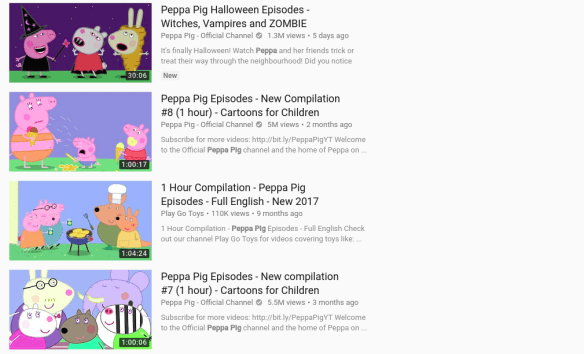
YouTube broadcasters have thus developed a huge number of tactics to draw parents’ and childrens’ attention to their videos, and the advertising revenues that accompany them. The first of these tactics is simply to copy and pirate other content. A simple search for “Peppa Pig” on YouTube in my case yielded “About 10,400,000 results” and the front page is almost entirely from the verified “Peppa Pig Official Channel”, while one is from an unverified channel called Play Go Toys, which you really wouldn’t notice unless you were looking out for it:

Play Go Toys’ channel consists of (I guess?) pirated Peppa Pig and other cartoons, videos of toy unboxings (another kid magnet), and videos of, one supposes, the channel owner’s own children. I am not alleging anything bad about Play Go Toys; I am simply illustrating how the structure of YouTube facilitates the delamination of content and author, and how this impacts on our awareness and trust of its source.

As another blogger notes, one of the traditional roles of branded content is that it is a trusted source. Whether it’s Peppa Pig on children’s TV or a Disney movie, whatever one’s feelings about the industrial model of entertainment production, they are carefully produced and monitored so that kids are essentially safe watching them, and can be trusted as such. This no longer applies when brand and content are disassociated by the platform, and so known and trusted content provides a seamless gateway to unverified and potentially harmful content.

(Yes, this is the exact same process as the delamination of trusted news media on Facebook feeds and in Google results that is currently wreaking such havoc on our cognitive and political systems and I am not going to explicitly explore that relationship further here, but it is obviously deeply significant.)

A second way of increasing hits on videos is through keyword/hashtag association, which is a whole dark art unto itself. When some trend, such as Surprise Egg videos, reaches critical mass, content producers pile onto it, creating thousands and thousands more of these videos in every possible iteration. This is the origin of all the weird names in the list above: branded content and nursery rhyme titles and “surprise egg” all stuffed into the same word salad to capture search results, sidebar placement, and “up next” autoplay rankings.

Play Go Toys’ channel consists of (I guess?) pirated Peppa Pig and other cartoons, videos of toy unboxings (another kid magnet), and videos of, one supposes, the channel owner’s own children. I am not alleging anything bad about Play Go Toys; I am simply illustrating how the structure of YouTube facilitates the delamination of content and author, and how this impacts on our awareness and trust of its source.

As another blogger notes, one of the traditional roles of branded content is that it is a trusted source. Whether it’s Peppa Pig on children’s TV or a Disney movie, whatever one’s feelings about the industrial model of entertainment production, they are carefully produced and monitored so that kids are essentially safe watching them, and can be trusted as such. This no longer applies when brand and content are disassociated by the platform, and so known and trusted content provides a seamless gateway to unverified and potentially harmful content.

(Yes, this is the exact same process as the delamination of trusted news media on Facebook feeds and in Google results that is currently wreaking such havoc on our cognitive and political systems and I am not going to explicitly explore that relationship further here, but it is obviously deeply significant.)

A second way of increasing hits on videos is through keyword/hashtag association, which is a whole dark art unto itself. When some trend, such as Surprise Egg videos, reaches critical mass, content producers pile onto it, creating thousands and thousands more of these videos in every possible iteration. This is the origin of all the weird names in the list above: branded content and nursery rhyme titles and “surprise egg” all stuffed into the same word salad to capture search results, sidebar placement, and “up next” autoplay rankings.

A striking example of the weirdness is the Finger Family videos (harmless example embedded above). I have no idea where they came from or the origin of the children’s rhyme at the core of the trope, but there are at least 17 million versions of this currently on YouTube, and again they cover every possible genre, with billions and billions of aggregated views.

Once again, the view numbers of these videos must be taken under serious advisement. A huge number of these videos are essentially created by bots and viewed by bots, and even commented on by bots. That is a whole strange world in and of itself. But it shouldn’t obscure that there are also many actual children, plugged into iphones and tablets, watching these over and over again — in part accounting for the inflated view numbers — learning to type basic search terms into the browser, or simply mashing the sidebar to bring up another video.

What I find somewhat disturbing about the proliferation of even (relatively) normal kids videos is the impossibility of determining the degree of automation which is at work here; how to parse out the gap between human and machine. The example above, from a channel called Bounce Patrol Kids, with almost two million subscribers, show this effect in action. It posts professionally produced videos, with dedicated human actors, at the rate of about one per week. Once again, I am not alleging anything untoward about Bounce Patrol, which clearly follows in the footsteps of pre-digital kid sensations like their fellow Australians The Wiggles.

And yet, there is something weird about a group of people endlessly acting out the implications of a combination of algorithmically generated keywords: “Halloween Finger Family & more Halloween Songs for Children | Kids Halloween Songs Collection”, “Australian Animals Finger Family Song | Finger Family Nursery Rhymes”, “Farm Animals Finger Family and more Animals Songs | Finger Family Collection – Learn Animals Sounds”, “Safari Animals Finger Family Song | Elephant, Lion, Giraffe, Zebra & Hippo! Wild Animals for kids”, “Superheroes Finger Family and more Finger Family Songs! Superhero Finger Family Collection”, “Batman Finger Family Song — Superheroes and Villains! Batman, Joker, Riddler, Catwoman” and on and on and on. This is content production in the age of algorithmic discovery — even if you’re a human, you have to end up impersonating the machine.

Other channels do away with the human actors to create infinite reconfigurable versions of the same videos over and over again. What is occurring here is clearly automated. Stock animations, audio tracks, and lists of keywords being assembled in their thousands to produce an endless stream of videos. The above channel, Videogyan 3D Rhymes — Nursery Rhymes & Baby Songs, posts several videos a week, in increasingly byzantine combinations of keywords. They have almost five million subscribers — more than double Bounce Patrol — although once again it’s impossible to know who or what is actually racking up these millions and millions of views.

I’m trying not to turn this essay into an endless list of examples, but it’s important to grasp how vast this system is, and how indeterminate its actions, process, and audience. It’s also international: there are variations of Finger Family and Learn Colours videos for Tamil epics and Malaysian cartoons which are unlikely to pop up in any Anglophone search results. This very indeterminacy and reach is key to its existence, and its implications. Its dimensionality makes it difficult to grasp, or even to really think about.

We’ve encountered pretty clear examples of the disturbing outcomes of full automation before — some of which have been thankfully leavened with a dark kind of humour, others not so much. Much has been made of the algorithmic interbreeding of stock photo libraries and on-demand production of everything from tshirts to coffee mugs to infant onesies and cell phone covers. The above example, available until recently on Amazon, is one such case, and the story of how it came to occur is fascinating and weird but essentially comprehensible. Nobody set out to create phone cases with drugs and medical equipment on them, it was just a deeply weird mathematical/probabilistic outcome. The fact that it took a while to notice might ring some alarm bells however.

Likewise, the case of the “Keep Calm and Rape A Lot” tshirts (along with the “Keep Calm and Knife Her” and “Keep Calm and Hit Her” ones) is depressing and distressing but comprehensible. Nobody set out to create these shirts: they just paired an unchecked list of verbs and pronouns with an online image generator. It’s quite possible that none of these shirts ever physically existed, were ever purchased or worn, and thus that no harm was done. Once again though, the people creating this content failed to notice, and neither did the distributor. They literally had no idea what they were doing.

What I will argue, on the basis of these cases and of those I’m going to describe further, is that the scale and logic of the system is complicit in these outputs, and requires us to think through their implications.

(Also again: I’m not going to dig into the wider social implications of such processes outside the scope of what I am writing about here, but it’s clear that one can draw a clear line from examples such as these to pressing contemporary issues such as racial and gender bias in big data and machine intelligence-driven systems, which require urgent attention but in the same manner do not have anything resembling easy or even preferable solutions.)

Let’s look at just one video among the piles of kid videos, and try to parse out where it comes from. It’s important to stress that I didn’t set out to find this particular video: it appeared organically and highly ranked in a search for ‘finger family’ in an incognito browser window (i.e. it should not have been influenced by previous searches). This automation takes us to very, very strange places, and at this point the rabbithole is so deep that it’s impossible to know how such a thing came into being.

Once again, a content warning: this video is not inappropriate in any way, but it is decidedly off, and contains elements which might trouble anyone. It’s very mild on the scale of such things, but. I describe it below if you don’t want to watch it and head down that road. This warning will recur.

The above video is entitled Wrong Heads Disney Wrong Ears Wrong Legs Kids Learn Colors Finger Family 2017 Nursery Rhymes. The title alone confirms its automated provenance. I have no idea where the “Wrong Heads” trope originates, but I can imagine, as with the Finger Family Song, that somewhere there is a totally original and harmless version that made enough kids laugh that it started to climb the algorithmic rankings until it made it onto the word salad lists, combining with Learn Colors, Finger Family, and Nursery Rhymes, and all of these tropes — not merely as words but as images, processes, and actions — to be mixed into what we see here.

The video consists of a regular version of the Finger Family song played over an animation of character heads and bodies from Disney’s Aladdin swapping and intersecting. Again, this is weird but frankly no more than the Surprise Egg videos or anything else kids watch. I get how innocent it is. The offness creeps in with the appearance of a non-Aladdin character —Agnes, the little girl from Despicable Me. Agnes is the arbiter of the scene: when the heads don’t match up, she cries, when they do, she cheers.

The video’s creator, BABYFUN TV (screenshot above), has produced many similar videos. As many of the Wrong Heads videos as I could bear to watch all work in exactly the same way. The character Hope from Inside Out weeps through a Smurfs and Trolls head swap. It goes on and on. I get the game, but the constant overlaying and intermixing of different tropes starts to get inside you. BABYFUN TV only has 170 subscribers and very low view rates, but then there are thousands and thousands of channels like this. Numbers in the long tail aren’t significant in the abstract, but in their accumulation.

The question becomes: how did this come to be? The “Bad Baby” trope also present on BABYFUN TV features the same crying. While I find it disturbing, I can understand how it might provide some of the rhythm or cadence or relation to their own experience that actual babies are attracted to in this content, although it has been warped and stretched through algorithmic repetition and recombination in ways that I don’t think anyone actually wants to happen.

Toy Freaks is a hugely popular channel (68th on the platform) which features a father and his two daughters playing out — or in some cases perhaps originating — many of the tropes we’ve identified so far, including “Bad Baby”, above. As well as nursery rhymes and learning colours, Toy Freaks specialises in gross-out situations, as well as activities which many, many viewers feel border on abuse and exploitation, if not cross the line entirely, including videos of the children vomiting and in pain. Toy Freaks is a YouTube verified channel, whatever that means. (I think we know by now it means nothing useful.)

As with Bounce Patrol Kids, however you feel about the content of these videos, it feels impossible to know where the automation starts and ends, who is coming up with the ideas and who is roleplaying them. In turn, the amplification of tropes in popular, human-led channels such as Toy Freaks leads to them being endlessly repeated across the network in increasingly outlandish and distorted recombinations.

There’s a second level of what I’m characterising as human-led videos which are much more disturbing than the mostly distasteful activities of Toy Freaks and their kin. Here is a relatively mild, but still upsetting example:

A step beyond the simply pirated Peppa Pig videos mentioned previously are the knock-offs. These too seem to teem with violence. In the official Peppa Pig videos, Peppa does indeed go to the dentist, and the episode in which she does so seems to be popular — although, confusingly, what appears to be the real episode is only available on an unofficial channel. In the official timeline, Peppa is appropriately reassured by a kindly dentist. In the version above, she is basically tortured, before turning into a series of Iron Man robots and performing the Learn Colours dance. A search for “peppa pig dentist” returns the above video on the front page, and it only gets worse from here.

Disturbing Peppa Pig videos, which tend towards extreme violence and fear, with Peppa eating her father or drinking bleach, are, it turns out very widespread. They make up an entire YouTube subculture. Many are obviously parodies, or even satires of themselves, in the pretty common style of the internet’s outrageous, deliberately offensive kind. All the 4chan tropes are there, the trolls are out, we know this.

In the example above, the agency is less clear: the video starts with a trollish Peppa parody, but later syncs into the kind of automated repetition of tropes we’ve seen already. I don’t know which camp it belongs to. Maybe it’s just trolls. I kind of hope it is. But I don’t think so. Trolls don’t cover the intersection of human actors and more automated examples further down the line. They’re at play here, but they’re not the whole story.

I suppose it’s naive not to see the deliberate versions of this coming, but many are so close to the original, and so unsignposted — like the dentist example — that many, many kids are watching them. I understand that most of them are not trying to mess kids up, not really, even though they are.

I’m trying to understand why, as plainly and simply troubling as it is, this is not a simple matter of “won’t somebody think of the children” hand-wringing. Obviously this content is inappropriate, obviously there are bad actors out there, obviously some of these videos should be removed. Obviously too this raises questions of fair use, appropriation, free speech and so on. But reports which simply understand the problem through this lens fail to fully grasp the mechanisms being deployed, and thus are incapable of thinking its implications in totality, and responding accordingly.

The New York Times, headlining their article on a subset of this issue “On YouTube Kids, Startling Videos Slip Past Filters”, highlights the use of knock-off characters and nursery rhymes in disturbing content, and frames it as a problem of moderation and legislation. YouTube Kids, an official app which claims to be kid-safe but is quite obviously not, is the problem identified, because it wrongly engenders trust in users. An article in the British tabloid The Sun, “Kids left traumatised after sick YouTube clips showing Peppa Pig characters with knives and guns appear on app for children” takes the same line, with an added dose of right-wing technophobia and self-righteousness. But both stories take at face value YouTube’s assertions that these results are incredibly rare and quickly removed: assertions utterly refuted by the proliferation of the stories themselves, and the growing number of social media posts, largely by concerned parents, from which they arise.

But as with Toy Freaks, what is concerning to me about the Peppa videos is how the obvious parodies and even the shadier knock-offs interact with the legions of algorithmic content producers until it is completely impossible to know what is going on. (“The creatures outside looked from pig to man, and from man to pig, and from pig to man again; but already it was impossible to say which was which.”)

Here’s what is basically a version of Toy Freaks produced in Asia (screenshot above). Here’s one from Russia. I don’t really want to use the term “human-led” any more about these videos, although they contain all the same tropes and actual people acting them out. I no longer have any idea what’s going on here and I really don’t want to and I’m starting to think that that is kind of the point. That’s part of why I’m starting to think about the deliberateness of this all. There is a lot of effort going into making these. More than spam revenue can generate — can it? Who’s writing these scripts, editing these videos? Once again, I want to stress: this is still really mild, even funny stuff compared to a lot of what is out there.

Here are a few things which are disturbing me:

The first is the level of horror and violence on display. Some of the times it’s troll-y gross-out stuff; most of the time it seems deeper, and more unconscious than that. The internet has a way of amplifying and enabling many of our latent desires; in fact, it’s what it seems to do best. I spend a lot of time arguing for this tendency, with regards to human sexual freedom, individual identity, and other issues. Here, and overwhelmingly it sometimes feels, that tendency is itself a violent and destructive one.

The second is the levels of exploitation, not of children because they are children but of children because they are powerless. Automated reward systems like YouTube algorithms necessitate exploitation in the same way that capitalism necessitates exploitation, and if you’re someone who bristles at the second half of that equation then maybe this should be what convinces you of its truth. Exploitation is encoded into the systems we are building, making it harder to see, harder to think and explain, harder to counter and defend against. Not in a future of AI overlords and robots in the factories, but right here, now, on your screen, in your living room and in your pocket.

Many of these latest examples confound any attempt to argue that nobody is actually watching these videos, that these are all bots. There are humans in the loop here, even if only on the production side, and I’m pretty worried about them too.

I’ve written enough, too much, but I feel like I actually need to justify all this raving about violence and abuse and automated systems with an example that sums it up. Maybe after everything I’ve said you won’t think it’s so bad. I don’t know what to think any more.

This video, BURIED ALIVE Outdoor Playground Finger Family Song Nursery Rhymes Animation Education Learning Video, contains all of the elements we’ve covered above, and takes them to another level. Familiar characters, nursery tropes, keyword salad, full automation, violence, and the very stuff of kids’ worst dreams. And of course there are vast, vast numbers of these videos. Channel after channel after channel of similar content, churned out at the rate of hundreds of new videos every week. Industrialised nightmare production.

For the final time: There is more violent and more sexual content like this available. I’m not going to link to it. I don’t believe in traumatising other people, but it’s necessary to keep stressing it, and not dismiss the psychological effect on children of things which aren’t overtly disturbing to adults, just incredibly dark and weird.

A friend who works in digital video described to me what it would take to make something like this: a small studio of people (half a dozen, maybe more) making high volumes of low quality content to reap ad revenue by tripping certain requirements of the system (length in particular seems to be a factor). According to my friend, online kids’ content is one of the few alternative ways of making money from 3D animation because the aesthetic standards are lower and independent production can profit through scale. It uses existing and easily available content (such as character models and motion-capture libraries) and it can be repeated and revised endlessly and mostly meaninglessly because the algorithms don’t discriminate — and neither do the kids.

These videos, wherever they are made, however they come to be made, and whatever their conscious intention (i.e. to accumulate ad revenue) are feeding upon a system which was consciously intended to show videos to children for profit. The unconsciously-generated, emergent outcomes of that are all over the place.

To expose children to this content is abuse. We’re not talking about the debatable but undoubtedly real effects of film or videogame violence on teenagers, or the effects of pornography or extreme images on young minds, which were alluded to in my opening description of my own teenage internet use. Those are important debates, but they’re not what is being discussed here. What we’re talking about is very young children, effectively from birth, being deliberately targeted with content which will traumatise and disturb them, via networks which are extremely vulnerable to exactly this form of abuse. It’s not about trolls, but about a kind of violence inherent in the combination of digital systems and capitalist incentives. It’s down to that level of the metal.

This, I think, is my point: The system is complicit in the abuse.

And right now, right here, YouTube and Google are complicit in that system. The architecture they have built to extract the maximum revenue from online video is being hacked by persons unknown to abuse children, perhaps not even deliberately, but at a massive scale. I believe they have an absolute responsibility to deal with this, just as they have a responsibility to deal with the radicalisation of (mostly) young (mostly) men via extremist videos — of any political persuasion. They have so far showed absolutely no inclination to do this, which is in itself despicable. However, a huge part of my troubled response to this issue is that I have no idea how they can respond without shutting down the service itself, and most systems which resemble it. We have built a world which operates at scale, where human oversight is simply impossible, and no manner of inhuman oversight will counter most of the examples I’ve used in this essay. The asides I’ve kept in parentheses throughout, if expanded upon, would allow one with minimal effort to rewrite everything I’ve said, with very little effort, to be not about child abuse, but about white nationalism, about violent religious ideologies, about fake news, about climate denialism, about 9/11 conspiracies.

This is a deeply dark time, in which the structures we have built to sustain ourselves are being used against us — all of us — in systematic and automated ways. It is hard to keep faith with the network when it produces horrors such as these. While it is tempting to dismiss the wilder examples as trolling, of which a significant number certainly are, that fails to account for the sheer volume of content weighted in a particularly grotesque direction. It presents many and complexly entangled dangers, including that, just as with the increasing focus on alleged Russian interference in social media, such events will be used as justification for increased control over the internet, increasing censorship, and so on. This is not what many of us want.

I’m going to stop here, saying only this:

What concerns me is not just the violence being done to children here, although that concerns me deeply. What concerns me is that this is just one aspect of a kind of infrastructural violence being done to all of us, all of the time, and we’re still struggling to find a way to even talk about it, to describe its mechanisms and its actions and its effects. As I said at the beginning of this essay: this is being done by people and by things and by a combination of things and people. Responsibility for its outcomes is impossible to assign but the damage is very, very real indeed.


Blade Runner And The Synthetic Panopticon

Truth Is Always An Open Question

By James Curcio

Source: Modern Mythology

This Is Only A Model

We are living in alternate realities. In one reality people see Trump’s incessant lying, and no one in power seeming to doing anything to stop it. Others see him as battling the deep state. Some see Brexit as a blind idiot kamikaze mission, while others see it as fighting back the evils of globalism. These are not equivalent claims, but they are both claims, narratives that claim to represent the way things are, and that’s what I’d like to examine here.

“All things are subject to interpretation, whichever interpretation prevails is a function of power and not truth.” — Nietzsche

Note that this aphorism doesn’t say “there is no truth,” nor does it question whether we all ultimately inhabit a single reality, only that whichever interpretation of the truth prevails is a function of power. Truth relies on an accurate or corresponding representation of reality. In this sense, we can talk of them singularly. But we only have our narratives and experiences with which to evaluate what that is.

And what is power? That demands at least an article in itself, but a popular 1984 quote lays the heart of what it’s purpose is: more of itself.

We know what no one ever seizes power with the intention of relinquishing it. Power is not a means; it is an end. One does not establish a dictatorship in order to safeguard a revolution; one makes the revolution in order to establish the dictatorship. The object of persecution is persecution. The object of torture is torture. The object of power is power.

This interpretation of social dynamics doesn’t contest the legitimacy of the scientific method, iteratively approaching closer approximations of truth (a model) distilled from reality, through experimentation. In fact, this premise was presented by Stephen Hawking and Leonard Mlodinow in their 2010 book, The Grand Design.

Model-dependent realism is a view of scientific inquiry that focuses on the role of scientific models of phenomena. It claims reality should be interpreted based upon these models, and where several models overlap in describing a particular subject, multiple, equally valid, realities exist. It claims that it is meaningless to talk about the “true reality” of a model as we can never be absolutely certain of anything. The only meaningful thing is the usefulness of the model.

However, social dynamics aren’t exactly like physics, either. Not being able to recognize the difference between the ideal (an appeal for rationality, consistent methodology, and balance), vs. how people actually engage with interpreting it is a serious problem. And got to catch up. Fast.

In other words, the appeal for truth — whether CNN’s recent “this is an apple” advertisement, or Fox New’s old “fair and balanced” — itself enters into the marketplace of ideas. Or perhaps a more apt metaphor is a battlefield, especially when we consider the amount of capital, technology and labor that states, corporations, and billionaires can throw at furthering their personal agendas.

Cognitive biases, innate responses like tribalism, the myopia of fear, etc. are all being leveraged via media, all around us, all the time. This includes all forms of media, since it’s all digital narrative building of a collective sort. Myth making, even. That’s the real point, and it seems to be drowned out across the spectrum. We’re all too familiar now with the ideas of dis/information wars, but all of them are fundamentally a contest over who gets to define the narrative. If we recognize that this is fundamentally about power, do we also recognize that it operates on dynamics that have absolutely nothing to do with our dearly held moral values?

An assumption some may draw from this is that vested interests have distorted reality; therefore there is no reality. However, that obviously isn’t quite right, either. What obscures clear thinking on this is that reality essentially has two meanings: the “state of things as they are”, which makes no assurances of what that state is, and the question of if things exist at all. The first poses an epistemological framework, the latter, an ontological one.

The former we might consider the social-linguistic definition. That shouldn’t be conflated with the absolute existence of a thing. No, it can only speak to the identity and meaning that we apply to what we’re given.


The Hierarchy of Reality

This may seem like a tangent, but consider the Turing test:

The Turing test, developed by Alan Turing in 1950, is a test of a machine’s ability to exhibit intelligent behavior equivalent to, or indistinguishable from, that of a human. Turing proposed that a human evaluator would judge natural language conversations between a human and a machine designed to generate human-like responses. … If the evaluator cannot reliably tell the machine from the human, the machine is said to have passed the test.

In other words, the appearance of sentience is all we ever get. An AI that behaves as if conscious is, from the outside, precisely the same as a conscious agent. If we appear to be having a conversation, then so we are. But does that prove we’re real in some definitive sense? No. Again, we are being presented with the social-linguistic layer of reality, that speaks to perceptions.

The relevance here to society is to be found within Blade Runner, which of course takes a great deal of inspiration in its core mythos from the problems posed by the Turing test. The world presented there is a hierarchy of power based on perceived degree of reality.

There is, within this, the implications of Benthamite Utilitarianism, and Foucault’s later elaboration on those ideas: that we may consider the world based on externalities that are socially determined rather than based on our internal experience. This seems in some sense precisely the opposite of “lived experience,” which seeks to situate our internal experience as the center of our concerns.

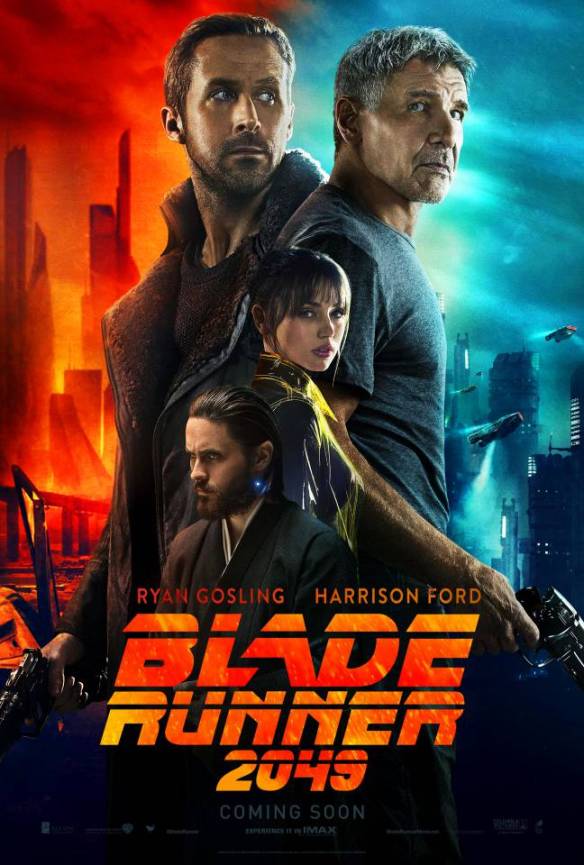
This directly enters into Blade Runner 2049, for instance, Joi, who seems the lowest on the hierarchy of reality, is seen as a pure surface, and all but K seem to question whether she has any lived experience at all. Mariette observes to K, “Oh I see, you don’t like real girls,” and later to Joi, “I‘ve been inside you. Not so much there as you think.”

Of course, this question is always open, one must always be judged “sufficiently real.”

Another example of this dilemma can be found in a current medical crisis. As many Americans know, we have something of an opiate epidemic in the United States. Although there is no end of debate over why this is the case, for doctors concerned about liability and patients concerned about being in pain for the rest of their lives, much of the politics boils away.

The problem comes down to the nature of pain itself. We may exhibit external signs of pain, but some patients will present with those more or less, for various cultural, personal, and even biological reasons. So the appearance of pain or lack of it is little use, when trying to determine whether a patient is “drug seeking.” Even if we test the biological response of different patients who are experiencing pain, we find that it is very difficult to tell. This is especially true with those who experience chronic pain. For instance, blood pressure often rises when you’re in pain, but higher blood pressure isn’t proof, and one must also ask what the baseline is. All of this calls to mind the lie-detector style tests used in the first Blade Runner movie to assess the reality of the subject, from the outside in.

Patient reporting was seen as the golden standard for pain level diagnosis during the years that doctors were ostensibly over-prescribing. But this too is no better than asking a Replicant whether they’re “real” or not. What we’re left with is a dependence on trust of people’s own stories about their lived experience, but of course, people can also lie. It comes down to a matter of faith and trust, and those are commonly in short supply.

This outside-in valuation is also the basis for what has recently come to be called — with some contention — neoliberal capitalism.

… it [Utilitarianism] presupposes a very concrete theory of nature as well as human nature: an understanding of human beings not as unique, irreplaceable beings — as neighbors, friends, or members of a community oriented toward justice and fairness — but rather as nameless, faceless, calculating, hedonistic, atomistic units. Alongside of this it understands nature and the natural world of plants, animals, trees, oceans and mountains not as intrinsic goods in themselves, but merely as ‘things’ that have only human use-value.

This gives us a clue to understanding why utilitarianism is so attractive to a modern bureaucratized, consumerist culture that is prepared to uphold profit maximization over human health, environmental safety, clean water and nutritious food. In other words, utilitarianism is widely embraced precisely because it replaces the living, breathing, emotional and experiencing human being with the human as pleasure or profit maximizing machine; it prizes the quick technical fix over the difficult task of understanding the human condition; it valorizes thoughtless calculation over thoughtful ethical discernment and practical wisdom. — CounterPunch

So Blade Runner presents an acceleration of the myths many of us already apply to the world around us, one which is deeply suspicious of our ability to find singular truth, or maybe more aptly, to avoid inflicting our power fantasies, needs and fears upon one another, forever.


The Authority of Authorship

When we engage with narratives online, in the press, in the media, we need to remain constantly aware that it is presenting a view of the world, and it is a view which in many ways is likely to be self-serving. There is, at the same time, an invisible architecture at work underneath the ways the world is re-presented to us, and this composes one of the fundamental anxieties that Baudrillard presented in Simulacra and Simulation. We cannot always discern even our own motives, or the reasons why we feel that one thing is more true than another when truly sufficient evidence has not been provided. Because interpretations of truth are malleable. And there has never been a mass-surveillance, mass-behavioral and linguistic analysis machine like the Internet.

It is easy for us to apply this sort of cynicism towards our presumptive ideological enemies, but will always remain more difficult to apply that same consideration to narratives that immediately go, “ah, this seems true!” Again, truth is always a claim, which must be proven — and never finally.

All authority that seeks to stop this process and say “put no others before me” are plays at power. Even within our own minds and hearts this is true.

We mustn’t forget that.

Revolutionary Terror: Mark Steven’s ‘Splatter Capital’

By Michael Grasso

Source: We Are the Mutants

Splatter Capital: The Political Economy of Gore Films
By Mark Steven
Repeater Books, 2017

“Splatter confirms and redoubles our very worst fears. It reminds us of what capital is doing to all of us, all of the time—of how predators are consuming our life-substances; of how we are gravely vulnerable against the machinery of production and the matrices of exchange; and of how, as participants of an internecine conflict, our lives are always already precarious.”

—from the Introduction to Splatter Capital

Political readings or interpretations of horror films are nothing new. But in Mark Steven’s 2017 study, Splatter Capital, an explicit connection is made between the bloody gore of what Steven terms “splatter” horror films and the dehumanizing, mutilative forces of global capitalism. Moreover, Steven posits the artistic motivation behind splatter horror as an explicit repudiation of this system: “It is politically committed and its commitment tends toward the anti-capitalist left.” In splatter films, Steven tells us, the images of gory dismemberment do double duty. They both offer a clear metaphor for capitalism’s cruelty, and act as a cathartic revenge in which the bloody legacy of capitalist exploitation is often visited upon its perpetrators and profiteers among the bourgeoisie.

Some definitions are in order here, given that Steven’s schema of genres—“splatter,” “slasher,” “extreme horror”—draws distinctions that might not be apparent even to horror fans. Splatter horror, according to Steven, is all about the violence that can be visited upon the human body and all the abjection that follows. It is machinery tearing apart flesh, blood, and guts: the moment a human body becomes meat. It differs from the personalized and often sexualized “hunt” of the slasher flick. The protagonist in a slasher movie is an individual (often female) resisting violent death at the hands of another individual (often male). In victory against Jason, Freddy, or Michael Myers, this protagonist, in Steven’s words, “restores a social order, which is all too regularly white, middle-class, and suburban.” Splatter horror not only expands the horizons of mutilation and violence allowable in a horror film but systematizes it. The splatter enemy is an implacable, impersonal force, full of shock and awe; its grudge is not personal, but instead overwhelming, inescapable, and, most importantly, class-based.

The language of violence and horror has been with Marxist thought from the beginning. Steven gives us a good précis of Marx’s use of explicitly Gothic (along with bloody and cannibalistic) imagery throughout his works, as well as a splatter-tastic explanation of the exploitation behind surplus value, using an imaginary case study in the manufacturing of chainsaws and knives. The October Revolution in Russia is viewed as a reaction to the inhuman mechanized slaughter of the first World War; Eisenstein’s early filmic paeans to the necessity of revolution such as Strike (1925) demonstrate, thanks to Eisenstein’s pioneering use of montage, capitalism’s role as butcher. Steven also discusses avowed leftist filmmakers from outside the Soviet Union such as Godard, Makavejev, and Pasolini—specifically their use of gore to embody the cruelty of the ruling classes.

As we enter the world of Hollywood film in Chapter Three, Steven examines splatter film as a specifically American reaction to the constant churning crisis of capitalism. Specifically, Steven looks at the two peaks of gore-flecked horror—the mid ’60s through the early ’80s, and the post-Cold War “torture porn” trend of the early ’00s—as expressions of two very important economic and political shifts. The first splatter peak in the ’70s is seen as a clear reaction to the slow, inexorable widening of neoliberal and globalist postindustrial economics and its impact on the American industrial worker. (The aftermath of this trend continues into the 1980s with the evaporation of industry and the establishment of a new information-and-finance-based economy.) The splatter/torture porn trend of the ’00s and beyond is a reaction to the crises of capitalism under a new world order of neocolonialist conflict: the War on Terror, the final disestablishment of the Western industrial base in favor of cheap labor in the developing world, and the new interconnected, networked world’s rulership by speculative capital in the form of the finance sector.

Steven cites too many splatter movies to cover in this review, but central to his thesis is the seminal 1974 Tobe Hooper film, The Texas Chain Saw Massacre. The death of local industry leads Leatherface and family to keep their slaughterhouse traditions alive by carving up and eating young people. These young people, Steven is quick to point out, are only here at all because they were unable to get gas for their car (thanks to the first of two 1970s oil crises). American decline is everywhere; betrayal by global economic forces are central to the trap that’s being laid by the cannibals. (Of course, the carnage of the Vietnam War can’t be overlooked here either, given the visual language of ambush, capture, and torture; Hooper himself has cited this in subsequent interviews.) Steven notes that the victims in The Texas Chain Saw Massacre are representative of a bourgeoisie who don’t know how the sausage is made. It’s important and vital, Steven says, that the cannibalistic side of splatter involves the bourgeoisie being forced to eat members of their own class. It’s Burroughs’s famous “naked lunch“: “the frozen moment when everyone sees what is at the end of every fork.”

As the neoliberal takeover of the world economy begins in earnest in the 1980s, as complex and largely ephemeral systems of mass media and finance take the place of the visceral, grinding monomania of industrial capitalism, splatter horror follows suit. Steven’s analysis of David Cronenberg’s Videodrome (1983) is especially sharp, examining the links between the body horror of the film and the Deleuzian body without organs. Max Renn’s body becomes an endlessly modular media node, able to accommodate video cassettes, to generate and fuse with phallic weapons (used to assassinate and destroy the media forces who’ve made him this way), to mesh and mold and mix with the hard plastic edges of media technology. By the end of the film, Renn is a weapon reprogrammed and re-trained on the very media-industrial complex that made him. More body horror: the cult classic Society (1989) and its shocking conclusion posits the ruling class as a cancerous monster, an amorphous leviathan straight out of a Gilded Age political cartoon, eating and fucking and vomiting, red in tooth and claw and pseudopod. Barriers between bodies break down; the system begins swallowing up all alternate possibilities.

By the time the Cold War is finished, the era of post-9/11 eternal war, of Abu Ghraib and Guantanamo, led to the popular new splatter sub-genre of “torture porn.” Steven identifies the genre’s distinguishing aesthetic feature: the indisputable, systematic, and worldwide victory of capitalism and the hypnotic Spectacle that accompanies it. In this era, there are no longer any alternatives. Everyone, rich and poor, is trapped in the system, and the system reintegrates torture into a worldwide video spectacle. This is embodied in both the global conspiracies of the wealthy in Roth’s Hostel series and in the Jigsaw Killer’s industrially-themed Rube Goldberg devices in the Saw franchise—devices of dismemberment explicitly linked to moral quandaries reminiscent of capitalism’s impossible everyday Hobson’s choices for the working class. The system will go on consuming you, whether you’re unlucky enough to be a splatter film’s victim, or “lucky” enough to wield the power to splatter (for example, Hostel: Part II‘s reversal of fate on the ultra-wealthy hunters, or the Jigsaw Killer’s death from cancer in Saw III—ultimately due to… a lack of health insurance).

Possibly the most intriguing aspect of this already very good book is Steven’s interspersing of personal anecdotes on when and where he discovered some of his favorite horror and genre films. By placing his personal and psychological experience of splatter films front and center, and linking it to his personal growth and increasing political maturity, he demonstrates the personal impact of the political, and the necessity of personal epiphany, mediated by culture, to achieve political awareness. Splatter Capital ultimately is not a book for the already-convinced and committed leftist, the Marxian thinker already well-versed in theory. (Another of Splatter Capital‘s very strong points is how Steven largely eschews jargon and obscurantism for an approachable tone and topic that laypeople can dive into easily.) It is for the fans of these films who’ve always wondered about the ineluctable appeal of visceral, shocking violence on screen, and perhaps why it all feels so strangely familiar.

Are We Living Haunted Lives?

By Kingsley L. Dennis

Source: Waking Times

‘Fear has many eyes
And can see things underground’
~Cervantes, Don Quixote

The world as we know it has gone from being flat to round; from being the center of the universe to the center of the solar system; from being animistic and supernatural to raw in tooth and claw; from being particle-atomic to wavy-quantum. And now we are disappearing into the digital domains of virtual-augmented spaces and false information, bombarded with the spectacle and the image. And somewhere in the midst of all this is the human soul, still largely wrapped and unopened. If there’s a crime here then it is that we’ve allowed ourselves to become haunted – to live haunted lives that lack significance and meaning.

The ‘objects’ or values that we have attempted to live by, or that we pursue, – such as power, truth, understanding, dreams, work, love, and the rest – have all seemingly vanished into some warped, elusive reality where the presence of these things no longer tangibly exist. However, the doubt, uncertainty, and pain of their absence – or ‘fake presence’ – are indeed real enough to affect us deeply. We seek the already disappeared and stalk their substitutes.

We are now close to the stage where we end up just acting out our fantasies upon the phantasmal theatre of our lives and thinking it is reality. This theatre, or screen, of fantasies and the fantastical is like the cave wall in Plato’s allegory where the flickering shadows that move across are taken to be the real. In an updating of Plato’s famous allegory we no longer have shadows projected upon the cave wall; they are now projected upon the green screens that form the back-drop for computer-generated imagery (CGI) that adorn our movies, television programs, and video games.

Whole societies, notably in the technologically-advanced western world, are arranging for our lives to be enacted amidst a scenery backdrop of events and issues artificially projected for us as CGI onto a fake canvas. Within this encroaching visual world, full of misinformation that influences our worldview, we are made to believe in a different kind of reality. It is a reality that is uncertain and insecure, and that requires for us to hold deep obedience to our state institutions to protect us. And within this projection of reality, meanings are provided for us as ready-made meals. In other words, full of too much salt, saturated fats, and laziness.

These socially manufactured meanings are provided as a substitute for the genuine lack. Of these choices offered we often take our pick, as consumers in a marketplace. It may be career, wealth, fame, achievement, or a combination of these and more. Yet the manufactured consent in our sense of meaning, no matter how thoroughly pursued and potentially obtained, is still not genuine. And like the ready-made meal, it soon leaves us with a continued hunger. The illusion of meaning is a vital illusion, yet it still remains an illusion. We may say then that the world we have come to know is a great spectacle of illusion and play; of movement, distraction, simulation, and excess. Yet rather than critically confronting the illusions and distractions we are cleverly persuaded to indulge in them.

The world we share now is also shared with our collective doubts, fears, anger, and frustrations. And these new emotions upon the global stage are blurring our picture of the world and its future. Whilst there are many of us who are excited and genuinely inspired by this increased complexity and diversity there has been a cultural backlash, in the western nations especially, to cover this up with a sheen of simplicity through generic news, bland reporting, and excruciatingly trivial entertainment. This clash of the complex with the simple is creating an odd reality where things just don’t feel right anymore.

We are participants on a ride through the flippant and the flimsy, the significant and the necessary, as we are expected to find our foothold – our human soul – in a world seemingly on the verge of insanity. In such a world, Disneyland may seem to some as the greatest of sanctuaries; whilst to rest of us it stands as a superficial sign of our times.

Most of us do not have the capacity to verify the truth claims of the mainstream media and yet we are more than willing it accept the veracity of their claims. We suspend our own disbelief by trusting in others, especially when it comes to authority and experts. In other words, we have been conditioned to respect the positions of authority and ‘the expert,’ often without critical thought.

And this is the context which frames the telling of his-story and also our-stories. The singer-songwriter Lou Reed once sang, ‘Don’t believe anything you hear and only half of what you see.’ Documentary film-maker Adam Curtis discusses this phenomenon of how the mainstream media projects a simplified, fake reality in his film HyperNormalization (2016). The term hypernormaliztion was taken from an account of life in the Soviet Union during the twenty years before it collapsed. In this account everyone knew the system was failing but they couldn’t envision any alternative and so everyone is resigned to maintaining the pretence of a functioning society. Over time this delusion is accepted as real, an effect termed as hypernormalization. In other words, when the fake is finally accepted as the real then we are living in a hypernormalized state. Does this sound familiar?

The question is – does Reality ever take place?

Our bodies of authority, our mainstream media channels, and our centers of learning – that is, a majority of our significant institutions – have turned, or are in the process of turning, into advertising gimmicks. They peddle publicity and propaganda as endless programs stuck on a loop. They serve to produce the appearance of reality; yet they fail to represent a sense of reality. And this fundamental difference has produced a feeling of living haunted lives. We wander as ghosts in liminal zones, hungry for meaning.

In this sense of loss we no longer seem to know, or distinguish, between oppositions. Almost all of our value systems are based on relative terms – good, bad, my history, your history, etc. Often, the values we take to be ‘our values’ were inculcated in us depending upon which culture we happened to be born into. It is true there are some values more universally shared – such as thou shalt not kill – but the majority of them are culturally relative. Take for instance, sex before marriage – good or bad? Same-sex partnerships? Freedom of religious speech? Eating pork? Eating rats? Democrats or Republicans? Labour or Conservative? Which is good and which is bad? In the case of political parties it is neither – they are false oppositions. More than that, they are also distractions. When you’re arguing (sorry, debating) over political parties you are not observing the system behind them that created this false lack of choice in the first place. False oppositions plague our haunted hinterland. We don’t see this if we are the aimless ghosts, or the walking dead. It’s not pleasant – it’s eerie. And we are in eerie times.

Modernity in its current form is haunted by a sense of loss; of not knowing where it is heading. There are a great many aspects of our age that are in disruption and dislocation. All forms of stability are in question; old and incumbent patterns and models are in dispute; and too many people are experiencing moods of despair and anguish. It is as if our human civilization has come loose from its moorings and is now adrift upon the waters of uncertainty, insignificance, and the loss of meaning.

And so it seems that our civilization is careering dangerously close to some kind of blind spot where we no longer can tell what is true or false anymore. Truth is replaced by a fake substitute and the false becomes a parody of the truth. They are the haunted spaces where the mist drifts by. It’s like a Zen joke. It’s the same as a voice whispering in the darkness saying there is no such thing as a voice whispering in the darkness. They couldn’t have written a better riddle if they had tried.

So what went wrong? Where did it all go? What is it, in fact?

A profound sense of unease has crept into many of us, and also into our social systems, our cultures, our art, our news, and into the very collective soul of humanity. It is an eeriness; an uncertain disquiet – almost an unsettling foreboding. Something has come loose, and we’re not sure what it is. Further still, most of us are fairly certain that those institutions supposedly ‘looking after our best interests’, or running the show – whether they be governmental bodies, financial elites, or shadowy organizations and cabals – are not really in control or are sure either. It feels as if something is amiss, and we just can’t quite put our finger on it. Welcome to our haunted modernity.

We have disarray over a consensus concerning climate chaos, stock market panics and economic crashes, offshore tax evasions and leaked documents, political scandals, pandemic threats and contested vaccines, state and terrorist violence, congenital anxiety and existential fear – a whole cauldron of terror, dread, disquiet, nervousness, angst, and what-the-hell-is-going-on collective confusion is bubbling both under and over in many of our societies.

We have been infiltrated with a virus and it is infecting not only our bodies but our very minds. It’s a pure mind-bending virus and it’s playing havoc with our insecurities and indulging in our sense of lostness. The Spanish have a phrase for this state – “de perdidos al río” – and it roughly translates as from lost to the river. It may not make complete literal sense in English but that’s just it; you can get the sense of it and its vagueness is exactly where we are – from lost to the river!

In such ‘haunted lives’ we can easily become accustomed to metaphysical anguish as just another pain. It is like a pulled muscle or a sprained ankle; something unpleasant and yet we continue to move around with it. In the end we learn how to direct and project this metaphysical anguish onto other things – we choose intoxicating entertainment, sports, and other cultural pastimes and diversions. Angst just becomes a factor that appears to come as a default setting with our species. There is the danger that we become accepting of the ghostly flimsiness to life, which ends up being hypernormalized so that the sense of absence of something real becomes the new reality. There is the dangerous potential here for a state of indifference to emerge and seep into our cultures, which then becomes an ennui-creep into the world until…oh, well, what does it matter anyway?

During these years of disarray and turbulence it is essential that we create meaning for ourselves, otherwise the ‘distant algorithmic’ universe that runs the life around us will create a deep sense of alienation. In a world of scrambled code and big data, transcendence will seem another chimera not within grasp or even real. Or, at worse, the very notion of transcendence will seem the delirium of unstable minds – for those people not able to ‘get real’ with the world of Now.

In this instance, transcendence will appear as a form of spiritual autism. And yet the notion of going beyond ourselves, of developing our capacities for higher perception, are the saving grace inherent within our human species. We are incomplete, and this haunts us, and yet it should also give us meaning and a higher aim in life in knowing that there is further to go. In knowing that there are tools within us for creating, shaping, and cultivating these finer faculties. In being haunted we are also being reminded of what is lacking and this urge should compel us to find a solution within ourselves. We are in fact being ‘haunted into remembrance.’

However, for many of us a haunted modernity offers us a conditioned life where there is little or no space for transcendence. In such social and cultural hauntings there are no navigable locations. We have stepped into an unsouling from the wilderness. We are compelled to walk on.

Initial Thoughts on Blade Runner 2049

Upon hearing early reports of a planned Blade Runner sequel a couple years ago, I felt both anticipation and dread. I considered it a singular vision which didn’t necessarily need a sequel, yet could understand the desire to re-immerse oneself in the compelling world it introduced. Re-experiencing the film through its Director’s Cut and Final Cut versions in subsequent years seemed to me as satisfying as watching sequels since even the relatively minor changes had a significant impact on its meaning and the richness of the sound and production design allows for the discovery of new details with every viewing. Also, one’s subjective experience watching even the same movie can be vastly different depending on one’s age and other circumstances.

One of my earliest cinematic memories was seeing the first Star Wars film as a toddler. At around the same time I remember staying up late with my parents to watch the network television premiere of 2001: A Space Odyssey. Though I was too young to fully comprehend those films’ narratives, the spectacle and sounds definitely left an impression and established a lifelong appreciation for the sci-fi genre and it’s mind-expanding possibilities.

Flash forward to an evening sometime in early 1982. After viewing a commercial for Blade Runner I instantly knew it was a movie I had to see. In the short trailer there were glimpses of flying cars over vast cityscapes, the guy that played Han Solo in a trench coat, bizarre humanoid robots within settings as strange yet detailed as 2001: a Space Odyssey. My parents, responsible as they were, refused to give in to incessant demands to see Blade Runner and that Summer I must have been the only kid who reluctantly agreed to see “E.T.” as a compromise. I probably did enjoy it more than I expected to, but might have enjoyed it more had I not viewed it as a weak Blade Runner substitute and if I actually paid attention to the entire film.

Back then our family usually saw films at drive-in theaters and the one we went to that night had two screens, one showing E.T. and the other, to my delight and frustration, happened to be Blade Runner. Even without sound and at a distorted angle I was awestruck by the establishing shots of LA in 2019 (which I glanced over to witness just as E.T.’s ship was landing on the screen in front of us, and for the entire duration of the films my eyes would switch back and forth between screens. Even without understanding anything about the plot of Blade Runner it made the most fantastical elements of E.T. pale in comparison. Judging from the box-office receipts of its theatrical run, the majority must have thought otherwise since Blade Runner earned a relatively meager $28 million while E.T. was the breakout hit of the year with nearly $360 million.

Within a few years I’d see portions of Blade Runner on cable TV at a friend’s house and finally saw the complete film after my family got a VCR and it was one of the first videos I rented. The film served as a gateway to many other interests such as cyberpunk, film noir, electronic music, but most importantly, an appreciation of the novels of Philip K. Dick. Like a psychedelic drug, they inspired philosophical questioning regarding the nature of reality, consciousness, society and what it means to be human.

This background, which is probably not too dissimilar to other stories of obsessive fandom, outlines how one’s immersion in media is rooted not just in the work itself but how it resonates with and shapes aspects of one’s identity and personal narrative as much as other memories. There’s also a nostalgia factor involved because, similar to a souvenir or any object with sentimental value, revisiting such media can recapture a sense of the feelings and sensations associated with the initial experience and sometimes the milieu of the content as well. Nostalgia is a longing for the past, even a past one has never directly experienced, never was and/or never will be, often prompted by loneliness and disconnectedness. Because it can sometimes provide comfort and hope it’s a feeling too often exploited by the marketing industry as well as media producers such as those behind reboots and sequels. Though Blade Runner 2049 may not have been solely created to cash in on nostalgia for the original, as with most big studio sequels it’s still a factor.

The type of nostalgia evoked by Blade Runner is singular, for it envisions a (near and soon to be past) future through the lens of the early eighties combining a pastiche of styles of previous eras. The film also serves as a meditation on the importance of memory and its relation to identity and the human experience. In a sense, being a longtime fan of the film is like having nostalgia for distilled nostalgia. Also unique is the fact that it took 35 years for the sequel to get made, just a couple years shy of the year in which the original takes place. The long delay is largely due to Blade Runner being so far ahead of its time it took over a decade for it to be widely regarded as a science fiction masterwork. Also, it took an additional decade and a half to develop plans for a sequel. But perhaps now is the ideal time for a follow-up as aspects of our world become more dystopian and there’s a greater need for nostalgic escape, even through narratives predicting dystopia.

While the future world of the original Blade Runner was definitely grim, it was also oddly alluring due to it’s depiction of a chaotic globalized culture, exotic yet functional-looking technology and hybrid retro/futuristic aesthetic shaped by sources as diverse as punk rock fashion, Heavy Metal magazine, film noir and Futurism among many others. The imagery of Blade Runner 2049 expands on the original by visualizing how the future (or alternate reality) LA has evolved over the course of 30 years as well as the environmentally and socially devastating impact of trying to sustain a technocratic corporate global system for so long.

Blade Runner opens with shots of oil refineries in the city intercut with close-ups of a replicant’s eye. 2049 opens with a close-up of an eye and transitions to an overhead shot of an endless array of solar panels, indicating a post peak-oil world. Despite the use of cleaner energy, the world of 2049 is far from clean with the entirety of San Diego depicted as a massive dumping ground for Los Angeles. Scavengers survive off the scraps which are recycled into products assembled by masses of orphaned child laborers in dilapidated sweatshop factories.

The Los Angeles of Blade Runner 2049 looks (and is) even colder and more foreboding than before. Gone are the Art Deco-inspired architecture and furnishings, replaced by Brutalist architecture and fluorescent-lit utilitarian interiors (with a few exceptions such as Deckard’s residence, Stelline Corporation headquarters and the Wallace Corporation building). Aerial shots reveal a vast elevated sprawl of uniform city blocks largely consisting of dark flat rooftops with glimmers of light emanating from below, visible only in the deep but narrow chasms between.

One of the more prominant structures is the LAPD headquarters which looks like an armored watchtower, signalling its role as a hub of the future surveillance state panopticon. Though an imposing feature of the city’s skyline, it’s dwarfed by larger structures housing even more powerful institutions. Just as a massive ziggurat owned by the Tyrell Corporation dominated the cityscape of the first film, by 2049 the Wallace Corporation has bought out the Tyrell Corporation and not only claims the ziggurat but has constructed an absurdly large pyramid behind it. Protecting the entire coastline of the city is a giant sea wall, presumably to prevent mass flooding from rising sea levels.

In a referential nod to the original film, city scenes of 2049 display some of the same ads such as Atari, Coca-Cola and Pan Am, but even more distracting are product placements for Sony, one of the companies which produced the new film. Such details might work as “Easter eggs” for fans (and shareholders), but takes away from the verisimilitude of the world depicted in the film where the Wallace Corporation has such seeming dominance over the economy and society in general, it probably wouldn’t leave much room for competition large enough to afford mass advertising.

While the background characters in the city of the first film seemed rude or largely indifferent to one another, 30 years later citizens are more outwardly hostile. This could reflect increasing social tensions from economic stratification as well as hostility towards replicants because the protagonist of this film is openly identified as one. Speaking of which, Ryan Gosling turns in an excellent performance as the new Blade Runner, Officer K (aka Joe, an obvious reference to Joseph K from Kafka’s “The Trial”).

Ironically, the replicants and other forms of AI in 2049 seem a little more self-aware and human-like while the humans and social institutions have become correspondingly android-like. From the perspective of the future CEOs (and some today), both replicants and non-wealthy humans (known as “little people” in cityspeak) exist to be exploited for labor and money and then “retired” when no longer needed. Reflecting this brutal reality are the largely grey and drab color scheme of the landscapes, interiors, and fashions. Adding to the mood is the soundtrack which, while at times evoking the calmer and more subtle Vangelis music of the original, is more often louder and harsher, sometimes blending with the noisy diegetic (background) soundscape.

2049‘s screenplay is almost a meta-sequel, introducing plot elements seemingly designed to address problems and inconsistencies in the original which have been pointed out by fans and critics through the years. Numerous references to Blade Runner, while nostalgic and crowd-pleasing, are almost distracting enough to break the spell of the film (at least for those who’ve re-watched the original enough times to memorize every detail). Fortunately, just as frequently new revelations, concepts and hints at potential new directions pulls one back in. I especially appreciated the further exploration of the origins and impact of false memories and its parallels to the creation and consumption of media and the way the film expanded the scope of the story beyond the city. Also surprising were references to films partly inspired by the works of Philip K. Dick such as Ghost in the Shell, The Matrix, and Her as well as stylistic influences from more contemporary aesthetic subcultures such as glitch and vaporwave.

Like with most sequels, the main draw for fans is the chance to see familiar faces from the original and 2049 doesn’t disappoint too much. Judging from the posters, trailers, interviews, etc. it was clear Harrison Ford would make a return, but unfortunately it wasn’t until after the majority of the duration of the film had passed. Nevertheless, the reappearance of Ford’s character Deckard was memorable, found by Agent K as a disheveled hermit in an abandoned casino surrounded by copious amounts of alcohol and ancient pop culture detritus. Deckard is apparently as much of a drinker as in the first film, but now not just to block out the pain of the past and present but to escape to an idealized past. Though his involvement in the plot seemed too brief it nevertheless plays a pivotal role in resolving the central mystery of the film and providing additional metacommentary.

Ford’s performance is arguably more compelling than his work in the original, though his character’s lack of charisma in the first film could be seen as intentional. Deckard’s character arc in the film, as well as that of Ford’s last two iconic roles from the 80s he reprised, cements his status as our culture’s archetype for the deadbeat father. This seems inevitable in hindsight because for a generation of latchkey kids (many with actual deadbeat dads), stars such as Harrison Ford were virtually surrogate father figures. Thus, it makes sense that the beloved characters Ford drifted away from for so long would be written as variations of a long absent deadbeat parent in their last installments.

An interesting detail about the way Deckard was characterized in the film was how he seemed more in line with a typical baby-boomer today than the gen x-er one would be at that age 32 years from now.  For example, people in their seventies today are probably more likely to be nostalgic for Elvis and Sinatra than a seventy-something person in 2049 who in our actual timeline would have more likely spent formative years listening to grunge or hiphop. A possible subtextual meaning might be that like false memories, nostalgia for media of enduring cultural value transcends lived experience. The referencing of “real” pop-culture figures within the world of the film seemed anachronistic at first, but the way it was done was interesting and worked with the themes and aesthetic (I suppose it’s preferable to having something like Beastie Boys’ “Sabotage” shoe-horned into the film like in the Star Trek reboots). Getting back to the point, in the original Blade Runner, nostalgia permeated the film through its themes, production design, costumes and soundtrack. In Blade Runner 2049, nostalgia is a subtext of repeated callbacks to the original film, Agent K’s idealized retro relationship with his AI girlfriend Joi and Deckard’s hideout within the ruins of a city once associated with fun and glamour. The simulacrum of iconic figures from the past like Elvis and Marilyn Monroe (and Ford) haunting the deserted casino like ghosts reinforces the idea of media and culture’s ability to “implant” memories and resultant nostalgia.

As for the finale, I was disappointed that it was so far from the unconventional conclusion of the showdown between Roy Batty and Deckard. One could argue it’s a reflection of the state of the world (in and of film and reality), but it’d be nice to have a little more creativity and risk-taking. Though viscerally exciting and suspenseful, it wasn’t distinguishable enough from countless modern action films to be truly memorable. More satisfying was the epilogue which paralleled the contemplative nature of the original while reconnecting to the film’s recurring themes.

In a sense, the writers and director of Blade Runner 2049 were in a catch-22 situation. Creating a film too unlike or similar to the original Blade Runner would provoke criticism from fans. What director Denis Villeneuve and co-writers Hampton Fancher and Michael Green have managed to pull off is a balancing act of a film that’s unique in many ways yet interwoven with the original; nostalgic, but not in an obvious or overly sentimental way. Both have their flaws, but while I admire the thought and craft put into the sequel, I prefer the originality, tone, texture and atmosphere of Blade RunnerBlade Runner 2049 will likely satisfy most sci-fi fans, but I’m not sure it proves a sequel was necessary or that it stands alone as a classic.

Though not given the recognition it deserved in its time, Blade Runner was a groundbreaking and visionary film upping the bar for intellectual depth, moral complexity, production design and special effects to a degree not seen since 2001: a Space Odyssey. Its influence can be spotted in countless dystopian science fiction films made since. Though it’s too early to tell how influential Blade Runner 2049 will be, it doesn’t seem to have pushed the genre forward to a similar extent (of course contemporaneous opinions can seem wildly off the mark in hindsight). Regardless, it’s an above-average science fiction film by any reasonable standard so it’s unfortunate that judging from disappointing initial box-office reports, it seems to be following in the footsteps of the first Blade Runner pretty closely in that regard. Time will tell whether it achieves a similar cult status in years to come. Perhaps in 35 years?


Manufacturing Panic: Social Engineering, Domination and Control

By S.C. Hickman

Source: Techno Occulture

In the 21st century, the social engineering of dread and longing have evolved into a bio-political arena of terror and a psycho-political culture of internalized domination. The globally deployed technology of the spectacle transforms to a creative panic industry, the pacification of the self and the silencing of multitudes. With no visible alternatives to universal pancapitalism there seems to be no need for payoffs for the disenchanted, no necessity to bribe the dissenting segments of the population and no incentive to grant extension of freedoms.1

Instead of peddling hope and visions of mutually shared commonwealth, authority is maintained by the production of synthetic fear and the need to secure property against some other. Deimos and Phobos, the gods of panic, angst and terror dominate the omni-directional realm of geo-psychological strategies in an asymmetric world war against invisible enemies without qualities. Market concentrations benefit neo-feudal power structures that know how to use access to media, private security and intelligence services to advance their interests. Austerity, power, and impersonal anonymity interface with a world replete with vast global migrations, desperation, and panic victims who willingly comply and give up liberties for shared security. An Orwellian world of competing agencies, wars, famines, and pestilence drive the panic cities of current criminal elements to traffic in sex, drugs, and war.

Private oligarchic networks of finance and business cartels cultivate relations to governmental entities controlling state agencies and military units. Media narratives and public relations strategies transform synthetic fear into advantages that produce windfalls of power and profit. This theater of fear is a skillful interplay of compartmentalized information units, privatized command centers, loyal officials and gatekeepers as well as professional Special Forces. Technocommercial Black-Ops programs that infiltrate both governmental and public spheres through experimental use of technics and pharmakon in collusion with DARPA and other shadow or Deep State agencies across the globe provide a base infrastructure for a 21st century society of control. Productions of artificial angst call for scenarios of counter-terrorist theater rehearsals and paramilitary actors as well as the professional staging of scapegoats and dupes. The dark networks draw on privatized intelligence units, so called “asteroids”, business entities which provide cover for compartmentalized operations.2

Space was formerly known as heaven and manned space flight from earth could be understood as mechanical equivalent to an ascent to divinity. Johannes Kepler suspected paradise to be located on the moon and Konstantin Tsiolkowsky, the Russian pioneer of modern rocket science, saw manned space flight as a freeway to the supernatural. In his novel “Gravity’s Rainbow” Thomas Pynchon contemplates the ambiguous interrelations between sex, rockets and magic.

Jack Parsons, a key figure in American rocketry, lost his reputation and security clearance in obsessive pursuit of occult rituals and sexual mumbo-jumbo before he diffused into space in a lab explosion in 1952. A crater on the dark side of the moon is named in memory of Parsons, a tribute to the shady cofounder of the famed Jet Propulsion Laboratory (JPL). The 19th century spiritualist pseudoscience of a world of ghosts and occult belief in spirits, a complex adaptation to modernity, has morphed into 20th century sciences. From social theories and “optimization” of the workplace, from operations research to scientific communication and applied psychology, many genres of academic disciplines and the influence business are rooted in the twilight zone of the netherworlds.

When Norbert Wiener, who developed his work on cybernetics from ballistics research, writes that “Communication and control belong to the essence of man’s inner life, even as they belong to his life in society” he evokes the ancient art of assessing the human personality and exploiting motivations. Developed out of clandestine mind control programs in the 1960’s, the methodical application of Personality Assessment Systems became standard operating procedure in business and intelligence. Systems of discipline and control which took shape in the 19th century on the basis of earlier procedures have mutated into new and aggressive forms, beyond simplistic theories of state and sovereignty. In the past, the science of power branched into the twin vectors of political control and control of the self.

In the 21st century the technologies of material control and subjective internalization are in a process of converging. The traditional twin operations, with which the authorities aim to win the hearts and minds, the binding maneuvers of law enforcement and the dazzling illusionist control of the imagination, are transforming into each other. Not unlike werewolves using the powers of the moon for a violent metamorphosis, contemporary agencies of power turn into shape shifters and fluctuating modes of dominance. Star Wars technology shape-shifts into applications of creative industries, into the domain of desire, imagination and mediated lunacy.

Technologies of individualization bound to controllable identities and the global machinery of homogenization are superimposing to a double-bind of contemporary power structures. The renaissance heretic Giordano Bruno anticipates these developments in his visionary treatise “De Vinculis in Genere” – a general account of bonding – on operational phantasms and the libidinal manipulation of the human spirit. The disputatious philosopher of an infinite universe, beyond his unique investigation into the imaginary and the persuasion of masses and the individual, also challenged the ontological separation between the spheres of the heavens and the sublunary world of his time.

Today, in a technological marriage of heaven and earth, there is a full spectrum military entertainment fusion of global conflict management. A strategic analysis of the enforced colonization of space and mind will certainly provide a more comprehensive understanding of the parameters of life and death on planet Earth. The extraterrestrial highway in the United States, is near the zone 51, a top secret area of the American army. In this zone “black projects” subjected to the secrecy defense are carried out. In 1994 a Congressional subcommittee revealed that up to 500,000 Americans were endangered by secret defense related tests between 1940 and 1974. They included covert experiments with radioactive materials, mustard gas, LSD, and biological agents.3

Disneyland and the global media sightings of men on the moon are exemplary for the universal power of imagination management and the spectacle. Receptiveness for the spectacle is deeply embedded in human desires for excitement, stimulation, knowledge acquisition and the construction of self esteem. Largely based on the biocybernetic exploitation of human response mechanisms that influence emotion, excitement and thrill, the technological spectacle in its play with danger and disorientation is rooted in the biology of ancient neural patterns. But its arena has been dramatically extended through technology. The machinery of the spectacle generates affect by triggering failures of orientation and control. This can be loss of physical balance, a rollercoaster ride or cognitive dissonance. The intensity of affect is directly correlated with the depth of disorientation and the more that vital human response structures are touched, the deeper the effect. Contextual parameters of relatively secure environments allow appreciating these disorientations as hedonistic experiences instead of discomfort and panic. These mechanisms trigger delight and numinous experiences, moving and enthusing audiences.

Aldous Huxley once remarked that there are two kinds of propaganda— rational propaganda in favor of action that is consonant with the enlightened self-interest of those who make it and those to whom it is addressed, and non-rational propaganda that is not consonant with anybody’s enlightened self-interest, but is dictated by, and appeals to, passion. 4

In the years and decades ahead both invasive and non-invasive technologies will enslave the uneducated masses, luring them with technologies of delight or fear to do the bidding of the Oligarchs without little or any resistance since for the most part people will willingly give up there freedoms for comfort, security, and happiness. Of course not all will give into such notions, nor condone the power of persuasion through both extrinsic propaganda and public relations, nor intrinsically through technological pharmakon or invasive forms of implants or nanobots. But these resistant anti-bodies will like any virus be hunted down and annihilated in a society that will have become a unified fascist enclave, a mindless world of automated machines both inorganic and organic. For in the end there will be no barriers between them, only the merger and enhancement of their twined potentials. This is the dark truth-condition of our future… can we stop it?


  1. Konrad Becker, Hypno Politics, Hyper State Control, Law Entrainment and the Symbolic Order. Center for Cognitive Liberty (2015)
  2. Lofgren, Mike. The Deep State: The Fall of the Constitution and the Rise of a Shadow Government. Penguin Books (January 5, 2016); Englehardt, Tom. Shadow Government: Surveillance, Secret Wars, and a Global Security State in a Single-Superpower World. Haymarket Books (September 15, 2014)
  3. Valentine, Douglas. The CIA as Organized Crime: How Illegal Operations Corrupt America and the World. Clarity Press (December 31, 2016)
  4. Huxley, Aldous. Brave New World Revisited. Harper Perennial; Reprint edition (July 1, 2014)