Manufacturing Panic: Social Engineering, Domination and Control

By S.C. Hickman

Source: Techno Occulture

In the 21st century, the social engineering of dread and longing have evolved into a bio-political arena of terror and a psycho-political culture of internalized domination. The globally deployed technology of the spectacle transforms to a creative panic industry, the pacification of the self and the silencing of multitudes. With no visible alternatives to universal pancapitalism there seems to be no need for payoffs for the disenchanted, no necessity to bribe the dissenting segments of the population and no incentive to grant extension of freedoms.1

Instead of peddling hope and visions of mutually shared commonwealth, authority is maintained by the production of synthetic fear and the need to secure property against some other. Deimos and Phobos, the gods of panic, angst and terror dominate the omni-directional realm of geo-psychological strategies in an asymmetric world war against invisible enemies without qualities. Market concentrations benefit neo-feudal power structures that know how to use access to media, private security and intelligence services to advance their interests. Austerity, power, and impersonal anonymity interface with a world replete with vast global migrations, desperation, and panic victims who willingly comply and give up liberties for shared security. An Orwellian world of competing agencies, wars, famines, and pestilence drive the panic cities of current criminal elements to traffic in sex, drugs, and war.

Private oligarchic networks of finance and business cartels cultivate relations to governmental entities controlling state agencies and military units. Media narratives and public relations strategies transform synthetic fear into advantages that produce windfalls of power and profit. This theater of fear is a skillful interplay of compartmentalized information units, privatized command centers, loyal officials and gatekeepers as well as professional Special Forces. Technocommercial Black-Ops programs that infiltrate both governmental and public spheres through experimental use of technics and pharmakon in collusion with DARPA and other shadow or Deep State agencies across the globe provide a base infrastructure for a 21st century society of control. Productions of artificial angst call for scenarios of counter-terrorist theater rehearsals and paramilitary actors as well as the professional staging of scapegoats and dupes. The dark networks draw on privatized intelligence units, so called “asteroids”, business entities which provide cover for compartmentalized operations.2

Space was formerly known as heaven and manned space flight from earth could be understood as mechanical equivalent to an ascent to divinity. Johannes Kepler suspected paradise to be located on the moon and Konstantin Tsiolkowsky, the Russian pioneer of modern rocket science, saw manned space flight as a freeway to the supernatural. In his novel “Gravity’s Rainbow” Thomas Pynchon contemplates the ambiguous interrelations between sex, rockets and magic.

Jack Parsons, a key figure in American rocketry, lost his reputation and security clearance in obsessive pursuit of occult rituals and sexual mumbo-jumbo before he diffused into space in a lab explosion in 1952. A crater on the dark side of the moon is named in memory of Parsons, a tribute to the shady cofounder of the famed Jet Propulsion Laboratory (JPL). The 19th century spiritualist pseudoscience of a world of ghosts and occult belief in spirits, a complex adaptation to modernity, has morphed into 20th century sciences. From social theories and “optimization” of the workplace, from operations research to scientific communication and applied psychology, many genres of academic disciplines and the influence business are rooted in the twilight zone of the netherworlds.

When Norbert Wiener, who developed his work on cybernetics from ballistics research, writes that “Communication and control belong to the essence of man’s inner life, even as they belong to his life in society” he evokes the ancient art of assessing the human personality and exploiting motivations. Developed out of clandestine mind control programs in the 1960’s, the methodical application of Personality Assessment Systems became standard operating procedure in business and intelligence. Systems of discipline and control which took shape in the 19th century on the basis of earlier procedures have mutated into new and aggressive forms, beyond simplistic theories of state and sovereignty. In the past, the science of power branched into the twin vectors of political control and control of the self.

In the 21st century the technologies of material control and subjective internalization are in a process of converging. The traditional twin operations, with which the authorities aim to win the hearts and minds, the binding maneuvers of law enforcement and the dazzling illusionist control of the imagination, are transforming into each other. Not unlike werewolves using the powers of the moon for a violent metamorphosis, contemporary agencies of power turn into shape shifters and fluctuating modes of dominance. Star Wars technology shape-shifts into applications of creative industries, into the domain of desire, imagination and mediated lunacy.

Technologies of individualization bound to controllable identities and the global machinery of homogenization are superimposing to a double-bind of contemporary power structures. The renaissance heretic Giordano Bruno anticipates these developments in his visionary treatise “De Vinculis in Genere” – a general account of bonding – on operational phantasms and the libidinal manipulation of the human spirit. The disputatious philosopher of an infinite universe, beyond his unique investigation into the imaginary and the persuasion of masses and the individual, also challenged the ontological separation between the spheres of the heavens and the sublunary world of his time.

Today, in a technological marriage of heaven and earth, there is a full spectrum military entertainment fusion of global conflict management. A strategic analysis of the enforced colonization of space and mind will certainly provide a more comprehensive understanding of the parameters of life and death on planet Earth. The extraterrestrial highway in the United States, is near the zone 51, a top secret area of the American army. In this zone “black projects” subjected to the secrecy defense are carried out. In 1994 a Congressional subcommittee revealed that up to 500,000 Americans were endangered by secret defense related tests between 1940 and 1974. They included covert experiments with radioactive materials, mustard gas, LSD, and biological agents.3

Disneyland and the global media sightings of men on the moon are exemplary for the universal power of imagination management and the spectacle. Receptiveness for the spectacle is deeply embedded in human desires for excitement, stimulation, knowledge acquisition and the construction of self esteem. Largely based on the biocybernetic exploitation of human response mechanisms that influence emotion, excitement and thrill, the technological spectacle in its play with danger and disorientation is rooted in the biology of ancient neural patterns. But its arena has been dramatically extended through technology. The machinery of the spectacle generates affect by triggering failures of orientation and control. This can be loss of physical balance, a rollercoaster ride or cognitive dissonance. The intensity of affect is directly correlated with the depth of disorientation and the more that vital human response structures are touched, the deeper the effect. Contextual parameters of relatively secure environments allow appreciating these disorientations as hedonistic experiences instead of discomfort and panic. These mechanisms trigger delight and numinous experiences, moving and enthusing audiences.

Aldous Huxley once remarked that there are two kinds of propaganda— rational propaganda in favor of action that is consonant with the enlightened self-interest of those who make it and those to whom it is addressed, and non-rational propaganda that is not consonant with anybody’s enlightened self-interest, but is dictated by, and appeals to, passion. 4

In the years and decades ahead both invasive and non-invasive technologies will enslave the uneducated masses, luring them with technologies of delight or fear to do the bidding of the Oligarchs without little or any resistance since for the most part people will willingly give up there freedoms for comfort, security, and happiness. Of course not all will give into such notions, nor condone the power of persuasion through both extrinsic propaganda and public relations, nor intrinsically through technological pharmakon or invasive forms of implants or nanobots. But these resistant anti-bodies will like any virus be hunted down and annihilated in a society that will have become a unified fascist enclave, a mindless world of automated machines both inorganic and organic. For in the end there will be no barriers between them, only the merger and enhancement of their twined potentials. This is the dark truth-condition of our future… can we stop it?


  1. Konrad Becker, Hypno Politics, Hyper State Control, Law Entrainment and the Symbolic Order. Center for Cognitive Liberty (2015)
  2. Lofgren, Mike. The Deep State: The Fall of the Constitution and the Rise of a Shadow Government. Penguin Books (January 5, 2016); Englehardt, Tom. Shadow Government: Surveillance, Secret Wars, and a Global Security State in a Single-Superpower World. Haymarket Books (September 15, 2014)
  3. Valentine, Douglas. The CIA as Organized Crime: How Illegal Operations Corrupt America and the World. Clarity Press (December 31, 2016)
  4. Huxley, Aldous. Brave New World Revisited. Harper Perennial; Reprint edition (July 1, 2014)

Freedom Is Not Necessarily The Absence Of Tyranny

By Brandon Smith

Source: Alt-Market

Is it true that freedom is an overly idealized concept? Perhaps, but it is one of the few concepts worthy of idealization. It is so worthy, that it is worth dying for.

Since the dawn of recorded history human beings have fought and sacrificed to attain freedom. It is an inherent psychological construct. It is a principle that is rooted not only in the mind of man, but his spirit or soul. Scientists in the realm of the mind have struggled for generations to understand where it comes from — others have sought to dismiss it as a fanciful notion or societal construct. Nihilists claim it doesn’t really exist, while other people center their entire lives on the proliferation of it. The concept of freedom, love it or hate it, is central to all cultures and all civilizations. The most common dismissal of the idea of freedom that I have seen is the argument that none of us is really free because “tyranny exists”. Tyranny is a constant, therefore, in the view of the nihilists, freedom cannot exist. I believe this dim way of thinking stems from a misconception of what freedom is and where it comes from.

Freedom, first and foremost, begins in the mind, or the heart; whatever you are inclined to put more stock in. To think critically or to imagine wildly is indeed to be free. Tyranny, by extension, rises from the mire and muck in the physical world around us and ends in the mind and the heart. If one is free of mind, then one is never truly enslaved.

I have heard so many times the ignorant accusation that freedom requires action before consequence. That is to say, if you have suffered the consequences of a tyrannical system, then you have already failed to prevent your own enslavement. This is not how freedom functions. It has never worked this way.

There is no such thing as a world without the consequences of tyranny. Tyrants are everywhere, always. There are little tyrants in our everyday lives, and big tyrants that pull strings from behind the curtains and from the darker places. There are people reading this article right now that think they are liberty-minded, but act like tyrants towards those around them. There are people who think they are slaves when one simple choice or action could easily make them free. There are people who see private property as tyranny and seek to supplant it….with an even greater tyranny of entitlement and socialism. And, there are people who think freedom means freedom for them, but not for others. Each tyrant takes time to understand and remove from our lives. Some we simply need to walk away from; others need to be destroyed.

The point is, we are forever dealing with tyranny, and many of us are forever working to topple it. As long as we are able to pursue that goal, we are still free. The true slaves are those that have given up completely out of laziness or fear. Tyranny is always present, after all; why take a bath today when you are just going to end up soiled again tomorrow?

The idea that one can do nothing in the face of the machine is an old idea proven wrong time and time again, yet, it is also a very easy and comfortable lie to live in. Struggle is difficult. Sacrifice is foreboding and ugly. There are a million-and-one excuses and rationalizations as to why it is better to “accept fate” or circumstances. There is always another excuse that can be used to paper over cowardice.

Tyrants can, in fact, win and keep winning for the length of an epoch, exactly because of the logical fallacy that they cannot be resisted or be beaten. It is the self-fulfilling prophecy of nihilism that makes tyranny possible. Without it, tyrants inevitably fail and fall.

The great monster of our time that must be slayed is the monster of organized conspiracy. Past generations have confronted and defeated appendages of this monster, but they never beheaded it, and this is why our particular brand of tyranny persists. It is not enough for us to fight the tentacles of the beast anymore — it is the job of the freedom fighters of our era to stab at the brains of the wretched thing.

I am of course speaking of the banking cabal, the cult of financiers and elites that make up the globalist hierarchy. They pervade the halls of numerous institutions and think tanks, from the Federal Reserve and the Council on Foreign Relations to the International Monetary Fund and the Bank for International Settlements. They sit in positions of great political influence and hold council (and some would say considerable sway) over world leaders. They write “theoretical” policies which are quickly adopted by governments and made into law. They are primary stockholders and owners of our mainstream media. Their slithering fingers are wrapped around academia and many scientific communities. They insinuate themselves into every foundation of thought, because thought is what they most wish to control.

They prefer to divide and conquer, to pit one group against another, or to give their ideological enemies enough rope to hang themselves with. If they can’t rule the psyche of a society or succeed in 4th generation warfare, they will fall back to the old standard of brute force. In fact, they might just do that anyway, because what tyrant doesn’t love instilling abject terror every once in a while?

And yet, these “elites” stand on a razor’s edge. Despite all their supposed power, despite all their wealth, despite the vast spiderwebs they weave, all of it can be turned to ash in an instant and they know it. Empires like this rely on anonymity, and they are anonymous no longer. The cabal is out in the open; they have to be.

To shift the world into true globalism and true centralization requires actions which can be masked from some people but not all people. They believe the intricate digital networks they have funded will buy them total information awareness, but these same networks also provide us with the tools to understand who they are and what they want. This double-edged sword of full spectrum data creates a Catch-22 timeline. The longer the globalists wait to implement the one world system they desire, the more time we have to educate millions of people. The faster they implement their one-world system, the more likely they are to make a mistake.

Time is running out. Time is working against them. Time is the master here, and the globalists are nothing but paper boats on a tidal wave.

This organized conspiracy increases its odds of success through psychological manipulation. There will come a time, perhaps sooner rather than later, when banking elites and their political allies can no longer stand outside the game unscathed. Risk is coming. So, they must encourage as much self-defeat in the minds of freedom champions as possible.

They will conjure crisis and catastrophe, they will conjure puppet enemy after puppet enemy, they will exploit useful idiots with collectivist views as cannon fodder, they will engineer conflicts between East and West. They will try to grind us down and break the legs of our resolve.

However, as long as there are people who know who the globalists are that are willing to hunt them down, the globalists cannot win. For what they desperately want is to stand out in the sun with criminal impunity, and without fear. They want to be untouchable. They want to be gods.

Real gods do not suffer consequences, and these people will suffer consequences.

The nihilists will cry, “When?! How?! Never!” But this is the nature of freedom. Freedom is in the fighting; winning is transitory. Tyranny can be subtle and it can be blunt, freedom is the same way. If you think because there is no shooting going on yet that a war is not happening, then you do not understand the nature of warfare.

Yes, it is possible that the fall of one globalist cabal might give rise to another, and another. But we are free to be there and to fight again. As long as we fight, we prevail. When we abandon the fight completely, that is when true slavery begins. Today, we fight using information versus propaganda, and we must be adept at this. We also must be adept at other forms of combat as the conflict escalates.

There will never be total absence of tyranny. The naysayers against the principle of freedom are delusional, or maybe they know such a standard is unattainable and this will make them forever “right.” When will the fight begin? It already has. It has been going on since time immemorial and we are merely here to continue it. This might seem like a task for Sisyphus – an endless circular nightmare. I look at it another way: We are a changing of the guard. We have inherited a responsibility beyond all responsibilities. In this age, we are the freedom fighters, and if we fail now then we pass an even more difficult horror on to some other generation down the line.

In my view this is unacceptable. The opportunity to end one longstanding tyranny is now. We must counter using information as long as is needed, and we must wake up as many people as possible, so when the time comes to storm the castle, the shared sacrifice is that much easier to bear. If you have taken up this fight in one form or another never let anyone tell you you are not free. Your ability to think and to act is concrete proof otherwise.

Media’s Grim Addiction to Perseverance Porn

By Adam Johnson

Source: FAIR

You’ve seen or heard or read the personal interest story a thousand times: An enterprising seven-year-old collects cans to save for college (ABC72/8/17), a man with unmatched moxie walks 15 miles to his job (Today2/20/17), a low-wage worker buys shoes for a kid whose mother can’t afford them (Fox512/14/16), an “inspiring teen” goes right back to work after being injured in a car accident (CBS News12/16/16). All heartwarming tales of perseverance in the face of impossible odds—and all ideological agitprop meant to obscure and decontextualize the harsh reality of dog-eat-dog capitalism.

Man walks eight miles in the snow to get to work every day (ABC 273/14/17). Or was it a teen walking 10 miles in freezing weather to a job interview (New York Daily News2/26/13)? Or was it 10 miles to work every day (Times Herald Record3/17/17)? Or was it 12 (ABC News2/22/17) or 15 (Today2/20/17) or 18 (Evening Standard, 2/9/09) or 21 (Detroit Free Press1/20/15)? Who cares—their humanity is irrelevant. They’re clickbait, stand-in bootstrap archetypes meant to validate the bourgeois morality of click-happy media consumers.

These stories are typically shared for the purposes of poor-shaming, typically under the guise of inspirational life advice. “This man is proof we all just need to keep walking, no matter what life throws at us,” insisted Denver ABC7 anchor Anne Trujillo, after sharing one of those stories of a poor person forced to walk thousands of miles a year to survive.

A healthy press would take these anecdotes of “can do” spirit and ask bigger questions, like why are these people forced into such absurd hardship? Who benefits from skyrocketing college costs? Why does the public transit in this person’s city not have subsidies for the poor? Why aren’t employers forced to offer time off for catastrophic accidents? But time and again, the media mindlessly tells the bootstrap human interest story, never questioning the underlying system at work.

One particularly vulgar example was CBS News(12/16/16) referring to an “inspiring” African-American kid who had to work at his fast food job with an arm sling and a neck brace after a car accident. To compound the perseverance porn, he was, at least in part, doing so to help donate to a local homeless charity. Here we have a story highlighting how society has colossally failed its most vulnerable populations—the poor, ethnic minorities, children and the homeless—and the take-home point is, “Ah gee, look at that scrappy kid.”

Journalism is as much—if not more—about what isn’t reported as what is. Here a local reporter is faced with a cruel example of people falling through the cracks of the richest country on Earth, and their only contribution is to cherry-pick one guy who managed—just barely—to cling on to the edge.

Perseverance porn goes hand in hand with the rise of a GoFundMe economy that relies on personal narrative over collective policy, emotional appeals over baseline human rights. $930 million out of the $2 billion raised on GoFundMe since its inception in 2010 was for healthcare expenses, while an estimated 45,000 people a year die a year due to a lack of medical treatment. Meanwhile, anchors across cable news insist that single-payer healthcare is “unaffordable,” browbeating guests who support it, while populating their broadcasts with these one-off tales of people heroically scraping by.

It’s part of a broader media culture of anecdotes in lieu of the macro, moralizing “success” rather than questioning systemic problems. Perseverance porn may seem harmless, but in highlighting handpicked cases of people overcoming hardship without showing the thousands that didn’t—much less asking broader questions as to what created these conditions—the media traffics in decidedly right-wing tropes. After all, if they can do it, so can you—right?

Open-Mindedness Is Intrinsic and Often Terrifying

By Equanimous Rex

Source: Modern Mythology

“If men define situations as real, they are real in their consequences.” — The Thomas Theorem, formulated in 1928 by William Isaac Thomas and Dorothy Swaine Thomas

The world of society appears a machine run off of the fuel of self-fulfilling prophecy. The word “prediction” gives us insight into the nature of prophecy: prediction. Speaking of a thing before it has happened. Prognostication, the half-rational half-intuitive art of looking at the mess around us and hazarding a guess at where it is going to go.

It would be easy to assume that this is a passive act, a matter of mere observation — as though it necessarily follows that when one perceives the present, they can perceive the future. But what about when the prediction alters the present, contributing to a future that without the prediction would not exist? Of course, since we do not have the capacities to create a universe exactly alike our own to test and experiment with, to play back and forth making slight alterations, we cannot know for certain. We can do our best to connect the branching causal links, however.

So when I first learned about the Thomas Theorem, something clicked immediately.

“If men define situations as real, they are real in their consequences.” — The child in America: Behavior problems and programs.

I had struggled for ages to explain to people how mental states and psychological abstractions are not merely ephemeral reactions to external stimuli, but aspects of feedback loops that in turn affect our behaviors. Our thoughts on events affect how we feel in reaction to our own interpretations of those events, our emotions subsequently affect our drives and aversions and alter our behaviors. Because we cannot directly observe thought, belief, or feelings, it is easy to believe that they have no real-world effect.

For many of us born in countries that have inherited the legacy of Christendom, we are told that by the merit of our very birth we are gifted with a metaphysical superpower known as free-will, which allows us continuous authorship and subsequently total responsibility for every action that we take, every decision we enact. It is then easy — with this presupposition firmly entrenched — to dismiss the effects of external stimuli on internal mentality, and visa-versa. To deny that we are open systems, and that there is an influx and egress between our environment and the core of our existence as perceiving-beings. (I have no desire to get into a debate on the metaphysics of free-will, but merely point to it as an example of a way of thinking that produces real-world change.)

If I think that everything I do is sourced originally from within myself, then there is no incentive to investigate the catalysts that prompt me to ponder in the first place, nor those which compel me to take action. No reason to reflect upon the framing and anchoring of news stories, blogs, or books. The unconscious is relegated to the status of urban myth, a spook to worry lesser beings who believe in such superstition. The assumption of free-will is necessarily the denial of non-conscious cognitive processes, of denial of bias, and the proposition that we are the masters of the entirety of our being.

This is a belief system which renders a person totally responsible for everything they do; the perfect grift. If you can convince people that psychic abstractions have no real-world effect, that thoughts and feelings are merely strange footnotes in human existence, wisps of our experience that follow only after our free-will based decisions, then you can convince people that the life they are currently perceiving is not merely a best-guess neurological prediction machine. You can convince them that new ideas and managed expectations, emotions, and visceral drives have no more than superficial impact on their lives. The doctrine of free-willism, the metaphysical presupposition tacitly assumed as true and inherited by our cultural ties to Abrahamism, is essentially an anti self-help system. If you assume all that you have to do is throw free-will at a problem to solve it, and the problem remains unsolved, it must be that you desire to be burdened and have chosen such a victimization. You are always at fault, or in denial. It declaws the idea of introspection, of conscious behavior modification and extensive practice and training, of therapies intended to guide a person into their more desired state, of art that sways and moves people or inspires them into action. It denies the effect of lies, of propaganda, of marketing. It is a myth that deceptively limits our sense of the power of myth.

If we assume that we are the ultimate source from which all of our opinions, actions and emotions arise, we will not search out how they were absorbed by osmosis from our environment, our parents, our peers, nor how old narratives prime us to select more of the same, and discard the rest. If we accept that we are neither source nor first cause, we are forced to face the unconscious head-on, to stare at it in its darkened visage despite the pain or unease it causes us.

We have to come to accept that not all of our interpretations of events are just or fair, and that the relationship between psyche and environment is an open one. That the things we see as passive — such as making an off-hand prediction about the future — can affect the external world and alter that which we strive to objectively assess. Consider such phenomena as the Pygmalion effect, in which higher expectations placed on a person leads to increases upon performance; and likewise the inverted Golem effect, in which lower expectations placed results in lowered performance. We deal with Mean-World syndrome, in which those who consume large amounts of violent media tend to believe that the world is a more violent and unforgiving place than people who do not consume such media, despite the statistics that seem to indicate that violence crime has been steadily decreasing in many parts of the world for an extended time. The placebo effect, far from meaning “nothing happens”, refers to substances administered as medicines that have no active therapeutic effect, which still cause changes in the experiential — even the physiological — state of the patient. Nocebo effect does the opposite, in which inert substances produce harmful effects on the individual.

I’m not trying to convince you free-will isn’t real or that there’s nothing you can do to affect your own behavior, or to accept that you are a bio-robotic automaton, a p-zombie devoid of agency or identity. My musing here is merely a sort of memorial to self-fulfilling prophecy, a reminder to myself and others that the unconscious is not accepted into our cultural narrative despite the near ubiquity of the term. If you want to see an alien world, merely think of humans as open systems subject to outside influence and go and talk to anyone about current events.

Love, Western Nihilism and Revolutionary Optimism


By Andre Vltchek

Source: Dissident Voice

How dreadfully depressing life has become in almost all of the Western cities! How awful and sad.

It is not that these cities are not rich; they are. Of course, things are deteriorating there, the infrastructure is crumbling and there are signs of social inequality, even misery, at every corner. But if compared to almost all other parts of the world, the wealth of the Western cities still appears to be shocking, almost grotesque.

The affluence does not guarantee contentment, happiness or optimism. Spend an entire day strolling through London or Paris, and pay close attention to people. You will repeatedly stumble over passive aggressive behavior, over frustration and desperate downcast glances, over omnipresent sadness.

In all those once great [imperialist] cities, what is missing is life. Euphoria, warmth, poetry and yes – love – are all in extremely short supply there.

Wherever you walk, all around, the buildings are monumental, and boutiques are overflowing with elegant merchandize. At night, bright lights shine brilliantly. Yet the faces of people are gray. Even when forming couples, even when in groups, human beings appear to be thoroughly atomized, like the sculptures of Giacometti.

Talk to people, and you’ll most likely encounter confusion, depression, and uncertainty. ‘Refined’ sarcasm, and sometimes a bogus urban politeness are like thin bandages that are trying to conceal the most horrifying anxieties and thoroughly unbearable loneliness of those ‘lost’ human souls.

Purposelessness is intertwined with passivity. In the West, it is increasingly hard to find someone that is truly committed: politically, intellectually or even emotionally. Big feelings are now seen as frightening; both men and women reject them. Grand gestures are increasingly looked down upon, or even ridiculed. Dreams are becoming tiny, shy and always ‘down to earth’, and even those are lately extremely well concealed. Even to daydream is seen as something ‘irrational’ and outdated.

*****

To a stranger who comes from afar, it appears to be a sad, unnatural, brutally restrained and, to a great extent, a pitiful world.

Tens of millions of adult men and women, some well educated, ‘do not know what to do with their lives’. They take courses or go ‘back to school’ in order to fill the void, and to ‘discover what they want to do’ with their lives. It is all self-serving, as there appear to be no greater aspirations. Most of the efforts begin and end with each particular individual.

Nobody sacrifices himself or herself for others, for society, for humanity, for the cause, or even for the ‘other half’, anymore. In fact, even the concept of the ‘other half’ is disappearing. Relationships are increasingly ‘distant’, each person searching for his or her ‘space’, demanding independence even in togetherness. There are no ‘two halves’; instead there are ‘two fully independent individuals’, co-existing in a relative proximity, sometimes physically touching, sometimes not, but mostly on their own.

In the Western capitals, the egocentricity, even total obsession with one’s personal needs, is brought to a surreal extreme.

Psychologically, it can only be described as a twisted and pathological world.

Surrounded by this bizarre pseudo reality, many otherwise healthy individuals eventually feel, or even become, mentally ill. Then, paradoxically, they embark on seeking ‘professional help’, so they can re-join the ranks of the ‘normal’, read ‘thoroughly subdued’ citizens. In most cases, instead of continuously rebelling, instead of waging personal wars against the state of things, the individuals who are still at least to some extent different, get so frightened by being in the minority that they give up, surrender voluntarily, and identify themselves as ‘abnormal’.

Short sparks of freedom experienced by those who are still capable of at least some imagination, of dreaming about a true and natural world, get rapidly extinguished.

Then, in a short instant, everything gets irreversibly lost. It may appear as some horror film, but it is not. It is the true reality of life in the West.

I cannot function in such an environment for more than a few days. If forced, I could last in London or Paris for two weeks at most, but only while operating on some ‘emergency mode’, unable to write, to create and to function ‘normally’. I cannot imagine ‘being in love’ in a place like that. I cannot imagine writing a revolutionary essay there. I cannot imagine laughing, loudly, happily, freely.

While briefly working in London, Paris or New York, the coldness, purposelessness, and chronic lack of passion and of all basic human emotions, is having a tremendously exhausting effect on me, derailing my creativity and drowning me in useless, pathetic existentialist dilemmas.

After one week there, I’m simply beginning to get influenced by that terrible environment: I’m starting to think about myself excessively, ‘listening to my feelings’, instead of considering the feelings of the others. My duties towards humanity get neglected. I put on hold everything that I otherwise consider essential. My revolutionary edge loses its sharpness. My optimism begins to evaporate. My determination to struggle for a better world begins to weaken.

This is when I know: it is time to run, to run away. Fast, very fast! It is time to pull myself from the stale emotional swamp, to slam the door behind the intellectual bordello, and to escape from the terrifying meaninglessness that is dotted with injured, even wasted lives.

I cannot fight for those people from within, only from outside. Our way of thinking and feeling do not match. When they get out and visit ‘my universe’, they bring with them resilient prejudices: they do not register what they see and hear, they stick to what they were indoctrinated with, for years and decades.

For me personally there are not many significant things that I can do in Western cities. Periodically I come to sign one or two book contracts, to open my films, or to speak briefly at some university, but I don’t see any point of doing much more. In the West, it is hard to find any meaningful struggle. Most struggles there are not internationalist; instead they are selfish, West-oriented in nature. Almost no true courage, no ability to love, no passion, and no rebellion remain. On closer examination, there is actually no life there; no life as we human beings used to perceive it, and as we still understand it in many other parts of the world.

*****

Nihilism rules. Was this mental state, this collective illness something that has been inflicted on purpose by the regime? I don’t know. I cannot yet answer this question. But it is essential to ask, and to try to understand.

Whatever it is, it is extremely effective – negatively effective but effective nevertheless.

Carl Gustav Jung, a renowned Swiss psychologist and psychiatrist, diagnosed Western culture as ‘pathological’, right after WWII. But instead of trying to comprehend its own abysmal condition, instead of trying to get better, even well, Western culture is actually made to expand, to rapidly spread to many other parts of the world, dangerously contaminating healthy societies and nations.

It has to be stopped. I say it because I do love this life, the life, which still exists outside the Western realm; I’m intoxicated with it, obsessed with it. I live it to the fullest, with great delight, enjoying every moment of it.

I know the world, from the ‘Southern Cone’ of South America, to Oceania, the Middle East, to the most god-forsaken corners of Africa and Asia. It is a truly tremendous world, full of beauty and diversity, and hope.

The more I see and know, the more I realize that I absolutely cannot exist without a struggle, without a good fight, without great passions and love, and without purpose; basically without all that the West is trying to reduce to nothing, to make irrelevant, obsolete and ridiculous.

My entire being is rebelling against the awful nihilism and dark pessimism that is being injected almost everywhere by Western culture. I’m violently allergic to it. I refuse to accept it. I refuse to succumb to it.

I see people, good people, talented people, wonderful people, getting contaminated, having their lives ruined. I see them abandoning great battles, abandoning their great loves. I see them choosing selfishness and their ‘space’ and ‘personal feelings’ over deep affection and inseparability, opting for meaningless careers over great adventures of epic battles for humanity and a better world.

Lives are being ruined one by one, and by millions, every moment and every day. Lives that could have been full of beauty, full of joy, of love, full of adventure, of creativity and uniqueness, of meaning and purpose, but instead are reduced to emptiness, to nothingness, in brief: to thorough meaninglessness. People living such lives are performing tasks and jobs by inertia, respecting without questioning all behavior patterns ordered by the regime, and obeying countless grotesque laws and regulations.

They cannot walk on their own feet anymore. They have been made fully submissive. It is over for them.

That is because the courage of the people in the West has been broken. It is because they have been reduced to a crowd of obedient subjects, submissive to the destructive and morally defunct Empire.

They have lost the ability to think for themselves. They have lost courage to feel.

As a result, because the West has such an enormous influence on the rest of the world, the entire humanity is in grave danger, is suffering, and is losing its natural bearing.

*****

In such a society, a person overflowing with passion, a person fully committed and true to his or her cause can never be taken seriously. It is because in a society like this, only deep nihilism and cynicism are accepted and respected.

In such a society, a revolution or a rebellion could hardly go beyond the pub or a living room couch.

A person, who is still capable of loving in such an emotionally constipating and twisted environment, is usually seen as a buffoon, even as a ‘suspicious and sinister element’. It is common for him or for her to be ridiculed and rejected.

Obedient and cowardly masses hate those who are different. They distrust people who stand tall and who are still capable of fighting, people who know perfectly well what their goals are, people who do and not just talk, and those who find it easy to throw their entire life, without the slightest hesitation, at the feet of a beloved person or an honorable cause.

Such individuals terrify and irritate those suave, submissive and shallow crowds in Western capitals. As a punishment, they get deserted and divorced, ostracized, socially exiled and demonized. Some end up getting attacked, even thoroughly destroyed.

The result is: there is no culture, anywhere on Earth, so banal and so obedient as that which is now regulating the West. Lately, nothing of revolutionary intellectual significance is flowing from Europe and North America, as there are hardly any detectable unorthodox ways of thinking or perceptions of the world there.

The dialogues and debates are flowing only through fully anticipated and well-regulated channels, and needless to say they fluctuate only marginally and through the fully ‘pre-approved’ frequencies.

*****

What is on the other side of the barricade?

I don’t want to glorify our revolutionary countries and movements.

I don’t even want to write that we are the “exact opposite” of that entire nightmare that has been created by the West. We are not. And we are far from being perfect.

But we are alive if not always well. We are standing, trying to advance this wonderful ‘project’ called humanity, attempting to save our planet from Western imperialism, its nihilist gloom, as well as absolute environmental disaster.

We are considering many different ways forward. We have never rejected socialism and Communism, and we are studying various moderate and controlled forms of capitalism. The advantages and disadvantages of the so-called ‘mixed economy’ are being discussed and evaluated.

We fight, but because we are much less brutal, orthodox and dogmatic than the West, we often lose, as we recently (and hopefully only temporarily) lost in Brazil and Argentina. We also win, again and again. As this essay goes to print, we are celebrating in Ecuador and El Salvador.

Unlike in the West, in such places like China, Russia and Latin America, our debates about the political and economic future are vibrant, even stormy. Our art is engaged, helping to search for the best humanist concepts. Our thinkers are alert, compassionate and innovative, and our songs and poems are great, full of passion and fire, overflowing with love and longing.

Our countries do not steal from anyone; they don’t overthrow governments in the opposite parts of the world, they do not undertake massive military invasions. What we have is ours; it is what we have created, produced and sown with our own hands. It is not always much, but we are proud of it, because no one had to die for it, and no one had to be enslaved.

Our hearts are purer. They are not always absolutely pure, but purer than those in the West are. We do not abandon those whom we love, even if they fall, get injured, or cannot walk any longer. Our women do not abandon their men, especially those who are in the middle of fighting for a better world. Our men do not abandon their women, even when they are in deep pain or despair. We know whom and what we love, and we know whom and what we hate: in this we rarely get ‘confused’.

We are much simpler than those living in the West. In many ways, we are also much deeper.

We respect hard work, especially work that helps to improve the lives of millions, not just our own lives, or the lives of our families.

We try to keep our promises. We don’t always succeed in keeping them, as we are only humans, but we are trying, and most of the times we are managing to.

Things are not always exactly like this, but often they are. And when “things are like this”, it means that there is at least some hope and optimism and often even great joy.

Optimism is essential for any progress. No revolution could succeed without tremendous enthusiasm, as no love could. No revolution and no love could be built on depression and defeatism.

Even in the middle of the ashes to which imperialism has reduced our world, a true revolutionary and a true poet can always at least find some hope. It will not be easy, not easy at all, but definitely not impossible. Nothing is ever lost in this life for as long as our hearts are beating.

*****

The state in which our world is right now is dreadful. It often feels that one more step in a wrong direction, another false turn, and everything will finally collapse, irreversibly. It is easy, extremely easy, to give up, to throw everything up into the air, and to land on a couch with a six-pack of beer, or to simply declare “there is nothing that can be done”, and then resume one’s meaningless life routine.

Western nihilism has already done its devastating work: it has landed tens of millions of thinking beings on their proverbial couches of defeatism. It has spread pessimism and gloom, and a general belief that things can never improve anymore. It has maneuvered people into refusing to ‘accept labels’, into rejecting progressive ideologies, and into a pathological distrust of any power. The “all politicians are the same” slogan could be translated clearly into: “We all know that our Western rulers are gangsters, but do not expect anything else from those in other parts of the world.” “All people are the same” reads: “The West has been plundering and murdering hundreds of millions, but don’t expect anything better from Asians, Latin Americans or Africans”.

This irrational, cynical negativism already domesticated in virtually all countries of the West, has successfully been exported to many colonies, even to such places as Afghanistan, where people have been suffering incessantly from crimes committed by the West.

Its goal is evident: to prevent people from taking action and to convince them that any rebellion is futile. Such attitudes are brutally choking all hopes.

In the meantime, collateral damage is mounting. Metastases of the passivity and nihilistic cancers which are being spread by the Western regime are already attacking even that very human ability to love, to commit to a person or to a cause, and to stand by one’s pledges and obligations.

In the West and in its colonies, courage has lost its entire luster. The Empire has managed to reverse the whole scale of human values, which was firmly and naturally in place on all the continents and in all cultures, for centuries and millennia. All of a sudden, submission and obedience have come to vogue.

It often feels that if the trend is not reversed soon, people will increasingly start to live like mice: constantly scared, neurotic, unreliable, depressed, passive, unable to identify true greatness, and unwilling to join those who are still pulling our world and humanity forward.

Billions of lives will get wasted. Billions of lives are already being wasted.

Some of us write about invasions, coups and dictatorships imposed by the Empire. However, almost nothing is being written about this tremendous and silent genocide that is breaking the human spirit and optimism, throwing entire nations into a dark depression and gloom. But it is taking place, even as these lines are being penned. It is happening everywhere, even in such places as London, Paris and New York, or more precisely, especially there.

In those unfortunate places, fear of great emotions has already been deeply rooted. Originality, courage and determination are now evoking fear. Great love, great gestures and unorthodox dreams are all observed with panic and mistrust.

But no progress, no evolution is possible without entirely unconventional ways of thinking, without the revolutionary spirit, without great sacrifices and discipline, without commitment, and without that most powerful and most daring set of emotions, which is called love.

The demagogues and propagandists of the Empire want us to believe that ‘something ended’; they want us to accept defeat.

Why should we? There is no defeat anywhere on the horizon.

There are only two separate realities, two universes, into which our world had been shattered into: one of Western nihilism, another of revolutionary optimism.

I have already described the nihilism, but what do I imagine when I dream about that better, different world?

Do I envision red flags and people forming closed ranks, charging against some lavish palaces and stock exchanges? Do I hear loud revolutionary songs blasted from loudspeakers?

I actually do not. What comes to my mind is essentially very quiet and natural, human and warm.

There is a park near the old train station in the city of Granada, Nicaragua. I visited it some time ago. There, several old trees are throwing fantastic shadows on the ground, providing a desirable shade. Into a few big metal columns are engraved the most beautiful poems ever written in this country, while in between those columns stand simple but solid park benches. I sat on one of them. Not far from me, a couple of ageing lovers was holding hands, reading cheek to cheek from an open book. They were so close that they appeared to be forming a simple and totally self-sufficient universe. Above them were the shining verses written by Ernesto Cardenal, one of my favorite Latin American poets.

I also recall two Cuban doctors, sitting on a very different bench, thousands of miles away, chatting and laughing next to two goodhearted and corpulent nurses, after performing a complex surgery in Kiribati, an island nation ‘lost’ in the middle of South Pacific.

I remember many things, but they are never monumental, only human. Because that is what revolution really is, I think: a couple of ageing peasants in a beautiful public park, both of them in love, holding hands, reading poetry to each other. Or two doctors travelling to the end of the world, just in order to save lives, far from the spotlight and fame.

And I always remember my dear friend, Eduardo Galeano, one of the greatest revolutionary writers of Latin America, telling me in Montevideo, about his eternal love for his wonderful lady called “Reality”.

Then I think: no, we cannot lose. We are not going to lose. The enemy is mighty and many people are weak and scared, but we will not allow the world to be converted into a mental asylum. We’ll fight for each and every person who has been affected, and drowned in gloom.

We’ll expose the abnormality and perversity of Western nihilism. We’ll fight it with our revolutionary enthusiasm and optimism, and we will use the greatest weapons, such as poetry and love.


Andre Vltchek is a philosopher, novelist, filmmaker and investigative journalist. He has covered wars and conflicts in dozens of countries. Three of his latest books are the revolutionary novel Aurora and two bestselling works of political non-fiction: Exposing Lies Of The Empire and Fighting Against Western Imperialism. View his other books here. Watch his Rwanda Gambit, a documentary about Rwanda and DRCongo. He continues to work around the world and can be reached through his website and Twitter. Read other articles by Andre.

The Deep State’s Dominant Narratives and Authority Are Crumbling

By Charles Hugh Smith

Source: Of Two Minds

This is why the Deep State is fracturing: its narratives no longer align with the evidence.

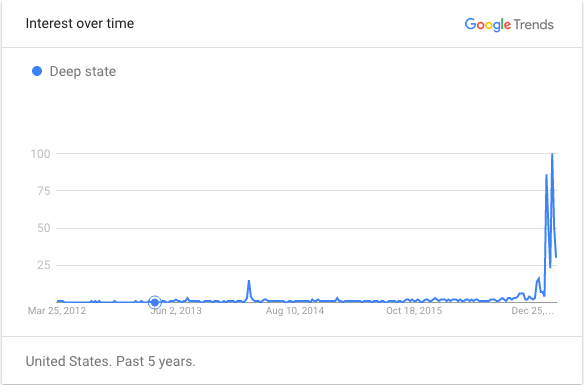
As this chart from Google Trends illustrates, interest in the Deep State has increased dramatically in 2017. The term/topic has clearly moved from the specialist realm to the mainstream. I’ve been writing about the Deep State, and specifically, the fractures in the Deep State, for years.

Amusingly, now that “Progressives” have prostituted themselves to the Security Agencies and the Neocons/Neoliberals, they are busy denying the Deep State exists. For example, There is No Deep State (The New Yorker).

In this risible view, there is no Deep State “conspiracy” (the media’s favorite term of dismissal/ridicule), just a bunch of “good German” bureaucrats industriously doing the Empire’s essential work of undermining democracies that happen not to prostrate themselves at the feet of the Empire, murdering various civilians via drone strikes, surveilling the U.S. populace, planting bugs in new iPhones, issuing fake news while denouncing anything that questions the dominant narratives as “fake news,” arranging sweetheart deals with dictators and corporations, and so on.

The New Yorker is right about one thing–the Deep State is not a “conspiracy:” it is a vast machine of control that is largely impervious to the views or demands of elected representatives or the American people. The key to understanding this social-political-economic control is to grasp that control of the narratives, expertise and authority is control of everything. Allow me to illustrate how this works.

The typical politician has a busy daily schedule of speaking at the National Motherhood and Apple Pie Day celebration, listening to the “concerns” of important corporate constituents, attending a lunch campaign fundraiser, meeting with lobbyists and party committees, being briefed by senior staff, and so on.

Senior administrators share similarly crowded schedules, minus the fundraising but adding budget meetings, reviewing employee complaints and multiple meetings with senior managers and working groups.

Both senior elected officials and senior state administrators must rely on narratives, expertise and authority because they have insufficient time and experience to do original research and assessment.

Narratives create an instant context that “makes sense” of various data points and events. Narratives distill causal factors into an explanatory story with an implicit teleology–because of this and that, the future will be thus and so.

For example: because Iraq has weapons of mass destruction (WMD), the future promises the terrible likelihood (more than a possibility, given Iraqi deployment of poison gas in the Iraq-Iran War) that America or its allies will be devastated by Iraqi weapons of mass destruction. This teleology leads to the inescapable need to eliminate Iraq’s weapons of mass destruction by any means necessary, and remove the political will to use them by removing Iraq’s leader from power.

Politicos and senior administrators rely on expertise and authority as the basis of deciding whether something is accurate and actionable. Professional specialists are assumed to have the highest available levels of expertise, and their position in institutions that embody the highest authority give their conclusions the additional weight of being authoritative. The experts’ conclusion doesn’t just carry the weight of expertise, it has been reviewed by senior officials of the institution, and so it also carries the weight of institutional authority.

So when the C.I.A. briefing by its experts claims Iraq has WMD, and the briefing includes various threads of evidence that the institution declares definitive, who is a non-expert to challenge this conclusion and teleology? On what technical basis does the skeptic reject the expertise and authority of the institution?

We can now define the Deep State with some precision. The Deep State is fundamentally the public-private centralized nodes that collect, archive and curate dominant narratives and their supporting evidence, and disseminate these narratives (and their implicit teleologies) to the public via the media and to the state agencies via formal and informal inter-departmental communication channels.

By gaining control of the narratives, evidence, curation and teleology, each node concentrates power. the power to edit out whatever bits contradict the dominant narrative is the source of power, for once the contradictory evidence is buried or expunged, it ceases to exist.

For example, the contradictory evidence in the Pentagon Papers was buried by being declared Top Secret. The bureaucratic means to bury skeptical (i.e. heretical) views or evidence are many. Sending the authors to figurative Siberia is remarkably effective, as is burying the heretical claims in a veritable mountain of data that few if any will ever survey.

Curation is a critical factor in maintaining control of the narrative and thus of control; the evidence is constantly curated to best support the chosen narrative which in turn supports the desired teleology, which then sets the agenda and the end-game.

The senior apparatchiks of the old Soviet Union were masters of curation; when a Soviet leader fell from favor, he was literally excised from the picture–his image was erased from photos.

This is how narratives are adjusted to better fit the evidence. Thus the accusation that “the Russians hacked our election” has been tabled because it simply doesn’t align with any plausible evidence. That narrative has been replaced with variants, such as “the Russians hacked the Democratic National Committee.” Now that this claim has also been shown to be false, new variants are popping up weekly, with equally poor alignment with evidence.

The primary claim of each Deep State node is that its expertise and authority cannot be questioned. In other words, while the dominant narrative can be questioned (but only cursorily, of course), the expertise and authority of the institutional node cannot be questioned.

This is why the Deep State is fracturing: the expertise and authority of its nodes are delaminating because its narratives no longer align with the evidence. If various Security Agencies sign off on the narrative that “Russia hacked our election” (a nonsense claim from the start, given the absurd imprecision of the “hacking”–hacking into what? Voting machines? Electoral tallies?), and that narrative is evidence-free and fact-free, i.e. false, then the expertise and authority of those agencies comes into legitimate question.

Once the legitimacy of the expertise and authority is questioned, control of the narrative is imperiled. The control of the narrative is control of the teleology, the agenda and the end-game–in other words, everything. If the institution loses control of the dominant narrative, it loses its hold on power.

This is why the Deep State is in turmoil–its narratives no longer make sense, or are in direct conflict with other nodes’ narratives or have been delegitimized by widening gaps between “definitive” claims and actual evidence.

There is indeed a Deep State, but its control of dominant narratives, and thus its source of control and power, is crumbling. The gap between the narratives and the evidence that supports them has widened to the point of collapse.


Snow, Death, and the Bewildered Herd

By Edward Curtin

Source: Behind the Curtain

Few people at this hour – and I refer to the time before the breaking out of this most grim war, which is coming to birth so strangely, as if it did not want to be born – few, I say, these days still enjoy that tranquility which permits one to choose the truth, to abstract one in reflection.  Almost all the world is in tumult, is beside itself, and when man is beside himself he loses his most essential attribute: the possibility of meditating, or withdrawing into himself to come to terms with himself and define what it is he believes and what it is that he does not believe; what he truly esteems and what he truly detests.  Being beside himself bemuses him, blinds him, forces him to act mechanically in a frenetic somnambulism.

-Ortega Y Gasset “The Self and the Other”

As I write these words, the house is being buried in a snowstorm. Heavy flakes fall slowly and silently as a contemplative peace muffles the frenetic agitation and speed of a world gone mad. A beautiful gift like this has no price, though there are those who would like to set one, as they do on everything.  In my mind’s eye I see Boris Pasternak’s Yurii Zhivago, sitting in the penumbra of an oil lamp in the snowy night stillness of Varykino, scratching out his poems in a state of inspired possession.  Outside the wolves howl. Inside the bedroom, his doomed lover, Lara, and her daughter sleep peacefully.  The wolves are always howling.

Then my mind’s lamp flickers, and Ignacio Silone’s rebel character, Pietro Spina (from the novel Bread and Wine) appears.  He is deep into heavy snow as he flees the Italian fascists by hiking into the mountains. There, too, howl the wolves, the omnipresent wolves, as the solitary rebel – the man who said “No” – slowly trudges in a meditative silence, disguised as a priest.

Images like these, apparitions of literary characters who never existed outside the imagination, might at first seem eccentric. But they appear to me because they are, like the silent snow that falls outside, evocative reminders of our need to stop the howling media streams long enough to set our minds on essential truths, to think and meditate on our fates – the fate of the earth and our individual fates. To resist the forces of death we need to concentrate, and that requires slow silence in solitude.  That is why the world’s archetypal arch-enemy, Mr. Death himself, aka Satan, aka Screwtape, advises his disciple Wormwood in C. S. Lewis’s The Screwtape Letters to befuddle people against the aberration of logic by keeping them distracted with contradictory, non-stop news reports. He tells him that “Your business is to fix his attention on the stream.  Teach him to call it ‘real life’ and don’t let him ask what he means by ‘real.’ “

It is a commonplace to say that we are being buried in continuous and never-ending information. Yet it is true.  We are being snowed by this torrent of indigestible “news,” and it’s not new, just vastly increased in the last twenty-five years or so.

Writing fifty-eight years ago, C. Wright Mills argued:

It is not only information they need – in the Age of Fact, information often dominates their attention and overwhelms their capacities to assimilate it….What they need…is a quality of mind that will help them to use information and to develop reason in order to achieve lucid summations of what is going on in the world and of what may be happening within themselves….what may be called the sociological imagination.

Today, as we speed down the information superhighway, Mills’s words are truer than ever.  But how to develop an imagination suffused with reason to arrive at lucid summations?  Is it possible now that “the information bomb” (attributed to Einstein) has fallen?

Albert Camus once said that “at any street corner the feeling of absurdity can strike any man in the face.”  While that is still true today, I would add that the feeling of an agitated and distracted bewilderment is everywhere to be seen as multitudes scan their idiot boxes for the latest revelations. Beeping and peeping, they momentarily quell their nervous anxieties by being informed and simulating proximity through the ether. Permanently busy in their mediated “reality,” they watch as streaming data are instantly succeeded by streaming data in acts of digital dementia. For Camus the absurd was a starting point for a freer world of rebellion. For Walter Lippman, the influential journalist and adviser to presidents and potentates, “the bewildered herd” – his name for regular people, the 99 % – was a beginning and a wished for end. His elites, the 1 %, would bewilder the herd in order to control them. His wish has come true.

A surfeit of information, fundamental to modern propaganda, prevents people from forming considered judgments.  It paralyzes them. Jacques Ellul writes in Propaganda:

Continuous propaganda exceeds the individual’s capacity for attention or adaptations. This trait of continuity explains why propaganda can indulge in sudden twists and turns.  It is always surprising that the content of propaganda can be so inconsistent that it can approve today what it condemned yesterday.

Coherence and unity in claims aren’t necessary; contradictions work just as well.  And the more the better: more contradictions, more consistency, more complementarity – just make it more.  The system demands more.  The informed citizen craves more; craves it faster and faster as the data become dada, an absurdist joke on logical thinking.

Wherever you go in the United States these days, you sense a generalized panic and an inability to slow down and focus.  Depression, anxiety, hopelessness fill the air.  Most people sense that something is seriously wrong, but don’t know exactly what. So they rage and rant and scurry along in a frenzy. It seems so huge, so everything, so indescribable.  Minds like pointilliste canvases with thousands of data dots and no connections.

In the mid-1990s, when the electronic world of computers and the internet were being shoved down our throats by a consortium of national security state and computer company operatives (gladly swallowed then by many and now resulting in today’s total surveillance state), I became a member of The Lead Pencil Club foundered by Bill Henderson (The Pushcart Press) in honor of Thoreau’s father’s pencil factory and meant as a whimsical protest: “a pothole on the information superhighway.”  There were perhaps 37 1/3 members worldwide, no membership roll, and no dues – just a commitment to use pencils to write and think slowly.

“Why should we live with such hurry and waste of life?” Thoreau asked.  “We are determined to be starved before we are hungry.”

So I am writing these words with a pencil, an object, to paraphrase Walter Benjamin, which haunts our present electronic world by being a ruin of the past.  It is not a question of nostalgia, for we are not returning to our lost homes, despite a repressed urge for simpler times. But the pencil is an object that stands as a warning of the technological hubris that has pushed our home on earth to the brink of nuclear extinction and made mush of people’s minds in grasping the reasons why.

I think of John Berger, the great writer on art and life, as I write, erase, cross out, rewrite – roll the words over and look at them, consider them.  Berger who wrote: “Writing is an off-shoot of something deeper”; that “most mainstream political discourse today is composed of words that, separated from any creature of language, are inert….dead ‘word-mongering’ [that] wipes out memory and breeds a ruthless complacency.”

The pencil is not a fetish; it is a reminder to make haste slowly, to hear and feel my thinking on the paper, to honor the sacredness of what Berger calls the “confabulation” between words and their meaning.  I smell the pencil’s wood, the tree of life, its slow ascent, rooted in the earth, the earth our home, our beginning and our end.

Imagining our ends, while always hard, has become much harder in modern times in western industrialized nations, especially the United States that reigns death down on the rest of the world while pretending it is immortal and immune from the nuclear weapons it brandishes. Yet the need to do so has become more important. When in 1939 Ortega y Gasset warned in the epigraph of a most grim war coming to birth so strangely, as people acted “mechanically in a frenetic somnambulism,” he was writing before nuclear weapons, the ultimate technology. If today we cannot imagine our individual deaths, how can we imagine the death of the earth? In a 1944 newspaper column George Orwell made an astute observation: “I would say that the decay of the belief in personal immortality has been as important as the rise of machine civilization.” He connected this growing disbelief to the modern cult of power worship.  “I do not want the belief in life after death to return,” he added, “and in any case it is not likely to return.  What I do point out is that its disappearance has left a big hole, and that we ought to take notice of that fact.”

I think that one reason we have not taken notice of this fact of the presence of a huge absence (not to say whether this disbelief is “true”) is the internet of speed, celebrated and foreseen by the grandmaster of electronic wizardry and obscurantic celebrator of retribalized man, Marshall McLuhan, who called the electronic media our gods whom we must serve and who argued that the extensions of human faculties through media would bring about abstract persons who would wear their brains outside their skulls and who would need an external conscience. Shall we say robots on fast forward?

Once the human body is reduced to a machine and human intercourse accepted as a “mediated reality” through so-called smart devices, we know – or should – that we are in big trouble.  John Ralston Saul, a keen observer of the way we live now, mimics George Carlin by saying, “If Marx were functioning today, he would have been hard put to avoid saying that imaginary sex is the opiate of the people.”

Saul is also one of the few thinkers to follow-up on Orwell’s point.  “Inexplicable violence is almost always the sign of deep fears being released and there can be no deeper fear than mortality unchained.  With the disappearance of faith and the evaporation of all magic from the image, man’s fear of mortality has been freed to roam in a manner not seen for two millennia.”  Blind reason, amoral and in the service of expertise and power, has replaced a holistic approach to understanding that includes at its heart art, language, “spirit, appetite, faith and emotion, but also intuition, will and, most important, experience.”  People, he argues, run around today in an inner panic as if they are searching for a lost forgotten truth.

Zygmunt Bauman, the brilliant sociological thinker, is another observer who has noticed the big hole that is staring us in the face.  “The devaluation of immortality,” he writes, “cannot but augur a cultural upheaval, arguably the most decisive turning point in human cultural history.”  He too connects our refusal in the west to contemplate this fact to the constant busyness and perpetual rushed sense of emergency engendered by the electronic media with its streaming information.  To this end he quotes Nicole Aubert:

Permanent busyness, with one emergency following another, gives the security of a full life or a ‘successful career’, sole proofs of self-assertion in a world from which all references to the ‘beyond’ are absent, and where existence, with its finitude, is the only certainty…When they take action people think short-term – of things to be done immediately or in the very near future…All too often, action is only an escape from the self, a remedy from the anguish.

McLuhan’s abstract persons, who rush through the grey magic of electronic lives where flesh and blood don’t exist, not only drown in excessive data that they can’t understand, but drift through a world of ghostly images where “selves” with nothing at the core flit to and fro. Style, no substance.  Perspective, no person.  Life, having passed from humans to things and the images of things, reduced and reified.  Nothing is clear, the images come and go, fact and fiction blend, myth and history coalesce, time and space collapse in a collage of confusion, surfaces appear as depths, the person becomes a perspective, a perspective becomes a mirror, a mirror reflects an image, and the individual is left dazed and lost, wondering what world he is in and what personality he should don. In McLuhan’s electronic paradise that is ours, people don’t live or die, people just float through the ether and pass away, as do the victims of America’s non-stop wars of aggression simply evaporate as statistics that float down the stream, while the delusional believe the world will bloodlessly evaporate in a nuclear war that they can’t imagine coming and won’t see gone. Who in this flow can hear the words of Federico Garcia Lorca: “Beneath all the totals, a river of warm blood/A river that goes singing/past the bedrooms…”?

If you shower the public with the thousands of items that occur in the course of a day or a week, the average person, even if he tries hard, will simply retain thousands of items which mean nothing to him.  He would need a remarkable memory to tie some event to another that happened three weeks or three months ago….To obtain a rounded picture one would have to do research, but the average person has neither the desire or time for it.  As a result, he finds himself in a kind of kaleidoscope in which thousands of unconnected images follow each other rapidly….To the average man who tries to keep informed, a world emerges that is astonishingly incoherent, absurd, and irrational, which changes rapidly and constantly for reasons he cannot understand.

Jaques Ellul wrote that in 1965. Lucid summations are surely needed now.

Here’s one from Roberto Calasso from The Forty-Nine Steps: “The new society is an agnostic theocracy based on nihilism.”

Anyone who sits silently and does a modicum of research while honestly contemplating the current world situation will have no trouble in noticing that there is one country in the world – the U.S.A. – that has used nuclear weapons, is modernizing its vast obscene arsenal, and has announced that it will use it as a first strike weapon. A quick glance at a map will reveal the positioning of U.S. NATO troops and weapons right up to Russia’s borders and the aggressive movement of U.S. forces close to China.  Hiroshima and Nagasaki make no difference.  The fate of the earth makes no difference. Nothing makes a difference. Obama started this aggressiveness, but will this change under Trump?  That’s very unlikely. We are talking about puppets for the potentates. It’s easy to note that the U.S. has 1,000,000 troops stationed in 175 countries because they advertise that during college basketball games, and of course you know of all the countries upon which the U.S. is raining down death and destruction in the name of peace and freedom.  That’s all you need to know.  Meditate on that and that hole that has opened up in western culture, and perhaps in your heart.

“If you are acquainted with the principle,” wrote Thoreau, “what do you care for myriad instances and applications?”  Simplify, simplify, simplify.

But you may prefer complexity, following the stream.

The snow is still falling, night has descended, and the roads are impassable.  The beautiful snow has stopped us in our tracks. Tomorrow we can resume our frantic movements, but for now we must simply stay put and wonder.

Eugene Ionesco, known for his absurdist plays, including Rhinoceros, puts it thus:

In all the cities of the world, it is the same.  The universal and modern man is the man in a rush (i.e. a rhinoceros), a man who has no time, who is a prisoner of necessity, who cannot understand that a thing might be without usefulness; nor does he understand that, at bottom, it is the useful that may be a useless and back-breaking burden.  If one does not understand the usefulness of the useless and the uselessness of the useful, one cannot understand art.  And a country where art is not understood is a country of slaves and robots.

Ionesco emphasized the literal insanity of everyday life, comparing people to rhinoceroses that think and act with a herd mentality because they are afraid of the solitude and slowness necessary for lucid thought. They rush at everything with their horns.  Behind this lies the fear of freedom, whose inner core is the fear of death.  Doing nothing means being nothing, so being busy means being someone.  And today being busy means being “plugged into the stream” of information meant to confound, which it does.

I return to the artist Pasternak, since the snowy night can’t keep me away. Or has he returned to me? I hear Yurii Zhivago’s uncle Nikolai speaking:

Only individuals seek the truth, and they shun those whose sole concern is not the truth.  How many things in the world deserve our loyalty?  Very few indeed.  I think one should be loyal to immortality, which is another word for life, a stronger word for it ….What you don’t understand is that it is possible to be an atheist, it is possible to not know whether God exists, or why, and yet believe that man does not live in a state of nature but in history….Now what is history?  It is the centuries of systematic explorations of the riddle of death, with a view to overcoming death. That’s why people discover mathematical infinity and electromagnetic waves, that’s why they write symphonies.  Now, you can’t advance in this direction without a certain faith.  You can’t make such discoveries without spiritual equipment.  And the basic elements of this equipment are in the Gospels.  What are they?  To begin with, love of one’s neighbor, which is the supreme form of vital energy.  Once it fills the heart of man it has to overflow and spend itself.  And then the two basic ideals of modern man – without them he is unthinkable – the idea of free personality and the idea of life as sacrifice.  Mind you, all of this is still extraordinarily new….Man does not die in a ditch like a dog – but at home in history, while the work toward the conquest of death is in full swing; he dies sharing in this work.  Ouf!  I got quite worked up, didn’t I?  But I might as well be talking to a blank wall.

I look outside and see the snow has stopped.  It is time to sleep.  Early tomorrow the plows will grind up the roads and the rush will ensue.  Usefulness will flow.

But for now the night is beautiful and slow. A work of art.

Review: The Utopia of Rules, by David Graeber

index

By Jonathan Woolley

Source: Gods & Radicals

Reading a book about bureaucracy may not sound like an exciting way to spend a weekend off with my family. And yet, having just started David Graeber’s latest – A Utopia of Rules – when I wasn’t making tea for my elderly grandmother, I curled up in a comfy chair with this little pink book, mocked up to look like one of the forms it excoriates, and excited by each new page. Although many of the ideas Graeber presents here aren’t new, the clarity and force with which they are drawn together and set out is a rare pleasure – a contrast with turgid official paperwork that was almost certainly intentional.

Graeber – a social anthropologist, anarchist, and prominent leftist thinker, based at the London School of Economics (LSE) – develops his argument, in part, by thinking ethnographically with his own personal experiences of officialdom, beginning with a heartbreaking account of his own struggle to deal with his elderly mother’s Medicaid application. In response to this, he introduces the book as a series of short essays on different facets of what he calls “total bureaucratisation” – defined as “the gradual fusion of public and private power into a single entity, rife with rules and regulations whose ultimate purpose is to extract wealth in the form of profits”. Bureaucracy is not a simple matter of red-tape created by the state tying up private enterprise, as right-wing pundits would have us believe: Graeber points out that bureaucratic forms have become intrinsic to both private and public spheres.

While the Left has been largely unable to produce a critique of bureaucracy, the Right has such a critique – but efforts to “roll back” the state by the Right have had the opposite effect, producing even more paperwork than ever. This leads Graeber to propose what he calls “the Iron Law of Liberalism”, which states that “any market reform, any government initiative intended to reduce red tape and promote market forces will have the ultimate effect of increasing the total number of regulations, the total amount of paperwork, and the total number of bureaucrats the government employs.”

In stressing the coeval nature of the free market and an expansive state, Graeber directs his analysis away from shallow criticism of big government, towards the common institutional basis of all inequality, found at the heart of neoliberal governance. Given the extent to which the general public in the English-speaking world continue to view the expansive state and the “free” market as antithetical to one another and synonymous with the Left and the Right of politics respectively, this is an important point to make.

With the foundations laid, Graeber’s lucid prose carries the reader briskly through a sequence of stand-alone essays, each of which engages with a particular aspect of total bureaucratisation today. Each of these, Graeber claims, will need to be addressed by any critique of bureaucracy the Left might develop. Dead Zones of the Imagination utilises feminist theory of imaginative labour to develop the argument that bureaucracy – in addition to being stupid – exists to create stupidity. Its impersonal procedures, backed up by threat of violence, ensure that those in positions of authority – especially the police – are able to avoid doing the imaginative labour of empathising with others, while forcing those others to engage in imaginative labour towards the authorities, simply in order to avoid physical harm. Police insist upon being able to “define the situation” – those who contest this, rather than violent criminals, are the ones who are routinely meet with physical violence. This serves to emphasise a very basic point: don’t underestimate the importance of physical violence, even if it takes place behind a veil of paper.

In Of Flying Cars and the Declining Rate of Profit, Graeber turns his attention to the trajectory of technological development in the modern world. Why is it, he asks, that in the 1950s we were able to explore space, and expected to be surrounded by robotic servants and flying cars by now, but that this awesome potential has not been realised? The answer, he suggests, is that rather than cause social change by itself, the direction of technological innovation is directed by financial interests – so that instead of pursuing automation and space travel that could disrupt existing economic relations on Earth, major funders have prioritised less disruptive research lines, such as information technology. The greatest achievement of the late 20th century – the Internet – is revealed as decidedly chimeric; both a tool for enhanced communication, but also a means of surveillance and manipulation on an industrial scale. The promise of technology has been broken in favour of labour discipline and social control; R&D budgets have been slashed in favour of boosting executive pay and shareholder dividends. Instead of being allowed to pursue their research interests, academics are increasingly forced to spend more and more of their time doing paperwork. Rather than a driver of social change, technology is itself subject to the demands of capital.

The Utopia of Rules, or Why We Really Love Bureaucracy After All concludes the triptych, by exploring the ways in which bureaucracy can, in fact, be deeply enchanting – when it works well – providing human beings with a sense of predictability and certainty that can be deeply seductive. While the second essay uses science fiction to reflect upon the curious falling short of innovation, this essay turns to magic and fantasy fiction in an attempt to understand how the appeal of bureaucratic rationality is generated. Graeber argues that the elaborate angelic hierarchies and formulaic modes of ritual address, developed in the Rennaissance but that now enliven Western Ceremonial Magic, actually reflect a political imaginary – a vision of the chaotic, violent world of the Middle ages reordered according to a spiritualised version of the old, lost, Roman bureaucracy. Nowadays, however, this vision is inverted – fantasy fiction today constructs a pseudo-Medieval world, where bureaucracy is almost entirely absent, where creativity is directly channelled into reality via magic, and where leadership is acquired on the basis of personal virtue and conquest, rather than through impersonal qualification or graduate recruitment. However, while giving us an opportunity to vicariously enjoy a world without bureaucracy, medievalist fantasies – with their perennial sense of threat and danger – nonetheless reinforce our sense that it’s probably preferable to live with the devil we know. Just as the gruesome spectacle of Gladitorial combat both beguiled and repulsed the populace of Rome from the idea of democracy, the blood-soaked cities of Westeros instil in us a fear of a world without bureaucratic order.

Perhaps the most fascinating contestation made by Graeber – albeit, only in passing – is that bureaucratic rationality rests upon a resolutely spiritual set of commitments. The idea that numbers and their rational appraisal can help one to understand and manipulate reality, reaches back to the Pythagoreanism of ancient Greece. They, in turn, directly inspired Plato, the father of Western formalism, and in turn the Medieval angelic hierarchies mentioned above. This commitment to the power of logic and pure numbers conferred upon bureaucracy a utopian air; bureaucrats envision a world of perfect harmony, governed by well-designed, efficient institutions, and develop frameworks that attempt to make that world a reality. The fact that the complexity of the world-as-lived rarely fits these lofty ideals ensures that bureaucracy requires constant enforcement – with the force in question being the threat of violence meted out by private security, the police or the military.

But it is in the Appendix – Batman and the Problem of Constituent Power – that we find some of Graeber’s most timely observations for the present moment. In a playful analysis of the cultural and political significance of superheroes, Graeber points out that – building upon his analysis of medievalist fantasy in the previous chapter – comics teach the same kind of lesson. In pitting basically passive superheroes who seek to preserve the status quo against endlessly creative and scheming villains who wish to unseat it, comics allow the reader to vicariously enjoy the thrill of unfettered creative potential, only to enforce the idea that such potential necessarily leads to violence, and that violence is in turn the only way that it can be controlled.

In the Marvel and DC Universes, the only alternative to bureaucracy is violent creativity of villains – in short, fascism. This, in turn, allows Graeber to highlight a broad distinction between the left and the right: “Ultimately, the division between left-and right-wing sensibilities turns on one’s attitude towards the imagination. For the Left, imagination, creativity, by extension production, the power to bring new things and new social arrangements into being, is always to be celebrated. It is the source of all real value in the world. For the Right, it is dangerous; ultimately, evil. The urge to create is also a destructive urge. This kind of sensibility was rife in the popular Freudianism of the day [1950s]: where the Id was the motor of the psyche, but also amoral; if really unleashed, it would lead to an orgy of destruction. This is also what separates conservatives from fascists. Both agree that the imagination unleashed can only lead to violence and destruction. Conservatives wish to defend us against that possibility. Fascists wish to unleash it anyway. They aspire to be, as Hitler imagined himself, great artists painting with the minds, blood, and sinews of humanity.”

Following from the magistral philosophical treatise Debt: The First 5,000 years (2011), The Utopia of Rules is a more modest project. Graeber does not attempt to propose a leftist critique of total bureaucratisation within its pages, though he argues such a critique is long overdue. Nor does he advance a singular argument – his goal is simply to prompt a conversation. With the rise of the populist right, this conversation is more important than ever. The mainstream Left, Graeber points out, has for too long positioned itself on the side of state control, leaving critiques of bureaucracy to the Right. As the pro-market efforts of neoliberalism have done nothing but concentrate capital in the hands of the rentier classes, the frustration is now boiling over. And yet, in unveiling the mystical roots of stultifying modern paperwork, Graeber reveals a way forward for us – if total bureaucratisation is a spell laid over the world, that spell may be broken. We need not live out the fevered dreams of Renaissance mystics; we can awaken. Nor shall the dark blood and bone portraits of fascists necessarily hold sway over the human imagination, for the Left is just as creative as the right; indeed, unlike them, we can create without fear of creativity. The Right may aspire to break this world, but it is the birthright of the Left to make a better one.