How to Avert a Digital Dystopia

By Jumana Abu-Ghazaleh

Source: OneZero

“What I find [ominous] is how seldom, today, we see the phrase ‘the 22nd century.’ Almost never. Compare this with the frequency with which the 21st century was evoked in popular culture during, say, the 1920s.”

—William Gibson, famed science-fiction author, in an interview on dystopian fiction.

The 2010s are almost over. And it doesn’t quite feel right.

When the end of 2009 came into view, the end of the 2000s felt like a relatively innocuous milestone. The current moment feels so much more, what’s the word?

Ah, yes: dystopian.

Looking back, “dystopia” might have been the watchword of the 2010s. Black Mirror debuted close to the beginning of the decade, and early in its run, it was sometimes critiqued for how over-the-top it all felt. Now, at the end of the decade, it’s regularly critiqued as made obsolete by reality.

And it’s not just prestige TV like Black Mirror reflecting the decade’s mood of incipient collapse. Of the 2010s top 10 highest-grossing films, by my count at least half involve an apocalypse either narrowly averted or, in fact, taking place (I’m looking at you, Avengers movies).

People have reasons to wallow. I get it. The existential threat of climate change alone — and seeing efforts to mitigate it slow down precisely as it becomes more pressing — could fuel whole libraries of dystopian fiction.

Meanwhile, our current tech landscape — the monopolies, the wild spread of disinformation, the sense that your most private data could go public whenever, with no recourse, all the things that risk making Black Mirror feel quaint — truly feels dystopian.

We enjoy watching distant, imaginary dystopias because they distract us from oncoming, real dystopias.

Since no one in a position to actually do something about our dystopian reality seems to be admitting it — no business leaders, politicians or legacy media — it makes sense that you might get catharsis of acknowledgment from pop culture instead. And yet, the most popular end-of-the-world fiction isn’t about actual imminent threats from climate or tech. It’s about Thanos coming to snap half of life out of existence. Or Voldemort threatening to destroy us Muggles.

Maybe that kind of pop culture, which acknowledges dystopia but not the actual threats we currently face, gives us a feeling of control: Sure, Equifax could leak my social security number and face zero consequences, but there are no Hunger Games. Wow — it really could be so much worse! Maybe we enjoy watching distant, imaginary dystopias because they distract us from oncoming, real dystopias.

But let’s look at those actual potential dystopias for a moment and think about what we need to do to avert them.

I’d suggest the big four U.S. tech giants — Amazon, Facebook, Apple, Google — each have a distinct possible dystopia associated with them. If we don’t turn around our current reality, we will likely get all four — after all, for all the antagonistic rhetoric among the giants, they are rather co-dependent. Let’s look at what we might have, ahem, look forward to — unless we demand the tech giants deliver on the utopia they purportedly set out to achieve when their respective founders raised their rounds of millions. I would argue not only that we can, but that we must hold them accountable.

“Mad Max,” or, slowly then all at once: starring Apple

“‘How did you go bankrupt?’ Bill asked. ‘Two ways,’ Mike said. ‘Gradually and then suddenly.’”

—Ernest Hemingway, The Sun Also Rises.

When you think of Mad Max, you probably think of an irradiated, post-apocalyptic desert hellscape. You’re also not thinking of Mad Max.

In the original 1979 film, the apocalypse hasn’t quite yet happened. There’s been a substantial social breakdown, but things are getting worse in slow motion. There are still functioning towns. Our protagonist, Max, is a working-class cop; and while there’s reason to believe a big crash is coming, or has even begun, society is still hanging on. (It’s only in the sequels that we’re well into the post-apocalyptic landscape people are thinking of when they say “Mad Max.”)

A relatively subtle dystopia, where things gradually decline in the background, is also a good day-to-day description of a society overrun by algorithms, even without the attention-grabbing mega-scandals of a Cambridge Analytica or massive data breach. A kind of dystopia “light” — and Apple is its poster child.

After all, Apple has a genuinely better track record than some of the other tech giants on a few key privacy issues. But it’s also genuinely aware of the value of promulgating that vision of itself — and that can lead Apple users into danger.

In January, Apple purchased a multistory billboard outside the Consumer Electronics Show in Las Vegas, with this message: “What happens on your iPhone, stays on your iPhone.” Sounds great — but it’s deeply misleading, and as journalist Mark Wilson noted, Apple’s mismatch between rhetoric and behavior fuels the nightmare that is our current data security crisis:

“[iPhone] contents are encrypted by default […] But that doesn’t stop the 2 million or so apps in the App Store from spying on iPhone users and selling details of their private lives. “Tens of millions of people have data taken from them — and they don’t have the slightest clue,” says [the] founder of [the] cybersecurity firm Guardian […] The Wall Street Journal studied 70 iOS apps […] and found several that were delivering deeply private information, including heart rate and fertility data, to Facebook.” [Emphasis mine.]

A tech giant that is claiming it’s the path to salvation, while effectively creating a trap for those who believe it, sounds ironically familiar given Apple’s famous evocation of Big Brother.

After all, when people talk about habit-forming technology in terms so terrifying they’ve convinced Silicon Valley executives to limit their children’s access to their own products, let’s be real: They’re talking about iPhones.

When academic child psychology researcher Jean Twenge talks about a possible teenage mental health epidemic fueled by social media, we know what’s at the heart of it: She’s talking about iPhones.

All those aforementioned horror stories, and a huge slice of those algorithms you’ve heard so much about, are likely first reaching you on smartphones that, with world market share above 50%, are largely, you guessed it, iPhones. (And none of these stories even mention Apple workers at overseas at facilities like Foxconn who create our iPhones and who really are living in a kind of explicit dystopia.)

What happens on your iPhone almost certainly doesn’t stay on your iPhone. But who created that surveillance capitalism running it all in the first place?

Enter Google.

“Black Mirror:” “Nosedive,” or, welcome to surveillance capitalism: starring Google

“We know where you are. We know where you’ve been. We can more or less know what you’re thinking about.”

—Google’s then-CEO Eric Schmidt, in a 2011 interview.

You’ve probably heard it before: “if you’re not paying, you’re the product.” This is usually in reference to ostensibly “free” services like Facebook or Gmail. It’s a creepy thought. And, according to Shoshana Zuboff, professor emeritus at Harvard and economic analyst of what she’s termed “surveillance capitalism,” the selling of your personal information undermines autonomy. It’s worse than you being the product: “You are not the product. You are the abandoned carcass.”

Google, according to Zuboff, is the original inventor of Surveillance Capitalism. In their early “Don’t Be Evil” days, the idea of accessing people’s private Google searches and selling them was considered unthinkable. Then Google realized it could use search data for targeting purposes — and never stopped creating opportunities to surveil their users:

“Google’s new methods were prized for their ability to find data that users had opted to keep private and to infer extensive personal information that users did not provide. These operations were designed to bypass user awareness. […]In other words, from the very start Google’s breakthrough depended upon a one-way mirror: surveillance.”

Twenty years later, surveillance capitalism has become so ubiquitous that it’s hard to live in Western society without being surveilled constantly by private actors.

As far as I know, no mass popular culture has really yet captured this reality, but one small metaphor that kind of hits on its effects is a Black Mirror episode called “Nosedive.”

In “Nosedive,” everyday people’s lived experience is very clearly the picked-apart carcass for an entire economic and social order; a kind of surveillance-driven social credit score affects every aspect of your daily life, from customer service to government resources to friendships, all based on your app usage and, most creepily, how other people rate you in the app.

If surveillance capitalism has been the engine powering our economy in the background for nearly two decades, it’s now having a coming-out party. Increasingly, Google isn’t just surveilling us in private — with its “designing smart cities” initiatives, the company will literally be making city management decisions instead of citizens: Sidewalk Labs, a Google sister company, plans to develop “the most innovative district in the entire world” in the Quayside neighborhood of Toronto, and Google itself is planning on siphoning every bit of data about how Quayside residents live and breathe and move via ubiquitous monitoring sensors that will likely inform — for a fee naturally — how other cities will develop.

If surveillance capitalism has been the engine powering our economy in the background for nearly two decades, it’s now having its coming-out party.

Much like Apple, Google takes pains to present itself as a conscientious corporate citizen. They might be paternalistic, or antidemocratic — but they have learned it’s important to their brand that they’re seen as responsive to their workers and the broader public, largely thanks to the courageous and persistent effort of their workers and consumer advocates in civil society.

Not so much with Amazon.

“Elysium,” or, dystopia for some, Prime Day for others: starring Amazon

“[The New York Times] claims that our intentional approach is to create a soulless, dystopian workplace where no fun is had and no laughter heard. Again, I don’t recognize this Amazon and I very much hope you don’t either.” —Jeff Bezos, August 17, 2015 letter to staff after the New York Times investigation into working conditions at the company.

In 2015, Jeff Bezos felt the need to set the record straight: The New York Times was wrong about Amazon. Working there did not feel like a dystopia.

The years since have only validated the New York Times story, which focused on life for coders and executives at Amazon. Notably, when the Times and other investigative journalists have probed life for the far more numerous warehouse workers employed by Amazon, Bezos has largely stayed silent.

In fact, the further down the corporate ladder you get at Amazon, the more likely it seems that Jeff Bezos will stay quiet on any controversy. Just this month, in a report published almost exactly four years after Bezos’ “Amazon is not a dystopia” declaration, the New York Times has uncovered almost a dozen previously unreported deaths allegedly caused by Amazon’s decentralized delivery network. Rather than defend itself out loud, Amazon has kept quiet while repeating the same argument in the courts: Those delivery people aren’t Amazon workers at all, and thus Amazon is not liable.

Amazon, like every major tech giant, has a key role in the dystopia of surveillance capitalism — the monopolylike market share of Amazon Web Services, and Amazon’s involvement in increasingly ubiquitous facial recognition software, represent their own deeply dystopian trends. But the most visible dystopia Amazon creates, for all to see, is dystopia in the workplace.

In many ways, Amazon is the single company that best explains the appeal of an Andrew Yang figure to a certain slice of economically alienated young voters. When speaking near Amazon’s HQ in Seattle, Yang explicitly talked about the surveillance of Amazon workers, and how reliable those jobs are in any case:

“All the Amazon employees [here] are like, ‘Oh shit, is Jeff watching me right now?’… [Amazon will] open up a fulfillment warehouse that employs, let’s call it 20,000 people. How many retail workers worked at the malls that went out of business because of Amazon? [The] greatest thing would be if Jeff Bezos just stood up one day and said, ‘Hey, the truth is we are one of the primary organizations automating away millions of American jobs.’ […] I have friends who work at Amazon and they say point-blank that ‘we are told we are going to be trying to get rid of our own jobs.’”

You can flat-out disagree with Yang’s proposed solutions, but a lot of his appeal stems from the fact that he’s diagnosing a problem that broad swaths of people don’t feel is being talked about. Yang validates his supporters’ concerns that they are, in fact, living in a dystopia of the corporate overlord variety.

In the movie Elysium, most work is done in warehouses, under constant surveillance, with workers creating the very automation systems that surveil and punish them. The movie takes place in a company townlike setting, with no such thing as a class system or social mobility. Meanwhile, the ruling class in Elysium lives in space, having left everyone else behind to work on Earth, a planet now fully ravaged by climate change.

That might sound particularly far-fetched, but given Bezos’ explicit intention to colonize space because “we are in the process of destroying this planet,” it suddenly doesn’t feel so off the mark. And in an era where Governors and Mayors openly genuflect to Amazon, preemptively giving up vast swaths of democratic powers for the mere possibility that Amazon might host an office building there, it’s hard not to feel like we’re already in an Elysium-flavored dystopia.

Amazon has their dystopia picked out, flavor and all. But what happens when the biggest social network in the world can’t decide which dystopia it wants to be when it grows up?

Pick a dystopia — any dystopia!: starring Facebook

“Understanding who you serve is always a very important problem, and it only gets harder the more people that you serve.”

—Mark Zuckerberg, 2014 interview with the New York Times.

Ready Player One is one of the more popular recent dystopian novels.

The bleak future it depicts is relatively straightforward: In the face of economic and ecological collapse, the vast majority of human interaction and commercial activity happens over a shared virtual reality space called Oasis.

In Oasis, the downtrodden masses compete in enormous multiplayer video games, hoping to win enough prizes and gain sufficient corporate sponsorship to scrape out a decent existence. Imagine a version of The Matrix, where people choose to constantly log into unreality because actual reality has gotten so unbearably terrible, electing to let the real world waste away. Horrific.

Ready Player One is also the book that Oculus founder and former Facebook employee Palmer Luckey used to give new hires, working on virtual reality to get them “excited” about the “potential” of their work.

Sound beyond parody? In so many ways, Facebook is unique among the tech giants: It’s not hiding the specter of dystopia. It’s amplifying dystopia.

It’s hard to pick a popular dystopia Facebook isn’t invested in.

Surveillance capitalism? Google invented it, but Facebook has taken it to a whole new level with its social and emotional contagion experiments and relentless tracking of even nonusers.

1984? Sure, Facebook says, quietly patenting technology that lets your phone record you without warning.

Brave New World? Lest we forget, Facebook literally experimented with making depression contagious in 2014.

28 Days Later, or any of the various other mass-violence-as-disease horror movies like The Happening? Facebook has been used to spread mass genocidal panics far more terrifying than any apocalyptic Hollywood film.

What about the seemingly way out there dystopias — something like THX-1138 or a particularly gnarly Black Mirror episode where a brain can have its thoughts directly read, or even electronically implanted? It won’t comfort you to know that Facebook just acquired CTRL-Labs, which is developing a wearable brain-computer interface, raising questions about literal thought rewriting, brain hacking, and psychological “discontinuity.”

Roger McNamee, an early Zuckerberg advisor and arguably its most important early investor, has become unadorned about it: Facebook has become a dystopia. It’s up to the rest of us to catch up.

We spent the 2010s on dystopia—let’s spend the 2020s on utopia instead

“Plan for the worst, hope for the best, and maybe wind up somewhere in the middle.” —Bright Eyes, “Loose Leaves”

People generally seem to think dystopias are possible, but utopias are not. No one ridicules you for conceiving of a dystopia.

I think part of that is because it gives us an easy out. Dystopias paralyze us. They overwhelm. They make us feel small and powerless. Envisioning Dystopia is like getting married anticipating the divorce. All we can do is make sure it’s amicable.

Is there room for a utopian counterweight? There’s not only room, there’s an urgent need if we want to look forward (as opposed to despondently) to the 22nd century. We cannot avert or undo dystopias without believing in their counterparts.

But we need to make the utopian alternative feel real, accessible, and achievable. We need to be rooting not for the lesser of two evils, but for something actually good.

Dystopias — real, about-to-unfold dystopias — have been averted before. The threat of nuclear apocalypse during the Cold War. The shrinking hole in the ozone layer (which is both distinct from, and has lessons to teach us about, the climate crisis). We didn’t land in utopia, but it was only by hitching our wagons to a utopian vision that we averted the worst.

In 2017, cultural historian Jill Lepore penned a kind of goodbye letter to dystopian fiction, calling for a renewal of utopian imagination. “Dystopia,” she lamented, “used to be a fiction of resistance; it’s become a fiction of submission.” Dystopian narratives once served as stark warnings of what might be in store for us if we do nothing, spurring us on to devise a brighter future. Today, dystopian fiction is so prevalent and comes in so many unsavory flavors that our civic imaginations are understandably confined to identifying the one we deem most likely to inevitably happen, and to come to terms with it.

But we don’t have to.

A new decade is on the way. Let’s spend the 2020s exercising our utopian imaginations — the muscles we use to envision dystopia are now all too-well-developed, and a body that only exercises one set of muscles quickly grows off-balance.

Dystopias disempower. We are tiny, inconsequential — how could we do anything about them? Utopias, on the other hand, are rhetorical devices calling upon us to build. They invite our participation. Because a utopia where we don’t matter is a contradiction in terms.

Let’s envision a world where those creating algorithms are thinking not only about their reach, but also about their impact. A world in which we are not the carcass left behind by surveillance capitalism. A world in which calling for ethical norms and standards is in itself a utopian act.

Let’s spend the next decade fighting for what we actually want: A world in which the powerful few are held to a higher standard; an industry in which ethics aren’t an afterthought, and the phrase “unintended consequences” doesn’t absolve actors from the fall out of their very deliberate acts.

Let’s actualize the utopia which, ironically enough, the tech giants themselves so enthusiastically promised us when they set out to change the world.

Let’s spend this next decade asking for what we actually want.

How the CIA, Mossad and “the Epstein Network” are Exploiting Mass Shootings to Create an Orwellian Nightmare

Graphic by Claudio Cabrera

By Whitney Webb

Source: Mint Press News

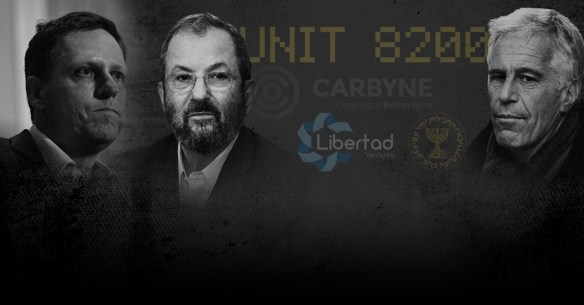
Following the arrest and subsequent death in prison of alleged child sex trafficker Jeffrey Epstein, a little-known Israeli tech company began to receive increased publicity, but for all the wrong reasons. Not long after Epstein’s arrest, and his relationships and finances came under scrutiny, it was revealed that the Israeli company Carbyne911 had received substantial funding from Jeffrey Epstein as well as Epstein’s close associate and former Prime Minister of Israel Ehud Barak, and Silicon Valley venture capitalist and prominent Trump backer Peter Thiel.

Carbyne911, or simply Carbyne, develops call-handling and identification capabilities for emergency response services in countries around the world, including the United States, where it has already been implemented in several U.S. counties and has partnered with major U.S. tech companies like Google. It specifically markets its product as a way of mitigating mass shootings in the United States without having to change existing U.S. gun laws.

Yet, Carbyne is no ordinary tech company, as it is deeply connected to the elite Israeli military intelligence division, Unit 8200, whose “alumni” often go on to create tech companies — Carbyne among them — that frequently maintain their ties to Israeli intelligence and, according to Israeli media reports and former employees, often “blur the line” between their service to Israel’s defense/intelligence apparatus and their commercial activity. As this report will reveal, Carbyne is but one of several Israeli tech companies marketing themselves as a technological solution to mass shootings that has direct ties to Israeli intelligence agencies.

In each case, these companies’ products are built in such a way that they can easily be used to illegally surveil the governments, institutions and civilians that use them, a troubling fact given Unit 8200’s documented prowess in surveillance as a means of obtaining blackmail and Israel’s history of using tech companies to aggressively spy on the U.S. government. This is further compounded by the fact that Unit 8200-linked tech companies have previously received U.S. government contracts to place “backdoors” into the U.S.’ entire telecommunications system as well as into the popular products of major American tech companies including Google, Microsoft and Facebook, many of whose key managers and executives are now former Unit 8200 officers.

Israeli Prime Minister Benjamin Netanyahu has made it no secret that placing Unit 8200 members in top positions in multinational tech companies is a “deliberate policy” meant to ensure Israel’s role as the dominant global “cyber power”, while also combating non-violent boycott movements targeting Israel’s violations of international law and stifling the United Nations’ criticisms of Israeli government policy and military operations abroad.

As Jeffrey Epstein’s links to intelligence in both the United States and Israel — the subject of a recent four-part series exclusive to MintPress — began to be revealed in full, his financing of Carbyne came under scrutiny, particularly for the company’s deep ties to Israeli intelligence as well as to certain Americans with known connections to U.S. intelligence. Ehud Barak’s own role as both financier and chairman of Carbyne has also added to that concern, given his long history of involvement in covert intelligence operations for Israel and his long-standing ties to Israeli military intelligence.

Another funder of Carbyne, Peter Thiel, has his own company that, like Carbyne, is set to profit from the Trump administration’s proposed hi-tech solutions to mass shootings. Indeed, after the recent shooting in El Paso, Texas, President Trump — who received political donations from and has been advised by Thiel following his election — asked tech companies to “detect mass shooters before they strike,” a service already perfected by Thiel’s company Palantir, which has developed “pre-crime software” already in use throughout the country. Palantir is also a contractor for the U.S. intelligence community and also has a branch based in Israel.

Perhaps most disturbing of all, whatever technological solution is adopted by the Trump administration, it is set to use a controversial database first developed as part of a secretive U.S. government program that involved notorious Iran-Contra figures like Oliver North as a means of tracking and flagging potential American dissidents for increased surveillance and detention in the event of a vaguely defined “national emergency.”

As this report will reveal, this database — often referred to as “Main Core” — was created with the involvement of Israeli intelligence and Israel remained involved years after it was developed, and potentially to the present. It was also used by at least one former CIA official on President Reagan’s National Security Council to blackmail members of Congress, Congressional staffers and journalists, among others.

Given recent reports on the Trump administration’s plan to create a new government agency to use “advanced technology” to identify “neurobehavioral signs” of “someone headed toward a violent explosive act” using data collected by consumer electronic devices, the picture painted by the technology currently being promoted and implemented under the guise of “keeping Americans safe” is deeply Orwellian. In fact, it points directly to the genesis of a far-reaching surveillance state far more extensive than anything yet seen in American history and it is being jointly developed by individuals connected to both American and Israeli intelligence.


Demystifying Carbyne

Carbyne911, which will be referred to simply as Carbyne in this report, is an Israeli tech-startup that promises to revolutionize how calls are handled by emergency service providers, as well as by governments, corporations and educational institutions. Not long after it was founded in 2014 by veterans of Israeli military intelligence, Carbyne began to be specifically marketed as a solution to mass shootings in the United States that goes “beyond the gun debate” and improves the “intelligence that armed emergency responders receive before entering an armed shooter situation” by providing video-streaming and acoustic input from civilian smartphones and other devices connected to the Carbyne network.

Prior to Jeffrey Epstein’s arrest in July, Carbyne had been receiving high praise from U.S. and Israeli media, with Fox News hailing the company’s services as the answer to the U.S.’ “aging 911 systems” and the Jerusalem Post writing that the company’s platform offers “hi-tech protection to social workers and school principals.” Other reports claimed that Carbyne’s services result in “a 65% reduction in time-to-dispatch.”

Carbyne’s call-handling/crisis management platform has already been implemented in several U.S. counties and the company has offices not only in the U.S. but also in Mexico, Ukraine and Israel. Carbyne’s expansion to more emergency service provider networks in the U.S. is likely, given that federal legislation seeks to offer grants to upgrade 911 call centers throughout the country with the very technology of which Carbyne is the leading provider. One of the main lobby groups promoting this legislation, the National Emergency Number Association (NENA), has a “strong relationship” with Carbyne, according to Carbyne’s website. In addition, Carbyne has also begun marketing its platform for non-emergency calls to governments, educational institutions and corporations.

Yet, what seemed like the inevitability of Carbyne’s widespread adoption in the U.S. hit a snag following the recent arrest and subsequent death of sex trafficker and pedophile Jeffrey Epstein, who exploited underage girls for the purpose of obtaining “blackmail” on the rich and poweful, an operation that had clear ties to intelligence. Epstein, after his first arrest and light sentence for soliciting sex from a minor in 2007, was tapped by former Israeli Prime Minister and former head of Israeli military intelligence Ehud Barak, to become a key financial backer of Carbyne.

As a result of increased scrutiny of Epstein’s business activities and his ties to Israel, particularly to Barak, Epstein’s connection to Carbyne was revealed and extensively reported on by the independent media outlet Narativ, whose exposé on Carbyne revealed not only some of the key intelligence connections of the start-up company but also how the architecture of Carbyne’s product itself raises “serious privacy concerns.”

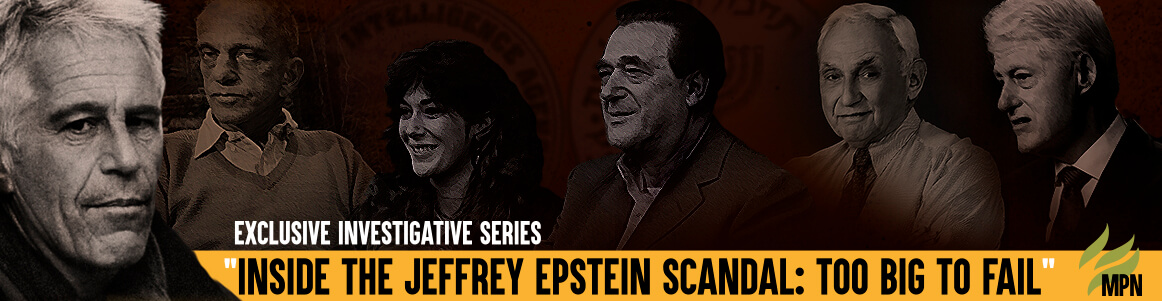
MintPress detailed many of Carbyne’s main intelligence connections in Part III of the investigative series “Inside the Jeffrey Epstein Scandal: Too Big to Fail.” In addition to Barak — former Israeli prime minister and former head of Israeli military intelligence — serving as Carbyne’s chairman and a key financer, the company’s executive team are all former members of Israeli intelligence, including the elite military intelligence unit, Unit 8200, which is often compared to the U.S. National Security Agency (NSA).

Carbyne’s current CEO, Amir Elichai, served in Unit 8200 and tapped former Unit 8200 commander and current board member of AIPAC Pinchas Buchris to serve as the company’s director and on its board. In addition to Elichai, another Carbyne co-founder, Lital Leshem, also served in Unit 8200 and later worked for Israeli private spy company Black Cube. The only Carbyne co-founder that didn’t serve in Unit 8200 is Alex Dizengof, who previously worked for Israel’s Prime Minister’s office.

As MintPress noted in a past report detailing Israeli military intelligence’s deep ties to American tech giant Microsoft, Unit 8200 is an elite unit of the Israeli Intelligence corps that is part of the IDF’s Directorate of Military Intelligence and is involved mainly in signal intelligence (i.e., surveillance), cyberwarfare and code decryption. It is frequently described as the Israeli equivalent of the NSA and Peter Roberts, senior research fellow at Britain’s Royal United Services Institute, characterized the unit in an interview with the Financial Times as “probably the foremost technical intelligence agency in the world and stand[ing] on a par with the NSA in everything except scale.”

Notably, the NSA and Unit 8200 have collaborated on numerous projects, most infamously on the Stuxnet virus as well as the Duqu malware. In addition, the NSA is known to work with veterans of Unit 8200 in the private sector, such as when the NSA hired two Israeli companies, to create backdoors into all the major U.S. telecommunications systems and major tech companies, including Facebook, Microsoft and Google. Both of those companies, Verint and Narus, have top executives with ties to Israeli intelligence and one of those companies, Verint (formerly Comverse Infosys), has a history of aggressively spying on U.S. government facilities. Unit 8200 is also known for spying on civilians in the occupied Palestinian territories for “coercion purposes” — i.e., gathering info for blackmail — and also for spying on Palestinian-Americans via an intelligence-sharing agreement with the NSA.

Unlike many other Unit 8200-linked start-ups, Carbyne also boasts several tie-ins to the Trump administration, including Palantir founder and Trump ally Peter Thiel — another investor in Carbyne. In addition, Carbyne’s board of advisers includes former Palantir employee Trae Stephens, who was a member of the Trump transition team, as well as former Secretary of Homeland Security Michael Chertoff. Trump donor and New York real-estate developer Eliot Tawill is also on Carbyne’s board, alongside Ehud Barak and Pinchas Buchris.

Yet, privacy concerns with Carbyne go beyond the company’s ties to Israeli intelligence and U.S. intelligence contractors like Peter Thiel. For instance, Carbyne’s smartphone app extracts the following information from the phones on which it is installed:

Device location, video live-streamed from the smartphone to the call center, text messages in a two-way chat window, any data from a user’s phone if they have the Carbyne app and ESInet, and any information that comes over a data link, which Carbyne opens in case the caller’s voice link drops out.” (emphasis added)

According to Carbyne’s website, this same information can also be obtained from any smartphone, even if it does not have Carbyne’s app installed, if that phone calls a 911 call center that uses Carbyne or merely any other number connected to Carbyne’s network.

Carbyne is a Next-Generation 9-11 (NG911) platform and the explicit goal of NG911 is for all 911 systems nationwide to become interconnected. Thus, even if Carbyne is not used by all 911 call centers using an NG911 platform, Carbyne will ostensibly have access to the data used by all emergency service providers and devices connected to those networks. This guiding principle of NG911 also makes it likely that one platform will be favored at the federal level to foster such interconnectivity and, given that it has already been adopted by several counties and has ties to the Trump administration, Carbyne is the logical choice.

Another cause for concern is how other countries have used platforms like Carbyne, which were first marketed as emergency response tools, for the purpose of mass surveillance. Narativ noted the following in its investigation of Carbyne:

In May, Human Rights Watch revealed Chinese authorities use a platform not unlike Carbyne to illegally surveil Uyghurs. China’s Integrated Joint Operations Platform brings in a much bigger data-set and sources of video, which includes an app on people’s phones. Like Carbyne, the platform was designed to report emergencies. Chinese authorities have turned it into a tool of mass surveillance.

Human Rights Watch reverse-engineered the app. The group discovered the app automatically profiles a user under 36 “person types” including “followers of Six Lines” which is the term used to identify Uyghurs. Another term refers to “Hajj,” the annual Islamic pilgrimage to Mecca. The app monitors every aspect of a user’s life, including personal conversations [and] power usage, and tracks a user’s movement.”

Such technology is currently used by Israeli military intelligence and Israel’s domestic intelligence agency Shin Bet to justify “pre-crime” detentions of Palestinians in the occupied West Bank. As will be noted in greater detail later in this report, Palestinians’ comments on social media are tracked by artificial intelligence algorithms that flag them for indefinite detention if they write social media posts that contain “tripwire” phrases such as “the sword of Allah.”

Carbyne’s platform has its own “pre-crime” elements, such as it’s c-Records component, which stores and analyzes information on past calls and events that pass through its network. This information “enables decision makers to accurately analyze the past and present behavior of their callers, react accordingly, and in time predict future patterns.” (emphasis added)

Concerns have recently been raised that “pre-crime” technology may soon become more widely adopted in the U.S., after President Trump stated that one of his planned solutions to mass shootings in the wake of the recent tragedy in El Paso was for big tech companies to detect potential shooters before they strike.


Israeli intelligence, Blackmail and Silicon Valley

Though many of the individuals involved in funding or managing Carbyne have proven ties to intelligence, a closer look into several of these players reveals even deeper connections to both Israeli and U.S. intelligence.

One of Carbyne’s clearest connections to Israeli intelligence is through its chairman and one of its funders, Ehud Barak. Though Barak is best known for being a former prime minister of Israel, he is also a former minister of defense and the former head of Israeli military intelligence. He oversaw Unit 8200’s operations, as well as other units of Israeli military intelligence, in all three of those positions. For most of his military and later political career, Barak has been closely associated with covert operations.

Prior to the public scrutiny of Barak’s relationship to Jeffrey Epstein, following the latter’s arrest this past July and subsequent death, Barak had come under fire for his ties to disgraced film mogul Harvey Weinstein. Indeed, it was Ehud Barak who put Weinstein in contact with the Israeli private intelligence outfit Black Cube, which employs former Mossad agents and Israeli military intelligence operatives, as Weinstein sought to intimidate the women who had accused him of sexual assault and sexual harassment. Former Mossad director Meir Dagan led Black Cube’s board until his death in 2016 and Carbyne co-founder Lital Leshem is Black Cube’s former director of marketing.

After Barak put him in contact with Black Cube’s leadership, Weinstein, according to The New Yorker, used the private spy firm to “‘target,’ or collect information on, dozens of individuals, and compile psychological profiles that sometimes focused on their personal or sexual histories.” In addition, The New Yorker noted that “Weinstein monitored the progress of the investigations personally” and “also enlisted former employees from his film enterprises to join in the effort, collecting names and placing calls that, according to some sources who received them, felt intimidating.”

Yet, more recently, it has been Barak’s close relationship to Epstein that has raised eyebrows and opened him up to political attacks from his rivals. Epstein and Barak were first introduced by former Israeli Prime Minister Shimon Peres in 2002, a time when Epstein’s pedophile blackmail and sex trafficking operation was in full swing.

Barak was a frequent visitor to Epstein’s residences in New York, so often that The Daily Beast reported that numerous residents of an apartment building linked to Epstein “had seen Barak in the building multiple times over the last few years, and nearly half a dozen more described running into his security detail,” adding that “the building is majority-owned by Epstein’s younger brother, Mark, and has been tied to the financier’s alleged New York trafficking ring.” Specifically, several apartments in the building were “being used to house underage girls from South America, Europe and the former Soviet Union,” according to a former bookkeeper employed by one of Epstein’s main procurers of underage girls, Jean Luc Brunel.

Barak is also known to have spent the night at one of Epstein’s residences at least once, was photographed leaving Epstein’s residence as recently as 2016, and has admitted to visiting Epstein’s island, which has sported nicknames including “Pedo Island,” “Lolita Island” and “Orgy Island.” In 2004, Barak received $2.5 million from Leslie Wexner’s Wexner Foundation, where Epstein was a trustee as well as one of the foundation’s top donors, officially for unspecified “consulting services” and “research” on the foundation’s behalf.

In 2015, Barak formed a limited partnership company in Israel for the explicit purpose of investing in Carbyne (then known as Reporty) and invested millions of dollars in the company, quickly becoming a major shareholder and subsequently the company’s public face and the chairman of its board. At least $1 million of the money invested in this Barak-created company that was later used to invest in Carbyne came from the Southern Trust Company, which was owned by Jeffrey Epstein.

In July, Bloomberg reported that Epstein’s Southern Trust Company is identified in U.S. Virgin Islands filings as “a DNA database and data mining” company. Given Carbyne’s clear potential for data-mining and civilian profiling, Epstein’s investment in Carbyne using this specific company suggests that Carbyne’s investors have long been aware of this little advertised aspect of Carbyne’s product.

In a statement to the Israeli newspaper Haaretz, Barak asserted:

I saw the business opportunity and registered a partnership in my control in Israel. A small number of people I know invest in it…Since these are private investments, it wouldn’t be proper or right for me to expose the investors’ details.”

However, Barak later admitted that Epstein had been one of the investors.

MintPress’ recent series on the Jeffrey Epstein scandal noted in detail Epstein’s ties to CIA/Mossad intelligence assets, such as Adnan Khashoggi; CIA front companies, such as Southern Air Transport; and organized crime, through his close association with Leslie Wexner. In addition, Epstein’s long-time “girlfriend” and alleged madam, Ghislaine Maxwell, has family links to Israeli intelligence through her father, Robert Maxwell. While it appears that Epstein may have been working for more than one intelligence agency, Zev Shalev, former executive producer for CBS News and journalist at Narativ, recently stated that he had independently confirmed with two unconnected sources “closely connected to the Epstein story and in a position to know” that Epstein had “worked for Israeli military intelligence.”

Notably, Epstein, who was known for his interest in obtaining blackmail through the sexual abuse of the underaged girls he exploited, also claimed to have “damaging information” on prominent figures in Silicon Valley. In a conversation last year with New York Times reporter James Stewart, Epstein claimed to have “potentially damaging or embarrassing” information on Silicon Valley’s elite and told Stewart that these top figures in the American tech industry “were hedonistic and regular users of recreational drugs.” Epstein also told Stewart that he had “witnessed prominent tech figures taking drugs and arranging for sex” and claimed to know “details about their supposed sexual proclivities.”

In the lead-up to his recent arrest, Jeffrey Epstein appeared to have been attempting to rebrand as a “tech investor,” as he had done interviews with several journalists including Stewart about technology investing in the months before he was hit with federal sex trafficking charges.

Jessica Lessin, editor-in-chief of The Information, told Business Insider that a journalist working for The Information had interviewed Epstein a month before his recent arrest because “he was believed to be an investor in venture capital funds.” However, Lessin claimed that the interview was not “newsworthy” and said the site had no plans to publish its contents. Business Insider claimed that the way the interviews with Epstein had been arranged “suggests that someone in Silicon Valley may have been trying to help Epstein connect with reporters.”

Though it is unknown exactly which Silicon Valley figures were most connected to Epstein and which tech executives were potentially being blackmailed by Epstein, it is known that Epstein associated with several prominent tech executives, including Google co-founder Sergey Brin, Facebook co-founder Mark Zuckerberg, Tesla CEO Elon Musk, Microsoft co-founder Bill Gates, and LinkedIn co-founder Reid Hoffman.

Last year, Epstein claimed to be advising Tesla and Elon Musk, who had been previously photographed with Epstein’s alleged madam Ghislaine Maxwell. A few years ago, Epstein also attended a dinner hosted by LinkedIn’s Reid Hoffman, where Musk had allegedly introduced Epstein to Mark Zuckerberg. Google’s Sergey Brin is known to have attended a dinner hosted by Epstein at his New York residence where Donald Trump was also in attendance.
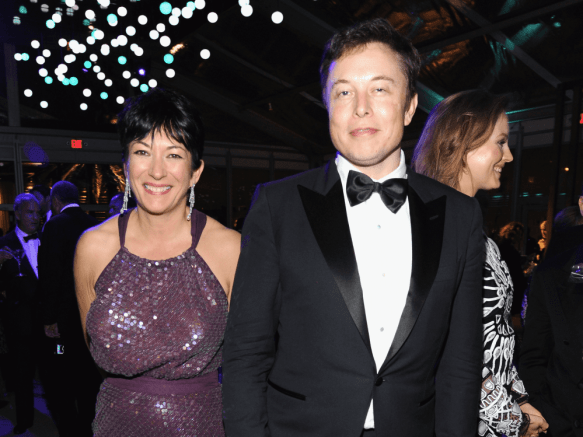
Elon Musk with Epstein’s alleged madam Ghislaine Maxwell at an Oscars after-party on March 2, 2014. Kevin Mazur | VF14

These associations suggest that the person in Silicon Valley who was trying to boost Epstein’s image as a tech investor before his arrest may have been Peter Thiel, whose Founders Fund had also invested in Carbyne. Thiel was an early investor in Facebook and is still on its board, connecting him to Zuckerberg; he is also a funder of Elon Musk’s SpaceX and a former colleague of Musk’s through PayPal. In addition, Thiel has ties to Reid Hoffman and both Thiel and Hoffman are prominent backers of Facebook.

It is unknown whether Epstein’s “damaging information” and apparent blackmail on notable individuals in the American technology industry were used to advance the objectives of Carbyne, which recently partnered with tech giants Google and Cisco Systems — and, more broadly, the expansion of Israeli intelligence-linked tech companies into the American tech sector, particularly through the acquisition of Israeli tech start-ups linked to Unit 8200 by major U.S. tech companies.

The latter seems increasingly likely given that the father of Ghislaine Maxwell — one of Epstein’s chief co-conspirators in his intelligence-linked sexual blackmail operation involving minors — was a Mossad operative who helped sell software that had been bugged by Israeli intelligence to government agencies and sensitive facilities around the world, including in the United States.

As will be noted later in this report, Israel’s Prime Minister Benjamin Netanyahu — to whom all of Israel’s intelligence agencies answer by virtue of his position — has stated on more than one occasion that the acquisition of Israeli intelligence-linked start-ups by foreign tech giants, especially in Silicon Valley, is a current and “deliberate policy” of the state of Israel.


Carbyne’s ties to U.S. intelligence

While Epstein and Barak are the two financiers of Carbyne whose ties to intelligence are clearest, another funder of Carbyne, Peter Thiel, has ties to U.S. intelligence and a history of investing in other companies founded by former members of Unit 8200. Thiel co-founded and still owns a controlling stake in the company Palantir, which was initially funded with a $2 million investment from the CIA’s venture capital fund In-Q-Tel and quickly thereafter became a contractor for the CIA.

After the success of its contract with the CIA, Palantir became a contractor for a variety of federal agencies, including the FBI, the Defense Intelligence Agency (DIA), the National Security Agency (NSA), the Department of Homeland Security(DHS) and the military’s Special Operations Command, among others. Last year, it won a contract to create a new battlefield intelligence system for the U.S. Army. Palantir is also in demand for its “pre-crime technology,” which has been used by several U.S. police departments. According to the Guardian, “Palantir tracks everyone from potential terrorist suspects to corporate fraudsters, child traffickers and what they refer to as ‘subversives’… it is all done using prediction.”

Thiel has gained attention in recent years for his support of President Trump and for becoming an adviser to Trump following the 2016 election, when he was “a major force in the transition,” according to Politico, and “helped fill positions in the Trump administration with former staff.” One of those former staffers was Trae Stephens, who is also on Carbyne’s board of advisers. Thiel also has business ties to Trump’s son-in-law and influential adviser, Jared Kushner, as well as to Kushner’s brother Josh. A senior Trump campaign aide told Politico in 2017 that “Thiel is immensely powerful within the administration through his connection to Jared.”

Thiel has also backed some prominent Israeli tech start-ups connected to Unit 8200, such as BillGuard, which Thiel funded along with former Google CEO Eric Schmidt and other investors. BillGuard was founded by Raphael Ouzan, a former officer in Unit 8200, who serves on the board of directors of Start-Up Nation Central (SUNC) alongside neoconservative American hedge fund manager Paul Singer, neoconservative political operative and adviser Dan Senor, and Terry Kassel, who works for Singer at his hedge fund, Elliott Management.

Peter Thiel Netanyahu
Peter Thiel greets Netanyahu during a 2017 meeting in Israel. Photo | Israel PM

SUNC is an organization founded by Paul Singer, who has donated heavily to both President Trump and Israeli Prime Minister Netanyahu. Since it was founded in 2012, SUNC has sought to integrate Unit 8200-connected Israeli tech start-ups into foreign companies, primarily American companies, and has helped oversee the shift of thousands of high-paying tech jobs from the U.S. to Israel.

Another Carbyne-connected individual worth noting is the former head of the Department of Homeland Security, Michael Chertoff, who serves on Carbyne’s board of advisers. In addition to Chertoff’s ties to DHS, Chertoff’s company, The Chertoff Group, employees several prominent former members of the U.S. intelligence community as principals, including Michael Hayden, former director of the CIA and former director of the NSA; and Charles Allen, former assistant director of Central Intelligence for Collection at the CIA, who worked at the agency for over 40 years.

The Chertoff Group has a long-standing and lucrative contract with the company OSI Systems, which produces full-body scanners and markets itself as a solution to mass shootings and crisis events, not unlike Carbyne. While Chertoff’s company was advising OSI Systems, Chertoff went on a media blitz to promote the widespread use of the machines produced by OSI Systems and even called on Congress to “fund a large-scale deployment of next-generation systems.” Chertoff did not disclose his conflict of interest while publicly promoting OSI’s full-body scanners.

Some have also alleged that Chertoff’s mother, Livia Eisen, had links to Israeli intelligence. According to her 1998 obituary, cited by both researcher/author Christopher Bollyn and journalist Jonathan Cook, Eisen participated in the Mossad operation code-named “Magic Carpet” while working for Israel’s El Al Airlines. Both Bollyn and Cook have suggested that Eisen’s participation in this covert Israeli intelligence operation strongly indicates that she had ties to the Mossad.


Melding into Silicon Valley

Beyond its troubling connections to Silicon Valley oligarchs, Israeli military intelligence and the U.S.-military industrial complex, Carbyne’s recent partnerships with two specific technology companies — Google and Cisco Systems — raise even more red flags.

Carbyne announced its partnership with Cisco Systems this past April, with the latter announcing that it would begin “aligning its unified call manager with Carbyne’s call-handling platform, allowing emergency call centers to collect data from both 911 callers and nearby government-owned IoT [Internet of Things] devices.” A report on the partnership published by Government Technology magazine stated that “Carbyne’s platform will be integrated into Cisco Kinetic for Cities, an IoT data platform that shares data across community infrastructure, smart city solutions, applications and connected devices.” The report also noted that “Carbyne will also be the only 911 solution in the Cisco Marketplace.”

As part of the partnership, Carbyne’s President of North American Operations Paul Tatro told Government Technology that the Carbyne platform would combine the data it obtains from smartphones and other Carbyne-connected devices with “what’s available through nearby Cisco-connected road cameras, roadside sensors, smart streetlamps, smart parking meters or other devices.” Tatro further asserted that “Carbyne can also analyze data that’s being collected by Cisco IoT devices … and alert 911 automatically, without any person making a phone call, if there appears to be a worthy problem,” and expressed his view that soon most emergency calls will not be made by human beings but “by smart cars, telematics or other smart city devices.”

A few months after partnering with Cisco Systems, Carbyne announced its partnership with Google on July 10, just three days after Carbyne funder Jeffrey Epstein was arrested in New York on federal sex trafficking charges. Carbyne’s press release of the partnership described how the company and Google would be teaming up in Mexico “to offer advanced mobile location to emergency communications centers (ECCs) throughout Mexico” following the conclusion of a successful four-week pilot program between Carbyne and Google in the Central American nation.

Netanyahu Eric Schmidt
Google Executive Chairman Eric Schmidt meets Netanyahu at his Jerusalem office. Israel PM | YouTube

The press release also stated:

Carbyne will provide Google’s Android ELS (Emergency Location Service) in real time from emergency calls made on AndroidTM devices. Deployment for any ECC in the country won’t require any integration, with Carbyne providing numerous options for connection to their secure ELS Gateway once an ECC is approved. The Carbyne automated platform, requiring no human interaction, has the potential to save thousands of lives each year throughout Mexico.”

The reason Carybne’s partnerships with Cisco Systems and Google are significant lies in the role that Cisco and former Google CEO Eric Schmidt have played in the creation of a controversial “incubator” for Israeli tech start-ups with deep ties to Israeli military intelligence, American neoconservative donor Paul Singer, and the U.S.’ National Security Agency (NSA).

This company, called Team8, is an Israeli company-creation platform whose CEO and co-founder is Nadav Zafrir, former commander of Unit 8200. Two of the company’s other three co-founders are also “alumni” of Unit 8200. Among Team8’s top investors is Schmidt, the former CEO of Google, who also joined Peter Thiel in funding the Unit 8200-linked BillGuard, as well as major tech companies including Cisco Systems and Microsoft.

Last year, Team8 controversially hired the former head of the NSA and U.S. Cyber Command, Retired Admiral Mike Rogers, and Zafrir stated that his interest in hiring Rogers was that Rogers would be “instrumental in helping strategize” Team8’s expansion in the United States. Jake Williams, a veteran of NSA’s Tailored Access Operations (TAO) hacking unit, told CyberScoop:

Rogers is not being brought into this role because of his technical experience. …It’s purely because of his knowledge of classified operations and his ability to influence many in the U.S. government and private-sector contractors.”

Team8 has also been heavily promoted by Start-Up Nation Central (SUNC). SUNC prominently features Team8 and Zafrir on the cybersecurity section of its website and also sponsored a talk by Zafrir and an Israeli government economist at the World Economic Forum, often referred to as “Davos,” that was attended personally by Paul Singer.

SUNC itself has deep ties to Israeli military intelligence, with former Unit 8200 officer Raphael Ouzan serving on its board of directors. Another example of SUNC-Unit 8200 ties can be seen with Inbal Arieli, who served as SUNC’s Vice President of Strategic Partnerships from 2014 to 2017 and continues to serve as a senior adviser to the organization. Arieli, a former lieutenant in Unit 8200, is the founder and head of the 8200 Entrepreneurship and Innovation Support Program (EISP), which was the first start-up accelerator in Israel aimed at harnessing “the vast network and entrepreneurial DNA of [Unit] 8200 alumni” and is currently one of the top company accelerators in Israel, alongside Team8. Arieli was the top executive at 8200 EISP while working at SUNC and several other top SUNC staffers are also connected to Israeli military intelligence.

Thus, Google and Cisco’s connections to Team8 suggests that their partnerships with another Israeli military intelligence-connected firm like Carbyne is a deepening of those two companies’ links to the growing bi-national security state that is uniting key players in the U.S. military-industrial complex and Israeli intelligence.


Mossad-backed Panic Buttons, coming to a school near you

Carbyne is hardly the only Israeli intelligence-linked tech company marketing itself in the United States as a solution to mass shootings. Another Israeli start-up, known as Gabriel, was founded in 2016 in response to a shooting in Tel Aviv and the Pulse Nightclub shooting in the United States, which took place just days apart.

Created by Israeli-American Yoni Sherizen and Israeli citizen Asaf Adler, Gabriel is similar to Carbyne in the sense that elements of its crisis response platform require installation on civilian smartphones as well as devices used by crisis responders. The main difference is that Gabriel also installs one or a series of physical “panic buttons,” depending on the size of the building to be secured, that also double as video and audio communication devices connected to the Gabriel network.

As with Carbyne, the ties between Gabriel and Israeli intelligence are obvious. Indeed, Gabriel’s four-person advisory board includes Ram Ben-Barak, former deputy director of the Mossad and former director-general of Israel’s intelligence ministry; Yohanan Danino, former chief of police for the state of Israel; and Kobi Mor, former director of overseas missions for the Israeli intelligence agency Shin Bet. The only American on the advisory board is Ryan Petty, the father of a Parkland shooting victim and friend of former Florida Governor Rick Scott.

Gabriel’s only disclosed funder is U.S.-based MassChallenge, a start-up accelerator non-profit. Gabriel is funded by MassChallenge’s Israel branch, which was opened six months prior to Gabriel’s creation and is partnered with the Israeli government and the Kraft Group. The Kraft Group is managed by Robert Kraft, who is currently embroiled in a prostitution scandal and is also a close friend of President Trump.

Notably, one of MassChallenge Israel’s featured experts is Wendy Singer, the executive director of SUNC, the organization created and funded by neoconservative Trump backer Paul Singer with the explicit purpose of promoting Israel’s tech start-ups and their integration into foreign, chiefly American, businesses. As was noted in a recent MintPress report on SUNC, Wendy Singer is the sister of neoconservative political operative Dan Senor, who founded the now-defunct Foreign Policy Initiative with Robert Kagan and Bill Kristol, and was previously the director of AIPAC’s Israel office for 16 years.

Gabriel’s founders have been quite upfront about the fact that the uptick in shootings in the U.S. has greatly aided their company’s growth and success. Last November, Sherizen told The Jerusalem Post that new mass shootings in the U.S. not only increased U.S. demand for his company’s product but also were opportunities to show the effectiveness of Gabriel’s approach:

Unfortunately every month there seems to be another high-profile event of this nature. After the Vegas shooting, we were able to show [that] our system would have managed to identify the location of the shooter much quicker.”

The Jerusalem Post noted that Gabriel is set to make considerable profits if concern over mass shootings continues to build in the U.S., writing:

With more than 475,000 soft targets across the US and amid increasing security fears, the potential market for Gabriel is huge. The company could gain revenues of almost $1 billion if only 10% of soft targets were to invest around $20,000 in its alert systems.”

Sherizen told the Jerusalem Post:

Our starter kit costs $10,000. Depending on the size and makeup of the community building, it would cost between $20-30,000 to fully outfit the location. We have made it very affordable. This is a game-changer for the lock-down and active shooter drills that are now a standard part of any child’s upbringing in the States.”


Much more than just a start-up

While it is certainly possible that numerous former officials and commanders of elite Israeli intelligence agencies may have no ulterior motive in advising or founding technology start-up companies, it is worth pointing out that top figures in Israel’s military intelligence agencies and the Mossad don’t see it that way.

Last March, Israeli media outlet Calcalist Tech published a report entitled “Israel Blurs the Line Between Defense Apparatus and Local Cybersecurity Hub,” which noted that “since 2012, cyber-related and intelligence projects that were previously carried out in-house in the Israeli military and Israel’s main intelligence arms are transferred to companies that in some cases were built for this exact purpose.” (emphasis added)

The article notes that beginning in 2012, Israel’s intelligence and military intelligence agencies began to outsource “activities that were previously managed in-house, with a focus on software and cyber technologies.” (emphasis added)

It continues:

In some cases, managers of development projects in the Israeli military and intelligence arms were encouraged to form their own companies, which then took over the project,’ an Israeli venture capitalist familiar with the matter told Calcalist Tech.”

Notably, Calcalist Tech states that the controversial company Black Cube was created this way and that Black Cube had been contracted, and is likely still contracted, by Israel’s Ministry of Defense. The private security agency Black Cube is known to have two separate divisions for corporations and governments. The firm was recently caught attempting to undermine the Iran nuclear deal — then also a top political objective of Israeli Prime Minister Benjamin Netanyahu — by attempting to obtain information on the “financial or sexual impropriety” (i.e., blackmail) of top U.S. officials involved in drafting the accord. NBC News noted last year that “Black Cube’s political work frequently intersects with Israel’s foreign policy priorities.” As previously mentioned, one of Carbyne’s co-founders — Lital Leshem, also a veteran of Unit 8200 — worked for Black Cube prior to starting Carbyne.

One of the main companies profiled in the Calcalist Tech report appeared to be a front for Israeli intelligence, as its registered owner was found not to exist: even high-level employees at the company had never heard of him; his registered addresses were for nonexistent locations in Israel’s capital of Tel Aviv; and the three people with that name in Tel Aviv denied any association with the business.

This company — which Calcalist Tech was unable to name after the Israeli military censor determined that doing so could negatively impact Israeli “national security” — was deliberately created to service the Israeli military and Israeli intelligence. It is also “focused on cyber technologies with expertise in research and development of advanced products and applications suitable for defense and commercial entities.” (emphases added) In addition, the company’s management consists largely of “veterans of Israeli military technology units.”

Notably, a former employee of this company told Calcalist Tech that “crossing the lines between military service and employment at the commercial outfit was ‘commonplace’ while he was working at the company.”

It’s not exactly clear why Israel’s military intelligence and other intelligence agencies decided to begin outsourcing its operations in 2012, though Calcalist Tech suggests the reasoning was related to the difference in wages between the private sector and the public sector, with pay being much higher in the former. However, it is notable that 2012 was also the year that Paul Singer — together with Netanyahu’s long-time economic adviser and former chair of the Israeli National Economic Council, Eugene Kandel — decided to create Start-Up Nation Central.

As MintPress noted earlier this year, SUNC was founded as part of a deliberate Israeli government effort to counter the nonviolent Boycott, Divest and Sanctions (BDS) movement and to make Israel the dominant global “cyber power.” This policy is aimed at increasing Israel’s diplomatic power and specifically undermining BDS as well as the United Nations, which has repeatedly condemned Israel’s government for war crimes and violations of international law in relation to the Palestinians.

Last year, Netanyahu was asked by Fox News host Mark Levin whether the large growth seen in recent years in Israel’s technology sector, specifically tech start-ups, was part of Netanyahu’s plan. Netanyahu responded, “That’s very much my plan … It’s a very deliberate policy.” He later added that “Israel had technology because the military, especially military intelligence, produced a lot of capabilities. These incredibly gifted young men and women who come out of the military or the Mossad, they want to start their start-ups.”

Netanyahu again outlined this policy at the 2019 Cybertech Conference in Tel Aviv, where he stated that Israel’s emergence as one of the top five “cyber powers” had “required allowing this combination of military intelligence, academia and industry to converge in one place” and that this further required allowing “our graduates of our military and intelligence units to merge into companies with local partners and foreign partners.”

The direct tie-ins of SUNC to Israel’s government and the successful effort led by SUNC and other companies and organizations to place former military intelligence and intelligence operatives in strategic positions in major multinational technology companies reveal that this “deliberate policy” has had a major and undeniable impact on the global tech industry, especially in Silicon Valley.


Mossad gets its own In-Q-Tel

This “deliberate policy” of Netanyahu’s also recently resulted in the creation of a Mossad-run venture capital fund that is specifically focused on financing Israeli tech start-ups. The venture capital fund, called Libertad, was first announced by Israel’s Prime Minister’s Office and was created with the explicit purpose of “increasing the Israeli intelligence agency’s knowledge base and fostering collaboration with Israel’s vibrant startup scene” It was modeled after the CIA’s venture capital fund In-Q-Tel, which invested in several Silicon Valley companies turned government and intelligence contractors — including Google and Palantir — with a similar goal in mind.

Libertad declines to reveal the recipients of its funding, but announced last December that it had chosen five companies in the fields of robotics, energy, encryption, web intelligence, and natural language processing and text analysis. In regard to its interest in web intelligence, a Mossad employee told the Jerusalem Post that the intelligence agency was specifically interested in “innovative technologies for [the] automatic identification of personality characteristics – personality profiling – based on online behavior and activity, using methods based on statistics, machine learning, and other areas.” (emphasis added)

According to Libertad’s website, in return for its investment, now set at NIS 2 million (~$580,000) per year per company, “the Mossad will receive access to the IP [initial product] developed during R&D [Research and Development] while under contract, and a non-commercial, non-exclusive license to use it. Libertad’s contract with the company will not provide it with any additional rights.” In an interview with Calcalist Tech, Mossad Director Yossi Cohen told the paper that the Mossad’s partnership with civilian companies in Israel is “excellent” and that the agency will continue to strengthen those ties.

Israeli intelligence has a documented history in placing “backdoors” into technology products for the purpose of surveillance, with one well-known case being Israel’s repurposing of the PROMIS software, discussed in Part III of MintPress’ series on Jeffrey Epstein. Furthermore, given that U.S. intelligence, specifically the NSA, had “backdoors” placed into the products of major Silicon Valley companies (a service performed by Israeli intelligence-linked tech companies no less), Mossad may very well plan on doing the same with the technology products of companies it backs through Libertad.

Tim Shorrock, investigative journalist and author of Spies For Hire: The Secret World of Intelligence Outsourcing, told MintPress that the Mossad’s continuation of such practices through Libertad was definitely plausible, especially given what Shorrock described as the “unusual” choice of Libertad choosing not to release the identities of the companies in which it invests.

“The Mossad is trying to hide what they are investing in,” Shorrock stated, adding that Libertad’s secrecy “raises a lot of questions” particularly given that it was modeled after the CIA’s In-Q-Tel. Shorrock noted that In-Q-Tel and other venture capital funds with ties to U.S. intelligence or the U.S. military rarely, if ever, hide the identities of the companies they finance.

However, Libertad is merely the latest and most public expression of the Mossad’s interest in Israeli tech start-ups, the lion’s share of which are created by veterans of Unit 8200 or other Israeli intelligence agencies. Indeed, former Mossad Director Tamir Pardo stated in 2017 that “everyone” in the Israeli cybertechnology sector is an “alumni” of either Israeli intelligence, like the Mossad, or Israeli military intelligence, like Unit 8200. Pardo even went as far as to say that the Mossad itself is “like a start-up.”

Pardo himself, after leaving his post as Mossad director in 2016, dove straight into the world of Israeli tech start-ups, becoming chairman of Sepio Systems, whose two CEOs are former Unit 8200 officers. Sepio Systems’ advisory board includes the former chief information security officer of the CIA, Robert Bigman; former member of the U.S. Military’s Joint Special Operations Command (JSOC), Geoff Hancock; and former head of the Israel National Cyber Bureau and veteran of Israeli military intelligence, Rami Efrati. Sepio Systems’ cybersecurity software has been adopted by several banks, telecom and insurance companies, including in the U.S. and Brazil.

Pardo is not the only prominent figure in Israel’s intelligence community to compare Israeli intelligence agencies to tech start-ups. Shin Bet Director Nadav Argaman described Israel’s domestic spy agency in similar terms. “The Shin Bet is like an evolving start-up, with unmatched strength,” Argaman stated in a June 2017 speech, as he extolled the agency’s use of “pre-crime” technology to detain Palestinians based on their social media activity.

Argaman, at the time, claimed that more than 2,000 Palestinians, whom he described as “potential lone-wolf terrorists,” had been arrested as a result of these “breakthrough technological advances” that use artificial-intelligence algorithms to monitor the social media accounts of Palestinians, especially younger Palestinians, for the use of “tripwire” phrases that have been used by Palestinians who later committed acts of violence. In the case of those who use such terms, “their phones are tracked to see if they meet other suspects, or leave their districts to move towards potential Israeli targets. In such cases, security forces detain the suspect,” according to a 2017 report on the practice by The Economist.


The road to fascism, paved by a corrupted PROMIS

Though Israeli intelligence’s interest in tech companies goes back several years, there is a well-documented history of Israeli intelligence using bugged software to surveil and gain “backdoor” access to government databases around the world, particularly in the United States.

As was mentioned in Part III of MintPress’ Epstein series, a sinister yet cunning plan was executed to place a backdoor for Israeli intelligence into the Prosecutor’s Management Information System (PROMIS) software, which was then being used by the U.S. Department of Justice and was the envy of government agencies, particularly intelligence agencies, around the world. This bugged version of PROMIS — born out of the collusion between Earl Brian, Ronald Reagan’s then-envoy to Iran, and Rafi Eitan, then-director of the now-defunct Israeli intelligence agency Lekem — was seeded around the world by Brian’s company Hadron as well as by Mossad-linked media mogul Robert Maxwell, father of Jeffrey Epstein’s long-time girlfriend and alleged madam, Ghislaine Maxwell.

After this first PROMIS “backdoor” was discovered, Israel would again gain access to sensitive U.S. government communications, as well as civilian communications, thanks to the collusion between Israeli intelligence and Israeli telecom and tech companies, especially Amdocs and Comverse Infosys (now Verint), that were operating throughout the United States. Today, Unit 8200-linked start-ups appear to have taken up the torch.

While the PROMIS software is perhaps best known for offering Israeli intelligence a backdoor into as many as 80 intelligence agencies and other sensitive locations around the world for nearly a decade, it was also used for a very different purpose by prominent officials linked to Iran-Contra.

One key Iran-Contra figure — Lt. Col. Oliver North, then serving on the National Security Council — decided to use PROMIS neither for espionage nor for foreign policy. Instead, North turned PROMIS’ power against Americans, particularly perceived dissidents, a fact that remained unknown for years.

Beginning in 1982, as part of the highly classified Continuity of Government (COG) program, North used the PROMIS software at a 6,100-square-foot “command center” in the Department of Justice, as well as at a smaller operations room at the White House, to compile a list of American dissidents and “potential troublemakers” if the COG protocol was ever invoked.

According to a senior government official with a high-ranking security clearance and service in five presidential administrations who spoke to Radar in 2008, this was:

A database of Americans, who, often for the slightest and most trivial reason, are considered unfriendly, and who, in a time of panic might be incarcerated. The database can identify and locate perceived ‘enemies of the state’ almost instantaneously.”

In 1993, Wired described North’s use of PROMIS in compiling this database as follows:

Using PROMIS, sources point out, North could have drawn up lists of anyone ever arrested for a political protest, for example, or anyone who had ever refused to pay their taxes. Compared to PROMIS, Richard Nixon’s enemies list or Sen. Joe McCarthy’s blacklist look downright crude.”

The COG program defined this “time of panic” as “a national crisis, such as nuclear war, violent and widespread internal dissent, or national opposition to a US military invasion abroad,” whereby the government would suspend the Constitution, declare martial law, and incarcerate perceived dissidents and other “unfriendlies” in order to prevent the government’s (or then-serving administration’s) overthrow.

This secretive database has often been referred to as “Main Core” by government insiders and, most troubling of all, it still exists today. Journalist Christ Ketcham, citing senior government officials, reported in 2008 that, at that time, Main Core was believed to contain the names of as many as 8 million Americans. Eleven years later, it is highly likely that the number of Americans included in the Main Core database has grown considerably.

Author and investigative journalist Tim Shorrock also covered other disturbing aspects of the evolution of Main Core back in 2008 for Salon. At the time, Shorrock reported that the George W. Bush administration was believed to have used Main Core to guide its domestic surveillance activities following the September 11 attacks.

Citing “several former U.S. government officials with extensive knowledge of intelligence operations,” Shorrock further noted that Main Core — as it was 11 years ago at the time his report was published — was said to contain “a vast amount of personal data on Americans, including NSA intercepts of bank and credit card transactions and the results of surveillance efforts by the FBI, the CIA and other agencies.”

Bill Hamilton, former NSA intelligence officer and the original creator of the PROMIS software, told Shorrock at the time that he believed that “U.S. intelligence uses PROMIS as the primary software for searching the Main Core database” and had been told as much by an intelligence official in 1992 and an NSA official in 1995. Dan Murphy, former deputy director at the CIA, had told Hamilton that the NSA’s use of PROMIS was “so seriously wrong that money alone cannot cure the problem.” “I believe in retrospect that Murphy was alluding to Main Core,” Hamilton had told Shorrock.

Though most reporting on Main Core, from the time its existence was first revealed to the present, has treated the database as something used by the U.S. government and U.S. intelligence for domestic purposes, MintPress has learned that Israeli intelligence was also involved with the creation of the Main Core database. According to a former U.S. intelligence official with direct knowledge of the U.S. intelligence community’s use of PROMIS and Main Core from the 1980s to 2000s, Israeli intelligence played a role in the U.S. government’s deployment of PROMIS as the software used for the Main Core domestic surveillance database system.

Israeli intelligence remained involved with Main Core at the time of the August 1991 death of journalist Danny Casolaro, who was investigating not only the government’s misuse of the stolen PROMIS software but also the Main Core database. This same official, who chose to remain anonymous, told MintPress that, shortly before his death, Casolaro had obtained copies of computer printouts from the PROMIS-based Main Core domestic surveillance database system from NSA whistleblower Alan Standorf, who was found murdered a few months before Casolaro’s lifeless body would be found in a West Virginia hotel room.

The source also stated that Main Core’s contents had been used for the political blackmail of members of Congress and their staff, journalists, and others by Walter Raymond, a senior CIA covert operator in psyops and disinformation who served on President Reagan’s National Security Council during and after Main Core’s creation. If used for this purpose by Raymond in the 1980s, Main Core has also likely been used by other individuals with access to the database for blackmailing purposes in the years since.

Given that Israeli intelligence was known to have placed a backdoor into the PROMIS software, before it was marketed and sold around the world by Earl Brian and Robert Maxwell, its role in the U.S. government’s decision to use PROMIS in the creation of Main Core suggests that Israeli intelligence likely advocated for the version of PROMIS containing this backdoor, thereby giving Israeli intelligence access to Main Core. Given that Reagan aides and officials colluded with Israeli “spymaster” Rafi Eitan in his efforts to create a backdoor into the software for Israeli military intelligence, the use of this version of PROMIS in the Main Core database is certainly plausible.

Furthermore, the fact that Israeli intelligence was known to be involved in Main Core nearly a decade after its creation suggests that Israeli intelligence may have played a role in certain aspects of the database, such as the criteria used to flag Americans as “unfriendly,” and — like Walter Raymond — may have used information in the database to blackmail Americans. In addition, the fact that the cooperation between U.S. and Israeli intelligence, particularly between Unit 8200 and the NSA, has only grown since 1991 further suggests that Israeli involvement in Main Core continues to the present.

While Main Core’s very existence is troubling for many reasons, the alleged involvement of a foreign intelligence service in the creation, expansion and maintenance of a database with personal details and potentially damaging information on millions of Americans targeted for detention or increased surveillance in times of crisis is chilling. It is especially so considering that the Trump administration’s latest proposals to prevent mass shootings before they occur are likely to use Main Core to flag certain Americans for increased surveillance or potentially detention, as was done by the George W. Bush administration following the September 11 attacks.

It appears that Main Core serves a dual purpose; first as a mass targeted surveillance system to crush dissent during times of “national crisis” — whether spontaneous or engineered — and, second, as a massive blackmail database used to keep every potential opponent in line during non-emergencies.


Peter Thiel’s Seeing Stone

As was mentioned earlier in this report, Palantir — the company co-founded by Peter Thiel — is set to profit handsomely from the Trump administration’s plans to use its “pre-crime” technology, which is already used by police departments throughout the country and also used to track Americans based on the company’s integrative data-mining approach. Palantir, named for the “seeing stones” in the Lord of the Rings novels, also markets software to foreign (and domestic) intelligence agencies that predicts the likelihood that an individual will commit an act of terrorism or violence.

Aside from its “pre-crime” products, Palantir has come under fire in recent years as a result of the company’s contracts with Immigration and Customs Enforcement (ICE), where it created an intelligence system known as Investigative Case Management (ICM). The IB Times described ICM as “a vast ‘ecosystem’ of data to help immigration officials in identifying targets and creating cases against them” and also “provides ICE agents with access to databases managed by other federal agencies.” ICM further gives ICE access to “targets’ personal and sensitive information, such as background on schooling, employment, family relationships, phone records, immigration history, biometrics data, criminal records as well as home and work addresses.” In other words, Palantir’s ICM is essentially a “Main Core” for immigrants.

Notably, part of Oliver North’s original intentions in “Main Core” was to track immigrants then coming from Central America as well as Americans who opposed Reagan era policy with respect to Central America. At that time, Main Core was believed to be controlled by the Federal Emergency Management Administration (FEMA), which is now part of the Department of Homeland Security (DHS).

VICE News reported in July that the Northern California Regional Intelligence Center, which is run by DHS, “serves around 300 communities in northern California and is what is known as a ‘fusion center,’ a Department of Homeland Security intelligence center that aggregates and investigates information from state, local, and federal agencies, as well as some private entities, into large databases that can be searched using software like Palantir. “ VICE further noted that this center alone used Palantir to surveil as many as 8 million Ameicans. There are many more such DHS “fusion centers” throughout the United States.

If the Trump administration moves forward with its proposal of employing technology to detect potential mass shooters before they strike, Palantir’s technology is set to be used, given that it has already been used by U.S. law enforcement and U.S. intelligence to determine which people run “the highest risk of being involved in gun violence,” according to an investigation of Palantir by The Verge. Furthermore, Palantir’s close ties to the Trump administration make the company’s role in a future nationwide “pre-crime” prevention system based on technology appear inevitable.
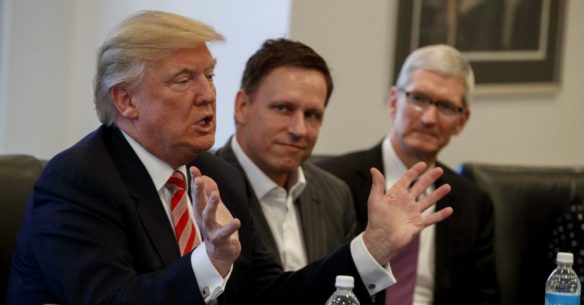
Apple CEO Tim Cook, right, and PayPal founder Peter Thiel, center, listen as President-elect Donald Trump speaks during a meeting with technology industry leaders at Trump Tower in New York, Wednesday, Dec. 14, 2016. (AP Photo/Evan Vucci)

Worse still is the apparent overlap between Palantir and Main Core. Palantir — which has obvious similarities to PROMIS — is already known to use its software to track potential terror threats, including domestic terror threats, and a category of people it refers to as “subversives.” Palantir’s tracking of these individuals “is all done using prediction.” Palantir’s close ties to the U.S. intelligence community suggest that Palantir may already have access to the Main Core database. Tim Shorrock told MintPress that Palantir’s use of Main Core is “certainly possible,” particularly in light of the company’s use of the term “subversive” to describe a category of people that its software tracks.

Palantir also has alleged ties to Israeli intelligence, as there have long been suspicions that Israeli intelligence has used Palantir as part of its AI “pre-crime” algorithms targeting Palestinians after Palantir opened a research and development (R&D) center in Israel in 2013. The current head of Palantir Israel, Hamultal Meridor, previously founded a brain-machine interface organization and was senior director of web intelligence at Verint (formerly Comverse Infosys), which has deep connections to Unit 8200, a history of espionage in the United States and was one of the two companies contracted by the NSA to insert a “backdoor” into the U.S. telecommunications system and popular products of major American tech companies.

Given the above, Peter Thiel’s 2018 decision to fund Carbyne, the Unit 8200-linked start-up that markets itself as a technological solution to mass shootings in the U.S., strongly suggests that Thiel has been anticipating for some time the now-public efforts of the Trump administration to employ “pre-crime” technology to track and target Americans who show signs of “mental illness” and “violent tendencies.”


A nightmare even Orwell could not have predicted

In early August, in the wake of the shooting at an El Paso Walmart, President Trump called on big tech companies to collaborate with the Justice Department in the creation of software that “stops mass murders before they start” by detecting potential mass shooters before they cnm act. Though Trump’s ideas were short on specifics, there is now a new proposal that would create a new government agency that will use data gathered from civilian electronic devices to identify “neurobehavioral” warning signs, thereby flagging “potential shooters” for increased surveillance and potentially detention.

This new agency, as proposed by the foundation led by former NBC Universal president and vice chairman of General Electric Robert Wright, would be known as the Health Advanced Research Projects Agency (HARPA) and would be modeled after the Defense Advanced Research Projects Agency (DARPA). Per the proposal, recently detailed by the Washington Post, the flagship program of HARPA would be “Safe Home” (Stopping Aberrant Fatal Events by Helping Overcome Mental Extremes), which would use “breakthrough technologies with high specificity and sensitivity for early diagnosis of neuropsychiatric violence,” specifically “advanced analytical tools based on artificial intelligence and machine learning.”

The program would cost an estimated $60 million over four years and would use data from “Apple Watches, Fitbits, Amazon Echo and Google Home” and other consumer electronic devices, as well as information provided by health-care providers to identify who may be a threat.

The Washington Post reported that President Trump has reacted “very positively” to the proposal and that he was “sold on the concept.” The Post also noted that Wright sees the president’s daughter, Ivanka, as “the most effective champion of the proposal and has previously briefed her on HARPA himself.” Ivanka has previously been cited as a driving force behind some of her father’s policy decisions, including his decision to bomb Syria after an alleged chemical weapons attack in 2017.

Liz Fed — president of the Susan Wright Foundation, which is led by Robert Wright and created the proposal for HARPA and “Safe Home” — told The Post that the proposal emulated DARPA because “DARPA is a brilliant model that works. They have developed the most transformational capabilities in the world for national security…We’re not leveraging the tools and technologies available to us to improve and save lives.” Fed further asserted that DARPA’s technological approach had yet to be applied to the field of healthcare.

For anyone familiar with DARPA, such claims should immediately sound loud alarm bells, especially since DARPA is already developing its own solution to “mental health” issues in the form of a “brain-machine interface” as part of its N3 program. That program, according to reports, involves “noninvasive and ‘minutely’ invasive neural interfaces to both read and write into the brain,” help distance soldiers “from the emotional guilt of warfare” by “clouding their perception” and “to program artificial memories of fear, desire, and experiences directly into the brain.” Though N3 is intended to improve the prowess of American soldiers, it is also set to be used as a means of pursuing DARPA’s Systems-Based Neurotechnology for Emerging Therapies (SUBNETS) project, which aims to “to develop a tiny, implanted chip in the skull to treat psychiatric disorders such as anxiety, PTSD and major depression.”

Given that HARPA’s lead scientific adviser is Dr. Geoffrey Ling, former director and founder of DARPA’s Biological Technologies Office (BTO), which “merges biology, engineering, and computer science to harness the power of natural systems for national security,” it seems likely that DARPA’s neurological-focused research programs, like SUBNETS and N3, would be folded into HARPA’s portfolio, making the proposed agency’s approach to mental health very questionable indeed.

Aside from the dystopian nature of both DARPA and potentially HARPA’s approach to mental health, there is grave cause for concern regarding the Trump administration’s moves to address U.S. mass shooting events by implementing pre-crime technology based on artificial intelligence, data-mining and mass surveillance, technologies already laying in wait thanks to companies like Palantir and numerous Israeli tech start-ups led by former Unit 8200 officers.

With companies like Carbyne — with its ties to both the Trump administration and to Israeli intelligence — and the Mossad-linked Gabriel also marketing themselves as “technological” solutions to mass shootings while also doubling as covert tools for mass data collection and extraction, the end result is a massive surveillance system so complete and so dystopian that even George Orwell himself could not have predicted it.

Following another catastrophic mass shooting or crisis event, aggressive efforts will likely follow to foist these “solutions” on a frightened American public by the very network connected, not only to Jeffrey Epstein, but to a litany of crimes and a frightening history of plans to crush internal dissent and would-be dissenters in the United States.

Feature photo | Graphic by Claudio Cabrera

Whitney Webb is a MintPress News journalist based in Chile. She has contributed to several independent media outlets including Global Research, EcoWatch, the Ron Paul Institute and 21st Century Wire, among others. She has made several radio and television appearances and is the 2019 winner of the Serena Shim Award for Uncompromised Integrity in Journalism.

 

Internet Free Speech All But Dead

Unelected, unnamed censors are operating across the Internet to suppress “unapproved” content.

By Philip Giraldi

Source: OpEdNews.com

The Internet was originally promoted as a completely free and uncensored mechanism for people everywhere to exchange views and communicate, but it has been observed by many users that that is not really true anymore. Both governments and the service providers have developed a taste for controlling the product, with President Barack Obama once considering a “kill switch” that would turn off the Internet completely in the event of a “national emergency.”

President Donald Trump has also had a lot to say about fake news and is reported to be supporting limiting protections relating to the Internet. In May, a “net neutrality” bill that would have prevented service providers from manipulating Internet traffic passed in the House of Representatives, but it is reported to be “dead on arrival” in the Senate, so it will never be enacted.

Social networking sites have voluntarily employed technical fixes that restrict some content and have also hired “reviewers” who look for objectionable material and remove it. Pending European legislation, meanwhile, might require Internet search engines to eliminate access to many unacceptable old posts. YouTube has already been engaged in deleting existing old material and is working with biased “partners” like the Anti-Defamation League (ADL) to set up guidelines to restrict future content. Many users of Facebook will have already undoubtedly noted that some contacts have been blocked temporarily (or even permanently) and denied access to the site.

Google now automatically disables or limits searches for material that it deems to be undesirable. If Google does not approve of something it will either not appear in search results or it will be very low on the list. And what does come up will likely favor content that derives from those who pay Google to promote their products or services. Information that originates with competitors will either be very low in the search results or even blocked. Google is consequently hardly an unbiased source of information.

In May 2017 Facebook announced that it would be hiring 3,000 new censors, and my own experience of social networking censorship soon followed. I had posted an article entitled “Charlottesville Requiem” that I had written for a website. At the end of the first day, the site managers noticed that, while the article had clearly attracted a substantial Facebook readership, the “likes” for the piece were not showing up on the screen counter, i.e., were not being tabulated. It was also impossible to share the piece on Facebook, as the button to do so had been removed.

The “likes” on sites like Facebook, Yahoo! news comments, YouTube, and Google are important because they automatically determine how the piece is distributed throughout the site. If there are a lot of likes, the piece goes to the top when a search is made or when someone opens the page. Articles similarly can be sent to Coventry if they receive a lot of dislikes or negative marks, so the approvals or disapprovals can be very important in determining what kind of audience is reached or what a search will reveal.

In my case, after one day my page reverted to normal, the “likes” reappeared, and readers were again able to share the article. But it was clear that someone had been managing what I had posted, apparently because there had been disapproval of my content based on what must have been a political judgment.

A couple of days later, I learned of another example of a similar incident. The Ron Paul Institute (RPI) website posts much of its material on YouTube (owned by Google) on a site where there had been advertising that kicked back to RPI a small percentage of the money earned. Suddenly, without explanation, both the ads and rebate were eliminated after a “manual review” determined the content to be “unsuitable for all advertisers.” This was a judgment rendered apparently due to disapproval of what the institute does and says. The ability to comment on and link from the pieces was also turned off.

Dissident British former diplomat Craig Murray also noted in April 2018 the secretive manipulation of his articles that are posted on Facebook, observing that his “site’s visitor numbers [were] currently around one-third normal levels, stuck at around 20,000 unique visitors per day. The cause [was] not hard to find. Normally over half of our visitors arrive via Facebook. These last few days, virtually nothing has come from Facebook. What is especially pernicious is that Facebook deliberately imposes this censorship in a secretive way.

The primary mechanism when a block is imposed by Facebook is that my posts to Facebook are simply not sent into the timelines of the large majority of people who are friends or who follow. I am left to believe the post has been shared with them, but in fact it has only been shown to a tiny number. Then, if you are one of the few recipients and do see the post and share it, it will show to you on your timeline as shared, but in fact the vast majority of your own friends will also not receive it. Facebook is not doing what it is telling you it is doing — it shows you it is shared — and Facebook is deliberately concealing that fact from you. Twitter has a similar system known as ‘shadow banning.’ Again, it is secretive and the victim is not informed.”

More recently, pressure to censor Internet social networking and information sites has increased, coming both from government and from various interested constituencies. In late May, Facebook founder and CEO Mark Zuckerberg met with French President Emmanuel Macron to discuss how to eliminate “hate speech” on the Internet. The two men agreed that the United States Internet model, in spite of already being heavily manipulated, is too laissez faire, and expressed an interest in exploring the French system where it is considered acceptable to ban unacceptable points of view. Zuckerberg suggested that it might serve as a good model for the entire European Union. France is reportedly considering legislation that establishes a regulator with power to fine Internet companies up to 4% of their global revenue, which can in some cases be an enormous sum, if they do not curb hateful expressions.

So unelected, unnamed censors are operating all around the Internet to control the content, which I suppose should surprise no one, and the interference will only get worse as both governments and service providers are willing to do what it takes to eliminate views that they find unacceptable — which, curiously enough, leads one to consider how “Russia-gate” came about and the current hysteria being generated in the conventional media and also online against both Venezuela and Iran. How much of the anger is essentially fake, being manipulated or even fabricated by large companies that earn mega billions of dollars by offering under false pretenses a heavily managed product that largely does what the government wants? Banning hate speech will be, unfortunately, only the first step in eliminating any and all criticisms of the status quo.

Tulsi Gabbard vs Google Goliath

By Rick Sterling

Source: Dissident Voice

Introduction

The Tulsi Gabbard presidential campaign has filed a major law suit against Google.  This article outlines the main points of the law suit and evidence the the social media giant Google has quietly acquired enormous influence on public perceptions and has been actively censoring alternative viewpoints.

Tulsi Now vs Google

Tulsi Now, Inc vs Google, LLC was filed on July 25 in the U.S. District Court for the Central District of California. The attorneys demand a jury trial and seek compensation and punitive damages of “no less than $50 million”. Major points and allegations in the 36 page complaint include:

* Google has monopolistic control of online searches and related advertising.

“Google creates, operates, and controls its platform and services, including but not limited to Google Search, Google Ads, and Gmail as a public forum or its functional equivalent by intentionally and openly dedicating its platform for public use and public benefit, inviting the public to utilize Google as a forum for free speech. Google serves as a state actor by performing an exclusively and traditionally public function by regulating free speech within a public forum and helping to run elections.” (p. 22)

“Google has used its control over online political speech to silence Tulsi Gabbard, a candidate millions of Americans want to hear from. With this lawsuit, Tulsi seeks to stop Google from further intermeddling in the 2020 United States Presidential Election….. Google plays favorites, with no warning, no transparency – and no accountability (until now).” (p. 2)

* At a critical moment Google undercut the Tulsi Gabbard campaign.

“On June 28, 2019 – at the height of Gabbard’s popularity among internet researchers in the immediate hours after the debate ended, and in the thick of the critical post-debate period… Google suspended Tulsi’s Google Ads account without warning.” (p. 3)

* Google has failed to provide a credible explanation.

The Tulsi campaign quickly sought to restore the account but “In response, the Campaign got opacity and an inconsistent series of answers from Google… To this day, Google has not provided a straight answer – let alone a credible one – as to why Tulsi’s political speech was silence right when millions of people wanted to hear from her.” (p. 4)

Google started by falsely claiming “problems with billing”.  Later, as reported in the NY Times story  a Google spokesperson claimed, “Google has automated systems that flag unusual activity on advertiser accounts – including large spending changes – to prevent fraud….In this case, ‘our system triggered a suspension.’ ”

* Google has a corporate profit motive to oppose Tulsi Gabbard.

“Google has sought to silence Tulsi Gabbard, a presidential candidate who has vocally called for greater regulation and oversight of (you guessed it) Google.” (p. 5)

“During her career in Congress, Gabbard has moved to limit the powers of big tech companies like Google and has fought to keep the internet open and available to all. Gabbard has co-sponsored legislation that prohibits multi-tiered pricing agreements for the privileged few, and she has spoken in favor of reinstating and expanding net neutrality to apply to Internet firms like Google.” (p. 8)

* Google’s Actions have caused significant harm to the Gabbard campaign and violate the U.S. and California constitutions and California business law.

“Through its illegal actions targeting Tulsi Gabbard, Google has caused the Campaign significant harm, both monetary (including potentially millions of dollars in forgone donations) and nonmonetary (the ability to provide Tulsi’s important message with Americans looking to hear it).” (p. 6)

“Google engages in a pattern and practice of intentional discrimination in the provision of its services, including discriminating and censoring the Campaign’s speech based not on the content of the censored speech but on the Campaign’s political identity and viewpoint.” (p. 27)

* The public has an interest in this case.

“Unless the court issues an appropriate injunction, Google’s illegal and unconstitutional behavior will continue, harming both the Campaign and the general public, which has an overwhelming interest in a fair, unmanipulated 2020 United States Election cycle. (p. 34)

Google Explanation is Not Credible

The Tulsi Gabbard Google Ads account was abruptly suspended at a crucial time. The question is why. Was it the result of “unusual activity” triggering an “automatic suspension” as claimed by Google? Or was it because someone at Google changed the software or otherwise intervened to undermine the Tulsi campaign?

Google’s explanation of an “automatic suspension” from “unusual activity” is dubious. First, the timing does not make sense. The sudden rise in searches on “Tulsi Gabbard” began the day before the suspension. Gabbard participated in the first debate, on June 26. Her presence and performance sparked interest among many viewers. Next morning, June 27, media reported that, “Tulsi Gabbard was the most searched candidate on Google after the Democratic debate in Miami“. The second debate took place in the evening of June 27. With discussion of the Democratic candidates continuing, Tulsi Gabbard continued to attract much interest. Around 9:30 pm (ET) on June 27 the Google Ads account was suddenly suspended. If the cause was “unusual activity”, the “automatic trigger” should have occurred long before.

Second, Google was fully aware of the “unusual activity”. In fact, Google was the source of the news reports on the morning of June 27.  Reports said:

According to Google Trends, Massachusetts Sen. Elizabeth Warren was the most searched candidate heading into the debate… After the debate, Gabbard vaulted into first.

Third, it is hard to believe that Google does not have any human or more sophisticated review before suspending a major Ads account on a politically intense night.  It should have been obvious that the cause of increased interest in Gabbard was the nationally televised Democratic candidates debate and media coverage.

Fourth, the changing explanation for the sudden suspension, starting with a false claim that there were “problems with billing”, raises questions about the integrity of Google’s response.

Google Secretly Manipulates  Public Opinion

Unknown to most of the public, there is compelling evidence that Google has been secretly manipulating search results to steer public perception and election voting for years.

Dr. Robert Epstein, former editor-in-chief of Psychology Today, has been studying and reporting on this for the past six years. Recently, on June 16, 2019 he testified before the Senate Judiciary Committee on the Constitution. His testimony is titled “Why Google Poses a Serious Threat to Democracy, and How to End That Threat”.

Epstein has published 15 books and over 300 scientific and mainstream media articles on artificial intelligence and related topics. “Since 2012, some of my research and writings have focused on Google LLC, specifically on the company’s power to suppress content – the censorship problem, if you will – as well as on the massive surveillance the company conducts, and also on the company’s unprecedented ability to manipulate the thoughts and behavior of more than 2.5 billion people worldwide.”

As shown by Dr. Epstein, Google uses several techniques to manipulate public opinion. The results of an online search are biased. Search “suggestions” are skewed. Messages such as “Go Vote” are sent to some people but not to others.

Epstein’s written testimony to Congress includes links to over sixty articles documenting his research published in sites ranging from Proceedings of the National Academy of Sciences to Huffington Post. Epstein’s testimony describes “disturbing findings” including:

“In 2016, biased search results generated by Google’s search algorithm likely impacted undecided voters in a way that gave at least 2.6 million votes to Hillary Clinton”. (Epstein notes that he supported Clinton.)

“On Election Day in 2018, the ‘Go Vote’ reminder Google displayed on its home page gave one political party between 800,000 and 4.6 million more votes than it gave the other party.”

“My recent research demonstrates that Google’s ‘autocomplete’ search suggestions can turn a 50/50 split among undecided voters into a 90/10 split without people’s awareness.”

“Google has likely been determining the outcomes of upwards of 25 percent of the national elections worldwide since at least 2015. This is because many races are very close and because Google’s persuasive technologies are very powerful.”

Google is Censoring Alternative Media  

In August 2017 TruePublica reported their experience and predictions in an article titled The Truth War is Being Lost to a Global Censorship Apparatus Called Google“. The article says:

60 percent of people now get their news from search engines, not traditional human editors in the media. It is here where the new information war takes place – the algorithm. Google now takes 81.2 percent of all search engine market share globally…. Google has the ability to drive demand and set the narrative, create bias and swing opinion.

In 2017, the World Socialist Web Site (wsws.org) reported that:

In April, under the guise of combating ‘fake news’, Google introduced new procedures that give extraordinary powers to unnamed ‘evaluators’ to demote web pages and websites. These procedures have been used to exclude the WSWS and other anti-war and oppositional sites. Over the past three months, traffic originating from Google to the WSWS  has fallen by approximately 70%…. In key searches relevant to a wide range of topics the WSWS regularly covers – including the U.S. military operations and the threat of war, social conditions, inequality and even socialism – the number of search impressions …has fallen dramatically.

In essence, Google has “de-ranked” and is screening searchers from seeing alternative and progressive websites such as truepublica, globalresearch, consortiumnews, commondreams, Wikileaks, truth-out and many more. WSWS reported numerous specific examples such as this one: “Searches for the term ‘Korean war’ produced 20,932 impressions in May. In July, searches using the same words produced zero WSWS impressions.”

“The policy guiding these actions is made absolutely clear in the April 25, 2017 blog post by Google’s Vice President for Engineering, Ben Gomes, and the updated ‘Search Quality Rater Guidelines’ published at the same time. The post refers to the need to flag and demote ‘unexpected offensive results, hoaxes and conspiracy theories’ – broad and amorphous language used to exclude any oppositional content…. “The ‘lowest’ rating is also to be given to a website that ‘presents unsubstantiated conspiracy theories or hoaxes as if the information were factual.’”

Tulsi Gabbard has not only called for much stricter regulations on high tech and social media giants. She has also challenged the Democratic Party and foreign policy establishment.  In late February 2016 she resigned as vice-chair of the Democratic National Committee to support candidate Bernie Sanders against the establishment favorite, Hillary Clinton. Gabbard has issued sharp criticisms of US foreign policy.  Recently she said:

We hear a lot of politicians say the same argument that we’ve got to stay engaged in the world otherwise we’ll be isolationists as though the only way the United States can engage with other countries is by blowing them up or strangling them with economic sanctions by smashing them and trying to overthrow their governments. This is exactly what’s wrong with this whole premise and the whole view in which too many politicians, too many leaders in this country are viewing the United States role in the world.

Conclusion

Did Google take the next step from silently censoring websites the corporation does not like to undercutting a presidential candidate the corporation does not like?

This is a David vs Goliath story. Google/Alphabet is the 37th largest corporation in the world with enormous political influence in Washington. Whether or not the law suit succeeds, it may serve the public interest by exposing Google’s immense monopolistic power and illustrate the need for much more regulation, transparency and accountability.  It may also generate more interest in Gabbard’s message and campaign in the face of efforts to silence her.


Rick Sterling is an investigative journalist who grew up in Canada but currently lives in the San Francisco Bay Area of California. He can be reached at rsterling1@gmail.com. Read other articles by Rick.

When the Journalists Ganged Up on Assange They Ganged Up on Themselves

By Paul Craig Roberts

Source: PaulCraigRoberts.org

Journalists did not appreciate the implications for themselves of the contrived and false indictment of Julian Assange by a corrupt US government.  It was obvious to a few of us that the indictment by the US government, a government constrained by the First Amendment, of a foreign national for publishing leaked material, an action never before regarded as espionage or a crime, was the beginning of the end of any Western government ever again being held accountable by a free press.

Not that the Western World has a free press.  It has a collection of presstitutes that serve as a Ministry of Propaganda for the ruling oligarchies.

Still, in principle it was possible that governments could be held accountable.  But that possibility ended with Assange’s false indictment.

First of all, no honest government would have spent years trying to invent a way to indict a journalist for practicing journalism.

Second, no intelligent grand jurors with an ounce of integrity would have been putty in the hands of a corrupt US prosecutor and enable a prosecution that ensures the destruction of accountable government.

Third, it was obvious that once America led the way in shutting down the principle of a free press, governments of other “Western democracies” would follow as soon as they could.

And follow they did.  Assange’s indictment led to raids by the Australian Gestapo on the home of News Corp Australia journalist Annika Smethurst and on the headquarters of the Australian Broadcasting Corp. https://caitlinjohnstone.com/2019/06/05/more-police-raids-as-war-on-journalism-escalates-worldwide/  The Australian government is angry about an investigative report about war crimes committed in Afghanistan by Australian participants in Washington’s war against the Taliban. What Australian troops are doing in Afghanistan remains an unexplained mystery. How much is the Australian government being paid by Washington for Australian mercenaries to die for the American Empire?

The Gestapo raids soon spread to other Australian journalists, including one whose sin was to report on “asylum seekers.”

Assange’s contrived and false indictment has also encouraged the French police to arrest journalists covering the ongoing “Yellow Vest” protests. The French government is desperate to blank out the protest against the American puppet government in Paris.

Even the San Francisco police, who tolerate massive homelessness on the streets and the associated crimes have been inspired by Assange’s indictment.  The front door of Journalist Bryan Carmody, who reported on the sudden death of a public defender, who apparently was in the way of successful police frameups, was broken down by police wielding sledgehammers.

Rather than knock on the door, the police break in. This not only costs the occupant large sums of money for repairs, but also serves to intimidate and to create a story that there was resistance that had to be overcome by breaking down the door.  This creates the necessary story for killing the occupants and the dog.

Listening to the fairy tales yesterday by Trump in Normandy about all the freedom Americans created by defeating Hitler, I wondered whose freedom he was talking about.  He was talking about the freedom of the oligarchs to rule without hindrance from the people or the First Amendment.

Not only journalists have lost First Amendment protection, but also citizens in encounters with police.  John Whitehead explains how a citizen’s exercise of constitutional rights is grounds for arrest.  https://www.rutherford.org/publications_resources/on_the_front_lines/u.s._supreme_court_upholds_arrest_over_contempt_of_cop_charge_limits_right_to_challenge_police_use_of_retaliatory_arrests_to_punish_speech

Communication monopolies such as Youtube, Twitter, and Google continue the censureship that teaches Americans to hold their tongues about an increasing array of subjects.  The same lesson is taught in schools and universities as speech codes gradually erase the First Amendment.  Each generation that is born is born into a country with less free speech.  As time passes, people will forget that once government and police could be held accountable.  Without free speech there is tyranny, and the road to tyranny is the road the United States and its Western vassals are on.

People Who Support Internet Censorship Are Infantile Narcissists

By Caitlin Johnstone

Source: CaitlinJohnstone.com

As of this writing, journalist Ford Fischer is still completely demonetized on YouTube as the result of a new set of rules that were put in place because of some doofy Twitter drama between some unfunny asshole named Steven Crowder and some infantile narcissist who thinks the world revolves around his opinions named Carlos Maza. It remains an unknown if Fischer will ever be restored to an important source of income around which he has built his livelihood.

Fischer often covers white supremacist rallies and counter-protests, and his channel was demonetized within minutes of YouTube’s new rules against hate speech going into effect because some of his content, as you’d expect, includes white supremacists saying and doing white supremacist things. Maza, a Vox reporter who launched a viral Twitter campaign to have Crowder removed from YouTube for making homophobic and bigoted comments about him on his channel, expressed concern over Fischer’s financial censorship.

“What’s happening to Ford is fucking awful,” Maza tweeted yesterday. “He’s a good journalist doing important work. I don’t understand how YouTube is still so bad at this. How can they not differentiate between white supremacist content and good faith reporting on white supremacy?”

https://twitter.com/gaywonk/status/1136425011970019329

I say that Maza is an infantile narcissist who thinks the world revolves around his opinions because it genuinely seems to have surprised him that good people would get harmed in the crossfire of his censorship campaign.

I mean, what did he think was going to happen? Did he think some soulless, multibillion-dollar Silicon Valley corporation was going to display company-wide wisdom and woke insightfulness while implementing his agenda to censor obnoxious voices? Did he imagine that YouTube executives were going to sit down with him over a cup of coffee and go down a list with him to get his personal opinion of who should and should not be censored?

Think about it. How narcissistic do you have to be to assume that a vast corporation is going to use your exact personal perceptual filters while determining who should and should not be censored for oafish behavior? How incapable of understanding the existence of other points of view must you be to believe it’s reasonable to expect that a giant, sweeping censorship campaign will exercise surgical precision which aligns perfectly with your own exact personal values system? How arrogant and self-centered must you be to demand pro-censorship reforms throughout an enormous Google-owned platform, then whine that they’re not implementing your censorship desires correctly?

This is the same staggering degree of cloistered, dim-eyed narcissism that leads people to support Julian Assange’s persecution on the grounds that he’s “not a journalist”. These egocentric dolts sincerely seem to believe that the US government is going to prosecute Assange for unauthorized publications about US war crimes, then when it comes time to imprison the next Assange the US Attorney General is going to show up on their doorstep to ask them for their opinion as to whether the next target is or is not a real journalist. Obviously the power-serving agenda that you are helping to manufacture consent for is not going to be guided by your personal set of opinions, you fucking moron.

The fact that other people aren’t going to see and interpret information the same way as you do is something Carlos Maza and the thousands of people who’ve supported his pro-censorship campaign should have learned as small children. Understanding that the world doesn’t revolve around you and your wants and desires is a basic stage in childhood development. People who believe Silicon Valley tech giants can implement censorship in a way that is wise and beneficent are still basically toddlers in this respect. One wonders if they still interrupt their mother’s important conversations with demands for attention and apple juice.

Ford Fischer was not the first good guy to get caught in the crossfire of internet censorship, and he will not be the last. In addition to the way unexpected interpretations of what constitutes hate speech can lead to important voices losing their platforms or being unable to make a living doing what they do, the new rules appear to contain a troubling new escalation that could see skeptics of legitimate military false flags completely censored.

“Finally, we will remove content denying that well-documented violent events, like the Holocaust or the shooting at Sandy Hook Elementary, took place,” reads a single sentence in the official YouTube blog about its new rules.

The sentence appears almost as an aside, without any elaboration or further information added, and at first glance it reads innocuously enough. No Holocaust deniers or Sandy Hook false flag videos? Okay, got it. I personally am not a denier of either of those events, so this couldn’t possibly affect me personally, right?

Wrong. YouTube does not say that it will just be censoring Holocaust deniers and Sandy Hook shooting deniers, it says it will “remove content denying that well-documented violent events, like the Holocaust or the shooting at Sandy Hook Elementary, took place.”

So what does this mean? Where exactly is the line drawn? If you are not an infantilized narcissist, you will not assume that YouTube intends to implement this guideline in the same way you would. It is very possible that it will include skeptics of violent events which the entire political/media class agrees were perpetrated by enemies of the US-centralized power alliance, which just so happen to manufacture support for increased aggressions against those nations.

Would the new rules end up forbidding, for example, this excellent YouTube video animation explaining how a leaked OPCW report disputes the official narrative about an alleged chemical attack in Douma, Syria last year? If you are not making the assumption that YouTube will be implementing its censorship using your own personal values system, there is no reason to assume it wouldn’t. After all, the official narrative that dozens of civilians were killed by the Assad government dropping chlorine cylinders through rooftops is the mainstream consensus narrative maintained by all respected US officials and “authoritative” news outlets.

This is a perfect example of a very real possibility that could be a disastrous consequence of increased internet censorship. It is a known fact that the US government has an extensive history of using false flags to manufacture consent for war, from the USS Liberty to the Gulf of Tonkin to the false Nayirah testimony about removing babies from incubators to the WMD narrative in Iraq. These new rules could easily serve as a narrative control device preventing critical discussions about suspicious acts of violence which have already happened, and which happen in the future.

Consider the fact that Google, which owns YouTube, has had ties to the CIA and the NSA from its very inception, is known to have a cozy relationship with the NSA, and has served US intelligence community narrative control agendas by tweaking its algorithms to deliberately hide dissenting alternative media outlets. Consider this, then ask yourself this question: do you trust this company to make wise and beneficent distinctions when it comes to censoring public conversations?

In a corporatist system of government which draws no meaningful distinction between corporate power and state power, corporate censorship is state censorship. Only someone who believes that giant Silicon Valley corporations would implement censorship according to their own personal values system could ever support giving these oligarchic establishments that kind of power. And if you believe that, it’s because you never really grew up.

The Trust Project: Big Media and Silicon Valley’s Weaponized Algorithms Silence Dissent

Sally Lehrman discusses the Trust Project at 2018 WordCamp For Publishers

Given the Trust Project’s rich-get-richer impact on the online news landscape, it is not surprising to find that it is funded by a confluence of tech oligarchs and powerful forces with a clear stake in controlling the flow of news.

By Whitney Webb

Source: Mintpress News

After the failure of Newsguard — the news rating system backed by a cadre of prominent neoconservative personalities — to gain traction among American tech and social media companies, another organization has quietly stepped in to direct the news algorithms of tech giants such as Google, Facebook, and Microsoft.

Though different from Newsguard, this group, known as “The Trust Project,” has a similar goal of restoring “trust” in corporate, mainstream media outlets, relative to independent alternatives, by applying “trust indicators” to social-media news algorithms in a decidedly untransparent way. The funding of “The Trust Project” — coming largely from big tech companies like Google; government-connected tech oligarchs like Pierre Omidyar; and the Knight Foundation, a key Newsguard investor — suggests that an ulterior motive in its tireless promotion of “traditional” mainstream media outlets is to limit the success of dissenting alternatives.

Of particular importance is the fact that the Trust Project’s “trust indicators” are already being used to control what news is promoted and suppressed by top search engines like Google and Bing and massive social-media networks like Facebook. Though the descriptions of these “trust indicators” — eight of which are currently in use — are publicly available, the way they are being used by major tech and social media companies is not.

The Trust Project’s goal is to increase public trust in the very same traditional media outlets that Newsguard favored and to use HTML-embedded codes in favored news articles to promote their content at the expense of independent alternatives. Even if its effort to promote “trust” in establishment media fail, its embedded-code hidden within participating news sites allow those establishment outlets to skirt the same algorithms currently targeting their independent competition, making such issues of “trust” largely irrelevant as it moves to homogenize the online media landscape in favor of mainstream media.

The Trust Project’s director, Sally Lehrman, made it clear that, in her view, the lack of public trust in mainstream media and its declining readership is the result of unwanted “competition by principle-free enterprises [that] further undermines its [journalism’s] very role and purpose as an engine for democracy.”

Getting to know the Trust Project

The Trust Project describes itself as “a consortium of top news companies” involved in developing “transparency standards that help you easily assess the quality and credibility of journalism.” It has done this by creating what it calls “Trust Indicators,” which the project’s website describes as “a digital standard that meets people’s needs.” However, far from meeting “people’s needs,” the Trust Indicators seem aimed at manipulating search engine and social-media news algorithms to the benefit of the project’s media partners, rather than to the benefit of the general public.

The origins of the Trust Project date back to a 2012 “roundtable” hosted by the Markkula Center for Applied Ethics at Santa Clara University, a center funded by former Apple CEO Mike Markkula. That roundtable became known as the Roundtable on Digital Journalism Ethics and was created by journalist Sally Lehrman, then working at the Markkula Center, in connection with the New Media Executive Roundtable and Online Credibility Watch of the Society of Professional Journalists. Lehrman has explicitly stated that the Trust Project is open only to “news organizations that adhere to traditional standards.”

The specific idea that spurred the creation of the Trust Project itself was born at a 2014 meeting of that roundtable, when Lehrman “asked a specialist in machine learning at Twitter, and Richard Gingras, head of Google News, if algorithms could be used to support ethics instead of hurting them, and they said yes. Gingras agreed to collaborate.” In other words, the idea behind the Trust Project, from the start, was aimed at gaming search-engine and social-media algorithms in collusion with major tech companies like Google and Twitter.

As the Trust Project itself notes, the means of altering algorithms were developed in tandem with tech-giant executives like Gingras and “top editors in the industry from 80 news outlets and institutions,” all of which are corporate, mainstream media outlets. Notably, the Trust Project’s media partners, involved in creating these new “standards” for news algorithms, include major publications owned by wealthy oligarchs: the Washington Post, owned by the world’s richest man, Jeff Bezos; the Economist, directed by the wealthy Rothschild family; and the Globe and Mail, owned by Canada’s richest family, the Thomsons, who also own Thomson Reuters. Other Trust Project partners include The New York Times, Mic, Hearst Television, the BBC and the USA Today network.

Other major outlets are represented on the News Leadership Council of the Markkula Center, including the Financial TimesGizmodo Media, and The Wall Street Journal. That council — which also includes Gingras and Andrew Anker, Facebook’s Director of Product Management — “guides the Trust Project on our Trust Indicators.”

These “Trust Indicators” are the core of the Trust Project’s activities and reveal one of the key mechanisms through which Google, Twitter and Facebook have been altering their algorithms to favor outlets with good “Trust Indicator” scores. Trust Indicators, on their face, are aimed at making news publications “more transparent” as a means of generating increased trust with the public. Though a total of 37 have been developed, it appears only eight of them are currently being used.

These eight indicators are listed and described by the Trust Project as follows:

  • Best Practices: What are the news outlet’s standards? Who funds it? What is the outlet’s mission? Plus commitments to ethics, diverse voices, accuracy, making corrections and other standards.
  • Author/Reporter Expertise: Who made this? Details about the journalist, including their expertise and other stories they have worked on.
  • Type of Work: What is this? Labels to distinguish opinion, analysis and advertiser (or sponsored) content from news reports.
  • Citations and References: What’s the source? For investigative or in-depth stories, access to the sources behind the facts and assertions.
  • Methods: How was it built? Also for in-depth stories, information about why reporters chose to pursue a story and how they went about the process.
  • Locally Sourced? Was the reporting done on the scene, with deep knowledge about the local situation or community? Lets you know when the story has local origin or expertise.
  • Diverse Voices: What are the newsroom’s efforts and commitments to bringing in diverse perspectives? Readers noticed when certain voices, ethnicities, or political persuasions were missing.
  • Actionable Feedback: Can we participate? A newsroom’s efforts to engage the public’s help in setting coverage priorities, contributing to the reporting process, ensuring accuracy and other areas. Readers want to participate and provide feedback that might alter or expand a story.

How the Trust Project makes these indicators available to the public can be seen in its new project, the Newsroom Transparency Tracker, where it provides a table of “transparency” for participating media outlets. Notably, that table conflates actual transparency practices with simply providing the Trust Project with outlet policies and guidelines related to the above indicators.

For example, The Economist gets a perfect transparency “score” for having provided the Trust Project links to its ethics policy, mission statement and other information requested by the project. However, the fact that those policies exist and are provided to the Trust Project does not mean that the publication’s policies are, in fact, transparent or ethical in terms of their content or in practice. The fact that The Economist provided links to its policies does not make the publication more transparent, but — in the context of the Newsroom Transparency Tracker’s table — it provides the appearance of transparency, though such policy disclosures by The Economist are unlikely to translate into any changes to its well-known biases and slanted reporting towards certain issues.

Trust Indicators manipulate big tech algorithms

The true power of the Trust Indicators comes in a form that is not visible to the general public. These Trust Indicators, while occasionally displayed on partner websites, are also coupled with “machine-readable signals” embedded in the HTML code of participating websites and articles used by Facebook, Google, Bing and Twitter. As Lehrman noted in a 2017 article, the Trust Project was then “already working with these four companies, all of which have said they want to use our indicators to prioritize honest, well-reported news over fakery and falsehood.” Gingras of Google News also noted that the Trust Indicators are used by Google as “cues to help search engines better understand and rank results … [and] to help the myriad algorithmic systems that mold our media lives.”

A press release from the Trust Project last year further underscores the importance of the embedded “indicators” to alter social-media and search-engine algorithms:

While each Indicator is visible to users on the pages of the Project’s news partners, it is also embedded in the article and site code for machines to read — providing the first, standardized technical language that offers contextual information about news sites’ commitments to transparency.”

Despite claiming to increase public knowledge of “news sites’ commitments to transparency,” the way that major tech companies like Google and Facebook are using these indicators is anything but transparent. Indeed, it is largely unknown how these indicators are used, though there are a few clues.

For instance, CBS News cited Craig Newmark — the billionaire founder of Craigslist, who provided the Trust Project’s seed funding — as suggesting that “Google’s search algorithm could rank trusted sources above others in search results” by using the project’s Trust Indicators.

Last year, the Trust Project stated that Bing used “the ‘Type of Work’ Trust Indicator to display whether an article is news, opinion or analysis.” It also stated that “when Facebook launched its process to index news Pages, they worked with the Trust Project to make it easy for any publisher to add optional information about their Page.” In Google’s case, Gingras was quoted as saying that Google News uses the indicators “to assess the relative authoritativeness of news organizations and authors. We’re looking forward to developing new ways to use the indicators.”

Notably, the machine-readable version of these Trust Indicators is available only to participating institutions, which are currently corporate, mainstream publications. Though WordPress and Drupal plug-ins are being developed to make those embedded signals to search engines and social media available to smaller publishers, it will be made available only to “qualified publishers,” a determination that will presumably be made by the Trust Project and its associates.

Richard Gingras, in a statement made in 2017, noted that “the indicators can help our algorithms better understand authoritative journalism — and help us to better surface it to consumers.” Thus, it is abundantly clear that these indicators, which are embedded only into “qualified” and “authoritative” news websites, will be used to slant search-engine and social-media news algorithms in favor of establishment news websites.

The bottom line is that these embedded and exclusive indicators allow certain news outlets to avoid the crushing effects of recent algorithm changes that have seen traffic to many news websites, including MintPress, plummet in recent years. This is leading towards a homogenization of the online news landscape by starving independent competitors of web traffic while Trust Project-approved outlets are given an escape valve through algorithm manipulation.

The tech billionaires behind the Trust Project

Given the Trust Project’s rich-get-richer impact on the online news landscape, it is not surprising to find that it is funded by rich and powerfl figures and forces with a clear stake in controlling the flow of news and information online.

According to its website, the Trust Project currently receives funding from Craig Newmark Philanthropies, Google, Facebook, eBay founder Pierre Omidyar’s Democracy Fund, the John S. and James L. Knight Foundation (often abbreviated as the Knight Foundation), and the Markkula Foundation. Its website also states that Google was “an early financial supporter” and that it had originally been funded by Craig Newmark, the founder of Craigslist. As previously mentioned, the Trust Project’s co-founder is Richard Gingras, current Google vice president of News. The Trust Project’s website described Gingras’s current role with the organization as “a powerful evangelist” who “can always be counted upon for expert advice and encouragement.” Newmark’s current role at the Trust Project is described as that of a “funder and valued connector.”

Newmark, through Craig Newmark Philanthropies, who provided the initial funding for the Trust Project, and has also funded other related initiatives like the News Integrity Initiative at the City University of New York, which shares many of the same financiers as the Trust Project, including Facebook, Omidyar’s Democracy Fund, and the Knight Foundation. The Trust Project is listed as a collaborator of the News Integrity Initiative. Newmark is also very active in several news-related NGOs with similar overlap. For instance, he sits on the board of the Electronic Frontier Foundation (EFF), a longtime recipient of massive grants from the Omidyar Network, and Politifact.com, which is funded in part by Omidyar’s Democracy Fund.

Newmark is currently working with Vivian Schiller as his “strategic adviser” in his media investments. Schiller is a member of the Council on Foreign Relations, former head of news at Twitter, and a veteran of well-known mainstream outlets like NPR, CNN, The New York Times and NBC News. She is also a director of the Scott Trust, which owns The Guardian.

The Markkula Foundation, one of the key funders of the Trust Project, exercises considerable influence over the organization through the Markkula Center for Applied Ethics, which originally incubated the organization and whose News Leadership Council plays an important role at the Trust Project. That council’s membership includes representatives of Facebook, The Wall Street Journal, The Washington Post, Financial Times and Google, and “guides the Trust Project on our Trust Indicators and advises on core issues related to information literacy and rebuilding trust in journalism within a fractious, so-called post-fact environment.”

Both the Markkula Foundation and the Markkula Center for Applied Ethics were founded by A. M. “Mike” Markkula, former CEO of Apple. The Markkula Center’s Journalism Ethics program is currently headed by Subramaniam Vincent, a former software engineer and consultant for Intel and Cisco Systems who has worked to bring together big data with local journalism and is an advocate for the use of “ethical-AI [artificial intelligence] to ingest, sort, and classify news.”

The John S. and James L. Knight Foundation is another interesting funder of the Trust Project, given that this same foundation is also a key investor in Newsguard, the controversial, biased news rating system with deep connections to government insiders and self-described government propagandists. There is considerable overlap between Newsguard and the Trust Project, with the latter citing Newsguard as a partner and also stating that Newsguard’s demonstrably biased ratings use the project’s “trust indicators” in its full-length reviews of news websites, which Newsguard calls “nutrition labels.” In addition, becoming a Trust Project participant is a factor that “supports a positive evaluation” from Newsguard, according to a press release from last year.

Notably, Sally Lehrman, who leads the Trust Project, described the project’s trust indicators for news as ”along the lines of a nutrition label on a package of food” when the Trust Project was created nearly a year before Newsguard launched, suggesting some intellectual overlap.

previous MintPress exposé revealed Newsguard’s numerous conflicts of interest and a ratings system strongly biased in favor of well-known, traditional media outlets — even when those outlets have a dubious track record of promoting so-called “fake news.” It should come as no surprise that the Trust Project’s goal is to increase public trust in the very same traditional media outlets that Newsguard favored and to use HTML-embedded codes in news articles to promote their content at the expense of independent alternatives.

A familiar face in the war against independent media

The Democracy Fund, another top funder of the Trust Project and a bipartisan foundation that was established by eBay founder and PayPal owner Omidyar in 2011 “out of deep respect for the U.S. Constitution and our nation’s core democratic values.” It is a spin-off of the Omidyar Network and, after splitting off as an independent company in 2014, became a member of the Omidyar Group. The fund’s National Advisory Committee includes former Bush and Obama administration officials and representatives of Facebook, Microsoft, NBC NewsABC News and Gizmodo Media group.

The Democracy Fund’s involvement in the Trust Project is notable because of the other media projects it funds, such as the new media empire of arch-neoconservative Bill Kristol, who has a long history of creating and disseminating falsehoods that have been used to justify the U.S. war in Iraq and other hawkish foreign policy stances. As a recent MintPress series revealed, Omidyar’s Democracy Fund provides financial support to Kristol’s Defending Democracy Together initiative and also supports Kristol’s Alliance for Securing Democracy, a project of the German Marshall Fund think tank that is best known for its cryptic Hamilton68 “Russian bot” dashboard. Omidyar’s Democracy Fund has also donated to the German Marshall Fund’s Defending Digital Democracy project and directly to the German Marshall Fund itself. In addition, Charles Sykes, a co-founder and editor-at-large of Kristol’s new publication The Bulwark, is on the Democracy Fund’s National Advisory Committee.

An acolyte of Kristol’s who works at the German Marshall Fund, Jamie Fly, stated last Octoberthat the coordinated social-media purges of independent media pages known for their criticisms of U.S. empire and U.S. police violence was “just the beginning” and hinted that the German Marshall Fund had a hand in past social media purges and, presumably, a role in future purges. Thus, the Democracy Fund’s links to neoconservatives who promote the censoring of independent media sites that are critical of militaristic U.S. foreign policy jibe with the fund’s underlying interest in the Trust Project.

Omidyar’s involvement with the Trust Project is interesting for another reason, namely that Omidyar is the main backer behind the efforts of the controversial Anti-Defamation League (ADL) to become a key driver of which outlets are censored by Silicon Valley tech giants. The ADL was initially founded to “stop the defamation of the Jewish people and to secure justice and fair treatment to all” but critics say that over the years it has begun labeling critics of Israel’s government as “anti-Semites.”

For example, content that characterizes Israeli policies towards Palestinians as “racist” or “apartheid-like” is considered “hate speech” by the ADL, as is accusing Israel of war crimes or attempted ethnic cleansing. The ADL has even described explicitly Jewish organizations that are critical of Israel’s government as being “anti-Semitic.”

In March 2017, the Omidyar Network provided the “critical seed capital” need to launch the ADL’s “new Silicon Valley center aimed at tackling this rising wave of intolerance and to collaborate more closely with technology companies to promote democracy and social justice.” That Omidyar-funded ADL center allowed the ADL to team up with Facebook, Twitter, Google and Microsoft — all of whom also collaborate with the Trust Project — to create a Cyberhate Problem-Solving Lab. Since then, these companies and their subsidiaries, including Google’s YouTube, have relied on the ADL to flag “controversial” content.

Given the fact that the Trust Project shares with the ADL a key funder (Pierre Omidyar) and several external tech partners, it remains to be seen whether there is overlap between how major tech companies like Google and Facebook use the Trust Indicators in its algorithms and the influence of the ADL on those very same algorithms.

What is clear however is that there exists an undeniable overlap given the fact that Craig Newmark, who provided the seed funding for the Trust Project and continues to fund it, is also a key donor and advisor to the ADL. In 2017, Newmark gave $100,000 to the ADL’s Incident Response Center and is a member of the group’s tech advisory board.

Outsourcing censorship

Of course, the most interesting and troubling donors of the Trust Project are Google and Facebook, both of which are using the very project they fund as a “third party” to justify their manipulation of newsfeed and search-engine algorithms. Google’s intimate involvement from the very inception of the Trust Project tags it as an extension of Google that has since been marketed as an “independent” organization tasked with justifying algorithm changes that favor certain news outlets over others.

Facebook, similarly, funds the Trust Project and also employs the “trust indicators” it funds to alter its newsfeed algorithm. Facebook’s other partners in altering this algorithm include the Atlantic Council — funded by the U.S. government, NATO, and weapons manufacturers, among others — and Facebook has also directly teamed up with foreign governments, such as the government of Israel, to suppress accurate yet dissenting information that the government in question wanted removed from the social-media platform.

The murkiness between “private” censorship, censorship by tech oligarchs, and censorship by government is particularly marked in the Trust Project. The private financiers of the Trust Project that also use its product to promote certain news content over others — namely Google and Facebook — have ties to the U.S. government, with Google being a government contractorand Facebook sporting a growing body of former-government officials in top company positions, including a co-author of the controversial Patriot Act as the company’s general counsel.

A similar tangle surrounds Pierre Omidyar, funder of the Trust Project through the Democracy Fund, who is extremely well-connected to the U.S. government, especially the military-industrial complex and intelligence communities. And partnering with media outlets like the Washington Post, whose owner is Jeff Bezos, spawns more conflicts of interests, given that Bezos’ company, Amazon, is also a major U.S. government contractor.

This growing nexus binding Silicon Valley companies and oligarchs, mainstream media outlets and the government suggests that these entities have increasingly similar and complementary interests, among which is the censorship of independent watchdog journalists and news outlets that seek to challenge their power and narratives.

The Trust Project was created as a way of outsourcing censorship of independent news sites while attempting to salvage the tattered reputation of mainstream media outlets and return the U.S. and international media landscape to years past when such outlets were able to dominate the narrative.

While it seems unlikely that’s its initiatives will succeed in restoring trust to mainstream media given the many recent and continuing examples of those same “traditional” media outlets circulating fake news and failing to cover crucial aspects of events, the Trust Project’s development of hidden algorithm-altering codes in participating websites shows that its real goal is not about improving public trust but about providing a facade of independence to Silicon Valley censorship of independent media outlets that speak truth to power.


Editor’s note | This article was updated to include Craig Newmark’s connections to the Anti-Defamation League.

Technotyranny: The Iron-Fisted Authoritarianism of the Surveillance State

By John W. Whitehead

Source: Activist Post

“There will come a time when it isn’t ‘They’re spying on me through my phone’ anymore. Eventually, it will be ‘My phone is spying on me.’” ― Philip K. Dick

Red pill or blue pill? You decide.

Twenty years after the Wachowskis’ iconic 1999 film, The Matrix, introduced us to a futuristic world in which humans exist in a computer-simulated non-reality powered by authoritarian machines—a world where the choice between existing in a denial-ridden virtual dream-state or facing up to the harsh, difficult realities of life comes down to a red pill or a blue pill—we stand at the precipice of a technologically-dominated matrix of our own making.

We are living the prequel to The Matrix with each passing day, falling further under the spell of technologically-driven virtual communities, virtual realities and virtual conveniences managed by artificially intelligent machines that are on a fast track to replacing us and eventually dominating every aspect of our lives.

Science fiction has become fact.

In The Matrixcomputer programmer Thomas Anderson a.k.a. hacker Neo is wakened from a virtual slumber by Morpheus, a freedom fighter seeking to liberate humanity from a lifelong hibernation state imposed by hyper-advanced artificial intelligence machines that rely on humans as an organic power source. With their minds plugged into a perfectly crafted virtual reality, few humans ever realize they are living in a dream world.

Neo is given a choice: to wake up and join the resistance, or remain asleep and serve as fodder for the powers-that-be. “You take the blue pill and the story ends. You wake in your bed and believe whatever you want to believe,” Morpheus says to Neo in The Matrix. “You take the red pill and you stay in Wonderland, and I show you how deep the rabbit hole goes.

Most people opt for the red pill.

In our case, the red pill—a one-way ticket to a life sentence in an electronic concentration camp—has been honey-coated to hide the bitter aftertaste, sold to us in the name of expediency and delivered by way of blazingly fast Internet, cell phone signals that never drop a call, thermostats that keep us at the perfect temperature without our having to raise a finger, and entertainment that can be simultaneously streamed to our TVs, tablets and cell phones.

Yet we are not merely in thrall with these technologies that were intended to make our lives easier. We have become enslaved by them.

Look around you. Everywhere you turn, people are so addicted to their internet-connected screen devices—smart phones, tablets, computers, televisions—that they can go for hours at a time submerged in a virtual world where human interaction is filtered through the medium of technology.

This is not freedom.

This is not even progress.

This is technological tyranny and iron-fisted control delivered by way of the surveillance state, corporate giants such as Google and Facebook, and government spy agencies such as the National Security Agency.

We are living in a virtual world carefully crafted to resemble a representative government, while in reality we are little more than slaves in thrall to an authoritarian regime, with its constant surveillance, manufactured media spectacles, secret courts, inverted justice, and violent repression of dissent.

So consumed are we with availing ourselves of all the latest technologies that we have spared barely a thought for the ramifications of our heedless, headlong stumble towards a world in which our abject reliance on internet-connected gadgets and gizmos is grooming us for a future in which freedom is an illusion.

It’s not just freedom that hangs in the balance. Humanity itself is on the line.

Indeed, while most people are busily taking selfies, Google has been busily partnering with the NSA, the Pentagon, and other governmental agencies to develop a new “human” species.

Essentially, Google—a neural network that approximates a global brain—is fusing with the human mind in a phenomenon that is called “singularity.” Google will know the answer to your question before you have asked it, said transhumanist scientist Ray Kurzweil. “It will have read every email you will ever have written, every document, every idle thought you’ve ever tapped into a search-engine box. It will know you better than your intimate partner does. Better, perhaps, than even yourself.”

But here’s the catch: the NSA and all other government agencies will also know you better than yourself. As William Binney, one of the highest-level whistleblowers to ever emerge from the NSA said, “The ultimate goal of the NSA is total population control.”

Cue the dawning of the Age of the Internet of Things, in which internet-connected “things” will monitor your home, your health and your habits in order to keep your pantry stocked, your utilities regulated and your life under control and relatively worry-free.

The key word here is control.

In the not-too-distant future, “just about every device you have — and even products like chairs, that you don’t normally expect to see technology in — will be connected and talking to each other.”

By 2020, there will be 152 million cars connected to the Internet and 100 million Internet-connected bulbs and lamps. By 2021, it is estimated there will be 240 million wearable devices such as smartwatches, keeping users connected it real time to their phones, emails, text messages and the Internet. By 2022, there will be 1.1 billion smart meters installed in homes, reporting real-time usage to utility companies and other interested parties.

This “connected” industry—estimated to add more than $14 trillion to the economy by 2020—is about to be the next big thing in terms of societal transformations, right up there with the Industrial Revolution, a watershed moment in technology and culture.

Between driverless cars that completely lacking a steering wheel, accelerator, or brake pedal and smart pills embedded with computer chips, sensors, cameras and robots, we are poised to outpace the imaginations of science fiction writers such as Philip K. Dick and Isaac Asimov. (By the way, there is no such thing as a driverless car. Someone or something will be driving, but it won’t be you.)

The aim of these internet-connected devices, as Nest proclaims, is to make “your house a more thoughtful and conscious home.” For example, your car can signal ahead that you’re on your way home, while Hue lights can flash on and off to get your attention if Nest Protect senses something’s wrong. Your coffeemaker, relying on data from fitness and sleep sensors, will brew a stronger pot of coffee for you if you’ve had a restless night.

Internet-connected techno gadgets as smart light bulbs can discourage burglars by making your house look occupied, smart thermostats will regulate the temperature of your home based on your activities, and smart doorbells will let you see who is at your front door without leaving the comfort of your couch.

Nest, Google’s $3 billion acquisition, has been at the forefront of the “connected” industry, with such technologically savvy conveniences as a smart lock that tells your thermostat who is home, what temperatures they like, and when your home is unoccupied; a home phone service system that interacts with your connected devices to “learn when you come and go” and alert you if your kids don’t come home; and a sleep system that will monitor when you fall asleep, when you wake up, and keep the house noises and temperature in a sleep-conducive state.

It’s not just our homes that are being reordered and reimagined in this connected age: it’s our workplaces, our health systems, our government and our very bodies that are being plugged into a matrix over which we have no real control.

Moreover, given the speed and trajectory at which these technologies are developing, it won’t be long before these devices are operating entirely independent of their human creators, which poses a whole new set of worries.

As technology expert Nicholas Carr notes, “As soon as you allow robots, or software programs, to act freely in the world, they’re going to run up against ethically fraught situations and face hard choices that can’t be resolved through statistical models. That will be true of self-driving cars, self-flying drones, and battlefield robots, just as it’s already true, on a lesser scale, with automated vacuum cleaners and lawnmowers.”

For instance, just as the robotic vacuum, Roomba, “makes no distinction between a dust bunny and an insect,” weaponized drones will be incapable of distinguishing between a fleeing criminal and someone merely jogging down a street.

For that matter, how do you defend yourself against a robotic cop—such as the Atlas android being developed by the Pentagon—that has been programmed to respond to any perceived threat with violence?

Unfortunately, in our race to the future, we have failed to consider what such dependence on technology might mean for our humanity, not to mention our freedoms.

Ingestible or implantable chips are a good example of how unprepared we are, morally and otherwise, to navigate this uncharted terrain. Hailed as revolutionary for their ability to access, analyze and manipulate your body from the inside, these smart pills can remind you to take your medication, search for cancer, and even send an alert to your doctor warning of an impending heart attack.

Sure, the technology could save lives, but is that all we need to know? Have we done our due diligence in dealing with the ramifications of giving the government and its cronies access to such intrusive programs? For example, asks reporter Ariana Eunjung Cha, “How will patients be assured that the technology won’t be used to compel them to take medications they don’t really want to take? Could what started as a voluntary experiment be turned into a compulsory government identification program that could erode civil liberties?

Let me put it another way.

If you were shocked by Edward Snowden’s revelations about how NSA agents have used surveillance to spy on Americans’ phone calls, emails and text messages, can you imagine what unscrupulous government agents could do with access to your internet-connected car, home and medications?

All of those internet-connected gadgets we just have to have (Forbes refers to them as “(data) pipelines to our intimate bodily processes”)—the smart watches that can monitor our blood pressure and the smart phones that let us pay for purchases with our fingerprints and iris scans—are setting us up for a brave new world where there is nowhere to run and nowhere to hide.

Imagine what a SWAT team could do with the ability to access, monitor and control your internet-connected home: locking you in, turning off the lights, activating alarms, etc.

Thus far, the public response to concerns about government surveillance has amounted to a collective shrug.

After all, who cares if the government can track your whereabouts on your GPS-enabled device so long as it helps you find the fastest route from Point A to Point B? Who cares if the NSA is listening in on your phone calls and downloading your emails so long as you can get your phone calls and emails on the go and get lightning fast Internet on the fly? Who cares if the government can monitor your activities in your home by tapping into your internet-connected devices—thermostat, water, lights—so long as you can control those things with the flick of a finger, whether you’re across the house or across the country?

It’s hard to truly appreciate the intangible menace of technology-enabled government surveillance in the face of the all-too-tangible menace of police shootings of unarmed citizens, SWAT team raids, and government violence and corruption.

However, both dangers are just as lethal to our freedoms if left unchecked.

Consider that on any given day, the average American going about his daily business is monitored, surveilled, spied on and tracked in virtually every way by both government and corporate eyes and ears.

Whether you’re walking through a store, driving your car, checking email, or talking to friends and family on the phone, you can be sure that some government agency, whether the NSA or some other entity, will be listening in and tracking your behavior.

This doesn’t even begin to touch on the corporate trackers that monitor your purchases, web browsing, Facebook posts and other activities taking place in the cyber sphere.

In other words, there is no form of digital communication that the government cannot and does not monitor: phone calls, emails, text messages, tweets, Facebook posts, internet video chats, etc., are all accessible, trackable and downloadable by federal agents.

The government and its corporate partners-in-crime have been bypassing the Fourth Amendment’s prohibitions for so long that this constitutional bulwark against warrantless searches and seizures has largely been rendered antiquated and irrelevant.

We are now in the final stage of the transition from a police state to a surveillance state.

Having already transformed local police into extensions of the military, the Department of Homeland Security, the Justice Department and the FBI are in the process of turning the nation’s police officers into techno-warriors, complete with iris scanners, body scanners, thermal imaging Doppler radar devices, facial recognition programs, license plate readers, cell phone Stingray devices and so much more.

Add in the fusion centers and real-time crime centers, city-wide surveillance networks, data clouds conveniently hosted overseas by Amazon and Microsoft, drones equipped with thermal imaging cameras, and biometric databases, and you’ve got the makings of a world in which “privacy” is reserved exclusively for government agencies.

In other words, the surveillance state that came into being with the 9/11 attacks is alive and well and kicking privacy to shreds in America. Having been persuaded to trade freedom for a phantom promise of security, Americans now find themselves imprisoned in a virtual cage of cameras, wiretaps, sensors and watchful government eyes.

Just about every branch of the government—from the Postal Service to the Treasury Department and every agency in between—now has its own surveillance sector, authorized to spy on the American people.

And of course that doesn’t even begin to touch on the complicity of the corporate sector, which buys and sells us from cradle to grave, until we have no more data left to mine. Indeed, Facebook, Amazon and Google are among the government’s closest competitors when it comes to carrying out surveillance on Americans, monitoring the content of your emails, tracking your purchases and exploiting your social media posts.

“Few consumers understand what data are being shared, with whom, or how the information is being used,” reports the Los Angeles Times. “Most Americans emit a stream of personal digital exhaust — what they search for, what they buy, who they communicate with, where they are — that is captured and exploited in a largely unregulated fashion.”

It’s not just what we say, where we go and what we buy that is being tracked.

We’re being surveilled right down to our genes, thanks to a potent combination of hardware, software and data collection that scans our biometrics—our faces, irises, voices, genetics, even our gait—runs them through computer programs that can break the data down into unique “identifiers,” and then offers them up to the government and its corporate allies for their respective uses.

For instance, imagine what the NSA could do (and is likely already doing) with voiceprint technology, which has been likened to a fingerprint. Described as “the next frontline in the battle against overweening public surveillance,” the collection of voiceprints is a booming industry for governments and businesses alike. As The Guardian reports, “voice biometrics could be used to pinpoint the location of individuals. There is already discussion about placing voice sensors in public spaces, and … multiple sensors could be triangulated to identify individuals and specify their location within very small areas.”

The NSA is merely one small part of a shadowy permanent government comprised of unelected bureaucrats who march in lockstep with profit-driven corporations that actually runs Washington, DC, and works to keep us under surveillance and, thus, under control. For example, Google openly works with the NSA, Amazon has built a massive $600 million intelligence database for CIA, and the telecommunications industry is making a fat profit by spying on us for the government.

In other words, Corporate America is making a hefty profit by aiding and abetting the government in its domestic surveillance efforts.

Control is the key here.

Total control over every aspect of our lives, right down to our inner thoughts, is the objective of any totalitarian regime.

George Orwell understood this. His masterpiece, 1984, portrays a global society of total control in which people are not allowed to have thoughts that in any way disagree with the corporate state. There is no personal freedom, and advanced technology has become the driving force behind a surveillance-driven society. Snitches and cameras are everywhere. And people are subject to the Thought Police, who deal with anyone guilty of thought crimes. The government, or “Party,” is headed by Big Brother, who appears on posters everywhere with the words: “Big Brother is watching you.”

Make no mistake: the Internet of Things is just Big Brother in a more appealing disguise.

Now there are still those who insist that they have nothing to hide from the surveillance state and nothing to fear from the police state because they have done nothing wrong. To those sanctimonious few, secure in their delusions, let this be a warning: the danger posed by the American police state applies equally to all of us, lawbreaker and law-abider alike.

In an age of too many laws, too many prisons, too many government spies, and too many corporations eager to make a fast buck at the expense of the American taxpayer, there is no safe place and no watertight alibi.

We are all guilty of some transgression or other.

Eventually, as I make clear in my book Battlefield America: The War on the American People, we will all be made to suffer the same consequences in the electronic concentration camp that surrounds us.