Reimagining the Middle Class

In her new book, Alissa Quart chronicles what happens when capitalism and families collide

By Ann Neumann

Source: The Baffler

AS THE ECONOMIC STATUS OF MANY in the United States has declined over the past several decades, journalists have often focused on the challenges faced by the working poor. In her new book, Squeezed: Why Our Families Can’t Afford America, Alissa Quart writes about how economic inequality has also drastically changed the middle class, destabilizing what was once considered a secure class and sending families into the tailspin of debt, overwork, underemployment, and precarious financial states. Squeezed demonstrates that inequality is not just a problem of those left behind in the lowest financial brackets, but a feature of our current economic system characterized by working professionals who are unable to pay for child care, declining job salaries, shifting work hours, and unaffordable housing. Families too often wrestle with “penalizing” factors, like women’s depressed salaries and unaffordable health care, making success unattainable for a formerly comfortable, educated, and skilled demographic of society.

The book challenges us to reimagine our prior understanding of what it means to be middle class, even as legislators champion “traditional values” that contradict the needs and responsibilities of families—and erode a safety net that once supported U.S. workers. Some of the factors that have upended the middle class are obvious—declining salaries, for instance—but others remain masked by corporate and social portrayal of them as a benefit to today’s workers. The gig economy, which, we’re told, gives workers young and old more flexibility and independence, turns out to be a contributor to what Quart calls the forever clock, a twenty-four-hour schedule that has usurped family and free time by keeping workers on constant call. Squeezed recounts the lives of the teachers who work second jobs, the professional mothers who struggle to pay for day care, the paralegals and adjuncts who have to moonlight to pay the rent, the well educated who never found a job in their intended profession that provides a livable salary. And the book causes us to ask why so many suffer in isolation, too ashamed to acknowledge their economic plight and too belabored to politically address it.

Quart is executive editor of the Economic Hardship Reporting Project, a nonprofit organization founded by Barbara Ehrenreich (a contributing editor for The Baffler) that supports journalism examining economic inequality, its causes and solutions (EHRP has funded my own work and that of others published at The Baffler). Quart is the author of four previous books: BrandedRepublic of OutsidersHothouse Kids, and the poetry book Monetized. She also co-writes, with Maia Szalavitz, a column for The Guardian titled “Outclassed.”

This month, Quart stopped by The Baffler office to talk to me about Squeezed. We’ve known each other for several years and I read the book in manuscript, so our conversation was casual, touching on individuals in the book, our own squeezed lives, how we can counter economic decline, and a necessary new definition of self-help.

Ann NeumannSqueezed straddles the Trump election and very often people on the left—and the right, to be honest—are using this as a clear demarcation. I think one of the things the book does really well is point out that the mechanisms in place that harm working class families have been long in coming.

Alissa Quart: The reason Sanders and Trump could tap into anger are the numbers of those economically squeezed; it’s what I was seeing anecdotally. And you can feel that. You can feel when you go sit in people’s living rooms, when you talk to them on the phone. I went to a conference called iRelaunch that was all about helping people to start their careers over and the room just rippled with shame and fear. And acidic humor.

AN: How did the election change this book project?

AQ: I think it gave it new urgency for me. Just as it gave urgency to the Economic Hardship Reporting Project, the organization I run. I think everyone in journalism felt like we have to tell these stories. The Trump effect has made me feel like I have to keep a laser focus on the things people are ignoring and try to find a way for readers to pay attention to them. We’re all focusing on Ivanka and whether she’s the c-word or not, which is fine, there are all kinds of things happening around us and in our own lives politically that have nothing directly to do with what Trump is tweeting, but the effects of his administration and long-term trends are real and we just need to keep looking.

We just published an article at EHRP about a journalist who lives in a $17 a night Airbnb, places below what you usually scroll to. But this person was a working journalist who was getting six-figure advances fifteen or twenty years ago. There are all these human examples that constantly show this decline. Fine, maybe the job numbers are up, but how many jobs are people working and are they jobs in the professions? Are they jobs that pay enough for people to live in cities? Or they’re working three different jobs which leads us to things like, as in this book, twenty-four-hour day care.

AN: Day care centers that are open twenty-four hours to accommodate parents with nontraditional work hours or multiple jobs.

AQ: And they are growing in number. I wrote a piece on this; I called it the dystopian social net. I feel like that’s part of my life’s work. I love dystopian fiction and science fiction, probably because it seems a few clicks away from the life we’re leading. It’s a markedly different life and childhood than the one you and I had. It may be horrible, or maybe not, but we’re seeing a palpable transformation in what childhood can be in the course of twenty years.

AN: And that’s really just the decline of income?

AQ: It’s people working different hours, it’s corporations using algorithms to find out what times of day are most profitable—when they’ll have the most foot traffic in retail, for instance—and demanding that employees work those times. It’s increasing nightwork. Nontraditional could mean 11 to 3 or it could mean working in the evening, or working in different jobs, hither and thither. That alone points to a huge transformation in things like time. A lot of the issues I address in the book are really about time, how we spend it. In the twenty-four-hour day care section I use the term the forever clock. But that’s true of the upper middle class too, they feel squeezed because they’re also on a forever clock. They’re working in IT, for instance, and they’re working unusual hours and they have the expectation that they should be better paid for it. 

AN: Your work has been focused on economic inequality for a long time.

AQ: Every single one of my books is in some way about economic inequality. I used to teach at Columbia J-school and I always told my students that every writer has a central question they spend their career trying to answer and your job is to find out what your question is. It’s like a parlor game. So I think mine is: what happens when the family—or childhood—hits capitalism? What are the deformations and the formations? I read so many nineteenth-century novels as a kid that I’m fascinated by that intersection. Naturalism is ascetically but also politically and intellectually appealing to me. I think I just like the texture of family, love, money, and how they all meet.

AN: That comes out in the writing of the book because, I’ll tell you, there are economics books that I have no interest in reading because they’re a slog, a data dump. You also coin terms that give us a way to think about worker’s plights. You just mentioned the forever clock but there’s also the middle precariat.

AQ: I was trying to explain the shift in the middle class as an imaginative category. The middle class used to equal solid, fixed, stable. Temporally it was about gratification later, but your life wasn’t miserable while you were waiting for it. It wasn’t like OK, total slog, but you’re going to get that pension. We have to now think of it as a shaken category, an unstable category, and that’s a big shift. When we visualize the middle class, we’re visualizing the white picket fence, like the blue sky on the cover of the book. But it’s really this truck being squeezed between two houses.

It’s an unsettled identity, and you can fall out of it, you can barely get into it, you certainly can’t rise above it very easily. Guy Standing coined the term precariat in 2011 to describe the proletariat, which is a Marxist way of understanding the working class, crossed with precariousness. And people get that. Every time they ride an Uber or they have a gig economy Task Rabbit person come to their house they’re like, OK, that’s the precariat. But I was seeing the same thing among paralegals or those who have law degrees but were still doing temporary work.

AN: Getting a law degree can be like selling your soul to the banks.

AQ: All these people are in debt. Some of it is because they went to for-profit colleges and those colleges were really expensive and they didn’t have a good rate of placement. Which can be traced to for-profit colleges and grad schools that have very little oversight—and are sometimes indeed federally funded. It can also be traced to fewer law jobs overall and too many people imagining that law is a secure profession. This is about reimagining. Once you can reimagine a profession, even if you choose to do it—you choose to be a journalist, you choose be a lawyer—we should understand that we’re choosing something unstable. Awareness is a huge part of survival and I guess part of what I want with this book is to increase awareness. This is your self-help: Don’t blame yourself. We have to come alive to this recognition. You can still do what you love, so long as you know what it can mean.

This is a personal journey for me too. When I was younger, as a freelancer, I had some recognition that journalism was starting to fragment. It was around 2006 or 2007—but it was before that too, the’90s. The word rates used to be consistent and for freelance writers those rates became lower or stayed the same while inflation rose. I remember talking to someone and they said, “just think about us as post modern.” Now you do lots of things, it’s a hustle here and a hustle there. That person was a boomer who had a steady job, who would get social security. I remember feeling an incredible resentment.

AN: So precarious employment has been described to us as a beautiful thing. We’re not chained to a factory job, we get to think and move around, but it doesn’t pan out.

AQ: I personally came from a middle class background. As I describe in the book, my parents were college professors, originally community college professors, and they could afford to send me to a private school. They didn’t have any inheritance or anything. That’s the sort of the world I thought I’d be living in. All of us, our generation, Generation X, had an idea of the world we thought we’d be living in. The generation after us has come to understand some of these things.

AN: That they’re fucked? So do you think this is a moment in capitalism, as we watch continued market decline over the next years, when we either do something about it or devolve into a disordered society?

AQ: Yes, I think so. But this book isn’t depressing because it points to some solutions—not in a pat way, but things that will work. It’s a way to think about what kind of family safety net, federal and local, we need to make sure people aren’t falling through. For instance, a few of the people I write about in the book are on food stamps and other kinds of support, but many of them are a little above that in terms of earning power and they can’t get help. There’s a labor organizer I spoke with who tries to lower her salary to be able to get some sort of subsidized day care, some sort of health insurance program. It’s that edge: people who are middle class in terms of education, but working class in terms of earning. They’re on the edge of being working poor and not being able to access any of those services. That’s most of the people in this book. Once we understand that they’re precarious we need to find a safety net for them.

AN: What this book does is lay out the many ways that people are hurting at the moment and it kind of gives a blueprint as to how precariousness could be addressed. Subsidized day care, for instance. I had no idea about how expensive child care is.

AQ: Child care can be 30 percent of many salaries. Or more. I think for us it was 30 percent of our take-home pay.

AN: How do people do it? In the book you show us. We spend a lot of time with individuals, we get a look at their lives and there’s a revelation for a reader to think, Oh, it’s not just me. There are things that I go without, there are resources that I don’t have access to, there are crises that I lose sleep over or pray will never come my way. There’s something about this book that brings this issue to light and I wonder if that was what you thought you’d get out of the stories? Is that why you used a storytelling approach?

AQ: That’s the chick lit, soap operatic part of me. And there is something of that in these stories. You think, What’s going to happen next? Sometimes I was surprised because they did have the messy amplitude of ordinary life. The people I write about aren’t just symbolic though. Some of them I followed for years.

AN: I think of the co-parenting section where you spend time with families who are trying to come up with creative solutions. In some cases, over time, things were better; in some cases they were worse. But readers still get the sense that nothing is fixed, no one really knows what’s working.

AQ: Or like the nanny who was separated from her son when I first met her and it was one kind of story. It became a story about them reunited, but then it became a story about school choice, and then it became a story about a mixed outcome at the end. She was actually happy, but I think the reader would want her to have a more middle class life given how hard she’s worked and all the effort she’s made to make the right choices.

AN: The anxiety of her life stayed with me. There are so many things that thwart her from getting ahead. She just needs the smallest break, trying to bring her son here, trying to find an affordable place to live. She’s doing everything right and she doesn’t deserve to go through this. That’s what comes out in the story. So when you were doing this reporting, did you get a sense of relief that we’re all going through this at the same time?

AQ: I definitely did. I felt relief. I say that this book is self-help because it makes you realize that it’s not your fault. And that’s how I see self-help. I see it as awareness, really granularly understanding all the ways that systems have made it impossible for you personally to overcome financial challenges—so that you’re no longer blaming yourself.

AN: Thank God someone’s redefining self-help.

AQ: [Laughs] But that’s it. How do you not feel stigmatized, how do you not feel isolated? So many of my friends feel ashamed that they can’t figure out the school system, can’t figure out how to own their home.

AN: The various penalties—for being a woman, for having children, for having debt—stack up. Shaming has abetted this erosion of rights and financial stability.

AQ: Time, day care scheduling, and other demands mean people can’t organize. They’re ashamed of where they are and so that becomes another debilitating factor. The adjunct in one chapter feels ashamed even though she knows politically she shouldn’t. There are people like the teachers who drive for Uber, who feel ashamed even though they know they shouldn’t. And it goes on and on. I don’t want to put it back on individuals, but the personal thing that people can do is start talking openly about their monetary situation. People are startled when you do that. It can erode social norms in a weird way, but I also think it’s important that people stop fronting with one another.

I write in one chapter about the 1 percent media, about the social media where people pretend to live in more expensive places than they do. I call them wealthies, not selfies. So it’s not your imagination when you’re in any of these circumstances and you see people in a sun dappled villa. People are representing themselves in this inflated way and then you feel terrible and isolated. There are so many ways in which the stigma, the isolation, around your class position gets underlined.

AN: Has it always been shameful to be poor?

AQ: Probably.

AN: It’s not a fair question!

AQ: But let’s be clear. A lot of these people are not poor. Most of the people in this book are earning between $45,000 and $125,000. Working class is $35,000. They’re not at the poverty level.

AN: So the shame then comes from not being able to make ends meet.

AQ: The shame comes from having debt for the education that you got in order to be middle class. The shame comes from not doing as well as your peers. The shame comes from not living up to your potential. The shame comes from not owning your home, defaulting on your mortgage. Not giving your kids as good a life as you had. I’m not writing about the working poor. I’m writing about the middle poor.

AN: We still operate under the myth that as a society we can continue to lift people into middle class and lift middle class into other class brackets. We no longer have any of that upward mobility. We cannot anticipate that our children will be better off.

AQ: No, we cannot anticipate that.

AN: But that’s still the American dream, isn’t it? And that American dream has been tied to, say, home ownership or a vehicle or not having debt.

AQ: In New York it’s like what school your kid goes to. What college your kid goes to.

AN: You use the word reimagining; it’s a word that I don’t hear often enough in politics, particularly not applied to class.

AQ: I mean reimagining what it means to be successful, reimagining what it means to be middle class. In a dream scape kind of way, like, This is what we would like to see in this country. But also reimagining middle class in its truth, what it actually means now? Let’s tear the veil and not just say, Oh, it means stability or security. It doesn’t.

Once We Awaken

By Rudy Avizius

Source: OpEdNews.com

Do you get a sense, that something is wrong
like that dissonance, that does not belong

As we move through the journey of life, many people are experiencing a sense of dis-ease, that something is off-kilter, that the narratives we are receiving do not match the reality we are experiencing. There is great hope in this knowledge because once one recognizes this dissonance the process of awakening begins.

Deep down way inside, you may have suspicions
that much what we’re told, are but veiled omissions

The narratives are controlled by a small handful of people who determine what issues and discussions we should be examining. As we watch the main stream news and follow social media, the news and discussions we see are mostly spectacle designed to boost ratings with little or no coverage of the real issues such as: our wars without end, corporate and big money control of government and media, or anything critical of the powers that be. Most of the journalists we see on the main stream media are basically celebrity faces who no longer practice journalism, but are simply parroting what those in power want them to say with little effort made to investigate and corroborate the stories. There is great hope in recognizing this knowledge, as it allows one to view the narratives more critically and to filter out what does not resonate with them.

Why do we listen, to those who would divide
those who leave us empty, with our humanity denied

  • Both of the main stream political parties support the Military/Industrial/Security Complex.
  • Both of the main stream political parties support the multiple simultaneous wars and occupations of other nations.
  • Both of the main stream political parties support a foreign policy of economic and military sanctions on nations that wish to pursue paths that do not fit interests of the global central banking system.
  • Both of the main stream political parties support their corporate donors over their constituents.
  • Both of the main stream political parties voted to extend the surveillance of citizens.
  • Both of the main stream political parties have made little or no attempt to stop the flood of big money into political campaigns.

However, the powers that be are very successful at projecting that there is a real difference between the two political parties. Both political parties are successful in getting people to fight each other over social issues that in the big picture are really not the key issues. Then, as long as the people are focused on fighting each other, those who orchestrated this fight enjoy the benefits of this effective diversion, keeping people from paying attention to the criminal syndicate that has taken over the government. There is great hope in recognizing this old divide and conquer tactic because once one does recognize it, one can stop fearing or hating “the other” and recognize that we have far more in common than what is dividing us. We can stop with name calling and finger pointing, and instead engage in meaningful conversations.

Why listen to those, with so little to tell
the very same ones who, have so much to sell

So many listen to the main stream media where sensationalism such as murders, car crashes, kidnappings, sex scandals and the like dominate the content. This is the same media where 90% of the media is owned by 6 corporations. One does not need a PhD to understand that this concentration of control over the narrative that people experience is not a positive development. Those that control the news keep the masses living in fear. This fear can take many forms, but often it is physical, economic, or social.

This is the same media that now has 36% of its hourly content filled with commercials. The fact that people are recognizing this is good news because they will become more discerning about who they give their money to. They will start to question whether they really need that product or service, or do they just want it.

Once we will awaken, things won’t be the same
we will manifest, an end to their game

Once we will awaken, the angels will observe
as those with dark souls, we’ll no longer serve

Our current political system has been totally corrupted by those with vast accumulations of money. This cuts across all ideologies and political party lines. This system of legal bribery has even been ratified by the highest court in the land which opened the floodgates to even more money corroding our system. How can someone represent you when they are being paid millions to represent others? What we need now goes beyond simple reforms and enters the realm of transformational change. Many articles and videos (mostly those in the alternative media space) connect these dots so that more and more people are becoming aware. This awareness or awakening is a critical step as it opens up the possibility for transformational change to take place.

The changes we are seeking will not take place from the top down, they will take place from the bottom up. Those who benefit from the current paradigm have little motivation to implement meaningful changes. Once we are ready to accept our own roles in this process, we will realize that what needs to happen is that we have to change ourselves. Once we stop playing their game of competing with each other, we will start cooperating instead. Local, self sufficient, and resilient communities will spring up like wild flowers in a field where they grow much of their own food, start their own currencies, and their citizens will stop buying from the big corporations, instead they will patronize their local businesses.

The current system of how we create and distribute money is at the very heart of most of the problems we face. It is absolutely amazing that people will work a significant portion of their lives away to earn money, and yet have only the most elementary understanding of how our debt based monetary system works. What does debt based monetary system mean? When was the last time your main stream media covered this? When was the last time your school taught you this? Why is this information withheld?

This debt based monetary system perpetuates and amplifies the inequalities of how Earth’s abundant resources are distributed. Our very existence on this planet is being threatened as unlimited economic growth within a finite biosphere remains the current paradigm. Until we move to a totally new monetary system, we are only hacking away at branches, and not getting to the root of the problem. There can be no effective transformation of our societies until this happens.

The models for a new monetary system are already in place. However the private individuals who have been given the monopoly power to create money and are benefiting from the current system will fight to make sure that knowledge of these systems does not spread widely. Those benefiting from the current system will work hard to make sure it stays firmly entrenched. When was the last time you heard a corporate media network discuss monetary reform?

Once we have local control of moneyfood productionenergy generation,and governance, the current paradigm of corporate and big money control of our systems will simply become obsolete. It will simply fade into oblivion as it becomes less and less relevant. There will be no need to confront the system. Once we awaken and change our ways, we will “manifest an end to their game”.

Those who sell their souls, for their daily bread
may not take the time, to think of what’s ahead

There have always been those who would sell their souls and use the excuse “it’s my job” to justify their actions. From those who tortured Jesus to more modern times with concentration camp guards to even more currently the mercenaries who were hired to confront those seeking to protect their water supplies from pipeline companies.

Think about this, these mercenaries are people who left the communities they pledged to “protect and serve” to answer a call to “protect and serve” corporate interests in another community, while these same corporate interests were placing local people’s water supplies at serious risk.

These mercenaries were the tip of the spear, there were many behind the scenes who acted as enablers for their behaviors. There were the corporate executives, prosecutors, judges, minor bureaucrats, and politicians without whose support, such injustices could never take place. Those who served helping these forces have “sold their souls for their daily bread.”

“It was my job” is not an acceptable response when it curtails the access of life sustaining necessities of fellow human beings.

It is very easy to develop an “I see nothing” attitude, or to allow oneself to be silenced by monetary gain by “playing along” with those who control and manipulate the system. It is time to witness, it is time to speak up, it is time to resist when you see injustice taking place.

Those that are insatiable, always seeking moar
ever quite so willing, to send others to war

Why do we accede, to their self served schemes
rather than just simply, following our dreams

Once we awaken we will no longer serve those who think only of themselves and their own self serving schemes. YOU can start making a huge difference by the way you spend YOUR money. Think about this, when you give your money to someone or some corporation, as you are transferring some of your your power to them. Is this really something you wish to do?

Do you shop at a local merchant or do you save that 35 cents by buying from Amazon? Do you give a percentage of every purchase to the big banks by using credit cards or do you pay in cash? Do you buy animal products humanely produced? Do you buy organic food or food produced using chemicals that threaten our ecosystem (and your health?) Do you bank at a “too big to fail bank” or a local community bank or Credit Union? Sometimes the lowest price or convenience is not the best buy and can carry an even higher unseen cost.

As we develop our own resilient local communities and economies, our dependencies on the corporate model will be reduced, weakening their tight grip on us. Mother Teresa once said “I alone cannot change the world, but I can cast a stone across the waters to create many ripples.”

Once we will awaken, we will clearly see
many of the others, who’ve also broken free

This is the best part of the awakening process. It is easy to think that the problems we face are overwhelming and that nothing can be done. The powers that be want us to think that way. Yet as we awaken, it becomes very clear that there are so many more of us that feel this same way than we originally believed. Once we awaken we become aware of others who have broken free. It is very empowering once we realize we are not alone. A critical mass is forming. It turns out that it takes only 10% of a population to bring about real changes.

We live in a world of abundance. There is enough air, water, and food for every person, animal, and plant on the planet. We have the resources and ability to make our existence here a paradise, to continue to develop socially, intellectually, emotionally, and spiritually. It is within our power to create a true golden age on this blue oasis floating through space and attain wondrous levels of development on a personal, family, community, regional, and global level while creating this paradise.

Multi-Billion Dollar Giveaway to Amazon

By Stephen Lendman

Source: StephanLendman.org

Seattle-based Amazon is like corporate predator Walmart, exploiting communities, along with harming local businesses and workers for maximum productivity and profits.

The company’s $100 billion dollar CEO Jeff Bezos didn’t get super-rich by being worker and community friendly – just the opposite, the way all Western corporate giants operate and most others, power, profits, and crushing competition their priorities.

That’s what predatory capitalism is all about – benefitting from harmful practices, polar opposite the way many, maybe most, locally owned and run small enterprises.

A London Guardian investigation revealed “numerous cases of Amazon workers being treated in ways that leave them homeless, unable to work or bereft of income after workplace accidents.”

One worker’s experience is similar to countless others, saying Amazon “cost me my home. They screwed me over and over, and I go days without eating.”

This “case is one of numerous reports from Amazon workers of being improperly treated after an avoidable work injury,” the Guardian explained, adding:

“Amazon’s warehouses were listed on the National Council for Occupational Safety and Health’s ‘dirty dozen’ list of most dangerous places to work in the United States in April 2018.”

“The company made the list due to its pattern of unsafe working conditions and its focus on productivity and efficiency over the safety and livelihood of its employees.”

“Amazon’s emphasis on fulfilling a high demand of orders has resulted in unsafe working conditions for its warehouse employees.”

Numerous workers “succumb to the fatigue and exhaustion of the fulfillment center work environment and quit before getting injured.”

The company lied claiming it prioritizes worker safety, expressing “pr(ide)” in its shameful record, causing enormous harm to countless numbers of workers at its fulfillment centers.

On November 13, Amazon announced two new headquarters locations, besides its current Seattle one.

Additional ones will be in suburban Washington’s Arlington, Virginia’s Crystal City and Queens, NY Long Island City.

An astonishing 238 US cities competed for what the company calls its HQ2. In January, 20 finalists were chosen for its second headquarters –  19 in America, Toronto the only one abroad.

Up for grabs is about 50,000 promised jobs and around a $5 billion investment. Whenever a corporate headquarters is sought,  cities and regions compete by offering companies huge tax breaks and other benefits – at the expense of small local businesses and cuts in public services.

For ordinary people, having major operations like Amazon, Walmart, and other corporate predators in communities is more of a curse than benefit.

Economics Professor Edward Glaeser said the downside of competition for companies like Amazon is it “become(s) a contest for throwing cash at the giant(s).”

The same thing goes on when professional sports teams consider moving to a new city, or the International Federation Association Football (FIFA) World Cup and International Olympic Committee (IOC) select locations for future events.

New stadiums become fields of schemes, not dreams, ordinary people in chosen areas harmed so super-wealthy ones can benefit hugely.

New York City won the bidding for one of two Amazon HQ2 locations by throwing $2.1 in tax incentives at the company – money badly needed for public education, affordable housing, and other vital public services lost to benefit Amazon.

The company’s move to NYC will cost area taxpayers around $61,000 for each of 25,000 promised jobs – double the per capita $32,000 for Virginia residents for the same number of promised jobs, according to Bloomberg, adding:

Amazon’s presence in these cities will likely “exacerbate the already fragile public transportation system and clogged roadways, and raise housing prices.”

Arlington, VA won its bid by offering Amazon $573 million in tax breaks and other benefits.

Locating one of two HQ2 locations there is related to the company’s pursuit of a $10 billion Defense Department cloud-computing contract it’s the front-runner to get.

In summer 2014, it got a $600 million Amazon Web Services cloud-computing contract for the CIA, linking the company and its Washington Post subsidiary to Langley, the broadsheet serving as its mouthpiece.

Bezos has a disturbing history currying favor with national security officials. Winning a major Defense Department contract will assure the company serves its interests along with the US intelligence community’s – at the expense of world peace, stability, and rights of ordinary people everywhere.

City officials betray their residents by throwing enormous amounts of money at deep-pocketed corporate giants to lure them to their areas – well able to defray the cost of expansion and conducting business operations without government handouts.

Yet it’s been the American way for time immemorial – Washington, states and cities financing enterprises from the earliest days of the republic.

The more concentrated business gets, the more power companies have over government – doing their bidding at the expense of ordinary people nationwide.

Amazon’s HQ2 is one of countless other examples of the same dirty business – getting enormous amounts of public money diverted from the general welfare.

The Rule of the Uber-Rich Means Tyranny or Revolution

By Chris Hedges

Source: TruthDig

At the age of 10 I was sent as a scholarship student to a boarding school for the uber-rich in Massachusetts. I lived among the wealthiest Americans for the next eight years. I listened to their prejudices and saw their cloying sense of entitlement. They insisted they were privileged and wealthy because they were smarter and more talented. They had a sneering disdain for those ranked below them in material and social status, even the merely rich. Most of the uber-rich lacked the capacity for empathy and compassion. They formed elite cliques that hazed, bullied and taunted any nonconformist who defied or did not fit into their self-adulatory universe.

It was impossible to build a friendship with most of the sons of the uber-rich. Friendship for them was defined by “what’s in it for me?” They were surrounded from the moment they came out of the womb by people catering to their desires and needs. They were incapable of reaching out to others in distress—whatever petty whim or problem they had at the moment dominated their universe and took precedence over the suffering of others, even those within their own families. They knew only how to take. They could not give. They were deformed and deeply unhappy people in the grip of an unquenchable narcissism.

It is essential to understand the pathologies of the uber-rich. They have seized total political power. These pathologies inform Donald Trump, his children, the Brett Kavanaughs, and the billionaires who run his administration. The uber-rich cannot see the world from anyone’s perspective but their own. People around them, including the women whom entitled men prey upon, are objects designed to gratify momentary lusts or be manipulated. The uber-rich are almost always amoral. Right. Wrong. Truth. Lies. Justice. Injustice. These concepts are beyond them. Whatever benefits or pleases them is good. What does not must be destroyed.

The pathology of the uber-rich is what permits Trump and his callow son-in-law, Jared Kushner, to conspire with de facto Saudi ruler Mohammed bin Salman, another product of unrestrained entitlement and nepotism, to cover up the murder of the journalist Jamal Khashoggi, whom I worked with in the Middle East. The uber-rich spend their lives protected by their inherited wealth, the power it wields and an army of enablers, including other members of the fraternity of the uber-rich, along with their lawyers and publicists. There are almost never any consequences for their failures, abuses, mistreatment of others and crimes. This is why the Saudi crown prince and Kushner have bonded. They are the homunculi the uber-rich routinely spawn.

The rule of the uber-rich, for this reason, is terrifying. They know no limits. They have never abided by the norms of society and never will. We pay taxes—they don’t. We work hard to get into an elite university or get a job—they don’t. We have to pay for our failures—they don’t. We are prosecuted for our crimes—they are not.

The uber-rich live in an artificial bubble, a land called Richistan, a place of Frankenmansions and private jets, cut off from our reality. Wealth, I saw, not only perpetuates itself but is used to monopolize the new opportunities for wealth creation. Social mobility for the poor and the working class is largely a myth. The uber-rich practice the ultimate form of affirmative action, catapulting white, male mediocrities like Trump, Kushner and George W. Bush into elite schools that groom the plutocracy for positions of power. The uber-rich are never forced to grow up. They are often infantilized for life, squalling for what they want and almost always getting it. And this makes them very, very dangerous.

Political theorists, from Aristotle and Karl Marx to Sheldon Wolin, have warned against the rule of the uber-rich. Once the uber-rich take over, Aristotle writes, the only options are tyranny and revolution. They do not know how to nurture or build. They know only how to feed their bottomless greed. It’s a funny thing about the uber-rich: No matter how many billions they possess, they never have enough. They are the Hungry Ghosts of Buddhism. They seek, through the accumulation of power, money and objects, an unachievable happiness. This life of endless desire often ends badly, with the uber-rich estranged from their spouses and children, bereft of genuine friends. And when they are gone, as Charles Dickens wrote in “A Christmas Carol,” most people are glad to be rid of them.

C. Wright Mills in “The Power Elite,” one of the finest studies of the pathologies of the uber-rich, wrote:

They exploited national resources, waged economic wars among themselves, entered into combinations, made private capital out of the public domain, and used any and every method to achieve their ends. They made agreements with railroads for rebates; they purchased newspapers and bought editors; they killed off competing and independent businesses and employed lawyers of skill and statesmen of repute to sustain their rights and secure their privileges. There is something demonic about these lords of creation; it is not merely rhetoric to call them robber barons.

Corporate capitalism, which has destroyed our democracy, has given unchecked power to the uber-rich. And once we understand the pathologies of these oligarchic elites, it is easy to chart our future. The state apparatus the uber-rich controls now exclusively serves their interests. They are deaf to the cries of the dispossessed. They empower those institutions that keep us oppressed—the security and surveillance systems of domestic control, militarized police, Homeland Security and the military—and gut or degrade those institutions or programs that blunt social, economic and political inequality, among them public education, health care, welfare, Social Security, an equitable tax system, food stamps, public transportation and infrastructure, and the courts. The uber-rich extract greater and greater sums of money from those they steadily impoverish. And when citizens object or resist, they crush or kill them.

The uber-rich care inordinately about their image. They are obsessed with looking at themselves. They are the center of their own universe. They go to great lengths and expense to create fictional personas replete with nonexistent virtues and attributes. This is why the uber-rich carry out acts of well-publicized philanthropy. Philanthropy allows the uber-rich to engage in moral fragmentation. They ignore the moral squalor of their lives, often defined by the kind of degeneracy and debauchery the uber-rich insist is the curse of the poor, to present themselves through small acts of charity as caring and beneficent. Those who puncture this image, as Khashoggi did with Salman, are especially despised. And this is why Trump, like all the uber-rich, sees a critical press as the enemy. It is why Trump’s and Kushner’s eagerness to conspire to help cover up Khashoggi’s murder is ominous. Trump’s incitements to his supporters, who see in him the omnipotence they lack and yearn to achieve, to carry out acts of violence against his critics are only a few steps removed from the crown prince’s thugs dismembering Khashoggi with a bone saw. And if you think Trump is joking when he suggests the press should be dealt with violently you understand nothing about the uber-rich. He will do what he can get away with, even murder. He, like most of the uber-rich, is devoid of a conscience.

The more enlightened uber-rich, the East Hamptons and Upper East Side uber-rich, a realm in which Ivanka and Jared once cavorted, look at the president as gauche and vulgar. But this distinction is one of style, not substance. Donald Trump may be an embarrassment to the well-heeled Harvard and Princeton graduates at Goldman Sachs, but he serves the uber-rich as assiduously as Barack Obama and the Democratic Party do. This is why the Obamas, like the Clintons, have been inducted into the pantheon of the uber-rich. It is why Chelsea Clinton and Ivanka Trump were close friends. They come from the same caste.

There is no force within ruling institutions that will halt the pillage by the uber-rich of the nation and the ecosystem. The uber-rich have nothing to fear from the corporate-controlled media, the elected officials they bankroll or the judicial system they have seized. The universities are pathetic corporation appendages. They silence or banish intellectual critics who upset major donors by challenging the reigning ideology of neoliberalism, which was formulated by the uber-rich to restore class power. The uber-rich have destroyed popular movements, including labor unions, along with democratic mechanisms for reform that once allowed working people to pit power against power. The world is now their playground.

In “The Postmodern Condition” the philosopher Jean-François Lyotard painted a picture of the future neoliberal order as one in which “the temporary contract” supplants “permanent institutions in the professional, emotional, sexual, cultural, family and international domains, as well as in political affairs.” This temporal relationship to people, things, institutions and the natural world ensures collective self-annihilation. Nothing for the uber-rich has an intrinsic value. Human beings, social institutions and the natural world are commodities to exploit for personal gain until exhaustion or collapse. The common good, like the consent of the governed, is a dead concept. This temporal relationship embodies the fundamental pathology of the uber-rich.

The uber-rich, as Karl Polanyi wrote, celebrate the worst kind of freedom—the freedom “to exploit one’s fellows, or the freedom to make inordinate gains without commensurable service to the community, the freedom to keep technological inventions from being used for public benefit, or the freedom to profit from public calamities secretly engineered for private advantage.” At the same time, as Polanyi noted, the uber-rich make war on the “freedom of conscience, freedom of speech, freedom of meeting, freedom of association, freedom to choose one’s own job.”

The dark pathologies of the uber-rich, lionized by mass culture and mass media, have become our own. We have ingested their poison. We have been taught by the uber-rich to celebrate the bad freedoms and denigrate the good ones. Look at any Trump rally. Watch any reality television show. Examine the state of our planet. We will repudiate these pathologies and organize to force the uber-rich from power or they will transform us into what they already consider us to be—the help.

CEOs should have been the fall guys; why are they still heroes?

By Carl Rhodes

Source: aeon

On 15 September 2008, the giant financial services firm Lehman Brothers filed for bankruptcy, starting a chain reaction that saw the global economy spiralling toward total collapse. The global financial crisis that ensued revealed just how fragile and unstable the world economic order really was. If there was ever a time that neoliberal capitalism should have faced a legitimation crisis, this was it.

One only needs to think back to December 2008 when the then US president Barack Obama scolded the heads of the largest US auto firms for flying to Washington in private jets to ask for financial bailouts. As one Democratic Party representative added: ‘Couldn’t you all have downgraded to first class or jet-pooled or something to get here? It would have at least sent a message that you do get it.’

For a short time after the crash, those on the top of the corporate ladder seemed as powerless as those on the bottom. The failure demonstrated that neither chief executive officers (CEOs) nor their financial advisors had much of an idea of how the market worked or how to control it. All that was left for modern citizens was to brace themselves as a runaway global free market fell off the proverbial cliff. The CEO suddenly appeared like a fall guy for the crash rather than as a hero.

Fast-forward 10 years, and it’s hard to believe that the economic and political supremacy of the CEO could have even been put into radical question the way it was in 2008. CEOs never really lost their stride and, now more than ever, they are considered to be visionaries and idealised as leaders. Nor did they lose their corporate jets. Other than for a brief symbolic belt-tightening immediately after the crisis, CEOs were soon flying high again on company planes.

Today, business founders such as Elon Musk, Mark Zuckerberg or even Larry Fink epitomise a new class of celebrity CEOs, seen by so many as personal heroes who can save the world, and the same goes for the larger array of employee CEOs such as Jamie Dimon at JPMorgan Chase or Tim Cook at Apple. Yet all the while, CEOs participate in a world economy wracked by increasing inequality, as epitomised by the kind of obscene CEO remuneration that sees the likes of Amazon’s boss Jeff Bezos earning almost a million times that of the workers in his warehouses.

More ominously, millions of Americans voted for an ostentatiously super-rich CEO, electing Donald Trump as their president. In his acceptance speech, Trump praised his own business acumen as being key to his political success: ‘I’ve spent my entire life in business, looking at the untapped potential in projects and in people all over the world. That is now what I want to do for our country.’

The barely interrupted veneration of the CEO as a hero, marked most expressively by the Trump presidency, has brought us to a point today where CEOs are not just valued for their skills in business but have become role models in all walks of life. We now live in what we call a ‘CEO society’: a society where corporate leadership has become the model for transforming not just business, but all human activity, where everyone from politicians to jobseekers to even those seeking love are expected to imitate the qualities of the lionised corporate executive.

The contemporary adulation and admiration of CEOs raises the question of what enabled their continued idolisation, given what could well have been their fall from grace 10 years ago? At the time, many hoped that the sad devastation of the crisis might open the door for an economic and political paradigm shift that would usher in a fairer, more equal and just society. It’s not that this promise of change has not arrived, it’s that it seems farther away than ever.

After 2008, for a brief time, people clamoured for CEOs to be held accountable and be prosecuted. This was, not least, a practical matter. With jobs being lost, shop fronts being boarded up, and politicians crying austerity, what people wanted above all else was economic recovery. Yet with the world’s top executives in disgrace, who could lead such a dramatic economic revival?

What arose from peril was a novel fantasy of executive-led recovery that allowed the shattered reputation of the CEO to stage a prompt, if not miraculous, comeback. This played into an appealing crisis narrative. With such a narrative, all faith must be invested in the recuperation of an imaginary golden past that existed before the upheaval. Most recently, this has manifested in Brexit’s investment in the promise of a renewed British sovereignty, as well as in populist political rallying cries such as ‘Make America Great Again’.

These desires for recovery and return are of course perfectly understandable, and they clearly shed light on why ideologies of free-market heroism thrived again after crisis. But this still only scratches the surface of why CEOs continue to be idolised by so many. Whereas individual executives from Martin Shkreli of Turing Pharmaceuticals to Harvey Weinstein of Miramax might be reviled for their greed, corruption or abuse of power, the CEO – as an ideal – has been reinstated with a solid-gold allure.

The financial crisis pointed to a deep insecurity rested in the fear that it was futile for humans to control the economic world that we had created, and this reverberated with a more general fear that we lack agency more widely. Suddenly, people were pushed into facing the possibility that their lives were lost to the whims and unpredictable fate of a supernatural market. Where since the advent of the 20th century it had been righteously condemned that ‘money is the secular God of the world’, now it was feared that finance had become an even more reckless God, one who cared little for the humans who worshiped at his gilded altar.

The quick rehabilitation of the image of the CEO in the popular imagination was not just a practical matter of wanting to hold on to the material benefits afforded by neoliberal capitalism. It was a psychic measure needed to counteract the fear of dehumanisation at the hands of a runaway Frankenstein economy. In other words, we just wanted to pretend that someone was in control, even if all the facts and evidence were telling us that this wasn’t the case. Everything could be forgiven if hope could be returned.

The retention of the CEO myth was an assertion of the power of individuals to shape events and control their destiny. To achieve this meant holding on to the heroic character of the CEO such that people might regain a sense of control over their own lives too.

Maintaining faith in the CEO was less a matter of empirical fact and more a symptom of a human need to find something to believe in at the end of a hard-earned day; with the reality too hard to bear, the fantasy had to return. Held out was the promise that everyone could receive grace if only he accepted the modern CEO gospel. This is the very same faith that allows people to believe that the business acumen of an impetuous, loud-mouthed, misogynist bully is able to lead America to greatness. When Trump said that he would run the US like a business project, ‘under budget and ahead of schedule’, enough people believed him to pave his way to the White House.

CEOs represent the ability to be in control of a market that appears uncontrollable and uncaring of its profound human costs. This desire for control belies the reality for too many people of being on the wrong side of the rising tide of inequality, and of being subjected to the tyranny of a new singleminded political authoritarian intolerance. Let’s hope that with the next crisis we learn that we need to let go of the fantasy of the CEO.

Has America Become a Dictatorship Disguised as a Democracy?


By John W. Whitehead

Source: The Rutherford Institute

“The poor and the underclass are growing. Racial justice and human rights are nonexistent. They have created a repressive society and we are their unwitting accomplices. Their intention to rule rests with the annihilation of consciousness. We have been lulled into a trance. They have made us indifferent to ourselves, to others. We are focused only on our own gain.”—They Live, John Carpenter

We’re living in two worlds, you and I.

There’s the world we see (or are made to see) and then there’s the one we sense (and occasionally catch a glimpse of), the latter of which is a far cry from the propaganda-driven reality manufactured by the government and its corporate sponsors, including the media.

Indeed, what most Americans perceive as life in America—privileged, progressive and free—is a far cry from reality, where economic inequality is growing, real agendas and real power are buried beneath layers of Orwellian doublespeak and corporate obfuscation, and “freedom,” such that it is, is meted out in small, legalistic doses by militarized police armed to the teeth.

All is not as it seems.

“You see them on the street. You watch them on TV. You might even vote for one this fall. You think they’re people just like you. You’re wrong. Dead wrong.”

This is the premise of John Carpenter’s film They Live, which was released 30 years ago in November 1988 and remains unnervingly, chillingly appropriate for our modern age.

Best known for his horror film Halloween, which assumes that there is a form of evil so dark that it can’t be killed, Carpenter’s larger body of work is infused with a strong anti-authoritarian, anti-establishment, laconic bent that speaks to the filmmaker’s concerns about the unraveling of our society, particularly our government.

Time and again, Carpenter portrays the government working against its own citizens, a populace out of touch with reality, technology run amok, and a future more horrific than any horror film.

In Escape from New York, Carpenter presents fascism as the future of America.

In The Thing, a remake of the 1951 sci-fi classic of the same name, Carpenter presupposes that increasingly we are all becoming dehumanized.

In Christine, the film adaptation of Stephen King’s novel about a demon-possessed car, technology exhibits a will and consciousness of its own and goes on a murderous rampage.

In In the Mouth of Madness, Carpenter notes that evil grows when people lose “the ability to know the difference between reality and fantasy.”

And then there is Carpenter’s They Live, in which two migrant workers discover that the world is not as it seems. In fact, the population is actually being controlled and exploited by aliens working in partnership with an oligarchic elite. All the while, the populace—blissfully unaware of the real agenda at work in their lives—has been lulled into complacency, indoctrinated into compliance, bombarded with media distractions, and hypnotized by subliminal messages beamed out of television and various electronic devices, billboards and the like.

It is only when homeless drifter John Nada (played to the hilt by the late Roddy Piper) discovers a pair of doctored sunglasses—Hoffman lenses—that Nada sees what lies beneath the elite’s fabricated reality: control and bondage.

When viewed through the lens of truth, the elite, who appear human until stripped of their disguises, are shown to be monsters who have enslaved the citizenry in order to prey on them.

Likewise, billboards blare out hidden, authoritative messages: a bikini-clad woman in one ad is actually ordering viewers to “MARRY AND REPRODUCE.” Magazine racks scream “CONSUME” and “OBEY.” A wad of dollar bills in a vendor’s hand proclaims, “THIS IS YOUR GOD.”

When viewed through Nada’s Hoffman lenses, some of the other hidden messages being drummed into the people’s subconscious include: NO INDEPENDENT THOUGHT, CONFORM, SUBMIT, STAY ASLEEP, BUY, WATCH TV, NO IMAGINATION, and DO NOT QUESTION AUTHORITY.

This indoctrination campaign engineered by the elite in They Live is painfully familiar to anyone who has studied the decline of American culture.

A citizenry that does not think for themselves, obeys without question, is submissive, does not challenge authority, does not think outside the box, and is content to sit back and be entertained is a citizenry that can be easily controlled.

In this way, the subtle message of They Live provides an apt analogy of our own distorted vision of life in the American police state, what philosopher Slavoj Žižek refers to as dictatorship in democracy, “the invisible order which sustains your apparent freedom.”

We’re being fed a series of carefully contrived fictions that bear no resemblance to reality.

The powers-that-be want us to feel threatened by forces beyond our control (terrorists, shootersbombers).

They want us afraid and dependent on the government and its militarized armies for our safety and well-being.

They want us distrustful of each other, divided by our prejudices, and at each other’s throats.

Most of all, they want us to continue to march in lockstep with their dictates.

Tune out the government’s attempts to distract, divert and befuddle us and tune into what’s really going on in this country, and you’ll run headlong into an unmistakable, unpalatable truth: the moneyed elite who rule us view us as expendable resources to be used, abused and discarded.

In fact, a study conducted by Princeton and Northwestern University concluded that the U.S. government does not represent the majority of American citizens. Instead, the study found that the government is ruled by the rich and powerful, or the so-called “economic elite.” Moreover, the researchers concluded that policies enacted by this governmental elite nearly always favor special interests and lobbying groups.

In other words, we are being ruled by an oligarchy disguised as a democracy, and arguably on our way towards fascism—a form of government where private corporate interests rule, money calls the shots, and the people are seen as mere subjects to be controlled.

Not only do you have to be rich—or beholden to the rich—to get elected these days, but getting elected is also a surefire way to get rich. As CBS News reports, “Once in office, members of Congress enjoy access to connections and information they can use to increase their wealth, in ways that are unparalleled in the private sector. And once politicians leave office, their connections allow them to profit even further.”

In denouncing this blatant corruption of America’s political system, former president Jimmy Carter blasted the process of getting elected—to the White House, governor’s mansion, Congress or state legislatures—as “unlimited political bribery… a subversion of our political system as a payoff to major contributors, who want and expect, and sometimes get, favors for themselves after the election is over.”

Rest assured that when and if fascism finally takes hold in America, the basic forms of government will remain: Fascism will appear to be friendly. The legislators will be in session. There will be elections, and the news media will continue to cover the entertainment and political trivia. Consent of the governed, however, will no longer apply. Actual control will have finally passed to the oligarchic elite controlling the government behind the scenes.

Sound familiar?

Clearly, we are now ruled by an oligarchic elite of governmental and corporate interests.

We have moved into “corporatism” (favored by Benito Mussolini), which is a halfway point on the road to full-blown fascism.

Corporatism is where the few moneyed interests—not elected by the citizenry—rule over the many. In this way, it is not a democracy or a republican form of government, which is what the American government was established to be. It is a top-down form of government and one which has a terrifying history typified by the developments that occurred in totalitarian regimes of the past: police states where everyone is watched and spied on, rounded up for minor infractions by government agents, placed under police control, and placed in detention (a.k.a. concentration) camps.

For the final hammer of fascism to fall, it will require the most crucial ingredient: the majority of the people will have to agree that it’s not only expedient but necessary.

But why would a people agree to such an oppressive regime?

The answer is the same in every age: fear.

Fear makes people stupid.

Fear is the method most often used by politicians to increase the power of government. And, as most social commentators recognize, an atmosphere of fear permeates modern America: fear of terrorism, fear of the police, fear of our neighbors and so on.

The propaganda of fear has been used quite effectively by those who want to gain control, and it is working on the American populace.

Despite the fact that we are 17,600 times more likely to die from heart disease than from a terrorist attack; 11,000 times more likely to die from an airplane accident than from a terrorist plot involving an airplane; 1,048 times more likely to die from a car accident than a terrorist attack, and 8 times more likely to be killed by a police officer than by a terrorist , we have handed over control of our lives to government officials who treat us as a means to an end—the source of money and power.

As the Bearded Man in They Live warns, “They are dismantling the sleeping middle class. More and more people are becoming poor. We are their cattle. We are being bred for slavery.”

In this regard, we’re not so different from the oppressed citizens in They Live.

From the moment we are born until we die, we are indoctrinated into believing that those who rule us do it for our own good. The truth is far different.

Despite the truth staring us in the face, we have allowed ourselves to become fearful, controlled, pacified zombies.

We live in a perpetual state of denial, insulated from the painful reality of the American police state by wall-to-wall entertainment news and screen devices.

Most everyone keeps their heads down these days while staring zombie-like into an electronic screen, even when they’re crossing the street. Families sit in restaurants with their heads down, separated by their screen devices and unaware of what’s going on around them. Young people especially seem dominated by the devices they hold in their hands, oblivious to the fact that they can simply push a button, turn the thing off and walk away.

Indeed, there is no larger group activity than that connected with those who watch screens—that is, television, lap tops, personal computers, cell phones and so on. In fact, a Nielsen study reports that American screen viewing is at an all-time high. For example, the average American watches approximately 151 hours of television per month.

The question, of course, is what effect does such screen consumption have on one’s mind?

Psychologically it is similar to drug addiction. Researchers found that “almost immediately after turning on the TV, subjects reported feeling more relaxed, and because this occurs so quickly and the tension returns so rapidly after the TV is turned off, people are conditioned to associate TV viewing with a lack of tension.” Research also shows that regardless of the programming, viewers’ brain waves slow down, thus transforming them into a more passive, nonresistant state.

Historically, television has been used by those in authority to quiet discontent and pacify disruptive people. “Faced with severe overcrowding and limited budgets for rehabilitation and counseling, more and more prison officials are using TV to keep inmates quiet,” according to Newsweek.

Given that the majority of what Americans watch on television is provided through channels controlled by six mega corporations, what we watch is now controlled by a corporate elite and, if that elite needs to foster a particular viewpoint or pacify its viewers, it can do so on a large scale.

If we’re watching, we’re not doing.

The powers-that-be understand this. As television journalist Edward R. Murrow warned in a 1958 speech:

We are currently wealthy, fat, comfortable and complacent. We have currently a built-in allergy to unpleasant or disturbing information. Our mass media reflect this. But unless we get up off our fat surpluses and recognize that television in the main is being used to distract, delude, amuse, and insulate us, then television and those who finance it, those who look at it, and those who work at it, may see a totally different picture too late.

This brings me back to They Live, in which the real zombies are not the aliens calling the shots but the populace who are content to remain controlled.

When all is said and done, the world of They Live is not so different from our own.

We, too, are focused only on our own pleasures, prejudices and gains. Our poor and underclasses are also growing. Racial injustice is growing. Human rights is nearly nonexistent. We too have been lulled into a trance, indifferent to others.

Oblivious to what lies ahead, we’ve been manipulated into believing that if we continue to consume, obey, and have faith, things will work out. But that’s never been true of emerging regimes. And by the time we feel the hammer coming down upon us, it will be too late.

So where does that leave us?

The characters who populate Carpenter’s films provide some insight.

Underneath their machismo, they still believe in the ideals of liberty and equal opportunity. Their beliefs place them in constant opposition with the law and the establishment, but they are nonetheless freedom fighters.

When, for example, John Nada destroys the alien hyno-transmitter in They Live, he restores hope by delivering America a wake-up call for freedom.

That’s the key right there: we need to wake up.

Stop allowing yourselves to be easily distracted by pointless political spectacles and pay attention to what’s really going on in the country.

The real battle for control of this nation is not being waged between Republicans and Democrats in the ballot box.

As I make clear in my book Battlefield America: The War on the American People, the real battle for control of this nation is taking place on roadsides, in police cars, on witness stands, over phone lines, in government offices, in corporate offices, in public school hallways and classrooms, in parks and city council meetings, and in towns and cities across this country.

The real battle between freedom and tyranny is taking place right in front of our eyes, if we would only open them.

All the trappings of the American police state are now in plain sight.

Wake up, America.

If they live (the tyrants, the oppressors, the invaders, the overlords), it is only because “we the people” sleep.

Wealth of 400 richest Americans hits record $2.9 trillion

These six men own as much wealth as half the world’s population

By Alec Anderson

Source: WSWS.org

On Wednesday, the US finance magazine Forbes released its annual “Forbes 400” list of wealthiest Americans, revealing an immense increase in wealth among the top social stratum in the United States.

The total net worth of the 400 people included on the list hit a record $2.9 trillion this year, up from $2.7 trillion last year. The most heavily represented sector was finance, from which 88 people on the list, including bank executives, hedge fund managers and investors, drew their wealth.

The next highest proportion comes from technology giants such as Google and Facebook. The CEO of Twitter and payments firm Square, Jack Dorsey, registered the greatest percentage growth in wealth from the previous year, an increase of 186 percent to $6.3 billion. This was due in large part to a jump in Square’s stock price.

The threshold necessary for inclusion on the list rose to $2.2 billion in 2018, up $100 billion from last year’s threshold. Fully one-third of billionaires in the United States, a record 204 individuals, failed to make this year’s Forbes 400 list.

The average net worth of billionaires on the list rose to $7.2 billion, an increase of a half-billion over last year’s average of $6.7 billion.

As Forbes notes, the vast increase in wealth among the very richest Americans is largely thanks to a continuing surge in US stock indexes. They have reached new record highs in part due to unprecedented levels of stock buybacks and dividend increases, which are parasitic diversions of wealth away from productive investment in areas that produce decent-paying jobs and to the detriment of pursuits such as research and development. The billionaires on the Forbes 400 list have also benefited immensely from the Trump tax cuts for corporations and the wealthy signed into law in December 2017.

Topping the list is Amazon CEO and world’s richest person Jeff Bezos, whose $160 billion is $63 billion more than the second-wealthiest person on the list, Bill Gates, and a full $78.5 billion more than last year. Bezos has made his fortune through the super-exploitation of warehouse workers around the world, enabling Amazon to move its products faster and at cheaper prices than its retail competitors.

The staggering increase in Bezos’s wealth over the past year has been due to the more than 100 percent increase in Amazon’s stock price. The $2,950 Jeff Bezos has earned per second in 2018 is more than the $2,796 a fulfillment center worker in India makes in an entire year.

Ironically, the Forbes report was published the same day that the press was full of praise for Bezos’s supposed generosity and humanitarian concern for his workers, occasioned by the announcement that he was raising the minimum wage of his US-based employees to the poverty-level wage of $15 an hour.

If the $160 billion fortune Bezos holds were divided among Amazon’s global workforce of 500,000, each worker would receive $320,000.

Coming in second on the list with a net worth of $97 billion is Microsoft co-founder and former CEO Bill Gates, who had topped the Forbes list since 1994. The top 10 wealthiest people on the list alone have a total net worth of $730 billion, up from $610 billion in 2018.

However, just the top 45 individuals out of the 400 on the list accounted for fully half of the total wealth, or $1.45 trillion. That amounts to an average fortune of more than $32 billion each, which is more than the estimated $30 billion required to end world hunger, according to a United Nations estimate.

The Forbes report illustrates that the barrier to resolving societal ills, such as poverty, hunger and disease, is the siphoning off and hoarding of a growing proportion of society’s resources by the wealthiest segment of society.

The $2.9 trillion in the hands of these 400 richest people in the United States is roughly three-quarters of the total federal budget. It represents nearly three times the 2018 budget for the Department of Health and Human Services, which was slashed from over $1.126 trillion in 2017 to $1.112 trillion this year, and 176 times the $16.4 billion budget for the Department of Education in 2018.

Rather than addressing these issues, the Democratic Party’s midterm election campaign has instead been centered on a right-wing effort to channel opposition to Supreme Court nominee Brett Kavanaugh and Donald Trump behind a #MeToo-style hysteria over alleged sexual abuse. This is accompanied by the ongoing campaign to demonize Russia and Vladimir Putin and brand Trump as a stooge of the Kremlin.

The timing of the release of the Forbes list is significant, coming as it does on the 10-year anniversary of the passage of the Troubled Asset Relief Program (TARP)—the $700 billion bank bailout that set the stage for the trillions that were essentially stolen from the working class to rescue the financial oligarchy and make it richer than ever. The result of the decade-long plundering of society since the crash, carried out by both Republican and Democratic administrations, is the ever-increasing concentration of wealth at the very top reflected in the new Forbes 400 list.

The Richest Sociopath in the World

By John Rachel

Source: Dissident Voice

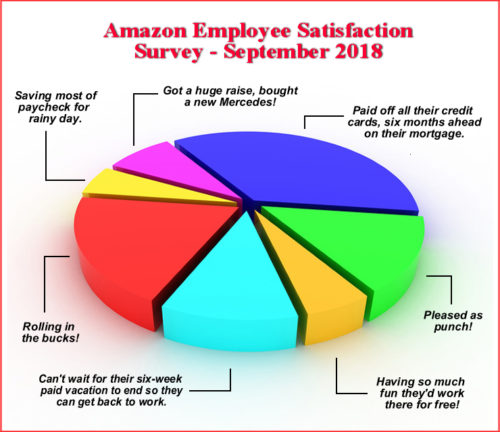
Obviously the above pie chart is a put-on. It is well-documented that working conditions for most employees of Amazon are  abysmaldehumanizing, bordering on abuse we normally associate with slavery.

Moreover, the median employee’s salary under Jeff Bezos’ imperial lordship is $28,446. No one working as a regular there has paid off their credit cards and is driving to work in a Mercedes. 

Jeff Bezos is referred to as The Richest Man in the World and his personal fortune, while growing by $191,000 each minute, is currently estimated at $168 billion.

So …

$28,446 vs. $168,000,000,000? While I can acknowledge the simple math, I find the contrast of such numbers on a gut level difficult to grasp.

To get a handle on such inequality, let’s try approaching it from different angles.

One way to put the disparity into perspective is to recognize it takes Bezos just under 9 seconds to earn what Amazon’s median worker does in an entire year.

Another is to recognize that for a worker to go through Jeff Bezos’ current personal fortune — and, of course, it continues mounting at accelerating levels as I write this — at his/her current median annual income of $28,446 per year, WOULD TAKE 5,905,927 YEARS! That’s close to 6 million years!

For Jeff Bezos himself to go through his current $168 billion, assuming his earnings stopped dead this very moment — which as you and I know they won’t — SPENDING $1,000,000 A DAY, would take NEARLY 460 years. Yes, even spending $1 million a day, in the year 2475 he’d still have plenty of cash, tens of million of dollars mad money. We can feel confident that he wouldn’t be foraging through the dumpster behind 7-11. 

Now, further consider that while the $28,446 median salary is above the national poverty line for a single individual if that person is the sole breadwinner for a family of four, it is marginally above it, which is why many Amazon employees must rely on government assistance to keep from starving.

As well as calculation, I did some speculation — a simple exercise in imagination.

Apparently Bezos’ wealth generating machine is raking it in so fast, he’s currently making $11.5 million per hour … every hour … 24 hours a day … seven days a week. $11,500,000 per hour! 

So here’s what I was picturing in my mind’s eye … 

If for 40 hours of the 168 hours in a week, Bezos were willing to scrape by on a mere $5,840,000 per hour, he could give every one of his 566,000 Amazon employees a $10 per hour raise. Of course, the remaining 128 hours in each week, Bezos could continue earning his normal $11.5 million per hour, not having to share any of it with the pathetic slobs who work for him.

Rhetorical question: Does Jeff Bezos have any concept of what that $10 per hour increase would mean to his employees? 

I’m not going to even suggest here I’m offering this for Bezos to entertain. There are so many advantages to him both as a putative member of the human race and the employer of over a half million workers — advantages that are so OBVIOUS — if they haven’t occurred to him up until now, then his brain functions in ways beyond my understanding. For one thing, he could point to his new fig leaf of “generosity” and ask people to stop calling him a selfish prick. Second, Amazon employees I’m sure would respond to his largesse with greater company loyalty and increased tolerance for his onerous working conditions. He’d still be the richest SOB on the block and could mock the pauperish Bill Gates and Warren Buffett as pitiable wannabees.

Consider …

The most poorly paid Amazon employee now makes $12 per hour. The $10 per hour raise I proposed would boost those $12 per hour workers right up there with Costco employees, who make an average of $21 per hour. And with the across-the-board $10 per hour increase, Bezos’ higher paid employees would be earning among the finest wages in the world provided by a major corporation. 

And by golly, there’s a plus side to the plus side …

Bezos’s bold and gracious gesture would result in a public relations coup of cosmic proportions! Amazon would no longer be demonized — well, not quite as much — by us bleeding-heart lefties as a capitalistic scourge and one-way ticket to Hell for the future of mankind, even if its environmental record is appalling and its business model generally the stuff of steroid-laced neo-feudalism.

Granted, Bezos would have to do some belt-tightening. He’d have to watch his pennies but could probably manage it, eh? Maybe he could skip a couple meals and do some of his own weeding at his estate. After all, after lavishing the $10 per hour raise on all of his employees, he’d only be pulling in $1,705,600,000 per week. I know I know! Like me you’re probably getting all teary-eyed for the poor guy.

Let me get to the extremely anti-climactic conclusion of this lament qua analysis.

Since nothing will change until the system itself changes, meaning the one in place now that creates, incentivizes, and lionizes the obscenely wealthy — reference current holder of the Office of President of the United States of America — I can only recommend this …

We have been labeling Jeff Bezos as ‘The Richest Man in the World’. Yet, quite honestly I don’t personally know any human, man or woman, who behaves like this gluttonous chunk of self-indulgent meat. It actually makes me nauseous to think we’re members of the same species.

Thus, from now on let’s use the correct terminology. Let’s call Jeff Bezos what he really is: the Richest Sociopath in the World.

We could probably order bumper stickers to help correct the record … from Amazon, of course.