After the Crash

Dispatches From a Long Recovery (Est. 10/2024)

After the Crash

Godzilla Amazon: The Amount of Power in Jeff Bezos’ Hands Should Frighten All Americans

Amazon very effectively uses technology and data to sidestep traditional restrictions on monopoly power.

By Matt Stoller

Source: AlterNet

To understand the depth and breadth of Jeff Bezos’ ambitions for the company he built, type www.relentless.com into your browser. The domain Bezos registered in 1994 will redirect to Amazon, the company aptly, and ambitiously, nicknamed The Everything Store. He tells his shareholders that the company will act like an aggressive startup — that at Amazon, it is always Day One.

Like Google and Facebook, Amazon uses technology and data to sidestep traditional restrictions on monopoly power. Our lives are increasingly organized by the platforms these companies run, platforms which now mediate the way we communicate and engage in commerce with each other. We are living in a world organized by tech monopolists, a change in power relationships that no one voted for but has been imposed upon us nonetheless.

Now, Bezos is attempting to add more power to his empire with the surprise announcement that the company will pay $13.7 billion for Whole Foods Market. Amazon will now have a store footprint in neighborhoods across America.

Our communities and the way we engage in commerce will change. Imagine walking into a Whole Foods store and seeing different prices depending on whether you are a member of Amazon Prime — or seeing different prices depending on any other way that you interact with Amazon.

This isn’t implausible. It is what the company does when it opens up stores. For instance, Amazon is creating a chain of physical book stores to take the place of the book stores the company destroyed. In these stores, there are no price tags at all: You scan the items with your phone and have a price delivered to you, personalized by Amazon. Why wouldn’t Amazon extend this to Whole Foods? “Our goal with Amazon Prime, make no mistake,” says Amazon CEO Jeff Bezos, “is to make sure that if you are not a Prime member, you are being irresponsible.”

This statement and the amount of power in Bezos’ hands should frighten all Americans. Bezos meant that Amazon will soon be so good for consumers that it would just be folly not to be a member. But what he unwittingly implied is that as a citizen, you will have no choice but to interact with his institution to buy and sell key goods that everyone needs — on his terms.

Jeff Bezos, in other words, has a vision. To be everywhere, to be the platform for everything for every consumer. So when Bezos calls you irresponsible for not tithing to Amazon, America has a big political problem.

Amazon’s takeover of Whole Foods means that it can target and eliminate regional competitors one by one as it did with its online competitors. When Diapers.com emerged as a competitor to Amazon, Amazon simply sold diapers below cost until the company capitulated and sold itself to Bezos. There’s no reason to assume Amazon wouldn’t bring the same predatory pricing strategy to bear in every city in America. Why wouldn’t it? Even though predatory pricing is illegal, the government hasn’t enforced those laws for decades. Whole Foods tends to source from local farms as part of a commitment to localism; these farms will now be negotiating with a much bigger entity that is committed to a ruthless model of efficiency.

There are so many ways that Amazon can use its power that it’s simply impossible to figure out what it will do. Amazon probably doesn’t even know yet; it will discover and test them, relentlessly. Maybe you will get first in line, or last in line, for the most popular toy during the Christmas period, or maybe the restaurant you own will get access to the freshest yet limited batch strawberries you need based on whether you are giving better deals to Prime members.

Or here’s a more creative possibility. Amazon is excluding Amazon Prime video from Apple TV so that Prime members will buy its streaming device instead of Apple’s. As the smartphone market commodifies and transforms, Bezos could simply use his combined physical and online footprint to keep you from even seeing prices at his stores unless you are using Amazon-approved electronic devices. If Amazon were just one of many stores that would be one thing. But Amazon is quickly becoming the dominant way to buy and sell.

And this, make no mistake, is what is happening. Upon the announcement of the acquisition, Target’s stock price dropped by 10 percent and Walmart’s by 5 percent. Amazon’s rose by more than the price it is paying for Whole Foods. Wall Street sees the writing on the wall. There is only one force that can stop Amazon from organizing and regulating basically all American retail commerce — our democratic institutions and our political system. We the people.

Bezos knows Amazon is a political enterprise at this point. The day before he announced his company’s attempt to buy this supermarket chain, he released a request on Twitter to have people offer ideas for where he can direct charity money. That is the kind of public relations undertaken by political leaders. And Amazon put out an ad for a Ph.D. economist-cum-lobbyist “to educate regulators and policy makers about the fundamentally procompetitive focus of Amazon’s businesses.” And he has put political fixers, like Ivanka Trump’s lawyer and ex-Clinton administration officer Jamie Gorelick, on his board of directors. He also bought The Washington Post.

The public should speak out in opposition to this merger. More than that, the government should take this opportunity to reject the entire pro-finance pro-concentration philosophy that has taken hold in this country since the Reagan era. It is no accident that Whole Foods founder John Mackey was forced to surrender his life’s work because financiers looking for a quick buck bought up a large bloc of shares in his company and pressured him to sell the company to Amazon. The day before the announcement of the sale, he called these hedge funds “Ringwraiths,” after the evil characters in “Lord of the Rings.” Bezos might be the most powerful empire-builder in the land, but he had help.

This merger should frighten all of us. But it should also embolden anyone who believes that America should not be in thrall to monopolists like Bezos. For them, today, as Jeff Bezos might put it, is Day One.

Matt Stoller is fellow at the Open Markets program, where he is researching the history of the relationship between concentrated financial power and the Democratic party in the 20th century.

The West’s War on Free Speech

By Tony Cartalucci

Source: Land Destroyer

With a name like the “National Democratic Institute” (NDI) one might expect the US State Department-funded, corporate-financier chaired front to be the premier proponent of freedom and democracy worldwide. And although it poses as such, it does precisely the opposite. It uses principles like free speech, democracy, press freedom, and human rights as a facade behind which it carries out a politically motivated agenda on behalf of the special interests that fund and direct its activities.

In a recent Tweet, NDI linked to a New York Times article titled, “In Europe’s Election Season, Tech Vies to Fight Fake News.” It claimed in the Tweet that the article featured:

A look at some of the projects aiming to use automated algorithms to identify and combat fake news. 

The article itself though, reveals nothing short of a global effort by US tech-giants Google and Facebook, in collaboration with the Western media, to censor any and all media that fails to align with Western-dominated narratives.

The article itself claims:

The French electorate heads to the polls in the second round of presidential elections on May 7, followed by votes in Britain and Germany in the coming months. Computer scientists, tech giants and start-ups are using sophisticated algorithms and reams of online data to quickly — and automatically — spot fake news faster than traditional fact-checking groups can. 

The goal, experts say, is to expand these digital tools across Europe, so the region can counter the fake news that caused so much confusion and anger during the United States presidential election in November, when outright false reports routinely spread like wildfire on Facebook and Twitter.

The article then explains that once “fake news” is spotted, it is expunged from the Internet. It reports that:

After criticism of its role in spreading false reports during the United States elections, Facebook introduced a fact-checking tool ahead of the Dutch elections in March and the first round of the French presidential election on April 23. It also removed 30,000 accounts in France that had shared fake news, a small fraction of the approximately 33 million Facebook users in the country.

Were foreign government-linked tech companies purging tens of thousands of accounts ahead of elections in say, Thailand or Russia, it is very likely organizations like NDI and media platforms like the New York Times would cry foul, depicting it as censorship.

In determining what is and isn’t “fake news,” the New York Times offers some clues (emphasis added):

Using a database of verified articles and their artificial intelligence expertise, rival groups — a combination of college teams, independent programmers and groups from existing tech companies — already have been able to accurately predict the veracity of certain claims almost 90 percent of the time, Mr. Pomerleau said. He hopes that figure will rise to the mid-90s before his challenge ends in June.

In other words, “fake news” is determined by comparing it directly to narratives presented by establishment media platforms like the New York Times, the BBC, CNN, MSNBC, Fox News, and others who have notorious track records of serial deception, false reporting, and even war propagandizing.

Nowhere does the New York Times explain how these “verified articles” have been determined to be factually accurate, and instead, it appears that all these algorithms are doing is ensuring all media falls in line with Western narratives.

If media in question coincides with Western-dominated media platforms, it is given a pass – if not, it is slated for expunging as described elsewhere in the New York Times’ piece.

Thus, the National Democratic Institute, who claims on its website to “support and strengthen democratic institutions worldwide through citizen participation, openness and accountability in government,” finds itself promoting what is essentially a worldwide agenda of malicious censorship, manipulating the perception of the globe’s citizenry, not supporting or strengthening it’s participation in any sort of honest political process.

To answer the question as to what the NDI is referring to when it claims other nations are “censoring” free speech and press freedoms, it involves defending local fronts funded by the NDI and its parent organization, the National Endowment for Democracy (NED) who merely repeat Western propaganda in local languages and with local spins. When foreign nations attempt to deal with these instances of “fake news,” US fronts like NDI and NED depict it as censorship.

While the West poses as the premier champion of free speech, citizen participation, openness, and accountability, the New York Times article reveals an unfolding plan to utterly crush any narrative that deviates from Western media talking points, thus controlling citizen perception, not encouraging “participation,” and ensuring that the West alone determines what is “opened” and held “accountable.”

No worse scenario can be referenced in human history or even among human fiction than plans to determine for the world through automatic algorithms and artificial intelligence almost in real time what is heard and read and what isn’t. It is even beyond the scope and scale of George Orwell’s cautionary dystopian “1984” novel.

In a truly free society, an educated citizenry is capable of deciding for itself what is “fake news” and what isn’t. Because of the rise of alternatives to the West’s monopoly over global information, many people are doing just that – determining that Western narratives are in fact deceptions. At no other point in modern history has the Western media faced as many alternatives, and as much skepticism on this scale, as well as an ebbing of trust domestically and abroad. It is no surprise then, to find the West resorting to outright censorship, even if it cushions mention of it with terms like “fake news.”

A dystopia in real time

By Dave Lefcourt

Source: OpEdNews.com

Let’s come straight out with it, to the US government, We the People are the enemy.

If you’ve read John W. Whitehead [1] regularly you’re already aware of that.

The tell-tale sign: surveillance camera’s seemingly everywhere. On most street intersections, photo enforced streets, roads by all schools, airports, railway stations, toll roads and all commercial stores.

Then there’s the ubiquitous, “If you see something, say something” heard in Metro subway stations, airports and railway stations. It’s portrayed as a necessary given for our “safety and protection” make us fearful of would be terrorists and other bad guys out to harm us.

But really ALL meant for the authorities to keep close tabs on us everywhere. Combined with electronic surveillance of our cell phones and computers-whether on or off-and the NSA pretty much has us under its constant surveillance.

Of course it’s all against the 4th Amendments strictures against “unreasonable searches and seizures” and without “probable cause” making it all illegal. Yet most Americans apparently don’t care taking the foolish “I haven’t done anything wrong so why worry about it” mantra.

It appears the public has been so propagandized and indoctrinated, they’ve accepted these illegal surveillance intrusions into their everyday lives.

But think about it: If the public absolutely objected to their governments spying on them these illegal intrusions could be severely curtailed, limited only to court ordered warrants for specific instances of suspected criminal activities-as legally specified in the Constitution.

The reason the government has become so paranoid of the people? They know we’re the many and they’re the few and if our police and military realized they were protecting and defending the indefensible, against the Constitution they’ve sworn to uphold, against all enemies, foreign and domestic, the party would all be over.

And that necessary “revolution” returning the government to and for the people could soon be realized.

Then all our illegal wars and occupations ended, the military downsized to defend only against an imminent attack, the billions spent on unnecessary defense industry weaponry eliminated, nuclear weapons eliminated and peace in the world realized.

So our government knows its biggest enemy is its own people, not terrorists, Russia, China, Iran or North Korea.

It’s us, you and me they’re really afraid of. That’s why they take the measures they do. Why they infiltrate peaceful protests and demonstrations with agent provocateurs who initiate violence giving the authorities the pretext to interfere and shut it down. It’s how “Occupy” was shut down in 2011 with government authorities acting in coordination nationwide.

It’s why the National Guard was called out to intervene in the summer of 2014 after police shot an unarmed Michael Brown in the streets of Ferguson, MO. when citizen protests erupted.

Now protests at political conventions are cordoned off far from the convention sites fearing a repeat of the protests and demonstrations at the 1968 Democratic convention.

It’s also why the military draft was eliminated specifically to get a compliant, all volunteer army of draft age men and women who were a significant part of those 1968 protests.

All governments propagandize and indoctrinate its people. In the US it starts with standing to recite the “Pledge of Allegiance” in our schools, the standing for the “Star Spangled Banner”, saluting the flag, belief in our “supposed” free elections, extolling the military as our “heroes”, the Navy a “force for good”, military flyovers at professional athletic events, spotlighting service men and women in the stands eliciting a standing ovation, playing “America the Beautiful” during the 7th inning stretch.

It’s all part of the indoctrination process.

When this past season professional quarterback Colin Kaepernick was ostracized refusing to stand for the national anthem before an NFL game he was condemned in the MSM as un-American, ungrateful and a traitor to his country. Though what he did was not illegal and protected under the Constitution.

Standing for and singing the national anthem is voluntary and not required. But long standing tradition has made it “appear” as required behavior.

It’s hard to know whether Americans are the most propagandized people ever. We certainly are obedient and compliant people accepting illegal government intrusions and generally accepting the governments explanations (propaganda?) of all significant national and international incidents.

It’s almost certain the government knows with a population generally compliant to its strictures it can and will do anything with impunity knowing it will not be held accountable for its actions.

That’s why “official” Washington represents the most dangerous, rogue state entity in the world and seen by most people worldwide as the primary threat to peace in the world.

Yet to most Americans we’re the beacon on the hill embracing freedom and democracy.

In America “official” lies have been taken on a whole new meaning, become the natural order of things; a dystopia in real time.

[1] John W. Whitehead, “Battlefield America: The War on the American People” and “A Government of Wolves: The Emerging American Police State”

Orwell, Freud, and the Syrian Ruse

Reality by other means

By Jason Hirthler

Source: Dissident Voice

We’re an empire now, and when we act, we create our own reality.

— Karl Rove speaking to a small group of reporters at a cocktail party in 2004…… printed in the Washington Post

The adjective ‘Orwellian’ is so overused mostly because it is so incredibly apt on a daily basis. George Orwell’s basic concept reflects a simple tenet of propaganda: the thing you are hiding is often hid behind its exact opposite. Orwell expressed this concept in 1984 with the government slogans, “War is Peace,” “Ignorance is Strength,” and “Freedom is Slavery.” The Austrian psychologist Sigmund Freud evidently suggested something similar about human nature: that to discover our true human nature, we need merely to reverse society’s moral maxims: if a commandment forbids adultery, it’s because we want to commit it. In other words, for both Orwell and Freud, we often disguise what we are doing behind claims that we are doing the opposite. We aren’t committing adultery; we’re practicing fidelity. We aren’t precipitating war; we’re pressing for peace. We aren’t seeking our own self-interest; we’re doing it all for others.

When applied to U.S. propaganda, the formula is revealing. To discover what your government is hiding, just reverse the media narrative. If the papers all say Russia is an imperial aggressor, it’s likely because Washington is. If the news networks say that Assad is a murderous monster, it’s likely because the groups we’re backing are. If the mainstream says Communism is a dire threat, it’s likely because capitalism is a dire threat. All of these examples are demonstrably true.

What confuses many readers is the fact that the first premise–that Russia, Assad, and Communism are all threats–usually has an element of truth to it, though not to the degree that it is portrayed. And so intelligent propaganda doesn’t simply traffic in lies, but rather half-truths, distortions, and omissions that themselves further distort a narrative. It is this sophisticated blend of fact, fiction, hyperbole and omission that makes propaganda so difficult to unpack for the average reader, who has little time, inclination, and practice in deciphering state-directed doctrine.

Reversing Reality

If Freud was correct, then we tend to publicly deny our greatest desires when they run counter to prevailing morality, shielding our base wishes behind a curtain of rectitude, even as we quietly pursue them. The modern instances of this in government are boundless. Example: FISA legitimates the surveillance it was designed to deter. Example: Congress abets the executive it was created to check. Example: ‘Defense’ becomes the aggression it was devised to defend against. Example: Healthcare becomes a bureaucracy built on denial of care in the name of its provision. Example. Journalism: the adversarial role of the fourth estate, becomes the adversary of the truth it was intended to protect. Journalists transcribe the diktats of power. Like the senators that notarize the mandates of the executive. Like the federal agents that entrap citizens in order to protect them. Like the drones that destroy lives to save them. Like the citizens who signal liberal values in support of imperial conquerors. Like the social justice warriors who legislate the intolerance they seek to eradicate. It seems to be a socio-political reality that the forcible assertion of one value guarantees a renaissance of its antitheses. Or is it that we forcibly assert a moral value to disguise a flowering of vice?

The process of turning a story into its opposite is fairly straightforward. If the U.S. is aggressively violating human rights, it needs to be rewritten as a defender of human rights. What this means in practice is switching the roles each of the actors assume in the narrative. Heroes become villains; villains become heroes; and victims are either genuine victims or villains depicted as martyrs for a righteous cause. This requires a good bit of romanticizing your side, demonizing the enemy, and eulogizing the victims. And then, as the author of Mein Kampf recommended, keep it simple. Your side wants one thing: peace. Your enemy wants one thing: war. And the victims want one thing: freedom.

Exhibit A

Take Syria as a recent example. The media narrative states that the U.S. and its freedom-loving allies have cautiously backed a loose confederation of rebels who rose up against Syrian tyrant Bashar al-Assad in 2011. In actuality, the U.S. and its freedom-hating allies have incautiously backed a loose confederation of foreign terrorists who have been paid to overthrow the elected Syrian President Bashar al-Assad. Only occasionally is the real backstory hinted at, which includes weakening Shia strongholds and destabilizing independent states in the region.

In turning the truth around to justify its war of aggression, the state and its supplicant media seized upon a handful of facts as the bedrock on which it constructed a false historical narrative. Which is what you’d expect from the Orwell-Freud model. And so…Are there elements of Syrian civil society that protested Assad in 2011? Absolutely. Are there actual Syrians fighting against Assad now? Sure. Are there elements of corruption and repression in Assad’s history? Definitely. But each of these truths are used to disguise the much larger facts of unmitigated U.S. aggression.

Upon this foundation, the typical narrative is constructed. The United States government is romanticized as a virtuous mediator concerned with supporting the freedom fighters and helping them achieve the freedoms they’ve yearned for. Assad is demonized as the autocratic mass murderer who repeatedly denies these freedoms, and tortures thousands before destroying the bodies. And the Syrian people, engine of the largest refugee crisis since World War Two, are shown as the valiant victims of the war, particularly in Aleppo, where the destruction of the city in an attempt to uproot the terrorist army is leveraged to milk as much emotional content from the war as possible and to further cement Assad’s reputation as a moral monster.

The MSM didn’t stop there. It followed with a series of attempts to further demonize Assad. A massive cache of photos purportedly detailing “regime” torture. This cache was delivered from somebody named “Caesar,” a defector not unlike the fake defector, “Curveball” from the run-up to the Iraq War. Twice false flags have been utilized to claim that the evil optometrist in Damascus has in a fit of pique demanded that innocent Syrians be sprayed with chemical weapons. Now a “crematorium” where Assad supposedly cremates all the Syrian citizens he is slaughtering (supposedly because he hates humanity so much). It doesn’t particularly matter if these stories eventually unravel when evidence is shown to be lacking. The damage is done to the psyche of readers and listeners, who absorb the media reports with the uncritical acceptance of animals entering an abattoir.

The takfiri mercenaries brought in by the West to topple Assad are likewise romanticized by the press. Instead of labeling the terrorists we backed as extremists, the New York Times peddled a story that they were moderates. Beheading of children, tossing gays from rooftops, using citizens as human shields, staging rescue operations, and many other atrocities failed to prevent the media from intransigently pushing this storyline.

No Quick Fix

As you can see, there is no shortage of opportunities to apply the Orwellian label to modern reportage. That said, I’m not suggesting that the authors at The New York Times and the Washington Post are all conniving propagandists consciously preparing deceitful reportage. For every Edward Bernays, there are a dozen Brian Williams. Often, they have simply internalized the values of the institution that employs them. They recognize, perhaps consciously or subconsciously, that their careers depend on their willingness to follow a particular narrative. And they make their choice, rationalizing themselves into a clean conscience.

Which is no surprise. The human species could give a master class in self-deception. And there are psychological needs that appear more urgent for us than truth. Namely, the need to feel good about oneself and believe in one’s tribe. Set aside the need to situate the world in a comprehensible narrative, the need to fit in with one’s peer group, and the need to do meaningful work and self-actualize in society. The point is that all of these needs are undermined by the counter-narratives of the left. Counter-narratives destabilize our cleanly delineated understanding of the world; they often ostracize us from our peer group; and they threaten our ability to contribute to society in a manner approved of by society (i.e., generally contributing to the machinery of consumerism). Who has time for a reconstruction of one’s worldview, especially if it might lead to social alienation? This is why just throwing facts at heavily propagandized people doesn’t often work. There are other forces in play, which may remind us that politics is often little more than a value signaling device for human beings.

So most of us, whatever inklings we may receive of an alternative reality, will settle for doing nothing untoward, recusing ourselves from political debates, and hewing as closely to inoffensive blandishments in our speech as we can. (The only other major path is to adopt the ideologically bankrupt cop-out of lesser evilism and rant about how horrible the other party is. This provides the frisson of feeling at one with the herd, but does nothing to improve society.) In other words, we shackle ourselves to political groupthink and play the role of the conscientious centrist like any good straight man would. We have no time for the revolutionary urgency of the disenfranchised. It was Dostoevsky’s Grand Inquisitor who argued that people don’t want intellectual freedom, but rather to be told what to believe. Only then will they be happy. Otherwise, we ruin our peace of mind through choice paralysis or some variety of existential angst, or through a lack of religious faith that leaves us with no guiding myth to sustain us. Given all these apolitical factors that inform whether or not one challenges the received narrative, is it any surprise that mental slavery and ignorance are as prevalent today as in Orwell’s time?

Accelerating Capital: Completed Nihilism and The Indebted Man


By S.C. Hickman

Source: Southern Nights

In his book Data Trash (1993), Arthur Kroker writes that in the field of digital acceleration, more information means less meaning, because meaning slows info circulation. In the sphere of the digital economy, the faster information circulates, the faster value is accumulated. But meaning slows down this process, as meaning needs time to be produced and to be elaborated and understood. So the acceleration of the info-flow implies the elimination of meaning.

—Franco Berardi, And: Phenomenology of the End

The pursuit of profit is the engine of Capital, accumulation is its outcome. Profit is from the Latin profectus, meaning  “advance, increase, success, progress,” out of which the need to benefit or provide income derived. This sense that progress and success drive the need for profit, that the goal of capitalism is this abstract movement toward increasing and advancing one’s success in the world has always been at the heart of the competitive spirit. To compete or strive against others for the foremost place, this sense of the competitive spirit that has been with us at least since the first Greek Olympics. The term itself “compete” is etymologically to enter or be put in rivalry with an other,” from Middle French compéter “be in rivalry with” (14c.), or directly from Late Latin competere “strive in common,” in classical Latin “to come together, agree, to be qualified,” later, “strive together,” from com “with, together” (com-) + petere “to strive, seek, fall upon, rush at, attack”.  A sense of violent taking and war against all comers for the top prize, the best or foremost place in the Sun.

As Berardi reminds us in the old industrial economy described by Marx, the goal of production was already the valorization of capital, through the extraction of surplus- -value from labour. But, in order to produce value, the capitalist was still obliged to exchange useful things, so he was obliged to produce cars and books and bread.

When the referent is cancelled, when profit is made possible by the mere circulation of money, the production of cars, books and bread become superfluous. The accumulation of abstract value is made possible through the subjection of human beings to debt, and through predation on existing resources. The destruction of the real world starts from this emancipation of valorization from the production of useful things, and from the self-replication of value in the financial field. The emancipation of value from the referent leads to the destruction of the existing world. This is exactly what is happening under the cover of the so-called financial crisis, which is not a crisis at all, but the transition to the self-referential financial capitalism. (A: 125-126)

Financial capitalism is no longer the pursuit of profit in the Greek or Latin sense I described. No longer is there a sense of the old value of the pursuit of excellence or an ill-defined sense of virtue. Rather there is no value at all in the outward sense, but rather value has itself lost its luster and only the sheer accumulation of abstract value in the form of debt remains. But what is debt? What exactly is this debt economy of financial capitalism. And, most of all, how does the spirit of capitalism in itself bring about the death of meaning (i.e., nihilism). If as many suspect we are in the moment when Capital is completing this process of nihilism, what does that entail for humanity?

As Berardi said in a recent essay,

The colonization of time has been a fundamental issue in the modern history of capitalist development: the anthropological mutation that capitalism produced in the human mind and in daily life has, above all, transformed the perception of time. But we are now leaping into the unknown—digital technologies have enabled absolute acceleration, and the short-circuiting of attention time. As info-workers are exposed to a growing mass of stimuli that cannot be dealt with according to the intensive modalities of pleasure and knowledge, acceleration leads to an impoverishment of experience. More information, less meaning. More information, less pleasure.

This sense that there is a connection between time, language, and capitalism that is playing out the endgame of nihilism in our generation is foremost in this equation. At the forefront of this is the notion of debt, and that we are entering an era of a new Guilt Culture based on an infinite and unpayable debt. A future imploding into a black hole of guilt and shame that will leave us and our planet bankrupt and without sense or value.

I’ve written of debt in other essays: here and here in which I follow Deleuze and Guattari down the rabbit hole. Alberto Toscano in an excellent essay on Maurizio Lazzarato’s book The Making of the Indebted Man talks of the indebted this way:

Artificially kept alive until they repay outstanding debts, they stalk the landscape of commodity refuse, scavenging, salvaging, recycling to shave off infinitesimal portions of their liabilities, living-dead labour both unproductive and profitable. Telescoping hi-tech financial expropriation and the lo-tech labour in the breakers yards of global capital, the indeadted embody a moment in which subjection to capitalist imperatives subsumes life to the point that it trespasses into death…2

Thanatropic capitalism feeding off the living dead, the zombies of a system that has become total predation on human life and the planet.

In Anti-Oedipus Deleuze and Guattari explain their sense of our current debt regimes:

Society is not exchangist, the socious is inscriptive: not exchanging but marking bodies, which are part of the earth. We have seen that the regime of debt is the unit of alliance, and alliance is representation itself. It is alliance that codes the flows of desire and that, by means of debt, creates for man a memory of words (paroles). It is alliance that represses the great, intense, mute filiative memory, the germinal influx as the representative of the noncoded flows of desire capable of submerging everything. It is debt that articulates the alliances with the filiations that have become extended, in order to form and to forge a system in extension (representation) based on the repression of nocturnal intensities. The alliance-debt answers to what Nietzsche described as humanity’s prehistoric labor: the use of the cruelest mnemotechnics, in naked flesh, to impose a memory of words founded on the ancient biocosmic memory. That is why it is so important to see debt as a direct consequence of the primitive inscription process, instead of making it – and the inscriptions themselves – into an indirect means of universal exchange. (p. 185)

For Deleuze and Guattari it is Nietzsche’s On the Genealogy of Morals that teaches us the truth of debt. In fact it was Nietzsche, and Nietzsche alone who provided the first hint of a theory that the “primitive socious” was inherently a “problem of inscription, of coding, of marking…” (p. 190). As they’ll state it:

Man must constitute himself through repression of the intense germinal influx, the great biocosmic memory that threatens to deluge every attempt at collectivity. But at the same time, how is a new memory to be created for man – a collective memory of the spoken word and of alliances that declines alliances with the extended filiations, that endows him with faculties of resonance and retention, of selection and detachment, and that effects this way of coding the flow of desire as a condition of the socious? The answer is simple – debt – open, mobile, and finite blocks of debt: the extraordinary composite of the spoken voice, the marked body, and the enjoying eye.” (AO: 190)

This sense that in financial capitalism is enforcing a cruel mimetic experiment of instilling and inscribing the Word of Capital upon the body socious; and, that we have reverted to the primitive tattooing systems by inscribing of the social body through the cruelest measures, imposing the harshest words of power over the flesh and blood of millions of indebted humans to suck every last ounce of desire from their zombie lives. This is the outcome of our completed nihilism. Capital as a machine of death and consumption, feeding off the desires of the indebted. If capitalism is defined by social production that passes through axioms of abstract quantities, flows of money and labor that are the real relations of alliance and filiation, rather than codes. Codes have become private matters, searches for meaning. This split between production and reproduction constitutes a very particular affective relation as well, which Deleuze and Guattari summarize as, “the age of cynicism, accompanied by a strange piety. These two affects, cynicism and piety, correspond to the division of social production and reproduction. In the first, in the axioms of capital, we have a social order that reproduces itself without meaning or code. Axioms merely set up a relation between two quantities, a flow of labor and a flow of money. One does believe in, or justify, the rate at which labor is exchanged for money—it simply is. Cynicism is an affect attuned to the indifference of the axioms that produce and reproduce social life, the recognition that the flows of the market mean nothing, have no justification, than their brute effectivity. (AO)

As Nietzsche would say,

All the stupidity and the arbitrariness of the laws, all the pain of initiations, the whole perverse apparatus of repression and education, the red-hot irons, and the atrocious procedures have only this meaning: to breed man, to mark him in his flesh, to render him capable of alliance, to form him within the debtor-credit relation, which both sides turns out to be a matter of memory – a memory straining toward the future. (On the Genealogy of Morals, p. 190)

This sense of debt binding us to a system of mnemonics and cruelty, an organized and ritualistic memory system based on marking and pain – inscription of the collective socious as a system of obligation and guilt, debt and the endless deferral of payment into the future. The ancestors require sacrifice and payment, blood and guts. Alliances against this filiation must be formed, struggles against the dead, defensive gestures: the infinite deferral of debt beyond the vampirism of the dead. This whole triangular process of voice – inscription – eye becomes in our time the “spectacle of punishment”: “as primitive justice, territorial representation has foreseen everything” (p. 191).

Even while we are punished and inscribed, ritually sacrificed to the modern Moloch and his retinue of High Priests and Financiers, the Oligarchs of the World we discover that Capital no longer needs to produce visible commodities, no longer needs to produce useful goods for its wage slaves, it can now bypass us, bypass our needs, our desires, our dreams for its own infinite and digital accelerated world of pure circulation and profit. As Berardi attests,

In the sphere of the financial economy, the acceleration of financial circulation and valorization imply the elimination of the concrete usefulness of products (no matter if material or immaterial, industrial or semiotic). The process of realization of capital, namely the exchange of goods with money, was obviously slowing the pace of monetary accumulation. The virtual technology has created the possibility of skipping this slow passage through concrete meaningful useful goods. (A: 126)

Invisible, immaterial, the new financial economy runs at the speed of light in an absolute timeworld, where profit is based on the virtual circulation of abstract value (not even money, but algorithms, electronic impulses) that has been accelerated and sped up to the point of totally escaping the possibility of human understanding and— obviously—of political control.(A: 126)

Value does not emerge from a physical relationship between work and things, but rather from infinite self-replication of virtual exchanges of nothing with nothing, whose outcome is more money. Digital abstraction leads to the virtualization of the physical act of meeting, and the manipulation of things. These new levels of abstraction do not only concern the labour process, they tend to encompass every space of social life. Therefore, digitalization and financialization are transforming the very fabric of the social body, and inducing mutations in it. (A: 127)

Berardi tells us to look at the reality of debt, look at the awful effects of submission, impoverishment and exploitation that debt is provoking in the body of society. Debt is a weapon against social autonomy, a transformation of money into a blackmail. Young people are obliged to borrow money from the bank in order to pay for their studies, as the public system of education has been destroyed by the Neoliberal fanatics, and private school is costing more and more. As soon as they come out from the university they have to start paying back their debt, and they are obliged to accept any kind of precarious job, and to suffer any kind of blackmail. (A: 128)

For such creatures the future can only be bleak and full of misery and endless years of untold grief as they strive to pay their debt. Many forgo such a Sisyphean project and commit suicide. Others mentally and spiritual die inside and live out the remainder of their lives as zombies under this terrible debt system. In our time whole nations have been blackmailed into this system of debt as we ponder the EU. This same process has already happened to much of the Third World nations for years under a predatory capitalism well documented by Naomi Kline in The Shock Doctrine among other works of like caliber.

Commenting on this dark scenario Berardi says “Money, which was supposed to be the measure of value, has been turned into a tool for psychic and social subjugation. The metaphysical debt is linking money, language and guilt. Debt is guilt, and as guilt it is entering the domain of unconscious, and shapes language according to structures of power and submission.” (A: 128)

The notion that our age old systems of power and coercion have migrated into the digital age and brought about a new guilt culture to subdue and channel the desires of nations into the profit bins of a minority of Oligarchs seems ludicrous at first glance as if this were some nefarious planned and intentional affair. But is it? Is anyone or anything behind such a sinister system of slavery and control? Is this a conspiracy of madness against the human species? Berardi will liken this process not to some power behind the scenes, but rather to the inherent power of language itself and how we for two hundred years have obliterated the hold language had on the referent:

This process of de-referentialization of language—emancipation of the linguistic sign from the referent—which has been the mark of poetic and artistic experimentation with language during the twentieth century, shows an interesting similarity with the transformation in the relation between economy and monetary exchange.

On August 15, 1971, President Nixon announced dramatic changes in economic policy. Particularly he ended the Bretton Woods international monetary system. The Bretton Woods system, created at the end of World War II, involved fixed exchange rates with the US dollar as the key currency—but also a role for gold linked to the dollar at $35/ounce. The system began to falter in the ‘60s because of an excess of dollars flowing out of the US which foreign central banks had to absorb. All of this was ended unilaterally by Nixon’s decision. After a brief attempt to create a modified fixed exchange rate system, the world moved to flexible rates.

Breaking the Bretton Woods’s agreements, the American President declared that the dollar has no referent, and its value is decided by an act of language. This was the starting point of the long lasting process of financialization of the economy, based on the emancipation of the financial dynamic from any conventional standard and from any economic reality. The Neoliberal offensive started in that very moment of arbitrary assertion of the value of the dollar outside the conventional standard. The neoliberal school of the Chicago Boys said “money is creating reality” like the Symbolist poets had said: “words are creating reality”. (A: 128-130)

Words had lost touch with their referent, the natural world and environment within which we all live and have our habitus. The disappearance of the natural and the virtualization of language produced the effects we see in the world today. We are the product of a process that undermined the ancient metaphysical systems of the world that guided primitive, feudal and early modern societies. In our bid to overcome the religious and metaphysical systems that held us in their clutches we also lost the world, our world. We lost the natural in life and ourselves, lost touch with the signs that kept us anchored to the natural environment that our brain had been tied to for sex and survival from the beginnings of the human. We ourselves in our bid to transcend the animal and inhuman in ourselves became non-human. We have brought upon ourselves the semantic apocalypse we see all around us. This is the guilt we bare and the debt we will have to pay, not the tributary debt to those few dark controllers who seek to lord it over us.

It was Jean Baudrillard who wrote in the Symbolic Exchange and Death, where he announces that the economy has abandoned the old law of determination of value, and that the referent for linguistic and economic exchange was dissolved:

“The reality principle coincided with a determinate phase of the law of value. Today the entire system is fluctuating in indeterminacy, all of reality absorbed by the hyperreality of the code and of simulation. It is now a principle of simulation, and not of reality, that regulates social life. The finalities have disappeared; we are now engendered by models… The entire strategy of the system lies in this hyperreality of floating values. It is the same for money and theory as for the unconscious. Value rules according to an ungraspable order: the generation of models, the indefinite chaining of simulation.” (Baudrillard 1976)

We have become mere simulacra of our former selves, simulated creatures in a simulated world. Bound and ensnared in a world of debt, controlled by an algorithmic system of digital hypersystems we live out our lives under the guilt of a system we ourselves helped create. We have no one to blame but ourselves. We know this. We deny this. We seek solace in escape and fantasy worlds of mediatainment that even further suck dry our desires and channel our hopes and dreams into a fantasia of tomorrows that will never come.

For Deleuze & Guattari this primitive system of memory and pain will enter the stage of religion as a debt to be paid ending in the death of Christ as the payer of all debts; and, yet, it will not end there, for debt can never be repaid, so it forms the kernel of the modern State: “the new machine, and the new apparatus of repression” (AO: 192). This system of endless debt: “that finds itself taken into an immense machinery that renders the debt infinite and no longer forms anything but one and the same crushing fate: the aim now is to preclude pessimistically, once and for all, the prospect of discharge; the aim now is to make the glance recoil disconsolately from an iron impossibility. The Earth becomes a madhouse.” (AO: 192)


  1. Berardi, Franco “Bifo”. And: Phenomenology of the End. Semiotext(e) (November 6, 2015) (A) (Page 126).
  2. Toscano, Alberto. Alien Mediations: Critical Remarks on The Making of the Indebted Man. The New Reader #1, 2017

Four Kinds of Dystopia

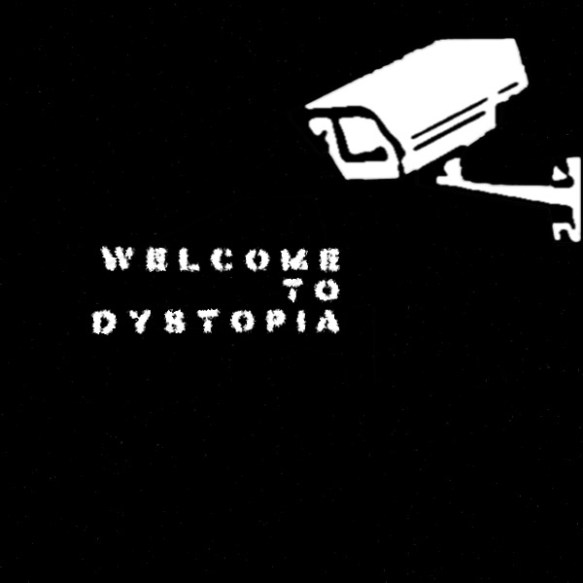
welcome_to_dystopia_by_crystalryu

By Darren Allen

Source: ExpressiveEgg.org

The twentieth century saw four basic visions of hell on earth, or dystopia. These were:

Orwellian. Rule by autocratic totalitarian people, party or elite group, limitation of choice, repression of speech and repression of minorities, belief in order, routine and rational-morality. Control by enclosure, fear and explicit violence. Violent repression of dissent (via ‘the party line’). Erotic physicality and sexual freedom suppressed via control of sexual impulses. Control of thought by explicitly policing language (Orwellian Newspeak).

Huxleyan Rule by democratic totalitarian systems, excess of choice, limitation of access to speech platforms, assimilation of minorities, belief in emotional-morality, ‘imagination’ and flexibility, and control by desire, debt and implicit threat of violence. No overt control of dissent (system selects for system-friendly voices). Erotic physicality and sexual freedom suppressed via promotion of pornographic sensuality and dissolution. Control of thought by implicitly enclosing language within professional boundaries (Illichian Newspeak, or Uniquack).

Kafkaesque Rule by bureaucracy. Control of populace via putting them into writing, forcing people to spend free time on bureaucratic tasks, thereby inducing tractable stress and the schizoid, self-regulating self-consciousness (anxiety about low marks, unlikes, official judgements and the like) that bureaucratic surveillance engenders. Generation of a system which structurally rewards those who seek an indirect relationship with their fellows or who, through fear of life, seek to control it through the flow of paperwork.

Phildickian Rule by replacing reality with an abstract, ersatz virtual image of it. This technique of social control began with literacy*—and the creation of written symbols, which devalued soft conscious sensuous inspiration, fostered a private (reader-text) interaction with society, created the illusion that language is a thing, that meaning can be stored, owned and perfectly duplicated, that elite-language is standard and so on—and ended with virtuality—the conversion of classrooms, offices, prisons, shops and similar social spaces into ‘immersive’ on-line holodecks which control and reward participants through permanent, perfect surveillance, the stimulation of positive and negative emotion, offers of godlike powers, and threats to nonconformists of either narco-withdrawal or banishment to an off-line reality now so degraded by the demands of manufacturing an entire artificial universe, that only hellish production-facilities, shoddy living-units and prisons can materially function there.

The reader can decide for herself under which of above we currently struggle to eke out a life worth living. I would like to suggest that all modern societies are both Kafkaesque and Phildickian with either a Huxleyan or Orwellian overarching framework; modern, western, capitalist societies tend to be basically Huxleyan (HKP) and pre-modern, eastern, communist countries tend to be basically Orwellian (OKP).

The reason why ideological managers** (academics, film directors, journalists, etc) prefer to have two (or more) dystopian systems is that it makes us seem like the goodies and them the baddies. Communism is to blame for their foodbanks and breadlines, but capitalism has nothing to do with ours (or vice versa). Sure our masses have the same miserable lives as theirs, reel under the same bureaucratic insanity, stumble around the same shoddy unreal worlds, and witness the same catastrophic destruction of nature and beauty as theirs do, but at least we’ve got democracy! / at least our families stick together! / at least the trains run on time! / at least GTA 9 is coming out soon / at least the Olympics will cheer us up (delete as appropriate).


This is an adapted extract from The Apocalypedia.


* Obviously I’m not suggesting that literacy is inherently or completely dystopian, but it is the beginning of a dangerous and distorting process, which starts with societies demanding literacy for participation — and devaluing orality and improvised forms of expression — and ends with the complete eradication of reality. This danger and distortion increases with every step towards virtuality (print, perspective, photography, television, internet) until, by the time we reach VR, there remains no possibility of reverie, transcendence, humanity, meaning or genuine creativity, all of which become suspect.

** And of course for those who depend on their illusions.

Lessons from George Orwell’s ‘1984’

1984

By Ethan Indigo Smith

Source: Waking Times

“Political language is designed to make lies sound truthful and murder respectable, and to give an appearance of solidity to pure wind.” — George Orwell

Some fictional literature is so profound as to be relevant for decades. George Orwell’s timeless 1984 is one such literary work. One of the most influential books of our time, its message resonates today as much as it did when it was first published over 65 years ago — as shown by its recent surge to the #1 spot on Amazon’s bestseller list.

So what can 1984 teach us about the modern day?

At its core, 1984 is a post-WWII interpretation of the relationship between individuals and institutions. It changed the course of social history by spawning new language relating to the structure and mechanisms of our society, expanding the scope of human language and thought, and therefore, humanity’s understanding of itself. And that legacy seems perfectly fitting, for in the story of 1984, the world is controlled by so many restrictions that even the expressiveness of the official language, “Newspeak”, is deliberately narrowed by the ruling institutions in a way that limits the ability of individuals to express “thoughtcrime” — that which is deemed illegal by the “Inner Party”, the State.

As a work of fiction, 1984 provides a stark view of a burgeoning culture of totalitarianism. As a work of symbolism, however, it stands as a reflection of modern fact in The U.S.A. and the world today. Within its narrative, the five freedoms of the First Amendment of the United States Constitution were infringed and removed; in particular, the freedom of speech was so restricted that there was only one source of news operated by the official governing body and an entire branch of government was dedicated to steadily eliminating language deemed detrimental to the State.

Orwell created new phrases like “Newspeak” (the official, limited language) and its antonym “Oldspeak”, “Goodthink” (thoughts that are approved by the Party) and its antonym “Crimethink”, and “Doublethink” (the normalized act of simultaneously accepting two contradictory beliefs). The new language allowed his narrative to portray and expose age-old structures of thought and language manipulation – structures that have exponentially escalated in the modern day.

In 1984 all opposition is controlled and absorbed into the background. ‘Big Brother’ is the human image that represents The Inner Party (and the Party line) via the Telescreen providing an ‘official’ narrative while appropriating and misrepresenting the notion of brotherhood and unity into a ‘brand name’ — one that actually instills a psychology of collectivism, not brotherhood, just as the controllers in our own world instill nationalism and war-mindedness in the name of “freedom” and “liberty”. Indeed, the Telescreen is the primary means through which norms were forced on the society and false imagery and narratives embedded in its collective consciousness. Totally transfixed on the Party line, as told by the Telescreen, the fictional society of 1984 has lost the ability to think such that it will believe two plus two is five, as the saying goes, as long as it is presented as such on the Telescreen. They have been captive to this set up their entire lives, and, with language and thought restricted and outlawed, they are blind to their own captivity, unable to discern for themselves. Thus, lies are made to be “truths” using logic so distorted that it not only convinces the masses that two plus two equal five, but that war is peace, freedom is slavery, and ignorance is strength.

In reality, individual ignorance is strength to institutions. Such distortions of language and thought (and, incidentally, history) are the perfect means by which to disempower and co-opt an entire society — means that are not limited to the works of fiction. Orwell knew that ideas do not exist separately from language. Language, in both spoken and written forms, is essential to our ability to form and communicate thoughts and ideas. That is why today the United States government, the shadow powerbrokers that control it, and the mainstream media that support it (the entirety of which is owned by only 6 corporations) continue their war on “fake news” — i.e. ideas that are skeptical of government pronouncements, and information that proves them to be false — taking aim not just at independent journalism but independent thought itself. While government surveillance of its own people continues to increase, government secrecy is at an all-time high, the sharing of ideas that challenge the status quo is becoming more heavily censored, releasing information on institutional and State activity is now punishable by law, and whistleblowers from inside the State are systematically destroyed. If that wasn’t Orwellian enough, Donald Trump’s advisors have begun coining phrases like “alternative facts”, and we have even seen the creation of an Orwellian “Ministry of Truth”, an “international fact-checking network” charged with deciding what is “truth” and what is “fake news”.

If the events of 1984 continue to hold true, and the ruling Party of today gets its way, words and ideas will soon become not only censored, but illegal and eliminated altogether, controlled by increasingly totalitarian governments steering our society down a dystopian path of censorship, blind belief, and misinformation — all in the name of the State. However, as our minds are freed, one at a time, we are ultimately finding that our society is heavily embedded with such norms and structures that perpetuate false imagery, preserving the status quo of the State from the ‘threat’ of individual thinking — hence the modern war on “fake news”. We are beginning, as a society, to question such falsehood, and exercise our inherent freedom to expose it.

“Freedom is the freedom to say that two plus two make four. If that is granted, all else follows”. ~ George Orwell

The Last Man in Europe

The original working title to 1984 was ‘The Last Man in Europe.’ This descriptive and evocative title idea provides a clear glimpse into George Orwell’s intent, and encapsulates a main point of 1984, a title perhaps too revealing to be anything but a working title. Certainly, that is the way many of us feel when we first become aware of lies and partial-truths that are presented as reality by those in control of our society today, and accepted in totality by seemingly everyone else – it is as if we are the last lone person. Indeed, the road of the freethinker can be a lonely one, and the story’s protagonist, patriot Winston Smith, is made to believe he is the last person who questions, who looks, listens and speaks.

In a totalitarian society — be it Orwell’s fictional world or the increasingly authoritarian political regimes of today — the official narratives portrayed by the “official” media portray that a society is in consensus with the State, and that those engaged in Thoughtcrime (whether or not it is legally a crime) are isolated social outcasts and lunatics, and demeaned as “rebels” and “conspiracy theorists” (despite the existence of actual conspiracy, against which the truly conscious mind must inevitably rebel.) Yet in reality, Crimethink is what differentiates we freethinkers from those who are lost in the spell of societal illusion and, therefore, pose a threat to the status quo of the State. But this is part of the trap of Goodthink — it creates the illusion of consensus, and therefore, engenders isolation in those who do not concede.

As a master of his craft, nothing Orwell wrote was off the cuff. Now it is not overtly spoken in the book, but there are four types of people in the fictional realm of 1984. There are three described classes and a suggested fourth, only later is it implied that the Brotherhood, anti-establishment rebels — has been eliminated from the narrative jut as those in power sought to eliminate them from the society.

The Secret to 1984 is ‘4’

1984 is in part an expose on the four basic types of people in a society, the four types of institutions and the four types of institutional lies that enable them.

Characterized by how they respond to information, modern societies are made up of four archetypes of people — idiots, zealots, elitists and patriots. Idiots refuse information, zealots blindly refute information, elitists misuse information, and patriots seek and distribute information. Despite dramatic alterations in the world’s geopolitical landscape, and some fluctuation of individuals from one group/role to another over time, the dynamic between these groups has historically remained the same, and are inevitably intertwined: Idiots avoid all new pertinent information in order to maintain their perspective, never questioning the status quo. Zealots ask certain questions of certain information, ignoring unaligned information in order to maintain their perspective, supporting the status quo at all costs. Elitists question information in order to manipulate and reap gains off those who don’t know, benefiting from the status quo. Patriots question information to educate themselves and share it with others, in order that we might enhance our lives and progress beyond the status quo.

It is no wonder, then, that the patriot has been all but deleted from today’s socio-political landscape, with those acting as true patriots being demonized by the State, and the meaning of the word “patriot” distorted and confused (by the likes of George W. Bush Jr.) to mean an unquestioning, flag-waving, with-us-or-against-us brand of nationalistic idiocy. (Check out my article, The First Amendment – The REAL Patriot Act for a deeper discussion of this.) Using a practice so well-defined by Orwell that it is known today as Orwellian speak, institutions transfer and confuse words and ideas by mixing up themselves, their policies and their products with patriotic ideas and words. They take the meaning of words and archetypes, and flip them on their heads: War is peace, freedom is slavery, ignorance is strength, and true patriotism (such as that shown by government whistleblowers) is traitorous.

In reality, the true patriots, the rebels who see through the lies of institutions and act accordingly, are removed from public consciousness in exactly the same way. In “Orwellian” fashion, the fourth deleted class of people in 1984, the Brotherhood, who are working to bring down the fascist Inner Party, are deleted through the admission of language. The other three types, which are specifically mentioned in the-book-within-the-book, the fictional The Theory and Practice of Oligarchical Collectivism, are the High, the Middle and the Low castes. Similarly, the other three types of people depicted in the society of Oceania are the Inner Party, the Outer Party and the Proles. The social classes interact very little.

The Inner Party and Outer Party make up 2% of the population, and are the institutionalized controllers of Oceania. They are akin to modern politicians and the financial elite, working with and against one another, and clamoring to gain and maintain power. They have privileges the other castes do not, including being able to (temporarily) turn off the propaganda-spewing Telescreens.

However, there is a pecking order within the Party. The Outer Party are given state administrative jobs and are composed of the more educated members of society. They are responsible for the direct implementation of the Party’s policies but have no say in decision making. They are the “artificial middle class” and as such, have strict rules applied to them. They are allowed “no vices other than cigarettes and Victory Gin”, are spied on via their Telescreens, and are encouraged to spy on each other, and to report suspicious activities to Big Brother.

The lower class of workers that perform the majority of menial tasks and labors are known as the Proles. They live in the poorest of conditions, are not educated, and instead are kept entertained with alcohol, gambling, sports, fiction and pornography (called “prolefeed”) — the 1984 equivalent of “bread and circus”.

According to the Inner Party and the Telescreen it controls, those who might challenge the system – the important fourth type of person – simply do not exist. The Brotherhood, the organization of patriots, are portrayed by the controlling ‘Inner Party’ as only a rumor, and the notion of their existence is belittled by the Inner Party, via the Telescreen. In Oceania, if the Telescreen is t be believed, there are no patriots, nor is such action allowed — and any who think that way are isolated by the divide-and-conquer tactic used by empires past and present. Thus, like so many in our failing society, Smith believes himself to be ‘The Last Man in Europe’…

“During times of universal deceit, telling the truth becomes a revolutionary act.” – George Orwell

And yet, as the character of Winston Smith accurately observes in his diary, “If there is any hope, it lies with the Proles” — just as our hope for today lies with the so-called “99%”. The “proles” in our society must begin to look beyond the bread and circus, beyond the prolefeed, and become a true brotherhood, and sisterhood, by questioning information, educating themselves, and sharing what they learn with others in order that we might overcome institutional oppression and finally create the ‘golden age’ that is our combined potential.

God and Gold is Within

“We shall meet in the place where there is no darkness.” — George Orwell, 1984

Nothing Orwell wrote was by accident. The name of the character who leads the Brotherhood rebellion is named Emmanuel Goldstein, a name that translates roughly to mean God (Emmanuel) and gold are within (Goldstein). The use of this character name by Orwell asserts a developed, even transmuted human being, who has transcended the imposed limitations of the system he is opposed to, and grown from dull to refined, disempowered to empowered. It also reveals Orwell’s knowledge of how such patriotism and rebellion can become revolution.

The word “prole” is short for prolétariat, a French word derived from the Latin proletarius, meaning “a man whose only wealth is his offspring, or whose sole service to the state is as father”. A word evoking pure institutionalized collectivism, it suggests that the individual has no value other than the labor and progeny he provides to the State. (If you’re only value to the state is as a breeder and consumer, well what kind of world does, sorry, would that result in??) Now compare that definition to the name Emmanuel Goldstein, Golden Godliness is Within. In complete contrast, it is a statement of inner development, of individual enlightenment and empowerment — which, as Orwell knew, are the only forces that can successfully lead a rebellion against the institutional oppression of both fiction and reality.

So, you see, the secret to 1984 is ‘4’. Its most powerful message is in its omissions: in the omission of information, which is the only way the Party/State can maintain authoritarian control, and in the deliberately-omitted fourth human archetype, the righteous rebel, the marginalized voice of descent who is led to believe he is the “last man in Europe”. But in fact, the last man in Europe is you and I. We are everywhere. And, as we open our minds and our mouths, and embrace the gold within, we re-tell the lost narrative of the Brotherhood, and turn our Proles into our Brothers.

The Future of Crime

mindinvaders

(Editor’s note: This essay was originally published in G-Spot 14 Winter 1994 and later included in the anthology book Mind Invaders: A Reader in Psychic Warfare, Cultural Sabotage and Semiotic Terrorism [Home, 1997]. Though intended as speculative satire, aspects of it now seem eerily prophetic.)

By Stewart Home

Source: Stewart Home Society

In the nineteen-sixties a group of French radicals called the Situationists suggested that ‘freedom is the crime that contains all other crimes’. Things have changed a lot since then, although those at the top of the social heap still believe that the vast mass of humanity are simply cattle to be fattened and slaughtered. It sounds like a cliche, but it’s now ten years since 1984 and the hardware for our total electronic control not only exists, it is also completely obsolete.

The industrial economy based around railways, electricity and the car is a historical curiosity. Until recently, the technological innovations revolutionising society were centred on the generation, storage, processing and transmission of information. Today, we are witnessing the rise of a new technological revolution, a bioeconomy dependent upon genetic engineering, nanotechnology and neurocomputers. Obviously, the level of scientific, technological and cultural development within any given society dictates the types of crime that may be committed within it. Among nomadic tribes, the chief crimes are rape and murder. With the establishment of agriculture and the development of a class system, theft became the major concern of those who controlled the fast expanding, and increasingly bureaucratic, legal system.

A lot of would-be trendy magazines and tv programmes like to pretend they’re covering the cutting edge of crime by running features on computer hacking. Basically, what these people present as the future of crime is hi-tech theft, with cybernauts ripping off money from bank accounts and credit card facilities. When you think about it, this scenario isn’t so different from some farmer of three thousand years ago stealing his neighbour’s cow. A theft, is a theft, is a theft, despite the fact that the methodology of larceny is transformed by technological developments.

What isn’t being reported by the mainstream media is the way in which biotechnology, based on genetic engineering, is being used to boost the profits of multinational corporations as it simultaneously destroys the health of ordinary people. At its most simple, this consists of drugs like Thalidomide being prescribed to pregnant women in Brazil, despite the fact that Thalidomide is banned in Europe because it causes children to be born without limbs. Biotechnology gets even sicker when it’s combined with pre-existing forms of mind control based on psychiatric and electro-shock treatments.

While RoboCop and Terminator were presented to the public as futuristic scenarios, they portray a situation that already exists. The technology required to remake a man or woman, either psychologically or physically, has existed for years. This is where the future of crime really lies, because the police and intelligence services require criminal activity to keep them in a job. While biotechnology is being used to transform the bulk of the population into obedient slaves, the psychological aspect of such mass brainwashing works much more effectively when a minority of individuals are programmed to act as violent psychopaths. The passive majority already accept that the constant surveillance of both public places and cyberspace is fully justified to protect them from those maniacs who threaten the smooth functioning of a well ordered society.

A huge body of publicly available literature exists on CIA experiments such as MK-Ultra, which used LSD as a means of turning ordinary men and women into mind controlled zombies. A number of MK-Ultra test subjects were programmed to slaughter their fellow citizens. Everyone from Luc Jouret and Charles Manson, to Jim Jones and Mark Chapman, the bloke who murdered former Beatle John Lennon, is a victim of coercive psychiatry which transformed them from a regular guy into a murder maniac. During LSD sessions, these future killers were subjected to ‘psychic driving’, a torture technique which consists of revelations extracted under psychoanalysis being played back over and over again, via a helmet the victim can’t remove. In the future, virtually every piece of mayhem to gain widespread publicity will be the involuntary act of some helpless sap whose murderous antics were pre-programmed in a government institution.

Alongside increasingly sophisticated mass murder programmes sponsored by the security services and multinational corporations, there will be resistance from those groups who have already been criminalised for wanting the freedom to party. The Criminal Justice Act, now in force, makes raves illegal and worse is to follow. Fortunately there are still plenty of people about who want to defend themselves from this crackdown. In England, the resistance will be led by the London Psychogeographical Association, who will use games of three-sided football to free people from the shackles of dualistic thinking. Already, the state is preparing to outlaw football played on triangular pitches, with three goals, where a tally of the goals conceded reveals who has won. The shifting allegiances this game brings into play teaches people to break out of the dualistic system of thought that tricks them into becoming victims of the mind control techniques employed by the ruling class.

When three-side football is banned, which will certainly happen in the next two or three years, the London Psychogeographical Association will organise games in abandoned multi-storey car parks and the basements of deserted office blocks. Some games will be played for a full ninety minutes, while others will be broken up by the cops. Anyone arrested will have been told in advance to claim that they are Luther Blissett, a name which has been appearing mysteriously on buildings all over Bologna, Italy, in recent weeks.  Some of those who are nicked during games of three-sided football will later reappear among their friends, and with great sadness they will be killed, to free them from the programming that’s destroyed their personality and will compulsively drive them to murder anyone who resists the state. This is the future of crime and it demonstrates that the Situationists were right. FREEDOM IS THE CRIME THAT CONTAINS ALL OTHER CRIMES.

Lara Trace Hentz

INDIAN COUNTRY NEWS

In Saner Thought

"It is the duty of every man, as far as his ability extends, to detect and expose delusion and error"..Thomas Paine

ZEDJournAI

Human in Algorithms

Rooster Crows

From the Roof Top

Aisle C

I See This

The Free

blog of the post capitalist transition.. Read or download the novel here + latest relevant posts

अध्ययन-अनुसन्धान(Essential Knowledge of the Overall Subject)

अध्ययन-अनुसन्धानको सार