I Participate

they-live-street-signs

By Jonathan Bessette

Source: Adbusters

Recall that you’re sitting in a rapid transit vehicle, carried along the sky-line above cement highways, paved in homage to the Romans, who designed a system of militarized paths stretching everywhere, causing everything to lead back to one place. Here we are everyone, the year of the Monkey, 2016, 98 years after The Great War … too bad it isn’t the year of the Dalmatians … Mickey Mouse recently Tweeted that Disney is working on buying the rights to the Chinese lunar calendar. Imagine 12 animated classics framing each and every year for the remainder of humanity’s existence. 

At this point human society is so vast, so complex, so multilayered, that it is impossible to stay updated, engaged, and participating in every area of local and global importance. Education takes us from a place of innocence, creativity and joy, forcing us to fall into the institutional lines of desks and faced forward attention. As a nodal point of knowledge each new person will be filled to the brim with information that makes them useful to the status quo.

Neuroscience now tells us that the brain has plasticity and the neurosynaptic networks that are created through nurturing, which become identity and personality, can be changed and overwritten. Newer pathways can be formed and strengthened and older ones can be reduced. Does this mean that our free-will has a physical manifestation as identity, as culture, and every choice affects the people, animals and objects around us? Everything we think and do reinforces everything we think and do, creating a strange logical loop which justifies our lives as ourselves. Without any major impetus, what reason do we have to change? Why compromise our internally consistent narrative and accept the narrative of someone else? What stands to be different?

Surreality is becoming a more constant state as life in the present starts to look like Science Fiction of the future from the past. The last historian wandering around Paris in the 21st Century, forgotten by a technologically advanced world that cares only for materialism. A beguiled Case, the lead character of Gibson’s Neuromancer, disenfranchised because he can no longer participate in the romance of cyberspace, looking something like a hacker barred by the law to approach or touch a computer. Of course cyborgs, robots, virtual reality and AI dance at the periphery, the momentum of current technological trends, yet we titillate ourselves with the practical possibility of these totems nearing our hearts and minds.

Information overflows like never before. Some cry Apocalypse! End Times! The Rapture! But most of the world is still filling up their gas tanks, believing that the day when Climate Change will actually affect them is the day that it will be clearly outlined in a power point presentation, at their offices or wherever they work, explaining the equity found in maintaining current profit margins while in the same breath rearranging the economic vehicle of prosperity.     

“Change without Changing!” might be the Party Slogan for whoever runs for the Presidency after Obama sputters to a close.

Take my hand and run through the ever-increasing fields of soya beans, where we can hear the Monsanto genetically-modified breeze blowing the answer in the wind, whispering corporate sonatas, proving that commercial capitalism is a system of religion. Faith in Profit! The Gospel of Endless Progress! Join our Church of Business! Maybe Monsanto can use its private militia to assassinate Thomas Piketty, because of the seeds he’s sowing about capitalism being a mechanical beast that needs regulation because its fuel is the disparity between rich and poor … the larger the gap the more efficacious the fuel.

Then I think whether or not you’ll be reading this on paper or a flat-screen … whether either will be made from recyclable resources, and the argument that the printed word is less sustainable than the digital, so let’s put them to the test, right here, right now:

What can you do with a single piece of printed paper? Read it, eat it, burn it, re-write on it, make origami, a paper airplane or a boat, use it as a funnel, snort powders with it, wipe our bums? What can we do with a tablet? Access every possible available medium via the Internet and software?

It takes at least a lumber, ink, metal, and print industry to create the basic elements to manufacture printed media on a large scale. The average printed matter, kept in modest condition, can last up to 100 years and still be usable. The space that a single printed work takes up is quite large, creating the need to provide space of the material itself. When recycling an old book there are few components to worry about, making it rather simple.

It takes at least most types of mining and the processing of raw materials (petroleum, silicon, zinc, aluminum), software and hardware development, manufacturing, and the assembly of components to create a tablet. The average tablet, kept in modest condition, can remain functional until it’s obsolete. It certainly will not last 100 years, and even if it did the components, chips and circuitry would be so worn down that anything you might have used it for would no longer be possible. Of course you can store a million, a billion, even a zillion books on a single tablet, but will everyone have equal access to it? Tablets are extremely difficult to recycle, their components don’t just make up another tablet. The loss from entropy alone assures destruction, and we cannot grow more zinc, petroleum, or aluminum.

But really none of this matters, we don’t have any control over what corporations choose to do with our futures, or what medium we will use. These new, futuristic developments, intended to define human culture, are being devised and formed inside of grand boardrooms, in tall skyscrapers, by CEOs and shareholders. They, the 1%, are only concerned with whether the product they create for us will become a necessary commodity, like food, like water, like shelter … like Subway, like Coke Cola, like Single Room Occupancies (SROs).

You hear someone talking about the protest on Burnaby Mountain. People don’t want Kinder-Morgan expanding the capacity of an already existent pipeline because it will significantly increase the traffic of oil tankers in the Burrard Inlet. Someone else discusses the unrest of activist groups in Vancouver; about the substandard living conditions; the war on the poor; the two new prisons … they care about housing those who arise from poverty and have been given nowhere else to go. Anger overtakes you for a moment and you think, I don’t like this, why is there so much injustice, maybe I can do something about it…

A flabbergasted voice backtracking intellectual missives comes on over the radio, you’re not sure if it’s in your head or not:
“Revolution is just going around and around, it’s a cycle, it begins with violence and it ends with violence and it only achieves the same power structure that precedes it.”

You think about the French Revolution, the Arab Spring, Anonymous, and realize grass-roots change can rise up from the ground, from the dirt, from the dust whence we came, to challenge the oligarchical deities of the political / corporate aristocracy. We can sell everything we own and buy whole streets collectively, live there together, change the land and what’s on it together. We can join all kinds of innovative communities. We can gather in massive groups and walk through the streets, calling attention to everything corruption has built up around us. We can participate in Civil Disobedience, because the obedience that is asked of us causes harm to someone or something that is alive and is not fairly allowed to defend itself.

No matter how much Ayn Rand and Alan Greenspan and Justin Trudeau tell you that the money will trickle down, no matter how much they tell you that they are the ones who created the railroads, produced the banks, developed the industries that sustain our economies … they didn’t do a damn thing. We laid the tracks, we hammered the spikes, we drove the trains, we maintained the services, we built the buildings, we painted the walls, we fitted the plumbing, we opened the doors, we mopped the floors, we surveyed the land, we mineral tested the rock, we operated the drills, we processed the crude and we shipped the products. None of these things that they presume to own did they make or build. They didn’t put one brick in the wall, they didn’t dig one trench, and they didn’t turn one switch. It’s all ours…

Now an unsettling feeling might skitter across you when you realize that you are implicated in this whole thing. Why do we feel so disenfranchised? Why does the 1% own so much more influence, so much more than we little peons? I feel powerless but every day I participate in the construction of human society. Every action contributes to a massive effect called the singularity of my life. Don’t fall into the kinds of aporia that Jacques Ellul observes in The Technological Society, where no one claims responsibility for the projects of technology. Who made this computer? Was it the engineers, or the design team, the software developers, the hardware makers? Or was it the companies who mined the silver, the petroleum, the zinc, the aluminum, the silicon? No single person in the process can take responsibility for the whole … so no one does, they just accept it, and its justification is its presence.

Well then … we are in a pickle aren’t we? But maybe revolution is the act of taking responsibility? Clips of revolution flicker through your mind-film, you see riots, Molotov cocktails, police lined up with transparent plastic shields. You realize you do not want to risk your comfort, your coziness, your conformity, so you fit in and play nice and salute whoever is in power. Or maybe you are just not interested, you have your soma, your serial monogamy, your fair trade Americano. Besides, you’re too busy, you’ve got kids, you work 60 hours a week, you recently bought a home in one of the most expensive housing markets in the world, you already have enough responsibilities …

Teaching Children How to Think Instead of What to Think

pink-floyd-the-wall-alan-parker

By Will Stanton

Source: The Mind Unleashed

Right now our education system is doing more to indoctrinate our children than to educate them. In fact, that has been the case for quite some time. Our young minds are being told to accept authority as truth instead of truth as authority, and teachers talk at the students instead of with them.

Teachers have become repeaters of information. They are merely regurgitating everything they once learned from their own teachers, and perpetuating the recycling of information; information that has managed to evade scrutiny for generations. Children are no longer the masters of their own learning, and instead, their minds are being treated as storage containers.

The factory model of education, with its focus on academic and economic elitism, is churning out obedient workers for the system, encouraged to conform every step of the way. We are not being treated as organic, creative, investigative human beings, but instead as parts in the machine. The education system is filtering out the inquisitive nature of our being, with the ultimate goal being to prevent dissent against the system. The system doesn’t want thinkers. It doesn’t want people to question its methods. It wants a population that can be easily manipulated and controlled so as to relinquish all its power to the elite.

There are those who say that skills cannot be taught in schools. Socrates would likely scoff at that notion, were he still alive today. It was Socrates who said, “I cannot teach anybody anything; I can only make them think.”

If we’re going to solve the problem of indoctrination in our school system, we have to learn to begin asking questions instead of giving answers. Real learning is achieved through the investigative process. Children have to be encouraged to search for the answers themselves. It is up to the teachers to provide the tools and resources necessary for the children to conduct these inquiries and make meaningful discoveries. One well-formed question will do more to inspire than any number of answers. In every facet of our educational pursuits, it becomes crucial to begin an open dialogue with our students, to encourage healthy debate and to have them form their own conclusions.

The importance of teaching philosophy in schools cannot be underestimated. In a world where most of humanity is running on the treadmill with the blinders on, it is paramount that we re-evaluate our own perspectives from time to time, and look at the big picture.

What teaching philosophy does is it gets us thinking, it gets us questioning, and it gets us contemplating. Without these skills, humanity will continue to function on autopilot, and we will allow those in power to continue to dominate, oppress and enslave us in every way.

We need to reclaim our own minds…


SMARTPHONES, SOCIAL MEDIA AND SLEEP: THE INVISIBLE DANGERS OF OUR 24/7 CULTURE

cell-phone-addiction

By Martijn Schirp

Source: High Existence

If there is one book to read about our addictions to work, phones, consumption, and the current state of capitalism, it’s 24/7: Late Capitalism and the Ends of Sleep by Jonathan Crary, a professor of Modern Art & Theory at Columbia University. Crary argues that sleep is a standing affront to capitalism and while that seems grim, it highlights the very real dark sides of always having glowing LED screens clutched in our hands.

Technology has ushered us into a 24/7 state: we live in a world that never stops producing and is infinitely connected. We have digital worlds in our pockets, and we carry our phones and screens everywhere, feeding our dopamine addictions when we’re bored or lonely, cradling us before bed with endless scrolls of news and waking us up with notifications and emails.

The barrier between work and home life has disappeared, and most professionals are able to and choose to continue working all hours of the day in an increasingly competitive, winner-take-all environment.

Most of our time then, is either spent working or consuming (the upside of working so much is money, which is then used to consume): food, drugs, shopping, films, Youtube videos, Instagram feeds, news articles, updates from friends — even socializing-time has been reduced to a passive “Netflix & Chill”.

There are now very few significant interludes of human existence (with the colossal expectation of sleep) that have not been penetrated and taken over as work time, consumption time, or marketing time.

The social-world and the work-world are both digitized, which makes it increasingly difficult to distinguish between the two, and beyond the pop-ups and video ads, individuals have become their own marketers. Building a “personal brand” as a living is not uncommon.

It is only recently that the elaboration, the modeling of one’s personal and social identity, has been reorganized to conform to the uninterrupted operation of markets, information networks, and other systems. A 24/7 environment has the semblance of a social world, but it is actually a non-social model of machinic performance and a suspension of living that does not disclose the human cost required to sustain its effectiveness.

The average North American adult “now sleeps approximately six and a half hours a night, an erosion from eight hours a generation ago, and down from ten hours in the early twentieth century,” and what suffers most from this lack of sleep is our innate ability to dream. Most people tend to forget or don’t even think about their dreams, much less their extraordinary ability to control them. What is frightening about this is the prevalent attitude of accepting the current state of reality as it is:

The idea of technological change as quasi-autonomous, driven by some process of autopoiesis or self-organization, allows many aspects of contemporary social reality to be accepted as necessary, unalterable circumstances, akin to facts of nature. In the false placement of today’s most visible products and devices within an explanatory lineage that includes the wheel, the pointed arch, moveable type, and so forth, there is a concealment of the most important techniques invented in the last 150 years: the various systems for the management and control of human beings.

What may be the most important fact to remember: Nothing must be as it is. Here are a three ways to escape the never-ending 24/7 state:

Unplug Your Phone & Plug Into Your Imagination

Break your cell phone habit. The dopamine addiction is real. I keep my phone in a Faraday pouch, which blocks signals to my phone and keeps me to my rule of no cell phone or screen use one hour prior to sleeping and one hour after waking.

As “visual and auditory ‘content’ is most often ephemeral, interchangeable material that in addition to its commodity status, circulates to habituate and validate one’s immersion in the exigences of twenty-first-century capitalism,” it is important to focus on the power of our own imagination. The hierarchal and algorithm-driven fields of social media and newsfeeds tend to serve us things we already know or like, and keep us wanting.

Instead, we can explore the limitless field of our imagination. Write down your dreams in the morning and use them as a vehicle for self-exploration, or venture into lucid dreaming to manifest your own desires or to explore creative pursuits. And yet for most of us, when walking, during our daily commute, even sitting on the toilet or in any moment where it’s just us and our thoughts, we turn to our cell phones for comfort, to fill the silence:

One of the forms of disempowerment within 24/7 environments is the incapacitation of daydream or of any mode of absent-minded introspection that would otherwise occur in intervals of slow or vacant time.

Even when socializing with friends, it’s a common habit to check our phones again and again. I’ve found that when one person does this, it enables others:if I see someone sitting across from me at a dinner checking their Instagram feed, I’ll feel less guilty about doing the same. Make it can stop with you — turn off your phone.

Reevaluate Your Drug Habits & Addictions

Beyond digital dopamine, are you addicted to caffeine, sugar, alcohol, adderall, cocaine, Ambien, Lexapro, vicodin, etc., etc.? We live in a self-selecting society, where some drugs are perfectly acceptable as long as they are prescribed by a doctor and other drugs are deemed dangerous. I used to babysit for an eight-year-old who was fed Ritalin daily for his ADHD, and then at night, had to take a tranquilizer to help him fall asleep. He was speedballing throughout his childhood, and I’ve met others who had the same experience only to question the impact of these drugs on their personality and life-path.

There is a multiplication of the physical or psychological states for which new drugs are developed and then promoted as effective and obligatory treatments. As with digital devices and services, there is a fabrication of pseudo-necessities, or deficiencies for which new commodities are essential solutions… Over the last two decades, a growing range of emotional states have been increasingly pathologized in order to create vast new markets for previously unneeded products. The fluctuating textures of human affect and emotion that are only imprecisely suggested by the notions of shyness, anxiety, variable sexual desire, distraction, or sadness have been falsely converted into medical disorders to be targeted by hugely profitable drugs. Of the many links between the use of psychotropic drugs and communication devices, one is their parallel products of forms of social compliance.

Ritalin, adderall (and cocaine) not only make the takers compliant but fueled to tackle the 24/7 lifestyle, deadening empathy, increasing competitiveness and perhaps is linked to “destructive delusions about performance and self-aggrandizement”.

While methamphetamines are regularly fed to children, psychedelic drugs tend to be demonized as extreme and dangerous. Yet, refreshingly, there are organizations now like the Multidisciplinary Association of Psychedelic Studies (MAPS) and other studies looking into how psychedelics can not only treat addictions, anxiety, and disorders, but also how psychedelics can expand consciousness and leave lasting personality changes for the better.

Find Your Passion & Connect With Real Life Communities

Crary argues that “whatever remaining pockets of everyday life are not directed toward quantitative or acquisitive ends, or cannot be adapted to telematic participation, tend to deteriorate in esteem and desirability.” Our tendency to tie our social worth to digital networks takes the saying “if a tree falls in a forest and nobody is around to hear it, does it make a sound?” and turns it into “if you do something fun and meaningful and don’t post it to social media, does it matter?”

But those meaningful moments in real life do matter, as does having a strong community to participate in. After all, addictions are a result mostly of isolation and bad environments:

As stated earlier: it is much easier to fold to the insidious trap of looking at your cell phone or constantly working if the person across from you does so first. Find your passion beyond the screen. Find your source of dopamine, what drives you, what engages you and makes you want to get up every day.

Finding a real community centered around a meaningful activity can help tremendously. For me, rock climbing is a meditative activity that requires focus and attention, and is anchored in a community of people who are invested in your success as much as they are in their own. The nature of the sport is so individual because each person is unique; climbing is a niche that carves out time for people to participate in life without any social rules and concepts of winning over another. Climbing outdoors is a way to be connected to nature and to just hang out with friends.

I just returned from a week in New York City, the city that never sleeps, the capitol of the 24/7 world, and it took me two weeks just to be able to find the time to sit down and write this. It is not easy to accept the bleak claims in Crary’s book because it would be admitting our own addictions and how we play into this non-stop state. It’s just as hard to look away from our screens, but you can. Tonight, don’t put your phone or laptop into “sleep mode” — turn them off, and pay attention to your own dreams.

Further Study:


24/7: Late Capitalism and the Ends of Sleep
 by Jonathan Crary

24/7: Late Capitalism and the Ends of Sleep explores some of the ruinous consequences of the expanding non-stop processes of twenty-first-century capitalism. The marketplace now operates through every hour of the clock, pushing us into constant activity and eroding forms of community and political expression, damaging the fabric of everyday life.

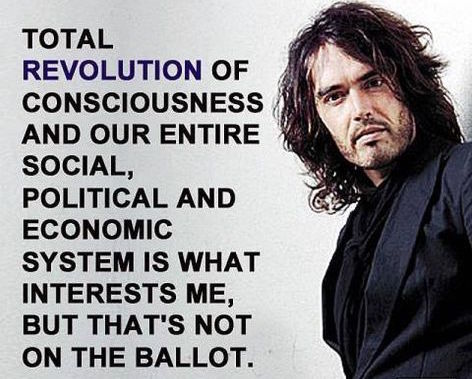
Your Awakening Counts More Than Your Vote

russell-brand-total-revolution-of-consciousness

By Dylan Charles

Source: Waking Times

We live in a world where illusions are held in higher esteem than verifiable truth. This is no accident, as the individual has for decades now been on the receiving end of social engineering programs, advanced political and corporate propaganda, fear programming and outright mind control.

The sum total of all this mass conditioning has been to convince otherwise good-natured and hard-working people to participate in their own enslavement and to willingly acquiesce to the ever-increasing rules, invasions of privacy, taxations, permissions and control schemes of a government and world elite who have long since left public interest in the dust.

The American dream is a mythic idea that was supposedly founded on the principle that public oversight of government is possible thanks to an electoral process which would give an informed citizenry the opportunity to replace undesirable politicians with better ones. Government itself, though, is a brutish and violent force that has time and again proven absolutely wild, reckless and untamable. It has never has obeyed its own laws, policies or regulations, and world history is a bloodstained chronicle of man’s failure to control himself when given power in the form of government.

Just as you cannot stop the tides from rising and falling, you cannot stop government from decaying into tyranny, especially so by following its very own rules and by participating in its token rituals.

This is truth, yet the illusion of so-called ‘democracy’ persists, seeming to grip people ever more feverishly with each passing election season. Even in the face of overt election fraud, party infighting, delegate rigging and widespread disenfranchisement. And so here we are again, facing the embarrassing spectacle of choosing between two undesirables when we all know the game is rigged.

For the powers the be, though, the repeating four-year cycle of presidential politics is the most effective device for keeping the masses high on the illusion of self-governance. It force feeds us on a regular schedule the false narrative that we the people can vote to reign in the power and corruption of the oligarchy of deep state, private and corporate influences that truly control the direction of this nation.

In this light, the purpose of national politics is not to perpetuate self-governance for the benefit of the common person, but rather to eat up personal energy and resources in order to suck the individual into a quagmire of false hope and endless patience with outrage after outrage. It is to make ineffectual action feel like action to the people being most screwed over by the corruption of the elite.

Sure, this may sound negative, cynical or apathetic to those who are over-invested emotionally in this game, but in order to move beyond the insanity of doing the same thing again and again while expecting different results, it’s imperative to be deadly honest about how this program works to enslave us, not to free us. Once we can think beyond the peer pressure, neighbor-hating, and mindless outrage that marks each election cycle, we make ourselves available to the possibility of real change. And real change always begins from within, and never forced from without.

There is no political leader who can make you stand fearlessly in this complex and dangerous world.There is no candidate that can give you the freedom that comes with a healthy mind and body. There is no political ruler who can manifest true and lasting happiness for you. There is no politician who can ensure that you enjoy the experience of your life everyday, under any and all circumstances. And there is no president that can empower you to be the best possible version of yourself so that you may give your best to others.

All of these qualities are vastly more critical to personal, community and planetary renewal than whichever new figurehead is selected to be the perceived front man of a morbidly corrupt American government.

The most effective way to change the world around you is to first focus on and create more value in yourself. This is why your awakening counts far more than your vote does. 

Modern Fictions – How the Sacred Manifests in Chaos, Superheroes and Outer Spaces

3124315-chaoswar00302

By Kingsley L. Davis

Source: Reality Sandwich

The virtual topographies of our millennial world are rife with angels and aliens, with digital avatars and mystic Gaian minds, with utopian longings and gnostic science fictions, and with dark forebodings of apocalypse and demonic enchantment
Erik Davis

…All our so-called consciousness is a more or less fantastic commentary on an unknown, perhaps unknowable, but felt text…
Frederick Nietzsche

Science fiction is always more important than science
Timothy Leary

Everything that can be said has already been said, or something to that effect. It is not original to make the statement that originality no longer exists as it’s all been done before. Yet, as Marshall McLuhan famously said, ‘the medium is the message.’ So it may not be the message we are concerned with here but rather the medium of its passing. And the adage goes that everything exists according to ‘time and place.’ When the ‘sacred speaks’ – so to speak – it does so through the ways and means of the times. This could apply to prophets, oracles, and channelling as well as pop culture and its modern fictions. The sacred, the sublime, has always walked amongst the profane. The signs are everywhere, blended into the sidewalks, pulp fictions, and the kitsch ‘n’ kool of the art world. For iconic sci-fi writer Philip K. Dick, most of the sublime things of his world were disguised as trash that seamlessly slipped into the background of a dysfunctional world reality. As modern society slipstreamed into a post-modern smorgasbord of chaos, clutter, poetically burnt outbursts, and beatific revelations, a new landscape of the sacred was scattered across the bedrock. The seeming trash of the everyday mundane clashed with the incoming cosmic, and a new urge for the transcendental found its way into so many popular cultural forms that it would take an encyclopaedic mobius-strip to recite it all. For my purposes here I will only all-so-briefly take a hop and skip around some of the budding flora that displayed a burgeoning sacred urge to blur the boundaries and reach for the sublime connection.

However paradoxical it may sound, one of the mediums for the sacred virus to spread came through the channel of chaos. Chaos, contrary to what we may think of it as being an anarchic and senseless cacophony, is actually a canvas for patterns to play out on. As the later emergence of the chaos sciences showed, there was a theory behind chaos – a method behind its apparent madness. Chaos, as we soon learned, did not operate in isolation. As the famous ‘butterfly effect’ was apt at promoting, a minimal disturbance in one part of the world (e.g., a butterfly flapping its wings) could result in a climate effect in another part (a tornado was often cited!). Everything thus existed in patterns, and not in arbitrary, random molluscs and mole-hills. The Santa Fe Institute (founded in 1984) quickly became a prominent centre for the research into complex systems, otherwise known as chaos science. Yet the emergence of chaos science had been actualized earlier through many different cultural forms of recognizing ‘chaos’ as a precursor to states of consciousness. Many forms/functions that emerge as aspects of the human condition are first seeded in popular culture ahead of their wider actualization. After all, the basis of the sacred refers to actualized aspects of human consciousness. And what the sacred art shows us is that its presence in our reality-matrix is determined by our capacity of consciousness to receive and acknowledge it. Chaos, as well as being patterns embedded in physical, computational, biological, and social systems, is also patterns of our minds. In fact, it can be said that chaos is part of the order of the cosmos.


Chaos & the Cosmic

“Tis an ill wind that blows no minds” – Principia Discordia

The signs for magic, chaos, and transcendental byways were popping up almost everywhere on the western landscape in the post-war, post-modern years. Enochian magic, Golden Dawn rituals, and meta-computing of the self were seeding a growing experimentalism of the human mind. In the US especially, a blend of anarchic cultural subversions were manifesting that played upon known semi-mystical memes. One of these was the text of the Principia Discordia that emerged in the nineteen-sixties as a ‘sacred text’ of Discordianism. Written by Malaclypse the Younger (Greg Hill) and Omar Khayyam Ravenhurst (Kerry Thornley) it proclaimed “All hail Discordia!” in a mixture of goddess worship with the notion of order and disorder as balancing illusions. The fifth commandment of Principia Discordia states, ‘V – A Discordian is Prohibited of Believing What he Reads.’ In mode with a rising tide of memes dealing with truth-through-contradiction the Principia Discordia also went on to claim that,

All statements are true in some sense, false in some sense, meaningless in some sense, true and false in some sense, true and meaningless in some sense, false and meaningless in some sense, and true and false and meaningless in some sense.

Discordia came to influence the writings of maverick author-philosopher Robert Anton Wilson, who popularised it further in his books, especially in ‘The Illuminatus! Trilogy.’ These utterances were echoed by the writer William S. Burroughs who, besides experimenting in cut-up narrative techniques, proclaimed a Discordian-esque ‘Nothing is absolutely true – Everything is permissible.’ Burrough’s infamous outburst was a culmination of religious history (the Assassins of Hassan-i Sabbah) with anarchic chaos from his spirit-possessed universe.

Around this time literate and literary magicians were cropping up everywhere, writing tracts on magic for a modern reader. Many of these literary figures were connected to the Golden Dawn system of magic. Yet another emerging stream was that of chaos magic which originated in United Kingdom in the late seventies. This broader magical path was liberal enough to combine forms of neoshamanism, eastern philosophy, quantum science, visionary art, and later computer technology. This experimental perspective on magic was part of a wider trend in experimenting with known forms for new avenues of stimulating and awakening consciousness. These ‘chaotic’ paths were attempting to destabilize our conditioning patterns and our resultant consensus reality. They were all aimed at waking up the usually-slumbering human mind. As the seminal work Waking Up (1986) by Charles Tart showed, humanity was largely intoxicated with a ‘consensus trance’ that kept us from recognizing sigils of the sacred. In more recent years the metaphors and memes of being trapped within a waking dream, or of dreams within dreams, have been explored in such popular films as ‘The Truman Show’ (1998); the ‘Matrix Trilogy’ (1999-2003); and Inception (2010). Part of the myth we find ourselves popularising is the mythology that we are in some sort of constructed reality – a gnostic-inspired simulacrum of truth.

Gnostic ideas are being gnawed over, processed, and consumed in ever more popular forms of culture. There’s an odd wave of mystical-spiritual impulses now radiating through popular culture that encourages us to throw ourselves into new world-spaces, fantastic realms, and mythological fictions and factions. These are new mash-ups of the counterculture now being packaged and presented as part of mainstream culture. And in recent years the most extraordinary success in this area has been the incredible, phenomenal rise of the modern superhero.


Superheroes & the Super-Self

Ever since Nietzsche first declared that ‘God is dead’ we have been reeling and dealing from our encroaching mortality – and trying to avoid this by seeking new technologies and cultural expressions of immortality. This collective experience on the possible ‘death of god’ is like a shock hammer-blow that propels us against the loss of sacred meaning and sublime mystery. Whether we admit it or not we fear the sense of absence, where nothing exists to which we can lend our communal assent. We don’t wish to struggle fragmented and bewildered, abashed by creative forms of indulgence. We cannot be left behind, losing our vital contact with the imaginal, the numinous, or the magical. We cannot be left untransformed in our vacant spaces as a paranormal pop culture washes over us. No – we need our superheroes, our possibilities, our potentials. We need to find a cultural expression for the human psyche; for our psychic currents and transmissions and sacred communication – our superheroes must live on!

Perhaps through the loss of our gods we have had to become our own multiple gods, as we realized a need to fill a vacuum left by myth. With the loss of the godly connection a different psychic wave was released upon the world to coincide with a rising arc of human consciousness. According to Jung, the gods gradually became our disease – ‘The gods have become diseases…who unwittingly let loose psychic epidemics on the world.’[1] These diseases have now morphed into mutations that make us into a hybrid human-god, with superhuman capacities, yet shunned by the world for being heretical against the natural order. We have the X-Men walking amongst us, a mutant subspecies of humans. The natural order is evo-mythological – it is sacred, beyond human, and connects us with evolutionary currents. In the absence of our ancient myths we have ingested the sacred alchemical root and through pop-culture morphed this transformation into the new wave of superheroes – myth lives anew in spandex. Maybe it is a cliché because it is true; we wish to find the personal superhero within each of us – the journey of the individual, unfolding within the great cosmic drama. This myth – this journey – has largely been taken from us through scientific rationalism and an industrial modernity. Yet now, by becoming more than oneself, we serve the larger story arc.

Our popular subcultures are gradually becoming the norm.  It is not only a question of whether more people are interested or not, but rather that these ideas are more widely available now thanks to popular culture. As William Irwin Thompson notes – ‘We Americans, who are so intent on creating a culture of technological materialism, cannot take in esoteric lore directly; it has to find another way in, and so comic books, science fiction, and movies are the back door.’ [2] Popular culture has been the back door for most of us, and not just for the Americans. But now perhaps the door frames are merging into the background and disappearing altogether. The waking life and the dream are becoming part of the same movie plot, as in Richard Linklater’s film version of Philip K. Dick’s A Scanner Darkly (2006). We are more and more waking up into our own movie – our very own Truman Show – where ideas are seeded directly into our environments in order to catalyze our awakening. Like the ancient Eastern tales told us, we have been asleep in a distant land and now we are receiving messages – signals – flashing like neon signs through our popular culture. This marks our juncture, our crisis point, between moving toward waking up or falling back into archaic, catastrophic and catatonic slumber. Again, Thompson reminds us that we ‘intuitively sense our evolutionary crisis and are expressing the catastrophe bifurcation through art – primarily through science fiction.’[3]

Our ultra high-definition visual culture is acting like a portal for the otherworld to enter. The psychedelic experiences that were once fringe and condemned are being re-played out through modern fictions that blend Gnostic tropes, mythological memes, and multidimensional portholes. Transcendental states of consciousness, ratified by the far explorations of new science, are adding to the mix of a new 21st century mythology that as of yet remains unnamed. Perhaps we are emerging toward the birth of new sacred gods. These are the gods of mutations, of neurological and biological adaptations. And they are emerging first in our pop-culture as our superheroes and psychic mutants. In this initiation into a psychically enhanced future we will need more than ever to learn how to distinguish the demonic from the spiritual. Hence the current barrage of cultural tropes in our films, TV series, and fiction that show angels vs. devils, humans vs. vampires, and the whole gamut of the good vs. the bad that has crawled from the forest floor to enter into the quest for the holy grail. All the while the Fisher King sits immobilized, feasting on an orgy of massively multiplayer online role-playing games (MMORPG). In this way the gods will never be forgotten as they merge with a super-augmented mutant humanity in spandex. As psychologist James Hillman says,

Remember: what the Greeks said their Gods asked for above all else, and perhaps only, was not blood; it was not to be forgotten, that is, to be kept in mind, recollected as psychological facts… [The God’s] reality can never fade as long as they are remembered, that is, kept in mind. That’s how they survive. [4]

The real gods, as we knew all along and yet had forgotten, reside within our psyche – they are kept in mind. And yet they can only become real for us – to re-mind us – when dashing about on the stage and streets in front of our very eyes. We need the sacred to slap our faces in spandex gloves before we begin to blink a waking eye.

As Jeffrey J. Kripal writes in his Mutants and Mystics, we have entered the stage of ‘Realization’ whereby we begin to recognize that the events around us in popular culture are not only real but are participatory. That is, our sacred and supernatural fictions appear for us and require our engaged reading of them in order for them to read us. Kripal says that,

In some fundamental way that we do not yet understand, they are us, projected into the objective world of events and things, usually through some story, symbol, or sign. Realization is the insight that we are caught in such a story. Realization is the insight that we are being written.[5]

The latest revival in the superheroes genre is significant in how it takes the mutant trope further and projects it forward as a form of evolutionary mysticism. Our new heroes are displaying to us our latent capacities and powers that are yet to unfold. We are witness to the first wave of mutant evolutionary pioneers. The summit of human evolution is far in the distance, and yet its early stages are manifesting through the Marvel and DC Universes where god-like potentials await us. Through such characters as Spider-Man, Iron Man, Captain America, Wolverine, and Doctor Strange, Marvel mesmerizes paranormal subliminals into popular cultural consciousness. And DC does the same with Superman, Batman, Wonder Woman, Green Lantern, Flash, and Green Arrow. Then as gangs they come together as the Guardians of the Galaxy, the Fantastic Four, the X-Men (Marvel), or as the Justice League (DC). They are now our teachers, our guides, our mutant futures that are beyond human. As Kripal recognized, the mutants have become practicing mystics.

We are seemingly living more and more in a mutational and metaphysical universe; and with the arrival of augmented reality our boundaries of interaction with the physical world around us will blur. And yet this suggests a return to the sacred perspective whereby the tangible and intangible worlds become an integral part of our holistic reality-matrix. And we are already well on our way as our outer and inner spaces explode into new blistering supernova.


Outer Spaces – Inner Spaces

Humankind has always been a child of the stars. Our early civilizations mapped the heavens before they mapped the terrain under their feet. The abode of the gods was amongst the glitterballs of the night sky, and their chariots blazed across the incandescent cosmic canvas. So it was no surprise then when the UFOs started to dart across our urban skies and come crashing down disguised as government weather balloons. Recent popular culture has nurtured a fascination with outer spaces and our galactic cousins from the Golden Age of science fiction of the nineteen thirties, forties, and fifties to the new wave of the sixties and seventies. The concerns of our outer space relations shifted from how to make contact with our space cousins to the entropic death of the universe. And then the environmental trope entered our outer spaces, as if a subliminal projection from our very own inner spaces. The sacred inner space of humankind was now tethering with the galactic outer spaces concerned with our future place in the universe. The growing number of alleged UFO abductees that emerged in the latter part of the twentieth century began to relay messages of extraterrestrial concern for our planetary well-being.

John. E Mack, an American professor of psychiatry at Harvard Medical School, in his later years became a leading authority on the spiritual or transformational effects of the alien abduction experience. Mack came to view the alien abduction phenomenon as acting as a catalyst to ‘shatter the boundaries of the psyche and to open consciousness to a wider sense of existence and connection in the universe.’[6] For more than a decade Mack rigorously studied the alien abduction phenomenon and interviewed hundreds of people (whom Mack referred to as ‘experiencers’). What initially started out as an exercise in studying mental illness soon turned into an in-depth inquiry into personal and spiritual transformation. Mack eventually came to see the alien abduction phenomenon as one of the most powerful agents for spiritual growth, personal transformation, and expanded awareness – in other words, as a trigger for a sacred experience. Despite the external anxiety produced by the experience, it was clear to both Mack and his set of experiencers that a profound communion was being established between humankind and other realities. Further, that this interaction was catalyzing a shift in human consciousness toward collapsing the old models of materialistic duality and opening up a connection not only ‘beyond the Earth’ but with other dimensional realities. Mack notes that ‘the process of psychospiritual opening that the abduction phenomenon provokes may bring experiencers to a still deeper level of consciousness where the oneness or interconnectedness of creation becomes a compelling reality.’[7]

This interconnectedness became a channel for the experiencers (abductees) to receive an impressive range of information; such as healing knowledge, spiritual truths, science, technology, and ecology. A major part of the information was apparently concerning the status of the Earth and humanity’s relationship with its environment. Many of the experiencers referred to their own abduction phenomenon as participating in a trans-dimensional or interspecies relationship. The transformative effects of these unusual encounters were often remarkable. Mack’s experiencers talked about an expansion of psychic or intuitive abilities; a heightened reverence for nature; the feeling of having a special mission on Earth; the collapse of space/time perception; an understanding of multi-dimensions of reality and the existence of multi-verses;  a feeling of connection with all of creation; and a whole range of related transpersonal experiences. Significant from these accounts is that, according to the experiencers, the abduction phenomenon is sometimes accompanied by a sense of moving into, or connecting with, other realities or dimensions. The sacred space and outer space were becoming one and the same. Or to put it another way, the contact initiated from those ‘out there’ was having a catalyzing effect to trigger an awakening in the inner spaces way ‘down here.’ It made sense then that our human future was going to include space migration. And according to our galactic cousins, it may even be a necessity if we continued to mess up our planetary home as if it were nothing but a playground to scoff around in.

Inner space junkie Timothy Leary was already riding that space-me-outta-here ticket with his S.M.I.2L.E. philosophy. Leary’s S.M.I.2L.E. stood for Space Migration, Increased Intelligence, and Life Extension. Basically, these were all the tropes from the post-humanism melange added on to the sci-fi dream of humanity living off-planet. We also have now the commercial race to establish a new branch of space tourism, with Virgin Galactic being one of the visible and vocal frontrunners. SpaceX, another private enterprise, is banking its dollars on helping to colonize Mars. There’s no lack of vision, it’s now down to the know-how and the technological leg-up. Now that the space cat is out the bag (excuse the pun), it’s only going to be a matter of time before the picture we have of ‘being human’ will incorporate the starry, cold vistas of outer space. From the earliest sacred expressions in the cave art of our ancestors to the ideas of space migration, they all show two fundamental urges within the human being: i) I am human, I am here (recognition); and ii) Where is the heavenly connection? (contact). Human dreams have encompassed living on Mars, leaving and migrating beyond the solar system, and of contact with ‘Higher Intelligence.’ Gene Roddenberry, creator of Star Trek, managed to combine both contact and communication through his receiving of channelled information. It has been documented that Roddenberry was introduced to an entity called ‘Tom’ who represented the Council of Nine, through the channel medium Phyllis Schlemmer. Roddenberry was allegedly receiving information for a film script to be written that would help prepare the public for extraterrestrial contact. The alleged film never got made, yet we might wonder what ideas made their way into Star Trek (including Star Trek: Deep Space Nine). It appears that there are those ‘out there’ who are concerned for our proper preparation for the sacred communion. And the archetypes are now flooding through our popular culture like an evangelical tsunami.

The mythic archetypes from Joseph Campbell’s The Hero with a Thousand Faces filled out the roles in George Lucas’s epic Star Wars universe. The good, the bad, and the hairy all took their cue and played along with the hero’s journey for an updated mythological rendering. Whilst the rise of industrial modernity and the secularization of culture may have contributed to an eroding of our myth-consciousness and a demotion of mystery, a new vital force has emerged that is shifting our planetary pranic energy. There may be those who bemoan that our current civilization does not have a mythic centre, yet they’re missing the point. And this point is that there is no exact point anymore. As hermetic lore states, the center is everywhere and the circumference nowhere. The earlier gods retreated back on their sky chariots until we finally arrived at the point where we asked ourselves where all the gods went. The new sacred guides are now secreted in our popular texts that penetrate the outer and inner worlds. These post-historic mythic guides are first to be found within us – within our collective species psyche that gets projected out onto our celluloid and digital-scapes. These re-modelled chameleon mythic memes are telling us that we are not here alone, nor are we here for ourselves alone. The future is both arriving, is here now, and has already been.

We have such films as Back to the Future, Primer, Looper, Terminator, Interstellar, and all the rest to attest to our obsession with shifting our timely perspectives. Everything is now malleable, according to our new quantum sciences, and our sacred revival is knocking down linear walls of rigidity. Just when you thought that you were safe in stable comfort zones, the paranormal is getting ready to redress itself as the new normal. A Gnostic-like awareness of being embedded in a reality-construct will become ever greater as our technologies increasingly broker and interface our physical experience. There are a plentiful array of fictions and films that ply us with plots on technologically-driven machine gnosis. Perhaps they are trying to signal that we are entering the sacred space of hybrid awareness. The film Transcendence (2014), for example, showed humanity edging toward sacred sentience as a means for solving the world’s global problems. As Vaclev Havel stated in one of his addresses – ‘Transcendence is the only real alternative to extinction’ (July 4th, 1994). Yet we are not on our way out, despite what the fear-mongering mainstream media may be trying to ram down our throats. Nor are we heading toward a techno-machine Overlord future with us as the slaves. Because the sacred works in multiple streams and never hedges all bets on a one-trick pony.

The game changer coming onto the scene is the participatory mind of human consciousness. The coming space migration is a reflection of our expanding inner spaces. We are toying with these memes in our popular culture now ahead of their coming actualization. What our fictions are dealing with are the blueprints before we’re ready to go the full hog. And that’s why we’re in a period of incredible experimentation – we are juggling with a new type of energy coming into our cultural realities. And this new pranic force is getting expressed in a myriad of multiple forms; be it creatively, chaotically, commercially, or crazily. It’s a cacophony of exuberance and experimentation trying to find its harmonic resonance. We are gaming, bopping, and trailblazing our way into a re-identification with a sacred energy. There’s a strong sense of the sacred filtering through our modern cultural memes, and it’s not all as chaotic as it seems.


References

1 Sabini, Meredith (ed) (2008) C.G. JUNG on Nature, Technology & Modern Life, Berkeley, CA, North Atlantic Books, p98

2 Thompson, William Irwin (1998) Coming Into Being: Artifacts and Texts in the Evolution of Consciousness. New York, St. Martin’s Griffin, p218

3 Thompson, William Irwin (1998) Coming Into Being: Artifacts and Texts in the Evolution of Consciousness. New York, St. Martin’s Griffin, p223

4 Cited in Hollis, James (1995) Tracking the Gods: The Place of Myth in Modern Life. Toronto, Canada, Inner City Books, p147

5 Kripal, Jeffrey J (2011) Mutants & Mystics: Science Fiction, Superhero Comics, and the Paranormal. Chicago The University of Chicago Press, p217-18

6 Mack, John, E. (1999) Passport to the Cosmos: Human Transformation & Alien Encounters. New York: Crown Publishers, p218

7 Mack, John, E. (1999) Passport to the Cosmos: Human Transformation & Alien Encounters, New York, Crown Publishers, p136

Wake Up Humanity: The Divide Of The Uninformed

1444793074811

By Ryan Cristian

Source: Collective Evolution

As the American people begin to closely examine the shroud that has been pulled over their eyes–seeing the veneer of misinformation that has been cast over the country’s exponential and perpetual profiteering and war-mongering–the people slowly awaken to the prospect that, in its simplest terms, they have been lied to.

The Choice To Follow Their Lead

This country is in the midst of a massive awakening, and the average person is being confronted with a choice: address the looming dark realization that their reality is not what it seems, or double down on the comforting lie and brace for the consequences. With the level of information being thrown at the public in today’s battle for the American mind, it is no wonder many have chosen the latter.

It is a far easier path to stick with what’s familiar, however sinister it might be. As Aldous Huxley predicted, people are being overwhelmed with so many conflicting narratives that most are choosing to stick with what they knew. Despite the pressing feeling that they are being misinformed, at least they can feel good about themselves, or so they are told to believe. It has almost become another form of religion: memorize these talking points, spread the talking points, and have faith that you are on the right side.

What this has produced is an entire class of Americans who have been convinced that they are “informed”; who’s attention, prior to this election cycle, was scarcely directed at much other than the latest reality TV scandal. In essence, that is what this election has been turned into, a crazy reality show. This was wildly ingenious, as those caught by the similarities of the two are slowly being turned on to the new reality show: American Politics. This has awakened a dumb sleeping giant, waiting to be pointed in the right direction. These are the very same individuals screaming at rallies and speaking about how we need to “Make America Great Again,” as if those that have been politically active, prior to the new shiny political show, have been just sitting on their hands waiting for this amazing slogan to come along and give Americans the insight they have been waiting for!

In reality they are simply parroting what they saw on their chosen pulpit and aggressively defending these falsehoods with no real understanding of the surrounding dynamics, or why they have the position they are claiming to hold. When confronted with contrasting information, even while attempting to have a civil discussion, these are the individuals who quickly get agitated and lash out, throwing out terms like “un-American” or a “conspiracy theorist” — the preconditioned responses to any idea that even slightly contradicts their treasured gospel of Truth.

The Divide

The current election cycle, with its supposed “anti-establishment candidates,” has completely changed what was previously a political insider’s game. With the increasing support for candidates such as Trump and Sanders, the country has witnessed a rise of the previously voiceless and currently uninformed. What is being witnessed is not only the sudden arrival of the silent 40%, who chose not to grace the nation with their opinions in previous years (by opting out of the voting process), but the staunch divide between who they have risen in defense of.

Whether these anti-establishment presidential potentials are genuine in their intentions or just more Manchurian candidates with designs to continue business as usual, a clear divide has arisen. This has invigorated a previously nonexistent “middle-class” (if there is still such a thing) to come out in droves to cast their vote for whoever their favorite show told them they were smart for already thinking about picking; nothing more than intentional validation of preexisting, preconceived ideas; no real critical thinking involved. This is by design.

Some feel that the intention is to syphon enough votes away from the other potential candidates, using Trump and Sanders, to allow for the clear establishment hopeful, Hillary Clinton, to easily fall into office as the obvious lesser of two evils. Yet, despite the legitimacy of that claim, no one actually informed can call Clinton the lesser of any evil, let alone the best choice. That can no doubt be argued, but all hinges on whether one feels the scandals surrounding Clinton are political hype, or legitimate crime.

It would seem the laughable idea of literally choosing the lesser of two evils to represent the American people and stand as commander-in-chief of the largest military force on the planet has become this country’s only option. As supposed free individuals, it is hard to address this fact and not come away feeling cheated. So, most ignore it, taking solace in the fact that at least they get to choose between the two; but do they?

Time and time again it has been shown in this country that the electoral college (the system that is used to dole out votes after they have been cast) is anything but democratic. Currently in 24 states, the electoral college does not even have to vote for the candidate who wins the popular vote; they can literally vote for whoever they want, despite what the people have chosen. Take that into account with gerrymandering and super delegates, and it becomes clear that this system is cleverly disguised as a democracy, but quite far from being one.

Some feel that this invigoration and divide of the previously uninvolved was created in order to garner the type of violence and unrest being witnessed in all political arenas at the current stage. The end goal being a push into “an obvious need for more control, more government, more more more,” and ultimatelythe big aversion for most of the uninformed, the New World Order, or a one world government; which has been openly discussed and is a genuine agenda.

Whether one chooses to listen to the obviously biased mainstream media or an independent source, not following up that observance with research of one’s own is equal to not truly being informed. It is just taking another’s word for it. Should one really bank their future and the future of this country on the thoughts and potential ulterior motives of another?

The only way to truly be informed is for one to take it upon themselves to not only research a topic they wish to understand, but to actually understand the topic, and not just repeat what was last heard as one’s personal opinion.

Do not be another manufactured tool of those pulling the strings. Do not allow yourself to be distracted and beguiled by the proverbial bells and whistles of the current political theatre. Take it upon yourself to understand the true inner workings of the US government and know when action must be taken and when it is in the best interest of the American people for that action to be avoided.


SOURCES

http://www.thenation.com/article/figuring-out-why-93-million-people-didnt-vote/

http://www.huffingtonpost.com/howard-steven-friedman/antidemocratic-electoral-college_b_1744138.html

Jan Kounen on Visionary Ayahuasca

blueberry-movie

(Editor’s note: In honor of the 52nd birthday of director Jan Kounen (Blueberry, Other Worlds and 99 Francs), we’re sharing this Reality Sandwich interview with a focus on Kounen’s latest book Visionary Ayahuasca.)

By Benton Rooks

Source: Reality Sandwich

I spoke to acclaimed filmmaker Jan Kounen (Blueberry, 2004) recently on art, consciousness, and his most recent book Visionary Ayahuasca. Like many other RS readers I am a huge fan, so it was a pleasure to speak to him.

Visionary Ayahuasca is a really refreshing book on the subject because it comes from someone who has engaged in over 400 ceremonies with the sacred medicine over many years. The wisdom shines through from that experience level and permeates the text. 

Why did you decide to structure Visionary in a non-linear format? I think it works really well because the reader can see the true juxtaposition from your earlier pre-aya self. Is it because you feel the experience of aya is experienced in non-linear terms?

I think that ayahuasca—both the teaching and journey—are fractals, a kaleidoscopic unfolding narrative.

Sometimes you have 15 ceremonies in a row and you only get what was the purpose at the last one. For me it’s a bit like a puzzle because sometimes you only discover the picture you are making when you put in the last piece.

I’m a filmmaker, so I created non-linear structures in films. This just allows me to tell a story slightly differently, so I’m used to learning in this way. 

Do you think that darker experiences with ayahuasca test the strength of the psyche so that the soul can know the healing power of the plant? Is the infamous purge always necessary or something that goes away in time or after more practice? 

I don’t think that there is any specific role of ayahuasca’s dark side necessarily, there is just the role of the medicine to put you in a better balance with yourself and the world.

So the dark side we are facing through ayahuasca, which acts as a mirror, can be coming from many directions simultaneously; bad food, physical illness, fears and trauma, self esteem issues, inflated ego, cultural implants, etc.

If you look at ayahuasca as an energetic medicine, all dark experience are really cleaning operations, re-establishing into the being a good balance (physical, spiritual, emotional, mental).

In other words, you don’t see in the normal state of consciousness how much of you inside is a mess (at least mine is), but you basically have the best possible healer with you, so you kind of purge through these dark visions.

So when you have the dark visions you ask the medicine to evacuate it, to vibrationally cleanse it in order to help you be rid of it. You might purge, you might not—especially in later journeys—but when the visions are gone then the next day you will feel like a new born. 

Can you explain how working with these kinds of plant medicines have caused you to view your role as a filmmaker differently, or how it has effected your overall view of art and inspiration? 

For me as a filmmaker, you’re projecting through a film, ideas, topics, concepts, emotions, rhythms, cognitive information.

Ayahuasca over a long period of use changes you holistically as a human being, so naturally it changes your relations to all of those realms at once. So it changed my approach to cinema, too.

You have to watch my pre-ayahuasca films, and my post ayahuasca films in order to see the changes I guess, but I look at my work differently now, more energetically.

A film, a painting, a piece of music, words, contain energy. So the question becomes; what energy do you want to propel into society?

In Visionary Ayahuasca there’s an amusing anecdote concerning peyote.

What do you see being the central qualitative differences between aya and other plant medicines? 

Peyote is a different experience, more sensitive and bodily than visionary. I had an incredible moment with peyote that I describe in my book. 

I have dieted on many varieties of Amazonian plants through the Shipibo way, it’s complementary to Ayahuasca.

Most Amazonian plant medicines function in healing. Some of them you have to be very cautious with because they are dangerous, Toé (Datura) for example, and they all work differently. For example some, like pignon blanco, are not inherently psychoactive, but will instead work to magnify the visual component of your dreams. 

The quest in this case may be about finding the plant that you can have a good relation with, then a respected relation with love and caution can develop.

It’s a love story, and like anything you can have ecstatic love and drama sometimes equally.  

The role of the healer is to aid in these encounters, to help you find the right plants that are willing be your ally. 

What are your thoughts on neotribalism or neopaganism and the aspects of Western hegemony in re-appropriation of South American or shamanic practices in general?

Even though there is sincere and legitimate healing happening, there seem to be stereotypes of naive tourists who do want more of an ayahuasca vacation quick fix, and this image has also been magnified by mainstream media.

I suppose it’s the natural movement of the world, the crossover and dispersion of all things in global culture. In a way it’s probably logical to get to that stage in our culture.

But I did my films and books basically for 2 reasons:

The first is that I recognized the knowledge of indigenous cultures is way ahead of the West currently in the exploration of the inner world, the invisible world, and the nature of consciousness.

The second is simply to give some information to my fellow compatriots in the West about these experiences.

We are all still like children in these realms, but the wisdom and mystery of the teachers is there, too.

Concerning Westerner’s beliefs; I do not know of them. Life is short and I decided to concentrate on exploring those realities with the Shipibo, through their science and medicine. A life time of drinking ayahuasca may not be enough learning anyway!

This is a speculative question but, do you think that ayahuasca as we know it today was ever used by the past by any cultures outside of South America, or by those with European ancestry?

I’m thinking particularly of European witchcraft lineages which tended to have an extensive knowledge of visionary plants. Usually these were taken specifically to cure illness or in general to heal the mind. Scholars like Claudia Müller-Ebeling and Christian Ratsch have also speculated about this. 

Of course. It’s evident for me.

We’ve had the knowledge of the plant world maybe more directly in the past, and we do still have many master plants in Europe. 

A lot of this has been destroyed by religious cults under the notion of “progress”, but the scientific evidence for healing properties of plants is all over the globe and is still preserved in books as you say.

Visionary plants do seem to be encoded at the foundation of all religions, that’s the paradox; the plants still exist, but the knowledge about all all of the more rare plants might still be in danger of disappearing.

What would you say to those that think ayahuasca visions are hallucinations or mere tricks of the mind?

For instance, do you believe in astral projection, remote viewing, divination and other aspects of trans-subjective mass visions such as two or more people experiencing the exact same visions of spirits? There have been reports of said spirits being also verified by those that did not drink in ceremony.

Marlene Dobkin De Rios, John Perkins, and other scholars have documented all of this phenomena as being possible amongst the indigenous, too.

Ayahuasca visions are called tricks of the mind?

I don’t want to sound rude, but these sorts of thoughts usually do come from Westerners—the so-called non believers from the indigenous point of view—who have not yet taken this medicine.

If a person has taken a good dose of ayahuasca, if your mind and body are ready and prepared, and if you have the visions, the question of that same person may become the next morning; Ayahuasca visions, are they tricks or messages from God?

When I started writing the book I was over 100 ceremonies, I’m now over 400. In 16 years there is still one thing relevant for me: 

You witness a lot of crazy stuff in ayahuasca ceremonies!

I’ve had sessions where life becomes magic and timelines explode, so in this sense it feels like anything is possible for me.

Nature is said to be an integrated communication system between species, and in that way it allows for access to non visible reality. The indigenous have the key, so we are lucky that some are STILL willing to share that wisdom with us.

As Arthur C Clarke has said “Any sufficiently advanced technology is indistinguishable from magic.”

What if?

Seer

By rahkyt

Source: Sacred Space in Time

What if, every moment were meaningful? Every thought no matter how banal, ever word no matter how mundane. Every action, no matter its intention sends reverberations of meaning out into time and space. Interacting with the thoughts, words and actions of others. With the world of the senses, the infinite worlds above and below and the ineffable creations beyond contemplation.

What if this is true right now? As you sit here reading these words? What if your problems, the things going on in your relationships, with your family, friends and acquaintances, in your community and nation have meaning beyond that we generally ascribe to them? And what if this were a show, and inscrutable and infinite entities beyond our ability to sense had access to our every thought, could see our reality from outside of time – cycling back and forth thru lives and eons with some cosmic remote – and were observing us as if we were the most popular reality show ever?

If all this were true, would it make you look at your life any differently? Live with the understanding that each moment is a precious gift? That these brief, fleeting lives of ours are as ephemeral as cirrus clouds in the stratosphere; only a brief and whimsical flowering amidst the bounteous and infinite glory of eternal creation.

If every moment is meaningful and there is more to creation than our eyes and ears and hands can interpret, them that must mean that there is more to us, too. That life is precious. That each soul has worth. That no matter how unimportant and worthless we each might think we are, our personal qualities are exactly that unique expression of the infinite and eternal act of creation that gives each life and body worth.

I have worth. You matter. We have value. See how long you can carry that thought today.

Life, is priceless.