Corporate giant Unilever demands crackdown on oppositional Internet content

By Will Morrow

Source: WSWS.org

The drive to censor the Internet took another step this week with a public statement by Keith Weed, the chief marketing officer for the London-based multinational Unilever, threatening to withdraw advertising from social media platforms if they fail to suppress “toxic content.”

Weed reportedly told an annual leadership meeting of the Interactive Advertising Bureau in Palm Desert, California that the company “will not invest in platforms or environments” that “create divisions in society, and promote anger or hate.” He added, “We will prioritize investing only in responsible platforms that are committed to creating a positive impact in society.”

Excerpts of Weed’s remarks—the most explicit of their kind from a major corporate executive—were leaked to several media outlets, including the Wall Street Journal and the Guardian. They were immediately featured on NBC News and other major American news outlets on Sunday. The Journal’s report was accompanied by an interview with Weed.

The coordinated release was designed to escalate the propaganda offensive by the Democratic Party and US intelligence agencies, together with the corporate media, for Internet censorship. The fraudulent premise for this assault on freedom of speech, both in the US and across Europe, is the claim that political opposition and social tensions are the product not of poverty, inequality and policies of austerity and militarism, but of “fake news” spread by Russia through social media.

Weed’s statements preceded yesterday’s US Senate Select Committee on Intelligence hearing, which witnessed a series of hysterical denunciations of Russia by politicians and intelligence agents. The Democratic vice-chairman of the committee, Mark Warner of Virginia, declared that Russia “utilized our social media platforms to push and spread misinformation at an unprecedented scale.”

Facebook responded to Weed’s threats by declaring, “[W]e fully support Unilever’s commitments and are working closely with them.” The Journal stated that Unilever “has already held discussions” with Facebook, Google, Twitter, Snap and Amazon “to share ideas about what each can do to improve.”

Weed absurdly framed his demand for censorship, made on behalf of a multibillion-dollar global corporation, as the expression of popular anger over the supposed spread of “fake news.” He referred to research showing a decline in trust in social media and a “perceived lack of focus” in the form of “illegal, unethical and extremist behavior and material on” social media platforms. Speaking to the Wall Street Journal, he claimed to be articulating the concerns of consumers over “fake news” and “Russians influencing the US election.”

In reality, the intervention by Unilever—a consumer products behemoth with a market capitalization of $157 billion and annual revenues of $65 billion, more than the gross domestic product of many countries—only highlights the economic and political forces driving the censorship campaign: an alliance of the military/intelligence apparatus, giant technology firms and the corporate-financial oligarchy.

Unilever’s annual marketing outlays of nearly $9 billion place it in the top five companies in that category globally. It owns dozens of brands used by some 2.5 billion people around the world, including Dove soap, Rexona deodorant and food products Cornetto, Magnum and Lipton. Weed’s statements amount to a declaration that Unilever will use this economic power to filter what the world’s population can and cannot read online.

This is in line with a long and reactionary tradition. Large advertisers played a significant role in enforcing the McCarthyite witch hunt of socialist and left-wing figures in the US during the late 1940s and 1950s. General Motors, DuPont, Reynolds Tobacco and other major companies were backers of the notorious anticommunist periodical Counterattack, which published names of suspected communist sympathizers and forced the removal of targeted performers and critical content from programs they sponsored.

In one of many such cases, the blacklisted Jean Muir was dropped from the television show “The Aldrich Family” after General Foods, the program’s sponsor, told NBC it would not sponsor programs featuring “controversial persons.”

In another development, Susan Wojcicki, the CEO of YouTube (owned by Google’s parent company, Alphabet), told a Code Media conference in Los Angeles that Facebook “should get back to baby pictures and sharing.” The statement is a reference to Facebook’s announcement last month that it is deprioritizing news content on its News Feed in favor of “personal moments.” The change is one of a number of recent measures to prevent Facebook users from accessing news and analysis outside of officially sanctioned corporate outlets.

UK Home Secretary Amber Rudd on Tuesday released a government-developed application that uses machine-learning algorithms to automatically detect ISIS-related content in videos so that it can be censored.

The BBC wrote that the tool was seen by the government as a way to demonstrate that its “demand for a clampdown on extremist activity was not unreasonable.” Rudd stated, “The technology is there. There are tools out there that can do exactly what we’re asking for,” i.e., identifying and censoring video content. The new application will be provided free of charge to smaller video hosting companies, and the government will consider making its use legally mandatory.

The Washington Post, which along with the New York Times has been at the forefront of the censorship campaign, linked the UK government’s announcement to the intervention of Unilever, writing that it came “amid mounting pressure on social media companies to do more to remove extremist content from their platforms.”

Saturday Matinee: There Will Come Soft Rains

“If Mankind Perished Utterly”: Nazim Tulyahodzhaev’s ‘There Will Come Soft Rains’, 1984

Source: We Are the Mutants

Object NameThere Will Come Soft Rains
Maker and Year: Nazim Tulyahodzhaev (Director), UzbekFilm, 1984
Object Type: Film
Description: (Steve Toyoshima)

There Will Come Soft Rains (Будет ласковый дождь) is an animated film produced in the former Soviet Union, based on the Ray Bradbury short story of the same name. Though obscure in the rest of the world during the Cold War, it has gained a cult following in recent years. A VHS-quality copy of the film has been uploaded to YouTube, and appears to be the only version available at this time.

Originally printed in 1950, Bradbury’s story follows the last day of an automated house in the wake of a nuclear apocalypse. The title is from a poem by Sarah Teasdale, written after she witnessed the horrors of the First World War. It described a world that nature reclaims after humanity has ceased to be. Bradbury adopts this poem’s tone and features it in his story.

Written just a few years after the bombings of Hiroshima and Nagasaki, and a few months before the start of the Korean War, There Will Come Soft Rains and the UzbekFilm adaptation reflect the fears of their respective eras. During the years between the original story and the 1984 version, the Cold War had broadened, touching off violence around the world as the two superpowers supported smaller proxy conflicts. In 1983, Soviet jets shot down a Korean airliner that they believed was on an espionage mission, provoking condemnation from the United States. The militant stance of new American President Ronald Reagan, his announcement of a US Strategic Defense Initiative (SDI, nicknamed “Star Wars” by the media), and plans to install missiles in Europe set nuclear tensions at an all-time high. In fact, much of the world felt that a nuclear war was inevitable. The invasion of Grenada and NATO war games exercises that simulated pre-nuclear attack communications put Soviet leadership at high alert for a first strike by their Western foes; the Kremlin wanted to avoid making the same mistake that Stalin had in 1941—ignoring Hitler’s aggression until it was nearly too late.

It was in this tense political environment that UzbekFilm‘s There Will Come Soft Rains was released. A studio in current day Uzbekistan that was originally founded in the 1920s, UzbekFilm expanded from art cinema to producing children’s fantasy films and animated features in the 1980s. There is a marionette show-like sense of playfulness and movement to the cartoons they produced, with a heavy emphasis on colors and textures. There Will Come Soft Rains was directed by Nazim Tulyahodzhaev, a prolific director and actor who had graduated from the Moscow State Institute of the Theatrical Arts in the 1970s and is still working today.

Tulyahodzhaev adapted Bradbury’s story for the 1980s, creating the character of the robot caretaker of the house, which didn’t exist in Bradbury’s original story. (The unsettling design of Robot was based on Lou Cameron’s Classics Illustrated cover for H.G. Wells’ War of the Worlds.) Where the automated house in the original story gradually fell apart after its owners were vaporized while playing outside, it’s the paranoia of Robot that leads to the destruction of the home in Tulyahodzhaev’s version.

When the film opens, it’s December 31st, 2026, in Allendale, California. It’s not entirely clear how long ago the nuclear war happened, or how long the McClellan family lived in a post-apocalyptic world. The McClellan home has been fortified for a nuclear war, with radiation suits hiding behind sliding cabinet doors for daily use by the family. Everything in the home is automated. The preparation of food, movement through the house, even religion is administered by the omnipresent Robot. During the time of prayer, a small crucifix slides out of a small door on the wall of the elder Mrs. McClellan’s room as a somber organ tune plays.

The McClellans themselves can no longer benefit from any of these conveniences, as we find out they were vaporized sometime before the events of the film. Somehow, the nuclear attack was able to breach the windows of the bunker, and the family has been reduced to ash. In a horrifying scene, Robot attempts to wake his charges by swiveling their beds upwards, spilling the remains of the family to the floor. Likely this is meant to invoke the neutron bomb, an atomic weapon designed to maximize radiation damage to humans caught within the radius and minimize damage to nearby structures. Its development became a focal point of the anti-nuke movement in the United States, with President Jimmy Carter only finding out about the program in the newspaper. Though Carter shelved the project, Reagan would become its champion. As he said in the late 1970s:

Very simply, it is the dreamed of death ray weapon of science fiction. It kills enemy soldiers but doesn’t blow up the surrounding countryside or destroy villages, towns and cities…..Here is a deterrent weapon available to us at much lower cost than trying to match the enemy gun for gun, tank for tank, plane for plane.

The fate of the McClellans is a visceral reminder of what it would mean to use such a weapon. Though they have been destroyed, their possessions are intact, with even small toys in the children’s room still walking around on battery power.

In the end, it is the intrusion of a curious bird through one of the broken windows of the home that sends Robot into a frenzy. The robotic arm sprouts sharp steel talons and attempts to smash the bird, which it sees as an intruder and danger to the family. The furniture, Mrs. McClellan’s wheelchair, and the crucifix are demolished during the rampage. Blinded after colliding with a wall, the final target of Robot is its own power source. It destroys itself and the house in a final blow.

The machine created to protect humans was engineered too well, a fear that has only become closer to reality in our modern age of militarized robotic drones. Though intended for peaceful purposes, Robot loses control after its owners are gone and only bits are left behind. The film closes with the poignant moment of the bird, unharmed, trying to fly into a peaceful scene on a video screen while one of Mrs. McClellan’s songs plays on the phonograph. Over the ending, Sarah Teasdale’s haunting poem is read.

This somber short and several more, including the light-hearted Contact (directed by Vladimir Tarasov), represent a wealth of animated films from the former Soviet Union that show the world through a lens that many of us who grew up in the West haven’t yet seen, but whose universal appeal carries the message past the boundaries of culture and language.

How To Create NPR’s Propaganda – As Seen In a Hit Piece Against Me

By Lee Camp

Source: Naked Capitalism

I never thought I’d be the target of an NPR attack piece. Through my twenties I even looked to NPR as an outlet full of good, progressive, thoughtful reporting – You know, the soothing voices occasionally interrupted by music no one really listens to but that sounds good between soft-spoken ivy league journalists over the age of 50.  Everything about NPR subtly reinforced the idea, “Everything is fine. You’re probably a middle to upper class white person or you hope to be one day, and that’s just great. Everything is fine.” They might not SAY that, but they say that. And for a long time, I was cool with that message.

Then I woke up. About the time NPR was avoiding Occupy Wall Street – or when they did cover it, acting like those of us who supported it were brainless hippies without a point or at least none that would fit easily into the lives of suburbanites with two kids, one cat, and a robust retirement account. In hindsight I should’ve woken up sooner. I should’ve seen the truth about the time most NPR shows were pushing for war in Iraq, buying into the WMD lie. Or maybe I should’ve realized the truth when Kevin Klose took over as President of NPR in 1998. Klose came straight from a nice seat as director of the US Information Agency, described as “a United States agency devoted to ‘public diplomacy’ (AKA propaganda).” So when you have one of the top government propagandists as your president, one can assume your reporting is slightly biased.

Anyway, that leads me to today. A couple days after NPR’s Weekend Edition hosted by Scott Simon did a rather awesome attack piece on me and my TV show Redacted Tonight with Lee Camp which airs on RT America. I’d like to walk you through how to write such beautiful propaganda, as I did following the NY Times smear job against me, which sounded shockingly similar (more on that later).

STEP ONE: Create a subconscious association to old Cold War Russian propaganda

Scott Simon opens his show with “Russian programming is no longer breathless proclamations about tractor production or accolades to the Kremlin. Look at a show like Redacted Tonight.” This opening sentence essentially tells the listener that everything they’re about to hear is modern Russian propaganda. Sure, he doesn’t use the word “propaganda” yet, but when you say something was ONCE accolades to the Kremlin and is now Redacted Tonight, you are priming your audience, giving them a subconscious opinion of the target before they even know what it is. This would be like saying “American programming is no longer ads where a little girl with a daisy is killed by a nuclear blast. Now it’s the Daily Show.” If you had never heard of the Daily Show, you would assume it must be a modern version of a girl obliterated by a nuclear bomb.

STEP TWO: Lie by omission

Scott Simon knows the truth, but he’s keeping it from his audience. My show is not Russian propaganda. Simon knows I’m an American in America covering American news for Americans. He does slip in that I’m American in the opening sentences, but not until the end does he reveal to his audience that I have never been told to say anything or not to say anything on RT America. And after he says that, he immediately plays a clip of me joking that my show is written by heavily bearded Russian trolls. He seems to play it as if it reveals the truth, rather than being a joke. Furthermore, assuming Simon did even an ounce of research, he knows that I’ve been doing the same type of material in my stand-up comedy act for decades – long before I was every on RT. Saying my show is Russian propaganda would be to say that all the shows on RT America are Russian propaganda including ones hosted by Larry King, Pulitzer Prize-winner Chris Hedges, Governor Jesse Ventura, Mike Papantonio, and former hosts Thom Hartmann and Abby Martin.

I’ve addressed why I do this show on RT America, and you can watch that here. But for NPR’s listeners who have never heard of me, Simon wants to essentially warn them that they are about to hear nefarious neo-propaganda put forward by dastardly Russians.

STEP THREE: Subtly let your listeners know the target is not one of us

In his second sentence Simon says, “The show is hosted and written by an American comic in black jeans with a hipster beard and long, bobbed hair, Lee Camp.” To begin with, I don’t know what a hipster beard is, but I doubt I have one. I guess Scott Simon thinks any beard is a “hipster beard.” I suppose this means Wolf Blitzer has a hipster beard too. I also don’t know what “long bobbed hair” is other than a way of saying, “He’s a fuckin’ long hair!” This description is all basically Simon’s way of letting his elitist older core audience know, “This guy is NOT one of us. He probably doesn’t even OWN a salmon-colored button-down shirt.”

STEP FOUR: Imply that curse words = enemy of the state

Simon next plays a few sentences from my show, bleeping out the word “fuck.” Then he interrupts and says, “A lot of profanity. In fact ONE profanity over and over…” So Simon’s first sentence about me was to insult my clothing and look. His first sentence about my show was to express near horror at the fact I use the word “fuck”. First of all, I take great exception to the idea I only use ONE profanity. My profanity is varied AND prolific. Name another show where you’ve recently heard Congress described as a “Steaming bucket of mangy dicks.” But again this is designed so Simon can let the nice NPR listeners know, “He’s not one of us. He uses dirty language.” Isn’t it amazing that it’s been a half century since the 1960’s and yet the insults against the “counter culture” are all the same – “He’s a long-hair hipster with a dirty mouth!” As George Carlin said, dirty words can “impact your mind, curve your spine and lose the war for the Allies!” Clearly Scott Simon didn’t get the memo that fearing dirty words is not something most of America is doing anymore. Americans are far more worried about where their next paycheck will come from or how to get healthcare for their sick child. If you look at the situation our country is in and don’t say “FUCK” to yourself, then you aren’t paying attention.

STEP FIVE: Bring in an “Expert” who clarifies how awful the target is

Next, Julia Ioffe is brought on to explain how horrible Redacted Tonight truly is and why your children should be asked to leave the room and cover their ears until the terrifying thought bombs are extinguished. NPR identifies Ioffe as simply someone who writes critically about Russia for the Atlantic and other platforms. What Simon doesn’t want his listeners to know is that Ioffe is a hardcore neocon neo-McCarthyist who spends her days spouting fake news about Russia, such as this lovely piece of fact-free reporting entitled “How Russia Hacked America.” In the credits of that piece she thanks two private intelligence firms for helping her out – Fidelis Cybersecurity and Farsight Security. Fidelis used to be owned by General Dynamics, one of the biggest weapons contractors riding the Russia hysteria to billions of dollars in profits. Julia Ioffe is not even close to an unbiased critic of my show. She’s quite the opposite – a useful idiot for the weapons industry which collects bundles of cash from the deaths of millions.

And those Russian hacking claims? I covered the reality of those claims on my show with former 27-year veteran CIA analyst Ray McGovern.

It’s very telling that while Ioffe and Scott Simon breathlessly attack dissenting voices, they choose NOT to cover how our 2016 election was ACTUALLY rigged as reported on by the nonpartisan Project Censored herehere, and here. I have also covered all of these stories extensively on my show.

Ioffe is not only a pure xenophobe, seemingly trying to angle our country towards nuclear war, but she also is – apparently – an expert on comedy! Her opening lines – “[Redacted Tonight] is very shrill. Lee Camp is very shrill. It looks like the kind of rantings I would engage in when I was an angry 15 year-old.” Apparently when Julia Ioffe was a mere teen, she was angrily spouting about how unfettered vulture capitalism destroyed Puerto Rico even before the hurricane did, or the unlimited war powers that both Democrats and Republicans voted to give Donald Trump, or perhaps the secret family making billions from our opioid crisis. I guess little Julia was once very well informed. But now, as an adult, she has changed her ways – becoming a good shill for the corporate state, toeing the pro-war propaganda line without a second thought.

STEP SIX: Shrug off or ignore any positive attributes

At one point Scott Simon talks about attending a taping of the show where the audience “laughed and cheered when prompted – but sincerely.” In the audio version the words “but sincerely” drip with disgust. This is about as close as Simon can come to admitting Redacted Tonight has very large, active, and excited fanbase of people who see through the ridiculous mainstream media and want something more, something deeper.

Another positive attribute of my show, in my opinion, is the fact that we’re left of the corporate-owned Democrats. Simon mentions that I mock both Republicans and Democrats but that’s where he leaves it. If he watched more than ten minutes, he knows that I don’t simply attack everything for the sake of mockery. I go after our ruling elite who are bought and sold by massive corporations, soulless people who seem fine with a level of inequality that surpasses even ancient Rome just before its collapse. This is the most important thing any viewer should know about my show, but NPR intentionally leaves it out. The reasoning is obvious – because it would attract a lot of viewers. And when you’re busy making new Cold War propaganda, you don’t want such stumbling blocks in your path.

STEP SEVEN: Bring in another “expert” to simply lie

Scott Simon next asks executive producer of Second City, Kelly Leonard, if Redacted Tonight is funny. Leonard response: “It is funny, but there’s a problem. ” Leonard says the real trouble is that I avoid certain subjects – such as hacking of the election. But in fact, I HAVE talked about hacking the election herehereherehereherehere – You get the point. I’ve talked about it FAR more than any other comedy news show Leonard can list. The problem is I don’t talk about it from the false narrative Leonard and Simon WANT me to – the narrative that calls it “hacking the election” even though no one is even accusing Russia of actually hacking voting machines, which is essentially impossible from a foreign country. (Instead voting machine rigging happens right here at home.) The accusations only have to do with hacking emails at the DNC (that showed *REAL* corruption) – and even those accusations have been debunked by experts.

So even if Leonard disagrees with my more truth-based views on the hacking, he still provably lied when he said I don’t talk about election hacking. Either he lied or he’s so woefully unfamiliar with my show that he’s hardly seen any of it. Which is worse? Scott Simon then lets this grand lie go unchecked, or Simon doesn’t know that I’ve covered the hacking extensively. Again, which is worse?

STEP EIGHT: Simply call your target evil

Leonard next says, “I think comedy is a superpower. And a very smart person once said, if it can’t be used for evil, it’s not a superpower. And in this case, that’s kind of what I feel is going on.” Yep, my show is clearly being used for evil. A show which tirelessly fights for a more egalitarian and just society – You could hardly find an episode where I’m not covering those issues and giving solutions for how to get there – Such a TV show is using comedy for evil. …Hence the sinister beard and long hair.

STEP NINE: Refuse to have the target on for a live interview

The number one question I’ve gotten about NPR’s attack piece was about this sentence by Simon, “We asked Lee Camp for an interview but couldn’t agree to his ground rules.” Simon is being intentionally vague here. Saying that we couldn’t agree to ground rules makes the listener think I said, “I’ll do an interview but no questions about Russia, and you have to be dressed as a chicken during the entirety of it!” In fact, what Simon doesn’t reveal to his listeners is that I simply said, “I would love to do a live on-air interview.” That is all I said, and I said it repeatedly over email. NPR cannot have me on for a live on-air interview because that would not allow them to cut out all the things they don’t want viewers to know. It would not allow them to redact certain parts and take things out of context. I was told by the producer of Weekend Edition that they rarely do live interviews – which means they do indeed have the capability. I, myself, have an interview show that is never filmed live because it simply doesn’t air live. So I am not opposed to pre-taped interviews played in their entirety, but NPR is not looking for that. If Simon valued honesty, he should’ve stated, “Lee Camp agreed to a live interview, but we were not willing to do that.”

STEP TEN: Bring back the New Cold Warrior faux expert

Julia Ioffe comes back to call me and my team  “co-conspirators” and “useful idiots.” (Which is it? Are we conspiring or are we idiots??) She says we are not creating the show “…for the rights and the lives of the little man or the little person. It’s for Putin’s power.” And although I find it hilarious to respond to a moral attack coming from someone spouting talking points on behalf of weapons contractors, I’ll do it anyway. Ioffe is perfectly wrong in her assertion. I’ve been doing politically minded stand-up comedy for nearly 20 years. Long before I ever created Redacted Tonight, I was speaking about the same issues – endless war, gut-wrenching inequality, environmental destruction – all the topics I continue to cover on my show. When I decided to work with RT America, it came down to one simple thought – I don’t believe we have a lot of time to waste. Our world is collapsing around us – for example the earth has lost half its wildlife in the past 40 years. We have to talk about all these issues, which are redacted from our corporate media. We have to provide information to people in new and interesting ways, and I’ve been trying to do that for two decades. Julia Ioffe on the other hand wants to create war, death, and continued destruction while tearing down anyone who dissents.

STEP ELEVEN: One last parting lie – “No one’s watching anyway.”

Scott Simon closes by saying fewer than 30,000 people are likely watching RT America. He says, “That’s not far from the average attendance at a Milwaukee Brewers baseball game.” But one can assume Simon knows he’s lying. Even without factoring in television views, the average episode of Redacted Tonight gets over 30,000 views on YouTube alone, which does not count Facebook and other platforms. Clips from each episode add hundreds of thousands of more views on YouTube. I have recent web exclusive videos that have over 150,000 views each on YouTube. Assuming Simon can do a simple search, he knows he’s misleading his listeners as to how many people watch my show. If he can’t do a YouTube search, it might be time for him to throw in the ol’ crusty  “journalism” towel.

If I really wanted to get down in the mud with Simon, I might mention that he has nearly 1.25 Million Twitter followers and yet his tweets – almost without exception – receive between zero and ten retweets. This either means Simon isn’t saying much of value or his 1.25 million followers aren’t listening to him to begin with.

It’s also a bit comical Simon picks Milwaukee as the city to use in his parting jab. Milwaukee also happens to be the home of Pabst Blue Ribbon beer, which helps fund NPR and therefore receives glowing segments like this in what seems to be a pay-to-play scenario. Even when corporations are not influencing NPR’s coverage, they are still benefiting from what NPR proudly calls “the halo effect” simply by being an underwriter. Basically NPR brags that they scrub clean the image some of the worst corporations in the world, making them angelic – corporations like ExxonMobil, Goldman Sachs, and Wells Fargo.

Furthermore Fairness and Accuracy In Reporting did a study (“Some Things Considered Mostly By White Men”) that included Weekend Edition and other NPR shows and found that most of the commentary is by white men and in recent years there is less and less political coverage. The lack of political coverage is actually by design. NPR’s job is to cast reality in a pro-corporate pro-war light via two avenues, one is by straight up propaganda, such as hit pieces against dissenting voices – anything outside the corporate unfettered-capitalist paradigm. (I covered this in a recent web exclusive video.)  Another avenue is to simply fill the airwaves with useless information that makes us feel smart and comfortable but contributes nothing to informing the population about what is REALLY happening. This is why Scott Simon produces pieces like this one about waiting in line. (It has 9 retweets as of this writing.) If you listen to the piece, he actually could have gone deeper and made the segment meaningful. He could have talked about how our system seeks profit over all else, even over the innately fair process of waiting in line. He could’ve discussed how those ideals then become codified in our cultural mindset, creating an immense level of misery and inequality. …But instead he left it as a weak version of Andy Rooney (which is impressive because I thought Andy Rooney was a weak version of Andy Rooney).

When he does cover politics, Simon has proven to be war hungry. Right now he seems to be Cold War hungry – which could lead to nuclear war. In the past he supported the Wars in Afghanistan and Iraq. In case it was never mentioned on NPR, the Iraq War killed over one million people according to Reuters. Even in 2003 he reassured his listeners that not finding weapons of mass destruction (the entire premise for the war) didn’t really matter that much anyway because the greatest threat to Iraqis was the regime that the U.S. had taken down. (One assumes he doesn’t mean the greatest threat to the million who were killed during our obliteration of their country.) Simon helped manufacture the consent for such a horrific bloodbath, and I wonder whether that sits with him at all.

Since Weekend Edition did a poor job of finding guests who could speak intelligibly on the issues at hand, I did it for them. Author Max Blumenthal said of this segment, “NPR only interviewed neo-Cold Warriors, giving figures with no expertise on Russia a platform to hold forth on Russian meddling, and offering figures with no experience in comedy a platform to criticize Redacted Tonight‘s comedic value. NPR interviewed Lee Camp’s fans but no media professionals from the left who could have offered a nuanced perspective on RT. And they deliberately obscured Camp’s principled left-wing positions by claiming that he bashes the GOP and Democrats equally, with the Dems as a stand in for the living, breathing left social movement that Camp is part of. If anyone is looking for slanted propaganda under the guise of news, look no further than this piece by the semi-official radio outlet of the US government.”

And Scott Dikkers, co-founder and longtime head of The Onion publicly stated to Scott Simon, “I was disappointed you thought it necessary to tar [Lee Camp] as little more than a Putin Stooge. He happens to be a talented and hard-working comedian on the populist/left end of the spectrum.”

This is the second major attack piece on me and my comedy show in recent months, one on NPR and one on the cover of the NY Times Arts section. These smear jobs are similar in nature, and I’m far from the only one experiencing such attacks. Many dissenting voices have been attacked, suppressed, and maligned, and it’s up to those of us who value truth and open debate to stand up and demand better. The good news is that corporate media [which does include NPR] and the profit-over-people they uphold are right now fighting for their lives, and the only way of maintaining their power is by drumming out those of us calling attention to the reality.

“The Richest Nation On Earth” Why Are Many Americans Broke?

By Timothy Gatto

Source: OpEdNews.com

I’m going to talk about some things that many people take for granted and that most writers not will write about. I’m going to throw a lot of information and figures out in this article and I really hope that people start to think about what these facts and figures really mean.

I want to preface this that I am not a mathematician nor am I an economist. I am however, someone who can read and the figures on going to give you come directly from the government. I didn’t make these numbers up.

Many people have read some of my articles know that I detest the fact that 55% of our national budget is comprised of our so-called “defense budget”. Many Americans have written and talked about the fact that this nation is involved “in endless war”. What most people don’t realize is how much of our national treasure is devoted to our military.

Let me start by telling how much this nation spends on our so-called “defense budget”. This money that we spend isn’t to defend people of the United States, these funds go to enrich the defense contractors and the people who fund our politicians in Congress.

This is the part where I throw the amounts that fund our so-called “defense budget”:

$2,988,083.00 is the total amount for the US budget. Out of this almost $3 trillion, $582 billion dollars go to the Department of Defense. This doesn’t include all the money that goes to the defense investigative agency the DIA, or to the CIA, or to the NSA, or to the FBI or any other intelligence agencies.

The number of people in the United States in 2017 is 326,474,083. If Congress cut the defense budget for 25% by closing overseas bases and cutting the number military that serve in our endless war machine, we would save $145 billion dollars. If you divide that number by the number of people living in the United States, every man woman and child, it would come out to almost $485,260,952. If Congress only returned 5% of that money “as a dividend” to the American people that would mean a windfall of almost $25,000. A family of four would receive hundred thousand dollars.

I’m not supposing that the government would do anything of the sort, I’m just throwing some numbers around to make people think. We always hear the United States is the richest nation on earth, and this just illustrates where all our wealth is going. Many people explain that the defense industry and shore up our economy and we stop producing arms and having a large military it would hurt the United States economically. What I’m saying is that if we cut the military spending by 25% we would not only give a windfall to the American people, but we could also rebuild our infrastructure and pay down our national debt.

If people honestly looked at those numbers, it should make them angry. How many aircraft carriers do we need to defend the people of the United States? How many cruise missiles do we need to protect the people of the United States? How many spy agencies do we need to protect us from our so-called enemies? We have an ocean on each side of the United States. We have enemies across the world that we ourselves have created. One only must look at the demonization of Russia to understand how United States makes an enemy. The United States needs an enemy to justify the amount of money spent on the military. We are all being sold a giant bill of goods that is unjustifiable and really is criminal when you look at how much money we spend.

I am not isolationist nor my pacifist, I’m just someone who holds citizenship in a country that has lost its perspective.

I would also like to point out that the recent fires in California should be looked at by every citizen in the United States. There are anomalies about these fires vaporizing brick, melting glass and vaporizing steel. There also anomalies where houses were demolished by this fire, yet trees next to these houses were not touched by fire. There also videos on YouTube that showed a tree burning from the inside out. What disturbs me is that many of the videos I looked at looked much like the anomalies that happened at the World Trade Center. I’m not explaining the fires, but I would like people to look at these videos and judge for yourself. I wasn’t going to write about this, but I felt an obligation to at least mention it.

Instead of just accepting the way America puts its money into our war Department, we should demand accountability and justification for all that they do. As a retired servicemember with over 20 years in the United States Army I feel that the military is out of control. Never in my lifetime have I seen military spending on the scale with no discernible enemy creeping up on our shores. As citizens I believe that every American should hold count Congress accountable for this wasteful military spending that should really go to rebuilding United States infrastructure and creating an economy that consumes things instead of just treading water to stay alive. “As the richest nation on earth” we should be helping our citizens instead of interfering in the affairs of other nations. As an American citizen I am angry as hell and I believe that every citizen should feel the same anger that I feel.


Tim Gatto is Ret. US Army and has been writing against the Duopoly for the last decade. He has two books on Amazon, “Kimchee Days, or Stoned-Cold Warriors” and “Complicity to Contempt”.

The attack on “fake news” is really an attack on alternative media

As the author of an article labeled “pro-Russia propaganda,” I can testify that unorthodox views are under attack

By Dave Lindorff

Source: Salon.com

These are tough days to be a serious journalist. Report a story now, with your facts all lined up nicely, and you’re still likely to have it labeled “fake news” by anyone whose ox you’ve gored — and even by friends who don’t share your political perspective. For good measure, they’ll say you’ve based it on “alternative facts.”

Historians say the term “fake news” dates from the late 19th-century era of “yellow journalism,” but the term really took off in 2016, a little over a year ago, during Donald Trump’s run for the presidency. It described several different things, from fact-free, pro-Trump online media to sensationalistic and largely untrue stories whose only goal was eyeballs and dollars. During the primary season, Trump himself began labeling all mainstream media stories about him as “fake news.” The idea that there could be different truths, while dating at least back to the administration of President George W. Bush, when his consigliere Karl Rove claimed that the administration “made its own” reality, gained currency when Trump adviser Kellyanne Conway, caught making stuff up in a TV interview, claimed that she was relying on “alternative facts.”

That dodge would be fine, on its own. Most people are primed to believe that politicians lie — whatever party or persuasion they represent — so their attempts to deny it when called a conjurer of falsehoods posing tend to be recognized as such.

The corporate media — The New York Times, The Washington Post, the network news programs and even National Public Radio — have all responded to being called liars and “fake news” fabricators of by promoting themselves as “the reality-based community” (NPR), or claiming they are fighting the good fight against ignorance, as demonstrated by the Post’s new masthead slogan “Democracy dies in darkness.” The Times has stuck with its hoary “All the news that’s fit to print”slogan, but has added a page-three daily feature listing “noteworthy facts from today’s paper” and has taken to calling out Trump administration whoppers as “lies.”

Last December Congress passed a new law, promptly signed by then-President Barack Obama, that enacted an Orwellian amendment to the Defense Authorization Act of 2017. Called the Countering Disinformation and Propaganda Act, this measure tasks the State Department, in consultation with the Department of Defense, the director of national intelligence and an obscure government propaganda organization called the Broadcasting Board of Governors, to establish a “Center for Information Analysis and Response.” The job of this new center, funded by a $160 million, two-year budget allocation, would be to collect information on “foreign propaganda and disinformation efforts” and “proactively advance fact-based narratives that support United States allies and interests.”

What is “fake news”? The target keeps moving

This might all seem laughable, but as a journalist who has worked in this field for 45 years, in both mainstream newspapers and television and in the alternative media, and as a long-time freelancer who has written for publications as widely varied as Business Week, the Nation, the Village Voice and a collectively run news site called ThisCantBeHappening.net, I have watched as this obsession with “fake news” has turned into an attack on alternative news and alternative news organizations.

Last Nov. 24, The Washington Post published a McCarthyite-style front-page article declaring that some 200 news sites on the web were actually witting or unwitting “purveyors of pro-Russian propaganda.” The article, by Post National Security Reporter Craig Timberg, was based on the work of a shady outfit called PropOrNot, whose owner-organizers were kept anonymous by Timberg and whose source of funding was left unexplained. PropOrNot, Timberg wrote, had developed a list of sites which it had determined to be peddling “pro-Russia propaganda.”

For one of the sites on the list, the prominent left-wing journal Counterpunch, founded decades ago by former Village Voice and Nation columnist Alexander Cockburn, PropOrNot offered up two articles as justification for its designation. One of those articles was by me. It was a piece I’d actually written for ThisCantBeHappening, which had been republished with credit by Counterpunch. The reviewer, a retired military intelligence officer named Joel Harding (who I discovered is linked to Fort Belvoir outside Washington, home to the U.S. Army’s Information Operations Command, or INSCOM), labeled my article “absurdly pro-Russian propaganda.”

In fact, the article was a pretty straightforward report on the Sept. 29, 2016 findings by the joint Dutch-Australian investigation into the July 2014 shoot-down of a Malaysian jumbo passenger jet over Ukraine, which concluded that Russia was the culprit. I noted in the article that this investigation was not legitimate, because two nations — Russia and Ukraine — were known to possess the Buk missiles and launchers that had brought down the plane, but only one of them, Ukraine, was permitted to offer evidence. Russian offers of evidence in the case were repeatedly rebuffed. The report also failed to mention that the Ukrainian government had received veto power over any conclusions reached by the investigators.

Was my report “fake news” or propaganda? Not at all.

The fake news in this case has been what has been written and aired by virtually all of the U.S. media, including the Times, the Post and all the major networks, about that horrific tragedy. They all continue to state as fact that a Russian Buk missile downed that plane, though no honest investigation has been conducted. (Technically it is true that the Buk missiles are all “Russian,” in that they were all manufactured in Russia. Left unsaid is that Ukraine’s military had Buk launchers since their nation was part of the Soviet Union and continued to purchase them after independence.)

 Laziest form of media criticism

“Labeling news reports that you don’t like as ’fake news’ is the laziest form of media criticism,” says Jim Naureckas, editor of Fairness and Accuracy In Reporting, a New York-based journalism review. “It’s like putting your fingers in your ears and going ‘la la la’ really loudly. Both the government and the corporate media have reasons for not wanting the public to hear points of view that are threats to their power.”

While Kellyanne Conway claimed her right to offer “alternative facts” as a way to justify getting caught in a lie, there are also alternative facts which are real but don’t get reported in the corporate media. A classic example was in the run-up to the U.S. invasion of Iraq, when the entire corporate media reported as fact that Saddam Hussein had weapons of mass destruction and was attempting to develop a nuclear bomb.

There were plenty of alternative news organizations who quoted UN inspectors saying that none of that was true and there were no WMDs or WMD programs in Iraq, but they were simply blacked out by the corporate media like the Times, the Post and the major news networks.

These days another dubious story is that the Russians “hacked” the server of the Democratic National Committee. It may have happened that way, but in fact, the vast intelligence system the U.S. has constructed to monitor all domestic and foreign telecommunications has offered up no hard evidence of such a hack. National Security Agency whistleblower William Binney and retired CIA analyst Ray McGovern have suggested that some evidence indicates a DNC insider must have been involved.

There is certainly fake news all over the internet, and baseless conspiracies run rampant on both the left and the right. But all too often, articles like mine cited by PropOrNot (a genuine purveyor of fake news!) are being labeled as propaganda in what Naureckas says is simply “the use of irony as a defense mechanism” by news organizations that themselves are actually guilty of publishing really fake news, as the Post did with its PropOrNot blacklist “scoop.”

“What the government and the corporate media are trying to do, with the help of the big internet corporations,” argues Mickey Huff, director of the Project Censored organization in California, “is basically to shut down alternative news sites that question the media consensus position on issues.”

A wide threat to online media

That’s a threat to any online news organization, including this one, that depend upon equal access to the internet and to fast download speeds. Already, Huff charges, there are reports that Facebook is slowing down certain sites that have links on its platform, in a misguided response to charges that it sold ad space to Russian government-linked organizations accused of trying to influence last November’s presidential election.

An end to internet neutrality, the equal access to high-speed internet for surfing and downloading that has been guaranteed to all users — but that is now under attack by the Trump administration, its Federal Communications Commission and a Republican-led Congress — would make it that much easier for such a shutdown of alternative media to happen.

The real answer, of course, is for readers and viewers of all media, mainstream or alternative, to become critical consumers of news. This means not just looking at articles critically, including this one, but going to multiple sources for information on important issues. Relying on just the Times or the Post, or on Fox News or NPR, will leave you informationally malnourished — not just uninformed but misinformed. Even if you were to read both those papers and watch both those networks, you’d often be left with an incomplete version of the truth.

To get to the truth, we need to also check out alternative news sources, whether of the left, right or center — and we need to maintain the critical distinction between unpopular or unorthodox points of view and blatant lies or propaganda. Without such a distinction, and the freedom to make such decisions for ourselves, maintaining democracy will be impossible.

Revolutionary Terror: Mark Steven’s ‘Splatter Capital’

By Michael Grasso

Source: We Are the Mutants

Splatter Capital: The Political Economy of Gore Films
By Mark Steven
Repeater Books, 2017

“Splatter confirms and redoubles our very worst fears. It reminds us of what capital is doing to all of us, all of the time—of how predators are consuming our life-substances; of how we are gravely vulnerable against the machinery of production and the matrices of exchange; and of how, as participants of an internecine conflict, our lives are always already precarious.”

—from the Introduction to Splatter Capital

Political readings or interpretations of horror films are nothing new. But in Mark Steven’s 2017 study, Splatter Capital, an explicit connection is made between the bloody gore of what Steven terms “splatter” horror films and the dehumanizing, mutilative forces of global capitalism. Moreover, Steven posits the artistic motivation behind splatter horror as an explicit repudiation of this system: “It is politically committed and its commitment tends toward the anti-capitalist left.” In splatter films, Steven tells us, the images of gory dismemberment do double duty. They both offer a clear metaphor for capitalism’s cruelty, and act as a cathartic revenge in which the bloody legacy of capitalist exploitation is often visited upon its perpetrators and profiteers among the bourgeoisie.

Some definitions are in order here, given that Steven’s schema of genres—“splatter,” “slasher,” “extreme horror”—draws distinctions that might not be apparent even to horror fans. Splatter horror, according to Steven, is all about the violence that can be visited upon the human body and all the abjection that follows. It is machinery tearing apart flesh, blood, and guts: the moment a human body becomes meat. It differs from the personalized and often sexualized “hunt” of the slasher flick. The protagonist in a slasher movie is an individual (often female) resisting violent death at the hands of another individual (often male). In victory against Jason, Freddy, or Michael Myers, this protagonist, in Steven’s words, “restores a social order, which is all too regularly white, middle-class, and suburban.” Splatter horror not only expands the horizons of mutilation and violence allowable in a horror film but systematizes it. The splatter enemy is an implacable, impersonal force, full of shock and awe; its grudge is not personal, but instead overwhelming, inescapable, and, most importantly, class-based.

The language of violence and horror has been with Marxist thought from the beginning. Steven gives us a good précis of Marx’s use of explicitly Gothic (along with bloody and cannibalistic) imagery throughout his works, as well as a splatter-tastic explanation of the exploitation behind surplus value, using an imaginary case study in the manufacturing of chainsaws and knives. The October Revolution in Russia is viewed as a reaction to the inhuman mechanized slaughter of the first World War; Eisenstein’s early filmic paeans to the necessity of revolution such as Strike (1925) demonstrate, thanks to Eisenstein’s pioneering use of montage, capitalism’s role as butcher. Steven also discusses avowed leftist filmmakers from outside the Soviet Union such as Godard, Makavejev, and Pasolini—specifically their use of gore to embody the cruelty of the ruling classes.

As we enter the world of Hollywood film in Chapter Three, Steven examines splatter film as a specifically American reaction to the constant churning crisis of capitalism. Specifically, Steven looks at the two peaks of gore-flecked horror—the mid ’60s through the early ’80s, and the post-Cold War “torture porn” trend of the early ’00s—as expressions of two very important economic and political shifts. The first splatter peak in the ’70s is seen as a clear reaction to the slow, inexorable widening of neoliberal and globalist postindustrial economics and its impact on the American industrial worker. (The aftermath of this trend continues into the 1980s with the evaporation of industry and the establishment of a new information-and-finance-based economy.) The splatter/torture porn trend of the ’00s and beyond is a reaction to the crises of capitalism under a new world order of neocolonialist conflict: the War on Terror, the final disestablishment of the Western industrial base in favor of cheap labor in the developing world, and the new interconnected, networked world’s rulership by speculative capital in the form of the finance sector.

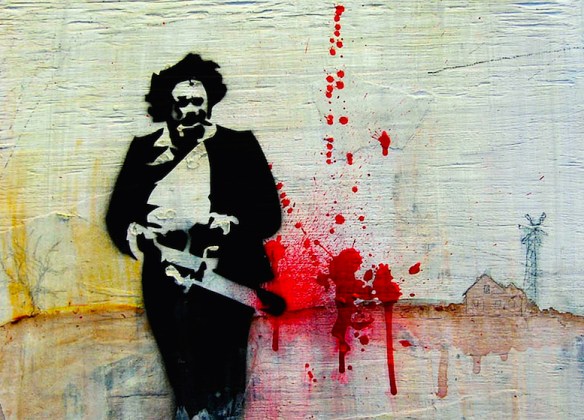
Steven cites too many splatter movies to cover in this review, but central to his thesis is the seminal 1974 Tobe Hooper film, The Texas Chain Saw Massacre. The death of local industry leads Leatherface and family to keep their slaughterhouse traditions alive by carving up and eating young people. These young people, Steven is quick to point out, are only here at all because they were unable to get gas for their car (thanks to the first of two 1970s oil crises). American decline is everywhere; betrayal by global economic forces are central to the trap that’s being laid by the cannibals. (Of course, the carnage of the Vietnam War can’t be overlooked here either, given the visual language of ambush, capture, and torture; Hooper himself has cited this in subsequent interviews.) Steven notes that the victims in The Texas Chain Saw Massacre are representative of a bourgeoisie who don’t know how the sausage is made. It’s important and vital, Steven says, that the cannibalistic side of splatter involves the bourgeoisie being forced to eat members of their own class. It’s Burroughs’s famous “naked lunch“: “the frozen moment when everyone sees what is at the end of every fork.”

As the neoliberal takeover of the world economy begins in earnest in the 1980s, as complex and largely ephemeral systems of mass media and finance take the place of the visceral, grinding monomania of industrial capitalism, splatter horror follows suit. Steven’s analysis of David Cronenberg’s Videodrome (1983) is especially sharp, examining the links between the body horror of the film and the Deleuzian body without organs. Max Renn’s body becomes an endlessly modular media node, able to accommodate video cassettes, to generate and fuse with phallic weapons (used to assassinate and destroy the media forces who’ve made him this way), to mesh and mold and mix with the hard plastic edges of media technology. By the end of the film, Renn is a weapon reprogrammed and re-trained on the very media-industrial complex that made him. More body horror: the cult classic Society (1989) and its shocking conclusion posits the ruling class as a cancerous monster, an amorphous leviathan straight out of a Gilded Age political cartoon, eating and fucking and vomiting, red in tooth and claw and pseudopod. Barriers between bodies break down; the system begins swallowing up all alternate possibilities.

By the time the Cold War is finished, the era of post-9/11 eternal war, of Abu Ghraib and Guantanamo, led to the popular new splatter sub-genre of “torture porn.” Steven identifies the genre’s distinguishing aesthetic feature: the indisputable, systematic, and worldwide victory of capitalism and the hypnotic Spectacle that accompanies it. In this era, there are no longer any alternatives. Everyone, rich and poor, is trapped in the system, and the system reintegrates torture into a worldwide video spectacle. This is embodied in both the global conspiracies of the wealthy in Roth’s Hostel series and in the Jigsaw Killer’s industrially-themed Rube Goldberg devices in the Saw franchise—devices of dismemberment explicitly linked to moral quandaries reminiscent of capitalism’s impossible everyday Hobson’s choices for the working class. The system will go on consuming you, whether you’re unlucky enough to be a splatter film’s victim, or “lucky” enough to wield the power to splatter (for example, Hostel: Part II‘s reversal of fate on the ultra-wealthy hunters, or the Jigsaw Killer’s death from cancer in Saw III—ultimately due to… a lack of health insurance).

Possibly the most intriguing aspect of this already very good book is Steven’s interspersing of personal anecdotes on when and where he discovered some of his favorite horror and genre films. By placing his personal and psychological experience of splatter films front and center, and linking it to his personal growth and increasing political maturity, he demonstrates the personal impact of the political, and the necessity of personal epiphany, mediated by culture, to achieve political awareness. Splatter Capital ultimately is not a book for the already-convinced and committed leftist, the Marxian thinker already well-versed in theory. (Another of Splatter Capital‘s very strong points is how Steven largely eschews jargon and obscurantism for an approachable tone and topic that laypeople can dive into easily.) It is for the fans of these films who’ve always wondered about the ineluctable appeal of visceral, shocking violence on screen, and perhaps why it all feels so strangely familiar.

The conspiracy to censor the Internet

By Andre Damon and Joseph Kishore

Source: WSWS.org

The political representatives of the American ruling class are engaged in a conspiracy to suppress free speech. Under the guise of combating “trolls” and “fake news” supposedly controlled by Russia, the most basic constitutional rights enumerated in the First Amendment are under direct attack.

The leading political force in this campaign is the Democratic Party, working in collaboration with sections of the Republican Party, the mass media and the military-intelligence establishment.

The Trump administration is threatening nuclear war against North Korea, escalating the assault on health care, demanding new tax cuts for the rich, waging war on immigrant workers, and eviscerating corporate and environmental regulations. This reactionary agenda is not, however, the focus of the Democratic Party. It is concentrating instead on increasingly hysterical claims that Russia is “sowing divisions” within the United States.

In the media, one report follows another, each more ludicrous than the last. The claim that Russia shifted the US election by means of $100,000 in advertisements on Facebook and Twitter has been followed by breathless reports of the Putin government’s manipulation of other forms of communication.

An “exclusive” report from CNN last week proclaimed that one organization, “Don’t Shoot Us,” which it alleges without substantiation is connected to Russia, sought to “exploit racial tensions and sow discord” on Instagram, Twitter, YouTube, Tumblr and even Pokémon Go, a reality game played on cell phones.

Another report from CNN on Monday asserted that a Russian “troll factory” was involved in posting comments critical of Hillary Clinton as “part of President Vladimir Putin’s campaign to influence the 2016 election.” All of the negative commentary in news media and other publications directed at Clinton, it implied, were the product of Russian agents or people duped by Russian agents.

As during the period of Cold War McCarthyism, the absurdity of the charges goes unchallenged. They are picked up and repeated by other media outlets and by politicians to demonstrate just how far-reaching the actions of the nefarious “foreign enemy” really are.

While one aim has been to continue and escalate an anti-Russia foreign policy, the more basic purpose is emerging ever more clearly: to criminalize political dissent within the United States.

The most direct expression to date of this conspiracy against free speech was given by the anticommunist ideologue Anne Applebaum in a column published Monday in the Washington Post, “If Russia can create fake ‘Black Lives Matter’ accounts, who will next?”

Her answer: the American people. “I can imagine multiple groups, many of them proudly American, who might well want to manipulate a range of fake accounts during a riot or disaster to increase anxiety or fear,” she writes. She warns that “political groups—on the left, the right, you name it—will quickly figure out” how to use social media to spread “disinformation” and “demoralization.”

Applebaum rails against all those who seek to hide their identity online. “There is a better case than ever against anonymity, at least against anonymity in the public forums of social media and comment sections,” she writes. She continues: “The right to free speech is something that is granted to humans, not bits of computer code.” Her target, however, is not “bots” operating “fake accounts,” but anyone who seeks, fearing state repression or unjust punishment by his or her employer, to make an anonymous statement online. And that is only the opening shot in a drive to silence political dissent.

Applebaum is closely connected to the highest echelons of the capitalist state. She is a member of key foreign policy think tanks and sits on the board of directors of the CIA-linked National Endowment for Democracy. Married to the former foreign minister of Poland, she is a ferocious war hawk. Following the Russian annexation of Crimea, she authored a column in the Washington Post in which she called for “total war” against nuclear-armed Russia. She embodies the connection between militarism and political repression.

The implications of Applebaum’s arguments are made clear in an extraordinary article published on the front page of Tuesday’s New York Times, “As US Confronts Internet’s Disruptions, China Feels Vindicated,” which takes a favorable view of China’s aggressive censorship of the Internet and implies that the United States is moving toward just such a regime.

“For years, the United States and others saw” China’s “heavy-handed censorship as a sign of political vulnerability and a barrier to China’s economic development,” the Times writes. “But as countries in the West discuss potential Internet restrictions and wring their hands over fake news, hacking and foreign meddling, some in China see a powerful affirmation of the country’s vision for the internet.”

The article goes on to assert that while “few would argue that China’s Internet control serves as a model for democratic societies… At the same time, China anticipated many of the questions now flummoxing governments from the United States to Germany to Indonesia.”

Glaringly absent from the Times article, Applebaum’s commentary and all of the endless demands for a crackdown on social media is any reference to democratic rights, free speech or the First Amendment.

The First Amendment, which asserts that “Congress shall make no law… abridging the freedom of speech,” is the broadest amendment in the US Constitution. Contrary to Applebaum, there is no caveat exempting anonymous speech from Constitutional protection. It is a historical fact that leaders of the American Revolution and drafters of the Constitution wrote articles under pseudonyms to avoid repression by the British authorities.

The Constitution does not give the government or powerful corporations the right to proclaim what is “fake” and what is not, what is a “conspiracy theory” and what is “authoritative.” The same arguments now being employed to crack down on social media could just as well have been used to suppress books and mass circulation newspapers that emerged with the development of the printing press.

The drive toward Internet censorship in the United States is already far advanced. Since Google announced plans to bury “alternative viewpoints” in search results earlier this year, leading left-wing sites have seen their search traffic plunge by more than 50 percent. The World Socialist Web Site’s search traffic from Google has fallen by 75 percent.

Facebook, Twitter and other social media platforms have introduced similar measures. The campaign being whipped up over Russian online activity will be used to justify even more far-reaching measures.

This is taking place as universities implement policies to give police the authority to vet campus events. There are ongoing efforts to abolish “net neutrality” so as to give giant corporations the ability to regulate Internet traffic. The intelligence agencies have demanded the ability to circumvent encryption after having been exposed for illegally monitoring the phone communications and Internet activity of the entire population.

In one “democratic” country after another governments are turning to police-state forms of rule, from France, with its permanent state of emergency, to Germany, which last month shut down a subsidiary of the left-wing political site Indymedia, to Spain, with its violent crackdown on the separatist referendum in Catalonia and arrest of separatist leaders.

The destruction of democratic rights is the political response of the corporate and financial aristocracy to the growth of working class discontent bound up with record levels of social inequality. It is intimately linked to preparations for a major escalation of imperialist violence around the world. The greatest concern of the ruling elite is the emergence of an independent movement of the working class, and the state is taking actions to prevent it.

CIA-Connected Google Aims to Weaken RT

By Stephen Lendman

Source: StephenLendman.org

Google transformed itself from a search engine to online censor.

Last July, the World Socialist Web Site reported “changes to its search service to make it harder for users to access what it called ‘low-quality’ information such as ‘conspiracy theories’ and ‘fake news.’ “

It’s Google’s code language for blocking what’s most important to know, what reliable sites like WSWS report daily, publishing vital information conflicting with the official narrative the corporate media feature, all rubbish all the time on vital world and national issues.

RT is the most widely viewed news operation on YouTube, owned by Google – no surprise it’s using it to censor truth-telling content, considered detrimental to the national security state because it exposes what it wants kept secret.

RT’s popularity keeps growing, why it’s considered a threat. Last month, its multi-language videos were watched over five billion times on YouTube.

Google declared war on the operation in cahoots with Washington, pulling it from its YouTube prime ad list in America without notification, a despicable action. RT’s deputy editor-in-chief Kirill Karnovich-Valua commented saying:

“RT has been Google’s premium partner since 2010 and accredited to an official status of the most watched TV news network on YouTube.”

“The fact that RT is no longer included in the Google Preferred advertising list in the US in itself does not affect RT distribution and monetization on the platform.”

“Yet, it is absolutely unacceptable that, while there were no notifications of any policy changes sent to RT, such internal info appears to have been leaked to the US media by Google.”

“This speaks to the unprecedented political pressure increasingly applied to all RT partners and relationships in a concerted effort to push our channel out of the US market entirely, and by any means possible.”

Censorship is a flagrant First Amendment violation, Russia, its officials and English-languish news operations prime targets for vilification and undermining – notably after Moscow was falsely accused of US election hacking, no evidence ever presented proving it.

RT and Sputnik News are threatened. Washington demanded a company providing services to RT America register as a foreign agent.

The FBI is investigating Sputnik, unheard of actions, perhaps prelude to preventing them from reaching a US audience.

Both are highly respected news and information services, media operations, not Russian propaganda as falsely claimed, nothing fake about their reporting – worlds apart from deplorable US media, disinformation operations.

Vilifying Russia persists on many fronts, a recklessly dangerous situation, risking direct confrontation – what’s coming if things continue on their present course.