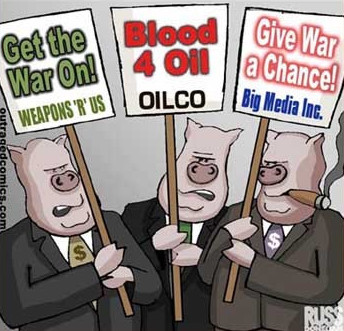
The War in Questions

Making Sense of the Age of Carnage

By Tom Engelhardt

Source: TomDispatch.com

My first question is simple enough: After 18-plus years of our forever wars, where are all the questions?

Almost two decades of failing American wars across a startlingly large part of the planet and I’d like to know, for instance, who’s been fired for them? Who’s been impeached? Who’s even paying attention?

I mean, if another great power had been so fruitlessly fighting a largely undeclared set of conflicts under the label of “the war on terror” for so long, if it had wasted trillions of taxpayer dollars with no end in sight and next to no one in that land was spending much time debating or discussing the matter, what would you think? If nothing else, you’d have a few questions about that, right?

Well, so many years later, I do have a few that continue to haunt me, even if I see them asked practically nowhere and, to my frustration, can’t really answer them myself, not to my satisfaction anyway. In fact, since 2001 — with the exception of the months leading up to the invasion of Iraq when America’s streets suddenly filled with hundreds of thousands of demonstrators asking a range of questions (“How did USA’s oil get under Iraq’s sand?” was a typical protest sign of that moment) — our never-ending wars have seldom been questioned in this country. So think of what follows not as my thoughts on the war in question but on the war in questions.

The Age of Carnage

In October 2001, in response to the 9/11 attacks, the administration of President George W. Bush launched a bombing campaign not just against al-Qaeda, a relatively small group partially holed up in Afghanistan, but the Taliban, an Islamist outfit that controlled much of the country. It was a radical decision not just to target the modest-sized organization whose 19 hijackers, most of them Saudis, had taken out almost 3,000 Americans with a borrowed “air force” of commercial jets, but in the phrase of the moment to “liberate” Afghanistan. These days, who even remembers that, by then, Washington had already fought a CIA-directed, Saudi-backed (and partially financed) war against the Soviet Union in that country for a full decade (1979-1989). To take on the Red Army then, Washington funded, armed, and supported extremist Islamist groups, some of which would still be fighting in Afghanistan (against us) in the twenty-first century.

In the context of that all-American war, a rich young Saudi, Osama bin Laden, would, of course, form al-Qaeda, or “the base.” In 1989, Washington watched as the mighty Red Army limped out of Afghanistan, the “bleeding wound” as its leader then called it. (Afghanistan wasn’t known as “the graveyard of empires” for nothing.) In less than two years, that second great power of the Cold War era would implode, an event that would be considered history’s ultimate victory by many in Washington. President Jimmy Carter’s national security adviser Zbigniew Brzezinski, the man who first committed the U.S. to its Afghan Wars, would, as last century ended, sum things up this way: “What is more important in world history? The Taliban or the collapse of the Soviet empire? Some agitated Moslems or the liberation of Central Europe and the end of the Cold War?”

Afghanistan itself would be left in ruins as Washington turned its attention elsewhere, while various local warlords fought it out and, in response, the extremist Taliban rose to power.

Now, let me jump ahead a few years. In 2019, U.S. air power expended more munitions (bombs and missiles) on that country than at any time since figures began to be kept in 2006. Despite that, during the last months of 2019, the Taliban (and other militant groups) launched more attacks on U.S.-and-NATO-trained-and-financed Afghan security forces than at any time since 2010 when (again) records began to be kept. And it tells you something about our American world that, though you could have found both those stories in the news if you were looking carefully, neither was considered worthy of major coverage, front-page headlines, or real attention. All these years later, it won’t surprise you to know that such ho-hum reporting is just par for the course. And when it comes to either of those two on-the-record realities, you certainly would be hard-pressed to find a serious editorial expression of outrage or much of anything else about them in the media.

At 18-plus years or, if you prefer to combine Washington’s two Afghan wars, 28-plus years, we’re talking about the longest American war in history. The Civil War lasted four years. The American part of World War II, another four. The Korean War less than four (though it never officially ended). The Vietnam War, from the moment the first significant contingent of U.S. advisors arrived, 14, and from the moment the first major U.S. troop contingents arrived, perhaps a decade. In the Trump era, as those air strikes rise, there has been a great deal of talk about possible “peace” and an American withdrawal from that country.  Peace, however, has now seemingly come to be defined in Washington as a reduction of American forces from approximately 12,000 to about 8,500 (and that’s without counting either private military contractors or CIA personnel there).

Meanwhile, of course, the war on terror that began in Afghanistan now stretches from the Philippines across the Greater Middle East and deep into the heart of Africa. Worse yet, it still threatens to expand into a war of some sort with Iran — and that, mind you, is under the ministrations of an officially “antiwar” president who has nonetheless upped American military personnel in the Middle East to record levels in recent years.

Of course, this is a story that you undoubtedly know fairly well. Who, in a sense, doesn’t? But it’s also a story that, so many years and so much — to use a word once-favored by our president — “carnage” later, should raise an endless series of disturbing and unnerving questions here. And that it doesn’t, should raise questions in itself, shouldn’t it?

Still, in a country where opposition to endless war seems constantly to falter or fade out amid a media universe in which Donald Trump’s latest tweet can top any war news, it seems potentially useful to raise some of those questions — at least the ones that occur to me — and perhaps for you to do the same. Isn’t it time, after all, for Americans to ask a few questions about war, American-style, in what might be thought of as the post-9/11 age of carnage?

In any case, here are six of mine to which, as I said, I don’t really have the answers. Maybe you do.

Here goes:

  1. When the Bush administration launched that invasion and occupation of Afghanistan in 2001 and followed it up with an invasion and occupation of Iraq in 2003, did we, in some curious fashion, really invade and occupy ourselves? Of course, in these years, across the Greater Middle East and Africa, the U.S. played a remarkable role in creating chaos in country after country, leading to failed states, displaced people in staggering numbers, economic disarray, and the spread of terror groups. But the question is: Did the self-proclaimed most exceptional and indispensable nation on the planet do a version of the same thing to itself in the process? After all, by 2016, the disarray in this country was striking enough and had spread far enough, amid historic economic inequality, social division, partisan divides, and growing anger, that Americans elected as president (if not quite by a majority) a man who had run not on American greatness but on American decline. He promised to make this country great again. (His declinist credentials were not much noted at the time, except among the heartland Americans who voted for him.) So, ask yourself: Would President Donald Trump have been possible if the Bush administration had simply gone after al-Qaeda on September 12, 2001, and left it at that? Since January 2017, under the tutelage of that “very stable genius,” the U.S. political (and possibly global economic) system has, of course, begun to crack open. Is there any connection to those forever wars?
  2. Has there ever been a truly great power in history, still at or near the height of its militarily prowess, that couldn’t win a war? Sure, great imperial powers from the Romans to the Chinese to the British sometimes didn’t win specific wars despite their seeming military dominance, but not a single one? Could that be historically unprecedented and, if so, what does it tell us about our moment? How has the country proclaimed by its leaders to have the finest fighting force the world has ever known won nothing in more than 18 years of unceasing global battle?
  3. How and why did the “hearts and minds” factor move from the nationalist left in the twentieth century to the Islamist right in the twenty-first? The anti-colonial struggles against imperial powers that culminated in America’s first great losing war in Vietnam (think of Korea as kind of a tie) were invariably fought by leftist and communist groups. And whatever the military force arrayed against them, they regularly captured — in that classic Vietnam-era phrase — “the hearts and minds” of what were then called “Third World” peoples and repeatedly outlasted far better armed powers, including, in the case of Vietnam, the United States. In a word, they had the moxie in such conflicts and it didn’t matter that, by the most obvious measures of military power, they were at a vast disadvantage. In the twenty-first century, similar wars are still being fought in a remarkably comparable fashion, Afghanistan being the most obvious.  Again, the weaponry, the money, everything that might seem to pass for the works has been the property of Washington and yet that ability to win local “hearts and minds” has remained in the hands of the rebels. But what I wonder about is how exactly that moxie passed from the nationalist left to the extremist religious right in this century and what exactly was our role, intended or not, in all this?
  4. When it comes to preparations for war, why can’t we ever stop? After all, when the Soviet Union collapsed and the Cold War ended in 1991, the United States essentially had no enemies left on the planet. Yet Washington continued essentially an arms race of one with a finish line so distant — the bomber of 2018, Earth-spanning weapons systems, and weaponry for the heavens of perhaps 2050 — as to imply eternity. The Pentagon and the military-industrial complex surrounding it, including mega-arms manufacturers, advanced weapons labs, university science centers, and the official or semi-official think tanks that churned out strategies for future military domination, went right on without an enemy in sight. In fact, in late 2002, preparing for his coming invasion of Iraq, George W. Bush had to cook up an “axis of evil” — Iran, Iraq, and North Korea, two of which were mortal enemies and the third unrelated in any significant way to either of them — as a justification for what was to come, militarily speaking. Almost 20 years later, investing as much in its military as the next seven countries combined, updating and upgrading its nuclear arsenal to the tune of $1.7 trillion in the coming decades (and having just deployed a new “low-yield” nuclear weapon), and still investing staggering sums in its planes, tanks, aircraft carriers, and the like, the U.S. military now seems intent (without leaving its forever wars) on returning to the era of the Cold War as well. Face-offs against Russia and China are now the military order of the day in what seems like a déjà-vu-all-over-again situation. I’m just curious, but isn’t it ever all over?
  5.  How can Washington’s war system and the military-industrial complex across the country continue to turn failure in war into success and endless dollars at home? Honestly, the one thing in America that clearly works right now is the U.S. military (putting aside those wars abroad). We may no longer invest in domestic infrastructure, but in that military and the giant corporate weapons makers that go with it? You bet! They are the true success stories of the twenty-first century if you’re talking about dollars invested, weaponry bought, and revolving doors greased. On the face of it, failure is the new success and few in this country seem to blink when it comes to any of that. How come?
  6. Why doesn’t the reality of those wars of ours ever really seem to sink in here?  This, to my mind, is at least partially a question about media coverage. Yes, every now and then (as with the Washington Post’s Afghanistan Papers last December), America’s forever wars briefly break through and get some attention. And yes, if you’re a war-coverage news jockey, you can find plenty of daily reports on aspects of our wars in the media. But isn’t it surprising how much of that coverage is essentially a kind of background hum, like Muzak in an elevator? Unless the president personally decides to drone assassinate an Iranian major general and prospective future leader of that country, our wars simply drone on, barely attended to (unless, of course, you happen to be in the U.S. military or a military spouse or child). Eighteen years of failed wars and so many trillions of dollars later, wouldn’t you have expected something else?

So those are my six questions, the most obvious things that puzzle me about what may be the strangest aspect of this American world of ours, those never-ending wars and the system that goes with them. To begin to answer them, however, would mean beginning to think about ourselves and this country in a different way.

Perhaps much of this would only make sense if we were to start imagining ourselves or at least much of the leadership crew, that infamous “Blob,” in Washington, as so many war addicts. War — the failing variety — is evidently their drug of choice and not even our “antiwar” president can get off it. Think of forever war, then, as the opioid not of the masses but of the ruling classes.


Tom Engelhardt is a co-founder of the American Empire Project and the author of a history of the Cold War, The End of Victory Culture. He runs TomDispatch.com and is a fellow of the Type Media Center. His sixth and latest book is A Nation Unmade by War.

Iraqi PM reveals Soleimani was on peace mission when assassinated, exploding Trump’s lie of ‘imminent attacks’

Secretary of State Mike Pompeo (AP Photo/Matt Rourke)

The Trump administration claimed Iranian general Qasem Soleimani was planning “imminent attacks” on US interests when it assassinated him. That lie was just destroyed, but not before countless corporate media outlets transmitted it to the public.

By Max Blumenthal

Source: The Grayzone

Desperate to justify the US drone assassination of Iranian Major General Qasem Soleimani, Secretary of State Mike Pompeo insisted that Washington had made an “intelligence-based assessment” that Soleimani was “actively planning in the region” to attack American interests before he was killed.

President Donald Trump justified his fateful decision to kill the Iranian general in even more explicit language, declaring that Soleimani was planning “imminent attacks” on US diplomatic facilities and personnel across the Middle East.

“We took action last night to stop a war,” Trump claimed. “We did not take action to start a war.”

Trump’s dubious rationale for an indisputably criminal assassination has been repeated widely across corporate media networks, and often without any skepticism or debate.

At a January 3 State Department briefing, where reporters finally got the chance to demand evidence for the claim of an “imminent” threat, one US official erupted in anger.

“Jesus, do we have to explain why we do these things?” he barked at the press.

Two days later, when Iraqi Prime Minister Adil Abdul-Mahdi addressed his country’s parliament, Trump’s justification for killing Soleimani was exposed as a cynical lie.

According to Abdul-Mahdi, he had planned to meet Soleimani on the morning the general was killed to discuss a diplomatic rapproachment that Iraq was brokering between Iran and Saudi Arabia.

Abdul-Mahdi said that Trump personally thanked him for the efforts, even as he was planning the hit on Soleimani – thus creating the impression that the Iranian general was safe to travel to Baghdad.

Soleimani had arrived in Baghdad not to plan attacks on American targets, but to coordinate de-escalation with Saudi Arabia. Indeed, he was killed while on an actual peace mission that could have created political distance between the Gulf monarchy and members of the US-led anti-Iran axis like Israel.

The catastrophic results of Soleimani’s killing recall the Obama administration’s 2016 assassination of Mullah Akhtar Muhammad Mansur, a Taliban leader who was eager to negotiate a peaceful end to the US occupation of Afghanistan. Mansur’s death wound up empowering hardline figures in the Taliban who favored a total military victory over the US and triggered an uptick in violence across the country, dooming hopes for a negotiated exit.

Since Soleimani’s assassination, Iraq’s parliament has voted to expel all US troops from the country and Iran’s Grand Ayatollah Ali Khamenei has sworn to exact a “severe revenge” on the “the criminals who have stained their hands with [Soleimani’s] and the other martyrs’ blood…”

Trump, for his part, tweeted a litany of gangster-like threats, promising to destroy Iranian cultural sites if it retaliated and pledging to sanction Iraq “like they’ve never been before” if it ousted US troops.

Trump’s treacherous assassination has brought the US closer to war than ever before against a country more militarily potent than any adversary it has faced since the Korean War. And as with the failed US invasion of Iraq, Washington’s casus belli for triggering this conflict was based on falsified intelligence sold to Americans by administration officials, and on a pliant Beltway media acting as their megaphone.

With its claim of “imminent attacks,” the Trump administration has essentially re-mixed Condoleeza Rice’s 2003 warning that “we don’t want the smoking gun to be a mushroom cloud.” Back then, the US attacked a sovereign state to rid it of WMD that did not exist. This time, it killed the second-most important Iranian official to prevent a killing spree that was not on the way. And Trump administration officials knew they were lying.

In fact, Pompeo pitched assassinating Soleimani to Trump several months ago, well before any attacks were “imminent.” And in the wake of the general’s killing, a US official revealed to the New York Times that the NSA had intercepted “communications the United States had between Iran’s supreme leader, Ayatollah Ali Khamenei, and General Suleimani showing that the ayatollah had not yet approved any plans by the general for an attack.”

But the preponderance of evidence exposing Trump’s basis for killing Soleimani as a titanic lie has not generated the same level of media interest as the lie itself.

On January 3, CNN assigned three reporters to disseminate the Trump administration’s disinformation about Soleimani, claiming without a hint of critical detachment that he was “planning specific attacks on US interests, including US personnel.”

After the story went live, CNN’s lead reporter, Jim Sciutto, reached out to another official US source to “confirm” his now-discredited piece of war propaganda. In Sciutto’s mind, if more than one US official says a thing, it must be true.

Sciutto is not just any run-of-the-mill national security reporter. During the Obama era, he accepted a job as chief of staff at the US Embassy in Beijing, placing himself at the center of Washington’s gathering Cold War with China. Now back behind CNN’s anchor desk, Sciutto poses as a ferocious critic of Trump while providing the Pentagon and State Department with reliable stenographic services.

No president in recent history has been despised more viscerally by the Beltway press corps than Trump. Nearly everything he says is met with disdain and suspicion, even when he is telling the truth.

But when Trump and his administration attempt to lie the public into war against a designated evildoer, a swath of the corporate media responds with reflexive trust, then shrugs when the lie is exposed in broad daylight.

Human Extinction Now Imminent and Inevitable? A Report on the State of Planet Earth

By Robert J. Burrowes

There is a significant body of evidence that human extinction is now imminent; that is, it will occur within the next few years and possibly this year: 2020. There is also a significant body of evidence that human extinction is now inevitable; that is, it cannot be prevented no matter what we do.

There are at least four distinct paths to imminent (that is, within five years) human extinction: nuclear war (possibly started regionally), biodiversity collapse (already well advanced and teetering on the brink), the deployment of 5G (commenced recently) and the climate catastrophe. Needless to say, each of these four paths might unfold in a variety of ways.

In addition, it should be noted, there are other possible paths to extinction in the near term, particularly when considered in conjunction with the four threats just mentioned. These include the cascading impacts triggered by destruction of the Amazon rainforest (which is now imminent) particularly given its critical role in the global hydrological cycle, the rapidly spreading radioactive contamination of Earth, and geoengineering for military purposes (which has been going on for decades and continues).

Far worse, however, is the path to extinction that looms before us when we consider the impact of all seven of these paths in combination with the vast range of other threats noted below.

These interrelated threats have generated a shocking series of ‘points of no return’ (‘tipping points’) that we have already crossed, the mutually reinforcing set of negative feedback loops that we have already triggered (and which we will continue to trigger) which cannot be reversed in the short-term, as well as the ongoing synergistic impact of the various ‘extinction drivers’ (such as ongoing extinctions because dependent species have lost their resource species) we have set in motion and which cannot be halted irrespective of any remedial action we might take. Hence, taking into account all of the above factors, the prospects of averting human extinction are now remote, at best.

Why has this happened?

Because long-standing dysfunctional human behavior, which we have not even begun to recognize as the fundamental driver of this extinction crisis, let alone address, has now trapped us between a rock and a hard place.

On the one hand, we are trapped by our grotesquely dysfunctional parenting and education models that mass produce individuals who are terrified, self-hating and powerless (leaving them submissively obedient while unable to seek out and consider the evidence for themselves and take powerful action in response) and who, as a result of being terrorized during childhood, are now addicted to chronic over-consumption to suppress their awareness of their deep (and unconscious) emotional pain. See ‘Love Denied: The Psychology of Materialism, Violence and War’ and ‘Do We Want School or Education?’ with more detailed evidence in ‘Why Violence?’ and Fearless Psychology and Fearful Psychology: Principles and Practice’.

On the other hand, also as an outcome of our dysfunctional parenting and education models (as well as the political and economic systems these generate), we keep reproducing and remain trapped by the global elite, and its compliant international organizations (such as the United Nations), national governments and corporations, including its corporate media. This global elite is utterly insane (and, hence, devoid of such qualities as conscience, empathy, compassion and love) and intent on exploiting our desire to suppress awareness of our emotional pain by over-consuming in order to feed their insatiable desire for profit, power and privilege no matter the cost to humanity and Earth’s biosphere. See ‘The Global Elite is Insane Revisited’.

Hence, this article does two things.

First, in the hope of generating greater consideration of these two issues – imminence and inevitability of human extinction – I have presented in straightforward language and point form, a reasonable summary of the nature and extent of our predicament (which clearly indicates that we are on track for human extinction between now – January 2020 – and 2025), as well as citing the relevant scientific and/or other evidence that explains each problem in more detail.

And second, the article outlines a powerful series of actions and strategies that individuals as well as community groups, neighborhoods and action groups can take as part of a global effort to fight to avert human extinction even if, as mentioned above, it is now inevitable. See, for example, ‘Extinction Foretold, Extinction Ignored’ in which the ‘McPherson Paradox’, which explains one key reason why we are doomed to extinction, is explained.

The obvious question, which you might well ask me, is this: ‘If the overwhelming evidence that human extinction is now imminent and inevitable is incontrovertible, why are you suggesting that we “fight to avert human extinction”?’ And my answer is simply this: Because, as I have done for several decades, I am committed to trying to do this one key thing that feels worth doing. Moreover, I am also hopeful that a miracle or two might just occur if we humans commit ourselves fully to the effort. I am only too well aware that anything less than a full effort, as outlined below, will certainly fail. And we will virtually certainly fail anyway. But I would rather try, than give up. And you?

So, in noting the points below, each of which identifies one key way (or a set of related key ways) in which the Earth and its inhabitants were subjected to greater violence in 2019, it is painful to reflect that, as forecast this time last year and based on a clear understanding of the primary driver of human behavior – fear – that is generating this multifaceted crisis, 2019 was another year of vital opportunities lost when so much is at stake.

Because, in essence, whether psychologically, socially, politically, militarily, economically, financially, ecologically or in other ways, in 2019 humanity took more giant strides backwards while passing up endless opportunities to make a positive difference in our world.

Moreover, to highlight the dramatic nature of our failure, by the end of 2019, a substantial number of countries and regions of the world – notably including the Amazon basin, Australia, several countries in Central Africa, many European countries, Indonesia, Siberia and North America – had each experienced (and/or were still experiencing) a huge series of wildfires (or fires that were deliberately lit), many of them ‘out of wildfire season’ and breaking records for their ‘unprecedented’ destructive impact, demonstrating that the Earth is literally burning up. For just an overview, see NASA’s ‘Fire Information for Resource Management System’.

But this very visible symptom of our crisis masks a vast quantity of evidence, in many domains, that is virtually unknown but far more damaging.

One acknowledgment of this crisis in Earth’s biosphere was the fact that the Doomsday Clock of the Bulletin of the Atomic Scientists remains poised at just two minutes to midnight, the closest it has ever been to ‘doomsday’ (and equal to 1953 when the Soviet Union first exploded a thermonuclear weapon matching the US capacity and raising the spectre of nuclear war). See ‘It is now two minutes to midnight’.

This status reflects the perilous state of our world, particularly given the renewed threat of nuclear war and the ongoing climate catastrophe. It didn’t even mention the massive and unrelenting assault on the biosphere (apart from the climate) and the rapidly accelerating biodiversity crisis nor, of course, the ongoing monumental atrocities against fellow human beings.

So let me identify, very briefly, some of the more crucial backward steps humanity took during 2019 and, far too easily, unfortunately, forecast what will happen in 2020.

Some Key Lowlights of 2019

  1. The global elite, using key elite fora such as the Group of 30, the Trilateral Commission, the Bilderberg Group and the World Economic Forum, and despite much rhetoric to the contrary, continued to plan, generate and exacerbate the many ongoing wars, deepening exploitation within the global economy, climate and environmental destruction, and the killing and exploitation of fellow human beings in a multitude of contexts, in pursuit of greater elite profit, power and privilege. See, for example, ‘Who Is Really in Control of US Foreign Policy?’, Giants: The Global Power Elite and ‘The Global Elite is Insane Revisited’.
  2. International organizations (such as the United Nations, the World Bank and International Monetary Fund) and national governments and corporations used military forces, legal systems, police forces and prison systems – see ‘The Rule of Law: Unjust and Violent’ – around the world to serve the global elite by defending its interests against the bulk of the human population, including those individuals and organizations courageous enough to challenge elite profit, power and privilege who are being killed in record numbers. (See more in point 35 below.)
  3. $US1.8 trillion was officially spent worldwide on military weapons to kill fellow human beings and other lifeforms, and to destroy the biosphere. This is the highest official (because the figures are taken from ‘open sources’) annual military expenditure ever recorded and the second consecutive year in which an increase occurred. Apart from military spending, weapons transfers worldwide remained high and both the USA and Russia were ‘on a path of strategic nuclear renewal’. See ‘SIPRI Yearbook 2019: Armaments, Disarmament and International Security; Summary’.

However, as noted last year, so out-of-control is this spending that the United States government has now spent $US21trillion on its military in the past 20 years for which it cannot even account! That’s right, $US1trillion each year above the official US national budget for killing is ‘lost’. See Army General Fund Adjustments Not Adequately Documented or Supported, ‘Has Our Government Spent $21 Trillion Of Our Money Without Telling Us?’ and ‘The Pentagon Can’t Account for $21 Trillion (That’s Not a Typo)’.

There has been no progress reported in accounting for this ‘lost’ expenditure during the past year.

  1. Under the direction of the global elite (as explained above), the United States government and its NATO allies continued their perpetual war across the planet wreaking devastation on many countries and regions, particularly in the Middle East and Africa. See, for example, Towards a World War III Scenario: The Dangers of Nuclear War, Dirty Wars: The World is a Battlefield and ‘Understanding NATO, Ending War’.

As a result, whether in the US-sponsored and supplied Saudi Arabian war against Yemen which the UNHCR characterizes as the worst humanitarian disaster in the world – see ‘The Cost of Feeding Yemen as War Rages On’ – the result of the US use of depleted uranium on top of its other extraordinary military destruction of Iraq over the past 29 years – see ‘Depleted Uranium and Radioactive Contamination in Iraq: An Overview’ – or the complete dismemberment of Libya as a result of NATO’s bombing of that country and the subsequent assassination of its leader Muammar Gaddafi in 2011 – see ‘Endless War and Chaos in Libya’ – the United States and its NATO allies have continued their efforts to destroy entire countries (also including Afghanistan, among others), at staggering cost to their populations and environments, not because these countries posed a threat to security anywhere but in order to maintain geopolitical control and to facilitate the theft of their resources (mainly oil) at great profit to the global elite. See, for example, ‘Hillary Emails Reveal NATO Killed Gaddafi to Stop Libyan Creation of Gold-Backed Currency’.

Moreover, of course, the perpetually-profitable perpetual war, by definition, has no end. But it still isn’t quite acceptable to say, too publicly and loudly, that ‘The global elite has again used the United States military and its NATO allies to destroy Iraq/Afghanistan/Syria/… (or, as is now the case, to attack Iran) to make a profit’ so what can be passed off as an excuse must be manufactured and promulgated by the compliant corporate media. And, with a gullibly terrified human population disinclined to question authority, this isn’t a problem. The same unconvincing formula invariably works each time. For a fuller and insightful explanation of this point, see Edward Curtin’s article ‘The war hoax redux’.

Of course, Iran has long been in the crosshairs of the global elite because of its prodigious (and thus hugely profitable) oil reserves as well as the clear inclination of its leaders (both before and after the US-installed Shah) to make decisions in the interests of Iranians, including foreign policy decisions such as those related to defense and the role of nuclear weapons. Thus, the global elite ensured that the US Congress, via removal by the Senate of a provision ‘explicitly not authorizing the Pentagon to wage war against Iran or assassinate its officials’ in the recently passed National Defense Authorization Act, effectively ‘authorized’ President Trump to order the assassination of General Qassem Soleimani. See ‘America Escalates its “Democratic” Oil War in the Near East’. Soleimani was the head of Iran’s Quds Force, the foreign arm of the Islamic Revolution Guard Corps (IRGC), Iran’s elite military force. He was the key figure in the fight against terrorism in the Middle East, and his assassination was carried out in clear contempt of international law. See ‘Trump’s assassination of Soleimani: Five things to know’, ‘With Suleimani Assassination, Trump Is Doing the Bidding of Washington’s Most Vile Cabal’, ‘Why US assassinated General Qassem Soleimani’ and ‘US killing of Iran’s Qassem Soleimani “an act of war”’.

This assassination, of course, raises a heightened possibility of war – essentially, from the elite perspective, to achieve ‘regime change’ and capture control of Iran’s oil – in one or more guises possibly involving, as explained by Professor Michel Chossudovsky, the use of ‘tactical’ nuclear weapons, acts of political destabilization, confiscation of financial assets, extensive economic sanctions, electromagnetic and climatic warfare, environmental modification techniques, cyberwarfare as well as chemical and biological warfare. See ‘A Major Conventional War Against Iran Is an Impossibility. Crisis within the US Command Structure’ and ‘America, An Empire on its Last Leg: To be Kicked Out from the Middle East?’

Hence, much will depend on the Iranian response to the insanity of those attacking it, which will unfold as this article is being published. For further thoughtful analyses of this crisis, see ‘War With Iran’, ‘Iran vs. US – The Murder of General Qassem Suleimani’ and ‘On the Brink of War?’

  1. Not content with the devastating impact of the military violence it is inflicting already, during 2019 the global elite continued to plan how to cause more destruction in future. Key initiatives included ongoing work to employ advances in autonomous systems and artificial intelligence technologies that will undermine nuclear deterrence and increase the likelihood of nuclear escalation – see ‘A Stable Nuclear Future? The Impact of Autonomous Systems and Artificial Intelligence’ – and the decision in the United States to create a Space Force, a sixth branch of the US military forces, just two manifestations of this. See ‘The Very Bad Space Force Deal’ and ‘US Making Outer Space the Next Battle Zone – Karl Grossman’.

In its turn, the Russian government has developed and just deployed a hypersonic weapon that travels at Mach 27 and which makes the US missile defense installations in Europe ‘obsolete’. See ‘Avangard changes everything: What Russia’s hypersonic warhead deployment means for the global arms race’.

But other initiatives receiving renewed attention – ‘hypervelocity guns, particle beams and laser weapons onboard orbiting battle platforms with onboard nuclear reactors or “super” plutonium systems providing the power for the weapons’ – also enhance the threat that ‘Modern society would go dark’ in the words of Apollo astronaut Edgar Mitchell. Why? Because ‘any war in space would be the one and only. By destroying satellites in space massive amounts of space debris would be created that would cause a cascading effect and even the billion-dollar International Space Station would likely be broken into tiny bits. So much space junk would be created… that we’d never be able to get a rocket off the planet again because of the minefield of debris orbiting the Earth at 15,000 mph’. See ‘Trump Signs Measure Enabling Establishment of a U.S. Space Force’.

Of course, technological ‘advances’ in weaponry reflect retrograde steps in policy with the US Air Force Global Strike Command (AFGSC) – which includes 20 B-2 stealth bombers, 76 B-52 bombers and 450 Minuteman III intercontinental ballistic missiles together capable of delivering thousands of nuclear warheads – along with the U.S. Navy’s submarine-launched Trident ballistic missiles, are now ‘capable of extinguishing essentially all life on Earth within a matter of hours.’ See ‘The Air Force’s Global Strike Command Is Preparing For A Delivery Of New Nuclear Weapons’.

  1. Following the US withdrawal from the Anti-Ballistic Missile (ABM) treaty in 2002 and after withdrawing from the Joint Comprehensive Plan of Action (the ‘Iran nuclear deal’) and the Intermediate Nuclear Forces (INF) Treaty (which limited the deployment of intermediate range nuclear weapons) in 2018, the US government further and unilaterally signaled its intention to dismantle the little that remained of attempts during the Cold War and since that time to contain the threat of nuclear war by further acting in violation of the Outer Space Treaty of 1967 – see ‘Treaty on Principles Governing the Activities of States in the Exploration and Use of Outer Space, including the Moon and Other Celestial Bodies’ and ‘US Weaponizing Space in Bid to Launch Arms Race’ – as explained in the point above, and demonstrating its disinterest in extending New START: the sole remaining restraint on U.S.-Russian nuclear arsenals that caps deployed offensive strategic nuclear weapons to no more than 1,550 each. See ‘Russia says it’s already too late to replace new START treaty’ and ‘Global Zero Urges Trump to Accept Putin’s Offer on Nuclear Treaty’.

If you are in any doubt regarding the devastating consequences of nuclear war, you will find Professor Steven Starr’s thoughts – see ‘Nuclear Darkness, Global Climate Change and Nuclear Famine: The Deadly Consequences of Nuclear War’ – illuminating. In addition, the description by Lynn Eden in ‘City on Fire’ (based on her book Whole World on Fire: Organizations, Knowledge, and Nuclear Weapons Devastation) is compelling.

  1. Another substantial proportion of global private financial wealth – conservatively estimated by the Tax Justice Network in 2010 to already total between $US21 and $US32 trillion – has been invested virtually tax-free through the world’s still-expanding black hole of more than 80 ‘offshore’ tax havens (such as the City of London Corporation, Jersey, Guernsey, the Isle of Man, Bermuda, the Cayman Islands, Hong Kong, Nauru, St. Kitts, Antigua, Tortola, Switzerland, the Channel Islands, Monaco, Cyprus, Gibraltar and Liechtenstein). This is just financial wealth. Additionally, a large share of the real estate, yachts, racehorses, gold bricks and many other assets that count as non-financial wealth are also owned via offshore structures that make it impossible to identify their owners. See Tax Justice Network.

Tax havens are locations around the world where wealthy individuals, criminals and terrorists, as well as governments and government agencies (such as the CIA), banks, corporations, hedge funds, international organizations (such as the Vatican) and crime syndicates (such as the Mafia), can stash their money so that they can avoid laws, regulation and oversight and, very often, evade tax. See ‘Elite Banking at Your Expense: How Secretive Tax Havens are Used to Steal Your Money’.

Controlled by the global elite, Wall Street and other major banks manage this monstrous diversion of wealth under Government protection. ‘Their business is fraud and grand theft.’ Tax haven locations offer more than tax avoidance. ‘Almost anything goes on.’ It includes ‘bribery, illegal gambling, money laundering, human and sex trafficking, arms dealing, toxic waste dumping, conflict diamonds and endangered species trafficking, bootlegged software, and endless other lawless practices.’ See ‘Trillions Stashed in Offshore Tax Havens’.

  1. The world’s major corporations continued to inflict enormous ongoing violence (in a myriad of ways) in their pursuit of endless profit at the expense of living beings (human and otherwise) and Earth’s biosphere by producing and marketing a wide range of life-destroying products ranging from nuclear weapons and nuclear power to fossil fuels, junk food, pharmaceutical drugs (including health-destroying and sometimes life-destroying vaccinations: see, for example, ‘Vaxxed-Unvaxxed – The Science’), synthetic poisons and genetically mutilated organisms (GMOs).

These corporations include the following: weapons manufacturers, major banks and their ‘industry groups’ like the International Monetary Conference, asset management firms, investment companies, financial services companies, fossil fuel (coal, oil and gas) corporations, technology corporations, media corporations, major marketing and public relations corporations, agrochemical (pesticides, seeds, fertilizers) giants, pharmaceutical corporations (with their handmaidens in the medical and psychiatric industries: see ‘Defeating the Violence in Our Food and Medicine’ and ‘Defeating the Violence of Psychiatry’), biotechnology (genetic mutilation) corporations, mining corporations, nuclear power corporations, food multinationals and water corporations. You can see a list of the major corporations in this article: ‘The Global Elite is Insane Revisited’.

  1. More than two billion people continued to live under occupation, dictatorship or threat of genocidal assault often with the global elite sponsoring an oppressive national government or simply a local elite that exercises power irrespective of the government in office. See, for example, ‘500 Years is Long Enough! Human Depravity in the Congo’.
  2. 36,500,000 human beings (mainly in Africa, Asia and Central/South America) were starved to death in 2019.

Are we serious about ending these totally unnecessary deaths? Not even remotely, as thoughtfully explained by Professor George Kent in his article ‘Are We Serious About Ending Hunger?’

As Professor Kent notes: currently, around the world, ‘around 800 million people suffer from hunger’ and that ‘global efforts to end hunger have not been serious’: There has been ‘no substantial commitment of resources, no management group to control the process, no realistic timeline, and no means for mid-course corrections on the way to the goal. There [have been] no contracts with agencies that would work toward achievement of the goal…. hoping for the end of hunger won’t work. Hope is not a strategy.’ Moreover, ‘The UN system offers little more than vague aspirations.’

  1. 18,250,000 children were killed by adults in wars, by starving them to death, by denying them clean drinking water, and in a large variety of other ways.
  2. 8,000,000 children were trafficked into sexual slavery; executed in sacrificial killings after being kidnapped; bred to be sold as a ‘cash crop’ for sexual violation, to produce child pornography (‘kiddie porn’) and ‘snuff’ movies (in which children are killed during the filming); ritually tortured and murdered as well as raped by dogs trained for the purpose. See ‘Humanity’s “Dirty Little Secret”: Starving, Enslaving, Raping, Torturing and Killing our Children’.
  3. Hundreds of thousands of individuals were kidnapped or tricked into slavery, which now denies 46,000,000 human beings (more than at any time in human history) the right to live the life of their choice, condemning many individuals – especially women and children – to lives of sexual slavery, forced labor or as child soldiers. Needless to say, the global elite continues to expand this highly profitable business while its compliant governments do no more than mouth an occasional objection to the practice while doing nothing effective to actually end it, as was patently evident following disclosures about high-profile public figures during the year. See ‘The Global Slavery Index’. For one recent account of the life of a modern slave, see ‘My Family’s Slave’. And for an account of the involvement of public figures in sex slavery, see ‘Prince Andrew and Jeffrey Epstein: what you need to know’ and the other articles listed at the end of this one.
  4. Well over 100,000 people (particularly Falun Gong practitioners) in China, where an extensive state-controlled program is conducted, were subjected to forced organ removal for the trade in human organs. See Bloody Harvest and The Slaughter.
  5. 15,768,000 people were displaced by war, persecution or famine. There are now 70,800,000 people, more that half of whom are children and approximately 10,000,000 of whom are stateless, who have been forcibly displaced worldwide and remain precariously unsettled, usually in adverse circumstances. One person in the world is forcibly displaced every two seconds. See ‘Figures at a Glance’.
  6. Millions of people were made homeless in their own country as a result of war, persecution, ‘natural’ disasters (many of which, including hurricanes/cyclones and wildfires, were actually generated by dysfunctional human behavior rather than nature), internal conflict, poverty or as a result of elite-driven national economic policies. The last time a global survey was attempted – by the United Nations back in 2005 – an estimated 100 million people were homeless worldwide. In addition, as many as 1.6 billion people lack adequate housing (living in slums, for example). See ‘Global Homelessness Statistics’.
  7. Highlighting the unheralded biodiversity crisis on Earth, as a result of habitat destruction and degradation as well as a multitude of other threats, 73,000 species of life (plants, birds, animals, fish, amphibians, insects, reptiles and microbes) on Earth were driven to extinction with the worldwide loss of many of these species – and certainly including insects, birds, animals and fish – now at catastrophic levels. Tragically, many additional species are now trapped in a feedback loop which will inevitably precipitate their extinction as well because of the way in which ‘co-extinctions’, ‘localized extinctions’ and ‘extinction cascades’ work once initiated and as has already occurred in almost all ecosystem contexts. See the (so far) five-part series ‘Our Vanishing World’. Have you seen a flock of birds of any size recently? A butterfly?
  8. Separately from global species extinctions, Earth continued to experience ‘a huge episode of population declines and extirpations, which will have negative cascading consequences on ecosystem functioning and services vital to sustaining civilization. We describe this as a “biological annihilation” to highlight the current magnitude of Earth’s ongoing sixth major extinction event.’ Moreover, local population extinctions ‘are orders of magnitude more frequent than species extinctions. Population extinctions, however, are a prelude to species extinctions, so Earth’s sixth mass extinction episode has proceeded further than most assume.’ See ‘Biological annihilation via the ongoing sixth mass extinction signaled by vertebrate population losses and declines’ and ‘Our Vanishing World: Wildlife’.
  9. Wildlife trafficking, worth up to $20 billion in 2019, is pushing many endangered species to the brink of extinction. Illegal wildlife products include jewelry, traditional medicine, clothing, furniture, and souvenirs, as well as some exotic pets, most of which are sold to unaware/unconcerned consumers in the West although China is heavily implicated too. See, for example, Stop Wildlife Trafficking.
  10. 16,000,000 acres of pristine rainforest were cut or burnt down for purposes such as the following: acquiring timbers used in construction, clearing land to establish cattle farms so that many people can eat cheap hamburgers, clearing land to establish palm oil plantations so that many people can eat processed (including junk) foods based on this oil, clearing land to establish palm oil and soybean plantations so that some people can delude themselves that they are using a ‘green biofuel’ in their car (when, in fact, these fuels generate a far greater carbon footprint than fossil fuels), mining (much of it illegal) for a variety of minerals (such as gold, silver, copper, coltan, cassiterite and diamonds), and logging to produce woodchips so that some people can buy cheap paper, including cheap toilet paper. One outcome of this destruction is that 40,000 tropical tree species are now threatened with extinction. See ‘Our Vanishing World: Rainforests’, ‘Measuring the Daily Destruction of the World’s Rainforests’, ‘Estimating the global conservation status of more than 15,000 Amazonian tree species’ and ‘Half of Amazon Tree Species Face Extinction’.

Another outcome is that ‘the precious Amazon is teetering on the edge of functional destruction and, with it, so are we’. How long do we have? ‘The tipping point is here, it is now.’ Professor Thomas E. Lovejoy and his fellow researcher Carlos Nobre elaborate this point: ‘Bluntly put, the Amazon not only cannot withstand further deforestation but also now requires rebuilding as the underpinning base of the hydrological cycle if the Amazon is to continue to serve as a flywheel of continental climate for the planet and an essential part of the global carbon cycle.’ See ‘Amazon Tipping Point: Last Chance for Action’.

  1. Vast quantities of soil were washed away as we destroyed the rainforests, and enormous quantities of both inorganic constituents (such as heavy metals like cadmium, chromium, lead, mercury, nickel and zinc) and organic pollutants (particularly synthetic chemicals in the form of fertilizers, pesticides and herbicides) were dumped into the soil as well, thus reducing its nutrients and killing the microbes and earthworms within it. We also contaminated enormous quantities of soil with radioactive waste. See Soil-net, ‘Glyphosate effects on soil rhizosphere-associated bacterial communities’ and ‘Disposing of Nuclear Waste is a Challenge for Humanity’.

To briefly elaborate the evidence in relation to earthworms: Given ‘recent reports of critical declines of microbes, plants, insects and other invertebrates, birds and other vertebrates, the situation pertaining to neglected earthworms’ was evaluated in an extensive investigation recently undertaken by Robert J. Blakemore. His research demonstrated an 83.3 percent decline in earthworms in agrichemical farms – that is, those that use pesticides, herbicides and synthetic fertilizers – compared with farms utilizing organic methods. Why? Because ‘it is impossible to replace or artificially engineer the myriad beneficial processes and services freely provided by earthworms’ which includes extensive burrows in pastures enriched with soil organic matter that allow ingress of air & water and provide living space for other soil organisms. Moreover, given that ecological services overall have been given a median value of US$135 trillion per year, which is almost double the global economic GDP of around $75 trillion – see ‘Changes in the global value of ecosystem services’ and ‘Valuing nature and the hidden costs of biodiversity loss’ – Blakemore reaches an obvious conclusion: ‘Persistence with failing chemical agriculture makes neither ecological nor economic sense.’ See ‘Critical Decline of Earthworms from Organic Origins under Intensive, Humic SOM-Depleting Agriculture’.

Given that this multifaceted destruction of the soil fundamentally threatens the global grain supply, when the ability to grow, store and distribute grains at scale is a defining element of civilization, as Professor Guy McPherson eloquently explains it: ‘A significant decline in grain harvest will surely drive this version of civilization to the abyss and beyond.’ See ‘Seven Distinct Paths to Loss of Habitat for Humans’.

  1. Despite an extensive and ongoing coverup by the Japanese government and nuclear corporations, as well as the International Atomic Energy Agency (IAEA), vast amounts of radioactive waste were dumped into the biosphere from the TEPCO nuclear power plant at Fukushima in Japan including by discharge into the Pacific Ocean killing an incalculable number of fish and other marine organisms and indefinitely contaminating expanding areas of that ocean. See ‘Fukushima: A Nuclear War without a War: The Unspoken Crisis of Worldwide Nuclear Radiation’, ‘2019 Annual Report – Fukushima 8th Anniversary’, ‘Eight years after triple nuclear meltdown, Fukushima No. 1’s water woes show no signs of ebbing’ and ‘Fukushima’s Three Nuclear Meltdowns Are “Under Control” – That’s a Lie’.

But the challenges to be overcome in safely handling and, ultimately, safely storing the radiation hazards (such as the three melted nuclear reactors and the spent fuel rods) and the radioactive waste from the Fukushima disaster are monumental, as touched on in this article outlining the 40-year plan that the Japanese government hopes will delude us into believing will deal with the many components of this perpetual radioactive nightmare. See ‘Japan revises Fukushima cleanup plan, delays key steps’.

In addition, one critical legacy of the US military’s 67 secretive and lethal nuclear weapons tests on the Marshall Islands between 1946 and 1958 is the ‘eternally’ radioactive garbage left behind and now leaking into the Pacific Ocean. See ‘The Pentagon’s Disastrous Radioactive Waste Dump in the Drowning Marshall Islands is Leaking into the Pacific Ocean’.

Is other nuclear waste safely stored? Of course not! See, for example, ‘NRC admits San Onofre Holtec nuclear waste canisters are all damaged’, ‘USA’s Hanford nuclear site could suffer the same fate as Russia’s Mayak – or worse’ and, for a more comprehensive report, ‘The World Nuclear Waste Report 2019: Focus Europe’.

Of course, the Chernobyl nuclear catastrophe in 1986 continues to inflict extensive damage on the biosphere which you can learn more about from the research by Professor Kate Brown, author of Manual for Survival: A Chernobyl Guide to the Future‘Chernobyl Radiation Cover-Ups & Deadly Truth’, ‘UN and Western countries covered up the facts on the huge health toll of Chernobyl radiation’ and ‘Unreported Deaths, Child Cancer & Radioactive Meat: The Untold Story of Chernobyl’ – as well as the investigatory work of Alison Katz of Independent WHO: ‘Chernobyl Health Cover-Up, Lies by UN/WHO Exposed’.

  1. Human use of fossil fuels to power aircraft, shipping and vehicles as well as for industrial production and to generate electricity (among other purposes) released 10 billion metric tons (10 gigatons) of carbon dioxide into Earth’s biosphere, a 0.6% increase over 2018, with China’s monstrous CO2 emissions for 2019 totaling 2.6% greater than the previous year. See ‘Global Carbon Budget 2019’.

As one measure of their contempt for the utterly inadequate goals of the Paris climate agreement, and with government approval, ‘over 400 of the 746 companies on the Global Coal Exit List are still planning to expand their coal operations’. If built, these projects in 60 countries would add over 579 GW to the global coal plant fleet, an increase of almost 29%. See ‘Companies Driving the World’s Coal Expansion Revealed: NGOs Release New Global Coal Exit List for Finance Industry’ and ‘Proposed Coal Plants by Country’.

  1. 72 billion land animals (mainly chickens, ducks, pigs, rabbits, geese, turkeys, sheep, goats and beef cattle) were killed for food. In addition, between 37 and 120 billion fish were killed on commercial farms with another 2.7 trillion fish caught and killed in the wild. See ‘How Many Animals Are Killed for Food Every Day?’

Apart from that, more than 100 million animals were killed for laboratory purposes in the United States alone and there were other animal deaths in shelters, zoos and in blood sports. See ‘How Many Animals Are Killed Each Year?’

In addition, according to Humane Society International, about 100 million animals (particularly mink, foxes, raccoon dogs and rabbits) were bred and slaughtered in fur farms geared to supplying the fashion industry. In addition to farming, millions of wild animals were trapped and killed for fur, as were hundreds of thousands of seals. See ‘How Many Animals are Killed Each Year?’

  1. Farming of animals for human consumption released 7.1 gigatons of CO2-equivalent into Earth’s atmosphere; this represented 14.5 percent of all anthropogenic greenhouse gas emissions. About 44% of livestock emissions were in the form of methane (which was 44% of anthropogenic CH4 emissions), 29% as Nitrous Oxide (which was 53% of anthropogenic N2O emissions) and 27% as Carbon Dioxide (which was 5% of anthropogenic CO2 emissions). See ‘GHG Emissions by Livestock’.
  2. Human use of fossil fuels and farming of animals released more than 3.2 million metric tons of (CO2 equivalent) nitrous oxide (N2O) into Earth’s atmosphere. See ‘Nitrous oxide emissions’.
  3. Despite largely successful efforts by the elite-controlled IPCC to delude people into believing that the global mean temperature has increased by only 1.0 degree celsius, in fact, since the pre-industrial era (prior to 1750) greenhouse gas (GHG) emissions have already caused the global temperature to rise by about 1.73 degrees celsius. See ‘How much warmer is it now?’

Among a lengthy list of adverse outcomes, this has caused the melting of Arctic permafrost and undersea methane ice clathrates resulting in an incalculable quantity of methane being uncontrollably released into the atmosphere, including during 2019, with the quantity being released getting ever closer to ‘exploding’. See ‘Anomalies of methane in the atmosphere over the East Siberian shelf: Is there any sign of methane leakage from shallow shelf hydrates?’, ‘7,000 underground gas bubbles poised to “explode” in Arctic’, ‘Release of Arctic Methane “May Be Apocalyptic,” Study Warns’ and ‘Understanding the Permafrost-Hydrate System and Associated Methane Releases in the East Siberian Arctic Shelf’.

In fact, the methane threat is already so extreme that the forecast El Niño event for 2020 could be the catalyst to trigger huge methane releases from the Arctic Ocean precipitating human extinction this year. See ‘Very early warning signal for El Niño in 2020 with a 4 in 5 likelihood’ and ‘Extinction in 2020?’

  1. Glaciers and mountain ice fields – whether located in Greenland or other regions of the far north, the Himalaya, at the Equator, in southern latitudes or Antarctica – are all melting at unprecedented and accelerating rates, losing billions of tonnes of ice in 2019. For a discussion of the details and the implications of this, see ‘Our Vanishing World: Glaciers’.
  2. The ongoing destruction of Earth’s oceans continued unabated and accelerated in key areas.

An incalculable amount of agricultural poisons, fossil fuels and other wastes was discharged into the ocean, adversely impacting life at all ocean depths – see ‘Staggering level of toxic chemicals found in creatures at the bottom of the sea, scientists say’ – and generating ocean ‘dead zones’: regions that have too little oxygen to support marine organisms. See ‘Our Planet Is Exploding With Marine “Dead Zones”’.

In addition, however, another problem that has been getting insufficient attention is the result of the expanding impacts of the rapidly increasing levels of ocean acidification, ocean warming, ocean carbon flows and ocean plastics. Taken in isolation each of these changes clearly has negative consequences for the ocean. All these shifts taken together, however, result in a rapid and serious decline in ocean health and this, in turn, adversely impacts all species dependent on the ocean including fish, mammals and seabirds. Moreover, on top of these problems is the issue of oxygen availability given that oxygen in the air or water is of paramount importance to most living organisms. As the recently released report ‘Ocean deoxygenation: Everyone’s problem. Causes, impacts, consequences and solutions’ describes in some detail, oxygen levels are currently declining across the ocean, not just in ‘dead zones’.

And to elaborate the plastics problem briefly: at least 8 million metric tons of plastic, of which 236,000 tons were microplastics, was discharged into the ocean. So severe is the problem that there are now five massive patches of plastic in the oceans around the world covering large swaths of the ocean; the plastic patch between California and Hawaii is the size of the state of Texas. See ‘Plastic waste inputs from land into the ocean’ and ‘Plastics in the Ocean’.

  1. Earth’s fresh water and ground water was further depleted and contaminated.

The depletion is a primary outcome of the ongoing deforestation of the planet and is manifesting in several ways including as localized droughts, which are becoming increasingly common as a number of cities and regions around the world can attest. According to the World Resources Institute, half of the surface water in some countries – mainly in Central Asia and the Middle East – was depleted between 1984 and 2015, with agriculture using an average of 70% of the water. 36 countries are ‘extremely water-stressed’ and water is now a major factor in conflict in at least 45 countries. See ‘7 Graphics Explain the State of the World’s Water’.

Separately from depletion, fresh water was contaminated by bacteria, viruses and household chemicals from faulty septic systems; hazardous wastes from abandoned and uncontrolled hazardous waste sites (of which there are over 20,000 in the USA alone); leaks from landfill items such as car battery acid, paint and household cleaners; the pesticides, herbicides and other poisons used on farms and home gardens; radioactive waste from nuclear tests (some of it stored in glaciers that are now melting); and the chemical contamination caused by hydraulic fracturing (fracking) in search of shale gas, for which about 750 chemicals and components, some extremely toxic and carcinogenic like lead and benzene, have been used. See ‘Groundwater contamination’, ‘Groundwater drunk by BILLIONS of people may be contaminated by radioactive material spread across the world by nuclear testing in the 1950s’ and ‘Fracking chemicals’.

  1. The longstanding covert military use of geoengineering – spraying tens of millions of tons of highly toxic metals (including aluminium, barium and strontium) and toxic coal fly ash nanoparticulates (containing arsenic, chromium, thallium, chlorine, bromine, fluorine, iodine, mercury and radioactive elements) into the atmosphere from jet aircraft to weaponize the atmosphere and weather – in order to enhance elite control of human populations, continued unchecked. Geoengineering is systematically destroying Earth’s ozone layer – which blocks the deadly portion of solar radiation, UV-C and most UV-B, from reaching Earth’s surface – as well as adversely altering Earth’s weather patterns and polluting its air, water and soil at incredible cost to the health and well-being of living organisms and the biosphere. See ‘Geoengineering Watch’, including ‘Engineered Climate Cataclysm: Hurricane Harvey’.

For a discussion of the military implications of geoengineering, see ‘The Ultimate Weapon of Mass Destruction: “Owning the Weather” for Military Use’.

And for discussions of the research, and implications of it, by Dr. Dietrich Klinghardt and Dr. Stephenie Seneff (Senior Research Scientist at MIT), which considers damage to the biosphere and human health caused by the geoengineering release of a synthesized compound of nanonized aluminium and the poison glyphosate that creates a ‘supertoxin’ that is generating ‘a crisis of neurological diseases’, see ‘World-Renowned Doctor Addresses Climate Engineering Dangers’, Dr Stephenie Seneff, ‘Autism Explained: Synergistic Poisoning from Aluminum and Glyphosate’ and ‘Extinction is Stalking Humanity: The Threats to Human Survival Accumulate’.

  1. The incredibly destructive 5G technology, which a vast number of scientists (currently totaling more than 188,000 individuals and organizations from 203 nations and territories: see ‘International Appeal to Stop 5G on Earth and in Space’) are warning will have catastrophic consequences for life on Earth, is now being rapidly introduced without informed public consultation and despite ongoing protests around the world.

The following articles and videos will give you a solid understanding of key issues from the viewpoint of human and planetary well-being. See ‘5G Satellites: A Threat to all Life’, ‘5G Danger: 13 Reasons 5G Wireless Technology Will Be a Catastrophe for Humanity’, ‘5G Technology is Coming – Linked to Cancer, Heart Disease, Diabetes, Alzheimer’s, and Death’, ‘20,000 Satellites for 5G to be Launched Sending Focused Beams of Intense Microwave Radiation Over Entire Earth’, ‘Will 5G Cell Phone Technology Lead To Dramatic Population Reduction As Large Numbers Of Men Become Sterile?’, ‘The 5G Revolution: Millions of “Human Guinea Pigs” in Big Telecom’s Global Experiment’ and ‘5G Apocalypse – The Extinction Event’.

  1. As one outcome of our dysfunctional parenting model and political systems, fascism continued to rise around the world. See ‘The Psychology of Fascism’.
  2. Despite the belief that we have ‘the right to privacy’, privacy (in any sense of the word) was ongoingly eroded in 2019 and is now effectively non-existent, particularly thanks to Alphabet (owner of Google). Taken together, ‘Uber, Amazon, Facebook, eBay, Tinder, Apple, Lyft, Foursquare, Airbnb, Spotify, Instagram, Twitter, Angry Birds… have turned our computers and phones into bugs that are plugged in to a vast corporate-owned surveillance network. Where we go, what we do, what we talk about, who we talk to, and who we see – everything is recorded and, at some point, leveraged for value.’ Moreover, given Google’s integrated relationship with the US government, the US military, the CIA, and major US weapons manufacturers, there isn’t really anything you can do that isn’t known by those who want to know it. In essence, Google is ‘a powerful global corporation with its own political agenda and a mission to maximise profits for shareholders’ and it partly achieves this by expanding the surveillance programs of the national security state at the direction of the global elite. But Google isn’t alone and it isn’t just happening in the USA. See ‘Everybody’s Watching You: The Intercept’s 2019 Technology Coverage’, ‘Google’s Earth: How the Tech Giant Is Helping the State Spy on Us’, the articles by John W. Whitehead on ‘Surveillance’ and the documentary ‘The Modern Surveillance State’.
  3. The right to free speech, accurate information and conscience-based nonviolent activism was ongoingly eroded in 2019 as efforts, by governments and corporations particularly, to control speech, information and political action accelerated. Whether this took the form of censorship, restrictions on access or violent acts directed against those whose views or actions were seen as dangerous or wrong, Global Witness, Human Rights Watch and other organizations documented an endless series of setbacks for free speech and political activity in a wide variety of countries around the world with individuals and journalists imprisoned for telling the truth, nonviolent activists assaulted and killed, critics silenced by defamation laws or ‘disappearance’, and the closure of newspapers, television stations and the internet to prevent rapid promulgation of information, among other infringements. See, for example, ‘Free Speech’, ‘The supply chain of violence’, ‘Environmental activist murders double in 15 years’ and ‘Enemies of the State? How governments and businesses silence land and environmental defenders’.
  4. Believing that we know better than evolution, and following the birth in 2018 of the first gene-edited babies in China – see ‘Why we are not ready for genetically designed babies’ and ‘China’s Golem Babies: There is Another Agenda’ – in 2019, further human gene-editing was done as well as gene-editing experiments intended to explore possibilities for more complex gene-editing of humans. Why? According to the authors of one report: ‘To extend the frontier of genome editing and enable the radical redesign of mammalian genomes’ (emphasis added). This experiment allowed ‘for the simultaneous editing of >10,000 loci in human cells’. See ‘Enabling large-scale genome editing by reducing DNA nicking’.

Needless to say, at least some responsible scientists are well aware of the possibly horrific consequences of this technology in the hands of those without ethics and are calling for a moratorium of at least five years on heritable human gene editing to allow time ‘to engage in proactive, rather than reactive, discussions about the future of such technology’. Of course, despite the calls for caution, ‘some researchers are forging ahead’. See ‘NIH Director on Human Gene Editing: “We Must Never Allow Our Technology to Eclipse Our Humanity”’.

  1. Incalculable amounts of waste of every conceivable kind – including antibiotic waste, military waste, nuclear waste, nanowaste and genetically engineered organisms, including ‘gene drives’ (or ‘mutagenic chain reactions’) – were released into Earth’s biosphere, with an endless series of adverse consequences for life. See ‘Junk Planet: Is Earth the Largest Garbage Dump in the Universe?’

Not content to dump our junk on Earth, an incalculable amount of junk was also dumped in Space which already contains 100 trillion items of orbiting junk. See ‘Junk Planet: Is Earth the Largest Garbage Dump in the Universe?’ and ‘Space Junk: Tracking & Removing Orbital Debris’.

  1. Ongoing ‘visible’, ‘invisible’ and ‘utterly invisible’ violence against children – see Why Violence?’ and Fearless Psychology and Fearful Psychology: Principles and Practice’ – ensured that more people will grow up accepting (and quite powerless to challenge) our dysfunctional and violent world, as described above.
  2. The global elite’s corporate media, schooling and film/television industries continued to distract vast numbers of people from reality with an endless barrage of propaganda respectively labeled, depending on the context, ‘news’, ‘education’ and ‘entertainment’ ensuring that most people remain oblivious to our predicament, devoid of the capacities to investigate, comprehend and analyze this predicament as well as their own role in it, and to respond to this predicament powerfully. See, for example, ‘Media’s Deafening Silence on Latest from WikiLeaks about the Organisation for the Prohibition of Chemical Weapons Fake Douma Report Blaming Syria’, ‘Do We Want School or Education?’ and ‘The Most Important Free Press Stories of 2019’.
  3. Finally, as a direct outcome of these last two points but most tragically of all, virtually all of the individuals who self-identify as ‘activists’ continued to waste their time begging the global elite (or their agents) to fix one or other of our crises – starkly illustrated by those thousands of climate ‘activists’ who traveled to Madrid, mostly using fossil fuels, and then complained when the outcome was, predictably, pitiful: see the powerless civil society ‘Statement on COP25’ – despite the overwhelming evidence that the global elite will not take action to ‘fix’ any of these crises. See ‘Why Activists Fail’. And, for more detail in two key contexts, see ‘The Global Climate Movement is Failing: Why?’ and ‘The War to End War 100 Years On: An Evaluation and Reorientation of our Resistance to War’.

Moreover, even if it was inclined, the elite is now powerless to avert extinction given that, if we are to have any chance given the advanced nature of the crisis and the incredibly short timeframe, we must plan intelligently to mobilize a substantial proportion of the human population in a strategically-focused effort. Nothing else can work.

Highlights of 2019

But so that the picture is clear and ‘balanced’: were there any gains made against the onslaught outlined above, particularly given we were driven inexorably closer to extinction?

Considering the elite and its agents: Zero gains were made of which I am aware. I have found no record of official efforts during the year to plan for the development and implementation of a comprehensive, just and sustainable peace although there was plenty of rhetoric in some quarters, often by those without any actual power to make a difference.

Separately from this, there have been some minor activist gains: for example, some western banks and insurance companies are no longer financially supporting the expansion of the western weapons industry and the western coal industry, some superannuation (pension) funds have divested from weapons and fossil fuels, some rainforest groups have managed to save portions of Earth’s rainforest heritage, and activist groups continue to work on a variety of issues sometimes making modest gains.

In essence however, as you probably realize, many of the issues above are not even being tackled and, even when they are, activist efforts have been hampered by inadequate analysis of the forces driving conflicts and problems, limited vision (particularly unambitious aims such as those in relation to ending war and the climate catastrophe), and unsophisticated strategy (necessary to have profound impact against a deeply entrenched, highly organized and well-resourced opponent), with the endless lobbying of elite institutions, such as governments and corporations, despite this effort simply allowing the absorption and dissipation of our dissent, as is intended. As Mark Twain once noted: ‘If voting made a difference, they wouldn’t let us do it.’ Another problem was the failure to make the difficult decisions to model and promote necessary solutions that are ‘unpopular’.

Fundamentally, these ‘difficult decisions’ include the vital need to campaign for the human population, particularly in industrialized countries, to substantially reduce their consumption – by 80% – involving both energy and resources of every kind, while increasing our individual and community self-reliance, as the central feature of any strategy to curtail destruction of the environment and climate, to undermine capitalism and to eliminate the primary driver of war: violent resource acquisition from Middle Eastern and developing nations for the production of consumer goods for consumers in industrialized countries.

So here we stand at the brink of human extinction (with 200 species of life on Earth being driven to extinction daily) and most humans utterly oblivious to (or in denial of: see ‘The Psychology of Denial’) the desperate nature and timeframe of our plight. And the fundamental reason why this is the case is simple to identify: unconscious fear is making people, including activists, incapable of behaving sensibly in the crisis. Instead, people are doing what they were terrorized into doing as a child: obeying their parents, teachers, religious figures and, ultimately, the elite. Why? Because when the choice is between obedience on the one hand and punishment on the other, obedience almost invariably wins. And so now we obediently ask the elite, perhaps by lobbying one of their governments, to ‘fix’ things for us – to save the climate, to end war… – and meekly accept it when they ignore us or refuse. After all, that is what most parents and teachers do – ignore us or refuse us – and we have fearfully learned to ‘accept it’. Which is why the idea of behaving powerfully ourselves never really occurs to most people.

‘But I am not afraid’ you (or someone else) might say. Aren’t you? Your unconscious mind has had years to learn the tricks it needed when you were a child to survive the onslaught of the violent parenting and schooling you suffered – see Why Violence?’, Fearless Psychology and Fearful Psychology: Principles and Practice’ and ‘Do We Want School or Education?’ – among the many other possibilities of violence, including those of a structural nature, that you will have also suffered.

But your mind only learned these ‘tricks’ – such as the trick of suppressing awareness of your fear and hiding it behind the permitted and encouraged overconsumption: see ‘Love Denied: The Psychology of Materialism, Violence and War’ – at great cost to your functionality and it now diverts the attention from reality of most people so effectively that they cannot even pay attention to the obvious and imminent threats to human survival.

In any case, there is a simple test of whether or not you are afraid.

Responding Powerfully

If you feel able to act powerfully in response to this complex and multifaceted crisis, in a way that will have strategic impact, you are invited to join (but now using a substantially accelerated timeframe) those participating in ‘The Flame Tree Project to Save Life on Earth’, which outlines a simple plan for you to systematically reduce your consumption, by at least 80%, involving both energy and resources of every kind – water, household energy, transport fuels, metals, meat, paper and plastic – while dramatically expanding your individual and community self-reliance in 16 areas, so that all threats to the biosphere are effectively addressed.

If you are also interested in conducting or participating in a campaign to systematically address one of the issues identified above, you are welcome to consider acting strategically in the way that Mohandas K. Gandhi did. Whether you are engaged in a peace, climate, environment or social justice campaign, the 12-point strategic framework and principles are the same. See Nonviolent Campaign Strategy. And, for example, you can see a basic list of the strategic goals necessary to end war and halt the climate catastrophe in ‘Strategic Aims’.

If you want to know how to nonviolently defend against a foreign invading power or a political/military coup, to liberate your country from a dictatorship or a foreign occupation, or to defeat a genocidal assault, you will learn how to do so in ‘Nonviolent Defense/Liberation Strategy’.

If you are interested in nurturing children to live by their conscience and to gain the courage necessary to resist elite violence fearlessly, while living sustainably despite the entreaties of capitalism to over-consume, then you are welcome to make ‘My Promise to Children’.

To reiterate: capitalism, war and destruction of the biosphere are, fundamentally, outcomes of our dysfunctional parenting and education of children which distorts their intellectual and emotional capacities, destroys their conscience and courage, and actively teaches them to over-consume as compensation for having vital emotional needs denied. See ‘Love Denied: The Psychology of Materialism, Violence and War’.

This explains why Gandhi’s example, set more than 100 years ago, to minimize his own possessions and consumption as symbolized by his wearing of khadi, together with his observation ‘Earth provides enough for every person’s need, but not for every person’s greed.’ have never had the widespread impact that was needed to achieve some level of sustainability about the human presence on Earth. The dysfunctional emotional attachment to possessions and consumption is overwhelming for most people.

If your own intellectual and/or emotional functionality is the issue and you have the self-awareness to perceive that, and wish to access the conscience and courage that would enable you to act powerfully, try ‘Putting Feelings First’.

And if you want to be part of the worldwide movement committed to ending all of the violence identified above, consider signing the online pledge of ‘The People’s Charter to Create a Nonviolent World’.

In summary: if we do not rapidly, systematically and substantially reduce our consumption in several key areas and radically alter our parenting model, while resisting elite violence strategically on several fronts, Homo sapiens will enter Earth’s fossil record in 2020 or soon after. Given the fear, self-hatred and powerlessness that paralyses most humans, your choices in these regards are even more vital than you realize.

Or, if the options above seem too complicated, consider committing to:

The Earth Pledge

Out of love for the Earth and all of its creatures, and my respect for their needs, from this day onwards I pledge that:

  1. I will listen deeply to children (see explanation above)
  2. I will not travel by plane
  3. I will not travel by car
  4. I will not eat meat and fish
  5. I will only eat organically/biodynamically grown food
  6. I will minimize the amount of fresh water I use, including by minimizing my ownership and use of electronic devices
  7. I will not buy rainforest timber
  8. I will not buy or use single-use plastic, such as bags, bottles, containers, cups and straws
  9. I will not use banks, superannuation (pension) funds or insurance companies that provide any service to corporations involved in fossil fuels, nuclear power and/or weapons
  10. I will not accept employment from, or invest in, any organization that supports or participates in the exploitation of fellow human beings or profits from killing and/or destruction of the biosphere
  11. I will not get news from the corporate media (mainstream newspapers, television, radio, Google, Facebook, Twitter…)
  12. I will make the effort to learn a skill, such as food gardening or sewing, that makes me more self-reliant
  13. I will gently encourage my family and friends to consider signing this pledge.

Conclusion

Very soon now, the overwhelming evidence is that Homo sapiens will join other species that only exist as part of the fossil record. For other summaries of our predicament, see ‘Human Extinction by 2026? A Last Ditch Strategy to Fight for Human Survival’, ‘Doomsday by 2021?’ and ‘Extinction in 2020?’

Our chance of escaping this fate is now remote.

Which is why I am compelled to forecast the following: As is overwhelmingly demonstrated by any consideration of the historical evidence in relation to human behavior, fear will prevent the vast bulk of human beings considering the evidence offered above as well as that cited. Moreover, even among those who do consider it, few will have the capacity to act sensibly and powerfully in response, particularly given the comprehensive range of strategies in so many different contexts that are now necessary.

Hence, absent the intellectual and emotional capacities necessary to respond strategically to this complex and multifaceted crisis, human extinction will occur imminently.

Obviously, I hope I am wrong (and I will be doing everything I can to make it so).


Biodata: Robert J. Burrowes has a lifetime commitment to understanding and ending human violence. He has done extensive research since 1966 in an effort to understand why human beings are violent and has been a nonviolent activist since 1981. He is the author of ‘Why Violence?’ His email address is flametree@riseup.net and his website is here.

Minority Report (2002) Esoteric Analysis

By Jay Dyer

Source: Jay’s Analysis

Spielberg’s Minority Report is now an important film to revisit.  Based on the short story by visionary science fiction author Phillip K. Dick, Spielberg’s film version implements an important number of predictive programming elements not found in Dick.  Both are worth a look, but the film is important for JaysAnalysis, since now 13 years later, we are actually seeing the implementation of the total technocratic takeover, including pre-crime tracking systems.

Although the film and the short story present the precognition as a metaphysical mystery by telepathic individuals who can see into the aether, the real pre-crime systems are based on A.I. and the digitizing of all records under total information awareness.  And as I’ve said, this was DARPA’s plan for the Internet all along.

In fact, a good friend of mine worked for a few years digitizing mass medical records, and while most are aware of Google’s attempts to digitize all books, most do not know why.  I’ve warned for several years now the end goal of all this digitization is not for “efficiency” and trendy techy cool iWatches to monitor heart rates and location.  The ultimate goal is total mind control, loss of free will and the complete rewrite of all past reality.

Consider, for example, the power the system will wield with the ability to “delete” all past versions of literature – religious texts, Shakespeare, 1984, nothing will be sacred and unable to be “revised.”  Remember that in 2009 Amazon erased Orwell’s 1984.  Your own past may even be deleted, subject to revision or altered to make you the next villain!  All this is revealed in detail in Minority Report.  Thus, while the public adopts “Kindles,” print itself is assigned the doom of the kindled fire – like Farenheit 451, as Richard Grove has said.

Minority Report’s setting is a 2055 dystopic D.C., where Agent John Anderton (Tom Cruise) is framed for two murders from within his own PreCrime Corporation ranks by the CEO, Lamar Burgess (Max Von Sydow). (Note: The existing system appears to be a merger of private and government sectors.)   I’m sure most readers have seen the film, so I’ll spare you detailed plot recaps and hit the highlights for the sake of our purposes.

The film’s PreCrime alerts a private corporation to a predetermined murder event ahead of time, giving the Agents of the corporation time to save victims.  Hailed as a perfect system, the infallibility of PreCrime has made D.C. the safest city in the world, with no murders for several years.  As a result, the PreCrime test requires a total surveillance society, something akin to complete panopticism.  In fact, the advertising in D.C. is user specific, targeting pedestrian’s personal desires based on retina scans – and all travel requires retinal scanning and mass microchipping.

We are now on the verge of the implementation of retinal scanning, as the U.S. military has engaged in retinal scanning in occupied territories for several years now.  It is important to understand that the action of the military abroad are often a test ground for the implementation of such surveillance and tracking technology at “home.”  In October 2010, the Guardian reported of U.S. troops stationed in Afghanistan:

“With each iris and fingertip scanned, the device gave the operator a steadily rising percentage chance that the goat herder was on an electronic “watch list” of suspects. Although it never reached 100%, it was enough for the man to be taken to the nearest US outpost for interrogation.

Since the Guardian witnessed that incident, which occurred near the southern city of Kandahar earlier this year, US soldiers have been dramatically increasing the vast database of biometric information collected from Afghans living in the most war-torn parts of southern and eastern Afghanistan. The US army now has information on 800,000 people, while another database developed by the country’s interior ministry has records on 250,000 people.”

Wired Magazine reported millions were the goal.  The goal is not millions, but the entire globe, where any and all information is now currency for “big data.”  This is exactly the world Minority Report foresaw, and for those curious about Phillip K. Dick, whispers are his foresight was due to being well-connected with the Silicon Valley elites.  This is how Ubik foresaw the “Internet of Things” I’ve written about many times, and probably in part why Dick went insane (or was targeted).  Slate writes of Ubik:

“Samsung, the world’s largest manufacturer of televisions, tells customers in its privacy policy that “personal or other sensitive” conversations “will be among the data captured and transmitted to a third party” through the TV’s voice-recognition software. Welcome to the Internet of Things.

Sci-fi great Philip K. Dick warned us about this decades ago. In his classic 1969 novel Ubik, the characters have to negotiate the way they move and how they communicate with inanimate objects that monitor them, lock them out, and force payments.”

Just as the predictive algorithm in Asimov’s Foundation was able to track mass movements, so now the same algorithmic tracking is in place across the “web of things” that are capable of being recorded and tracked – and that’s most things.  The Pentagon has a virtual “you” in a realtime 3D interface that updates its data consistently from everything done on the web.  The Register reported in 2009 about this simulated warfare and predictive software:

“Defense analysts can understand the repercussions of their proposed recommendations for policy options or military actions by interacting with a virtual world environment,” write the researchers.

“They can propose a policy option and walk skeptical commanders through a virtual world where the commander can literally ‘see’ how things might play out. This process gives the commander a view of the most likely strengths and weaknesses of any particular course of action.”

It’s not telepathic Samantha Morton’s in a tub of goo, it’s Google and DARPA developing highly advanced technology along the lines of what William Binney exposed, as a former NSA employee.  Think here of War Games (1983), where the A.I. bot was able to war game future scenarios of global thermonuclear war, but thankfully Ferris Bueller was there to save us.  If this was displayed in 1983 in pop culture, imagine how far that technology has come 30 years later.  Lest anyone think the “precrime” is merely for security and weekend Xbox enjoyment, recall what I wrote two years back:

“Capitalism, communism, nationalism, 401ks, blah blah blah, all of these things are basically obsolete. Why?  Because of the nature of the real secret high-tech and plans for mega SmartCities that are to come.  You see, you think you are getting ahead and climbing the scum social ladder, and you aren’t even aware that the CEO of IBM Ginni Rommety gives lectures about SmartCities where everything you do will be rationed, tracked and traced by the central supercomputers, with pre-crime determining whether you are guilty of crimethink.  So everything you are trusting in is already obsolete.  You think I’m exaggerating?  On the contrary, you and your children’s futures are determined (you don’t have a future), and if you are allowed to live past the great culling, you will essentially be boxed into a giant WalmartTargetGameStopUniversity City that will literally be run by a supercomputer. Watch for yourself:”

And lest anyone think PreCrime is a thing of the future, consider that it has been used for two years in the U.K.  The New Scientist and 21stCenturyWire report:

“That’s the hope of police in the US, who have begun using advanced software to analyse crime data in conjunction with emails, text messages, chat files and CCTV recordings acquired by law enforcement. The system, developed by Wynyard, a firm based in Auckland, New Zealand, could even look at social media in real time in an attempt to predict where the gang might strike next.

“We’re trying to get to the source of the mastermind behind the criminal activity, that’s why we’re setting up a database so everybody can provide the necessary information and help us get higher up the chain,” says Craig Blanton of the Marion County Sheriff’s Office in Indiana. Because Felony Lane Gang members move from state to state to stay one step ahead, the centralised database is primed to aggregate historical information on the group and search for patterns in their movements, Blanton says.

“We know where they’ve been, where they are currently and where they may go in the future,” he says. “I think had we not taken on this challenge, we along with the other 110 impacted agencies would be doing our own thing without better knowledge of how this group operates.”

It’s not the only system that police forces have at their disposal. PredPol, which was developed by mathematician George Mohler at Santa Clara University in California, has been widely adopted in the US and the UK. The software analyses recorded crimes based on date, place and category of offence. It then generates daily suggestions for locations that should be patrolled by officers, depending on where it calculates criminal activity is most likely to occur.”

Returning to the film, an interesting tidbit occurs about three times that I noticed.  Any time Anderton or his fellow Agents access the “Temple,” the holding site of the telepathic PreCogs, the sound made is distinctly the iPhone power on sound.  The first iPod premiered in 2001, so I’m assuming it’s the same sound for turning on, but readers can correct me.  I find it curious if not, since the sound would likely be chosen for a reason. This puts the infamous 1984 Apple ad in a new, ominous light.

If you’ve seen the important Spike Jonze film, Her, you’ll see why.  In Her, lead character Theodore (Joaquin Phoenix) falls in love with an iOS – his operating system.  The iOS of his future is an intelligent software system with capability for learning (like the A.I. in War Games), and ultimately transcends its own limitations.

I bring this up because Minority Report is distinctly dominated by eye imagery.  While seemingly insignificant, it is my opinion that Siri and Apple in particular are crucial in the implementation of the coming new order.  Apple ads have contained a distinctly esoteric and significant cultural referent.  This is not to say Microsoft or any of the other tech giants are insignificant, on the contrary, I believe they are all arms of one entity and the appearance of competition is largely illusory.

There is only one military industrial complex, and DARPA and Google and Apple and Microsoft are all its children.  The façade of competition is enough to advance the technology by the tech nerds that serve it, but in the end, it all serves the same system.  My point here is that the iPhone is much more than an iPhone. It is actually an EYEphone, functioning as the eye of Sauron himself, as A.I. reconnaissance before the takeover.

I have mentioned before the whispers are the iPhone of the next few years will contain a Siri that communicates with you like a personal assistant.  I have finally found an article on this here, which describes it directly in connection to Her, like I said here.  “Viv” will do the following:

“On the other hand, not only will Viv recognize disparate requests, she will also be able to put them together. Basically, Viv is Siri with the ability to learn. The project is being kept heavily under wraps, but the guys at Viv have hinted that they’re working towards creating a “global brain,” a shared source of artificial intelligence that’s as readily accessible as heat or electricity.  It’s unclear how soon a breakthrough of this magnitude can happen. But if this team made Siri, you can bet their next project is going to blow the tech world to pieces.”

In order to endear the public to that idea, a prototype Siri had to be offered.  While this may be a rumor, it will eventually come.  And the dystopic scenario presented in Her will meet the nightmare of Minority Report.  For now, it all seems harmless (though we are seeing a generation of youth destroyed by screens and pads – Steve Jobs didn’t let his own kids play with an iPad!), but the end goal I assure is nefarious.

The dominant ideology of these tech giants is pure and total dysgenics (not eugenics).  In order for the total rewrite to come, the existing structure must be destroyed.  The “old way” of doing things will be scapegoated as the technocracy replaces it, offering utopia and salvation, but the synthetic rewrite is a Trojan horse.  Humanity will be enslaved in the same virtual Matrix Anderton is enslaved in, in the film.

The film’s tag line, which pops up numerous times in the story, is about running.  “Everybody runs,” and John spends most of the film on the run from the very system he operated.  The film asks the question multiple times, “Can you see?” and when we think of this on a deeper level in terms of predictive programming, I think we are intended to look beyond the immediate narrative.  There are also numerous hat tips to Blade Runner, where again the “running” imagery comes to the fore.  Can we run from the panopticon?  Do we have eyes to see the iEYES that are “infallibly” surveilling us perpetually?

Rage Against the War Machine: An Interview with Peace Activist Cindy Sheehan

By Mnar Muhawesh

Source: Mint Press News

Some 2.7 billion dollars per day. That’s how much the U.S. government will spend next year to prop up the military and the more than 800 bases it maintains in over 70 countries. All in the name of national security. And despite that staggering figure, a majority of Americans feel that the wars in Iraq and Afghanistan were not even worth fighting, and they certainly have not made America safer.

That money is more than enough to pay for four years of college for every college student in this country, to fund food stamps and other social safety nets that help our most vulnerable, and to fund programs that would cut fossil-fuel emissions by 40 percent by 2035.

Despite this, there has been an utter failure by both the media and grassroots activists to address the growing waste and greed of the military-industrial complex.

An estimated 4 million people just took part in worldwide climate strikes that put the issue of climate breakdown at the forefront of the media conversation. Missing from this conversation, however, is an analysis of the role militarism and empire plays in driving the chaos. The U.S. military is the world’s largest polluter and emits more carbon dioxide than a hundred countries combined.

You see, America does not have a budget problem, it has a priorities problem; until we demand that our leaders prioritize our needs over those of corporations and those who profit off of war, our politicians will continue to pilfer taxpayer dollars by the trillions to fund forever wars that support building the largest empire history has seen.

Today, Donald Trump is the ugly face of the American Empire, and recently declared the country to be “locked and loaded” and ready to confront the Islamic Republic of Iran. And with conflicts in Iraq, Afghanistan and Syria (to mention only a few) ongoing, it feels like the cycle of war may never end.

The anti-war movement in the U.S., so strong under George W. Bush’s presidency, was effectively disarmed by his successor. Barack Obama put a friendly face on U.S. imperialism and, with the help of Hillary Clinton as his secretary of state, even managed to convince many so-called liberals and progressives to support devastating regime-change operations in Libya, Syria and Ukraine on humanitarian grounds. These interventions unleashed al-Qaeda and ISIS onto the Middle East and neo-Nazi rule on Russia’s borders. Obama expanded America’s wars, dropping over 25,000 bombs targeting seven different countries: Afghanistan, Iraq, Syria, Libya, Yemen, Somalia and Pakistan. He expanded drone wars, earning the nickname “Drone King,” and expanded U.S. bases across Africa under the guise of fighting the War on Terror.

While the Democratic Party and establishment-left mourned Obama’s exit from the White House, warning of a new era of fascism under President Trump, hundreds of thousands of outraged Americans took to the streets in protests against the new Republican president’s racism, misogyny, and xenophobia. This outrage gave birth to the Women’s March. But as these protests swelled, one couldn’t help wondering why there wasn’t any mobilization remotely on this scale in the previous eight years during Obama’s presidency?

This question crossed the mind of Cindy Sheehan, a longtime anti-war activist nicknamed “Peace Mom,” who contacted the organizers of the Women’s March — since one of the movement’s stated goals was to end violence against women — and asked them to make peace a central focus of the march.

But the response of a key organizer of the march showed just how little war and peace was a priority to establishment liberals: “I appreciate that war is your issue Cindy, but the Women’s March will never address the war issue as long as women aren’t free.”

Sheehan rejected the notion that women could be “free” without addressing war and empire. She countered the dismissive comment of the march organizer by stating that divorcing peace activism from women’s issues “ignored the voices of the [millions] of women of the world who are being bombed and oppressed by U.S. military occupation.”

It was clear that the anti-war movement needed to be reborn again, and who better than Sheehan herself could fit the bill?

Cindy grew up in California, where her father worked for the Lockheed corporation. A turning point in her life came in April 2004 after her son Casey was killed while on active service with the U.S. military in Iraq. She gained national attention after she staged an extended protest outside George W. Bush’s ranch in Crawford, Texas, demanding to meet him.

Since then she has tirelessly campaigned against war and violence abroad, being described as the “Rosa Parks of the peace movement.” Throughout her activism, she has taken a nonpartisan stance in speaking truth to power, calling out George W. Bush as the biggest terrorist in the world, but also traveling to Norway to protest Barack Obama’s Nobel Peace Prize. In 2012 she was the vice-presidential nominee of the Peace and Freedom Party.

Today, Cindy is the chief organizer of the upcoming Rage Against the War Machine protests in Washington, scheduled to take place on October 11.


Mnar Muhawesh is founder, CEO and editor in chief of MintPress News, and is also a regular speaker on responsible journalism, sexism, neoconservativism within the media and journalism start-ups.

War Profiteers and the Demise of the US Military-Industrial Complex

By Dmitry Orlov

Source: Club Orlov

Within the vast bureaucratic sprawl of the Pentagon there is a group in charge of monitoring the general state of the military-industrial complex and its continued ability to fulfill the requirements of the national defense strategy. Office for acquisition and sustainment and office for industrial policy spends some $100,000 a year producing an Annual Report to Congress. It is available to the general public. It is even available to the general public in Russia, and Russian experts had a really good time poring over it.

In fact, it filled them with optimism. You see, Russia wants peace but the US seems to want war and keeps making threatening gestures against a longish list of countries that refuse to do its bidding or simply don’t share its “universal values.” But now it turns out that threats (and the increasingly toothless economic sanctions) are pretty much all that the US is still capable of dishing out—this in spite of absolutely astronomical levels of defense spending. Let’s see what the US military-industrial complex looks like through a Russian lens.

It is important to note that the report’s authors were not aiming to force legislators to finance some specific project. This makes it more valuable than numerous other sources, whose authors’ main objective was to belly up to the federal feeding trough, and which therefore tend to be light on facts and heavy on hype. No doubt, politics still played a part in how various details are portrayed, but there seems to be a limit to the number of problems its authors can airbrush out of the picture and still do a reasonable job in analyzing the situation and in formulating their recommendations.

What knocked Russian analysis over with a feather is the fact that these INDPOL experts (who, like the rest of the US DOD, love acronyms) evaluate the US military-industrial complex from a… market-based perspective! You see, the Russian military-industrial complex is fully owned by the Russian government and works exclusively in its interests; anything else would be considered treason. But the US military-industrial complex is evaluated based on its… profitability! According to INDPOL, it must not only produce products for the military but also acquire market share in the global weapons trade and, perhaps most importantly, maximize profitability for private investors. By this standard, it is doing well: for 2017 the gross margin (EBITDA) for US defense contractors ranged from 15 to 17%, and some subcontractors—Transdigm, for example—managed to deliver no less than 42-45%. “Ah!” cry the Russian experts, “We’ve found the problem! The Americans have legalized war profiteering!” (This, by the way, is but one of many instances of something called systemic corruption, which is rife in the US.)

It would be one thing if each defense contractor simply took its cut off the top, but instead there is an entire food chain of defense contractors, all of which are legally required, no less, to maximize profits for their shareholders. More than 28,000 companies are involved, but the actual first-tier defense contractors with which the Pentagon places 2/3 of all defense contracts are just the Big Six: Lockheed Martin, Northrop Grumman, Raytheon, General Dynmics, BAE Systems and Boeing. All the other companies are organized into a pyramid of subcontractors with five levels of hierarchy, and at each level they do their best to milk the tier above them.

The insistence on market-based methods and the requirement of maximizing profitability turns out to be incompatible with defense spending on a very basic level: defense spending is intermittent and cyclical, with long fallow intervals between major orders. This has forced even the Big Six to make cuts to their defense-directed departments in favor of expanding civilian production. Also, in spite of the huge size of the US defense budget, it is of finite size (there being just one planet to blow up), as is the global weapons market. Since, in a market economy, every company faces the choice of grow or get bought out, this has precipitated scores of mergers and acquisitions, resulting in a highly consolidated marketplace with a few major players in each space.

As a result, in most spaces, of which the report’s authors discuss 17, including the Navy, land forces, air force, electronics, nuclear weapons, space technology and so on, at least a third of the time the Pentagon has a choice of exactly one contractor for any given contract, causing quality and timeliness to suffer and driving up prices.

In a number of cases, in spite of its industrial and financial might, the Pentagon has encountered insoluble problems. Specifically, it turns out that the US has only one shipyard left that is capable of building nuclear aircraft carriers (at all, that is; the USS Gerald Ford is not exactly a success). That is Northrop Grumman Newport News Shipbuilding in Newport, Virginia. In theory, it could work on three ships in parallel, but two of the slips are permanently occupied by existing aircraft carriers that require maintenance. This is not a unique case: the number of shipyards capable of building nuclear submarines, destroyers and other types of vessels is also exactly one. Thus, in case of a protracted conflict with a serious adversary in which a significant portion of the US Navy has been sunk, ships will be impossible to replace within any reasonable amount of time.

The situation is somewhat better with regard to aircraft manufacturing. The plants that exist can produce 40 planes a month and could produce 130 a month if pressed. On the other hand, the situation with tanks and artillery is absolutely dismal. According to this report, the US has completely lost the competency for building the new generation of tanks. It is no longer even a question of missing plant and equipment; in the US, a second generation of engineers who have never designed a tank is currently going into retirement. Their replacements have no one to learn from and only know about modern tanks from movies and video games. As far as artillery, there is just one remaining production line in the US that can produce barrels larger than 40mm; it is fully booked up and would be unable to ramp up production in case of war. The contractor is unwilling to expand production without the Pentagon guaranteeing at least 45% utilization, since that would be unprofitable.

The situation is similar for the entire list of areas; it is better for dual-use technologies that can be sourced from civilian companies and significantly worse for highly specialized ones. Unit cost for every type of military equipment goes up year after year while the volumes being acquired continuously trend lower—sometimes all the way to zero. Over the past 15 years the US hasn’t acquired a single new tank. They keep modernizing the old ones, but at a rate that’s no higher than 100 a year.

Because of all these tendencies and trends, the defense industry continues to lose not only qualified personnel but also the very ability to perform the work. INDPOL experts estimate that the deficit in machine tools has reached 27%. Over the past quarter-century the US has stopped manufacturing a wide variety of manufacturing equipment. Only half of these tools can be imported from allies or friendly nations; for the rest, there is just one source: China. They analyzed the supply chains for 600 of the most important types of weapons and found that a third of them have breaks in them while another third have completely broken down. In the Pentagon’s five-tier subcontractor pyramid, component manufacturers are almost always relegated to the bottommost tier, and the notices they issue when they terminate production or shut down completely tend to drown in the Pentagon’s bureaucratic swamp.

The end result of all this is that theoretically the Pentagon is still capable of doing small production runs of weapons to compensate for ongoing losses in localized, low-intensity conflicts during a general time of peace, but even today this is at the extreme end of its capabilities. In case of a serious conflict with any well-armed nation, all it will be able to rely on is the existing stockpile of ordnance and spare parts, which will be quickly depleted.

A similar situation prevails in the area of rare earth elements and other materials for producing electronics. At the moment, the accumulated stockpile of these supplies needed for producing missiles and space technology—most importantly, satellites—is sufficient for five years at the current rate of use.

The report specifically calls out the dire situation in the area of strategic nuclear weapons. Almost all the technology for communications, targeting, trajectory calculations and arming of the ICBM warheads was developed in the 1960s and 70s. To this day, data is loaded from 5-inch floppy diskettes, which were last mass-produced 15 years ago. There are no replacements for them and the people who designed them are busy pushing up daisies. The choice is between buying tiny production runs of all the consumables at an extravagant expense and developing from scratch the entire land-based strategic triad component at the cost of three annual Pentagon budgets.

There are lots of specific problems in each area described in the report, but the main one is loss of competence among technical and engineering staff caused by a low level of orders for replacements or for new product development. The situation is such that promising new theoretical developments coming out of research centers such as DARPA cannot be realized given the present set of technical competencies. For a number of key specializations there are fewer than three dozen trained, experienced specialists.

This situation is expected to continue to deteriorate, with the number of personnel employed in the defense sector declining 11-16% over the next decade, mainly due to a shortage of young candidates qualified to replace those who are retiring. A specific example: development work on the F-35 is nearing completion and there won’t be a need to develop a new jet fighter until 2035-2040; in the meantime, the personnel who were involved in its development will be idled and their level of competence will deteriorate.

Although at the moment the US still leads the world in defense spending ($610 billion of $1.7 trillion in 2017, which is roughly 36% of all the military spending on the planet) the US economy is no longer able to support the entire technology pyramid even in a time of relative peace and prosperity. On paper the US still looks like a leader in military technology, but the foundations of its military supremacy have eroded. Results of this are plainly visible:

• The US threatened North Korea with military action but was then forced to back off because it has no ability to fight a war against it.

• The US threatened Iran with military action but was then forced to back off because it has no ability to fight a war against it.

• The US lost the war in Afghanistan to the Taliban, and once the longest military conflict in US history is finally over the political situation there will return to status quo ante with the Taliban in charge and Islamic terrorist training camps back in operation.

• US proxies (Saudi Arabia, mostly) fighting in Yemen have produced a humanitarian disaster but have been unable to prevail militarily.

• US actions in Syria have led to a consolidation of power and territory by the Syrian government and newly dominant regional position for Russia, Iran and Turkey.

• The second-largest NATO power Turkey has purchased Russian S-400 air defense systems. The US alternative is the Patriot system, which is twice as expensive and doesn’t really work.

All of this points to the fact that the US is no longer much a military power at all. This is good news for at least the following four reasons.

First, the US is by far the most belligerent country on Earth, having invaded scores of nations and continuing to occupy many of them. The fact that it can’t fight any more means that opportunities for peace are bound to increase.

Second, once the news sinks in that the Pentagon is nothing more than a flush toilet for public funds its funding will be cut off and the population of the US might see the money that is currently fattening up war profiteers being spent on some roads and bridges, although it’s looking far more likely that it will all go into paying interest expense on federal debt (while supplies last).

Third, US politicians will lose the ability to keep the populace in a state of permanent anxiety about “national security.” In fact, the US has “natural security”—two oceans—and doesn’t need much national defense at all (provided it keeps to itself and doesn’t try to make trouble for others). The Canadians aren’t going to invade, and while the southern border does need some guarding, that can be taken care of at the state/county level by some good ol’ boys using weapons and ammo they already happen to have on hand. Once this $1.7 trillion “national defense” monkey is off their backs, ordinary American citizens will be able to work less, play more and feel less aggressive, anxious, depressed and paranoid.

Last but not least, it will be wonderful to see the war profiteers reduced to scraping under sofa cushions for loose change. All that the US military has been able to produce for a long time now is misery, the technical term for which is “humanitarian disaster.” Look at the aftermath of US military involvement in Serbia/Kosovo, Afghanistan, Iraq, Libya, Syria and Yemen, and what do you see? You see misery—both for the locals and for US citizens who lost their family members, had their limbs blown off, or are now suffering from PTSD or brain injury. It would be only fair if that misery were to circle back to those who had profited from it.

The Struggle for Peace in Afghanistan: Is Community Engagement the Key?

By Robert J. Burrowes

I have just read a superb book by Mark Isaacs, an Australian who has documented several years of effort by a group of incredibly committed young people in Afghanistan to build peace in that war-torn country the only way it can be built: by learning, living and sharing peace.

The book, titled The Kabul Peace House: How a Group of Young Afghans are Daring to Dream in a Land of War, records in considerable detail the struggle, both internal and external, to generate a peaceful future in Afghanistan. Some might consider this vision naive, others courageous, but few would doubt the simple reality: it is slow, daunting, incredibly difficult, often saddening, frightening, infuriating or painful, sometimes uplifting or hilarious and, just occasionally, utterly rewarding.

This is a human story written by a person who knows how to listen and to observe. And because the subject is about a group of ordinary Afghans and their mentor doing their best in the struggle to end one of the longest wars in human history, it is a story that is well worth reading.

This story is embedded in a combination of (brief) historical background on Afghanistan’s longstanding and central role in imperial geopolitics (including during ‘The Great Game’ of the 19th century) and more recent history on the progressive modernity of Afghanistan prior to the Soviet invasion in 1979 which was followed by an ongoing and multifaceted war in which the United States has played the most damaging role since its invasion of the country in 2001. But the background also includes a description of the ethnic diversity throughout the country, the role of religion and gender relations (and the challenges these social parameters present), as well as commentary on the social, economic and political regression as a result of the war’s many adverse impacts. So the book weaves a lot of strands into a compelling story of nonviolent resistance and regeneration against almost overwhelming odds.

However, that is not all. Given that all of the Afghans in this visionary community have each been traumatized by their unique experience of war, the book doesn’t shy away from describing the challenges this presents both to them personally and to the community, including its mentor and even some of the community’s many international visitors.

Most of the community members – whether Pashtun, Hazara, Uzbek, Turkmen, Tajik, Sayyid, Pashai… – have suffered serious loss during the war, especially those members who have had family and other relatives killed, or worse. Worse? you might ask. What is worse than death? Well, after reading this book, you will better understand that the context and the manner of death mean a great deal psychologically. None of the victims of this war died peacefully in their sleep after long and meaningful lives and this is just one part of the psychological trauma suffered by so many in this particular community but also in wider Afghan society.

So what does this community in Kabul do? Well, throughout its evolution and many manifestations, the community has done many things including run a variety of projects intended to foster understanding, cooperation and learning: nurture mutual respect among the diversity of people that constitute its membership, teach some of its members to read and write and facilitate learning opportunities in other contexts, teach the meaning and practice of nonviolence, give street kids the chance to learn skills that will make them employable, make duvets to give to people who go cold in Afghanistan’s freezing winters, teach and practice permaculture, organize protests against the war (including by flying kites instead of drones), and generally working to create a world that is green, equal and nonviolent.

If you think this sounds all good and straightforward, given slowly spreading acceptance of such ideas elsewhere (in some circles at least), then you might have underestimated their radical nature in a society in which ideas about nonviolence, equality and sustainability have, for the most part, not been previously encountered and have certainly not taken root. Isaacs records the observations of the group’s mentor on these subjects: ‘Over the years I have seen how the volunteers have changed within their personal lives, even if it means distancing themselves from the traditions of their own family…. But on a public level it’s much slower.’

This is understandable. As Isaacs notes, even in ordinary conversation and group discussions, ‘the weight of resistance, the taboos and the self-censorship’ made an impact on him. In a culture in which, in 2015, a woman in her twenties was stoned, her body run over by a car and then dumped in a river and set on fire because a mullah falsely accused her of burning the Quran, there is a long way to go.

One of the things that I found most compelling about the book is the occasional ‘biography’ of one of the community’s main characters. Given pseudonyms to avoid possible adverse repercussions, these stories provide real insight into the lives of certain community members and their struggle to leave home (in some cases), to join the community, to find their place within it and gain acceptance by the other members.

Some, like Hojar, are more outspoken and this, for a woman, is unusual in itself. Hojar is deeply aware of the gender inequality and violence against women in Afghanistan and will talk about it. This inspires other women, like Tara, who have not experienced this outspokenness before.

But Hojar’s life had started differently, in the mountains where, as a teenager, she was getting up at 3am to start baking bread for her four snoring brothers before milking the goats and sheep. ‘I am not a woman’, she thought, ‘I am a slave’. Fortunately and unusually, Hojar’s parents supported her desire to not marry at 13 or 15, but to continue her education and follow her dreams. It’s a long, painful, terrifying and fascinating journey but Hojar ended up in this novel community experiment in Kabul where her now college-educated talent was highly valued and put to wonderful use. She has my utmost admiration.

Unlike Hojar, other community members, like Horse, originally a shepherd in the mountains, are more circumspect on gender equality and other issues. But this doesn’t mean that Horse is not active, at times playing roles in the networking team, the accounts team and, particularly, as coordinator of the food cooperative which provided monthly gifts of food to the impoverished families of one hundred children who studied at the community’s street kids school. If you think raising donations to pay for this food was easy, particularly given the community decision to avoid the international aid sector to try to encourage Afghans to help their fellow Afghans, when more than half of the population lived below the poverty line and unemployment was at 40%, you will find it compelling to read how the teenaged Horse struggled with the monumental range of challenges he faced in that particular role. He has my admiration too.

Insaan, a doctor who mentors the community, provides a compelling story as well. Originally from another country, in 2002 a consultation with a patient at his successful medical practice inspired him to depart some time later. After spending more than two years in Pakistan, working with refugees from Afghanistan, he went to Afghanistan in 2004 to work for an international NGO in public health education in its central mountainous region.

His ongoing experience in this role, however, taught him that every problem the villagers faced had its origins in the war. And this underpinned his gradual transformation from health professional to peace activist. He discovered Thoreau, Gandhi and King, among others, and ‘became convinced of the power of love’. By 2008, Insaan had initiated his first multi-ethnic live-in community (although he did not live in it himself) in the mountains but in 2011, when his house was deliberately burned down, he departed for Kabul determined to restart the peace work he had begun in the mountains.

Starting with three young people who accompanied him from the mountains, the first manifestation of a live-in peace community in Kabul was soon underway. Endlessly paying attention, trying to provide guidance, reconcile those in conflict, and even withstanding threats of violence, Insaan’s love has undoubtedly been the glue that has held the growing and evolving community together. But not without cost. At times, Insaan has struggled, emotionally and otherwise, to survive in this perpetual war zone as the key figure holding this loving experiment together. He is a truly remarkable human being.

And it is because of the trauma that he and each of the other community members has suffered, that I hope that, in future, they can somehow dedicate time to their own personal, emotional healing. See ‘Putting Feelings First’ and ‘Nisteling: The Art of Deep Listening’. There is no better investment for any human being than to spend time consciously focusing on feeling the fear, pain, anger and sadness that we are taught and terrorized into suppressing during childhood (so that we become the obedient slaves that our society wants). Given the extraordinary violence that the people of Afghanistan have suffered and are still suffering, the value of making this investment would be even greater.

Anyway, if you want to read an account of the deeply personal human costs of war, and what one community is doing about it, read this book. It isn’t all pretty but, somehow, this remarkable community, through all of its manifestations over many years, its successes and failures, manages to inspire one with the sense that while those insane humans who spend their time planning, justifying, fighting and profiting from wars against people in other countries, those people on the receiving end of their violence are capable of visioning a better tomorrow and working to achieve it. No matter how difficult or how long it takes. Moreover, we can help too. See Nonviolent Campaign Strategy.

So allow yourself to be inspired by a group of young people, each of whom has lived their entire life in a country at war both with itself and with foreign countries, but has refused to submit to the predominant delusion that violence is the way out.


Biodata: Robert J. Burrowes has a lifetime commitment to understanding and ending human violence. He has done extensive research since 1966 in an effort to understand why human beings are violent and has been a nonviolent activist since 1981. He is the author of Why Violence? His email address is flametree@riseup.net and his website is here.

EMPIRES ARE A SECRET UNTIL THEY START FALLING

By Margaret Flowers and Kevin Zeese

Source: Popular Resistance

In the past, we have written about the 2020s as a decade when the United States Empire will end. This is based on Alfred McCoy’s predictions (listen to our interview with him on Clearing the FOG). Sociologist and peace scholar John Galtung believes US Empire will fall much faster, losing world dominance by 2020. Much of what he predicted when he said this in 2016 is happening now. In particular, there is a rise in “reactionary fascism” or a desire to go back to the “good old days,” the cost of maintaining the empire is taking an increasing economic toll and other countries are starting to rebuke the US, both its requests for military assistance and its unfair economic demands.

What this means for people in the United States and around the world depends on whether we can build a mass popular movement with the clarity of vision, skills, and solidarity necessary to navigate what is and will surely be a turbulent period. There are no guarantees as to the outcome. Failure to act could result in a disastrous scenario – at best, that the US will continue to try to hold onto power by waging economic and military warfare abroad weakening the economy at home and undermining necessities such as housing, healthcare, education and the transition to a Green economy. At worst, as Galtung describes, there could be “an inevitable and final war” involving nuclear weapons.

When Empire Is In Decline

Alfred McCoy says that it is only when empires are in decline that people begin to recognize they live in an empire and start to talk about it. While discussion of empire hasn’t broken into the corporate media, it is certainly happening in the independent media. A concerted effort by a popular movement could bring it to the fore, just as Occupy changed the political dialogue about wealth inequality and the power of money. People in the US need to face some stark realities when it comes to declining US global power.

For starters, the United States does not currently have the capacity to wage a “Great Power Conflict” even though that is the goal of the national security strategy. The loss of its manufacturing base and lack of access to minerals necessary for producing weapons and electronics means the US does not have the resources to fight a great war. Much of the US’ manufacturing has been outsourced to other countries, including those targeted by US foreign policy. Resources necessary for weapons and electronics are in China, Afghanistan, the Democratic Republic of the Congo and Venezuela. It’s no surprise that the US is maintaining a military presence in Afghanistan, has increased its presence in Africa through AFRICOM and is struggling to wrest control of Venezuela.

Despite these attempts, the US is not having success. There is no military solution for the US in Afghanistan. As Moon of Alabama explains, the Taliban has taken control of more territory than it has had since the US started the war and has no reason to negotiate with the US. He advises, “The U.S. should just leave as long as it can. There will come a point when the only way out will be by helicopter from the embassy roof.”

Alexander Rubinstein writes the failures in Afghanistan can be attributed to Zalmay Khalilzad, currently the US Special Representative for Afghanistan Reconciliation. Khalilzad has led US foreign policy in Afganistan and Iraq since the presidency of George W. Bush, and before that worked with Carter’s National Security Advisor Zbigniew Brzezinski, who provided crucial support for the Mujahideen to draw the Soviet Union into a quagmire. The writing is on the wall that the US must leave Afghanistan, but that is unlikely to happen as long as people such as Khalilzad and Elliott Abrams, who has a similar ideology, are in charge.

As the US-led coup in Venezuela continues to fail due to a lack of support for it within the country, resilience to the effects of the unilateral coercive economic measures (sanctions) and exposure of attempts to create chaos and terror by paramilitary mercenaries, the US grows increasingly desperate in its tactics. There has already been a failed assassination attempt against President Maduro, a US freight company tied to the CIA has been caught smuggling weapons and the US and its Puppet Guaido have been implicated in a terrorist plot as the failed coup enters a more dangerous phase. This week, the Organization of American States voted to invoke a treaty, the Inter-American Treaty of Reciprocal Assistance (TIAR), which would allow military intervention. Mexico strongly opposed that possibility. This comes as Venezuela has strengthened troops at the Colombian border after discovering terrorist training camps on the Colombian side. With allies such as Russia and China, an attack on Venezuela would not only hurt the region but could go global.

Despite the Asian Pivot under President Obama during his first administration and Secretary of Defense Mark Esper’s comment this week that the US is directing a lot of energy toward China, analysts predict the US will fail to achieve dominance in the Asia-Pacific. China is purchasing weapons from Russia that are superior to US systems, is strengthening its military coordination with Russia through drills and is expanding its global ties through the Belt and Road Initiative. Matthew Ehret writes in Strategic Culture, “Those American military officials promoting the obsolete doctrine of Full Spectrum dominance are dancing to the tune of a song that stopped playing some time ago. Both Russia and China have changed the rules of the game on a multitude of levels….”

Protests in Hong Kong, as we described in a recent newsletter, are being used to stoke greater anti-China sentiment in the US. As often occurs, the sophisticated propaganda arm of US-backed color revolutions excites leftist activists, but each day it becomes clearer just how deep the US’ influence is. K. J. Noh provides a helpful guide – a list of seven signs a protest is not a popular progressive uprising. One sign is Hong Kong protesters are supporting a bill in the US Congress, the so-called “Hong Kong Human Rights and Democracy Act.” The bill would allow the United States to sanction Hong Kong officials.

Andre Vltchek attended a recent protest and interviewed some of the participants. He found the democracy protesters have little grasp on the oppression Hong Kongers faced under British colonization, they attack anyone who disagrees with them and they are destroying public infrastructure. One of the protest leaders, Joshua Wong, is openly meeting with figures connected to US regime change efforts, and NED-backed organizations are planning an anti-China protest in Washington, DC on September 29. Their new propaganda symbol is a Chinese flag with a Swastika on it. No surprise that was evident at the protests in Hong Kong this weekend.

The US is already at war with China with battlefronts on trade and the Asian Pacific. The propaganda around Hong Kong showing prejudice against China is part of manufacturing consent for the conflict between the US and China, which will define the 21st Century. US militarism is also escalating to involve space. This week, the US conducted its first space war game and Putin warned of a space arms race.

Our Tasks as Activists

It was good news this past week that President Trump asked John Bolton, a white supremacist neocon who disrupted any attempts at negotiation, to resign from his position as National Security Adviser. Glen Ford of Black Agenda Report writes, “Every sane person on the planet should be glad to see Bolton go.” But, even with Bolton gone, the US War Machine will rage on with bi-partisan support. Whether Trump starts to live up to his campaign rhetoric of non-intervention remains to be seen. The appointment of Michael Kozak as the new US envoy to Latin America is a bad sign.

Almost two centuries of Manifest Destiny that went beyond North America to spread US Empire across the globe will not end overnight. It will take a concerted effort to build a national consensus against the dominant ideologies of white supremacy and US exceptionalism to change the course of US foreign policy. Fundamental tasks of that effort include education, organizing and mobilizing. Below are some examples of each.

Education:

The Palestinian Great March of Return, a weekly nonviolent protest in Gaza demanding the right of return granted by the United Nations, continues and each week Israelis injure and murder unarmed Palestinians. Abby Martin and Mike Prysner of The Empire Files produced an excellent documentary about it, “Gaza Fights For Freedom,” and are touring the country to raise awareness. Listen to our interview with Abby Martin on Clearing the FOG. Find a showing near you or organize one.

The United States uses unilateral coercive measures (sanctions) that are illegal under international law to wage war on other countries. The Treasury Department currently lists 20 countries sanctioned by the US, but the US also uses threats of sanctions to wield power. Sanctions are warfare, even though they are not commonly viewed that way. They result in the suffering and death of mostly civilians. Kevin Cashman and Cavan Kharrazian explain how sanctions work, why they violate international law and how they threaten global stability.

Organizing:

Alison Bodine and Ali Yerevani encourage activists to avoid the organizing pitfall of getting caught up in debates about the internal politics of countries targeted by US imperialism. Our tasks, as citizens of imperialist countries, are to stop our governments from intervening in the affairs of other countries and demand they respect international law. We also have a task of building solidarity with civilians of other countries. It will require a global mass movement to address major issues such as the climate crisis, wealth inequality, colonization, and violence.

Citizen to citizen diplomacy is critical in building this mass movement and solidarity. Ann Wright, retired from the military and State Department, writes about the challenges of citizen to citizen diplomacy as she tours Russia. Ajamu Baraka, national organizer of Black Alliance for Peace, reminds us that war and militarism are class issues in his address to an international meeting of trade unions held in Syria.

We are strong believers in breaking out of the confines of the narrative presented by corporate media about countries outside the US. Our trips to Iran and Venezuela this year were invaluable learning experiences. We hope to visit more targeted countries. An effort that came out of these trips is the new Global Appeal for Peace, first steps toward creating an international network to complement the more than 120 non-aligned movement countries that are resolved to respect international law and sovereignty and take action to create peace and prevent the catastrophic climate crisis. Sign on to this effort at GlobalAppeal4Peace.net.

Mobilizing:

The People’s Mobilization to Stop the US War Machine and Save the Planet starts next weekend. On Saturday night, Black Alliance for Peace is sponsoring a discussion, “Race, Militarism and Black Resistance in the ‘Americas’” in the Bronx. On Sunday we will rally and march to the UN with Embassy Protectors, Roger Waters and many more. On Monday night, we have a special solidarity night at Community Church of New York. Registration is required as there will be high-level representatives of impacted countries speaking about the challenges they face. Click here to register.

Rage Against the US War Machine will take place October 11 and 12 in Washington, DC. This is the second annual event organized by March on the Pentagon. Click here for details.

We also ask you to join the Embassy Protectors Defense Committee. Sign the petition to drop the Trump administration’s charges against us for protecting the Venezuelan Embassy this spring. We are facing up to a year in prison and exorbitant fines even though it was the US State Department that violated the Vienna Convention by raiding the embassy in May. We will tour Northern California in October and are planning more tours to raise awareness that the struggle to end the US  coup and interventions in Venezuela continues.

John Galtung predicts that the fall of the US Empire could have a devastating impact on domestic cohesion in the United States. As the US loses its position of global supremacy, we have an opportunity to fundamentally reshape what we as a nation represent. We can become cooperative global citizens in a world free of oppression, violence, and poverty if we do the work of joining in international solidarity for these goals.