
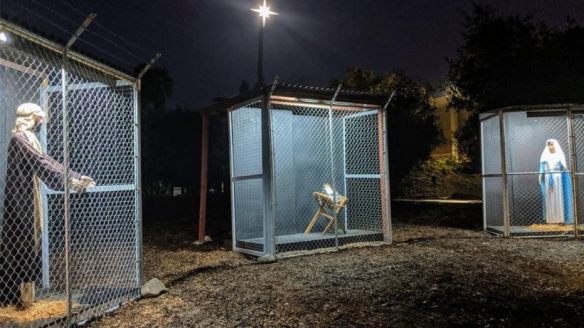
The Child That Christmas Forgot: How Would Jesus Fare in the American Police State?

By John W. Whitehead

Source: The Rutherford Institute

“Once upon a midnight clear, there was a child’s cry, a blazing star hung over a stable, and wise men came with birthday gifts. We haven’t forgotten that night down the centuries. We celebrate it with stars on Christmas trees, with the sound of bells, and with gifts… We forget nobody, adult or child. All the stockings are filled, all that is, except one. And we have even forgotten to hang it up. The stocking for the child born in a manger. It’s his birthday we’re celebrating. Don’t let us ever forget that. Let us ask ourselves what He would wish for most. And then, let each put in his share, loving kindness, warm hearts, and a stretched out hand of tolerance. All the shining gifts that make peace on earth.”—The Bishop’s Wife (1947)

The Christmas story of a baby born in a manger is a familiar one.

The Roman Empire, a police state in its own right, had ordered that a census be conducted. Joseph and his pregnant wife Mary traveled to the little town of Bethlehem so that they could be counted. There being no room for the couple at any of the inns, they stayed in a stable (a barn), where Mary gave birth to a baby boy, Jesus. Warned that the government planned to kill the baby, Jesus’ family fled with him to Egypt until it was safe to return to their native land.

Yet what if Jesus had been born 2,000 years later?

What if, instead of being born into the Roman police state, Jesus had been born at this moment in time? What kind of reception would Jesus and his family be given? Would we recognize the Christ child’s humanity, let alone his divinity? Would we treat him any differently than he was treated by the Roman Empire? If his family were forced to flee violence in their native country and sought refuge and asylum within our borders, what sanctuary would we offer them?

A singular number of churches across the country are asking those very questions, and their conclusions are being depicted with unnerving accuracy by nativity scenes in which Jesus and his family are separated, segregated and caged in individual chain-link pens, topped by barbed wire fencing.

These nativity scenes are a pointed attempt to remind the modern world that the narrative about the birth of Jesus is one that speaks on multiple fronts to a world that has allowed the life, teachings and crucifixion of Jesus to be drowned out by partisan politics, secularism, materialism and war.

The modern-day church has largely shied away from applying Jesus’ teachings to modern problems such as war, poverty, immigration, etc., but thankfully there have been individuals throughout history who ask themselves and the world: what would Jesus do?

What would Jesus—the baby born in Bethlehem who grew into an itinerant preacher and revolutionary activist, who not only died challenging the police state of his day (namely, the Roman Empire) but spent his adult life speaking truth to power, challenging the status quo of his day, and pushing back against the abuses of the Roman Empire—do?

Dietrich Bonhoeffer asked himself what Jesus would have done about the horrors perpetrated by Hitler and his assassins. The answer: Bonhoeffer risked his life to undermine the tyranny at the heart of Nazi Germany.

Aleksandr Solzhenitsyn asked himself what Jesus would have done about the soul-destroying gulags and labor camps of the Soviet Union. The answer: Solzhenitsyn found his voice and used it to speak out about government oppression and brutality.

Martin Luther King Jr. asked himself what Jesus would have done about America’s warmongering. The answer: declaring “my conscience leaves me no other choice,” King risked widespread condemnation when he publicly opposed the Vietnam War on moral and economic grounds.

Even now, despite the popularity of the phrase “What Would Jesus Do?” (WWJD) in Christian circles, there remains a disconnect in the modern church between the teachings of Christ and the suffering of what Jesus in Matthew 25 refers to as the “least of these.”

As the parable states:

“Then the King will say to those on his right, ‘Come, you who are blessed by my Father; take your inheritance, the kingdom prepared for you since the creation of the world. For I was hungry and you gave me something to eat, I was thirsty and you gave me something to drink, I was a stranger and you invited me in, I needed clothes and you clothed me, I was sick and you looked after me, I was in prison and you came to visit me.’ Then the righteous will answer him, ‘Lord, when did we see you hungry and feed you, or thirsty and give you something to drink? When did we see you a stranger and invite you in, or needing clothes and clothe you? When did we see you sick or in prison and go to visit you?’ The King will reply, ‘Truly I tell you, whatever you did for one of the least of these brothers and sisters of mine, you did for me.’ Then he will say to those on his left, ‘Depart from me, you who are cursed, into the eternal fire prepared for the devil and his angels. For I was hungry and you gave me nothing to eat, I was thirsty and you gave me nothing to drink, I was a stranger and you did not invite me in, I needed clothes and you did not clothe me, I was sick and in prison and you did not look after me.’ They also will answer, ‘Lord, when did we see you hungry or thirsty or a stranger or needing clothes or sick or in prison, and did not help you?’ He will reply, ‘Truly I tell you, whatever you did not do for one of the least of these, you did not do for me.’”

This is not a theological gray area: Jesus was unequivocal about his views on many things, not the least of which was charity, compassion, war, tyranny and love.

After all, Jesus—the revered preacher, teacher, radical and prophet—was born into a police state not unlike the growing menace of the American police state. When he grew up, he had powerful, profound things to say, things that would change how we view people, alter government policies and change the world. “Blessed are the merciful,” “Blessed are the peacemakers,” and “Love your enemies” are just a few examples of his most profound and revolutionary teachings.

When confronted by those in authority, Jesus did not shy away from speaking truth to power. Indeed, his teachings undermined the political and religious establishment of his day. It cost him his life. He was eventually crucified as a warning to others not to challenge the powers-that-be.

Can you imagine what Jesus’ life would have been like if, instead of being born into the Roman police state, he had been born and raised in the American police state?

Consider the following if you will.

Had Jesus been born in the era of the America police state, rather than traveling to Bethlehem for a census, Jesus’ parents would have been mailed a 28-page American Community Survey, a mandatory government questionnaire documenting their habits, household inhabitants, work schedule, how many toilets are in your home, etc. The penalty for not responding to this invasive survey can go as high as $5,000.

Instead of being born in a manger, Jesus might have been born at home. Rather than wise men and shepherds bringing gifts, however, the baby’s parents might have been forced to ward off visits from state social workers intent on prosecuting them for the home birth. One couple in Washington had all three of their children removed after social services objected to the two youngest being birthed in an unassisted home delivery.

Had Jesus been born in a hospital, his blood and DNA would have been taken without his parents’ knowledge or consent and entered into a government biobank. While most states require newborn screening, a growing number are holding onto that genetic material long-term for research, analysis and purposes yet to be disclosed.

Then again, had Jesus’ parents been undocumented immigrants, they and the newborn baby might have been shuffled to a profit-driven, private prison for illegals where they first would have been separated from each other, the children detained in make-shift cages, and the parents eventually turned into cheap, forced laborers for corporations such as Starbucks, Microsoft, Walmart, and Victoria’s Secret. There’s quite a lot of money to be made from imprisoning immigrants, especially when taxpayers are footing the bill.

From the time he was old enough to attend school, Jesus would have been drilled in lessons of compliance and obedience to government authorities, while learning little about his own rights. Had he been daring enough to speak out against injustice while still in school, he might have found himself tasered or beaten by a school resource officer, or at the very least suspended under a school zero tolerance policy that punishes minor infractions as harshly as more serious offenses.

Had Jesus disappeared for a few hours let alone days as a 12-year-old, his parents would have been handcuffed, arrested and jailed for parental negligence. Parents across the country have been arrested for far less “offenses” such as allowing their children to walk to the park unaccompanied and play in their front yard alone.

Rather than disappearing from the history books from his early teenaged years to adulthood, Jesus’ movements and personal data—including his biometrics—would have been documented, tracked, monitored and filed by governmental agencies and corporations such as Google and Microsoft. Incredibly, 95 percent of school districts share their student records with outside companies that are contracted to manage data, which they then use to market products to us.

From the moment Jesus made contact with an “extremist” such as John the Baptist, he would have been flagged for surveillance because of his association with a prominent activist, peaceful or otherwise. Since 9/11, the FBI has actively carried out surveillance and intelligence-gathering operations on a broad range of activist groups, from animal rights groups to poverty relief, anti-war groups and other such “extremist” organizations.

Jesus’ anti-government views would certainly have resulted in him being labeled a domestic extremist. Law enforcement agencies are being trained to recognize signs of anti-government extremism during interactions with potential extremists who share a “belief in the approaching collapse of government and the economy.”

While traveling from community to community, Jesus might have been reported to government officials as “suspicious” under the Department of Homeland Security’s “See Something, Say Something” programs. Many states, including New York, are providing individuals with phone apps that allow them to take photos of suspicious activity and report them to their state Intelligence Center, where they are reviewed and forwarded to law-enforcement agencies.

Rather than being permitted to live as an itinerant preacher, Jesus might have found himself threatened with arrest for daring to live off the grid or sleeping outside. In fact, the number of cities that have resorted to criminalizing homelessness by enacting bans on camping, sleeping in vehicles, loitering and begging in public has doubled.

Viewed by the government as a dissident and a potential threat to its power, Jesus might have had government spies planted among his followers to monitor his activities, report on his movements, and entrap him into breaking the law. Such Judases today—called informants—often receive hefty paychecks from the government for their treachery.

Had Jesus used the internet to spread his radical message of peace and love, he might have found his blog posts infiltrated by government spies attempting to undermine his integrity, discredit him or plant incriminating information online about him. At the very least, he would have had his website hacked and his email monitored.

Had Jesus attempted to feed large crowds of people, he would have been threatened with arrest for violating various ordinances prohibiting the distribution of food without a permit. Florida officials arrested a 90-year-old man for feeding the homeless on a public beach.

Had Jesus spoken publicly about his 40 days in the desert and his conversations with the devil, he might have been labeled mentally ill and detained in a psych ward against his will for a mandatory involuntary psychiatric hold with no access to family or friends. One Virginia man was arrested, strip searched, handcuffed to a table, diagnosed as having “mental health issues,” and locked up for five days in a mental health facility against his will apparently because of his slurred speech and unsteady gait.

Without a doubt, had Jesus attempted to overturn tables in a Jewish temple and rage against the materialism of religious institutions, he would have been charged with a hate crime. Currently, 45 states and the federal government have hate crime laws on the books.

Had anyone reported Jesus to the police as being potentially dangerous, he might have found himself confronted—and killed—by police officers for whom any perceived act of non-compliance (a twitch, a question, a frown) can result in them shooting first and asking questions later.

Rather than having armed guards capture Jesus in a public place, government officials would have ordered that a SWAT team carry out a raid on Jesus and his followers, complete with flash-bang grenades and military equipment. There are upwards of 80,000 such SWAT team raids carried out every year, many on unsuspecting Americans who have no defense against such government invaders, even when such raids are done in error.

Instead of being detained by Roman guards, Jesus might have been made to “disappear” into a secret government detention center where he would have been interrogated, tortured and subjected to all manner of abuses. Chicago police have “disappeared” more than 7,000 people into a secret, off-the-books interrogation warehouse at Homan Square.

Charged with treason and labeled a domestic terrorist, Jesus might have been sentenced to a life-term in a private prison where he would have been forced to provide slave labor for corporations or put to death by way of the electric chair or a lethal mixture of drugs.

Indeed, as I show in my book Battlefield America: The War on the American People, given the nature of government then and now, it is painfully evident that whether Jesus had been born in our modern age or his own, he still would have died at the hands of a police state.

Thus, as we draw near to Christmas with its celebrations and gift-giving, we would do well to remember that what happened on that starry night in Bethlehem is only part of the story. That baby in the manger grew up to be a man who did not turn away from evil but instead spoke out against it, and we must do no less.

Human Violence: Pervasive, Multi-dimensional and Extinction-threatening

By Robert J. Burrowes

Violence is pervasive throughout human society and it has a vast range of manifestations. Moreover, some of these manifestations – particularly the threat of nuclear war (which might start regionally), the climate catastrophe and the ongoing ecological devastation, as well as geoengineering and the deployment of 5G – threaten imminent human extinction if not contained. Separately from these extinction-threatening manifestations, however, violence occurs in a huge range of other contexts denying many people the freedom, human rights and opportunities necessary for a meaningful life. Moreover, human violence is now driving 200 species of life on Earth to extinction daily with another 1,000,000 species under threat.

For just a sample of the evidence in relation to the threats noted above see, for example, ‘Rapidly expanding nuclear arsenals in Pakistan and India portend regional and global catastrophe’, ‘Plan A’, ‘City on Fire’, ‘Human Extinction by 2026? A Last Ditch Strategy to Fight for Human Survival’, Geoengineering Watch, ‘International Appeal: Stop 5G on Earth and in Space’ and ‘5G and the Wireless Revolution: When Progress Becomes a Death Sentence’.

Given the expanding range of threats to human survival that require a strategic response if they are to be contained, is that possible?

Well, any candid assessment of the relevant scientific literature coupled with an understanding of the psychological, sociological, political, economic and military factors driving the violence, clearly indicates that the answer is ‘highly unlikely’. Particularly because so many people are so (unconsciously) terrified and incapable of responding powerfully.

However, this does not mean that many people are not trying and some of these people perceive the interrelated and synergistic nature of these threats and know that we must be addressing each of them strategically if humanity and an enormous number of other species are to have any meaningful chance of survival in a viable biosphere. These people range from ‘ordinary’ activists, who work passionately to end violence in one context or another, to globally prominent individuals doing the same. Let me tell you about some of them.

Ramesh Agrawal is a prominent social and environmental activist in India who has devoted many years to educating and organizing local village people, including adivasi communities, to defend their homes and lands from those corporations and governments that would deprive them of their rights, livelihoods, health and a clean environment for the sake of mining the abundant coal in the state of Chhattisgarh. However, because his ongoing efforts to access and share key information and his organization of Gandhian-inspired grassroots satyagrahas (nonviolent campaigns) have been so effective, he has also paid a high price for his activism, having been attacked on many occasions. In 2011, for example, he was arrested despite ill-health at the time and chained to a hospital bed. A year later he was shot in the leg, which required multiple operations. He still has difficulty walking with six metal rods inserted through his thigh.

The Jan Chetna (‘peoples’ awareness’) movement started by Ramesh has spread to several parts of Chhattisgarh as well as other states of India. For the latest account of his efforts including the recent ‘coal satyagrapha’ focused on coal blocks owned by state power companies but being developed and operated by Adani Enterprises, see ‘Thousands Hold “Coal Satyagraha”, Allege Manufacturing of Consent at Public Hearing’. For his nonviolent activism, Ramesh was awarded the Goldman Environmental Prize in 2014. See ‘Ramesh Agrawal: 2014 Goldman Prize Recipient Asia’ and ‘Chhattisgarh activist, Ramesh Agrawal, bags Goldman prize’.

In Ghana, the Women’s International League for Peace and Freedom (WILPF) continues its work under the leadership of President Dr. Ayo Ayoola-Amale, a certified mediator and peacebuilder. One recent activity was a two weeks training course on negotiation and mediation as a tool for conflict resolution for women in the Upper West region of Ghana, particularly three districts: Lawra, Nadowli and Lambussie. The training was aimed at providing local NGOs, community elders, administrators and others with the skills and knowledge to further improve their capacity in the work they do. In such courses, Ayo emphasizes the importance of trust, identity and relationship building issues, quoting Dr. Martin Luther King Jr.: ‘Life and history give eloquent testimony to the fact that conflicts are never resolved without trustful give and take on both sides.’

But Ayo has also conducted other courses, such as a three day workshop on peacemaking and mediation skills for the teachers and students at Okyereko Methodist Junior High School which taught skills such as communication (listening, speaking, silence), cooperation, trusting, empathy, responsibility, reconciliation and problem solving. Ayo also used her storytelling skills to convey an understanding of what it means to be a responsible person and how that puts us in charge of our lives. Through the storytelling she reveals some of the personal benefits that come from being honest, reliable, trustworthy and principled and how treating people with respect helps us get along with each other, avoid and resolve conflicts, and create a positive social climate. She told workshop participants that every choice they make helps define the kind of person they are choosing to be and their character is defined by what they do, not what they say or believe.

Professor René Wadlow, President of the Association of World Citizens headquartered in France, has been involved for decades in efforts to engage people in world events rather than leave these events to be mismanaged by elites with a vested interest in a particular outcome. In this article, for example, he reflects thoughtfully on the ‘Iran Crisis: Dangers and Opportunities’ by drawing attention to opportunities for citizen engagement through NGOs to influence how the conflict plays out. As he notes: ‘The dangers are real. We must make the most of the opportunities.’ René also continues to examine issues and throw light on subjects well outside the spotlight of the corporate media, such as conflicts in Africa. See, for example, his article ‘Sahel Instability Spreads’.

Since 2017 Dr Marthie Momberg in South Africa has been working with international colleagues to address Zionism amongst Christians. Along with a colleague from Kairos USA, Marthie offered, for example, a seminar entitled ‘Christianity and the Shifting of Perceptions on Zionism’ at Stellenbosch University’s Beyers Naudé Centre. ‘With some other colleagues we are also in the midst of a research project at this Centre to understand how to sensitise Christians on the nature of Zionism and how it serves as an important lens on so many other struggles in our world. I am also in the process of writing a number of scholarly articles on ethics and religion in the context of Israel and the Palestinian struggle.’

And while on Palestine, US activist journalist Abby Martin recently completed her debut feature film Gaza Fights for Freedom. Directed, written and narrated by Abby, the film had its origins while Abby was reporting in Palestine, where she was denied entry into Gaza by the Israeli government on the accusation she was a ‘propagandist’. Connecting with a team of journalists in Gaza to produce the film through the blockaded border, this collaboration shows you Gaza’s protest movement ‘like you’ve never seen it before’. Filmed during the height of the Great March Of Return protests, it features riveting footage of demonstrations ‘where 200 unarmed civilians have been killed by Israeli snipers since March 30, 2018’ and is a thorough indictment of the Israeli military for war crimes, and a stunning cinematic portrayal of the heroic resistance by Palestinians. You can watch a preview of the film here: Gaza Fights for Freedom (preview). And if you would like to buy or rent the film (and support Abby’s work) you can do so here: Gaza Fights for Freedom.

In Guatemala, Daniel Dalai continues his visionary work providing opportunities for girls to develop their leadership capacities at Earthgardens. If you haven’t previously been aware of their work, including in Bolivia and Nicaragua, you will find it fascinating to read how girls – including Carmen, Angelica, Reyna, Katiela, Yapanepet, Zenobia, Deysi, Rosalba, Charro, Katarina and Marleni – in this community each changed their society, often by forming ‘Eco-Teams’, with a remarkable variety of initiatives.

The Asia Institute ‘is the first truly pan-Asian think tank. A research institution that addresses global issues with a focus on Asia, The Asia Institute is committed to presenting a balanced perspective that takes into account the concerns of the entire region. The Asia Institute provides an objective space wherein a significant discussion on current trends in technology, international relations, the economy and the environment can be carried out.’ Focused on research, analysis and dialogue, and headed by president Emanuel Yi Pastreich, the Institute was originally founded in 2007 while Emanuel was working in Daejeon, Republic of (South) Korea. Emanuel writes extensively on culture, technology, the environment and international relations with a focus on Northeast Asia. He also serves as president of the Earth Management Institute, a global think tank dedicated to developing original approaches to global governance in this dangerous age. But for more on The Asia Institute, see the website above.

While the individuals and organizations mentioned above are just a sample of those directly involved, they are part of an expanding worldwide network in 105 countries committed to working to end human violence in all of its manifestations. Whatever the odds against it, they refuse to accept that violence cannot be ended, and each has chosen to focus on working to end one or more manifestations of violence, according to their particular circumstances and interests. If you would like to join these people, you are welcome to sign the online pledge of The Peoples Charter to Create a Nonviolent World.

If your own interest is campaigning on a peace, climate, environment or social justice issue, consider doing it strategically. See Nonviolent Campaign Strategy.

If your focus is a defense or liberation struggle being undertaken by a national group, consider enhancing its strategic impact. See Nonviolent Defense/Liberation Strategy.

If your preference is addressing the climate and environmental catastrophes systematically while working locally, consider participating in (and inviting others to participate in) The Flame Tree Project to Save Life on Earth.

If you would like to tackle violence at its source, consider revising your parenting in accordance with ‘My Promise to Children’. If you want the evidence to understand why this is so crucial, see Why Violence?’ and Fearless Psychology and Fearful Psychology: Principles and Practice.

If you are self aware enough to know that you are not dealing effectively with our deepening, multifaceted crisis, consider doing the personal healing necessary to do so. See ‘Putting Feelings First’.

Perhaps ending human violence is impossible. If that is true, then human extinction is inevitable and it will occur as a result of one cause or another. Moreover, it will happen in the near term. But every person who believes that human violence can be ended, and then takes strategic action to end it, is participating in the most important undertaking in human history: a last ditch strategy to fight for human survival.


Biodata: Robert J. Burrowes has a lifetime commitment to understanding and ending human violence. He has done extensive research since 1966 in an effort to understand why human beings are violent and has been a nonviolent activist since 1981. He is the author of Why Violence? His email address is flametree@riseup.net and his website is here.


The Pathocracy of the Deep State: Tyranny at the Hands of a Psychopathic Government

By John W. Whitehead

Source: The Rutherford Institute

Politicians are more likely than people in the general population to be sociopaths. I think you would find no expert in the field of sociopathy/psychopathy/antisocial personality disorder who would dispute this… That a small minority of human beings literally have no conscience was and is a bitter pill for our society to swallow — but it does explain a great many things, shamelessly deceitful political behavior being one.”—Dr. Martha Stout, clinical psychologist and former instructor at Harvard Medical School

Twenty years ago, a newspaper headline asked the question: “What’s the difference between a politician and a psychopath?

The answer, then and now, remains the same: None.

There is no difference between psychopaths and politicians.

Nor is there much of a difference between the havoc wreaked on innocent lives by uncaring, unfeeling, selfish, irresponsible, parasitic criminals and elected officials who lie to their constituents, trade political favors for campaign contributions, turn a blind eye to the wishes of the electorate, cheat taxpayers out of hard-earned dollars, favor the corporate elite, entrench the military industrial complex, and spare little thought for the impact their thoughtless actions and hastily passed legislation might have on defenseless citizens.

Psychopaths and politicians both have a tendency to be selfish, callous, remorseless users of others, irresponsible, pathological liars, glib, con artists, lacking in remorse and shallow.

Charismatic politicians, like criminal psychopaths, exhibit a failure to accept responsibility for their actions, have a high sense of self-worth, are chronically unstable, have socially deviant lifestyles, need constant stimulation, have parasitic lifestyles and possess unrealistic goals.

It doesn’t matter whether you’re talking about Democrats or Republicans.

Political psychopaths are all largely cut from the same pathological cloth, brimming with seemingly easy charm and boasting calculating minds. Such leaders eventually create pathocracies: totalitarian societies bent on power, control, and destruction of both freedom in general and those who exercise their freedoms.

Once psychopaths gain power, the result is usually some form of totalitarian government or a pathocracy. “At that point, the government operates against the interests of its own people except for favoring certain groups,” author James G. Long notes. “We are currently witnessing deliberate polarizations of American citizens, illegal actions, and massive and needless acquisition of debt. This is typical of psychopathic systems, and very similar things happened in the Soviet Union as it overextended and collapsed.”

In other words, electing a psychopath to public office is tantamount to national hara-kiri, the ritualized act of self-annihilation, self-destruction and suicide. It signals the demise of democratic government and lays the groundwork for a totalitarian regime that is legalistic, militaristic, inflexible, intolerant and inhuman.

Incredibly, despite clear evidence of the damage that has already been inflicted on our nation and its citizens by a psychopathic government, voters continue to elect psychopaths to positions of power and influence.

According to investigative journalist Zack Beauchamp, “In 2012, a group of psychologists evaluated every President from Washington to Bush II using ‘psychopathy trait estimates derived from personality data completed by historical experts on each president.’ They found that presidents tended to have the psychopath’s characteristic fearlessness and low anxiety levels — traits that appear to help Presidents, but also might cause them to make reckless decisions that hurt other people’s lives.”

The willingness to prioritize power above all else, including the welfare of their fellow human beings, ruthlessness, callousness and an utter lack of conscience are among the defining traits of the sociopath.

When our own government no longer sees us as human beings with dignity and worth but as things to be manipulated, maneuvered, mined for data, manhandled by police, conned into believing it has our best interests at heart, mistreated, jailed if we dare step out of line, and then punished unjustly without remorse—all the while refusing to own up to its failings—we are no longer operating under a constitutional republic.

Instead, what we are experiencing is a pathocracy: tyranny at the hands of a psychopathic government, which “operates against the interests of its own people except for favoring certain groups.”

Worse, psychopathology is not confined to those in high positions of government. It can spread like a virus among the populace. As an academic study into pathocracy concluded, “[T]yranny does not flourish because perpetuators are helpless and ignorant of their actions. It flourishes because they actively identify with those who promote vicious acts as virtuous.”

People don’t simply line up and salute. It is through one’s own personal identification with a given leader, party or social order that they become agents of good or evil.

Much depends on how leaders “cultivate a sense of identification with their followers,” says Professor Alex Haslam. “I mean one pretty obvious thing is that leaders talk about ‘we’ rather than ‘I,’ and actually what leadership is about is cultivating this sense of shared identity about ‘we-ness’ and then getting people to want to act in terms of that ‘we-ness,’ to promote our collective interests. . . . [We] is the single word that has increased in the inaugural addresses over the last century . . . and the other one is ‘America.’”

The goal of the modern corporate state is obvious: to promote, cultivate, and embed a sense of shared identification among its citizens. To this end, “we the people” have become “we the police state.”

We are fast becoming slaves in thrall to a faceless, nameless, bureaucratic totalitarian government machine that relentlessly erodes our freedoms through countless laws, statutes, and prohibitions.

Any resistance to such regimes depends on the strength of opinions in the minds of those who choose to fight back. What this means is that we the citizenry must be very careful that we are not manipulated into marching in lockstep with an oppressive regime.

Writing for ThinkProgress, Beauchamp suggests that “one of the best cures to bad leaders may very well be political democracy.”

But what does this really mean in practical terms?

It means holding politicians accountable for their actions and the actions of their staff using every available means at our disposal: through investigative journalism (what used to be referred to as the Fourth Estate) that enlightens and informs, through whistleblower complaints that expose corruption, through lawsuits that challenge misconduct, and through protests and mass political action that remind the powers-that-be that “we the people” are the ones that call the shots.

Remember, education precedes action. Citizens need to the do the hard work of educating themselves about what the government is doing and how to hold it accountable. Don’t allow yourselves to exist exclusively in an echo chamber that is restricted to views with which you agree. Expose yourself to multiple media sources, independent and mainstream, and think for yourself.

For that matter, no matter what your political leanings might be, don’t allow your partisan bias to trump the principles that serve as the basis for our constitutional republic. As Beauchamp notes, “A system that actually holds people accountable to the broader conscience of society may be one of the best ways to keep conscienceless people in check.”

That said, if we allow the ballot box to become our only means of pushing back against the police state, the battle is already lost.

Resistance will require a citizenry willing to be active at the local level.

Yet as I point out in my book Battlefield America: The War on the American People, if you wait to act until the SWAT team is crashing through your door, until your name is placed on a terror watch list, until you are reported for such outlawed activities as collecting rainwater or letting your children play outside unsupervised, then it will be too late.

This much I know: we are not faceless numbers. We are not cogs in the machine. We are not slaves.

We are human beings, and for the moment, we have the opportunity to remain free—that is, if we tirelessly advocate for our rights and resist at every turn attempts by the government to place us in chains.

The Founders understood that our freedoms do not flow from the government. They were not given to us only to be taken away by the will of the State. They are inherently ours. In the same way, the government’s appointed purpose is not to threaten or undermine our freedoms, but to safeguard them.

Until we can get back to this way of thinking, until we can remind our fellow Americans what it really means to be free, and until we can stand firm in the face of threats to our freedoms, we will continue to be treated like slaves in thrall to a bureaucratic police state run by political psychopaths.

How To Defeat The Empire

By Caitlin Johnstone

Source: CaitlinJohnstone.com

One of the biggest and most consistent challenges of my young career so far has been finding ways to talk about solutions to our predicament in a way that people will truly hear. I talk about these solutions constantly, and some readers definitely get it, but others will see me going on and on about a grassroots revolution against the establishment narrative control machine and then say “Okay, but what do we do?” or “You talk about problems but never offer any solutions!”

Part of the difficulty is that I don’t talk much about the old attempts at solutions we’ve already tried that people have been conditioned to listen for. I don’t endorse politicians, I don’t advocate starting a new political party, I don’t support violent revolution, I don’t say that capitalism contains the seeds of its own destruction and the proletariat will inevitably rise up against the bourgeoisie, and in general I don’t put much stock in the idea that our political systems are in and of themselves sufficient for addressing our biggest problems in any meaningful way.

What I do advocate, over and over and over again in as many different ways as I can come up with, is a decentralized guerrilla psywar against the institutions which enable the powerful to manipulate the way ordinary people think, act and vote.

I talk about narrative and propaganda all the time because they are the root of all our problems. As long as the plutocrat-controlled media are able to manufacture consent for the status quo upon which those plutocrats built their respective empires, there will never be the possibility of a successful revolution. People will never rebel against a system while they’re being successfully propagandized not to. It will never, ever happen.

Most people who want drastic systematic changes to the way power operates in our society utterly fail to take this into account. Most of them are aware to some extent that establishment propaganda is happening, but they fail to fully appreciate its effects, its power, and the fact that it’s continually getting more and more sophisticated. They continue to talk about the need for a particular political movement, for this or that new government policy, or even for a full-fledged revolution, without ever turning and squarely focusing on the elephant in the room that none of these things will ever happen as long as most people are successfully propagandized into being uninterested in making them happen.

It’s like trying to light a fire without first finding a solution to the problem that you’re standing under pouring rain. Certainly we can all agree that a fire is sorely needed because it’s cold and wet and miserable out here, but we’re never going to get one going while the kindling is getting soaked and we can’t even get a match lit. The first order of business must necessarily be to find a way to protect our fire-starting area from the downpour of establishment propaganda.

A decentralized guerrilla psywar against the propaganda machine is the best solution to this problem.

By psywar I mean a grassroots psychological war against the establishment propaganda machine with the goal of weakening public trust in pro-empire narratives. People only believe sources of information that they trust, and propaganda cannot operate without belief. Right now trust in the mass media is at an all-time low while our ability to network and share information is at an all-time high. Our psywar is fought with the goal of using our unprecedented ability to circulate information to continue to kill public trust in the mass media, not with lies and propaganda, but with truth. If we can expose journalistic malpractice and the glaring plot holes in establishment narratives about things like war, Julian Assange, Russia etc, we will make the mass media look less trustworthy.

By decentralized I mean we should each take responsibility for weakening public trust in the propaganda machine in our own way, rather than depending on centralized groups and organizations. The more centralized an operation is, the easier it is for establishment manipulators to infiltrate and undermine it. This doesn’t mean that organizing is bad, it just means a successful grassroots psywar won’t depend on it. If we’re each watching for opportunities to weaken public trust in the official narrative makers on our own personal time and in our own unique way using videos, blogs, tweets, art, paper literature, conversations and demonstrations, we’ll be far more effective.

By guerrilla I mean constantly attacking different fronts in different ways, never staying with the same line of attack for long enough to allow the propagandists to develop a counter-narrative. If they build up particularly strong armor around one area, put it aside and expose their lies on an entirely different front. The propagandists are lying constantly, so there is never any shortage of soft targets. The only consistency should be in attacking the propaganda machine as visibly as possible.

As far as how to go about that attack, my best answer is that I’m leading by example here. I’m only ever doing the thing that I advocate, so if you want to know what I think we should all do, just watch what I do. I’m only ever using my own unique set of skills, knowledge and assets to attack the narrative control engine at whatever points I perceive to be the most vulnerable on a given day.

So do what I do, but keep in mind that each individual must sort out the particulars for themselves. We’ve each got our own strengths and abilities that we bring to the psywar: some of us are funny, some are artistic, some are really good at putting together information and presenting it in a particular format, some are good at finding and boosting other people’s high-quality attacks. Everyone brings something to the table. The important thing is to do whatever will draw the most public interest and attention to what you’re doing. Don’t shy away from speaking loud and shining bright.

It isn’t necessary to come up with your own complete How It Is narrative of exactly what is happening in our world right now; with the current degree of disinformation and government opacity that’s too difficult to do with any degree of completion anyway. All you need to do is wake people up in as many ways as possible to the fact that they’re being manipulated and deceived. Every newly opened pair of eyes makes a difference, and anything you can do to help facilitate that is energy well spent.

Without an effective propaganda machine, the empire cannot rule. Once we’ve crippled public trust in that machine, we’ll exist in a very different world already, and the next step will present itself from there. Until then, the attack on establishment propaganda should be our foremost priority.

Rage Against the War Machine: An Interview with Peace Activist Cindy Sheehan

By Mnar Muhawesh

Source: Mint Press News

Some 2.7 billion dollars per day. That’s how much the U.S. government will spend next year to prop up the military and the more than 800 bases it maintains in over 70 countries. All in the name of national security. And despite that staggering figure, a majority of Americans feel that the wars in Iraq and Afghanistan were not even worth fighting, and they certainly have not made America safer.

That money is more than enough to pay for four years of college for every college student in this country, to fund food stamps and other social safety nets that help our most vulnerable, and to fund programs that would cut fossil-fuel emissions by 40 percent by 2035.

Despite this, there has been an utter failure by both the media and grassroots activists to address the growing waste and greed of the military-industrial complex.

An estimated 4 million people just took part in worldwide climate strikes that put the issue of climate breakdown at the forefront of the media conversation. Missing from this conversation, however, is an analysis of the role militarism and empire plays in driving the chaos. The U.S. military is the world’s largest polluter and emits more carbon dioxide than a hundred countries combined.

You see, America does not have a budget problem, it has a priorities problem; until we demand that our leaders prioritize our needs over those of corporations and those who profit off of war, our politicians will continue to pilfer taxpayer dollars by the trillions to fund forever wars that support building the largest empire history has seen.

Today, Donald Trump is the ugly face of the American Empire, and recently declared the country to be “locked and loaded” and ready to confront the Islamic Republic of Iran. And with conflicts in Iraq, Afghanistan and Syria (to mention only a few) ongoing, it feels like the cycle of war may never end.

The anti-war movement in the U.S., so strong under George W. Bush’s presidency, was effectively disarmed by his successor. Barack Obama put a friendly face on U.S. imperialism and, with the help of Hillary Clinton as his secretary of state, even managed to convince many so-called liberals and progressives to support devastating regime-change operations in Libya, Syria and Ukraine on humanitarian grounds. These interventions unleashed al-Qaeda and ISIS onto the Middle East and neo-Nazi rule on Russia’s borders. Obama expanded America’s wars, dropping over 25,000 bombs targeting seven different countries: Afghanistan, Iraq, Syria, Libya, Yemen, Somalia and Pakistan. He expanded drone wars, earning the nickname “Drone King,” and expanded U.S. bases across Africa under the guise of fighting the War on Terror.

While the Democratic Party and establishment-left mourned Obama’s exit from the White House, warning of a new era of fascism under President Trump, hundreds of thousands of outraged Americans took to the streets in protests against the new Republican president’s racism, misogyny, and xenophobia. This outrage gave birth to the Women’s March. But as these protests swelled, one couldn’t help wondering why there wasn’t any mobilization remotely on this scale in the previous eight years during Obama’s presidency?

This question crossed the mind of Cindy Sheehan, a longtime anti-war activist nicknamed “Peace Mom,” who contacted the organizers of the Women’s March — since one of the movement’s stated goals was to end violence against women — and asked them to make peace a central focus of the march.

But the response of a key organizer of the march showed just how little war and peace was a priority to establishment liberals: “I appreciate that war is your issue Cindy, but the Women’s March will never address the war issue as long as women aren’t free.”

Sheehan rejected the notion that women could be “free” without addressing war and empire. She countered the dismissive comment of the march organizer by stating that divorcing peace activism from women’s issues “ignored the voices of the [millions] of women of the world who are being bombed and oppressed by U.S. military occupation.”

It was clear that the anti-war movement needed to be reborn again, and who better than Sheehan herself could fit the bill?

Cindy grew up in California, where her father worked for the Lockheed corporation. A turning point in her life came in April 2004 after her son Casey was killed while on active service with the U.S. military in Iraq. She gained national attention after she staged an extended protest outside George W. Bush’s ranch in Crawford, Texas, demanding to meet him.

Since then she has tirelessly campaigned against war and violence abroad, being described as the “Rosa Parks of the peace movement.” Throughout her activism, she has taken a nonpartisan stance in speaking truth to power, calling out George W. Bush as the biggest terrorist in the world, but also traveling to Norway to protest Barack Obama’s Nobel Peace Prize. In 2012 she was the vice-presidential nominee of the Peace and Freedom Party.

Today, Cindy is the chief organizer of the upcoming Rage Against the War Machine protests in Washington, scheduled to take place on October 11.


Mnar Muhawesh is founder, CEO and editor in chief of MintPress News, and is also a regular speaker on responsible journalism, sexism, neoconservativism within the media and journalism start-ups.

The Global Climate Movement is Failing: Why?

By Robert J. Burrowes

It has been satisfying to note the significant response to two recent climate campaigns: the actions, including the recent Global Climate Strike, initiated by school students inspired by Greta Thunberg and the climate actions organized by Extinction Rebellion.

While delighted that these campaigns have finally managed to mobilize significant numbers of people around the existential threat the climate catastrophe poses to life on Earth, I would like to briefly raise some issues for consideration by each of those involved in the climate movement as well as those considering involvement.

I do this because history provides clearcut and compelling lessons on how to make such movements have the impact we need and, so far, the climate movement is not doing several vital things if we are to indeed be successful. And I would like to be successful.

So here are five key issues that I would address as soon as possible.

  1. Analyze the climate catastrophe within the context of the ongoing and broader environmental disaster that is currently taking place.
  2. Analyze the climate catastrophe and environmental disaster to better understand the political, economic and social systems and structures, as well as the individual behaviours, that are driving them.
  3. Based on these analyses, reorient the movement’s strategic focus: that is, who and what is the movement trying to change?
  4. And then identify the nature of the behavioural changes we are asking of people and their organizations, and how these will be achieved.
  5. In what timeframe?

Let me briefly elaborate why I believe these issues are so important.

  1. Earth’s biosphere is under siege, not just the climate.

There is no point mobilizing action to halt ongoing destruction of the climate while paying insufficient attention to the vast range of other threats to key ecosystems that make life on Earth possible. I understand that most movements, whether concerned with peace, the environment or social justice, for example, tend to confine their concern to one issue. Unfortunately, however, we no longer have the luxury of doing that given the multifaceted existential threats to life on Earth.

The biosphere is under siege on many fronts with military violence, radioactive contamination (from nuclear weapons testing, nuclear waste from power plants including Fukushima and Chernobyl, depleted uranium weapons…), destruction of the rainforests and oceans, contamination and depletion of Earth’s fresh water supply, geoengineering, 5G and many other assaults inflicting ongoing and uncontained damage on Earth and its species. See, for example, ‘5G and the Wireless Revolution: When Progress Becomes a Death Sentence’.

This has critical implications for the strategic goals we set ourselves in our struggle to save not only the climate but the many vital ecosystems of Earth’s biosphere. In short, if we ‘save the climate’ but rainforests are destroyed or nuclear war takes place, then saving the climate will have been a pyrrhic victory.

  1. Politicians are a ‘sideshow’ with negligible power.

Hence, it is a waste of time lobbying them to do such things as ‘declare a climate emergency’, ‘phase out all fossil fuel extraction and transform our economy to 100% renewable energy by 2030’, ‘recognize indigenous sovereignty’ and ‘implement a Green New Deal’.

The global elite, which is insane, is ‘running the show’, including the key political, economic, military and social structures and the bulk of the politicians we supposedly elect. This means that the global elite holds the levers of power over the world capitalist system, national military forces and the major international political and economic organizations such as the United Nations, the World Bank and the International Monetary Fund. For brief explanations of this, with references to many more elaborate accounts, see the section headed ‘How the World Works: A Brief History’ in ‘Why Activists Fail’, as well as ‘Exposing the Giants: The Global Power Elite’ and ‘The Global Elite is Insane Revisited’.

But separately from the role of the global elite in managing the major political, economic and social systems and structures in order to extract maximum corporate profit, individual behaviours, particularly the consumption patterns of people in industrialized countries, are also driving the destruction of Earth’s biosphere. Why? Because our parenting and teaching models are extraordinarily violent and leave the typical human living in an unconsciously terrified, self-hating and powerless state and addicted to using consumption as a key means to suppress awareness of how they feel. See ‘Love Denied: The Psychology of Materialism, Violence and War’ and ‘Do We Want School or Education?’ and, for more detail, ‘Why Violence?’ and ‘Fearless Psychology and Fearful Psychology: Principles and Practice’.

3 & 4. If we understand the above two points, we can reorient our efforts.

This means that instead of powerlessly lobbying politicians, we can change our strategic focus to maximize our strategic impact. So, on the one hand for example, we can tackle corporations profiting from the manufacture, sale and use of military weapons, the extraction and sale of fossil fuels or the manufacture and sale of the poison glyphosate (‘Roundup’), by designing and implementing thoughtful strategies of nonviolent action to end their manufacture and sale of these life-destroying products. For comprehensive guidance on campaigning strategically, see Nonviolent Campaign Strategy. For a list of the strategic goals necessary to effectively tackle the climate catastrophe or end war, for example, see ‘Strategic Aims’. And for a brief explanation of how to make a nonviolent action have maximum impact, see ‘Nonviolent Action: Why and How it Works’.

On the other hand, we can encourage responsible and systematic reductions of consumption in all key areas – water, household energy, transport fuels, metals, meat, paper and plastic – while dramatically expanding individual and community self-reliance in 16 areas in industrialized countries as outlined in ‘The Flame Tree Project to Save Life on Earth’. Or, more simply, we can encourage people to make the Earth Pledge (below).

Once enough people commit to one or the other of these two approaches (to substantially reduce consumption and increase local self-reliance), then three vital outcomes will be achieved:

  1. it will progressively reduce resource extraction from, and pollution of, Earth’s biosphere,
  2. it will functionally undermine capitalism and the ongoing industrialization process, and
  3. it will remove the fundamental driver of the global elite’s perpetual war: our collective demand for the goods and services made available by the elite’s theft of resources from countries they invade and exploit on our behalf.

I am well aware of the captivating power of turning up in a shared space with a vast bunch of other people with whom we agree. Unfortunately, while it might be a lot of fun, it is usually a waste of time strategically. Even the largest worldwide mobilization in human history (against the imminent US-led war on Iraq) on 15 February 2003, in which 30,000,000 people participated in more than 600 cities around the world, was ineffective. See ‘Why Activists Fail’.

Of course, if you still want a large public action, then you need to make sure the gathering has strategic focus. For example, instead of using it to powerlessly beg politicians to fix things for us, make it an occasion where participants can publicly commit to taking powerful action themselves by signing the Earth Pledge.

The Earth Pledge

Out of love for the Earth and all of its creatures, and my respect for their needs, from this day onwards I pledge that:

  1. I will listen deeply to children (see explanation below)
  2. I will not travel by plane
  3. I will not travel by car
  4. I will not eat meat and fish
  5. I will only eat organically/biodynamically grown food
  6. I will minimize the amount of fresh water I use, including by minimizing my ownership and use of electronic devices
  7. I will not buy rainforest timber
  8. I will not buy or use single-use plastic, such as bags, bottles, containers, cups and straws
  9. I will not use banks, superannuation (pension) funds or insurance companies that provide any service to corporations involved in fossil fuels, nuclear power and/or weapons
  10. I will not accept employment from, or invest in, any organization that supports or participates in the exploitation of fellow human beings or profits from killing and/or destruction of the biosphere
  11. I will not get news from the corporate media (mainstream newspapers, television, radio, Google, Facebook, Twitter…)
  12. I will make the effort to learn a skill, such as food gardening or sewing, that makes me more self-reliant
  13. I will gently encourage my family and friends to consider signing this pledge.

To reiterate: It is delusional to believe that we can sustain the existing levels of consumption and preserve Earth’s biosphere. Because, in the end, it is our over-consumption that is driving the destruction. As an aside, this is also why the various Green New Deal proposals being put forward are misconceived: each of the versions that I have checked is essentially a wish-list of desirable changes ‘demanded’ of governments while missing the fundamental point that if people still want to fly, drive, eat meat and fish, or food that is poisoned, use electronic devices…, they are paying the elite to maintain existing structures of violence and exploitation, to continue killing people (to steal their resources) and to destroy the biosphere. And this, of course, means that we are directly complicit in the violence, exploitation and destruction. After all, why should the elite listen to our demands for change when we spend our money supporting their existing profit-maximizing, people-killing and biosphere-destroying behaviours?

If this all seems too challenging, then I invite you to consider doing the emotional healing necessary so that you can act powerfully in response to this crisis. See ‘Putting Feelings First’. If you want to help children to do so, consider making ‘My Promise to Children’ which will require capacity in ‘Nisteling: The Art of Deep Listening’.

  1. The timeframe to which we are working is vital.

Given the ever-increasing body of evidence that suggests human extinction will occur by 2026, there is no point working to the elite-sponsored IPCC timeframe, designed to maximize corporate profits-as-usual for as long as possible. We do not have, for example, until 2030 to contain the temperature increase to 1.5 degrees celsius above the pre-industrial level or, say, mid-century to fully reign in carbon, methane and nitrous oxide emissions. We have nothing like this much time. Moreover, anyone paying attention to the state and ongoing destruction of the world’s rainforests and oceans, the ‘insect apocalypse’ and the accelerating rate of species extinctions (with one million species now under threat) should perceive this intuitively unless (unconsciously) terrified and hence delusional.

But for a fuller elaboration of the short timeframe we have left, if we take into account the synergistic psychological, sociological, political, economic, climate, ecological, military and nuclear considerations that each play a part in shaping this timeframe, see ‘Human Extinction by 2026? A Last Ditch Strategy to Fight for Human Survival’.

Conclusion

By now, of course, many people will be overwhelmed by what they have read above (if they got this far). So this is why those who feel able to grapple with the evidence presented are also the ones most likely to have the courage to join me in taking the action outlined and gently encouraging others in the movement to reconsider and reorient movement strategy too.

It also means that the climate movement and those with whom we must work, such as those in the labour, women’s, antiwar, indigenous rights and environment movements, have considerably more work to do if we are to achieve the outcomes we all want.

Unless enough of us are able to embrace the path outlined above, human extinction in the near term is inevitable because our efforts will be wasted on actions that cannot have the necessary impact given the full dimensions of the crisis.


Biodata: Robert J. Burrowes has a lifetime commitment to understanding and ending human violence. He has done extensive research since 1966 in an effort to understand why human beings are violent and has been a nonviolent activist since 1981. He is the author of ‘Why Violence?’ His email address is flametree@riseup.net and his website is here.

The Struggle for Peace in Afghanistan: Is Community Engagement the Key?

By Robert J. Burrowes

I have just read a superb book by Mark Isaacs, an Australian who has documented several years of effort by a group of incredibly committed young people in Afghanistan to build peace in that war-torn country the only way it can be built: by learning, living and sharing peace.

The book, titled The Kabul Peace House: How a Group of Young Afghans are Daring to Dream in a Land of War, records in considerable detail the struggle, both internal and external, to generate a peaceful future in Afghanistan. Some might consider this vision naive, others courageous, but few would doubt the simple reality: it is slow, daunting, incredibly difficult, often saddening, frightening, infuriating or painful, sometimes uplifting or hilarious and, just occasionally, utterly rewarding.

This is a human story written by a person who knows how to listen and to observe. And because the subject is about a group of ordinary Afghans and their mentor doing their best in the struggle to end one of the longest wars in human history, it is a story that is well worth reading.

This story is embedded in a combination of (brief) historical background on Afghanistan’s longstanding and central role in imperial geopolitics (including during ‘The Great Game’ of the 19th century) and more recent history on the progressive modernity of Afghanistan prior to the Soviet invasion in 1979 which was followed by an ongoing and multifaceted war in which the United States has played the most damaging role since its invasion of the country in 2001. But the background also includes a description of the ethnic diversity throughout the country, the role of religion and gender relations (and the challenges these social parameters present), as well as commentary on the social, economic and political regression as a result of the war’s many adverse impacts. So the book weaves a lot of strands into a compelling story of nonviolent resistance and regeneration against almost overwhelming odds.

However, that is not all. Given that all of the Afghans in this visionary community have each been traumatized by their unique experience of war, the book doesn’t shy away from describing the challenges this presents both to them personally and to the community, including its mentor and even some of the community’s many international visitors.

Most of the community members – whether Pashtun, Hazara, Uzbek, Turkmen, Tajik, Sayyid, Pashai… – have suffered serious loss during the war, especially those members who have had family and other relatives killed, or worse. Worse? you might ask. What is worse than death? Well, after reading this book, you will better understand that the context and the manner of death mean a great deal psychologically. None of the victims of this war died peacefully in their sleep after long and meaningful lives and this is just one part of the psychological trauma suffered by so many in this particular community but also in wider Afghan society.

So what does this community in Kabul do? Well, throughout its evolution and many manifestations, the community has done many things including run a variety of projects intended to foster understanding, cooperation and learning: nurture mutual respect among the diversity of people that constitute its membership, teach some of its members to read and write and facilitate learning opportunities in other contexts, teach the meaning and practice of nonviolence, give street kids the chance to learn skills that will make them employable, make duvets to give to people who go cold in Afghanistan’s freezing winters, teach and practice permaculture, organize protests against the war (including by flying kites instead of drones), and generally working to create a world that is green, equal and nonviolent.

If you think this sounds all good and straightforward, given slowly spreading acceptance of such ideas elsewhere (in some circles at least), then you might have underestimated their radical nature in a society in which ideas about nonviolence, equality and sustainability have, for the most part, not been previously encountered and have certainly not taken root. Isaacs records the observations of the group’s mentor on these subjects: ‘Over the years I have seen how the volunteers have changed within their personal lives, even if it means distancing themselves from the traditions of their own family…. But on a public level it’s much slower.’

This is understandable. As Isaacs notes, even in ordinary conversation and group discussions, ‘the weight of resistance, the taboos and the self-censorship’ made an impact on him. In a culture in which, in 2015, a woman in her twenties was stoned, her body run over by a car and then dumped in a river and set on fire because a mullah falsely accused her of burning the Quran, there is a long way to go.

One of the things that I found most compelling about the book is the occasional ‘biography’ of one of the community’s main characters. Given pseudonyms to avoid possible adverse repercussions, these stories provide real insight into the lives of certain community members and their struggle to leave home (in some cases), to join the community, to find their place within it and gain acceptance by the other members.

Some, like Hojar, are more outspoken and this, for a woman, is unusual in itself. Hojar is deeply aware of the gender inequality and violence against women in Afghanistan and will talk about it. This inspires other women, like Tara, who have not experienced this outspokenness before.

But Hojar’s life had started differently, in the mountains where, as a teenager, she was getting up at 3am to start baking bread for her four snoring brothers before milking the goats and sheep. ‘I am not a woman’, she thought, ‘I am a slave’. Fortunately and unusually, Hojar’s parents supported her desire to not marry at 13 or 15, but to continue her education and follow her dreams. It’s a long, painful, terrifying and fascinating journey but Hojar ended up in this novel community experiment in Kabul where her now college-educated talent was highly valued and put to wonderful use. She has my utmost admiration.

Unlike Hojar, other community members, like Horse, originally a shepherd in the mountains, are more circumspect on gender equality and other issues. But this doesn’t mean that Horse is not active, at times playing roles in the networking team, the accounts team and, particularly, as coordinator of the food cooperative which provided monthly gifts of food to the impoverished families of one hundred children who studied at the community’s street kids school. If you think raising donations to pay for this food was easy, particularly given the community decision to avoid the international aid sector to try to encourage Afghans to help their fellow Afghans, when more than half of the population lived below the poverty line and unemployment was at 40%, you will find it compelling to read how the teenaged Horse struggled with the monumental range of challenges he faced in that particular role. He has my admiration too.

Insaan, a doctor who mentors the community, provides a compelling story as well. Originally from another country, in 2002 a consultation with a patient at his successful medical practice inspired him to depart some time later. After spending more than two years in Pakistan, working with refugees from Afghanistan, he went to Afghanistan in 2004 to work for an international NGO in public health education in its central mountainous region.

His ongoing experience in this role, however, taught him that every problem the villagers faced had its origins in the war. And this underpinned his gradual transformation from health professional to peace activist. He discovered Thoreau, Gandhi and King, among others, and ‘became convinced of the power of love’. By 2008, Insaan had initiated his first multi-ethnic live-in community (although he did not live in it himself) in the mountains but in 2011, when his house was deliberately burned down, he departed for Kabul determined to restart the peace work he had begun in the mountains.

Starting with three young people who accompanied him from the mountains, the first manifestation of a live-in peace community in Kabul was soon underway. Endlessly paying attention, trying to provide guidance, reconcile those in conflict, and even withstanding threats of violence, Insaan’s love has undoubtedly been the glue that has held the growing and evolving community together. But not without cost. At times, Insaan has struggled, emotionally and otherwise, to survive in this perpetual war zone as the key figure holding this loving experiment together. He is a truly remarkable human being.

And it is because of the trauma that he and each of the other community members has suffered, that I hope that, in future, they can somehow dedicate time to their own personal, emotional healing. See ‘Putting Feelings First’ and ‘Nisteling: The Art of Deep Listening’. There is no better investment for any human being than to spend time consciously focusing on feeling the fear, pain, anger and sadness that we are taught and terrorized into suppressing during childhood (so that we become the obedient slaves that our society wants). Given the extraordinary violence that the people of Afghanistan have suffered and are still suffering, the value of making this investment would be even greater.

Anyway, if you want to read an account of the deeply personal human costs of war, and what one community is doing about it, read this book. It isn’t all pretty but, somehow, this remarkable community, through all of its manifestations over many years, its successes and failures, manages to inspire one with the sense that while those insane humans who spend their time planning, justifying, fighting and profiting from wars against people in other countries, those people on the receiving end of their violence are capable of visioning a better tomorrow and working to achieve it. No matter how difficult or how long it takes. Moreover, we can help too. See Nonviolent Campaign Strategy.

So allow yourself to be inspired by a group of young people, each of whom has lived their entire life in a country at war both with itself and with foreign countries, but has refused to submit to the predominant delusion that violence is the way out.


Biodata: Robert J. Burrowes has a lifetime commitment to understanding and ending human violence. He has done extensive research since 1966 in an effort to understand why human beings are violent and has been a nonviolent activist since 1981. He is the author of Why Violence? His email address is flametree@riseup.net and his website is here.

Comparative Political Leadership: Gandhi vs. Contemporary Leaders

By Robert J. Burrowes

On 2 October 2019, it will be the 150th anniversary of the birth of Mohandas K. Gandhi in Gujarat, India. I would like to reflect on the visionary leadership that Gandhi offered the world, briefly comparing it with some national leaders of today, and to invite you to emulate Gandhi’s leadership.

While Gandhi is best remembered for being the mastermind and leader of the decades-long nonviolent struggle to liberate colonial India from British occupation, his extraordinary political, economic, social, ecological, religious and moral leadership are virtually unknown, despite the enormous legacy he left subsequent generations who choose to learn from what he taught. This legacy is available online in the 98-volume Collected Works of Mahatma Gandhi.

While touching on Gandhi’s legacy in each of these regards, I would particularly like to highlight Gandhi’s staggering legacy in four of these fields by briefly comparing his approach to politics, economics, society and the environment with the approach of contemporary political leaders such as Jair Bolsonaro (Brazil), Xi Jinping (China), Emmanuel Macron (France), Viktor Orbán (Hungary), Narendra Modi (India), Binjamin Netanyahu (Israel), Shinzo Abe (Japan), Vladimir Putin (Russia), Mohammad bin Salman (Saudi Arabia), Boris Johnson (UK) and Donald Trump (USA).

Before doing so, let me offer a little basic background on Gandhi so that the foundational framework he was using to guide his thinking and behaviour is clear.

Gandhi in Brief

In order to develop his understanding of the human individual and human society, as well as his approach to conflict, Gandhi engaged in ongoing research throughout his life. He read avidly and widely, as well as keenly observing the behaviour of those around him in many social contexts in three different countries (India, England and South Africa). Shaped also by the influence of his mother and his Hindu religion, this led to Gandhi’s unique understanding of the human individual and his approach to the world at large.

For a fuller elaboration of the points about Gandhi discussed below and the precise references, see relevant chapters and sections on Gandhi in The Strategy of Nonviolent Defense: A Gandhian Approach.

Gandhi’s conception of the human individual and human nature

In order to understand Gandhi generally, it is imperative to comprehend his conceptions of the human individual and human nature simply because these are the foundation of his entire philosophy.

Gandhi attached enormous importance to individual responsibility. He also had a very positive view of human nature. Gandhi believed that humans could respond to ‘the call of the spirit’ and rise above selfishness and violence. Moreover, this was necessary in their quest for self-realization. Self-realization, as the Gandhian scholar Professor Arne Naess explains it, ‘involves realizing oneself as an autonomous, fully responsible person’.

In Gandhi’s view, this quest is an individual one that relies on nonviolence, self-reliance, and the search for truth. ‘To find Truth completely is to realize oneself and one’s destiny.’ But what should guide this search? According to Gandhi, it can only be the individual conscience: The ‘inner voice’ must always be ‘the final arbiter when there is a conflict of duty’. And in his view, ‘the voice of God, of Conscience, of Truth or the Inner Voice or “the still small Voice” mean one and the same thing.’

This point is centrally important, because the usual descriptions of Gandhian nonviolence stress its morality, humility and sacrifice while neglecting the fundamental norm ‘that you should follow your inner voice whatever the consequences’ and ‘even at the risk of being misunderstood’.

The point, of course, is that creation of the nonviolent society which Gandhi envisioned required the reconstruction of the personal, social, economic and political life of each individual. ‘We shall get nothing by asking; we shall have to take what we want, and we need the requisite strength for the effort.’ Consequently, the individual required increased power-from-within through the development of personal identity, self-reliance and fearlessness.

So what is fearlessness? For Gandhi, it means freedom from all external fear, including the fear of dispossession, ridicule, disease, bodily injury and death. In his view, progress toward the goal of fearlessness requires ‘determined and constant endeavour’. But why is fearlessness so important? Because a person who is fearless is unbowed by the punitive power of others and that makes them powerful agents of change.

Gandhi’s approach to society and political economy

Gandhi’s conception of society is based on a rejection of both capitalism and socialism.

In relation to capitalism, he rejected the competitive market and private property, with their emphasis on individual competitiveness and material progress and their consequent greed and exploitation of the weak. He also rejected the major institutions of capitalism, including its parliamentary system of democracy (which denied sovereignty to the people), its judicial system (which exacerbated conflict and perpetuated elite power), and its educational system (which divorced education from life and work).

In relation to socialism, he rejected its conception of conflict in terms of class war, its claim that state ownership and centralization are conducive to the common welfare, its emphasis on material progress, and its reliance on violent means.

The Gandhian vision of future society is based on a decentralized network of self-reliant and self-governing communities using property held in trust, with a weak central apparatus to perform residual functions. His vision stresses the importance of individuals being able to satisfy their personal needs through their own efforts – including ‘bread labor’ – in cooperation with others and in harmony with nature.

For Gandhi, this horizontal framework is necessary in order to liberate the exploiter and exploited alike from the shackles of exploitative structures. This is vitally important because, in his view, ‘exploitation is the essence of violence.’ Self-reliance and interdependence must be built into the structure in order to enhance the capacity for self-regeneration and self defense and to eliminate the potential for structural violence inherent in any dependency relationship.

This social vision was clearly evident in Gandhi’s ‘constructive program’, which was intended to restructure the moral, political, social and economic life of those participating in it. The constructive program was designed to satisfy the needs of each individual member of society and was centrally concerned with the needs for self-esteem, security, and justice. The program entailed many elements, some of which are outlined below in order to illustrate this point.

A crucial feature of the constructive program was the campaign for communal unity. This was intended to encourage reciprocal recognition of the identity of Hindus, Muslims, Christians, Jews and those of other religions. According to Gandhi, all people should have the same regard for other faiths as they have for their own.

The campaign to liberate women was intended to secure self esteem, security, and justice for those most systematically oppressed by India’s patriarchal society. ‘Woman has been suppressed under custom and law for which man was responsible… In a plan of life based on nonviolence, woman has as much right to shape her own destiny as man.’

The campaign for the removal of untouchability was meant to restore self-esteem, dignity, and justice to the Harijans (Gandhi’s term for those without caste) in Hindu society. Similarly, the constructive program was concerned with recognizing the needs of indigenous peoples and lepers throughout India. ‘Our country is so vast… one realizes how difficult it is to make good our claim to be one nation, unless every unit has a living consciousness of being one with every other.’

The khadi (handspun/handwoven cloth) and village industries programs were intended to make the villages largely self-reliant and Indians proud of their identity after centuries of oppression and exploitation under British imperial rule. Khadi, Gandhi argued, ‘is the symbol of unity of Indian humanity, of its economic freedom and equality.’ The struggle for economic equality was aimed at securing distributive justice for all. It meant ‘leveling down’ the rich, who owned the bulk of the nation’s wealth, while raising the living standards of ‘the semi-starved’ peasant millions.

Thus, Gandhi stressed the centrality of the individual and the importance of creating a society that satisfied individual human needs. ‘The individual is the one supreme consideration’; individuals are superior to the system they propound. In fact: ‘If the individual ceases to count, what is left of society?… No society can possibly be built on a denial of individual freedom.’

According to Gandhi then, the foundation of this nonviolent society can only be the nonviolent individual: No one need wait for anyone else before adopting the nonviolent way of life. Hesitating to act because the whole vision might not be achieved, or because others do not yet share it, is an attitude that only hinders progress.

So how is this nonviolent society to come into being? For Gandhi, the aim is not to destroy the old society now with the hope of building the new one later. In his view, it requires a complete and ongoing restructuring of the existing social order using nonviolent means. And while it might not be possible to achieve it, ‘we must bear it in mind and work unceasingly to near it’.

The political means for achieving this societal outcome entailed three essential elements: personal nonviolence as a way of life, constructive work to create new sets of political, social, economic and ecological relationships, and nonviolent resistance to direct and structural violence.

Gandhi the nonviolent conflict strategist

So what did nonviolence mean to Gandhi?

According to Gandhi: ‘Ahimsa [nonviolence] means not to hurt any living creature by thought, word or deed.’ The individual, humanity, and other life forms are one: ‘I believe in the essential unity of [humanity] and for that matter of all that lives.’

Given Gandhi’s understanding that conflict is built into structures and not into people, and that violence could not resolve conflict (although it could destroy the people in conflict and/or the issues at stake) his religious/moral belief in the sanctity of all life compelled him to seek a way to address conflict without the use of violence. Moreover, despite his original training as a lawyer in England and his subsequent practice as a lawyer in South Africa, Gandhi soon rejected the law as a means of dealing with conflict too, preferring to mediate between conflicting parties in search of a mutually acceptable outcome.

According to Gandhi, British imperialism and the Indian caste system were both examples of structures that were perpetuated, in large part, as a result of people performing particular roles within them. The essence of Gandhi’s approach was to identify approaches to conflict that preserved the people while systematically demolishing the evil structure. Moreover, because he saw conflict as a perennial condition, his discussions about future society are particularly concerned with how to manage conflict and how to create new social arrangements free of structural violence.

More importantly, according to Gandhi conflict is both positive and desirable. It is an important means to greater human unity. Professor Johan Galtung explains this point: ‘far from separating two parties, a conflict should unite them, precisely because they have their incompatibility in common.’ More fundamentally, Gandhi believed that conflict should remind antagonists of the deeper, perhaps transcendental, unity of life, because in his view humans are related by a bond that is deeper and more profound than the bonds of social relationship.

So how is conflict to be resolved? In essence, the Gandhian approach to conflict recognizes the importance of resolving all three corners of what Galtung calls the ‘conflict triangle’: the attitude, the behavior, and the goal incompatibility itself. The Gandhian method of conflict resolution is called ‘satyagraha’, which means ‘a relentless search for truth and a determination to reach truth’, it is somewhat simplistically but more widely known (and practiced) in English as ‘nonviolent action’ (or equivalent names). While the perpetrator of violence assumes knowledge of the truth and makes a life-or-death judgment on that basis, satyagraha, according to Gandhi, excludes the use of violence precisely because no one is capable of knowing the absolute truth. Satyagraha, then, was Gandhi’s attempt to evolve a theory of politics and conflict resolution that could accommodate his moral system.

It is for this reason then that ‘Satyagraha is not a set of techniques’. This is because the actions cannot be detached from the norms of nonviolence that govern attitudes and behavior. Therefore, an action or campaign that avoids the use of physical violence but that ignores the attitudinal and behavioral norms characteristic of satyagraha cannot be classified as Gandhian nonviolence. Moreover, the lack of success of many actions and campaigns is often directly attributable to a failure to apply these fundamental norms to their practice of ‘nonviolent action’ (by whatever name it is given locally). To reiterate: ‘Satyagraha is not a set of techniques’.

But Gandhi was not just committed to nonviolence; he was committed to strategy as well. Because he was a shrewd political analyst and not naive enough to believe that such qualities as truth, conviction and courage, nor factors such as numbers mobilized, would yield the necessary outcomes in conflict, he knew that strategy, too, was imperative.

Consequently, for example, he set out to develop a framework for applying nonviolence in such a way that desirable outcomes were built into the means of struggle. ‘They say “Means are after all means”. I would say “means are after all everything”. As the means so the end.’

Gandhi the ecologist

According to Karl Marx, the crisis of civilization was created by the production relations of capitalism; for Gandhi, it was created by the process of industrialization itself. This process both stimulated and was fueled by the unrestrained growth of individual wants. The remedy, according to Gandhi, lay in individuals transforming themselves and, through this transformation, founding a just social order.

He argued that social transformation, no matter how profound, would be neither adequate nor lasting if individuals themselves were not transformed. A part of this strategy was ‘the deliberate and voluntary reduction of wants’. Gandhi did not begrudge people a reasonable degree of physical well-being, but he made a clear distinction between needs and wants. ‘Earth provides enough to satisfy every [person’s] need but not for every [person’s] greed.’

But, as with everything else in Gandhi’s worldview, he did not just advocate this simple material lifestyle; he lived it, making and wearing his own khadi, and progressively reducing his personal possessions.

Contemporary Political Leaders

While contemporary national leaders obviously display a wide variety of styles, it is immediately evident that individuals such as Jair Bolsonaro (Brazil), Xi Jinping (China), Emmanuel Macron (France), Viktor Orbán (Hungary), Narendra Modi (India), Binjamin Netanyahu (Israel), Shinzo Abe (Japan), Vladimir Putin (Russia), Mohammad bin Salman (Saudi Arabia), Boris Johnson (UK) and Donald Trump (USA) might be readily identified as representative of virtually all of them.

And whatever one might say about each of these leaders, it is clear from both their words and behaviour that none of them regards the human individual and their conscience as the foundation on which their national societies or even global society should be built. On the contrary, individuals are destroyed, one way or another, so that society is not inconvenienced more than minimally by any semblance of ‘individuality’ or individual conscience.

Moreover, while in some countries there are clearly articulated doctrines about reducing inequality and, in a few cases, some effort to achieve this, there is little or no concerted effort to restructure their national societies and economies so that inequality is eliminated; on the contrary, the wealth of the few is celebrated and defended by law. None of these leaders wears a local equivalent of khadi to express their solidarity with those less privileged and model a lifestyle that all can (sustainably) share.

The oppression of certain social groups, such as women, indigenous peoples, racial and religious minorities, particular castes or classes, those of particular sexual and identity orientations or with disabilities, remains widespread, if not endemic, in each of these societies with considerably less than full effort put into redressing these forms of discrimination.

Not one of these leaders could profess an ecological worldview (and national policies that reflected a deep commitment to environmental sustainability) or the simplicity of material lifestyle that Gandhi lived (and invited others to emulate).

And not one of them could pretend that killing fellow human beings was abhorrent to them with each of these countries and their leaders content to spend vast national resources on military violence rather than even explore the possibility of adopting the strategically superior (when properly understood and implemented) strategy of nonviolent defense that Gandhi advocated. ‘I have always advised and insisted on nonviolent defence. But I recognize that it has to be learnt like violent defence. It requires a different training.’ See The Strategy of Nonviolent Defense: A Gandhian Approach or, more simply, Nonviolent Defense/Liberation Strategy.

For just a taste of the discriminatory, destructive and violent policies of contemporary political leaders, see ‘Equality Reserved: Saudi Arabia and the Convention to End All Discrimination against Women’, ‘156 Fourth World Nations suffered Genocide since 1945: The Indigenous Uyghurs Case’, ‘Weaponizing Space Is the New Bad Idea Coming From Washington D.C.’ and ‘Report Shows Corporations and Bolsonaro Teaming Up to Destroy the Amazon’. But for further evidence of the support of contemporary political leaders for violence and exploitation in all of their forms, just consult any progressive news outlet.

As an aside, it is important to acknowledge that the world has had or still does have some national leaders with at least some of Gandhi’s credentials. It also has many community leaders who display at least some of these credentials too, which is why there are so many social movements working to end violence, inequality, exploitation and ecological destruction in their many forms.

Was Gandhi realistic? Was he right?

But even if you concede that Gandhi was a visionary, you might still ask ‘Was Gandhi realistic?’ Surely it is asking too much for modern political leaders to live simply and nurture ecological sustainability, to work energetically against all forms of inequality and discrimination, and to deal with conflicts without violence, for example. Especially in a world where corporations are so powerful and drive so much of the inequality, violence and ecological destruction that takes place.

Of course, ‘Was Gandhi realistic?’ is the wrong question. With human beings now on the brink of precipitating our own extinction – see ‘Human Extinction by 2026? A Last Ditch Strategy to Fight for Human Survival’ – the more appropriate question is ‘Was Gandhi right?’

And if he was, then we should be attempting to emulate him, however imperfect our attempts may be. Moreover, we should be endeavouring to improve on his efforts because no-one could credibly suggest that Gandhi’s legacy has had the impact that India, or the world, needs.

Can we improve on Gandhi?

Of course we can. As Gandhi himself would want us to do: ‘If we are to make progress, we must not repeat history but make new history. We must add to the inheritance left by our ancestors.’

One key area in which I would improve on Gandhi is an outcome of doing decades of research to understand the fundamental cause of violence in human society: the dysfunctional parenting and teaching models we are using which inflict virtually endless ‘visible’, ‘invisible’ and ‘utterly invisible’ violence on children and adolescents. See Why Violence?’, Fearless Psychology and Fearful Psychology: Principles and Practice and ‘Do We Want School or Education?’

This cause must be addressed if we are to have any chance of eliminating the staggering and unending violence, in all of its forms, from our families, communities and societies while empowering all individuals to deal fearlessly and nonviolently with conflict.

Hence, I would encourage people to consider making ‘My Promise to Children’ which will require them to learn the art of nisteling. See ‘Nisteling: The Art of Deep Listening’.

For those who need to heal emotionally themselves in order to be able to engage with children in this way, see ‘Putting Feelings First’.

There are several vitally important reasons why a radical reorientation of our parenting and teaching models is necessary as part of any strategy to end human violence. One reason is that the emotional damage inflicted on children leaves them unconsciously terrified and virtually powerless to deal with reality; that is, to respond powerfully to (rather than retreat into delusion about) political, military, economic, social and ecological circumstances. As casual observation confirms, most individuals in industrialized societies become little more than mindlessly obedient consumers under the existing parenting and teaching models. See ‘Love Denied: The Psychology of Materialism, Violence and War’. This is as far as it can get from Gandhi’s aspiration to generate individuals who are fearless.

Moreover, at their worst, these parenting and teaching models generate vast numbers of people who are literally insane: an accurate description of most of the political leaders mentioned earlier but particularly those who pull the strings of these leaders. See ‘The Global Elite is Insane Revisited’.

Another reason that a radical reorientation of our parenting and teaching models is necessary is so that we produce a far greater number of people of conscience who can think, plan and act strategically in response to our interrelated existential crises. Too few people have these capacities. See, for example, ‘Why Activists Fail’ and ‘Nonviolent Action: Why and How it Works’. Consequently, most activism, and certainly that activism on issues vital to human survival, lacks the necessary strategic orientation, which is explained in Nonviolent Campaign Strategy.

A fourth reason that transformed parenting and teaching approaches are necessary is that it will open up a corner of the ‘conflict square’ that Gandhi (and Galtung) do not discuss: the feelings, particularly fear, that shape all conflicts (that is, the other three corners of the ‘conflict square’: attitude, behaviour and goal incompatibility) and then hold them in place. Fear and other suppressed feelings are central to any conflict and these must be heard if conflict is to be resolved completely. But, more fundamentally, conflict is much less likely to emerge (and then become ‘frozen’) if fear and other feelings are not present at the beginning. Imagine how much easier it would be to deal with any situation or conflict if the various parties involved just weren’t scared (whether of the process and/or certain possible outcomes). See ‘Challenges for Resolving Complex Conflicts’.

Anyway, separately from the above, if you share Gandhi’s understanding that the Earth cannot sustain the massive overconsumption that is now destroying our biosphere, consider participating in a project that he inspired: The Flame Tree Project to Save Life on Earth.

And consider signing the online pledge of The Peoples Charter to Create a Nonviolent World.

Or, if none of the above options appeal or they seem too complicated, consider committing to:

The Earth Pledge

Out of love for the Earth and all of its creatures, and my respect for their needs, from this day onwards I pledge that:

  1. I will listen deeply to children (see explanation above)
  2. I will not travel by plane
  3. I will not travel by car
  4. I will not eat meat and fish
  5. I will only eat organically/biodynamically grown food
  6. I will minimize the amount of fresh water I use, including by minimizing my ownership and use of electronic devices
  7. I will not buy rainforest timber
  8. I will not buy or use single-use plastic, such as bags, bottles, containers, cups and straws
  9. I will not use banks, superannuation (pension) funds or insurance companies that provide any service to corporations involved in fossil fuels, nuclear power and/or weapons
  10. I will not accept employment from, or invest in, any organization that supports or participates in the exploitation of fellow human beings or profits from killing and/or destruction of the biosphere
  11. I will not get news from the corporate media (mainstream newspapers, television, radio, Google, Facebook, Twitter…)
  12. I will make the effort to learn a skill, such as food gardening or sewing, that makes me more self-reliant
  13. I will gently encourage my family and friends to consider signing this pledge.

Despite the now overwhelming odds against human survival, can we get humanity back on track? Gandhi would still be optimistic: ‘A small body of determined spirits fired by an unquenchable faith in their mission can alter the course of history.’

Are you one of those ‘determined spirits’?


Biodata: Robert J. Burrowes has a lifetime commitment to understanding and ending human violence. He has done extensive research since 1966 in an effort to understand why human beings are violent and has been a nonviolent activist since 1981. He is the author of Why Violence? His email address is flametree@riseup.net and his website is here.