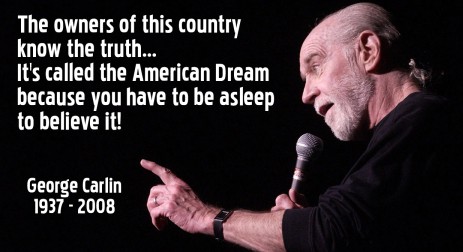
The American Dream is Dead

george-carlin-american-dream

By Dustin Meyer

Source: The Evolutionary Mind

To say the American Dream is Dead couldn’t be more true. The American people as a whole are ignorant. They grow up believing that there is a perfect lifestyle in which they will get once they get older and “pay their dues”. Unfortunately this is very far from wrong, the system is corrupt and is against anyone who thinks this way. Simply put, there is no American dream.

What is it? The American Dream, at least as I knew it was where you would live an ideal life, work a 9-5 job, have a house with a white picket fence, a yard, car, and a dog. More in a modern sense, it is getting rich and famous, owning a huge house, fancy car, having all the fanciest clothes and things. This is why it had been dying but not why it is dead. People are greedy, they want more and more, and forget to appreciate the simple life they have. Some people don’t even have their lives anymore, and yet so many people take theirs for granted.

Pop culture can be given much of the credit due to the skewing of the American dream. Since the people are influenced by anything and everything, they will believe any message conveyed to them. Music and film are the main mediums where this is, but a huge culprit is the news and daytime television. Also, unfortunately people are losing their individualism, which is leading to them falling more into this hole in which you cannot escape, you just aren’t you anymore once you’ve given in.

But a big question is why do I say it is dead? Well, the system in general is against us. The gap between rich and poor is expanding exponentially each and every day. The odds are not in the average person’s favor. People are working until they are 60+ years old and barely being able to retire, and with that work, most aren’t in executive type jobs. For the small business owner, you have huge corporations that are destroying your chances to even provide for your family. So why is it dead? Opening you eyes will show you.

People have to stand up, to realize that something is wrong. With this upcoming election (being quite possibly the worst election/selection of candidates’ ever.) we have to fight for the people. No matter who is in office no one will ever fight for you, unless you do. The people are for the people, we have a choice to change. The change must happen!

The Entire Status Quo Is a Fraud

corruptPoliticalSystem2

By Charles Hugh Smith

Source: Of Two Minds

Fraud as a way of life caters an extravagant banquet of consequences.

This can’t be said politely: the entire status quo in America is a fraud.

The financial system is a fraud.

The political system is a fraud.

National Defense is a fraud.

The healthcare system is a fraud.

Higher education is a fraud.

The mainstream corporate media is a fraud.

Culture–from high to pop–is a fraud.

Need I go on?

We have come to accept fraud as standard operating practice in America, to the detriment of everything that was once worthy. why is this so?

One reason, which I outline in my book A Radically Beneficial World: Automation, Technology and Creating Jobs for All, is that centralized hierarchies select for fraud and incompetence. Now that virtually every system in America is centralized or regulated by centralized hierarchies, every system in America is fraudulent and incompetent.

Nassim Taleb explains this further in his recent article How To Legally Own Another Person (via Lew G.)

The three ingredients of fraud are abundant: pressure (to get an A, to please your boss, to make your sales numbers, etc.), rationalization (everybody’s doing it) and opportunity.

Taleb explains why failure and fraud become the status quo: admitting error and changing course are risky, and everyone who accepts the servitude of working in a centralized hierarchy–by definition, obedience to authority is the #1 requirement– is averse to risk.

As as I explain in my book, these systems select for risk aversion and the appearance of obedience to rules and authority while maximizing personal gain: in other words, fraud as a daily way of life.

Truth is a dangerous poison in centralized hierarchies: anyone caught telling the truth risks a tenner in bureaucratic Siberia. (In the Soviet Gulag ,a tenner meant a ten-year sentence to a labor camp in Siberia.)

And so the truth is buried, sent to a backwater for further study, obfuscated by jargon, imprisoned by a Top Secret stamp, or simply taken out and executed.Everyone in the system maximizes his/her personal gain by going along with the current trajectory, even if that trajectory is taking the nation off the cliff.

Consider the F-35 Joint Strike Fighter, a $1+ trillion failure. The aircraft is underpowered, under-armed, insanely overpriced, insanely over-budget and still riddled with bugs after seven years of fixes, making it an unaffordable maintenance nightmare that puts our servicepeople and nation at risk.

But no one in a position of power will speak the truth about the F-35, because it is no longer a weapons system–it’s a jobs program. Defense contractors are careful to spread the work of assembling parts of the F-35 to 40+ states, so 80+ senators will support the program, no matter how much a failure it is as a weapons system, or how costly the failure is becoming.

A rational person in charge would immediately cancel it and start from scratch, with a program run outside the Pentagon and outside congressional meddling.But this is impossible in America: instead, we build failed, under-armored, under-powered, under-armed and unreliable ships (LCS) and failed under-powered, under-armed and unreliable fighters as the most expensive make-work programs in history.

As for our failed healthcare system, one anecdote will do. (You undoubtedly have dozens from your own experience.) A friend from Uruguay with a high-tech job in the U.S. recently flew home to Montevideo for a medical exam because 1) the cost of the flight was cheaper than the cost of the care in the U.S. and 2) she was seen the next day in Montevideo while it would have taken two months to get the same care in the U.S.

I’ve listed dozens of examples here over the years: $120,000 for a couple days in a hospital, no procedures performed; $20,000+ for a single emergency room visit, no procedures performed; several thousand dollars charged to Medicare for a few minutes in an “observation room” that was occupied by patients, no staff present–the list is endless.

We’ve habituated to fraud as a way of life because every system is fraudulent.Consider the costly scam known as higher education. The two essentials higher education should teach are: 1) how to learn anything you need to learn or want to learn on your own, and 2) how to think, behave, plan and function entrepreneurially (i.e. as an autonomous problem-solver and lifelong learner who cooperates and collaborates productively with others) as a way of life.

That higher education fails to do so is self-evident. We could create a highly effective system of higher education that costs 10% of the current corrupt system. I’ve described such a system (in essence, a directed apprenticeship as opposed to sitting in a chair for four years) in The Nearly Free University and the Emerging Economy: The Revolution in Higher Education.

As for what passes as culture in the U.S.: the majority of what’s being sold as culture, both high and low, is derivative and forgettable. We suffer the dual frauds of absurd refinement (so only the elites can “appreciate” the art, music, food, wine, etc.) and base coarsening: instead of Tender (romantic love and sex) we have Tinder (flammable trash).

Fraud as a way of life caters an extravagant banquet of consequences. While everyone maximizes their personal gain in whatever system of skim, scam and fraud they inhabit, the nation rots from within. We’ve lost our way, and lost the ability to tell the truth, face problems directly, abandon what has failed and what is unaffordable, and accept personal risk as the essential element of successful adaptation.

Here’s a good place to start: require every politician to wear the logos of their top 10 contributors–just like NASCAR drivers and vehicles display the logos of their sponsors. The California Initiative to make this a reality is seeking signatures of registered California voters. Since politicians are owned, let’s make the ownership transparent.

Mobility, Meritocracy and Other Myths

justice-fish


By Kevin Carson

Source: Center for a Stateless Society

At the American Enterprise Institute, Mark Perry (“Yes, America’s middle class has been disappearing… into higher income groups,” Dec. 17) justifies the shrinking middle class and growing economic inequality by citing the finding of a recent Pew Institute study that of the 11% shrinkage in the American middle class, 7% have gone to the top and only 4% to the bottom.

First, movement between strata doesn’t legitimize stratification if the structure itself is illegitimate. Meritocracy is a legitimizing myth created to distract people from the question of whether the system of power those meritocratic functionaries serve is just. As Chris Dillow, an unorthodox British Marxist economist, observed (“Beyond social mobility,” Stumbling and Mumbling, Dec. 19):

“Imagine a dictator were to imprison his people, but offer guard jobs to those who passed exams, and well-paid sinecures to those who did especially well. We’d have social mobility — even meritocracy and equality of opportunity. But we wouldn’t have justice, freedom or a good society. They all require that the prisons be torn down.”

Also note that what’s called the “upper class” in the study includes not only the super-rich rentier classes and people in the C-Suites with million-dollar salaries, but also most of the larger managerial stratum. There’s a good reason this stratum has expanded from 14% to 21% of the general population. As David Gordon argued in Fat and Mean, it was the neoliberal decision in the ’70s to cap real hourly wages and shift a greater share of income upwards to rentiers and cowboy CEOs that resulted in increasing internal authoritarianism in the corporation and a need for a larger class of overseers to monitor the (understandably) increasingly disgruntled work force.

And despite the increased income of the managerial classes, the great bulk of them are still salaried employees whose income depends on the ongoing approval of their superiors. That 14-21% of the population is more or less what Orwell, in 1984, called the “middle” stratum (represented in the story by the Inner Party to which Winston and Julia belonged). Here’s how Orwell described the same general type in the corporate England of his day in another novel, Coming Up for Air:  “in every one of those little stucco boxes there’s some poor bastard who’s never free except when he’s fast asleep…”

Not only do these people continue to collect their managerial salary at the good pleasure of the senior oligarchs of the corporate hierarchy, but to even have a shot at that management pay in the first place they’ve got to put themselves in a position of student debt peonage that will likely eat up a major part of that increased income for years (along with a mortgage that means they’ll really be renting their house from the bank into old age). Add to that the long hours middle management types have to work coupled with the endless bureaucratic toadyism and sycophancy required of them, and the ongoing precarity of their position.

Getting back to the issue of legitimacy, there’s also the fact that the functions exercised by most of these managerial types are illegitimate and would be unnecessary absent an exploitative class society. They are, in anarchist anthropologist David Graeber’s famous phrase, “b***s*** jobs.” They exist because the American state, in league with corporate capital, has cartelized the economy under the control of bureaucratic hierarchies many times larger than the point of declining returns in efficiency, and because the authoritarian nature of those hierarchies and the rent-seeking nature of their management creates a conflict of interest that necessitates intensified surveillance and control.

The late Joe Bageant aptly described the nature of the work these people perform: “The empire needs… about 20-25% of its population… to administrate and perpetuate itself — through lawyers, insurance managers, financial managers, college teachers, media managers, scientists, bureaucrats, managers of all types and many other professions and semi-professions.”

When workers own the firm and manage their own work, as in the recuperated enterprises of Argentina, not only can workers be trusted to use their own superior knowledge of the work process but what little coordinating costs remain are a small fraction of U.S. corporate administrative costs. In fact eliminating all those management salaries solved the unit costs problem at one stroke.

The upper quintile is growing in size and income because all the value created by actual productive workers in the lower quintiles gets extracted by those at the top. When the top classes rob everybody else, they need a lot more guard labor to keep their stolen loot secure.

And whether or not there’s been an increase in the real income of the lower four strata, production workers’ loss of control over the work force and increased precarity is even worse than that of those middle managers in the top 21%. Whether for production workers or middle management, stress correlates directly with powerlessness.

We don’t need meritocracy. We need justice.

The Rise of the Corporatocracy

SMARTPHONES, SOCIAL MEDIA AND SLEEP: THE INVISIBLE DANGERS OF OUR 24/7 CULTURE

cell-phone-addiction

By Martijn Schirp

Source: High Existence

If there is one book to read about our addictions to work, phones, consumption, and the current state of capitalism, it’s 24/7: Late Capitalism and the Ends of Sleep by Jonathan Crary, a professor of Modern Art & Theory at Columbia University. Crary argues that sleep is a standing affront to capitalism and while that seems grim, it highlights the very real dark sides of always having glowing LED screens clutched in our hands.

Technology has ushered us into a 24/7 state: we live in a world that never stops producing and is infinitely connected. We have digital worlds in our pockets, and we carry our phones and screens everywhere, feeding our dopamine addictions when we’re bored or lonely, cradling us before bed with endless scrolls of news and waking us up with notifications and emails.

The barrier between work and home life has disappeared, and most professionals are able to and choose to continue working all hours of the day in an increasingly competitive, winner-take-all environment.

Most of our time then, is either spent working or consuming (the upside of working so much is money, which is then used to consume): food, drugs, shopping, films, Youtube videos, Instagram feeds, news articles, updates from friends — even socializing-time has been reduced to a passive “Netflix & Chill”.

There are now very few significant interludes of human existence (with the colossal expectation of sleep) that have not been penetrated and taken over as work time, consumption time, or marketing time.

The social-world and the work-world are both digitized, which makes it increasingly difficult to distinguish between the two, and beyond the pop-ups and video ads, individuals have become their own marketers. Building a “personal brand” as a living is not uncommon.

It is only recently that the elaboration, the modeling of one’s personal and social identity, has been reorganized to conform to the uninterrupted operation of markets, information networks, and other systems. A 24/7 environment has the semblance of a social world, but it is actually a non-social model of machinic performance and a suspension of living that does not disclose the human cost required to sustain its effectiveness.

The average North American adult “now sleeps approximately six and a half hours a night, an erosion from eight hours a generation ago, and down from ten hours in the early twentieth century,” and what suffers most from this lack of sleep is our innate ability to dream. Most people tend to forget or don’t even think about their dreams, much less their extraordinary ability to control them. What is frightening about this is the prevalent attitude of accepting the current state of reality as it is:

The idea of technological change as quasi-autonomous, driven by some process of autopoiesis or self-organization, allows many aspects of contemporary social reality to be accepted as necessary, unalterable circumstances, akin to facts of nature. In the false placement of today’s most visible products and devices within an explanatory lineage that includes the wheel, the pointed arch, moveable type, and so forth, there is a concealment of the most important techniques invented in the last 150 years: the various systems for the management and control of human beings.

What may be the most important fact to remember: Nothing must be as it is. Here are a three ways to escape the never-ending 24/7 state:

Unplug Your Phone & Plug Into Your Imagination

Break your cell phone habit. The dopamine addiction is real. I keep my phone in a Faraday pouch, which blocks signals to my phone and keeps me to my rule of no cell phone or screen use one hour prior to sleeping and one hour after waking.

As “visual and auditory ‘content’ is most often ephemeral, interchangeable material that in addition to its commodity status, circulates to habituate and validate one’s immersion in the exigences of twenty-first-century capitalism,” it is important to focus on the power of our own imagination. The hierarchal and algorithm-driven fields of social media and newsfeeds tend to serve us things we already know or like, and keep us wanting.

Instead, we can explore the limitless field of our imagination. Write down your dreams in the morning and use them as a vehicle for self-exploration, or venture into lucid dreaming to manifest your own desires or to explore creative pursuits. And yet for most of us, when walking, during our daily commute, even sitting on the toilet or in any moment where it’s just us and our thoughts, we turn to our cell phones for comfort, to fill the silence:

One of the forms of disempowerment within 24/7 environments is the incapacitation of daydream or of any mode of absent-minded introspection that would otherwise occur in intervals of slow or vacant time.

Even when socializing with friends, it’s a common habit to check our phones again and again. I’ve found that when one person does this, it enables others:if I see someone sitting across from me at a dinner checking their Instagram feed, I’ll feel less guilty about doing the same. Make it can stop with you — turn off your phone.

Reevaluate Your Drug Habits & Addictions

Beyond digital dopamine, are you addicted to caffeine, sugar, alcohol, adderall, cocaine, Ambien, Lexapro, vicodin, etc., etc.? We live in a self-selecting society, where some drugs are perfectly acceptable as long as they are prescribed by a doctor and other drugs are deemed dangerous. I used to babysit for an eight-year-old who was fed Ritalin daily for his ADHD, and then at night, had to take a tranquilizer to help him fall asleep. He was speedballing throughout his childhood, and I’ve met others who had the same experience only to question the impact of these drugs on their personality and life-path.

There is a multiplication of the physical or psychological states for which new drugs are developed and then promoted as effective and obligatory treatments. As with digital devices and services, there is a fabrication of pseudo-necessities, or deficiencies for which new commodities are essential solutions… Over the last two decades, a growing range of emotional states have been increasingly pathologized in order to create vast new markets for previously unneeded products. The fluctuating textures of human affect and emotion that are only imprecisely suggested by the notions of shyness, anxiety, variable sexual desire, distraction, or sadness have been falsely converted into medical disorders to be targeted by hugely profitable drugs. Of the many links between the use of psychotropic drugs and communication devices, one is their parallel products of forms of social compliance.

Ritalin, adderall (and cocaine) not only make the takers compliant but fueled to tackle the 24/7 lifestyle, deadening empathy, increasing competitiveness and perhaps is linked to “destructive delusions about performance and self-aggrandizement”.

While methamphetamines are regularly fed to children, psychedelic drugs tend to be demonized as extreme and dangerous. Yet, refreshingly, there are organizations now like the Multidisciplinary Association of Psychedelic Studies (MAPS) and other studies looking into how psychedelics can not only treat addictions, anxiety, and disorders, but also how psychedelics can expand consciousness and leave lasting personality changes for the better.

Find Your Passion & Connect With Real Life Communities

Crary argues that “whatever remaining pockets of everyday life are not directed toward quantitative or acquisitive ends, or cannot be adapted to telematic participation, tend to deteriorate in esteem and desirability.” Our tendency to tie our social worth to digital networks takes the saying “if a tree falls in a forest and nobody is around to hear it, does it make a sound?” and turns it into “if you do something fun and meaningful and don’t post it to social media, does it matter?”

But those meaningful moments in real life do matter, as does having a strong community to participate in. After all, addictions are a result mostly of isolation and bad environments:

As stated earlier: it is much easier to fold to the insidious trap of looking at your cell phone or constantly working if the person across from you does so first. Find your passion beyond the screen. Find your source of dopamine, what drives you, what engages you and makes you want to get up every day.

Finding a real community centered around a meaningful activity can help tremendously. For me, rock climbing is a meditative activity that requires focus and attention, and is anchored in a community of people who are invested in your success as much as they are in their own. The nature of the sport is so individual because each person is unique; climbing is a niche that carves out time for people to participate in life without any social rules and concepts of winning over another. Climbing outdoors is a way to be connected to nature and to just hang out with friends.

I just returned from a week in New York City, the city that never sleeps, the capitol of the 24/7 world, and it took me two weeks just to be able to find the time to sit down and write this. It is not easy to accept the bleak claims in Crary’s book because it would be admitting our own addictions and how we play into this non-stop state. It’s just as hard to look away from our screens, but you can. Tonight, don’t put your phone or laptop into “sleep mode” — turn them off, and pay attention to your own dreams.

Further Study:


24/7: Late Capitalism and the Ends of Sleep
 by Jonathan Crary

24/7: Late Capitalism and the Ends of Sleep explores some of the ruinous consequences of the expanding non-stop processes of twenty-first-century capitalism. The marketplace now operates through every hour of the clock, pushing us into constant activity and eroding forms of community and political expression, damaging the fabric of everyday life.

Commodifying Dissent: Media, the Arts and the Hope in Cooperatives

Empire-USA-déclin

By Yoav Litvin

Source: CounterPunch

In the latest onslaught of apocalyptic news updates: The European Union is in crisis after the BREXIT vote, endless wars continue to ravage Africa and the Middle East causing millions of refugees to flee for their lives, ISIS strikes again, this time slaughtering over one hundred and fifty innocent Iraqis in Baghdad, and man-made climate change is wreaking havoc, fueling the third major mass extinction of species on Earth.

Meanwhile, back in the halls of empire the theatrics of the electoral process, together with the usual seasonal sports spectacles are mesmerizing and distracting the vast majority of the American public from the pressing issues threatening society. Despair and hatred mar our streets, nightclubs, schools, churches and movie theaters. Greed has overtaken empathy and a few powerful individuals have squashed the collective. Whole communities have been ravaged by neoliberal agendas that imprison and impoverish, all in the name of the almighty greenback.

But it is just another day at the office for the 1%. They own the Executive, Legislative and Judicial branches of government. As Chris Hedges frequently stresses: “We’ve undergone a corporate coup d’etat in slow motion. And it’s over. We’ve lost, and they’ve won.”

The vast majority of media sources, the watchdogs meant to protect democracy and the people’s interests at all costs, have succumbed to the rule of profit, aka “ratings”. They have become de factopropaganda outlets meant to manufacture consent and sell us on the faux virtues of consumerism and the American dream.

The corporate-owned mainstream media has been complicit on many levels. It is business as usual when a major outlet like MSNBC casually interrupts US Congresswoman Jane Harman speaking about NSA mass surveillance to feature the “breaking news” of teen pop star Justin Bieber’s DUI arrest. News networks carry on for hours with mind-numbing repetition about Donald Trump’s racist and misogynist antics, while all but completely ignoring a massive sit-in led by Democracy Spring, a movement that champions an end to the corruption of big money in our politics. Pundits whose job is to cry wolf endlessly discuss ISIS and the “threat of radical Islam”, but thorough analyses of the continued crimes of capitalism and imperialism are taboo, not to mention any productive discussions about systemic alternatives.

In this climate of corrupted news outlets, media that are independent of corporate funding are crucial in providing the people accurate information about systems of power and control.

But historically, the media has not been the only watchdog for the people and against powerful interest groups. Artists and other creatives have often used their works to voice progressive ideals that rebel against widely held conceptions of gender, race and class. As such, artists have been among the first voices of dissent to be targeted by totalitarian and fascist regimes. In the American capitalist culture, artists fall prey to a system that monetizes and commodifies all walks of life, including health care and education. Many artists willfully sell out, becoming court jesters who contribute their art to the needs of empire, i.e. as propaganda. Now studied as a degree at schools for higher education, the bulk of arts have become part of an “art market” – a multi-billion dollar industry that is more about a lifestyle and an investment, than it is about progressive messages or a passion for a new and interesting aesthetic. In the current cynical era when replicas sell for $100,000, there is little room for political art that expresses genuine and independent notions that challenge systemic conventions.

There are exceptions. Some artists refuse to corrupt themselves and their art by adhering to the whims of the “art market”. Notably, since the late sixties, there has been a movement of graffiti and street artists who have claimed public space from private owners. Born in the Washington Heights neighborhood in New York City (arguably) and now a global phenomenon, graffiti and street art often empower disenfranchised communities by serving as a voice of dissent, and providing free, uncensored messages regardless of commercial constraints.

The pathology behind the hijacking of media and the arts by the lords of capital runs deeper than the mere criminality of the 1%. It lies at the roots of one of the fundamental American values- individualism, where the achievements of the lone genius are sanctified, and those of the collective are ignored or even vilified. Individualism divides and conquers, providing the promise of immense spoils for victors, while always blaming failure on individual inadequacies, not systemic ones.

The cult of individualism has been so deeply ingrained in the American psyche that it has degenerated the biological human affinity to empathize rather than disregard, collaborate rather than dominate and has stifled the desire to give without the expectation of immediate return. Individualism has made cooperation a waste of time. But the fact of the matter is that humans have evolved as a social species and naturally yearn for and need connection, affirmation, love and stimulation to survive, thrive and create.

The crises humanity faces leave no choice but to decommodify dissent, abandon notions of individuality at the expense of others, topple hierarchies, and unite around democratic cooperatives that promote community, democracy and solidarity. Returning ownership of dissent to the public is a crucial step towards revolutionizing the workspaceen route toward a truly free and just democratic society.

Yoav Litvin is a Doctor of Psychology/ Behavioral Neuroscience.

A Universal Basic Income Is The Bipartisan Solution To Poverty We’ve Been Waiting For

 Molly Crabapple Basic Income Banner

What if the government simply paid everyone enough so that no one was poor? It’s an insane idea that’s gaining an unlikely alliance of supporters.

By Ben Schiller

Source: FastCoexist.com

There’s a simple way to end poverty: the government just gives everyone enough money, so nobody is poor. No ifs, buts, conditions, or tests. Everyone gets the minimum they need to survive, even if they already have plenty.

This, in essence, is “universal minimum income” or “guaranteed basic income”—where, instead of multiple income assistance programs, we have just one: a single payment to all citizens, regardless of background, gender, or race. It’s a policy idea that sounds crazy at first, but actually begins to make sense when you consider some recent trends.

The first is that work isn’t what it used to be. Many people now struggle through a 50-hour week and still don’t have enough to live on. There are many reasons for this—including the heartlessness of employers and the weakness of unions—but it’s a fact. Work no longer pays. The wages of most American workers have stagnated or declined since the 1970s. About 25% of workers (including 40% of those in restaurants and food service) now need public assistance to top up what they earn.

The second: it’s likely to get worse. Robots already do many menial tasks. In the future, they’ll do more sophisticated jobs as well. A study last year from Carl Frey and Michael Osborne at Oxford University found that 47% of jobs are at risk of computerization over the next two decades. That includes positions in transport and logistics, office and administration, sales and construction, and even law, financial services and medicine. Of course, it’s possible that people who lose their jobs will find others. But it’s also feasible we’re approaching an era when there will simply be less to do.

The third is that traditional welfare is both not what it used to be and not very efficient. The value of welfare for families with children is now well below what it was in the 1990s, for example. The move towards means-testing, workfare—which was signed into law by Bill Clinton in 1996—and other forms of conditionality have killed the universal benefit. And not just in the U.S. It’s now rare anywhere in the world that people get a check without having to do something in return. Whatever the rights and wrongs of this, that makes the income assistance system more complicated and expensive to manage. Up to up to 10% of the income assistance budget now goes to administrating its distribution.

For these reasons and others, the idea of a basic income for everyone is becoming increasingly popular. There has been a flurry of reports and papers about it recently, and, unusually, the idea has advocates across the political spectrum.

The libertarian right likes basic income because it hates bureaucracy and thinks people should be responsible for themselves. Rather than giving out food stamps and health care (which are in-kind services), it thinks people should get cash, because cash is fungible and you do what you like with it.

The left likes basic income because it thinks society is unequal and basic income is redistributive. It evens up the playing field for people who haven’t had good opportunities in life by establishing a floor under the poorest. The “precariat” goes from being perpetually insecure to knowing it has something to live on. That, in turn, should raise well-being and produce more productive citizens.

The technology elite, like Netscape’s Marc Andreessen, also likes the idea. “As a VC, I like the fact that a lot of the political establishment is ignoring or dismissing this idea,” Albert Wenger, of Union Square Ventures, told a TED audience recently, “because what we see in startups is that the most powerful innovative ideas are ones truly dismissed by the incumbents.” A minimum income would allow us to “embrace automation rather than be afraid of it” and let more of us participate in the era of “digital abundance,” he says.

The exact details of basic income still need to be worked out, but it might work something like this: Instead of welfare payments, subsidies for health care, and tax credits for the working poor, we would take that money and use it to cover a single payment that would give someone the chance to live reasonably. Switzerland recently held an (unsuccessful) is planning to hold a referendum on a basic income this year, though no date is set. The proposed amount is $2,800 per month.

But would it actually work? The evidence from actual experiments is limited, though it’s more positive than not. A pilot in the 1970s in Manitoba, Canada, showed that a “Mincome” not only ended poverty but also reduced hospital visits and raised high-school completion rates. There seemed to be a community-affirming effect, which showed itself in people making use of free public services more responsibly.

Meanwhile, there were eight “negative income tax” trials in the U.S. in the ’70s, where people received payments and the government clawed back most of it in taxes based on your other income. The results for those trials was more mixed. They reduced poverty, but people also worked slightly less than normal. To some, this is the major drawback of basic income: it could make people lazier than they would otherwise be. That would certainly be a problem, though it’s questionable whether, in the future, there will be as much employment anyway. The age of robots and artificial intelligence seems likely to hollow out many jobs, perhaps changing how we view notions of laziness and productivity altogether.

Experiments outside the U.S. have been more encouraging. One in Namibia cut poverty from 76% to 37%, increased non-subsidized incomes, raised education and health standards, and cut crime levels. Another involving 6,000 people in India paid people $7 month—about a third of subsistence levels. It, too, proved successful.

“The important thing is to create a floor on which people can start building some security. If the economic situation allows, you can gradually increase the income to where it meets subsistence,” says Guy Standing, a professor of development studies at the School of Oriental and African Studies, in London, who was involved with the pilot. “Even that modest amount had incredible effects on people’s savings, economic status, health, in children going to school, in the acquisition of items like school shoes, so people felt in control of their lives. The amount of work people were doing increased as well.”

Given the gridlock in Congress, it’s unlikely we’ll see basic income here for a while. Though the idea has supporters in both left and right-leaning think-tanks, it’s doubtful actual politicians could agree to redesign much of the federal government if they can’t agree on much else. But the idea could take off in poorer countries that have more of a blank slate and suffer from less polarization. Perhaps we’ll re-import the concept one day once the developing world has perfected it?

Is the US Economy Heading for Recession?