We Still Want Everything: The Politicisation of Anti-work

balestrini-we-want-everything-650

By Hans Rollman

Source: PopMatters

If there is such a thing as a ‘revolutionary novel,’ Nanni Balestrini’s We Want Everything is as good an example as any. The novel, first published in Italy in 1971, recounts in dramatic narrative form actual events that occurred in late 1969 in Italy: a massive mobilization and strike against Italian auto-maker Fiat that erupted into civil violence and came close to political revolution.

Balestrini—a poet, visual artist and writer—was himself personally involved in these struggles. In 1979, explains Rachel Kushner in an introductory essay, he had to flee the country on skis through the Alps in order to avoid arrest on charges of insurrection and terrorism, later dropped. But more than offering a dramatic recount of the events of 1969, the book offers a potent political analysis of today’s ‘mass worker’ and the struggles they face, couched in everyday language and dramatic action.

The novel offers a fast-paced first-person narrative. The language is blunt, unadorned and honest; the action sticks to key points and races along without detours from the main theme. The narrator comes from southern Italy, and like others from the region, he is lured north by the promise of easy quick cash in the newly modernising factory towns.

The context of this historical moment of capitalist development in Italy is important. For centuries Italians, particularly in the south, had lived an essentially feudal subsistence lifestyle. They eked out a living working the fields and farms of petty landlords, meeting their needs with relative ease but living in a constant state of abject poverty. They could gather food from the forests and fields around them; they could live in fairly basic housing and even sleep comfortably outdoors for much of the year. They wore simple clothing, handed down and patched up.

But then the factories arrived, luring young people off the land with the promise of cash and all that it offered: things their families had never even dreamed of. Stylish clothes, cars, modern homes of their own. At first the lure seemed attractive. But once they left their traditional lifestyles, they discovered they had new needs as well that they had never had before: the need to pay for housing, for food, for clothes for their families. To meet these needs, they had to work, and work hard; they no longer had the right to take a day off whenever they wanted to sit at the beach. To obtain the consumer goods they wanted and needed, they had to surrender to the tyranny of bosses and to the tyranny of work itself.

But they didn’t go without a fight, and that fight is the subject of Balestrini’s classic novel.

Kushner makes an important point in her introduction: the struggle depicted in the novel is predominantly depicted as a masculinist struggle. Women have very little presence in the novel and are objectified when they are. This is an ironic oversight, as Kushner notes, because women more than anyone had call to demand everything. It’s an unfortunate oversight too, she observes, since “it’s accurate to say that feminism had the most lasting and successful impact among the demands made in the revolts of 1970s Italy.”

The narrator—based loosely on a real figure, Alfonso Natella, to whom the author dedicates his work—is a happy-go-lucky southerner who comes north looking for easy cash. He gets it, drifting through a series of jobs, filling his wallet and then quitting jobs just as quickly as he gets them in order to enjoy the cash he’s earned. Then he finds new jobs, and becomes quite adept at scamming employers, as well.

The point of his continuous lies and scams is this: work is not something to be respected. He wants to have a good time, a natural human inclination, and so wants money, but sees no reason to respect the principle of work. At first his hatred of work is primal and intuitive; he has no real political analysis, just knows he wants to enjoy life and is happy to take the quickest route to get there. He’s willing to work for money—and only as long and as hard as it takes to get some—but understands there is nothing intrinsically worthy or noble about work. His views crystallize after he obtains one of the coveted jobs at Fiat, the Italian automaker. There, he eagerly joins in with students, union organizers and other activists who are vying with each other to gain adherents among the Fiat workers.

So I started stirring things up at the gates. Comrades, today we must stop work. Because we’ve fucking had it up to here with work. You’ve seen how tough work is. You’ve seen how heavy it is. You’ve seen that it’s bad for you. They’d made you believe that Fiat was the promised land, California, that we’re saved.

I’ve done all kinds of work, bricklayer, dishwasher, loading and unloading. I’ve done it all, but the most disgusting is Fiat. When I came to Fiat I believed I’d be saved. This myth of Fiat, of work at Fiat. In reality it’s shit, like all work, in fact it’s worse. Every day here they speed up the line. A lot of work and not much money. Here, little by little, you die without noticing. Which means that it is work that is shit, all jobs are shit. There’s no work that is OK, it is work itself that is shit. Here, today, if we want to get ahead, we can’t get ahead by working more. Only by the struggle, not by working more, that’s the only way we can make things better. Kick back, today we’re having a holiday.

The Politicisation of Anti-work

Gradually he comes to develop a political analysis as well. It’s not just that work is bad and pointless: it’s hypocritical as well, with arbitrary determinations of whose work is valued over others, and who gets paid what.

But organizing the workers and inciting them to go on strike is challenging at first. One of the barriers is what the narrator refers to as workers’ ‘neurosis’.

What is this neurosis? Every Fiat worker has a gate number, a corridor number, a locker room number, a locker number, a workshop number, a line number, a number for the tasks they have to do, a number for the parts of the car they have to make. In other words, it’s all numbers, your day at Fiat is divided up, organised by this series of numbers that you see and by others that you don’t see. By a series of numbered and obligatory things. Being inside there means that as you enter the gate you have to go like this with a numbered ID card, then you have to take that numbered staircase turning to the right, then that numbered corridor. And so on.

In the cafeteria for example. The workers automatically choose a place to sit, and those remain their places for ever. It’s not as if the cafeteria is organised so that everyone has to sit in the same place all the time. But in fact you always end up sitting in the same place. It’s like, this is a scientific fact, it’s strange. I always ate in the same seat, at the same table, with the same people, without anyone ever having put us together. Well this signifies neurosis, according to me. I don’t know if you can say neurosis for this, if that is the exact word. But to be inside there you have to do this, because if you don’t you can’t stay.

The narrator’s point is clear: the regimentation and routinization of work tasks generates a tendency to accept the routinization of daily life—a hesitation to question or challenge norms; an inclination toward accepting the status quo, even when there is no rule saying they have to.

We Challenge Everything

Two aspects of the workers’ struggle are impressively articulated and conveyed in We Want Everything. The first is an abject hatred of work—a clear indictment of the pointlessness and myth of work. Work is not noble, work does not contribute to the self or society; it is oppression and exploitation, pure and simple.

“Workers don’t like work, workers are forced to work. I’m not here at Fiat because I like Fiat, because there isn’t a single fucking thing about Fiat that I like, I don’t like the cars that we make, I don’t like the foremen, I don’t like you. I’m here at Fiat because I need money.”

The narrator is careful to emphasize that it’s not just manual labour, it’s not just certain kinds of work that are useless and disgusting—it’s all work. The narrator knows from the beginning, with an instinctive honesty, that he doesn’t like work, but it’s only as the novel progresses that he understands the oppressive and exploitative nature of all work, realizes the political and social nature of the demand—“Less work!”

The other refreshing dimension of We Want Everything is the perceptive critique of unions. Yes, this is a workers’ struggle, but it’s not a union struggle. The unions are portrayed as the enemy of the working class. They’re exposed as serving a mediating role for the company bosses; it’s a critique that is still appropriate to level at many unions today. The unions, in their efforts to retain their control over the workers’ movement, to ensure that they control the workers and members, connive and conspire to undermine autonomous and spontaneous workers’ struggles. They fear loss of control as much as the company bosses do. The bosses want to control the factory, and the union leaders want to control the movement.

What both fear is a spontaneous, grassroots, autonomous and democratic movement self-organized by workers themselves. Example: when the struggle starts, there are various categories of workers, each of which earns different salaries. Because the workers are demanding more money, the union and bosses negotiate the creation of new categories, to provide more pay scales. The workers reject this: they want the elimination of all the different pay scales, so that all the workers earn the same amount, and that it’s an acceptable amount for all. The narrator’s lesson is this: the unions want tangible victories to wave in the air; but the workers want a powerful united movement capable of taking on the bosses.

The Outcome of the Struggle Has Yet to Be Written

“The unions try to start the struggles one at a time, one finishing and another starting, to avoid the struggle widening and to stop the workers organising themselves in the factories from expressing their will autonomously. But the working-class struggle won’t be controlled this way. Almost every day a new struggle starts, and it’s the workers who start it. This is a big test of the working class’s strength… If workers end up divided and disorganised after the struggle, this is a defeat, even if something has been gained. If workers come out of the struggle more united and organised, this is a victory, even if some demands remain unmet.”

The narrator does a superb job of chronicling the gradual evolution of the unions’ role in the struggle: at first encouraging strikes and actions, but as the workers start organizing autonomously and making their own—often more radical—decisions, the unions begin to panic and escalate their own efforts to suppress the autonomous workers’ struggle. Eventually, they even cooperate with the bosses in this effort, each of them terrified that a system which benefits them both might actually be overthrown.

“Unionists, PCI bureaucrats, fake Marxist-Leninists, cops and fascists all have one characteristic in common. They have a total fear of the workers’ struggle, of the workers’ ability to tell the bosses and the bosses’ servants to go to hell and to organise their struggle autonomously, in the factory and outside the factory. We made them a leaflet that finished like this: Someone once said that even whales have lice. The class struggle is a whale, and cops, Party and union bureaucrats, fascists and fake revolutionaries are its lice.”

The Assembly

The varied themes come together in a workers’ assembly that takes place toward the end of the novel. Workers denounce the fact that the union, instead of fighting for equal wages for everyone, has settled for an even more convoluted hierarchy of pay. Workers point out that even though the bosses have conceded a pay increase, the price of consumer goods and housing is rising accordingly. What good is a pay increase, then? Others demand a guaranteed wage for all, regardless of whether they’re employed or unemployed.

The unions warn them against radical demands, since they could upset the country’s economic system. But the workers counter that’s precisely what they want: the destruction of an economic system that perpetually exploits them. Union reforms only strengthen that system. “We say no to the reforms that the unions and the party want us to fight for. Because we understand that those reforms only improve the system that the bosses exploit us with. Why should we care about being exploited more, with a few more apartments, a few more medicines and a few more kids at school. All of this only advances the State…”

But communism is no solution either, observe other workers—the communists are just as obsessed as the capitalists with making people work hard for no reward. What the workers want is an end to work. “Comrades, I’m from Salerno, and I have done every kind of work in the south as well as the north and I have learned one thing. That a worker has only two choices: a grueling job when things are going well or unemployment and hunger when they go badly. I don’t know which of the two is worse.”

“We started this great struggle by demanding more money and less work. Now we know that this is a call that turns everything upside-down, that sends all the bosses’ projects, capital’s entire plan, up in smoke. And now we must move from the struggle for wages to the struggle for power. Comrades, let us refuse work. We want all the power, we want all the wealth.”

The Struggle Continues

The struggle against work portrayed in the novel was sparked by a particular type of worker. Earlier in the century, Italian workers’ struggles (like elsewhere) were defined by skilled workers who could more effectively demand more wealth because of their highly specialised skills. And it was that type of worker around which left-leaning political parties and labour unions organised their strategies. But in the ‘60s a new type of worker appeared: “adept at a thousand trades because he has no trade, without a single professional quality even when he possesses a diploma, lacking a steady job and often unemployed or forced into casual service, who can’t find work and so seeks it in Turin, in Milan, in Switzerland, in Germany, anywhere in Europe. Who finds the hardest, most exhausting, most inhuman jobs, those that no one else is prepared to do.” It is on this worker, Balestrini points out, that the postwar economies of the West were built.

What is significantly different about this worker is that unlike the skilled worker of the past, who could often take pride in their sought-after technical skills, the new worker is defined by “his ideological estrangement from work and from any professional ethic, the inability to present himself as the bearer of a trade and to identify himself in it. His single obsession is the search for a source of income to be able to consume and survive… For him work and development are understood solely as money, immediately transformable into goods to consume.”

As Balestrini notes in his afterword, this worker is in many ways still the worker of today. In the ‘60s and ‘70s the state and the capitalist system hastily responded to the workers’ challenge with a series of measures which suppressed that struggle for a time—automation and robotisation of factories, outsourcing of production to the third world, co-optation of unions and where none of these strategies worked, brutal police repression. But the workers, the issues, and the struggle continues today.

It was because of this new and unpredictable type of worker—who wasn’t fooled by the notion of a ‘work ethic’ and was uninterested in the elitist machinations of unions and political parties—that unprecedented revolts broke out across Italy (and elsewhere) during this period. The novel ends with a dramatic street battle between workers and police, the end of which is left hanging. Throughout that dramatically depicted battle, which rages throughout the city, it becomes clear that the workers’ strength comes from the self-empowered, self-organised movement they have been building in the weeks and months previous.

These weren’t workers following union instructions, or students playing at textbook revolutionary. These were workers who had challenged their bosses face-to-face in the factory; who had walked off the assembly lines in solidarity when one of their fellows was fired. It was their unity that was their strength—not their union or their political ideology. And as the battle rages, they realize that this unity can bring them real power.

“People kept coming from all around. You could hear a hollow noise, continuous, the drumbeat of stones rhythmically striking the electricity pylons. They made this sound, hollow, striking, continuous. The police couldn’t surround and search the whole area, full of building sites, workshops, public housing, fields. People kept attacking, the whole population was fighting. Groups reorganised themselves, attacked at one point, came back to attack somewhere else. But now the thing that moved them more than rage was joy. The joy of finally being strong. Of discovering that your needs, your struggle, were everyone’s needs, everyone’s struggle.”

The aftermath of the battle is left hanging, uncertain. Balestrini’s message is clear: the outcome of the struggle has yet to be written. “Capital only appeared to have won a victory; it has triggered a process that leads unavoidably to a confrontation with the underlying issue, expressed clearly 30 years ago in the struggles of the mass worker with the slogan ‘refusal of work’,” writes Balestrini in his afterword.

More and more the automation of production, and also the possibility in general of trusting almost every type of work and activity to machines and computers, requires a laughably small quantity of human labour power. Therefore why shouldn’t everyone profit from the wealth produced by machines and from the time freed from labour? Today, absurdly, work that is no longer necessary continues to be imposed because only through this is it possible to conceive of the distribution of money, allowing the continuation of the cycle of production and consumption and the accumulation of capital.

It’s surely no coincidence that Balestrini’s novel is undergoing a renewed popularity, at a time of mass mobilizations by a public whose ideological estrangement from work echoes so strongly with that of the characters in his 45-year old book. As demands arise again that echo the demands of the period—less work, more pay, more leisure, guaranteed income—We Want Everything sends a stirring reminder that these are not new demands, and that although it is a new generation rising to the challenge, it is the same fundamental struggle that continues.

“A new era is waiting for humanity, when it will be freed from the blackmail and the suffering of a forced labour that is already unnecessary and the enslavement to money, which prevent the free conduct of activity according to the aptitudes and desires of each and steal and degrade from the rhythm of life, at the same time that there is the real possibility of widespread and general wellbeing. This was the meaning, and could again be the meaning today and in the future, of that old rallying cry: Vogliamo tutto!” We want everything!

In a highly indebted world, austerity is a permanent state of affairs

images

By Mark Blyth

Source: Aeon

By 2010, everyone had heard the ‘austerity’ rallying cry. Immediately following the 2008 financial crisis, especially in Europe, it resounded: ‘Stimulate no more, now is the time for all to tighten!’ And tighten governments did, cutting public expenditure across continental Europe, and in the United Kingdom and the United States.

The logic behind ‘austerity’ holds that ‘the market’ – which the public had just bailed out – did not like the debt incurred when states everywhere rescued and recapitalised their banking systems. Unsurprisingly, tax revenues fell as the economy slowed and state expenditures rose. And what were once private debts on the balance sheets of banks became public debt on the balance sheet of states. Given this sorry state of affairs, states (policymakers and business leaders argued) had to take action to restore ‘business confidence’ – which is apparently always and everywhere created by cutting government spending. So governments cut.

Public debt, however, grew, because economies got smaller and grew slower the more they cut. The ‘confidence fairy’ as Paul Krugman named the expected effect, simply failed to show up. Why?

The reason is simple – and it is surprising anyone thought that anything else would happen. Imagine an economy as a sum, with a numerator and a denominator. Make total debt 100 and stick that on the top (the numerator). Make Gross Domestic Product (GDP) 100 and stick that on the bottom (the denominator) to give us a 100 per cent debt-to-GDP ratio. If you cut total spending by 20 per cent to restore ‘confidence’, the economy is ‘balanced’ at 100/80. That means the debt-to-GDP ratio of the country just went up to 120 per cent, all without the government issuing a single cent of new debt.

In short, cuts to spending in a recession make the underlying economy contract. After all, government workers have lost jobs or income, and government workers not shopping has the same effect as private sector workers not shopping. So the debt goes up as the economy shrinks further. States respond by cutting spending further. The pattern continues.

Having a common currency among different countries actually aggravates the problem because cuts in one state reverberate through many states, depressing them all. In 2008, euro area government debt as a share of the economy, including the already profligate Greeks, averaged around 65 per cent of GDP. Following budget cuts and monetary tightening (the European Central Bank twice pushed up interest rates in 2011) Euro Area government debt, by 2014, had risen to 92 per cent of GDP.

Greece is the poster child for this ‘denominator effect’. Under the auspices of ‘bailouts’ from the IMF and the EU, Greece cut more than 20 per cent of GDP in spending. It lost nearly 30 per cent in final consumption. Yet its debt increased from 103 per cent in 2006 to more than 180 per cent by 2014. That’s a 57 per cent increase in debt while spending is being cut.

Let’s look at the originating question again: how is destroying a third of the economy supposed to inspire consumer and business confidence? It won’t – unless you are a creditor – and that’s where the politics comes in.

If you are a holder of government debt (a creditor), three things hurt the value of your asset: if the inflation rate goes above the interest rate on your bond; if the exchange rate moves against you so that what the bond is worth vis-à-vis other currencies falls; and, of course, default – if the government takes the money and runs.

In the post-crisis world, despite major central banks putting trillions of dollars into the global money supply, there is almost no inflation anywhere in the developed world. Exchange rates (Brexit effects apart) are comparatively stable and ultimately move against each other relatively, so that’s not a huge worry. If the country whose debt you hold can have elections, and the public dares to vote against more budget cuts, the European Central Bank will shut down their banking system to make them revisit their choices. That’s what they did to Greece in the summer of 2015.

In this world, our present world, creditors will get paid and debtors will get squeezed. Budgets will be cut to make sure that bondholders get their money. And, in a highly indebted world, austerity – introduced as an ‘emergency’ measure to save the economy, to right the fiscal ship – becomes a permanent state of affairs.

As Britain’s former prime minister David Cameron said (standing beside a throne in a white bow-tie and tails) in 2013: ‘We need to do more with less. Not just now, but permanently.’ But here’s the question hidden in that blithe statement – are you and me part of the ‘we’ here?

Let’s go back to the huge jump in public debt that occurred when governments, ie the people, bailed out the banks. That debt was not, and is not, a liability. As difficult as it can be to make this reality part of the political conversation, public debt is an asset. Even at today’s low rates, it earns interest and retains value. No one is forced to invest in public debt, but every time bonds are issued investors show up and buy them by the truckload. By market criteria, public debt is a great investment.

But who pays for it? That would be the taxpayer. More generally, those who contribute to the payment of debts by not consuming government-produced services that have been cut. Basically, in most countries, this means that the bottom 70 per cent of the income distribution bears the cost of paying for public debt.

Over the past 25 years, to make up for chronically low wage growth, that same 70 per cent of the population has increased its personal indebtedness. Massively. Which means that in an economy deformed by austerity, they are the ones paying out – twice. With stagnant or declining wages, they have to service both the massive private debt they have accumulated to live and the public debt issued in their name.

Meanwhile, those whose assets the public bailed out – those with investible wealth, those who hold ‘all that debt’ and make money from it – do not suffer from the decline in public spending. Since they are net lenders, the hike in personal indebtedness does not trouble them either.

The result, and the situation in which we find ourselves, is a classic bad equilibrium. Those who can’t pay, and don’t earn enough, are being asked to pay the most to service debt, from which they do not and will not benefit. Those who can pay, and earn almost all the income, both contribute the least and benefit the most from ‘all that debt’.

Strip away all the electoral politics at the moment in the US, the UK, Italy, Spain and elsewhere, and that’s the underlying political economy. It’s a creditor/debtor stand-off where the creditors have the whip hand.

And yet, the more they crack the whip, the more the backlash against austerity, in all its forms, gains strength. Donald Trump, Jeremy Corbyn, Marine Le Pen, Pablo Iglesias: Left or Right, they are all riding debtor anger against creditor strength. It might be expressed as anger against, variously, ‘trade’ or ‘the elite’ or the ‘EU’. But what’s underneath all that is the politics of debt.

This is the ‘new normal’. It’s not about flat interest rates or anaemic growth rates. They are the consequences of austerity, not its causes. The new normal is the new politics of debtors versus creditors. It’s here to stay. As we already can see, it’s going to be anything but normal.

The Mainstream Has Failed

disobey

By Charles Hugh Smith

Source: Of Two Minds

The good news is there is a way to avoid failure and stagnation: avoid the mainstream like the plague.

The mainstream became mainstream because it worked: the mainstream advice to “go to college and you’ll get a good job” worked, the mainstream financial plan of buying a house to build equity to pass on to your children worked, the mainstream of government regulation worked to the public’s advantage at modest cost to taxpayers and the mainstream media, despite being cozy with government agencies such as the C.I.A. and operating as a profit machine for the families that owned the newspapers, radio stations, etc., functioned as a basically honest broker of information and reporting.

Now, the mainstream has failed. Mainstream career advice now leads to crushing debts and career stagnation, mainstream financial planning generates high risks, mainstream government regulations are costly and burdensome, and the mainstream media is little more than a corporate-owned mouthpiece of propaganda and distributor of infotainment that is sold as “news.”

Does anyone actually believe the mainstream political process isn’t broken? Those who claim it isn’t broken are either well-paid shills just doing their job or they’re delusional.

The mainstream American diet now leads to chronic disease and early death.Supersized portions, large amounts of sugar and/or salt in virtually every packaged food item, heavy doses of low-quality fats in almost all mainstream fast foods–these have become mainstream at a very high cost in diminished health and reduced years of life free of chronic disease and pain.

The mainstream level of fitness contributes to chronic disease and early death.The mainstream lifestyle is one in which people passively watch a few daredevils pursue extreme sports on a variety of digital screens, passively “consume” music rather than learning to play music themselves, passively consume “news” rather than being engaged in community activities that make news, and so on.

The mainstream healthcare system is structured so it is incapable of promoting health. As my longtime friend GFB recently asked, “Who is happy with the current healthcare system?” Certainly not the doctors and nurses or the patients. Perhaps Big Pharma is happy as a result of their enormous profits (more of which is spent on marketing the latest marginally useful and often dangerous drug than on R&D), but even Big Pharma has legitimate complaints about the cost and time required to get a potentially life-changing drug (such as immunotherapy drugs) through the pipeline.

But the real problem is the soaring costs of the system will eventually collapse the entire economy. The same can be said of the soaring costs of increasingly marginal higher education, the soaring costs of increasingly marginal weapons systems, and so on.

medical-costs6-16a

The mainstream healthcare system is incapable of promoting health or restraining costs:

bankrupt-healthcare

The other problem with the mainstream is that any attempt to structurally reform these broken systems will trigger collapse. The mainstream systems are now so fragile that any significant change will cause them to implode. I explain why in my book Why Our Status Quo Failed and Is Beyond Reform.

The good news is there is a way to avoid failure and stagnation: avoid the mainstream like the plague. Stop eating packaged and fast foods, eat restaurant meals only occasionally, prepare 90% of your meals at home with real ingredients, including lots of fresh vegetables. Walk at least one mile/2 kilometers a day, start bicycling instead of driving (where possible), start doing yoga, tai chi, etc. every day, turn any 6-foot square floor area into your home gym–get lean.

Stop watching sports and start doing sports (appropriate to your age and climate, of course).

As for fashioning a sustainable career–don’t count on a college degree to work some sort of magic. I describe a more proactive approach to forging a sustainable career in my book Get a Job, Build a Real Career and Defy a Bewildering Economy.

Don’t accept “standards of care” that include addictive pain-killers and powerful meds that require another six meds with their own side-effects to counter the side-effects of the first med. Do you own research, get a second opinion. Discover what you can do to help heal yourself first.

Stop “consuming” mainstream media except in small, limited portions and consume even these portions with a skeptical eye and ear for propaganda and rigged numbers that supports failed mainstream narratives.

We are what we do every day. Step out of the mainstream and stay out of the mainstream and opportunities that are unavailable to those who passively accept the mainstream as “all there is” will emerge.

As Douglas MacArthur observed, “There is no security on this earth; there is only opportunity.”

If you’re interested in avoiding the mainstream of failure and stagnation, please consider these quotes drawn from my extensive list of Aphorisms:

“We are what we repeatedly do.” (Aristotle)

“Do the thing and you shall have the power.” (Ralph Waldo Emerson)

“Any intelligent fool can make things bigger, more complex, and more violent. It takes a touch of genius and a lot of courage to move in the opposite direction.” (E.F. Schumacher)

“He who will not risk cannot win.” (John Paul Jones)

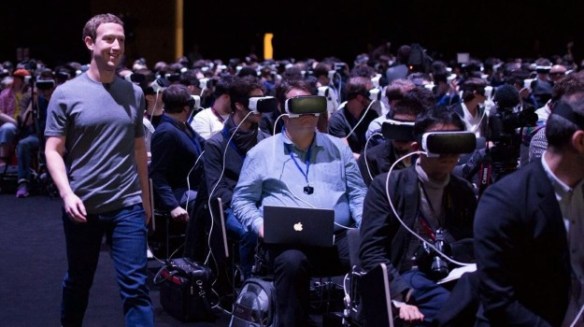
The world wide cage

zuckerberg_VR_people-625x350

Technology promised to set us free. Instead it has trained us to withdraw from the world into distraction and dependency

By Nicholas Carr

Source: Aeon

It was a scene out of an Ambien nightmare: a jackal with the face of Mark Zuckerberg stood over a freshly killed zebra, gnawing at the animal’s innards. But I was not asleep. The vision arrived midday, triggered by the Facebook founder’s announcement – in spring 2011 – that ‘The only meat I’m eating is from animals I’ve killed myself.’ Zuckerberg had begun his new ‘personal challenge’, he told Fortune magazine, by boiling a lobster alive. Then he dispatched a chicken. Continuing up the food chain, he offed a pig and slit a goat’s throat. On a hunting expedition, he reportedly put a bullet in a bison. He was ‘learning a lot’, he said, ‘about sustainable living’.

I managed to delete the image of the jackal-man from my memory. What I couldn’t shake was a sense that in the young entrepreneur’s latest pastime lay a metaphor awaiting explication. If only I could bring it into focus, piece its parts together, I might gain what I had long sought: a deeper understanding of the strange times in which we live.

What did the predacious Zuckerberg represent? What meaning might the lobster’s reddened claw hold? And what of that bison, surely the most symbolically resonant of American fauna? I was on to something. At the least, I figured, I’d be able to squeeze a decent blog post out of the story.

The post never got written, but many others did. I’d taken up blogging early in 2005, just as it seemed everyone was talking about ‘the blogosphere’. I’d discovered, after a little digging on the domain registrar GoDaddy, that ‘roughtype.com’ was still available (an uncharacteristic oversight by pornographers), so I called my blog Rough Type. The name seemed to fit the provisional, serve-it-raw quality of online writing at the time.

Blogging has since been subsumed into journalism – it’s lost its personality – but back then it did feel like something new in the world, a literary frontier. The collectivist claptrap about ‘conversational media’ and ‘hive minds’ that came to surround the blogosphere missed the point. Blogs were crankily personal productions. They were diaries written in public, running commentaries on whatever the writer happened to be reading or watching or thinking about at the moment. As Andrew Sullivan, one of the form’s pioneers, put it: ‘You just say what the hell you want.’ The style suited the jitteriness of the web, that needy, oceanic churning. A blog was critical impressionism, or impressionistic criticism, and it had the immediacy of an argument in a bar. You hit the Publish button, and your post was out there on the world wide web, for everyone to see.

Or to ignore. Rough Type’s early readership was trifling, which, in retrospect, was a blessing. I started blogging without knowing what the hell I wanted to say. I was a mumbler in a loud bazaar. Then, in the summer of 2005, Web 2.0 arrived. The commercial internet, comatose since the dot-com crash of 2000, was up on its feet, wide-eyed and hungry. Sites such as MySpace, Flickr, LinkedIn and the recently launched Facebook were pulling money back into Silicon Valley. Nerds were getting rich again. But the fledgling social networks, together with the rapidly inflating blogosphere and the endlessly discussed Wikipedia, seemed to herald something bigger than another gold rush. They were, if you could trust the hype, the vanguard of a democratic revolution in media and communication – a revolution that would change society forever. A new age was dawning, with a sunrise worthy of the Hudson River School.

Rough Type had its subject.

The greatest of the United States’ homegrown religions – greater than Jehovah’s Witnesses, greater than the Church of Jesus Christ of Latter-Day Saints, greater even than Scientology – is the religion of technology. John Adolphus Etzler, a Pittsburgher, sounded the trumpet in his testament The Paradise Within the Reach of All Men (1833). By fulfilling its ‘mechanical purposes’, he wrote, the US would turn itself into a new Eden, a ‘state of superabundance’ where ‘there will be a continual feast, parties of pleasures, novelties, delights and instructive occupations’, not to mention ‘vegetables of infinite variety and appearance’.

Similar predictions proliferated throughout the 19th and 20th centuries, and in their visions of ‘technological majesty’, as the critic and historian Perry Miller wrote, we find the true American sublime. We might blow kisses to agrarians such as Jefferson and tree-huggers such as Thoreau, but we put our faith in Edison and Ford, Gates and Zuckerberg. It is the technologists who shall lead us.

Cyberspace, with its disembodied voices and ethereal avatars, seemed mystical from the start, its unearthly vastness a receptacle for the spiritual yearnings and tropes of the US. ‘What better way,’ wrote the philosopher Michael Heim in ‘The Erotic Ontology of Cyberspace’ (1991), ‘to emulate God’s knowledge than to generate a virtual world constituted by bits of information?’ In 1999, the year Google moved from a Menlo Park garage to a Palo Alto office, the Yale computer scientist David Gelernter wrote a manifesto predicting ‘the second coming of the computer’, replete with gauzy images of ‘cyberbodies drift[ing] in the computational cosmos’ and ‘beautifully laid-out collections of information, like immaculate giant gardens’.

The millenarian rhetoric swelled with the arrival of Web 2.0. ‘Behold,’ proclaimed Wired in an August 2005 cover story: we are entering a ‘new world’, powered not by God’s grace but by the web’s ‘electricity of participation’. It would be a paradise of our own making, ‘manufactured by users’. History’s databases would be erased, humankind rebooted. ‘You and I are alive at this moment.’

The revelation continues to this day, the technological paradise forever glittering on the horizon. Even money men have taken sidelines in starry-eyed futurism. In 2014, the venture capitalist Marc Andreessen sent out a rhapsodic series of tweets – he called it a ‘tweetstorm’ – announcing that computers and robots were about to liberate us all from ‘physical need constraints’. Echoing Etzler (and Karl Marx), he declared that ‘for the first time in history’ humankind would be able to express its full and true nature: ‘we will be whoever we want to be.’ And: ‘The main fields of human endeavour will be culture, arts, sciences, creativity, philosophy, experimentation, exploration, adventure.’ The only thing he left out was the vegetables.

Such prophesies might be dismissed as the prattle of overindulged rich guys, but for one thing: they’ve shaped public opinion. By spreading a utopian view of technology, a view that defines progress as essentially technological, they’ve encouraged people to switch off their critical faculties and give Silicon Valley entrepreneurs and financiers free rein in remaking culture to fit their commercial interests. If, after all, the technologists are creating a world of superabundance, a world without work or want, their interests must be indistinguishable from society’s. To stand in their way, or even to question their motives and tactics, would be self-defeating. It would serve only to delay the wonderful inevitable.

The Silicon Valley line has been given an academic imprimatur by theorists from universities and think tanks. Intellectuals spanning the political spectrum, from Randian right to Marxian left, have portrayed the computer network as a technology of emancipation. The virtual world, they argue, provides an escape from repressive social, corporate and governmental constraints; it frees people to exercise their volition and creativity unfettered, whether as entrepreneurs seeking riches in the marketplace or as volunteers engaged in ‘social production’ outside the marketplace. As the Harvard law professor Yochai Benkler wrote in his influential book The Wealth of Networks (2006):

This new freedom holds great practical promise: as a dimension of individual freedom; as a platform for better democratic participation; as a medium to foster a more critical and self-reflective culture; and, in an increasingly information-dependent global economy, as a mechanism to achieve improvements in human development everywhere.

Calling it a revolution, he said, is no exaggeration.

Benkler and his cohort had good intentions, but their assumptions were bad. They put too much stock in the early history of the web, when the system’s commercial and social structures were inchoate, its users a skewed sample of the population. They failed to appreciate how the network would funnel the energies of the people into a centrally administered, tightly monitored information system organised to enrich a small group of businesses and their owners.

The network would indeed generate a lot of wealth, but it would be wealth of the Adam Smith sort – and it would be concentrated in a few hands, not widely spread. The culture that emerged on the network, and that now extends deep into our lives and psyches, is characterised by frenetic production and consumption – smartphones have made media machines of us all – but little real empowerment and even less reflectiveness. It’s a culture of distraction and dependency. That’s not to deny the benefits of having easy access to an efficient, universal system of information exchange. It is to deny the mythology that shrouds the system. And it is to deny the assumption that the system, in order to provide its benefits, had to take its present form.

Late in his life, the economist John Kenneth Galbraith coined the term ‘innocent fraud’. He used it to describe a lie or a half-truth that, because it suits the needs or views of those in power, is presented as fact. After much repetition, the fiction becomes common wisdom. ‘It is innocent because most who employ it are without conscious guilt,’ Galbraith wrote in 1999. ‘It is fraud because it is quietly in the service of special interest.’ The idea of the computer network as an engine of liberation is an innocent fraud.

I love a good gizmo. When, as a teenager, I sat down at a computer for the first time – a bulging, monochromatic terminal connected to a two-ton mainframe processor – I was wonderstruck. As soon as affordable PCs came along, I surrounded myself with beige boxes, floppy disks and what used to be called ‘peripherals’. A computer, I found, was a tool of many uses but also a puzzle of many mysteries. The more time you spent figuring out how it worked, learning its language and logic, probing its limits, the more possibilities it opened. Like the best of tools, it invited and rewarded curiosity. And it was fun, head crashes and fatal errors notwithstanding.

In the early 1990s, I launched a browser for the first time and watched the gates of the web open. I was enthralled – so much territory, so few rules. But it didn’t take long for the carpetbaggers to arrive. The territory began to be subdivided, strip-malled and, as the monetary value of its data banks grew, strip-mined. My excitement remained, but it was tempered by wariness. I sensed that foreign agents were slipping into my computer through its connection to the web. What had been a tool under my own control was morphing into a medium under the control of others. The computer screen was becoming, as all mass media tend to become, an environment, a surrounding, an enclosure, at worst a cage. It seemed clear that those who controlled the omnipresent screen would, if given their way, control culture as well.

‘Computing is not about computers any more,’ wrote Nicholas Negroponte of the Massachusetts Institute of Technology in his bestseller Being Digital (1995). ‘It is about living.’ By the turn of the century, Silicon Valley was selling more than gadgets and software: it was selling an ideology. The creed was set in the tradition of US techno-utopianism, but with a digital twist. The Valley-ites were fierce materialists – what couldn’t be measured had no meaning – yet they loathed materiality. In their view, the problems of the world, from inefficiency and inequality to morbidity and mortality, emanated from the world’s physicality, from its embodiment in torpid, inflexible, decaying stuff. The panacea was virtuality – the reinvention and redemption of society in computer code. They would build us a new Eden not from atoms but from bits. All that is solid would melt into their network. We were expected to be grateful and, for the most part, we were.

Our craving for regeneration through virtuality is the latest expression of what Susan Sontag in On Photography (1977) described as ‘the American impatience with reality, the taste for activities whose instrumentality is a machine’. What we’ve always found hard to abide is that the world follows a script we didn’t write. We look to technology not only to manipulate nature but to possess it, to package it as a product that can be consumed by pressing a light switch or a gas pedal or a shutter button. We yearn to reprogram existence, and with the computer we have the best means yet. We would like to see this project as heroic, as a rebellion against the tyranny of an alien power. But it’s not that at all. It’s a project born of anxiety. Behind it lies a dread that the messy, atomic world will rebel against us. What Silicon Valley sells and we buy is not transcendence but withdrawal. The screen provides a refuge, a mediated world that is more predictable, more tractable, and above all safer than the recalcitrant world of things. We flock to the virtual because the real demands too much of us.

‘You and I are alive at this moment.’ That Wired story – under headline ‘We Are the Web’ – nagged at me as the excitement over the rebirth of the internet intensified through the fall of 2005. The article was an irritant but also an inspiration. During the first weekend of October, I sat at my Power Mac G5 and hacked out a response. On Monday morning, I posted the result on Rough Type – a short essay under the portentous title ‘The Amorality of Web 2.0’. To my surprise (and, I admit, delight), bloggers swarmed around the piece like phagocytes. Within days, it had been viewed by thousands and had sprouted a tail of comments.

So began my argument with – what should I call it? There are so many choices: the digital age, the information age, the internet age, the computer age, the connected age, the Google age, the emoji age, the cloud age, the smartphone age, the data age, the Facebook age, the robot age, the posthuman age. The more names we pin on it, the more vaporous it seems. If nothing else, it is an age geared to the talents of the brand manager. I’ll just call it Now.

It was through my argument with Now, an argument that has now careered through more than a thousand blog posts, that I arrived at my own revelation, if only a modest, terrestrial one. What I want from technology is not a new world. What I want from technology are tools for exploring and enjoying the world that is – the world that comes to us thick with ‘things counter, original, spare, strange’, as Gerard Manley Hopkins once described it. We might all live in Silicon Valley now, but we can still act and think as exiles. We can still aspire to be what Seamus Heaney, in his poem ‘Exposure’, called inner émigrés.

A dead bison. A billionaire with a gun. I guess the symbolism was pretty obvious all along.

The real Hunger Games: the Capitalist recipe to maximise profits while ‘having fun’

peacekeeper

By Sky Wanderer

Source: Investment Watch

Introduce a political economy upon the arbitrary axiom that Capitalism is the one and only economic system for mankind, and introduce a narcissistic moral philosophy that you as a Capitalist represent unsurpassable objective moral virtues.

You as a Capitalist hire politicians to implement policy as per your moral and economic philosophy and redefine ‘democracy’ as the political system to sustain Capitalism. Then from such position of self-established authority, abolish unions and all labour-representation, thus force your employees into a race-to-the-bottom contest to compete for jobs by accepting lower and lower wages.

Give decent jobs and benefits to only those who belong to your noble circles. For everyone else reintroduce slavery in the form of “workfare”. The goal is that you pay the lowest wages for jobs done by the fittest slaves, who will survive the contest. If you wish, you can call the contest “real Hunger Games”.

To speed up the process, extend the race-to-the-bottom into global scope so that you will have access to the cheapest and fittest labour everywhere on the planet. Never mind that your slaves will have to live out of a suitcase and every time when you lay them off and labour demand calls them elsewhere, they will have to relocate to yet another continent.

To further accelerate the process, make good use of your 3rd-world colonies, your Mideast colonising wars and your secretly sponsored mercenaries (ISIS). Via your “leftist” assistants, organise a massive refugee crisis to import the cheapest possible workforce via your war-refugees and economic migrants. These migrants are the fittest contestants who – glad just to escape your bombs – will worship you as their saviours and will work for you for literally zero payment. The migrants will not only boost your profits to sky-high levels but will rapidly pull down the overall wages of your domestic employees.

Meanwhile keep increasing the prices so your slaves can’t pay for food, energy, heat and shelter from their next-to-zero incomes. If some of them attempt to survive by taking bank-loans to acquire shelter, education and meet other basic needs, but they can’t repay the loans from their low incomes, you can just evict them from their homes via your banks.

When you made them homeless this way, make sure their ugly presence won’t spoil the beauty of your city. Install pretty anti-homeless spikes, so when they crush onto the pavement they will die, and you can just collect their bodies. To project your capitalist moral virtues into eternity, incorporate the beauty of your anti-homeless spikes into the modern concept of art and beauty.

Introduce private banking to enable yourself to creating new money when you wish. This way you can easily indebt the entire society, soon you can even purchase the whole planet.

Meanwhile dismantle public healthcare, so those of your slaves who are still alive but get sick, will die without treatment. Eliminate (privatise) all affordable public services, destroy the public sphere, abolish all public spaces and welfare benefits. To have a dandy excuse for such policy, make sure to keep the country in ever increasing debt by taking countless £ billions of government loans, and transfer the responsibility of these odious debts onto your slaves. Refer to these debts as the reason for the crisis, then refer to the crisis as the reason for these debts, then refer to the debts and the crisis as the reason for austerity and spending cuts. Then you can increase the public debt again and continue the same loop ad infinitum.

Make sure your very own mainstream media and academia would never reveal the truth that the never-ending crisis and mass-unemployment are due to your private banking and debt- and profit-mongering dysfunctional capitalist system, and keep the real disastrous indicators of the state of economy in secret.

Instead of admitting the truth, use the divide et impera strategy to make your victims blame themselves and one another. To increase the fun, produce reality shows where the still active part of your slaves will blame the disabled and the unemployed, meanwhile make the local poor blame the immigrant poor for the overall misery that you inflicted. Then establish offices where the local poor dressed as fancy clerks will evict the immigrant poor, meanwhile watch how all of them are begging for their lives until they give up and commit suicide.

Enjoy!

We Don’t Need A Government, We Need A Purpose

psychedelic-trippy-abstract-art-poster-soul-universe-time-cameron-gray-font-b-spiritual-b-font-art

By Lance Schuttler

Source: The Mind Unleashed

What truly motivates a person? Years ago I would have answered, “well, money of course. Money helps to to be able to pay for our food, shelter, some entertainment and allows us to (sometimes) further our education.”

While that answer is true in ways, today I would take it further and say that a purpose is what motivates us. It is not that money itself it motivating for us, but it is the security money can provide by allowing us to pay for our basic needs like food, shelter and clothing.

From our childhood, we have been conditioned to believe that it is necessary to have money and the institutions that direct the flow of money to the greater populace. However, if we analyze that deep enough, we see that it is a fact that such a means of rationing resources (which money does) and the institutions that control the rationing are not necessary, but are by choice.

Sure, in some ways government has served it’s purpose. It has allowed us to build an infrastructure on this planet where we can travel pretty much wherever we would like. It has also built schools, hospitals and allowed for the creation of all sorts of public services as well as public entertainment. However, what is important to remember is that it wasn’t governments who built these things. It was people. People made the choice each and every morning to wake up and go to their job to help create whatever it was they were working on.

Though money was almost certainly and incentive for many of these people, I believe that we human beings have an innate desire to help serve a greater cause. Perhaps for many of these people, an additional incentive for doing their work was that they knew on a deeper level, that this was in some way, big or small, to allow our civilization to develop and grow in a positive direction.

In today’s world, with the internet, 3-D printing and the ability to harness unlimited energy for the entire world in the forms of solar, wind, tidal and geothermal, not to mention the numerous patented “free energy” devices which are currently suppressed, the need for money and government has passed us. We no longer need money as a way to ration resources when we have the technology to create unlimited abundance for everyone on the planet. With no longer needing money, we no longer need a system such as governance who acts as the hub of rationing these resources through the means of money. 

While I do not think that immediately stopping the usage of money and governance simultaneously around the world would be a wise or even positive decision in the short-term, I do believe that we could easily begin the process of scaling these back tremendously with the intention of completely ridding them of our reality. 

It is no secret that many people today do not like their jobs or the work they do. However, people realize that the money that is paid to them allows them to pay for a place to live and for food to eat, which in turn allows them to continue their life. In a very real way, many people are working a job they couldn’t care less about, just in order to stay alive. Some say, “well, that’s life. Get used to it.” Or, “You have to work. Stop complaining.”

I say, “with the technology we have today that could easily provide abundance in all forms for every person on this planet, it is counter-productive to use our time doing things we do not enjoy doing.” If you knew that if we as a planet really want to, we can cleanly power the entire world, which will allow us to grow the food and resources needed to feed, house and clothe everyone. This in turn will allow the basic needs of everyone to be met. From there, we will stop doing the work we’ve been doing to earn the money, which in turns allows us to pay for our basic needs.

At that point, we will start doing things that are passionate about. We will move away from the need of a government and move into finding what is of purpose for us. Perhaps at that point we can move from competition to cooperation. We can begin to heal ourselves, our family and friends. We can then begin to heal our pets, the water and land of the Earth. We can create a truly peaceful paradise.

For those arguing, “this sounds like communism,” I say, “this has nothing to do with politics or money and is several levels evolved past such barbaric methods.” Remember, communism is a political system who also has been enslaved via the monetary system, just as every other political system has been, whether that is capitalism, feudalism, communism or fascism.

Again, powering, feeding, clothing and housing the entire world has nothing to do with politics. It does, however, have everything to do with the human spirit and the deservability that each person naturally has. Remember, we are human beings living on a planet that is flying through our solar system, who receives it’s warmth from a massive ball of gas known as the Sun. We are human beings. We are each a miracle. This planet’s existence is a miracle. We needn’t do a thing but simply exist to deserve the abundance this Earth can and one day will easily provide to all of us.

With that, I ask you: What is it that you can do, whether as a “job” or as a hobby that allows you feel a sense of purpose? What do you get passionate about? Maybe you are already in your purpose.

I do believe strongly that with the advancements we have made and continue to make technologically, but most importantly emotionally/spiritually, we are beginning the transition away from a monetary world and into a world where abundance, peace and purpose are the norm. What can you do to help add to this momentum?

I Participate

they-live-street-signs

By Jonathan Bessette

Source: Adbusters

Recall that you’re sitting in a rapid transit vehicle, carried along the sky-line above cement highways, paved in homage to the Romans, who designed a system of militarized paths stretching everywhere, causing everything to lead back to one place. Here we are everyone, the year of the Monkey, 2016, 98 years after The Great War … too bad it isn’t the year of the Dalmatians … Mickey Mouse recently Tweeted that Disney is working on buying the rights to the Chinese lunar calendar. Imagine 12 animated classics framing each and every year for the remainder of humanity’s existence. 

At this point human society is so vast, so complex, so multilayered, that it is impossible to stay updated, engaged, and participating in every area of local and global importance. Education takes us from a place of innocence, creativity and joy, forcing us to fall into the institutional lines of desks and faced forward attention. As a nodal point of knowledge each new person will be filled to the brim with information that makes them useful to the status quo.

Neuroscience now tells us that the brain has plasticity and the neurosynaptic networks that are created through nurturing, which become identity and personality, can be changed and overwritten. Newer pathways can be formed and strengthened and older ones can be reduced. Does this mean that our free-will has a physical manifestation as identity, as culture, and every choice affects the people, animals and objects around us? Everything we think and do reinforces everything we think and do, creating a strange logical loop which justifies our lives as ourselves. Without any major impetus, what reason do we have to change? Why compromise our internally consistent narrative and accept the narrative of someone else? What stands to be different?

Surreality is becoming a more constant state as life in the present starts to look like Science Fiction of the future from the past. The last historian wandering around Paris in the 21st Century, forgotten by a technologically advanced world that cares only for materialism. A beguiled Case, the lead character of Gibson’s Neuromancer, disenfranchised because he can no longer participate in the romance of cyberspace, looking something like a hacker barred by the law to approach or touch a computer. Of course cyborgs, robots, virtual reality and AI dance at the periphery, the momentum of current technological trends, yet we titillate ourselves with the practical possibility of these totems nearing our hearts and minds.

Information overflows like never before. Some cry Apocalypse! End Times! The Rapture! But most of the world is still filling up their gas tanks, believing that the day when Climate Change will actually affect them is the day that it will be clearly outlined in a power point presentation, at their offices or wherever they work, explaining the equity found in maintaining current profit margins while in the same breath rearranging the economic vehicle of prosperity.     

“Change without Changing!” might be the Party Slogan for whoever runs for the Presidency after Obama sputters to a close.

Take my hand and run through the ever-increasing fields of soya beans, where we can hear the Monsanto genetically-modified breeze blowing the answer in the wind, whispering corporate sonatas, proving that commercial capitalism is a system of religion. Faith in Profit! The Gospel of Endless Progress! Join our Church of Business! Maybe Monsanto can use its private militia to assassinate Thomas Piketty, because of the seeds he’s sowing about capitalism being a mechanical beast that needs regulation because its fuel is the disparity between rich and poor … the larger the gap the more efficacious the fuel.

Then I think whether or not you’ll be reading this on paper or a flat-screen … whether either will be made from recyclable resources, and the argument that the printed word is less sustainable than the digital, so let’s put them to the test, right here, right now:

What can you do with a single piece of printed paper? Read it, eat it, burn it, re-write on it, make origami, a paper airplane or a boat, use it as a funnel, snort powders with it, wipe our bums? What can we do with a tablet? Access every possible available medium via the Internet and software?

It takes at least a lumber, ink, metal, and print industry to create the basic elements to manufacture printed media on a large scale. The average printed matter, kept in modest condition, can last up to 100 years and still be usable. The space that a single printed work takes up is quite large, creating the need to provide space of the material itself. When recycling an old book there are few components to worry about, making it rather simple.

It takes at least most types of mining and the processing of raw materials (petroleum, silicon, zinc, aluminum), software and hardware development, manufacturing, and the assembly of components to create a tablet. The average tablet, kept in modest condition, can remain functional until it’s obsolete. It certainly will not last 100 years, and even if it did the components, chips and circuitry would be so worn down that anything you might have used it for would no longer be possible. Of course you can store a million, a billion, even a zillion books on a single tablet, but will everyone have equal access to it? Tablets are extremely difficult to recycle, their components don’t just make up another tablet. The loss from entropy alone assures destruction, and we cannot grow more zinc, petroleum, or aluminum.

But really none of this matters, we don’t have any control over what corporations choose to do with our futures, or what medium we will use. These new, futuristic developments, intended to define human culture, are being devised and formed inside of grand boardrooms, in tall skyscrapers, by CEOs and shareholders. They, the 1%, are only concerned with whether the product they create for us will become a necessary commodity, like food, like water, like shelter … like Subway, like Coke Cola, like Single Room Occupancies (SROs).

You hear someone talking about the protest on Burnaby Mountain. People don’t want Kinder-Morgan expanding the capacity of an already existent pipeline because it will significantly increase the traffic of oil tankers in the Burrard Inlet. Someone else discusses the unrest of activist groups in Vancouver; about the substandard living conditions; the war on the poor; the two new prisons … they care about housing those who arise from poverty and have been given nowhere else to go. Anger overtakes you for a moment and you think, I don’t like this, why is there so much injustice, maybe I can do something about it…

A flabbergasted voice backtracking intellectual missives comes on over the radio, you’re not sure if it’s in your head or not:
“Revolution is just going around and around, it’s a cycle, it begins with violence and it ends with violence and it only achieves the same power structure that precedes it.”

You think about the French Revolution, the Arab Spring, Anonymous, and realize grass-roots change can rise up from the ground, from the dirt, from the dust whence we came, to challenge the oligarchical deities of the political / corporate aristocracy. We can sell everything we own and buy whole streets collectively, live there together, change the land and what’s on it together. We can join all kinds of innovative communities. We can gather in massive groups and walk through the streets, calling attention to everything corruption has built up around us. We can participate in Civil Disobedience, because the obedience that is asked of us causes harm to someone or something that is alive and is not fairly allowed to defend itself.

No matter how much Ayn Rand and Alan Greenspan and Justin Trudeau tell you that the money will trickle down, no matter how much they tell you that they are the ones who created the railroads, produced the banks, developed the industries that sustain our economies … they didn’t do a damn thing. We laid the tracks, we hammered the spikes, we drove the trains, we maintained the services, we built the buildings, we painted the walls, we fitted the plumbing, we opened the doors, we mopped the floors, we surveyed the land, we mineral tested the rock, we operated the drills, we processed the crude and we shipped the products. None of these things that they presume to own did they make or build. They didn’t put one brick in the wall, they didn’t dig one trench, and they didn’t turn one switch. It’s all ours…

Now an unsettling feeling might skitter across you when you realize that you are implicated in this whole thing. Why do we feel so disenfranchised? Why does the 1% own so much more influence, so much more than we little peons? I feel powerless but every day I participate in the construction of human society. Every action contributes to a massive effect called the singularity of my life. Don’t fall into the kinds of aporia that Jacques Ellul observes in The Technological Society, where no one claims responsibility for the projects of technology. Who made this computer? Was it the engineers, or the design team, the software developers, the hardware makers? Or was it the companies who mined the silver, the petroleum, the zinc, the aluminum, the silicon? No single person in the process can take responsibility for the whole … so no one does, they just accept it, and its justification is its presence.

Well then … we are in a pickle aren’t we? But maybe revolution is the act of taking responsibility? Clips of revolution flicker through your mind-film, you see riots, Molotov cocktails, police lined up with transparent plastic shields. You realize you do not want to risk your comfort, your coziness, your conformity, so you fit in and play nice and salute whoever is in power. Or maybe you are just not interested, you have your soma, your serial monogamy, your fair trade Americano. Besides, you’re too busy, you’ve got kids, you work 60 hours a week, you recently bought a home in one of the most expensive housing markets in the world, you already have enough responsibilities …

Teaching Children How to Think Instead of What to Think

pink-floyd-the-wall-alan-parker

By Will Stanton

Source: The Mind Unleashed

Right now our education system is doing more to indoctrinate our children than to educate them. In fact, that has been the case for quite some time. Our young minds are being told to accept authority as truth instead of truth as authority, and teachers talk at the students instead of with them.

Teachers have become repeaters of information. They are merely regurgitating everything they once learned from their own teachers, and perpetuating the recycling of information; information that has managed to evade scrutiny for generations. Children are no longer the masters of their own learning, and instead, their minds are being treated as storage containers.

The factory model of education, with its focus on academic and economic elitism, is churning out obedient workers for the system, encouraged to conform every step of the way. We are not being treated as organic, creative, investigative human beings, but instead as parts in the machine. The education system is filtering out the inquisitive nature of our being, with the ultimate goal being to prevent dissent against the system. The system doesn’t want thinkers. It doesn’t want people to question its methods. It wants a population that can be easily manipulated and controlled so as to relinquish all its power to the elite.

There are those who say that skills cannot be taught in schools. Socrates would likely scoff at that notion, were he still alive today. It was Socrates who said, “I cannot teach anybody anything; I can only make them think.”

If we’re going to solve the problem of indoctrination in our school system, we have to learn to begin asking questions instead of giving answers. Real learning is achieved through the investigative process. Children have to be encouraged to search for the answers themselves. It is up to the teachers to provide the tools and resources necessary for the children to conduct these inquiries and make meaningful discoveries. One well-formed question will do more to inspire than any number of answers. In every facet of our educational pursuits, it becomes crucial to begin an open dialogue with our students, to encourage healthy debate and to have them form their own conclusions.

The importance of teaching philosophy in schools cannot be underestimated. In a world where most of humanity is running on the treadmill with the blinders on, it is paramount that we re-evaluate our own perspectives from time to time, and look at the big picture.

What teaching philosophy does is it gets us thinking, it gets us questioning, and it gets us contemplating. Without these skills, humanity will continue to function on autopilot, and we will allow those in power to continue to dominate, oppress and enslave us in every way.

We need to reclaim our own minds…