Demise Of The Petrodollar Has The Potential To Reshape The Geopolitical World

By James ONeill

Source: New Eastern Outlook

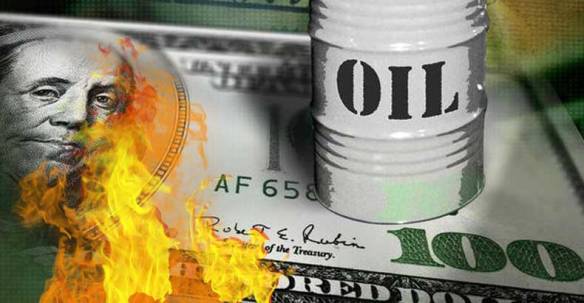
In the early 1970s President Richard Nixon instigated two changes that had profound effects. The first of these was taking United States off the gold standard; i.e. henceforth US dollars would no longer be convertible to Gold. Ordinarily this might have been expected to have significant ramifications for the value of the US dollar.

Deleterious effects however, were avoided by another equally profound change. Nixon’s National Security Adviser Henry Kissinger negotiated an agreement with Saudi Arabia that henceforth all oil(initially from Saudi Arabia but rapidly extended to all OPEC) countries would be traded only in US dollars, the birth of the so called petrodollar.

It was a classic mafia style arrangement. In exchange for Saudi Arabia’s agreement to the sole use of the dollar for oil transactions, the US underwrote Saudi Arabia’s security thereby ensuring the continuity of one of the world’s most corrupt and repressive regimes.

Also unknown at the time, the US and Saudi Arabia entered an arrangement whereby Islamist terrorist groups (as long as they were Sunni) would be financed by Saudi Arabia and armed by the Americans and then used in pursuit of US geopolitical goals. Operation Cyclone, begun under the Carter administration in the 1970s was an early forerunner of this tactic, but it has been refined and utilized in different formats in a wide number of countries ever since.

The objective was always fundamentally the same: to undermine and if necessary replace governments that were insufficiently compliant with US geopolitical aims. As and when necessary, US troops and their “coalition” allies would be inserted into the target countries. The destruction of Afghanistan (2001 and continuing) Iraq (2003 and continuing) Libya (2011 and continuing) are only three of the better-known examples.

The huge financial cost of these military and geopolitical ventures did not impose a proper price upon the US because of the hegemonic role of the US dollar. The US, in effect, had their multiple wars of choice paid for by other countries as the dollar’s role in world trade created a constant demand for US Treasury bonds.

The role of the US dollar also permitted the US to impose sanctions on recalcitrant countries. The selective nature of the sanctions, always directed toward a US geopolitical or commercial advantage, were clearly an instrument of repressive power. Notwithstanding claims that they were to “punish” the alleged misconduct of the specified country, their actually use betrayed their geopolitical purpose.

Sanctions against Russia for its” invasion” of Ukraine “annexation” of Crimea, and against Iran for its “nuclear program” are two of the better known illustrations of sanctions being justified on spurious grounds..

The use and abuse of the dollar’s power is clearly unacceptable, but the capacity to invoke countermeasures was until quite recently severely limited. The single most important countervailing force is the rise of China as the economic powerhouse of the world, and importantly, the creation of alternative structures in trade, finance and security, that translate China’s economic power into a force for major change.

That change is assisted by the number of collateral developments. In 1990, the G7 nations (Canada, France, Germany, Italy, Japan, the US and UK) had a combined GDP approximately six times greater then the seven economically most important emerging nations (Brazil, China, India, Indonesia, Mexico, Russia and South Korea).

By 2013 the “emerging seven” had surpassed the G7’s GDP total and according to the IMF’s estimates for 2017, the GDP of the two groups will be $47 .5 trillion and $37.8 trillion for the emerging seven and the G7 respectively. Turkey, which is growing at 5% per annum, has replaced Mexico in the top emerging seven.

BRICS, which contains four of the emerging seven nations and the Shanghai Corporation Organisation (SCO), which includes China, India and Russia, are working together on the architecture of a monetary alternative to the dollar. The SCO alone contains 42% of the world’s population.

India’s role in BRICS and the SCO is one reason it is being assiduously cultivated by Australia, Japan and the United States in an attempt to set up a “quadrilateral four” to slow and undermine the role of China and Russia in creating an alternative to longstanding western domination and exploitation.

It was in this context that Russia’s President Putin at the recent BRICS meeting in Xiamen, China said that

“Russia shares the BRICS countries concerns over the unfairness of the global financial and economic architecture, which does not give due regard to the growing weight of the emerging economies.”

This speech developed a theme that Putin had developed in an article published prior to the BRICS meeting. Putin bluntly vowed to destroy the US led financial system, aiming to reform a system that gives excessive domination to a limited number of reserve (i.e. predominantly western) currencies.

China has developed a new Cross Border Interbank Payments System (CIPS) to replace the US dominated SWIFT system, itself used as a tool for financial bullying by the US. Russia has also taken steps to insulate itself from the ill effects of being excluded from SWIFT.

Other major changes are also occurring. Venezuela, with the world’s largest known oil reserves, has ceased accepting payment in US dollars. In the past US retaliation through regime change would have been immediate as happened to Libya’s Gaddafi (confirmed by Clinton’s leaked emails) and the Iraq’s Saddam Hussein who had announced that he would henceforth accept payment in euros and not dollars.

China and Qatar recently concluded a $50 billion deal denominated in Yuan. There were immediate threats and absurd demands from Saudi Arabia, undoubtedly acting as the voice of the US administration, but nothing more serious. The lack of military intervention or attempted regime change was probably attributable to Turkey’s military intervention, a series of agreements with Iran, and the probable implied threat of Chinese intervention should the Saudis further demonstrate their military incompetence (as in Yemen) by anything as rash as direct military moves against Qatar.

Saudi Arabia is rapidly reaching a crunch point in its relationship with China, a huge purchaser of Saudi Arabia’s oil. It is widely known that China wants future oil contracts denominated in Yuan. The attraction for Saudi Arabia is that the Chinese guarantee their Yuan with gold traded on the Hong Kong and Shanghai exchanges. Ironically, this puts China in the same position as the United States prior to Nixon’s withdrawal from the gold backed dollar.

The dilemma for the Saudis is that if they comply with the Chinese demands they risk losing the Americans underwriting their security. US instigated regime change in Saudi Arabia is a very real possibility and the recent maneuverings by Mohammad bin Salman to consolidate his power can be interpreted as a response to that possibility.

Typically, the western media focused on relative trivialities, such as women being able to drive motor vehicles from 2018 (in limited circumstances), rather than examining the underlying geopolitical power struggle.

The other major development worth mentioning in this context is the rapid increase in the number of countries doing deals with China using the Yuan or their own national currencies as the medium of exchange. China’s Belt and Road Initiative, currently involving 65 nations, will undoubtedly accelerate this trend. Russia and China are already each other’s critically important trading partners and all agreements between them are being denominated in either Yuan or Rubles.

It would be naïve to assume that this is all going to occur without a massive rearguard action by the Americans who know full well that their ability to defy economic logic is only possible because of the dollar’s unique role, allowing in turn military interventions to prop up their now rapidly declining power.

The United States’ aggressive and provocative actions in the South China Sea, North Korea, Ukraine, Syria and elsewhere our best interpreted as the flailing’s of a declining empire. The real question is will the United States accept the disappearance of the unique power that it has wielded since the Bretton Woods agreement of 1944 and adjust its policies accordingly, or destroy us all in their attempts to recapture a lost world.

Perpetual Prosperity And The ‘Strategy of Tension’

By Graham Vanbergen

Source: TruePublica

Marco Rubio, the American politician, attorney and former Speaker of the Florida House of Representatives once said; “Every nation on the Earth that embraces market economics and the free enterprise system is pulling millions of its people out of poverty. The free enterprise system creates prosperity, not denies it.”

Statements such as these are common amongst politicians, especially wealthy ones who hold wealth driven values. But one man’s prosperity is another man’s misery in a world blighted by an economic model that demands eternal growth.

The only one constant that sits well with this model is that world population continues to increase, but even that is tailing off. Global population currently sits at 7.5 billion and rising at a rate of 80 million per year. The rate of population increase was 2.19 percent at its peak in 1963, which has now halved.

Concerns of the Fourth Industrial Revolution fusing the physical, digital and biological worlds, and impacting all disciplines, economies and industries emanate from the corporations who now see their future declining revenue potential being rescued through reduced reliance on human labour.

Get Briefed, Get Weekly Intelligence Reports – Essential Weekend Reading – Safe Subscribe

Subscribe!

To keep prosperity on a perpetual upward trajectory in the backdrop of a continually shrinking and less well off consumer base, the most politically influential now work in concert with the corporate behemoths – the new rulers of the world.

The strategies adopted to keep the ball rolling over the last few decades centre around a financial architecture that requires drastic anti-democratic political support. As Noam Chomsky warns “The very design of neoliberal principles is a direct attack on democracy.

One does not have to look far to see these principles at work. Trillions of desperately needed taxes to support a decaying system of civil society are illegally offshored by household named corporations and individuals. Unfortunately, this form of extreme neoliberalism still isn’t enough to keep the ball rolling.

Naomi Klein’s 2007 book ‘Shock Doctrine, the rise of Disaster Capitalism’ exploded the myth that the global free market triumphed democratically. Klein highlights how the “puppet strings behind the world-changing crises and wars of the last four decades is the real story of how America’s “free market” policies came to dominate the world, through the exploitation of disaster-shocked people and countries.”

Then, one year later, Klein’s prognosis saw the 2008 financial crisis offering up more disaster shocked peoples at the global level as neoliberalism wriggled free from the remnants of regulation to reach a new pinnacle for the few and a created an even greater crisis of daily life for the hundreds of millions left behind.

This erroneous ideology delivered little more than world economic stagnation, crippling austerity, peak inequality, a global environmental crisis, the slowest economic recovery in history and monumental debt of every country it infected. This was no mistake, no unforeseen event, that we were told stunned our leaders and their captains.

The problem always existed that extreme wealth was never going to come from a global post-war peace through globalisation – so a ‘strategy of tension’, an Anglo/American innovation, was invented to keep the exploitation model alive.

The actual definition of this strategy is that “Western governments during the Cold War used tactics that aimed to divide, manipulate and control public opinion using fear, propaganda, disinformation, psychological warfare, agents provocateurs, and terrorist actions in order to achieve their strategic aims.

Amongst many, one of those aims was financial domination.

During the closing days of the Cold War, the UK, US and other western governments along with the secret services colluded to engineer terrorist attacks inside Western Europe, to be blamed on Russia. This is now so well documented it needs no elaboration here (1).

However, the objective was always clear. By mobilising public opinion against left-wing parties (and their policies) and legitimising war, capitalism was to be forever invigorated. Ultimately though, this required the denying of national independence movements, mainly in the third world, to fund new forms of Western wealth.

The Cold War, stoked and fuelled by a deliberate strategy of tension gave us ‘Red Russia’ and the potential for nuclear Armageddon. When that ran its course, imaginary foes such as Saddam Hussein and Gaddafi were invented. The war on terror was used as a means to an end. Today, Red Russia is back on the agenda once again.

Dr Nafeez Ahmed, the award winning investigative journalist wrote about this Strategy of Tension:

The immense fear and chaos generated by the impact of this phenomenon throughout Western Europe was instrumental in legitimising the interventionist policies of the Anglo-American alliance throughout the Cold War period. The number of people killed across the third world as a consequence of this militarisation process is shocking, its implications genuinely difficult to absorb.” (2)

Ahmed goes on to say that 12 to 15 million people since WW2 have been sacrificed for this strategy with many millions more suffering as their economies were destroyed and denied the right to restructure whilst Western corporations made fortunes at their ultimate expense.

Dr Daniele Ganser, a Swiss historian who specialises in contemporary history, international politics, covert warfare, resource wars and geo-strategy confirms that this strategy is very much alive and in use to this day.

“What you may have, if you translate our experience from the Cold War to the current day situation, is that a strategy of tension is still being implemented, but this time against Muslims,” Ganser says. “We all know that the west is dependent upon oil, and a pretext is needed to develop more operations in Iran, Iraq etc. We can’t just go there and invade them, so we have to have this idea that they’re trying to kill us, then it’s possible, or at least imaginable that a strategy of tension in which the Muslims are playing the role that the communists played in the Cold War, is happening.”

The result is that the world is facing a new desperate multi-faceted game of thrones – as it morphs into something even more destructive.

Conflict and change is now the new norm. Global peace and domestic security is fading as the world order spirals out of control. This engineered spiral is going to prove to be a disaster for everyone, in what looks a lot like a coming global collapse on every front.

Civil society is now shrouded in a cycle of fear, terrorism, surveillance and experiencing a perpetual loss of rights and liberties as the world order disintegrates.

Today, we are now unable to make reasonable predictions of our near future as war, lawlessness, terrorism and now threats of nuclear annihilation become ever more real.

Even hope is diminishing. People of the West are now so afraid they want to stop perceived threats from foreigners, they want them expelled. Manufactured geo-political tensions have created a migration of people in the 21st century even greater than mankind’s greatest tragedy – the last world war. This is no mistake, no unforeseen event either.

China was once the greatest economic power on earth, followed by India, Britain and then America. Not once has the continent of Africa produced a global GDP exceeding 5% in its history, with 16% of the world’s population.

Having deprived this entire continent any possible chance of progression, a migrant surge is now destabilising the very regions responsible for pillaging it.

Alongside all of these pressures, environmental collapse seems inevitable when extreme capitalism sees natural catastrophic events such as the oil industry viewing melting ice caps as nothing more than an investment opportunity.

America is still fighting wars in the Middle East, threatening China, Iran, Korea, India, and even the European Union. The EU is breaking down into four distinct regions as the fifty-year unity project is visibly disintegrating. Is this just a fight for dwindling resources or something else?

Total global debt is now $227 trillion – or 327 percent of global GDP and something like 45 percent higher than the 2008 apex of the financial meltdown.

The Bank of International Settlements urged just two months ago that policymakers need to press on with rate rises notwithstanding the financial market turbulence it will cause.

The world’s six largest pension saving systems – the US, UK, Japan, Netherlands, Canada and Australia – are expected to reach a $224 trillion gap by 2050, a new study by the World Economic Forum shows. Implosion is its only obvious trajectory as there is nowhere near than amount of money anywhere in the world to plug such a gap as that (3).

Total US household debt surged by $460 billion last year, the sharpest one-year rise ever, with an eye-watering $13 trillion outstanding (4). Britain’s household debt is rising at 10 percent per year, five times the rate of earnings growth and has just surpassed the 2008 level of debt as households struggle to keep afloat (5).

The World Economic Forum has also determined that unemployment, an energy price shock, fiscal crisis, failure of national governance and profound social instability makes up the top five global risks to economic performance (6).

To rid the world of its debt’s, kick-start the world economy and take advantage of the shifting global chess board, some believe conflict is the only consequential route left. NATO’s threats to Russia supported by mass media hysteria only adds to the WEF global risks list.

We have a lot to be fearful of. The fact that any combination of the risk list could happen at the same time in today’s world is no longer the conspiratorial thinking of doom-mongers but the architecture of a strategy that the world has seen before.

Public intellectual Tariq Ali wrote a warning in his 2010 book “The Obama Syndrome: Surrender at Home, War Abroad:

This is the permanent tension that lies at the heart of a capitalist democracy and is exacerbated in times of crisis. In order to ensure the survival of the richest, it is democracy that has to be heavily regulated rather than capitalism.”

Seven years after Ali’s book we are experiencing a never-ending relay of crisis after crisis; democracy under threat, capitalism out of control and the very real threat of facing another human catastrophe.

In his sobering analysis, Professor Ugo Bardi, a professor in Physical Chemistry at the University of Florence and president of the Association for the Study of Peak Oil (ASPO), dissects historical statistics on war to unpick the patterns of the violence of the past. He warns that statistical data suggests we are on the brink of heading into another round of major wars resulting, potentially, in mass deaths on a scale that could rival what we have seen in the early 20th century. This is confirmation indeed that a ‘Strategy of Tension’, controlled or not, is heading towards its ultimate apogee. At this juncture, it is reasonable to conclude we are all in trouble.


(1) Operation Gladio (see Post war creation) https://en.wikipedia.org/wiki/Operation_Gladio

(2) Nafeez Ahmed – Strategy of Tension: http://www.nafeezahmed.com/2007/05/strategy-of-tension.html

( 3 ) Global pension funding gap: https://www.weforum.org/press/2017/05/global-pension-timebomb-funding-gap-set-to-dwarf-world-gdp/

(4) US household debt: https://www.wsws.org/en/articles/2017/02/20/debt-f20.html

(5) UK household debt: http://www.telegraph.co.uk/business/2017/07/31/growing-risk-uk-household-debts-warns-moodys-amid-lending-boom/

(6) World Economic Forum – Global Risks: http://reports.weforum.org/global-risks-2017/global-risks-of-highest-concern-for-doing-business-2017/

“The Richest Nation On Earth” Why Are Many Americans Broke?

By Timothy Gatto

Source: OpEdNews.com

I’m going to talk about some things that many people take for granted and that most writers not will write about. I’m going to throw a lot of information and figures out in this article and I really hope that people start to think about what these facts and figures really mean.

I want to preface this that I am not a mathematician nor am I an economist. I am however, someone who can read and the figures on going to give you come directly from the government. I didn’t make these numbers up.

Many people have read some of my articles know that I detest the fact that 55% of our national budget is comprised of our so-called “defense budget”. Many Americans have written and talked about the fact that this nation is involved “in endless war”. What most people don’t realize is how much of our national treasure is devoted to our military.

Let me start by telling how much this nation spends on our so-called “defense budget”. This money that we spend isn’t to defend people of the United States, these funds go to enrich the defense contractors and the people who fund our politicians in Congress.

This is the part where I throw the amounts that fund our so-called “defense budget”:

$2,988,083.00 is the total amount for the US budget. Out of this almost $3 trillion, $582 billion dollars go to the Department of Defense. This doesn’t include all the money that goes to the defense investigative agency the DIA, or to the CIA, or to the NSA, or to the FBI or any other intelligence agencies.

The number of people in the United States in 2017 is 326,474,083. If Congress cut the defense budget for 25% by closing overseas bases and cutting the number military that serve in our endless war machine, we would save $145 billion dollars. If you divide that number by the number of people living in the United States, every man woman and child, it would come out to almost $485,260,952. If Congress only returned 5% of that money “as a dividend” to the American people that would mean a windfall of almost $25,000. A family of four would receive hundred thousand dollars.

I’m not supposing that the government would do anything of the sort, I’m just throwing some numbers around to make people think. We always hear the United States is the richest nation on earth, and this just illustrates where all our wealth is going. Many people explain that the defense industry and shore up our economy and we stop producing arms and having a large military it would hurt the United States economically. What I’m saying is that if we cut the military spending by 25% we would not only give a windfall to the American people, but we could also rebuild our infrastructure and pay down our national debt.

If people honestly looked at those numbers, it should make them angry. How many aircraft carriers do we need to defend the people of the United States? How many cruise missiles do we need to protect the people of the United States? How many spy agencies do we need to protect us from our so-called enemies? We have an ocean on each side of the United States. We have enemies across the world that we ourselves have created. One only must look at the demonization of Russia to understand how United States makes an enemy. The United States needs an enemy to justify the amount of money spent on the military. We are all being sold a giant bill of goods that is unjustifiable and really is criminal when you look at how much money we spend.

I am not isolationist nor my pacifist, I’m just someone who holds citizenship in a country that has lost its perspective.

I would also like to point out that the recent fires in California should be looked at by every citizen in the United States. There are anomalies about these fires vaporizing brick, melting glass and vaporizing steel. There also anomalies where houses were demolished by this fire, yet trees next to these houses were not touched by fire. There also videos on YouTube that showed a tree burning from the inside out. What disturbs me is that many of the videos I looked at looked much like the anomalies that happened at the World Trade Center. I’m not explaining the fires, but I would like people to look at these videos and judge for yourself. I wasn’t going to write about this, but I felt an obligation to at least mention it.

Instead of just accepting the way America puts its money into our war Department, we should demand accountability and justification for all that they do. As a retired servicemember with over 20 years in the United States Army I feel that the military is out of control. Never in my lifetime have I seen military spending on the scale with no discernible enemy creeping up on our shores. As citizens I believe that every American should hold count Congress accountable for this wasteful military spending that should really go to rebuilding United States infrastructure and creating an economy that consumes things instead of just treading water to stay alive. “As the richest nation on earth” we should be helping our citizens instead of interfering in the affairs of other nations. As an American citizen I am angry as hell and I believe that every citizen should feel the same anger that I feel.


Tim Gatto is Ret. US Army and has been writing against the Duopoly for the last decade. He has two books on Amazon, “Kimchee Days, or Stoned-Cold Warriors” and “Complicity to Contempt”.

Censorship in the Digital Age

By Jason Hirthler

Source: CounterPunch

The grand experiment with western democracy, badly listing thanks to broadsides from profiteering oligarchs, may finally run ashore on the rocks of thought crime. In the uneven Steven Spielberg project Minority Report, starring excitable scientologist Tom Cruise, Cruise plays a futuristic policeman who investigates pre-crimes and stops them before they happen. The police owe their ability to see the criminal plots developing to characters called pre-cognitives, or pre-cogs, kind of autistic prophets who see the future and lie sleeping in sterile pools of water inside the police department. Of course, it turns out that precogs can pre-visualize different futures, a hastily hidden flaw that threatens to jeopardize the profits of the pre-crime project. Here is the crux of the story: thought control is driven by a profit motive at bottom. As it turns out, just like real life.

Now, the British government has decided to prosecute pre-crime but has done away with the clunky plot device of the pre-cogs, opting rather to rely on a hazy sense of higher probability to justify surveilling, nabbing, convicting, and imprisoning British citizens. The crime? Looking at radical content on the Internet. What is considered radical will naturally be defined by the state police who will doubtless be personally incentivized by pre-crime quotas, and institutionally shaped to criminalize trains of thought that threaten to destabilize a criminal status quo. You know, the unregulated monopoly capitalist regime that cuts wages, costs, and all other forms of overhead with psychopathic glee. Even a Grenfell Towers disaster is regarded more as a question of how to remove the story from public consciousness than rectify its wrongs.

The Triple Evils

Martin Luther King, Jr. famously, or infamously, depending on whether you are a penthouse mandarin or garden-variety prole, linked the triple evils of poverty, racism, and militarism. These evils are as yet unaddressed in our society, as we are daily shown on the media mouthpieces of imperial capitalism. Wars must be waged. Victims of social injustice must be incarcerated. Society itself must be made poor to ensure higher profits.

Yet there is another set of evils that are primarily used to mask the original trifecta outlined by King. In fact, the connection between propaganda, surveillance, and censorship is clear and inseparable. Take as your initial premise that imperial capitalists want to control the world. Not an unjustified claim. As an imperial capitalist, you are part of a privileged minority whose objective is to further exploit the disenfranchised whose only recourse is the resources you are pillaging. War, be it with bombs or sanctions or special forces or proxies, is immensely profitable to the capitalists. Arms makers make money. Chemical companies make money. Energy companies make money. Media companies make money. Presidents not only make money, they also make history. But the workers, the poor, and the downtrodden pay the price. That’s why they won’t be happy to hear of your plans. Therefore, they must be lied to, lied to so convincingly and comprehensively that they accept, without a second thought, the plans you have laid out before them.

This convincing requires three decisive actions: propaganda, surveillance, and censorship. The first is the official lie you craft to convince them to believe you. The second is the dragnet of digital observation by which you assess whether or not they do believe you. The third is the coercive methods by which you punish those that don’t believe you (justified by the imperial tale you first wove).

The official interpretation of reality is already in place: western civilization is beset on all sides by maniacs that want to take away our freedoms. The surveillance is already in place through programs like the Five Eyes alliance and ECHELON, PRISM, Boundless Informant, FISA, Stellar Wind, and many others. What remains is to tighten the noose of censorship around the neck of our open western societies.

Idiots Abroad

To that end, British Home Secretary Amber Rudd recently announced that citizens that view too much extremist material online could face up to 15 years in jail. Rudd related,

“I want to make sure those who view despicable terrorist content online, including jihadi websites, far-right propaganda and bomb-making instructions, face the full force of the law.”

This flaxen cipher of totalitarian control opened by tabulating some 67,000 tweets by ISIS, along with 44,000 links to ISIS propaganda, had been generated in the last year. Already, Section 58 of the Terrorist Act 2000 criminalized the possession of information that might be useful to a terrorist. But this is not enough for 10 Downing Street. Rudd is taking that law of possession and expanding it into a law of perception. It is now enough to simply watch extremist content. You needn’t download it, distribute it, or otherwise act on it. You need only see it more than once. At that point, by Rudd’s surely flawlessly calculated probabilities, you have become an existential threat to the state, or rather, to national security. You are more likely to commit acts of terror than those who have not seen the extremist content. Pre-crime without the pre-cogs.

But Rudd’s was another step in a long line of encroachments peddled by fascist-minded western governments. Theresa May, the reviled Thatcherite epigone, wants to play a paternal role in preventing citizens from even having the chance to view extremist content. The Tory manifesto tells us, “Some people say that it is not for government to regulate when it comes to technology and the internet. We disagree.” Britain plans, quite proudly it seems, to become the “global leader” in the regulation of the Internet. Just before these announcements were made, Britain had passed the Investigatory Powers Act, which lets the government sweep up user browsing histories. So the surveillance data authorities would use to implement Rudd’s plan is already there. Want to read that eloquent jeremiad against the Tories? Sorry, that was just labeled hate speech. Want to visit your favorite leftist forum? Apologies, mate, but that was deemed a “safe space” for extremist speech and shut down. Want to watch some attractive young people copulate? No problem. Just submit a request to your local minister outlining your precise reasons for wanting access to such nominally proscribed content. Otherwise, forget it.

The Germans aren’t far behind. The so-called Network Enforcement Act is said to create a framework for managing Internet activity, particularly in social media. The act is part of the country’s fake fight against fake news and hate speech, or rather its quite real fight against progressive, leftist, or communist thought and expression. This law demands, on pain of a fifty million euro penalty, that companies with two million or more web visitors must, on receipt of complaint, remove “unlawful content” from their sites. Facebook has opened a new data center in Germany to deal with removal requests, sure to be flooding in from the Bundestag. As the World Socialist Web Sitemakes clear, if your fake news promotes war (Iraq 2003), mischaracterizes coup d’états (Ukraine 2014), or spreads anti-immigrant hysteria (Cologne 2015), then you’ve got nothing to fear. Of course, it falls to the government itself to decide what is and what isn’t extremist content, no doubt a comforting thought for myriad Der Spiegel loyalists. And, of course, the erstwhile European Commission, destroyer of Greece and perpetrator of other ills, has published guidelines to help member states remove “illegal” content. Even the Russians have joined in, promoting legislation designed to curtail digital freedoms.

Stateside Schlemiels

None of this would be news to Barack Obama, whose own legacy of crumpled writs of habeas corpus, worthless privacy platitudes, and high-altitude wetwork, sits like a canker on the body politic. On his way out the door, through the turnstile of public weal into private gain, he provided the deep state with millions of dollars when he added the Countering Disinformation and Propaganda Act to the annual National Defense Authorization Act (NDAA), which consecrates black budgets, cost overruns, price gouging, and all other manner of insecurity practiced by the Pentagon and its parasitic defense contractor community. The CDPA, if that’s how it will eventually be known, will effectively pay people to generate officially sanctioned narratives. The U.S. government is fighting fact by calling it propaganda and then producing its own propaganda and calling it fact.

Thanks in part to pressure from Congressional Senate Intelligence Committee that, and the indefatigable efforts of Democrats Adam Schiff and Mark Warner, major brands have been hopping on the clanging tumbrel of Russiagate, as it wheels unsteadily through the digital space, collecting the corpses of freethinkers. Facebook is now blocking “fake news” from its ads. YouTube has begun to fetter content producers with a more restrictive ad network and murky review policies. Google has tweaked its algorithm to keep “fake news” from surfacing high in Search Engine Results Pages, or SERPS. What precisely constitutes fake news is evidently up to the Zuckerbergs and Schmidts of the world. For Google, it has decidedly meant suppressing progressive and left-wing content, as plummeting traffic numbers have indicated. Of course, it won’t mean suppressing the fake news produced by the CIA or Mi5 or the standard state-fluffing smorgasbord of lies, deceits and hit jobs offered up by the so-called mainstream media.

The always sharp Glen Ford at Black Agenda Report writes that the FBI has created a fresh construct to deal with African-American unrest, called, “Black Identity Extremism,” already truncated into another mind-murdering acronym, BIE. (As though an acronym adds just the note of tenability required to pass off a fatuity on a mal-educated populace.) Foreign Policy, in an otherwise surprisingly liberal-minded story, suggests the construct risks reviving the racism the agency has worked so hard to overcome. Ford drily notes the overlooked matter of J. Edgar Hoover targeting blacks since the 1920s, not to mention COINTELPRO and attacks on the Black Panthers. Regardless, in the eyes of the FBI, blacks angry about police abuses, persistent economic inequalities, and the New Jim Crow, are little more than “identity extremists,” a danger to national security, notably the security of the white plutocracy which it serves.

(Fore) Closing Thoughts

Remember that much of this apparatus of thought control has been applied beneath the banner of the fake Russia hacking story. That story, created by the Clinton camp to distract from the DNC email revelations provided by WikiLeaks, at first blamed Russia for hacking into “our democracy”, then suggested Donald Trump had colluded with Russia to swing the election, and then emphasized that Russia had launched an “influence campaign” designed to swing the election, with the focus subtly shifting from hacking to collusion to influence. At each turn, the evidence proves paltry, the claims absurd, and the virtue signaling nauseating. The bar is being progressively lowered until it meets a threshold of credibility by which the Senate Intel Committee can prosecute Donald Trump or justify some sort of punitive measures against Russia.

The story is so transparently false, from the technical detail to the geopolitical motive, that it is only sustained by the permanent—or deep state—elements of the foreign policy community that need a means by which to control and direct the Trump administration. Russia collusion served as an ideal pretext to force Trump away from campaign-trail odes to conciliation and toward a continuation of the hostile foreign policies glibly enabled and advanced by Barack Obama. The comedy of it all is that Facebook found ‘incriminating’ ads that amounted to less than one percent of the Facebook total ad buys. Congress would like to ban RT, which has ratings that are 0.3 percent of Judge Judy’s. And the infamous hack has been shown to be a leak. What are we left with? A grandiose deceit based on a need to sustain a brutal ideology of oppression, austerity, and war.

But this is how the imperialists do it. They organize globally to oppress locally. That’s why they’ve been rightly rebranded as ‘the globalists’. The workers always trail behind, left to cope with recently discovered alliances of institutional powers collaborating to fence in the prospects for economic equality, social justice, and the fair distribution of a nation’s wealth. We find ourselves beneath the a pregnant cloud of metastasizing repression, conceived and constructed beneath our own gaze. In his recent novel Purity, one of author Jonathan Franzen’s characters, a famous East German exile and whistleblower extraordinaire (a more charismatic Assange), finds himself a global celebrity, the subject of countless interviews wherein,

“…he’d taken to dropping the word totalitarian. Younger interviewers, to whom the word meant total surveillance, total mind control, gray armies in parade with medium-range missiles, had understood him to be saying something unfair about the Internet. In fact, he simply meant a system that was impossible to opt out of.”

Whether it is too late for a world of working class people and the ubiquitous poor to opt out of the globalized imperium dreamed up by our post-war planners, is hard to say. But if you think there’s still time, be extremely careful, since the pre-crime police are nearly omnipresent, and they might overhear you quoting Marx or see you scrawling ideas about redistribution on the walls of some abandoned underpass. Just imagine some future advertisement for the pre-crime program, a glistening LCD ad floating between skyscrapers, a smiling family at play, a nation secure, and an omniscient narrator softly reminding you, “Don’t forget—it’s the thought that counts.”

An Unreal Existence

By Richard Fernandez

Source: The Burning Platform

At the end of the 20th century people believed in the truth. While they had several truths, — liberalism, conservativism, classic Communism of the kind once espoused by Che Guevara and in places a naive form of apocalyptic Islam — at least each believed the world’s problems could be solved if their truth should triumph over the rest.

The clash of civilizations since September 11, 2001 has left every culture wounded and guilty in its own way. Western civilization, dominant through the modern era appears to be destroying itself in self-hatred, literally choosing extinction. “In 2015, all European Union countries had a sub-replacement fertility rate.” With the replacement fertility at 2.33, the average for the EU was 1.58. At the same time Islam was tearing itself apart in a global civil war while the United States was riven by discord.

No one seems to have the answers any more. Technological warfare only seems to increase entropy rather than reduce it. Yemen, Libya, Afghanistan are stories of one set of villains replacing another. So many Black Swans have appeared that they are no longer novelties. The old status quo faces the possibility that Brexit, Trump, Catalonia and the North Korean nuclear breakout far from being exceptions to the rule are harbingers of things to come.

What seems to have changed is our mental furniture though we don’t quite understand how it happened. Globalization has allowed drastic mutations that biologist Ernst Mayr notes often originates “in a relatively small and isolated population” to propagate very rapidly into a new normal. The new normal in Europe is depopulation, don’t ask how because the periphery can now become the center with surprising speed. The New York Times report that “major liberal donors, posing an insurgent challenge to some of the left’s most venerable institutions — and the Democratic Party itself” are no longer funding politicians like Hillary but the Resistance itself should come as no surprise.

“We’re in a disruptive period, and when we get through it, the progressive infrastructure landscape may look different,” said Gara LaMarche, president of the Democracy Alliance, a club of wealthy liberals who donate at least $200,000 a year to recommended groups.

The new variability is overwhelming the old political elite. As the World Wars and the Black Death demonstrated upheaval can produce wild mood swings in a populace. “The tremendous emotional shock [of the Black Death] … created a state of … depression and sometimes even panic” which turned people to fanaticism as others sought scapegoats for their troubles or lost themselves in a debauchery made famous by Poe’s Masque of the Red Death and the wild abandon of Weimar.

The underlying disruption is creating a similar volatility today. Currently we are obsessed with 71 genders but a nuclear or biological disaster can can flip decades of political correctness and deference to technology into their opposite. Considering all the freedoms and privacy the West has already given up to preserve the status quo the mantra “we can’t let it change us” is mockingly ironic. It is change, not changelessness which is characteristic of the present.

Perhaps the world is living through history’s first information epidemic and like the medievals who fell to unseen pathogens we can scarcely understand the catastrophe befalling us. Many are at a loss to explain entropy and anomie on a scale never seen before. But we cannot respond effectively to chaos without realizing the threat is not merely physical but an information corruption challenge.

At least Hillary’s call for more censorship on social media shows the old establishment is belatedly waking up to the informational nature of the threat without fully understanding it. “This is a new kind of Cold War — and it is just getting started,” Clinton said in a speech at Stanford University, using the language of 1945 to describe 2017.  Clinton seems to regard the machinery of manipulation per se as acceptable as long as it does not fall into the wrong hands and is probably counting on it to restore order.  She fails to see that manipulation itself — the Narrative — is the root problem and that the Narrative is likely to master her rather than the other way round.

Human sanity was long anchored in reality. Religions might have been flawed but they usually tried to explain things in the light of contemporary knowledge. Common people spent the greater part of their day in contact with society and family in a smartphone-free world that seems to be lost forever. They were innoculated against much craziness. That world had a self-centering property that is now missing.

Today we have live in an environment where whole populations are immersed in an ocean of deliberate lies. People can believe anything — and often do. The Narrative is malware corroding our sense of humanity and reality. Instead of increasing privacy so data miners cannot engage in the targeted lying which makes “fake news” so effective we decrease it the better to help the manipulators. We’ve reached the point where having real human networks instead of social ones is slightly suspicious. “Fear the man,” we are told when pondering Steven Paddock, “with no digital footprint.”

Perhaps humanity was better off with rival truths rather than rival lies. In retrospect the status quo got bitten by its own creation in 2016 after Putin wrested a surprising chunk of the Narrative from the Gatekeepers. But the politicians far from learning their lesson want the handlers to take a firmer grip on the snake instead of defanging it. It will bite them again and more venomously next time.

FIGHTING FOR OKINAWA — MY HOME, NOT A MILITARY BASE

By Moé Yonamine

Source: Rethinking Schools

My family moved to the United States from Okinawa when I was 7. But Okinawa is still home — and I’m hurt and angered at how the United States and Japan continue to treat Okinawa as little more than a colonial outpost. As a teacher, I’m even more dismayed at how the conventional school curriculum keeps young people in this country ignorant about the abuse, but also about the resistance, in my home islands.

“They are burying our beautiful ocean,” read the recent message from my mother in Okinawa, as though she was grieving the loss of a loved one. After decades of protest by Okinawan people to completely get rid of all U.S. military bases that occupy a fifth of the Ryukyu Island chain, the United States and Japan signed a treaty to evacuate one of the most contested bases located in the center of the main island, Futenma Marine Corps (MCAS) base. In exchange for the removal, both governments announced that they would construct a floating military base off the northeast coast of Henoko. Okinawans expressed vehement opposition, with a majority voting in a referendum for the complete removal of all bases. Still the construction continued and the people persisted in protest — marching for miles down main streets, creating human chains for peace, linking arms around military bases, elders repeatedly lying down in front of bulldozers. Governor Takeshi Onaga demanded the Japanese government terminate the heliport construction and city mayors prevented access of U.S. military construction vehicles through their districts — later overturned by federal court order last December sought by the Japanese federal government.

Today, the concrete seawalls are finished, and soon, rocks will be crushed and sand will pile high, burying the tropical, clear waters. The Japanese government and U.S. military continue to pursue the construction of the runway, despite community complaints of environmental damage and pollution, endangerment to sea life, harm to the fishing and tourism industry, as well as the ongoing threat to cultural survival and island sovereignty. On July 6th the Ryukyu Shimpo announced that the Japanese government would not return the land occupied by MCAS Futenma to the Okinawan people. The U.S. and Japan added a condition to the promise for Futenma’s removal: The Naha International Airport must be made available for the U.S. military any time they declare an emergency. When Governor Onaga rejected this demand, the U.S. military withdrew its promise to remove Futenma. Japanese Defense Minister Tomomi Inada stated, “If the requisite conditions for the return of Futenma are not met, it will not be returned.” In a surge of anger, pain and frustration, word spread quickly in Okinawa across social media.

Devastated at the sacrifice of my home, I turned to the news here in the United States, and there was not one story about Okinawa on any major network. Frustrated, I recalled my conversation with an elderly grandmother I met at a peace rally in my neighborhood when I went home last summer. When I told her I was a teacher in the United States, she told me that the best thing we as teachers can do is to teach kids about what’s happening in Okinawa and how we want a world without war. She said, “They need to know our story so they can stand up with us.”

But when I turn to a typical U.S. textbook, I see how students are ill-equipped to understand what’s happening in Okinawa. For example, in Holt McDougal’s widely used The Americans, there are a mere three paragraphs about Okinawa under the section, “The Atomic Bomb Ends the War.”

Discussion of Okinawa begins and ends with a skewed description of the Battle of Okinawa during WWII: “In April 1945, U.S. Marines invaded Okinawa,” it begins. “By the time the fighting ended on June 21, 1945, more than 7,600 Americans had died. But the Japanese paid an even greater price — 110,000 lives — in defending Okinawa.” Okinawans are completely invisible in this account of the war, the bloodiest battle in the history of the Pacific, where our islands were used as a battleground between the United States and Japan. The highest cost was in Okinawan lives, where more than a third of the population was killed within three months — almost 150,000 — and more than 92 percent were left homeless. The majority of today’s families — including mine — have experienced grief and loss of loved ones.What The Americans does not teach is that Okinawa was once an independent kingdom, was colonized by Japan, then controlled by the United States for 27 years, and finally became a Japanese prefecture. At the end of the war, the U.S. military stripped Japan of its constitution and replaced it with one that took away Japan’s right to have an offensive military. Henceforth, the United States would “protect” Japan, and create bases throughout Japanese territory. However, three-quarters of all U.S. bases on Japanese territory are on Okinawa, even though Okinawa makes up only .6 percent of Japan’s total landmass. Okinawa’s main island is just 62 miles long; and its width averages one mile.

MCAS Futenma was constructed in the middle of our skinny island — creating environmental destruction, air pollution and noise pollution, blocking direct access to roads in a densely populated community, and exposing survivors and families to the sights and sounds of war. Frequent violent crimes against women and children continue to bring hundreds of thousands of protesters together demanding justice and humanity — and the complete removal of U.S. military bases.

Not only do commercial textbooks fail to equip students to understand what’s happening in Okinawa, the mainstream school curriculum does not help students understand issues affecting island people more broadly. I have seen time and time again the shock when my high school students in Portland, Oregon, learn about the U.S. military’s long-standing nuclear testing in the Marshall Islands, the environmental damage to Vieques in Puerto Rico, or the history of U.S. military trainings on indigenous Hawaiian soil. Many of my students are confused when they learn that Guam is a “U.S. territory,” has the highest per capita U.S. military enlistment, has a huge U.S. base presence, but its people have no right to vote in U.S. elections. When I talk about the International Women’s Network Against Militarism, students wonder why women from places with high U.S. military presence — the Philippines, South Korea, Hawai’i, Puerto Rico, Guam and Okinawa — gather regularly to talk and organize.

When people say to me, “Why are Okinawans complaining? We’re there to protect you,” I want them to learn our whole history and to know our colonized story. When people ask, “Why don’t Okinawans complain to the Japanese government?” I want them to know about the history of our people’s movements to demand our rights. When people say, “So what? It’s just one little island,” I want them to know this is my home; it’s sacred — these are my loved ones. What’s more, our story of struggle today represents issues affecting so many island people.

The elderly grandmother from the peace rally told me that we must teach the children “that we have been fighting because we have always wanted peace but now we need the world to fight with us. Go back and tell our story.” Our story though, is much more than three short paragraphs in a textbook. It is a story about a people’s determination for sovereignty in the face of imperialism, resilience in midst of colonization, and perseverance for peace as survivors of war. Our story is urgent and it is a call for global action in the name of peace and justice. The history of Okinawa is a story of resistance but also a call to the world.


Moé Yonamine (moe@rethinkingschools.org) teaches at Roosevelt High School in Portland, Oregon, and is an editor of Rethinking Schools magazine. Yonamine is part of a network of Zinn Education Project teachers developing original people’s history curriculum. She is the author of “The Other Internment: Teaching the Hidden Story of Japanese Latin Americans During WWII,” “‘ANPO: Art X War’: A Film Tackles the U.S. Occupation of Japan,” a film review with teaching activities of “ANPO: Art X War,” a documentary about visual resistance to U.S. military bases in Japan, and “Uchinaaguchi: The Language of My Heart.”

Revolutionary Terror: Mark Steven’s ‘Splatter Capital’

By Michael Grasso

Source: We Are the Mutants

Splatter Capital: The Political Economy of Gore Films
By Mark Steven
Repeater Books, 2017

“Splatter confirms and redoubles our very worst fears. It reminds us of what capital is doing to all of us, all of the time—of how predators are consuming our life-substances; of how we are gravely vulnerable against the machinery of production and the matrices of exchange; and of how, as participants of an internecine conflict, our lives are always already precarious.”

—from the Introduction to Splatter Capital

Political readings or interpretations of horror films are nothing new. But in Mark Steven’s 2017 study, Splatter Capital, an explicit connection is made between the bloody gore of what Steven terms “splatter” horror films and the dehumanizing, mutilative forces of global capitalism. Moreover, Steven posits the artistic motivation behind splatter horror as an explicit repudiation of this system: “It is politically committed and its commitment tends toward the anti-capitalist left.” In splatter films, Steven tells us, the images of gory dismemberment do double duty. They both offer a clear metaphor for capitalism’s cruelty, and act as a cathartic revenge in which the bloody legacy of capitalist exploitation is often visited upon its perpetrators and profiteers among the bourgeoisie.

Some definitions are in order here, given that Steven’s schema of genres—“splatter,” “slasher,” “extreme horror”—draws distinctions that might not be apparent even to horror fans. Splatter horror, according to Steven, is all about the violence that can be visited upon the human body and all the abjection that follows. It is machinery tearing apart flesh, blood, and guts: the moment a human body becomes meat. It differs from the personalized and often sexualized “hunt” of the slasher flick. The protagonist in a slasher movie is an individual (often female) resisting violent death at the hands of another individual (often male). In victory against Jason, Freddy, or Michael Myers, this protagonist, in Steven’s words, “restores a social order, which is all too regularly white, middle-class, and suburban.” Splatter horror not only expands the horizons of mutilation and violence allowable in a horror film but systematizes it. The splatter enemy is an implacable, impersonal force, full of shock and awe; its grudge is not personal, but instead overwhelming, inescapable, and, most importantly, class-based.

The language of violence and horror has been with Marxist thought from the beginning. Steven gives us a good précis of Marx’s use of explicitly Gothic (along with bloody and cannibalistic) imagery throughout his works, as well as a splatter-tastic explanation of the exploitation behind surplus value, using an imaginary case study in the manufacturing of chainsaws and knives. The October Revolution in Russia is viewed as a reaction to the inhuman mechanized slaughter of the first World War; Eisenstein’s early filmic paeans to the necessity of revolution such as Strike (1925) demonstrate, thanks to Eisenstein’s pioneering use of montage, capitalism’s role as butcher. Steven also discusses avowed leftist filmmakers from outside the Soviet Union such as Godard, Makavejev, and Pasolini—specifically their use of gore to embody the cruelty of the ruling classes.

As we enter the world of Hollywood film in Chapter Three, Steven examines splatter film as a specifically American reaction to the constant churning crisis of capitalism. Specifically, Steven looks at the two peaks of gore-flecked horror—the mid ’60s through the early ’80s, and the post-Cold War “torture porn” trend of the early ’00s—as expressions of two very important economic and political shifts. The first splatter peak in the ’70s is seen as a clear reaction to the slow, inexorable widening of neoliberal and globalist postindustrial economics and its impact on the American industrial worker. (The aftermath of this trend continues into the 1980s with the evaporation of industry and the establishment of a new information-and-finance-based economy.) The splatter/torture porn trend of the ’00s and beyond is a reaction to the crises of capitalism under a new world order of neocolonialist conflict: the War on Terror, the final disestablishment of the Western industrial base in favor of cheap labor in the developing world, and the new interconnected, networked world’s rulership by speculative capital in the form of the finance sector.

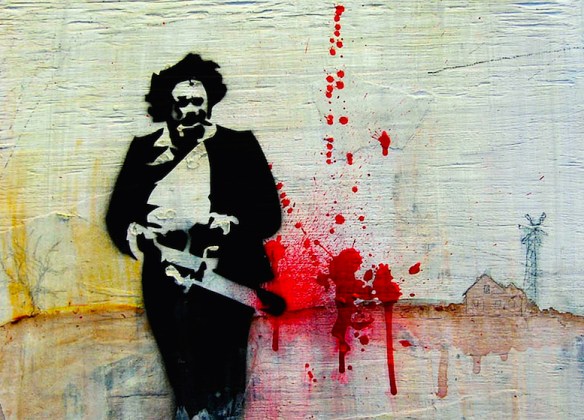
Steven cites too many splatter movies to cover in this review, but central to his thesis is the seminal 1974 Tobe Hooper film, The Texas Chain Saw Massacre. The death of local industry leads Leatherface and family to keep their slaughterhouse traditions alive by carving up and eating young people. These young people, Steven is quick to point out, are only here at all because they were unable to get gas for their car (thanks to the first of two 1970s oil crises). American decline is everywhere; betrayal by global economic forces are central to the trap that’s being laid by the cannibals. (Of course, the carnage of the Vietnam War can’t be overlooked here either, given the visual language of ambush, capture, and torture; Hooper himself has cited this in subsequent interviews.) Steven notes that the victims in The Texas Chain Saw Massacre are representative of a bourgeoisie who don’t know how the sausage is made. It’s important and vital, Steven says, that the cannibalistic side of splatter involves the bourgeoisie being forced to eat members of their own class. It’s Burroughs’s famous “naked lunch“: “the frozen moment when everyone sees what is at the end of every fork.”

As the neoliberal takeover of the world economy begins in earnest in the 1980s, as complex and largely ephemeral systems of mass media and finance take the place of the visceral, grinding monomania of industrial capitalism, splatter horror follows suit. Steven’s analysis of David Cronenberg’s Videodrome (1983) is especially sharp, examining the links between the body horror of the film and the Deleuzian body without organs. Max Renn’s body becomes an endlessly modular media node, able to accommodate video cassettes, to generate and fuse with phallic weapons (used to assassinate and destroy the media forces who’ve made him this way), to mesh and mold and mix with the hard plastic edges of media technology. By the end of the film, Renn is a weapon reprogrammed and re-trained on the very media-industrial complex that made him. More body horror: the cult classic Society (1989) and its shocking conclusion posits the ruling class as a cancerous monster, an amorphous leviathan straight out of a Gilded Age political cartoon, eating and fucking and vomiting, red in tooth and claw and pseudopod. Barriers between bodies break down; the system begins swallowing up all alternate possibilities.

By the time the Cold War is finished, the era of post-9/11 eternal war, of Abu Ghraib and Guantanamo, led to the popular new splatter sub-genre of “torture porn.” Steven identifies the genre’s distinguishing aesthetic feature: the indisputable, systematic, and worldwide victory of capitalism and the hypnotic Spectacle that accompanies it. In this era, there are no longer any alternatives. Everyone, rich and poor, is trapped in the system, and the system reintegrates torture into a worldwide video spectacle. This is embodied in both the global conspiracies of the wealthy in Roth’s Hostel series and in the Jigsaw Killer’s industrially-themed Rube Goldberg devices in the Saw franchise—devices of dismemberment explicitly linked to moral quandaries reminiscent of capitalism’s impossible everyday Hobson’s choices for the working class. The system will go on consuming you, whether you’re unlucky enough to be a splatter film’s victim, or “lucky” enough to wield the power to splatter (for example, Hostel: Part II‘s reversal of fate on the ultra-wealthy hunters, or the Jigsaw Killer’s death from cancer in Saw III—ultimately due to… a lack of health insurance).

Possibly the most intriguing aspect of this already very good book is Steven’s interspersing of personal anecdotes on when and where he discovered some of his favorite horror and genre films. By placing his personal and psychological experience of splatter films front and center, and linking it to his personal growth and increasing political maturity, he demonstrates the personal impact of the political, and the necessity of personal epiphany, mediated by culture, to achieve political awareness. Splatter Capital ultimately is not a book for the already-convinced and committed leftist, the Marxian thinker already well-versed in theory. (Another of Splatter Capital‘s very strong points is how Steven largely eschews jargon and obscurantism for an approachable tone and topic that laypeople can dive into easily.) It is for the fans of these films who’ve always wondered about the ineluctable appeal of visceral, shocking violence on screen, and perhaps why it all feels so strangely familiar.

George W. Bush and Barack Obama: Kings of Pain

Giggling Mass-Murderers

By Cindy Sheehan

Source: Cindy Sheehan’s Soapbox

The facts don’t lie.

Under the regimes of George W. Bush and Barack Obama, millions of civilians in places such as Iraq, Afghanistan, Libya, Syria, and Yemen have been slaughtered, wounded, displaced and made desperately ill with the effects of toxins such as depleted uranium: the “gift” that never ends, literally—it has a half-life of 4.5 billion years.

Now, “because Trump,” the image of George W. Bush has been rehabilitated and (if one can believe polls) now enjoys a 59% approval rating. He left office with ratings in the mid-20’s, which I thought were far too generous, at the time.

Since the imperial agenda of W. Bush murdered my son in Iraq on April 04, 2004, my personal grief has expanded to become global in nature and I can’t stomach any of this Bush-lite just because he has been critical of someone with whom his family has personal issues. Remember when Trump humiliated Jeb? Jeb, whom I believe was the next crown prince of the Bush Crime Family?

This is not a defense of Trump. I am sure given one or two full-terms, his regime will equal that of his predecessors in gore and pain, but he has a way to go if he wants to catch up with them. I also know, that when his term ends, whenever that is, whichever presidents are still alive will laugh it up with him, no matter what political points they seem to be scoring today.
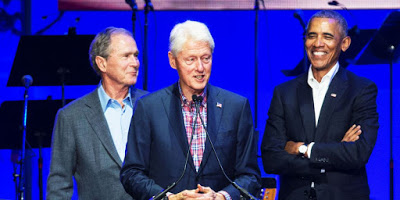
Recently, when The Five Former Presidents™ were on their “hurricane relief” tour (god help those poor people who have already been through so much), Bill Clinton was speaking with George and Barack standing behind him. George Bush apparently said something that “cracked” up Barack Obama. Of course, whenever one killer is making another laugh, the joke is usually on us. However, what disheartens me, is how many are raving about those two mass-murderers giggling just like 7th graders at a school assembly when so many are suffering because of their allegiance to empire.
Of course, the presidencies of Carter, Bush Sr. (perv and self-pro-claimed, “David Cop-a-Feel”) and Clinton (W. Bush destroyed Iraq, but Clinton “softened” it up with regular bombing raids and a decade of crippling sanctions that killed around 2 million) were blood-soaked, but Obama and W. Bush seem to radiate a certain kind of sleazy vibrancy.

To see these killers who have caused so much lingering pain have so much delightful fun (at taxpayer’s expense, by the way), is heartrending.

Even when I am at my happiest with my grandchildren and I feel my heart is filled with joy, it isn’t, quite. There is always a black hole of anguish that can never be filled. At any moment, without warning, I can be plunged back into despair, but, hey, at least The Five Former Presidents™ are still able to yuck it up and garner millions for speeches and public appearances. Who am I to deny all these war criminals a renewed lease on life?

They are not good humans and they ALL (yes even Carter) deserve to be incarcerated for life at The Hague, never to bother anyone again. Just because they all left office unfettered by shackles doesn’t mean they should be able to live long lives of peace and profit.

The people of the United States need to be deprogrammed from their cultish devotion to these mass-murderers: Absent incarceration in The Hague, they should be shunned and ridiculed at every opportunity.

I intend to make it my life’s work to hold them accountable.