For Purely Technical Reasons

peak-oil

By Dmitry Orlov

Source: Club Orlov

It is tempting for us to think that our technological choices—whether we choose to live in a city, a suburb or out in the country; whether we want to drive a pick-up truck, a gasoline-electric hybrid or ride a bicycle; whether we take a train, drive long distances or fly—are determined by our tastes. We may flatter ourselves that we are in control, and that our choices are reflective of our enlightened, environmentally conscious values. This view rests on a foundation of circular reasoning: we behave in enlightened ways because we are enlightened, and we are enlightened because, to wit, we behave in enlightened ways. As to why what we consider enlightened is in fact enlightened rather than a question of possibly questionable personal taste—that is not to be discussed: de gustibus non est disputandum.

But there is an alternative viewpoint, which seems more realistic in many ways, because it rests on a foundation of physical, technical specifics rather than fickle and arbitrary consumer preference, whim or taste. From this viewpoint, our technology and associated lifestyle choices are dictated by the technical requirements of their underlying technologies, both physical (the operation of the energy industry, the transportation industry, etc.) and political (the operation of political machines that segregate society by net worth and income, relegating wage-earners to a global disenfranchised underclass).

A few years ago I found out that I needed to replace the diesel engine on my boat (the old one blew up definitively) and looked at a number of options, one of which was to replace it with an electric motor and a large bank of batteries. The electric option was touted as being quiet, non-polluting, and having just enough range to get in and out of the marina and to get back to dock if the wind died during a typical daysail. It turned out to be more than twice as expensive as a replacement diesel engine. As to what one might do to take such a boat any great distance (that involves many hours of motoring) the solution is to… add a diesel engine hooked up to a very large alternator, at triple the cost of just replacing the diesel. And so I just replaced the diesel.

Diesel engines have a lot of positive qualities: they can run continuously for tens of thousands of hours; they can be rebuilt many times just by replacing the bearings, the cylinder sleeves, the piston rings and the valves; they are exceptionally reliable; the fuel they use is energy-dense. For these reasons, they are found throughout freight and construction industries and are used for small-scale power generation. They can be very large: the larger ships have engines that are as big as houses, with ladders welded to their cylinder walls, so that servicemen can climb down into them to service them after the cylinder head and the piston assembly are pulled out using an overhead shop crane. Small diesel engines make a lot less sense, and the silliest of them are the ones found on small yachts. There are many aspects of their design that make them silly, but there is also an overriding reason: they use the wrong fuel.

You see, diesel is a precious commodity, used in the transportation industry (by trucks, locomotives and ships), and in construction equipment, with no alternative that is feasible. A cousin of diesel fuel is jet fuel—another petroleum distillate—that is used to power jet engines, again, with no alternative that is feasible. And then there is a fuel that is only really useful as a small engine fuel: gasoline, that is. Gasoline engines beyond a certain size become much more trouble than they are worth.

Each barrel of crude oil can be distilled and refined into a certain amount of diesel and jet fuel, a certain amount of gasoline, some tar and some far less useful substances such as naphtha. The diesel is spoken for, because it literally moves the world; but if enough small engines cannot be found to burn all the gasoline that is produced, it becomes a waste product and has to be flared off at the oil refinery, at a loss. Indeed, prior to Henry Ford coming up with the brilliant plan to build cars cheap enough for his workers to afford, gasoline was dumped into rivers just to get rid of it, because while everyone burned kerosene (a distillate, like jet fuel and diesel) in lamps, cars remained playthings of the rich, and there simply wasn’t a market for any great quantities of gasoline.

Therefore, it became very important to find ways to sell gasoline, by finding enough uses for it, no matter how superfluous they happened to be. And although some people think that the private automobile is a symbol of luxury and freedom and feel the thrill of the open road, the reason they think that is because these ideas were implanted in their heads by the people who were tasked with finding a market for gasoline. Alongside cars, great effort was put into marketing all sorts of other small engines: for lawn mowers, jet skis, motorcycles, ATVs, boat outboard motors… The only semi-industrial use of gasoline is in chainsaws, small generators and air compressors, service and delivery vehicles, and outboard engines.

And so people were sold on the idea of driving their own car, whether they needed to or not, and spending lots of time stuck in traffic—all so that they would pay for gasoline. By causing all that excess traffic congestion, they also created the need to widen roads and highways, generating demand for another borderline useless petroleum product: road tar. And since there was a problem with cramming all these cars into cities (where cars are generally not needed if the cities are laid out using proper urban design, with sufficient numbers of tram, light rail and subway lines, etc.) the solution was to move everybody out to the suburbs. And so the reason half of the US population now lives in suburbia and drives has nothing to do with their needs, and everything to do with the need to sell them gasoline.

Some people may react negatively to the idea that their suburban castle and their magic chariot are all just part of a plan to make them spend much of their life paying for the right to dispose of toxic waste in unsafe ways. Rest assured, their preprogrammed negative reaction is part of the plan. Every effort has been made to program people to think that this waste disposal job—carried out at one’s own expense—is, in fact, something that should be considered a sign of success. The most efficient way to motivate a slave to perform is to convince him that he is free. To this end, driving is celebrated in music and film and portrayed as a way of life. Calling it what it is—being a slave to a machine—is bound to cause cognitive dissonance, all the more so because driving a lot destroys one’s mind: in the immortal words of a character from the movie Repo Man, ”The more you drive, the less intelligent you become.” In this respect, most of the people living in the US are far past the point of no return, and it is pointless to attempt to impart to them any ideas that are discordant with the dead-end lifestyle into which they have been unconsciously coerced.

Getting back to electric vehicles, such as what my boat would have ended up if I were gullible and made of money: they are obviously a defective idea. Their range is limited, they take longer to charge than it takes to fill a gas tank, and they use expensive and dangerous lithium-ion batteries that need periodic replacement. There is not enough lithium available to continue making batteries for laptops and smartphones (which periodically burst into flames), never mind providing for a giant expansion of battery-building to support lots of electric cars. Perhaps most importantly, they shrink the market for gasoline. So, what’s the reason behind the push?

It certainly isn’t part of any particular effort to electrify transportation in general, because no electric solution exists for ships or planes, and electrifying rail freight is an impossibly expensive proposition. It certainly isn’t part of an effort to cut greenhouse gas emissions, because most of the ways electricity is currently generated is by burning coal and natural gas—and will be, while supplies last, because electricity is hard to store, and no matter how many solar arrays and wind farms are installed something will be needed to power the electric grid on overcast, windless days.

No, the push for electric cars is motivated by a different sort of technology—political technology. You see, the oil age is drawing to a close. Last year the oil companies only discovered 1 barrel of oil for every 10 barrels they produced; at the turn of the century it was closer to 1 for every 4. At the same time, most of the easy-to-get-at oil has already been produced, and now it takes 1 barrel’s worth of energy to produce something like 10 barrels, whereas at the dawn of the age of oil it was closer to 1 for every 100 barrels. Such a low level of net energy production is turning out to be insufficient to maintain an industrial civilization, and as a result economic growth has largely stalled out. And although large investments in oil production have succeeded in keeping large volumes of oil flowing, for now, this is turning out to be an ineffective way to invest money, with many energy companies, once so profitable, now unable to pay the interest on their debt. And even though constant injections of free money are currently keeping developed economies from cratering into bankruptcy, it has been clear for some time that each additional dollar of debt produces significantly less than a dollar’s worth of economic growth. Growing debt within a growing economy can be very nice; but if the economy isn’t growing as fast, it’s fatal.

As the oil age winds down, personal transportation, in the form of the automobile, is bound to once again become a plaything of the very rich. But then, when it comes to electric cars, it already is! And I don’t mean Tesla: the most commonly used electric vehicle worldwide is the golf cart. And who uses golf carts? Members of golf clubs; guests at resorts; residents of posh gated communities; employees at corporate and academic campuses… And what do all these people have in common? They are all members of the salaried elite; they are definitely not members of the wage-earning class. To them, the electric car offers a way of preserving a semblance of the status quo for themselves while setting themselves apart (in their own minds) from all of the gasoline-burning riffraff. Let the great unwashed in the flyover states, with their pickup trucks complete with gun racks, burn what’s left of the gasoline while overdosing on synthetic opiates while the salaried elites and individuals of high net worth, ensconced in their campuses and gated communities, will create a different future for themselves, replete with wind turbines, solar panels and electric cars (until they all get shot by all those they have disenfranchised).

Hybrid Landscapes – From Posthistoric to Posthuman

spiritual-phenomena-other-dimensions

By Kingsley L. Dennis

Source: Reality Sandwich

The collective psyche seems to be in the grip of a powerful archetypal dynamic in which the long-alienated modern mind is breaking through, out of the contractions of its birth process, out of what Blake called its “mind-forg’d manacles,” to rediscover its intimate relationship with nature and the larger cosmos.
Richard Tarnas

Reality, it seems, has been deregulated, and nothing is business as usual anymore….as ancient mapmakers used to mark on the watery unknown, “Here be dragons”
Erik Davis

Here be dragons, indeed. Our human exploration is swinging through a momentum that includes knowledge of the finer forces at work within the cosmos, which includes how we experiment in our interactions with not only the environment but also our bodies. In this article I will explore these themes, looking at memes of meta-programming to post-body scenarios – all in the framework of a human search along the sacred path of understanding our very selves.

American writer Philip K. Dick is famous mostly for his science-fiction books that question the nature and validity of our reality-matrix. In “The Android and the Human,” a speech that Dick gave in the early 1970s, he spoke about this blurring of the boundaries between body and environment:

[O]ur environment, and I mean our man-made world of machines, artificial constructs, computers, electronic systems, interlinking homeostatic components – all of this is in fact beginning more and more to possess what the earnest psychologists fear the primitive sees in his environment: animation. In a very real sense our environment is becoming alive, or at least quasi-alive, and in ways specifically and fundamentally analogous to ourselves.1 

The human-body-environment is increasingly being reconfigured as a site for a new magical animism, as distinct from the previous archaic notion of animism. Writer-philosopher Erik Davis has referred to this as a sort of ‘techno-animism’ whereby we give life to our technologies based on our imaginations.2 This new configuration is no longer anymore about technologies and us, but rather our technological bodies that now inhabit our ‘techno-imaginal’ realm. The body is becoming back into vogue as a site for experience and experimentation, as a vessel that interacts, intercedes, and interprets the sacred-mystical reality-matrix that encloses us. As modern quantum science has now aptly demonstrated, we do not inhabit a subject-object type of us-and-it world.[1] All materiality is enmeshed within a quantum entangled universe, and our bodies are somatically communicating with this energy field simultaneously.

Much of the western spiritual (Gnostic) mystical practice is interpreted as a somatically felt experience. The body is the instrument that receives and grounds the experience, whether it be in terms of the ‘great flash’, ‘illuminating light’ or the ‘bodily rush.’ The body is the human instrument for attracting and centralizing (receiving, transcribing, and sometimes transferring) the developmental energy. There are many ‘bodies’ in spiritual-mystic traditions, including the etheric, the spiritual, the ecstatic, the subtle, the higher, and others, so that the purely physical-material body is recognized as the densest and least mobile of them all. As cultural historian Morris Berman has noted, the body in history has always been a site/sight of focus.3 It has helped define the experience of the Self/Other, the Outer/Inner, and to be a material vessel for the spiritual impulse. Our earlier ancestors, who exhibited more of an animist relationship to the world, saw less distinction between the physical body and its environment. The rise of the philosophy of dualism and the mind-body split, which was supported by the mechanistic worldview, saw our modern societies further strengthen the mind/body rift. This was publicly endorsed by Orthodox/organized religions that have been quick to spurn and even demonize the body. Many so-called ‘modern’ societies around the world have, at one time or another, attempted to suppress the power and expression of the human body. The body has always been a site for the convergence of power and control. Perhaps no one in recent times has done more to expose this body-power relationship than the work of French philosopher Michel Foucault.[2] Foucault has deconstructed, in the body of work that he refers to as a critical history of modernity, how the body has been fought over as a site of power. The physical body is a location of resistance against the establishment; it is a fixed place where an individual can be located, found, and held accountable. If we cannot escape from our bodies then, it seems, we are forever within the system. The body-in-system has always been taken to represent the form of something, as a socially tangible entity. We have bodies in terms of social institutions, such as the body politic, or the social body, the scientific body, the medical body, or the body of an organization, etc. The once sacred site of the body, which was the vessel for somatic spiritual experiences, has become the subject of control and suppression.

In Gnostic terms the body’s site of power has been referred to as those of the ‘sleepers’ and ‘wakers.’ The ‘sleepers’ being those whose conscious self has yet to break through the layers of the body’s social conditioning. The spiritual-somatic experience has been seen as a threat to hierarchical societies because it exists beyond their bounds of power. This is one reason why ecstatic experiences – whether through spiritual or other means – have been suppressed, outlawed, and discredited by religions and mainstream institutions alike. Ecstatic experiences that can break down human thinking patterns and conditioning structures are unnerving for institutions of social-political power. How can you control, regulate, and discipline a body/energy/experience that has no physical location? Such intangible forces, such as the power of baraka,[3] is positively infectious and beyond bounds. As Berman notes,

The goal of the Church (any church) is to obtain a monopoly on this vibratory experience, to channel it into its own symbol system, when the truth is that the somatic response is not the exclusive property of any given religious leader or particular set of symbols. 4 

The spiritual-occult renaissance of the 20th century strove to rejuvenate and strengthen the presence of the somatic experience. This intangible flow of spiritual blessing, grace, and power is also a resurging undercurrent in the sacred revival.

In more recent times there has been an increasing focus on what is termed the innate consciousness (of the body), and which has been revealed through such techniques as muscle testing. It is innate because it is inborn (born in and of the body), and it is instinctual. Somatic consciousness then is another word for our intuitive intelligence. As I discussed in a previous book,[4] many of those now being born into the world are displaying a stronger sense of intuitive intelligence. However, in our modern haste we have, in the words of French philosopher Bruno Latour, never really been modern at all since we continue to exist in an anthropological matrix where nature and culture cannot be neatly divided. As Latour points out, this matrix is composed of hybrids where natural/cultural, real/imagined, and subject/object merge. Moreover, this hybridity is being further enforced and coalesced through genetic engineering, implants, virtual reality, and NBIC sciences (Nanotechnology, Biotechnology, Information technology and Cognitive science). Latour is right in saying that humanity has never exited from what he refers to as our pre-modern ancestors’ world. We are, and always have been, a hybrid of body-mind-environment. Yet unlike Latour, I contest that we are modern – or rather we are past the post of post-modern, in how we are merging our lives into a new hybrid fusion.

Our ancestors made no such division between nature and society because their state of consciousness did not allow them to – they simply did not perceive it. However, the state of human consciousness today is far different in its capability and lucidity to perceive and acknowledge the relationship with our external world. Saying this, of course, in our development ‘to be modern’ we left behind the sacred component of perceiving just how entangled our reality truly is. Yet the succeeding ‘post-modern’ stage then worked on breaking down these ‘perceptions of containment.’ As William Irwin Thompson says,

The project of Modernism was to expel preindustrial magic and mysticism and stabilize consciousness in materialism, but the projects of postmodernism have broken down the walls that once contained us in a solidly materialistic and confidently middle class worldview. 5 

This breakdown has now moved into a more advanced stage with the advent of the internet and digital technologies. We have now entered what Thompson refers to as the ‘astral plane, a bardo realm, in which everything is out there at once, a technologized form of the collective unconscious…a place where the physical body is either dead or absent.’ 6

Thompson prefers to view this technologized-bardo realm, where the physical body is either dead or absent, not as post-modern but as postcivilization – or even posthistoric.7 We are in a new phase of planetary culture where we are no longer simply reacting to emerging technologies, but rather our evolving state of consciousness is drawing forth these new technologies. In other words, it is as if new technologies come into being in accordance with shifting states of human consciousness. Like a good magician, we are pulling new technological innovations out of the hat of our collective consciousness – archetypes into manifestation. Whereas modernity was about ‘coming to our senses’ in a rather conservative way, the posts we have passed now – whether they be modern, civilization, or historic – are about shifting beyond our senses. As one well-placed commentator put it,

The human being’s organism is producing a new complex of organs in response to such a need. In this age of the transcending of time and space, the complex of organs is concerned with the transcending of time and space. What ordinary people regard as sporadic and occasional bursts of telepathic or prophetic power are…nothing less than the first stirrings of these same organs.8 

As a new historical phase unfolds within the human species – as part of a shift toward a planetary civilization – it appears that new needs are pushing out – or birthing – novel organs or faculties within the human being.

This brings to mind the Richard Tarnas quote that headed up this article, where he stated that the once alienated (read ‘sacred’) mind is now breaking through, as if in a birth process, out of what Blake called its “mind-forg’d manacles,” to ‘rediscover its intimate relationship with nature and the larger cosmos.’ Note that Tarnas said ‘rediscover,’ suggesting it is a recovery, a revival, and not a new birth. The sacred revival of which I speak is literally carving out a new topography for itself.

Hybrid Landscapes

Our millennial era is still trying to decide how to define and view the physical biological body. At this stage the landscape is literally littered with a thousand voices, all howling ‘for the ancient heavenly connection to the starry dynamo in the machinery of night.[5] Some voices see the human body as a hindrance upon the evolutionary journey toward an immortal society that is destined for the stellar neighbourhood. Others view it as a field for experimentation; to tinker and adapt toward a genetically modified hybrid. There are still others who see the body as a site to blur the boundaries between the digital and physical worlds. And then there are those voices who view the biological body as undergoing its own intrinsic in-built modification, or upgrade, through a self-adapting nervous system, programmed by emerging DNA programs hitherto latent.

In the latter part of the 20th century we had a wave of trends that all converged upon the body-mind-spirit matrix. These streams included the physical (bodily) research fields of cybernetics, computer programming, and artificial intelligence. These streams then interwove with the mind-spirit tropes of psychedelic experimentation (LSD, peyote, etc), mystical philosophies (Gurdjieff, Castaneda, etc) and transcendental movements. You would literally need a whole book dedicated to this topic alone to even begin to make a credible dent into this yellow brick road bricolage of body-mind-spirit convergences. Just to give a slight taste from the tip of the iceberg I will ever so briefly mention how the computer metaphor gave rise to notions of programming – and meta-programming – the human body as a biocomputer. This image was reinforced by Dr. John C. Lilly’s bookProgramming and Metaprogramming in the Human Biocomputer that described some of his experiments on human consciousness and human-dolphin communication. Meta-programming became a core theme of the writings of Timothy Leary and Robert Anton Wilson who produced such works as Exo-Psychology: A Manual on the Use of the Human Nervous System According to the Instructions of the Manufacturers and Prometheus Rising respectively. Both these works discuss an eight-circuit model of consciousness that is part of a path in neurological evolution. Both authors, Leary especially, took it upon themselves to evolve a philosophy stating that the future evolution of human civilization was encoded in our DNA. Hence, the new sacred technology is our nervous system itself, and our DNA is already hard-wired for evolutionary mutation. Similarly, running through some of these streams were the ideas of Caucasian mystic G. I. Gurdjieff who spoke of the human being in terms of a ‘man-machine’ that was asleep to life and could be triggered into wakeful activation. Leary, as if in Gurdjieffian overtones, would call for humanity to ‘wake up, mutate, and ascend.’9 The new sacred magic had mutated into practices (rituals) to reprogram the apparatus that receives, according to the authors, our biofields as well as human consciousness; namely, DNA. Interestingly, recent advances in quantum biology have outlined how DNA emits biophotons that produces a coherent biological field that may be susceptible to impact and influence (read ‘reprogramming’ here).10[6]

Whether or not the new game in town was actively to epigenetically re-program the DNA through a fusion of transcendental and/or psychedelic practices, it was very much about work on oneself. Gurdjieff’s program of study – called The Fourth Way – was a kind of blend of Eastern dervish yoga with western scientism. As Gurdjieff famously proclaimed – Take the understanding of the East and the knowledge of the West and then seek. This blend of eastern understanding and western knowledge became known amongst its adherents simply as The Work. The western melting pot of sacred angst and survivalist spirituality saw an emergence of similar tropes such as E.J. Gold’s The Human Biological Machine as a Transformational Apparatus. The western playing field in the second half of the 20th century was open to the new Great Game – and it involved inner spaces and the body-mind matrix. Robert S. de Ropp aptly called it the Master Game in his book Master Game: Pathways to Higher Consciousness Beyond the Drug Experience. For a sense of what was bubbling up around this Master Game sacred revival, in the US especially, one needs to understand a history of the Esalen Institute, co-founded by Michael Murphy and Richard Price on the Californian shores.[7] An excellent, if exhaustive, study of the body-mind matrix based upon the fizzy, fired-up tropes of the time is Michael Murphy’s Future of the Body: Explorations into the Further Evolution of Human Nature. These explorations, however, were all based upon expanding and amplifying the potentials of our current human biological body-mind. That was before the computer trope really got going – and science-fiction became research grant.

The rise of the robots literally happened after the Dartmouth Summer Research Project on Artificial Intelligence (AI), in the summer of 1956, announced the beginning of the AI field. College campuses and defence departments suddenly began the earnest journey along the stony research road that finally spawned the controversial concept of consciousness upload. One of the more vocal supporters of this ‘mind-in-machine’ notion is robotics researcher Hans Moravec. Moravec, whose books include Mind Children and Robot, outlines a future where the human mind can be uploaded as a precursor to full artificial intelligence. Similarly, cognitive scientist Marvin Minksy (who was one of the 1956 gang who coined the AI field) espoused a philosophy that saw no fundamental difference between humans and machines – as put forward in such works as his Society of Mind. Artificial Intelligence is uncannily consistent with the Christian belief in resurrection and immortality – does this make AI research into a sacred, god-like enterprise? It does make us wonder. Historian of technology David F. Noble notes also that the AI project is imbued with its own trajectory of transcendence:

The thinking machine was not, then, an embodiment of what was specifically human, but of what was specifically divine about humans – the immortal mind…the immortal mind could evolve independently into ever higher forms of artificial life, reunited at last with its origin, the mind of God.11

Other streams have been quick to spring up around this fertile theme, including several futurist movements and their manifestos. These have included, but not limited to, the Upwingers (F. M. Esfandiary), Extropians, Transhumanists; and then later came the high-profile members that announced the Technological Singularity.

F.M. Esfandiary’s ‘Upwingers Manifesto’ (by now Esfandiary was known as FM-2030) announced in the 1970s our glorious moment in human evolution. According to their manifesto:

We UpWingers are resigned to nothing. We consider no human problems irreversible – no goals unattain-able. For the first time in history we have the ability, the resources, the genius to resolve ALL our age-old problems. Attain ALL our boldest visions.[8]

Similarly, in the 1980s Max Moore and Natasha Vita-More expounded on Extropian principles which later came to be formulated as: Perpetual Progress; Self-Transformation; Practical Optimism; Intelligent Technology; Self-Direction; and Rational Thinking. And for the Moores, Intelligent Technology meant ‘Applying science and technology creatively and courageously to transcend “natural” but harmful, confining qualities derived from our biological heritage, culture, and environment.’ [9] The Transhumanist movement is still going strong and is not definable to any one particular group, although Humanity Plus (H+) is one of its most recognized institutions. There are streams and sub-groups under the transhumanist umbrella, and yet they all share a similar goal in viewing the human condition as being open to transformation through the use of sophisticated technologies. In other words, the goal is to give humanity a technological upgrade to its current bodily and mental capacities.

From Gurdjieff’s ‘man-machine,’ to Moravec and Minsky, to Max and Natasha Vita-More and Ray Kurzweil, the list goes on. And recently we have had the call for a new speciation along the homo sapiens evolutionary line – into Homo evolutis. In their TED talk and subsequent book Homo Evolutis Juan Enriquez and Steve Gullans present how we have already gone through twenty-five speciation events before arriving at our current species. Enriquez and Gullans consider it an anomaly to think that no other humanoid will ever evolve; and so they ask the question – ‘what would the next human species look like?’ They say that ‘We are transitioning from a hominid that is conscious of its environment into one that drastically shapes its own evolution…We are entering a period of hypernatural evolution…Homo evolutis.’12 This brings us back again to Latour’s concept of the anthropological matrix where nature and culture is mixed together without clear boundaries. With the NBIC sciences of nanotechnology, biotechnology, information technology and cognitive science we are meshing our genetic and cultural DNA. We are 3-D printing buildings as well as human body parts. We are now as a species consciously and deliberately experimenting, shaping, and morphing our environments, as well as journeying and mapping our inner spaces. We are the inhabitants and psychonauts of hybrid landscapes. And yet why should all this be part of an observation on the sacred revival? Because this transmutation of the human condition is what we, as a sentient sapien species, have always been doing.

Our early ancestors were obsessed with the transmutation of the human body-mind as far back as 35,000 years ago. The existence of rock paintings of therianthropes (shape-shifting forms from human to animal) that date back 35,000 years are speculated to be the early origins of human religious traditions. The symbolic paintings and drawings on cave walls and traces of ancient rituals which appear throughout the Palaeolithic era display a ‘primitive’ people in touch with the unseen realm. They display a fascination with a creative world beyond that of the human reality-matrix. These numerous examples of sacred, ritualistic art show how early humans were communing with a transcendental realm which modern humans have never stopped attempting to access. Noted anthropologist David Lewis-Williams has built a theory which explains how the people of the Upper Palaeolithic era harnessed altered states of consciousness to fashion their society, and used such imagery as a means of establishing and defining social relationships.13 The rock art of shape-shifting therianthropes also suggests a ‘primitive’ spiritual belief in the human soul as being connected to that of an animal or another being. Here we have a clear indication of our early ancestors creating sacred ritual around the transmutation and transcending of the human body-mind matrix. And this, in a nutshell, is part of the wisdom stream of shamanism.

It appears then that the human body-mind matrix has always, since earliest known cultural records, been a site for practicing sacred transcendentalism not far off from current transhumanist notions. As a species ‘in-transmutation’ we are increasingly having out-of-body experiences that meld cosmic consciousness with cultural artefacts. From the published out-of-body flights of Robert Monroe[10] to the rise in channelled texts and audio, we have passed beyond our senses into a totally different multifaceted realm. We are not wanderers in an anthropological matrix but waves and particles in a holographic field where each flash and speck contains and reflects the whole. Enmeshed and entangled within this field-matrix we are akin to the famous Buddhist Indra’s Net analogy:

Far away in the heavenly abode of the great god Indra, there is a wonderful net that has been hung by some cunning artificer in such a manner that it stretches out infinitely in all directions. In accordance with the extravagant tastes of deities, the artificer has hung a single glittering jewel in each “eye” of the net, and since the net itself is infinite in all dimensions, the jewels are infinite in number. There hang the jewels, glittering like stars of the first magnitude, a wonderful sight to behold. If we now arbitrarily select one of these jewels for inspection and look closely at it, we will discover that in its polished surface there are reflected all the other jewels in the net, infinite in number. Not only that, but each of the jewels reflected in this one jewel is also reflecting all the other jewels, so that there is an infinite reflecting process occurring.14

We are also reflections of ourselves in other universes as our reality-matrix bends and curves throughout countless cosmic contortions. According to physicist Paul Davis we co-exist alongside countless billions of other universes ‘some almost identical to ours, others wildly different, inhabited by myriads or near carbon-copies of ourselves in a gigantic, multifoliate reality of parallel worlds.’15 We no longer know what it means to live in a dualistic subject/object type of world. Our dualistic prison walls have disintegrated around us like a simulacrum or, in more popular parlance, like a rebooting video game.

We have already passed the post into a posthistoric era. Almost everything is up for grabs, which makes this era one of spectacular possibilities as well as gravest dangers. It would appear to any off-world observer that we are in the midst of a western slipstream of creative nihilism that is creeping its way around the fringes of tech-geekism and apocryphal-apocalyptic mysticism that says Take Nothing for Granted! As the ancient mapmakers used to scribe over unknown watery territories, Here be dragons – and here indeed they be, like lounging lizards waiting to lick at our heels. These are adventurous times as we innovate with outer form, and forge ahead into the inner spaces of essence. These are the features that adorn the sacred – the multifaceted faces of the body-mind-nature matrix that weaves the cosmic with the social, and which collapses the wave of duality. Lifepass the post is where we experiment with ourselves, as a species, and as a vessel of consciousness. And this, if done in a right relationship within our reality-matrix, is at its core a sacred art. Our cultural canvas is a palimpsest upon which new fictions and artefacts are engraved. And these fictions are the channels through which the sacred revival is raising its head and smiling the seven rays of emanation.

1 Cited in Davis, Erik (1998) Techgnosis: myth, magic and mysticism in the age of information. New York, Three Rivers Press, p187

2 Davis, Erik (1998) Techgnosis: myth, magic and mysticism in the age of information. New York, Three Rivers Press

3 Berman, Morris (1990) Coming to Our Senses: Body and Spirit in the Hidden History of the West. New York, HarperCollins.

4 Berman, Morris (1990) Coming to Our Senses: Body and Spirit in the Hidden History of the West. New York, HarperCollins, p146

5 Thompson, William Irwin (1998) Coming Into Being: Artifacts and Texts in the Evolution of Consciousness. New York, St. Martin’s Griffin, p307

6 Thompson, William Irwin (1998) Coming Into Being: Artifacts and Texts in the Evolution of Consciousness. New York, St. Martin’s Griffin, p307

7 Thompson, William Irwin (1998) Coming Into Being: Artifacts and Texts in the Evolution of Consciousness. New York, St. Martin’s Griffin.

8 Shah, I. (1982) The Sufis. London: Octagon, p54

9 Leary, Timothy (1988) Info-Psychology. New Mexico, New Falcon Publications.

10 Ho, Mae-Wan (1998) The Rainbow and the Worm: The Physics of Organisms. Singapore, World Scientific.

11 Noble, David F. (1999) The Religion of Technology: The Divinity of Man and the Spirit of Invention. London, Penguin, p148-9

12 Enriquez, Juan and Gullans, Steve (2011) Homo Evolutis. TED Books – ebook only.

13 Lewis-Williams, David (2004) The Mind in the Cave: Consciousness and the Origins of Art. London, Thames & Hudson.

14Cited in Davis, Erik (1998) Techgnosis: myth, magic and mysticism in the age of information. New York, Three Rivers Press, p319

15 Cited in Thompson, William Irwin (1998) Coming Into Being: Artifacts and Texts in the Evolution of Consciousness. New York, St. Martin’s Griffin, p217        


[1] See Dawn of the Akashic Age: New Consciousness, Quantum Resonance, and the Future of the World by Ervin Laszlo and Kingsley L. Dennis

[2] See especially Michel Foucault’s Discipline and Punish.

[3] Baraka, a prominent concept in Islamic mysticism, refers to a flow of grace and spiritual power that can be transmitted.

[4] See The Phoenix Generation: A New Era of Connection, Compassion, and Consciousness

[5] Taken from part 1 of Allen Ginsberg’s poem Howl

[6] See also Dennis, Kingsley L. (2010) ‘Quantum Consciousness: Reconciling Science and Spirituality Toward Our Evolutionary Future(s)’, World Futures, 66: 7, 511 — 524

[7] See Esalen: America and the Religion of No Religion by Jeffrey J. Kripal

[8] http://transhumanism.org/index.php/WTA/more/upwingers/

[9] https://web.archive.org/web/20131015142449/http://extropy.org/principles.htm

Escapism as Spiritual Journey

mobile-marketing-coming-to-virtual-reality

By rahkyt

Source: Sacred Space in Time

People are racing to leave this world.

Seriously.

There are virtual reality worlds you can immerse yourself in, there are fantasy role-playing worlds too. One, you can put on a headset or stare at a screen to enjoy and the other you play on boards with pieces with your friends. Both, you can lose yourself in for hours out of the day.
Or, you can go the spiritual route.

Become a New Ager, a Wiccan, a Pagan or Luciferian and learn how to astral travel or experience OOBEs. You can visit the Fae or the Reptilian and Mantis peoples; you can communicate with Galactic Councils, you may even be a member of one! You can experience your past lives and leave this one behind, living in the energy streams and the cocoon of coalescing consciousness they call the Alternative Community.

Some People are doing what they can to leave this world behind. Or should I say, some aspects of it. To voluntarily give up your grounding in Gaia is a serious thing.

People say they’re alien, ain’t from here, feel alienated from other types of humans, feel closer to machines and dream of transhumanistic transformations to our world, where the virtual will become the real world and biomechanical implants are the norm rather than the exception.

All I’m saying, is be careful what you wish for. For real.

Allow your imagination to soar free for a while and envision the consequences of your leaving this world, and the people that you don’t like, behind. What checking out of the necessity of saving the world in favor of dreaming fantasies about a future world will mean.

The manifestation of whatever the active (yin) and passive (yang) states co-create will reflect these simultaneous forms of grounding and soaring, vibratory rates of simpatico energetically supporting and releasing souls into their destinies sans plan. Or, seemingly so, at least.

It all looks crazy from this vantage point. If you gotta go join your star family, peace and well being to you. Best of luck. But if you feel your destiny is here on earth, with us mere earthlings of all persuasions and potentialities, we welcome you to join the fight. The Light against the Dark. My name is Mark. Welcome.

Ah…if only it were so simple. But shades of grey reign, as the world seems to be headed down the track in the face of an oncoming freight train, carrying Nazis and Fascists, Epidemics and comet strikes, nuclear waste and dead ocean life.

Maybe the escapists have it right.

Well, whatever the case may be, the world is splitting in twain. Two groups, one seeking the spiritual flow, the other immersed in the world we know.

Which side do you come down on? Dreaming of bringing heaven to earth and making man into gods or getting ready for the Ascension and the New Rebirth? Is Jesus coming to get you? The Maitreya singing siren songs? Or does Deus ex Machina call, luring you down into computerized depths, never to return to the meat haven of Gaia’s bowels?

Whatever folks choose, is what they will experience. Guarantee it. So better choose right. Might not have another chance, past tonight.

Depicting Perpetual Crimes committed by Corporate Culture and its Mainstream Media

index-1-229x300

Russian Novels Combating Global Capitalist Nightmare

By Andre Vltchek

Source: Dissident Voice

Imagine Moscow being taken over by some international corporate cartel. By a monster which has its own factories and office buildings, security services, private prisons, re-education (‘training’) centers, and its obedient mass media outlets. Imagine that it also has detailed databases on almost everyone who really matters in the capital.

Imagine that human lives suddenly don’t matter. People are only expected to produce and consume; they become fully disposable.

Imagine that the once greatly educated Russia with its legendary artists and philosophers is gradually getting reduced to an unimaginably primitive level. Suddenly, there is US pop trash flying about everywhere, and the greatest entertainment for the masses comes from watching countless television ‘reality shows’, including those that graphically depict, candidly, how both men and women are shitting and pissing in the capital’s public toilets.

That’s what you get when reading a witty, provocative and thoroughly outrageous novel by Sergei Minaev, called R.A.B.; 521 pages of it!

In all his novels, including Soulless, The Telki, Media Sapiens and R.A.B., Minaev masterfully depicts the perpetual crimes committed by corporate culture and its mainstream media. Brutally and candidly he describes an apocalyptic society constructed on the soulless, merciless and murderous principles of the modern Western-style capitalist system.

In such a world, nothing is sacred anymore. The ‘elites’ are having great fun hunting on the outskirts of the city, not for some animals, but for homeless people living in abandoned pipelines (R.A.B.). A US mainstream television news channel, together with its local counterpart, manage to trigger a military conflict between Georgia and Russia, after hiring several combat helicopters and retired soldiers, killing real people, just in order to increase their ratings. And several terrorist attacks in Moscow are being paid for and staged by other big media conglomerates (Media Sapiens).

Minaev is not crying; he is definitely far from being a ‘bleeding heart’. He is tough and cynical. His characters are mostly ruthless super-yuppies from Moscow, go-getters, living a fast life, taking drugs, partying in luxury clubs, having sex literally with everything that moves (Soulless).

But they get burned, destroyed, brought to near suicide.

They have no ideology, no political views. They laugh at, they insult everything and everybody, but deep inside they are actually suffering from a horrible void, from emptiness. In those rare moments of honesty, they admit to each other and to themselves, that they are actually still longing for at least ‘something pure and decent’, uncorrupted by the global market-fundamentalist regime and its ‘values’ and ‘culture’.

*****

In R.A.B. Minaev goes much further. His yuppies (paradoxically, the mid and upper-level managers) start a rebellion against the system. They go on strike, march through the streets, and build barricades. They begin demanding social justice. They burn down their own offices.

They do it after their Russian toy-producing company (and other companies all over the city) gets swallowed by a US-based multi-national corporation, which immediately begins dismantling all social benefits, while injecting uncertainty and fear into the workplace. A multi-national also opens a horrid toy factory on the outskirts of Moscow, which then employs desperate immigrants from the Central Asian republics.

The privately-owned mass media outlets first confront the protesters, and then follow up with pro-corporate propaganda and in the end the corporate security services and the army. Many people disappear. Others are locked up in the offices and secret prisons of the corporations, and tortured. Those who survive become ‘unemployable’, their names permanently on the blacklist.

But what does Minaev really call for? Is it a true revolution?

Yes and no. He does not believe that in the countries that have been conquered by market fundamentalism and by unbridled consumerism, a ‘real revolution’ is possible. He does not think that the people there have any ideals or any zeal left. At the same time, at least some of his characters are clearly unwilling to surrender.

It is chilling to read R.A.B. while at the same time those ‘rebellions’ in Greece, France, Spain and the U.K. are taking place.

One of the main characters of R.A.B. confronts the demonstrators: It is not a revolution! You are all parts of the system. You just want a better deal for yourself. Through this rebellion, you are actually negotiating with the cartel of the corporations. If you get what you are asking for, you’ll happily remain where you are and carry on as if nothing happened.

*****

Then Minaev does exactly what no Western writer would dare to do. He begins to argue that to destroy the system, there has to be an armed struggle. Otherwise no real change could ever be achieved.

The suppressed rebellion of the yuppies eventually triggers much a wider movement, and soon there are real battles raging in several provincial capitals.

The end of the novel is open. The main character of R.A.B. is destroyed. He loses the love of his life (in desperation she commits suicide); he has no job, no money and no place to go. But he is still alive. Russia is still alive. It is obvious that no matter what, it will never accept this monstrous system that was forced on it by the West.

*****

It all may sound like an insane fantasy, but. in fact, what Minaev writes about is not too far from the nightmares that Russia was descending into right after Gorbachev allowed the country (USSR) to fall apart, and then Yeltsin introduced unbridled privatization and gave unprecedented concessions to foreign corporations. During that period, Russia went through something that could be easily described as a social genocide. Life expectancy dropped to the levels of war-torn countries in Africa. Lawlessness ruled. All ideals were ridiculed and spat at. A big number of Russian intellectuals were bought and organized by the West into countless NGO’s. The lowest grade of Western pop and entertainment torpedoed Russian culture. During those dark days, the West finally succeeded in bringing Russia to its knees.

Not even two decades later, a new Russia is once again proud, strong and confident.

It rose to its feet, it began successfully producing again, and it underwent a tremendous and positive social transformation.

Just one week ago I returned from the Russian Far East, from the cities of Vladivostok, Khabarovsk and Petropavlovsk Kamchatski. Wherever I went, I witnessed new and impressive infrastructure. I encountered a confident, hard working nation, which was working hard to restore at least some of the socialist structures and benefits that it used to enjoy in the past.

The new, present-day Russia is much closer to China; much more impressed by the Chinese system, than by what it was forced to adopt in the past; during the “pro-Western era” which is now generally considered to be synonymous to a national disaster.

Russian writers played an important role in describing the horrors of the Gorbachev/Yeltsin years, and of the brutal global economic, political and ‘cultural’ regime injected by the West to all the corners of the Planet. From an outrageous Eduard Limonov’s novel It’s Me, Eddie to Minaev’s R.A.B., Russian literature has been daring, insulting, direct and brutally honest.

While Limonov and Minaev sell millions of copies of their books at home, their work is virtually unknown in the West. I found no English translations when searching on Amazon.com, and elsewhere.

In his New York-based Eddie, Limonov is calling openly for terrorist acts against the Western regime, while some of Minaev’s characters also believe in an armed struggle, although of a more conventional type.

Nothing is spared. When the US toy-producing corporation demands a special tax from its employees in Russia, for “helping out those poor children in the Third World”, the main character of R.A.B. thinks: “well, they can now use that money to buy coffins for children they employ and kill in Indonesia or Thailand”. When the tax goes slightly up, he comments: “now they will have enough funds to dig at least a few mass graves”.

All this is simply too outrageous for Western readers. Or more precisely, the ‘book business’ most likely ‘thinks’ that it is.

The fact remains that despite what is constantly repeated by Western propaganda, those who read Russian can clearly see and appreciate that Russian literature is actually much more free, daring and rebellious than its counterpart in the West.

When several Russian bestselling novelists are calling openly for combat against the global regime (the same regime which is, until now, at least partially, controlling the economy of their country), one has no choice but to be impressed by the level of freedom in the country which allows such work to be published and then promoted.

But in the West, you would never know all this, unless you spoke Russian. It is because in the West (and in its ‘client’ states and colonies) you are being extremely well ‘protected’ from such uncomfortable (and the regime would even say ‘dangerous’) thoughts!


André Vltchek is a novelist, filmmaker, and investigative journalist. He has covered wars and conflicts in dozens of countries. His latest book is Exposing Lies of the Empire.

The world wide cage

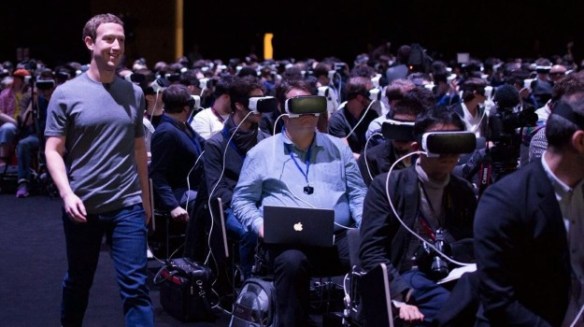
zuckerberg_VR_people-625x350

Technology promised to set us free. Instead it has trained us to withdraw from the world into distraction and dependency

By Nicholas Carr

Source: Aeon

It was a scene out of an Ambien nightmare: a jackal with the face of Mark Zuckerberg stood over a freshly killed zebra, gnawing at the animal’s innards. But I was not asleep. The vision arrived midday, triggered by the Facebook founder’s announcement – in spring 2011 – that ‘The only meat I’m eating is from animals I’ve killed myself.’ Zuckerberg had begun his new ‘personal challenge’, he told Fortune magazine, by boiling a lobster alive. Then he dispatched a chicken. Continuing up the food chain, he offed a pig and slit a goat’s throat. On a hunting expedition, he reportedly put a bullet in a bison. He was ‘learning a lot’, he said, ‘about sustainable living’.

I managed to delete the image of the jackal-man from my memory. What I couldn’t shake was a sense that in the young entrepreneur’s latest pastime lay a metaphor awaiting explication. If only I could bring it into focus, piece its parts together, I might gain what I had long sought: a deeper understanding of the strange times in which we live.

What did the predacious Zuckerberg represent? What meaning might the lobster’s reddened claw hold? And what of that bison, surely the most symbolically resonant of American fauna? I was on to something. At the least, I figured, I’d be able to squeeze a decent blog post out of the story.

The post never got written, but many others did. I’d taken up blogging early in 2005, just as it seemed everyone was talking about ‘the blogosphere’. I’d discovered, after a little digging on the domain registrar GoDaddy, that ‘roughtype.com’ was still available (an uncharacteristic oversight by pornographers), so I called my blog Rough Type. The name seemed to fit the provisional, serve-it-raw quality of online writing at the time.

Blogging has since been subsumed into journalism – it’s lost its personality – but back then it did feel like something new in the world, a literary frontier. The collectivist claptrap about ‘conversational media’ and ‘hive minds’ that came to surround the blogosphere missed the point. Blogs were crankily personal productions. They were diaries written in public, running commentaries on whatever the writer happened to be reading or watching or thinking about at the moment. As Andrew Sullivan, one of the form’s pioneers, put it: ‘You just say what the hell you want.’ The style suited the jitteriness of the web, that needy, oceanic churning. A blog was critical impressionism, or impressionistic criticism, and it had the immediacy of an argument in a bar. You hit the Publish button, and your post was out there on the world wide web, for everyone to see.

Or to ignore. Rough Type’s early readership was trifling, which, in retrospect, was a blessing. I started blogging without knowing what the hell I wanted to say. I was a mumbler in a loud bazaar. Then, in the summer of 2005, Web 2.0 arrived. The commercial internet, comatose since the dot-com crash of 2000, was up on its feet, wide-eyed and hungry. Sites such as MySpace, Flickr, LinkedIn and the recently launched Facebook were pulling money back into Silicon Valley. Nerds were getting rich again. But the fledgling social networks, together with the rapidly inflating blogosphere and the endlessly discussed Wikipedia, seemed to herald something bigger than another gold rush. They were, if you could trust the hype, the vanguard of a democratic revolution in media and communication – a revolution that would change society forever. A new age was dawning, with a sunrise worthy of the Hudson River School.

Rough Type had its subject.

The greatest of the United States’ homegrown religions – greater than Jehovah’s Witnesses, greater than the Church of Jesus Christ of Latter-Day Saints, greater even than Scientology – is the religion of technology. John Adolphus Etzler, a Pittsburgher, sounded the trumpet in his testament The Paradise Within the Reach of All Men (1833). By fulfilling its ‘mechanical purposes’, he wrote, the US would turn itself into a new Eden, a ‘state of superabundance’ where ‘there will be a continual feast, parties of pleasures, novelties, delights and instructive occupations’, not to mention ‘vegetables of infinite variety and appearance’.

Similar predictions proliferated throughout the 19th and 20th centuries, and in their visions of ‘technological majesty’, as the critic and historian Perry Miller wrote, we find the true American sublime. We might blow kisses to agrarians such as Jefferson and tree-huggers such as Thoreau, but we put our faith in Edison and Ford, Gates and Zuckerberg. It is the technologists who shall lead us.

Cyberspace, with its disembodied voices and ethereal avatars, seemed mystical from the start, its unearthly vastness a receptacle for the spiritual yearnings and tropes of the US. ‘What better way,’ wrote the philosopher Michael Heim in ‘The Erotic Ontology of Cyberspace’ (1991), ‘to emulate God’s knowledge than to generate a virtual world constituted by bits of information?’ In 1999, the year Google moved from a Menlo Park garage to a Palo Alto office, the Yale computer scientist David Gelernter wrote a manifesto predicting ‘the second coming of the computer’, replete with gauzy images of ‘cyberbodies drift[ing] in the computational cosmos’ and ‘beautifully laid-out collections of information, like immaculate giant gardens’.

The millenarian rhetoric swelled with the arrival of Web 2.0. ‘Behold,’ proclaimed Wired in an August 2005 cover story: we are entering a ‘new world’, powered not by God’s grace but by the web’s ‘electricity of participation’. It would be a paradise of our own making, ‘manufactured by users’. History’s databases would be erased, humankind rebooted. ‘You and I are alive at this moment.’

The revelation continues to this day, the technological paradise forever glittering on the horizon. Even money men have taken sidelines in starry-eyed futurism. In 2014, the venture capitalist Marc Andreessen sent out a rhapsodic series of tweets – he called it a ‘tweetstorm’ – announcing that computers and robots were about to liberate us all from ‘physical need constraints’. Echoing Etzler (and Karl Marx), he declared that ‘for the first time in history’ humankind would be able to express its full and true nature: ‘we will be whoever we want to be.’ And: ‘The main fields of human endeavour will be culture, arts, sciences, creativity, philosophy, experimentation, exploration, adventure.’ The only thing he left out was the vegetables.

Such prophesies might be dismissed as the prattle of overindulged rich guys, but for one thing: they’ve shaped public opinion. By spreading a utopian view of technology, a view that defines progress as essentially technological, they’ve encouraged people to switch off their critical faculties and give Silicon Valley entrepreneurs and financiers free rein in remaking culture to fit their commercial interests. If, after all, the technologists are creating a world of superabundance, a world without work or want, their interests must be indistinguishable from society’s. To stand in their way, or even to question their motives and tactics, would be self-defeating. It would serve only to delay the wonderful inevitable.

The Silicon Valley line has been given an academic imprimatur by theorists from universities and think tanks. Intellectuals spanning the political spectrum, from Randian right to Marxian left, have portrayed the computer network as a technology of emancipation. The virtual world, they argue, provides an escape from repressive social, corporate and governmental constraints; it frees people to exercise their volition and creativity unfettered, whether as entrepreneurs seeking riches in the marketplace or as volunteers engaged in ‘social production’ outside the marketplace. As the Harvard law professor Yochai Benkler wrote in his influential book The Wealth of Networks (2006):

This new freedom holds great practical promise: as a dimension of individual freedom; as a platform for better democratic participation; as a medium to foster a more critical and self-reflective culture; and, in an increasingly information-dependent global economy, as a mechanism to achieve improvements in human development everywhere.

Calling it a revolution, he said, is no exaggeration.

Benkler and his cohort had good intentions, but their assumptions were bad. They put too much stock in the early history of the web, when the system’s commercial and social structures were inchoate, its users a skewed sample of the population. They failed to appreciate how the network would funnel the energies of the people into a centrally administered, tightly monitored information system organised to enrich a small group of businesses and their owners.

The network would indeed generate a lot of wealth, but it would be wealth of the Adam Smith sort – and it would be concentrated in a few hands, not widely spread. The culture that emerged on the network, and that now extends deep into our lives and psyches, is characterised by frenetic production and consumption – smartphones have made media machines of us all – but little real empowerment and even less reflectiveness. It’s a culture of distraction and dependency. That’s not to deny the benefits of having easy access to an efficient, universal system of information exchange. It is to deny the mythology that shrouds the system. And it is to deny the assumption that the system, in order to provide its benefits, had to take its present form.

Late in his life, the economist John Kenneth Galbraith coined the term ‘innocent fraud’. He used it to describe a lie or a half-truth that, because it suits the needs or views of those in power, is presented as fact. After much repetition, the fiction becomes common wisdom. ‘It is innocent because most who employ it are without conscious guilt,’ Galbraith wrote in 1999. ‘It is fraud because it is quietly in the service of special interest.’ The idea of the computer network as an engine of liberation is an innocent fraud.

I love a good gizmo. When, as a teenager, I sat down at a computer for the first time – a bulging, monochromatic terminal connected to a two-ton mainframe processor – I was wonderstruck. As soon as affordable PCs came along, I surrounded myself with beige boxes, floppy disks and what used to be called ‘peripherals’. A computer, I found, was a tool of many uses but also a puzzle of many mysteries. The more time you spent figuring out how it worked, learning its language and logic, probing its limits, the more possibilities it opened. Like the best of tools, it invited and rewarded curiosity. And it was fun, head crashes and fatal errors notwithstanding.

In the early 1990s, I launched a browser for the first time and watched the gates of the web open. I was enthralled – so much territory, so few rules. But it didn’t take long for the carpetbaggers to arrive. The territory began to be subdivided, strip-malled and, as the monetary value of its data banks grew, strip-mined. My excitement remained, but it was tempered by wariness. I sensed that foreign agents were slipping into my computer through its connection to the web. What had been a tool under my own control was morphing into a medium under the control of others. The computer screen was becoming, as all mass media tend to become, an environment, a surrounding, an enclosure, at worst a cage. It seemed clear that those who controlled the omnipresent screen would, if given their way, control culture as well.

‘Computing is not about computers any more,’ wrote Nicholas Negroponte of the Massachusetts Institute of Technology in his bestseller Being Digital (1995). ‘It is about living.’ By the turn of the century, Silicon Valley was selling more than gadgets and software: it was selling an ideology. The creed was set in the tradition of US techno-utopianism, but with a digital twist. The Valley-ites were fierce materialists – what couldn’t be measured had no meaning – yet they loathed materiality. In their view, the problems of the world, from inefficiency and inequality to morbidity and mortality, emanated from the world’s physicality, from its embodiment in torpid, inflexible, decaying stuff. The panacea was virtuality – the reinvention and redemption of society in computer code. They would build us a new Eden not from atoms but from bits. All that is solid would melt into their network. We were expected to be grateful and, for the most part, we were.

Our craving for regeneration through virtuality is the latest expression of what Susan Sontag in On Photography (1977) described as ‘the American impatience with reality, the taste for activities whose instrumentality is a machine’. What we’ve always found hard to abide is that the world follows a script we didn’t write. We look to technology not only to manipulate nature but to possess it, to package it as a product that can be consumed by pressing a light switch or a gas pedal or a shutter button. We yearn to reprogram existence, and with the computer we have the best means yet. We would like to see this project as heroic, as a rebellion against the tyranny of an alien power. But it’s not that at all. It’s a project born of anxiety. Behind it lies a dread that the messy, atomic world will rebel against us. What Silicon Valley sells and we buy is not transcendence but withdrawal. The screen provides a refuge, a mediated world that is more predictable, more tractable, and above all safer than the recalcitrant world of things. We flock to the virtual because the real demands too much of us.

‘You and I are alive at this moment.’ That Wired story – under headline ‘We Are the Web’ – nagged at me as the excitement over the rebirth of the internet intensified through the fall of 2005. The article was an irritant but also an inspiration. During the first weekend of October, I sat at my Power Mac G5 and hacked out a response. On Monday morning, I posted the result on Rough Type – a short essay under the portentous title ‘The Amorality of Web 2.0’. To my surprise (and, I admit, delight), bloggers swarmed around the piece like phagocytes. Within days, it had been viewed by thousands and had sprouted a tail of comments.

So began my argument with – what should I call it? There are so many choices: the digital age, the information age, the internet age, the computer age, the connected age, the Google age, the emoji age, the cloud age, the smartphone age, the data age, the Facebook age, the robot age, the posthuman age. The more names we pin on it, the more vaporous it seems. If nothing else, it is an age geared to the talents of the brand manager. I’ll just call it Now.

It was through my argument with Now, an argument that has now careered through more than a thousand blog posts, that I arrived at my own revelation, if only a modest, terrestrial one. What I want from technology is not a new world. What I want from technology are tools for exploring and enjoying the world that is – the world that comes to us thick with ‘things counter, original, spare, strange’, as Gerard Manley Hopkins once described it. We might all live in Silicon Valley now, but we can still act and think as exiles. We can still aspire to be what Seamus Heaney, in his poem ‘Exposure’, called inner émigrés.

A dead bison. A billionaire with a gun. I guess the symbolism was pretty obvious all along.

Saturday Matinee: VR Short Double Feature

“Uncanny Valley” (2015, dir. Federico Heller) uses a documentary format and virtual reality scenarios to depict a frightening world in which damaged individuals rely on VR as a means to escape their depressing social reality while being used by the state.

“Hyper-Reality” (2016, dir. Keiichi Matsuda) depicts an average day in the life of a struggling precariat woman, that is, until she’s gang stalked by virtual and physical predators.

Pokémon and the Age of Augmented Hyper-Surreality

maxresdefault

By Luther Blissett

Imagine walking to a park in a fairly average medium-sized city on a warm Summer day. There you see groups, pairs and individuals of different ages and races slowly milling about, some with dogs, some with baby carriages. Approaching closer, you realize nearly everyone in the park other than yourself is staring intently at their phone, occasionally tapping and swiping the screen. It seems odd, though not completely out of the ordinary in this day and age. Then, off in the distance at the far end of the park, someone shouts what sounds like a word in an alien language or dialect triggering a crowd to rapidly swarm towards the general area; most speed-walking or jogging but all aiming their phones at the same destination. Soon everyone in the vicinity of the park (except yourself a few vagrants and junkies of a less tech-savvy sort) surges towards the center of the swarm of over a hundred participants as if sucked into a vortex. As quickly as it started, the crowd disperses and an “normalcy” resumes, albeit temporarily since the pattern repeats continuously at half hour to one hour intervals throughout different areas of the park.

This dream-like scenario is an outsider’s description of a Pokémon Go session on a typical Summer weekend at Bellevue Downtown Park. The crowd might have been slightly larger than usual due to the balmy weather, but numerous videos posted on YouTube indicate such occurrences aren’t completely anomalous.

An example:

Still, the relative newness and novelty of the experience doesn’t make it feel any less like being in a dystopian narrative such as a Philip K. Dick novel or an episode of Charlie Brooker’s “Black Mirror”. However, the sense of social displacement and alienation for non-gamers is dampened by nearly a decade of collective exposure to increasingly advanced internet-enabled cellphones whose ubiquity and usage has steadily increased over the years.

Prior to the release of Pokémon Go more people have been spending increasing hours using smartphones for talking, texting, email, news, entertainment and social media, selfies, etc. In the context of modern industrial society it’s almost an aberration to be without a device, or to not be heavily reliant on one. What sets Pokémon Go apart is its ability to simulate a fusion of material and virtual worlds by depicting through phone screens digital sprites superimposed on real-time images of physical environments to its users.

Just as shamans would use entheogens to peer behind the veil of reality, augmented reality allows users to perceive additional veils over reality. This is not necessarily a bad thing because there’s potential for “digital veils” to assist us in seeing what certain interests might prefer to keep hidden. For example, what if everyone could literally see the interests orchestrating a politician’s rise to power? What if we could walk into any store and instantly know which products were made by war-profiteers, polluters, and/or sweatshop owners? Would people want to know? How much of an impact would it have on decisions and actions in the context of a media environment inundated with heavily financed government/corporate PR and marketing? Of course, even without augmented reality the virtual realm affects the “real world”, most notably with the economic dominance of the tech industry as well as the social, political and economic havoc wreaked by hackers; but rarely is such influence immediately manifested as when crowds swarm newly spawned Pokémon sprites.

In many ways, Pokémon Go was the ideal vehicle to bring augmented reality to the masses. Many apps have utilized it for different purposes such as navigating, translating, finding dates, viewing celestial objects, narrating self-guided tours, weather forecasting, image enhancement, etc., but only Pokémon was able to use the technology to bring a fictional universe closer to life by creating a cross-generational craze. Alfie Brown of ROAR Magazine, characterized virtual Pokémon as the perfect example of what Jacques Lacan called the objet petit a, a fetishized yet ephemeral and unobtainable object of desire, a key concept behind consumerist neoliberalism’s push towards cheap, chronically obsolete, ephemeral and now digital goods and services.

But what makes Pokémon creatures so desirable? In regard to children, they seem naturally drawn towards cute and brightly colored cartoon characters. The mechanics of the game taps into natural tendencies to collect things and to display one’s collection to others (a phenomenon South Park astutely critiqued on episodes lampooning World of Warcraft and “freemiums”). In consumer societies children and adults are prone to feeling prestige and power from the size and perceived value of their collections; however, children are mostly limited in terms of the acquisitive power: video games elicit a rare opportunity to gain more prestige and power than adults have in real life.

As for older folks, there’s a variety of additional interconnected factors. For teens and young adults, peer pressure alone might be enough to hook some people, but the mainstreaming of geek culture no doubt plays a part, making fandom, quirkiness and technological obsession more accepted and valued. The transition to adulthood also happens to be a time when there’s increased pressure to establish one’s sense of identity, become more independent and to succeed academically and professionally. Games are a means of escape from such pressures (as real life opportunities for economic advancement continue to dwindle) while at the same time functioning as structured activities for social interaction and, more broadly, to build communities. For adults, reasons may include all of those previously mentioned in addition to fascination with technology, bonding with younger friends and family, the feeling of being part of a global phenomena, or nostalgia for the original Pokémon games, for example.

Returning to Pokémon Go’s more dystopian aspects, the game has been used as a tool by the unscrupulous for crimes such as robbery and sexual assault. Though crowds created by Pokémon Go spawning areas or “gyms” (locations where players battle each other in teams to increase their avatars’ abilities) have been a benefit to some local businesses, residential neighbors in some cases view game players as unwanted loiterers invading their privacy. There have also been news reports of video game battles escalating to physical brawls and innocent gamers being racially profiled as suspicious threats.

As with most online tools, there’s a risk of the app and users being exploited for surveillance, social control, to extract money and personal data, etc. Modern media literacy requires an understanding of how businesses benefit from our use of game and service apps (especially “free” ones) and how intentional or unknowing misuse of collected data could serve government/corporate/criminal interests. Augmented reality games are an exciting new media with potential to be used in novel and fun ways, but we should be vigilant of its potential to influence beliefs as well as decisions regarding how we spend time and resources.

Pokémon Go is at the forefront of the increasing power of tech companies such as Google and Niantic (the software developer behind Pokémon Go) to control and use information to manipulate the masses. Such power in itself is disturbing, but more sensational examples might include news reports of car accidents caused by drivers mindlessly following Google Maps off the road or colliding into other cars while playing Pokémon Go. Such cases may seem absurd but they prompt a number of important questions. Why do some prioritize and trust mediated information over their own senses? As online personas increase in perceived importance, at what lengths will people go to sustain it and would it be at the expense of others things (such as personal safety)? Are we becoming addicted to cognitive “skinner boxes” with our needs perpetually triggered and gratified by apps? In an increasingly hyperreal world in which the boundary between the real and virtual becomes more permeable, what new hazards await?

The Lid is Off

tumblr_lsjs8cqofc1qanyg8

By Charles Eisenstein

Source: CharlesEisenstein.net

It is getting harder to keep a secret these days. The collective shadow of our society, once safely relegated to the dark basement of the unmentionable, is now exposed to daylight, forcing us to face our contradictions. I’ll offer three examples: Donald Trump’s leaked recordings, Hillary Clinton’s emails and Wall Street speeches, and the endless procession of videos of police brutality.

Once upon a time, “locker room talk” like Donald Trump’s lewd and degrading remarks leaked to the media would have stayed safely sequestered from public view. Misogynistic locker room banter existed, as it were, in an alternate universe. What was said on the golf course or the barroom didn’t register as part of a man’s public reputation; in those places, men were free to say things that would be unforgivable in public. The coexistence of these two realms was seldom questioned. As a high school and college athlete, I remember hearing the kinds of things Trump has said, and they were quite unremarkable in that context. A boy could say the most brutish, repellent things in the locker room without damage to his reputation outside it. Respectable society would never find out. Likewise, when reporters and politicians mingled outside the public performances of their roles, an unwritten understanding kept their conversations safely off the record. I imagine Donald Trump feeling a sense of betrayal at the revelation of his remarks, as if a boy reported to another boy’s girlfriend what he said about her in the locker room.

I think this division into two realms extended to internal, psychological divisions in the individuals making the degrading boasts and comments about women. In polite company, they became people who did not harbor such thoughts. The locker room alter-ego was safely contained in a different psychic compartment. I can imagine a Donald Trump being sincerely – sincerely! – scandalized to hear in polite company the very things he himself said in the safety of the mens’-only field of misogyny. I can imagine him condemning what was said in all earnestness, with zero awareness of hypocrisy.

So it is that rape culture is allowed to persist. It needs a shadow zone. The locker room conversations that objectify and degrade women and contribute to rape culture need a “locker room” in which to happen, a wall of separation between it and the larger realm of general social acceptability.

This wall of separation is breaking down, thanks in large part to the ubiquity of recording technology and the impossibility of stopping the distribution of the recordings on the Internet. Contradictions, whether personal or social, that could once remain hidden are coming unstoppably to light. It is getting harder to uphold a divided self.

As with sex, so with money. Hillary Clinton is having a hard time maintaining a wall of separation between her public posture of economic populism and her decades-long ministration to the needs of Wall Street. In former times a politician’s speeches to elite insiders would exist in an inviolably separate realm from his or her public image. In inside circles of power, the politician would be free to express himself directly. No concealment of his allegiances was necessary, because no one outside the political and corporate elite was listening. So of course, Hillary Clinton was loathe to release the transcripts of her speeches to Wall Street banks. Those speeches were the equivalent of locker room talk, which is supposed to stay in the locker room. Here, though, the context is financial domination rather than sexual domination.

Something similar applies to Clinton’s infamous deleted emails. There is nothing new about the contrast between the public presentation of governance and its ugly inner workings. The exercise of political power has never been pretty. The backroom deals, the threats and coercion, the buying of favors… all the nastiness that the email scandal hints at is characteristic of politics as we know it. The difference today is that it can no longer be confined to the back room. In other words, it is getting harder to maintain the appearance of democracy in a reality of oligopoly.

It is perhaps necessary that Clinton and Trump are both such extreme expressions of the suppressed shadow of our culture, presenting itself in unambiguous form for clearing. Liberal pundits have repeatedly observed that the bigoted sentiments Donald Trump expresses are merely the undisguised version of what Republicans have been saying in code for a long time. The hidden erupts into view. Clinton, meanwhile, is no ordinary establishment politician; she is the very epitome of the establishment, embodying its insincerity, lack of imagination, normalized corruption, and narrow technocratic commitment to preserving the status quo.

This is not meant as a personal criticism. My purpose here is not to condemn Hillary or the Donald; it is to illuminate the dissolving of the insulating compartments that allow contradictions and hypocrisy to exist. Probably in person, each of them is a complex individual like you and me, a mixture of beauty and pain, playing the roles laid out for them. I imagine that in their most private moments neither fully identifies with those roles nor believes in the game into which they have been thrust, any more than you or I believe in it. The elites usually precede the people into cynicism. In any event, our current moment of social evolution is calling each of them, in their public roles, to be an avatar of a cultural shadow archetype, presented to us in extreme form so that it cannot be ignored.

Clinton and Trump are a product of their conditions, playing the “game of thrones” according to the secret rules of the insiders, in a system that has long allowed, encouraged, and in some ways nearly required hypocrisy. That system is coming to an end. We are entering by fits and starts an era of transparency in which, we may someday hope, secret rules and hypocrisy will have no purchase.

Another arena with a longstanding division between sanitized public presentation and gritty reality is law enforcement. As with misogyny and political corruption, there is nothing new about police brutality and nothing new about its disproportionate application to brown-skinned people. For a long time though, it was sequestered in the realm of the unmentionable, relegated to the left-wing margins of political discourse or the statistics of academic papers. No longer. The advent of ubiquitous cell phone video cameras and other video surveillance has lifted the lid off the dark political unconscious and exposed its contents to light.

Here again, this exposure is making the two contradictory functions of the police – serving and protecting, and bullying and abusing – impossible to maintain simultaneously. It is only possible if the latter function is well hidden in the shadows.

I could go on to make similar points about drone strikes, refugee camps, clearcuts, and all the other injury and injustice that technology and social media are bringing into view. For a long time, propriety and ideology have buffered normalcy from the ugly inner workings of its maintenance. For example, the ideology of development has buffered us from the horrors of Third World sweatshops, strip mines, dispossession of land, and so forth. Lurid caricatures of violent criminals hides the grinding injustice of the legal system. The triumphal narrative of exploration and progress obscures the genocide of indigenous cultures. These various buffers, which allow contradictions to stand, have been necessary to operate a civilization built on exploitation and ecocide. Open up any social institution – politics, finance, business, education, medicine, academia, and even philanthropy – and you will find within it the same ugly machinations of power.

Today these buffers are disintegrating, despite the best efforts of established power to maintain secrecy, prosecute whistle-blowers, and control information. We might thank technology for bringing the dark underbelly of our system to light, but I think something larger is afoot. The trend toward transparency that is happening on the systems level is also happening in our personal relationships and within ourselves. Invisible inconsistencies, hiding, pretense, and self-deception show themselves as the light of attention turns inward. The tools of self-examination are proliferating on every level, from the personal to the collective. Herein is a link between the political developments I’ve described and the world of self-help, spirituality, or consciousness. At its best, these comprise ways of shedding light onto our internal contradictions and blockages in order to create a kind of inner transparency. On the interpersonal level too, a lot of work around partnership and community also aims for transparency, for example to expose hidden resentments, repressed desires, and unconscious conflicts. Illuminating the contradictions between the story and the actuality of a relationship brings the possibility of healing.

When previously hidden contradictions rise to consciousness and collide, the result is first denial and rage, followed by cognitive dissonance and the breakdown of normalcy. We see that happening today in the public sphere. That process can be disorienting, even paralyzing, as familiar orienting certitudes turn false. Who are we as a people? What is reliable? What is possible? What is real? We aren’t what we thought we were, and it isn’t what we thought it was. This confusion is a good thing. It is a sign of liberation from the old story that confined us. The exposure and clearing of hidden contradictions brings us to a higher degree of integrity, and frees up prodigious amounts of energy that had been consumed in the maintenance of illusions. What will our society be capable of, when we are no longer wallowing in pretense?