Saturday Matinee: HyperNormalisation

maxresdefault

Media, Mind-Control, & Meditation: Plato’s E-Cave Panopticon and Beyond

panopticon-image

By Mankh (Walter E. Harris III)

Source: Axis of Logic

“Relax,” said the night man,
”We are programmed to receive.
You can check-out any time you like, 
But you can never leave!”

 – The Eagles, from “Hotel California”

In Plato’s Allegory of the Cave, people saw a shadow play on the wall and perceived it as reality. Today that Cave has morphed to provide umpteen TV channels and mini-screen gadgets; and the once sanctified living room cave has expanded into a free-range bubble of consciousness – heads bowed before an electronic altar, seemingly oblivious to the outside world.

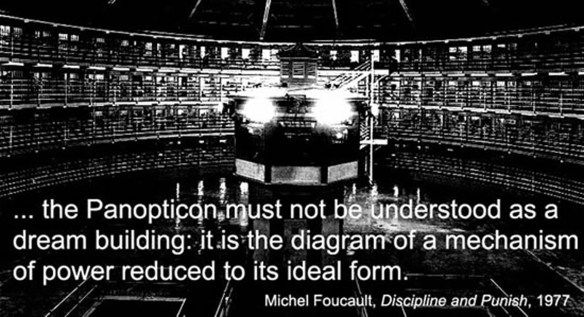
“The “panopticon” refers to an experimental laboratory of power in which behaviour could be modified, and Foucault viewed the panopticon as a symbol of the disciplinary society of surveillance.”[1]

In Plato’s E-Cave, not only are the people watching a shadow play, they, and the shadows they watch, are being watched.

HyperNormalization
With a veneer of calm aplomb, the masses communicate 24-7, often in a frenetic urgency of the mundane, hence one interpretation of HyperNormalization. In all the years of overhearing cell-phone conversations in public, I can’t recall one snippet of philosophy or practical advice, rather stuff like, ‘yeah OMG I’ll get the chips!’ and ‘I’ll be there in like 30 seconds!’; if you’re old enough, you’d remember the days when, you got there when you got there! That said, a cell-phone can be a helpful even life-saving device.

The USEmpire election appears to have both proven and disproven the main theory of Adam Curtis’ fascinating new documentary “HyperNormalization.”

“Curtis argues that since the 1970s, governments, financiers, and technological utopians have given up on the complex “real world” and built a simple “fake world” that is run by corporations and kept stable by politicians.”[2]

The California cyber-tech-boom was a love-child of LSD-consciousness that found refuge in E-wizardy all the while looking to escape repressive politics. In his book “2030” Pepe Escobar describes it as: “Digital network capitalism would then shape post-modern globalization, from the New Economy before the end of the millennium to every digital wall to be broken beyond. California cosmology forged our world.”

According to Wikipedia:

“The term “hypernormalisation” is taken from Alexei Yurchak’s 2006 book Everything was Forever, Until it was No More: The Last Soviet Generation, about the paradoxes of life in the Soviet Union during the 20 years before it collapsed. A professor of anthropology at the University of California, Berkeley, he argues that everyone knew the system was failing, but as no one could imagine any alternative to the status quo, politicians and citizens were resigned to maintaining a pretence of a functioning society. Over time, this delusion became a self-fulfilling prophecy and the “fakeness” was accepted by everyone as real, an effect which Yurchak termed “hypernormalisation”.”[3]

First off, I see HyperNormalization as a half-truth because while the self-referential, gossipy world is fake, it is a veneer for a very real world of resource extraction and the violence perpetrated to maintain the status quo – and that is what the fakers ignore. As far as the election, many expected the Clinton dynasty to prevail as the corrupt, business as usual lesser of two evils. Breaking snooze: Where’s  the headline news that Melania Trump plans to focus on helping women and children?; I saw that mentioned on CNN’s Anderson Cooper 360, such a perfect antidote for Hillary’s loss and The Donald’s anti-feminist track record.

Even though WikiLeaks revealed the DNC (Democratic National Convention) was rigged against Sanders and leaks of Podesta/Clinton e-mails may have been proverbial straws for Hillary’s campaign camel, the prevailing media sentiment was that she would win – despite the fact that the day before the election some polls indicated a shrinking 3-4 point lead, thus with the typical margin of error, it was, in effect, tied. Yet the mass hyper-surprise!; and all that after the corporate media and comedy shows had simultaneously bashed Trump and given him more air-time than a kite on a windy day – both disdaining and elevating him, a media-mindfuck if ever there was one.

And there was little uproar when Gary Johnson and Jill Stein were excluded from debates and virtually banned from all corporate news, thus proving (if you didn’t know already) that it’s not a truly democratic election. Yet carry on we must and do the best we can with what we got, was the general sentiment, in other words, “the “fakeness” was accepted by everyone as real” aka HyperNormalization.

Yet the non-coastal, poor and middle America White working class (with sides of KKK and minorities!), which reportedly was the key demographic for The Don’s victory, was voting out of bare-bones needs; in effect they were not HyperNormalized. Then again, if Trump, who promises to challenge the status quo, caves-in to Deep State pressure, we will have an answer to an interesting article’s titular question: “President Trump: big liar going to Washington or Tribune of the People?”[4] And if that answer is the former, then the mostly White working poor will also have been duped/HyperNormalized.

You see, it’s hard to know what’s what; which all seems to prove HyperNormalization as the dominant societal charade; which screen is real, if any?

What you perceive is what you get
Another key phrase in Curtis’ documentary is “managed perception” – akin to Chomsky and Herman’s  “Manufacturing Consent: The Political Economy of the Mass Media” (1988) which showed how opinions and desensitized agreement to the status quo became a product to be mined and marketed. Witness CBS Chairman Les Moonves’ comment from February 2016:

“Man, who would have expected the ride we’re all having right now? … The money’s rolling in and this is fun. I’ve never seen anything like this, and this [is] going to be a very good year for us. Sorry. It’s a terrible thing to say. But, bring it on, Donald. Keep going.” [5] And, if i might satirically add, like an orangey topped Duracell battery, The Don does seem to have a lot of energy.

HyperNormalization is also akin to Sheldon Wolin’s theory  of “inverted totalitarianism,” where the faceless corporate machine wields so much entertainment and bureaucratic power that the people barely notice they are being played hook, line, and sinking feelings.

Some of Curtis’ info, however, is inaccurate or questionable. For examples, he blames the demise of the Occupy Movement on lack of vision and planning yet neglects to mention the FBI coordinated systemic crackdown on the ‘camps’ across the country. [6]

About Syria he says that President Bashar al-Assad retaliated with a “vengeful fury,” whereas Assad has defended his actions as self-defense for his people; numerous journalists back the Syrian President’s claim.

Post-election, I wonder: Why were so many liberals, lefties, and women more surprised that Trump won than that the DNC/HRC rigged it against Sanders? Were they simply feeling impotent due to HyperNormalized shadow play? Whatever the case, his victory revealed a crack in the smooth screen of HyperNormalization.

According to Patrick Caddell’s survey before the election, the populace seems to be hip to what’s happening:

“Powerful interests from Wall Street banks to corporations, unions and political interest groups have used campaign and lobbying money to rig the system for them. They are looting the national treasury of billions of dollars at the expense of every man, woman and child. AGREE = 81%; DISAGREE = 13%…

“The country is run by an alliance of incumbent politicians, media pundits, lobbyists and other powerful money interests for their own gain at the expense of the American people. AGREE = 87%; DISAGREE = 10%

The real struggle for America is not between Democrats and Republicans but between mainstream American and the ruling political elites. AGREE = 67%; DISAGREE = 24%.” [7]

This makes it seem it is the ‘how-to bring about change’ that is the deeper conundrum of the HyperNormalized world. Then again, people too often seem to have only their own best interests at heart. Approximately 90% of Americans want their food labeled so as to know if they contain GMOs etc. or not, yet hardly a peep out of anyone that climate change or the “environment” aka Mother Earth & Nature-beings were deliberately excluded as a main topic of the presidential debates. This makes it seem that, in general, Americans want clean food for themselves, they want a clean environment so they can go ‘play in the park’ by themselves. And that brings us to the Great Disconnect and Standing Rock.

Flow like water, be steady as a rock
Part of HyperNormalization is a disconnect from Nature and from being self- and community-guided, and therefore disconnected from the Original Peoples of Turtle Island. While many people are certainly aware of what’s happening with Standing Rock, the corporate media’s lack of attention, let alone empathy, fosters lack of concern for the outcome, lack of being outraged by the violent and racist treatment of those in prayer and peacefully protecting the main source of water for the Standing Rock Sioux and other Natives as well as approximately 17-million people downstream. The real-fake outrage is over the outcome of a fake election.

For many Native reservations where poverty and PTSD are prevalent, the people are anything but HyperNormalized; they are struggling to survive – as with Standing Rock, they are not asking for much: clean water and the space to live their lives with ancient traditions timelessly connected with the land, the water, the stones…

Plato, imagining a prisoner getting outside of the Cave, wrote: “Slowly, his eyes adjust to the light of the sun. First he can only see shadows. Gradually he can see the reflections of people and things in water and then later see the people and things themselves. Eventually, he is able to look at the stars and moon at night until finally he can look upon the sun itself .” [8]

Standing Rock is bringing people together, raising consciousness at many levels. As one example from a little over a week ago:

“In a “historic” show of interfaith solidarity, 500 clergy members prayed along the banks of North Dakota’s Cannonball River on Thursday where they “bore witness with the Standing Rock Sioux Nation,” which has faced intimidation, violence, and arrests for protecting their sacred land and water supply from the threats of a massive oil pipeline. According to the Episcopal News Service, “The interfaith group spent more than five hours on site, marching, singing hymns, sharing testimony, and calling others to join them in standing with the more than [300] tribes who have committed their support to the Sioux Nation as they protest the route of the Dakota Access Pipeline (DAPL).” [9]

This solidarity is in stark contrast with the election where a typically 51/49 system determines an outcome for a society literally programmed for exciting close-call winners – think sporting events,
reality shows, awards ceremonies.

Outside in and inside out
There are many ways to get outside the Cave. One of those is by going within. When I first started to meditate, as is common, I became aware of the constant chatter in my head and soon realized that the mind left unattended will rattle on endlessly. Meditation then showed me that once the chatter quiets, one then has access to other frequencies, other ‘channels’ – what happens then is a very personal matter yet also impersonal because one becomes connected with another source of thinking-seeing-feeling. Chatter, like cell-phones, has it’s usefulness, say, if you forgot to turn the stove off. My point to the personal anecdote is that the corporate media is too much chatter, endlessly looping itself. The gadgets, too, though useful, seem hard-wired for HyperNormalization.

Some of the chatter we must live with, yet by learning to follow our intuitions, listening to and connecting with Nature, talking with elders and little children we can better tune-out from the shadow-play, we can find new and ancient ways for more people – and that includes trees, rivers, etc. –  “to look at the stars and moon at night” and “look upon the sun itself.”

“Sin filo ya y derrotada se quejó: Soy más fuerte que ella, pero no le puedo hacer daño y ella a mi, sin pelear. me ha vencido.’”

“Without sharpness and defeated, it [the sword] complained: ‘I am stronger than the water, but I cannot harm her. And the water, without fighting, has conquered me.’” [10]

NOTES:
1.    Panopticism here and here.
2.    Ibid.
3.    HyperNormalization
4.    See here.
5.    “Les Moonves: Trump’s run is ‘damn good for CBS’”. See here.
6.    “Revealed: how the FBI coordinated the crackdown on Occupy
7.    “Patrick Caddell; The Pollster Who ‘Got it Right’
8.    “Allegory of the Cave
9.    “A Prayer for People and Planet: 500 Clergy Hold ‘Historic’ Mass Gathering for Standing Rock
10.    “Questions & Swords: Folktales of the Zapatista Revolution” as told by Subcomandante Marcos, Cino Puntos Press, El Paso, Texas, 2001, p.82.

To watch “HyperNormalization”, click here.

Mankh (Walter E. Harris III) is an essayist and resident poet on Axis of Logic. In addition to his work as a writer, he is a small press publisher and Turtle Islander. His new book of genre-bending poetic-nonfiction is “Musings With The Golden Sparrow.” You can contact him via his literary website.


Review: The Utopia of Rules, by David Graeber

index

By Jonathan Woolley

Source: Gods & Radicals

Reading a book about bureaucracy may not sound like an exciting way to spend a weekend off with my family. And yet, having just started David Graeber’s latest – A Utopia of Rules – when I wasn’t making tea for my elderly grandmother, I curled up in a comfy chair with this little pink book, mocked up to look like one of the forms it excoriates, and excited by each new page. Although many of the ideas Graeber presents here aren’t new, the clarity and force with which they are drawn together and set out is a rare pleasure – a contrast with turgid official paperwork that was almost certainly intentional.

Graeber – a social anthropologist, anarchist, and prominent leftist thinker, based at the London School of Economics (LSE) – develops his argument, in part, by thinking ethnographically with his own personal experiences of officialdom, beginning with a heartbreaking account of his own struggle to deal with his elderly mother’s Medicaid application. In response to this, he introduces the book as a series of short essays on different facets of what he calls “total bureaucratisation” – defined as “the gradual fusion of public and private power into a single entity, rife with rules and regulations whose ultimate purpose is to extract wealth in the form of profits”. Bureaucracy is not a simple matter of red-tape created by the state tying up private enterprise, as right-wing pundits would have us believe: Graeber points out that bureaucratic forms have become intrinsic to both private and public spheres.

While the Left has been largely unable to produce a critique of bureaucracy, the Right has such a critique – but efforts to “roll back” the state by the Right have had the opposite effect, producing even more paperwork than ever. This leads Graeber to propose what he calls “the Iron Law of Liberalism”, which states that “any market reform, any government initiative intended to reduce red tape and promote market forces will have the ultimate effect of increasing the total number of regulations, the total amount of paperwork, and the total number of bureaucrats the government employs.”

In stressing the coeval nature of the free market and an expansive state, Graeber directs his analysis away from shallow criticism of big government, towards the common institutional basis of all inequality, found at the heart of neoliberal governance. Given the extent to which the general public in the English-speaking world continue to view the expansive state and the “free” market as antithetical to one another and synonymous with the Left and the Right of politics respectively, this is an important point to make.

With the foundations laid, Graeber’s lucid prose carries the reader briskly through a sequence of stand-alone essays, each of which engages with a particular aspect of total bureaucratisation today. Each of these, Graeber claims, will need to be addressed by any critique of bureaucracy the Left might develop. Dead Zones of the Imagination utilises feminist theory of imaginative labour to develop the argument that bureaucracy – in addition to being stupid – exists to create stupidity. Its impersonal procedures, backed up by threat of violence, ensure that those in positions of authority – especially the police – are able to avoid doing the imaginative labour of empathising with others, while forcing those others to engage in imaginative labour towards the authorities, simply in order to avoid physical harm. Police insist upon being able to “define the situation” – those who contest this, rather than violent criminals, are the ones who are routinely meet with physical violence. This serves to emphasise a very basic point: don’t underestimate the importance of physical violence, even if it takes place behind a veil of paper.

In Of Flying Cars and the Declining Rate of Profit, Graeber turns his attention to the trajectory of technological development in the modern world. Why is it, he asks, that in the 1950s we were able to explore space, and expected to be surrounded by robotic servants and flying cars by now, but that this awesome potential has not been realised? The answer, he suggests, is that rather than cause social change by itself, the direction of technological innovation is directed by financial interests – so that instead of pursuing automation and space travel that could disrupt existing economic relations on Earth, major funders have prioritised less disruptive research lines, such as information technology. The greatest achievement of the late 20th century – the Internet – is revealed as decidedly chimeric; both a tool for enhanced communication, but also a means of surveillance and manipulation on an industrial scale. The promise of technology has been broken in favour of labour discipline and social control; R&D budgets have been slashed in favour of boosting executive pay and shareholder dividends. Instead of being allowed to pursue their research interests, academics are increasingly forced to spend more and more of their time doing paperwork. Rather than a driver of social change, technology is itself subject to the demands of capital.

The Utopia of Rules, or Why We Really Love Bureaucracy After All concludes the triptych, by exploring the ways in which bureaucracy can, in fact, be deeply enchanting – when it works well – providing human beings with a sense of predictability and certainty that can be deeply seductive. While the second essay uses science fiction to reflect upon the curious falling short of innovation, this essay turns to magic and fantasy fiction in an attempt to understand how the appeal of bureaucratic rationality is generated. Graeber argues that the elaborate angelic hierarchies and formulaic modes of ritual address, developed in the Rennaissance but that now enliven Western Ceremonial Magic, actually reflect a political imaginary – a vision of the chaotic, violent world of the Middle ages reordered according to a spiritualised version of the old, lost, Roman bureaucracy. Nowadays, however, this vision is inverted – fantasy fiction today constructs a pseudo-Medieval world, where bureaucracy is almost entirely absent, where creativity is directly channelled into reality via magic, and where leadership is acquired on the basis of personal virtue and conquest, rather than through impersonal qualification or graduate recruitment. However, while giving us an opportunity to vicariously enjoy a world without bureaucracy, medievalist fantasies – with their perennial sense of threat and danger – nonetheless reinforce our sense that it’s probably preferable to live with the devil we know. Just as the gruesome spectacle of Gladitorial combat both beguiled and repulsed the populace of Rome from the idea of democracy, the blood-soaked cities of Westeros instil in us a fear of a world without bureaucratic order.

Perhaps the most fascinating contestation made by Graeber – albeit, only in passing – is that bureaucratic rationality rests upon a resolutely spiritual set of commitments. The idea that numbers and their rational appraisal can help one to understand and manipulate reality, reaches back to the Pythagoreanism of ancient Greece. They, in turn, directly inspired Plato, the father of Western formalism, and in turn the Medieval angelic hierarchies mentioned above. This commitment to the power of logic and pure numbers conferred upon bureaucracy a utopian air; bureaucrats envision a world of perfect harmony, governed by well-designed, efficient institutions, and develop frameworks that attempt to make that world a reality. The fact that the complexity of the world-as-lived rarely fits these lofty ideals ensures that bureaucracy requires constant enforcement – with the force in question being the threat of violence meted out by private security, the police or the military.

But it is in the Appendix – Batman and the Problem of Constituent Power – that we find some of Graeber’s most timely observations for the present moment. In a playful analysis of the cultural and political significance of superheroes, Graeber points out that – building upon his analysis of medievalist fantasy in the previous chapter – comics teach the same kind of lesson. In pitting basically passive superheroes who seek to preserve the status quo against endlessly creative and scheming villains who wish to unseat it, comics allow the reader to vicariously enjoy the thrill of unfettered creative potential, only to enforce the idea that such potential necessarily leads to violence, and that violence is in turn the only way that it can be controlled.

In the Marvel and DC Universes, the only alternative to bureaucracy is violent creativity of villains – in short, fascism. This, in turn, allows Graeber to highlight a broad distinction between the left and the right: “Ultimately, the division between left-and right-wing sensibilities turns on one’s attitude towards the imagination. For the Left, imagination, creativity, by extension production, the power to bring new things and new social arrangements into being, is always to be celebrated. It is the source of all real value in the world. For the Right, it is dangerous; ultimately, evil. The urge to create is also a destructive urge. This kind of sensibility was rife in the popular Freudianism of the day [1950s]: where the Id was the motor of the psyche, but also amoral; if really unleashed, it would lead to an orgy of destruction. This is also what separates conservatives from fascists. Both agree that the imagination unleashed can only lead to violence and destruction. Conservatives wish to defend us against that possibility. Fascists wish to unleash it anyway. They aspire to be, as Hitler imagined himself, great artists painting with the minds, blood, and sinews of humanity.”

Following from the magistral philosophical treatise Debt: The First 5,000 years (2011), The Utopia of Rules is a more modest project. Graeber does not attempt to propose a leftist critique of total bureaucratisation within its pages, though he argues such a critique is long overdue. Nor does he advance a singular argument – his goal is simply to prompt a conversation. With the rise of the populist right, this conversation is more important than ever. The mainstream Left, Graeber points out, has for too long positioned itself on the side of state control, leaving critiques of bureaucracy to the Right. As the pro-market efforts of neoliberalism have done nothing but concentrate capital in the hands of the rentier classes, the frustration is now boiling over. And yet, in unveiling the mystical roots of stultifying modern paperwork, Graeber reveals a way forward for us – if total bureaucratisation is a spell laid over the world, that spell may be broken. We need not live out the fevered dreams of Renaissance mystics; we can awaken. Nor shall the dark blood and bone portraits of fascists necessarily hold sway over the human imagination, for the Left is just as creative as the right; indeed, unlike them, we can create without fear of creativity. The Right may aspire to break this world, but it is the birthright of the Left to make a better one.

Soylent Burgers and Cockroach Milk

wICCXTa

Source: The Hipcrime Vocab

“The profitability of production cannot expand indefinitely. Any increase in the quantity of soil, water, minerals, or plants put into a particular production process per unit of time constitutes intensification. It has been the burden of this book to show that intensification inevitably leads to declining efficiencies. That declining efficiencies have adverse effects upon the average standard of living cannot be doubted.’
-MARVIN HARRIS, ‘Cannibals and Kings’

This comment made me chuckle: “The futurology future is starting to look worse than the collapse future.” This was on Reddit in response to an article about cockroaches providing the “milk of the future”:

Scientists think cockroach milk could be the superfood of the future (Science Alert)

This really does seem like The Onion at this point. Someone suggested that Reddit’s collapse and futurology boards should merge at some point. Believe it or not, they aren’t all that far apart.

We’ve already been treated to an endless litany of articles about how insect ranching will provide the protein of the future. Then there’s the meat grown in a petri-dish, and the nutrition shake cheekily named Soylent scarfed down by the Silicon Valley crowd so they can cram in a few more hours of work after popping their Ritalin. Now people are questioning whether the government should step in and force us to eat less meat.

And yet we are still simultaneously told that overpopulation and resource depletion are not a problem, and that more growth is good.

This is progress???

One of the things I’ve written about over the years is this idea that technological innovations are inherently good. But it’s clear what’s really going on: desperately trying to maintain the status quo in the face of increasing population pressure and declining resources. There’s a technical term for this: intensification.

Marvin Harris, whose works serve as a guidepost for this blog, warned us that intensification always leads to lower living standards for the majority of people in the long run, while only benefiting a tiny handful. This is a law of history. Over the years, I’ve tried to point out the difference between true innovation which solves problems or allows us to do things we could not do before, and intensification, which is essentially squeezing blood from a stone. In the former category are things like antibiotics and radio, which solve problems (killer infections) or allow us to do new things (communicate globally). In the latter category are things like electric cars (attempting to keep the unsustainable automobile infrastructure alive) and aquaculture (to make up for stripping the oceans bare of wild fish).

For the majority of people, there is no difference, since both are “growth” and growth is always good, full stop. GDP, the yardstick by which we measure progress in the modern world (which even its creator warned us against) is agnostic as to the source of growth, whether it is producing more food to feed hungry people or asthma inhalers to deal with the lung irritants from air pollution.

People tend to forget we’ve been here before.

Back during the Ice Age (late Pleistocene), we H. sapiens lived primarily off of herds of large fauna, especially reindeer, mammoth and bison. This was supplemented with wild salmon in season. The fattiest parts of the animal were the most prized and sought after. Bones were cracked and boiled to extract the grease. Most calories came from nutrient-dense meat and fat, while plants were consumed for their beneficial vitamins and minerals (plants are less calorie dense).

Then the large fauna started to die off. They died off due to a double-blow of a changing climate and increasing human predation. Scientists debate about which was the primary cause, but it’s pretty clear that whenever humans showed up in a pristine environment, the large animals went extinct shortly thereafter. Many of these animals had survived previous climatic changes, so it’s doubtful that climate change alone was responsible. Skeletons riddled with spear points provide more damning evidence for our species.

In response, we launched a broad spectrum revolution – using our omnivorous diet to exploit a wider variety of foodstuffs, particularly plant foods. This began with acorns and pistachios, but soon moved to grass seeds, sedges and pulses. Meanwhile, the prey animals got smaller and smaller, from reindeer and bison, to gazelles and fallow deer, to hares and waterfowl. Instead of the nutritious and diverse food sources of their ancestors, we became more and more dependent upon eating pulverized grass seeds, obtained at the cost of backbreaking labor for harvesting, threshing and grinding.

The human population became mostly vegetarian by necessity, and remained so for roughly the next 8,000 or so years. The problem is, a vegetarian diet doesn’t provide a lot of necessary vitamins, minerals and nutrients for optimal health. Today’s vegetarians can choose from a plethora of foods year round that simply weren’t available to ancient people. They don’t have to worry about what is in season and have the entire world as their larder. In the past, however, the vast majority of people ended up subsisting on a diet of weak beer and gruel. Regular meat consumption became a privilege restricted to the wealthy upper classes, while everyone else went begging. Hunting, an activity once done by all humans everywhere since time immemorial, became the exclusive provenance of kings and princes – society’s rulers. While it is true that too much meat can be detrimental to health, too little is perhaps even more damaging. Humans are meat-eaters, and a certain level of fat and protein is required for optimal health. The protein in grains and legumes is incomplete (the body needs 22 different types of amino acids to function properly; adults can synthesize 13 of those internally, but the other 9 must be obtained from food), and there are no fats (the human brain is over 60 percent fat). Grains produce an over-abundance of omega-6 fatty acids, poisonous lectins to prevent their consumption, have low nutrient density, and high acidity. They are actually a terrible thing to base a primate diet around. But we had no other choice, thanks to intensification.

And this is dramatically reflected by the skeletons of ancient peoples, who show major signs of malnutrition, disease, and stunted growth. At the same time, arthritis and other signs of wear and tear make their appearance on the bones of people who now have to spend hours a day grinding grain in a saddle quern rather than fishing and chasing after wild animals. This gruel also breaks down into simple sugars in the mouth during digestion, meaning that cavities and premature tooth decay became endemic as well.

As population pressure grew, grains, pulses and sedges, once “unpalatable” dietary supplements cultivated by hunter-gatherers for times of extreme scarcity or fermentation into medicinal beverages, became the chief dietary staple for most people. At the same time, humans found themselves preyed upon by a new class of predator: their own kind, which continues unabated to this day.

In order to keep large herbivores from going totally extinct, we embarked upon what Harris called “the greatest conservation project in history”: animal domestication. Meanwhile, cheap carbohydrates from grain are what kept most of the human population alive from day-to-day for thousands of years, such that “bread” is synonymous in all ancient cultures with “food.”

All this came from attempting to exploit resources more intensively from our environment in the face of increasing population pressure.

This sad tale, memorably spun by Jared Diamond some years ago, reflects Harris’ principle: intensification inevitably leads to benefits for the few; misery and oppression for the many.

During periods of deintensifcation, we actually recovered some of the losses. This was due to either 1.) a reduced population or 2.) new lands and resources opened up for exploitation. For example, signs of health improve after the Black Death in Europe for the survivors, due to the reduced population pressure. There were more resources to go around per head. Also, the opening up of the new lands due to colonization (and the dieoff of the native peoples), brought vast new areas of virgin land under cultivation. This led to more wealth, as well as political freedoms. Serfdom waned after the black death, and the American Revolution put Enlightenment principles of representative democracy and justice into practice. Perhaps the most dramatic result came from the harnessing of millions of years of stored sunlight in fossil fuels, combined with the scientific method. This allowed many more people a higher standard of living, even in the face of increasing population and intensifying resource use. It was during this period that “economics” became the guiding principle of our civilization, and it chalked up all benefits to “institutions”–typically capitalist market institutions–rather than a temporary superabundance of energy and resources.

Thomas Jefferson once noted that the Americans in the room were all a head taller than their European counterparts. That’s what happens when you have plenty for everybody. The first Europeans in North America also noted how much taller the Native Americans were. As this article notes, in the past, Americans ate more meat than today, and were healthier as well:

How Americans Used to Eat (The Atlantic)

Eventually, the Malthusian cycle kicked in again. Population grew, the empty spaces filled up, and the frontier was closed. Increasing competition caused wages and purchasing power to drop. People gradually lost what self-sufficiency they had, allowing the elites to consolidate power. People once again began working longer, harder, for less. Sound familiar?

We intensified again – in order to keep up with the demand for meat, we crowded animals together into feedlots in unsanitary conditions and fed them cheap corn (maize), which they are not adapted to eat. To cope with the inevitable sickness which resulted, we pumped the animals full of antibiotics (which has a side effect of increasing growth). It is these miserable and tortured animals which most of us are forced to eat now, thanks to intensification.

However, domesticated meat is less nutritious than the wild variety. The Omega-3/Omega-6 profile is altered, and there are less antioxidants. Omega-6 fatty acids reduce inflammation, which is increasingly being pinpointed as the root cause of just about every disease you care to name, from autoimmune diseases, to Alzheimer’s, to arthritis, to chronic pain, depression, and cancer. At the same time, it’s been shown that grains actually increase inflammation, and are implicated in a host of metabolic diseases:

This Is Your Brain on Gluten (The Atlantic)

While grass-fed, hormone-free beef is still available, it costs more, meaning it is restricted to those with high incomes, just like in the past. And hunting is still primarily an elite sport for the rich in many places (especially outside North America). Just like in the past, the poor people trapped in “food deserts” feed themselves with cheap carbohydrates, now in the form of processed corn and sugar products made by the industrial food system, while the wealthy can purchase boutique ‘lifestyle” products at Whole Paycheck Foods.Malnutrition now takes the form of obesity as well as starvation, although much of the non-industrialized world still deals with empty bellies, stunted growth and vitamin deficiencies, including many of those who produce export crops for the West. That’s on top of poverty and pollution.

When we scraped the oceans clean of fish and poisoned our air and waterways due to industrial pollutants (e.g. mercury ash is a side effect of coal power generation) we turned to fish farming, (aquaculture) – one of the favorite high-tech “innovations” of the futurist crowd. But farmed fish are nutritionally inferior to wild ones. Wild fish travel widely and get their food from a great variety of sources. This means that they have a much better Omega-3 fatty acid profile (which prevents inflammation and helps brain growth). But farmed fish have to be fed. This means their diet is far more restricted, and hence their meat less nutritious (more Omega-6’s). In fact, salmon needs to be fed a pill in order to turn them pink so that consumers will buy them since their meat does not develop its natural color from their diet. As Spencer Wells notes in Pandora’s Seed, were now doing for fish what we did for ungulates some 8000 years ago: a desperate attempt to preserve what remains. Farmed fish is replacing wild fish in supermarkets. As with grass-fed meat, the wild variety is now sold at a premium affordable only to those with high incomes (sound familiar)?

In each and every case, intensification had led to far more work for ultimately inferior products. This is always the result of intensification in the long run.

We are constantly told we can’t go back to hunting and gathering (even if we wanted to). Why is that? What’s left unsaid is the reason: too many people and too much environmental degradation as the result of 6-8,000 years of intensification, which also brought about disease, governments, wars, taxes, poverty, inequality, and so on. Now we’re told we’ve got to eat less meat (which means more grains), live in small, tightly sealed houses, use less water, take shorter showers, and so forth. In essence, that we will “innovate” our way to success. But all of these are signs of lower living standards. And no wonder: seven billion-plus people, all quarters of the earth occupied and brought under the plow, rain forests being chopped down, the most easily accessible fossil fuels plateauing, toxic pollution of the air, land and water, overpumping of ground water, and the stable climate of the Holocene threatened by carbon levels. Intensification caused all of these things; it is not the solution. The next phase of intensification isn’t going to lead to better living standards any more than the last few rounds. Yet we’ve been tricked into thinking it will, because we don’t realize that fossil fuels are what are ultimately responsible for our current living standards (us Westerners, that is), not intensification. And even then, given the levels of stress, overwork, social dysfunction, health maladies and mental disease in industrialized societies, we might be tempted to wonder if even our living standards are all that great to begin with.

Furthermore, we are told that a healthy diet centered around pastured meat, plants and nuts is just not possible because it’s too damaging to the environment, or too “expensive.” That is, “we” need to “feed the world!” But according to the elites (the ones who benefit from intensification, remember) the answer isn’t less people, or curtailing economic growth. No, instead it’s new “innovations” that are profitable to the parasitical corporate owners of this planet: lab-grown meat, hydroponics, vertical gardens, meal-replacement shakes, protein powder from ground-up crickets, steel-and-glass human anthills. “The futurology future is starting to look worse than the collapse future.” Maybe that’s because the collapse future has more room to grow actual real food, live in a house you built yourself with your friends and family, spend time in nature, work less, play more, and get in touch with what we really are, deep down, instead of what industrial society wants to mold us to be.

Now, for the record, I have no problem with eating bugs. The Permaculturist in me says we should exploit all sources for sustenance in our environment such that they work together in a sustainable, harmonious way in line with the earth’s natural ecosystems. Raising insects, as we now do with bees, makes sense. And, yes, the overconsumption of Americans is grotesque and makes us unhappy, and we’d be better off ditching it (which I already do voluntarily). So to be clear: what I am criticizing is not eating insects or deriving milk from cockroaches per se. Nor am I defending the overconsumption produced by status-driven consumer capitalism. Rather, I am critiquing the idea that these futurology trends are signs of progress rather than collapse. Which is why r/collpase and r/futurology increasingly appear to be turning into the same thing.

P.S This comment nails it.

 

We Still Want Everything: The Politicisation of Anti-work

balestrini-we-want-everything-650

By Hans Rollman

Source: PopMatters

If there is such a thing as a ‘revolutionary novel,’ Nanni Balestrini’s We Want Everything is as good an example as any. The novel, first published in Italy in 1971, recounts in dramatic narrative form actual events that occurred in late 1969 in Italy: a massive mobilization and strike against Italian auto-maker Fiat that erupted into civil violence and came close to political revolution.

Balestrini—a poet, visual artist and writer—was himself personally involved in these struggles. In 1979, explains Rachel Kushner in an introductory essay, he had to flee the country on skis through the Alps in order to avoid arrest on charges of insurrection and terrorism, later dropped. But more than offering a dramatic recount of the events of 1969, the book offers a potent political analysis of today’s ‘mass worker’ and the struggles they face, couched in everyday language and dramatic action.

The novel offers a fast-paced first-person narrative. The language is blunt, unadorned and honest; the action sticks to key points and races along without detours from the main theme. The narrator comes from southern Italy, and like others from the region, he is lured north by the promise of easy quick cash in the newly modernising factory towns.

The context of this historical moment of capitalist development in Italy is important. For centuries Italians, particularly in the south, had lived an essentially feudal subsistence lifestyle. They eked out a living working the fields and farms of petty landlords, meeting their needs with relative ease but living in a constant state of abject poverty. They could gather food from the forests and fields around them; they could live in fairly basic housing and even sleep comfortably outdoors for much of the year. They wore simple clothing, handed down and patched up.

But then the factories arrived, luring young people off the land with the promise of cash and all that it offered: things their families had never even dreamed of. Stylish clothes, cars, modern homes of their own. At first the lure seemed attractive. But once they left their traditional lifestyles, they discovered they had new needs as well that they had never had before: the need to pay for housing, for food, for clothes for their families. To meet these needs, they had to work, and work hard; they no longer had the right to take a day off whenever they wanted to sit at the beach. To obtain the consumer goods they wanted and needed, they had to surrender to the tyranny of bosses and to the tyranny of work itself.

But they didn’t go without a fight, and that fight is the subject of Balestrini’s classic novel.

Kushner makes an important point in her introduction: the struggle depicted in the novel is predominantly depicted as a masculinist struggle. Women have very little presence in the novel and are objectified when they are. This is an ironic oversight, as Kushner notes, because women more than anyone had call to demand everything. It’s an unfortunate oversight too, she observes, since “it’s accurate to say that feminism had the most lasting and successful impact among the demands made in the revolts of 1970s Italy.”

The narrator—based loosely on a real figure, Alfonso Natella, to whom the author dedicates his work—is a happy-go-lucky southerner who comes north looking for easy cash. He gets it, drifting through a series of jobs, filling his wallet and then quitting jobs just as quickly as he gets them in order to enjoy the cash he’s earned. Then he finds new jobs, and becomes quite adept at scamming employers, as well.

The point of his continuous lies and scams is this: work is not something to be respected. He wants to have a good time, a natural human inclination, and so wants money, but sees no reason to respect the principle of work. At first his hatred of work is primal and intuitive; he has no real political analysis, just knows he wants to enjoy life and is happy to take the quickest route to get there. He’s willing to work for money—and only as long and as hard as it takes to get some—but understands there is nothing intrinsically worthy or noble about work. His views crystallize after he obtains one of the coveted jobs at Fiat, the Italian automaker. There, he eagerly joins in with students, union organizers and other activists who are vying with each other to gain adherents among the Fiat workers.

So I started stirring things up at the gates. Comrades, today we must stop work. Because we’ve fucking had it up to here with work. You’ve seen how tough work is. You’ve seen how heavy it is. You’ve seen that it’s bad for you. They’d made you believe that Fiat was the promised land, California, that we’re saved.

I’ve done all kinds of work, bricklayer, dishwasher, loading and unloading. I’ve done it all, but the most disgusting is Fiat. When I came to Fiat I believed I’d be saved. This myth of Fiat, of work at Fiat. In reality it’s shit, like all work, in fact it’s worse. Every day here they speed up the line. A lot of work and not much money. Here, little by little, you die without noticing. Which means that it is work that is shit, all jobs are shit. There’s no work that is OK, it is work itself that is shit. Here, today, if we want to get ahead, we can’t get ahead by working more. Only by the struggle, not by working more, that’s the only way we can make things better. Kick back, today we’re having a holiday.

The Politicisation of Anti-work

Gradually he comes to develop a political analysis as well. It’s not just that work is bad and pointless: it’s hypocritical as well, with arbitrary determinations of whose work is valued over others, and who gets paid what.

But organizing the workers and inciting them to go on strike is challenging at first. One of the barriers is what the narrator refers to as workers’ ‘neurosis’.

What is this neurosis? Every Fiat worker has a gate number, a corridor number, a locker room number, a locker number, a workshop number, a line number, a number for the tasks they have to do, a number for the parts of the car they have to make. In other words, it’s all numbers, your day at Fiat is divided up, organised by this series of numbers that you see and by others that you don’t see. By a series of numbered and obligatory things. Being inside there means that as you enter the gate you have to go like this with a numbered ID card, then you have to take that numbered staircase turning to the right, then that numbered corridor. And so on.

In the cafeteria for example. The workers automatically choose a place to sit, and those remain their places for ever. It’s not as if the cafeteria is organised so that everyone has to sit in the same place all the time. But in fact you always end up sitting in the same place. It’s like, this is a scientific fact, it’s strange. I always ate in the same seat, at the same table, with the same people, without anyone ever having put us together. Well this signifies neurosis, according to me. I don’t know if you can say neurosis for this, if that is the exact word. But to be inside there you have to do this, because if you don’t you can’t stay.

The narrator’s point is clear: the regimentation and routinization of work tasks generates a tendency to accept the routinization of daily life—a hesitation to question or challenge norms; an inclination toward accepting the status quo, even when there is no rule saying they have to.

We Challenge Everything

Two aspects of the workers’ struggle are impressively articulated and conveyed in We Want Everything. The first is an abject hatred of work—a clear indictment of the pointlessness and myth of work. Work is not noble, work does not contribute to the self or society; it is oppression and exploitation, pure and simple.

“Workers don’t like work, workers are forced to work. I’m not here at Fiat because I like Fiat, because there isn’t a single fucking thing about Fiat that I like, I don’t like the cars that we make, I don’t like the foremen, I don’t like you. I’m here at Fiat because I need money.”

The narrator is careful to emphasize that it’s not just manual labour, it’s not just certain kinds of work that are useless and disgusting—it’s all work. The narrator knows from the beginning, with an instinctive honesty, that he doesn’t like work, but it’s only as the novel progresses that he understands the oppressive and exploitative nature of all work, realizes the political and social nature of the demand—“Less work!”

The other refreshing dimension of We Want Everything is the perceptive critique of unions. Yes, this is a workers’ struggle, but it’s not a union struggle. The unions are portrayed as the enemy of the working class. They’re exposed as serving a mediating role for the company bosses; it’s a critique that is still appropriate to level at many unions today. The unions, in their efforts to retain their control over the workers’ movement, to ensure that they control the workers and members, connive and conspire to undermine autonomous and spontaneous workers’ struggles. They fear loss of control as much as the company bosses do. The bosses want to control the factory, and the union leaders want to control the movement.

What both fear is a spontaneous, grassroots, autonomous and democratic movement self-organized by workers themselves. Example: when the struggle starts, there are various categories of workers, each of which earns different salaries. Because the workers are demanding more money, the union and bosses negotiate the creation of new categories, to provide more pay scales. The workers reject this: they want the elimination of all the different pay scales, so that all the workers earn the same amount, and that it’s an acceptable amount for all. The narrator’s lesson is this: the unions want tangible victories to wave in the air; but the workers want a powerful united movement capable of taking on the bosses.

The Outcome of the Struggle Has Yet to Be Written

“The unions try to start the struggles one at a time, one finishing and another starting, to avoid the struggle widening and to stop the workers organising themselves in the factories from expressing their will autonomously. But the working-class struggle won’t be controlled this way. Almost every day a new struggle starts, and it’s the workers who start it. This is a big test of the working class’s strength… If workers end up divided and disorganised after the struggle, this is a defeat, even if something has been gained. If workers come out of the struggle more united and organised, this is a victory, even if some demands remain unmet.”

The narrator does a superb job of chronicling the gradual evolution of the unions’ role in the struggle: at first encouraging strikes and actions, but as the workers start organizing autonomously and making their own—often more radical—decisions, the unions begin to panic and escalate their own efforts to suppress the autonomous workers’ struggle. Eventually, they even cooperate with the bosses in this effort, each of them terrified that a system which benefits them both might actually be overthrown.

“Unionists, PCI bureaucrats, fake Marxist-Leninists, cops and fascists all have one characteristic in common. They have a total fear of the workers’ struggle, of the workers’ ability to tell the bosses and the bosses’ servants to go to hell and to organise their struggle autonomously, in the factory and outside the factory. We made them a leaflet that finished like this: Someone once said that even whales have lice. The class struggle is a whale, and cops, Party and union bureaucrats, fascists and fake revolutionaries are its lice.”

The Assembly

The varied themes come together in a workers’ assembly that takes place toward the end of the novel. Workers denounce the fact that the union, instead of fighting for equal wages for everyone, has settled for an even more convoluted hierarchy of pay. Workers point out that even though the bosses have conceded a pay increase, the price of consumer goods and housing is rising accordingly. What good is a pay increase, then? Others demand a guaranteed wage for all, regardless of whether they’re employed or unemployed.

The unions warn them against radical demands, since they could upset the country’s economic system. But the workers counter that’s precisely what they want: the destruction of an economic system that perpetually exploits them. Union reforms only strengthen that system. “We say no to the reforms that the unions and the party want us to fight for. Because we understand that those reforms only improve the system that the bosses exploit us with. Why should we care about being exploited more, with a few more apartments, a few more medicines and a few more kids at school. All of this only advances the State…”

But communism is no solution either, observe other workers—the communists are just as obsessed as the capitalists with making people work hard for no reward. What the workers want is an end to work. “Comrades, I’m from Salerno, and I have done every kind of work in the south as well as the north and I have learned one thing. That a worker has only two choices: a grueling job when things are going well or unemployment and hunger when they go badly. I don’t know which of the two is worse.”

“We started this great struggle by demanding more money and less work. Now we know that this is a call that turns everything upside-down, that sends all the bosses’ projects, capital’s entire plan, up in smoke. And now we must move from the struggle for wages to the struggle for power. Comrades, let us refuse work. We want all the power, we want all the wealth.”

The Struggle Continues

The struggle against work portrayed in the novel was sparked by a particular type of worker. Earlier in the century, Italian workers’ struggles (like elsewhere) were defined by skilled workers who could more effectively demand more wealth because of their highly specialised skills. And it was that type of worker around which left-leaning political parties and labour unions organised their strategies. But in the ‘60s a new type of worker appeared: “adept at a thousand trades because he has no trade, without a single professional quality even when he possesses a diploma, lacking a steady job and often unemployed or forced into casual service, who can’t find work and so seeks it in Turin, in Milan, in Switzerland, in Germany, anywhere in Europe. Who finds the hardest, most exhausting, most inhuman jobs, those that no one else is prepared to do.” It is on this worker, Balestrini points out, that the postwar economies of the West were built.

What is significantly different about this worker is that unlike the skilled worker of the past, who could often take pride in their sought-after technical skills, the new worker is defined by “his ideological estrangement from work and from any professional ethic, the inability to present himself as the bearer of a trade and to identify himself in it. His single obsession is the search for a source of income to be able to consume and survive… For him work and development are understood solely as money, immediately transformable into goods to consume.”

As Balestrini notes in his afterword, this worker is in many ways still the worker of today. In the ‘60s and ‘70s the state and the capitalist system hastily responded to the workers’ challenge with a series of measures which suppressed that struggle for a time—automation and robotisation of factories, outsourcing of production to the third world, co-optation of unions and where none of these strategies worked, brutal police repression. But the workers, the issues, and the struggle continues today.

It was because of this new and unpredictable type of worker—who wasn’t fooled by the notion of a ‘work ethic’ and was uninterested in the elitist machinations of unions and political parties—that unprecedented revolts broke out across Italy (and elsewhere) during this period. The novel ends with a dramatic street battle between workers and police, the end of which is left hanging. Throughout that dramatically depicted battle, which rages throughout the city, it becomes clear that the workers’ strength comes from the self-empowered, self-organised movement they have been building in the weeks and months previous.

These weren’t workers following union instructions, or students playing at textbook revolutionary. These were workers who had challenged their bosses face-to-face in the factory; who had walked off the assembly lines in solidarity when one of their fellows was fired. It was their unity that was their strength—not their union or their political ideology. And as the battle rages, they realize that this unity can bring them real power.

“People kept coming from all around. You could hear a hollow noise, continuous, the drumbeat of stones rhythmically striking the electricity pylons. They made this sound, hollow, striking, continuous. The police couldn’t surround and search the whole area, full of building sites, workshops, public housing, fields. People kept attacking, the whole population was fighting. Groups reorganised themselves, attacked at one point, came back to attack somewhere else. But now the thing that moved them more than rage was joy. The joy of finally being strong. Of discovering that your needs, your struggle, were everyone’s needs, everyone’s struggle.”

The aftermath of the battle is left hanging, uncertain. Balestrini’s message is clear: the outcome of the struggle has yet to be written. “Capital only appeared to have won a victory; it has triggered a process that leads unavoidably to a confrontation with the underlying issue, expressed clearly 30 years ago in the struggles of the mass worker with the slogan ‘refusal of work’,” writes Balestrini in his afterword.

More and more the automation of production, and also the possibility in general of trusting almost every type of work and activity to machines and computers, requires a laughably small quantity of human labour power. Therefore why shouldn’t everyone profit from the wealth produced by machines and from the time freed from labour? Today, absurdly, work that is no longer necessary continues to be imposed because only through this is it possible to conceive of the distribution of money, allowing the continuation of the cycle of production and consumption and the accumulation of capital.

It’s surely no coincidence that Balestrini’s novel is undergoing a renewed popularity, at a time of mass mobilizations by a public whose ideological estrangement from work echoes so strongly with that of the characters in his 45-year old book. As demands arise again that echo the demands of the period—less work, more pay, more leisure, guaranteed income—We Want Everything sends a stirring reminder that these are not new demands, and that although it is a new generation rising to the challenge, it is the same fundamental struggle that continues.

“A new era is waiting for humanity, when it will be freed from the blackmail and the suffering of a forced labour that is already unnecessary and the enslavement to money, which prevent the free conduct of activity according to the aptitudes and desires of each and steal and degrade from the rhythm of life, at the same time that there is the real possibility of widespread and general wellbeing. This was the meaning, and could again be the meaning today and in the future, of that old rallying cry: Vogliamo tutto!” We want everything!

Will Robots Take Your Job?

Walmart Robots

By Nick Srnicek and Alex Williams

Source: ROAR

In recent months, a range of studies has warned of an imminent job apocalypse. The most famous of these—a study from Oxford—suggests that up to 47 percent of US jobs are at high-risk of automation over the next two decades. Its methodology—assessing likely developments in technology, and matching them up to the tasks typically deployed in jobs—has been replicated since then for a number of other countries. One study finds that 54 percent of EU jobs are likely automatable, while the chief economist of the Bank of England has argued that 45 percent of UK jobs are similarly under threat.

This is not simply a rich-country problem, either: low-income economies look set to be hit even harder by automation. As low-skill, low-wage and routine jobs have been outsourced from rich capitalist countries to poorer economies, these jobs are also highly susceptible to automation. Research by Citi suggests that for India 69 percent of jobs are at risk, for China 77 percent, and for Ethiopia a full 85 percent of current jobs. It would seem that we are on the verge of a mass job extinction.

Nothing New?

For many economists however, there is nothing to worry about. If we look at the history of technology and the labor market, past experiences would suggest that automation has not caused mass unemployment. Automation has always changed the labor market. Indeed, one of the primary characteristics of the capitalist mode of production has been to revolutionize the means of production—to really subsume the labor process and reorganize it in ways that more efficiently generate value. The mechanization of agriculture is an early example, as is the use of the cotton gin and spinning jenny. With Fordism, the assembly line turned complex manufacturing jobs into a series of simple and efficient tasks. And with the era of lean production, we have had the computerized management of long commodity chains turn the production process into a more and more heavily automated system.

In every case, we have not seen mass unemployment. Instead we have seen some jobs disappear, while others have been created to replace not only the lost jobs but also the new jobs necessary for a growing population. The only times we see massive unemployment tend to be the result of cyclical factors, as in the Great Depression, rather than some secular trend towards higher unemployment resulting from automation. On the basis of these considerations, most economists believe that the future of work will likely be the same as the past: some jobs will disappear, but others will be created to replace them.

In typical economist fashion, however, these thoughts neglect the broader social context of earlier historical periods. Capitalism may not have seen a massive upsurge in unemployment, but this is not a necessary outcome. Rather, it was dependent upon unique circumstances of earlier moments—circumstances that are missing today. In the earliest periods of automation, there was a major effort by the labor movement to reduce the working week. It was a successful project that reduced the week from around 60 hours at the turn of the century, down to 40 hours during the 1930s, and very nearly even down to 30 hours. In this context, it was no surprise that Keynes would famously extrapolate to a future where we all worked 15 hours. He was simply looking at the existing labor movement. With reduced work per person, however, this meant that the remaining work would be spread around more evenly. The impact of technology at that time was therefore heavily muted by a 33 percent reduction in the amount of work per person.

Today, by contrast, we have no such movement pushing for a reduced working week, and the effects of automation are likely to be much more serious. Similar issues hold for the postwar era. With most Western economies left in ruins, and massive American support for the revitalization of these economies, the postwar era saw incredibly high levels of economic growth. With the further addition of full employment policies, this period also saw incredibly high levels of job growth and a compact between trade unions and capital to maintain a sufficient amount of good jobs. This led to healthy wage growth and, subsequently, healthy growth in aggregate demand to stimulate the economy and keep jobs coming. Moreover, this was a period where nearly 50 percent of the potential labor force was constrained to the household.

Under these unique circumstances, it is no wonder that capitalism was able to create enough jobs even as automation continued to transform for the labor process. Today, we have sluggish economic growth, no commitments to full employment (even as we have commitments to harsh welfare policies), stagnant wage growth, and a major influx of women into the labor force. The context for a wave of automation is drastically different from the way it was before.

Likewise, the types of technology that are being developed and potentially introduced into the labor process are significantly different from earlier technologies. Whereas earlier waves of automation affected what economists call “routine work” (work that can be laid out in a series of explicit steps), today’s technology is beginning to affect non-routine work. The difference is between a factory job on an assembly line and driving a car in the chaotic atmosphere of the modern urban environment. Research from economists like David Autor and Maarten Goos shows that the decline of routine jobs in the past 40 years has played a significant role in increased job polarization and rising inequality. While these jobs are gone, and highly unlikely to come back, the next wave of automation will affect the remaining sphere of human labor. An entire range of low-wage jobs are now potentially automatable, involving both physical and mental labor.

Given that it is quite likely that new technologies will have a larger impact on the labor market than earlier waves of technological change, what is likely to happen? Will robots take your job? While one side of the debate warns of imminent apocalypse and the other yawns from the historical repetition, both tend to neglect the political economy of automation—particularly the role of labor. Put simply, if the labor movement is strong, we are likely to see more automation; if the labor movement is weak, we are likely to see less automation.

Workers Fight Back

In the first scenario, a strong labor movement is able to push for higher and higher wages (particularly relative to globally stagnant productivity growth). But the rising cost of labor means that machines become relatively cheap in comparison. We can already see this in China, where real wages have been surging for more than 10 years, thereby making Chinese labor increasingly less cheap. The result is that China has become the world’s biggest investor in industrial robots, and numerous companies—most famously Foxconn—have all stated their intentions to move towards increasingly automated factories.

This is the archetype of a highly automated world, but in order to be achievable under capitalism it requires that the power of labor be strong, given that the relative costs of labor and machines are key determinants for investment. What then happens under these circumstances? Do we get mass unemployment as robots take all the jobs? The simple answer is no. Rather than mass decimation of jobs, most workers who have their jobs automated end up moving into new sectors.

In the advanced capitalist economies this has been happening over the past 40 years, as workers move from routine jobs to non-routine jobs. As we saw earlier, the next wave of automation is different, and therefore its effects on the labor market are also different. Some job sectors are likely to take heavy hits under this scenario. Jobs in retail and transport, for instance, will likely be heavily affected. In the UK, there are currently 3 million retail workers, but estimates by the British Retail Consortium suggest this may decrease by a million over the next decade. In the US, there are 3.4 million cashiers alone—nearly all of whose work could be automated. The transport sector is similarly large, with 3.7 million truck drivers in the US, most of whose jobs could be incrementally automated as self-driving trucks become viable on public roads. Large numbers of workers in such sectors are likely to be pushed out of their jobs if mass automation takes place.

Where will they go? The story that Silicon Valley likes to tell us is that we will all become freelance programmers and software developers and that we should all learn how to code to succeed in their future utopia. Unfortunately they seem to have bought into their own hype and missed the facts. In the US, 1.8 percent of all jobs require knowledge of programming. This compares to the agricultural sector, which creates about 1.5 percent of all American jobs, and to the manufacturing sector, which employs 8.1 percent of workers in this deindustrialized country. Perhaps programming will grow? The facts here are little better. The Bureau of Labor Statistics (BLS) projects that by 2024 jobs involving programming will be responsible for a tiny 2.2 percent of the jobs available. If we look at the IT sector as a whole, according to Citi, it is expected to take up less than 3 percent of all jobs.

What about the people needed to take care of the robots? Will we see a massive surge in jobs here? Presently, robot technicians and engineers take up less than 0.1 percent of the job market—by 2024, this will dwindle even further. We will not see a major increase in jobs taking care of robots or in jobs involving coding, despite Silicon Valley’s best efforts to remake the world in its image.

This continues a long trend of new industries being very poor job creators. We all know about how few employees worked at Instagram and WhatsApp when they were sold for billions to Facebook. But the low levels of employment are a widespread sectoral problem. Research from Oxford has found that in the US, only 0.5 percent of the labor force moved into new industries (like streaming sites, web design and e-commerce) during the 2000s. The future of work does not look like a bunch of programmers or YouTubers.

In fact, the fastest growing job sectors are not for jobs that require high levels of education at all. The belief that we will all become high-skilled and well-paid workers is ideological mystification at its purest. The fastest growing job sector, by far, is the healthcare industry. In the US, the BLS estimates this sector to create 3.8 million new jobs between 2014 and 2024. This will increase its share of employment from 12 percent to 13.6 percent, making it the biggest employing sector in the country. The jobs of “healthcare support” and “healthcare practitioner” alone will contribute 2.3 million jobs—or 25 percent of all new jobs expected to be created.

There are two main reasons for why this sector will be such a magnet for workers forced out of other sectors. In the first place, the demographics of high-income economies all point towards a significantly growing elderly population. Fewer births and longer lives (typically with chronic conditions rather than infectious diseases) will put more and more pressure on our societies to take care of elderly, and force more and more people into care work. Yet this sector is not amenable to automation; it is one of the last bastions of human-centric skills like creativity, knowledge of social context and flexibility. This means the demand for labor is unlikely to decrease in this sector, as productivity remains low, skills remain human-centric, and demographics make it grow.

In the end, under the scenario of a strong labor movement, we are likely to see wages rise, which will cause automation to rapidly proceed in certain sectors, while workers are forced to struggle for jobs in a low-paying healthcare sector. The result is the continued elimination of middle-wage jobs and the increased polarization of the labor market as more and more are pushed into the low-wage sectors. On top of this, a highly educated generation that was promised secure and well-paying jobs will be forced to find lower-skilled jobs, putting downward pressure on wages—generating a “reserve army of the employed”, as Robert Brenner has put it.

Workers Fall Back

Yet what happens if the labor movement remains weak? Here we have an entirely different future of work awaiting us. In this case, we end up with stagnant wages, and workers remain relatively cheap compared to investment in new equipment. The consequences of this are low levels of business investment, and subsequently, low levels of productivity growth. Absent any economic reason to invest in automation, businesses fail to increase the productivity of the labor process. Perhaps unexpectedly, under this scenario we should expect high levels of employment as businesses seek to maximize the use of cheap labor rather than investing in new technology.

This is more than a hypothetical scenario, as it rather accurately describes the situation in the UK today. Since the 2008 crisis, real wages have stagnated and even fallen. Real average weekly earnings have started to rise since 2014, but even after eight years they have yet to return to their pre-crisis levels. This has meant that businesses have had incentives to hire cheap workers rather than invest in machines—and the low levels of investment in the UK bear this out. Since the crisis, the UK has seen long periods of decline in business investment—the most recent being a 0.4 percent decline between Q12015 and Q12016. The result of low levels of investment has been virtually zero growth in productivity: from 2008 to 2015, growth in output per worker has averaged 0.1 percent per year. Almost all of the UK’s recent growth has come from throwing more bodies into the economic machine, rather than improving the efficiency of the economy. Even relative to slow productivity growth across the world, the UK is particularly struggling.

With cheap wages, low investment and low productivity, we see that companies have instead been hiring workers. Indeed, employment levels in the UK have reached the highest levels on record—74.2 percent as of May 2016. Likewise, unemployment is low at 5.1 percent, especially when compared to their neighbors in Europe who average nearly double that level. So, somewhat surprisingly, an environment with a weak labor movement leads here to high levels of employment.

What is the quality of these jobs, however? We have already seen that wages have been stagnant, and that two-thirds of net job creation since 2008 has been in self-employed jobs. Yet there has also been a major increase in zero-hour contracts (employment situations that do not guarantee any hours to workers). Estimates are that up to 5 percent of the labor force is in such situations, with over 1.7 million zero-hour contracts out. Full-time employment is down as well: as a percentage of all jobs, its pre-crisis levels of 65 percent have been cut to 63 percent and refused to budge even as the economy grows (slowly). The percentage of involuntary part-time workers—those who would prefer a full-time job but cannot find one—more than doubled after the crisis, and has barely begun to recover since.

Likewise with temporary employees: involuntary temporary workers as a percentage of all temporary workers rose from below 25 percent to over 40 percent during the crisis, only partly recovering to around 35 percent today. There is a vast number of workers who would prefer to work in more permanent and full-time jobs, but who can no longer find them. The UK is increasingly becoming a low-wage and precarious labor market—or, in the Tories’ view, a competitive and flexible labor market. This, we would argue, is the future that obtains with a weak labor movement: low levels of automation, perhaps, but at the expense of wages (and aggregate demand), permanent jobs and full-time work. We may not get a fully automated future, but the alternative looks just as problematic.

These are therefore the two poles of possibility for the future of work. On the one hand, a highly automated world where workers are pushed out of much low-wage non-routine work and into lower-wage care work. On the other hand, a world where humans beat robots but only through lower wages and more precarious work. In either case, we need to build up the social systems that will enable people to survive and flourish in the midst of these significant changes. We need to explore ideas like a Universal Basic Income, we need to foster investment in automation that could eliminate the worst jobs in society, and we need to recover that initial desire of the labor movement for a shorter working week.

We must reclaim the right to be lazy—which is neither a demand to be lazy nor a belief in the natural laziness of humanity, but rather the right to refuse domination by a boss, by a manager, or by a capitalist. Will robots take our jobs? We can only hope so.

Note: All uncited figures either come directly from, or are based on authors’ calculations of, data from the Bureau of Labor Statistics, O*NET and the Office for National Statistics.

Saturday Matinee: Technocalypse

technocalyps_dvd_cover

“Technocalyps” (2006) is a documentary by Frank Theys examining the transhumanist movement and development of the sciences of interest to them including genetics, robotics, nanotechnology, and artificial intelligence. Features interviews with philosophers, writers and researchers including Raymond Kurzweil, Kirkpatrick Sale, Natasha Vita More, Robert Anton Wilson and Terence McKenna among others.

For Purely Technical Reasons

peak-oil

By Dmitry Orlov

Source: Club Orlov

It is tempting for us to think that our technological choices—whether we choose to live in a city, a suburb or out in the country; whether we want to drive a pick-up truck, a gasoline-electric hybrid or ride a bicycle; whether we take a train, drive long distances or fly—are determined by our tastes. We may flatter ourselves that we are in control, and that our choices are reflective of our enlightened, environmentally conscious values. This view rests on a foundation of circular reasoning: we behave in enlightened ways because we are enlightened, and we are enlightened because, to wit, we behave in enlightened ways. As to why what we consider enlightened is in fact enlightened rather than a question of possibly questionable personal taste—that is not to be discussed: de gustibus non est disputandum.

But there is an alternative viewpoint, which seems more realistic in many ways, because it rests on a foundation of physical, technical specifics rather than fickle and arbitrary consumer preference, whim or taste. From this viewpoint, our technology and associated lifestyle choices are dictated by the technical requirements of their underlying technologies, both physical (the operation of the energy industry, the transportation industry, etc.) and political (the operation of political machines that segregate society by net worth and income, relegating wage-earners to a global disenfranchised underclass).

A few years ago I found out that I needed to replace the diesel engine on my boat (the old one blew up definitively) and looked at a number of options, one of which was to replace it with an electric motor and a large bank of batteries. The electric option was touted as being quiet, non-polluting, and having just enough range to get in and out of the marina and to get back to dock if the wind died during a typical daysail. It turned out to be more than twice as expensive as a replacement diesel engine. As to what one might do to take such a boat any great distance (that involves many hours of motoring) the solution is to… add a diesel engine hooked up to a very large alternator, at triple the cost of just replacing the diesel. And so I just replaced the diesel.

Diesel engines have a lot of positive qualities: they can run continuously for tens of thousands of hours; they can be rebuilt many times just by replacing the bearings, the cylinder sleeves, the piston rings and the valves; they are exceptionally reliable; the fuel they use is energy-dense. For these reasons, they are found throughout freight and construction industries and are used for small-scale power generation. They can be very large: the larger ships have engines that are as big as houses, with ladders welded to their cylinder walls, so that servicemen can climb down into them to service them after the cylinder head and the piston assembly are pulled out using an overhead shop crane. Small diesel engines make a lot less sense, and the silliest of them are the ones found on small yachts. There are many aspects of their design that make them silly, but there is also an overriding reason: they use the wrong fuel.

You see, diesel is a precious commodity, used in the transportation industry (by trucks, locomotives and ships), and in construction equipment, with no alternative that is feasible. A cousin of diesel fuel is jet fuel—another petroleum distillate—that is used to power jet engines, again, with no alternative that is feasible. And then there is a fuel that is only really useful as a small engine fuel: gasoline, that is. Gasoline engines beyond a certain size become much more trouble than they are worth.

Each barrel of crude oil can be distilled and refined into a certain amount of diesel and jet fuel, a certain amount of gasoline, some tar and some far less useful substances such as naphtha. The diesel is spoken for, because it literally moves the world; but if enough small engines cannot be found to burn all the gasoline that is produced, it becomes a waste product and has to be flared off at the oil refinery, at a loss. Indeed, prior to Henry Ford coming up with the brilliant plan to build cars cheap enough for his workers to afford, gasoline was dumped into rivers just to get rid of it, because while everyone burned kerosene (a distillate, like jet fuel and diesel) in lamps, cars remained playthings of the rich, and there simply wasn’t a market for any great quantities of gasoline.

Therefore, it became very important to find ways to sell gasoline, by finding enough uses for it, no matter how superfluous they happened to be. And although some people think that the private automobile is a symbol of luxury and freedom and feel the thrill of the open road, the reason they think that is because these ideas were implanted in their heads by the people who were tasked with finding a market for gasoline. Alongside cars, great effort was put into marketing all sorts of other small engines: for lawn mowers, jet skis, motorcycles, ATVs, boat outboard motors… The only semi-industrial use of gasoline is in chainsaws, small generators and air compressors, service and delivery vehicles, and outboard engines.

And so people were sold on the idea of driving their own car, whether they needed to or not, and spending lots of time stuck in traffic—all so that they would pay for gasoline. By causing all that excess traffic congestion, they also created the need to widen roads and highways, generating demand for another borderline useless petroleum product: road tar. And since there was a problem with cramming all these cars into cities (where cars are generally not needed if the cities are laid out using proper urban design, with sufficient numbers of tram, light rail and subway lines, etc.) the solution was to move everybody out to the suburbs. And so the reason half of the US population now lives in suburbia and drives has nothing to do with their needs, and everything to do with the need to sell them gasoline.

Some people may react negatively to the idea that their suburban castle and their magic chariot are all just part of a plan to make them spend much of their life paying for the right to dispose of toxic waste in unsafe ways. Rest assured, their preprogrammed negative reaction is part of the plan. Every effort has been made to program people to think that this waste disposal job—carried out at one’s own expense—is, in fact, something that should be considered a sign of success. The most efficient way to motivate a slave to perform is to convince him that he is free. To this end, driving is celebrated in music and film and portrayed as a way of life. Calling it what it is—being a slave to a machine—is bound to cause cognitive dissonance, all the more so because driving a lot destroys one’s mind: in the immortal words of a character from the movie Repo Man, ”The more you drive, the less intelligent you become.” In this respect, most of the people living in the US are far past the point of no return, and it is pointless to attempt to impart to them any ideas that are discordant with the dead-end lifestyle into which they have been unconsciously coerced.

Getting back to electric vehicles, such as what my boat would have ended up if I were gullible and made of money: they are obviously a defective idea. Their range is limited, they take longer to charge than it takes to fill a gas tank, and they use expensive and dangerous lithium-ion batteries that need periodic replacement. There is not enough lithium available to continue making batteries for laptops and smartphones (which periodically burst into flames), never mind providing for a giant expansion of battery-building to support lots of electric cars. Perhaps most importantly, they shrink the market for gasoline. So, what’s the reason behind the push?

It certainly isn’t part of any particular effort to electrify transportation in general, because no electric solution exists for ships or planes, and electrifying rail freight is an impossibly expensive proposition. It certainly isn’t part of an effort to cut greenhouse gas emissions, because most of the ways electricity is currently generated is by burning coal and natural gas—and will be, while supplies last, because electricity is hard to store, and no matter how many solar arrays and wind farms are installed something will be needed to power the electric grid on overcast, windless days.

No, the push for electric cars is motivated by a different sort of technology—political technology. You see, the oil age is drawing to a close. Last year the oil companies only discovered 1 barrel of oil for every 10 barrels they produced; at the turn of the century it was closer to 1 for every 4. At the same time, most of the easy-to-get-at oil has already been produced, and now it takes 1 barrel’s worth of energy to produce something like 10 barrels, whereas at the dawn of the age of oil it was closer to 1 for every 100 barrels. Such a low level of net energy production is turning out to be insufficient to maintain an industrial civilization, and as a result economic growth has largely stalled out. And although large investments in oil production have succeeded in keeping large volumes of oil flowing, for now, this is turning out to be an ineffective way to invest money, with many energy companies, once so profitable, now unable to pay the interest on their debt. And even though constant injections of free money are currently keeping developed economies from cratering into bankruptcy, it has been clear for some time that each additional dollar of debt produces significantly less than a dollar’s worth of economic growth. Growing debt within a growing economy can be very nice; but if the economy isn’t growing as fast, it’s fatal.

As the oil age winds down, personal transportation, in the form of the automobile, is bound to once again become a plaything of the very rich. But then, when it comes to electric cars, it already is! And I don’t mean Tesla: the most commonly used electric vehicle worldwide is the golf cart. And who uses golf carts? Members of golf clubs; guests at resorts; residents of posh gated communities; employees at corporate and academic campuses… And what do all these people have in common? They are all members of the salaried elite; they are definitely not members of the wage-earning class. To them, the electric car offers a way of preserving a semblance of the status quo for themselves while setting themselves apart (in their own minds) from all of the gasoline-burning riffraff. Let the great unwashed in the flyover states, with their pickup trucks complete with gun racks, burn what’s left of the gasoline while overdosing on synthetic opiates while the salaried elites and individuals of high net worth, ensconced in their campuses and gated communities, will create a different future for themselves, replete with wind turbines, solar panels and electric cars (until they all get shot by all those they have disenfranchised).