Bezos Reveals His Ugly Vision For The World He’s Trying To Rule

By Caitlin Johnstone

Source: CaitlinJohnstone.com

“Guess what the best planet is in this solar system?” asked Amazon CEO Jeff Bezos at a recent media event on his Blue Origin space program.

“It’s easy to know the answer to that question,” he continued. “We’ve sent robotic probes like this one to all of the planets in our solar system. Now, some of them have been fly-bys, but we’ve examined them all. Earth is the best planet. It is not close. This one is really good.”

Bezos then went on to discuss his plan to ship humans off of the best planet in the solar system and send them to live in floating cylinders in space.

Bezos claimed that the growing human population and growing energy consumption will force us to make a choice between “stasis and rationing” and “dynamism and growth”, and claimed that the latter item in his dichotomy is possible only by moving humans off the planet.

“If we’re out in the solar system, we can have a trillion humans in the solar system, which means we’d have a thousand Mozarts and a thousand Einsteins,” Bezos said. “This would be an incredible civilization. What would this future look like? Where would a trillion humans live? Well it’s very interesting, someone named Gerry O’Neill, a physics professor, looked at this question very carefully and he asked a very precise question that nobody had ever asked before, and it was, ‘Is a planetary surface the best place for humans to expand into the solar system?’ And he and his students set to work on answering that question, and they came to a very surprising–for them–counterintuitive answer: No.”

Bezos went on to describe how the limited surface areas, distance, and gravitational forces of the other planets in our solar system make settling on those planets impractical and cost-prohibitive, while constructing giant space cylinders closer to Earth which can hold a million people is far more practical. These cylinders would spin to replicate Earth’s gravitational pull with centrifugal force.

Here are some illustrations Bezos used in his presentation to show us what these “O’Neill colonies” might look like:

“These are really pleasant places to live,” Bezos said. “Some of these O’Neill colonies might choose to replicate Earth cities. They might pick historical cities and mimic them in some way. There’d be whole new types of architecture. These are ideal climates. These are short-sleeve environments. This is Maui on its best day, no rain, no storms, no earthquakes.”

No rain? No weather? Just big, spinning cylinders floating monotonously in space? A trillion divided by a million is one million, which means that the best idea the richest man in the world can come up with for the future of our species is to fill our solar system with a million of these floating homogenized space malls.

“If we build this vision, these O’Neill colonies, where does it take us? What does it mean for Earth?” Bezos asked. “Earth ends up zoned, residential, and light industry. It’ll be a beautiful place to live, it’ll be a beautiful place to visit, it’ll be a beautiful place to go to college, and to do some light industry. But heavy industry, polluting industry, all the things that are damaging our planet, those will be done off Earth. We get to have both. We get to keep this unique gem of a planet, which is completely irreplaceable–there is no Plan B. We have to save this planet. And we shouldn’t give up a future of our grandchildren’s grandchildren of dynamism and growth. We can have both.”

Now, if you look at the behavior of Jeff Bezos, who exploits his employees and destroys his competitors, and who some experts say is trying to take over the underlying infrastructure of our entire economy, you can feel reasonably confident that this man has no intention of leaving “this unique gem of a planet”, nor of having the heirs to his empire leave either. When you see this Pentagon advisory board member and CIA contractor planning to ship humans off the Earth’s surface so the planet can thrive, you may be certain that he’s talking about other humans. The unworthy ones. The ones who weren’t sociopathic enough to climb the capitalist ladder by stepping on the backs of everyone else.

And make no mistake, when Bezos talks about saving the planet for “our grandchildren’s grandchildren”, he’s not just talking about his heirs, he’s talking about himself. Bezos has invested large amounts of wealth in biotech aimed at reversing the aging process and cracking the secret of immortality.

This is the sort of guiding wisdom that is controlling the fate of our species, everyone. The world’s most ambitious plutocrat envisions a world in which, rather than evolving beyond our destructive tendencies and learning to live in collaboration with each other and our environment, we are simply shipped off into space so that he can stretch out and enjoy our beautiful planet. That’s his best idea.

Our plutocratic overlords aren’t just sociopaths. They’re morons.

Bezos’ incredibly shallow vision for humanity reminds me of something Julian Assange said at a 2017 London festival via video link about the way Silicon Valley plutocrats are trying to become immortal by finding a way to upload their brains onto computers.

“I know from our sources deep inside those Silicon Valley institutions, they genuinely believe that they are going to produce artificial intelligences that are so powerful, relatively soon, that people will have their brains digitized, uploaded on these artificial intelligences, and live forever in a simulation, therefore will have eternal life,” Assange said. “It’s a religion for atheists. They’ll have eternal life, and given that you’re in a simulation, why not program the simulation to have endless drug and sex orgy parties all around you. It’s like the 72 virgins, but it’s like the Silicon Valley equivalent.”

I mean, damn. First of all, how stupid do you have to be to overlook the fact that science has virtually no understanding of consciousness and doesn’t even really know what it is? Even if these idiots find a way to upload their neurological patternings onto some AI’s virtual simulation, it’s not like they’d be there to experience it. It would just be a bunch of data running in a computer somewhere, mimicking the personality of a dead person and experienced by no one. People who believe that all there is to them is their dopey mental patterns have not spent any time whatsoever exploring what they are, and have no idea what it is to be human. The fact that anyone would think they could become immortal by digitizing their churning, repetitive personality patterns is crazy, and the fact that they’d want to is even crazier.

People who think this way should shut up and learn about life, not rule the world in a plutocratic system where money translates directly to political influence. People who think that humans can be happily unplugged from the ecosystemic context in which they evolved, the ecosystemic context of which they are an inseparable part, and people who think they can become immortal by uploading their wanky personalities onto a computer should shut the fuck up, spend some time alone with themselves, maybe try some psilocybin mushrooms, and learn a bit about what it means to be human. They certainly shouldn’t be calling the shots.

Earth is our home. It’s what we’re made for. The earth went through a lot to give you life. Sparks had to catch, oceans had to freeze, billions of cells had to survive endless disease, all of these amazing things had to happen just right to give you life. You belong here. You are as much a creation of the earth as the air you breathe. You may feel like a singular organism but you’re actually as much a singular organism as one of the many billions of organisms that make up your body. You and earth are one. And because you evolved on earth, you are perfectly adapted to earth and it is perfectly adapted to you. It yearns for your breath as you yearn for its breeze on your face.

We absolutely have the ability to transcend our unhealthy tendencies as a species which, when you really look at them, are merely creations of a mind that feels alone and separate and like it is in a constant fight for its life. If we just put down our mental swords for a hot second and learned to channel our creativity into the thriving of our society and our ecosystem instead of into killing and out-competing one another then we will be okay. The way out of this is the way towards health. For example, once women have been given back even the most basic rights of sexual sovereignty such as birth control and access to terminations as they have in most western countries, birth rates fall below replication levels. Women’s own internal bodily wisdom makes the problem of overpopulation moot if given half a chance just to make decisions on behalf of her own body.

Another example. People lament the lack of jobs due to AI and automation but we actually desperately need people to do less. We need a whole lot of people doing nothing, not using the roads every morning and evening, not producing widgets that no one needs and creating advertising campaigns to brainwash people into buying them anyway, just to have them end up in the ocean or leaching heavy metals into the earth. Having a whole lot of people doing nothing for more of their week would take the strain off of our health systems as the single biggest factor in disease is stress. Studies show that stress also shrinks your brain and lessens your creativity and innovation too, so all the punitive-minded libertarians out there who are worried that we won’t progress as a species if we start sharing resources around to people who aren’t doing things that traditionally made money because we’ll be too relaxed can chill too. We don’t need to crack the whip to get people to make beautiful innovations. Humans are at their best when feeling playful and relaxed. Nearly all the technological advances of the past came from people who had a lot of leisure time due to their privileged status. Releasing humans from 9 to 5 slavery would be the fastest way to slow our resource consumption and take pressure off of all our systems and would have the added benefit of making us smarter, funnier, more creative and more innovative too.

And for that matter, having every idea and innovation be required to make money is also killing us. We need the ability to fund things that will not make profit. How many times have you been in a conversation and someone’s come up with an idea that will solve a major environmental, energy or health problem and no one’s got excited because it will never get off the ground because it will never make money? Fully disappearing a problem never made anyone any money. Healthy people, for example, never spend a dime at the doctors. The way out of this is detaching human innovation from money and allowing solutions to flourish without the imposition of also having to turn a profit.

These are merely three things I can think of that will dramatically improve our collective ability to reverse this extinction event and all we have to do is get saner, stop punishing each other, start sharing and start collaborating. The only issue we have as humans is that a handful of highly competitive, highly sociopathic and yet incredibly mediocre people have all the power to build our future for us with virtually no input from anyone else. Because all the power in the form of all the money has been allowed to pool into the hands of those most willing to do whatever it takes to get it, we have just a few ruthless yet surprisingly dumb individuals calling the shots on the future of all living beings. The competitive mindset that gave rise to Jeff Bezos is the exact opposite of the kind of collaborative, harmonious mindset we’ll need if we’re going to overcome the challenges we face on the horizon.
 

Zuck’s New Scam

Don’t buy into Facebook’s pivot to privacy

By Lizzie O’Shea

Source: The Baffler

THE RHETORIC AT FACEBOOK—the largest social media platform in the world—is changing. In 2010, Mark Zuckerberg claimed that privacy was no longer a “social norm.” Today, the same man is asserting that “the future is private.” This was the buzz phrase at the company’s developer conference last month, F8, as the platform reoriented away from the newsfeed toward private chats, groups, and stories. Has Mark Zuckerberg been occupied by a parasitic fungus and become a zombie?

There is something stunning about this cultural shift in a corporation that holds such significant global power. It shows that when people speak up and agitate around privacy and data mining it can have a material effect. The idea that people don’t care about privacy, that they are willing to give it all away for the convenience of free services, has been debunked. Facebook specifically has been unable to ignore the waves of criticism it has experienced of late. The capitalist behemoths of the digital age often seem untouchable, and it is easy to forget that they operate in a social context. Like any powerful actor in society, Facebook is subject to the influence of organized people who will not shut up.

Nonetheless, it’s also important to be wary: savvy marketing is not the same as progress. The company is still fundamentally motivated by growth and profit. The presentations at F8 were focused on getting people onto Facebook-owned apps (including Instagram and WhatsApp) and building a sticky web around this engagement so they need never leave. You will shortly be able to buy things, find a date, even apply for a job—all directly through Facebook. Throughout these processes, Facebook will be able to grow its library of behavioral surplus, and in doing so, continue to expand its core business as the most effective and sophisticated supplier of advertising space in human history.

This context can help us better understand Zuckerberg’s privacy turn. Lest you feel uncomfortable about living more of your digital life through Facebook, they want to remind you that they are sufficiently forward thinking and benevolent to respect your privacy. As your adherence to the platform inches toward total, you can be sure the Facebook team is creating “a place where you are safe and supported.”

Well, sorry, Mark, your idea of privacy isn’t the same as mine. Privacy is too often framed in these discussions in highly superficial terms. It is about tinkering with the ways users engage with a platform as a matter of consumer choice. Mark wants you to be able to easily exclude people from seeing your messages and stories—unless that person happens to be him. This vision of privacy doesn’t hold any power because it does not challenge the definitive power framework for users of social media.

Privacy has necessarily become an expansive concept in the digital age, given the myriad ways in which technology occupies more of our personal spaces. To that end: the right to privacy includes the right to exist outside of the market. It is the right to enjoy spaces without feeling as though your presence is being used by marketers to predict your future.

In her recent book, Surveillance Capitalism, Shoshana Zuboff, writes about how these platform collect data and feed it into sophisticated algorithms, to be fabricated into prediction products that anticipate what you will do now, next, and later. Our participation becomes fodder for the “behavioral futures market,” and in turn, this has an influence on our psychology and sense of self. Private groups on Facebook might be slightly more comforting cyber spaces, but the essential topography remains the same. The fancy developer conferences and user products continue to be funded in a specific way. The logic of surveillance capitalism cannot be circumnavigated via a new company slogan. If anything, Zuckerberg’s privacy talk is an endorsement of this model. As Bernard Harcourt points out, “the watching works best not when it is internalized, but when it is absentmindedly forgotten.”

It need not be so: we can expropriate this moment. A better understanding of privacy will not be limited to design concepts generated by highly profitable social media platforms. It needs to encompass how privacy is an essential component of our agency as human beings. Agency, to be explored and expressed fully, requires that we have space outside the influence of capitalism—to have freedom from market forces seeking to manipulate our unconscious. Privacy demands that human emotions like shame, joy, guilt, and desire be explored without someone seeking to profit from the process without us noticing.

The unconscious exists as “neither individual nor collective,” writes the philosopher Mladen Dolar, but rather “precisely between the two, in the very establishment of the ties between an individual (becoming a subject) and a group to which s/he would belong.” In other words, there is a dialectic process at play between the social forces that shape us and our own personality. The baron capitalists of the data era seek to monetize this space—the right to privacy is the theoretical foundation for resistance. We need to elevate privacy to its full rhetorical potential, and recognize how it is both paradoxically individual and collective, and is defined not by consumer choice but agency. And privacy is therefore something that Facebook cannot offer—unless the company is prepared to change their entire business model.

More Police Raids As War On Journalism Escalates Worldwide

By Caitlin Johnstone

Source: CaitlinJohnstone.com

The Australian Federal Police have conducted two raids on journalists and seized documents in purportedly unrelated incidents in the span of just two days.

Yesterday the AFP raided the home of News Corp Australia journalist Annika Smethurst, seeking information related to her investigative report last year which exposed the fact that the Australian government has been discussing the possibility of giving itself unprecedented powers to spy on its own citizens. Today they raided the Sydney headquarters of the Australian Broadcasting Corp, seizing information related to a 2017 investigative report on possible war crimes committed by Australian forces in Afghanistan.

In a third, also ostensibly unrelated incident, another Australian reporter disclosed yesterday that the Department of Home Affairs has initiated an investigation of his reporting on a story about asylum seeker boats which could lead to an AFP criminal case, saying he’s being pressured to disclose his source.

“Why has AFP suddenly decided to carry out these two raids after the election?” tweeted Australian Sky News political editor David Speers during the Sydney raid. “Did new evidence really just emerge in both the Annika Smethurst and ABC stories?!”

Why indeed?

“If these raids unconnected, as AFP reportedly said, it’s an extraordinary coincidence,” tweeted The Conversation chief political correspondent Michelle Grattan. “AFP needs to explain ASAP the timing so long after the stories. It can’t be that inefficient! Must be some explanation – which makes the ‘unconnected’ claim even more odd.”

Odd indeed.

It is true that the AFP has formally denied that there was any connection between the two raids, and it is in fact difficult to imagine how the two could be connected apart from their sharing a common theme of exposing malfeasance that the government wanted kept secret. If it is true that they are unconnected, then what changed? What in the world could have changed to spark this sudden escalation of the Australian government’s assault on the free press?

Well, if as I suggested recently you don’t think in terms of separate, individual nations, it’s not hard to think of at least one thing that’s changed.

“The criminalization and crack down on national security journalism is spreading like a virus,” WikiLeaks tweeted today in response to the ABC raid. “The Assange precedent is already having effect. Journalists must unite and remember that courage is also contagious.”

“The arrest and espionage charges against Assange was just the beginning, as many in the media, even those who hate Assange, feared,”  tweeted Consortium News editor-in-chief Joe Lauria in response to the News Corp raid. “The home of a mainstream Australian journalist was raided Wed. morning by police because of a story she worked on.”

“Shameful news from Australia as the police raid journalists’ offices and homes,” tweeted legendary Australian journalist John Pilger. “One warrant allows them to ‘add, copy, delete or alter’ computer files at the ABC. The assault on Julian Assange was a clear warning to all of us: it was only the beginning.”

If you think about it, it would have been far less disturbing than the alternative if there were a connection between the two raids, because the alternative is vastly more sinister: that the Australian government’s attitude toward the free press has changed. And that it has perhaps done so, as Australia has been doing for decades, in alignment with the behavior of the rest of the US-centralized empire.

In an article for Consortium News titled “After Assange’s Espionage Act Indictment, Police Move Against More Journalists for Publishing Classified Material”, Joe Lauria reminds us that Australia is not the first nation within the western power alliance to see such an escalation since the paradigm-shifting imprisonment of Julian Assange in the UK.

“Police in Paris arrested two journalists who were covering Yellow Vest protests on April 20,” Lauria writes.  “One of the journalists, Alexis Kraland, said he was taken into custody after refusing to be searched and to turn his camera over to police at Gare du Nord train station. The largest journalism union in France demanded an explanation from police.”

“And on May 10 in San Francisco, police using sledgehammers to break down the door, raided the home of Bryan Carmody, a freelance journalist, to get him, while handcuffed, to reveal his source who leaked him a police report into the sudden death the city’s elected public defender,” Lauria added. “Police took away computers, cameras, mobile phones and notes.”

So we’re seeing a pattern already. You can choose to ignore it or dismiss it with a pleasant story, or you can acknowledge that we appear to be in the midst of a rapidly escalating shutdown of the free press in the western world.

There does not necessarily have to be any centrally-planned conspiracy behind this trend; it can simply be the natural result of an ailing empire seeing that it’s going to need a lot more war, lies and deception in order to keep from collapsing, and responding accordingly. Once the Assange line was crossed, it could simply have served as a precedent for the other governments within the empire to begin doing things they’d already wanted to do anyway.

https://twitter.com/AssangeMrs/status/1136169465026994176

Julian Assange is the dot of a question mark at the end of a historically important question which we are all being asked right now. That question reads as follows: Does humanity wish to create a society that is based on truth and holds power to account, or does it want the exact opposite?

So far, the general consensus answer to that question has been going somewhere along the lines of “We’re actually fine with a headlong plunge into Orwellian dystopia, thanks.” But as the implications of that answer become clearer and clearer, we may yet see some stirrings in the other direction before it is too late.

How GMO Seeds and Monsanto/Bayer’s “RoundUp” are Driving US Policy in Venezuela

Hugo Chavez and Luiz Inacio Lula da Silva visit a soy farm in El Tigre in Venezuela’s Anzoategui state, Oct. 30, 2009. Ariana Cubillos | AP

With Juan Guaidó’s parallel government attempting to take power with the backing of the U.S., it is telling that the top political donors of those in the U.S. most fervently pushing regime change in Venezuela have close ties to Monsanto and major financial stakes in Bayer.

By Whitney Webb

Source: MintPress News

As the political crisis in Venezuela has unfolded, much has been said about the Trump administration’s clear interest in the privatization and exploitation of Venezuela’s oil reserves, the largest in the world, by American oil giants like Chevron and ExxonMobil.

Yet the influence of another notorious American company, Monsanto — now a subsidiary of Bayer — has gone largely unmentioned.

While numerous other Latin American nations have become a “free for all” for the biotech company and its affiliates, Venezuela has been one of the few countries to fight Monsanto and other international agrochemical giants and win. However, since that victory — which was won under Chavista rule — the U.S.-backed Venezuelan opposition has been working to undo it.

Now, with Juan Guaidó’s parallel government attempting to take power with the backing of the U.S., it is telling that the top political donors of those in the U.S. most fervently pushing regime change in Venezuela have close ties to Monsanto and major financial stakes in Bayer.

In recent months, Monsanto’s most controversial and notorious product — the pesticide glyphosate, branded as Roundup, and linked to cancer in recent U.S. court rulings — has threatened Bayer’s financial future as never before, with a litany of new court cases barking at Bayer’s door. It appears that many of the forces in the U.S. now seeking to overthrow the Venezuelan government are hoping that a new Guaidó-led government will provide Bayer with a fresh, much-needed market for its agrochemicals and transgenic seeds, particularly those products that now face bans in countries all over the world, including once-defoliated and still-poisoned Vietnam.


U.S.-Backed Venezuelan opposition seeks to reverse Chavista seed law and GMO ban

In 2004, then-president of Venezuela, Hugo Chávez, surprised many when he announced the cancellation of Monsanto’s plans to plant 500,000 acres of Venezuelan agricultural land in genetically modified (GM) soybeans. The cancellation of Monsanto’s Venezuela contract led to what became an ad hoc ban on all GM seeds in the entire country, a move that was praised by local farmer groups and environmental activists. In contrast to anti-GM movements that have sprung up in other countries, Venezuela’s resistance to GM crops was based more on concerns about the country’s food sovereignty and protecting the livelihoods of farmers.

Although the ban has failed to keep GM products out of Venezuela — as Venezuela has long imported a majority of its food, much of it originating in countries that are among the world’s largest producers of genetically modified foods — one clear effect has been preventing companies like Monsanto and other major agrochemical and seed companies from gaining any significant foothold in the Venezuelan market.

In 2013, a new seed law was nearly passed that would have allowed GM seeds to be sold in Venezuela through a legal loophole. That law, which was authored by a member of the Chavista United Socialist Party of Venezuela (PSUV), was widely protested by farmers, indigenous activists, environmentalists, and eco-socialist groups, which led to the law’s transformation into what has been nicknamed the “People’s Seed Law.” That law, passed in 2015, went even farther than the original 2004 ban by banning not just GM seeds but several toxic agrochemicals, while also strengthening heirloom seed varieties through the creation of the National Seed Institute.

Soon after the new seed law was passed in 2015, the U.S.-backed Venezuelan opposition led by the Roundtable of Democratic Unity (MUD) — a group comprised of numerous U.S.-funded political parties, including Guaidó’s Popular Will — took control of the country’s National Assembly. Until Venezuela’s Supreme Court dissolved the assembly in 2017, the MUD-legislature attempted to repeal the seed law on several occasions. Those in favor of the repeal called the seed bill “anti-scientific” and damaging to the economy.

Despite the 2017 Supreme Court decision, the National Assembly has continued to meet, but the body holds no real power in the current Venezuelan government. However, if the current government is overthrown and Guaidó  — the “interim president” who is also president of the dissolved National Assembly — comes to power, it seems almost certain that the “People’s Seed Law” will be one of the first pieces of legislation on the chopping block.


The AEI axis

Some of the key figures and loudest voices supporting the efforts of the Trump administration to overthrow the Venezuelan government in the United States are well-connected to one particular think-tank, the American Enterprise Institute (AEI). For instance, John Bolton — now Trump’s national security advisor and a major player in the administration’s aggressive Venezuela policy — was a senior fellow at AEI until he became Trump’s top national security official. As national security adviser, Bolton advises the president on foreign policy and issues of national security while also advising both the Secretary of State and the Secretary of Defense. As of late, he has been pushing for military action in Venezuela, according to media reports.

Another key figure in Trump’s Venezuela policy — Elliott Abrams, the State Department’s Special Representative for Venezuela — has been regularly featured at AEI summits and as a guest on its panels and podcasts. According to Secretary of State Mike Pompeo, Abrams’ current role gives him the “responsibility for all things related to our efforts to restore democracy” in Venezuela. Other top figures in the administration, including Vice President Mike Pence and Secretary of State Mike Pompeo, were featured guests at the AEI’s “secretive” gathering in early March. As MintPress and other outlets have reported, Guaidó declared himself “interim president” of Venezuela at Pence’s behest. Pompeo is also intimately involved in directing Trump’s Venezuela policy as the president’s main adviser on foreign affairs.

Other connections to the Trump administration include Secretary of Education Betsy DeVos who was previously on AEI’s board of trustees.

AEI has long been a key part of the “neoconservative” establishment and employs well-known neoconservatives such as Fred Kagan — the architect of the Iraq “troop surge” — and Paul Wolfowitz, the architect of the Iraq War. Its connections to the George W. Bush administration were particularly notable and controversial, as more than 20 AEI employees were given top positions under Bush. Several of them, such as Bolton, have enjoyed new prominence in Trump’s administration.

Other key Bush officials joined the AEI soon after leaving their posts in the administration. One such was Roger Noriega, who was the U.S. representative to the Organization of American States (OAS) during the failed, U.S.-backed 2002 coup and went on to be assistant secretary of state for Western Hemisphere affairs from 2003 to 2005, where he was extremely influential in the administration’s policies towards Venezuela and Cuba.

Since leaving the Bush administration and promptly joining the AEI, Noriega has been instrumental in pushing claims that lack evidence but aim to paint Venezuela’s current President Nicolas Maduro-led government as a national security threat, such as claiming that Venezuela is helping Iran acquire nuclear weapons and hosts soldiers from Lebanon’s Hezbollah. He also lobbied Congress to support Venezuelan opposition leader Leopoldo López, Guaidó’s political mentor and leader of his political party, Popular Will.

Not only that, but Noreiga teamed up with Martin Rodil, a Venezuelan exile formerly employed by the IMF, and José Cardenas, who served in the Bush administration, to found Visión Américas, a private risk-assessment and lobbying firm that was hired to “support the efforts of the Honduran private sector to help consolidate the democratic transition in their country” after the U.S.-backed Honduran coup in 2009. In recent months, Noriega and his associates have been very focused on Venezuela, with Cardenas offering Trump public advice about how “to hasten Maduro’s exit,” while Rodil has publicly offered “to get you a deal” if you have dirt on Venezuela’s government.

While the AEI is best known for its hawkishness, it is also a promoter of big agricultural interests. Since 2000, It has hosted several conferences on the promise of “biotechnology” and genetically modified seeds and has heavily promoted the work of former Monsanto lobbyist Jon Entine, who was an AEI visiting fellow for several years. The AEI also has long-time connections to Dow Chemical.

The most likely reason for the AEI’s interest in promoting biotech, however, can be found in its links to Monsanto. In 2013, The Nation acquired a 2009 AEI document, obtained through a filing error and not intended for public disclosure, that revealed the think tank’s top donors. The form, known as the “schedule of contributors,” revealed that the AEI’s top two donors at the time were the Donors Capital Fund and billionaire Paul Singer.

The Donors Capital Fund, which remains a major contributor to the AEI, is linked to Monsanto interests through the vice chairman of its board, Kimberly O. Dennis, who is also currently a member of the AEI’s National Council. According to AEI, the National Council is composed of “business and community leaders from across the country who are committed to AEI’s success and serve as ambassadors for AEI, providing us with advice, insight, and guidance.”

Dennis is the long-time executive chairwoman of the Searle Freedom Trust, which was founded in 1988 by Daniel Searle after he oversaw the sale of his family pharmaceutical company — G.D. Searle and Company — to Monsanto in 1985 for $2.7 billion. The money Searle had made from that merger was used to fund the trust that now funds the AEI and other right-wing think tanks. Searle was also close to Donald Rumsfeld, who led G.D. Searle and Co. for years and was Secretary of Defense under Gerald Ford and George W. Bush. Searle was also a trustee of the Hudson Institute, which once employed Elliott Abrams.

After the family company — which gained notoriety for faking research about the safety of its sweetener, aspartame or NutraSweet — was sold to Monsanto, G.D. Searle executives close to Daniel Searle rose to prominence within the company. Robert Shapiro, who was G.D. Searle’s long-time attorney and head of its NutraSweet division, would go on to become Monsanto’s vice president, president and later CEO. Notably, Daniel Searle’s grandson, D. Gideon Searle, was an AEI trustee until relatively recently.


Why is a top to Marco Rubio increasing his stake in Bayer while others flee?

Yet, it is AEI’s top individual donor noted in the accidental “schedule of contributors” disclosure who is most telling about the private biotech interests guiding the Trump administration’s Venezuela policy. Paul Singer, the controversial billionaire hedge fund manager, has long been a major donor to neoconservative and Zionist causes — helping fund the Foreign Policy Initiative (FPI), the successor to the Project for a New American Century (PNAC); and the neoconservative and islamophobic Foundation for the Defense of Democracies (FDD), in addition to the AEI.

Singer is notably one of the top political donors to Senator Marco Rubio (R-FL) and has been intimately involved in the recent chaos in Venezuela. He has been called one of the architects of the administration’s current regime-change policy, and was the top donor to Rubio’s presidential campaign, as well as a key figure behind the controversial “dossier” on Donald Trump that was compiled by Fusion GPS. Indeed, Singer had been the first person to hire Fusion GPS to do “opposition research” on Trump. However, Singer has largely since evaded much scrutiny for his role in the dossier’s creation, likely because he became a key donor to Trump following his election win in 2016, giving $1 million to Trump’s inauguration fund.

Singer has a storied history in South America, though he has been relatively quiet about Venezuela. However, a long-time manager of Singer’s hedge fund, Jay Newman, recently told Bloomberg that a Guaidó-led government would recognize that foreign creditors “aren’t the enemy,” and hinted that Newman himself was weighing whether to join a growing “list of bond veterans [that have] already begun staking out positions, anticipating a $60 billion debt restructuring once the U.S.-backed Guaidó manages to oust President Nicolas Maduro and take control.” In addition, the Washington Free Beacon, which is largely funded by Singer, has been a vocal advocate for the Trump administration’s regime-change policy in Venezuela.

Beyond that, Singer’s Elliott Management Corporation gave Roger Noriega, the former assistant secretary of state for Western Hemisphere affairs under Bush, $60,000 in 2007 to lobby on the issue of sovereign debt and for “federal advocacy on behalf of U.S. investors in Latin America.” During the time Noriega was on Singer’s payroll, he wrote articles linking Argentina and Venezuela to Iran’s nonexistent nuclear program. At the time, Singer was aggressively pursuing the government of Argentina in an effort to obtain more money from the country’s prior default on its sovereign debt.

While Singer has been mum himself on Venezuela, he has been making business decisions that have raised eyebrows, such as significantly increasing his stake in Bayer. This move seems at odds with Bayer’s financial troubles, a direct result of the slew of court cases regarding the link between Monsanto’s glyphosate and cancer. The first ruling that signaled trouble for Monsanto and its new parent company Bayer took place last August, but Singer increased his stake in the company starting last December, even though it was already clear by then that Bayer’s financial troubles in relation to the glyphosate court cases were only beginning.

Since the year began, Bayer’s problems with the Monsanto merger have only worsened, with Bayer’s CEO recently stating that the lawsuits had “massively affected” the company’s stock prices and financial performance.


Forcing open a new market for RoundUp

Part of Singer’s interest in Bayer may relate to Venezuela, given that Juan Guaido’s “Plan País” to “rescue” the Venezuelan economy includes a focus on the country’s agricultural sector. Notably, prior to and under Chavismo, agricultural productivity and investment in the agricultural sector took a backseat to oil production, resulting in under 25 percent of Venezuelan land being used for agricultural purposes despite the fact that the nation has a wealth of arable land. The result has been that Venezuela needs to import much of its food from abroad, most of which originate in Colombia or the United States.

Under Chávez and his successor, Maduro, there has been a renewed focus on small-scale farming, food sovereignty and organic agriculture. However, if Maduro is ousted and Guaidó moves to implement his “Plan País,” the opposition’s coziness with foreign corporations, the interests of U.S. coup architects in Bayer/Monsanto, and the opposition’s past efforts to overturn the GM seed ban all suggest that a new market for Bayer/Monsanto products — particularly glyphosate — will open up.

South America has long been a key market for Monsanto and — as the company’s problems began to mount prior to the merger with Bayer — it became a lifeline for the company due to less stringent environmental and consumer regulations that many Western countries. In recent years, when South American governments have opened their countries to more “market-friendly” policies in their agricultural sectors, Monsanto has made millions.

For instance, when Brazil sought to expand biotechnology (i.e. GM seed) investment in 2012, Monsanto saw a 21% increase in its sales of GM corn seed alone, generating an additional $1 billion in profits for the company. A similar comeback scenario is needed more than every by Bayer/Monsanto, as Monsanto’s legal troubles saw the company’s profits plunge late last year.

With countries around the world now weighing glyphosate bans as a result of increased litigation over the chemical’s links to cancer, Bayer needs a new market for the chemical to avoid financial ruin. As Singer now has a significant stake in the company, he — along with the politicians and think tanks he funds — may see promise in the end of the anti-GM seed ban that a Guaidó-led government would bring.

Furthermore, given that Guaidó’s top adviser wants the Trump administration to have a direct role in governing Venezuela if Maduro is ousted, it seems likely that Singer would leverage his connections to keep Bayer/Monsanto afloat amid the growing controversy surrounding glyphosate. Such behavior on the part of Singer would hardly be surprising in light of the fact that international financial media have characterized him as a “ruthless opportunist” and “overly aggressive.”

Such an outcome would be in keeping with the increased profit margins for Monsanto and related companies that have followed its expansion into countries following U.S.-backed coups. For instance, after the U.S.-backed coup in Ukraine in 2014, the loans given to Ukraine by the International Monetary Fund and the World Bank forced the country to open up and expand the use of “biotechnology” and GM crops in its agricultural sector, and Monsanto, in particular, made millions as the prior government’s ban on GM seeds and their associated agrochemicals was reversed. If Maduro is ousted, a similar scenario is likely to play out in Venezuela, given that the Guaidó-led government made known its intention to borrow heavily from these institutions just days after Guaidó declared himself “interim president.”


Whitney Webb is a MintPress News journalist based in Chile. She has contributed to several independent media outlets including Global Research, EcoWatch, the Ron Paul Institute and 21st Century Wire, among others. She has made several radio and television appearances and is the 2019 winner of the Serena Shim Award for Uncompromised Integrity in Journalism.

Kieran Barr contributed to the research used in this report.

High Fives to Jimmy Dore for Laughing Russiagaters out of the Room

By John V. Walsh

Source: Dissident Voice

Jimmy Dore is a comic who has taken on Russiagate, a deadly serious matter.  He is one of those brave souls who count themselves as progressives but dared to call into question Russiagate.

There are those who will tell you that Trump is a despicable human; and so if Russiagate tarnished Trump, the argument goes, what did it matter whether it was true.  (The proposition that Trump is more monstrous than his predecessors, Obama, W or the Clintons is highly dubious to say the least – but that is a different topic.). There is, however, a very good reason why it does matter whether the charges making up Russiagate are true; for opposing Trump over his tax policies or stance on health care is quite a different matter from labeling him a Manchurian Candidate who colluded with Vlad Putin in 2016.  Russiagate put a US President in a position where he was unable to negotiate crucial issues with the other nuclear superpower.  To do so invited charges of being a Putin puppet, as evidenced by the howls that went up from the Establishment and most progressives over the Helsinki Summit.

What if the tensions between the US and Russia were to spin out of control in hot spots like Syria, where troops from the two nuclear superpowers pass within a whisker of one another, or Ukraine or even Venezuela?  To extract us from such a predicament, Putin and Trump would need to make concessions to one another, as Kennedy and Krushchev did successfully in the Cuban Missile Crisis.  But with the cloud of Russiagate hanging over his head Trump could make no such concession without being labelled a treasonous Putin puppet.  So Russiagate took away from Trump the ability to negotiate his way out of an existential threat should one emerge.  As such it should have been based on the highest levels of evidence.  In fact, it was not based on any hard evidence at all – there was none for the central charge of collusion.  And the Mueller investigation finally admitted this.  Given this, those who knowingly concocted Russiagate owe us all a great apology, for they committed the most serious of crimes by creating a situation that potentially threatened the existence of the American and Russian peoples – and perhaps all of humanity.

The absurdity of Russiagate and the absence of evidence for it was evident from the start.  But very few on the progressive side broke with the mainstream media and the Democratic Party political herd to say so.  That carried the risk of being shunned in progressive circles.  Or as one brave Russiagate dissident said under his breath, “I don’t have much social life any longer.”  That fact, in itself, is a sad commentary on what is called “progressivism” in the U.S.

Nevertheless, a handful of Russiagate debunkers emerged on the left, including Robert Parry and others at Consortium News, Aaron Maté now at The Nation, Pulitzer Prize winner Glenn Greenwald at the Intercept, Michael Tracey, Stephen F. Cohen of EastWestAccord.com, Ray McGovern of Veteran Intelligence Professionals for Sanity, Matt Taibi of Rolling Stone, Craig Murray and others. They deserve enormous credit for poring over the detritus that the media dumped on us 24/7 for over two years and refuting it, one noxious bit at a time.

A standout among these dissidents is Jimmy Dore, a nightclub comic with a YouTube show run out of his garage in Pasadena. Dore took on Russiagate just as he took on the Dem Establishment and backed Bernie in 2016, and as he now offers high praise for Tulsi Gabbard, the peace candidate for 2020.  Jimmy Dore made the exposure of Russiagate fun.

Dore enjoys raising a simple question in the wake of the Mueller report:  How did a “jagoff comedian,” as he calls himself, who claims on occasion to smoke marijuana when he gets out of bed in the morning, get Russiagate right when grads of the Columbia School of Journalism and pundits like Rhodes Scholar Rachel Maddow and David Corn got it so wrong?

Dore has the answer, taking Maddow as an example who earns $30,000 for every single show.  For that and the celebrity career that goes with it, she lies – simple as that.   Dore even allows that he might be willing to lie at $30,000 an hour. But, he laments, the invitation has not been forthcoming.  And what is true of Maddow and the other Cable “News” talking heads is just as true of the upscale propagandists who dump their extrusions into gilded receptacles like the NYT, WaPo, New Yorker, NPR.  In contrast to be a Jimmy Dore or any of the other truth tellers requires a considerable dose of courage, because swimming against the mainstream can be a career terminator as Chris Hedges once of the NYT and a number of others can testify.

One of Dore’s approaches is especially powerful.  He provides a quote from the mainstream media, an establishment journalist or a faux progressive, reads it and then tears it apart.  Dore likes to play down his intellect – a good comic shtick – but the precision of his takedowns tells another story.  The takedown is followed by invective that is as accurate as it is impassioned.  Dore’s invective for which he has considerable talent would turn Jeremiah green with envy. In this task he is usually aided by his fellow comic, the insightful Ron Placone and Dore’s wife Stefane Zamorano, who styles herself The Miserable Liberal.

It is very satisfying to watch Dore in action – and funny.  In fact, at the gym I watch Jimmy on my iPad to save me from looking up at the omnipresent fake news on CNN.  My cardiac health, as well as my mental health, over the past two years has depended on his show.  If Dore were a physician, he could bill me.

You can best appreciate the Jimmy Dore show by going to YouTube and watching an episode.  I recommend this one, “Mueller Report Drops! Aaron Maté Explains.”  Here Maté also names the names of the fake progressives who caved to the Establishment narrative and some of the heroes who did not.  Dore expresses his usual sympathy for Mate’ for having to live among journalists most of whom compromise themselves whereas Dore gets to dwell among comics.

For a dose of truth, sanity and fun – catch the Jimmy Dore Show.  Russiagate is behind us but Dore already has the bogus basis for war on Venezuela and Iran clearly in his sites – along with the 2020 election and its rich veins of hypocrisy to mine.

Recent Highlights From the Jimmy Dore Show


U.S. War Criminals, Conspiracy Theorists and the Mainstream Media vs. Julian Assange

By Timothy Alexander Guzman

Source: Silent Crow News

Julian Assange exposed U.S. war crimes, CIA spying capabilities, false flag cyber attacks and corruption within the Democratic Party and he’s the bad guy? Trump’s Justice department has decided to charge Julian Assange with “17 counts of violating the Espionage Act for his role in obtaining and publishing secret military and diplomatic documents in 2010, the Justice Department announced on Thursday, a novel case that raises profound First Amendment issues” according to The New York Times. The article ‘Assange Indicted Under Espionage Act, Raising First Amendment Issues’ does mention the fact that charging Assange under the Espionage Act sets the precedent to criminalize investigative journalism that is “related to obtaining, and in some cases publishing, state secrets to be criminal, the officials sought to minimize the implications for press freedoms.” However, The New York Times has become the judge and jury and says that Assange is a fugitive trying to avoid Sweden’s justice system for an alleged sexual assault charge and that he is a useful tool for the Russians in regards to interfering in U.S. elections:

The charges are the latest twist in a career in which Mr. Assange has morphed from a crusader for radical transparency to fugitive from a Swedish sexual assault investigation, to tool of Russia’s election interference, to criminal defendant in the United States.

Mr. Assange vaulted to global fame nearly a decade ago as a champion of openness about what governments secretly do. But with this indictment, he has become the target for a case that could open the door to criminalizing activities that are crucial to American investigative journalists who write about national security matters.

The case has nothing to do with Russia’s election interference in 2016, when Mr. Assange’s organization published Democratic emails stolen by Russia as part of its covert efforts to help elect President Trump. Instead, it focuses on Mr. Assange’s role in the leak of hundreds of thousands of State Department cables and military files by the former Army intelligence analyst Chelsea Manning

According to the head of the Justice Department’s National Security Division, John Demers, he said that “Some say that Assange is a journalist and that he should be immune from prosecution for these actions,” and that “The department takes seriously the role of journalists in our democracy and we thank you for it. It is not and has never been the department’s policy to target them for reporting.” But Mr. Assange, was “no journalist.”

Demers has accused Assange of collaborating with Chelsea Manning to steal classified information when he said that “No responsible actor, journalist or otherwise, would purposefully publish the names of individuals he or she knew to be confidential human sources in a war zone, exposing them to the gravest of dangers.”

The New York Times admits that they can be charged for doing what Wikileaks has done in the near future under the Espionage Act:

Notably, The New York Times, among many other news organizations, obtained precisely the same archives of documents from WikiLeaks, without authorization from the government — the act that most of the charges addressed. While The Times did take steps to withhold the names of informants in the subset of the files it published, it is not clear how that is legally different from publishing other classified information

Assange’s lawyer, Barry J. Pollack said that his client was charged for a crime, but according to Pollack, Assange is guilty “for encouraging sources to provide him truthful information and for publishing that information.” The New York Times also said that “the United States has asked Britain to extradite Mr. Assange, who is fighting the move, and the filing of the new charges clears the way for British courts to weigh whether it would be lawful to transfer custody of him to a place where he will face Espionage Act charges.” Britain will most likely extradite Assange to the U.S. since Britain is a close U.S. ally. The New York Times is sort of playing good cop, bad cop with the case of Julian Assange. They describe Assange as a fugitive who is avoiding Sweden’s sexual assault investigation to becoming a tool or a puppet for “Russia’s election interference” which is a joke, then they say that they can face the same charges as Wikileaks if they use the same tactics to obtain information. However, The New York Times and every other mainstream media outlet works for the U.S. government and are on the same page with the politicians as they shamefully and continuously discredit Assange. According to a report by FAIR (Fairness and Accuracy in Reporting) titled ‘Media Cheer Assange’s Arrest’ said that the media demonized Assange after his arrest:

A Washington Post editorial (4/11/19) claimed Assange was “no free-press hero” and insisted the arrest was “long overdue.” Likewise, the Wall Street Journal (4/11/19) demanded “accountability” for Assange, saying, “His targets always seem to be democratic institutions or governments.”

Other coverage was more condemnatory still. The View’s Meghan McCain (4/11/19) declared she hoped Assange “rots in hell.” Saturday Night Live’s Colin Jost (4/13/19) said it was “so satisfying to see an Internet troll get dragged out into the sunlight.” But it was perhaps the National Review (4/12/19) that expressed the most enthusiastic approval of Assange’s arrest, condemning him for his “anti-Americanism, his antisemitism and his raw personal corruption” and for harming the US with his “vile spite”

Trump and the CIA

The CIA is Trump’s wet dream, I know it sounds nasty but it was obvious from the start when Trump made his first visit as President of the United States to the CIA headquarters in Langley, Virginia and said “But I want to say that there is nobody that feels stronger about the intelligence community and the CIA than Donald Trump. There’s nobody.” Trump practically brown-nosed the CIA, and in doing so, the writing was on the wall to where the Trump-CIA relationship was going, that’s why Trump’s u-turn on Julian Assange’s arrest was not surprising and may I say, one of the most dishonest responses made by the president since the Obama and Bush years. Let’s remember during Trump’s campaign trail, it was reported that he mentioned Wikileaks more than 141 times until the day Assange was dragged out in handcuffs from the Ecuadorian embassy, and then Trump changed his tune when he was asked by the media about Assange’s arrest, and what was his response? “I know nothing about WikiLeaks.” Politicians from both sides of the aisle in Washington praised the arrest of Julian Assange especially Hillary Clinton who said Assange “has to answer for what he has done” according to The Guardian.

Trump’s entire administration wants Julian Assange and his Wikileaks organization to be permanently shut down including Trump’s advisor John Bolton who was exposed by Wikileaks when they released more than 800 files exposing his war crimes. Secretary of State and former CIA Director, Mike Pompeo is another war hawk neocon who wants Assange either dead or alive. Pompeo had called Julian Assange a “narcissist” who allegedly works hands in glove with Russia and that Assange depends on “the dirty work of others to make him famous.” During a speech at The Center for Strategic and International Studies(CSIS) back in 2017, Pompeo said that “It is time to call out WikiLeaks for what it really is: a non-state hostile intelligence service often abetted by state actors like Russia.” Pompeo said that the U.S. intelligence community (including the CIA) had already determined that Russia’s military intelligence service, the GRU used WikiLeaks to release hacked information from the DNC. But the reality is that the hacked emails came from a source who faced a serious risk according to Assange and that source was Seth Rich who was shot and killed in an affluent neighborhood in Washington, D.C. in the summer of 2016 in an apparent robbery that “failed” according to Seth Rich’s father, Joel during an interview with a local TV station KMTV. In 2016, Assange was interviewed on a Dutch television program Nieuwsuur, and said that they concerned about what happened to Seth Rich and were investigating the situation:

“We have to understand how high the stakes are in the US, and that our sources face serious risks. That’s why they come to us, so we can protect their anonymity. We are investigating what happened with Seth Rich. We think it is a concerning situation. There is not a conclusion yet; we are not willing to state a conclusion, but we are concerned about it. And more importantly, a variety of WikiLeaks sources are concerned when that kind of thing happens”

 Wikileaks offered a $20,000 reward for information leading to a conviction for the murder of Seth Rich.

Robert Mueller is a Conspiracy Theorist

The New York Times published an article based on the Mueller Report regarding the murder of Seth Rich ‘Seth Rich Was Not Source of Leaked D.N.C. Emails, Mueller Report Confirms’ claiming that Seth Rich was not the source of the Democratic National Committee’s (DNC) leaked emails proving that they were undermining the Bernie Sander’s campaign. The emails were first published by DCLeaks and then by WikiLeaks on July 22, 2016 right before the 2016 Democratic National Convention. According to The New York Times:

The special counsel’s report confirmed this week that Seth Rich, a young Democratic National Committee employee whose unsolved killing became grist for a right-wing conspiracy theory, was not the source of thousands of internal D.N.C. emails that WikiLeaks released during the 2016 presidential race, officially debunking a notion that had persisted without support for years

The report also said that “tucked amid hundreds of pages of the report’s main findings, the special counsel, Robert S. Mueller III, took aim at WikiLeaks and its founder, Julian Assange, for falsely implying that Mr. Rich was somehow involved in the dissemination of the emails, an act that aided President Trump’s campaign.” Mueller said that “WikiLeaks and Assange made several public statements apparently designed to obscure the source of the materials that WikiLeaks was releasing.” The report claims that WikiLeaks collaborated with the “true source of the leaked emails — Russian hackers — after Mr. Rich’s death.” The New York Times also said that “The theory linking Mr. Rich to the email leak took root in conservative circles and was cited by prominent conservatives like Newt Gingrich and right-wing commentators like Rush Limbaugh, Sean Hannity and Alex Jones of Infowars.” Mueller’s final statement regarding the murder of Seth Rich is just a diversion away from the truth and with Mueller’s help he can make it just go away, at least in the mainstream-media. The only people that can expose the truth regarding Seth Rich is Julian Assange and the Wikileaks organization. According to an nbcwashington.comarticle “The Mueller report says beginning in the summer of 2016 Julian Assange and WikiLeaks made statements about Rich falsely implying he leaked the stolen emails.” Last month, Vox.com published an article declaring that ‘The Seth Rich conspiracy theory needs to end now’ and falsely claimed that Assange knew that Seth Rich was not the source, because it was the Russians:

The report definitively disproved the notion that a Democratic National Committee staffer named Seth Rich was the source of leaked DNC documents later published by WikiLeaks, and that his July 2016 murder came as the result of his decision to leak those documents to WikiLeaks. This wasn’t true, although Trump associates like Jerome Corsi, Roger Stone, and countless others, have argued vehemently for years that it was. And WikiLeaks, and its founder Julian Assange, knew it

The Trump-Russia collusion hoax has been on air since Trump took office more than 2 years ago. MSNBC who was a cheerleader for the removal of Trump was humiliated after the Mueller Report revealed that Trump did not collude with Russia in the 2016 Presidential elections to defeat Hillary Clinton. Clinton lost the election because of Clinton, not Assange, the Russians or anyone else. Clinton was and still is despised by most people within the U.S. especially when she tried to undermine the other hypocrite, Bernie Sanders (who would be another puppet of the deep state if he were to win the 2020 U.S. elections)and she was exposed. Clinton and the DNC’s plan to undermine the Sander’s campaign was to secure her nomination. Wikileaks embarrassed the DNC and forced them to make an apology to Bernie Sanders and his supporters by saying “On behalf of everyone at the DNC, we want to offer a deep and sincere apology to Senator Sanders, his supporters, and the entire Democratic Party for the inexcusable remarks made over email” and that “These comments do not reflect the values of the DNC or our steadfast commitment to neutrality during the nominating process.” The Mueller report claims that the emails were allegedly stolen by hackers associated with Russian intelligence called Guccifer 2.0. In the summer of 2018, Robert Mueller indicted 12 Russian military intelligence agents called Fancy Bear who were allegedly responsible for the attack. Fancy Bear was supposedly behind Guccifer 2.0 who claimed they were responsible, but then again, it’s all a lie.

Vault 7: The CIA’s ‘Global Covert Hacking System’

One of the biggest news stories involving Wikileaks and the release of more than 8,761 documents under ‘Year Zero’, exposing the CIA and its global operations. It was the first part of a series of leaks that Wikileaks called ‘Vault 7’ a network that was inside the CIA’s Center for Cyber Intelligence based in Langley, Virginia that involves a “global covert hacking program,” including what Wikileaks describes as “weaponized exploits” used against such devices as “Apple’s iPhone, Google’s Android and Microsoft’s Windows and even Samsung TVs, which are turned into covert microphones.” The CIA bypassed encryption codes on messaging services such as WhatsApp and other phones devices. WikiLeaks said that government hackers can hack Android phones that basically collects “audio and message traffic before encryption is applied.” There are various parts of Vault 7 such as ‘Dark Matter’ that exposed the CIA’s hacking capabilities including Apple’s iPhones and Macs. Weeping Angel is another hacking tool that was developed by the CIA and the U.K.’s very own MI5 used to penetrate smart TVs to gather intelligence. Once the program is installed in smart T.V.s with a USB stick, it enabled those same televisions’ with built-in microphones and sometimes even video cameras to record while the television is turned off. Then the recorded data is either stored into the television’s memory or sent to the CIA through the internet. There are several other programs exposed under the ‘Year Zero’ global covert hacking program, but one other program stands out the most is what the CIA uses to conduct “false flag” cyber-attacks that has portrayed Russia in the past as the aggressor. Regarding the CIA’s Remote Devices Branch’s UMBRAGE group, which is a subdivision of the center’s Remote Development Branch (RDB), and according to Wikileaks’s source, the program “collects and maintains a substantial library of attack techniques” that were stolen from malware produced in other states including the Russian Federation. Wikileaks said the following:

With UMBRAGE and related projects the CIA cannot only increase its total number of attack types but also misdirect attribution by leaving behind the “fingerprints” of the groups that the attack techniques were stolen from. UMBRAGE components cover keyloggers, password collection, webcam capture, data destruction, persistence, privilege escalation, stealth, anti-virus (PSP) avoidance and survey techniques

Kim Dotcom commented on the Wikileaks revelations when he tweeted that the “CIA uses techniques to make cyber attacks look like they originated from enemy state. It turns DNC/Russia hack allegation by CIA into a JOKE.” Wired.com claimed that “Russian hacking deniers” were at an advantage in a 2017 article titled ‘WikiLeaks CIA Dump Gives Russian Hacking Deniers the Perfect Ammo’ and said that:

One nugget of particular interest to Trump supporters: a section titled “Umbrage” that details the CIA’s ability to impersonate cyber-attack techniques used by Russia and other nation states. In theory, that means the agency could have faked digital forensic fingerprints to make the Russians look guilty of hacking the Democratic National Committee

The CIA’s ability to hack smart TV’s, Smartphone’s and encrypted messaging applications and we must add to the fact that the CIA also has the capability to conduct cyber-attacks under the UMBRAGE group and make them appear it came from a foreign power is as Orwellian as one can get, it also carries very serious geopolitical implications. What is insane about the CIA’s UMBRAGE group is that according to Wikileaks, “With UMBRAGE and related projects the CIA cannot only increase its total number of attack types but also misdirect attribution by leaving behind the “fingerprints” of the groups that the attack techniques were stolen from.” In other words, the CIA could launch a malware attack that was originally developed by another country to intentionally “misdirect attribution” for the hack that would not be traced back to the CIA in any way. In 2017, CNN quoted the former CIA director James Woolsey as saying that “It’s often not foolproof to say who it is because it is possible and sometimes easy to hide your tracks,” he said. “There’s lots of tricks.” and he should know. “I think the Russians were in there, but it doesn’t mean other people weren’t, too,” Woolsey told CNN.

The CIA and the Persecution of Julian Assange 

When Julian Assange was arrested by British authorities, Wikileaks immediately released a statement on twitter mentioning the role of the CIA:

This man is a son, a father, a brother. He has won dozens of journalism awards. He’s been nominated for the Nobel Peace Prize every year since 2010. Powerful actors, including CIA, are engaged in a sophisticated effort to dehumanise, delegitimize and imprison him. #ProtectJulian

The arrest of Assange has sparked outrage and anger around the world. Assange is a hero to us all especially those in the alternative media. The mainstream-media, as we all know are based on conspiracy theories, fabrications and flat-out lies are celebrating the arrest of Assange. Perhaps, they are hoping to rebound after the ‘RussiaGate’ conspiracy theory hoax which backfired in their faces and since then, their viewership has completely collapsed.

Julian Assange will face a U.S. court if he is extradited. But rest assured, there will be those of us who will continue to speak out for Assange, and there will also be worldwide protests in coming months and years until Julian Assange is released from prison. There is hope because Assange has the truth on his side no matter what happens. If is imprisoned for life or god forbid executed at the behest of Washington and the CIA, Assange will become a Martyr. There will be many more people like Assange because the truth is like a virus to the establishment, and that’s why they want to destroy Wikileaks and the alternative media, but it’s too late, the truth is out and it will never be stopped. #ProtectJulian

HOW THE AMERICAN CULTURE OF CONVENIENCE IS KILLING US

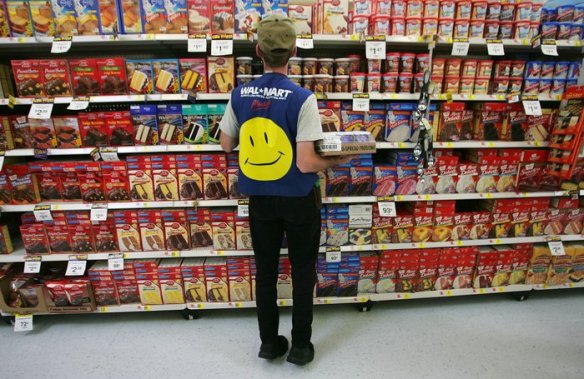
TROY, OH – MAY 11: An employee restocks a shelf in the grocery section of a Wal-Mart Supercenter May 11, 2005 in Troy, Ohio. Wal-Mart, America’s largest retailer and the largest company in the world based on revenue, has evolved into a giant economic force for the U.S. economy. With growth, the company continues to weather criticism of low wages, anti-union policies as well as accusations that it has homogenized America’s retail economy and driven traditional stores and shops out of business. (Photo by Chris Hondros/Getty Images)

By Daisy Luther

Source: Waking Times

In the United States, we are lucky to have massive convenience at our fingertips. I was talking to one of the instructors for the urban survival course, who is from Sweden, on a car ride. He was blown away by some of the things I told him about the levels of convenience and comfort in the United States. Things I completely took for granted don’t even exist there. I thought some of you might be interested in hearing about some of the insights we discussed.

Before I left for the course, I was walking my dogs a mile or two every day with my dogs, but that was about it. I thought it was enough but I learned during the field exercises that it wasn’t even close to the physicality required during an SHTF situation. But I digress. Let’s get back to convenience.

A caveat before people respond indignantly and tell me about all the inconvenience with which they deal every day: this is an opinion piece. Obviously many people in America still work out hard and have manual jobs. But when two-thirds of American adults and 30% of American children are overweight or obese, you have to see that you are not in the majority.

And it’s the majority here that I’m discussing. Between a combination of low-quality food and extremely sedentary lifestyles, the majority are killing themselves with convenience.

The American Culture of Convenience

The first thing that struck me when I landed in the Balkans was how different their lifestyle is from ours in the United States. But the longer I’ve been here, the more obvious it has become.

In the United States, depending on where you live, everything is dropped in your lap.

Food can be quickly acquired by shouting your order into a microphone and driving around a building, all without you having to leave your car. And if you live in a larger town or city, with the advent of services like GrubHub and DoorDash, the food delivered to your home is no longer the domain of pizza chains. You can have your choice of practically any restaurant in town brought right to your door within 45 minutes.

But it isn’t just about food. Instacart offers pick-up services from a wide variety of stores, including places like chain grocers, Wal-Mart, and Target. All you have to do is drive up, let them know by phone that you’ve arrived, and pop your trunk. Poof. Your shopping is done. In some cities, you can even use services like Instacart to have these things brought to your door.

Amazon has brought us practically anything else we could want with two-day shipping, regardless of where you live in the country. Gone are the days of scouring half a dozen stores to locate the whatchamacallit you needed. A quick search on Amazon and One-Click ordering and it’s yours within 48 hours and you never moved off your comfy chair.

If you need to go somewhere you don’t even have to drive yourself or take public transit. Uber or Lyft will happily send somebody to pick you up and drive you anywhere you need to go for a reasonable price, and you can watch the approach of your driver from the convenience of your phone.

Entire billion dollar industries are evolving to make our lives more convenient and easy every single day. Imagine how stunned our hunter-gatherer ancestors would be to discover we don’t even have to leave the house to be clothed and fed in epic abundance.

We don’t walk much, either.

And speaking of drive-thrus and driving to the store to get your Instacart packages, we drive everywhere. Part of this is because of the way suburbia is developed. It’s rare to live in a neighborhood where you can walk to the market, the bakery, and the wine store. So instead of walking to get our goods, we drive there, dash in, and get back in our cars. Those in big cities probably walk far more than those in suburbia, and for those in the country, it depends if they actually have a place to walk and whether they’re taking care of a large property.

And if we’re not walking to run our errands, we’re not carrying stuff. We get as close as possible with our cars if heavy groceries need to be lugged in and we carry as little as we can if we’re heading somewhere. When you walk the dogs, you might take your phone and some poop bags but you’re generally not taking it as a training opportunity and strapping on a pack.

Then there are the stairs.

Even two-story buildings in the United States have elevators much of the time because everything, by law, has to be easily accessible to every person. (And no, I’m not saying that people in wheelchairs need to try to haul themselves up the stairs. I’m discussing a trend.) But it goes even further than that. Adding elevators to your home is a growing trend in both the United States and Canada. New home builders are including elevators in the original design of some homes.

On the other hand, in Europe, they don’t have elevators in many buildings with fewer than five floors. I walked up and down more stairs in the past month than I have in the past year at home combined, and I live in a three-story house.

And the list of conveniences that would blow the minds of people I met in the Balkans goes on.

It’s an agoraphobic’s paradise in the United States.

You can get all sorts of mobile services that come to your door – everything from hairstyling to dog grooming. Other people mow our lawns, clean our homes, service our vehicles, and take care of us in general. There are even people who hire others to walk their dogs. Some people definitely need help with physical tasks but able-bodied people should be able to do a little yard work, shouldn’t we? Especially if we’re preparing for some kind of apocalypse.

In many areas, things are perfectly level, the sidewalks are carefully maintained (because who wants to ask for trouble in our litigious society), and a slight incline is considered a “hill” that people avoid to make their dog walk a little easier.

You can get meal kits brought to your door with every single ingredient you need to make a gourmet meal, right down to the seasonings accurately doled out in little packages. You can have fresh fruits and vegetables dropped off at your door by your local CSA. You can get subscription services of all types with the delivery of things like cosmetics, fitness gear, food from exotic locales, wine, candy, home decor items, socks, and dog paraphernalia.

Looking at it from the perspective of the area where I’ve been spending time, it’s simply mind-boggling that all of these riches are brought to you at the click of a button.

And it’s killing us.

As I mentioned earlier in this article, the obesity rate in the United States is staggering. A lot of it is our food. Thanks to subsidization by the USDA, many of the foods that are cheap are highly processed with low-quality ingredients. The NY Times reports:

At a time when almost three-quarters of the country is overweight or obese, it comes as no surprise that junk foods are the largest source of calories in the American diet. Topping the list are grain-based desserts like cookies, doughnuts and granola bars. (Yes, granola bars are dessert.)

That’s according to data from the federal government, which says that breads, sugary drinks, pizza, pasta dishes and “dairy desserts” like ice cream are also among Americans’ top 10 sources of calories.

What do these foods have in common? They are largely the products of seven crops and farm foods — corn, soybeans, wheat, rice, sorghum, milk and meat — that are heavily subsidized by the federal government, ensuring that junk foods are cheap and plentiful, experts say.

Between 1995 and 2010, the government doled out $170 billion in agricultural subsidies to finance the production of these foods, the latter two in part through subsidies on feed grains. While many of these foods are not inherently unhealthy, only a small percentage of them are eaten as is. Most are used as feed for livestock, turned into biofuels or converted to cheap products and additives like corn sweeteners, industrial oils, processed meats and refined carbohydrates. (source)

And even when we try to clean up our diets, foods are genetically modified, produce is doused in pesticides, and it’s packaged in all sorts of hormone-disrupting material that leaches in when you heat it up.

But it’s not just the crappy food. A lot of folks in the United States just do not get off their butts. And – I hate to say it – but I’m talking to a lot of people in the survival and preparedness world. Sitting at a keyboard or phone typing all day while Netflix plays in the background is sedentary to a deadly degree. On average Americans sit for 8.2 hours per day and this does not include the average 7-ish hours a day we’re sleeping.  And when we’re not sitting, it doesn’t mean we’re doing things that are good for us. We spend a great deal of time standing in line and driving in our cars. And the trend toward inactivity is only increasing.

Meanwhile, obesity contributes to many diseases such as:

  • High blood glucose (sugar) or diabetes.
  • High blood pressure (hypertension).
  • High blood cholesterol and triglycerides (dyslipidemia, or high blood fats).
  • Heart attacks due to coronary heart disease, heart failure, and stroke.
  • Bone and joint problems, more weight puts pressure on the bones and joints. This can lead to osteoarthritis, a disease that causes joint pain and stiffness.
  • Stopping breathing during sleep (sleep apnea). This can cause daytime fatigue or sleepiness, poor attention, and problems at work.
  • Gallstones and liver problems.
  • Some cancers.

The National Institute of Health is incredibly concerned about the future of overweight, sedentary Americans.

More recent evidence points to differential roles for body fat distribution patterns, in addition to excess overall adiposity, in elevating risk of many major chronic diseases. The large numbers of children entering adulthood overweight, together with increased weight gain in adulthood, portend an enormous burden in terms of human suffering, lost productivity, and health care expenditure in the coming decades. (source)

And – since it’s the purview of this website – imagine if the SHTF and you were too overweight and sedentary to go out and acquire the supplies you need to survive. Imagine what will happen when your medication runs out and you have a preventable disease brought on by your sedentary lifestyle. Imagine how your family will feel watching you suffer.

You need to add more movement to your life.

Unless you are among the 23% of Americans who meet the national exercise guidelines, you need to add more movement to your life. I suspect that there are a lot of people who believe they are disabled because getting started on a movement program is hard. It really does hurt, I know. But there’s a very good chance as you begin to move more it will become far easier. Don’t give in to it if your doctor says, “Oh, you’re disabled” and hands you a sticker for your car unless you really, truly are. If there’s even a glimmer of doubt in your mind, try to move just a few more steps each day. Instead of using the scooter to shop, push a cart to give yourself something to lean on. You aren’t training for a marathon – 10 extra steps a day will add up if you keep on pushing. But, MOVE.

The best way to increase movement is to decrease convenience. I don’t mean that you need to suddenly become a hunter-gatherer but you need to get off your duff. (To get started, check out this article or Bug Out Boot Camp and of course, always contact your doctor before beginning an exercise program. Blah, blah, blah.)

You need to carry heavy things instead of getting them delivered. You need to climb the stairs instead of taking the elevator or escalator. You need to actually go inside the store to do your shopping instead of sitting in your car, waiting for stuff to get loaded into your trunk. Park at the back of the parking lot, or better yet, at a store further away. Quit ordering from Amazon and buy things locally so you can walk around the store. Look for the hills and walk up and down them instead of avoiding them. If you want to eat restaurant food, go to the dad-gum restaurant. Find a place to walk to every day – maybe the post office, a coffee shop, or the dog park – and make it part of your routine.

It’s not unusual in other parts of the world to walk 8, 10, or even more miles, every single day. You don’t need to start there but maybe you should strive to get there. Once you’re in your groove, it should only take an hour or so to walk 4 miles. Using your feet as transportation is one of the healthiest things you can do.


Saturday Matinee: Koyaanisqatsi

Young Life Out Of Balance: The Impact and Legacy of ‘Koyaanisqatsi’

By Michael Grasso

Source: We Are the Mutants

Throughout the latter half of the 1970s, ex-seminarian/political activist Godfrey Reggio and cinematographer Ron Fricke shot, assembled, and edited film footage from all over the United States—from the yawning chasms of southwestern American deserts to the teeming mechanized metropolises of New York and Los Angeles—creating a feature film that would speak to the overwhelming complexity of late 20th century life in the West. This film, Koyaanisqatsi, debuted at American film festivals in 1982 and quickly became an arthouse (and eventual home video) favorite. The frequently eerie score for the film, composed by Philip Glass, provides the only aural accompaniment for this 86-minute montage showing the collision of nature and technology, of mankind and the planet. The word koyaanisqatsi, Hopi for “corrupted life” or “life out of balance,” provided a mission statement for the film; while Reggio has been cagey about not wanting to either imply or explicitly provide any specific meaning for the film, both the title and the Hopi prophecies of doom sung over the film’s final act make Koyaanisqatsi‘s point of view more or less explicit: something is dreadfully and fundamentally wrong with the way the settler inhabitants of America and the industrialized world as a whole relate to both the planet and themselves.

Koyaanisqatsi arrived with much fanfare as part of the PBS “Great Performances” anthology series in March of 1985. Given my love of all things PBS, I was absolutely there to see it in one of its initial broadcasts or repeats in ’85 or ’86. I’d heard about it most likely due to the hype around the film’s arrival on broadcast television for the first time. I do remember watching it at night, alone, possibly while my parents were out or in bed. When I found Koyaanisqatsi on a streaming service this year, I realized that I hadn’t watched it in its entirety since I was 10 years old. As I watched, I found myself thinking about how 10-year-old Mike responded to these overwhelming images. The process of meaning-making for a 10-year-old kid watching a film containing a sophisticated symbolic critique of modern life fascinated me. I decided to watch Koyaanisqatsi in 2019 with a close eye towards the images and sounds that had stuck with me subconsciously in the intervening third of a century, the sequences that offered today’s me a direct connection to my younger self. In childhood I was surrounded by films, cartoons, and other educational programming that transmitted the profundity and complexity of human existence and the universe directly into my growing brain. What did Koyaanisqatsi‘s sensory bombardment, its sometimes overwhelming contrasting of nature and technology mean to me then? And how did that meaning change for me as an adult, now fully conscious of and conversant with the issues Reggio raises?

It’s absolutely the first 15 minutes of the film that I remember most vividly from childhood. It begins with the juxtaposition of ancient petroglyphs at Horseshoe Canyon in Utah against slow-motion, almost abstract closeups of the Apollo 11 launch in 1969. This kind of meaning-through-montage connected with me on an intimate level at the age of 10; this was precisely the kind of respect for the pageant of human “progress” that electronic media teachers such as Carl Sagan had inculcated in me in my early years. Sagan did not necessarily privilege the Western, “scientific” worldview in his works; understanding that the ancient astronomers of the American West were precisely as clever as their European and Asian counterparts was an important part of Sagan’s pedagogy. And in this sweeping montage of the natural environment of the American West, Reggio offers a simultaneously calming and stunning view of the untouched majesty of nature. This is the same “blank screen” of desert that would thrill Baudrillard during his sojourn in North America at about exactly the same time. Even on a relatively tiny 1980s television screen, these aerial shots were breathtaking; it wouldn’t be until I first saw an IMAX projection in 1987 when the Omni Theater opened at Boston’s Museum of Science that I felt something similarly awe-inspiring.

These images of nature and the elements—earth and clouds and crashing waves—soothe the viewer; Glass’s musical accompaniments for these sections are tellingly titled “Organic” and “Cloudscape.” But just as we are lulled into a sense of security and a naturally human sense of awe at the landscape, Reggio (and Glass) throw us violently out of our idyll, showing us what man has done to these landscapes. We see engineering on a massive scale: strip mining, power plants with huge cooling lakes, massive dam projects. Glass’s hectic, pulsing aria, titled “Resource,” says it all. Natural rhythms and flows are subsumed under black clouds of pollution from earth-moving equipment; natural landscapes carved by millions of years of river and wind are carved into regularly-repeating, Cartesian geometry. “Resource” is horrifying, punishing: every trumpet blast announces the coming of something horrible. Again I am reminded of Cosmos: Sagan opines in Episode 5, “Blues for a Red Planet,” where Sagan imagines how an alien species will be able to determine that an intelligent species inhabits Earth—by how we change and adjust our natural environment. To Sagan, this is a largely joyful sign of our ingenuity and a necessary contrast with the natural “canals” of Mars. To Reggio, these marks are a constant, painful scarring, and his depiction of them on-screen has an immediate and negative emotional impact on the viewer, even a young one. Pollution was, of course, something I’d been made aware of from an early age: not just from the constant bombardment of PSAs on television, but from the plumes rising from the smokestacks every time I’d cross the Tobin Bridge in the family station wagon to go into Boston.

For much of “Resource” we are denied the opportunity to see sky: despite the grandeur of the landscapes, the camera angles and editing completely remove the context of said landscape with its cycles with nature and climate. The only blue we are offered is the reflection of the sky in the slightly sinister pools of the power plants’ cooling waters. And it’s here that we start to see humans for the first time as well, first dwarfed by the enormity of the dams and power plants around them, then briefly a few individuals populating the background of a sequence in a metal foundry. These figures are the reason behind all the scarring and carving of industry. Here is mankind. The glowing metal of the foundry reminds us of the original technological myth: fire tamed by Promethean man.

And there Reggio brings forth the myth’s ultimate expression: nukes. Stock footage of nuclear explosions would not be a symbol that needed much in the way of interpreting for a 10-year-old still scared bone-deep of the prospect of nuclear war. In this section we begin to see how all of these technological “advances” impact humanity. We see beachgoers enjoying a hot sunny beach—but with a huge looming power plant behind them. We see the mighty Boeing 747 taxiing on a runway, another testament to human ingenuity—sheathed and shimmering in an uncanny petroleum haze. Highways and cloverleaf overpasses are shown, overflowing with traffic; new cars are lined up in a holding yard, soon juxtaposed with Soviet tanks, American fighter jets, ICBMs, and more Apollo footage. Production and consumption, the war machine, and the nuclear arms race: all part of the same insane global system. The film footage of cluster bomb blasts, de rigueur as a signifier of the American war machine since the days of Vietnam and thus intimately familiar to 1985 me from various expressions on television and in pop culture, have a new and shocking impact when shown as part of the unnatural system that digs resources from the ground and turns them into immediate, instant death.

For many, the segment near the center-point of the film where the viewer is treated to an aerial survey of the abandoned Pruitt-Igoe housing projects in St. Louis is the film’s most brutal and emotional. Bookended in Koyaanisqatsi by other images of the failure of social housing in the South Bronx, and very much of a piece with the worldwide midcentury penchant for Brutalist “urban renewal”, the tale of Pruitt-Igoe would be resolutely familiar to an adult in the early 1980s. For me at 10, a sheltered white kid who’d grown up entirely in the suburbs, the sequence’s eerie ruined majesty held complete mystery. What were these huge repeating buildings shaped like boxes? Why were they in such disrepair? And why were they being totally and completely annihilated with explosives in such a dramatic fashion? I was insulated through much of my youth (by express design of the white power structure, as it turns out) from the living and educational conditions of Black Americans in both my own home city of Boston and around the country. The wages of centuries of American apartheid were nothing but a vague unease at the periphery of my consciousness. The power demonstrated in both choosing to build and choosing to destroy these buildings, over a period of a mere three decades—little more than one human generation—was accurately and shockingly conveyed by the film, but its ultimate meaning was lost to me. As an adult, with all the context and knowledge present upon my re-viewing of the film, “Pruitt-Igoe” stands as a testament to midcentury liberalism’s best intentions, naturally sabotaged by the white violence inherent in American capitalism. This is the one sequence of Koyaanisqatsi that I look back on today and wish I’d had an adult—a wise, sensitive adult—to guide me through.

At the film’s halfway point, we really begin to see mass man. At first in slow motion, urban crowd “B-roll” shots of a type I would have been intimately familiar with from television in 1985, shot in slow-motion, cut with close-ups of individual human beings in front of vivid backgrounds: the whooshing of an urban subway, a military officer in front of a jet engine, a group of casino workers with the lights of Las Vegas flashing behind them. In a concerted way, these “portraits” arrest us as viewers after the sensory assault of the first 40 minutes of the film, getting us to begin seeing the individuals behind the mass movements and incomprehensible destruction we’ve seen so far. As an adult I find them almost unbearably poignant; I found myself wondering what happened to all these folks after Reggio and Fricke finished filming them. As a kid, their slightly outdated fashions (from the mid-to-late-’70s, by the looks of it) consigned them to the more recent past of the only context I could understand: sitcom reruns in syndication, that forever-lagging-behind-the-present that ensured I was in some ineffable way a nostalgic even at the age of 10.

“The Grid” is the section of Koyaanisqatsi where Reggio and Fricke first use time-lapse photography for, I would argue, its greatest achievement in film history. As much as we’ve been given a key to understanding the impact of technology and so-called progress on the natural world, this section, full of glittering cityscapes and the pulsating grid of traffic in Los Angeles at night, are heartbreakingly beautiful. The flow of traffic through midtown Manhattan, so expertly regulated by traffic lights, is yet somehow unnatural; these highway and street scenes, sped up, remind us (and certainly would have reminded the young me who’d grown up with educational programming) of microphotography of blood cells in arteries and capillaries, but somehow off: constantly halting and resolutely inorganic. In contrast, one of the film’s trademark shots (featured on the home video box and posters) of the moon’s movement through the sky as it is eclipsed by an office block is so sure in the lens of Fricke’s innovative time-lapse cameras, so machine-precise, far outstripping in elegance and power the stuttering processes of automobile and pedestrian traffic regulated by human-created technology.

Possibly the most homely, familiar, and comforting section of the film involves the juxtaposition of manufacturing, industry, and food processing with the crazy-quilt of consumption that completes industrial capitalism’s cycle. Hot dogs and Twinkies, blue jeans and televisions and automobiles roll off of assembly lines; as an adult in 2019 all I could think was “look at all those human workers!” There were so few robots in sight in each of these sequences, and the factory workers themselves looked so humble yet so proud. I also thought back to me at age 10, and how Mister Rogers’ Neighborhood would have primed me to look at these time-lapse sequences of production as something wondrous, something to be proud of. The flip side of all this production is seen in Koyaanisqatsi‘s views of Americans enjoying their leisure time: playing video games (I spotted Ms. Pac-Man, Q*bert, and Defender among many other video cabinets in the arcade sequence), bowling, going to the movies, visiting the mall food court, and especially watching television. The time-lapse photography zips through banks of televisions airing the prime-time advertisements and network news breaks of the kind I’m obsessed with and hunt down on YouTube in 2019. As a kid, this would have been the segment of the film that would’ve been the most immediate and identifiable to me. The people in these sections looked like me: they were suburban, not urban, dressed in casual clothes, not hats and suits and trenchcoats. They were young! There were younger kids sipping on milkshakes and having burgers with their families at the mall. These people were me. Did I understand how my consumption made me an accomplice to the black billowing smoke and scarred landscapes seen earlier in the film? At that age, I’m sure not.

Reggio always returns to people, not only to give the viewer (whether 10 years old or 43 years old) that sense of identification, a sense of their stakes in the modern “life out of balance,” but to return to the dignity of the individual human being. Reggio’s intellectual origins both in post-Vatican II Catholic conceptions of social justice and human dignity as well as Christian eco-anarchism demands this kind of attention to the individual humans behind these teeming visual landscapes. The final sequence is titled “Prophecies.” Glass’s musical accompaniment for this final sequence features a chorus singing three Hopi prophecies, interpreted by academic consultants Michael Lowatewama and Ekkehart Malotki, and translated on-screen at the end of the film. These prophecies are ones that would be familiar to anyone raised in the Western Christian tradition: tales of the death of the world thanks to mysterious poisons falling from the sky. As the choir chants these predictions of chaos and confusion, we see people wandering the streets, crushed by their surroundings: a homeless man gazing down at the change in his hand, a sick man put onto a litter by EMTs, someone in a hospital with a bloody wound resulting from an intravenous injection of fluids. The combination of Hopi prophecy on the soundtrack with the kind of lost people that Christ tried to minister to is devastatingly effective; even as a child, this section evoked pity and empathy in me rather than the disgust from seeing out of control pollution or technology. Bookending this is a lengthy sequence in slow-motion of an Atlas-Centaur rocket disaster, one of its thrusters tumbling back to earth slowly. The name of the star might have been Wormwood, but a year after this PBS airing, both a Challenger disaster and a nuclear disaster at another Wormwood half a world away would offer yet another Promethean lesson to both the U.S. and the Soviet Union.

I can’t remember exactly what I felt like immediately after viewing Koyaanisqatsi all those years ago, but its indelible images and sounds remained firmly in my subconscious all through my adolescence and adulthood. Now I’m middle-aged, the same age as all those scurrying New York City businessmen who seemed so weirdly uniform and alien to me as a kid. As I watch now, I of course am able to see that we are all lost in the life out of balance now. I wouldn’t call Reggio prophetic because anyone with eyes to see and ears to hear knew what was happening to us in the years since the end of the Second World War. And while art can absolutely point out injustice, fraud, exploitation, and abuse, it can very easily be used to recuperate these ideas into a more comfortable idea of the inevitability of “progress.” I don’t feel like any later misuse of Reggio’s praxis is his fault per se; whether or not he expressly provides meaning for us, his words and actions in the years following Koyaanisqatsi‘s release are clear and obvious.

I’ve never bothered to watch the two “Qatsi” sequels released in the years following the original. Their dual focuses were on life in the developing world and “life as war,” focusing on the modern world’s war with itself over technology. I’m not sure if they could achieve the mythic status and impact which Koyaanisqatsi had on my developing brain as a kid. Was 10 years old too young to consider these kinds of issues of modern life? I’m not sure. All I know is that I’m grateful I was given the opportunity to internalize these images and thoughts, to consider my place on a planet, both blessed and cursed by my surroundings, to ponder my role both as an individual and as part of a societal collective. While the televisual instruction of my childhood idols Sagan and Rogers may have in some small part normalized the mindset that brought us to this point (all while being steadfast advocates of social justice and peace, of course), Reggio’s camera, untouched by words, conveys the meaning of this life out of balance directly, resolutely, fearlesssly. A prophet Reggio himself may not be, but his filmic prophecy, and through it the prophecy of the Hopi, lives on.


Watch the full film on Kanopy here: https://www.kanopy.com/product/koyaanisqatsi