An Introduction to Technofeudalism Ascending

feudalism-then-and-now-hierarchy.jpg.w560h467

By SARTRE

Source: BATR.org

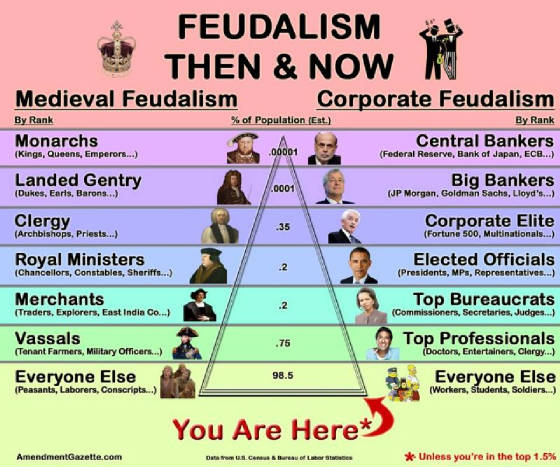
The future of the planetary Reign of Terror has never been clearer. The pattern for global governance has been set into motion and operates under a model that has been used throughout much of history. The modern day version of command and control can be effectively described as Technofeudalism. The purpose of this introduction is to provide an outline of the arguments used by Steven Yates, Ph.D. The link to this significant treatise is provided below. In addition News With Views maintains an extensive archives of Dr. Yates’ work. Invest the time to read the entire essay for a full understanding of the linkage behind Technofeudalis and the course for top down dominance.

Technofeudalism Ascending comprises nine sections. Dr. Yates provides the following preface.

My book Four Cardinal Errors (2011) introduced the idea of technofeudalism. Though a bit of a mouthful, this is the best term for the political economy towards which an intergenerational superelite has been directing as much of the world as possible for at least a century. This existence of this group, I argue, is the foremost political-economic reality of our times.

Their goal, I argued in Four Cardinal Errors, is to institute corporate controlled global governance: de facto world government, managed for private profit and for control over national governments and populations. Technofeudalism is the resulting political economy. While preserving some of the vocabulary and outward features of market capitalism, technofeudalism has almost nothing to do with free markets, or free enterprise, as generally understood. It is about instituting whatever policies, instigating whatever wars, bringing about whatever revolutions, and causing whatever levels of misery are deemed necessary for enforced mass compliance. Its tools include both neoliberal and neoconservative ideology, artificial scarcity, education reduced to job training, and fear induction through constant pontificating about “terrorism” amidst random and often-depraved acts of violence, reducing as many as possible to a status of permanently cash-strapped, mentally paralyzed subjects — living amidst the most advanced technology in human history, but equivalent to serfs (“owned” as de facto property by “their” governments, employers, etc., as in medieval feudal systems of old). Hence, the term technofeudalism.

Introduction:  Why Technofeudalism? (Technofeudalism is the best term for a kind of political economy that has been coming together very gradually for much of the past century, but accelerating in recent decades: it is technologically advanced but populations are controlled by various means and, in effect, made into serfs who are tied to whatever work they can find and to government programs. Technofeudalism is driven by those I call the superelite—a group of globalist-minded extended families whose primary motivation is wealth and power. It illustrates the primary problem of practical political philosophy and strategy: how to contain that minority in our midst that is drawn to power.)

  1. The End of History? (The collapse of the Soviet Union seemed to leave the world at a major turning point; Communism was dead, the combination of market capitalism and liberal democracy seemed to be catching on everywhere, and the U.S. was the sole superpower. It seemed conceivable that it really was, as Francis Fukuyama described, the end of history.)
  1. The Neoliberal Illusion.  (Things began to unravel almost at once, as trade deals such as NAFTA began to put an end to the largest financially independent middle class in history. Neoliberal ideology proved to have a dark side, as wealth began to be redistributed upward and millions of people ended up out of work.)
  1. Precariatization and the Destruction of the American Mind.  (Higher education faced multiple crises: rising radical left “scholarship” in the humanities, a rising corporate or business mindset in expanding administrations, the collapse of the academic job market creating conditions where control was possible, and the impoverishing of faculty via adjunctification, one species of the creation of a precariat — workers in an environment of part-time, temporary, and short term work. Liberal arts learning itself came under assault, as the thinking skills it provides threaten a political economy of power, domination, precarity, and corruption.)
  1. The Empire of Corruption.  (Ensuing decades have seen rising corruption and financial manipulation which eventually caused the 2008 meltdown and have brought about a steadily lowering of the standard of living in the U.S. Supreme Court decisions such as Citizens United ensure a bought-and-paid-for political class, and articles now appear in refereed journals indicating that the U.S. is now a plutocratic oligarchy.)
  1. The Global Corporatist Leviathan.  (If the present political system is plutocratic oligarchy, the correct term for the present economy is corporatism, with technofeudalism its broader political-economic-technocratic instrument. Poor education ensures a systematic confusion between capitalism and corporatism. Under corporatism, corporations are in the driver’s seat behind governments, as we can see from their latest effort to dominate a section of the world’s economy: the Trans-Pacific Partnership.)
  1. The New Serfdom.  (You are living in a feudal system when there is one set of rules for those with power and another set of rules for those without power, with only token representation. Technofeudalism emerges in that its subjects are technologically advanced serfs — surrounded by technology but tied to low-wage work or to a government-based support system.)
  1. “What Can We Do?”  (You can educate yourself on issues ranging from the possibilities of expatriation to that of peoples separating politically from empires, which may become possible as a very severe downturn, worse than the Great Recession — a Greater Depression — is almost certainly inevitable.)
  1. Preparing for the Greater Depression.  (The world is on the verge of having to face the realities of financialization that will bring on the Greater Depression. You can prepare by building proper skills now. It is conceivable that the global superelite is planning on a Greater Depression. You should prepare anyway.)
  1. Grounds for Hope: Real Sustainability and the Cycles of History.  (Technofeudalism will prove unsustainable. It may be put in place, but its structure and the mindset that gave rise to it will cause it to decay and eventually disintegrate. We have come this way before, as empires have risen and fallen before. This provides hope, in that with the collapse of the technofeudalist state, separation and the building of a world of small states will become possible — again if we begin to prepare now.)

This summary outline attempts to persuade the compelling case to review the entire critique. Filling in the connections and relationships to achieve the eternal objective of worldwide ascendancy in an age of technological supremacy, means that the return to a feudal society becomes the undeniable 21th century danger.

Technofeudalism is based upon herding marginal and unneeded humans into ghettos of subsistent serfdom existence. The technocrats who administer the process of dehumanization become the executioners of civilization. Utopia for the select, built on the misery of the masses is a future not worth living. This fact is exactly the objective of the globalist. Destroying resistance through marginalizing survival rules a feudal society. However, building the achievement of a renaissance culture is based upon the liberation of the human spirit and decentralization of authority.

The global elites depend on acquiesce of the masses to accept and adopt the tyrannical systems and indoctrination methods propagated by the technocratic matrix. Liberty is despised by authoritarians. Technofeudalism is the enemy of all human beings. Once armed with the knowledge of this threat, what will be the response of the populace targeted for slavery or extinction?


Life’s Most Important Dramas Are Being Disrupted

index

By Charles Hugh Smith

Source: Washington’s Blog

The idea that human life subdivides rather naturally into stages is based on our natural progression from childhood into adulthood and eventual (if we’re lucky) old age.

Confucian thought views life as a developmental process with seven stages, each roughly corresponding to a decade: childhood, young adulthood (16-30), age of independence (30-39), age of mental independence (40-49), age of spiritual maturity (50-59), age of acceptance (60-69), and age of unification (70 – end of life).

Each stage has various tasks, goals and duties, which establish the foundation for the next stage.

Each stage is centered on a core human drama: for the teenager, establishing an identity and life that is independent of parents; for the young adult, finding a mate and establishing a career; for the middle-aged, navigating the challenges of raising children and establishing some measure of financial security; for those in late middle-age, helping offspring reach independent adulthood and caring for aging parents; early old age, seeking fulfillment now that life’s primary duties have been accomplished and managing one’s health; and old age, the passage of accepting mortality and the loss of vitality.

The End of Secure Work and the diminishing returns of financialization are disrupting these core human dramas and frustrating those who are unable to proceed to the next stage of life:

1. Teenagers are being pressured to focus their lives on achieving a conventional financial success that is becoming harder to achieve.

2. Young adults without secure full-time careers cannot afford marriage or children, so they extend the self-absorption of late adolescence into middle age.

3. The middle-aged are finding financial security elusive or out of reach as they struggle to fund their young adult children, aging parents and their own retirement.

4. Increasing longevity is pressuring the late-middle-aged’s stage of fulfillment, as elderly parents may require care even as their children reach their own retirement (65-70).

The financial pressures generated by the demise of financialization and the End of Secure Work are not just disrupting each stage; they are upending essential financial balances between the young, the middle-aged and the old.

The elderly, protected by generous social welfare benefits paid by current taxpayers, also benefit from the soaring value of assets such as real estate and stocks. Meanwhile, financialization’s asset bubbles have pushed housing beyond the reach of most young people.

Downsizing, lay-offs, low-paying replacement work and poor decisions to buy houses near the peak of the prior bubble have left many of the middle-aged with high fixed costs and a stagnant or increasingly insecure income.

The stresses of trying to make enough money to afford what was once assumed to be a birthright–a “middle class” lifestyle–is taking a heavy toll on the mental and physical health of the middle-aged, leaving many of them too tired for any fulfilling activities and easy prey for destructive self-medication.

This erosion of opportunities to complete life’s stages and core dramas is gradual, and rarely recognized, much less addressed. We are constantly bombarded with messages to innovate, keep up, be fulfilled, etc.–essentially impossible demands for those with multiple generational and/or business duties.

The most productive response to these financial disruptions is to focus not on what’s scarce and fraught with intense competition (the top 5% slots of conventional financial security) but on what’s still abundant, which is opportunities outside conventional hierarchies, ways of reducing fixed costs and life-skills that are entrepreneurial, adaptive and fulfilling.

When I talk about the Mobile Creative class, I’m not talking about a finance-centric definition of success or a path to join the top 5% in Corporate America and the government. The herd is chasing those dwindling slots, too, guaranteeing frustration and failure for the 95% who won’t secure one of those slots.

What we’re really discussing is a way of living that places a premium on independent thinking, maintaining very low fixed costs, establishing a healthy honesty with oneself and one’s associates and customers, the ability to make realistic assessments of oneself, one’s successes, failures and errors, and a focus on challenges, opportunities, risks, adaptability, flexibility and experimentation, all with a goal of building one’s own human, social and physical capital–the foundations not just of well-being but of any meaningful measure of independent, real wealth.

Economic grace of ‘Social Credit’: national dividend with compensated retail prices for consumer goods distribution in an age of technology

quote-at-the-present-time-the-alternative-is-not-between-change-or-no-change-but-between-change-c-h-douglas-77-2-0224By Wallace Klinck

Source: The Daily Censored

“The unacknowledged, but obvious, truth is that unnecessary work, imposed by either edict or contrived financial legerdemain, is slavery and servitude—totally irrational and immoral.  Every engineer worthy of the name is trying to eliminate the need for human effort as a factor of production while every witless or hypocritical politician, pressured by the financial powers above and an insecure and uncomprehending population below, is professing, at least, to promote policies designed to ‘put people back to work.’” (from the below article)

Five minute video of Major C.H. Douglas, founder of Social Credit (1934):

Because of its deleterious impact on personal freedom and initiative, centralization of both economic and political power is the critical issue facing society. The primary obstacle to reversing this growing concentration of power is an almost universal ignorance of the manner in which the existing financial system renders the price-system increasingly non-self-liquidating, making impossible the recovery of industrial production costs through sales. Institutions and individuals attempt to resolve this problem by resorting to bank debt, thereby obtaining access to the products of industry by the self-defeating expedient of mortgaging our future–i.e., transferring these costs as an exponentially growing debt charge against future cycles of production–and by engaging in an orgy of wasteful and destructive activities, effectively culminating in continuous war.

Their monopolistic proclivities disincline both Finance-Capitalism operating under the Monopoly of Credit and every form of collectivist organization (e.g., socialism, communism or fascism) from grappling with this problem.  The solution must entail an appropriate modification of the existing financial-credit and price system so as to properly facilitate distribution of the immense output of modern technology-based industry, in the context of expanding leisure.

Nearly a century ago this emergent challenge was studied in depth by the British engineer Clifford Hugh Douglas, who not only analyzed the defects of the existing price system as it functions under present financial and industrial cost-accounting conventions, but also put forward realistic remedial proposals.  Between and for a period after the World Wars, Douglas’s ideas, which he named “Social Credit”, attracted large numbers of adherents and spawned many political movements in countries around the world.

Douglas recognized that life is more than bread alone and that in order to attain his full stature man must be released from unnecessary material concerns in order to make time for matters of the Mind and Spirit. This clearly was inherent in certain much-neglected aspects of the message of Jesus, who explicitly stated that lack of faith is the reason for our obsession with toiling our own way to material survival. Jesus asked how we could doubt that God, who provides for the fish and birds and the beasts, knows our needs and will provide even better for us. On more than one occasion Jesus unconditionally distributed loaves and fishes to crowds that had gathered to hear him. To indicate how reality operates outside of puritanical human notions of morality, Jesus pointed out that his heavenly Father causes the sun to rise on the evil and the good, and lets rain fall on both the just and the unjust.

An aspect of this divine caring is the ability we have been given to accumulate understanding of natural laws, which has resulted in an endless extension of “mechanical advantage”—termed by Social Crediters the Unearned Increment of Association—from which has emerged our amazing modern technology with its outflow of material abundance. Through learning how to associate effectively in the areas of both human endeavours and material resources, we have multiplied our productive capacity many thousands, if not millions, of times over.  The historical aggregation of Unearned Increments has provided the vast Cultural Heritage upon which we all so greatly, if unconsciously, depend.

This is the background of why Social Credit came to be perceived by its leading thinkers as “practical Christianity”. Although Douglas did not set out to design it as such, ongoing development of Social Credit thought has revealed it to be uniquely consonant with and revelatory of the assurances given by the founder of the Christian faith.

This realistic perception of our situation is absent from the major ideologies of our time.  For example, Libertarians promote the notion that the individual must “make it on his/her own”. No one today (apart maybe from individuals lost in the wilderness) is doing this; all have the benefit of the Cultural Heritage, which ties us in a web of dependencies not only with our contemporaries but also with previous generations.

Socialism, which calls for State ownership and administration of the means of production—the central planning of the economy and of human activity—similarly endeavors to alienate people from their heritage.  Besides specifically attacking the very principle of inheritance, Socialists force the energies of the members of society into mandatory employment in projects prescribed by the State. Suppression of individual initiative is an inevitable result of this constraint of access to the possibilities afforded by the richness of the Cultural heritage. This observation applies to all forms of “socialism”, whether national or international in nature.

Social Credit is the inverse of socialism and a negation of finance capitalism.  Many persons have it in their minds that a sharing society necessarily is socialistic; i.e., power centralizing. Presumably they think this way on the erroneous assumption that the sharing will be accomplished by redistributing existing wealth by means of various confiscatory forms of taxation.  However, Social Credit, uniquely, stands not for redistribution of earned incomes, but rather for distribution of consumer goods at source as they emerge from the production line.

Douglas enunciated and stressed the truism that production without consumption is sheer futility and waste.

The fundamental task of economic policy is to match and balance the cycles of consumption and production.  Producers’ costs cannot be recovered without money received from consumers, whose incomes alone provide business its means to liquidate all financial costs of production.

In order to effect this balance, Douglas recommended that National (Consumer) Dividends and Compensated (lowered) Prices at point of retail sale must be provided and financed by a Government Agency (created or existing, whatever is most efficient and convenient) with funds not derived from taxation but drawn down from a properly constructed National Credit Account.  This would be a continuously updated actuarial accounting of the nation’s real credit, being an inventory of all those resources which are available to be used for production and which, if so used, may result in the making of financial prices.

Unfortunately, the public are conditioned to reason from the false assumption that the economic “pie” is limited to the financial incomes paid out in production, and hence they perceive this as the only possible source of funding. This assumption includes the erroneous corollary that the price-system is self-liquidating; i.e., that incomes paid out as wages, salaries and dividends are not only equal to, but available to meet, the total financial costs of production. That this is a major fallacy is readily proved by the enormous accumulation of inflationary private and public debt created as loans by the banking system, which allows goods to be purchased after a fashion but does not liquidate their financial costs of production in a synchronized fashion.  As a kind of stop-gap expedient, these loans merely transfer these costs into the future, to be liquidated with income derived from later cycles of production unrelated to the cycles in which they were incurred.

The physical (i.e., real) costs of production are met as production takes place. Obviously, if this were not the case, production could not proceed.  This is self-evident and axiomatic. When goods are produced in finished form they are meant to be used and should be immediately available to the overall consuming public in toto and without entailing any residual financial debt.

This universal piling-up of debt is bogus and is required only because price increasingly includes, as real capital replaces labor as a factor of production, allocated charges in respect of real capital which are not distributed as income in the same cycle of production. Consumer income is cancelled prematurely, leaving a growing deficiency of income relative to the total prices of goods awaiting purchase. In other words, the flow of final prices increasingly exceeds the flow of effective financial purchasing-power. Purchasing-power is prematurely cancelled in respect of still existing real capital, whereas it should be cancelled only at the rate of actual physical consumption or depletion.  Money should be issued at the rate of production and cancelled at the rate of consumption

In the face of this predicament, we can simply forgo acquisition of these goods, leaving the producer no option but to warehouse or destroy them and go bankrupt—making his endeavors a mindless exercise in futility. Or we can ensure that, while required remaining actual “workers” (i.e., recipients of remuneration from others for services rendered) continue to have the benefit of their earnings, all citizens, workers included, have access to the full output of industry by being provided adequate aggregate purchasing-power to make this possible.

Besides being a practical necessity, such an arrangement recognizes the share all have in the almost fantastic Cultural Heritage of Civilization. In a Social Credit dispensation, Inheritance would be generalized.

In stark contrast is the socialist attitude, which is that inheritance is evil and should be abolished.

Social Credit stands most definitely, unashamedly and unabashedly, for a sharing society—and as labor is increasingly reduced by technology it would become more sharing with the passage of time. Unlike Socialism, which in reality has always been more about centralized control than about sharing, Social Credit does not involve State ownership, planning or administration of the economy or of social organization as such. By giving people as individuals full access to the ever-increasing abundance made possible by technology and to concomitant economic independence, it is in fact highly decentralizing.

The rational purpose of technology is to eliminate inefficiency, and “jobs” concocted merely for the sake of distributing incomes are precisely that—mere wasted energy and materials.  The solution to the problem of economic insecurity in the modern age of super-production does not lie primarily in “making” work, but increasingly in facilitating

distribution.  Those who clamor for “jobs” actually visualize a model along the lines of fascist and communist states, which give and demand of everyone endless work throughout their lifetime, in accordance with the rather suspect dictum that “work will make you free”—but not until you die.

The unacknowledged, but obvious, truth is that unnecessary work, imposed by either edict or contrived financial legerdemain, is slavery and servitude—totally irrational and immoral.  Every engineer worthy of the name is trying to eliminate the need for human effort as a factor of production while every witless or hypocritical politician, pressured by the financial powers above and an insecure and uncomprehending population below, is professing, at least, to promote policies designed to “put people back to work.”

Frankly, if I desire “work”, then I want to do it by my own choice and at my own leisure, increasingly freed from the enforced conformity and servitude of the existing system.

We should not be striving to provide more, and more, human work but rather more technological productive efficiency with augmented effective consumer purchasing-power capable of eliminating consumer debt and liquidating industrial costs in a timely manner.  Let robots do the work.  Tirelessly and without complaint, they perform the vast majority of it better than people can.

You want more work?  Then let’s have another war—or, better yet, continuous wars until we end up destroying the whole planet or all life upon it.

Indeed, the flaws in the current financial system provide a constant incentive for military war, which normally is just an extension of economic war. Unbalanced international trade is driven by the increasing inherent orthodox need to export—not to receive an equivalent of real wealth in return, but to capture financial credits from other nations to compensate for the internal intrinsic deficiency of consumer purchasing-power that exists in the domestic price-system of every nation.

Anyone who does not understand this compulsive destructive dynamic of the modern financial-economic system is totally unqualified even to comment on our economic position.

The abundance that technology makes possible should set men and women free from physical want, increasingly enabling them to choose independently and without duress their preferred activities in life. As opposed to the ubiquitous Keynesian, cognitively dissonant, counterfeit socialist concept of “economic democracy” as a centralized administrative proletarian Work-State, Social Credit gives real meaning to the concept of economic democracy by favoring a consumer-motivated system of production.

C. H. Douglas stressed the importance of understanding policy by tracing its pedigree.  From a metaphysical standpoint, Social Credit would be a practical, physical incarnation of the Christian Doctrine of Salvation by Unearned Grace—in contradistinction to the prevailing Judaic conception, and system, of Salvation through Works. The current financial system is predicated upon a materialist philosophy characterizable as do ut des,  meaning “this for that”—in other words, that nothing can be obtained except it be earned, that, as the saying goes, “There is no free lunch”. It is the underlying principle of the madness-inducing doctrine of “Salvation through Works”.

Hence, the existing financial system issues money only as debt for production and never for consumption, except in the latter case as debt which must be acquitted by future work This policy of issuing money only for work might have had some basis in equity in the primitive economy where production was primarily due to human effort. It makes no rational or moral sense whatever in the modern highly technological economy where non-human factors of production predominate and human intervention becomes increasingly a mere, although essential, catalyst within a vast productive complex.

Social Credit coheres profoundly with the Christian philosophy of Salvation through Unearned Grace–Grace being an outright gift from God. Spiritual Grace has, or should have, a physical counterpart, or incarnation, in the economic or material realm. Thus, from this philosophical standpoint access to consumer goods and services should increasingly be justified not by work alone but rather by the individual’s share in an inalienable inheritance of the communal capital that has accumulated over the ages.  The effect of growth of our historic Cultural Heritage has always been to advance the potential for faster, more diversified and less wasteful productivity, with an accompanying potential for enhanced human leisure.

Christian philosophy holds that it is a major sin to make an end of a means. The rational purpose and end of production is consumption, not to create work (a means). An economic system should provide goods and services for mankind as efficiently as possible with minimal trouble and effort for all concerned.

One might ask how it is possible for a nation such as the United States of America, professedly predicated upon Christian principles, to base its entire economy and social structure upon a financial system that is a total inversion of those principles. A clue to this strange contradiction may be found in Douglas’s observation that Finance and the Established Media are concentric. As a result, he said, society has been hypnotized, with the consequence that only a drastic de-hypnotization can save it.

If society can pursue a continuous, destructive, malevolent and malignant policy of devastating the continents and populations of foreign nations, then surely we can easily pursue instead the civilized alternative of providing (Consumer) Dividends and Compensated (lowered) Retail Prices to support a secure and leisured life for our citizens.  Under the existing iniquitous financial system we are driven to deliver those potential Dividends to other nations in the form of bombs.  This would appear to be insanity by any rational criterion, but it satisfies the overarching irrational one of providing plenty of “jobs” and “incomes” (not to mention “profits”)—albeit at the additional cost of stupendous physical waste, human suffering and a massive, exponentially expanding financial mortgage burdening our future.  This too would appear to be insanity, but apparently not to members of the banking fraternity, which finances it all with conspicuously detached equanimity.

Surely the time is long past when individuals and nations should have stopped “fighting” amongst themselves and instead concentrated their intelligence, energies and talents on demanding reality-grounded financial and economic policies.

I hope that the above commentary may help to clarify some of the major questions and issues often raised about Social Credit.

Dr. Oliver Heydorn has recently published a major informative book, comprehensively incorporating C. H. Douglas’s essential ideas. Refer:  http://www.socred.org

See also:

https://en.wikipedia.org/wiki/Social_credit

http://social-credit.blogspot.ca

http://www.socialcredit.com.au

http://socialcredit.schooljotter2.com

___________________________________________________________

The author was born during the so-called “Great Depression” when in 1935 the historic election of the world’s first “Social Credit” Government in the Province of Alberta, Canada startled the pundits and alarmed the global financial powers.  In later years he became acquainted with several Cabinet Ministers of that Government.  His close mentor was Mr. Leslie Denis Byrne, O.B.E., a British actuary and technical expert in Social Credit who was sent, with a colleague, from Britain by C. H. Douglas to advise the fledgling new Provincial Administration. The author holds baccalaureate degrees in Arts and Education. In Arts, he majored in political science, and minored in economics. In Education, he majored in social studies, secondary route.

Appreciation is expressed to Robert E. Klinck, M.A. for his considerate and patient assistance in editing this essay.


Breaking the chains: precarity in the Age of Anxiety

breaking-the-chainsBy Joseph Todd

Source: RoarMag.org

In our Age of Anxiety, society assaults us from every possible angle with an avalanche of uncertainty. How do we fight back under conditions of precarity?

­An Age of Anxiety is upon us, one where society assaults us from every possible angle with an avalanche of uncertainty, fear and alienation. We live with neither liberty nor security but instead precariousness. Our housing, our income and our play are temporary and contingent, forever at the whim of the landlord, policeman, bureaucrat or market. The only constant is that of insecurity itself. We are gifted the guarantee of perpetual flux, the knowledge that we will forever be flailing from one abyss to another, that true relaxation is a bourgeois luxury beyond our means.

Our very beings come to absorb this anxiety. We internalize society’s cruelty and contradiction and transform them into a problem of brain chemistry, one that is diagnosed and medicated away instead of being obliterated at root. All hope is blotted out. Authentic experience, unmediated conversation, distraction-free affection and truly relaxed association feel like relics of a bygone era, a sepia dream that perhaps never existed.

Instead we have the frenetic social arenas of late capitalism: the commodified hedonism of clubs and festivals, express lunches, binge culture and the escapist, dislocating experience of online video games, all underlined by either our desperate need to numb our anxieties or to create effective, time-efficient units of fun so we are available for work and worry.

This is assuming we have work, of course. Many of us are unemployed, or are instead held in constant precarity. Stuck on zero-hour contracts or wading through as jobbing freelancers in industries that used to employ but don’t anymore, we are unable to plan our lives any further than next week’s rota, unable to ever switch off as the search for work is sprawling and continuous.

And if we do have traditional employment, what then? We are imprisoned and surveilled in the office, coffee shop or back room, subject to constant assessment, re-assessment and self-assessment, tracked, monitored and looped in a perpetual performance review, one which even our managers think is worthless, but has to be done anyway because, hey, company policy.

Continuous is the effective probationary period and we are forever teetering on the edge of unemployment. We internalize the implications of our constant assessment, the knowledge that we’re always potentially being surveilled. We censor ourselves. We second-guess ourselves. We quash ourselves.

And thanks to the effective abolition of the traditional working day, work becomes unbearable and endless. The security of having delineated time — at work and then at play — has been eradicated. Often this is because individuals have to supplement their atrocious wages with work on the side. But it is also because traditional 9-to-5 jobs have suffered a continuous extension of working hours into out-of-office time, enabled and mediated by our laptops and smartphones. These gadgets demand immediacy and, when coupled with the knowledge that you are always reachable and thus available, they instill in us a frantic need to forever reply in the now.

And with this expectation comes obligation. Hyper-networked technologies gift our bosses the ability to demand action from us at any moment. Things that had to wait before become doable — and thus are done — in the now. If you are unwilling, then someone is ready to take your place. You must always be at their beck and call. From this, our only refuge is sleep, perhaps the last bastion of delineated time against frenetic capitalism, and one that is being gradually eroded and replaced.

For those that are out of work the situation is no better. They face the cruel bureaucracy of the Job Centre or the Atos assessment, institutions that have no interest in linking up job seekers with fulfilling employment but instead attempt only to lower the benefits bill through punitive, arbitrary sanctions and forcing the sick back to work. Insider accounts of these programs betray the mix of anxiety inducing micro-assessment and surveillance they employ.

Disabled claimants — always claimants, never patients, insists Atos — are assessed from the moment they enter the waiting room, noted as to whether they arrive alone, whether they can stand unassisted and whether they can hear their name when called. Compounding this is the hegemonic demonization of those that society has failed: if you are out of work, you are a scrounger, a benefit cheat and a liar. Utterly guilty of your failure, a situation individualized in its totality and attributable to no system, institution or individual but yourself.

We are surveilled, monitored and assessed from cradle to grave, fashioned by the demand that we must be empirical, computable and trackable, our souls transformed into a series of ones and zeros. This happens in the workplace, on the street and in various government institutions. But its ideological groundwork is laid in the nursery and the school.

These institutions bracket our imaginations while still in formation, normalizing a regime of continuous surveillance and assessment that is to last for the rest of our lives. Staff are increasingly taken away from educating and nurturing and instead are made to roam nurseries taking pictures and recording quotes, all to be computed and amalgamated so authorities can track, assess and predict a child’s trajectory.

It is true that this does not trouble the child in the same way traditional high intensity rote examination does. But what it instead achieves is the internalization of the surveillance/assessment nexus in our minds; laying the groundwork for an acquiescence to panoptical monitoring, a resignation to a private-less life and a buckling to regimes of continuous assessment.

Britain is particularly bad in this respect. Not only does our government have a fetish for closed-circuit television like no other, but also, GCHQ was at the heart of the Snowden revelations. Revelation, however, is slightly misleading — as what was most telling about the leaks wasn’t the brazen overstep by government institutions, but that few people were surprised. Although we didn’t know the details, we suspected such activity was going on. We acted as if we were being watched, tracked and monitored anyhow.

In this we see the paranoid fugitive of countless films, books and television dramas extrapolated to society writ large. We are all, to some extent, that person. Our growing distrust of governments, the knowledge that our technologically-integrated lives leave a heavy trace and the collection of “big” data for both commercial and authoritarian purposes contributes to our destabilized, anxious existence. An existence that impels us towards self-policing and control. One where we do the authority’s job for them.

Many individuals offer the amount of choice we have, or the amount of knowledge we can access at the click of a button, as the glorious consequences of late capitalist society. But our rampant choice society, one where we have to make an overwhelming number of choices — about the cereal we eat, the beer we drink, or the clothes we wear — is entirely one sided. While we have an incredible amount of choice over issues of little importance, we are utterly excluded from any choice about the things that matter; what we do with the majority of our time, how we relate to others or how society functions as a whole. Nearly always these choices are constricted by the market, the necessity of work, cultures of overwork and neoliberal ideology.

Again we find this ideology laid down in primary education. Over the years more and more “continuous” learning has been introduced whereby children, over a two week period or so, have to complete a set of tasks for which they can choose the order. This is an almost perfect example of how choice functions in our society, ubiquitous when insignificant but absent when important. The children can choose when they do an activity, which matters little as they will have to do it at some point anyway, but cannot choose not to do it, or to substitute one kind of activity with another.

Why does this matter? Because meaningful choices about our lives give us a sense of certainty and control. Avalanches of bullshit choices that still have to be made, as study after study has shown, make us incredibly anxious. Each of them takes mental effort. Each contains, implicitly, the multitude of choices that we didn’t make; all those denied experiences for every actual experience. This is fine if there are only one or two. But if there are hundreds, every act is riddled with disappointment, every decision shot with anxiety.

Compounding this orgy of choice, and in itself another root cause of anxiety, is the staggering amount of information that assaults us every day. Social media, 24-hour news, the encroachment of advertising into every crack — both spatially and temporally — and our cultures of efficiency that advocate consuming or working at every possible moment all combine to cause intense sensory overload. This world, for many, is just too much.

Although we’ve talked mostly about work, surveillance, assessment and choice, there are a multitude of factors one could add. The desolation of community due to the geographical dislocation of work, the increased transiency of populations and the growing privatization of previously public acts — drinking, eating and consuming entertainment are increasingly consigned to the home — shrinks our world to just our immediate families.

Camaraderie, extended community and solidarity are eroded in favor of mistrust, suspicion and competition. Outside of work our lives become little more than a series of privatized moments, tending to our property and ourselves rather than each other, flitting between the television shows, video games, home DIY and an incredible fetish for gardening with no hint towards the thought that perhaps these experiences would be better if they were held in common, if they appealed to the social and looked outward rather than in.

In the same way we could mention the ubiquity of debt — be it the mortgage, the credit card or the student loans — and the implicit moral judgment suffered by the debtor coupled with the anxiety-inducing knowledge that they could lose everything at any moment. Or we could consider the near-existential crises humanity faces, be it climate change, ISIS or the death throes of capitalism; all too abstract and total to comprehend, all contributing to a sense that there is no future, only a grainy, distant image of lawless brutality, flickering resolutely in our heads.

But the crux, and the reason anxiety could become a revolutionary battleground, is that neoliberal ideology has individualized our suffering, attributing it to imbalances in our brain chemistry, constructing it as a problem of the self, rather than an understandable human reaction to a myriad of cruel systemic causes. Instead of changing society the problem is medicalized and we change ourselves, popping pills to mold our subjectivities to late-capitalist structures, accepting the primacy of capitalism over humanity.

This is why “We Are All Very Anxious”, a pamphlet released by the Institute of Precarious Consciousness, is so explosively brilliant. Not only does it narrate the systemic causes of anxiety, but it situates the struggle within a revolutionary strategy, constructing a theory that is at once broad and personal, incorporating one’s own subjective experience into an explanatory framework, positing anxiety as a novel, contemporary revolutionary battleground, ripe for occupation.

It is, they claim, one of three eras spanning the last two-hundred years where we have progressed between different dominant societal affects. Until the postwar settlement we suffered from misery. The dominant narrative was that capitalism benefited everybody; while at the same time overcrowding, malnourishment and slum dwelling were rife. In response to this appropriate tactics such as strikes, mutual aid, cooperatives and formal political organization were adopted.

After the postwar settlement, until around the 1980s, a period of Fordist boredom ensued. Compared to the last era, most people had stable jobs, guaranteed welfare and access to mass consumerism and culture. But much of the work was boring, simple and repetitive. Life in the suburbs was beige and predictable. Capitalism, as they put it, “gave everything needed for survival, but no opportunities for life.” Again movements arose in opposition, positioned specifically against the boredom of the age. The Situationists and radical feminism can be mentioned, but also the counter-culture surrounding the anti-war movement in America and the flourishing DIY punk scene in the UK.

This period is now finished. Capitalism has co-opted the demand for excitement and stimulation both by appropriating formerly subversive avenues of entertainment — the festival, club and rave — while dramatically increasing both the amount and intensity of distractions and amusements.

In one sense we live in an age of sprawling consumerism that avoids superficial conformity by allowing you to ornament and construct your identity via hyper-customized, but still mass-produced products. But technological development also mean that entertainment is now more total, immersive and interactive; be it the video game or the full-color film watched on a widescreen, high-definition television.

Key to this linear conception is the idea of the public secret, the notion that anxiety, misery or boredom in these periods are ubiquitous but also hidden, excluded from public discourse, individualized and transformed into something unmentionable, a condition believed to be isolated and few because nobody really talked about it. Thus to even broach the subject in a public, systematic manner becomes not just an individual revelation but also a collective revolutionary act.

I’ve seen this first-hand when running workshops on the topic. Sessions, which were often argumentative and confrontational, became, when the subject was capitalism and anxiety, genuinely inquisitive and exploratory. Groups endeavored to broaden their knowledge of the subject, make theoretical links and root out its kernel rather than manning their usual academic ramparts and launching argument after rebuttal back and forth across the battlefield.

But more than this, there was a distinct edge of excitement, the feeling that we were onto something, a theory ripe with explosive newness, one that managed to combine our subjective experiences and situate them in a coherent theoretical framework.

However, we must be critical. To posit anxiety as a specifically modern affect, unique to our age, is contentious. What about the 1950s housewife, someone mentioned in one of the sessions, with her subjectivity rigidly dictated by the misogyny and overbearing cultural norms of the time? Didn’t this make her feel anxious?

Well, perhaps. But if we take anxiety to mean a general feeling of nervousness or unease about an uncertain outcome — with chronic anxiety being an actively debilitating form — then we can draw distinct differences. Although the housewife was oppressed, her oppression was codified and linear, her life depressingly mapped out with little room for choice or maneuver. Similarly with the slave — surely the universal symbol of oppression — hierarchies aren’t nebulous but explicit, domination is ensured by the whip and the gun, the master individualized and present.

This is in stark contrast to the current moment. While it is obvious that oppressions are distinct and incomparable, we can nevertheless see that the fug of the 21st century youth is of a different nature. Our only certainty is that of uncertainty. Our oppressor is not an individual but a diffuse and multiplicitous network of bureaucrats, institutions and global capital, hidden in its omnipotence and impossible to grasp.

We aren’t depressed by the inevitability of our oppression, but instead are baffled by its apparent (but unreal) absence, forever teetering on the brink, not knowing why, nor knowing who we should blame.

Similarly it is bold to claim that anxiety is the dominant affect of Western capitalism, tantamount to pitching it as the revolutionary issue of our age. Yet if we analyze the popular struggles of our time — housing, wages, work/life balance and welfare — they are often geared, in one way or another, towards promoting security over anxiety.

Housing for many is not about having a roof over their heads, but about security of tenure, be it via longer fixed-term tenancies or the guarantee that they won’t be priced out by rent rises that their precarious employment can’t possibly cover. In the same way struggles over welfare are often about material conditions, but what particularly strikes a chord is the cruel insecurity of a life on benefits, forever at the whim of sanction-wielding bureaucrats who are mandated to use any possible excuse to remove your only means of support.

Anxiety is also a struggle that unites diverse social strata, emanating from institutions such as the job center, loan shark, university, job market, landlord and mortgage lender, affecting the unemployed, precariously employed, office worker, indebted student and even the comparatively well-off. Again we find this unification in the near-universal adoption of the smartphone and other hyper-networked technologies. All of us, and especially our children, are beholden to a myriad of glowing screens, flitting between one identity and another, alienated and disconnected from our surroundings and each other.

This is not to say a movement against anxiety itself will ever arise. Such a rallying cry would be too abstract and fail to inspire. Instead, anxiety must be conceptualized both as an affect which underlies various different struggles, and a schema within which they can be assembled into a revolutionary strategy.

So, what is our tangible aim here? In part it must be to reduce the level of general anxiety so as to increase quality of life. Yet if we are to take a revolutionary rather than a mere humanitarian approach, this drop in anxiety must in some way translate into a rise in revolutionary disposition. In certain ways it obviously will. If there is a public realization that large swathes of the mentally ill are not as such because of their unfortunate brain chemistry but instead because of a misconfiguration of society, people are already thinking on an inherently challenging, systemic level.

Similarly, conflict with the state or capital — be it on the street, in the workplace or inside one’s own head — tends to be high-impact and anxiety-inducing. A drop in general anxiety will make it more likely that individuals will engage in such moments of conflict and, crucially, experience the intense radicalization and realization of hegemonic power that can only be achieved through such visceral moments. But a second part to this, hinted at already and integral to giving the struggle a revolutionary edge, is to emphasize that there is a public secret to be aired. As well as combating the sources of anxiety, we must say we are doing so; we must situate these struggles within larger frameworks and provide education on its systemic nature.

Thus, any strategy would need to be both abstract and practical. On one hand we must explode the public secret by raising consciousness. This would require a general onslaught of education, including, but not limited to, consciousness-raising sessions, participatory workshops, articles, books, pamphlets, leaflets, posters, YouTube videos and “subvertised” adverts. The emphasis would be to educate but also to listen, to intermingle theoretical understanding with subjective experience.

The second part would be to strategically support campaigns and make demands of politicians that specifically combat anxiety in its various different guises. When it comes to work, the abolition of zero-hour contracts, the raising of the minimum wage in line with the actual cost of living, and the tightening of laws on overwork as part of a broader campaign to assert the primacy of life over work, of love over pay, would be a good start.

For those out of work, underpaid or precarious, the introduction of a basic citizen’s income would represent a revolutionizing of the job market. In one move it would alleviate the cultural and practical anxieties of worklessness — ending the bureaucratic cruelty of the job center while removing the anxiety-inducing stigma associated with claiming benefits — while simultaneously allowing individuals to pursue culturally important and revolutionary activities such as art, music, writing or (dare I say it?) activism, without the crushing impossibility of trying to make them pay. When we look to housing obvious solutions include mandatory, secured five-year tenancies, capped rent increases and a guarantee of stable, suitable social housing for those who need it.

There are many more reforms I could list. You will notice, however, that these are indeed reforms; bread and butter social democracy. Does that mean such a program is counter-revolutionary? A mere placatory settlement between capital and the working class? No, it does not. Revolution does not emerge from the systematic subjection of individuals to increased misery, anxiety and hardship as accelerationist logic demands. Instead it flourishes when populations become aware of their chains, are given radical visions for the future and the means to achieve them. It is when leftists critique but also offer hope. It is when the population writ large are included in and are masters of their own liberation; not when they are viewed as a lumpen, otherly mass, of only instrumental importance in achieving the glorious revolution.

Look at the practicalities and this becomes obvious. How can we expect individuals to launch themselves into high-tension anxiety-inducing conflicts if the mere thought of such a situation causes them to have a panic attack? How can individuals, in the face of near panoptical surveillance and monitoring, combat the overwhelming desire to conform if they aren’t awarded some freedom from the practical anxieties of life? How are we to think and act in a revolutionary, and often abstract, manner if the very real and immediate anxieties of work, home and play fog our minds so totally?

This is not to say freedom will be given to us. It must always be taken, and we must not rely on electoral politics to hand us the revolution down from above. Nor will true struggle ever be an anxiety-free leisure pursuit. Genuine conflict with the state and capital will always entail danger, stress and the possibility of intensified precariousness.

Nevertheless, the dismissal of electoral politics in its totality represents abysmal revolutionary theory. The pursuit of reforms by progressive governments being bitten at the heels by sharp, vibrant social movements can produce real, tangible change.

It was what should have happened with Syriza, and it is what will hopefully happen with the new Labour leadership in the UK. And if, as individuals and communities, we are to puncture the distress, precariousness and general sense of cruel unknowing so particular to the moment in which we live, if we are to overcome the avalanche of bullshit and reclaim our confidence, if we to construct and disseminate a distinctly communal, hopeful revolutionary fervor, such changes are imminently needed.


Joseph Todd is a writer and an activist. Find more of his writings here or follow him on twitter.

Grim New Year tidings

father-time-in-space_thumb

By Stephen Lendman

Source: Intrepid Report

The new year traditionally is a time for hope and change, a new beginning, a shift from policies causing so much harm to many millions worldwide—nameless, faceless victims of imperial ruthlessness.

New Year’s day and each successive ones assure more of the same, business as usual—a continued menu of endless imperial wars, neoliberal harshness, government serving elitist interests exclusively, and harsh crackdowns on nonbelievers, America heading toward full-blown tyranny in the name of combating terrorism—the greatest hoax in modern times.

The larger issue is whether humanity can survive the ravages of US-led pure evil—the greatest threat it ever faced in world history, power-crazed lunatics in Washington willing to risk destroying Planet Earth to own it.

Instead of sounding the alarm and urging a call to action, presstitutes masquerading as journalists support what demands condemnation.

Ordinary people are manipulated by bread, circuses, and daily misinformation—mindless of the dangers they face, indifferent to the risk of ending life on Earth, ignorant of the pure evil Washington represents, complicit with its rogue partners.

Each new year begins with the threat of US-launched nuclear war, the unthinkable possibility able to kill us all. Power-crazed lunatics make ruthless choices.

Witness them in one war theater after another—endless mass slaughter and destruction, making the world safe for monied interests.

Madness defines US policies. Its criminal class is bipartisan. Whoever succeeds Obama in January 2017 will exceed the worst of his homeland and geopolitical agenda.

America already is third-worldized, on a fast track toward a ruler-serf society, unfit and unsafe to live in, fundamental freedoms eliminated in plain sight, run by a gangster class serving its own interests exclusively.

It devotes more resources to homeland and foreign militarism, belligerence and confrontational policies than the rest of the world combined.

Expect more of the same in the new year, likely more than ever before, maybe looked back on as the year WW III began—if anyone survives the onslaught, a long shot at best.

Another holiday season brings no joy to the vast majority of people worldwide. Human suffering remains extreme.

US policymakers consider it a small price to pay, nothing too outlandish in serving their interests.

The horrors of their maniacal agenda are airbrushed from official and scoundrel media reports—on New Year’s and every other day.


Stephen Lendman lives in Chicago. He can be reached at lendmanstephen@sbcglobal.net. His new book as editor and contributor is “Flashpoint in Ukraine: US Drive for Hegemony Risks WW III.” Visit his blog at sjlendman.blogspot.com . Listen to cutting-edge discussions with distinguished guests on the Progressive Radio News Hour on the Progressive Radio Network. It airs three times weekly: live on Sundays at 1PM Central time plus two prerecorded archived programs.

The Other Dieoffs

pc15

By Chad Hill

Source: The Hipcrime Vocab

Last week I realized that there were a few subtleties left out of my (rather depressing) topic. I argued that America was doing more than just throwing its working class under the bus; it was actively trying to eliminate of them. Meanwhile, the media, especially that tailored to the richest twenty percent of news consumers, is consistently waxing ecstatic on how this is the “best, richest, most peaceful time, ever,” because Facebook, even though most of us Americans are living in communities that are in an advanced state of decay, if not outright collapse.

The point I wanted to make is that the dieoff is happening not only at the end of life as we saw last week, but also at the beginning. By this I mean that it’s simply too expensive to have kids anymore.  Lowered birthrates are a sort of “stealth dieoff” among the lower classes, and the upper ones too.

Now, lowered birthrates is certainly something I can get behind, but I would rather it have come from choice rather than economic necessity. I realize that not everyone is like me, and for some, the desire to breed is unstoppable. The rich are perennially complaining that the poor are having children they can’t afford, a very Anglo-Saxon complaint that goes back several hundred years. Of course, the poor will continue to breed no matter what because a child costs nothing to produce, and if their ancestors hadn’t behaved the same way after all, they wouldn’t be here. The idea that poverty will stop the poor and indigent from breeding has a poor track record, especially with the numbers of poor and indigent consistently rising. All it means is that more children will be born in poverty, and we now know that there are a host of behavioral and epigenetic consequences of that. Most certainly, the fallout from that will once again be placed on individual failure rather than social circumstance.

Scientists Find Alarming Deterioration In DNA Of The Urban Poor (HuffPo)

The number of kids in the US would be shrinking if it weren’t for immigrants. Americans are castigated for having children they can’t afford, with entire communities, especially rural ones, bereft of well-paying jobs. Meanwhile people in these communities see a massive influx immigrants with huge families working in all the blue collar occupations that they used to do. Is it any wonder that anti-immigrant demagoguery is a political winner in decaying Middle America? Corporate America felt they could keep a lid on this situation forever, even as they cynically stoked this reactionary fervor to delegitimize the very idea of the common good to gain tax benefits and hide the stealth takeover of government. Now they cannot control the demon they have unleashed. The nihilistic philosophy purveyed by the Right of every man for himself has reaped a whirlwind that even they can no longer control. It was only a matter of time before someone hijacked it and used it for their own personal ends.

This article is from the British newspaper The Guardian, but is just as relevant to the United States:

These hurdles to the world of adulthood continue to be a great source of sadness and anxiety, and I’m not alone. For swathes of people in their 20s and 30s, who largely thought they would be at least a bit sorted by now, achieving the adult lives they want seems a distant fantasy. Spiralling property prices coupled with the fetishisation of housing as an investment – expressed through buy-to-let properties and often poor rental conditions – means secure housing is off the table for many of us as we continue to subsidise our much richer landlords…The recession, unstable and unreliable unemployment, low pay compounded by a pensions shortfall and an ageing population, have all led to a situation in which many members of my generation feel not only short-changed, but helpless when it comes to building some semblance of a stable family life. While our generational predecessors, the baby boomers, reaped the rewards of free university education and affordable property prices, we have been disproportionately affected by austerity…

Jealousy towards baby boomers is an everyday occurrence. You’ll be sitting in a bar with friends and hear them lament the fact that their parents had bought a house by the time they were 27. .. Generation Y – or millennials, if you must – are still often portrayed as existing in a state of perpetual kidulthood; we’re Peter Pans who never want to grow up. Yet many of us are desperate to do so.

Unaffordable housing and living costs are often portrayed as a “London problem”. “Why not simply move?” detractors say, as though career opportunity, family ties or personal finances are not an issue. Yet I spoke to people in their 20s and 30s from all over the UK, and many felt the same way: that their chances of getting to the point where they are stable enough to settle down and have children are slim to none. Many of them feel great sadness about this, not only because they look to their parents’ generation and see opportunities they’ve never had, but because a gulf is opening within our own generation – between those who can start a family or whose parents can help them get on the property ladder, and those who can’t….

The more people I spoke to, the more apparent it became that this is not just about generational divides, but about class. Interviewees were forever mentioning friends or acquaintances who had been privileged enough to buy, while those from low-income backgrounds lost out.

‘Babies? An impossible dream’: the millennials priced out of parenthood (Guardian)

The decay of America’s working class is often chalked up sort of a moral turpitude, and this is depicted as something that emerged as a fallout of the permissive 1960’s, despite the fact that it more exactly coincides with the shuttering of factories all over the country than the flower children. The lower classes are consistently depicted by the media as stupid and lazy, and thus deserving of their plight. Meanwhile, the wealthy are depicted as increasingly hard-working and morally upstanding, constantly either studying for another certification or working to the point of exhaustion, and pushing their sheltered, overprivileged children to study hard and get into a good college so they can keep up with the Joneses. Yet at the same time, these poor, working class white Americans are held up as moral exemplars of the nation; the “Real Americans,” in contrast to the swarthy, godless, libertine city-dwellers living it up on welfare. Middle Americans get the mixed message that they are morally superior than the lazy, dark-skinned masses in the cities (where most of the economic activity takes place), at the same time as their communities are being overtaken by violence, family breakdown and chronic drug abuse. It’s a rather schizophrenic view, to say the least.

I recently read this comment on Disinfo :

Viewing this site without Adblocking software is quite the experience. Right now, I’ve got two professional wrestling ads and an ad for Kohls up top. Down at the bottom:

“The way Kim Kardashian lost her virginity is disgusting!”
“25 sexy girls who don’t hide that they’re bisexual!”
“14 selfies taken right before death!”
“20 unseemly moments caught on Walmart security cameras!”
“24 stars who forgot to wear underwear in public!”
Something about ultimate female fighter Ronda Rousey.

It’s like the server is emanating from “Idiocracy,” targeting the oh so coveted “13 Year Old Boy Who Jacks Off 23 Times a Day” demographic.

When I click on the banners, I’m brought to a site running so many simultaneous video ads that my computer freezes. “Gee, thanks! Say, could I perhaps buy something from you?”

This is in reply to a Matt Taibbi article, America is too dumb for TV news.

It’s our fault. We in the media have spent decades turning the news into a consumer business that’s basically indistinguishable from selling cheeseburgers or video games. You want bigger margins, you just cram the product full of more fat and sugar and violence and wait for your obese, over-stimulated customer to come waddling forth.

The old Edward R. Murrow, eat-your-broccoli version of the news was banished long ago. Once such whiny purists were driven from editorial posts and the ad people over the last four or five decades got invited in, things changed. Then it was nothing but murders, bombs, and panda births, delivered to thickening couch potatoes in ever briefer blasts of forty, thirty, twenty seconds.

What we call right-wing and liberal media in this country are really just two different strategies of the same kind of nihilistic lizard-brain sensationalism. The ideal CNN story is a baby down a well, while the ideal Fox story is probably a baby thrown down a well by a Muslim terrorist or an ACORN activist. Both companies offer the same service, it’s just that the Fox version is a little kinkier.

And this coming not long after “Black Friday,” in which we are treated to scenes from all over the country of herds of people camping out outside in the freezing cold on one of our few holidays outside the blank, cinderblock boxes of suburban wasteland, so that they can trample themselves to death to secure a new big-screen TV, video game or juicer.

It does seem like Idiocracy, which was theoretically a parody movie, is increasingly an accurate depsiction of our society right now. We currently have a reality TV star running for president. What else is Donald Trump but our very own President Camacho?

Idiocracy is now. How much further can society plummet?

On this news website, chronicling just one area (upstate New York), every article was a depiction of the horror show that Middle America has become:

Mother hid dead body of 11-year-old daughter missing for over a year in freezer, police say

Rome police: Teen shot girlfriend’s baby after trying to stand with loaded gun

Man checks into Syracuse hospital with gunshot wound, but won’t say what happened

Armed Arizona man threatens Islamic community in Upstate NY

In Louisiana, a ‘picture-perfect’ family of 4 is dead in murder-suicide

Mississippi Man Guns Down Waffle House Waitress After She Asks Him Not to Smoke (Alternet)

Citing mass shootings, Upstate NY sheriff urges citizens to carry guns

This is not the sign of a healthy society. This is a society in the grip of madness. This is the other dieoff.

America is one giant tapestry of scam artistry. From pedophiles in Congress, to hedge-funders jacking the price of drugs, to shaking down taxpayers to fund sports stadiums for billionaires, to gutting finance laws, everywhere you turn there is a scam where someone is either trying to rip someone off, or is getting ripped off. And those who are getting ripped off are busily looking to get in on the hustle where they take advantage of someone else below them. It’s a society of predators and prey. And we think this is somehow normal. How much longer can a society like this last?

Isn’t it time we start acknowledging that this is what capitalism is. I mean inherently. It’s the law of the jungle. It’s every man for himself. It’s the “survival of the fittest.” It’s everyone jockeying for some sort of advantage, every minute of every day, morality be damned. It’s a society dedicated to nothing else besides getting every last dollar from the next guy by any means possible. It’s appealing to the lowest and basest instincts in humanity. Yet we’re told that “naked self interest” is natural and is the sole engine of prosperity, and that extreme inequality drives us to “achieve” by the pseudoscience of economics, and most of us appear to believe it.

This is the society we’ve made for ourselves. Are your proud of it? So is it any wonder there’s a backlash, whether from religious fundamentalists or radical political ideologies like Trumpism?

…on the free market it is legal and customary to instrumentalize our fellow human beings, violating their dignity because our goal is not to protect it. Our goal is to gain personal advantage, and in many cases this can be achieved more easily if we take advantage of others and violate their dignity…What is decisive is my attitude and my priority: am I interested in the greatest good and the preservation of the dignity of all, which is something which affects me automatically and which I benefit from as well, or am I primarily interested in my own welfare and my own advantage, which others might, but will not necessarily draw benefit from? If we pursue our own advantage as our supreme goal, the customary practice is to use others as means to achieve this goal and to take advantage of them accordingly.

If we must constantly fear that our fellow human beings will take advantage of us in the market as soon as they are in a position to do so, something else will be systematically destroyed: trust. Some economists say this doesn’t matter because the economy focuses completely on efficiency. But such a view must be disputed, for trust is the highest social and cultural good we know. Trust is what holds societies together from the inside – not efficiency!..The interim conclusion to be drawn is radical: so long as a market economy is based on pursuit of profit and competition and the mutual exploitation that results from it, it is reconcilable with neither human dignity nor liberty. It systematically destroys societal trust in the hope that the efficiency it yields will surpass that achieved by any other form of economy.

10 Moral Crises That Have Resulted From Unfettered, Free Market Capitalism (Alternet)

This comment to a Barbara Ehrenreich piece at Naked Capitalism describes one major reason the white working classes, especially who have bought into the “rugged individualism” ethos, are being skinned alive by this economic system.

I believe this analysis is missing a very important component. True, historically poor whites have experiences somewhat more privileged conditions than minorities (admittedly even today they still do), but that traditional privilege has simultaneously caused them to be somewhat more fragile, less resilient than other oppressed groups. Poor whites are more atomized, isolated people in America. They do not have, nor have access to, the same cohesive social structures that have tended to develop among minorities as a survival mechanism against white oppression in the past.

I don’t say that as a theory, but rather as experienced reality. In the trailer park my family still lives in minority groups tend be gregarious and social among themselves (and honestly among others as well if one were inclined to invite himself as I often was). From my experience they were mostly psychologically stable and had a good ability to roll with the punches. The poor whites on the other hand were near universally drug addicts and thieves, and even when they did (or do–they’re still there I mean) form (weak) social bonds they’d nevertheless steal from each other or rat each other out to the police regardless. This was something I never saw happen among minorities (though I’m sure it does happen; I just didn’t see it at all).

Anyway to continue on, I believe that our economic system is in decline across the board, and that everyone’s wealth and prosperity are taking a hit on average (and the poor are getting the worst of it, as is common in collapsing societies–as I believe I understood from Jared Diamond’s work as well as a Sciencedaily anthropology article I read a while back). This being the case, I put the two together and come up with the idea that poor whites simply do not have the social frameworks, that were previously forged by oppression among the minorities, required to survive a declining society–and thus are dying off.

http://www.nakedcapitalism.com/2015/12/america-to-working-class-whites-drop-dead.html#comment-2520049

Which coincides with my observations.

Of course there are no social bonds in a society where it’s every man for himself trying to gain personal advantage. Humans were not meant to live like this. The endgame of such a society is Colin Turnbull’s description of the Ik in Uganda, also brought about by a rapid onset of scarcity and deracination. We’re doing the elite’s dirtywork ourselves. They don’t have to massacre us if they can get us to massacre each other.

Meanwhile, among the “meritocratic elite” winners, things are not looking so rosy either:

The rich middle- and high-school kids Luthar and her collaborators have studied show higher rates of alcohol and drug abuse on average than poor kids, and much higher rates than the national norm. They report clinically significant depression or anxiety or delinquent behaviors at a rate two to three times the national average. Starting in seventh grade, the rich cohort includes just as many kids who display troubling levels of delinquency as the poor cohort, although the rule-breaking takes different forms. The poor kids, for example, fight and carry weapons more frequently, which Luthar explains as possibly self-protective. The rich kids, meanwhile, report higher levels of lying, cheating, and theft.

One of the two major causes of distress, Luthar found, was the “pressure to excel at multiple academic and extracurricular pursuits.” …From their answers, Luthar constructed a profile of elite American adolescents whose self-worth is tied to their achievements and who see themselves as catastrophically flawed if they don’t meet the highest standards of success. Because a certain kind of success seems well within reach, they feel they have to attain it at all costs—a phenomenon she refers to as “I can, therefore I must.” Middle-class kids, she told me, generally do not live with the expectation that they should go to Stanford or earn $200,000 a year. “If I’ve never been to the moon,” she said of middle-class families, “why would I expect my kids to go there?” The yardstick for the children of the meritocratic elite is different, and it can intimidate as much as it can empower.

The second major cause of distress that Luthar identified was perhaps more surprising: Affluent kids felt remarkably isolated from their parents….

Since Levine wrote The Price of Privilege, she’s watched the stress in the Bay Area and in affluent communities all over the country become more pervasive and more acute. What disturbs her most is that the teenagers she sees no longer rebel. A decade ago, she used to referee family fights in her office, she told me, where the teens would tell their parents, “This is bad for me! I’m not doing this.” Now, she reports, the teenagers have no sense of agency. They still complain bitterly about all the same things, but they feel they have no choice. Many have also fallen prey to what Levine calls a “mass delusion” that there is but one path to a successful life, and that it is very narrow. Adolescents no longer typically identify parents or peers as the greatest source of their stress, Levine says. They point to school. But that itself may suggest a submission of sorts—the unquestioned adoption of parental norms.

The Silicon Valley Suicides (The Atlantic)

One of the reason the children of the elites feel such a sense of anxiety is by design. We’ve made sure that anyone who doesn’t make it into the “cognitive elite” now lives a life of persistent humiliation, desperation and scarcity, constantly trying to stay one step ahead of the debt collectors and predatory law enforcement. And now they can’t even afford to have a family, as we saw above. Add to that the fact that the social safety net is being gutted every day because it is “unaffordable,” even as the pool of jobs is inexorably shrinking. Is it any wonder they’re being driven to neurosis, even to the point of taking their own lives?

It’s yet another dieoff.

So who exactly is thriving in a society like this? Because I can’t find anyone. Yet we’re constantly told by economists that this is just the “natural” evolution of society, as inevitable as the phases of the moon or the law of gravity. There is simply nothing to be done but stomp down on the pedal of more growth and innovation. Really?

Can there be any doubt after reading stories like those above, that something is seriously wrong? for those of us who don’t live in gated communities, or the rarefied communities in Manhattan, Washington D.C. or Los Angeles where all of our media originates, we can see this with our own two eyes. We see the dysfunction around us. Yet the media constantly denies it. It’s dedicated to stoking our fears and insecurities to push product. Can there be any surprise that people in this frightened and decaying nation are turning to someone like Trump who ignores the economists and promises to “make us great again?” It was only a matter of time before someone did it.

Now, you might accuse me of cherry-picking the sordid and sensationalist stories above. I collected them last week entirely by happenstance intending to write about them, but in the interim, something else happened that you may have heard about. As cynical as I am, even my breath is constantly getting taken away.

I once wrote that mass-shootings will become so common in America that the media won’t even bother to cover them anymore. One remarkable thing about the massacre in San Bernardino was that it managed to completely obscure the other gun massacre that took place on the very same day! And it pushed coverage off of the religious fundamentalist massacre at an abortion clinic less than a week before. In other words, there are so many gun massacres that the media cant even cover them all!

Of the 30,000-plus people killed by firearms each year in the United States, more than 11,000 of those are homicides. That means there are more than 30 gun-related murders daily.

The San Bernardino massacre marked the 353rd mass shooting in America this year alone, according to the Mass Shooting Tracker, which defines a mass shooting where at least four people are either injured or killed.

“You have 14 people dead in California, and that’s a horrible tragedy. But likely 88 other people died today from gun violence in the United States,” Everytown for Gun Safety’s Ted Alcorn told the New York Times.

In 2015 to date, according to the Gun Violence Archive, 12,223 people have died as a result of gun violence in America, while another 24,722 people have been injured.
“We’re having a mass shooting every day, it’s just happening under the radar,” Jon Vernick, co-director of the Johns Hopkins Centre for Gun Policy and Research, told news.com.au.

New York Daily News front cover divides America: ‘God Isn’t Fixing This’ (news.com.au)

Legislation that was unobjectionable to the George W. Bush administration—laws that would simply prevent people on the FBI’s consolidated terrorist watch list from buying guns or explosives—are voted down in Congress. A physician, running for president, say,  “I never saw a body with bullet holes that was more devastating than taking the right to arm ourselves away.” And 185,345 background checks to buy guns were processed on Black Friday alone—a new record. According to the FBI, “The previous high for receipts were the 177,170 received on 12/21/2012—a week after Adam Lanza killed 26 people at Sandy Hook Elementary School in Newtown, Conn.” Mass killings turn out to be extremely good news for the gun industry. 

Beyond the frequency and the brutality and the futility of effecting changes, maybe this is a statistic worth noting. As Joshua Holland writes: “Perhaps the most frightening thing we know about gun violence comes from a study conducted by researchers at Duke, Harvard, and Columbia that was published earlier this year in the journal Behavioral Sciences and the Law. It found that almost one in 10 Americans who have access to guns are also prone to impulsive outbursts of rage. Among this group are almost 4 million people who carry their guns around in public and say they ‘have tantrums or angry outbursts,’ ‘get so angry [that they] break or smash things’ and lose their temper and ‘get into physical fights.’ ” This is not about mental illness; it’s about anger, violence, and fear. And in no small part because of mass shootings, we become more angry, violent, and more fearful all the time. 

And while we read the same articles, and make the same phone calls, and buy more guns, and grow more frightened, one other thing does change. Our schools go into lockdown. More and more. Thursday in Denver (“reports … of an armed person at the school”). Thursday in Pleasant Grove, Utah (“after a student reported another student with a gun”). Thursday in Chicago. Thursday in Palm Beach, Florida. Thursday in Dallas. Thursday in Savannah, Georgia. Thursday (and two other days this week) in Cambridge, Massachusetts. Friday in Philadelphia. Wait, what? Kids bring guns to schools? In what universe does this surprise us? For our children, a world of daily shootings and daily lockdowns is the way they will have been raised. For them, as a friend who lives near one of Thursday’s lockdowns puts it, “It’s not if. It’s when.”

Mass Shootings are Changing Us (Slate)

The irony is that, when it comes to real resources, America is one of the best placed societies in the world. We waste upwards of forty percent of our food and energy on a daily basis. While we do import oil, this is mainly due to our profligate ways rather than true scarcity or “need.” Our population density compared to land area is the envy of Europe, much less places like India, China and Nigeria. We have the resources to give people a much higher standard of living in an industrial decline situation than much of the world, it’s just that our frontier growth mentality and bootstrap ideals dictate that life must be a hard struggle, and that allowing the rich to accumulate massive fortunes is somehow not only morally, but also practically, ideal.

I feel somewhat fortunate that I understood from an early age that the American lifestyle is toxic just be observing the lives of people around me. I never bought into the bullshit, and it seems like the people who did are the ones who are struggling, particularly mentally. My circumstances are somewhat similar to this woman from the article cited above:

Some might argue that expectations are now simply too high. Thea, 26, certainly thinks so. “I come from a working-class background, so, while I have had some financial help from my parents when I’ve been desperate – I’m talking a couple of hundred quid a month – the onus has always been on me to achieve and get where I want to be in life. I’ve not had anything ‘handed’ to me, like a house or substantial amount of money that would help me settle down in future.”

But it doesn’t bother her too much. “My upbringing and background have helped me accept my current situation. Despite not having much money as a kid – we never went abroad, for example – I never felt I missed out on anything. I do think my expectations of what constitute necessities – foreign holidays, owning a house or car – are lower than those of some of my peers who had more middle-class upbringings.”

Thea has never wanted children and, as an only child, knows that she will inherit her parents’ house when they die. “I think the country, as far as wages, property, poverty and my generation actually being able to build secure finances, is in an absolute state and something undoubtedly needs to be done. But I also think part of the problem is that so many people go to uni now: it devalues a degree (I don’t have one) and doesn’t guarantee anyone a job. So you’re left with broke, unemployed twentysomethings in debt.”

In my office context, I saw countless examples of people pursuing the “American Dream” of going deep into debt for a fancy degree, clawing their way up the career ladder by working 80-hour weeks and hitting the links, marrying someone from a suitable class background, pumping out the babies immediately thereafter, and moving out of their cozy, walkable neighborhoods to a bloated starter mansion out in the distant exurban wastelands, with the requisite hour-plus commute to be in a good school district (and moving another ten miles out with every raise or promotion). This is the good life? Really? I had no intention (or even opportunity) to get into the competition of who has the bigger house, or whose kids have the best SAT scores, or any of that nonsense. Being born on the bottom with no family has its advantages. You don’t have to be a hermit to not buy into this society’s bullshit, you just have to think for yourself, something most people are conditioned never to do, because if they did the whole thing might fall apart.

But then, again it’s all falling apart anyway.

The Dying Americans

1365203033_2628_auschwitz

By Chad Hill

Source: The Hipcrime Vocab

I’ve often used the term “the final solution for the working class,” in reference to the current American policy towards its vast intercoastal peasantry who, for reasons of circumstance or inclination, do not subject themselves to the decade or so of wildly expensive education that qualifies them for the remaining jobs on offer. It may be a reflection of my readership that I haven’t received any pushback. As someone who is in that same working class, I can clearly see what is happening around me, and I’m not alone. David J. Blacker, in his book, The Falling Rate of Learning and the Neoliberal Endgame, also broached the subject of eliminationism, going so far as to study the German holocaust literature of the 1930’s which calmly and rationally discussed how to deal with the problem of getting rid of the millions of excess people whom the elites determined were “undesirable” in the brave new world they were creating.

After last week, it’s hard to argue that this is hyperbole. The news that America’s white working class between the ages of 45-65 has dramatically falling life expectancy, alone against nearly the entire world, received a surprising (to me) bit of coverage. When I first read it, I assumed it would be just another footnote story that I would write about here, but would be ignored everywhere else. But it received a surprising amount of coverage: even Paul Krugman wrote about it. I suspect a large part of that was due to the fact that it was research by the most recent economics “Nobel” laureate Angus Deaton and his wife, so it was harder to ignore than if it had been from some unknown researcher.

Often times you hear about a “dieoff” due to our situation. I think this study confirms beyond a doubt that the dieoff is already happening. Yet, consider that, before this study became popularized, you would have never heard about it in the mainstream press. Still doubt the collapse is real?

It’s not people dying in the streets, though, unlike some of the more feverish TEOTWAKI peak oil predictions. From the research, elevated levels of suicide and drug abuse are the prime culprits. It’s the million little deaths that go unnoticed in the obituary columns of decaying communities all across this formerly prosperous nation. Someone overdosed in a back alley. Or a meth lab exploded. Or maybe they were killed in a car accident, or decapitated while driving their motorcycle too fast. Or they were shot by police. Or they are dying of liver failure by age 40. Or, increasingly, they are ground down slowly by the many chronic diseases such as diabetes that are symptomatic of the chronic stress and horrid (yet highly profitable) junk food diet of most Americans. It’s a dieoff all right, but it’s never framed as such. You can see it all around you: the overcrowded jails filled with unemployed people, the overcrowded hospitals filled with sick, obese people, the folks standing on the medians and freeway offramps with cardboard signs and living their cars, all while the media just goes on reporting about spectator sports and celebrity gossip as though nothing bad is happening. Ignorance really is bliss.

The obvious analogy here is Russia after the fall of the Soviet Union, as many people writing about the study have pointed out: The Dying Russians (New York Review of Books). But there was no “collapse” of the United States. Or was there? Instead, we’re told by the media and politicians that everything in every way is getting better and better for everyone. Just look at the latest iPhone! Television screens are huge! Even the very poor have indoor plumbing! And you can Google anything you like, so what are you complaining about, loser?

Everything is famed as personal failure, thus the dieoff is just a million stories of individual failure with no overall pattern. Nothing to see here, more along. Study and “work hard” (whatever that means), and you’ll be okay. Certainly that fear is behind the epidemic of overwork, presenteeism and grinding hours of unpaid overtime Americans are putting in at work in the hope of not being next. It’s like being the model prisoner in a concentration camp, though. Ask the turkeys this month if being a good turkey had any effect on their ultimate fate. The Parable of the Happy Turkey (Global Guerrillas)

Up until now, Americans have been happy turkeys. Thus, they cannot comprehend what is happening to them. In America it is taken for granted that the ultimate locus of control is on the individual, and that there is no such thing as society. That belief has been heavily promoted over the past thirty years, along with the “create your own reality” and other assorted positive thinking nonsense (thanks Oprah!), and I think we can see why.

And since we see this always as personal failure and are not allowed to see it as systemic failure, the poor and formerly middle classes take it out on themselves instead of the system. After all, America is the land of opportunity; if you don’t “make it’ (whatever that means), you have no one to blame but yourself! Of course it is not true; the musical chairs job market and winner-take-all economy means that only a tiny number of people even have a shot at the middle class anymore, and a lot of that is due to geography, pre-existing social connections and luck.

They don’t have to kill you if they can get you to kill yourself.

And although framed as a tragedy, I wonder if to some extent this behavior on the part of working class males is a logical response to living in the kind of society that the United States has become. In a society that has no use for them anymore and where they have no sense of purpose and no hope for the future, it seems like suicide is a rational response. After a certain age, you realize that you have been sorted to the “losers” pile. If you live in the vast suburban flatland of Middle America, you likely live in a decrepit house somewhere in the anonymous miasma of strip-mall suburbia, buy disposable plastic crap made in China from baleful fluorescent-lit Dollar Stores, drive an older model pickup truck or SUV with a bad muffler and bad brakes over potholed streets and under rusty bridges, while all the jobs around you aside from the hospital and the university (which are mainly female-staffed) are minimum wage, dead-end jobs where you have to smile and wear a uniform. You realize you’re never going to meet the girl of your dreams since hypergamy is still baked into female mating choice, despite what some feminists claim. You realize you will never get that that great job that will allow you to be upwardly mobile and live in relative ease and comfort, and life is a bitter, hard struggle relieved only by the occasional joint and video games. Or you’re divorced and paying child support to your former wife who’s managed to keep herself presentable enough to hook up with one of the few remaining alpha-males, and half your income goes to support the kids you never see. Or your deadbeat loser children have been working multiple McJobs and living in the basement for years with no hope of even affording a one-bedroom apartment, and between them and the wife you never speak to anymore, you can’t even get into your own damn bathroom. You realize that, like most Americans, you will never afford to retire and will have to work your boring, dead-end job under your asshole supervisor until you literally drop dead. So why wait?

I mean, who wouldn’t kill themselves or anesthetize themselves with drugs and booze in an environment like this?

I once read an online commenter say that the rich are the beta testers for the lifestyles we will all be living in the future (and thus no restraints must be put on their wealth accumulation if we are to experience that future). But that commenter had it wrong. Rather, it is the poor–those living on less than a few dollars a day; those who live in ghettos marred by gangs and drug abuse; those with their heat, water, and streetlights turned off, who are the beta testers for the lifestyles that most of us will be “enjoying” in the near future. As William Gibson said, the future is already here, just not evenly distributed.

Given the above, I can’t help but think of the “Rat Park” experiment. Rats in a cage, when given  a choice between water and drugs, would overdose themselves to death on the drugs, neglecting even basic self-maintenance. But a cage is a boring, repetitive, stressful environment for a rat, so you might expect the animals to anesthetize themselves with whatever was on offer. But rats living in an environment specifically designed to be pleasant and give the rats what they needed to thrive did not overdose themselves to death; they preferred healthier behaviors instead. It’s worth noting that most of the drugs we use today have been known for hundreds or even thousands of years, but were not abused by the native peoples who discovered them. That is reserved for modern, “advanced” societies. The Rat Park experiment (io9)

I once wrote that if you wanted to intentionally design a social environment to drive a primate insane, you would develop something pretty much identical to modern-day America (advertising, chronic stress, inequality, separation from nature and each other, boring, repetitive work, constant surveillance, and on and on…). It’s pretty obvious how Rat Park parallels life in twenty-first century America with its ubiquitous television, concentration-camp schools complete with metal detectors, freeways and cul-de-sacs and landscapes of Applebees™ and Walmarts; along with a steady diet of Pizza Hut and Taco Bell. It’s hardly an environment designed for human flourishing, is it? Rather, it is designed to maximize “economic growth” at all costs. The results of that experiment are as plain to see as they are predictable.

Most people who are still relatively comfortable are content to write off the people who are living in deprived circumstances among them right now, especially in the United States where so many of those poor are African-American. But more and more, whites are experiencing what they had previously dismissed as “black problems” due to their racist attitudes: the hopelessness and despair, the unemployment, the sociological pathologies; the drug abuse, divorces, domestic violence, youth gangs and so on. It’s not race, it’s environment, as Rat Park showed. Given a certain environment, an animal–any animal–will behave a certain way. Its totally predictable. We know this, but why do we pretend it is not true? Instead we reliably chalk it all up to “the Cult of Personal Failure.”

But this leads to an even larger question, one that gets to the heart of our modern predicament. We have to ask ourselves, what kind of society are we creating where so many people see death as preferable to living in such a society? In what kind of a society do people see life as so miserable that they prefer to kill themsleves, either slowly or immediately?  That is, why is this the end result of hundreds of years of supposed “progress?”

Fundamentally, how do you feel about this society? Do you feel good about this society? Do you feel good about the school-to-prison pipeline? Do you feel good that there are more prisoners than small yeoman farmers? Do you feel good that it is a felony to show us how our food is produced? Do you feel good about students mortgaging their future for jobs that won’t exist by the time the bill comes due? Do you feel good about hospitals treating chronic diseases taking the place of farming and making things as basis of the America’s rural economies? Do you feel good about police armed with body armor and and tear gas? Do you feel good about wall-to-wall advertising preying on our weakness and insecurities? Do you feel good about the atmosphere of incessant adversarial competition against everyone else for the shrinking pool of jobs on offer which pay enough to afford rent?

If so, why?

This puts a crimp on the Panglossian “everything in every way is getting better for everyone,” rhetoric that you hear so often in the media. What I find amusing is that this rhetoric used to come from the Left–that the welfare state would eliminate poverty, racism, that everything was under control and circles of cooperation would get larger and larger, and so on. But now, I mostly hear the Panglossian rhetoric coming primarily from the Right, whose preferred God is the unregulated “free” market. It’s in the Right-wing propaganda now that I constantly hear how wonderful everything is, and that those who are complaining are either delusional misfits or just jealous. Here is a prime example from the Right-wing National Review:

Good news abroad, and good news at home: In 1990, there were 2,245 murders in New York City. That number has fallen by 85 percent. Murders are down, often dramatically, in cities across the country. The overall rate of violent crime has fallen by about half in recent decades. U.S. manufacturing output per worker trebled from 1975 to 2005, and our total manufacturing output continues to climb. Despite the no-knowthings [sic] who go around complaining that “we don’t make things here anymore,” the United States continues to make the very best of almost everything and, thanks to our relatively free-trading ways, to consume the best of everything, too. General-price inflation, the bane of the U.S. economy for some decades, is hardly to be seen. Flexible and effective institutions helped ensure that we weathered one of the worst financial crises of modern times with surprisingly little disruption in the wider economy. Despite politicians who would usurp our rights, our courts keep reliably saying that the First Amendment and the Second Amendment pretty much mean what they say. I just filled up my car for $1.78 a gallon.

 The world isn’t ending.

The world is healthier, wealthier, and less hungry mainly because of the efforts of millions of unknown investors, entrepreneurs, farmers, workers, bankers, etc., all working without any central coordinating authority….There is much left to do: We have unsustainable fiscal situations in the Western welfare states, irreconcilable Islamist fanatics originating in points east but spread around the world, environmental challenges, and that tenth of the human race that still needs lifting out of hardcore poverty. But we have achieved a remarkable thing in that unless we mess things up really badly, in 50 years we’ll be having to explain to our grandchildren what a famine was, how it came to be that millions of people died every year for want of clean water — and they will look at us incredulously, wondering what it must have been like to live in the caveman times of the early 21st century.

Liberal Democracy and Free Markets, Take a Bow (National Review) Or better yet, strap on flight suit and hang up a “Mission Accomplished” banner.

Yes, for the folks on the Right, it truly is a Golden Age. There are a few flaws in the ointment like those pesky welfare states and all that but, hey, gas is cheap! Can’t you just feel the bright, shiny future ahead? Here’s a another sampling from The Wall Street Journal:

The trajectory of the world doesn’t justify this pessimism. People are living longer on every continent. They’re doing less arduous, backbreaking work. Natural disasters are killing fewer people. Fewer crops are failing. Some 100,000 people are being lifted out of poverty every day, according to World Bank data.

Life is also getting better in the U.S., on multiple measures, but the survey found that 55% of Americans think the “rich get richer” and the “poor get poorer” under capitalism. Sixty-five percent agree that most big businesses have “dodged taxes, damaged the environment or bought special favors from politicians,” and 58% want restrictions on the import of manufactured goods.

Has the World Lost Faith in Capitalism? (WSJ) Silly people, how dare they “lose faith!” Once we stamp out every last vestige of “socialism” we can restore that faith.

So what’s going on here? Listening to the Right, one gets the appearance that things have never been better, and that people are just totally irrational and determined to complain no matter how good they have it, despite voluminous scientific literature portraying optimism bias as the default cognitive condition for most people.

I think it stems from two areas – the Neoliberal experiment has clearly been an unmitigated disaster, so the literature constantly has to portray a rosy picture for those still living in the elite ideological bubble by cherry-picking data: Cheer – Inequality is Falling Globally!! (and similar nonsense) (Pieria). It’s much like the “happy peasant” literature that prevailed on the eve of the French Revolution and during early Industrialism to convince upper-class readers that their efforts were actually for the good of all, not just themselves; it’s just that the feckless peasants were too short-sighted to realize it. The elites, for some reason, have a need to believe, despite all the evidence to the contrary, that the free-market fundamentalism they subscribe to is making everyone–not just them–better off. Perhaps it is a remedy for cognitive dissonance and a guilty conscience.

The second agenda might be to cover up the agenda of eliminationism referred to above.
Going back to the original topic, it’s fairly clear that getting rid of the lower classes is, as The Joker put it in The Dark Knight, “all part of the plan.”

Now that might seem a bit paranoid, but consider this – the governors of many states are withdrawing basic social protections for their poorest citizens, and actually paying for the priviliege! Here’ Kevin Drum:

…the states that refuse to expand Medicaid are denying health care to the needy and paying about $2 billion for the privilege. Try to comprehend the kind of people who do this. 

The residents of every state pay taxes to fund Obamacare, whether they like it or not. Residents of the states that refuse to expand Medicaid are paying about $50 billion in Obamacare taxes each year, and about $20 billion of that is for Medicaid expansion. Instead of flowing back into their states, this money is going straight to Washington DC, never to be seen again. So they’re willing to let $20 billion go down a black hole and pay $2 billion extra in order to prevent Obamacare from helping the needy. It’s hard to fathom, isn’t it?

Red States Spent $2 Billion in 2015 to Screw the Poor (Mother Jones)

Last week, McClatchy documented the unnecessary pain being inflicted on red state residents by their elected Republican representatives…Roughly 260 million Americans (roughly 85 percent) already have health insurance provided by their employers, the government or through individual policies they purchased. In places like Oregon, Colorado, New York, California and other, mostly Democratic states, governors and state legislators accepted the expansion of Medicaid to provide free health insurance for those earning up to 138 percent of the federal poverty (FPL). For those earning between 138 and 400 percent of the FPL, the Affordable Care Act’s subsidies will help them purchase insurance in the private market. But in the states where Republicans said “no” to the expansion of Medicaid, the picture is much different. As the AP explained the coverage gap:

Nearly 2 in 3 uninsured people who would qualify for health coverage under an expansion of Medicaid live in states which won’t broaden the program or have not yet decided on expansion.

The resulting Republican body count is staggering. Thanks to the GOP’s rejection of Medicaid expansion, 1.3 million people in Texas, 1 million in Florida, 534,000 in Georgia and 267,000 in Missouri will be ensnared in the coverage gap.

Health Insurance “Coverage Gap” Coming To A Red State Near You (Crooks and Liars)

That’s right, Republican governors are blowing a hole in their budget just to remove social protections for the poor. Often times, “unaffordability” is cited as a justification, but clearly this is not at work here. It’s pure ideology. But what is that ideology? Here’s more detail:

American conservatives for the past several decades have shown a remarkable hostility to poor people in our country. The recent effort to slash the SNAP food stamp program in the House; the astounding refusal of 26 Republican governors to expand Medicaid coverage in their states — depriving millions of poor people from access to Medicaid health coverage; and the general legislative indifference to a rising poverty rate in the United States — all this suggests something beyond ideology or neglect.

The indifference to low-income and uninsured people in their states of conservative governors and legislators in Texas, Florida, and other states is almost incomprehensible. Here is a piece in Bustle that reviews some of the facts about expanding Medicaid coverage:

In total, 26 states have rejected the expansion, including the state of Mississippi, which has the highest rate of uninsured poor people in the country. Sixty-eight percent of uninsured single mothers live in the states that rejected the expansion, as do 60 percent of the nation’s uninsured working poor.

These attitudes and legislative efforts didn’t begin yesterday. They extend back at least to the Reagan administration in the early 1980s…

Most shameful, many would feel, is the attempt to reduce food assistance in a time of rising poverty and deprivation. It’s hard to see how a government or party could justify taking food assistance away from hungry adults and children, especially in a time of rising poverty. And yet this is precisely the effort we have witnessed in the past several months in revisions to the farm bill in the House of Representatives. In a recent post Dave Johnson debunks the myths and falsehoods underlying conservative attacks on the food stamp program in the House revision of the farm bill.

This tenor of our politics indicates an overt hostility and animus towards poor people. How is it possible to explain this part of contemporary politics on the right? What can account for this persistent and unblinking hostility towards poor people?

Why a war on poor people? (Understanding Society)

Let’s restate this to be clear to make sure the point is not lost: these states are willing to lose money in order to make sure their poor die quicker. Clear enough? And we’re not even talking about things like the outright cold-blooded murder of the homeless by police, the breaking up of homeless encampments, the mass incarceration, and return of debtors’ prisons, and so on. It’s expensive to be poor in  America. We do everything by the Matthew Effect from jobs to education, and wonder why class mobility is nonexistent. Yet we’re still told that everyone wants to be an American, that it’s the land of opportunity, and that things have literally never been better.

Thrown in jail for being poor: the booming for-profit probation industry (Guardian)

Much of the well-funded efforts of plutocrats and their allies has been to repeal the Affordable Care Act (which was designed by Right-wing think tanks), not to reform it or replace it with something more effective, but to return to the predatory status quo ante. Now, businessmen may be greedy, short-sighted and sociopathic, but they are not stupid. They surely know that the American System is wildly more expensive than any other place on earth, but they are willing to lose billions of dollars in profit just to make sure people don’t get health care! Think about that. A European friend said to me once that he didn’t understand why American businesses seemed to want sick, insecure employees who either don’t have access to health care, or are worried about going broke trying to pay for it. It seemed totally irrational to him. But it’s only irrational if you don’t understand the underlying ideology of eliminationism. Some societies actually want to kill off their own people, as Nazi Germany and other tragic examples have shown.

And it’s of a piece with the withdrawal of mass education that Blacker documents in his book. The elites are disinvesting from society in every way because they just don’t need us anymore. And their propaganda mills are dedicated to making sure the blame is squarely placed on individuals so that we will internalize learned helplessness which has prevented any effective resistance. Or their mills are insisting that it’s just not happening, and everybody is really better off, as we saw above, except for a few churlish losers who have no one to blame but themselves (and are probably looking for a handout).

Who turned my blue state red? (NYT). A great explanation of America’s crab mentality.

I’ve featured the analogy of horses that some economists use before. Human beings may have found other jobs (which is debatable), but the population of horses just went down in line with the work that was available for them to do. I think it’s obvious that this is a good analogy for what’s happening.

…Similarly, one could just as easily have said, a century ago, that: “Fundamental economic principles will continue to operate. Scarcities will still be with us…. Most horses will still have useful tasks to perform, even in an economy where the capacities of power sources and automation have increased considerably…”

Yet demand for the labor of horses today is vastly less than it was a century ago, even though horses are extremely strong, fast, capable and intelligent animals. “Peak horse” in the U.S. came in the 1910s, I believe. After that there was no economic incentive to keep the horse population of America from declining sharply, as at the margin the horse was not worth its feed and care. And in a marginal-cost pricing world, in which humans are no longer the only plausible source of Turing-level cybernetic control mechanisms, what will happen to those who do not own property should the same come to be true, at the margin, of the human? What would “peak human” look like? Or–a related but somewhat different possibility–even “peak male”?

Technological Progress Anxiety: Thinking About “Peak Horse” and the Possibility of “Peak Human” (Brad DeLong)

Off to the glue factory with the middle class, then. As long as it’s kept diffuse enough, it will never be picked up on; “Work Makes You Free” hangs in the air over our heads instead of over the entry gates. Perhaps we should just inscribe it on the Gateway Arch.

So, all told, the self-destructive habits of the middle-aged white poor are hardly irrational. Rather, it seems to be to be the most rational response to the type of world we’ve created. The only question is, why do so many of us apparently want to stay on this path?

Revolution is On Doorstep in the US

poverty_line_america

By Valery Kulikov

President Obama just like any other US politician is particularly keen on criticizing human rights situations in other countries, while glorifying the ideals of “American-style democracy.” Moreover, these topics are not simply the prime topic of his speeches, but the basis for meddling in other countries’ affairs under the guise of “promoting democracy”. To carry out these operations the US has been heavily funding a countless number of NGOs and when those fail to stage a coup d’etat – usually a military intervention follows. This was the case in Iraq, Libya, Afghanistan, Syria and a number of other states.