The Lid is Off

tumblr_lsjs8cqofc1qanyg8

By Charles Eisenstein

Source: CharlesEisenstein.net

It is getting harder to keep a secret these days. The collective shadow of our society, once safely relegated to the dark basement of the unmentionable, is now exposed to daylight, forcing us to face our contradictions. I’ll offer three examples: Donald Trump’s leaked recordings, Hillary Clinton’s emails and Wall Street speeches, and the endless procession of videos of police brutality.

Once upon a time, “locker room talk” like Donald Trump’s lewd and degrading remarks leaked to the media would have stayed safely sequestered from public view. Misogynistic locker room banter existed, as it were, in an alternate universe. What was said on the golf course or the barroom didn’t register as part of a man’s public reputation; in those places, men were free to say things that would be unforgivable in public. The coexistence of these two realms was seldom questioned. As a high school and college athlete, I remember hearing the kinds of things Trump has said, and they were quite unremarkable in that context. A boy could say the most brutish, repellent things in the locker room without damage to his reputation outside it. Respectable society would never find out. Likewise, when reporters and politicians mingled outside the public performances of their roles, an unwritten understanding kept their conversations safely off the record. I imagine Donald Trump feeling a sense of betrayal at the revelation of his remarks, as if a boy reported to another boy’s girlfriend what he said about her in the locker room.

I think this division into two realms extended to internal, psychological divisions in the individuals making the degrading boasts and comments about women. In polite company, they became people who did not harbor such thoughts. The locker room alter-ego was safely contained in a different psychic compartment. I can imagine a Donald Trump being sincerely – sincerely! – scandalized to hear in polite company the very things he himself said in the safety of the mens’-only field of misogyny. I can imagine him condemning what was said in all earnestness, with zero awareness of hypocrisy.

So it is that rape culture is allowed to persist. It needs a shadow zone. The locker room conversations that objectify and degrade women and contribute to rape culture need a “locker room” in which to happen, a wall of separation between it and the larger realm of general social acceptability.

This wall of separation is breaking down, thanks in large part to the ubiquity of recording technology and the impossibility of stopping the distribution of the recordings on the Internet. Contradictions, whether personal or social, that could once remain hidden are coming unstoppably to light. It is getting harder to uphold a divided self.

As with sex, so with money. Hillary Clinton is having a hard time maintaining a wall of separation between her public posture of economic populism and her decades-long ministration to the needs of Wall Street. In former times a politician’s speeches to elite insiders would exist in an inviolably separate realm from his or her public image. In inside circles of power, the politician would be free to express himself directly. No concealment of his allegiances was necessary, because no one outside the political and corporate elite was listening. So of course, Hillary Clinton was loathe to release the transcripts of her speeches to Wall Street banks. Those speeches were the equivalent of locker room talk, which is supposed to stay in the locker room. Here, though, the context is financial domination rather than sexual domination.

Something similar applies to Clinton’s infamous deleted emails. There is nothing new about the contrast between the public presentation of governance and its ugly inner workings. The exercise of political power has never been pretty. The backroom deals, the threats and coercion, the buying of favors… all the nastiness that the email scandal hints at is characteristic of politics as we know it. The difference today is that it can no longer be confined to the back room. In other words, it is getting harder to maintain the appearance of democracy in a reality of oligopoly.

It is perhaps necessary that Clinton and Trump are both such extreme expressions of the suppressed shadow of our culture, presenting itself in unambiguous form for clearing. Liberal pundits have repeatedly observed that the bigoted sentiments Donald Trump expresses are merely the undisguised version of what Republicans have been saying in code for a long time. The hidden erupts into view. Clinton, meanwhile, is no ordinary establishment politician; she is the very epitome of the establishment, embodying its insincerity, lack of imagination, normalized corruption, and narrow technocratic commitment to preserving the status quo.

This is not meant as a personal criticism. My purpose here is not to condemn Hillary or the Donald; it is to illuminate the dissolving of the insulating compartments that allow contradictions and hypocrisy to exist. Probably in person, each of them is a complex individual like you and me, a mixture of beauty and pain, playing the roles laid out for them. I imagine that in their most private moments neither fully identifies with those roles nor believes in the game into which they have been thrust, any more than you or I believe in it. The elites usually precede the people into cynicism. In any event, our current moment of social evolution is calling each of them, in their public roles, to be an avatar of a cultural shadow archetype, presented to us in extreme form so that it cannot be ignored.

Clinton and Trump are a product of their conditions, playing the “game of thrones” according to the secret rules of the insiders, in a system that has long allowed, encouraged, and in some ways nearly required hypocrisy. That system is coming to an end. We are entering by fits and starts an era of transparency in which, we may someday hope, secret rules and hypocrisy will have no purchase.

Another arena with a longstanding division between sanitized public presentation and gritty reality is law enforcement. As with misogyny and political corruption, there is nothing new about police brutality and nothing new about its disproportionate application to brown-skinned people. For a long time though, it was sequestered in the realm of the unmentionable, relegated to the left-wing margins of political discourse or the statistics of academic papers. No longer. The advent of ubiquitous cell phone video cameras and other video surveillance has lifted the lid off the dark political unconscious and exposed its contents to light.

Here again, this exposure is making the two contradictory functions of the police – serving and protecting, and bullying and abusing – impossible to maintain simultaneously. It is only possible if the latter function is well hidden in the shadows.

I could go on to make similar points about drone strikes, refugee camps, clearcuts, and all the other injury and injustice that technology and social media are bringing into view. For a long time, propriety and ideology have buffered normalcy from the ugly inner workings of its maintenance. For example, the ideology of development has buffered us from the horrors of Third World sweatshops, strip mines, dispossession of land, and so forth. Lurid caricatures of violent criminals hides the grinding injustice of the legal system. The triumphal narrative of exploration and progress obscures the genocide of indigenous cultures. These various buffers, which allow contradictions to stand, have been necessary to operate a civilization built on exploitation and ecocide. Open up any social institution – politics, finance, business, education, medicine, academia, and even philanthropy – and you will find within it the same ugly machinations of power.

Today these buffers are disintegrating, despite the best efforts of established power to maintain secrecy, prosecute whistle-blowers, and control information. We might thank technology for bringing the dark underbelly of our system to light, but I think something larger is afoot. The trend toward transparency that is happening on the systems level is also happening in our personal relationships and within ourselves. Invisible inconsistencies, hiding, pretense, and self-deception show themselves as the light of attention turns inward. The tools of self-examination are proliferating on every level, from the personal to the collective. Herein is a link between the political developments I’ve described and the world of self-help, spirituality, or consciousness. At its best, these comprise ways of shedding light onto our internal contradictions and blockages in order to create a kind of inner transparency. On the interpersonal level too, a lot of work around partnership and community also aims for transparency, for example to expose hidden resentments, repressed desires, and unconscious conflicts. Illuminating the contradictions between the story and the actuality of a relationship brings the possibility of healing.

When previously hidden contradictions rise to consciousness and collide, the result is first denial and rage, followed by cognitive dissonance and the breakdown of normalcy. We see that happening today in the public sphere. That process can be disorienting, even paralyzing, as familiar orienting certitudes turn false. Who are we as a people? What is reliable? What is possible? What is real? We aren’t what we thought we were, and it isn’t what we thought it was. This confusion is a good thing. It is a sign of liberation from the old story that confined us. The exposure and clearing of hidden contradictions brings us to a higher degree of integrity, and frees up prodigious amounts of energy that had been consumed in the maintenance of illusions. What will our society be capable of, when we are no longer wallowing in pretense?

Why Ajamu Baraka? Why Vice President? And Why the Green Party?

Ajamu-Baraka-final

What does the Green Party nomination of longtime Black Agenda Report contributing editor Ajamu Baraka for Vice President mean for the Green Party and the 2016 presidential election?  Is he just a black face on the ticket, or is it really time to begin organizing in black and brown communities outside the matrix of the bankrupt black and brown misleadership class?

By Bruce A. Dixon

Source: Black Agenda Report

In Houston on the first Saturday of August, the Green Party nominated Jill Stein, a Massachusetts physician, and Ajamu Baraka, a longtime human rights activists as its presidential and vice presidential candidates for 2016.  Stein’s nomination was a foregone conclusion, having been the Green candidate in 2012 and the only one of several aspirants to raise money, hire staff and campaign across the country full time for more than a year.

Ajamu Baraka followed a different road to the nomination, having been an interested observer but with no organizational connection to the Green Party till now.  Ajamu Baraka was the founding executive director of the US Human Rights Network, which still seeks to have the framework of internationally recognized human rights law applied to the victims of social and economic injustice in the US.  This is a truly radical concept because the supreme law in the US is the Constitution, which chiefly guarantees property rights and the rights of corporations but not necessarily the rights of human beings to a quality education, the vote, decent housing, health care, renumerative jobs and the right to organize, or to a safe and clean environment, none of which are mentioned.
Ajamu Baraka was among the first to demand, in the wake of the Katrina disaster, that the 300,000 or so persons uprooted, the majority of them African American, be classified as “internally displaced” under international law, a status which would have guaranteed them the right to return to the cities and towns from which they were displaced and dispersed to the four corners of the US.  Since the 1980s Baraka has been a consistent and principled critic of imperial US foreign policy over the years in Africa, Asia, Central and South America and the Middle East.  He’s served in and led fact-finding delegations to Central America, Cuba, Israel-Palestine, Colombia and other places.  In the wake of the 2010 hunger strike waged by Georgia prisoners, Baraka led an unprecedented civilian inspection team into two state prisons where they were able to interview staff and prisoners alike.

I should say here that I count both Jill and Ajamu as comrades and personal friends, that I was on Jill’s campaign staff for several months and that Ajamu Baraka has more than 50 articles published at Black Agenda Report.
So why Ajamu Baraka?

It’s not a simple matter of putting a black face on the ticket.  Greens have run black candidates in local and national races before without managing to make a significant dent in traditional black allegiances to the Democratic party.

Stein chose Baraka because one of her campaign’s objectives is to strengthen state and local Green parties.  As a result of his more than four decades of work in the movement, Baraka has longstanding personal ties with and has been mentor to many of the activists involved in the Black Lives Matter movement around the country.  If anyone can carry the message to these forces that now is the time for organizing alternative centers of struggle for political power, centers of struggle outside the two capitalist parties and outside the nonprofit industrial complex, that someone is Ajamu Baraka.

African American voters have long been the rock upon which the Democratic party’s voting coalition rests.  But since blacks vote Democratic mainly out of fear of the Republicans, they are a captive constituency whose votes are counted but whose demands are ignored.  Jill and the Greens know it will take more than running good black or brown candidates to make its black, Latin and working class captive constituencies climb out of the Democrats’ trunk.  Realistically that won’t much happen this election.  The candidacies of Greens like Joshua Harris in Baltimore and Ashley Flash Gordon in Travis County TX are signs that something new and unprecedented is peeking over the horizon, something that will challenge the vacuity and lack of vision of the black political class.  It’s not a challenge mature enough to accomplish a string of local electoral victories across the country.  But it’s real, it’s gaining ground, building experience and it’s not going away.

The present black political class and the leadership model that supports it have been in place pretty much since the days of Booker T. Washington twelve decades ago.  They won’t be displaced this election cycle, but their political bankruptcy is every bit as real and obvious as that of their white counterparts.

Why Vice President?

A frequently asked question is why Greens run candidates for president every year, but haven’t elected or even run candidates in many states for state reps and state senators, for county commissioners and members of congress.  The answer is really simple.

The two capitalist parties protect themselves against competitors with a briar patch, a minefield of provisions and conditions expressly designed to make it all but impossible for parties not financed by the one percent to appear on the ballot.  In many states, candidates who are not Democrats or Republicans are prohibited from appearing on the ballot until after their parties have scored one percent, two percent or five percent, depending on the state, in a statewide election.

This legal requirement in states like Georgia that Greens must score tens or hundreds of thousands of votes in statewide races before being allowed to run in local races is one more of the deliberate obstacles Democrats and Republicans have erected to competition from third parties at the ballot box.  And it’s why Ajamu Baraka is running for vice president and Jill Stein for president much of the country were Greens are not allowed to run for local office.

Why the Green Party?

For the last fifty years, Republicans have deliberately made themselves the party of white racists and nativists.  There’s simply in the Republican party or African Americans except a shorter line.  Democrats talk a different game, but are responsible to the same one percenters who fund Republicans, so once in office, Democrats govern pretty much like Republicans.  In fact Democratic presidents and governors frequently enact the oppressive policies we won’t allow Republicans to enact.

NAFTA came up twice during the first Bush presidency and failed.  It took a Democrat, a President Clinton to rally enough right wing Democrats to ally with Republicans to get it into law.  Ending public aid was also something no Republican could do, but Democrats only need  the support of the black and poor when they’re candidates, not so much when they’re governing.  The 2008 Bush bailout went before a Democratic Congress and it failed.  Barack Obama had to suspend his campaign for a week and come to DC and work the phones to flip the Congressional Black Caucus and enough other Democrats to pass the Bush bailout, which he quadrupled down on once in the White House.  Again it was a blow no Republican could have struck, though many wanted to.

Barack Obama used stimulus money to fund what he called “Race To The Top”, a drive to privatize public education that resulted in the closing and privatization of thousands of public schools, and pushed hundreds of thousands of qualified experienced public school educators out of the classroom.  This too was something no Republican could have accomplished, much as they wanted to.  There are many, many similar examples of Democrats accomplishing the right wing goals Republicans can only talk about on the state and local levels.
Republicans like Donald Trump talk about how they’d like to do mass deportations.  But our First Black President has deported two million people, more than any other three presidents combined, after promising Latino voters “a road to citizenship” in both his campaigns.

The only reason to vote for Democrats is our fear of Republicans, and as Jill Stein says, this politics of fear has delivered to us everything we were afraid of.  People voted Democratic to end the war in Iraq but we got more war in the Middle East and Africa.  People voted Democrat to raise the minimum wage and see millions of new jobs created.  But the minimum wage has barely risen and the only reason official unemployment figures are down is that his policies have pushed millions of people out of the formal workforce into increasingly precarious economic situations.

At the end of the reign of our first black president, a Democrat when blacks have been the rock and mainstay of Democratic voting coalitions for two generations, forty percent of black children are growing up in poverty.  Isn’t it time for some new questions?

Why must “progressives” ride to Hillary’s rescue if we don’t get progress?

Trump is a bumbling clown and a bogeyman.  He’s raising a fraction of the money Romney raised, four years ago.  Hillary Clinton has a billion dollars to campaign with and most of the corporate media. If she can’t beat this fool with all the resources available to her, why is it up to us?  Why?  Hillary ought to be, and ought to have been helping us, not the other way around.

I don’t expect the Greens to win the presidential election.  But the US system is almost 250 years old, one of the most elderly on the planet.  Its creaks and cracks are highly visible and aren’t going away.  Isn’t it time to start imagining and building what comes next, what comes after capitalism, what comes after genocide and ecocide, what comes after patriarchy and white supremacy?

Isn’t it time to start being the change we want to see?

That won’t happen inside the Democratic party.  It’s been tried again and again.  It’s time to build something different.  So why not the Green Party?
Bruce A. Dixon is managing editor at Black Agenda Report and a member of the state committee of the Georgia Green Party.  He lives and works near Marietta GA and can be reached via email at bruce.dixon(at)blackagendareport.com.


Mobility, Meritocracy and Other Myths

justice-fish


By Kevin Carson

Source: Center for a Stateless Society

At the American Enterprise Institute, Mark Perry (“Yes, America’s middle class has been disappearing… into higher income groups,” Dec. 17) justifies the shrinking middle class and growing economic inequality by citing the finding of a recent Pew Institute study that of the 11% shrinkage in the American middle class, 7% have gone to the top and only 4% to the bottom.

First, movement between strata doesn’t legitimize stratification if the structure itself is illegitimate. Meritocracy is a legitimizing myth created to distract people from the question of whether the system of power those meritocratic functionaries serve is just. As Chris Dillow, an unorthodox British Marxist economist, observed (“Beyond social mobility,” Stumbling and Mumbling, Dec. 19):

“Imagine a dictator were to imprison his people, but offer guard jobs to those who passed exams, and well-paid sinecures to those who did especially well. We’d have social mobility — even meritocracy and equality of opportunity. But we wouldn’t have justice, freedom or a good society. They all require that the prisons be torn down.”

Also note that what’s called the “upper class” in the study includes not only the super-rich rentier classes and people in the C-Suites with million-dollar salaries, but also most of the larger managerial stratum. There’s a good reason this stratum has expanded from 14% to 21% of the general population. As David Gordon argued in Fat and Mean, it was the neoliberal decision in the ’70s to cap real hourly wages and shift a greater share of income upwards to rentiers and cowboy CEOs that resulted in increasing internal authoritarianism in the corporation and a need for a larger class of overseers to monitor the (understandably) increasingly disgruntled work force.

And despite the increased income of the managerial classes, the great bulk of them are still salaried employees whose income depends on the ongoing approval of their superiors. That 14-21% of the population is more or less what Orwell, in 1984, called the “middle” stratum (represented in the story by the Inner Party to which Winston and Julia belonged). Here’s how Orwell described the same general type in the corporate England of his day in another novel, Coming Up for Air:  “in every one of those little stucco boxes there’s some poor bastard who’s never free except when he’s fast asleep…”

Not only do these people continue to collect their managerial salary at the good pleasure of the senior oligarchs of the corporate hierarchy, but to even have a shot at that management pay in the first place they’ve got to put themselves in a position of student debt peonage that will likely eat up a major part of that increased income for years (along with a mortgage that means they’ll really be renting their house from the bank into old age). Add to that the long hours middle management types have to work coupled with the endless bureaucratic toadyism and sycophancy required of them, and the ongoing precarity of their position.

Getting back to the issue of legitimacy, there’s also the fact that the functions exercised by most of these managerial types are illegitimate and would be unnecessary absent an exploitative class society. They are, in anarchist anthropologist David Graeber’s famous phrase, “b***s*** jobs.” They exist because the American state, in league with corporate capital, has cartelized the economy under the control of bureaucratic hierarchies many times larger than the point of declining returns in efficiency, and because the authoritarian nature of those hierarchies and the rent-seeking nature of their management creates a conflict of interest that necessitates intensified surveillance and control.

The late Joe Bageant aptly described the nature of the work these people perform: “The empire needs… about 20-25% of its population… to administrate and perpetuate itself — through lawyers, insurance managers, financial managers, college teachers, media managers, scientists, bureaucrats, managers of all types and many other professions and semi-professions.”

When workers own the firm and manage their own work, as in the recuperated enterprises of Argentina, not only can workers be trusted to use their own superior knowledge of the work process but what little coordinating costs remain are a small fraction of U.S. corporate administrative costs. In fact eliminating all those management salaries solved the unit costs problem at one stroke.

The upper quintile is growing in size and income because all the value created by actual productive workers in the lower quintiles gets extracted by those at the top. When the top classes rob everybody else, they need a lot more guard labor to keep their stolen loot secure.

And whether or not there’s been an increase in the real income of the lower four strata, production workers’ loss of control over the work force and increased precarity is even worse than that of those middle managers in the top 21%. Whether for production workers or middle management, stress correlates directly with powerlessness.

We don’t need meritocracy. We need justice.

Confirmed: “Draw Mohammed” Contest Attackers Were Managed by FBI

david-yerushalmi-pamela-geller-640x480

Anti-Muslim activists Pamela Geller and David Yerushalmi

UPDATE: Readers should backtrack to CNN’s 2015 coverage of the Garland, Texas shooting to see just how badly they are being deceived. As readers watch CNN’s video coverage and read the article, they must keep in mind that the FBI had been in contact with the suspects for years, and encouraged them to carry out the attack.

By Tony Cartalucci

Source: Land Destroyer

To some the 2015 shooting in Garland Texas at a “Draw Mohammed” contest organized by state-sponsored agitators seemed all too convenient.

The protest was meant to prove Muslims were irrational and violent, and amid the protest two armed men did indeed attack, both killed by police who were already on the scene.

The event was meant to reinforce the narrative that Islam is an irrational and dangerous ideology, that Muslims pose a danger to America and the West in general, and that both Islam and Muslims should be actively resisted culturally, politically, and militarily.

It was the culmination of years of agitation through networks maintained by Washington politicians and policymakers, particularly those who have – ironically – not only engineered America’s various and unending wars begun during the so-called “War on Terror,” but who have also armed and funded some of the most dangerous terrorist organizations on Earth via America’s Persian Gulf allies.

Now it is revealed that not only was the protest organized by politicians and organizations associated with Washington, but the shooting was as well.

The two suspects were being directed by undercover FBI agents, one of which reportedly told one of the shooters shortly before the attack to “tear up Texas.”

The Daily Beast in its article, “FBI Agent Apparently Egged on ‘Draw Muhammad’ Shooter,” would report that:

Days before an ISIS sympathizer attacked a cartoon contest in Garland, Texas, he received a text from an undercover FBI agent. 

“Tear up Texas,” the agent messaged Elton Simpson days before he opened fire at the Draw Muhammad event, according to an affidavit (pdf) filed in federal court Thursday.

The Daily Beast would also report:

That revelation comes amidst a national debate about the use of undercover officers and human sources in terrorism cases. Undercover sources are used in more than half of ISIS-related terror cases, according to statistics kept by the George Washington University Program on Extremism, and civil liberties advocates say some of those charged might not have escalated their behavior without those interventions.

This latest development regarding the 2015 incident reveals how the entire event and attack were organized by the state for the expressed purpose of creating fear, hysteria, and division within American society. It is very likely that similar attacks both in the United States and across Europe are also the work of concerted efforts by Western governments to manipulate public perception.

The toxic climate created by a phenomenon known as “Islamophobia” is helping the West justify an increased police state at home and wider wars abroad. It is also playing a role in helping to radicalize Muslims sorely needed to fill the ranks of the West’s militant fronts in nations like Syria where they are being used to target and overthrow governments obstructing American special interests.

Despite the rhetoric, there are approximately 1.6 billion Muslims on Earth today, meaning that if even 1% were truly as they are characterized by state-sponsored propaganda – as violent fanatics bent on global conquest – that would constitute an army of some 16 million strong – or in other words – an army larger than all of the military forces of the industrialized world combined.

In reality, the number of extremists is extremely low – a fraction of 1% of the total global Muslim population – and the vast majority of these extremists are indoctrinated by US-Saudi funded and facilitated “madrases,” trained, funded, and armed by US and its Persian Gulf allies, and “coincidentally” waging war on all of the West’s enemies – ranging from the now toppled government of Libya to the current governments of Syria and Iraq, as well as even Russia and China.

Those feeding into Islamophobia – then – are in fact aiding and abetting the cycle of violence, ignorance, and fear that keeps viable the West’s use of terrorism as a geopolitical tool both at home and abroad. It is particularly ironic that the “radical Islam” many Westerners are now paralyzed in fear over, is in fact a creation of the modern Western state, springing out of Washington-based policy papers, not the pages of the Qu’ran.

Saturday Matinee: La Haine

haine_1

“La Haine” (1995) is the second feature film written and directed by Mathieu Kassovitz. The plot follows 19 hours in the lives of a multi-ethnic 20-something trio of friends from the housing projects of Paris where racism, police brutality and poverty have created a social pressure cooker. After finding a police pistol in the aftermath of a riot in which one of their friends was severely beaten by police, they navigate a series of perilous situations exemplifying simmering race and class hatred in French society (often escalated by the presence of the weapon). Though set in France, the basic storyline is all too relatable for disenfranchised people everywhere including the US. The film features great performances from the three leads (Hubert Koundé, Vincent Cassel and Saïd Taghmaoui), striking black and white cinematography by Pierre Aïm, and excellent writing/direction by Mathieu Kassovitz.

Watch the full film on Kanopy: https://www.kanopy.com/product/la-haine

Fascism, American style

fascism1

By John W. Whitehead

Source: Intrepid Report

“If we define an American fascist as one who in case of conflict puts money and power ahead of human beings, then there are undoubtedly several million fascists in the United States.”―Henry A. Wallace, 33rd Vice President of the United States

This is an indictment of every politician who has ever sold us out for the sake of money and power, it is a condemnation of every politician who has ever lied to us in order to advance their careers, and it is a denunciation of every political shill who has sacrificed our freedoms on the altar of Corporate America.

They’re all fascists.

If Donald Trump is a fascist—as nearly half of Americans surveyed believe—then so is every other politician in office or running for office in America who has ever prioritized money and power over human beings.

Truly, apart from Trump’s virulently bombastic comments and his metaphorical willingness to spit in the wind in order to garner media coverage and notoriety, how is he any more of a fascist than Hillary Clinton and the millions she has amassed from the financial sector?

How is Trump any more of a fascist than Barack Obama, whose willingness to march in lockstep with the military industrial complex has resulted in endless wars, covert drone strikes that have killed hundreds of civilians abroad, and militarized police who have killed thousands of American citizens here at home?

How is Trump any more of a fascist than Congress, the majority of whom are millionaires and who are more inclined to do the bidding of their corporate sponsors and benefactors, all the while remaining deaf to their less affluent constituents?

For that matter, how is Trump any more of a fascist than the Supreme Court whose decisions in recent years have been characterized most often by an abject deference to government authority, military and corporate interests?

Writing for the New York Times in 1944, Vice President Henry A. Wallace noted that “American fascists are most easily recognized by their deliberate perversion of truth and fact. Their newspapers and propaganda carefully cultivate every fissure of disunity, every crack in the common front against fascism. They use every opportunity to impugn democracy. They use isolationism as a slogan to conceal their own selfish imperialism. They cultivate hate and distrust . . .”

As Wallace concluded, American fascists are not pro-Constitution:

They are patriotic in time of war because it is to their interest to be so, but in time of peace they follow power and the dollar wherever they may lead . . . They claim to be super-patriots, but they would destroy every liberty guaranteed by the Constitution. They demand free enterprise, but are the spokesmen for monopoly and vested interest. Their final objective toward which all their deceit is directed is to capture political power so that, using the power of the state and the power of the market simultaneously, they may keep the common man in eternal subjection.

We are being played for fools. Again.

The United States of America, that dream of what a democratic republic ought to be, has become the Fascist States of America. We have moved beyond the era of representative government and entered a new age. You can call it the age of authoritarianism. Or fascism. Or oligarchy. Or the American police state.

Whatever label you want to put on it, the end result is the same.

Driven by our fears, we have entered into a corporate-controlled, militaristic state where all citizens are suspects, security trumps freedom, and the U.S. government does not represent the majority of American citizens but instead is ruled by the rich and powerful.

Any semblance of constitutional government that we might still enjoy today is a mere shadow, a mockery of what the founders envisioned. Constitutional government today—much like the farcical circus that purports to be the presidential election—is a sham, a hoax, an elaborate ruse maintained by the powers-that-be to mollify us into believing that we still have a say in the workings of our government. We do not.

Shortly after World War II, historian William L. Shirer predicted that America may be the first country in which fascism comes to power through democratic elections.

Former presidential advisor Bertram Gross also warned that we would not recognize fascism when it took over:

Anyone looking for black shirts, mass parties, or men on horseback will miss the telltale clues of creeping fascism . . . In America, it would be supermodern and multi-ethnic—as American as Madison Avenue, executive luncheons, credit cards, and apple pie. It would be fascism with a smile. As a warning against its cosmetic facade, subtle manipulation, and velvet gloves, I call it friendly fascism. What scares me most is its subtle appeal.

They were both right.

However, what we failed to realize is that the fascist coup took place long ago. It was that subtle and that incremental.

We are now ruled by the velvet-gloved, technologically savvy, militarized iron fist of what Gross termed “friendly fascism” or fascism with a smile. Having studied Shirer and Gross, tracked the rise of fascism in past regimes, and assimilated the necessary ingredients for a fascist state, I can attest to the fact—as I document in my book Battlefield America: The War on the American People—that the parallels to modern America are impossible to ignore.

Under fascism, the government:

  • is managed by a powerful leader (even if he or she assumes office by way of the electoral process)
  • assumes it is not restrained in its power (this is authoritarianism, which eventually evolves into totalitarianism)
  • ostensibly operates under a capitalist system while being undergirded by an immense bureaucracy
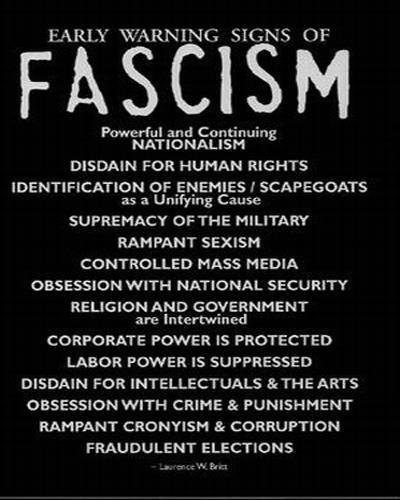
  • emits powerful and continuing expressions of nationalism through its politicians
  • has an obsession with national security while constantly invoking terrifying internal and external enemies
  • establishes a domestic and invasive surveillance system and develops a paramilitary force that is not answerable to the citizenry
  • and its various agencies (federal, state, and local) develop an obsession with crime and punishment (this is overcriminalization)
  • becomes increasingly centralized while aligning closely with corporate powers to control all aspects of the country’s social, economic, military, and governmental structures
  • uses militarism as a center point of its economic and taxing structure
  • and is increasingly imperialistic in order to maintain the military-industrial corporate forces.

Compare that to America today where, as economist Jeffrey Tucker rightly observes, “every industry is regulated. Every profession is classified and organized. Every good or service is taxed. Endless debt accumulation is preserved. Immense doesn’t begin to describe the bureaucracy. Military preparedness never stops, and war with some evil foreign foe, remains a daily prospect.”

Fascism thrives by hiding behind the entertainment spectacle that is partisan politics. As Tucker points out, “It’s incorrect to call fascism either right wing or left wing. It is both and neither . . . fascism does not seek to overthrow institutions like commercial establishments, family, religious centers, and civic traditions. It seeks to control them . . . it preserves most of what people hold dear but promises to improve economic, social, and cultural life through unifying their operations under government control.”

In this way, American-style fascism is deceptively appealing.

It appears friendly.

The news media covers the entertainment and political trivia. The basic forms of government remain intact. The legislators remain in session. There are elections.

Consent of the governed, however, no longer applies. Actual control has finally passed to the oligarchic elite controlling the government behind the scenes.

Yet the most crucial ingredient for fascism to succeed in America is that the majority of the people would have to agree that it’s not only expedient but necessary for the government to assume greater powers in order to keep them safe and secure, whether it’s by militarizing the police, stripping them of basic constitutional rights, criminalizing virtually every form of behavior, or spying on their communications, movements and transactions.

Sound familiar?

When you really drill down to what the various presidential candidates believe about the issues that will impact the future of our freedoms long-term—war, surveillance, civil liberties—you’ll find that most of them support the government’s position, which, conveniently enough, profits the corporate sector.

This is not freedom.

It is despotism, which Gross refers to as “faceless oligarchs [who] sit at command posts of a corporate-government complex that has been slowly evolving over many decades.” Gross explains:

In efforts to enlarge their own powers and privileges, they are willing to have others suffer the intended or unintended consequences of their institutional or personal greed. For Americans, these consequences include chronic inflation, recurring recession, open and hidden unemployment, the poisoning of air, water, soil and bodies, and, more important, the subversion of our constitution. More broadly, consequences include widespread intervention in international politics through economic manipulation, covert action, or military invasion . . .

It is, in Gross’ words, “pretended patriots who desecrate the American flag by waving it while waiving the law”:

I see at present members of the Establishment or people on its fringes who, in the name of Americanism, betray the interests of most Americans by fomenting militarism, applauding rat-race individualism, protecting undeserved privilege, or stirring up nationalistic and ethnic hatreds.

It is, concludes Gross, Big Business and Big Government in bed together:

In this present, many highly intelligent people look with but one eye and see only one part of the emerging Leviathan. From the right, we are warned against the danger of state capitalism or state socialism, in which Big Business is dominated by Big Government. From the left, we hear that the future danger (or present reality) is monopoly capitalism, with finance capitalists dominating the state. I am prepared to offer a cheer and a half for each view; together, they make enough sense for a full three cheers.Big Business and Big Government have been learning how to live in bed together and despite arguments between them, enjoy the cohabitation. Who may be on top at any particular moment is a minor matter—and in any case can be determined only by those with privileged access to a well-positioned keyhole.

When the votes have all been counted, “we the people” will be the losers.

The joke will be on us. Whether we ever realize it not, the enemy is not across party lines, as they would have us believe. It has us surrounded on all sides.

Even so, we’re not yet defeated.

We could still overcome our oppressors if we cared enough to join forces and launch a militant nonviolent revolution—a people’s revolution that starts locally and trickles upwards—but that will take some doing.

It will mean turning our backs on the political jousting contests taking place on the national stage and rejecting their appointed jesters as false prophets. It will mean not allowing ourselves to be corralled like cattle and branded with political labels that have no meaning anymore. It will mean recognizing that all the evils that surround us today—endless wars, drone strikes, invasive surveillance, militarized police, poverty, asset forfeiture schemes, overcriminalization, etc.—were not of our making but came about as a way to control and profit from us.

It will mean “voting with our feet” through sustained, mass civil disobedience. As journalist Chris Hedges points out, “There were once radicals in America, people who held fast to moral imperatives. They fought for the oppressed because it was right, not because it was easy or practical. They were willing to accept the state persecution that comes with open defiance. They had the courage of their convictions. They were not afraid.”

Ultimately, it will mean refusing to be divided, one against each other, as Democrats versus Republicans, and instead uniting behind the only distinction that has ever mattered: “we the people” against tyranny.


Constitutional attorney and author John W. Whitehead is founder and president of The Rutherford Institute. His new book “The Freedom Wars” (TRI Press) is available online at www.amazon.com. Whitehead can be contacted at johnw@rutherford.org. Information about The Rutherford Institute is available at www.rutherford.org.


Rent Strikes: ‘together we can defeat the housing market’

Rent-Strikers-1

By Matt Broomfield

Source: RoarMag.org

As they revive a long-dormant form of protest, rent strikers in London and San Francisco must learn lessons from the great strikes of the 20th century.

When you can no longer afford to pay your rent, only one course of action remains: stop paying it. On both sides of the Atlantic, tenants are militating against the unbearable pressure of the housing market via the only locus of power available to them — going on rent strike.

Midtown Apartments, San Francisco

Jose LaCrosby was an African-American hair stylist to the stars. Nina Simone, James Brown and Miles Davis all frequented his San Francisco salon. Terminally ill at the age of 89, LaCrosby was told by his doctors that he should return to die among his friends in Midtown Apartments.

But the City of San Francisco had just hiked rents by up to 300 percent. If the Korean War veteran wanted to move back in to a ground-floor apartment it would now cost him $3700 a month. LaCrosby had lived in Midtown for two decades, but he spent the last 7 months of his life under fluorescent lights in an anodyne hospice ward, unable to afford the grossly inflated rent.

LaCrosby’s treatment is symptomatic of the way Midtown is being used as an asset to be stripped for cash, says long-time resident and Save Midtown organizer Jay Majitov. “This community is being displaced by the greed and avarice of property pimps preying on the weak and the disenfranchised,” he explains. Many of Majitov’s neighbors moved into Midtown after being socially cleansed from other areas of San Francisco in the 1960s, on what they understood was a rent-to-buy agreement.

But though Midtown paid off its collective mortgage in 2007, the city reneged on its agreement to hand the building over to the tenants. Instead, Midtowners were hit with a threefold increase in rent, far outstripping the maximum increase set by San Francisco rent controls. Appalled by this betrayal of trust, the tenants of 65 Midtown apartments have been withholding their rent increase since August 2015.

University College London

On the face of it, LaCrosby’s working-class neighbors in Midtown have little in common with the primarily middle-class, primarily white students of University College London. But the price of UCL accommodation has risen by 56 percent in the last six years, and the university extracts £16 million annually in pure profit from their residences. The halls remain shabby, cramped and infested with cockroaches.

As a result, around 150 students are currently striking for a 40 percent rent decrease. “UCL call residents in halls customers, not students,” says David Dahlborn of UCL, Cut The Rent (UCL-CTR). “It’s sheer exploitation.”

There have been rumblings about wider rent strikes across the British left for months, while US activists in Portland and elsewhere are now looking to copy Midtown’s example. Yet until a couple of years ago, no one was talking about rent strikes at all.

The problem(s) with rent strikes

Once a cornerstone of tenants’ rights activism, since the 1980s the rent strike has largely been absent from the arsenal of the left. The most famous rent strike in history occurred in 1915, when the fear of a Bolshevik insurrection forced the UK government to appease strikers in Glasgow by introducing rent controls. As the Communist threat faded after the second Red Scare, so too did the need to form housing policy with one eye on the Kremlin, and the government’s attitude toward rent strikers hardened accordingly.

Given that many rent strikes occurred in mutual relation with industrial strikes, their decline in popularity can partially be ascribed to the decimation of workers’ right to strike by Thatcher and her successors. The UK now loses a tenth as many days to industrial action as it did in the 1980s, and “strike” has become a politically toxic term. (UCL-CTR advise their activists to avoid the word altogether when door-knocking.) The fragmentation of the left and the castration of the trade unions have left Britain without left-wing superstructures capable of amplifying wildcat rent strikes into a broader social movement.

There are also delocalized issues inherent in the mode of protest. The vulnerable people who stand to gain the most from a reduction in rent are also those most imperiled by eviction: working-class people, people of color, single mothers and the disabled, often living in social housing. According to Jay Majitov, many Midtowners will be forced out of state or onto the street if their strike is broken. There is no legal protection for rent strikers in the UK or the USA.

Recrimination can be brutal: after the arrest of rent strikers in Kings’ Cross in 1960, crowds of protesters were baton-charged and violently dispersed by mounted police. Mary Barbour and her army of Glaswegian housewives were forced to fight off heavy-handed bailiffs with wet clothes, rotten food and flour-bombs. Barbour would stomp round the tenements whirling a football rattle to summon her troops as the “factor” moved in.

Midtown property managers Mercy Housing have kept up an aggressive campaign of intimidation, towing residents’ cars for minor infractions and muscling into pensioners’ homes. “They came in as an occupying force, a colonizer. There’s no regard for cultural sensitivity or the long-term tenants,” says Majitov. Tenants have been told they face eviction if their grandchildren visit more than twice a week, or if they hold barbecues on their own property. “I’m sorry, man, but barbecues are what we do,” Majitov adds.

Making rent strikes work

An industrial striker does no work and so loses her pay, but rent strikers actually save money while they agitate, as astronomic rents stop crippling working people and start depreciating from the profits of housing companies. The more unbearable the financial burden on the renters, the keener the loss suddenly felt by the landlord, in an efficacious reversal of power dynamics.

Last year, UCL-CTR organized students from UCL and SOAS in a successful strike, securing £400,000 compensation after the university conceded it had left students in unlivable conditions among cockroaches, rats and incessant building works. London’s first genuine rent strike for 40 years only involved 50 students, but each individual striker made a tangible, measurable impact on the university’s finances. Glasgow 1915 and UCL-SOAS 2015 are century-spanning testaments to the fact that a well-executed rent strike can be devastatingly effective.

Historically, successful mass rent strikes have benefited from a united left providing the infrastructure to exponentially increase the strike’s effect across multiple homes and into the industrial sphere, rather than leaving isolated strikers at the mercy of the bailiffs. A New York strike in 1907 relied on the backing of a strong, active Socialist Party, and the Glasgow strikes would not have succeeded without union support.

As noted above, the male-dominated superstructures traditionally capable of supporting mass direct action have diminished in size and power. If they want to achieve this vital escalation, 21st century rent strikers must look to alternative, grassroots networks of activists.

Alternate support networks

Most successful rent strikes have been led by women. The distinction between rent strikes and industrial strikes should not be collapsed into a crude dichotomy between the male public sphere and the female domestic sphere. In 1907, 16-year-old Pauline Newman led strikes which secured rent reductions for 2000 New York families. She worked till 9pm in a textile factory before campaigning all night in the slums of Manhattan. Working-class women have always worked formally in the marketplace, as well as informally (and unpaid) in the home.

But Newman, the “East Side Joan of Arc”, was supported by housewives who spent the day going from tenement to tenement urging other families to join the strike. Working-class shop-floor networks intermeshed with female-dominated domestic networks. The Glasgow rent strike was sparked by landlords seeking to cow women into submission while their husbands were away fighting in the war. Again, Mary Barbour and her army rapidly spread information through the slums whenever the factor descended, militating via a social infrastructure which their landlords grossly underestimated.

Half of all British housing benefit recipients are single women. The average female flat-sharer in London earns £4236 less than her male counterpart, and twice as many women as men spend over half their salary on rent. Women have a disproportionate stake in the housing crisis, and male politicians continue to underestimate their ability to organize and resist. Though not a rent strike per se, the success of the Focus E15 mothers in resisting eviction attempts by Newham Council illustrates the continued power of localized, female, working-class support networks.

Interlocking working-class communities and communities of color have proven similarly capable of disseminating information and resistance. Rent strikers in 1930s Peckham relied on a rolling guard of unemployed laborers to defend their homes while successfully agitating for an improvement in living conditions. Majitov repeatedly emphasizes the importance of working-class solidarity in Midtown: “We don’t build apps, we don’t code. We drive buses and we deliver mail. And if this working-class community of color hadn’t stood together we would have been out a long time ago. ”

African-American Jean King (another woman) secured rent controls in St Louis after a year-long strike in 1969, while Majitov proudly notes that Save Midtown has the support of civil rights luminary Andrew Young, who successfully organized a rent strike alongside Martin Luther King in 1960s Chicago. Just like in Glasgow in 1907, Save Midtown have appointed tenant organizers with responsibility for contacting strikers across the development, and they are now reaching out to other African-American communities being abused by Mercy to launch a nationwide class action against the housing company.

The university bubble

A rent strike is a very different proposition for students, who are typically more privileged than the general population — a state of affairs maintained by the inaccessible rent conditions UCL-CTR are striking against. Many students have family homes to return to, and this can be leveraged against universities.

David Dahlborn explains: “When nothing had happened by the end of summer 2015, the international students who were on strike said ‘well, fuck it, I’m going home’. The university realized they couldn’t really send bailiffs to Mexico.” UCL capitulated soon after. Again, rent strikes reverse a power dynamic familiar to anyone who has tried to secure the return of a deposit from a suddenly evanescent landlord.

Students can also leverage the disjuncture between the public face of the academic university and its profit-making operations. “They say they’re concerned with education,” says UCL striker Aleksandra Tomaszewska. “But they’ve cut funding and bursaries while raising rent and tuition fees.”

Where housing companies are not hugely concerned with positive public relations, university authorities are at pains to emphasize that they provide a caring, nurturing environment. It would be a PR disaster for UCL to forcibly evict white, well-spoken, middle-class students. As with much student activism, student rent strikers can trade on their privilege to enjoy a much greater degree of security than their counterparts in council housing.

Universities constitute a ready-made network for the expansion of a strike. A successful rent strike at Sussex University in 1972-3 rapidly spread to 23 other universities. UCL-CTR is sharing advice and materials with student activists from SOAS, Imperial and Goldsmiths, as they seek to expand the current rent strike across the capital.

“Anyone could do it,” says Dahlborn, who repeatedly emphasizes the lateral organization of UCL-CTR. “Everybody on the strike is a potential organizer.” Students have more free time than workers; they have access to condensed bodies of left-leaning tenants paying vastly excessive rent; and they are keyed in to networks of information exchange between these bodies.

Rent strikes for the 21st century

Paradigms established by 20th century rent strikers could be instructive for those on the radical left wrangling about their relationship with Momentum and Jeremy Corbyn’s Labour Party. Newman and Barbour instigated their strikes alone, but willingly worked alongside hierarchical, party-rooted structures to replicate these actions on a wider scale.

But as Dahlborn argues, a successful general rent strike must ultimately emerge from coordinated grassroots action, as multiple localized organizations “replicate and generalize” tactics that have worked well elsewhere. An emphasis on the dispersal of power underpins much recent left-wing strategizing, and rent strikes can operate particularly effectively through decentralized, lateral organization.

“Together we are powerful, and united we can defeat the market,” Dahlborn says. The unity he describes is not monolithic but dispersed, varied and multiple. Strikes should be generated through grassroots networks, not mandated by top-down frameworks.

Networks of university activists provide one such structure. London’s Radical Housing Network, which unites housing co-ops, community action groups and union representatives, is another. (This organization could also facilitate liaison between university students and working-class activists).

Roger Hallam’s concept of “Conditional Commitment” involves assuring potential strikers that a strike will only go ahead once a certain number of other tenants have committed to the action. Successfully implemented by UCL-CTRE, this system of collective responsibility would function well in enabling dispersed networks of rent strikers to operate in unison.

Industrial strikes expose the gulf between the evaluated worth of employees’ labor and the evaluated worth of the products they manufacture. The fact that a rent strike is even tenable as a concept illustrates the fact that tenants, like workers, are treated as profit-making organs.

Historically, the establishment has therefore reacted ferociously to rent strikes, which expose the cruelty of market logic. A general rent strike called by a hypothetical national tenants’ union would likely meet with overwhelming opposition. But it would be much more difficult for the establishment to defeat a network of localized, coordinated strikes breaking out on university campuses and council estates across the country.

Saturday Matinee: Struggle

logo

From MentalRev Productions:

Struggle is a case study of the 2004 Presidential Election in Ohio, the deciding swing state which delivered the presidency once again to George W. Bush. Diligently researched by the key contributors to the film, Struggle is a bold film that challenges the legitimacy of that Presidential Election and brings the entire US electoral process into question.

This gripping documentary is filmed with a mix of expert testimony and first-hand accounts of voters whose votes were suppressed or manipulated, and community members who protested for election reform and justice in the State and National Capitals. This informative, engaging and tense film is told from a grass roots perspective, from the ground up, without the filters of mainstream media framing the dialogue. Filmed with a handheld style that reflects the intensity of the moment, this film identifies the practices of Individual and State entities to silence protest and manipulate elections in the United States.

This film was made without the resources of mainstream media or a highly funded political campaign. This is a grass roots film that speaks truth to power, with your help we will magnify that voice and demand free and fair elections for all Americans.

https://vimeo.com/50791629