The Entire Status Quo Is a Fraud

corruptPoliticalSystem2

By Charles Hugh Smith

Source: Of Two Minds

Fraud as a way of life caters an extravagant banquet of consequences.

This can’t be said politely: the entire status quo in America is a fraud.

The financial system is a fraud.

The political system is a fraud.

National Defense is a fraud.

The healthcare system is a fraud.

Higher education is a fraud.

The mainstream corporate media is a fraud.

Culture–from high to pop–is a fraud.

Need I go on?

We have come to accept fraud as standard operating practice in America, to the detriment of everything that was once worthy. why is this so?

One reason, which I outline in my book A Radically Beneficial World: Automation, Technology and Creating Jobs for All, is that centralized hierarchies select for fraud and incompetence. Now that virtually every system in America is centralized or regulated by centralized hierarchies, every system in America is fraudulent and incompetent.

Nassim Taleb explains this further in his recent article How To Legally Own Another Person (via Lew G.)

The three ingredients of fraud are abundant: pressure (to get an A, to please your boss, to make your sales numbers, etc.), rationalization (everybody’s doing it) and opportunity.

Taleb explains why failure and fraud become the status quo: admitting error and changing course are risky, and everyone who accepts the servitude of working in a centralized hierarchy–by definition, obedience to authority is the #1 requirement– is averse to risk.

As as I explain in my book, these systems select for risk aversion and the appearance of obedience to rules and authority while maximizing personal gain: in other words, fraud as a daily way of life.

Truth is a dangerous poison in centralized hierarchies: anyone caught telling the truth risks a tenner in bureaucratic Siberia. (In the Soviet Gulag ,a tenner meant a ten-year sentence to a labor camp in Siberia.)

And so the truth is buried, sent to a backwater for further study, obfuscated by jargon, imprisoned by a Top Secret stamp, or simply taken out and executed.Everyone in the system maximizes his/her personal gain by going along with the current trajectory, even if that trajectory is taking the nation off the cliff.

Consider the F-35 Joint Strike Fighter, a $1+ trillion failure. The aircraft is underpowered, under-armed, insanely overpriced, insanely over-budget and still riddled with bugs after seven years of fixes, making it an unaffordable maintenance nightmare that puts our servicepeople and nation at risk.

But no one in a position of power will speak the truth about the F-35, because it is no longer a weapons system–it’s a jobs program. Defense contractors are careful to spread the work of assembling parts of the F-35 to 40+ states, so 80+ senators will support the program, no matter how much a failure it is as a weapons system, or how costly the failure is becoming.

A rational person in charge would immediately cancel it and start from scratch, with a program run outside the Pentagon and outside congressional meddling.But this is impossible in America: instead, we build failed, under-armored, under-powered, under-armed and unreliable ships (LCS) and failed under-powered, under-armed and unreliable fighters as the most expensive make-work programs in history.

As for our failed healthcare system, one anecdote will do. (You undoubtedly have dozens from your own experience.) A friend from Uruguay with a high-tech job in the U.S. recently flew home to Montevideo for a medical exam because 1) the cost of the flight was cheaper than the cost of the care in the U.S. and 2) she was seen the next day in Montevideo while it would have taken two months to get the same care in the U.S.

I’ve listed dozens of examples here over the years: $120,000 for a couple days in a hospital, no procedures performed; $20,000+ for a single emergency room visit, no procedures performed; several thousand dollars charged to Medicare for a few minutes in an “observation room” that was occupied by patients, no staff present–the list is endless.

We’ve habituated to fraud as a way of life because every system is fraudulent.Consider the costly scam known as higher education. The two essentials higher education should teach are: 1) how to learn anything you need to learn or want to learn on your own, and 2) how to think, behave, plan and function entrepreneurially (i.e. as an autonomous problem-solver and lifelong learner who cooperates and collaborates productively with others) as a way of life.

That higher education fails to do so is self-evident. We could create a highly effective system of higher education that costs 10% of the current corrupt system. I’ve described such a system (in essence, a directed apprenticeship as opposed to sitting in a chair for four years) in The Nearly Free University and the Emerging Economy: The Revolution in Higher Education.

As for what passes as culture in the U.S.: the majority of what’s being sold as culture, both high and low, is derivative and forgettable. We suffer the dual frauds of absurd refinement (so only the elites can “appreciate” the art, music, food, wine, etc.) and base coarsening: instead of Tender (romantic love and sex) we have Tinder (flammable trash).

Fraud as a way of life caters an extravagant banquet of consequences. While everyone maximizes their personal gain in whatever system of skim, scam and fraud they inhabit, the nation rots from within. We’ve lost our way, and lost the ability to tell the truth, face problems directly, abandon what has failed and what is unaffordable, and accept personal risk as the essential element of successful adaptation.

Here’s a good place to start: require every politician to wear the logos of their top 10 contributors–just like NASCAR drivers and vehicles display the logos of their sponsors. The California Initiative to make this a reality is seeking signatures of registered California voters. Since politicians are owned, let’s make the ownership transparent.

Fear our new robot overlords: This is why you need to take artificial intelligence seriously

Matrix-Machines-Best-Movie-AI

Killer computers determined to kill us? Nope. Forget “Terminator” — there’s something more specific to worry about

By Phil Torres

Source: Salon

There are a lot of major problems today with tangible, real-world consequences. A short list might include terrorism, U.S.-Russian relations, climate change and biodiversity loss, income inequality, health care, childhood poverty, and the homegrown threat of authoritarian populism, most notably associated with the presumptive nominee for the Republican Party, Donald Trump.

Yet if you’ve been paying attention to the news for the past several years, you’ve almost certainly seen articles from a wide range of news outlets about the looming danger of artificial general intelligence, or “AGI.” For example, Stephen Hawking has repeatedly expressed that “the development of full artificial intelligence could spell the end of the human race,” and Elon Musk — of Tesla and SpaceX fame — has described the creation of superintelligence as “summoning the demon.” Furthermore, the Oxford philosopher and director of the Future of Humanity Institute, Nick Bostrom, published a New York Times best-selling book in 2014 called Superintelligence, in which he suggests that the “default outcome” of building a superintelligent machine will be “doom.”

What’s with all this fear-mongering? Should we really be worried about a takeover by killer computers hell-bent on the total destruction of Homo sapiens? The first thing to recognize is that a Terminator-style war between humanoid robots is not what the experts are anxious about. Rather, the scenarios that keep these individuals awake at night are far more catastrophic. This may be difficult to believe but, as I’ve written elsewhere, sometimes truth is stranger than science fiction. Indeed, given that the issue of AGI isn’t going anywhere anytime soon, it’s increasingly important for the public to understand exactly why the experts are nervous about superintelligent machines. As the Future of Life Institute recently pointed out, there’s a lot of bad journalism about AGI out there. This is a chance to correct the record.

Toward this goal, step one is to realize is that your brain is an information-processing device. In fact, many philosophers talk about the brain as the hardware — or rather, the “wetware” — of the mind, and the mind as the software of the brain. Directly behind your eyes is a high-powered computer that weighs about three pounds and has roughly the same consistency as Jell-o. It’s also the most complex object in the known universe. Nonetheless, the rate at which it’s able to process information is much, much slower than the information-processing speed of an actual computer. The reason is that computers process information by propagating electrical potentials, and electrical potentials move at the speed of light, whereas the fastest signals in your brain travel at around 100 miles per second. Fast, to be sure, but not nearly as fast as light.

Consequently, an AGI could think about the world at speeds many orders of magnitude faster than our brains can. From the AGI’s point of view, the outside world — including people — would move so slowly that everything would appear almost frozen. As the theorist Eliezer Yudkowsky calculates, for a computer running a million times faster than our puny brains, “a subjective year of thinking would be accomplished for every 31 physical seconds in the outside world, and a millennium would fly by in eight-and-a-half hours.”

Already, then, an AGI would have a huge advantage. Imagine yourself in a competition against a machine that has a whole year to work through a cognitive puzzle for every 31 seconds that you spend trying to think up a solution. The mental advantage of the AGI would be truly profound. Even a large team of humans working together would be no match for a single AGI with so much time on its hands. Now imagine that we’re not in a puzzle-solving competition with an AGI but a life-and-death situation in which the AGI wants to destroy humanity. While we struggle to come up with strategies for keeping it contained, it would have ample time to devise a diabolical scheme to exploit any technology within electronic reach for the purpose of destroying humanity.

But a diabolical AGI isn’t — once again — what many experts are actually worried about. This is a crucial point that the Harvard psychologist Steven Pinker misses in a comment about AGI for the website Edge.org. To quote Pinker at length:

“The other problem with AGI dystopias is that they project a parochial alpha-male psychology onto the concept of intelligence. Even if we did have superhumanly intelligent robots, why would they want to depose their masters, massacre bystanders, or take over the world? Intelligence is the ability to deploy novel means to attain a goal, but the goals are extraneous to the intelligence itself: being smart is not the same as wanting something. History does turn up the occasional megalomaniacal despot or psychopathic serial killer, but these are products of a history of natural selection shaping testosterone-sensitive circuits in a certain species of primate, not an inevitable feature of intelligent systems.” Pinker then concludes with, “It’s telling that many of our techno-prophets can’t entertain the possibility that artificial intelligence will naturally develop along female lines: fully capable of solving problems, but with no burning desire to annihilate innocents or dominate the civilization.”

Unfortunately, such criticism misunderstands the danger. While it’s conceptually possible that an AGI really does have malevolent goals — for example, someone could intentionally design an AGI to be malicious — the more likely scenario is one in which the AGI kills us because doing so happens to be useful. By analogy, when a developer wants to build a house, does he or she consider the plants, insects, and other critters that happen to live on the plot of land? No. Their death is merely incidental to a goal that has nothing to do with them. Or consider the opening scenes of The Hitchhiker’s Guide to the Galaxy, in which “bureaucratic” aliens schedule Earth for demolition to make way for a “hyperspatial express route” — basically, a highway. In this case, the aliens aren’t compelled to destroy us out of hatred. We just happen to be in the way.

The point is that what most theorists are worried about is an AGI whose values — or final goals — don’t fully align with ours. This may not sound too bad, but a bit of reflection shows that if an AGI’s values fail to align with ours in even the slightest ways, the outcome could very well be, as Bostrom argues, doom. Consider the case of an AGI — thinking at the speed of light, let’s not forget — that is asked to use its superior intelligence for the purpose of making humanity happy. So what does it do? Well, it destroys humanity, because people can’t be sad if they don’t exist. Start over. You tell it to make humanity happy, but without killing us. So it notices that humans laugh when we’re happy, and hooks up a bunch of electrodes to our faces and diaphragm that make us involuntarily convulse as if we’re laughing. The result is a strange form of hell. Start over, again. You tell it to make us happy without killing us or forcing our muscles to contract. So it implants neural electrodes into the pleasure centers of everyone’s brains, resulting in a global population in such euphoric trances that people can no longer engage in the activities that give life meaning. Start over — once more. This process can go on for hours. At some point it becomes painfully obvious that getting an AGI’s goals to align with ours is going to be a very, very tricky task.

Another famous example that captures this point involves a superintelligence whose sole mission is to manufacture paperclips. This sounds pretty benign, right? How could a “paperclip maximizer” pose an existential threat to humanity? Well, if the goal is to make as many paperclips as possible, then the AGI will need resources to do this. And what are paperclips composed of? Atoms — the very same physical stuff out of which your body is composed. Thus, for the AGI, humanity is nothing more than a vast reservoir of easily accessible atoms, atoms, atoms. As Yudkowsky eloquently puts it, “The [AGI] does not hate you, nor does it love you, but you are made out of atoms which it can use for something else.” And just like that, the flesh and bones of human beings are converted into bendable metal for holding short stacks of paper.

At this point, one might think the following, “Wait a second, we’re talking about superintelligence, right? How could a truly superintelligent machine be fixated on something so dumb as creating as many paperclips as possible?” Well, just look around at humanity. By every measure, we are by far the most intelligent creatures on our planetary spaceship. Yet our species is obsessed with goals and values that are, when one takes a step back and peers at the world with “new eyes,” incredibly idiotic, perplexing, harmful, foolish, self-destructive, other-destructive, and just plain weird.

For example, some people care so much about money that they’re willing to ruin friendships, destroy lives and even commit murder or start wars to acquire it. Others are so obsessed with obeying the commandments of ancient “holy texts” that they’re willing to blow themselves up in a market full of non-combatants. Or consider a less explicit goal: sex. Like all animals, humans have an impulse to copulate, and this impulse causes us to behave in certain ways — in some cases, to risk monetary losses and personal embarrassment. The appetite for sex is just there, pushing us toward certain behaviors, and there’s little we can do about the urge itself.

The point is that there’s no strong connection between how intelligent a being is and what its final goals are. As Pinker correctly notes above, intelligence is nothing more than a measure of one’s ability to achieve a particular aim, whatever it happens to be. It follows that any level of intelligence — including superintelligence — can be combined with just about any set of final goals — including goals that strike us as, well, stupid. A superintelligent machine could be no less infatuated with obeying Allah’s divine will or conquering countries for oil as some humans are.

So far, we’ve discussed the thought-speed of machines, the importance of making sure their values align with ours, and the weak connection between intelligence and goals. These considerations alone warrant genuine concern about AGI. But we haven’t yet mentioned the clincher that makes AGI an utterly unique problem unlike anything humanity has ever encountered. To understand this crucial point, consider how the airplane was invented. The first people to keep a powered aircraft airborne were the Wright brothers. On the windy beaches of North Carolina, they managed to stay off the ground for a total of 12 seconds. This was a marvelous achievement, but the aircraft was hardly adequate for transporting goods or people from one location to another. So, they improved its design, as did a long lineage of subsequent inventors. Airplanes were built with one, two, or three wings, composed of different materials, and eventually the propeller was replaced by the jet engine. One particular design — the Concorde — could even fly faster than the speed of sound, traversing the Atlantic from New York to London in less than 3.5 hours.

The crucial idea here is that the airplane underwent many iterations of innovation. Problems that arose in previous designs were improved upon, leading to increasingly safe and reliable aircraft. But this is not the situation we’re likely to be in with AGI. Rather, we’re likely to have one, and only one, chance to get all the problems mentioned above exactly right. Why? Because intelligence is power. For example, we humans are the dominant species on the planet not because of our long claws, sharp teeth and bulky musculatures. The key difference between Homo sapiens and the rest of the Animal Kingdom concerns our oversized brains, which enable us to manipulate and rearrange the world in incredible ways. It follows that if an AGI were to exceed our level of intelligence, it could potentially dominate not only the biosphere, but humanity as well.

Even more, since creating intelligent machines is an intellectual task, an AGI could attempt to modify its own code, a possibility known as “recursive self-improvement.” The result could be an exponential intelligence explosion that, before one has a chance to say “What the hell is happening?,” yields a super-super-superintelligent AGI, or a being that towers over us to the extent that we tower over the lowly cockroach. Whoever creates the first superintelligent computer — whether it’s Google, the U.S. government, the Chinese government, the North Korean government, or a lone hacker in her or his garage — they’ll have to get everything just right the first time. There probably won’t be opportunities for later iterations of innovation to fix flaws in the original design, if there are any. When it comes to AGI, the stakes are high.

It’s increasingly important for the public to understand the nature of thinking machines and why some experts are so worried about them. Without a grasp of these issues, claims like “A paperclip maximizer could destroy humanity!” will sound as apocalyptically absurd as “The Rapture is near! Save your soul while you still can!” Consequently, organizations dedicated to studying AGI safety could get defunded or shut down, and the topic of AGI could become the target of misguided mockery. The fact is that if we manage to create a “friendly” AGI, the benefits to humanity could be vast. But if we fail to get things right on the first go around, the naked ape could very well end up as a huge pile of paperclips.


Phil Torres is the founder of the X-Risks Institute and author of The End: What Science and Religion Tell Us About the Apocalypse. He’s on Twitter @xriskology.

The new mind control

mind_control

The internet has spawned subtle forms of influence that can flip elections and manipulate everything we say, think and do

By Robert Epstein

Source: Aeon Magazine

Over the past century, more than a few great writers have expressed concern about humanity’s future. In The Iron Heel (1908), the American writer Jack London pictured a world in which a handful of wealthy corporate titans – the ‘oligarchs’ – kept the masses at bay with a brutal combination of rewards and punishments. Much of humanity lived in virtual slavery, while the fortunate ones were bought off with decent wages that allowed them to live comfortably – but without any real control over their lives.

In We (1924), the brilliant Russian writer Yevgeny Zamyatin, anticipating the excesses of the emerging Soviet Union, envisioned a world in which people were kept in check through pervasive monitoring. The walls of their homes were made of clear glass, so everything they did could be observed. They were allowed to lower their shades an hour a day to have sex, but both the rendezvous time and the lover had to be registered first with the state.

In Brave New World (1932), the British author Aldous Huxley pictured a near-perfect society in which unhappiness and aggression had been engineered out of humanity through a combination of genetic engineering and psychological conditioning. And in the much darker novel 1984 (1949), Huxley’s compatriot George Orwell described a society in which thought itself was controlled; in Orwell’s world, children were taught to use a simplified form of English called Newspeak in order to assure that they could never express ideas that were dangerous to society.

These are all fictional tales, to be sure, and in each the leaders who held the power used conspicuous forms of control that at least a few people actively resisted and occasionally overcame. But in the non-fiction bestseller The Hidden Persuaders (1957) – recently released in a 50th-anniversary edition – the American journalist Vance Packard described a ‘strange and rather exotic’ type of influence that was rapidly emerging in the United States and that was, in a way, more threatening than the fictional types of control pictured in the novels. According to Packard, US corporate executives and politicians were beginning to use subtle and, in many cases, completely undetectable methods to change people’s thinking, emotions and behaviour based on insights from psychiatry and the social sciences.

Most of us have heard of at least one of these methods: subliminal stimulation, or what Packard called ‘subthreshold effects’ – the presentation of short messages that tell us what to do but that are flashed so briefly we aren’t aware we have seen them. In 1958, propelled by public concern about a theatre in New Jersey that had supposedly hidden messages in a movie to increase ice cream sales, the National Association of Broadcasters – the association that set standards for US television – amended its code to prohibit the use of subliminal messages in broadcasting. In 1974, the Federal Communications Commission opined that the use of such messages was ‘contrary to the public interest’. Legislation to prohibit subliminal messaging was also introduced in the US Congress but never enacted. Both the UK and Australia have strict laws prohibiting it.

Subliminal stimulation is probably still in wide use in the US – it’s hard to detect, after all, and no one is keeping track of it – but it’s probably not worth worrying about. Research suggests that it has only a small impact, and that it mainly influences people who are already motivated to follow its dictates; subliminal directives to drink affect people only if they’re already thirsty.

Packard had uncovered a much bigger problem, however – namely that powerful corporations were constantly looking for, and in many cases already applying, a wide variety of techniques for controlling people without their knowledge. He described a kind of cabal in which marketers worked closely with social scientists to determine, among other things, how to get people to buy things they didn’t need and how to condition young children to be good consumers – inclinations that were explicitly nurtured and trained in Huxley’s Brave New World. Guided by social science, marketers were quickly learning how to play upon people’s insecurities, frailties, unconscious fears, aggressive feelings and sexual desires to alter their thinking, emotions and behaviour without any awareness that they were being manipulated.

By the early 1950s, Packard said, politicians had got the message and were beginning to merchandise themselves using the same subtle forces being used to sell soap. Packard prefaced his chapter on politics with an unsettling quote from the British economist Kenneth Boulding: ‘A world of unseen dictatorship is conceivable, still using the forms of democratic government.’ Could this really happen, and, if so, how would it work?

The forces that Packard described have become more pervasive over the decades. The soothing music we all hear overhead in supermarkets causes us to walk more slowly and buy more food, whether we need it or not. Most of the vacuous thoughts and intense feelings our teenagers experience from morning till night are carefully orchestrated by highly skilled marketing professionals working in our fashion and entertainment industries. Politicians work with a wide range of consultants who test every aspect of what the politicians do in order to sway voters: clothing, intonations, facial expressions, makeup, hairstyles and speeches are all optimised, just like the packaging of a breakfast cereal.

Fortunately, all of these sources of influence operate competitively. Some of the persuaders want us to buy or believe one thing, others to buy or believe something else. It is the competitive nature of our society that keeps us, on balance, relatively free.

But what would happen if new sources of control began to emerge that had little or no competition? And what if new means of control were developed that were far more powerful – and far more invisible – than any that have existed in the past? And what if new types of control allowed a handful of people to exert enormous influence not just over the citizens of the US but over most of the people on Earth?

It might surprise you to hear this, but these things have already happened.

To understand how the new forms of mind control work, we need to start by looking at the search engine – one in particular: the biggest and best of them all, namely Google. The Google search engine is so good and so popular that the company’s name is now a commonly used verb in languages around the world. To ‘Google’ something is to look it up on the Google search engine, and that, in fact, is how most computer users worldwide get most of their information about just about everything these days. They Google it. Google has become the main gateway to virtually all knowledge, mainly because the search engine is so good at giving us exactly the information we are looking for, almost instantly and almost always in the first position of the list it shows us after we launch our search – the list of ‘search results’.

That ordered list is so good, in fact, that about 50 per cent of our clicks go to the top two items, and more than 90 per cent of our clicks go to the 10 items listed on the first page of results; few people look at other results pages, even though they often number in the thousands, which means they probably contain lots of good information. Google decides which of the billions of web pages it is going to include in our search results, and it also decides how to rank them. How it decides these things is a deep, dark secret – one of the best-kept secrets in the world, like the formula for Coca-Cola.

Because people are far more likely to read and click on higher-ranked items, companies now spend billions of dollars every year trying to trick Google’s search algorithm – the computer program that does the selecting and ranking – into boosting them another notch or two. Moving up a notch can mean the difference between success and failure for a business, and moving into the top slots can be the key to fat profits.

Late in 2012, I began to wonder whether highly ranked search results could be impacting more than consumer choices. Perhaps, I speculated, a top search result could have a small impact on people’s opinions about things. Early in 2013, with my associate Ronald E Robertson of the American Institute for Behavioral Research and Technology in Vista, California, I put this idea to a test by conducting an experiment in which 102 people from the San Diego area were randomly assigned to one of three groups. In one group, people saw search results that favoured one political candidate – that is, results that linked to web pages that made this candidate look better than his or her opponent. In a second group, people saw search rankings that favoured the opposing candidate, and in the third group – the control group – people saw a mix of rankings that favoured neither candidate. The same search results and web pages were used in each group; the only thing that differed for the three groups was the ordering of the search results.

To make our experiment realistic, we used real search results that linked to real web pages. We also used a real election – the 2010 election for the prime minister of Australia. We used a foreign election to make sure that our participants were ‘undecided’. Their lack of familiarity with the candidates assured this. Through advertisements, we also recruited an ethnically diverse group of registered voters over a wide age range in order to match key demographic characteristics of the US voting population.

All participants were first given brief descriptions of the candidates and then asked to rate them in various ways, as well as to indicate which candidate they would vote for; as you might expect, participants initially favoured neither candidate on any of the five measures we used, and the vote was evenly split in all three groups. Then the participants were given up to 15 minutes in which to conduct an online search using ‘Kadoodle’, our mock search engine, which gave them access to five pages of search results that linked to web pages. People could move freely between search results and web pages, just as we do when using Google. When participants completed their search, we asked them to rate the candidates again, and we also asked them again who they would vote for.

We predicted that the opinions and voting preferences of 2 or 3 per cent of the people in the two bias groups – the groups in which people were seeing rankings favouring one candidate – would shift toward that candidate. What we actually found was astonishing. The proportion of people favouring the search engine’s top-ranked candidate increased by 48.4 per cent, and all five of our measures shifted toward that candidate. What’s more, 75 per cent of the people in the bias groups seemed to have been completely unaware that they were viewing biased search rankings. In the control group, opinions did not shift significantly.

This seemed to be a major discovery. The shift we had produced, which we called the Search Engine Manipulation Effect (or SEME, pronounced ‘seem’), appeared to be one of the largest behavioural effects ever discovered. We did not immediately uncork the Champagne bottle, however. For one thing, we had tested only a small number of people, and they were all from the San Diego area.

Over the next year or so, we replicated our findings three more times, and the third time was with a sample of more than 2,000 people from all 50 US states. In that experiment, the shift in voting preferences was 37.1 per cent and even higher in some demographic groups – as high as 80 per cent, in fact.

We also learned in this series of experiments that by reducing the bias just slightly on the first page of search results – specifically, by including one search item that favoured the other candidate in the third or fourth position of the results – we could mask our manipulation so that few or even no people were aware that they were seeing biased rankings. We could still produce dramatic shifts in voting preferences, but we could do so invisibly.

Still no Champagne, though. Our results were strong and consistent, but our experiments all involved a foreign election – that 2010 election in Australia. Could voting preferences be shifted with real voters in the middle of a real campaign? We were skeptical. In real elections, people are bombarded with multiple sources of information, and they also know a lot about the candidates. It seemed unlikely that a single experience on a search engine would have much impact on their voting preferences.

To find out, in early 2014, we went to India just before voting began in the largest democratic election in the world – the Lok Sabha election for prime minister. The three main candidates were Rahul Gandhi, Arvind Kejriwal, and Narendra Modi. Making use of online subject pools and both online and print advertisements, we recruited 2,150 people from 27 of India’s 35 states and territories to participate in our experiment. To take part, they had to be registered voters who had not yet voted and who were still undecided about how they would vote.

Participants were randomly assigned to three search-engine groups, favouring, respectively, Gandhi, Kejriwal or Modi. As one might expect, familiarity levels with the candidates was high – between 7.7 and 8.5 on a scale of 10. We predicted that our manipulation would produce a very small effect, if any, but that’s not what we found. On average, we were able to shift the proportion of people favouring any given candidate by more than 20 per cent overall and more than 60 per cent in some demographic groups. Even more disturbing, 99.5 per cent of our participants showed no awareness that they were viewing biased search rankings – in other words, that they were being manipulated.

SEME’s near-invisibility is curious indeed. It means that when people – including you and me – are looking at biased search rankings, they look just fine. So if right now you Google ‘US presidential candidates’, the search results you see will probably look fairly random, even if they happen to favour one candidate. Even I have trouble detecting bias in search rankings that I know to be biased (because they were prepared by my staff). Yet our randomised, controlled experiments tell us over and over again that when higher-ranked items connect with web pages that favour one candidate, this has a dramatic impact on the opinions of undecided voters, in large part for the simple reason that people tend to click only on higher-ranked items. This is truly scary: like subliminal stimuli, SEME is a force you can’t see; but unlike subliminal stimuli, it has an enormous impact – like Casper the ghost pushing you down a flight of stairs.

We published a detailed report about our first five experiments on SEME in the prestigious Proceedings of the National Academy of Sciences (PNAS) in August 2015. We had indeed found something important, especially given Google’s dominance over search. Google has a near-monopoly on internet searches in the US, with 83 per cent of Americans specifying Google as the search engine they use most often, according to the Pew Research Center. So if Google favours one candidate in an election, its impact on undecided voters could easily decide the election’s outcome.

Keep in mind that we had had only one shot at our participants. What would be the impact of favouring one candidate in searches people are conducting over a period of weeks or months before an election? It would almost certainly be much larger than what we were seeing in our experiments.

Other types of influence during an election campaign are balanced by competing sources of influence – a wide variety of newspapers, radio shows and television networks, for example – but Google, for all intents and purposes, has no competition, and people trust its search results implicitly, assuming that the company’s mysterious search algorithm is entirely objective and unbiased. This high level of trust, combined with the lack of competition, puts Google in a unique position to impact elections. Even more disturbing, the search-ranking business is entirely unregulated, so Google could favour any candidate it likes without violating any laws. Some courts have even ruled that Google’s right to rank-order search results as it pleases is protected as a form of free speech.

Does the company ever favour particular candidates? In the 2012 US presidential election, Google and its top executives donated more than $800,000 to President Barack Obama and just $37,000 to his opponent, Mitt Romney. And in 2015, a team of researchers from the University of Maryland and elsewhere showed that Google’s search results routinely favoured Democratic candidates. Are Google’s search rankings really biased? An internal report issued by the US Federal Trade Commission in 2012 concluded that Google’s search rankings routinely put Google’s financial interests ahead of those of their competitors, and anti-trust actions currently under way against Google in both the European Union and India are based on similar findings.

In most countries, 90 per cent of online search is conducted on Google, which gives the company even more power to flip elections than it has in the US and, with internet penetration increasing rapidly worldwide, this power is growing. In our PNAS article, Robertson and I calculated that Google now has the power to flip upwards of 25 per cent of the national elections in the world with no one knowing this is occurring. In fact, we estimate that, with or without deliberate planning on the part of company executives, Google’s search rankings have been impacting elections for years, with growing impact each year. And because search rankings are ephemeral, they leave no paper trail, which gives the company complete deniability.

Power on this scale and with this level of invisibility is unprecedented in human history. But it turns out that our discovery about SEME was just the tip of a very large iceberg.

Recent reports suggest that the Democratic presidential candidate Hillary Clinton is making heavy use of social media to try to generate support – Twitter, Instagram, Pinterest, Snapchat and Facebook, for starters. At this writing, she has 5.4 million followers on Twitter, and her staff is tweeting several times an hour during waking hours. The Republican frontrunner, Donald Trump, has 5.9 million Twitter followers and is tweeting just as frequently.

Is social media as big a threat to democracy as search rankings appear to be? Not necessarily. When new technologies are used competitively, they present no threat. Even through the platforms are new, they are generally being used the same way as billboards and television commercials have been used for decades: you put a billboard on one side of the street; I put one on the other. I might have the money to erect more billboards than you, but the process is still competitive.

What happens, though, if such technologies are misused by the companies that own them? A study by Robert M Bond, now a political science professor at Ohio State University, and others published in Nature in 2012 described an ethically questionable experiment in which, on election day in 2010, Facebook sent ‘go out and vote’ reminders to more than 60 million of its users. The reminders caused about 340,000 people to vote who otherwise would not have. Writing in the New Republic in 2014, Jonathan Zittrain, professor of international law at Harvard University, pointed out that, given the massive amount of information it has collected about its users, Facebook could easily send such messages only to people who support one particular party or candidate, and that doing so could easily flip a close election – with no one knowing that this has occurred. And because advertisements, like search rankings, are ephemeral, manipulating an election in this way would leave no paper trail.

Are there laws prohibiting Facebook from sending out ads selectively to certain users? Absolutely not; in fact, targeted advertising is how Facebook makes its money. Is Facebook currently manipulating elections in this way? No one knows, but in my view it would be foolish and possibly even improper for Facebook not to do so. Some candidates are better for a company than others, and Facebook’s executives have a fiduciary responsibility to the company’s stockholders to promote the company’s interests.

The Bond study was largely ignored, but another Facebook experiment, published in 2014 in PNAS, prompted protests around the world. In this study, for a period of a week, 689,000 Facebook users were sent news feeds that contained either an excess of positive terms, an excess of negative terms, or neither. Those in the first group subsequently used slightly more positive terms in their communications, while those in the second group used slightly more negative terms in their communications. This was said to show that people’s ‘emotional states’ could be deliberately manipulated on a massive scale by a social media company, an idea that many people found disturbing. People were also upset that a large-scale experiment on emotion had been conducted without the explicit consent of any of the participants.

Facebook’s consumer profiles are undoubtedly massive, but they pale in comparison with those maintained by Google, which is collecting information about people 24/7, using more than 60 different observation platforms – the search engine, of course, but also Google Wallet, Google Maps, Google Adwords, Google Analytics, Chrome, Google Docs, Android, YouTube, and on and on. Gmail users are generally oblivious to the fact that Google stores and analyses every email they write, even the drafts they never send – as well as all the incoming email they receive from both Gmail and non-Gmail users.

According to Google’s privacy policy – to which one assents whenever one uses a Google product, even when one has not been informed that he or she is using a Google product – Google can share the information it collects about you with almost anyone, including government agencies. But never with you. Google’s privacy is sacrosanct; yours is nonexistent.

Could Google and ‘those we work with’ (language from the privacy policy) use the information they are amassing about you for nefarious purposes – to manipulate or coerce, for example? Could inaccurate information in people’s profiles (which people have no way to correct) limit their opportunities or ruin their reputations?

Certainly, if Google set about to fix an election, it could first dip into its massive database of personal information to identify just those voters who are undecided. Then it could, day after day, send customised rankings favouring one candidate to just those people. One advantage of this approach is that it would make Google’s manipulation extremely difficult for investigators to detect.

Extreme forms of monitoring, whether by the KGB in the Soviet Union, the Stasi in East Germany, or Big Brother in 1984, are essential elements of all tyrannies, and technology is making both monitoring and the consolidation of surveillance data easier than ever. By 2020, China will have put in place the most ambitious government monitoring system ever created – a single database called the Social Credit System, in which multiple ratings and records for all of its 1.3 billion citizens are recorded for easy access by officials and bureaucrats. At a glance, they will know whether someone has plagiarised schoolwork, was tardy in paying bills, urinated in public, or blogged inappropriately online.

As Edward Snowden’s revelations made clear, we are rapidly moving toward a world in which both governments and corporations – sometimes working together – are collecting massive amounts of data about every one of us every day, with few or no laws in place that restrict how those data can be used. When you combine the data collection with the desire to control or manipulate, the possibilities are endless, but perhaps the most frightening possibility is the one expressed in Boulding’s assertion that an ‘unseen dictatorship’ was possible ‘using the forms of democratic government’.

Since Robertson and I submitted our initial report on SEME to PNAS early in 2015, we have completed a sophisticated series of experiments that have greatly enhanced our understanding of this phenomenon, and other experiments will be completed in the coming months. We have a much better sense now of why SEME is so powerful and how, to some extent, it can be suppressed.

We have also learned something very disturbing – that search engines are influencing far more than what people buy and whom they vote for. We now have evidence suggesting that on virtually all issues where people are initially undecided, search rankings are impacting almost every decision that people make. They are having an impact on the opinions, beliefs, attitudes and behaviours of internet users worldwide – entirely without people’s knowledge that this is occurring. This is happening with or without deliberate intervention by company officials; even so-called ‘organic’ search processes regularly generate search results that favour one point of view, and that in turn has the potential to tip the opinions of millions of people who are undecided on an issue. In one of our recent experiments, biased search results shifted people’s opinions about the value of fracking by 33.9 per cent.

Perhaps even more disturbing is that the handful of people who do show awareness that they are viewing biased search rankings shift even further in the predicted direction; simply knowing that a list is biased doesn’t necessarily protect you from SEME’s power.

Remember what the search algorithm is doing: in response to your query, it is selecting a handful of webpages from among the billions that are available, and it is ordering those webpages using secret criteria. Seconds later, the decision you make or the opinion you form – about the best toothpaste to use, whether fracking is safe, where you should go on your next vacation, who would make the best president, or whether global warming is real – is determined by that short list you are shown, even though you have no idea how the list was generated.

Meanwhile, behind the scenes, a consolidation of search engines has been quietly taking place, so that more people are using the dominant search engine even when they think they are not. Because Google is the best search engine, and because crawling the rapidly expanding internet has become prohibitively expensive, more and more search engines are drawing their information from the leader rather than generating it themselves. The most recent deal, revealed in a Securities and Exchange Commission filing in October 2015, was between Google and Yahoo! Inc.

Looking ahead to the November 2016 US presidential election, I see clear signs that Google is backing Hillary Clinton. In April 2015, Clinton hired Stephanie Hannon away from Google to be her chief technology officer and, a few months ago, Eric Schmidt, chairman of the holding company that controls Google, set up a semi-secret company – The Groundwork – for the specific purpose of putting Clinton in office. The formation of The Groundwork prompted Julian Assange, founder of Wikileaks, to dub Google Clinton’s ‘secret weapon’ in her quest for the US presidency.

We now estimate that Hannon’s old friends have the power to drive between 2.6 and 10.4 million votes to Clinton on election day with no one knowing that this is occurring and without leaving a paper trail. They can also help her win the nomination, of course, by influencing undecided voters during the primaries. Swing voters have always been the key to winning elections, and there has never been a more powerful, efficient or inexpensive way to sway them than SEME.

We are living in a world in which a handful of high-tech companies, sometimes working hand-in-hand with governments, are not only monitoring much of our activity, but are also invisibly controlling more and more of what we think, feel, do and say. The technology that now surrounds us is not just a harmless toy; it has also made possible undetectable and untraceable manipulations of entire populations – manipulations that have no precedent in human history and that are currently well beyond the scope of existing regulations and laws. The new hidden persuaders are bigger, bolder and badder than anything Vance Packard ever envisioned. If we choose to ignore this, we do so at our peril.

Google’s lemmings: Pokémon go where Silicon Valley says

index

An analysis of Ingress and Pokémon Go reveals important truths about corporate control and the ability of our mobile phones to organize our desires.

By Alfie Brown

Source: ROAR Magazine

his article has a clickbaity title but a sobering and concerning point to make. In 2010, Google started up what is now a very important subsidiary, Niantic Inc. Google starts up a lot of companies each year and acquires a great many more, so there is nothing special in this. What is important is that whilst most of us see Google’s acquisition of every “start-up” and endless development of “subsidiary” companies with different names as simply an attempt to completely monopolize the market, the case of Niantic shows us that there is more to the extent of Google’s power.

Six years on from its inception with the launch of its biggest game yet, Pokémon Go, Niantic has hit the headlines and people are finally paying attention to the company, with some apparent leftists even claiming we ought to boycott Pokémon Go. In fact, Niantic have been working on mobile phone psychology and social organization for several years. An analysis of the company’s two big games, Ingress and Pokémon Go, shows us some important truths about the world we are living in, about corporate control and about the ability of our mobile phones to organize our desires.

Niantic developed their first major game, Ingress, in 2011. The game, one of the most important of recent years, is a key ideological tool for Google — one that, unlike Pokémon Go, is little publicized. Ingress has seven million or more players and Ingress tattoos show the degree to which people define themselves by the application. Some players even describe Ingress as a “lifestyle” rather than a “game”. The reader can be forgiven for thinking: “I don’t play it, so why would this apply to me?” But the entertainment coming out of Google via Niantic is in line with Google’s wider project of regulating our movements and experiences of the physical world; unless you don’t use Google or any of its applications, many of which come built-it to our phones and cannot be uninstalled, this applies to you.

Ingress reflects a trend of mobile phone application development (which includes Google Maps and Uber, among other well-known apps) designed to regulate and influence our experience of the city, turning the mobile phone into a new kind of unconscious: an ideological force driving our movements while we remain only semi-aware of what propels us and why we are propelled in the directions we are.

I first considered the importance of mobile phone games to be about a kind of “distraction” — an argument I made in my book and related article in The New Inquiry. Later, when playing Ingress for the first time, I realized there was a lot more to it than this. Ingress, rather than simply distracting us from the city around us, actually trains us to become Google’s perfect citizens. In Ingress, the player moves around the real environment capturing “portals” represented by landmarks, monuments and public art, as well as other less-famous features of the city. The player is required to be within physical range of the “portal” to capture it, so the game constantly tracks the player via GPS. Importantly, it not only monitors where we go, but directs us where it wants us to move.

As such it is very much the counterpart of Google Maps, which is also developing the ability not only to track our movements but to direct them. Of course, Google’s algorithms have long since dictated which restaurants we visit, which cafés we are aware of and which paths we take to get to these destinations. Now though, Google is developing new technology that actually predicts where you will want to go based on the time, your GPS location and your habitual history of movement stored in its infinitely powerful recording system. This, like Ingress, shows us a new pattern emerging in which the mobile phone dictates our paths around the city and encourages us, without realizing it, to develop habitual and repetitious patterns of movement. More importantly still, such applications anticipate our very desires, not so much giving us what we want as determining what we desire.

Here again, the connection with the concept of the unconscious is useful. While some have seen the unconscious as a morass of unregulated desires, followers of Freud and later of Lacanian psychoanalysis have been keen to show precisely how structured the unconscious is by outside forces. Our mobile phones pretend to be about fulfilling our every desire, giving us endless entertainment (games), easy transport (Uber) and instant access to food and drink (OpenRice, JustEat) and even near-instantaneous sex and love (Tindr, Grindr). Yet, what is much scarier than the fact that you can get everything you want via your mobile phone is the possibility that what you want is itself set in motion by the phone.

Into precisely this atmosphere enters Pokémon Go, out just days ago, and already the most significant mobile phone release of 2016. The game is, of course, made by none other than Niantic Labs. A series of hysterical events have already arisen from the ethical minefield that is Pokémon Go. In the case of Ingress, academic study has already been dedicated to the fact that the game has sent young children into unlit city parks at 3am. With Pokémon Go, Australian police have had to respond to a bunch of Pokémon trainers trying to get into a police station to capture the Pokémon within and some people found a dead body instead of a Pokémon. It has already been suggested that Pokémon Go is eventually going to kill someone — and since that article was published someone has crashed into a police car and another has been run-over while hunting Pokemon. But, as with Ingress, it is not the occasional mad story to emerge that should concern us, but the psychological and technological effects of every user’s experience.

The premise of Pokémon Go is simply that you use your GPS to find Pokémon in the real environment and then your camera to make the Pokémon visible, so that the world is enriched by looking through the screen at what lies behind it, as in the image below:

images

The Pokémon itself is an incredible phenomenon deserving of a book length study. Perhaps for now we can say that the Pokémon is the perfect example of what Jacques Lacan called the objet a, that perfectly cute fetishised but illusive object of desire that would truly make us happy if only we could just get our hands on it. We never do, because there is always a newer, cuter and harder to capture version that we just have to catch!

Dystopian visions of what technology and videogames would lead to seem to have got something completely wrong. Depictions of the dystopian videogame future have always tended to see the future as involving each individual isolated from the rest and sat quietly alone in a small room hooked up into a computer through which their lives are exclusively lived. In other words, the importance of the physical environment recedes in favor of the imaginary electronic world. On the contrary to these predictions of the future, we now live in a dystopia where Google and its subsidiaries send us madly around the city almost non-stop in directions of its choosing in search of the objects of desire, whether that be a lover on Tindr, a bowl of authentic Japanese ramen or that elusive Clefairy or Pikachu.

In the 1990s parents could ask their children to “get outside more” to escape the videogame space, but now it is the games that make us charge around the city capturing portals and collecting Pokémon and going on dates. Putting aside the full access that Google gets to your accounts via Pokémon Go, this shows us something really dangerous. It points to the increasing reality that there really is no escape from Google — and that while we are doing what we think we want, believing that we are just using our phones to help us get it, in fact Google has an even greater power, a truly revolutionary one: the ability to create and organize desire itself.

It is this truly revolutionary power that is important when it comes to Pokémon Go and Ingress. To say that these games are revolutionary is not to say that they are doing any good, nor that they are “radical”, and certainly it is not to say that they are left-wing — on the contrary, the revolution in desire appears to be corporate, hegemonic and centralized. If the left is to have any hope, however, it must not resist Pokémon Go, as Jacobin have now famously suggested, but understand and perhaps even embrace the power of the mobile phone to re-organize desire and look for ways forward from here.


Alfie Bown is the author of Enjoying It: Candy Crush and Capitalism (Zero, 2015) and The PlayStation Dreamworld (Polity, forthcoming 2017). He is the co-editor of the Hong Kong Review of Books and writes on the politics of technology and videogames for many publications.

Was Super Tuesday Rigged?

secret-win-V2-060416c_02_png__800×593_

By Jerry Kroth

Source: The Hampton Institute

Social scientists have long known that releasing poll information early, before polls have closed, has two effects: first it decreases voter turnout by about 12 percent,[1] and it increases the bandwagon effect, where people hop on and vote for the winner, by about 8 percent. [2]

On the morning of Super Tuesday, before anyone had voted, the Associated Press released a story that Hillary Clinton had already won. She was the “presumptive presidential nominee” and the victor. AP had made that announcement because of a super delegate count and decided she already beat Sanders.

Other media outlets then piggy-backed on this story, and virtually every American woke up that morning to headlines that Hillary had won-and remember, that is before anyone voted on Super Tuesday.

What a surprise! By the time you had your morning coffee and went off to the polls, you already knew Mrs. Clinton was the winner. Did that bias the election? Did it discourage people from voting? Did it create a “bandwagon effect?”

If one looks carefully at the percentage totals for Clinton versus Sanders totals for those primary states, it is clear the so-called “landslide” victory of Clinton on that day was fully within this margin of bias created by the bandwagon and voter turnout effects.

In other words, the AP story determined the outcome of this election.

Strong words? Well, let’s look at the data.

Three days before the election, a Yougov poll showed Clinton leading Sanders by two points in California. But after the Associated Press released its story, Clinton beat Sanders not by two points but by 13! Hillary got an 11 point “bump.”

From somewhere.

The same effect happened in New Mexico. Sanders was ahead of Clinton by a wide margin 54 to 40 percent. [3] By Super Tuesday, the situation reversed and Clinton beat Sanders 51.5 to 48.5. That surprising result gave Hillary an additional 13 points. Surprise! A 13 point “bump.”

In New Jersey, poll results just before Super Tuesday showed Clinton leading sanders 54 to 40 percent [4] but on election day she beat him 63 to 36, another unexpected 9 point “bump” in Hillary’s favor.

In South Dakota, a poll showed Sanders ahead of Clinton by 6 percentage points [5] just a few weeks before the primary, but on Super Tuesday Hillary pulled another rabbit out of her hat and beat Sanders by two points; an 8 point “bump” for Clinton.

Those are the only states where we can calculate pre-post results. Hillary got an unexpected 9 points in New Jersey, 8 points in South Dakota, 13 points in New Mexico, and 11 points in California. All unexpected. All unpredicted. All quite different from polls held just days before Super Tuesday.

And all very suspicious!

If one tries to rebut these findings alleging they all are within the margin of error for polls, then Sanders should have had just as many spurious bumps as Clinton. Didn’t happen! All went to Hillary. The skewing is not random! The statistical anomalies are consistently prejudiced toward Hillary.

Sixteen European countries ban reporting election results before voting occurs, and in the UK, reporting poll data on the day of the election is forbidden. [6]

All for good reason.

Serious attention should be paid to declaring these primaries invalid. Furthermore, the possibility of investigating media entities, in particular Gary Pruitt, CEO of the Associated Press, for any alleged collusion with the Clinton campaign should be aggressively pursued. Even if there is no corporate media complicity, it can still be argued that the AP’s desire for an early morning scoop determined, biased and corrupted this entire election.
Jerry Kroth, Ph.D. is Associate Professor Emeritus Santa Clara University. He may be contacted through his website, collectivepsych.com

Notes


Related Videos:

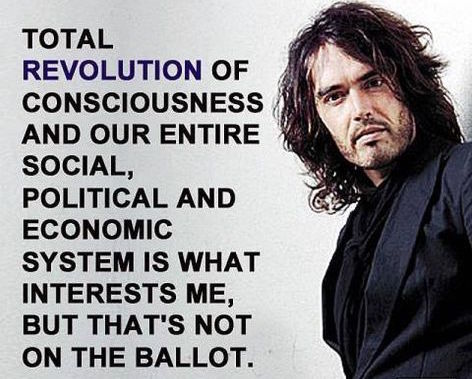
Your Awakening Counts More Than Your Vote

russell-brand-total-revolution-of-consciousness

By Dylan Charles

Source: Waking Times

We live in a world where illusions are held in higher esteem than verifiable truth. This is no accident, as the individual has for decades now been on the receiving end of social engineering programs, advanced political and corporate propaganda, fear programming and outright mind control.

The sum total of all this mass conditioning has been to convince otherwise good-natured and hard-working people to participate in their own enslavement and to willingly acquiesce to the ever-increasing rules, invasions of privacy, taxations, permissions and control schemes of a government and world elite who have long since left public interest in the dust.

The American dream is a mythic idea that was supposedly founded on the principle that public oversight of government is possible thanks to an electoral process which would give an informed citizenry the opportunity to replace undesirable politicians with better ones. Government itself, though, is a brutish and violent force that has time and again proven absolutely wild, reckless and untamable. It has never has obeyed its own laws, policies or regulations, and world history is a bloodstained chronicle of man’s failure to control himself when given power in the form of government.

Just as you cannot stop the tides from rising and falling, you cannot stop government from decaying into tyranny, especially so by following its very own rules and by participating in its token rituals.

This is truth, yet the illusion of so-called ‘democracy’ persists, seeming to grip people ever more feverishly with each passing election season. Even in the face of overt election fraud, party infighting, delegate rigging and widespread disenfranchisement. And so here we are again, facing the embarrassing spectacle of choosing between two undesirables when we all know the game is rigged.

For the powers the be, though, the repeating four-year cycle of presidential politics is the most effective device for keeping the masses high on the illusion of self-governance. It force feeds us on a regular schedule the false narrative that we the people can vote to reign in the power and corruption of the oligarchy of deep state, private and corporate influences that truly control the direction of this nation.

In this light, the purpose of national politics is not to perpetuate self-governance for the benefit of the common person, but rather to eat up personal energy and resources in order to suck the individual into a quagmire of false hope and endless patience with outrage after outrage. It is to make ineffectual action feel like action to the people being most screwed over by the corruption of the elite.

Sure, this may sound negative, cynical or apathetic to those who are over-invested emotionally in this game, but in order to move beyond the insanity of doing the same thing again and again while expecting different results, it’s imperative to be deadly honest about how this program works to enslave us, not to free us. Once we can think beyond the peer pressure, neighbor-hating, and mindless outrage that marks each election cycle, we make ourselves available to the possibility of real change. And real change always begins from within, and never forced from without.

There is no political leader who can make you stand fearlessly in this complex and dangerous world.There is no candidate that can give you the freedom that comes with a healthy mind and body. There is no political ruler who can manifest true and lasting happiness for you. There is no politician who can ensure that you enjoy the experience of your life everyday, under any and all circumstances. And there is no president that can empower you to be the best possible version of yourself so that you may give your best to others.

All of these qualities are vastly more critical to personal, community and planetary renewal than whichever new figurehead is selected to be the perceived front man of a morbidly corrupt American government.

The most effective way to change the world around you is to first focus on and create more value in yourself. This is why your awakening counts far more than your vote does. 

Modern Fictions – How the Sacred Manifests in Chaos, Superheroes and Outer Spaces

3124315-chaoswar00302

By Kingsley L. Davis

Source: Reality Sandwich

The virtual topographies of our millennial world are rife with angels and aliens, with digital avatars and mystic Gaian minds, with utopian longings and gnostic science fictions, and with dark forebodings of apocalypse and demonic enchantment
Erik Davis

…All our so-called consciousness is a more or less fantastic commentary on an unknown, perhaps unknowable, but felt text…
Frederick Nietzsche

Science fiction is always more important than science
Timothy Leary

Everything that can be said has already been said, or something to that effect. It is not original to make the statement that originality no longer exists as it’s all been done before. Yet, as Marshall McLuhan famously said, ‘the medium is the message.’ So it may not be the message we are concerned with here but rather the medium of its passing. And the adage goes that everything exists according to ‘time and place.’ When the ‘sacred speaks’ – so to speak – it does so through the ways and means of the times. This could apply to prophets, oracles, and channelling as well as pop culture and its modern fictions. The sacred, the sublime, has always walked amongst the profane. The signs are everywhere, blended into the sidewalks, pulp fictions, and the kitsch ‘n’ kool of the art world. For iconic sci-fi writer Philip K. Dick, most of the sublime things of his world were disguised as trash that seamlessly slipped into the background of a dysfunctional world reality. As modern society slipstreamed into a post-modern smorgasbord of chaos, clutter, poetically burnt outbursts, and beatific revelations, a new landscape of the sacred was scattered across the bedrock. The seeming trash of the everyday mundane clashed with the incoming cosmic, and a new urge for the transcendental found its way into so many popular cultural forms that it would take an encyclopaedic mobius-strip to recite it all. For my purposes here I will only all-so-briefly take a hop and skip around some of the budding flora that displayed a burgeoning sacred urge to blur the boundaries and reach for the sublime connection.

However paradoxical it may sound, one of the mediums for the sacred virus to spread came through the channel of chaos. Chaos, contrary to what we may think of it as being an anarchic and senseless cacophony, is actually a canvas for patterns to play out on. As the later emergence of the chaos sciences showed, there was a theory behind chaos – a method behind its apparent madness. Chaos, as we soon learned, did not operate in isolation. As the famous ‘butterfly effect’ was apt at promoting, a minimal disturbance in one part of the world (e.g., a butterfly flapping its wings) could result in a climate effect in another part (a tornado was often cited!). Everything thus existed in patterns, and not in arbitrary, random molluscs and mole-hills. The Santa Fe Institute (founded in 1984) quickly became a prominent centre for the research into complex systems, otherwise known as chaos science. Yet the emergence of chaos science had been actualized earlier through many different cultural forms of recognizing ‘chaos’ as a precursor to states of consciousness. Many forms/functions that emerge as aspects of the human condition are first seeded in popular culture ahead of their wider actualization. After all, the basis of the sacred refers to actualized aspects of human consciousness. And what the sacred art shows us is that its presence in our reality-matrix is determined by our capacity of consciousness to receive and acknowledge it. Chaos, as well as being patterns embedded in physical, computational, biological, and social systems, is also patterns of our minds. In fact, it can be said that chaos is part of the order of the cosmos.


Chaos & the Cosmic

“Tis an ill wind that blows no minds” – Principia Discordia

The signs for magic, chaos, and transcendental byways were popping up almost everywhere on the western landscape in the post-war, post-modern years. Enochian magic, Golden Dawn rituals, and meta-computing of the self were seeding a growing experimentalism of the human mind. In the US especially, a blend of anarchic cultural subversions were manifesting that played upon known semi-mystical memes. One of these was the text of the Principia Discordia that emerged in the nineteen-sixties as a ‘sacred text’ of Discordianism. Written by Malaclypse the Younger (Greg Hill) and Omar Khayyam Ravenhurst (Kerry Thornley) it proclaimed “All hail Discordia!” in a mixture of goddess worship with the notion of order and disorder as balancing illusions. The fifth commandment of Principia Discordia states, ‘V – A Discordian is Prohibited of Believing What he Reads.’ In mode with a rising tide of memes dealing with truth-through-contradiction the Principia Discordia also went on to claim that,

All statements are true in some sense, false in some sense, meaningless in some sense, true and false in some sense, true and meaningless in some sense, false and meaningless in some sense, and true and false and meaningless in some sense.

Discordia came to influence the writings of maverick author-philosopher Robert Anton Wilson, who popularised it further in his books, especially in ‘The Illuminatus! Trilogy.’ These utterances were echoed by the writer William S. Burroughs who, besides experimenting in cut-up narrative techniques, proclaimed a Discordian-esque ‘Nothing is absolutely true – Everything is permissible.’ Burrough’s infamous outburst was a culmination of religious history (the Assassins of Hassan-i Sabbah) with anarchic chaos from his spirit-possessed universe.

Around this time literate and literary magicians were cropping up everywhere, writing tracts on magic for a modern reader. Many of these literary figures were connected to the Golden Dawn system of magic. Yet another emerging stream was that of chaos magic which originated in United Kingdom in the late seventies. This broader magical path was liberal enough to combine forms of neoshamanism, eastern philosophy, quantum science, visionary art, and later computer technology. This experimental perspective on magic was part of a wider trend in experimenting with known forms for new avenues of stimulating and awakening consciousness. These ‘chaotic’ paths were attempting to destabilize our conditioning patterns and our resultant consensus reality. They were all aimed at waking up the usually-slumbering human mind. As the seminal work Waking Up (1986) by Charles Tart showed, humanity was largely intoxicated with a ‘consensus trance’ that kept us from recognizing sigils of the sacred. In more recent years the metaphors and memes of being trapped within a waking dream, or of dreams within dreams, have been explored in such popular films as ‘The Truman Show’ (1998); the ‘Matrix Trilogy’ (1999-2003); and Inception (2010). Part of the myth we find ourselves popularising is the mythology that we are in some sort of constructed reality – a gnostic-inspired simulacrum of truth.

Gnostic ideas are being gnawed over, processed, and consumed in ever more popular forms of culture. There’s an odd wave of mystical-spiritual impulses now radiating through popular culture that encourages us to throw ourselves into new world-spaces, fantastic realms, and mythological fictions and factions. These are new mash-ups of the counterculture now being packaged and presented as part of mainstream culture. And in recent years the most extraordinary success in this area has been the incredible, phenomenal rise of the modern superhero.


Superheroes & the Super-Self

Ever since Nietzsche first declared that ‘God is dead’ we have been reeling and dealing from our encroaching mortality – and trying to avoid this by seeking new technologies and cultural expressions of immortality. This collective experience on the possible ‘death of god’ is like a shock hammer-blow that propels us against the loss of sacred meaning and sublime mystery. Whether we admit it or not we fear the sense of absence, where nothing exists to which we can lend our communal assent. We don’t wish to struggle fragmented and bewildered, abashed by creative forms of indulgence. We cannot be left behind, losing our vital contact with the imaginal, the numinous, or the magical. We cannot be left untransformed in our vacant spaces as a paranormal pop culture washes over us. No – we need our superheroes, our possibilities, our potentials. We need to find a cultural expression for the human psyche; for our psychic currents and transmissions and sacred communication – our superheroes must live on!

Perhaps through the loss of our gods we have had to become our own multiple gods, as we realized a need to fill a vacuum left by myth. With the loss of the godly connection a different psychic wave was released upon the world to coincide with a rising arc of human consciousness. According to Jung, the gods gradually became our disease – ‘The gods have become diseases…who unwittingly let loose psychic epidemics on the world.’[1] These diseases have now morphed into mutations that make us into a hybrid human-god, with superhuman capacities, yet shunned by the world for being heretical against the natural order. We have the X-Men walking amongst us, a mutant subspecies of humans. The natural order is evo-mythological – it is sacred, beyond human, and connects us with evolutionary currents. In the absence of our ancient myths we have ingested the sacred alchemical root and through pop-culture morphed this transformation into the new wave of superheroes – myth lives anew in spandex. Maybe it is a cliché because it is true; we wish to find the personal superhero within each of us – the journey of the individual, unfolding within the great cosmic drama. This myth – this journey – has largely been taken from us through scientific rationalism and an industrial modernity. Yet now, by becoming more than oneself, we serve the larger story arc.

Our popular subcultures are gradually becoming the norm.  It is not only a question of whether more people are interested or not, but rather that these ideas are more widely available now thanks to popular culture. As William Irwin Thompson notes – ‘We Americans, who are so intent on creating a culture of technological materialism, cannot take in esoteric lore directly; it has to find another way in, and so comic books, science fiction, and movies are the back door.’ [2] Popular culture has been the back door for most of us, and not just for the Americans. But now perhaps the door frames are merging into the background and disappearing altogether. The waking life and the dream are becoming part of the same movie plot, as in Richard Linklater’s film version of Philip K. Dick’s A Scanner Darkly (2006). We are more and more waking up into our own movie – our very own Truman Show – where ideas are seeded directly into our environments in order to catalyze our awakening. Like the ancient Eastern tales told us, we have been asleep in a distant land and now we are receiving messages – signals – flashing like neon signs through our popular culture. This marks our juncture, our crisis point, between moving toward waking up or falling back into archaic, catastrophic and catatonic slumber. Again, Thompson reminds us that we ‘intuitively sense our evolutionary crisis and are expressing the catastrophe bifurcation through art – primarily through science fiction.’[3]

Our ultra high-definition visual culture is acting like a portal for the otherworld to enter. The psychedelic experiences that were once fringe and condemned are being re-played out through modern fictions that blend Gnostic tropes, mythological memes, and multidimensional portholes. Transcendental states of consciousness, ratified by the far explorations of new science, are adding to the mix of a new 21st century mythology that as of yet remains unnamed. Perhaps we are emerging toward the birth of new sacred gods. These are the gods of mutations, of neurological and biological adaptations. And they are emerging first in our pop-culture as our superheroes and psychic mutants. In this initiation into a psychically enhanced future we will need more than ever to learn how to distinguish the demonic from the spiritual. Hence the current barrage of cultural tropes in our films, TV series, and fiction that show angels vs. devils, humans vs. vampires, and the whole gamut of the good vs. the bad that has crawled from the forest floor to enter into the quest for the holy grail. All the while the Fisher King sits immobilized, feasting on an orgy of massively multiplayer online role-playing games (MMORPG). In this way the gods will never be forgotten as they merge with a super-augmented mutant humanity in spandex. As psychologist James Hillman says,

Remember: what the Greeks said their Gods asked for above all else, and perhaps only, was not blood; it was not to be forgotten, that is, to be kept in mind, recollected as psychological facts… [The God’s] reality can never fade as long as they are remembered, that is, kept in mind. That’s how they survive. [4]

The real gods, as we knew all along and yet had forgotten, reside within our psyche – they are kept in mind. And yet they can only become real for us – to re-mind us – when dashing about on the stage and streets in front of our very eyes. We need the sacred to slap our faces in spandex gloves before we begin to blink a waking eye.

As Jeffrey J. Kripal writes in his Mutants and Mystics, we have entered the stage of ‘Realization’ whereby we begin to recognize that the events around us in popular culture are not only real but are participatory. That is, our sacred and supernatural fictions appear for us and require our engaged reading of them in order for them to read us. Kripal says that,

In some fundamental way that we do not yet understand, they are us, projected into the objective world of events and things, usually through some story, symbol, or sign. Realization is the insight that we are caught in such a story. Realization is the insight that we are being written.[5]

The latest revival in the superheroes genre is significant in how it takes the mutant trope further and projects it forward as a form of evolutionary mysticism. Our new heroes are displaying to us our latent capacities and powers that are yet to unfold. We are witness to the first wave of mutant evolutionary pioneers. The summit of human evolution is far in the distance, and yet its early stages are manifesting through the Marvel and DC Universes where god-like potentials await us. Through such characters as Spider-Man, Iron Man, Captain America, Wolverine, and Doctor Strange, Marvel mesmerizes paranormal subliminals into popular cultural consciousness. And DC does the same with Superman, Batman, Wonder Woman, Green Lantern, Flash, and Green Arrow. Then as gangs they come together as the Guardians of the Galaxy, the Fantastic Four, the X-Men (Marvel), or as the Justice League (DC). They are now our teachers, our guides, our mutant futures that are beyond human. As Kripal recognized, the mutants have become practicing mystics.

We are seemingly living more and more in a mutational and metaphysical universe; and with the arrival of augmented reality our boundaries of interaction with the physical world around us will blur. And yet this suggests a return to the sacred perspective whereby the tangible and intangible worlds become an integral part of our holistic reality-matrix. And we are already well on our way as our outer and inner spaces explode into new blistering supernova.


Outer Spaces – Inner Spaces

Humankind has always been a child of the stars. Our early civilizations mapped the heavens before they mapped the terrain under their feet. The abode of the gods was amongst the glitterballs of the night sky, and their chariots blazed across the incandescent cosmic canvas. So it was no surprise then when the UFOs started to dart across our urban skies and come crashing down disguised as government weather balloons. Recent popular culture has nurtured a fascination with outer spaces and our galactic cousins from the Golden Age of science fiction of the nineteen thirties, forties, and fifties to the new wave of the sixties and seventies. The concerns of our outer space relations shifted from how to make contact with our space cousins to the entropic death of the universe. And then the environmental trope entered our outer spaces, as if a subliminal projection from our very own inner spaces. The sacred inner space of humankind was now tethering with the galactic outer spaces concerned with our future place in the universe. The growing number of alleged UFO abductees that emerged in the latter part of the twentieth century began to relay messages of extraterrestrial concern for our planetary well-being.

John. E Mack, an American professor of psychiatry at Harvard Medical School, in his later years became a leading authority on the spiritual or transformational effects of the alien abduction experience. Mack came to view the alien abduction phenomenon as acting as a catalyst to ‘shatter the boundaries of the psyche and to open consciousness to a wider sense of existence and connection in the universe.’[6] For more than a decade Mack rigorously studied the alien abduction phenomenon and interviewed hundreds of people (whom Mack referred to as ‘experiencers’). What initially started out as an exercise in studying mental illness soon turned into an in-depth inquiry into personal and spiritual transformation. Mack eventually came to see the alien abduction phenomenon as one of the most powerful agents for spiritual growth, personal transformation, and expanded awareness – in other words, as a trigger for a sacred experience. Despite the external anxiety produced by the experience, it was clear to both Mack and his set of experiencers that a profound communion was being established between humankind and other realities. Further, that this interaction was catalyzing a shift in human consciousness toward collapsing the old models of materialistic duality and opening up a connection not only ‘beyond the Earth’ but with other dimensional realities. Mack notes that ‘the process of psychospiritual opening that the abduction phenomenon provokes may bring experiencers to a still deeper level of consciousness where the oneness or interconnectedness of creation becomes a compelling reality.’[7]

This interconnectedness became a channel for the experiencers (abductees) to receive an impressive range of information; such as healing knowledge, spiritual truths, science, technology, and ecology. A major part of the information was apparently concerning the status of the Earth and humanity’s relationship with its environment. Many of the experiencers referred to their own abduction phenomenon as participating in a trans-dimensional or interspecies relationship. The transformative effects of these unusual encounters were often remarkable. Mack’s experiencers talked about an expansion of psychic or intuitive abilities; a heightened reverence for nature; the feeling of having a special mission on Earth; the collapse of space/time perception; an understanding of multi-dimensions of reality and the existence of multi-verses;  a feeling of connection with all of creation; and a whole range of related transpersonal experiences. Significant from these accounts is that, according to the experiencers, the abduction phenomenon is sometimes accompanied by a sense of moving into, or connecting with, other realities or dimensions. The sacred space and outer space were becoming one and the same. Or to put it another way, the contact initiated from those ‘out there’ was having a catalyzing effect to trigger an awakening in the inner spaces way ‘down here.’ It made sense then that our human future was going to include space migration. And according to our galactic cousins, it may even be a necessity if we continued to mess up our planetary home as if it were nothing but a playground to scoff around in.

Inner space junkie Timothy Leary was already riding that space-me-outta-here ticket with his S.M.I.2L.E. philosophy. Leary’s S.M.I.2L.E. stood for Space Migration, Increased Intelligence, and Life Extension. Basically, these were all the tropes from the post-humanism melange added on to the sci-fi dream of humanity living off-planet. We also have now the commercial race to establish a new branch of space tourism, with Virgin Galactic being one of the visible and vocal frontrunners. SpaceX, another private enterprise, is banking its dollars on helping to colonize Mars. There’s no lack of vision, it’s now down to the know-how and the technological leg-up. Now that the space cat is out the bag (excuse the pun), it’s only going to be a matter of time before the picture we have of ‘being human’ will incorporate the starry, cold vistas of outer space. From the earliest sacred expressions in the cave art of our ancestors to the ideas of space migration, they all show two fundamental urges within the human being: i) I am human, I am here (recognition); and ii) Where is the heavenly connection? (contact). Human dreams have encompassed living on Mars, leaving and migrating beyond the solar system, and of contact with ‘Higher Intelligence.’ Gene Roddenberry, creator of Star Trek, managed to combine both contact and communication through his receiving of channelled information. It has been documented that Roddenberry was introduced to an entity called ‘Tom’ who represented the Council of Nine, through the channel medium Phyllis Schlemmer. Roddenberry was allegedly receiving information for a film script to be written that would help prepare the public for extraterrestrial contact. The alleged film never got made, yet we might wonder what ideas made their way into Star Trek (including Star Trek: Deep Space Nine). It appears that there are those ‘out there’ who are concerned for our proper preparation for the sacred communion. And the archetypes are now flooding through our popular culture like an evangelical tsunami.

The mythic archetypes from Joseph Campbell’s The Hero with a Thousand Faces filled out the roles in George Lucas’s epic Star Wars universe. The good, the bad, and the hairy all took their cue and played along with the hero’s journey for an updated mythological rendering. Whilst the rise of industrial modernity and the secularization of culture may have contributed to an eroding of our myth-consciousness and a demotion of mystery, a new vital force has emerged that is shifting our planetary pranic energy. There may be those who bemoan that our current civilization does not have a mythic centre, yet they’re missing the point. And this point is that there is no exact point anymore. As hermetic lore states, the center is everywhere and the circumference nowhere. The earlier gods retreated back on their sky chariots until we finally arrived at the point where we asked ourselves where all the gods went. The new sacred guides are now secreted in our popular texts that penetrate the outer and inner worlds. These post-historic mythic guides are first to be found within us – within our collective species psyche that gets projected out onto our celluloid and digital-scapes. These re-modelled chameleon mythic memes are telling us that we are not here alone, nor are we here for ourselves alone. The future is both arriving, is here now, and has already been.

We have such films as Back to the Future, Primer, Looper, Terminator, Interstellar, and all the rest to attest to our obsession with shifting our timely perspectives. Everything is now malleable, according to our new quantum sciences, and our sacred revival is knocking down linear walls of rigidity. Just when you thought that you were safe in stable comfort zones, the paranormal is getting ready to redress itself as the new normal. A Gnostic-like awareness of being embedded in a reality-construct will become ever greater as our technologies increasingly broker and interface our physical experience. There are a plentiful array of fictions and films that ply us with plots on technologically-driven machine gnosis. Perhaps they are trying to signal that we are entering the sacred space of hybrid awareness. The film Transcendence (2014), for example, showed humanity edging toward sacred sentience as a means for solving the world’s global problems. As Vaclev Havel stated in one of his addresses – ‘Transcendence is the only real alternative to extinction’ (July 4th, 1994). Yet we are not on our way out, despite what the fear-mongering mainstream media may be trying to ram down our throats. Nor are we heading toward a techno-machine Overlord future with us as the slaves. Because the sacred works in multiple streams and never hedges all bets on a one-trick pony.

The game changer coming onto the scene is the participatory mind of human consciousness. The coming space migration is a reflection of our expanding inner spaces. We are toying with these memes in our popular culture now ahead of their coming actualization. What our fictions are dealing with are the blueprints before we’re ready to go the full hog. And that’s why we’re in a period of incredible experimentation – we are juggling with a new type of energy coming into our cultural realities. And this new pranic force is getting expressed in a myriad of multiple forms; be it creatively, chaotically, commercially, or crazily. It’s a cacophony of exuberance and experimentation trying to find its harmonic resonance. We are gaming, bopping, and trailblazing our way into a re-identification with a sacred energy. There’s a strong sense of the sacred filtering through our modern cultural memes, and it’s not all as chaotic as it seems.


References

1 Sabini, Meredith (ed) (2008) C.G. JUNG on Nature, Technology & Modern Life, Berkeley, CA, North Atlantic Books, p98

2 Thompson, William Irwin (1998) Coming Into Being: Artifacts and Texts in the Evolution of Consciousness. New York, St. Martin’s Griffin, p218

3 Thompson, William Irwin (1998) Coming Into Being: Artifacts and Texts in the Evolution of Consciousness. New York, St. Martin’s Griffin, p223

4 Cited in Hollis, James (1995) Tracking the Gods: The Place of Myth in Modern Life. Toronto, Canada, Inner City Books, p147

5 Kripal, Jeffrey J (2011) Mutants & Mystics: Science Fiction, Superhero Comics, and the Paranormal. Chicago The University of Chicago Press, p217-18

6 Mack, John, E. (1999) Passport to the Cosmos: Human Transformation & Alien Encounters. New York: Crown Publishers, p218

7 Mack, John, E. (1999) Passport to the Cosmos: Human Transformation & Alien Encounters, New York, Crown Publishers, p136

Lifting the Veil of Psychopathic Intrusion in Everyday Life

what-people-think-psychopaths-are-streetdemocracy

By Nozomi Hayase

Source: Dissident Voice

In recent years, the conception of the psychopath has gained a new upsurge of interest. Popular culture’s sensational image of Hannibal Lecter in the movie Silence of the Lambs and notorious killers like Ted Bundy have long cultivated public fascination. Now, awareness is spreading beyond these portrayals of outlandish criminals. More people are beginning to recognize the existence of socialized psychopaths who are not so outwardly violent.

Psychopaths walk among us, quietly blending into society. They could be corporate CEOs who exploit their workers, politicians who lie to get elected or Don Juan-like womanizers who inspire love to play with others hearts. Roughly 1-2 % of individuals in overall society are estimated to have been affected by this pervasive personality disorder (Neumann & Hare, 2008), yet some suggest these numbers are conservative and that many go unnoticed (Kantor, 2006).

The difficulty of accurately identifying psychopaths partly lies in a significant ambiguity among mental health professionals. Psychopathy expert, Robert D. Hare (1996) described the pivotal shift that occurred in 1980 with the publication of the third edition of the American Psychiatric Association’s Diagnostic and Statistical Manual of Mental Disorders (DSM-3), concerning the diagnosis of psychopathy. He noted how in this standard classification of mental disorder that has become the clinician’s bible, psychopathy was renamed antisocial personality disorder (ASPD), and defined by “persistent violations of social norms, including lying, stealing, truancy, inconsistent work behavior and traffic arrests” (para. 5).

Hare (1996) explained how this change was made based on the reasoning that affective and interpersonal traits that play a primary role in understanding psychopathy were difficult to measure. As a result, this diagnostic criteria of ASPD that mainly refer to criminal and outwardly observable antisocial behaviors, stripped off personality traits that are critical factors inherent in psychopathy. The trend of omitting the traits unique to this pathology has not been overturned to this day in the latest version of diagnostic manual DSM-5.

Along with this blurring of diagnosis, the very nucleus of this psychiatric disorder seems to have contributed to creating this lack of clarity. In his seminal work The Mask of Sanity, first published in 1941, psychiatrist Hervey M. Cleckley articulated how, among other personality traits such as their superficial charm, emotional poverty and egocentricity, the essential characteristic of psychopathy lies in its deceitful nature; hiding their lack of internal structure in a façade of normalcy.

Without knowing what to look for, even for professionals it is extremely hard to detect the psychopathic individual. This is made even more difficult when the very characteristics involve deception. All this has unleashed this dangerous population with few restraints, bringing great risk to the public. Their ability to fake and hide makes their exploitation invisible to the public eye. Oftentimes, people do not recognize abuse in a relationship until much of the damage is done. There are even cases where those who suffered harm do not realize they are victims.

Now, with the Internet and social media, a new level of education is happening. Through YouTube channels and online forums, those who experienced significant pain inflicted by these deranged individuals are coming together to gain validation that is desperately needed, yet often lacking in formal therapy. They are spouses, friends and co-workers, whose life had been ruined financially, mentally or emotionally. Those who had close encounters with these unknown members of society have seen the true face of psychopathy. With this sharing of first hand experience and witnesses outside lab experiments, the mystery of psychopathy is slowly being unveiled.

Hollowness as Elusive Core

In Without Conscience, Hare (1993) describes a psychopath as “a self-centered, callous, and remorseless person profoundly lacking in empathy and the ability to form warm emotional relationships with others, a person who functions without the restraints of conscience” (p. 2). The elusive core of this pathology is an absence of empathy. This sets those affected apart from the rest. People equipped with the ability to put themselves into another’s shoes often take this attribute for granted and don’t recognize the crucial role this seemingly innate aspect of human nature plays in forming a sense of one’s own self.

Humans are social beings. We exist in relation and develop identity through making connections with others at an emotional level. For instance, mother’s validation and proper attuning to her baby’s needs is crucial for infants to cultivate their sense of reality.

Psychopaths do not bond in the same way most people do and have not secured healthy attachment to caregivers. Because of this lack of attachment, argued by Hare (1993) as being a symptom of psychopathy, they cannot develop their identity based upon concrete reality.

Empathy unlocks the door into the world of a larger humanity, allowing one to experience higher emotions of joy, love and compassion. As the foundation of their identity is divorced from an empathic ground, psychopaths are emotionally held down in a “pre-socialized world”, lacking the full range of emotions (Meloy, 1988).

There is nothing inside to hold their identity together. As described in a T.S. Eliot’s poem, they are “hollow men… stuffed men -leaning together, headpiece filled with straw” (1934/1951, p. 56). Out of this vacuousness at the center of their personality, a head grows with an intelligence that is cunning and clever and primarily serves narrow selfish interests.

The being personified in this entity is enslaved by an internal void. They are a nobody and are driven to fill an insatiable hunger at any cost. Hare (1993) describes how they are “social predators who charm, manipulate, and ruthlessly plow their way through life, leaving a broad trail of broken hearts, shattered expectations, and empty wallets” (p. xi). Like going out on a hunt, they trespass people’s boundaries, dragging those who enter their proximity into their dark hole of nothingness. Anyone can become a target and once trapped, they are often sucked dry if not completely destroyed.

Idealization, Prelude to Seduction

The psychopath’s predation follows certain destructive relationship patterns that they repeat throughout their life. Regardless of differences in background, the victims all share similar cycles of abuse. Claudia Moscovici (2010) on her blog Psychopathyawareness describes these patterns in three stages; idealization, devaluation and then discard.

The first stage of a psychopathic relationship is idealization. This is a powerful and seductive period when psychopaths allure their potential victims. With superficial charm, this cunning and manipulative population enchants their targets. They put their new love interest on a pedestal, saying whatever the person wants to hear, transfixing whoever has become the unfortunate prey. It could be a whirlwind romance or promising partnership. Showered with flattery and adulation, targets often feel they are finally getting the appreciation they deserve in life.

In Snakes in Suits: When Psychopaths Go to Work, Hare and leading organizational psychologist Paul Babiak (2006) described this period as an assessment phase, where psychopaths examine their targets’ value and utility. They outlined the four main messages that psychopaths convey to their targets to create an instant connection, which they call the “psychopathic bond”. These are: 1) “I like who you are”; 2) “I am just like you”; 3) “Your secrets are safe with me”; 4) “I am the perfect friend, lover, partner for you” (p. 74-78).

If you are chosen, you will be adored and made to feel special. In their idealizing gaze, you are a center of the universe and can do no wrong. This newly acquainted friend or lover taps into fears, insecurity and deep wishes and morphs themselves into becoming anything their victim wants them to be.

Their seemingly caring gestures appear very genuine and many mistake this as empathy. Later, targets would reflect back on that exciting beginning and feel that they had been fooled. Hare describes how, unlike other mental disorders, psychopaths are rational and that “their behavior is the result of choice, freely exercised” (1993, p. 22). Although it is true that some of the deviants are calculative and indeed plot all the way through, at the same time, as Hare suggests, it is often done more instinctively and is not necessarily planned out. Their love-bombing during this phase rather appears to be an effect of their pathology, caused by impaired emotional processing.

Narcissistic Mirror and Erosion of Identity

So, why do they idealize? The idealization is a part of their pathological makeup. Psychopaths are truly outsiders. Without being a part of the world informed by empathy, they live in isolation and develop a sense of self that is divergent from the majority of society. Researchers point to the psychopath as having a “narcissistic and grossly inflated view of their self-worth and importance” (Hare, 1993 p. 38), a “grandiose self-structure” and a “psychopathology of narcissism” (Meloy, 2001, p. 11).

Although psychopathy is different from the other severe personality dysfunction recognized in the psychiatric community as Narcissistic Personality Disorder (NPD), its core of empathy deficit encompasses some of the features exhibited by NPD. Like those who suffer from excessive narcissism, they are trapped in mirrors of self-absorption and can’t recognize others as having their own autonomous thoughts and feelings. Through not being grounded in a consensual reality, they lack objectivity in their assessment of their own selves. For them, reality is constructed not based on who they really are, but who they want and believe themselves to be.

Being cut off from emotional reality, they are dead inside and can’t harvest their own energy. So they become parasites and feed off others’ emotional reactions. When they idealize their partners, they are unconsciously wanting to establish a connection to a source of creativity, that which gives emotional sustenance. Through weaving a fantasy and duping the other into their web of deception, they extract the life forces of the victim.

For psychopaths, relationship is the stage on which they enact their grandiose fantasy. Others are seen as an extension of themselves, as props that can be used. Anyone who comes their way is screened for their ability to perform a role that serves their plot. Their chosen targets become an object of desire and are pursued with great passion. With beam-like attention, they turn the spotlight on the victims. Through mirroring the victims’ positive qualities, predators disarm their prey and bring them under the luminary light of their narcissistic mirror. In this, the victim’s identity is eroded, yet with constant flattery and attention, they feel pumped up and elated.

This internal casting process can be seen as the psychopath launching a parallel persona upon their targets’ identity and then using it as a mask to create a rapport with their target. Yet, this mirroring is not consciously carried out. It is an automatic reflex that happens when they see something they want in others. Also, in some cases, in others’ positive attributes, these self-absorbed individuals see an idealized image of themselves. Like the Greek myth of Narcissus who falls in love with his own reflection in the water and then pines away, this is the effect of psychopaths seeing themselves in another’s reflection that is created by victims favorably responding to idealization and then trying to claim that image for themselves.

This mirroring starts to fade after the psychopaths successfully attach themselves to their hosts and is then replaced with mind games. Without being able to feel genuine emotions, the psychopath from a young age studied human behavior and learned how to effectively create a favorable response. They will slowly start to use this acquired skill of clever manipulation to keep their victims inside their delusional bubble and maintain control.

Devaluation and the Broken Mirror

What comes next is devaluation, marked as a betrayal with broken promises. This is when psychopaths who had always seen their partners in a positive light will begin to criticize and withdraw their attention. They slowly tear down the pedestal they once put victims up on and engage in subtle ridicule and condescension. Confused, the targets often internalize these criticisms and start becoming convinced that they are not as perfect as the psychopaths initially made them feel and that they have faults just like everyone else.

So, why does this devaluation happen? Many who have been taken for a ride wonder why this person who once seemed to love them so much, changes all of sudden. After psychopaths absorb their targets’ good traits, they cannot truly make them their own. There is nothing that can fill their bottomless pit and soon the void starts to grow again. When the initial thrill and excitement of a new target wears off, they get bored. This is the point where those who have been taken in by the charm start to see the mask slipping.

While victims begin to have a glimpse of the hollow man behind the mask of the manufactured persona, in the eyes of the psychopath, the victim ceases to be the perfect mirror that reflects back their delusions of grandeur. This happens because those who were made to be reflections in their mirror are living human beings. When victims start to act autonomously, as every human being is meant to do, these malignantly narcissistic individuals experience their self-image fluctuating and their mirror of absorption beginning to shatter.

In a sense, psychopaths are like bullets that have been fired by a gun they themselves barely understand. Distortion in the mirror that occurs during this devaluation process is experienced by them as an attack on their very existence. When they start to realize their idealized partner is fallible, they experience injury and believe that what pulled the trigger is coming from outside them. The love of life that they once declared quickly becomes malformed or damaged goods and the victim can even be seen as an object of hatred and contempt. The idealized self-image projected onto their partners now disappears from the mirror and they have to look for it elsewhere. Thus, rinse and repeat. They start chasing a new object of ‘affection’ and begin the idealization phase all over again.

Discarded

Little does the victim know, but the person they had fallen for is now gone. The psychopath has already abandoned their masks. At this point, if the target remains useful to them, they would be kept around, but otherwise, the psychopath moves on, as if the previous victim never existed. The duration of each stage leading up to the final discard depends on how fast the targets catch on to their ploy or whether they cease to be useful.

After being cast aside, the victims might feel they were handled dishonestly. They realize that their partners were fraudulent and that what they thought was love or true friendship was an illusion. Those who were wronged ask themselves if their partners really cared about them at all. When the psychopath’s mask is finally blown off and one begins to glimpse the monster behind that mask, one is flooded with questions that may never be answered.

It is important not to forget that these are ‘hollow men’. They suffer from shallow emotions and don’t have the same capacity for feeling as most people do. Hare (1993) describes their apparent lack of emotional depth, noting how they “seem to know the dictionary meanings of words but fail to comprehend or appreciate their emotional value or significance” (p. 128). They are “like a color-blind person who sees the world in shades of gray but who has learned to function in a colored world” (p. 129). Without having vital emotional understanding, they mimic experiences they can’t really understand through simulating emotions and parroting words that others use.

Without this understanding, those with empathy assume the other has a similar orientation and they fill in the blanks by projecting good attributes and interpreting words of those who lack feeling for others according to how they themselves use language. As the relationship unfolds beyond the initial stage, the differences eventually begin to emerge and the shallow consciousness behind the beautiful words starts to unravel.

As they are not tied to others by empathy, psychopaths have little connection to their own history and are uprooted from the shared narrative of humanity. They live in the present moment and are driven by immediate needs and instinctual desires. Just like the hollowness of their soul, their words are empty, rarely matching actions. They promise eternal devotion and love to describe their transient and fleeting desires of the here and now. For them there is no future; there is no past. There is nothing lasting that deeply connects them with other human fellows. They try on one personality and then drop it when it becomes inconvenient and move on to the next as needed.

The Anesthetized Heart

Who are these empty souls, masquerading as friends, lovers and good Samaritans, whose self-gratifying deeds in the end always leave their victims bewildered? The beast inside this small minority of society seizes everything that moves. They conquer the other, turning constantly evolving images of their targets into frozen snapshots of abstraction, which they then possess. In extreme cases, this is seen in the example of serial killers cutting up victims’ dead bodies and sleeping with them. Although the degree might be different, this deadening force that works within is the same. Psychopaths try to wipe out victims’ identity, so to make them a clean slate that can more perfectly mirror their grandiose self. Through lies and re-framing events, they attack their target’s memory, making them doubt their own sense of self. What awaits one toward the end of the relationship, if one does not disentangle themselves in time, can even be a total annihilation of the self.

The horror displayed by psychopathy and this moral bankruptcy often provokes an image of evil. In People of the Lie: The Hope for Healing Human Evil, psychiatrist and author Scott Peck (1983) defined evil as a reversal of the word ‘live’, and portrayed it as something that crushes life. They have what psychologist James Hillman (1992) characterized as an “anesthetized heart, the heart that has no reaction to what it faces, thereby turning the variegated sensuous face of the world into monotony, sameness, oneness” (p. 64).

Empathy is the foundation of conscience. It is to think with the heart and to feel with others. As the psychopath is delinked from the heart; from that which ties all living beings together, they are in a kind of darkness, where the light of conscience cannot reach. They lack insight about the situations they are in. They can intellectually understand what they are doing, but they cannot be fully conscious of their own actions and their devastating effects.

This state of numbness blinds them to the beast within that is devouring their victims. It makes them become deaf to the cries of those who are slowly dying. After the initial honeymoon phase, when their partners don’t defer to the psychopath’s version of reality and question this pretend world, they rush out and punish the victims. When victims strike back, psychopaths often fail to see how those abused are trying to defend themselves and instead twist reality. They deflect, misconstrue conversations to fit a narrative where they are constantly aggrieved and injured, making the victims look like the perpetrators.

No amount of love is enough for them. In the effort to communicate with these disordered individuals, words bounce back off their hardened hearts and become echos that the psychopath cannot hear. They rationalize and make one feel what they can’t feel about themselves, transmitting these emotions like poison. Victims are called too sensitive, crazy or imagining things and are further dragged into the predator’s one-sided reality.

Recovery and Path Back to the Self

How can those who are captured in a toxic web escape this snare and stop the bleeding that has been feeding this beast? These hungry carnivores sink their claws into their prey through the innate human trait of empathy and exploit our trusting nature. Most people relate to others in dialogue, giving a space for another’s perspective to enter in the interaction. Psychopaths on the other hand, not abiding by empathy, live in solipsism and operate in a monologue. While victims are trying to understand their perspective, these emotional vampires move quickly to direct the narrative, giving no chance for their targets to participate in the unfolding story as a co-creator. Through being nitpicky and accusative, they make victims back off from asserting their needs and make them walk on eggshells.

In relationship with these deadly individuals, what remains unconscious, both the dark and bright parts of oneself become vulnerable for manipulation. During idealization, the psychopath, like a puppeteer, attaches invisible heartstrings to their targets. They promise to fill a void, play on one’s vanity, mirroring back desires and enamoring victims with their own reflected beauty. Victims would not know until much later how this idealization was conditioning them to act in a certain way. What happens is a transfer of authority, where without realizing it, victims slowly begin to seek for approval from this pretend friend or partner.

When the devaluation phase sets in, if victims begin to become aware of what is happening and try to fortify their boundaries, they are often so deep in the fantasy and the fog of confusion becomes so thick that they cannot even see the path from which they came. They often suppress their emotions and take the blame in confrontational situations, so as not to ruin this idealized image.

Master manipulators know their prey, their insecurities and desires and know very well which buttons to push to get what they want. Chosen targets become like rats in a maze that leads to a shadow of one’s former self. As long as one performs according to the master’s plot, they will be rewarded, yet when one derails from their story, they are punished. Many desperately try to mend the broken mirror that once reflected their idealized self and focus on fixing what they have been brainwashed to believe as their ‘issues’.

For those who have been abducted into psychopaths’ illusory world, the path back to the self lies within. Recovery from the terror of the anesthetized heart calls for fully reclaiming one’s own empathy. This first requires one to have empathy for oneself; to claim all that was disowned within. Through accepting one’s own emotions without judgment no matter what they are, one can make a more conscious relationship with them and recognize how these emotions have been used as a tool for control. One can then break this hypnotic spell and take back the power to define one’s own reality.

Larger Social Implications

The relationship with a psychopath is like nothing experienced before. Until it is lived on a personal level, it is difficult to understand the depth of its destruction. This is a kind of psychological warfare being quietly waged upon victims. Psychopaths build up their targets and then knock them down under the rug. In the aftermath, victims may come to realize that they have been in a battle for their own life and that what is at stake is something even larger. This psychopathic invasion into one’s life is an infiltration of our deeper humanity. So, what is the agenda behind this dark force and where is it taking us?

Those with imperiled empathy are haunted by an eternal emptiness. They are thirsty, yet they can’t drink from the water of life. All they see are frozen images on the surface. This internal vacuum can turn into a monstrous desire for power that boils below consciousness. Philosopher Friedrich Nietzsche (1920) once signified this force when he urged his readers to make themselves “superior to humanity in power, in loftiness of soul, —contempt” (p. 38). This fighter for human freedom revealed to us the fall of human nature in his call for the will to power. He asked:

What is good? —Whatever augments the feeling of power, the will to power, power itself, in man. What is evil? —Whatever that springs from weakness. What is happiness? —The feeling that power increases—that resistance is overcome. (p. 42-43)

In praise of independence, psychopaths condemn human emotions such as attachment and jealousy as weakness and deny attributes like compassion and cooperation. They hijack and pull the development of the individual into becoming a reflection of their dry and deserted soul.

The encounter with psychopaths brings forth the fundamental question of evil; how can humanity confront what has become so terrifying in the world? Austrian philosopher Rudolf Steiner (1943/1977) once elucidated how the role of evil is to educate us to freedom and love:

Love would be impossible for man and freedom would be impossible for man without the possibility of sailing down into the abyss. A man unable of his own free decision to choose good or evil, would be a being only led on a leading string to a good which must be attained of necessity and who had no power to choose the good of his own fully purified will, by the love which springs from freedom. (p. 206)

We are born into the cradle of nature and unconsciously carried by affects and desires that stem from deep obligation to one another. Governed by this internal law of empathy, emotions that arise from a communal ground such as the sense of guilt or shame or simply feelings for the other, naturally regulate self-interests and restrain actions in consideration of others’ needs.

Unless we are ripped away from this protective world of empathy, how will we become aware of it and understand its true value? Psychopaths make us fight against ourselves. Their assault on empathy awakens us to the force that denies and breaks the bond of brotherhood. It gives us an opportunity to find the strength within to resist this will to power. By being pushed to the edge, we are asked to uphold out of free will all that makes us human.

When one fights this battle consciously, one can see this ‘evil’ for what it truly is. Hare (1993) shared a view held by some investigators that “behind Cleckley’s ‘mask of sanity’ lies not insanity but a young child of nine or ten” (p. 169). Like poet Rainer Maria Rilke’s myth of dragons being transformed into princesses at the last moment, perhaps these frightening members of society are a part of our own humanity that is “waiting to see us just once being beautiful and courageous” (1992, P. 85).

When we find courage to turn to what has become so dark, we find ourselves anew in those who are forgotten or condemned –within the shadows of man. We become survivors and begin to understand the true meaning of this battle.

One day, a stranger knocked at the door and opened our eyes to a side of humanity that we didn’t know existed. Darkness had a gift. It let us see the light that shines from within. With this light, mankind may find its true path toward evolution, becoming a species that can truly love. This is our salvation, where lies the potential for redemption of ourselves and the world.


Nozomi Hayase, Ph.D., is a writer who has been covering issues of freedom of speech, transparency, and decentralized movements. Her work is featured in many publications. Find her on twitter @nozomimagine Read other articles by Nozomi.