The world wide cage

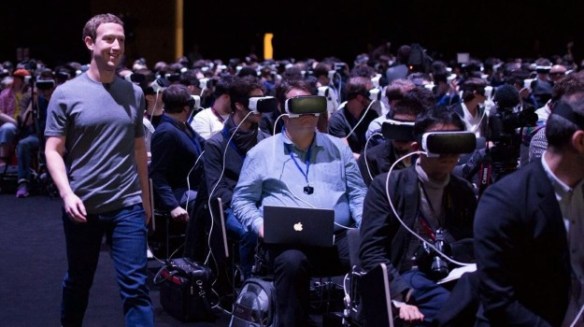
zuckerberg_VR_people-625x350

Technology promised to set us free. Instead it has trained us to withdraw from the world into distraction and dependency

By Nicholas Carr

Source: Aeon

It was a scene out of an Ambien nightmare: a jackal with the face of Mark Zuckerberg stood over a freshly killed zebra, gnawing at the animal’s innards. But I was not asleep. The vision arrived midday, triggered by the Facebook founder’s announcement – in spring 2011 – that ‘The only meat I’m eating is from animals I’ve killed myself.’ Zuckerberg had begun his new ‘personal challenge’, he told Fortune magazine, by boiling a lobster alive. Then he dispatched a chicken. Continuing up the food chain, he offed a pig and slit a goat’s throat. On a hunting expedition, he reportedly put a bullet in a bison. He was ‘learning a lot’, he said, ‘about sustainable living’.

I managed to delete the image of the jackal-man from my memory. What I couldn’t shake was a sense that in the young entrepreneur’s latest pastime lay a metaphor awaiting explication. If only I could bring it into focus, piece its parts together, I might gain what I had long sought: a deeper understanding of the strange times in which we live.

What did the predacious Zuckerberg represent? What meaning might the lobster’s reddened claw hold? And what of that bison, surely the most symbolically resonant of American fauna? I was on to something. At the least, I figured, I’d be able to squeeze a decent blog post out of the story.

The post never got written, but many others did. I’d taken up blogging early in 2005, just as it seemed everyone was talking about ‘the blogosphere’. I’d discovered, after a little digging on the domain registrar GoDaddy, that ‘roughtype.com’ was still available (an uncharacteristic oversight by pornographers), so I called my blog Rough Type. The name seemed to fit the provisional, serve-it-raw quality of online writing at the time.

Blogging has since been subsumed into journalism – it’s lost its personality – but back then it did feel like something new in the world, a literary frontier. The collectivist claptrap about ‘conversational media’ and ‘hive minds’ that came to surround the blogosphere missed the point. Blogs were crankily personal productions. They were diaries written in public, running commentaries on whatever the writer happened to be reading or watching or thinking about at the moment. As Andrew Sullivan, one of the form’s pioneers, put it: ‘You just say what the hell you want.’ The style suited the jitteriness of the web, that needy, oceanic churning. A blog was critical impressionism, or impressionistic criticism, and it had the immediacy of an argument in a bar. You hit the Publish button, and your post was out there on the world wide web, for everyone to see.

Or to ignore. Rough Type’s early readership was trifling, which, in retrospect, was a blessing. I started blogging without knowing what the hell I wanted to say. I was a mumbler in a loud bazaar. Then, in the summer of 2005, Web 2.0 arrived. The commercial internet, comatose since the dot-com crash of 2000, was up on its feet, wide-eyed and hungry. Sites such as MySpace, Flickr, LinkedIn and the recently launched Facebook were pulling money back into Silicon Valley. Nerds were getting rich again. But the fledgling social networks, together with the rapidly inflating blogosphere and the endlessly discussed Wikipedia, seemed to herald something bigger than another gold rush. They were, if you could trust the hype, the vanguard of a democratic revolution in media and communication – a revolution that would change society forever. A new age was dawning, with a sunrise worthy of the Hudson River School.

Rough Type had its subject.

The greatest of the United States’ homegrown religions – greater than Jehovah’s Witnesses, greater than the Church of Jesus Christ of Latter-Day Saints, greater even than Scientology – is the religion of technology. John Adolphus Etzler, a Pittsburgher, sounded the trumpet in his testament The Paradise Within the Reach of All Men (1833). By fulfilling its ‘mechanical purposes’, he wrote, the US would turn itself into a new Eden, a ‘state of superabundance’ where ‘there will be a continual feast, parties of pleasures, novelties, delights and instructive occupations’, not to mention ‘vegetables of infinite variety and appearance’.

Similar predictions proliferated throughout the 19th and 20th centuries, and in their visions of ‘technological majesty’, as the critic and historian Perry Miller wrote, we find the true American sublime. We might blow kisses to agrarians such as Jefferson and tree-huggers such as Thoreau, but we put our faith in Edison and Ford, Gates and Zuckerberg. It is the technologists who shall lead us.

Cyberspace, with its disembodied voices and ethereal avatars, seemed mystical from the start, its unearthly vastness a receptacle for the spiritual yearnings and tropes of the US. ‘What better way,’ wrote the philosopher Michael Heim in ‘The Erotic Ontology of Cyberspace’ (1991), ‘to emulate God’s knowledge than to generate a virtual world constituted by bits of information?’ In 1999, the year Google moved from a Menlo Park garage to a Palo Alto office, the Yale computer scientist David Gelernter wrote a manifesto predicting ‘the second coming of the computer’, replete with gauzy images of ‘cyberbodies drift[ing] in the computational cosmos’ and ‘beautifully laid-out collections of information, like immaculate giant gardens’.

The millenarian rhetoric swelled with the arrival of Web 2.0. ‘Behold,’ proclaimed Wired in an August 2005 cover story: we are entering a ‘new world’, powered not by God’s grace but by the web’s ‘electricity of participation’. It would be a paradise of our own making, ‘manufactured by users’. History’s databases would be erased, humankind rebooted. ‘You and I are alive at this moment.’

The revelation continues to this day, the technological paradise forever glittering on the horizon. Even money men have taken sidelines in starry-eyed futurism. In 2014, the venture capitalist Marc Andreessen sent out a rhapsodic series of tweets – he called it a ‘tweetstorm’ – announcing that computers and robots were about to liberate us all from ‘physical need constraints’. Echoing Etzler (and Karl Marx), he declared that ‘for the first time in history’ humankind would be able to express its full and true nature: ‘we will be whoever we want to be.’ And: ‘The main fields of human endeavour will be culture, arts, sciences, creativity, philosophy, experimentation, exploration, adventure.’ The only thing he left out was the vegetables.

Such prophesies might be dismissed as the prattle of overindulged rich guys, but for one thing: they’ve shaped public opinion. By spreading a utopian view of technology, a view that defines progress as essentially technological, they’ve encouraged people to switch off their critical faculties and give Silicon Valley entrepreneurs and financiers free rein in remaking culture to fit their commercial interests. If, after all, the technologists are creating a world of superabundance, a world without work or want, their interests must be indistinguishable from society’s. To stand in their way, or even to question their motives and tactics, would be self-defeating. It would serve only to delay the wonderful inevitable.

The Silicon Valley line has been given an academic imprimatur by theorists from universities and think tanks. Intellectuals spanning the political spectrum, from Randian right to Marxian left, have portrayed the computer network as a technology of emancipation. The virtual world, they argue, provides an escape from repressive social, corporate and governmental constraints; it frees people to exercise their volition and creativity unfettered, whether as entrepreneurs seeking riches in the marketplace or as volunteers engaged in ‘social production’ outside the marketplace. As the Harvard law professor Yochai Benkler wrote in his influential book The Wealth of Networks (2006):

This new freedom holds great practical promise: as a dimension of individual freedom; as a platform for better democratic participation; as a medium to foster a more critical and self-reflective culture; and, in an increasingly information-dependent global economy, as a mechanism to achieve improvements in human development everywhere.

Calling it a revolution, he said, is no exaggeration.

Benkler and his cohort had good intentions, but their assumptions were bad. They put too much stock in the early history of the web, when the system’s commercial and social structures were inchoate, its users a skewed sample of the population. They failed to appreciate how the network would funnel the energies of the people into a centrally administered, tightly monitored information system organised to enrich a small group of businesses and their owners.

The network would indeed generate a lot of wealth, but it would be wealth of the Adam Smith sort – and it would be concentrated in a few hands, not widely spread. The culture that emerged on the network, and that now extends deep into our lives and psyches, is characterised by frenetic production and consumption – smartphones have made media machines of us all – but little real empowerment and even less reflectiveness. It’s a culture of distraction and dependency. That’s not to deny the benefits of having easy access to an efficient, universal system of information exchange. It is to deny the mythology that shrouds the system. And it is to deny the assumption that the system, in order to provide its benefits, had to take its present form.

Late in his life, the economist John Kenneth Galbraith coined the term ‘innocent fraud’. He used it to describe a lie or a half-truth that, because it suits the needs or views of those in power, is presented as fact. After much repetition, the fiction becomes common wisdom. ‘It is innocent because most who employ it are without conscious guilt,’ Galbraith wrote in 1999. ‘It is fraud because it is quietly in the service of special interest.’ The idea of the computer network as an engine of liberation is an innocent fraud.

I love a good gizmo. When, as a teenager, I sat down at a computer for the first time – a bulging, monochromatic terminal connected to a two-ton mainframe processor – I was wonderstruck. As soon as affordable PCs came along, I surrounded myself with beige boxes, floppy disks and what used to be called ‘peripherals’. A computer, I found, was a tool of many uses but also a puzzle of many mysteries. The more time you spent figuring out how it worked, learning its language and logic, probing its limits, the more possibilities it opened. Like the best of tools, it invited and rewarded curiosity. And it was fun, head crashes and fatal errors notwithstanding.

In the early 1990s, I launched a browser for the first time and watched the gates of the web open. I was enthralled – so much territory, so few rules. But it didn’t take long for the carpetbaggers to arrive. The territory began to be subdivided, strip-malled and, as the monetary value of its data banks grew, strip-mined. My excitement remained, but it was tempered by wariness. I sensed that foreign agents were slipping into my computer through its connection to the web. What had been a tool under my own control was morphing into a medium under the control of others. The computer screen was becoming, as all mass media tend to become, an environment, a surrounding, an enclosure, at worst a cage. It seemed clear that those who controlled the omnipresent screen would, if given their way, control culture as well.

‘Computing is not about computers any more,’ wrote Nicholas Negroponte of the Massachusetts Institute of Technology in his bestseller Being Digital (1995). ‘It is about living.’ By the turn of the century, Silicon Valley was selling more than gadgets and software: it was selling an ideology. The creed was set in the tradition of US techno-utopianism, but with a digital twist. The Valley-ites were fierce materialists – what couldn’t be measured had no meaning – yet they loathed materiality. In their view, the problems of the world, from inefficiency and inequality to morbidity and mortality, emanated from the world’s physicality, from its embodiment in torpid, inflexible, decaying stuff. The panacea was virtuality – the reinvention and redemption of society in computer code. They would build us a new Eden not from atoms but from bits. All that is solid would melt into their network. We were expected to be grateful and, for the most part, we were.

Our craving for regeneration through virtuality is the latest expression of what Susan Sontag in On Photography (1977) described as ‘the American impatience with reality, the taste for activities whose instrumentality is a machine’. What we’ve always found hard to abide is that the world follows a script we didn’t write. We look to technology not only to manipulate nature but to possess it, to package it as a product that can be consumed by pressing a light switch or a gas pedal or a shutter button. We yearn to reprogram existence, and with the computer we have the best means yet. We would like to see this project as heroic, as a rebellion against the tyranny of an alien power. But it’s not that at all. It’s a project born of anxiety. Behind it lies a dread that the messy, atomic world will rebel against us. What Silicon Valley sells and we buy is not transcendence but withdrawal. The screen provides a refuge, a mediated world that is more predictable, more tractable, and above all safer than the recalcitrant world of things. We flock to the virtual because the real demands too much of us.

‘You and I are alive at this moment.’ That Wired story – under headline ‘We Are the Web’ – nagged at me as the excitement over the rebirth of the internet intensified through the fall of 2005. The article was an irritant but also an inspiration. During the first weekend of October, I sat at my Power Mac G5 and hacked out a response. On Monday morning, I posted the result on Rough Type – a short essay under the portentous title ‘The Amorality of Web 2.0’. To my surprise (and, I admit, delight), bloggers swarmed around the piece like phagocytes. Within days, it had been viewed by thousands and had sprouted a tail of comments.

So began my argument with – what should I call it? There are so many choices: the digital age, the information age, the internet age, the computer age, the connected age, the Google age, the emoji age, the cloud age, the smartphone age, the data age, the Facebook age, the robot age, the posthuman age. The more names we pin on it, the more vaporous it seems. If nothing else, it is an age geared to the talents of the brand manager. I’ll just call it Now.

It was through my argument with Now, an argument that has now careered through more than a thousand blog posts, that I arrived at my own revelation, if only a modest, terrestrial one. What I want from technology is not a new world. What I want from technology are tools for exploring and enjoying the world that is – the world that comes to us thick with ‘things counter, original, spare, strange’, as Gerard Manley Hopkins once described it. We might all live in Silicon Valley now, but we can still act and think as exiles. We can still aspire to be what Seamus Heaney, in his poem ‘Exposure’, called inner émigrés.

A dead bison. A billionaire with a gun. I guess the symbolism was pretty obvious all along.

Why Are There So Many Psychopaths in Positions of Power?

what-people-think-psychopaths-are-streetdemocracy

By Anna LeMind

Source: Waking Times

A 2010 study that examined a sample of 203 individuals from different companies’ management development programs revealed something interesting. It was found that about 3% of business managers scored in the psychopath range while the incidence of psychopathy in the general population is approximately 1%. So why are there so many psychopaths in senior management positions?

The Study

A more recent study, published in 2014 in the Journal of Forensic Psychiatry and Psychology, shed new light on the behavior of psychopaths, which could explain this phenomenon.

During an experiment, a group of people were given a standard test of psychopathy. At the same time, the participants were shown a series of picture aimed to test their levels of empathy. For this purpose, the researchers measured their galvanic skin response to examine their emotional reaction to the shown pictures.

The research showed that psychopaths with average or high levels of intelligence were able to control their galvanic skin response. As a result of this, their responses appeared normal. At the same time, psychopaths with low IQ exhibited abnormal test results, which are typical for individuals with psychopathic tendencies.

What the Results Mean

Psychopaths are great manipulators, and this research provides new evidence for that. The results of the study suggest that psychopaths with high IQs are able to hide their true identity, faking their emotional responses and probably personality traits as well. As a result, they often show a different picture of themselves and trick others into believing this is their real self.

Carolyn Bate, the first author of the study, said:

“The ones who are at the top of businesses are often charming and intelligent, but with emotional deficits, as opposed to psychopaths who are quite erratic and tend to commit gruesome crimes and are often caught and imprisoned.”

She also thinks that psychopaths in positions of power could be far more than 3%, because if people are aware they are psychopathic they can also lie – they are quite manipulative and lack empathy.”

These findings are quite interesting to consider and could apply to other spheres except for the business world. I’m sure that if psychologists had the opportunity to study those in positions of political power, the figure would go beyond 3%. Being manipulative and able to fake one’s emotions is a quality that certainly helps one become a successful politician. Not even to mention that in order to reach the highest levels of political power, some lack of empathy and conscience is a must.

Dr. Paul Babiak writes in his book, Snakes in Suits: When Psychopaths Go to Work:

They are masters of impression management; their insight into the psyche of others combined with a superficial – but convincing – verbal fluency allows them to change their situation skillfully as it suits the situation and their game plan.”

Doesn’t this sound like most of our politicians? They are just playing their game, tricking people into believing that their concerns about the world and society are sincere. They pretend to care while in reality, they only want more power and money. And we don’t even need a study to know this for sure.

Pokémon and the Age of Augmented Hyper-Surreality

maxresdefault

By Luther Blissett

Imagine walking to a park in a fairly average medium-sized city on a warm Summer day. There you see groups, pairs and individuals of different ages and races slowly milling about, some with dogs, some with baby carriages. Approaching closer, you realize nearly everyone in the park other than yourself is staring intently at their phone, occasionally tapping and swiping the screen. It seems odd, though not completely out of the ordinary in this day and age. Then, off in the distance at the far end of the park, someone shouts what sounds like a word in an alien language or dialect triggering a crowd to rapidly swarm towards the general area; most speed-walking or jogging but all aiming their phones at the same destination. Soon everyone in the vicinity of the park (except yourself a few vagrants and junkies of a less tech-savvy sort) surges towards the center of the swarm of over a hundred participants as if sucked into a vortex. As quickly as it started, the crowd disperses and an “normalcy” resumes, albeit temporarily since the pattern repeats continuously at half hour to one hour intervals throughout different areas of the park.

This dream-like scenario is an outsider’s description of a Pokémon Go session on a typical Summer weekend at Bellevue Downtown Park. The crowd might have been slightly larger than usual due to the balmy weather, but numerous videos posted on YouTube indicate such occurrences aren’t completely anomalous.

An example:

Still, the relative newness and novelty of the experience doesn’t make it feel any less like being in a dystopian narrative such as a Philip K. Dick novel or an episode of Charlie Brooker’s “Black Mirror”. However, the sense of social displacement and alienation for non-gamers is dampened by nearly a decade of collective exposure to increasingly advanced internet-enabled cellphones whose ubiquity and usage has steadily increased over the years.

Prior to the release of Pokémon Go more people have been spending increasing hours using smartphones for talking, texting, email, news, entertainment and social media, selfies, etc. In the context of modern industrial society it’s almost an aberration to be without a device, or to not be heavily reliant on one. What sets Pokémon Go apart is its ability to simulate a fusion of material and virtual worlds by depicting through phone screens digital sprites superimposed on real-time images of physical environments to its users.

Just as shamans would use entheogens to peer behind the veil of reality, augmented reality allows users to perceive additional veils over reality. This is not necessarily a bad thing because there’s potential for “digital veils” to assist us in seeing what certain interests might prefer to keep hidden. For example, what if everyone could literally see the interests orchestrating a politician’s rise to power? What if we could walk into any store and instantly know which products were made by war-profiteers, polluters, and/or sweatshop owners? Would people want to know? How much of an impact would it have on decisions and actions in the context of a media environment inundated with heavily financed government/corporate PR and marketing? Of course, even without augmented reality the virtual realm affects the “real world”, most notably with the economic dominance of the tech industry as well as the social, political and economic havoc wreaked by hackers; but rarely is such influence immediately manifested as when crowds swarm newly spawned Pokémon sprites.

In many ways, Pokémon Go was the ideal vehicle to bring augmented reality to the masses. Many apps have utilized it for different purposes such as navigating, translating, finding dates, viewing celestial objects, narrating self-guided tours, weather forecasting, image enhancement, etc., but only Pokémon was able to use the technology to bring a fictional universe closer to life by creating a cross-generational craze. Alfie Brown of ROAR Magazine, characterized virtual Pokémon as the perfect example of what Jacques Lacan called the objet petit a, a fetishized yet ephemeral and unobtainable object of desire, a key concept behind consumerist neoliberalism’s push towards cheap, chronically obsolete, ephemeral and now digital goods and services.

But what makes Pokémon creatures so desirable? In regard to children, they seem naturally drawn towards cute and brightly colored cartoon characters. The mechanics of the game taps into natural tendencies to collect things and to display one’s collection to others (a phenomenon South Park astutely critiqued on episodes lampooning World of Warcraft and “freemiums”). In consumer societies children and adults are prone to feeling prestige and power from the size and perceived value of their collections; however, children are mostly limited in terms of the acquisitive power: video games elicit a rare opportunity to gain more prestige and power than adults have in real life.

As for older folks, there’s a variety of additional interconnected factors. For teens and young adults, peer pressure alone might be enough to hook some people, but the mainstreaming of geek culture no doubt plays a part, making fandom, quirkiness and technological obsession more accepted and valued. The transition to adulthood also happens to be a time when there’s increased pressure to establish one’s sense of identity, become more independent and to succeed academically and professionally. Games are a means of escape from such pressures (as real life opportunities for economic advancement continue to dwindle) while at the same time functioning as structured activities for social interaction and, more broadly, to build communities. For adults, reasons may include all of those previously mentioned in addition to fascination with technology, bonding with younger friends and family, the feeling of being part of a global phenomena, or nostalgia for the original Pokémon games, for example.

Returning to Pokémon Go’s more dystopian aspects, the game has been used as a tool by the unscrupulous for crimes such as robbery and sexual assault. Though crowds created by Pokémon Go spawning areas or “gyms” (locations where players battle each other in teams to increase their avatars’ abilities) have been a benefit to some local businesses, residential neighbors in some cases view game players as unwanted loiterers invading their privacy. There have also been news reports of video game battles escalating to physical brawls and innocent gamers being racially profiled as suspicious threats.

As with most online tools, there’s a risk of the app and users being exploited for surveillance, social control, to extract money and personal data, etc. Modern media literacy requires an understanding of how businesses benefit from our use of game and service apps (especially “free” ones) and how intentional or unknowing misuse of collected data could serve government/corporate/criminal interests. Augmented reality games are an exciting new media with potential to be used in novel and fun ways, but we should be vigilant of its potential to influence beliefs as well as decisions regarding how we spend time and resources.

Pokémon Go is at the forefront of the increasing power of tech companies such as Google and Niantic (the software developer behind Pokémon Go) to control and use information to manipulate the masses. Such power in itself is disturbing, but more sensational examples might include news reports of car accidents caused by drivers mindlessly following Google Maps off the road or colliding into other cars while playing Pokémon Go. Such cases may seem absurd but they prompt a number of important questions. Why do some prioritize and trust mediated information over their own senses? As online personas increase in perceived importance, at what lengths will people go to sustain it and would it be at the expense of others things (such as personal safety)? Are we becoming addicted to cognitive “skinner boxes” with our needs perpetually triggered and gratified by apps? In an increasingly hyperreal world in which the boundary between the real and virtual becomes more permeable, what new hazards await?

The Desire to Fit In is the Root of Almost All Wrongdoing

226816_20150205_092434_mddtpdg

By Christopher Freiman

Source: aeon

Imagine that one morning you discover a ring that grants you magic powers. With this ring on your finger, you can seize the presidency, rob Fort Knox and instantly become the most famous person on the planet. So, would you do it?

Readers of Plato’s Republic will find this thought experiment familiar. For Plato, one of the central problems of ethics is explaining why we should prioritise moral virtue over power or money. If the price of exploiting the mythical ‘Ring of Gyges’ – acting wrongly – isn’t worth the material rewards, then morality is vindicated.

Notice that Plato assumes that we stray from the moral path through being tempted by personal gain – that’s why he tries to show that virtue is more valuable than the gold we can get through vice. He isn’t alone in making this assumption. In Leviathan (1651), Thomas Hobbes worries about justifying morality to the ‘fool’ who says that ‘there is no such thing as justice’ and breaks his word when it works to his advantage. And when thinking about our reasons to prefer virtue to vice, in his Enquiry Concerning the Principles of Morals (1751) David Hume confronts the ‘sensible knave’, a person tempted to do wrong when he imagines ‘that an act of iniquity or infidelity will make a considerable addition to his fortune’.

Some of history’s greatest philosophers, then, agree that wrongdoing tends to be motivated by self-interest. Alas, I’m not one of history’s greatest philosophers. Although most assume that an immoral person is one who’s ready to defy law and convention to get what they want, I think the inverse is often true. Immorality is frequently motivated by a readiness to conform to law and convention in opposition to our own values. In these cases, it’s not that we care too little about others; it’s that we care too much. More specifically, we care too much about how we stack up in the eyes of others.

Doing the wrong thing is, for most of us, pretty mundane. It’s not usurping political power or stealing millions of dollars. It’s nervously joining in the chorus of laughs for your co-worker’s bigoted joke or lying about your politics to appease your family at Thanksgiving dinner. We ‘go along to get along’ in defiance of what we really value or believe because we don’t want any trouble. Immanuel Kant calls this sort of excessively deferential attitude servility. Rather than downgrading the values and commitments of others, servility involves downgrading your own values and commitments relative to those of others. The servile person is thus the mirror image of the conventional, self-interested immoralist found in Plato, Hobbes and Hume. Instead of stepping on whomever is in his way to get what he wants, the servile person is, in Kant’s words, someone who ‘makes himself a worm’ and thus ‘cannot complain afterwards if people step on him’.

Kant thinks that your basic moral obligation is to not treat humanity as a mere means. When you make a lying promise that you’ll pay back a loan or threaten someone unless he hands over his wallet, you’re treating your victim as a mere means. You’re using him like a tool that exists only to serve your purposes, not respecting him as a person who has value in himself.

But Kant also says that you shouldn’t treat yourself as a mere means. This part of his categorical imperative gets less publicity than his injunction against mistreating others, but it’s no less important. Thomas Hill, a philosopher at the University of North Carolina, Chapel Hill, notes in Autonomy and Self-Respect (1991) that servility involves a mistaken assessment of your moral status. Crucially, the servile person is guilty of the same root error as the person who deceives or threatens others – namely, denying the basic moral equality of all persons. It’s just that the person you’re degrading is you. But servile behaviour neglects the fact that you’re entitled to the same respect as anyone else.

Now, maybe you’re thinking that lying about your opinion of Donald Drumpf [or Shillary Clinton] to placate your parents so you can eat your cranberry sauce in peace is no big deal. Fair enough. But servility can cause much graver moral transgressions.

Take the most famous psychological study of the 20th century: Stanley Milgram’s obedience experiments. Milgram discovered that most of his subjects would deliver excruciating – and sometimes apparently debilitating or lethal – electric shocks to innocent victims when an experimenter told them to do so. In ‘The Perils of Obedience’ (1973), Milgram explained that one reason why the typical subject goes along with malevolent authority is because he ‘fears that he will appear arrogant, untoward, and rude if he breaks off’. The subjects’ commitment to politeness overwhelmed their commitment to basic moral decency. And a lot of us are more like Milgram’s subjects than we’d care to admit: we don’t want to appear arrogant, untoward or rude at the dinner table, the classroom, the business meeting. So we swallow our objections and allow ourselves – and others – to be stepped on.

The pernicious consequences of servility aren’t confined to the lab, either. Indeed, Milgram’s experiment was motivated partly by his desire to understand how so many ordinary-seeming people could have participated in the moral horrors of the Holocaust. More recently, the military violence at Abu Ghraib has been explained in part by the soldiers’ socialisation into conformity. These examples and reflections on our own lives reveal an underappreciated moral lesson. It’s not always, or even usually, the case that we do wrong because we lack respect for others. Often it’s because we lack respect for ourselves.

Charlie Kaufman on Zombie Ants, Mind Control, and Consumerist Culture

By The Unknown

Source: High Existence

Charlie Kaufman has one of the most inventive and original minds in Hollywood. That’s probably why he has eluded mainstream success.

Mr. Kaufman is perhaps best known for writing the modern classic Eternal Sunshine of the Spotless Mind, for which he was awarded an Oscar for best original screenplay. He’s also the writer of Being John Malkovich, Adaptation, Anomalisa, and the writer-director of the little-known but brilliant Synecdoche, New York, which Roger Ebert named the “best film of the decade” (2000-2010).

In the words of fellow writer Jeremy Brock:

One of the few screenwriters to transcend his profession, Charlie Kaufman is responsible for some of the most unique, daring, and inventive screenplays in contemporary cinema. […] His films deal with identity, mortality, relationships, and the meaning or purpose of life. They are metaphysical, self-reflexive, hyper-aware, often using surrealist conceits to explore our fundamental anxieties. It is in this tradition of finding new, startling, and funny ways of exploring human psychology that Charlie Kaufman sits comfortably amongst the world’s greatest living writers.

Fans love him. Critics adore him. Mainstream audiences… ignore him.

And that’s a shame.

In a world filled with sequels, prequels, remakes, and reboots, creativity is dying in Hollywood.Worse than dying, I’d argue that creativity is being tied up, beaten, tortured, mocked, murdered, then thrown in a gutter and pissed on.

You could argue that I’m cynical.

You could also argue that I’m tired of being patronized by the regurgitated garbage Hollywood pukes up and tries to spoon feed us. We all know the difference between food and vomit, and Hollywood’s been steadily feeding us barf for the last ten years while distracting us with silly airplane noises like we’re babies.

But I’m getting sidetracked.

This isn’t about my personal disdain for Hollywood; this is about Charlie Kaufman’s views on consumerism, and Charlie Kaufman is much more polite, intelligent, and eloquent than I am.

I stumbled across a speech Charlie Kaufman delivered at a BAFTA lecture in 2011 and absolutely loved it.

Mr. Kaufman was supposed to deliver a speech about screenwriting, but gave the audience much more. The full speech covers a broad range of topics, but I spliced together a few of my favorites — Zombie Ants, Mind Control, and Consumerist Culture — and created the video below.

Watch and listen as Charlie Kaufman dissects and diagnoses the fallacies of our present-day culture, but rather than react with juvenile indignation (as I did in my brief rant earlier), he responds with poignant words of heartbroken yet hopeful wisdom.

Enjoy!

Positively Thriving Through the Collapse of Civilisation

permaculture1

By Open

Source: ZenGardner.com

Have you ever watched something happening in slow motion? You can quite clearly see the end result, but nevertheless, you can’t quite believe in your mind what your eyes are seeing. Like when the twin towers ‘collapsed’. The demolition was happening there right in front of you, but you had to pinch yourself to make sure you weren’t just dreaming. I feel exactly that way about modern society right now. The collapse is already happening, but in slow motion, so you can’t quite believe the entirety of it. What will it look like as the ‘buildings’ topple? More importantly, how can we not only survive the shift, but positively thrive in it?…

Slow motion free fall

Have you seen the film “Collapse” yet? It’s a grounded, real and at times very emotive interview with the late whistle-blower Michael C Rupert. I believe everybody on the planet should watch it (I’ve included it below). You hear the calling of a soul, put here for a purpose. Never so clearly have I witnessed a man express so eloquently, the destiny that drew him here.

He sums up so marvelously the reason why society is going to collapse. Let me correct myself: why it is already collapsing, just that it’s in slow motion, and not everyone has yet pinched themselves out of the dream that prevents them seeing the reality of it.

Society is built on the foundation of ‘infinite growth’, the need to continuously expand in order to service a surging ocean of debt. It depends on the ever burgeoning exploitation of natural resources. Which is why governments and corporations are more concerned with the last pockets of oil under the pole, rather than the ice on top of it. It’s why they’re stripping the tar from the sand, and fracking the earth into oblivion. Therein lies the problem. That’s why society is already in a state of slow motion free fall. Because we live on a planet of finite resources, and the two ends no longer meet. We’ve built foundations on sand and now the tide is fast flowing in.

Nevertheless, I am an optimist. Where others might slip into fear, I see the light shining through the shadows. There’s a way to survive what is to come. No, there’s a way to positively thrive in it!

Thriving the meltdown

You first have to accept what you see. That’s a challenge in itself. Watch the film, especially towards the end, because it’s fascinating. The interviewer suggests all manner of information can be presented to support the view you want to put across (like the ‘debate’ on global warming for example). And he’s right. But that’s not what Michael is about and neither am I. For me, and for others I work with, the debate is not necessary – such intellectual pontification is a pointless waste of time. We’ve already seen the towers collapsing. I can feel the energies of higher benevolence instigating the collapse mechanism. The earth needs to be saved from the wanton, consumeristic destruction. The debate – if ever there was one – is over. And until you can see through the veil, there’s nowhere to begin. So my first suggestion – assuming you feel any resonance with me – is to work to see past the veil into what is surely now taking place: collapse of the civilisation we currently depend upon.

When this lands for you, you’ll realise like the Hopi Elders, that the only way to prosper through this collapse, is by spiritual means. This will be a ‘war’ of the spiritual through the material. Not fighting. Rather breaking through the sense of physical disempowerment into the liberation of the spirit. The expression of the boundless, unlimited you, and watching this miraculous nature shine out into the world. Trusting that your every step will be supported. Not in the way your ego might want. It won’t deliver the physical outcome you desire. It’ll deliver much more than that: as the old skin peels off, a metamorphosis into an interconnected, interdimensional way of being – The rise of the Divine Human.

But yes, at this time we are physical beings too. And we’ll need a platform from which to unveil our divine being at the heart of every man, woman and child. Just as the dragonfly stands on the leaf, peels off the old skin and unfolds its wings in the sunlight before taking flight, so we’ll need a stable background to help people learn to fly.

What does that mean exactly?

It means we have to bring as swift an end to the system as possible. It’s gobbling up precious resources and energy, ridiculously wasting them on idle rubbish, mindless entertainment and hopeless addiction. We have to ween ourselves off this crutch through non-compliance with the corporations that would try to bolster it – those that would like to keep mankind dwelling in the murky depths of the pond, rather than flying liberated above it.

Discovering how less is more

We have to spend our time and money wisely now: to invest in ourselves and our future (especially since paper money will lose its value); to gather together the resources and communities that can help one another out as society steadily pulls itself apart. Even if you continue to work in the matrix, you can still prepare. And don’t worry, you have time, if you begin now. Society will not collapse in one fell swoop. It will be a steady degradation. It’s happening now. It’s just that most haven’t clicked yet as to what’s going on. So you’ve got time to gather together, share ideas, support and suggestions about what might work best. You can start growing your own food and collect a reserve of essentials to tide you through difficult times.

That’s the inspirational idea behind Transition Towns, which have been springing up and thriving all around the world for several years now. It’s about supporting local skills, already developing the web of a local support and resource mechanism. Even if it’s just a micro community of a few neighbours and friends, it will make all the difference as the globalised structure fractures.

In the film below, Michael shares a poignant and prophetic example of the fate of two countries – North Korea and Cuba – that both suffered through the collapse of the iron curtain: affected because they were both dependent on Soviet oil, just as the civilised world is right now.

The North Korean approach was to centralise resource, for government to control everything, like the collectivised food supply and nationalised energy. Communism? It sounds suspiciously like the leading western ‘democracies’ to me. And what was the result? Starvation on a massive scale. Cuba on the other hand encouraged people to come together in local communities, to grow their own food in their own back gardens, thus consuming a fraction of the energy. They no longer have the paraphernalia of modern society – a blessing – and the people positively thrived by needing less, discovering that less is more.

Some will say we can use unlimited supplies of ‘free energy’. Whilst we may benefit from new technologies that could come through, what we have to realise is how hopelessly dependent the current system is on oil. How will all those fossil fuel engines be replaced? Where will the resources come from to build the new machines, gadgets and widgets? Whatever technology we discover to tide us through, it is my strong assertion that we need to get used to consuming less, using wisely the resources we currently have…

Even if you new the world was to end tomorrow, would you plant that apple tree today? Would you live wisely, with compassion and a soft footprint on the earth? It is these souls that will ascend through the collapse of the old world. This is the new consciousness which will thrive as the old is peeled away.

Pinch yourself awake

The universe is a flowing ocean of energy. Humanity – spurred by an Interdimensional Intervention – has built a dam and tried to contain it in some eddy current. And we’ve turned a blind eye as the realigning energy of higher dimensional forces and devic consciousness now comes in to break apart the false reality fabric over time.

This shift and cleansing process that is beginning will be unlike any other to have taken place on earth. Why? Because Gaia has released her karma. She needed the control mechanism too, in order to experience being fully accepting and forgiving of those that would disrespect her. But she’s processed that constriction now and needs it no longer. Thus the ‘matrix’ no longer has a foundation. It will be peeled off over time. There will be no place for the old human consciousness, which will be shed with the skin too. Instead, will incarnate the new human consciousness – Divinicus Cometh – to thrive through this cleansing process which has now begun.

The renewed human spirit is meant to ride this realigning wave, rather than try to manipulate it. Because anything that tries to control something else, ultimately ends up controlling only itself. So we need to learn to ride the wave of the soul once more. To listen to it and above all, feel it coursing through our veins, respond to its direction. We need to master the inner alchemy of change. There’s two streams of consciousness within you. Which do you identify with: the sense of separation, the fear and contraction? or do you penetrate that, soften through it and flow with your eternal spirit?Right now too many are still caught ‘rabbit like’ in the car headlamps as the slow motion tsunami approaches them. Hoping, pretending, that they’re just in a dream and when they wake up, all will be okay, the car won’t really be careering towards them. But by then, it’s too late.

I urge you then to watch the film, pinch yourself awake, but then let the soul inspire you to make new choices in this new multidimensional landscape. And if you can’t yet clearly hear the soul and follow its guidance through every choice, then I would suggest that’s the best place to begin. Here’s the documentary and afterwards, if you’d like help with the soul guidance part, feel free to get in touch.

from my heart to yours

Open
(on behalf of Openhand)

Can We Please Get Rid of the Pledge?

112congress_tx700

By Mike Whitney

Source: CounterPunch

The Pledge of Allegiance is not an expression of patriotism. It is a loyalty oath that one normally associates with totalitarian regimes. People who love freedom, should be appalled by the idea our children are being coerced to stand and declare their support for the state. This is the worst form of indoctrination and it is completely anathema to the principals articulated in the US Constitution and the Bill of Rights. I cannot imagine outspoken libertarians like Thomas Jefferson or Tom Paine ever proclaiming their loyalty to the state when they correctly saw the state as the greatest threat to individual freedom. Which it is.

Now I know that many people think the Pledge is simply an affirmation of their respect for the flag, their love for the country, and their gratitude to the men and women who fought in America’s wars. But that’s not what it is. The Pledge is an attempt to impose conformity on the masses and compel them to click their heels and proclaim their devotion to the Fatherland. That’s not how it’s supposed to work in a democracy. In a democracy, the representatives of the state are supposed to pledge their loyalty to the people and to the laws that protect them. That’s the correct relationship between the state and the people. The Pledge turns that whole concept on its head.

Now I’d have no problem if our schoolchildren recited the Preamble to the Declaration of Independence before class every day:

“We hold these truths to be self-evident, that all men are created equal, that they are endowed by their Creator with certain unalienable Rights, that among these are Life, Liberty and the pursuit of Happiness.

That to secure these rights, Governments are instituted among Men, deriving their just powers from the consent of the governed, That whenever any Form of Government becomes destructive of these ends, it is the Right of the People to alter or to abolish it, and to institute new Government, laying its foundation on such principles and organizing its powers in such form, as to them shall seem most likely to effect their Safety and Happiness.”

That’s great stuff, unfortunately, the people who run this country would never allow it. They’d never allow our kids to recite an incendiary, revolutionary document like that every day for fear it would incite violence against the state. What they want is “good Germans”, not revolutionaries, not freedom-loving populists, and not well-informed, critical thinking individuals who can see through the sham of their jingoistic propaganda. They want people who are going to follow the rules, do what they’re told, fight the wars, and perform their worktime drudgery for 30 or 40 years until they’re carted off to the glue factory. That’s what they want. Reciting the Pledge fits perfectly with this dumbed-down version of permanent indentured servitude. It provides the ideological foundation for bovine acquiescence to the demands of the state and the crooks who run it behind the tri-color banner.

The fact that institutions like the Pledge are never challenged in a public format, points to deeper problems with the media and the way our kids are being educated. And while I don’t have time to talk about that now, it makes me wonder where are the people to question these silly recitations that undermine democracy and personal liberty? Why are their voices never heard?

I can’t answer that, but when I see the state deliberately eviscerating habeas corpus and locking away terror suspects for life with no evidence, no witnesses, no due process, no presumption of innocence, no way to defend themselves or claim their innocence in a court of law or before a jury of their peers–when I see the US state assuming the same unchecked, tyrannical powers as all of the dictatorships that went before them– I grow increasingly concerned that this lack of critical thinking is costing the country quite dearly. We are on the verge of losing what-little democracy we have left because people are incapable of looking around and asking ‘what the hell is going on?’

Pulling your head out of the sand and asking questions is not a sign of disloyalty. It’s a sign of intelligence, the kind of intelligence this country needs to stop the bloody wars and get back on track.

So next time you’re in a situation where you’re asked to stand up and recite the pledge, just pause for a minute and ask yourself what it really means. Is it really an expression of “love of country” or a is it a vacuous and demeaning exercise in nationalism that should be done away with ASAP?

I’d say, it’s the latter.


MIKE WHITNEY lives in Washington state. He is a contributor to Hopeless: Barack Obama and the Politics of Illusion (AK Press). Hopeless is also available in a Kindle edition. He can be reached at fergiewhitney@msn.com.

Related Article: The Truth About the Pledge of Allegiance: Indoctrination & Obedience

Related Videos:

Teaching Children How to Think Instead of What to Think

pink-floyd-the-wall-alan-parker

By Will Stanton

Source: The Mind Unleashed

Right now our education system is doing more to indoctrinate our children than to educate them. In fact, that has been the case for quite some time. Our young minds are being told to accept authority as truth instead of truth as authority, and teachers talk at the students instead of with them.

Teachers have become repeaters of information. They are merely regurgitating everything they once learned from their own teachers, and perpetuating the recycling of information; information that has managed to evade scrutiny for generations. Children are no longer the masters of their own learning, and instead, their minds are being treated as storage containers.

The factory model of education, with its focus on academic and economic elitism, is churning out obedient workers for the system, encouraged to conform every step of the way. We are not being treated as organic, creative, investigative human beings, but instead as parts in the machine. The education system is filtering out the inquisitive nature of our being, with the ultimate goal being to prevent dissent against the system. The system doesn’t want thinkers. It doesn’t want people to question its methods. It wants a population that can be easily manipulated and controlled so as to relinquish all its power to the elite.

There are those who say that skills cannot be taught in schools. Socrates would likely scoff at that notion, were he still alive today. It was Socrates who said, “I cannot teach anybody anything; I can only make them think.”

If we’re going to solve the problem of indoctrination in our school system, we have to learn to begin asking questions instead of giving answers. Real learning is achieved through the investigative process. Children have to be encouraged to search for the answers themselves. It is up to the teachers to provide the tools and resources necessary for the children to conduct these inquiries and make meaningful discoveries. One well-formed question will do more to inspire than any number of answers. In every facet of our educational pursuits, it becomes crucial to begin an open dialogue with our students, to encourage healthy debate and to have them form their own conclusions.

The importance of teaching philosophy in schools cannot be underestimated. In a world where most of humanity is running on the treadmill with the blinders on, it is paramount that we re-evaluate our own perspectives from time to time, and look at the big picture.

What teaching philosophy does is it gets us thinking, it gets us questioning, and it gets us contemplating. Without these skills, humanity will continue to function on autopilot, and we will allow those in power to continue to dominate, oppress and enslave us in every way.

We need to reclaim our own minds…