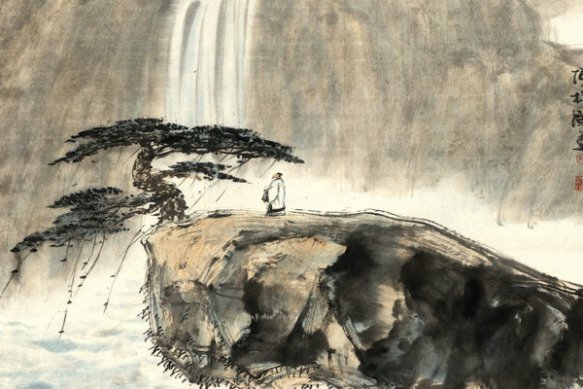
A Taoist Master Explains the Difference Between Religion and Individual Spiritual Cultivation

By Dylan Charles

Source: Waking Times

“The modern world needs true spiritual guidance and development.” ~ Taoist Master Hua Ching Ni

A spiritual war is upon us and the individual is challenged to maintain integrity in a sea of greed, egotism, terror and fear. With no clear path toward spiritual evolution, so many of us floundering and losing ourselves to addiction, despair and self-destruction.

When in the past ordinary religions might have served to offer a pathway toward spiritual awakening based upon the experiences of their ancient sages, today, the best they seem to offer is communal support. Far too often, though, modern religions are mired in greed, scandal, pedophilia and outright terrorism. Religions are failing to provide the help one needs to spiritually thrive in this insane world.

In a reading from the book 8,000 Years of Wisdom, Taoist Master Hua-Ching Ni talks about the state of religions today:

“Spirit can hardly be found in noisy, crowded churches and temples. Even where the teachings of the past sages have been established they have been spoiled by the insensitive trend of the times.

The spirit of the world’s religions died long ago and left most temples and churches merely empty shells.

These places continue as superficial social conventions and can only supply their devotees with shallow activities, psychological games of shadow playing, and hypnosis, all of which have absolutely nothing to do with spiritual reality.

This is the faith of today’s world, and most of their achievements are not the true answer.” ~ Taoist Master Hua Ching Ni

What then, is spiritual reality? And what does it look like in a world governed by fear, distracted by materialism, and kept in conflict by egotism? It’s really quite straightforward, says Master Ni, who refers to it as the “plain, simple truth of your life,’ which is best understood as the profoundly important concept of inner peace.

“The first spiritual goal of Taoism is the restoration and realization of one’s own well-balanced being, and then one’s spiritual evolution.

The highest goal of life is to combine oneself with the spiritual energy of the universe. There is one way to eliminate all wonder, bewilderment and confusion and that is to have inner peace.

The primary method or principle for personal cultivation is to keep peace within oneself and maintain normalcy in one’s environment; thus you can dwell with the spiritual energy and the spiritual energy dwells within you.” ~ Taoist Master Hua Ching Ni

Comparing the teachings of ordinary religions to true personal spiritual cultivation, Master Ni notes that undeveloped human beings follow and devote themselves to belief systems, deities and spiritual figureheads. In contrast, individuals seeking genuine spiritual evolution understand these systems for what they are: illusions and traps.

“People mistake religious emotionalism and hypnosis for spiritual reality.

Often in history religious emotion has been exalted as truth itself. This gave birth to all kinds of religious prejudice and persecution. Religious mobs have carried out the mischief caused by the hot-blooded in the forceful image of a spiritual sovereign. This has not the slightest connection with spiritual reality. It is the manifestation of the impure, heavy, bloody energy of undeveloped human beings before having completed their spiritual evolution.

Many people are fooled by their own ignorance or that of others. And in their ignorance they fool others too. People like this have no hope of reaching the spiritual realm. They will have no chance to touch the real spiritual life. So, before you commit yourself to any religion, you should develop the mental ability to discern what is religious emotion and what is the spiritual truth. One is the right way to follow, and the other is only a psychological pitfall and trap. This is very important for a seeker of truth on the spiritual path.” ~ Taoist Master Hua Ching Ni

Generating this type of spiritual emotionalism has become a profitable art form. Take note of the costumes worn by Catholic Cardinals and deference to the Pope in his symbolic Mitre hat. Islamic fundamentalists and ISIS do the same when they emote fear and terror by parading captives in front of religious soldiers clad in all black robes with faces covered, armed with rifles and sabres. Using symbolic imagery as tools of dominance and control, as Master Ni points out, has absolutely nothing to do with true spiritual reality.

What would the world look like if individuals first placed their own spiritual development ahead of their desire to change the world in accordance with their beliefs about spirituality and feelings religious emotionalism? What if individuals were instead offered a plan of genuine spiritual cultivation, a path that led to actual inner peace?

“The spiritual process itself is a process of the evolution of the human spirit.” ~ Taoist Master Hua Ching Ni

Let us now stop praising famous men (and women)

By David V. Johnson

Source: aeon.com

After the Notre-Dame Cathedral in Paris nearly burned down in April, the French luxury-goods magnate François-Henri Pinault was celebrated for committing €100 million to reconstruct what he called ‘this jewel of our heritage’ and ushering in a flood of donations from other benefactors and companies. Though an impressive figure in the abstract, Pinault’s commitment reflected only 0.3 per cent of his family fortune. If he instead had the average net wealth for a French household and donated 0.3 per cent of his fortune, his commitment would total about €840. Not an insignificant sum for an average Frenchman, but who would refuse to give that sum if it garnered the praise and notoriety that followed Pinault’s donation?

We live in an age of excessive praise for the wealthy and powerful. The upper echelons of society bathe in a sea of honours, awards and celebrity. We see it in the glossy magazines and at the so-called ideas festivals, where billionaires are fawned over for their bons mots. We applaud philanthropists for their largesse, even if their charity will do little ultimate good for society, and even if their conduct in acquiring their fortune was reprehensible. We commend them for dabbling in politics or pushing school reform, before we see any results, and even if we have reason to doubt the good that they will do.

To criticise our praise for the wealthy and powerful as excessive inevitably raises the question of meritocracy. To what extent do we live in a meritocracy, and is that a good or a bad thing? Meritocracy is a form of social organisation that is founded on praise and blame. People signal who deserves power and status by praising them for their character, their talent, their productivity and their actions, and who merits demotion in status and power by blaming them for their vices, their ineptitude and their failings. Insofar as people’s assessments of praise and blame are accurate, they will promote those deemed better up in the hierarchy of power and status, and demote those deemed worse down. Better people will do better things with their superior power and status. When the system works, we have an aristocracy – rule by the finest people. Or so thinkers from Aristotle onward have thought.

This system doesn’t work and can’t work on its own terms. Assessments of praise and blame tend to reflect existing hierarchies of power and status, thereby reifying them. This is because praise and blame have as much to do with the person judging as the person being judged. If everyone in a meritocracy wants to get ahead, assessments of praise and blame will be influenced by whatever helps people to get ahead – namely heaping praise on the powerful and respected, and castigating those without power and status. This is obviously true with meritocracies that most people explicitly reject, such as white supremacy and patriarchy – hierarchies drawn along racial and gender lines. These systems have persisted despite the baseless moral judgments on which they are grounded, because those living within the system are incentivised to see such judgments as legitimate. Meritocracies in general convince those within the system to echo the moral assessments on which they are based as objective and justified, when in fact they are shaped not by objective criteria but by the qualities of the powerful. Praise and blame are ideological blinders that uphold the legitimacy of the meritocratic hierarchy. If we take a more critical look at ourselves and our moral assessments, we will be better able to remove those blinders.

The smog of praise that permeates the upper echelons of society is a product of perverse incentives. As individuals, we tend to praise others and to court praise, because we want to win good will from others and receive confirmation of others’ good will. What’s more, we have an even stronger incentive to praise people who are wealthy and powerful, because winning their goodwill secures their premium support, and the wealthy and powerful are, in turn, more readily able to court praise from others. The more elite someone is, the more likely he is to crowd-surf on the praise of the many lesser folks seeking his favour. And insofar as our age of massive inequality creates people who are wealthier and more powerful, to that extent will the wave of excessive praise swell. We can even anticipate this tendency generating a negative feedback loop: praise of the wealthy and powerful affirms that they are good people deserving their fortune, which can, in turn, augment their wealth and influence, which thereby attracts even more praise.

The effects of excessive praise on conduct are also worth concern. Praising people, even those who deserve praise, can actually have a negative effect on their behaviour. There are many psychological studies demonstrating that people are susceptible to moral compensation. That is, when people feel that they have engaged in good behaviour, they also feel that it gives them licence to act badly in the future. The converse also holds: when people feel that they have engaged in bad behaviour, they also feel that they should make up for it by acting better in the future. If these studies hold up, they appear to upend the social consequences of praise and blame: praising people excessively can lead them to act badly, while blame puts them on notice and reinforces good behaviour. And insofar as this effect is more likely to influence wealthy and powerful people – those who can, thanks to their resources and influence, do more – it magnifies the harm of their bad conduct.

Meritocracies try to establish objective criteria to justify social hierarchies. Nowadays, entry into the elite often has to do with having the right résumé: Oxbridge or Ivy League degrees, a stint at the best consulting firm or investment bank, service in politics or government, writing a book or giving a TED talk about your work. These résumé items are supposed to establish the talent, judgment and character of the people in question. People with such résumés receive respect and esteem – even though their accomplishments are the predictable consequences of being born into the right family, knowing the right people, and swimming with the current. For the ambitious – and meritocracies feed ambition – these résumé items are primarily credentials for acquiring greater power and status. There is no reason for the public to accept such credentials as being an objectively valid base for praise.

If we want to foster a truly democratic society – a society in which we treat each other as equals – we must rein in such excessive praise and the perverse incentives that encourage it. We should aim for the opposite extreme, toward withholding praise and being more circumspect about the wealthy and powerful, to restore balance. As Justice Louis Brandeis, who witnessed our previous Gilded Age, might have said: ‘We may have democracy, or we may have praise showered on the heads of a few, but we can’t have both.’

The Global Climate Movement is Failing: Why?

By Robert J. Burrowes

It has been satisfying to note the significant response to two recent climate campaigns: the actions, including the recent Global Climate Strike, initiated by school students inspired by Greta Thunberg and the climate actions organized by Extinction Rebellion.

While delighted that these campaigns have finally managed to mobilize significant numbers of people around the existential threat the climate catastrophe poses to life on Earth, I would like to briefly raise some issues for consideration by each of those involved in the climate movement as well as those considering involvement.

I do this because history provides clearcut and compelling lessons on how to make such movements have the impact we need and, so far, the climate movement is not doing several vital things if we are to indeed be successful. And I would like to be successful.

So here are five key issues that I would address as soon as possible.

  1. Analyze the climate catastrophe within the context of the ongoing and broader environmental disaster that is currently taking place.
  2. Analyze the climate catastrophe and environmental disaster to better understand the political, economic and social systems and structures, as well as the individual behaviours, that are driving them.
  3. Based on these analyses, reorient the movement’s strategic focus: that is, who and what is the movement trying to change?
  4. And then identify the nature of the behavioural changes we are asking of people and their organizations, and how these will be achieved.
  5. In what timeframe?

Let me briefly elaborate why I believe these issues are so important.

  1. Earth’s biosphere is under siege, not just the climate.

There is no point mobilizing action to halt ongoing destruction of the climate while paying insufficient attention to the vast range of other threats to key ecosystems that make life on Earth possible. I understand that most movements, whether concerned with peace, the environment or social justice, for example, tend to confine their concern to one issue. Unfortunately, however, we no longer have the luxury of doing that given the multifaceted existential threats to life on Earth.

The biosphere is under siege on many fronts with military violence, radioactive contamination (from nuclear weapons testing, nuclear waste from power plants including Fukushima and Chernobyl, depleted uranium weapons…), destruction of the rainforests and oceans, contamination and depletion of Earth’s fresh water supply, geoengineering, 5G and many other assaults inflicting ongoing and uncontained damage on Earth and its species. See, for example, ‘5G and the Wireless Revolution: When Progress Becomes a Death Sentence’.

This has critical implications for the strategic goals we set ourselves in our struggle to save not only the climate but the many vital ecosystems of Earth’s biosphere. In short, if we ‘save the climate’ but rainforests are destroyed or nuclear war takes place, then saving the climate will have been a pyrrhic victory.

  1. Politicians are a ‘sideshow’ with negligible power.

Hence, it is a waste of time lobbying them to do such things as ‘declare a climate emergency’, ‘phase out all fossil fuel extraction and transform our economy to 100% renewable energy by 2030’, ‘recognize indigenous sovereignty’ and ‘implement a Green New Deal’.

The global elite, which is insane, is ‘running the show’, including the key political, economic, military and social structures and the bulk of the politicians we supposedly elect. This means that the global elite holds the levers of power over the world capitalist system, national military forces and the major international political and economic organizations such as the United Nations, the World Bank and the International Monetary Fund. For brief explanations of this, with references to many more elaborate accounts, see the section headed ‘How the World Works: A Brief History’ in ‘Why Activists Fail’, as well as ‘Exposing the Giants: The Global Power Elite’ and ‘The Global Elite is Insane Revisited’.

But separately from the role of the global elite in managing the major political, economic and social systems and structures in order to extract maximum corporate profit, individual behaviours, particularly the consumption patterns of people in industrialized countries, are also driving the destruction of Earth’s biosphere. Why? Because our parenting and teaching models are extraordinarily violent and leave the typical human living in an unconsciously terrified, self-hating and powerless state and addicted to using consumption as a key means to suppress awareness of how they feel. See ‘Love Denied: The Psychology of Materialism, Violence and War’ and ‘Do We Want School or Education?’ and, for more detail, ‘Why Violence?’ and ‘Fearless Psychology and Fearful Psychology: Principles and Practice’.

3 & 4. If we understand the above two points, we can reorient our efforts.

This means that instead of powerlessly lobbying politicians, we can change our strategic focus to maximize our strategic impact. So, on the one hand for example, we can tackle corporations profiting from the manufacture, sale and use of military weapons, the extraction and sale of fossil fuels or the manufacture and sale of the poison glyphosate (‘Roundup’), by designing and implementing thoughtful strategies of nonviolent action to end their manufacture and sale of these life-destroying products. For comprehensive guidance on campaigning strategically, see Nonviolent Campaign Strategy. For a list of the strategic goals necessary to effectively tackle the climate catastrophe or end war, for example, see ‘Strategic Aims’. And for a brief explanation of how to make a nonviolent action have maximum impact, see ‘Nonviolent Action: Why and How it Works’.

On the other hand, we can encourage responsible and systematic reductions of consumption in all key areas – water, household energy, transport fuels, metals, meat, paper and plastic – while dramatically expanding individual and community self-reliance in 16 areas in industrialized countries as outlined in ‘The Flame Tree Project to Save Life on Earth’. Or, more simply, we can encourage people to make the Earth Pledge (below).

Once enough people commit to one or the other of these two approaches (to substantially reduce consumption and increase local self-reliance), then three vital outcomes will be achieved:

  1. it will progressively reduce resource extraction from, and pollution of, Earth’s biosphere,
  2. it will functionally undermine capitalism and the ongoing industrialization process, and
  3. it will remove the fundamental driver of the global elite’s perpetual war: our collective demand for the goods and services made available by the elite’s theft of resources from countries they invade and exploit on our behalf.

I am well aware of the captivating power of turning up in a shared space with a vast bunch of other people with whom we agree. Unfortunately, while it might be a lot of fun, it is usually a waste of time strategically. Even the largest worldwide mobilization in human history (against the imminent US-led war on Iraq) on 15 February 2003, in which 30,000,000 people participated in more than 600 cities around the world, was ineffective. See ‘Why Activists Fail’.

Of course, if you still want a large public action, then you need to make sure the gathering has strategic focus. For example, instead of using it to powerlessly beg politicians to fix things for us, make it an occasion where participants can publicly commit to taking powerful action themselves by signing the Earth Pledge.

The Earth Pledge

Out of love for the Earth and all of its creatures, and my respect for their needs, from this day onwards I pledge that:

  1. I will listen deeply to children (see explanation below)
  2. I will not travel by plane
  3. I will not travel by car
  4. I will not eat meat and fish
  5. I will only eat organically/biodynamically grown food
  6. I will minimize the amount of fresh water I use, including by minimizing my ownership and use of electronic devices
  7. I will not buy rainforest timber
  8. I will not buy or use single-use plastic, such as bags, bottles, containers, cups and straws
  9. I will not use banks, superannuation (pension) funds or insurance companies that provide any service to corporations involved in fossil fuels, nuclear power and/or weapons
  10. I will not accept employment from, or invest in, any organization that supports or participates in the exploitation of fellow human beings or profits from killing and/or destruction of the biosphere
  11. I will not get news from the corporate media (mainstream newspapers, television, radio, Google, Facebook, Twitter…)
  12. I will make the effort to learn a skill, such as food gardening or sewing, that makes me more self-reliant
  13. I will gently encourage my family and friends to consider signing this pledge.

To reiterate: It is delusional to believe that we can sustain the existing levels of consumption and preserve Earth’s biosphere. Because, in the end, it is our over-consumption that is driving the destruction. As an aside, this is also why the various Green New Deal proposals being put forward are misconceived: each of the versions that I have checked is essentially a wish-list of desirable changes ‘demanded’ of governments while missing the fundamental point that if people still want to fly, drive, eat meat and fish, or food that is poisoned, use electronic devices…, they are paying the elite to maintain existing structures of violence and exploitation, to continue killing people (to steal their resources) and to destroy the biosphere. And this, of course, means that we are directly complicit in the violence, exploitation and destruction. After all, why should the elite listen to our demands for change when we spend our money supporting their existing profit-maximizing, people-killing and biosphere-destroying behaviours?

If this all seems too challenging, then I invite you to consider doing the emotional healing necessary so that you can act powerfully in response to this crisis. See ‘Putting Feelings First’. If you want to help children to do so, consider making ‘My Promise to Children’ which will require capacity in ‘Nisteling: The Art of Deep Listening’.

  1. The timeframe to which we are working is vital.

Given the ever-increasing body of evidence that suggests human extinction will occur by 2026, there is no point working to the elite-sponsored IPCC timeframe, designed to maximize corporate profits-as-usual for as long as possible. We do not have, for example, until 2030 to contain the temperature increase to 1.5 degrees celsius above the pre-industrial level or, say, mid-century to fully reign in carbon, methane and nitrous oxide emissions. We have nothing like this much time. Moreover, anyone paying attention to the state and ongoing destruction of the world’s rainforests and oceans, the ‘insect apocalypse’ and the accelerating rate of species extinctions (with one million species now under threat) should perceive this intuitively unless (unconsciously) terrified and hence delusional.

But for a fuller elaboration of the short timeframe we have left, if we take into account the synergistic psychological, sociological, political, economic, climate, ecological, military and nuclear considerations that each play a part in shaping this timeframe, see ‘Human Extinction by 2026? A Last Ditch Strategy to Fight for Human Survival’.

Conclusion

By now, of course, many people will be overwhelmed by what they have read above (if they got this far). So this is why those who feel able to grapple with the evidence presented are also the ones most likely to have the courage to join me in taking the action outlined and gently encouraging others in the movement to reconsider and reorient movement strategy too.

It also means that the climate movement and those with whom we must work, such as those in the labour, women’s, antiwar, indigenous rights and environment movements, have considerably more work to do if we are to achieve the outcomes we all want.

Unless enough of us are able to embrace the path outlined above, human extinction in the near term is inevitable because our efforts will be wasted on actions that cannot have the necessary impact given the full dimensions of the crisis.


Biodata: Robert J. Burrowes has a lifetime commitment to understanding and ending human violence. He has done extensive research since 1966 in an effort to understand why human beings are violent and has been a nonviolent activist since 1981. He is the author of ‘Why Violence?’ His email address is flametree@riseup.net and his website is here.

The Ultimate Conspiracy Revealed

By Caitlin Johnstone

Source: CaitlinJohnstone.com

It’s a trip how much mental energy people pour into arguments about world affairs while devoting almost none to the way their understanding and perception of those affairs is happening.

People will happily argue day in and day out about what political ideology is most correct or what should be done about a given problem, but it’s rare for them to turn around and examine the sources of information that they’ve used to form those opinions. The fact that most of the information being circulated about what’s going on in the world is owned by plutocrats who undeniably have a vested interest in maintaining the status quo rarely enters into mainstream awareness. Which is of course by design.

Even less common than people questioning the nature of the information they’ve received is for them to examine what happens to that information once it gets into their heads. Nearly everyone lives a life that is dominated by nonstop compulsive mental chatter which determines everything from one’s emotional state to how their interest and attention moves, thereby creating cognitive biases and perceptual filters which shape how all future information will be interpreted. For most of us, thought serves not as the useful tool we evolved it to be, but as the writer, director and star of the entire show. As Ecknath Easwaran once said, “we don’t think our thoughts, our thoughts think us.”

Rarer even than examining the nature of thought is examining the nature of consciousness itself. From cradle to grave none of us ever experience a single thing that is outside our own field of consciousness, but almost everyone goes that whole time without ever seriously looking into the nature of that field for themselves. Which is a shame, because a bit of rigorous investigation reveals that our entire conscious experience is happening in a very different way than the consensus worldview assumes.

Most of us labor under the assumption that we are a finite, physical body moving around in world from which we are separate, and against which we must protect and secure ourselves. Some dedicated self inquiry reveals that it’s far more accurate to say that what you are is not a body or a mind or a separate “me” at all, but rather a kind of strange, imperceptible subject to which the field of consciousness appears. In your actual experience without referring to mental narrative, you can discover a clear distinction between this ineffable subject and your field of consciousness, and see lucidly that if you’re going to identify as anything, it only makes sense to identify as that ineffable subject.

If you think it’s mind-blowing to launch an investigation into the source of the world’s problems and discover a covert alliance of plutocrats, intelligence agencies and domestic propagandists, wait until you launch an investigation into the source of your own suffering and discover that “you” don’t even exist at all. You chase the white rabbit down twisting funhouse-mirror rabbit holes, finally discover the secret chamber of your tormenter, spin his desk chair around to face you, and find not the rabbit, nor the devil, nor even yourself, but an empty chair.

That’s the real red pill, right there. That’s the ultimate conspiracy revealed. Not that there’s a secret cabal controlling world affairs to ensure world domination, but that there’s ultimately no one in the driver’s seat at all. Some clever primates with robust egoic structures have figured out how to manipulate things, but they themselves are just like the rest of us: empty processes playing themselves out for no one, just like a fire or a waterfall. We all conspired to tell a story about a bunch of separate selves who simply do not exist outside of the story.

And in this sense our impulse to expose the ultimate conspiracy to solve our world’s problems once and for all is a perfectly healthy one. Those efforts don’t have the end result that most of us are anticipating, but if enough people pursue those efforts to their end it will indeed solve all our problems. The ego is an illusion held in place by the mistaken belief that there exists some hard, tangible object that can be accurately labeled “me” or “mine”, and ego also happens to be the thing that the propagandists use to hold the status quo in place. Without the illusion that there exists a non-conceptual self who must be protected and secured from a separate world, the propagandists cannot propagandize, because their only tools are narrative, fear, and greed. Awakening from the illusion of ego makes people immune to illusory narratives, fear and greed, which means awakening on a large scale will make them impossible to propagandize, at which time we can use the power of our numbers to expunge the status quo.

But we’ve got to wake up first. We’ve got to stop overlooking the most important and fundamental aspects of our experience here. Self-inquiry is a powerful tool that can be used to investigate the nature of self and consciousness in a way that can lead relatively quickly to self-realization. Just do a search for the term and find your own approach to it if this is something which interests you.

Once you’ve resolved this fundamental matter, the illusion of ego is no longer there to disturb your natural state of equanimity and prevent you from using thought as the useful tool it’s meant to be. You can pick up stories, concepts and identities and use them to the extent that they are useful, and then put them down once they’re not. But please remember that the ultimate goal in discovering the ultimate conspiracy is not to just know it, but to solve the world’s problems. Don’t be content with self-knowledge, carry it out into the world and use your newfound inner peace and lucid relationship with concepts to help make this planet a better place to live on.

Happy rabbit holing.

Spaciousness: How to Free Your Mind and Stop Living Reactively

By Jordan Bates

Source: High Existence

“Between stimulus and response there is a space. In that space is our power to choose our response. In our response lies our growth and our freedom.”

— Viktor Frankl

‘Spaciousness’ is a Buddhist concept that has been profoundly useful and liberating for me.

Perhaps it will prove nourishing for you as well.

Spaciousness feels like having more space in your mind. 

It feels like widening the space between stimulus and response, such that you can stop living in reaction and begin responding skillfully to reality.


David Chapman on Spacious Freedom

A couple years ago while perusing David Chapman’s remarkable work, I happened upon an intriguing post on ‘Spacious Freedom.’ [1]

Reading it, I was struck by the clarity and conciseness with which David articulated the powerfully liberating Buddhist concept of ‘spaciousness.’

The post was one of the most concentrated doses of wisdom I’ve ever absorbed, and I’d like to share its essence with you.

I’ll let David take over:

“‘Spaciousness’ is freedom from fixed meanings. Spaciousness liberates you from automatic interpretations, and from habitual responses.

Lacking spaciousness, here is the pattern of life:

  1. Something happens
  2. You perceive the event
  3. You immediately interpret it, based on some familiar framework of meaning-making
  4. An emotion arises in response to the meaning you have given
  5. The energy of the emotion demands action
  6. You do something that seems mandatory based on the emotional interpretation

This is unnecessarily limited at steps 3 and 6:

  • There may be other ways to interpret the event. And it may not be helpful to interpret it at all.
  • There may be other ways to react to the emotional energy. And it may not be helpful to react at all.

Spaciousness is an attitude: the willingness to suspend the process of meaning-making. Spaciousness is the willingness to allow unknowing, uncertainty, confusion, ambiguity, meaninglessness.

Spaciousness values astonishment, perplexity, and groundlessness. Spaciousness gives experience a quality of freshness: every situation appears unique, not merely as another instance of a familiar category.”

Spaciousness is closely related to cultivating a Beginner’s Mind: a mind that is wide open, non-rigid, non-dogmatic, ready to receive the raw, vivid reality of each moment without immediately judging, filtering, and categorizing it based on preexisting beliefs.

Non-reactive spacious awareness is freedom. The experience of gaining spaciousness is the experience of increasingly feeling that you can choose how to interpret events and choose how to respond to emotional energy, rather than being a slave to habitual patterns.

It is not easy to attain a state of wide-open spaciousness, but it is easy to begin walking the path of cultivating more spaciousness.

You can do this simply by beginning to observe yourself closely. Observe how your automatic reactions and habitual interpretations create your reality. Observe how it would be possible to create a different reality by loosening your grip on your default reactions.

A Story: Flat Tire

Let’s say a person’s car suddenly gets a flat tire.

A person deep in self-pity and resentment will reactively start telling themselves a story like: “God dammit, why does this shit always happen to me? I swear this universe just fucking hates me. Everything is out to get me. Fuck, fuck, fuck. Nothing goes my way.” 

This will reinforce their habitual response to reality—that of viewing themselves as a pitiable victim and scanning their environment for evidence to confirm this story.

A spacious, awakened, deeply peaceful person, on the other hand, might respond internally like this: “Ah, I see that this is happening now. Okay. I’ll have to change the tire and will be running a bit later than expected. This could be a fine chance to get some fresh air, appreciate the setting sun, maybe meditate a little. Perhaps this change of timing will have some happy results; we never know what things are good for, after all.”

This simple example illustrates how our state of being and mode of perception create our reality. The very same situation can be experienced as night-and-day different by two people in dramatically different states of being.

This points to the possibility of liberation; it suggests the massive quantity of suffering we can transcend by cultivating a spacious way of being.


Stop Creating “Good” and “Bad”

“… the very search for pleasure is the cause of pain.”

— Sri Nisargadatta Maharaj, I Am That

A wise woman told me that the root of all our problems is the mental process of judging some experiences as “good” and others as “bad,” some as desirable and others as undesirable.

This dichotomy becomes a torture chamber.

To cultivate spaciousness, I find it useful to practice not judging events, experiences, emotions as ‘good’ or ‘bad,’ desirable or undesirable. 

Practice seeing whatever is happening as simply ‘what is happening now,’ and trust that whatever is happening is workable, manageable, and likely contains hidden lessons or gemstones.

“Accept — then act. Whatever the present moment contains, accept it as if you had chosen it. Always work with it, not against it. Make it your friend and ally, not your enemy. This will miraculously transform your whole life.”

— Eckhart Tolle, The Power of Now

As you begin to practice this, you’ll find that it’s very difficult, as we’re heavily conditioned to dichotomize the content of our reality into that which is desirable and that which is undesirable.

When we do this, though, we suffer. A lot. If one feels anger, fear, or guilt, yet remains neutral about these things and simply experiences them, they wouldn’t be so difficult. They may even be useful; they may teach us about ourselves. There is nothing wrong with experiencing negativity; this is a universal aspect of the human experience.

But when we experience such things and immediately condemn ourselves for experiencing them, grit our teeth and resist them, and concoct a self-judging story about them that we keep replaying in our minds, we pour kerosene on the fire and make everything feel exponentially worse.

A spacious person will still experience pain in life, as this is unavoidable; but they will suffer far less by responding more skillfully to their pain. 


Stop Thinking and End Your Problems

Nothing is inherently a problem; the mind makes it so. 

This is why, 2,500 years ago, Lao Tzu wrote in the Tao Te Ching“Stop thinking and end your problems.” 

To be sure, we need to think sometimes, but the vast majority of humanity’s mental activity is not helpful; it’s often downright insidious.

When you begin to watch closely, you increasingly notice how the mind is the source of all “problems.”

When you drop your narratives about reality and focus on the sensory data of this moment, “problems” dissolve.

The essence of meditation is to come into a state of deep presence and see clearly the traps of the monkey mind by observing its neurotic movements with openness, gentleness, non-judgment, compassion, and humor. This practice increases spaciousness.

One can do this through forms of sitting meditation, such as focus meditation: Dropping one’s mental stories about reality and simply following the breath, or repeating a mantra, or focusing on the energy of aliveness coursing through the body. The mind will doubtlessly try to pull you away; this is perfectly okay; this is how you learn to see its funny tricks; you simply smile at it then return to the breath, mantra, the aliveness of the body, or another object of focus.

Or, you can practice choiceless awareness: Simply sitting in open awareness, watching thoughts, feelings, phenomena arise but not clinging to them, not choosing one thing over another, allowing all things to drift past like leaves on the breeze. This becomes easier when you begin to see that you are not your thoughts.

One can also practice cultivating spaciousness at any time in day to day life, by observing closely how your conditioned mental-emotional system reacts to reality, conjures up over-dramatic stories about it, and gets you in trouble by ‘hooking’ you into this drama.

You can then practice dropping your stories and simply feeling the energy in your body, allowing it to be just what it is without judging it, and watching it gradually run its course and dissolve. Through this process you begin to un-learn your automatic interpretations/reactions. A lighter way of being becomes possible. 


Parting Words: Spacious Flow

“Flow with whatever may happen, and let your mind be free: Stay centered by accepting whatever you are doing. This is the ultimate.”

— Chuang Tzu

Much more could be said about spaciousness, but hopefully this introduction has been useful and curiosity-inducing for you.

Meditation—gently observing the mind and non-judgmentally feeling whatever you are feeling—is the key to unlocking ever greater degrees of spaciousness.

If you feel drawn to dive deeper into meditation, I highly recommend reading The Power of Now by Eckhart Tolle; Letting Go by David Hawkins; and taking our self-liberation course, 30 Challenges to Enlightenment

I’ll leave you with one of my favorite Zen stories. I have a tattoo on my arm that says “we’ll see,” a reference to this story. Ponder how the protagonist in this story embodies spaciousness:

A farmer had only one horse. One day, his horse ran away.

His neighbors said, “I’m so sorry. This is such bad news. You must be so upset.”

The man just said, “We’ll see.”

A few days later, his horse came back with twenty wild horses following. The man and his son corralled all twenty-one horses.

His neighbors said, “Congratulations! This is such good news. You must be so happy!”

The man just said, “We’ll see.”

One of the wild horses kicked the man’s only son, breaking both his legs.

His neighbors said, “I’m so sorry. This is such bad news. You must be so upset.”

The man just said, “We’ll see.”

The country went to war, and every able-bodied young man was drafted to fight. The war was terrible and killed every young man, but the farmer’s son was spared, since his broken legs prevented him from being drafted.

His neighbors said, “Congratulations! This is such good news. You must be so happy!”

The man just said, “We’ll see.”

Cheers to non-reactive spacious awareness.

Cheers to freedom.

Cheers to flow.

Cheers to peace.

Go forth and be spacious.

The Humans Are Waking Up

By Caitlin Johnstone

Source: CaitlinJohnstone.com

You run into a lot of despair in this line of work. The more you learn about the mechanisms of power, the more hopeless things seem at first glance.

The political system is totally locked down, with anyone who tries to upend the status quo being aggressively sabotaged by the mass media and their own political party.

Technology, which futurists have long heralded as the deus ex machina which will liberate humanity from its self-destructive ways, is owned by plutocrats with a vested interest in maintaining the status quo, and is pervasively infiltrated by murderous intelligence agencies from top to bottom.

Even attempts to circulate information about the dangers of war, ecocide and oligarchy are consistently sabotaged by internet censorship, blanket de-platforming and mass media propaganda, and even imprisonment if one’s truth-telling becomes too successful.

Still, I remain unwaveringly hopeful. Not because I foresee any of those massive obstacles vanishing at any time in the near future, but because I see an escape route that none of them are blocking.

I have had a great many bizarre and utterly unanticipated experiences, some of them ongoing, which assure me beyond a shadow of a doubt that humanity is capable of far, far more than our consensus worldview about ourselves accounts for. Most of those experiences I will probably never share publicly, because, while I often venture well off the beaten path in my commentary, if I discussed those experiences people will think I’m way more insane than they already believe me to be. But I don’t mind sharing here that I know from my own experience that humans are capable of radically and permanently shifting into a much healthier and efficacious relationship with mental narrative, which happens to be the mechanism by which existing power structures keep us locked down.

But so what, right? Just because an individual is capable of exiting the fearful egoic state of consciousness which propagandists and social engineers exploit to manipulate us into consenting to the status quo doesn’t mean that everybody is. People have been writing about spiritual enlightenment for millennia, and still we remain collectively asleep. Believing that such a shift is possible on a mass scale is childish and absurd. Right?

Well, maybe. That objection certainly makes sense from the perspective of our consensus worldview about what humans are capable of. Except people who’ve been coaching others into this shift for a long time say in no uncertain terms that it’s becoming more and more common.

“For the first time there is a large scale awakening on our planet,” spiritual teacher Eckhart Tolle said in an interview last year. “Why now? Because if there is no change in human consciousness now, we will destroy ourselves and perhaps the planet. The insanity of the collective egoic mind, amplified by science and technology, is rapidly taking our species to the brink of disaster. Evolve or die: that is our only choice now. Without considering the Eastern world, my estimate is that at this time about ten percent of people in North America are already awakening. That makes thirty million Americans alone, and in addition to those people in other North American countries, about ten percent of the population of Western European countries are also awakening. This is probably enough of a critical mass to bring about a new earth. So the transformation of consciousness is truly happening even though they won’t be reporting it on tonight’s news. Is it happening fast enough? I am hopeful about humanity’s future, much more so now than when I wrote The Power of Now. In fact that is why I wrote that book. I really wasn’t sure that humanity was going to survive. Now I feel differently. I see many reasons to be hopeful.”

Tolle is easily the best-known teacher on the subject of enlightenment in the western world, and he’s been doing it for decades. There’s not much research available on this topic, but if anyone in the west has interacted with enough people and gathered enough experience to make such a declaration, it would be him.

But what if he’s wrong? Well again, maybe. But he’s not alone in this perspective.

“There’s a phenomenon happening in the world today. More and more people are waking up—having real, authentic glimpses of reality,” writes Adyashanti, another longtime popular awakening coach. “In the beginning of my teaching work, most of the people who came to me were seeking these deeper realizations of spirituality. They were seeking to wake up from the limiting and isolated senses of self they had imagined themselves to be. It’s this yearning that underpins all spiritual seeking: to discover for ourselves what we already intuit to be true— that there is more to life than we are currently perceiving. But as time has passed, more and more people are coming to me who have already had glimpses of this greater reality.”

Adyashanti gets a bit more specific than Tolle, saying that it’s non-abiding “glimpse”-type awakenings in particular that are growing more common, which often happen spontaneously without having been sought out.

“This glimpse of awakening, which I call non-abiding awakening, is becoming more and more common,” he writes. “It happens for a moment, an afternoon, a day, a week—maybe as long as a month or two. Awareness opens up, the sense of the separate self falls away—and then, like the aperture on a camera lens, awareness closes back down.”

Jac O’Keeffe, another awakening coach who’s been teaching for some time, has more to add on the subject. She said in a 2015 interview that the awakening process, which used to be a difficult and much more physiologically gruelling ordeal for humans, is coming to us more easily not just as a process, but in terms of how physically taxing it is as well.

“We live in an interesting time, and whether it’s a leap in the evolution of consciousness, or whether it’s because of the industrial age and the quickening that has come about in how we function as human beings; whether it’s unusual, or whether it’s a part of the pattern, I’m not sure,” O’Keeffe said. “However, what’s happening right now is that there’s a mutation happening because we’re not changing fast enough for the changing mechanisms that we have created in the world. And so the shift in consciousness that’s happening now, it’s phenomenally more rapid than how it used to be. Things are not as concrete and as solid, not as difficult to shift in folk’s perception as it used to be. That’s for sure, for sure.”

“The mechanism of which through this is seen also, there seems to be less of a trauma or a dramatic shift,” O’Keeffe added. “Spiritual shifts used to be really difficult on the body, really difficult on every level — they’re not now. And what is that? How come? It’s like our whole cellular structures are more susceptible to transformation, to the embodiment of a higher frequency, a higher vibration. And you know, while we have more toxicity, we also have more availability of hearing what’s beyond all of it, of information, of new influences, of education, you know? We’re learning how to use the mind at last. And so this is bringing about a quickening in the evolution of consciousness.”

Dr Jeffery A Martin, who has been gathering data on awakened individuals for the Center for the Study of Non-Symbolic Consciousness, told me via email that “We see an uptick in our data that starts about 1996. By this I mean the number of people saying they transitioned after that time versus before.”

“However it is important to note that we have a snowball sample, not a full population sample, so that could be a bias in our data,” Martin added. “If it is not, the only correlate we’ve been able to think of is that the Internet was reaching a level of connectivity and information sharing maturity starting about this time. So practices that were formerly secret or soloed were starting to become more available, and one of our key findings is that the best way to make progress is to find your fit from a practice standpoint.”

“I’m reasonably confident that significantly more people are coming to see True Nature than any other time in human history,” said awakening coach Fred Davis when I asked him for comment on the subject via email, adding, “I do think there are more clear beings on the planet than there were even ten years ago.”

Now obviously awakenings becoming more common than they used to be wouldn’t by itself mean much; humanity overall remains deeply unconscious and we appear to be bound for either extinction or Orwellian dystopia if we continue on our current trajectory at its current rate. But the fact that this phenomenon seems to be getting more common and more easy in various ways indicates that something is up. Something entirely unanticipated, from way out of left field which neither the revolutionaries nor the propagandists have foreseen.

But why would we be experiencing a sudden shift in consciousness? Darwinian evolution doesn’t explain it, since if this phenomenon is real it’s moving far too quickly and without natural selection eliminating the unenlightened from the gene pool at any noticeable rate.

Well, maybe as O’Keeffe suggested it’s got something to do with the industrial age and how it’s changed the way we function as a species, or as Martin theorized is due to the increased availability of spiritual teachings online. We now after all have over 4.5 billion human brains connected to each other by the internet with well over half our world’s population now online, which by itself is per definition a shift in human consciousness without adding any fancy stuff about spiritual enlightenment. It’s hard to imagine such a drastic change not having a significant impact on the way our minds operate collectively. So that could be part of it.

It could also have something to do with the fact that, as Adyashanti once suggested in an interview, we’re all aware on some level that we’re at a point of crisis where we’ll either change or go extinct.

“Crises are often the catalyst for change,” he said. “And I think as humanity is in general we can all start to agree, I hope we’re starting to agree, that we’re coming to a place of crisis. That… we’re coming into contact, not just with our own personal mortality, but our mortality as a species. That we as a species may not survive. And that can provide, just like individual mortality, [that] can lead to a change of consciousness because we realize time’s run out. There is no more time. So in that ‘no more time’ sometimes consciousness can shift. And as humanity I think we’re rapidly approaching that same kind of imperative. Time is running out and so quite naturally there is tremendous pressure on humanity and on humanity’s consciousness right now. We all feel it, right? This tremendous pressure to evolve, to awaken, because somehow intuitively everyone knows that if there’s not some rather dramatic shift in consciousness then this opportunity will be missed.”

Another potential explanation for our apparent “quickening” is the possibility that we’re all a lot more interconnected than we assume we are. Some strange and unexpected anomalies in scientific studies have poked a few uncomfortable holes in the consensus worldview about organisms existing as wholly independent individuals on this earth, which opens up the possibility that one person’s awakening could in some ways inform the level of consciousness of the whole of humanity.

Scientist Rupert Sheldrake has been documenting the curious way animals sometimes appear capable of picking up new skills in ways that learning and genetics don’t seem to account for, like the strange case of laboratory rats around the world suddenly getting better at navigating water mazes from generation to generation following a water maze study in the 1920s by psychologist William McDougall. Sheldrake’s theories are often rejected by mainstream scientists with an extreme emotionality which reveals an egoic fixation on dogma rather than scientific objectivity, but if you’re curious about his ideas he had an interesting appearance on The Joe Rogan Experience a few years ago which outlines his thinking more clearly than any other video I’ve found.

If this is true, if humans are interconnected in such a way that one person’s awakening could be informing the rest of the species, then this could indicate that we are on track for a exponential awakening event of the kind that could transform us as a species overnight.

When futurist Roy Amara said “We tend to overestimate the effect of a technology in the short run and underestimate the effect in the long run,” he wasn’t really making a statement about technology, he was making a statement about human cognition. We’re pattern-seeking creatures whose minds tend to think in linear terms within the near future, a tendency which served us well in our evolutionary history when trying to predict when it’s safe to reproduce and where the mammoths will be, but which is absolutely useless in predicting large-scale movements which may be nonlinear. It’s possible that the only reason the predictions the hippies were making about the “great awakening” that started in the sixties was solely because of this cognitive bias Amara spoke of. Perhaps we overestimated the short-term effects of that shift and underestimated its ongoing effects in the long term.

I personally don’t know quite what to make of any of this, which could end up being a good thing. If our future depends on us finding a way out of this ecocidal, omnicidal status quo that the propagandists and manipulators can’t anticipate and slam the door on, it’s going to have to come from an unexpected and mysterious direction. Something does appear to be stirring deep within our species, and for me that’s enough reason to hold out hope and keep pushing for real change. Maybe this shift isn’t what it appears to be from my point of view, and even if it is that doesn’t mean it will necessarily start happening quickly enough, but it’s enough to take a stand on. I believe we’ll either transcend our old self-destructive patterns or perish, so we might as well say “Damn the torpedoes” and sprint toward that transcendence at full speed.

The Varieties of Psychonautic Experience: Erik Davis’s ‘High Weirdness’

Art by Arik Roper

By Michael Grasso

Source: We Are the Mutants

High Weirdness: Drugs, Esoterica, and Visionary Experience in the Seventies
By Erik Davis
Strange Attractor Press/MIT Press, 2019

Two months ago, I devoured Erik Davis’s magisterial 2019 book High Weirdness: Drugs, Esoterica, and Visionary Experience in the Seventies the same weekend I got it, despite its 400-plus pages of sometimes dense, specialist prose. And for the past two months I have tried, in fits and starts, to gather together my thoughts on it—failing every single time. Sometimes it’s been for having far too much to say about the astonishing level of detail and philosophical depth contained within. Sometimes it’s been because the book’s presentation of the visionary mysticism of three Americans in the 1970s—ethnobotanist and psychonaut Terence McKenna, parapolitical trickster Robert Anton Wilson, and paranoid storyteller-mystic Philip K. Dick—has hit far too close to home for me personally, living in the late 2010s in a similarly agitated political (and mystical) state. In short, High Weirdness has seemed to me, sitting on my bookshelf, desk, or in my backpack, like some cursed magical grimoire out of Weird fiction—a Necronomicon or The King in Yellow, perhaps—and I became obsessed with its spiraling exploration of the unfathomable universe above and the depthless soul below. It has proven itself incapable of summary in any linear, rationalist way.

So let’s dispense with rationalism for the time being. In the spirit of High Weirdness, this review will try to weave an impressionistic, magical spell exploring the commonalities Davis unveils between the respective life’s work and esoteric, drug-aided explorations of McKenna, Wilson, and Dick: explorations that were an attempt to construct meaning out of a world that to these three men, in the aftermath of the cultural revelations and revolutions of the 1960s that challenged the supposed wisdom and goodness of American hegemony, suddenly offered nothing but nihilism, paranoia, and despair. These three men were all, in their own unique ways, magicians, shamans, and spiritualists who used the tools at their disposal—esoteric traditions from both East and West; the common detritus of 20th century Weird pop culture; technocratic research into the human mind, body, and soul; and, of course, psychedelic drugs—to forge some kind of new and desperately-needed mystical tradition in the midst of the dark triumph of the Western world’s rationalism.

A longtime aficionado of Weird America, Davis writes in the introduction to High Weirdness about his own early encounters with Philip K. Dick’s science fiction, the Church of the SubGenius, and other underground strains of the American esoteric in the aftermath of the ’60s and ’70s. As someone who came late in life to a postgraduate degree program (High Weirdness was Davis’s doctoral dissertation for Rice University’s Religion program, as part of a curriculum focus on Gnosticism, Esotericism, and Mysticism), I find it incredibly easy to identify with Davis’s desire to tug at the edges of his longtime association with and love for the Weird in a scholarly context. This book’s scholarly origins do not make High Weirdness unapproachable to the layperson, however. While Davis does delve deeply into philosophical and spiritual theorists and the context of American mysticism throughout the book, he provides succinct and germane summaries of this long history, translating the work of thinkers as diverse as early 20th century psychologist and student of religious and mystical experience William James to contemporary theorists such as Peter Sloterdijk and Mark Fisher. Davis’s introduction draws forth in great detail the long tradition of admitting the ineffable, the scientifically-inexplicable, into the creation of subjective, individual mystical experiences.

Primary among Davis’s foundational investigations, binding together all three men profiled in the book, is a full and thorough accounting of the question, “Why did these myriad mystical experiences all occur in the first half of the 1970s?” It’s a fairly common historical interpretation to look at the Nixon years in America as a hangover from the cultural revolution of the late 1960s, a retrenchment of Nixon’s “silent majority” of middle- and working-class whites vs. the perceived chaos of a militant student movement and identity-based politics among racial and sexual minorities. Davis admits that the general mystical seeking that went on in the early ’70s is a reaction to this revanchism. And while he quotes Robert Anton Wilson’s seeming affirmation of this idea—“The early 70s were the days when the survivors of the Sixties went a bit nuts”—his interest in the three individuals at the center of his study allows him to delve deeper, offering a more profound explanation of the politics and metaphysics of the era. In the immediate aftermath of the assassinations, the political and social chaos, and the election of Nixon in 1968, there was an increased tendency among the younger generation to seek alternatives to mass consumption culture, to engage in what leftist philosopher Herbert Marcuse would term “the Great Refusal.” All three of the figures Davis focuses on in this book, at some level or another, decided to opt out of what their upbringings and conformist America had planned for them, to various levels of harm to their livelihoods and physical and mental health. This refusal was part of an awareness of what a suburban middle-class life had excised from human experience: a sense of meaning-making, of a more profound spirituality detached from the streams of traditional mainline American religious life.

To find something new, the three men at the center of High Weirdness were forced to become bricoleurs—cobbling together a “bootstrap witchery,” in Davis’s words—from real-world occult traditions (both Eastern and Western); from the world of Cold War technocratic experimentation with cybernetics, neuroscience, psychedelics, and out-and-out parapsychology; and from midcentury American pop culture, including science fiction, fantasy, comic books, and pulp fiction. Davis intriguingly cites Dick’s invention of the term “kipple” in his 1968 novel Do Androids Dream of Electric Sheep? as a key concept in understanding how this detritus can be patched together and brought new life. Given Dick’s overall prescience in predicting our 21st century world of social atomization and disrepair, this seems a conceptual echo worth internalizing a half-century later. If the late 1960s represented a mini-cataclysm that showed a glimpse of what a world without the “Black Iron Prison” might look like, those who graduated to the 1970s—the ones who “went a bit nuts”—needed to figure out how to survive by utilizing the bits and scraps left behind after the sweeping turbulence blew through. In many ways, McKenna, Wilson, and Dick are all post-apocalyptic scavengers.

All three men used drugs extensively, although not necessarily as anthropotechnics specifically designed to achieve enlightenment (Davis notes that Dick in particular had preexisting psychological conditions that, in conjunction with his prodigious use of amphetamines in the 1960s, were likely one explanation for his profound and sudden breaks with consensus reality in the ’70s). But we should also recognize (as Davis does) that McKenna, Wilson, and Dick were also, in many ways, enormously privileged. As well-educated scions of white America, born between the Great Depression and the immediate aftermath of World War II, they had the luxury to experiment with spirituality, psychedelic drugs, and technology to various degrees while holding themselves consciously separate from the mainstream institutions that would eventually co-opt and recuperate many of these strains of spirituality and individual seeking into the larger Spectacle. As Davis cannily notes, “Perhaps no one can let themselves unravel into temporary madness like straight white men.” But these origins also help explain the expressly technocratic bent of many of their hopes (McKenna) and fears (Wilson and Dick). Like their close confederate in Weirdness, Thomas Pynchon (who spent his early adulthood working for defense contractor Boeing, an experience which allowed him a keener avenue to his literary critiques of 20th century America), all three men were adjacent to larger power structures that alternately thrilled and repelled them, and which also helped form their specific esoteric worldviews.

It would be a fool’s errand to try to summarize the seven central chapters of the book, which present in great detail Terence (and brother Dennis) McKenna’s mushroom-fueled experiences contacting a higher intelligence in La Chorrera, Colombia in 1971, Robert Anton Wilson’s LSD-and-sex-magick-induced contact with aliens from the star Sirius in 1973 and ’74 as detailed in his 1977 book Cosmic Trigger: The Final Secret of the Illuminati, and Philip K. Dick’s famous series of mystical transmissions and revelations in February and March of 1974, which influenced not only his fiction output for the final eight years of his life but also his colossal “Exegesis,” which sought to interpret these mystical revelations in a Christian and Gnostic context. Davis’s book is out there and I can only encourage you to buy a copy, read these chapters, and revel in their thrilling detail, exhilarating madness, and occasional absurdity. Time and time again, Davis, like a great composer of music, returns to his greater themes: the environment that created these men gave them the tools and technics to blaze a new trail out of the psychological morass of Cold War American culture. At the very least, I can present some individual anecdotes from each of the three men’s mystical experiences, as described by Davis, that should throw some illumination on how they explored their own psyches and the universe using drugs, preexisting religious/esoteric ritual, and the pop cultural clutter that had helped shape them.

Davis presents a chapter focusing on each man’s life leading up to his respective spiritual experiences, followed by a chapter (in the case of Philip K. Dick, two) on his mystical experience and his reactions to it. For Terence McKenna and his brother Dennis, their research into organic psychedelics such as the DMT-containing yagé (first popularized in the West in the Cold War period by William S. Burroughs), alternately known as oo-koo-hé or ayahuasca, led them to South America to find the source of these natural, indigenous entheogens. But at La Chorrera in Colombia they instead met the plentiful and formidable fungus Psilocybe cubensis. In their experiments with the mushroom, Terence and Dennis tuned into perceived resonances with long-dormant synchronicities within their family histories, their childhood love of science fiction, and with the larger universe. Eventually, Dennis, on a more than week-long trip on both mushrooms and ayahuasca, needed to be evacuated from the jungle, but not before he had acted as a “receiver” for cryptic hyper-verbal transmissions, the hallucinogens inside him a “vegetable television” tuned into an unseen frequency—a profound shamanic state that Terence encouraged. The language of technology, of cybernetics, of science is never far from the McKenna brothers’ paradigm of spirituality; the two boys who had spent their childhoods reading publications like Analog and Fate, who had spent their young adulthoods studying botany and science while deep in the works of Marshall McLuhan (arguably a fellow psychedelic mystic who, like the McKennas and Wilson, was steeped in a Catholic cultural tradition), used the language they knew to explain their outré experiences.

Wilson spent his 20s as an editor for Playboy magazine’s letters page and had thus been exposed to the screaming gamut of American political paranoia (while contributing to it in his own inimitable prankster style). He had used this parapolitical wilderness of mirrors, along with his interest in philosophical and magickal orientations such as libertarianism, Discordianism, and Crowleyian Thelema as fuel for both the Illuminatus! trilogy of books written with Robert Shea (published in 1975), and his more than year-long psychedelic-mystical experience in 1973 and 1974, during which he claimed to act as a receiver on an “interstellar ESP channel,” obtaining transmissions from the star Sirius. His experiences as detailed in Cosmic Trigger involve remaining in a prolonged shamanic state (what Wilson called the “Chapel Perilous,” a term redolent with the same sort of medievalism as the McKenna brothers’ belief that they would manifest the Philosopher’s Stone at La Chorrera), providing Wilson with a constant understanding of the universe’s playfully unnerving tendency towards coincidence and synchronicity. Needless to say, the experiences of one Dr. John C. Lilly, who was also around this precise time tuned into ostensible gnostic communications from a spiritual supercomputer, mesh effortlessly with Wilson’s (and Dick’s) experiences thematically; Wilson even used audiotapes of Lilly’s lectures on cognitive meta-programming to kick off his mystical trances. Ironically, it was UFO researcher and keen observer of California’s 1970s paranormal scene Jacques Vallée who helped to extract Wilson out of the Chapel Perilous—by retriggering his more mundane political paranoia, saying that UFOs and other similar phenomena were instruments of global control. In Davis’s memorable words, “Wilson did not escape the Chapel through psychiatric disenchantment but through an even weirder possibility.”

Philip K. Dick, who was a famous science fiction author at the dawn of the ’70s, had already been through his own drug-induced paranoias, political scrapes, and active Christian mystical seeking. Unlike McKenna and Wilson, Dick was a Protestant who had stayed in close contact with his spiritual side throughout adulthood. In his interpretation of his mystical 2-3-74 experience, Dick uses the language and epistemology of Gnostic mystical traditions two millennia old. Davis also notes that Dick used the plots of his own most overtly political and spiritual ’60s output to help him understand and interpret his transcendent experiences. Before he ever heard voices or received flashes of information from a pink laser beam or envisioned flashes of the Roman Empire overlapping with 1970s Orange County California, Dick’s 1960s novels, specifically The Three Stigmata of Palmer Eldritch (1965) and Ubik (1969), had explored the very nature of reality and admitted the possibility of a Gnostic universe run by unknowable, cruel demiurges. Even in these hostile universes, however, there exists a messenger of hope and mercy who seeks to destroy the illusion of existence and bring relief. These existing pieces of cultural and religious “kipple,” along with the parasocial aspects of Christian belief that were abroad in California at the time, such as the Jesus People movement (the source of the Ichthys fish sign that triggered the 2-3-74 experience), gave Dick the equipment he needed to make sense of the communications he received and the consoling realization that he was not alone, that he was instead part of an underground spiritual movement that acted as a modern-day emanation of the early Christian church.

After learning about these three figures’ shockingly similar experiences with drug-induced contact with beyond, the inevitable question emerges: what were all these messages, these transmissions from beyond, trying to convey? One common aspect of all three experiences is how cryptic they are (and how difficult and time-consuming it was for each of these men to interpret just what the messages were saying). It’s also a little sobering to discover through Davis’s accounts how personal all three experiences were, whether it’s Terence and Dennis’s private fraternal language during the La Chorrera experiment, or mysterious phone calls placed back in time to their mother in childhood, or a lost silver key that Dennis was able to, stage-magician-like, conjure just as they were discussing it, or the message Philip K. Dick received to take his son Christopher to the doctor for an inguinal hernia that could have proven fatal. But alongside these personal epiphanies, there is also always an undeniable larger social and political context, especially as both Wilson and Dick saw their journeys in 1973 and 1974 as a way to confront and deal with the intense paranoia around Watergate and the fall of Richard Nixon (in his chapter setting the scene of the ’70s, Davis calls Watergate “a mytho-poetic perversion of governance”). In every case, the message from beyond requires interpretation, meaning-making, and, in Davis’s terminology, “constructivism.” The reams of words spoken and written by all three men analyzing their respective mystical experiences are an essential part of the experience. And these personal revelations all are attempts by the three men to make sense of the chaos of both their personal lives and their existence in an oppressive 20th century technocratic society: to inject some sense of mystery into daily existence, even if it took the quasi-familiar and, yes, somewhat comforting form of transmissions from a mushroom television network or interstellar artificial intelligence.

Over the past nine months I’ve spent much of my own life completing (and recovering from the process of completing) a Master’s degree. My own academic work, focusing on nostalgia’s uses in binding together individuals and communities with their museums, tapped into my earliest memories of museum visits in the late 1970s, when free education was seemingly everywhere (and actually free), when it was democratic and diverse, when it was an essential component of a rapidly-disappearing belief in social cohesion. In a lot of ways, my work at We Are the Mutants over the past three years is the incantation of a spell meant to conjure something new and hopeful from the “kipple” of a childhood suffused in disposable pop culture, the paranormal and “bootstrap witchery,” and science-as-progress propaganda. At the same time, over the past three years the world has been at the constant, media-enabled beck and call of a figure ten times more Weird and apocalyptic and socially malignant than any of Philip K. Dick’s various Gnostic emanations of Richard Nixon.

Philip K. Dick believed he was living through a recapitulation of the Roman Empire, that time was meaningless when viewed from the perspective of an omniscient entity like VALIS. In the correspondences and synchronicities I have witnessed over the past few months—in the collapse of political order and the revelation of profound, endemic corruption behind the scenes of the ruling class—this sense of recurring history has sent me down a similar set of ecstatic and paranoid corridors as McKenna, Wilson, and Dick. The effort to find meaning in a world that once held some inherent structure in childhood but has become, in adulthood, a hollow facade—a metaphysical Potemkin village—is profoundly unmooring. But meaning is there, even if we need technics such as psychedelic drugs, cybernetics (Davis’s final chapter summarizing how the three men’s mystical explorations fed into the internet as we know it today is absolutely fascinating), and parapolitical activity to interpret it. On this, the 50th anniversary of the summer of 1969, commonly accepted as the moment the Sixties ended, with echoes of moon landings and Manson killings reverberating throughout the cultural theater, is it any wonder that the appeal of broken psychonauts trying to pick up the pieces of a shattered world would appeal to lost souls in 2019? High Weirdness as a mystical tome remains physically and psychically close to me now, and probably will for the remainder of my life; and if the topics detailed in this review intrigue you the way they do me, it will remain close to you as well.

Me, Me, Me – The Neurotic Satisfactions of the Selfie Generation

By Julian Rose

Source: Waking Times

We humans are rather curious creatures, I’ll admit. So many sides to our nature, so many colours to our emotions, so many journeys of our imaginations. But the question must arise, do we learn any more about these traits by making ourselves the perpetual object of our own fascination?

One would certainly assume so based upon the cult of the ‘selfie’ which rages around the world at this particular juncture of human evolution. I am tempted to say ‘devolution’, but going backwards would at least stand the chance of putting us in touch with something tangible, earthy even – whereas to live life as a virtual reality experience with one’s own photographic image as the central point of attraction – fails to provoke my sense of admiration for the human race.

The cult of the selfie has gone so far that reports are now emerging that addicts often put themselves in positions of real danger in order to get the perfect shot. A number have already died as a result of the dare-devil approach to getting the perfect selfie.

If I was to take a relaxed and laid-back view of all this, I might say, “OK, sure, we all need to get our kicks in some form or other, just let it be – let people have fun with their cameras on poles; apart from the excesses we hear about it’s pretty harmless fun isn’t it?”

It would be simple enough to go along with such a prognosis were it not for the fact that the whole thing is surely telling us something more than just what the crazy craze of the moment is. It is telling us something quite profound about an advanced preoccupation with superficiality per se. A kind of ego flattering sport whose popularity has presently reached the point of pandemic.

Is this just a kick-back against a sense of loneliness and sense of insignificance in a world that appears indifferent to the fate of the individual? Is it a wish to be noticed in an age of hyper inflated promotion of the engineered stars of stage, screen, video, social media et al? A range of elevated self-importance that runs from TV chef to porn star to political poser?

Whatever the cause, its ubiquitous nature is undeniable and has added yet more techno baggage to the 21st century tourist’s arsenal of seemingly indispensable smart gizmos. If one isn’t squinting into the illuminated screen of a smart phone while walking through a beautiful landscape, one is posing against the same background smiling cheesily for a selfie. While a discourse with nature herself, the source of all our deepest and most practical needs, is shunned. Left out of the picture, except to the extent that she forms the backdrop to the vanity inflated self.

Here lies a clue to this infliction. Modern day living has contrived to be a virtual reality form of existence, one which has alienated human beings from their roots. The ability to find a deep appreciation for beauty, quiet and the actual power of landscape has been smothered by an electro-smog of self satisfying surface pursuits; the sum total of which have formed a veritable barrier against true instincts, perceptions and genuinely life satisfying experiences.

This is a dangerous state of affairs, because we need these qualities to be at the forefront of our daily lives in order to gain/regain a true sense of equilibrium and balance. To find in ourselves that which gives us the courage and vision we need to negotiate and ultimately to vanquish the miasma of deceptions, twisted truths and outright lies legion at this time.

Those who feel the necessity to surround themselves with stimulants for the nourishment of their superficial selves cannot resist slavery to the controlling powers that be. Cannot resist becoming pawns to the carefully planned sales promotions that make such people feel they ‘must have’ the latest, most advance, most essential addition to the range. It is an addiction which includes uncritical acceptance of the disinformation that forms the great majority of what appears on mainstream television, newspapers, glossy journals and all channels of communication that maintain a wall of conscious-blocking visual and printed fake news and views 24/7.

It’s only a small step from here to open armed acceptance of life in a ‘Smart City’. A life where electromagnetic microwaves come with the very air you breathe. No choice. A place where ‘being monitored’ and ‘monitoring’ form a framework around the chief activities of the day – and no doubt night. A place designed and built for technology addicts, one might surmise. But actually a sinister prison camp for the imposition of a cyborgian programme of control.

It’s a place where no trees will be present because they interrupt the 5G signals which are the controlling motor of everything that happens in this arid world of concrete, glass and microwave radiation. Woe betide you if you should lose your personal chip which gives access to everything you need including your own self autonomous self driving car and the ability to unlock the front door of your home. In a smart city, should you lose or destroy your chip, permission will have to be sought from Big Brother to get back into your house, turn on the lights and open the refrigerator.

The ‘internet of everything’ which is to be the techno-hub of the 5G Smart City, ensures citizens cannot act outside the authority of the centralised computer master control.

Orwellian fantasy? No, already existing reality in its first stages.

But all this will, I presume be a source of frisson to those who willingly accept a fate controlled by anyone other than themselves. Who find such a techno-psychotic existence a direct extension of their fascination with all that comes under the word ‘superficial’. And that brings us full circle back to the exponents of narcissistic selfies, who roam the world camera triggered extension pods so as to photograph themselves against exotic backgrounds and famous works of architecture as though they were just empty cut-outs for a theatre set. After all, for selfie exponents, the only thing of real importance is themselves.

It is a remarkable seductive trait that leads to the entrapment of the spirit and soul of man. The master stroke in all this is that it all appears to be oh so normal – and those who do not conform are regarded with incredulity and relegated to the old pastures rare breeds museum for special research into their strange individualistic traits.

The rare breeds, however, turn out to have strong genes and resistant immune systems. They never abandoned nature in favour of the arid virtual 5G powered smartscape. Instead they organised resistance and were supported by energies that were not recognised or understood by adherents of the smartscape.

They kept alive the torch of justice and truth and they grew in number in spite of the dystopian landscape around them. They retained the collective name ‘humanity’ and the warm feelings that underpin that name – the state we call ‘human’. And in the course of time, they came to nurture back to health the planet that nourished them and to rescue those drowning in the narcissistic electro- magnetic soup of their naive choosing. They heeded the cries of desperation of these prisoners – to find a way back out of their oh so ordinary self-imposed toxic prison. It was only the irredeemable selfie who never made it back to real life. The rest experienced the flowering of a self they never knew existed. An unselfish self.

How successfully this unselfish self had been kept at bay by the distractions and fakery of the now defunct soulless smartscapes of yesteryear. As has been noted many times over the millennia, the only real learning is learning by experience.