Charlie Brooker’s 2015 Wipe

weeklywipe-832x469

No other television program seems to capture the outrages and absurdities of the past year quite as well as the year end Wipe reviews compiled by writer/broadcaster Charlie Brooker (creator of Black Mirror). He takes a satirical look at the past year’s news and cultural events including the beginning of Corbyn-mania and a Tory majority, the end of Page Three, and Cecil the Lion. Brooker also tackles the terrifying truth of 2015 and features special guests including comedians Doug Stanhope and Diane Morgan (aka Philomena Cunk).

Peter Levenda Podcast Roundup

hqdefault

Peter Levenda is best known as the author of the Sinister Forces series, a seminal trilogy on the occult history of the United States. He’s also the alleged author of the Simon Necronomicon. Like Robert Anton Wilson (with a more historical and sociological bent), Levenda is able to draw connections between a wide range of fascinating but seemingly disparate topics and consistently digs up mindblowing information that could leave readers questioning their understanding of reality. Throughout the year he’s been doing a larger than usual number of podcast interviews in part to promote his latest book The Hitler Legacy: The Nazi Cult in Diaspora, How it was Organized, How it was Funded, and Why it remains a Threat to Global Security in the Age of Terrorism. Fans of his writing will likely enjoy all the following podcasts which highlight different aspects of his work. Those new to Levenda might want to start with the Higherside Chats interview which provides an expansive yet concise overview of his research.

12/17/15: The Higherside Chats (Sinister Forces, Occult History and The Nine)

http://thehighersidechats.com/wp-content/uploads/2015/12/THC-Peter-Levenda-Free.mp3

12/10/15: Project Camelot (Nazi Roots of ISIS)

8/25/15 – 10/27/15: Dave Emory (10 Episodes on the Hitler Legacy)

https://wfmu.org/playlists/DX

8/7/15: Dreamland (w/ Joseph Farrell on the Dark Energies of the Modern World)

http://strieber.streamguys1.com/dreamland_08_07_15fr.mp3

4/18/15: Auticulture (on culture, religion, the occult, and geopolitics among other topics)

http://auticulture.com/podcasts/Levenda.mp3

Saturday Matinee: Star Wars Knock-Off Double Feature

150px-MfsusaStarcrash_1979_film_poster

Media hype surrounding the release of the latest Star Wars film is similar to the release of the previous films in the series except for the fact that prior to the release of the first installment, few outside the sci-fi community predicted it’d be such a success. Though it’s too early to tell how much of an enduring cultural impact The Force Awakens will have, in hindsight the impact of A New Hope has been substantial. It definitely raised the bar for effects-laden “event” films and marked a transition point for Hollywood from releasing films with a more gritty pessimistic tone and European-influenced aesthetic of the early and mid seventies to films with larger budgets and more optimistic “retro” sensibilities of the late seventies and beyond.

Star Wars also upped the ante for the potential boon to be had not just for studios but from merchandising partnerships, multimedia spin-offs expanding the franchise universe and countless opportunists attempting to cash in. Kids growing up in the post-Star Wars era had no shortage of Star Wars toys and products to choose from (or Star Wars-like toys and products) which helped boost a generation’s interest in sci-fi, space and technology. On television kids and adults could get their sci-fi fix through such shows as Battlestar Galactica, Buck Rogers, Quark, and an anime from 1974 repackaged as Star Blazers for American audiences. Meanwhile Hollywood was diving head-first into the sci-fi/fantasy resurgence with Disney’s The Black Hole, a space-bound James Bond in Moonraker, new versions of Superman, Star Trek and Flash Gordon, Ridley Scott’s Alien, and Jimmy Murakami (When the Wind Blows) and Roger Corman’s Battle Beyond the Stars among others.

Movie producers around the world also jumped on the bandwagon with films as diverse as Os Trapalhões (The Dabblers) from Brazil and Dünyayı Kurtaran Adam (The Man Who Saved the World), also known as “Turkish Star Wars” due to the filmmaker’s liberal use of Star Wars footage for spliced in effects shots and backdrops. As many horrible examples of this subgenre of world cinema as there are, there’s at least two I’ve found to be charming and enjoyable in their own ways: Message From Space (Japan, 1978) and Starcrash (Italy, 1979). Both feature eclectic casts with hammy performances (eg Vic Morrow and Sonny Chiba in Message From Space and Caroline Munro, Christopher Plummer and David Hasselhoff in Starcrash), both have low-budget yet creative production design, and like Star Wars, they also make a decent attempt at recombining various mythological and cinematic tropes to create new fantasy worlds. Message From Space also had the benefit of having Kinji Fukasaku in charge, the auteur who also directed Black Lizard, Battles Without Honor and Humanity, and Battle Royale.

Message From Space (Full Movie)

The Other Dieoffs

pc15

By Chad Hill

Source: The Hipcrime Vocab

Last week I realized that there were a few subtleties left out of my (rather depressing) topic. I argued that America was doing more than just throwing its working class under the bus; it was actively trying to eliminate of them. Meanwhile, the media, especially that tailored to the richest twenty percent of news consumers, is consistently waxing ecstatic on how this is the “best, richest, most peaceful time, ever,” because Facebook, even though most of us Americans are living in communities that are in an advanced state of decay, if not outright collapse.

The point I wanted to make is that the dieoff is happening not only at the end of life as we saw last week, but also at the beginning. By this I mean that it’s simply too expensive to have kids anymore.  Lowered birthrates are a sort of “stealth dieoff” among the lower classes, and the upper ones too.

Now, lowered birthrates is certainly something I can get behind, but I would rather it have come from choice rather than economic necessity. I realize that not everyone is like me, and for some, the desire to breed is unstoppable. The rich are perennially complaining that the poor are having children they can’t afford, a very Anglo-Saxon complaint that goes back several hundred years. Of course, the poor will continue to breed no matter what because a child costs nothing to produce, and if their ancestors hadn’t behaved the same way after all, they wouldn’t be here. The idea that poverty will stop the poor and indigent from breeding has a poor track record, especially with the numbers of poor and indigent consistently rising. All it means is that more children will be born in poverty, and we now know that there are a host of behavioral and epigenetic consequences of that. Most certainly, the fallout from that will once again be placed on individual failure rather than social circumstance.

Scientists Find Alarming Deterioration In DNA Of The Urban Poor (HuffPo)

The number of kids in the US would be shrinking if it weren’t for immigrants. Americans are castigated for having children they can’t afford, with entire communities, especially rural ones, bereft of well-paying jobs. Meanwhile people in these communities see a massive influx immigrants with huge families working in all the blue collar occupations that they used to do. Is it any wonder that anti-immigrant demagoguery is a political winner in decaying Middle America? Corporate America felt they could keep a lid on this situation forever, even as they cynically stoked this reactionary fervor to delegitimize the very idea of the common good to gain tax benefits and hide the stealth takeover of government. Now they cannot control the demon they have unleashed. The nihilistic philosophy purveyed by the Right of every man for himself has reaped a whirlwind that even they can no longer control. It was only a matter of time before someone hijacked it and used it for their own personal ends.

This article is from the British newspaper The Guardian, but is just as relevant to the United States:

These hurdles to the world of adulthood continue to be a great source of sadness and anxiety, and I’m not alone. For swathes of people in their 20s and 30s, who largely thought they would be at least a bit sorted by now, achieving the adult lives they want seems a distant fantasy. Spiralling property prices coupled with the fetishisation of housing as an investment – expressed through buy-to-let properties and often poor rental conditions – means secure housing is off the table for many of us as we continue to subsidise our much richer landlords…The recession, unstable and unreliable unemployment, low pay compounded by a pensions shortfall and an ageing population, have all led to a situation in which many members of my generation feel not only short-changed, but helpless when it comes to building some semblance of a stable family life. While our generational predecessors, the baby boomers, reaped the rewards of free university education and affordable property prices, we have been disproportionately affected by austerity…

Jealousy towards baby boomers is an everyday occurrence. You’ll be sitting in a bar with friends and hear them lament the fact that their parents had bought a house by the time they were 27. .. Generation Y – or millennials, if you must – are still often portrayed as existing in a state of perpetual kidulthood; we’re Peter Pans who never want to grow up. Yet many of us are desperate to do so.

Unaffordable housing and living costs are often portrayed as a “London problem”. “Why not simply move?” detractors say, as though career opportunity, family ties or personal finances are not an issue. Yet I spoke to people in their 20s and 30s from all over the UK, and many felt the same way: that their chances of getting to the point where they are stable enough to settle down and have children are slim to none. Many of them feel great sadness about this, not only because they look to their parents’ generation and see opportunities they’ve never had, but because a gulf is opening within our own generation – between those who can start a family or whose parents can help them get on the property ladder, and those who can’t….

The more people I spoke to, the more apparent it became that this is not just about generational divides, but about class. Interviewees were forever mentioning friends or acquaintances who had been privileged enough to buy, while those from low-income backgrounds lost out.

‘Babies? An impossible dream’: the millennials priced out of parenthood (Guardian)

The decay of America’s working class is often chalked up sort of a moral turpitude, and this is depicted as something that emerged as a fallout of the permissive 1960’s, despite the fact that it more exactly coincides with the shuttering of factories all over the country than the flower children. The lower classes are consistently depicted by the media as stupid and lazy, and thus deserving of their plight. Meanwhile, the wealthy are depicted as increasingly hard-working and morally upstanding, constantly either studying for another certification or working to the point of exhaustion, and pushing their sheltered, overprivileged children to study hard and get into a good college so they can keep up with the Joneses. Yet at the same time, these poor, working class white Americans are held up as moral exemplars of the nation; the “Real Americans,” in contrast to the swarthy, godless, libertine city-dwellers living it up on welfare. Middle Americans get the mixed message that they are morally superior than the lazy, dark-skinned masses in the cities (where most of the economic activity takes place), at the same time as their communities are being overtaken by violence, family breakdown and chronic drug abuse. It’s a rather schizophrenic view, to say the least.

I recently read this comment on Disinfo :

Viewing this site without Adblocking software is quite the experience. Right now, I’ve got two professional wrestling ads and an ad for Kohls up top. Down at the bottom:

“The way Kim Kardashian lost her virginity is disgusting!”
“25 sexy girls who don’t hide that they’re bisexual!”
“14 selfies taken right before death!”
“20 unseemly moments caught on Walmart security cameras!”
“24 stars who forgot to wear underwear in public!”
Something about ultimate female fighter Ronda Rousey.

It’s like the server is emanating from “Idiocracy,” targeting the oh so coveted “13 Year Old Boy Who Jacks Off 23 Times a Day” demographic.

When I click on the banners, I’m brought to a site running so many simultaneous video ads that my computer freezes. “Gee, thanks! Say, could I perhaps buy something from you?”

This is in reply to a Matt Taibbi article, America is too dumb for TV news.

It’s our fault. We in the media have spent decades turning the news into a consumer business that’s basically indistinguishable from selling cheeseburgers or video games. You want bigger margins, you just cram the product full of more fat and sugar and violence and wait for your obese, over-stimulated customer to come waddling forth.

The old Edward R. Murrow, eat-your-broccoli version of the news was banished long ago. Once such whiny purists were driven from editorial posts and the ad people over the last four or five decades got invited in, things changed. Then it was nothing but murders, bombs, and panda births, delivered to thickening couch potatoes in ever briefer blasts of forty, thirty, twenty seconds.

What we call right-wing and liberal media in this country are really just two different strategies of the same kind of nihilistic lizard-brain sensationalism. The ideal CNN story is a baby down a well, while the ideal Fox story is probably a baby thrown down a well by a Muslim terrorist or an ACORN activist. Both companies offer the same service, it’s just that the Fox version is a little kinkier.

And this coming not long after “Black Friday,” in which we are treated to scenes from all over the country of herds of people camping out outside in the freezing cold on one of our few holidays outside the blank, cinderblock boxes of suburban wasteland, so that they can trample themselves to death to secure a new big-screen TV, video game or juicer.

It does seem like Idiocracy, which was theoretically a parody movie, is increasingly an accurate depsiction of our society right now. We currently have a reality TV star running for president. What else is Donald Trump but our very own President Camacho?

Idiocracy is now. How much further can society plummet?

On this news website, chronicling just one area (upstate New York), every article was a depiction of the horror show that Middle America has become:

Mother hid dead body of 11-year-old daughter missing for over a year in freezer, police say

Rome police: Teen shot girlfriend’s baby after trying to stand with loaded gun

Man checks into Syracuse hospital with gunshot wound, but won’t say what happened

Armed Arizona man threatens Islamic community in Upstate NY

In Louisiana, a ‘picture-perfect’ family of 4 is dead in murder-suicide

Mississippi Man Guns Down Waffle House Waitress After She Asks Him Not to Smoke (Alternet)

Citing mass shootings, Upstate NY sheriff urges citizens to carry guns

This is not the sign of a healthy society. This is a society in the grip of madness. This is the other dieoff.

America is one giant tapestry of scam artistry. From pedophiles in Congress, to hedge-funders jacking the price of drugs, to shaking down taxpayers to fund sports stadiums for billionaires, to gutting finance laws, everywhere you turn there is a scam where someone is either trying to rip someone off, or is getting ripped off. And those who are getting ripped off are busily looking to get in on the hustle where they take advantage of someone else below them. It’s a society of predators and prey. And we think this is somehow normal. How much longer can a society like this last?

Isn’t it time we start acknowledging that this is what capitalism is. I mean inherently. It’s the law of the jungle. It’s every man for himself. It’s the “survival of the fittest.” It’s everyone jockeying for some sort of advantage, every minute of every day, morality be damned. It’s a society dedicated to nothing else besides getting every last dollar from the next guy by any means possible. It’s appealing to the lowest and basest instincts in humanity. Yet we’re told that “naked self interest” is natural and is the sole engine of prosperity, and that extreme inequality drives us to “achieve” by the pseudoscience of economics, and most of us appear to believe it.

This is the society we’ve made for ourselves. Are your proud of it? So is it any wonder there’s a backlash, whether from religious fundamentalists or radical political ideologies like Trumpism?

…on the free market it is legal and customary to instrumentalize our fellow human beings, violating their dignity because our goal is not to protect it. Our goal is to gain personal advantage, and in many cases this can be achieved more easily if we take advantage of others and violate their dignity…What is decisive is my attitude and my priority: am I interested in the greatest good and the preservation of the dignity of all, which is something which affects me automatically and which I benefit from as well, or am I primarily interested in my own welfare and my own advantage, which others might, but will not necessarily draw benefit from? If we pursue our own advantage as our supreme goal, the customary practice is to use others as means to achieve this goal and to take advantage of them accordingly.

If we must constantly fear that our fellow human beings will take advantage of us in the market as soon as they are in a position to do so, something else will be systematically destroyed: trust. Some economists say this doesn’t matter because the economy focuses completely on efficiency. But such a view must be disputed, for trust is the highest social and cultural good we know. Trust is what holds societies together from the inside – not efficiency!..The interim conclusion to be drawn is radical: so long as a market economy is based on pursuit of profit and competition and the mutual exploitation that results from it, it is reconcilable with neither human dignity nor liberty. It systematically destroys societal trust in the hope that the efficiency it yields will surpass that achieved by any other form of economy.

10 Moral Crises That Have Resulted From Unfettered, Free Market Capitalism (Alternet)

This comment to a Barbara Ehrenreich piece at Naked Capitalism describes one major reason the white working classes, especially who have bought into the “rugged individualism” ethos, are being skinned alive by this economic system.

I believe this analysis is missing a very important component. True, historically poor whites have experiences somewhat more privileged conditions than minorities (admittedly even today they still do), but that traditional privilege has simultaneously caused them to be somewhat more fragile, less resilient than other oppressed groups. Poor whites are more atomized, isolated people in America. They do not have, nor have access to, the same cohesive social structures that have tended to develop among minorities as a survival mechanism against white oppression in the past.

I don’t say that as a theory, but rather as experienced reality. In the trailer park my family still lives in minority groups tend be gregarious and social among themselves (and honestly among others as well if one were inclined to invite himself as I often was). From my experience they were mostly psychologically stable and had a good ability to roll with the punches. The poor whites on the other hand were near universally drug addicts and thieves, and even when they did (or do–they’re still there I mean) form (weak) social bonds they’d nevertheless steal from each other or rat each other out to the police regardless. This was something I never saw happen among minorities (though I’m sure it does happen; I just didn’t see it at all).

Anyway to continue on, I believe that our economic system is in decline across the board, and that everyone’s wealth and prosperity are taking a hit on average (and the poor are getting the worst of it, as is common in collapsing societies–as I believe I understood from Jared Diamond’s work as well as a Sciencedaily anthropology article I read a while back). This being the case, I put the two together and come up with the idea that poor whites simply do not have the social frameworks, that were previously forged by oppression among the minorities, required to survive a declining society–and thus are dying off.

http://www.nakedcapitalism.com/2015/12/america-to-working-class-whites-drop-dead.html#comment-2520049

Which coincides with my observations.

Of course there are no social bonds in a society where it’s every man for himself trying to gain personal advantage. Humans were not meant to live like this. The endgame of such a society is Colin Turnbull’s description of the Ik in Uganda, also brought about by a rapid onset of scarcity and deracination. We’re doing the elite’s dirtywork ourselves. They don’t have to massacre us if they can get us to massacre each other.

Meanwhile, among the “meritocratic elite” winners, things are not looking so rosy either:

The rich middle- and high-school kids Luthar and her collaborators have studied show higher rates of alcohol and drug abuse on average than poor kids, and much higher rates than the national norm. They report clinically significant depression or anxiety or delinquent behaviors at a rate two to three times the national average. Starting in seventh grade, the rich cohort includes just as many kids who display troubling levels of delinquency as the poor cohort, although the rule-breaking takes different forms. The poor kids, for example, fight and carry weapons more frequently, which Luthar explains as possibly self-protective. The rich kids, meanwhile, report higher levels of lying, cheating, and theft.

One of the two major causes of distress, Luthar found, was the “pressure to excel at multiple academic and extracurricular pursuits.” …From their answers, Luthar constructed a profile of elite American adolescents whose self-worth is tied to their achievements and who see themselves as catastrophically flawed if they don’t meet the highest standards of success. Because a certain kind of success seems well within reach, they feel they have to attain it at all costs—a phenomenon she refers to as “I can, therefore I must.” Middle-class kids, she told me, generally do not live with the expectation that they should go to Stanford or earn $200,000 a year. “If I’ve never been to the moon,” she said of middle-class families, “why would I expect my kids to go there?” The yardstick for the children of the meritocratic elite is different, and it can intimidate as much as it can empower.

The second major cause of distress that Luthar identified was perhaps more surprising: Affluent kids felt remarkably isolated from their parents….

Since Levine wrote The Price of Privilege, she’s watched the stress in the Bay Area and in affluent communities all over the country become more pervasive and more acute. What disturbs her most is that the teenagers she sees no longer rebel. A decade ago, she used to referee family fights in her office, she told me, where the teens would tell their parents, “This is bad for me! I’m not doing this.” Now, she reports, the teenagers have no sense of agency. They still complain bitterly about all the same things, but they feel they have no choice. Many have also fallen prey to what Levine calls a “mass delusion” that there is but one path to a successful life, and that it is very narrow. Adolescents no longer typically identify parents or peers as the greatest source of their stress, Levine says. They point to school. But that itself may suggest a submission of sorts—the unquestioned adoption of parental norms.

The Silicon Valley Suicides (The Atlantic)

One of the reason the children of the elites feel such a sense of anxiety is by design. We’ve made sure that anyone who doesn’t make it into the “cognitive elite” now lives a life of persistent humiliation, desperation and scarcity, constantly trying to stay one step ahead of the debt collectors and predatory law enforcement. And now they can’t even afford to have a family, as we saw above. Add to that the fact that the social safety net is being gutted every day because it is “unaffordable,” even as the pool of jobs is inexorably shrinking. Is it any wonder they’re being driven to neurosis, even to the point of taking their own lives?

It’s yet another dieoff.

So who exactly is thriving in a society like this? Because I can’t find anyone. Yet we’re constantly told by economists that this is just the “natural” evolution of society, as inevitable as the phases of the moon or the law of gravity. There is simply nothing to be done but stomp down on the pedal of more growth and innovation. Really?

Can there be any doubt after reading stories like those above, that something is seriously wrong? for those of us who don’t live in gated communities, or the rarefied communities in Manhattan, Washington D.C. or Los Angeles where all of our media originates, we can see this with our own two eyes. We see the dysfunction around us. Yet the media constantly denies it. It’s dedicated to stoking our fears and insecurities to push product. Can there be any surprise that people in this frightened and decaying nation are turning to someone like Trump who ignores the economists and promises to “make us great again?” It was only a matter of time before someone did it.

Now, you might accuse me of cherry-picking the sordid and sensationalist stories above. I collected them last week entirely by happenstance intending to write about them, but in the interim, something else happened that you may have heard about. As cynical as I am, even my breath is constantly getting taken away.

I once wrote that mass-shootings will become so common in America that the media won’t even bother to cover them anymore. One remarkable thing about the massacre in San Bernardino was that it managed to completely obscure the other gun massacre that took place on the very same day! And it pushed coverage off of the religious fundamentalist massacre at an abortion clinic less than a week before. In other words, there are so many gun massacres that the media cant even cover them all!

Of the 30,000-plus people killed by firearms each year in the United States, more than 11,000 of those are homicides. That means there are more than 30 gun-related murders daily.

The San Bernardino massacre marked the 353rd mass shooting in America this year alone, according to the Mass Shooting Tracker, which defines a mass shooting where at least four people are either injured or killed.

“You have 14 people dead in California, and that’s a horrible tragedy. But likely 88 other people died today from gun violence in the United States,” Everytown for Gun Safety’s Ted Alcorn told the New York Times.

In 2015 to date, according to the Gun Violence Archive, 12,223 people have died as a result of gun violence in America, while another 24,722 people have been injured.
“We’re having a mass shooting every day, it’s just happening under the radar,” Jon Vernick, co-director of the Johns Hopkins Centre for Gun Policy and Research, told news.com.au.

New York Daily News front cover divides America: ‘God Isn’t Fixing This’ (news.com.au)

Legislation that was unobjectionable to the George W. Bush administration—laws that would simply prevent people on the FBI’s consolidated terrorist watch list from buying guns or explosives—are voted down in Congress. A physician, running for president, say,  “I never saw a body with bullet holes that was more devastating than taking the right to arm ourselves away.” And 185,345 background checks to buy guns were processed on Black Friday alone—a new record. According to the FBI, “The previous high for receipts were the 177,170 received on 12/21/2012—a week after Adam Lanza killed 26 people at Sandy Hook Elementary School in Newtown, Conn.” Mass killings turn out to be extremely good news for the gun industry. 

Beyond the frequency and the brutality and the futility of effecting changes, maybe this is a statistic worth noting. As Joshua Holland writes: “Perhaps the most frightening thing we know about gun violence comes from a study conducted by researchers at Duke, Harvard, and Columbia that was published earlier this year in the journal Behavioral Sciences and the Law. It found that almost one in 10 Americans who have access to guns are also prone to impulsive outbursts of rage. Among this group are almost 4 million people who carry their guns around in public and say they ‘have tantrums or angry outbursts,’ ‘get so angry [that they] break or smash things’ and lose their temper and ‘get into physical fights.’ ” This is not about mental illness; it’s about anger, violence, and fear. And in no small part because of mass shootings, we become more angry, violent, and more fearful all the time. 

And while we read the same articles, and make the same phone calls, and buy more guns, and grow more frightened, one other thing does change. Our schools go into lockdown. More and more. Thursday in Denver (“reports … of an armed person at the school”). Thursday in Pleasant Grove, Utah (“after a student reported another student with a gun”). Thursday in Chicago. Thursday in Palm Beach, Florida. Thursday in Dallas. Thursday in Savannah, Georgia. Thursday (and two other days this week) in Cambridge, Massachusetts. Friday in Philadelphia. Wait, what? Kids bring guns to schools? In what universe does this surprise us? For our children, a world of daily shootings and daily lockdowns is the way they will have been raised. For them, as a friend who lives near one of Thursday’s lockdowns puts it, “It’s not if. It’s when.”

Mass Shootings are Changing Us (Slate)

The irony is that, when it comes to real resources, America is one of the best placed societies in the world. We waste upwards of forty percent of our food and energy on a daily basis. While we do import oil, this is mainly due to our profligate ways rather than true scarcity or “need.” Our population density compared to land area is the envy of Europe, much less places like India, China and Nigeria. We have the resources to give people a much higher standard of living in an industrial decline situation than much of the world, it’s just that our frontier growth mentality and bootstrap ideals dictate that life must be a hard struggle, and that allowing the rich to accumulate massive fortunes is somehow not only morally, but also practically, ideal.

I feel somewhat fortunate that I understood from an early age that the American lifestyle is toxic just be observing the lives of people around me. I never bought into the bullshit, and it seems like the people who did are the ones who are struggling, particularly mentally. My circumstances are somewhat similar to this woman from the article cited above:

Some might argue that expectations are now simply too high. Thea, 26, certainly thinks so. “I come from a working-class background, so, while I have had some financial help from my parents when I’ve been desperate – I’m talking a couple of hundred quid a month – the onus has always been on me to achieve and get where I want to be in life. I’ve not had anything ‘handed’ to me, like a house or substantial amount of money that would help me settle down in future.”

But it doesn’t bother her too much. “My upbringing and background have helped me accept my current situation. Despite not having much money as a kid – we never went abroad, for example – I never felt I missed out on anything. I do think my expectations of what constitute necessities – foreign holidays, owning a house or car – are lower than those of some of my peers who had more middle-class upbringings.”

Thea has never wanted children and, as an only child, knows that she will inherit her parents’ house when they die. “I think the country, as far as wages, property, poverty and my generation actually being able to build secure finances, is in an absolute state and something undoubtedly needs to be done. But I also think part of the problem is that so many people go to uni now: it devalues a degree (I don’t have one) and doesn’t guarantee anyone a job. So you’re left with broke, unemployed twentysomethings in debt.”

In my office context, I saw countless examples of people pursuing the “American Dream” of going deep into debt for a fancy degree, clawing their way up the career ladder by working 80-hour weeks and hitting the links, marrying someone from a suitable class background, pumping out the babies immediately thereafter, and moving out of their cozy, walkable neighborhoods to a bloated starter mansion out in the distant exurban wastelands, with the requisite hour-plus commute to be in a good school district (and moving another ten miles out with every raise or promotion). This is the good life? Really? I had no intention (or even opportunity) to get into the competition of who has the bigger house, or whose kids have the best SAT scores, or any of that nonsense. Being born on the bottom with no family has its advantages. You don’t have to be a hermit to not buy into this society’s bullshit, you just have to think for yourself, something most people are conditioned never to do, because if they did the whole thing might fall apart.

But then, again it’s all falling apart anyway.

Keeping The Portal Open: Erik Davis on TechGnosis and the Blurring “Real” & “Virtual”

51klnRMeb8L

By Michael Garfield

Source: Reality Sandwich

Erik Davis is the author of TechGnosis: Myth, Magic, & Mysticism in the Age of Information (recently reissued by North Atlantic Books with a new afterword).  An investigation into how our transcendental urges play out in the realm of high technology, it is a rare treat – both an exemplary work of scholarship and also a delightful read – a florid, fun, and virtuosic play of language.  Even more impressive is that in our metamorphic times, this book has aged considerably well.  TechGnosis is in ways more relevant today than it was in the rosy dawn of 1998, before The Matrix and the iPhone, Facebook, and Edward Snowden.  We’re living in the future.  Read this book and learn the territory.

Over a glitchy Google Hangout (you can watch both parts on YouTube), Erik and I discussed our culture’s highest hopes and darkest dreams for our collective future, and how they’ve both become more complicated since the turn of the Millennium.

If you imagine browser windows as a kind of portal in between dimensions – if you wonder when the apes and whales will open social media accounts – if you believe that we can find a way to surf the turbulence of our connected century with grace and humor – then read on…

(Thanks to Terra Celeste and Ivan Marko for transcribing this!  This is about one-third of the full conversation.  You can also read the transcript in its raw entirety here.)

Erik: I apologize for our developing-world level of internet connectivity. Here in San Francisco! That’s right, folks, you heard it right: I live in the city of San Francisco, the absolute white hot center of the technological creative mutation, and yet my internet’s kind of crappy.

Michael: Well, you know, San Francisco was where Skynet was headquartered in the last Terminator film, so it may just be that your home is becoming ever-more inimical to human existence.

Erik: And the Federation, too! In a way those were the two models, right? On the one hand, you have the Federation from Star Trek, where it’s a liberal, UN, kind of globalist model – we’re no longer fighting nation states, we’re still human beings, we have desires, we get to drink tea and explore the universe. That sounds pretty cool from a humanist point of view, and yet on the other side we have Skynet, which is of course a whole other ball of wax. In a way, isn’t that it? It’s the struggle between the Federation and Skynet.

Michael:  It’s funny, ‘cause most of what I wanted to talk to you about today was about how your book -– which is a brilliant piece of writing – has aged since 1998. The new volume includes a new afterword from the 2004 edition, as well as a new afterword from the 2015 edition. One of the things that you discuss is the way that the expectation that we had of boundary dissolution and transcendence at the turn of the millennium has become more complex. Now, it’s more of just a general shifting and metamorphosis of the construction of new boundaries. And so, like in the most recent Star Trek films and Terminator films, we now have good Terminators that believe they are people and are willing to donate their heart to the dying members of the human resistance. You know, the actual human heart that these Terminators possess, in order spoof human security systems. And then, in the latest Star Trek film, the threat comes from within the Federation, from a black box military program. Our culture seems to be getting more and more comfortable with these liminal zones and these ethical complexities. Less naïve with respect to that kind of simple dyadic distinction.

Erik: Techgnosis first came out in ’98. I talk a lot about gnosticism in the book and about these ancient Christian heresies about the spark in us that can escape from this prison that’s run by evil demons who are fabricating reality. That ancient model of mysticism and theology just fits like a hand and glove in our digital era. And then the Matrix films come along and I was like, “Oh my God, so beautiful.” It was just a perfect expression, and I wrote about that in the afterword for the 2004 edition. Nowadays a lot of the topics that I wrote about are even more available and perceivable through popular culture because popular culture has gotten weirder, more full of occultism, more intense, even as, in some ways, it’s become more ordinary. A lot of these sort of topics were very fringe in the ’80s or even the ’90s, in the sense that you had to kinda dig for occultism, for Satanism, for people who believed that they were channeling deities. All this stuff was part of a subculture, an outsider culture. Whether we believed it or not doesn’t matter. In a way, it’s not that there are necessarily more people who believe in these things. It’s just that they’re more available, because of the way that popular culture introduces these ideas. We become fans of shows. Fantasy and science fiction have become the norm.

Michael:  I’m sure you remember when James Cameron’s Avatar came out, and the Avatar world immediately took off within the LARPing community. And so you started to see this foreshadowing of a new dysphrenia, a psychological disorder of the possible fragmentation of worldspaces that we seem kind of doomed to experience with the advent of the true landing of virtual reality. These people were so just morose and desperate because they became so immersed in the Pandora world that they couldn’t readjust to their life as human beings. It’s sort of akin to my generation’s wave of acid burnouts, maybe. As we invest more and more of ourselves into this increasingly popular and available and sexy because it’s not just animated by our religious impulses, but it’s actively being advertised, and commercialized and sold to us. We’re really being encouraged to throw ourselves into these alternative worldspaces. And then there isn’t a landing pad for when we get back. So I feel like one of the lasting lessons of your book, one of the reasons that I feel its resonance remains, is because it allows a person to integrate those experiences. In a way, it functions as a manual for understanding our drives and the larger emotional matrix in which we play with new freedoms to explore occult realities.

Erik: That’s very well said, actually, because in conventional society, even very recently, these things have largely been shuttered out. My generation grew up in the shadow of the hippies, and those things were around, but they were very much part of the counterculture. They were either mocked or ignored in the New York Times reality, which is still kind of a good symbol for consensus reality. I’m not even sure if we have a consensus reality anymore, or if it’s not some crazy topological knot, but in the old days, it had a little bit more stability to it, and you would never see these things acknowledged. Or if they were, they were pathologized – it was crazy, it was absurd, it was narcissistic and navel-gazing. This was true for a whole range of things – meditation, esotericism, UFOs, psychedelics, the whole range of extraordinary experience that people wanted to seek and experience.

As someone who basically keeps my feet on the ground, I’m largely skeptical in temperament. I’m very anthropological in my approach, which means I like to go into environments and participate as I observe, that classic stance of participant-observation. And what’s come from that is a realization that you can plunge very deeply into very interesting, rich otherworlds that are full of magic and enchantment and bizarre synchronicities and wonderful downloads, but at the same time you can also trust the ability to return to the body, to the ordinary, to the conditions of human experience in an everyday way, and that those don’t have to be in conflict so much.

I think that these experiences are not only really valuable, but they’re absolutely necessary to understand what’s actually happening. Whether people acknowledge it or not, a lot of the time we are driven by desires to be in dreamworlds, to achieve unusual-states-of-consciousness, to find them inside ourselves and see the way that they’re driving us. There’s a strong kind of rationalist technologized way of thinking about experience that’s very pervasive now, that’s actually carried like a philosophical virus through the widespread notions of tweaking and controlling your experience, of making yourself more efficient or powerful. So for me it’s really important to keep portals open to the unknown, to the mystery, to the bizarre, because it’s precisely in those encounters that we see beyond the rationalistic frame, which often is, in my opinion, benighted. Instead, we can adopt a more open-ended, but not necessarily mystical, attitude to the whole range of otherworldly experiences.

Michael: There’s a through-line here in one of the last chapters of Coming into Being: Artifacts and Texts in the Evolution of Consciousness by William Irwin Thompson, someone whom I know that has inspired us both immensely. That books last chapter a chapter is about how the Ramayana tells how humans and animals allied to expel the demons from what we now take as take as mundane, everyday reality. Bill Thompson’s view was that the Electrical Imaginary descending back into our networked global civilization is opening a portal, and that the screen is literally a shamanic window through which these spirits are granted fresh access to our world. And then in your latest afterword you talk about how the irony of these ultra-hyper-realist-skeptic-atheist-revenge-of-the-enlightenment types is that you can’t actually create a complete model of the mundane world. You can’t perfectly map the enlightened cosmos without getting into all of the weird stuff, the out-of-body experiences, the UFO abductions. These things have to be explained in order to cast out all of the shadows, but the naïve attempt to cast them out is really just an invocation. It’s like the topological knot you mentioned earlier, where merely addressing them makes them a more vivid part of our reality.

Erik: Absolutely. I think that that’s part of the deeper logic behind the renaissance of psychedelics. In many ways, “psychedelics” as a topic is a key site in understanding how modern technological scientific people recover, rediscover, and repackage, if you will, these kinds of liminal states and otherworldly encounters, with their potential sources of meaning and spiritual experiences. I also think that one of the reasons we have seen such an incredible renaissance emerge so quickly is because it was an inevitable part of scientific logic. Science has to take the brain seriously, it has to take the experiences in the brain seriously. Psychedelics are clearly physical, material agents that produce somewhat regular phenomenological effects. We have to understand that if we’re going to understand the brain. Any reasonable scientist is going to say that. And, whoa, lo and behold, it actually seems to do some good. So the genie is out of the bottle, and the genie doesn’t mean that we’re going to return to some kind of mystical worldview. I don’t believe we are. I think we’re in a state of tremendous mixing, of a multidimensional view where we have to learn how to move between different kinds of frameworks, including occult and animist frameworks, including mystical or religious frameworks, but also including secular, critical, analytic frameworks – scientific in that classic sense as well. How to do that I don’t know. But I do know that it’s a multidimensional field and I think that that’s why we see this turn towards the very multidimensional psychedelics.

Michael: Yeah, definitely. That is, in the sense of the original articulation of TechGnosis. You’ve got that chapter, “The Path is a Network”. There is something about the way the network allows for this manifold, multifaceted appraisal of reality, that really breeds and encourages and nourishes multiperspectivism. And so, in a way, I think the inherently psychedelic nature of our age, and what’s become really just like much more imminently and vividly obvious and easy to spot about the mainstream culture in general, is that we don’t all agree. It’s a much deeper revelation of the same kind of cultural relativism that we started to experience through the global interchange and commerce a couple hundred years ago, but now it’s to the point where culture has splintered to such an extraordinary degree due to the fact that everyone at the dinner table is occupying their own iPhone reality portal, that the main yoga of at least the first half of the twentieth century seems to be the psychedelic yoga, of being able to take our ontological conclusions lightly, and to be able to juggle them and to adopt them when they’re appropriate but to treat them with the kind of middle-way balance of skepticism and sympathy that you have modeled for your readers.

Erik: Yeah, that’s a really important thing for me. Also, itIt also plays an important role in a lot of the stuff that we haven’t been talking about, which is the dark side of the tale. Probably my proudest thing about TechGnosis is that it first came out in 1998, so the book was written during the first internet bubble. This was the time when a truly millennialist set of ideas were held by many people working in technology, the new rules of the economy of abundance. That kind of utopian thinking.was partly legitimately believed. I knew a lot of these people, I was kinda part of that world, of people who were imagining the potential of virtual reality, of new kinds of political formations, people drawn together in new forms of community, etc. At the same time those ideas were also ruthlessly exploited by capitalist forces, which created essentially a kind of ponzi scheme of IPOs. And so, the sense that something new and different was actually happening was simultaneously exploited.

When I was writing TechGnosis, it would have been easy for someone to write a much more happy, fluffy vision of the connections between spirituality and technology. “Here we are, just around the corner, just about to break through!” But for me, that sense of transformation was always accompanied by a shadow. If you open the portal and you accept the existence of these half-fantastic beings, there are demons there as well. In our future visions now we feel the presence apocalyptic energies. There’s the sense of mass breakdown, of ecological collapse, or the rise of a fascist surveillance state. On some intimate level we know that every time we’re using a device we’re moving through a shadow realm where we don’t know what sorts of agents – entities, algorithms, human beings – are perceiving and making meaning out of our operations. That is an unnerving, uncanny situation, and it’s one that we have to live with.

We have to acknowledge that we do have these fears and terrors, and apocalyptic presumptions inside of us, inside our imaginations, inside our hearts, inside our stories, inside our cultural traditions. And so we have to be very careful about where and how we mix the apocalyptic templates that we carry in our imaginations with the actual real conditions that we find ourselves in. It’s very tricky, but I suspect it takes that same sort of balance of skepticism and sympathy into the shadow realm as well as the utopian, or at least poetic possibility. And in a lot of ways I feel that’s where we’re at. That’s part of why I do what I do, is to try to kind of map that ginger, open, but questioning space, because it seems like one of the places to try to navigate these very difficult issues.

Michael: So many people worship the idea of the return to nature, or Terence McKenna’s idea of an archaic revival, this sort of forward-escape atavism where we go all the way around and end up back where we started, transformed. But we’re also naïve to the lived reality of not being on the top of the food chain, and that’s absolutely part of this that comes back, it can’t be divorced from the rest of it. We long for the community of the tribal life that we left behind, for the openness, the permeability of the self that we experience. The last experiment of civilization was profoundly dissociative, isolated, and lonely, and as consequence, we have a totally pathological relationship to the natural world. But in restoring that, in the humility of science recognizing its ultimate ignorance, we move back into an age where we’re no longer able to kid ourselves quite so successfully about the dragons that we have swept under the map. They’re still there, and they’re in a way even more alive for us now.

In your interview with Vice, you said a god is just a fiction that everyone believes in. So in a way – and this is kind of Information Warfare 101 – even if the NSA did not have supercomputers inside that Utah data complex, the fact that they built it, and that it can be observed on Google Maps, holds this profound power over the human imagination, and so we’re all having to catch up really quickly to these magical concepts. Even if they’re not clothed in the language and trappings of magical traditions, we’re being reacquainted with the power of the symbol and the power of ritual, and the sway that an idea has over the population when it becomes harder and harder to verify things beyond the shadow of a doubt.

Erik: You could call it conspiracy thinking, although that gets defined in all sorts of ways, some of which I think are themselves forms of mind-gaming. Either way, we’re in a realm of mind-games, where perception is reality, and where the crafting of perception takes place on multiple levels through multiple agendas. Multiple agents are crafting reality in a more and more overt way, even as we’re technically learning to craft subjective experience more and more. Here we’re getting into the edge of Virtual Reality 2.0.  I think that, again, familiarity with these occult or even animist liminal zones will help us navigate through the jungle that we’re in. I mean, I can totally understand why people want to drop out of this thing. Like, fully drop out – whether into criminal underworlds, into darknet trafficking, or whether they go off the grid, or try to monkey-wrench the show. Those desires makes a lot of sense to me. It’s not who I am, it’s not where I am, but I can resonate with that. So, as long as I’m still participating in this network world that we’re sharing, that we’re fabricating, that the machines are fabricating, that we’re sharing with the machines, we have to develop that kind of light step.

You also mentioned a sense of the larger ecological framework that we’re in. As we look at what’s happening with technology, as we try to understand what’s happening with communication and human civilization, it’s impossible to extricate it from this larger ecological condition of crisis and no-going-back. It really feels like what we’re being asked to do, ethically and imaginatively, is to extend our ability to sympathize, to engage with, and even just to leave a space open for that which is outside of us, outside of the human frame, outside of the human story. That Outside may be technology, in the sense of the algorithmic intelligences that are already beginning to swamp our world, as well as the complex institutions and networks that are distributing these things. But that Outside also supports a more ecological and even cosmic view. We’re on a planet, the planet’s changing rapidly, spinning in space. All of those larger views, I think, are what we’re called upon to connect with.

I think one of my greater fears or concerns – I mean, I have so many, but just talking specifically about technology, and how people use it – is that it’s very easy to stay within a kind of human narcissistic world through media, especially social media, and the internet. I see people putting their energy into virtual or technological information circuitry, getting absorbed into a mass-cybernetic web of media, with its transmission of human stories and human perceptions and human egos and identification and projection. The whole game is so absorbing, so seductive, so fascinating, so enervating, that it can drown out our ability to wrestle with the non-human – whether it’s technology, geology, animals, capital flows. We need to become better post-humans, not narcissistic post-humans seeking our pleasure buttons, figuring out the best way to design some kind of crazy experience. That’s great, it’s part of the whole picture, but we have to also really think about what does it mean to live in a profoundly interwoven cosmos that necessarily draws us out of our narrow human egoic frame.

Michael: I totally agree. So, in light of that, I’m really fascinated by what you might have to say on recent developments on the interspecies internet – have you heard much about this? There was a TED talk about it a year or two ago.

Erik: I think I know what you mean. Why don’t you set it up?

Michael: A couple of years ago, Vint Cerf, Peter Gabriel, and a couple other people – dolphin researchers, bonobo researchers, and technologists – came forward at a TED conference to launch the idea that we can get into the sensorium of other animals and understand the way they experience things well enough to create computer interfaces for them that perform something like “Babel Fish” or Google Translate, so that we can communicate – whether it’s through music, symbols, or something else – with some of these other animals that we know have high intelligence and a sense of self.

I was really excited about being a part of this in some way, just throwing my bid into this process, and then I started thinking about how it got more complex. Because, what’s really going on here is that we can scarcely recognize a world beyond ourselves without immediately attempting to colonize it with our technological bid for control. To reference George Dvorsky of io9, there’s something really beautiful in his fascination with animal uplift, and his vision of our ethical responsibility to involve non-human species in the fate of the planet – which is currently being decided by human parliamentary action. The dolphins should get a vote. The gorillas should get a vote. And the only way that they can get a vote is to involve them in the technological infrastructure that we’re creating that is allows us the hope and the opportunity for that Star Trek world government. At the same time, it enfolds them into our own personal and transpersonal nightmare that we just discussed, and ultimately they may not want to participate in our uniquely human breed of insanity.

Erik: Yeah, that’s very well put. You know, we keep stumbling onto this Faustian bargain. It increasingly seems to describe these kinds of situations. There are people who believe that we can design a good enough system where, even despite its flaws, we’re drawing in others to decisions about the best and most ethical thing to do. And at the same time you’re going to have people who are just, like, gagging in their throats.  It’s like, after all of the violence we have exerted on the animal world, to do this is the final, most nihilistic violence – to draw them into this madness! And you could have the same discussion about the desire to colonize planets. How could we not get excited about the idea of human beings on Mars or even robots landing on asteroids? It’s just totally fascinating and wonderful, and yet it’s pretty easy to see what that would look like as an industry, and the kinds of problems that would arise in the way that seems stitched into the nature of human beings. Sometime you can almost be Christian about it. It’s a kind of original sin, a way of, like, always fighting and competing and outmaneuvering and exploiting and trying to create elites. All these things that civilization has been doing since the get-go, since we stepped outside of the Paleolithic life and made a pact with writing and social organization, with pyramidical structures. It’s an old, old, old pact, and it’s deeply religious. Our religion is fundamentally bound up with the mythology of the state.

And so, where I stumble now is…where is the state? Is it everywhere? Is it nowhere? Are we at a point where that whole relationship is shifting? Is it worth extending hope into these things, or is it reasonable to say, “Look, we just keep doing the same horrible thing over and over again, so let’s just tear it down.”

Getting back to the specific question about animals, though. I really buy that radical democratic notion in a lot of ways. Turning to the Outside, whether it’s animals or elements of technology or geological forces, is part of what democracy means. Part of the constitution in Ecuador recognizes the rights of nature. Not just nature, but “Pachamama” – and, as people who are interested in medicine work and indigenous worldviews know, Pachamama is a goddess. It’s a way of understanding and relating to the fecund, beneficent giving quality of the earth, in a spiritual light, or a personhood light, or an animist light, whatever you want to call it. And that’s part of the constitution, part of a legal document. The thinking behind that document is, “Look, it’s just extending the idea of rights, which is a modern construct. The notion of inalienable rights emerges at a certain point in Western history, it gets installed into governmental and legal forms. Initially it’s just for white men with property, then it’s just for men, then women get it, then people of color, whatever – you have this spreading of the notion of rights, so that now we are called upon to spread it into the environment as well.” Very tricky, very complicated, very confusing. What does it mean, to give nature a voice? Is “nature”, or Pachamama, even the right word? And at the same time, that seems like a very vital and significant mutation in the operating system of the state. You’ve got to factor in these others, even though exactly how that happens is so difficult to understand. So again, here we go! Plunging into the Faustian bargain!

Michael: It’s very much related to a book that I feel stands in a fun balance with yours. It came out this last year by Christian Schwägerl. It’s called The Anthropocene, and if you haven’t read it I highly recommend the read (editor’s note: Shwägerl has a number of excerpts published on Reality Sandwich). It ignores the mystical dimensions of things. Schwägerl lives in Berlin, and he’s very much operating from a secular, European Union, modern global ecological sensibility.  But the whole idea of his book is that the last remaining wild places are, in a sense, artifacts, because they only exist due to the determination of the human hand to preserve them. That there is no real wilderness anymore on our planet, at least in the natural world. Everything is indoors, and we have to find a way to first recognize that the so-called “Human Age” is actually tilting us into this much more profound, complex, and difficult relationship with the non-human world.

But we do have to find a way to express that world in our own language and our own systems – for example, by honoring what he calls “ecosystem services” in our economy, not factoring out that the water cycle, the carbon cycle, and all of these supporting systems that have an order of magnitude greater economic value than anything we’re trading on the stock market. They must be preserved at literally all costs. But he is ethically divided by the question, “Do we have to talk about the rainforest in terms of its monetary value in order to save it?”

Erik: That’s the crux. I’m glad you brought up this topic of wilderness, because I think it’s a good way to reflect on one of the problems we face. On the one hand, we have the wild – what the wild represents, what it means to be wild, what it means to stumble across the wild in your life, We are talking the unknown, the mystery, the chaos, a kind of Dionysian encounter, an intensity that takes you beyond reason, whether it’s experienced in a natural environment or in your head, or in the city. There’s something about wildness that’s profound to human beings. It has a lot to do with what people seek when they’re spiritual seekers, when they’re religious, when they are plumbing the depths. When people question the autonomy or imperial demands of reason, it’s often in the name of some kind of wild – whether it’s the sacred or the archaic or the nonhuman.

At the same time, you can sit down and go, “But this whole idea of wilderness, of natural wilderness, well, it’s a construct, it’s part of the European imagination, and that imagination is over. It’s not doing anyone any good anymore.” Some very serious environmentalists will argue that ideas of wilderness or even “nature” are actually in the way. The argument is that the religious and spiritual ideas about nature that were such an important part of twentieth century environmentalism actually get in the way of the process of introducing these non-human factors into the system in a way that would actually force the system to recognize and negotiate with them, rather than pretending in this abstract, insidious way that they don’t exist. And I don’t know what to do with that tension between these two “wildernesses”. All I know is that it’s incredibly vital in whatever way that we keep a portal open to the wild.

In that sense I’m very different than rationalist people who think we just need to introduce everything into the system – that it has to be drawn into the logic of capital, it has to be commodified, it has to be seen.  That the way to deal with pollution is to create carbon debt and to introduce it into the financial system. But that solution is a house of cards. I have a slightly, perhaps darker view that whatever tumult lies ahead, whatever sorts of forms of chaos we confront, whether they’re through a highly developed technological society that manages to keep things going, or whether society is forced to reorganize in the face of a major hiccups and breakdowns, whatever the thing is, the more that we are actually able to handle the wild, the chaos, the unknown, the mystery, the others, the whispers on the edge of our vision, the better we’ll be able to actually navigate that situation on an individual and a cultural level. There is a problem with the rational, reasonable, incorporate-everything logic, with its call to squeeze everything for its monetary value, to quantify everything, to quantify the self. All of that may be fine and well, but only as long as it keeps a space open for those kinds of encounters, for that kind of imagination, for that kind of risk and vulnerability.

But that’s often what doesn’t happen. So, in a way, my work, not just in TechGnosis, but in all the writing and conversations that I’ve done and continue to do is about riding these edges. I just want to keep those portals open, to keep the spaces open, so that people don’t feel like they have to be fools in order to engage these broader ways of seeing the world. That’s why it’s really important to keep those portals, those edges open.


Read more by Erik Davis here.

Read more by Michael Garfield here.

Saturday Matinee: Branded

Branded_US_film_poster

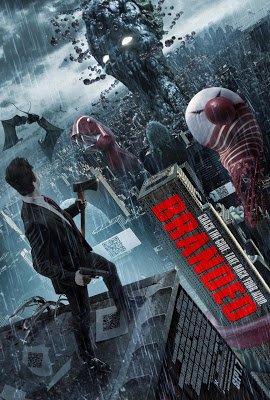
Branded (2012) is a Russian-US sci-fi parable written and directed by Jamie Bradshaw and Aleksandr Dulerayn. Much of the story is told in flashbacks documenting the rise, fall and rebirth of top-level advertising executive Misha (Ed Stoppard, son of playwright Tom Stoppard). Upon being scapegoated for a marketing disaster, Misha withdraws to the countryside where in a trance state he’s compelled to perform a bizarre ritual. Shortly after, he finds he has a unique ability to “see” strange parasitic creatures which are the embodiment of corporate influence. Horrified, Misha sets out to destroy the creatures of his visions, a quest which could ultimately liberate society but at the expense of his personal and professional life. Though the film is hindered by uneven tonal shifts and occasionally stilted performances, Branded is notable for its relevant social critique which mixes elements of Putney Swope, They Live  and novels of Philip K. Dick.

Mark Ruffalo: ‘Monsanto Chief is Horrible’

mark-ruffalo-the-hulk

By Mark Ruffalo

Source: EcoWatch

Monsanto chief is horrible … And I got to tell him that to his face after his interview on CBS This Morning.

Approaching someone like this isn’t really my thing. But being so well behaved all the time doesn’t seem to be helping people. It made me really uncomfortable to do it. But that’s how we change. We must become uncomfortable. We must act out of our comfort zones for things to change. We must call out the people who are doing horrible things when they do them.

Hugh Grant (Monsanto CEO not the actor) must be made to feel uncomfortable for what he allows his company to do in the world. That is why I told him what I did and why I am sharing it with you.

Before a segment I was doing for the movie Spotlight with Mike Rezendes on Dec. 2, I was waiting in the green room watching Grant worm his way through the strong questions he was getting from the CBS team. His handlers clearly have been working very hard with him to give him every slippery non-answer to every question he was asked. I was beside myself watching this guy who is responsible for so much misery and sickness throughout the world slime his way through his interview. I could not hold my tongue. He came through the Green Room door ready to do high fives with his press agent and I simply told him this:

“You are wrong. You are engaged in monopolizing food. You are poisoning people. You are killing small farms. You are killing bees. What you are doing is dead wrong.”

A bead of sweat broke out on his head. “Well, what I think we are doing is good,” Grant replied.

“I am sure you do,” I told him.

When people get paid the kind of money he gets paid their thinking becomes incredibly clouded and the first thing to go is their morality.

He says Monsanto needs to do a better job with their messaging.

Hugh, it’s not your messaging that makes you and your company horrible. It’s the horrible stuff you guys do that makes you and your company horrible. People don’t walk around making horrible stories up about good companies because they got nothing else better to do with their time. People like you and your company are horrible because … you are horrible. No matter how much jumping around you do on morning shows (where no one can really nail you down for the horrible stuff you do), you will still always be horrible and people will always greet you the way I did, when you go around trying to cover up the fact that you are horrible.

Want to know more about the real Monsanto and Hugh Grant? Watch this:

There is a lot more horrible stuff to look at here:

Monsanto’s greatest hit jobs.

In 2003, Monsanto settled a lawsuit for $700 million with 20,000 Anniston, Alabama residents who claimed that a Monsanto plant contaminated local rivers, lakes, soil and air with polychlorinated biphenyls (PCBs). Plaintiffs reported a range of health issues including cancer, birth defects and neurological disorders.

New York Times: $700 Million Settlement in Alabama PCB Lawsuit

CBS News: Toxic Secret: Alabama Town Never Warned of Contamination

In 2012, Monsanto settled a lawsuit with tens of thousands of plaintiffs in West Virginia for $93 million. Residents of Nitro, West Virginia claimed they had been poisoned by decades of contamination from cancer-causing chemicals used in the manufacturing of Agent Orange produced in a Monsanto plant.

The Guardian: Monsanto Settles ‘Agent Orange’ Case with US Victims

In March 2015, the International Agency for Research on Cancer (IARC), an arm of the World Health Organization, concluded in a study that glyphosate, the active ingredient in Monsanto’s widely used weedkilling product Roundup, was “probably carcinogenic to humans.”

Shortly after the IARC’s study was made public, France took steps to limit the sale of Roundup. France has also banned the cultivation of genetically modified crops.

Reuters: Frances Bolsters Ban on Genetically Modified Crops

Newsweek: Frances Bans Sale of Monsanto’s Roundup in Garden Centers After UN Names it Probable Carcinogen

In September 2015, a French appeals court in Lyon upheld a decision that held Monsanto liable for poisoning a French farmer. The grain farmer, Paul Francois, developed neurological damage after inhaling Monsanto’s weedkilling product Lasso.

Reuters: French Court Confirms Monsanto Liable in Chemical Poisoning Case

Le Monde: Monsanto Condamné pour L’Intoxicite d’un Agriculteur Francais

In September 2015, two U.S. farm workers filed suit against Monsanto claiming that exposure to Roundup caused them to develop cancer.

Reuters: U.S. Workers Sue Monsanto Claiming Herbicide Caused Cancer

You can find reports of Monsanto products being linked to cancer and other health issues all over the world, for example:

Argentina is the world’s third largest soy-producing country.

According to Mother Jones, nearly 100 percent of the soy crop is genetically altered and Monsanto’s Roundup is very widely used. As the use of pesticides and herbicides in Argentina has increased, cancer clusters have begun to develop around farming communities. A 2010 study at the University of Buenos Aires also found that injecting glyphosate (the active ingredient in Roundup) into chicken and frog embryos caused the same sort of spinal defects that doctors have found to be increasingly prevalent in communities where farm chemicals are used.

Mother Jones: Argentina is Using More Pesticides than Ever. And Now It Has Cancer Clusters

On Monsanto suing small farmers:

The Guardian: Monsanto Sued Small Farmers to Protect Seed Patents

Vanity Fair: Monsanto’s Harvest of Fear


Related Article: Global Citizens Tribunal to Put Monsanto on Trial at the International People’s Court in The Hague


Mainstream Media Just Destroyed a National Security Level Crime Scene on LIVE TV

apartment-terrorist-redlands-msnbc

By William N. Grigg

Source: The Free Thought Project

If the San Bernardino shooting were not being treated as an episode of Homeland Security Theater, why would the FBI – the lead investigative agency in what has been described as an ISIS-linked act of mass terrorism – allow an MSNBC News crew to contaminate a crime scene? Why would a reporter be allowed to handle evidence with un-gloved hands – picking up licenses, identification cards, and other credentials, credit cards, and riffling through copies of the Koran?

NBC Anchor Andrea Mitchell explained that the landlord of the apartment rented by Sayed Farook and his wife, Tashfeen Malik, had allowed “the media to enter … en masse” and examine what was still an active crime scene. If, as several media reports have suggested, the couple had received repeated, mysterious visits to their home by yet-unidentified co-conspirators, the mere presence of multiple news crews might be sufficient to destroy forensic evidence. Any investigator with even a modicum of knowledge and experience will recognize that allowing reporters to handle evidence with bare hands will adulterate fingerprints and DNA traces that could be useful in identifying additional suspects.

Although the couple’s landlord had reportedly been told on December 3 that the police had finished examining the apartment, and FBI Director James B. Comey made a similar statement this afternoon (December 4), the San Bernardino Sheriff’s Office still considered the site an active crime scene.

“That is not a cleared crime scene,” a spokesman for the San Bernardino Sheriff’s Office shortly after the landlord used a crowbar to break the plywood seal to let the media – and, apparently, several bystanders, including a woman with a dog and another carrying a newborn child — into the apartment.

“The most important aspect of evidence collection and preservation is protecting the crime scene,” explains George Schiro, a forensic scientist with the Louisiana State Police Crime Laboratory. “This is to keep the pertinent evidence uncontaminated until it can be recorded and collected. The successful prosecution of a case can hinge on the state of the physical evidence at the time it is collected. The protection of the scene begins with the arrival of the first police officer at the scene and ends when the scene is released from police custody.”

The personal effects that were pawed by dozens of curious reporters were not the only potential source of valuable clues as to potential accomplices in the deadly shooting.

“Particular attention should be paid to the floor since this is the most common repository of evidence and it poses the greatest potential for contamination,” Schiro advises. This is why “the arrival of additional personnel can cause problems in protecting the scene”; non-essential people “should never be allowed into a secured crime scene unless they can add something (other than contamination) to the crime scene investigation.”
In addition to the apartment’s floors, the curtilage – “driveways, surrounding yards, pathways, etc.” – could likewise provide valuable evidence, assuming that it isn’t trampled out of existence by an eager herd of media personnel and curiosity seekers.

Aaron Elswick, a neighbor of Farook and his wife, claims that he had noticed “suspicious activity” at their apartment, and had been told by another neighbor that the couple had received “quite a few packages within a short amount of time, and they were actually doing a lot of work out in the garage.”

According to the SBSO, once again, the apartment had not been “released” from police custody at the time of the “media tour.” The reported cache of pipe bombs and ammunition had been removed. Instead, the visitors saw “what would have looked like a relatively normal cluttered household, notwithstanding a shredded front door that had been ripped from its hinges and cast aside as law enforcement officers broke in,” summarized the New York Times. “There were signs throughout the home of the residents’ Muslim faith: The sticker pasted on a chest of drawers (`Praise be to Allah Who relieved me from suffering and gave me relief’). And there were the books: `The Characteristics of the Prophet Muhammad’ in a linen closet and `Common Mistakes Regarding Prayer’ on the bedside table.”

To that segment of the media propagating the narrative that America’s Muslim population teems with latent suicide terrorists, those items – which are similar to those found in the home of at least one of the people killed in Tuesday’s mass shooting – are more incriminating than firearms.

Rather than seeking to learn the truth and tell it without fear or favor, the Legacy Media’s role in this affair is to promote public suspicion that will result in the expansion of government power at the expense of individual liberty – whether in the form of expanded surveillance of Muslim houses of worship, or new restrictions on the right to armed self-defense.

Interestingly, a dialectical synthesis of those views can be found in a bill sponsored by California Senator Diane Feinstein (D-California) shortly before the shooting that would have prevented people listed on the federal “no-fly” list from buying firearms. In an interview shortly after the shooting, Barack Obama lamented the failure of that bill to pass the Senate. Republican presidential contender Jeb Bush has expressed qualified support for that measure – if it were narrowed down to apply only to people subject to “an active investigation” on the part of the FBI.

It isn’t difficult to imagine a “bipartisan” push to promote such a “compromise” approach: Republican national security hawks might approve of expanded scrutiny of, and limitations on the personal liberties of, people who display symptoms of “incipient radicalization,” such as regular mosque attendance; anti-gun Democrats would favor new “common-sense” restrictions on gun ownership, while seeking to expand the “radicalization” profile to include other indicators, such as participation in anti-abortion protests. The corporate media, for its part, would frame the discussion in terms that would eventually lead to less freedom for everybody, rather than subjecting such proposals to intellectually rigorous scrutiny. That’s why the state-centered media cannot be considered trustworthy.