Russia and the War Party

By Carl Boggs

Source: CounterPunch

The steady deterioration of American political discourse seems to have reached its lowest ebb in historical memory, visible in the rightward shift of both Democrats and Republicans.  One sign is the frenzied Democratic assault on Republicans from the right, especially in foreign policy.  Another is the resounding silence on the most crucial problems facing humanity: threat of catastrophic war, nuclear arms race, ecological crisis, health-care debacle, the worsening miseries of global capitalism.   Tabloid-style spectacles have increasingly filled media space.  Still another sign is the intensifying anti-Russia hysteria promoted by unhinged liberals in Congress and the corporate media, reminiscent of the worst McCarthyism.

Another example of this descent into absurdity is the book Russian Roulette, by liberals Michael Isikoff and David Corn – Beltway writers whose shrill anti-Russian crusade has received highest accolades by the New York Times and such promoters of the permanent warfare state as Rachel Maddow (whose gushing endorsement is on the back cover).  The subtitle – “The Inside Story of Putin’s War on America and the Election of Donald Trump” – reveals the political obsession of Democrats (and plenty of Republicans) for the past eighteen months, to the exclusion of most everything else.   More than anything, the volume illustrates the staggering level of ignorance in the U.S. about Russian history and politics, crude propaganda easily displacing coherent analysis.  (A more general – and devastating – review of Russian Routlette by Paul Street appeared earlier in CP.)

Russian Roulette is filled with 300 pages of meticulous detail – Trump’s (actual, planned, or failed) business dealings in Russia, endless goings and comings of shady characters and “operatives”, electronic transactions across the great divide, a litany of speeches, conferences, dinners and other activities, computer hacking and trolling schemes, breathless tales of lurid behavior, Russians clandestinely entering the U.S., reports on secret files, and of course the menacing specter of Russian “oligarchs”.  All this is believed to demonstrate Putin’s ruthless war against America, his supreme goal being to “destroy our democracy”, instill chaos, and neutralize U.S. as well as European geopolitical power.  As we have been ritually informed by CNN and kindred venues, cyber warfare (for now) is the Russians’ preeminent mode of combat – and it has been so devastatingly effective as to paralyze normal American politics.  It was cyber warfare, moreover, that delivered the 2016 presidential election to the Russia-loving Trump.

Trump, it turns out, was guilty of the most grievous sin: he went so far as to mention the possibility of cooperative relations with Russia, the idea being to help fight terrorism and better manage the nuclear threat. His other crime was to question the neocon/Democratic/Clintonite agenda of regime change in Syria – an agenda (still alive) that could bring military confrontation with a nuclear state. Trump’s fanciful hope meant that he had to be a willing “stooge” of Putin and his nefarious plots.

It turns out that the myriad claims, charges, and allegations set forth by Isikoff and Corn amount to little of substance – surely nothing to prove that Putin has been conducting warfare against the U.S., or that Russians had decisively influenced the 2016 presidential election.  Evidence that Trump conspired in any way with Putin or his imagined assemblage of henchmen, former KGB agents, cyberwarriors, and oligarchs is similarly lacking.   Yet, for the authors the only way Hillary Clinton could have lost the presidency that was rightfully hers was because the Russians intervened, with help from the treacherous Wikileaks, the authors writing: “Never before had a president’s election been so closely linked to the intervention of a foreign power.”

According to Isikoff and Corn, the scheming Russians managed to infiltrate party machinery, elections, and the Internet, deploying squads of cyberwarriors from the notorious Internet Research Agency and other sites.  They also placed ads in Facebook and other social-media sites.  How many American voters were even exposed to such fare, much less swayed by it, cannot be established, but vague popular awareness of this Russian skullduggery did not appear until the Mueller investigation called attention to it more than a year after the election.  No one denies the actuality of Russian trolling and hacking enterprises. The problem for the authors here is that such operations are so universally practiced as to be rather commonplace, while it has yet to be shown they can alter election outcomes in the U.S.. Moreover, in this area of intelligence work (as in so many others) the U.S. has long been unchallenged world champion.

The authors describe Putin as an “autocratic, repressive, and dangerous Russian leader” who routinely kills his political enemies and crushes dissent.  Such oversimplified descriptions of Putin and the Russian scene in general are set forth as established truths, no discussion or evidence needed.  Why a duly-elected leader (with 76 percent of the vote earlier this year) can be so ritually dismissed as a ruthless tyrant Isikoff and Corn never get around to explaining.  Were election irregularities or illegalities reported?   Were voters threatened or coerced?   Is Putin any more authoritarian than the vast majority of leaders around the world?  Would Netanyahu in Israel, Macron in France, or Merkel in Germany (all elected by much slimmer margins) be described as simple despots?

As for Trump, Russian Roulette seeks to demonstrate that the candidate and then president somehow “aided and abetted Moscow’s attack on American democracy.” That’s right: the White House served as a willing, secret accomplice in Putin’s criminal schemes.  So many Trump associates –Paul Manafort, General Michael Flynn, Carter Page, et. al. – had indeed previously traveled to Russia, talked and dined with Russians, and (gasp) seemed to want something of a cordial relationship with business and other interests there.  (Why this should have been shocking is hard to fathom, since in 2016 and 2017 the Russian Federation was still an integral part of the global capitalist economy and the U.S. has been doing plenty of business there since the early 1990s.)

The authors’ unfounded generalizations are based mainly on three sources, most crucially the all-important (but phony) Christopher Steele “dossier” that was said to implicate Trump in a variety of offenses and scandals that even Isikoff and Corn admit is comprised of “sensational and uncorroborated claims” – that is, fake news.  They argue, further, that Putin hacked DNC communications and passed along damning emails to Wikileaks, but investigation (by William Binney and others) suggests they were more likelyleaked than hacked; Julian Assange firmly denies that the files (never viewed by the FBI) came from any state actor.  The establishment media paid little attention to the damning content of these emails, so their impact on the election in any case could not have amounted to much.  Even the Mueller Committee report earlier this year, which indicted 13 Russian trolls and hackers, conceded they had no appreciable impact on the 2016 election results.

In Russian Roulette the authors seem infatuated with the American “intelligence community” – purported last word on the question of Russian interference — writing confidently but misleadingly: “The intelligence community has identified Moscow as the culprit in the hacks of Democrats in October [2016].”  One cannot help wondering what sort of “community” Isikoff and Corn have in mind.

By “intelligence community” do they include the NSA, an agency that has been spying on Americans and the world with impunity for years while a spokesperson (James Clapper) lied about it before Congress?  Could they be referring to the CIA, active for decades in clandestine and illegal operations such as unwarranted surveillance, sabotage, torture, drone strikes on civilians, and regime change (by military force, not just computer meddling) in Vietnam, Iran, Guatemala, Chile, Yugoslavia, Iraq, Libya, Ukraine, and too many other countries to list here, all aided and abetted by flagrant lies and cover-ups?  Perhaps they have in mind the FBI, an agency long dedicated to destroying popular movements (Civil Rights, anti-war, etc.) through COINTELPRO and other illegal operations.  Or the DEA (Drug Enforcement Administration), which for decades has squandered hundreds of billions of dollars on a futile but disastrous and racist War on Drugs, filling jails with people targeted, harassed, jailed, and ruined for the crime of using banned substances?

Can Isikoff and Corn actually take seriously the murky claims of the most Orwellian surveillance apparatus in history?  Do they believe that this “community” is subject to any meaningful oversight and accountability?  Their remarkably clueless account – basic to virtually every narrative in Russian Roulette – reveals an astonishing disconnect from postwar American (and world) history.

The central Isikoff/Corn thesis is not only devoid of factual support but is totally inverted: the present state of affairs is exactly the opposite of what they argue.  There has been no “Putin’s war on America”, but rather sustained U.S. (and NATO) warfare against Russia – political, economic, ideological, military – since 2000, if not earlier.  The Russians occupy the other, targetedend of the power spectrum, obvious to any serious observer.  Who has invoked harsh and repeated economic sanctions on whom?  Who has militarily encircled and targeted whom?  Who has deployed nuclear weapons at whose border?  Who has financed and orchestrated a hostile coup adjacent to whose territory?  Who has carried out non-stop ideological hysteria against whom?

In the world as it now exists, it is worth asking whether Russia could plausibly assume the role of imperial aggressor in its dealings with the world’s leading superpower?   Consider that in 2017 the total Russian GDP as barely 1.5 trillion dollars, roughly one-twelfth that of the U.S. ($19.5 trillion) and not even one-tenth that of the European Union ($14 trillion).  Military spending breaks down accordingly: nearly one trillion for the U.S. and $250 billion for NATO compared to $61 billion for Russia.  As for intelligence operations, the imbalance worsens – a budget of six billion dollars for the FSB and military GRU combined, compared to $75 billion for Washington not counting another $45 billion for the DEA and DHS (Department of Homeland Security) in tandem.

In fact Russia, despite its nuclear prowess, does not have the leverage and resources to threaten American (much less broader Western) geopolitical objectives – the real “threat” coming from the stubborn fact of Russian independence that was squelched during the Clintonite 1990s, when Washington used its power to reduce post-Soviet Russia to puppet status under Boris Yeltsin.   During the Yeltsin period the U.S. was never content with simple “meddling” in Russian affairs: it propped up a weak president, dismantled the public infrastructure, coddled an emergent stratum of oligarchs, and then spent $2.5 billion to sway the 1996 election in favor of a weak and unpopular Yeltsin.  Only with Putin’s emergence in 1999 did the nation regain a semblance of independence, restoring economic and political sovereignty, much to the disgust of Western ruling interests.

American intrusion into domestic Russian affairs is never explored by Isikoff and Corn, as it would undermine their one-sided tract. Nor do the authors have much to say about the post-Soviet eastward march of NATO, which allowed the U.S. and its allies to partially encircle Russia with both nuclear and conventional forces. The opening salvo of this strangulation gambit was President Bill Clinton’s “humanitarian” war against Serbia ending with the 1999 U.S./NATO bombings.   This was followed by President George W. Bush’s decision to scrap the crucial ABM Treaty with Russia in 2002 before invading Iraq in 2003.  CIA and State Department efforts to orchestrate regime change in Ukraine, ultimately achieved in 2014, came soon thereafter.

The ongoing Western campaign of economic warfare, media propaganda, and military provocations directed at Russia has only served to bolster Putin’s legitimacy, as shown by his overwhelming support in the 2018 election.  Yet Isikoff and Corn can write: “He [Putin] was a Russian nationalist to the core.  He wanted to extend Russian power. . . [as] an autocrat in the long tradition of Russian strongmen and had little interest in joining the club of Western liberal democracies – or winning its approval.”  Given the rampant imperial behavior of Washington and its European partners, Putin would have to be certifiably insane to respond in a manner that would permit further Western encroachments.

It is the expansionist U.S./NATO alliance that has maliciously targeted Russia, not the other way around.  Putin is surely a nationalist, but why not?  That just means he will fight for Russian national integrity against Western efforts to isolate and destabilize the country.  Any cyberwarfare activities launched by the Russians will appear to the rational observer as quite intelligible, a proven method to gain information about the plans of a vastly superior adversary overflowing with anti-Russia venom.

Like other Russia-bashing ideologues, Isikoff and Corn see terrible “oligarchs” everywhere, all naturally cozy with Putin. We have references to “Putin and his oligarch friends,” as if large-scale business interests could somehow have nothing to do with government.  They note that payments to IRA trolls “were being made through a holding company owned by Yevgeny Prigozhin, a Russian oligarch and restaurateur close to the Russian president and known as ‘Putin’s chef”.”  Along with this disturbing revelation we are told that a “clique of [oligarchic] hardliners was able to outgun Russian moderates – a group including Yury Kovalchuk, billionaire owner of Rossiya bank and friend of the president “known as Putin’s banker”.  It would be a mistake to overlook the infamous Aras Agalarov, a real-estate mogul identified as “Putin;s Builder”.  Left out was any reference to “Putin’s Gardener”.

The authors deftly uncover a clique of diabolical oligarchs colluding with Putin to launch attacks on the West.  It might be useful to clarify the meaning of “oligarch”. One generally held definition is that they are exceedingly wealthy and powerful business and financial elites – the same interests that Washington zealously supported in Russia during the 1990s. These would be aligned with the very corporate and banking interests that dominate the global capitalist system, everywhere seeming to enjoy close relations with their governments.  American oligarchs (multibillionaires) in fact far outnumber their Russian counterparts – 565 to 96 – and possess many times the wealth and influence.  Further, if Washington really despises oligarchs, why did it install billionaire Petro Poroshenko as Ukraine ruler after the 2014 coup?

For Isikoff and Corn, Hillary Clinton might have been a terribly flawed candidate, but her loss nonetheless would not have occurred in the absence of “Putin’s underhanded intervention”.  No one questions whether Russian trolls and hackers were active in 2016 – or that Facebook ads were placed – but no evidence of their actual effectiveness has been presented, much less their capacity to determine an election outcome.

As they righteously celebrate the virtues of multiculturalism, diversity, and tolerance, liberal Democrats – now more than ever a neocon party of war – have come to embrace just the opposite: fierce hostility against other nations and cultures, smug provincialism, a recycled McCarthyism that spews hatred at even the slightest dissent from super-patriotic orthodoxy.  They pretend victim status when they are the ones targeting, attacking, smearing, and warmongering.

Worse yet, to satisfy their narrow political agendas they are perfectly ready to risk military confrontation with a nuclear power – a conflict that could lead to unprecedented global catastrophe.  Nowhere in this parochial text do the authors express the slightest concern for the horrors that might result from years of U.S./European hostility toward Russia.  Despite an unlevel economic and political playing-field, it is worth remembering that in nuclear matters Russia has rough parity with the West.  This might deter the neocons of both parties or it might not, the sad reality being is that liberal Democrats exemplified by Isikoff and Corn have little to offer the world beyond continuous war shrouded in a flimsy, desperate identity politics.


Carl Boggs is the author of The Hollywood War Machine, with Tom Pollard (second edition, forthcoming), and Drugs, Power, and Politics, both published by Paradigm.     


NYT: Don’t Be Progressive, Be a ‘Liberal’

By Jim Naureckas

Source: FAIR

A New York Times op-ed by political scientist (and former Bob Kerrey aide) Greg Weiner (7/13/18) may well be the New York Times–iest op-ed ever.

Its ostensible subject is why Democrats should call themselves “liberals” and not “progressives.” But in making that case, it hits most of the main points of the New York Times‘ ideology—one that has guided the paper since the late 19th century.

First and foremost, it’s a defense of the status quo. “The basic premise of liberal politics,” Weiner writes, “is the capacity of government to do good, especially in ameliorating economic ills.” But not too much good, mind you:  “A liberal can believe that government can do more good or less,” he stresses. Weiner draws a contrast with progressives: “Where liberalism seeks to ameliorate economic ills, progressivism’s goal is to eradicate them.”

So Lyndon Johnson’s Great Society is cited negatively as an example of “a progressive effort to remake society by eradicating poverty’s causes”—in the process supporting  “community action” and  financing the “political activism”—presented without explanation as a self-evident evil.  The explanation, presumably, is that the poor should remain passive as they remain poor, gratefully accepting the handouts that “alleviate” their plight, as “cutting checks,” as Weiner puts it, is “something government does competently.”

Coupled with this anxiety about “eradicating poverty’s causes” is the confident assurance that the truth is always somewhere in the middle. “Unlike liberalism, progressivism is intrinsically opposed to conservation,” Weiner warns:

Nothing structurally impedes compromise between conservatives, who hold that the accumulated wisdom of tradition is a better guide than the hypercharged rationality of the present, and liberals, because both philosophies exist on a spectrum.

Conservatives make better partners for liberals than progressives, because “one can debate how much to conserve.” But you can’t debate how much to progress, apparently: “Progressivism is inherently hostile to moderation because progress is an unmitigated good.”

In other words: Equality and justice, sure, but let’s not rush into things, is the “liberal’s” advice. He endorses “policies [that] develop gradually and command wide consensus—at least under normal circumstances.” (Progressives have an unnerving desire to “depress the accelerator.”)

Something that doesn’t change is the right wing of the left’s attraction to redbaiting. Weiner praises “the Cold War liberal who stood for social amelioration and against Soviet Communism,” a figure who “was often maligned by progressives.” Without coming out and accusing progressives of Stalinism, he describes progressives’ response to critics as “a passive-aggressive form of re-education,” one that “supersedes the rights of its opponents.” The example he gives of this is the “progressive indifference to the rights of those who oppose progressive policies in areas like sexual liberation”—an odd arena to cite, since the main “rights” that opponents of “sexual liberation” have demanded in recent years are the “right” of small businesses to discriminate against gay customers and the “right” to check the chromosome status of people who use public restrooms.


You can send a message to the New York Times at letters@nytimes.com  (Twitter:@NYTimes). Please remember that respectful communication is the most effective.

Freedom Rider: Syria and Press Propaganda

By Margaret Kimberly

Source: Black Agenda Report

“Trump protects himself with war as Democrats and the rest of the ruling elite support his militarism.”

It is difficult for Americans to find out what is happening in their country and around the world. That is because corporate media outlets have nearly complete control over what they see and hear and because those interests are closely allied with the state. The promise of the internet, the hoped for level playing field for communication and information gathering, is also under corporate control. It is now part of a well coordinated censorship effort and attack against left wing sites such as Black Agenda Report.

The lies which allowed the United States, France and Britain to attack Syria are presented without contradiction. The people with knowledge and expertise who can counter these narratives are disappeared from access to newspapers or television stations. The close relationship between the deep state, the corporate media, and the establishment elite at home and abroad continues without hindrance.

“British prime minister Theresa May refused to allow a parliamentary vote on the Syrian missile strike.”

Donald Trump may be labeled a fascist but he attacked Syria with the help of France and Britain. Apparently every leader of a “free world” country is also a fascist. They certainly behave that way as they trample on the rights of millions of people. Far from being the “civilized” nations that Trump referred to in his televised address, these three countries are among the most criminal that have ever existed. They all grew rich on the slave trade, indigenous genocides, the plantation economies in the Americas, and the theft of resources all over the world. Now they run roughshod over their own people. British prime minister Theresa May refused to allow a parliamentary vote on the Syrian missile strike and showed the hollowness of claims that hers is a democratic nation. The same can be said of her partners in crime.

France impoverished Haiti with nearly 100 years of theft, murdered Algerians in the streets of Paris and keeps its former African colonies financially dependent. Former president Nicolas Sarkozy took millions of dollars from Muammar Gaddafi and then had him murdered, just like a mob boss would do. Now they have connived with the help of press propagandists in all three countries to fool millions of people as they try to continue their gangsterish aggression against Syria.

“Sarkozy took millions of dollars from Muammar Gaddafi and then had him murdered, just like a mob boss would do.”

If even mediocre journalists were allowed to report freely on this issue the crime would be obvious. Consider the timeline of events. On March 4, former Russian double agent Sergei Skripal and his daughter are poisoned with a chemical agent in Britain. The British government immediately blames Russia, which has no motive to harm a former spy they swapped eight years earlier. Saudi crown prince Mohammed bin Salman arrives in London for an official visit on March 7. On March 12 French president Emmanuel Macron states that France will attack Syria if any chemical weapons are used there. The next day the Russian military claims to have evidence that a chemical attack will be carried out against Syrian civilians as a pretext for war. On March 16 France warns French journalists to leave Syria. Mohammed bin Salman arrives in Washington on March 19. On April 8 he goes to Paris for yet another official visit. That same day Saudi funded jihadist groups and the White Helmets, who were created by a British intelligence officer, claim that a chemical weapons attack occurred in the city of Douma. On April 14 the United States, France and Britain join in the missile strike.

“They have connived with the help of press propagandists in all three countries to fool millions of people.”

The aggressors are very transparent. The plot was carried out in the open. But because they have a compliant media behind them they have no reason to worry. No journalist asked why Sergei Skripal and his daughter are in effect held hostage and denied access to Russian officials as a treaty between the two countries demands. No one questions a strangely worded statement allegedly from Yulia Skripal but issued by the London Metropolitan Police in which she said she didn’t want help from her government or contact with her own relatives.

Why shouldn’t Mohammed bin Salman openly plan with presidents and prime ministers? Who will question him? The New York Times and MSNBC and the Washington Post and the BBC and AFP certainly will not. We will probably never know the name of the person or persons who poisoned the Skripals but common sense tells us that the intended murders were ordered by someone with a motive to create a pretext for war.

“The plot was carried out in the open.”

The actual air strike was limited because of back channel negotiations between these countries. The danger may look like Kabuki theater but no one should assume that the peril is over. The criminals in Washington, London and Paris may yet go too far and provoke a major hot war.

All three heads of state have their own concerns. Macron was put into power to kill off his country’s welfare state and any remnants of left politics. May is struggling with Brexit negotiations and cruel austerity measures that have made her so unpopular she actively avoids voters. Trump may be impeached but he protects himself with war as Democrats and the rest of the ruling elite support his militarism.

Regardless of individual rationales these three people pose a threat to the entire planet. They are aided and abetted by corporate media who act as scribes and present war propaganda as fact. The Nuremberg trials after World War II established that planning aggressive war is a crime and so is the propaganda that promotes it. May, Trump and Macron are guilty but so-called journalists are as well. The criminals could not commit their dirty deeds without their help.


Margaret Kimberley’s Freedom Rider column appears weekly in BAR, and is widely reprinted elsewhere. She maintains a frequently updated blog as well at http://freedomrider.blogspot.com . Ms. Kimberley lives in New York City, and can be reached via e-Mail at Margaret.Kimberley(at)BlackAgendaReport.com.

How The Guardian Fulfills George Orwell’s Prediction of ‘Newspeak’

By Eric Zuesse

Source: Strategic Culture Foundation

On Sunday April 15th, Britain’s Guardian bannered “OPCW inspectors set to investigate site of Douma chemical attack” and pretended that there was no question that a chemical attack in Douma Syria on April 7th had actually occurred, and the article then went further along that same propaganda-line, to accuse Syria’s Government of having perpetrated it. This ‘news’ story opened [and clarificatory comments from me will added in brackets]:

UN chemical weapons investigators were set on Sunday to begin examining the scene of a chemical attack in the Syrian city of Douma, which had prompted the joint US, French and British strikes against military installations and chemical weapons facilities near the capital, Damascus.

The arrival of the delegation from the Organisation for the Prohibition of Chemical Weapons (OPCW) came as the Syrian military announced that it had “purified” [no source provided, but this — from 7 March 2018  is the only source that existed prior to the April 14th missiles-invasion of Syria, and its meaning is very differentthe region of eastern Ghouta, of which Douma is a part, after a two-month campaign that killed nearly 2,000 civilians [no source provided as regards either the number, or that all of them were ‘civilians’ and that none of them were jihadists or “terrorists”], following years of siege.

The propaganda-article continued directly:

“Units of our brave armed forces, and auxiliary and allied forces, completed the purification of eastern Ghouta, including all its towns and villages, of armed terrorist organisations,” the general command statement said.

No source was provided for that, but this sentence is a sly mind-manipulation, because here is what the Syrian Government’s General Command had actually said: “Statement of the Army General Command declaring Eastern Ghouta clear of terrorism” as headlined by the Syrian Government itself. In other words: the Guardian’s ‘journalist’ had substituted the word “clear” by the word “purify” and did this after having already asserted but not documented, that the Government had just completed “a two-month campaign that killed nearly 2,000 civilians.” When the Syrian Government announces that an area has been “cleared of terrorists (or of terrorism),” the US-allied propagandist uses the word “purify,” such as “purified the region of eastern Ghouta” or “the purification of eastern Ghouta, including all its towns and villages, of armed terrorist organisations.” But by the time that the reader gets there to “purification … of armed terrorist organisations,” the reader has already been indoctrinated to believe that Syria’s Government is trying to “purify” land, or perpetrate some type of ethnic-cleansing.

Later, the article asserts that, “The OPCW mission will arrive in Douma eight days after the chemical attack, and days after the area fell to the control of Russian military and Syrian government forces. That delay, along with the possibility of the tampering of evidence by the forces accused of perpetrating the attack, raises doubts about what the OPCW’s inspectors might be able to discover.” However, a fierce debate is being waged over whether this was not any real “chemical attack” but instead a staged event by the jihadists in order to draw Trump back into invading Syria. In other words: any journalistic reference yet, at this time, to the event as “the chemical attack” instead of as “the alleged chemical attack” is garbage, just as, prior to the guilty-verdict in a murder trial, no journalistic reference may legitimately be made to the defendant as “the murderer,” instead of as “the defendant.” That is lynch-mob ‘journalism’, which Joseph Goebbels championed.

The Joseph-Goebbels-following ‘journalist’ has thus opened by implying that the Russia-allied Syrian Government is trying to crush a democratic revolution, instead of the truth, that the US-allied Governments are trying to overthrow and replace the Russia-allied Syrian Government. It’s a big difference, between the lie, and the truth.

Another story in the April 15th Guardian was “Pressure grows on Russia to stop protecting Assad as US, UK and France press for inquiry into chemical weapons stockpiles” and this one pretended that the issue is for “Russia to stop protecting Assad,” who is the democratically electedand popular President of Syria, and not to stop the invasion of Syria since 2011 by US and Saudi backed foreign jihadists to overthrow him. Furthermore, as regards “press for inquiry into chemical weapons stockpiles,” the real and urgent issue right now is to allow the Organization for the Prevention of Chemical Weapons (OPCW) into Douma to hold an independent and authoritative investigation into the evidence there. Russia pressed for it at the U.N. Security Council and the US and its allies blocked it there. But the OPCW went anyway — even after the US-allied invasion on April 14th — and this courageous resistance by them against the US dictatorship can only be considered heroic.

That type of ‘news’-reporting is virtually universal in The West, among the US and its allied governments, which refer to themselves as ‘democracies’ and refer to any Government that they wish to overthrow and replace by their own selected dictator, as ‘dictatorships’, such as these regimes had referred to Iraq in 2003, Libya in 2011, Syria forever, and Ukraine in 2014.


The New York Times takes on the social media “hordes”

By Andre Damon

Source: WSWS.org

Since late 2016, the New York Times, working together with the US intelligence agencies and the Democratic Party, has been engaged in a campaign to promote internet censorship in the guise of targeting “fake news” and “Russian propaganda.”

In waging this campaign, the Times’ motives are both political and pecuniary. Speaking for a ruling elite that sees the growth of social opposition on all sides and expects far worse, the Times has promoted censorship to remove opportunities for the working class to organize outside the framework of official politics.

In addition, the Times, for the most part a clearinghouse for staid and predigested state propaganda, is seeking to carve back market share it has lost to online publications that carry out genuine investigative journalism and oppose the lies peddled by the US government and media.

In recent months, this campaign has entered a new and malignant phase. Increasingly dropping the pretext of “Russian meddling,” the Times is now directly attacking its main target: the fact that the internet, and in particular social media, helps empower the population to access oppositional sources of news and have their voices heard in public.

Among the Times’ latest broadsides against freedom of expression is an article by its “State of the Art” columnist Farhad Manjoo headlined “For Two Months, I Got My News From Print Newspapers. Here’s What I Learned.” The piece, supposedly written as a first-hand account of a journalist turning off social media and only reading the news from print newspapers, is—in an unusually literal sense—a piece of lying propaganda from beginning to end.

As the Columbia Journalism Review pointed out, during the period in which he supposedly stopped using social media, Manjoo managed to post on Twitter virtually every day. “Manjoo remained a daily, active Twitter user throughout the two months he claims to have gone cold turkey, tweeting many hundreds of times, perhaps more than 1,000,” the Review pointed out.

Manjoo’s blatant falsifying of his own social media use is hardly the most sinister aspect of his piece. However, it expresses something essential about the Times’ notion of “reporting”: its writers feel they can say anything and get away with it, so long as their claims conform to the dictates of the establishment and the intelligence agencies whose interests determine what is and what is not reported in the US media.

The columnist’s dishonesty about his own activities provides much needed context for his article as a whole, which is little more than a long-form denunciation of a reading public that feels compelled to obtain its news from sources not massaged by the CIA-vetted hacks at the New York Times. In the process, Manjoo gives his unqualified blessings to the pronouncements of his own publication and castigates anyone who would question them as a member of an ignorant “herd,” whose opinions ought to be suppressed.

During his pretended sojourn into the desert of print media, Manjoo said he learned to value having the news spoon-fed to him by “professionals,” without having to worry about whether what he was reading was true or false.

As he puts it, “It takes professionals time to figure out what happened, and how it fits into context… This was the surprise blessing of the newspaper. I was getting news a day old, but in the delay between when the news happened and when it showed up on my front door, hundreds of experienced professionals had done the hard work for me.”

He continues, “Now I was left with the simple, disconnected and ritualistic experience of reading the news, mostly free from the cognitive load of wondering whether the thing I was reading was possibly a blatant lie.”

Here, we assume, the reader is supposed to heave a sigh of relief. How soothing not to have to think for oneself! The author’s surrender of his critical faculties supposedly did wonders for his health and general well being. Not only did he become “less anxious,” but he had the time to “take up pottery” and “became a more attentive husband and father”! Wonderful! And so much more wonderful if he hadn’t actually made up the story about his abstinence from social media.

Manjoo’s condemnation of critical thinking aside, the real core of the piece is a scathing denunciation of the public, which he describes as a “herd” and a “crowd,” and which, moreover, is empowered to express its rotten opinions by the sinister power of social media.

“Avoid social [media],” he declares. “Technology allows us to burrow into echo chambers, exacerbating misinformation and polarization and softening up society for propaganda.”

The statements posted by the “online hordes” are not “quite news, and more like a never-ending stream of commentary, one that does more to distort your understanding of the world than illuminate it,” Manjoo adds. “On social networks … People don’t just post stories—they post their takes on stories, often quoting key parts of a story to underscore how it proves them right.”

People are posting “their takes on stories!” The horror! Instead of just consuming the news as worked over by the Times, complete with big lies (“weapons of mass destruction”) and small ones (its technology columnist giving up Twitter for two months), social media allows users to critically examine the stories they read. In other words, the internet allows the public to bypass the monopoly of “professional” falsifiers and “gatekeepers” like Manjoo, Judith Miller, Thomas Friedman and the like.

The author’s only hope is that “the government” and “Facebook” will soon “fix” this problem. The clear implication is that once social media is “fixed,” the “herd,” “crowd,” and “hordes” will no longer be allowed to pollute cyberspace by questioning the pronouncements of the New York Times. Manjoo’s self-righteous pontifications, worthy of Polonius (if Polonius were also a liar), would be comical if they were not so ominous. Faced with a growing wave of social struggles, the ruling elite is preparing censorship on a massive scale. Having succeeded in dramatically reducing traffic to left-wing web sites, the technology giants and intelligence agencies are proceeding to the next phase: censoring all expressions of social opposition, in particular by the working class, on social media.

American Public Troubled by ‘Deep State’

By John V. Walsh

Source: ConsortiumNews.com

“Public Troubled by Deep State” is the headline that the Monmouth University Polling Institute tags to its recent poll.  Acknowledging that polling about the term “Deep State” is problematic because “few Americans (13%) are very familiar with the term ‘Deep State,’” the pollsters at Monmouth defined the term as follows for their interviewees: “The term Deep State refers to the possible existence of a group of unelected government and military officials who secretly manipulate or direct national policy.”

Then they asked whether such a group exists.

Monmouth reports the results as follows: “Nearly 3-in-4 (74%) say they believe this type of apparatus exists in Washington. This includes 27% who say it definitely exists and 47% who say it probably exists. Only 1-in-5 say it does not exist (16% probably not and 5% definitely not).”

These opinions do not follow a partisan divide. The report explains that belief in the Deep State’s existence “comes from more than 7-in-10 Americans in each partisan group, although Republicans (31%) and independents (33%) are somewhat more likely than Democrats (19%) to say that the Deep State definitely exists.”

This leads the director of the independent Monmouth University Polling Institute, Patrick Murray, to volunteer: “We usually expect opinions on the operation of government to shift depending on which party is in charge. But there’s an ominous feeling by Democrats and Republicans alike that a ‘Deep State’ of unelected operatives are pulling the levers of power.”

In addition, there are some significant but not drastic racial and ethnic differences on this question. Says the report, “Americans of black, Latino and Asian backgrounds (35%) are more likely than non-Hispanic whites (23%) to say that the Deep State definitely exists.”

The report also asked about government surveillance of the citizenry and here again there is widespread concern: Fully 8-in-10 believe that the U.S. government currently monitors or spies on the activities of American citizens, including a majority (53%) who say this activity is widespread and another 29% who say such monitoring happens but is not widespread. Just 14% say this monitoring does not happen at all. There are no substantial partisan differences in these results.

This too causes the director of the Institute to be concerned.  “This is a worrisome finding. The strength of our government relies on public faith in protecting our freedoms, which is not particularly robust. And it’s not a Democratic or Republican issue. These concerns span the political spectrum,” says director Murray.

We can add to the concern about a manipulative unelected apparatus at work in the government the widespread distrust of the press summarized in this recent Gallup/Knight poll:

“*Today, 66% of Americans say most news media do not do a good job of separating fact from opinion. In 1984, 42% held this view.

“*Less than half of Americans, 44%, say they can think of a news source that reports the news objectively.

“*On a multiple-item media trust scale with scores ranging from a low of zero to a high of 100, the average American scores a 37.”

This paints a pretty grim picture of trust in both our government and our media.  Perhaps “Deep Media” should be a term added to “Deep State.”

But perhaps it is cause for optimism. It seems that people are waking up and thinking for themselves. This is, perhaps, good news for those who are trying to end U.S. wars being ginned up by the Deep State.


John V. Walsh can be reached at john.endwar@gmail.com

According to the Father of Propaganda an Invisible Government Controls Our Minds with a Thought Prison

By Sigmund Fraud

Source: Waking Times

“Who are the men who without our realizing it, give us our ideas, tell us whom to admire and whom to despise, what to believe about the ownership of public utilities, about the tariff, about the price of rubber, about the Dawes Plan, about immigration; who tell us how our houses should be designed, what furniture we should put in them, what menus we should serve on our table, what kind of shirts we must wear, what sports we should indulge in, what plays we should see, what charities we should support, what pictures we should admire, what slang we should affect, what jokes we should laugh at?” ~ Edward Bernays [b.11/22/1891, d. 3/9/1995]  Propaganda

Authored by Edward Bernays and published in 1928, the book Propaganda still holds its position as the gold standard for influencing and manipulating public behavior. Drawing on his expertise in psychology while using the language of manipulation, Bernays pioneered social engineering via mass media, and his work lives on in the distorted, statist, consumer world we have today.

But who are the ones behind the curtain telling us what to think by directing our attention onto the things which serve interests?

Interestingly, chapter III of Propaganda is titled, ‘The New Propagandists, and is devoted to explaining why the controls for mass manipulation are so closely guarded by a relatively tiny elite who sit in the shadows, out of the public eye, choosing what we are to see and to think, even controlling the politicians we elect to represent us.

If we set out to make a list of the men and women who, because of their position in public life, might fairly be called the molders of public opinion we could quickly arrive at an extended list of persons mentioned in “Who’s Who…”

Such a list would comprise several thousand persons. But it is well known that many of these leaders are themselves led, sometimes by persons whose names are known to few.

Such persons typify in the public mind the type of ruler associated with the phrase invisible government.

An invisible government of corporate titans and behind the scenes influencers who’s mark on culture cannot be understated today. Bernays continues:

The invisible government tends to be concentrated in the hands of the few because of the expense of manipulating the social machinery which controls the opinions and habits of the masses.

The public relations counsel, then, is the agent who, working with modern media communication and the group formation of society, brings an idea to the consciousness of the public. But he is a great deal more than that. He is concerned with courses of action, doctrines, systems and opinions, and the securing of public support for them.

Ultimately, the goal of this type of mass-produced, pop-culture propaganda is to weaken the individual’s ability to think critically, thereby creating an environment where many people look to one another for approval, always second-guessing their own faculties. When this happens, the strength of the collective group begins to take form and multiply, and ideas can be implanted into the popular culture, taking root in the form of widespread conformist behavior.

Thinking critically means making reasoned judgments that are logical and well thought out. It is a way of thinking in which one doesn’t simply accept all arguments and conclusions to which one is exposed without questioning the arguments and conclusions. It requires curiosity, skepticism and humility. People who use critical thinking are the ones who say things such as, “How do you know that?” “Is this conclusion based on evidence or gut feelings?” and “Are there alternative possibilities when given new pieces of information?””  [Source]

Final Thoughts

The takeaway here is that not much has changed in 100 years of corporate/statist American culture, other than the technical capacity to scale this ever upward. Our lives are still heavily influenced by the likes of the described by Bernays. There is one advantage we do have now, however, as technology has given us greater access to the truth and we are now free to split from the matrix psychologically by understanding what it is and how it influences our lives. If we choose to do so, that is, if we choose to take the red pill.

In order to understand your life and your mission here on earth in the short time you have, it is imperative to learn to see the thought prison that has been built around you, and to actively circumnavigate it. Free-thinking is being stamped out by the propagandists, but our human tendency is to crave freedom, and with the aid of truth, we are more powerful than the control matrix and the invisible government.

Our Bigoted Brains

Photo credit: Art Killing ApathyBigotry,

By Eleanor Goldfield

Source: Popular Resistance

If you’ve ever moved beyond small talk and vapid pleasantries in conversation then you’ve likely dealt with the infuriating occurrence of trying to convince someone of a fact they just don’t want to accept. Beyond just avoiding the information, they almost seem hardwired to reject your proof in a phenomenon that I like to call “fact fear.” I noticed a sharp rise in fact fear during the 2016 elections and levels continue to hover at disturbing heights today. So, what gives? Are we really in a new era of idiocy or are we just seeing our particularly vapid and anti-intellectual culture ping off the most base and stubborn aspects of the human psyche? Both, I think.

Daniel Patrick Moynihan famously said, “You are entitled to your own opinions but not your own facts.” But in the post-truth, anti-intellectual, “I read it in a blog post so it must be true” era, our opinions and beliefs run the ever-growing risk of being founded on complete bullshit. Filter bubbles (which we covered in Episode 132) and digital spheres protect us from ideas and facts outside our own personal shit heaps and only serve up the information we want to see – which is not always factually accurate. Our culture of quick “news” and a growing lack of intellectual curiosity drive us further into an echo chamber of our own ideas – facts and information be damned. In turn, a false but far from flimsy crust solidifies around our minds –- and the soft light of truth and knowledge can’t get in.

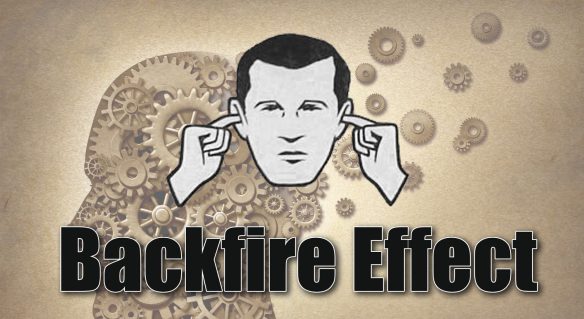
Our brains are wired to find comfort behind that crust. In what’s known as the backfire effect, our minds reject new information that clashes with our belief systems and opinions. As David McRaney, author of the books You Are Not So Smart and You Are Now Less Dumb explains it: “Once something is added to your collection of beliefs, you protect it from harm. You do this instinctively and unconsciously when confronted with attitude-inconsistent information. Just as confirmation bias shields you when you actively seek information, the backfire effect defends you when the information seeks you, when it blindsides you. Coming or going, you stick to your beliefs instead of questioning them. When someone tries to correct you, tries to dilute your misconceptions, it backfires and strengthens those misconceptions instead. Over time, the backfire effect makes you less skeptical of those things that allow you to continue seeing your beliefs and attitudes as true and proper.” In other words, that crust acts as a shield for facts that threaten your beliefs. And you’ve probably seen this in action online. Someone posts something like “climate change isn’t real” so you face palm and proceed to post ample proof that they’re wrong and that in fact, climate change is very real. The problem is that with each fact you post, the crust hardens – for both you AND the other person. Of course, it doesn’t help that you can find just as much if not more bullshit online than you can actual truth but much of it is actually tied to the inherent laziness of our brains. “The more difficult it becomes to process a series of statements, the less credit you give them overall…In experiments where two facts were placed side by side, subjects tended to rate statements as more likely to be true when those statements were presented in simple, legible type than when printed in a weird font with a difficult-to-read color pattern. Similarly, a barrage of counterarguments taking up a full page seems to be less persuasive to a naysayer than a single, simple, powerful statement.”

So does this mean that we should just stop pointing out when someone is wrong? That we should let all kinds of ridiculous notions from lizard people to “homeless people are dangerous” slide? Of course not. Rather, it means that if we want to educate and engage, if we want people to wake the fuck up then we have to consider how the human mind works – and how it doesn’t. Furthermore, our goal shouldn’t be to win an argument as if to suggest that as soon as we win the argument, justice is at hand. Indeed, if your goal is to simply be right, the religious zeal with which you defend your ideas will only turn you into the very monster you are trying to slay. Being right, in other words, is not the point. Progress is not a church. We are not looking for converts. Our aim should always be to engage and empower; to share our knowledge and embrace the knowledge of others. Seek and speak truth – then act on it. And do not think that because you found a nugget of information you hold moral superiority over those who don’t know it. Our minds are just as susceptible to that crust as anyone else’s. We are not special or better. Indeed, we must constantly question our opinions, compare them with facts and new information. By that I mean actual facts, not “alt facts” sourced from a single Google search or indeed even something from a “trusted” publication.

In an interview last March with Robert Scheer of Truthdig, author Joel Whitney discusses the 60 year history of fake news and how it was used in the Cold War era to sew distrust and hatred of all things “commie” and Russian. Major and well-trusted media outlets were a part of the propaganda ring and Whitney notes “that the fearful political atmosphere at the time led to “secrecy being used to preside over and rule over the free press — which we’re supposed to be the champions of.” “They drank the Kool-Aid and thought they were saving freedom,” Scheer agrees. The discussion underscores the need for analysis of Cold War-era media as a way to avoid propagandized journalism today. Scheer says, “I look at the current situation, where we don’t even have a good communist enemy, so we’re inventing Russia as a reborn communist power enemy.” “I call it superpolitics,” Whitney concludes, “where essentially there’s something that’s so evil and so frightening that we have to change how our democratic institutions work.” The latest red scare is but one example of how easy it is to mold minds when you use something like the hatred of Trump as a trigger. Blend some tried and true anti-Russia sentiment in there and you’ve got yourself a brand spanking new enemy – one that allows you to further mold those democratic institutions just as seamlessly as the minds you’ve now crusted and convinced. Russia aside, the same propaganda games go for mass media collusion on everything from fracking to the military industrial complex. For example, leaked email messages show that a writer from the LA times colluded with the CIA not only in terms of getting the CIA’s OK on forthcoming stories but actually offered to write stories for them that would put a positive spin on such issues as drone warfare, saying it would be quote “reassuring to the public” and a “good opportunity” for the CIA. Various other email messages show that the same was true for a list of other media outlets.

All this to say, if I may borrow a phrase: no investigation, no right to speak. Do your own research before you claim to know something. Incidentally this will also help steel you from the rumor mill AND infiltrators. Whether it’s taking someone to task on a rumor or engaging someone in discourse, be vigilant. Be vigilant in your drive, your actions, and be primarily vigilant in your own thinking. Release the flimsy beliefs that would just as soon sink you as keep you afloat. Arm yourself with knowledge and reach out to build and to engage, not to win a Facebook tiff. Consider the goal of engagement and empowerment rather than just being right. Consider the reaction you would have if someone came at you with a barrage of links followed by “read a fucking book, asshole!” You’d more than likely write them off as an unhinged asshole even if their information is solid. Try asking a question or perhaps as Ben Franklin suggested, ask them for a favor, something small that seeds trust, pinging off the human psychology that seeks appreciation and the feel of community. Push past political theory and get down to human connection – to start with. For instance, anarchists in several communities will often engage with would-be white supremacists via the common ground of distrust and disgust in the system. They’ll sit and talk; discuss the pitfalls of a system that’s left them behind and from there grow to a discourse on the roots of their discontent, i.e. not black people. In other words, knock on the door rather than trying to break down the wall. Because that wrought iron shit crust is stronger than steel.

Finally, keep in mind that this won’t always work and nor should it. We have to accept that in our grandiose imaginings of the revolution, many people will either be against us or sitting at home praying we all just shut up. But again, if you’re not looking for converts, if you’re engaging to empower, you’ll not only find more people willing to talk to you, you’ll also more than likely learn something in the process. You might even pick something up that’ll put a dent in your own mental crust.