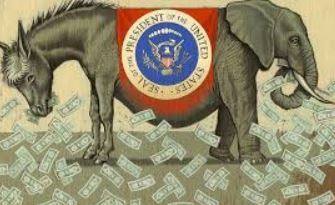
Enough Is Enough: If You Really Want to Save Lives, Take Aim at Government Violence

By John W. Whitehead

Source: The Rutherford Institute

“It is often the case that police shootings, incidents where law enforcement officers pull the trigger on civilians, are left out of the conversation on gun violence. But a police officer shooting a civilian counts as gun violence. Every time an officer uses a gun against an innocent or an unarmed person contributes to the culture of gun violence in this country.”—Journalist Celisa Calacal

Enough is enough.

That was the refrain chanted over and over by the thousands of demonstrators who gathered to protest gun violence in America.

Enough is enough.

We need to do something about the violence that is plaguing our nation and our world.

Enough is enough.

The world would be a better place if there were fewer weapons that could kill, maim, destroy and debilitate.

Enough is enough.

On March 24, 2018, more than 200,000 young people took the time to march on Washington DC and other cities across the country to demand that their concerns about gun violence be heard.

More power to them.

I’m all for activism, especially if it motivates people who have been sitting silently on the sidelines for too long to get up and try to reclaim control over a runaway government.

Curiously, however, although these young activists were vocal in calling for gun control legislation that requires stricter background checks and limits the kinds of weapons being bought and sold by members of the public, they were remarkably silent about the gun violence perpetrated by their own government.

Enough is enough.

Why is no one taking aim at the U.S. government as the greatest purveyor of violence in American society and around the world?

The systemic violence being perpetrated by agents of the government has done more collective harm to the American people and our liberties than any single act of terror or mass shooting.

Violence has become our government’s calling card, starting at the top and trickling down, from the more than 80,000 SWAT team raids carried out every year on unsuspecting Americans by heavily armed, black-garbed commandos and the increasingly rapid militarization of local police forces across the country to the drone killings used to target insurgents.

Enough is enough.

The government even exports violence worldwide, with weapons being America’s most profitable export.

Indeed, the day before thousands of demonstrators descended on Washington DC to protest mass shootings such as the one that took place at Stoneman Douglas High School, President Trump signed into law a colossal $1.3 trillion spending bill that gives the military the biggest boost in spending in more than a decade.

Ironic, isn’t it?

Here we have thousands of passionate protesters raging, crying and shouting about the need to restrict average Americans from being able to purchase and own military-style weapons, all the while the U.S. government—the same government under Trump, Obama, Bush, Clinton and beyond that continues to act as a shill and a shield for the military industrial complex—embarks on a taxpayer-funded death march that will put even more guns into circulation, and no one says a thing about it.

Why is that?

Why does the government get a free pass?

With more than $700 billion earmarked for the military, including $144.3 billion for new military equipment, you can expect a whole lot more endless wars, drone strikes, bombing campaigns, civilian deaths, costly military installations, and fat paychecks for private military contractors who know exactly how to inflate invoices and take the American taxpayers for a ride.

Enough is enough.

You can be sure this financial windfall for America’s military empire will be used to expand the police state here at home, putting more militarized guns and weapons into the hands of local police and government bureaucrats who have been trained to shoot first and ask questions later.

There are now reportedly more bureaucratic (non-military) government civilians armed with high-tech, deadly weapons than U.S. Marines.

While Americans have to jump through an increasing number of hoops in order to own a gun, the government is arming its own civilian employees to the hilt with guns, ammunition and military-style equipment, authorizing them to make arrests, and training them in military tactics.

Among the agencies being supplied with night-vision equipment, body armor, hollow-point bullets, shotguns, drones, assault rifles and LP gas cannons are the Smithsonian, U.S. Mint, Health and Human Services, IRS, FDA, Small Business Administration, Social Security Administration, National Oceanic and Atmospheric Administration, Education Department, Energy Department, Bureau of Engraving and Printing and an assortment of public universities.

Seriously, why do IRS agents need AR-15 rifles?

Enough is enough.

Remember, it was just a few months ago that President Trump, aided and abetted by his trusty Department of Justice henchman Jeff Sessions, rolled back restrictions on the government’s military recycling program to the delight of the nation’s powerful police unions.

Under the auspices of this military “recycling” program, which was instituted decades ago and allows local police agencies to acquire military-grade weaponry and equipment, more than $4.2 billion worth of equipment has been transferred from the Defense Department to domestic police agencies since 1990.

Ironically, while gun critics continue to clamor for bans on military-style assault weapons, high-capacity magazines and armor-piercing bullets, expanded background checks, and tougher gun-trafficking laws, the U.S. military boasts all of these and more, including some weapons the rest of the world doesn’t have.

In the hands of government agents, whether they are members of the military, law enforcement or some other government agency, these weapons have become routine parts of America’s day-to-day life, a byproduct of the rapid militarization of law enforcement over the past several decades.

Over the course of 30 years, police officers in jack boots holding assault rifles have become fairly common in small town communities across the country. As investigative journalists Andrew Becker and G.W. Schulz reveal, “Many police, including beat cops, now routinely carry assault rifles. Combined with body armor and other apparel, many officers look more and more like combat troops serving in Iraq and Afghanistan.”

Although these federal programs that allow the military to “gift” battlefield-appropriate weapons, vehicles and equipment to domestic police departments at taxpayer expense are being sold to communities as a benefit, the real purpose is to keep the defense industry churning out profits, bring police departments in line with the military, and establish a standing army.

It’s a militarized approach to make-work programs, except in this case, instead of unnecessary busy work to keep people employed, communities across America are being inundated with unnecessary drones, tanks, grenade launchers and other military equipment better suited to the battlefield in order to fatten the bank accounts of the military industrial complex.

Thanks to Trump, this transformation of America into a battlefield is only going to get worse.

Get ready for more militarized police.

More police shootings.

More SWAT team raids.

More violence in a culture already drenched with violence.

Enough is enough.

You want to talk about gun violence?

According to the Washington Post, “1 in 13 people killed by guns are killed by police.”

While it still technically remains legal for the average citizen to own a firearm in America, possessing one can now get you pulled over, searched, arrested, subjected to all manner of surveillance, treated as a suspect without ever having committed a crime, shot at and killed by police.

You don’t even have to have a gun or a look-alike gun, such as a BB gun, in your possession to be singled out and killed by police.

There are countless incidents that happen every day in which Americans are shot, stripped, searched, choked, beaten and tasered by police for little more than daring to frown, smile, question, or challenge an order.

Growing numbers of unarmed people are being shot and killed for just standing a certain way, or moving a certain way, or holding something—anything—that police could misinterpret to be a gun, or igniting some trigger-centric fear in a police officer’s mind that has nothing to do with an actual threat to their safety.

Enough is enough.

With alarming regularity, unarmed men, women, children and even pets are being gunned down by twitchy, hyper-sensitive, easily-spooked police officers who shoot first and ask questions later, and all the government does is shrug and promise to do better.

Killed for standing in a “shooting stance.” In California, police opened fire on and killed a mentally challenged—unarmed—black man within minutes of arriving on the scene, allegedly because he removed a vape smoking device from his pocket and took a “shooting stance.”

Killed for holding a cell phone. Police in Arizona shot a man who was running away from U.S. Marshals after he refused to drop an object that turned out to be a cellphone. Similarly, police in Sacramento fired 20 shots at an unarmed, 22-year-old black man who was standing in his grandparents’ backyard after mistaking his cellphone for a gun.

Killed for carrying a baseball bat. Responding to a domestic disturbance call, Chicago police shot and killed 19-year-old college student Quintonio LeGrier who had reportedly been experiencing mental health problems and was carrying a baseball bat around the apartment where he and his father lived.

Killed for opening the front door. Bettie Jones, who lived on the floor below LeGrier, was also fatally shot—this time, accidentally—when she attempted to open the front door for police.

Killed for running towards police with a metal spoon. In Alabama, police shot and killed a 50-year-old man who reportedly charged a police officer while holding “a large metal spoon in a threatening manner.”

Killed for running while holding a tree branch. Georgia police shot and killed a 47-year-old man wearing only shorts and tennis shoes who, when first encountered, was sitting in the woods against a tree, only to start running towards police holding a stick in an “aggressive manner.

Killed for crawling around naked. Atlanta police shot and killed an unarmed man who was reported to have been “acting deranged, knocking on doors, crawling around on the ground naked.” Police fired two shots at the man after he reportedly started running towards them.

Killed for wearing dark pants and a basketball jersey. Donnell Thompson, a mentally disabled 27-year-old described as gentle and shy, was shot and killed after police—searching for a carjacking suspect reportedly wearing similar clothing—encountered him lying motionless in a neighborhood yard. Police “only” opened fire with an M4 rifle after Thompson first failed to respond to their flash bang grenades and then started running after being hit by foam bullets.

Killed for driving while deaf. In North Carolina, a state trooper shot and killed 29-year-old Daniel K. Harris—who was deaf—after Harris initially failed to pull over during a traffic stop.

Killed for being homeless. Los Angeles police shot an unarmed homeless man after he failed to stop riding his bicycle and then proceeded to run from police.

Killed for brandishing a shoehorn. John Wrana, a 95-year-old World War II veteran, lived in an assisted living center, used a walker to get around, and was shot and killed by police who mistook the shoehorn in his hand for a 2-foot-long machete and fired multiple beanbag rounds from a shotgun at close range.

Killed for having your car break down on the road. Terence Crutcher, unarmed and black, was shot and killed by Oklahoma police after his car broke down on the side of the road. Crutcher was shot in the back while walking towards his car with his hands up.

Killed for holding a garden hose. California police were ordered to pay $6.5 million after they opened fire on a man holding a garden hose, believing it to be a gun. Douglas Zerby was shot 12 times and pronounced dead on the scene.

Killed for calling 911. Justine Damond, a 40-year-old yoga instructor, was shot and killed by Minneapolis police, allegedly because they were startled by a loud noise in the vicinity just as she approached their patrol car. Damond, clad in pajamas, had called 911 to report a possible assault in her neighborhood.

Killed for looking for a parking spot. Richard Ferretti, a 52-year-old chef, was shot and killed by Philadelphia police who had been alerted to investigate a purple Dodge Caravan that was driving “suspiciously” through the neighborhood.

Shot seven times for peeing outdoors. Eighteen-year- old Keivon Young was shot seven times by police from behind while urinating outdoors. Young was just zipping up his pants when he heard a commotion behind him and then found himself struck by a hail of bullets from two undercover cops. Allegedly officers mistook Young—5’4,” 135 lbs., and guilty of nothing more than taking a leak outdoors—for a 6’ tall, 200 lb. murder suspect whom they later apprehended. Young was charged with felony resisting arrest and two counts of assaulting a peace officer.

This is what passes for policing in America today, folks, and it’s only getting worse.

In every one of these scenarios, police could have resorted to less lethal tactics.

They could have acted with reason and calculation instead of reacting with a killer instinct.

They could have attempted to de-escalate and defuse whatever perceived “threat” caused them to fear for their lives enough to react with lethal force.

That police instead chose to fatally resolve these encounters by using their guns on fellow citizens speaks volumes about what is wrong with policing in America today, where police officers are being dressed in the trappings of war, drilled in the deadly art of combat, and trained to look upon “every individual they interact with as an armed threat and every situation as a deadly force encounter in the making.”

Remember, to a hammer, all the world looks like a nail.

We’re not just getting hammered, however.

We’re getting killed, execution-style.

Enough is enough.

When you train police to shoot first and ask questions later—whether it’s a family pet, a child with a toy gun, or an old man with a cane—they’re going to shoot to kill.

This is the fallout from teaching police to assume the worst-case scenario and react with fear to anything that poses the slightest threat (imagined or real).

This is what comes from teaching police to view themselves as soldiers on a battlefield and those they’re supposed to serve as enemy combatants.

This is the end result of a lopsided criminal justice system that fails to hold the government and its agents accountable for misconduct.

You want to save lives?

Start by doing something to save the lives of your fellow citizens who are being gunned down every day by police who are trained to shoot first and ask questions later.

You want to cry about the lives lost during mass shootings?

Cry about the lives lost as a result of the violence being perpetrated by the U.S. government here at home and abroad.

If gun control activists really want the country to reconsider its relationship with guns and violence, then it needs to start with a serious discussion about the role our government has played and continues to play in contributing to the culture of violence.

If the American people are being called on to scale back on their weapons, then as I make clear in my book Battlefield America: The War on the American People, the government and its cohorts—the police, the various government agencies that are now armed to the hilt, the military, the defense contractors, etc.—need to do the same.

It’s time to put an end to the government’s reign of terror.

Enough is enough.

American Public Troubled by ‘Deep State’

By John V. Walsh

Source: ConsortiumNews.com

“Public Troubled by Deep State” is the headline that the Monmouth University Polling Institute tags to its recent poll.  Acknowledging that polling about the term “Deep State” is problematic because “few Americans (13%) are very familiar with the term ‘Deep State,’” the pollsters at Monmouth defined the term as follows for their interviewees: “The term Deep State refers to the possible existence of a group of unelected government and military officials who secretly manipulate or direct national policy.”

Then they asked whether such a group exists.

Monmouth reports the results as follows: “Nearly 3-in-4 (74%) say they believe this type of apparatus exists in Washington. This includes 27% who say it definitely exists and 47% who say it probably exists. Only 1-in-5 say it does not exist (16% probably not and 5% definitely not).”

These opinions do not follow a partisan divide. The report explains that belief in the Deep State’s existence “comes from more than 7-in-10 Americans in each partisan group, although Republicans (31%) and independents (33%) are somewhat more likely than Democrats (19%) to say that the Deep State definitely exists.”

This leads the director of the independent Monmouth University Polling Institute, Patrick Murray, to volunteer: “We usually expect opinions on the operation of government to shift depending on which party is in charge. But there’s an ominous feeling by Democrats and Republicans alike that a ‘Deep State’ of unelected operatives are pulling the levers of power.”

In addition, there are some significant but not drastic racial and ethnic differences on this question. Says the report, “Americans of black, Latino and Asian backgrounds (35%) are more likely than non-Hispanic whites (23%) to say that the Deep State definitely exists.”

The report also asked about government surveillance of the citizenry and here again there is widespread concern: Fully 8-in-10 believe that the U.S. government currently monitors or spies on the activities of American citizens, including a majority (53%) who say this activity is widespread and another 29% who say such monitoring happens but is not widespread. Just 14% say this monitoring does not happen at all. There are no substantial partisan differences in these results.

This too causes the director of the Institute to be concerned.  “This is a worrisome finding. The strength of our government relies on public faith in protecting our freedoms, which is not particularly robust. And it’s not a Democratic or Republican issue. These concerns span the political spectrum,” says director Murray.

We can add to the concern about a manipulative unelected apparatus at work in the government the widespread distrust of the press summarized in this recent Gallup/Knight poll:

“*Today, 66% of Americans say most news media do not do a good job of separating fact from opinion. In 1984, 42% held this view.

“*Less than half of Americans, 44%, say they can think of a news source that reports the news objectively.

“*On a multiple-item media trust scale with scores ranging from a low of zero to a high of 100, the average American scores a 37.”

This paints a pretty grim picture of trust in both our government and our media.  Perhaps “Deep Media” should be a term added to “Deep State.”

But perhaps it is cause for optimism. It seems that people are waking up and thinking for themselves. This is, perhaps, good news for those who are trying to end U.S. wars being ginned up by the Deep State.


John V. Walsh can be reached at john.endwar@gmail.com

The Global Elite is Insane Revisited

By Robert J. Burrowes

In 2014 I wrote an article titled ‘The Global Elite is Insane’. I want to elaborate what I explained in the earlier article so that people have a clearer sense of what we are up against in our struggle to create a world of peace, justice and ecological sustainability.

Of course, as I explained previously, it is not just the global elite that is insane. All those individuals – politicians, businesspeople, academics, corporate media editors and journalists, judges and lawyers, bureaucrats…. – who serve the elite, including by not exposing and resisting it, are also insane. And it is important to understand this if we are to develop and implement effective strategies to resist elite violence, exploitation and destruction but also avert the now-imminent human extinction driven by their insane desire for endless personal privilege, corporate profit and political control whatever the cost to Earth’s biosphere and lifeforms (human and non-human alike).

But first, who constitutes the global elite? Essentially, it is those extremely wealthy individuals – notably including the Rothschild family, Jeff Bezos, Bill Gates, Warren Buffett, Amancio Ortega, Mark Zuckerberg, Carlos Slim, the Walton family and the Koch brothers – as well as the world’s other billionaires and millionaires. See ‘Bloomberg Billionaires Index’.

Testament to their secretly and long-accumulated wealth and power, a 2012 investigation concluded that rich individuals and their families have as much as $32 trillion of hidden financial assets – which excludes non-financial assets such as real estate, gold, yachts and racehorses – in offshore tax havens. See the Tax Justice Network.

If this sum was devoted to programs of social uplift then starvation, poverty, homelessness and other privations would vanish immediately and environmental restoration projects as well as research, development and implementation of visionary sustainability initiatives would flourish instantly. The idea of an ‘underdeveloped’ or ‘developing’ national economy would vanish from the literature on Africa, Asia and Central/South America.

In addition to these individuals, however, the global elite includes the major multinational corporations, particularly including the following – although, it should be noted, this list simplifies the picture considerably by ignoring the conglomerate nature of many of these corporations and not including many of the (more difficult to identify) private corporations that should be listed in any comprehensive presentation:

* the major weapons manufacturers (such as Lockheed Martin, Boeing, BAE Systems, Raytheon, Northrop Grumman and General Dynamics)

* the major banks (including Industrial & Commercial Bank of China, China Construction Bank, HSBC Holdings, JPMorgan Chase, Mitsubishi UFJ Financial Group and Bank of America) and their ‘industry groups’ like the International Monetary Conference

* the major investment companies (including BlackRock, Capital Group Companies, FMR, AXA, and JP Morgan Chase)

* the major financial services companies (including Berkshire Hathaway, AXA, Allianz and BNP Paribas)

* the major energy corporations including coal companies (such as Coal India, Adani Enterprises, China Shenhua Energy, China Coal Energy, Mechel, Exxaro Resources, Public Power, Glencore and Peabody Energy) as well as the oil and gas corporations (such as Saudi Aramco, Gazprom, Rosneft, PetroChina, ExxonMobil, Lukoil, BP, Royal Dutch Shell, Petrobras, Chevron, Novatek, Total S.A. and Eni)

* the major media corporations (including Alphabet [Google owner], Comcast, Disney, AT&T, News Corporation, Time Warner, Fox, Facebook, Bertelsmann and Baidu)

* the major marketing and public relations corporations (including Edelman, W2O Group, APCO Worldwide, Deksia, BrandTuitive, Fearless Media, and Citizen Group)

* the major agrochemical (pesticides, seeds, fertilizers) giants (including Bayer, Syngenta, Dow, Monsanto and DuPont)

* the major pharmaceutical corporations (including Johnson & Johnson, Roche, Pfizer, Novartis, Sanofi and GlaxoSmithKline)

* the major biotechnology (genetic mutilation) corporations (again including Johnson & Johnson, Roche, Pfizer and Novartis)

* the major mining corporations (including Glencore Xtrata, BHP Billiton, Rio Tinto, Vale, Anglo American, China Shenhua Energy, Freeport McMoRan Copper & Gold, and Barrick Gold)

* the major nuclear power corporations (including Areva, Rosatom, General Electric/Hitachi, Kepco, Mitsubishi, Babcock & Wilcox, BNFL, Duke Energy, McDermott International, Southern, NextEra Energy, American Electric Power, and Westinghouse)

* the major food multinationals (including Cargill, Archer Daniels Midland Company [ADM], Nestlé, PepsiCo, Coca-Cola, Unilever, Danone, General Mills, Kellogg’s, Mars, Associated British Foods and Mondelez)

* the major water corporations (including Veolia, Suez Environnement, ITT Corporation, United Utilities, Severn Trent, Thames Water, American Water Works).

Of course, the global elite also includes elite fora where various combinations of elite individuals from the corporate, political, media and academic worlds gather to plan their continuing violence against, and exploitation of, the Earth and its inhabitants. This is intended to consolidate and extend t heir control over populations, markets and resources to maximize their privilege, profit and power at the expense of the rest of us and life generally. Among intergovernmental organizations, it includes the United Nations, the World Bank and the International Monetary Fund.

A quick perusal of the agenda of such elite gatherings – including the World Economic Forum, the Bilderberg Group and the Trilateral Commission – reveals a comprehensive lack of interest, despite rhetoric and the occasional token mention, of pressing issues ranging from the threat of nuclear war and the climate catastrophe to the many ongoing wars, deepening exploitation within the global economy, extensive range of environmental threats and the refugee crisis, each of which they generated and now continue to deliberately exacerbate. See, for example, the agenda of the recent WEF meeting in Davos.

Primary servants of the global elite include political leaders in major industrialized countries (who legislate to progressively expand elite power, profit and privilege, such as Donald Trump’s recent tax cuts for the wealthy at the expense of social programs), the judges and lawyers (who defend elite power using the elite-designed and manipulated legal system: ever heard of a wealthy individual convicted in court and given any serious punishment or of any major corporation genuinely held to legal account for its exploitation of indigenous peoples or destruction of the natural environment?), as well as corporate media editors and journalists, entertainment industry personnel, academics, industry organizations (such as the European Round Table of Industrialists) that represent the interests of major corporations, so-called ‘think tanks’ (such as the Council on Foreign Relations and the Brookings Institution) and ‘philanthropic trusts’ (such as the Rockefeller, Carnegie and Ford foundations) all of which justify, ignore or divert attention from elite violence and exploitation.

Importantly too, primary servants of the global elite include those who work within elite-directed agencies, notably including those in the so-called ‘intelligence community’ (such as the US CIA, British MI6, Russian SVR RF, Chinese Ministry for State Security and Israeli Mossad), who perform elite functions in relation to spying, surveillance and secret assassinations (particularly of grassroots activists), ostensibly under the direction of national governments. But it also includes many lower-level servants such as those who work as political lobbyists or in the bureaucracy as well as the education, police and prison systems.

So why do I claim that the elite and those who serve them are insane?

Any dictionary will offer a simple definition of ‘sanity’ along the lines of ‘soundness of judgment or reason’ and ‘the ability to think and speak in a reasonable way and to behave normally’.

But if we use this definition of sanity then, obviously, ‘sanity’ must be interpreted to mean that it is ‘sound judgment, reasonable and normal’ to further perpetrate the violence and exploitation that are overwhelmingly characteristic of our world. After all, most people powerlessly accept this incredibly violent state of affairs and, if they discuss it, do so in terms of its merits, politically, economically, morally or otherwise. Few people argue, simply, that violence is just insane.

So I would like to propose a more rigorous definition of sanity: Sanity is the capacity to consider a set of circumstances, to carefully analyze the evidence pertaining to those circumstances, to identify the cause of any conflict or problem, and to respond appropriately, both emotionally and intellectually, to that conflict or problem with the intention of resolving it, preferably at a higher level of need satisfaction for all parties (including those of the Earth and all of its living creatures).

Clearly, my proposed definition of sanity is designed to imply that any conceptions we have of ‘sound judgment’, ‘reasonable’ and ‘normal’ mean that they are qualities we associate with individuals who possess the desirable capacity to improve the overall state of human affairs, whether an interpersonal relationship or geopolitically. This means, as an absolute minimum, the capacity to reduce violence or exploitation in one context or another.

You might, of course, accuse me of writing a definition of ‘sanity’ that serves my agenda to dramatically improve world order in the direction of peace, justice and sustainability. And you are right! But whose interest does it serve to have sanity defined as behavior that involves ‘sound judgment’ and is considered ‘reasonable and normal’ in the context of perpetuating extraordinary violence?

Alternatively, you might argue that my definition of insanity is too broad. Surely, you might say, we can account for many of the behaviors outlined above in terms of different belief systems, ideologies and religions. Doesn’t a person who believes in killing people to win wars (or for other reasons) just have a worldview different from those who believe that people should resolve conflict nonviolently? Doesn’t a capitalist just have a worldview different from those who believe that people should share resources equally? Doesn’t a person who believes in the unlimited accumulation of wealth just have a worldview different from those who believe in ecological sustainability?

But there is a more fundamental issue here. As I explained in my original article, cited at the beginning of this one: Do you really believe that someone who is capable of perpetrating extraordinary violence, inequity and biosphere-threatening behavior – and thus clearly incapable of experiencing and expressing the love, compassion, empathy and sympathy that would drive a nonviolent approach to the world – is sane? Given that emotional qualities such as love, compassion, empathy and sympathy are an evolutionary gift to those not seriously damaged during childhood, what happened to those individuals who do not possess them? See Why Violence?’ and Fearless Psychology and Fearful Psychology: Principles and Practice.

Or, to explain it based on my longer definition of sanity highlighted above: Casual observation of the state of our world, including the primary threat of near-term human extinction through climate catastrophe or nuclear war – see ‘On Track for Extinction: Can Humanity Survive?’ – clearly reveals that none of the elite is paying considered attention to the perilous state of our world, analyzing the evidence in relation to it, identifying the cause(s) driving it or responding powerfully to end it. Why is this?

In essence, it is because one manifestation of their insanity drives them to deny reality to make huge profits from weapons production used to kill people, the burning of climate-destroying fossil fuels, environmental destruction (through, for example, mining and rainforest logging), commercial farming based on the poisoning and genetic mutilation of foods, the mass production and sale of poisoned, processed and nutritionally-depleted foods, the consumption of health-destroying and dependency-creating drugs, and control over the sale of water, once considered a human right. Moreover, insanity makes the elite do everything in its power to maintain this highly profitable state of affairs. See ‘Profit Maximization is Easy: Invest in Violence’.

Moreover, of course, there is no evidence of committed elite engagement in efforts to end the many local wars (from which they make huge profits), end corporate exploitation of human beings (which kills, through starvation alone, 100,000 people every day but from which they make huge profits) and nonhuman beings (which drives 200 species of life to extinction daily but from which they make huge profits) or end local environmental destruction in a myriad ways (from which they make huge profits).

So, in summary, given our ongoing rush to extinction, it is clear that those who exacerbate this threat through failure to consider and act with awareness (as well as encourage aware action by others) fail to satisfy the definition of sanity that I offered above. In short: Gambling on the future of humanity is not sane.

As an aside, it should be noted: Often enough too, the elite can rely on a largely insane population to mindlessly consume the latest consumer product, no matter how unnecessary, or they can rely on their marketing and advertising agents to persuade those of us who show the slightest reluctance to buy the latest inanity.

So with an insane global elite and its many insane servants as well as a largely insane consumer population, what can those of us who have the sanity to respond powerfully to the many threats to our survival do?

Well, if you want a child who is emotionally and intellectually engaged with the world and therefore capable of responding powerfully to their circumstances (which includes being able to resist the lure of serving the elite and being suckered by its marketing), then terrorizing the child into obedience is not the way to go about it. So, you might like to consider making ‘My Promise to Children’.

If you are sane enough to investigate the evidence and to act intelligently and powerfully in response to it, I encourage you to do so. One option you have if you find the evidence in relation to one or more of the threats mentioned above compelling, is to join those participating in ‘The Flame Tree Project to Save Life on Earth’.

If you are self-aware enough to know that you are inclined to avoid ‘difficult issues’ and to take the action that these require, then perhaps you could tackle this problem at its source by ‘Putting Feelings First’. Unfortunately, as mentioned above, few of us had a childhood that nurtured our sanity.

If you want to mobilize people to campaign effectively on the climate, war, rainforest destruction or any other elite-driven violence that threatens our future, consider developing a comprehensive nonviolent strategy to do so. See Nonviolent Campaign Strategy.

And if you want to participate in the worldwide effort to end the insanity we call violence in all of its manifestations, you are welcome to consider signing the online pledge of The Peoples Charter to Create a Nonviolent World.

Elite insanity, if not stopped, will drive us out of existence. If you believe that the elite and their servants will ‘see the light’ before it is too late, I invite you to seek out the evidence to justify your belief. I have found none.

I also see no evidence that individual members of the elite will do the emotional healing necessary to be able to act sanely in response to the extinction-threatening crisis it has generated.

So it is up to those of us who can think and act sanely to stop the rush to extinction before it is too late.

Are you one of those people?


Biodata: Robert J. Burrowes has a lifetime commitment to understanding and ending human violence. He has done extensive research since 1966 in an effort to understand why human beings are violent and has been a nonviolent activist since 1981. He is the author of Why Violence? His email address is flametree@riseup.net and his website is here.

Robert J. Burrowes
P.O. Box 68
Daylesford, Victoria 3460
Australia

Email: flametree@riseup.net

Websites:
Nonviolence Charter
Flame Tree Project to Save Life on Earth
‘Why Violence?’
Feelings First
Nonviolent Campaign Strategy
Nonviolent Defense/Liberation Strategy
Anita: Songs of Nonviolence
Robert Burrowes
Global Nonviolence Network

America: The Country That Never Was!

By thnkfryrslf

Source: Axis of Logic

The ideal country. Democratic and Free. The greatest country in the world, because they’re exceptional.

Saves citizens of other countries from tyrannical governments by slaying the tyrants and bringing democracy and staying to make sure that democracy is implemented, no matter how long it takes. Always doing right by those citizens in need.

A beacon of liberty to the rest of the world. Saved the world by winning the 2nd world war. Its citizens always patriotically supporting the troops. The richest country on earth. All citizens are equal under the law. Economically, presents to its citizens every opportunity to succeed. A culture of endless opportunities.

Constantly reforming education for its people. Good God-fearing moral people, supported by a God-fearing, moral government. A benevolent people, whose benevolent government shows benevolence to the rest of the world. Respecting the freedom and sovereignty of all nations.

Generous loans given to poorer countries.

Good supportive and caring neighbour to its northern and southern neighbours.

Always warning its public and the rest of the world who the enemy of their stability and peace is and that this country of exceptional people will always defend them.

Admirer of those self-made creators of wealth. They are the true rugged individuals. Showing in Hollywood movies the heroism of their noble military. Accepting all races of people, it being one of their highest values.

An engaged citizenry always challenging its government to do better. Freedom of speech exercised by all, because they are a government of the people and by the people.

Citizens love of their country runs deep, shown by not having a need to travel much to other lesser countries. The MSM always helping the people to understand politics domestically and globally and how their government is constantly practicing democratic values at home and abroad.

The envy of the world for their wealth and freedom. A country who historically fought a civil war to abolish slavery and succeeded. A country that was essentially built by Europeans. A country whose heroic history is taught as an inspiration.

America, a brutal and savage killer, posing as a liberator and keeper of peace, is the country that does exist.

“If poor people knew how rich rich people are, there would be riots in the streets”

By Staff, Anticap.wordpress.com

Source: Popular Resistance

Chris Rock may be right. Still, Americans are well aware that economic inequality in their country is obscene, even though they often underestimate the growing gap between the poor and the rich.

But it’s Frank Rich, who conducted the interview with the American comedian, who made the more perceptive observation:

For all the current conversation about income inequality, class is still sort of the elephant in the room.

All the experts agree—from Thomas Piketty and the other members of the World Inequality Lab team to John C. Weicher of the conservative Hudson Institute—that inequality in the United States, especially the unequal distribution of wealth, has been worsening for decades now. Both before and after the crash of 2007-08. And there’s no sign that things are going to get better anytime soon, unless radical changes are made.

But, as it turns out, even the experts underestimate the degree of inequality in the United States. The usual numbers that are produced and disseminated indicate that, in 2014 (the last year for which data are available), the top 1 percent of Americans owned one third (35 percent) of total household wealth while the bottom 90 percent had less than half (45.3 percent) of the wealth.

According to my calculations, illustrated in the chart at the top of the post, the situation in the United States is much worse. In 2014, the top 1 percent (red line) owned almost two thirds of the financial or business wealth, while the bottom 90 percent (blue line) had only six percent. That represents an enormous change from the already-unequal situation in 1978, when the shares were much closer (28.6 percent for the top 1 percent and 23.2 percent for the bottom 90 percent).

Why the large difference between my numbers and theirs? It all depends on how wealth is defined. Both the World Inequality Lab and the Federal Reserve (in the Survey of Consumer Finances) include housing and retirement pensions in household wealth—and those two categories comprise most of the so-called wealth of most Americans. They just don’t own much in the way of financial or business wealth. They live in their houses and they retire based on contributions from their wages and salaries over the course of their work lives. They produce but don’t take home any of the surplus; therefore, they just don’t have the ability to amass any real wealth.

For the small group at the top, things are quite different. They do get a cut of the surplus, which they use, not only to purchase housing and put aside in their pensions, but to accumulate real wealth, for themselves and their families. If we take out housing and pensions and calculate just the shares of financial or business wealth—and, thus, equities, fixed-income claims, and business assets—the degree of inequality is much, much worse.

Yes, rich people in the United States are very rich—even more than either regular Americans or the experts believe.

But that’s not the real elephant in the room. The big issue that everyone is aware of, but nobody wants to talk about, is class. And that’s the reason there should be, if not riots, at least a sustained political movement to transform the existing economic and social structures in the United States.

Smashing the Cult of Celebrity and the Disempowerment Game

By Dylan Charles

Source: Waking Times

At the dark heart of corporate consumer culture lie the social programs that mass-produce conformity,  obedience, acquiescence and consent for the matrix.

The cult of celebrity is the royal monarch of these schemes, the ace in the hole for mass mind control and the disempowerment of the individual. This is the anointed paradigm of idol worship and idol sacrifice, a vampire’s feast on our individual and collective dreams. Who do you love? Who do you hate? Who do want to be like? 

Combine this paradigm with the technology of social media, and the individual is flung into oblivion, never fully understanding the importance and value of their own life, instead always comparing themselves to phony ideals and well-designed, well-funded marketing campaigns.

‘The camera has created a culture of celebrity; the computer is creating a culture of connectivity. As the two technologies converge – broadband tipping the Web from text to image; social-networking sites spreading the mesh of interconnection ever wider – the two cultures betray a common impulse. Celebrity and connectivity are both ways of becoming known. This is what the contemporary self wants. It wants to be recognized, wants to be connected: It wants to be visible. If not to the millions, on Survivor or Oprah, then hundreds, on Twitter or Facebook. This is the quality that validates us, this is how we become real to ourselves – by being seen by others. The great contemporary terror is anonymity.’ ~William Deresiewicz

Marketeers and propagandists are skilled at leveraging human psychology to exploit human nature. They utilize the study of the psyche to gain inroads into your behavior, and they employ this science as a tool for stoking insecurities and triggering urges.

They may be selling an idea, a lifestyle, a product, or a war, but, the pitch is the same: a false idol rises from the wastelands of the American dream, and is presented to the hordes as a well-packaged product. The celebrity’s life is a projection of a niche fantasy, and a following is built up around this fantasy, and the cult followers are steered toward whatever point of purchase.

And that’s what a cult is: “a system of religious veneration and devotion directed toward a particular figure or object.”

This kind of externalized validation serves as a power transfer. Your personal power is extracted and foisted onto a manufactured image in the matrix, and without realizing it, you’ve forfeited your power to influence the direction of your own life.

“The Fantasy of celebrity culture is not designed simply to entertain. It is designed to drain us emotionally, confuse us about our identity, make us blame ourselves for our predicament, condition us to chase illusions of fame and happiness, and keep us from fighting back.” – Chris Hedges

This is about usurping individuality in order to foster groupthink and hive consciousness. It’s also about creating a barrier between what you believe is possible for yourself and what chances you are willing to take in order to manifest a unique vision for your life.

You see, human beings are energetic creations, partly made of matter and partly made of spirit, but wholly malleable to the direction of the mind. We are affected by subtle energies, body language, electromagnetic energy, frequencies of light that we cannot see, sounds that we cannot hear, and a thousand other hidden cues. We are beings of energy, and much like a battery, we can can give or receive energy.

But the mind is at the center of it all. Whatever the mind entertains, the being creates.

When the mind fixes on an external idol, this innate power to form ourselves is transferred outside of our own locus of control, and where the mind could be centered on creating and expanding the self, it is instead focused on the fantasy of achieving an impossible ideal.

As journalist Jon Rappoport notes:

“If perception and thought can be channeled, directed, reduced, and weakened, then it doesn’t matter what humans do to resist other types of control. They will always go down the wrong path. They will always operate within limited and bounded territory. They will always ignore their own authentic power.” ~Jon Rappoport

The end game here is to keep us from accepting ourselves as worthy and perfect divine beings, and to disconnect us from our own potential. This is deep stuff, reaching far beyond the push to convert us into greedy, materialistic consumers. In a metaphysical sense it is a transfer of energy, and where once we were strong and full of promise, we are now helpless and content to observe as the world flits by.

What’s most dangerous to any system of control is for the individual to know their own strength and to speak their own language, as Chris Hedges puts it.

“That’s why I don’t own a television… and I work as hard as I can to distance myself from popular culture so that I can speak in my own language, not the one they give me.” ~Chris Hedges

Saturday Matinee: Testament

Cover Your Eyes: Lynne Littman’s ‘Testament’, 1983

By Richard McKenna

Source: We Are the Mutants

Testament
Directed by Lynne Littman
Paramount Pictures, 1983

1983 was a pretty fertile year for fictional nuclear apocalypses in Western popular culture. 2019: After the Fall of New York, Endgame, Exterminators of the Year 3000, Stryker, and Le Dernier Combat were released in cinemas, while ABC’s The Day After and Britain’s BBC2 adaptation of 1961 dystopian novel The Old Men at the Zoo, updated to feature a nuclear attack on London, appeared on television. Publishers released a slew of books with atomic mushrooms on their covers, including The Aftermath: The Human and Ecological Consequences of Nuclear War (edited by Jeannie Peterson), Luke Rhinehart’s Long Voyage Back, William Prochnau’s Trinity’s Child, and Dean Ing’s Pulling Through, as well as The Web, that year’s installment in Jerry Ahern’s Survivalist series. All of them attempted, seriously or otherwise—and it was generally otherwise—to examine the effects of a seemingly imminent nuclear war. The Doomsday Clock stood at four minutes to midnight (the closest it had been since 1960, though it was about to move even closer) and two events that year—the NATO military exercise Able Archer 83 and a nuclear attack false alarm in the Soviet Union—almost prompted a catastrophic escalation from fiction to reality.

The BBC’s optimism-annihilating Threads was still a year away, but the cultural momentum was building up to a psychological discharge whose blast radius would, for some, obliterate their ability to think about or plan for the future: what was the point, when they would be spending it eking out a life in the radioactive ruins of our civilization (or, if the Italians were right, driving customized cars and dressing like members of Krokus). That momentum surged dramatically with the release of Testament, the high water mark of the class of ’83. British sci-fi and horror magazine Starburst published a short yet positive review of it alongside a single publicity still showing a mother huddled up in bed with her children, fearfully pointing a torch into the darkness—an image that summarized perfectly the fear that it would be in our own homes that we would be killed, if not by the bomb itself then by the stone-age appetites and economics its detonation unleashed.

Despite containing no mushroom clouds, no heroics, no fallout shelters, no special effects, no geiger counters, and no enormous doors slamming in the depths of hellTestament is absolutely devastating: nothing except average people gradually realizing that the rest of their already abbreviated lives is destined to be a grim slog through even more illness, death, and loss than they’ve already experienced.

The film, produced by PBS and directed by National Education Television documentarian Lynne Littman, deals with the effects of a nuclear attack on a family who live in an idyllic small town (so idyllic that a young Kevin Costner and Rebecca De Mornay have settled there) somewhere within driving distance of San Francisco, and the first ten minutes is an artfully contrived little précis of their privileged lives: we see mom Carol (the great Jane Alexander) unenthusiastically acting out the instructions on her workout tape from bed while husband Tom (the also great William Devane) blithely takes their reluctant older son Brad cycling, leaving mom to get teenage daughter Mary (Roxana Zal) and little son Scotty (Lukas Haas) ready for school.

This initial section of the film highlights the reassuring frivolities and ephemera of Western life—toys, games, sports, exercise, E.T. t-shirts, He-Man figures and Sesame Street, and, in a way, Testament plays peculiarly like some kind of anti-E.T., or at least some nightmarish re-edit of its homely, chaotic, childish motifs, the intruder into the suburban calm not a kindly alien botanist but something native and altogether less friendly.

There is almost no buildup to the nuclear attack—no news reports about the mobilization of the armed forces, no preparations for shelter. The only indication that an attack is coming at all is that the nature of the film indicates that it must be, and the lack of narrative preparation makes the viewer’s stomach sink even more violently when the cartoon the family children are watching in their sunny lounge is suddenly replaced by static, which is then replaced by an emergency warning transmission. When the attack itself comes, it’s not even a noise, just a silent flash of blinding light. There are none of the typical signifiers: no models are destroyed, there is no colorized stock footage of shacks being blown away by 1,000 mph winds, no flesh drooping from bones, no radiation sickness makeup—only confusion, then coffins, and then funeral pyres. As the broadcasters who exchange news with the town’s chipper old radio ham start to vanish one by one, awareness grows that this might really be it—there might really be no hope.

The locals pull together and, unable to believe that the wider world won’t rally, seem determined to struggle through, organizing mutual assistance and continuing with their little world of school plays and piano lessons. But it gradually becomes more and more obvious that there is going to be no struggling through this one. Things are not going to return to normal—they are just going to keep getting worse, and there won’t be any school plays when all the children have died and all the adults are busy building bonfires to burn their corpses on.

The delicacy of touch with which the proceedings are handled—director Littman got the rights to the source material, a 1981 short story by Carol Amen, after reading it with her son—means that Testament makes its point all the more forcefully. Yes, very occasionally the tone does get slightly preachy, but considering the point the film wants to make—the stupidity of slowly and agonizingly killing half of the population of the planet—it’s a forgivable blip. In any event, Testament never feels smug or self-righteous: there are a few things that jar, and others that produce the odd smirk (a display of priestly affection very unlike that in Thorn Birds, a TV miniseries that caused a scandal the same year that Testament was released), but, most of the time, the viewer is simply staring at the screen in dread.

With its calm tonal palette and inoffensive James Horner score, suggestive of TV movies about domestic tragedy on the scale of divorce or alcoholism, one can imagine a grandparent of any political persuasion sitting down to watch it. In terms of production values, Testament sits somewhere between that well-made TV movie and a feature film proper, and its artlessness and lack of pretension, make it, if anything, even more upsetting and disorientating when things start to get really awful. Handled with a little less sensitivity and compassion, it could easily have been mawkish; but it isn’t, and Testament refuses to underline any particular aspect of the situation. There is simply the grind of life getting worse and worse until it is intolerably awful and you cannot survive. The economy with which the characters are sketched lends them a blank credibility, and the absence of any of the iconography of nuclear war (not even a single radioactive symbol) only adds to the film’s power.

Throughout the film, motifs of recording and repetition recur: family super-8 movies, nursery rhymes, the exercise cassette that mom is playing at the beginning, the answering machine, the pre-recorded warning message, the journal that Carol starts writing at the beginning of the film, even the roles of priest, mom, and policeman. It is when the graves turn to funeral pyres that the gravity of the situation becomes obvious, and perhaps the point is that the repetition and formalization of daily life is life. Deprived of the batteries and security and hope that allow us make those repetitions, the life we know ends as the recordings wind down. One very touching moment, when mom and son dance together to a (not very good) cover of the Beatles’ “All My Loving” played on a battery powered recorder, underlines perfectly the finite nature of the technologies we use to remember who we are.

The film is dotted with such lovely little scenes, like the one where Brad takes his late dad’s bike from the garage after his own has been stolen, and another when Mary asks Carol what it’s like to make love. Nobody is blamed for the war, and there’s no mention of politics, or enemy countries, or presidents. By definition it is probably a left-wing film (Amen’s original story appeared in feminist magazine Ms.), at least in as much as it aims to affect the opinion of the viewer as regards the effectiveness of a nuclear deterrent, and it is conceivable that to some particularly ideologically-driven idiots at the time it may have looked like liberal hand-wringing.

Testament isn’t perfect, but it is a powerful and economic piece of drama about personal loss and mass death that eschews all spectacle and seems to have no particular axe to grind other than to ask: What is the conceivable purpose of all this misery? It’s a point that bears repeating.

Watch the full film here.