After the Crash

Dispatches From a Long Recovery (Est. 10/2024)

After the Crash

Jiddu Krishnamurti, the Inner Revolution, and Why We Don’t Really Love Our Children

(Editor’s note: on this anniversary of the birthday of Jiddu Krishnamurti [born May 11, 1895] please read and share this excellent overview of some of the key principles of his philosophy.)

By Matt Karamazov

Source: High Existence

“The mind must be utterly silent. Not asking, not hoping for experience. It must be completely still. Only then is there a possibility of that light which will dispel our darkness.”

— Jiddu Krishnamurti

IS FUNDAMENTAL CHANGE POSSIBLE?

In a collection of talks given throughout the 1950’s and gathered together in the book, The Revolution From Within, Jiddu Krishnamurti stressed the urgency of staging a revolution in our thinking.

Our habitual ways of thinking have led us to where we are now, he says, and nothing less than radical, fundamental change has any hope of remaking our thoughts, attitudes, and ultimately the societies in which we live. Anything less than fundamental change is a mere modification of what has come before, and key aspects of what has come before has in turn failed a large proportion of our population.

The paradox that Krishnamurti relentlessly demands us to consider, however, is that nothing we can DO can bring about this change. We can only observe the operations of our own mind, and ask questions about everything that we think we know.

Consider the question, “Is fundamental change possible?”, the jumping-off point leading to the multitudinous questions that Krishnamurti is asking us to examine deeply.

It’s where we have to begin if we want to observe the functioning of our own minds on a level that will have real significance with respect to the outside world, and how we live our lives.

So let’s go into this question, friends, with an open mind, a mind that is open to revelation.

If we go into it with the idea that we already know the answer, then we won’t turn up anything worthwhile. This is a question with real consequences for the way we organize our societies, parent our children, and direct our lives.

We must pursue the idea of fundamental change in the same way that Jiddu Krishnamurti relentlessly posed questions to his listeners.

You’ll notice, if you read the transcripts of some of his greatest talks, that Krishnamurti asks multiple questions for every single ‘answer’ that he gives. He might answer one, only to pose three others that each attempt to get at the original question in a more nuanced way.

Krishnamurti does this because life’s biggest questions have no final answers.

Given the asymptotic nature of perfect Truth, we can only approach it by negation; by discarding what isn’t true or helpful, in an effort to move past our conditioned thinking and to achieve radical, fundamental change.

But is such a change indeed possible?

This is something that must be gone into, and not just accepted because someone has said it. It has no meaning if you just merely accept it. Arguments from authority, that common logical fallacy, have no essential relationship to perfect Truth.

Truth needs no defenders or justification.

Rather, you must ceaselessly question what you think you know, and approach life’s biggest questions from the viewpoint of someone who knows nothing. And it really is clear that we do know nothing, in an absolute sense, as we will discuss later in more depth.

If I were to ask you who you are, where you came from, where you’ll ultimately end up, and where you are right now, you would have no satisfactory answers to any of these questions. There would always be a deeper level of Truth that you could never penetrate with your limited, conscious mind.

So let’s start from the beginning…

WHAT IS FUNDAMENTAL CHANGE?

What exactly is it that we can point to as evidence that a revolution in the mind has taken place that is not simply a modification of what was there before?

It’s clear that anything that can be incrementally added  is not fundamental change. It’s a modification, and it’s improvement, but it is not the fundamental change that we are seeking.

This “adding to” the mind, such as one can achieve by reading books or watching documentaries or listening to talks is simply an incremental increase of knowledge. No matter how compelling or insightful, this newfound knowledge will always be an addition to what was there before.

While learning is important, and proper education is never a waste of time, it’s merely representative of change on the surface, and change on the surface can never lead to radical, fundamental change. What we’re really after is meaningful change.

What kind of change IS meaningful? Is only fundamental change meaningful? How do we get closer to understanding what it might look like?

Let’s first take a look at a few examples of surface change, or simple modifications, in order to get an idea of what radical change is NOT. Thereby, we can approach the idea of fundamental change via negation.

For example:

If you are unhappy, and you are trying to BECOME happy, then you have instantaneously DEFINED YOURSELF as an unhappy person struggling to overcome his or her unhappiness.

You can become MORE happy, sure, but you will always be an unhappy person, always in the process of becoming slightly more happy, adding to your happiness, instead of experiencing the radical, fundamental change that brings with it a revolution in the mind.

Happiness will always be somewhere ‘over there’ and you will always be struggling to arrive there.

That can never be said to be true happiness and fulfillment, and it is certainly not what we mean by fundamental change.

In the same way, trying to become virtuous, we never acquire virtue, but rather expand our Self in the ‘guise’ of virtue.

Simply, a man who cultivates virtue ceases to be completely virtuous, because there is a part of him that is not, a part of him that is increasing his virtue. Likewise, a man who practices humility is no longer completely humble.

And further:

When violent, the mind has an ideal of non-violence which is ‘over there’ in the distance. It will take time to achieve that state, and in the meantime, the mind can continue to be violent.

This, too, is not the radical, fundamental change which we are seeking to illuminate.

So now that we know what fundamental change is not, do we know any more about what it is?

Is it not instantaneous, unconditional freedom in the here and now? Is it not timeless, in that we don’t have to wait for it to appear?

Are there any preconditions that have to be met?

I think that we can conclude, provisionally, that we have the freedom to drop our resentments and sadness at any time we so choose.

Easy for me to type, extremely difficult for you to do. I get that.

But from our current position, we can see that it is our mind, this thing that we call the self, that is preventing fundamental change from occurring. As we get further into our discussion, we’ll have a better handle on whether or not we can discard the restraints of the self, and realize radical, fundamental change.

THE NECESSITY OF FUNDAMENTAL CHANGE

Assuming that we can become radically different than we are today, we must ask ourselves:

Is this a pursuit that’s worthwhile?

Is it necessary?

Do we need to change at all?

I think it would be obvious to many people that we DO need to see fundamental change in our societies and our patterns of social interaction.

A world in which billions of people currently live on less than $2.00/day is crying out for change.

And to be clear, that figure is, shockingly, adjusted for purchasing power. It’s not what $2.00 would buy you in a developing country, although that would be bad enough; rather, billions of people are living on what you could buy for $2.00 a day in a country like Canada or the US.

Aside: There is commendable, although insufficient, progress being made by extremely committed individuals and organizations all over the world. In fact, the World Bank recently predicted that global extreme poverty will soon fall to under 10%. To make matters more complicated, there is an ongoing debate concerning what exactly constitutes “extreme poverty.”

To say that fundamental change isn’t necessary in a world like ours is akin to being in a sinking ship and saying: “I’m sure glad the hole isn’t in OUR end!”

However, we can state rather confidently that trying to change society, while leaving the individuals who constitute that society unchanged, is a dangerous error.

Simply put, we cannot afford to be “ordinary” any longer; the challenge of the world is too great.

We are the world; we are not on the sidelines. What we are, of that we make the world, and everywhere we face real problems that demand our urgent attention.

Thus, we return to the question at hand: Is fundamental change necessary?

I think it’s clear that it is necessary, if by fundamental change within our societies we mean implementing societal structures that would do better in meeting the needs of all our world’s inhabitants.

Obviously, this is a vastly more complex problem than it even may seem at first. It has many moving parts, but we can only begin where we are. A total revolution of the mind has to start from within. Society is comprised of individuals, and radical societal change starts at the level of the individual.

Yet, most of us are so eager to reform others and so little concerned with the transformation of ourselves.

Can we not see that this whole attitude is very confused?

We often look up to those who can help us or who can do something for us, and look down on those who cannot. So we are always looking up or looking down. Cannot the mind be free from this state of contempt and false respect?

Is it even possible to look through the lens of our own confusion and get a clear picture of the idea of radical, fundamental change?

It is to this question that we now turn.

WE ARE ALL CONFUSED

“There is a path to the known, but not to the unknowable. Thus every system of finding truth breaks down.”

— Jiddu Krishnamurti

Before going further in our discussion, I think it’s helpful to take a look at our own confusion when confronted with the problem and necessity of fundamental change.

We’ve asserted that it’s both possible and necessary, but what are the impediments to action? Why are we not all enlightened already? If it’s supposed to be instantaneous, why is it so difficult for us?

The answer has to lie somewhere within our own confusion.

It’s very difficult to admit to yourself that you are confused, but clearly, we are all confused.

And, truth be told, those who say they aren’t confused, are the most confused of all.

In order to be free from confusion, we would have to know that which it is impossible to know. We’d need to know where the universe in its totality is headed, we’d need to know our precise place within it, who we are fundamentally, and what we need to do with our lives.

Philosophers are good at coming up with “-isms” that seek to explain the world and its direction. We can look for answers in logical positivism, consequentialism, possibilianism, dialectical materialism, populism, liberalism, empiricism, and every other kind of ‘-ism’ that we can conceive of, but we are still going to remain confused. Every book and every teacher is only going to add to this confusion that prevents us from knowing what life is all about.

It may be that we do not know what living is about at all, and that is why death seems to be such a terrible thing. Obviously, everyone is confused about death, and many more things besides.

The whole totality of the mind is confused, and there simply isn’t a higher part of the mind which isn’t.

So how are we supposed to make sense out of all this confusion?

Is it possible to bring clarity to our naturally disordered minds?

Is there a method we can follow, or a path we can take towards clarity?

Krishnamurti explains that whenever one is confused, one must stop all activity, psychologically. Otherwise, anything new is just translated according to our own confusion.

If I’m confused, then I may read, or look, or ask, but my search, my asking, is the outcome of my confusion, and therefore it can only lead to further confusion.

We know this, but is there anything we can do about it?

The problem is not the real issue; rather, it is the mind which approaches the problem.

So, again we return to the necessity of radical, fundamental change.

We can’t keep incrementally increasing our store of knowledge and, at some distant point, realize fundamental change. So we have to drop down to the level of the mind, and see if we can’t somehow bypass the problem of incremental change altogether.

So, you see how our desire for the resolution of our confusion can never lead to fundamental change.

All solutions are based on desire, and the problem exists BECAUSE of desire.

Basically, thought is not the way out. All of our thought is conditioned, and a confused mind cannot resolve its own confusion.

You have chosen your political leaders, your religious leaders, out of your confusion.

You have chosen your career, your friends, your daily activities out of your confusion.

The books you’ve read, the experiences you’ve had, the lessons you’ve learned, have all been assimilated according to the confusion that already exists in your mind.

Collectively, we’ve established our social order based on our confusion. Our efforts to help the poor are based on our confusion. Our educational institutions are based on our confusion.

We don’t even know what we don’t know.

But…

When you realize that you don’t know, then you are beginning to find out.

THE FUTILITY OF SEEKING

“If we take this journey together, and simply observe as we go along the extraordinary width and depth and beauty of life, then out of this observation may come a love…which is a state of being free of all demand…and we may perhaps be awakened to something far more significant than the boredom and frustration, the emptiness and despair of our daily lives.”

— Jiddu Krishnamurti

How do we escape our confusion?

How can we even tell when we’re not confused any more?

Is there an end to our confusion while we are still alive?

Krishnamurti’s prescription is as follows:

“Observe the activities of the mind without trying to change them or put a stop to them, because the moment you seek an end, you are back in the ‘me, not-me’ duality.

It’s the mind that is unaware of its own activities that sets up as the authority someone or something external to which we go for help, and we therefore become slaves.”

He is saying that we can bring about a transformation in ourselves only when we understand the process of our own thinking.

What is important is to understand the whole field of thought, and see if the mind can go beyond all that.

He asks, “Is thought somehow different than the mind?”

This in turn leads us to the question of, “What is the ‘self’, the center of the ‘me’ from which all activity seems to spring?”

The self for most people is a center of desires, manifesting itself through various forms of continuity.

We ceaselessly desire to perpetuate ourselves, to satisfy our cravings, and to set ourselves up as an object of specialness in a world of meaning.

None of these desires are permanent except in the memory of what we have been and would like to be, although we try to make them permanent through clinging to various ideas, perceptions, and relationships.

For those who want more, more, more, life is an everlasting struggle.

Life is one thing, and what we want is another. We get what we want, only to discover that it’s not ultimately what we wanted at all. We wanted some other thing, tantalizingly just a little further up the road.

Can we live in this world without any effort to be or become something, without trying to achieve, to reject, to acquire?

I mean, of course, without trying to become something other than your authentic self?

Can the mind cease to think in terms of continuing, of the “me”?

The concern to become something more, to become something others want you to be, is the constant preoccupation of the mind and the primary cause of its superficiality.

That much is clear. Which leads Krishnamurti to say:

“It is my mind that creates the problem, my mind being the result of time, of memory, the seat of the ‘me’, which is everlastingly craving for the ‘more’, for immortality, for continuity, for permanency here and in the hereafter. It is this uncertainty within ourselves that leads to the outward manifestations of personal ambition, the desire to be somebody, the aggressive attitude towards life.”

What we are, of that we make the world. So in order to avoid superficiality and meaninglessness, there must be ceaseless questioning.

Any conscious effort on my part to become something other than what I am, or other than what I consciously want to become, only produces still further suffering, sorrow, and pain.

A man like Jiddu Krishnamurti would never tell his listeners that education was a waste of time. However, we must never believe that our education is over, or that we have somehow reached the end of our confusion.

Everything around us tells us what to think, books and teachers included, and we must continually renew our freedom from traditional and historical thinking in every moment.

Linear thinking and the all-too-human propensity to settle for easy answers has failed the bottom 40%. It even plagues those in the so-called ‘developed’ nations who are today stricken by existential anxiety.

At bottom, acquisitiveness and greed have destroyed our potential for gratitude.

Nationalism and eschatological certitude have crippled our capacity for understanding and reconciliation.

A radical, fundamental revolution from within can restore the unrestrained lust for life that gives us our reason for being. We can revive our capacity to greedily enjoy our friends, instead of our possessions.

But so long as there is the idea of the “me” or the “I”, then there must necessarily be loneliness.

And you can’t seek the immeasurable because you don’t know what it is; hence the futility of seeking.

But, can we give up seeking? Just like that?

Can we overcome our self-directed focus and do what is just and fair? Can we live with uprightness in a world often bereft of such character?

Or, even more basically, can we love our children?

JIDDU KRISHNAMURTI SAYS WE DON’T REALLY LOVE OUR CHILDREN

“If we did love our children, we would stop all wars tomorrow, obviously. We would not condition our children. They would not be English children or American children, they would just be children.”

— Jiddu Krishnamurti

If you have been following what has been discussed so far, you will see that fundamental change is absolutely critical to the dissolution of the threats to our continued existence.

Violence and suffering on a global scale can be reduced to the individual. It is the mind of the individual that approaches the problem that needs to change, and the world is made up of individuals.

Society is based on violence and comparisons, and as long as it is so, there will always be struggle within that society, not to mention all the struggles, pains, and difficulties that naturally accompany human existence. That is what Krishnamurti is driving at here.

Everything that we do is based on striving, ambition, success, achievement; but none of it is the abandonment of the self.

Granting that everyone is doing the best that they can, the best that they know how to do, how can it be otherwise that our toxic thoughts and undisciplined habits are being passed down to our children?

Our own confusion, with which we are now hopefully becoming intimately aware, cascades downward to future generations.

Parents want their children to conform to meet the demands of their insane societies, but is that education?

Since our society is not yet what it should be, why encourage our children to stay within its destructive pattern?

We are currently dependent on this pattern, but can we live without this dependence?

The insistence on one’s nationality, on race, on religious belief or any other idea, obviously separates. All of it represents the activities of the self, and its insistence on continuity and self-perpetuation. That much is clear.

We submit to authority because all of us have this inward demand to be safe, to feel secure. We have enough to think about with respect to our survival and to the “success” of our children, that we can easily settle into the acceptance of easy answers handed down to us from above. Whether that means from the state or from some religious authority.

This safety, so it seems to many, must be defended at all costs, because we have so much invested in it.

So much of our identities and our feelings of assurance of our continued survival rest on the perceived strengths of our existing institutions.

It’s here that Krishnamurti steps in with the bold and incendiary claim that we don’t really love our children.

You don’t really love your children, he says, so you sacrifice them to protect your property, to defend your State, or the church, or some other organization which demands of you certain things.

Organized religions don’t really insist that you step out of greed, envy, ruthless ambition, and cruelty. They are far more concerned with what you believe, with rituals and the rest of the confusion.

In contrast, righteousness of behavior is not something to be gained, to be arrived at, but must be understood from moment to moment in the actuality of daily living.

It requires a fundamental change in our approach to life, and constant awareness of how our actions impact others.

Krishnamurti’s own phrasing is as such:

“The man who is ceaselessly questioning, who has no authority, who does not follow any tradition, any book or teacher, becomes a light unto himself.”

Perhaps it’s radical, fundamental change that’s required to shake us out of our collective stupor and restore to us our humanity.

THE REVOLUTION

“Sirs, life is something extraordinary, if you observe it. Life is not merely this stupid little quarreling among ourselves, this dividing up of mankind into nations, races, classes; it is not just the contradiction and misery of our daily existence. Life is wide, limitless, it is that state of love which is beauty; life is sorrow and this tremendous sense of joy. But our joys and sorrows are so small, and from that shallowness of mind we ask questions and find answers.”

— Jiddu Krishnamurti

If there can be any conclusion at all, it’s that freedom is not at the end; it is at the very beginning, the now.

The end is at the beginning, which lies outside of time.

Radical, fundamental change does not come at the end. Rather, it’s our starting point. If we’re not happy now, then we never will be. If we don’t remake our societies now, then we never will.

Fundamental change doesn’t occur across time, but rather it is available to us at every moment.

Revolutions of the mind occur instantaneously, at the very moment when we cease our anguished searching.

And that is what our lives often are, correct?

We say: “I am ‘this’, and I would like to be ‘that,’” but the struggle to be something different is still within the pattern of our desire.

All suffering comes from desire, and so any incremental change that we pursue throughout our lives is not only going to be fraught with confusion, but will carry with it all the attendant suffering and anguish which it necessarily implies.

So where can we find relief for this condition of the mind?

Where can we go for some form of final answer to our continued searching and relentless questioning?

In the end, we must realize that life’s biggest questions have no definite answers. Indeed, the right question has no answer.

We must also conclude that a mind that seeks peace will never find it, and thought is not the way out.

When you see that fundamental change is instantaneous, and is a function of observing the workings of your own mind, you can break free of your past at any moment, and start to unravel your own conditioning.

It’s simple: The mind can never free itself through some system or method. Anything that your mind DOES can never bring about this kind of radical, fundamental change that we are discussing.

Anything that can be KNOWN is not what we’re looking for.

All that can be left to us is to observe the functioning of our own minds.

When we realize this, we also realize the truth of Krishnamurti’s words when he says:

“To have that inward fullness of life, which includes death, the mind must free itself from the known. The known must cease for the unknown to be.”

When you don’t know what it is that you’re looking for, and you don’t know what it’ll look like when you find it, all that remains to you is to examine the operations of your own mind.

Naturally, this leads to the falling away of every answer that has been and could be given concerning happiness and fulfillment, and concerning how we should govern our societies.

Since we see that the ideas of happiness and fulfillment are constantly changing, we must ask ourselves if there really is such a thing.

We’ve been discussing the necessity and possibility of fundamental change for some time now, and if you have been following the logical progression of our discussion, you can see that observing the function and operation of your own mind without judgement is the only way out of our collective confusion.

I can also assume that you WANT to love your children, that you WANT to overcome the destructive patterns of society, and that you WANT to affirm the meaningfulness of daily life.

So what’s stopping you?

What’s holding you back from experiencing this revolution of the mind?

In the final analysis, there is nothing to do, and nothing to attain.

“When you realize there is nothing lacking, the whole world belongs to you”

— Lao Tzu

There is no set of rules or precepts that you are required to follow, nothing that you are being asked to believe.

Rather, fundamental change is ready and waiting.

What are YOUR answers to these questions that we have been discussing? How will they impact you on the concrete level of your daily existence? Will you change?

If you don’t change now, then you never will.

All the best,

Matt Karamazov


Sensate Immersion and the Empathic Core

neuronblueheads-1

By rahkyt

Source: Sacred Space in Time

I’ve experienced enough life, seen enough movies and read enough books to know that not everybody lives the same form of consciousness. That we are walking around, talking to and interacting with people who literally do not “feel” life in a similar manner.
I can only speak from my experience.

If I see someone get hurt, with my eyes, I feel, in my body, an actual, sympathetic resonance that is sometimes so intense it approximates pain and is located in the same location on my body as it is on the body of the person whose pain I am witnessing. It happens often when I see pain depicted in movies and on television as well.

In social situations, if people are feeling discomfort or if there is conflict that results in uncomfortable social situations, I feel, in my body, the same burning, intense feeling of shame or embarrassment. I literally have to intervene to alleviate the energetic imbalance in order to relieve my own sympathetic symptoms. I look away from such situations in movies and on television as the feeling is similarly acute.

If people are upset, I can see it in their faces and body language and often feel it as well.

When I see, hear and read something that is true, the old saying that something “rings” true is literally what happens to my body. I resonate, vibrate, “ring”, to the truth.

Do you? Experience life in this visceral, sensate manner?

Not everyone does. For some, life is what they see, hear, smell, touch and taste. And that is it. For many, they do experience empathy to a certain degree, although it may not be as intense as what I describe here. For others, it may be even more intense.

Even though it has been argued that any supposed sixth sense, that some might call intuition, is only a combination of the known five senses accompanied by an holistic, synesthetic component that encompasses all possible methods of sensory input, still, not everyone experiences it.

Which means that not everyone shares the same kind of understanding about the nature of the world as others. Not everyone is influenced by their feelings the same way and, often, those who are not deride those who are. And vice versa.

Again, it is an experience of consciousness whereby some are innately more sensitive than others. A scale of intensity. Some have such a capacity, others do not. It is not a question of better or worse, which are value judgements and therefore subjective, but of degree.

There are many who are not as sensitive who supplant their experience with keen observational skills. They do not feel the emotions of others but they can see them occurring and respond accordingly. Many who lack such empathy often have increased intelligence quotients, perhaps as an example of nature’s way of compensating for a lack of emotional depth.

It is also possible to experience a desensitization effect, purposeful or not, which often occurs as a response to emotionally and/or physically violent material conditions. What the Bible calls the “hardening of the heart”.

Feelings are important. We assume that we experience them similarly. And so are confounded when we interact with those who apparently do not. There are biological and neurological reasons for these differences that are well documented. And many books that speak about the trauma that can result from intimate relationships between people of asymmetrical emotional capacities.

All of human history is rife with examples. Our lives are filled with them as well. Understanding the difference and incorporating strategies that allow you to navigate these differences while securing your own emotional and spiritual well-being is a mandatory skill set to cultivate in the life of all who seek to live consciously.


How to get rid the bastards before they murder us all

march_of_tyranny

By Jack Balkwill

Source: Intrepid Report

If most Americans knew what was happening in our extremely corrupt government, there would be a bloody riot, and most of the Democrats and Republicans would be slaughtered with as little mercy as they’ve shown the American public.

Through their actions, Democrats and Republicans have caused the deaths of millions from unsafe products, unsafe workplaces, lack of minimal health care, unnecessary wars, and other malfeasance resulting from their serving the vile capitalists who finance their elections.

True, a fourth of the electorate vote Democrat, and another fourth Republican, because they see no other hope. Delusions of “lesser evils” lead them to line up, lambs to the slaughter, hoping that the stinking pile of dung for whom they vote will enable less horror than the other stinking pile of dung.

Half of the electorate routinely do not vote, understanding that, in our system, decent candidates are not allowed air time by the corporate-viewpoint media, nor allowed the mountains of cash given to the Democrats and Republicans with which to purchase additional media exposure for deceitful campaign ads.

If a candidate of the people did find a way to be recognized, he or she would not be allowed into the controlled debates. Ballot access is another way the establishment blocks democracy from breaking out in the Land of the Free. The ruling plutocratic oligarchs have pretty much covered all the bases to snuff out any hope for an iota of democracy.

In many of our elections, far more than half of eligible voters do not cast ballots. Propaganda control by mainstream media tell us this is because those who do not cast votes are satisfied, when anybody with an IQ higher than their shoe size knows it’s a lie. “Let’s see now,” these potential voters ponder, should I vote for the guy who’ll stick a knife in my left hand, or the one who will put an ice pick through my right foot?

I’ve watched for decade after decade as young people voted for “lesser evil” scum, saying they will do better next time. Next time they do the same thing. The system is evil itself, if anything is evil, encouraging the hopeless to vote for scumbags with the hope to stop other scumbags from winning.

It is a part of American capitalism, where everything of importance is controlled and nobody is supposed to notice that it only works for the capitalists—those few who control most of the capital. American capitalism is so badly broken that it requires the world’s largest prison system to make it barely chug along. It requires thousands dying for a lack of health care each year, higher numbers than in any industrialized nation. It requires the highest homelessness and hunger among major industrialized nations.

And the corporate media, fawning lap dogs that they are, never notice any of it. If a corporate-paid journalist did, they would soon find themselves to be among the unemployed. Capitalism loves unemployment because it draws down wages, allowing the capitalists to increase their profits, the only thing that works in capitalism. That is why our submissive government lies about unemployment figures constantly, always giving the numbers as half or less than half of the true misery index.

When people begin to minimally get jobs, the Federal Reserve raises interest rates to increase unemployment and maintain the wealth disparity. As the poor are wiped out by the millions, no billionaire is allowed to lose a penny in the rigged system.

The problem in doing something about it is that the doors have just about all been shut by corrupt laws. There are groups of voters who have more right to be upset than others, but they are locked out of the system to prevent an outbreak of democracy.

For example, in most states convicted felons are not allowed to vote, even though they have officially “paid for their crime.” These people are ripe for voting for a people’s party, and the establishment knows it, so bars them. Unemployed, they may have sold some pot to feed their kids, the only real shot there is for many at the bottom of an economy in which more illegal drugs are sold than in any other nation.

And I’ve tried for decades to change the law in Virginia so that homeless people can vote. Long ago I was feeding homeless people on the street, spooning out grits in freezing cold, watching people with ice around their faces crawl out from doorways where they slept and thinking, “What if I could bring registration forms, get them to sign up and encourage them to vote for the Greens?”

I even found a legislator, a Black woman named Mary Christian, to sponsor me to speak before the Constitution Committee of the House of Delegates, the oldest legislature in North America, and ask that they allow homeless people to vote. To make a long story short, I failed in that attempt.

Didn’t know that homeless people can’t vote? Check your state and you will probably find it’s near impossible there as well. In Virginia, if you are caught with a false address on your registration, you are subject to a year in jail and a $10,000 fine. If you are homeless, and you register as living in the building whose doorway you slept in last night, chances are you won’t be there the next night after a cop tells you to move along.

The establishment knows who could be trouble, and has already enacted laws to make democratic participation hell for millions of Americans.

Most Americans live in ignorance of almost anything of importance to them, knowing only the myths given to them by the corporate media. That is what makes it so difficult to organize them—their heads are filled with propaganda. “But if I don’t vote for Hitler, Satan will get in. . . .”

So, in my entire life of trying to find ways to disrupt the system and make it work for the people, I always come back to the one thing that holds promise, and that is to find a way to get information to the masses around the corporate-viewpoint media. It is that mainstream media which keeps the masses ignorant and in thrall.

I hate to agree with Donald Trump, but he’s right that the mainstream media is the enemy of the people. They have been all my 72 years, but it is getting worse.

Once there were big dreamers in our government who came up with National Public Radio and the Public Broadcasting System, which were a great idea. The idea was to allow opinions around the corporate media, so that the public could get a second opinion.

But good ideas soon hit a meat grinder in our system. The scum who run the country had their bought-and-paid-for politicians cut funding, forcing NPR and PBS to take more and more corporate money, until they became a clone of ABC, NBC, CBS, CNN, FOX, etc.

If we had one TV channel of our own, we could destroy the entire house of cards. Years ago I wrote about it and it appears we need a Social Justice Network more than ever today. The thing the establishment fears most is information and democracy, and a Social Justice Network could bring us both, by opening the eyes of the public to the scam that keeps a boot on their backs. Ignorant people are controlled people.


Jack Balkwill has been published from the little read Rectangle, magazine of the English Honor Society, to the (then) millions of readers USA Today and many progressive publications/web sites such as Z Magazine, In These Times, Counterpunch, This Can’t Be Happening, Intrepid Report, and Dissident Voice. He is author of “An Attack on the National Security State,” about peace activists in prison.

4 Ways to Throw a Monkey Wrench into the War Machine

By Gary ‘Z’ McGee

Source: Waking Times

“When a public is stressed and confused, a big lie told repeatedly and unchallenged can become accepted truth.” ~George Orwell

One of the biggest lies told is the false notion that in order to maintain peace, we must have war. Orwellian logic.

As ridiculous as it sounds, the majority of naïve statists believe this notion to be true. This is due, in no small part, to statist conditioning and state-driven propaganda that capitalizes on a blind, patriotic whimsy. And so the war machine continues to rage on, destroying lives, while fattening the pockets of the fat cats at Lockheed Martin and Boeing, not to mention all the other companies which directly and indirectly profit from war. It’s an all-too-common tragedy. But what can you expect when living within an oligarchic plutocracy disguised as a democratic republic? Rhetorical questions aside, there must be ways in which we can, as courageous individuals, throw a monkey wrench into the war machine and thus stop it in its violent tracks.

Here are four ways to do precisely that.

1. Teach Military Members to Disobey Immoral Orders

“The surest way to corrupt a youth is to instruct him to hold in higher esteem those who think alike than those who think differently.” ~Friedrich Nietzsche

The military chain of command is an antiquated system of leadership that is, unfortunately still in use today. It’s the epitome of a human centipede. Everything just rolls downhill. Like lemmings hell-bent on going over whatever cliff the “higher ranking” lemmings tell them to, the military chain of command is a blatant case of “the blind leading the blind.” Leadership is nothing more than ad hoc authoritarianism disguising a greedy race to the next rank or pay raise. They are not trained to be true leaders who think for themselves; they are brainwashed to be obedient followers that follow orders without question. The entire system is set upon blind obedience.

One way to toss a wrench into the war machine is to teach its members how to courageously and strategically disobey orders, especially immoral ones. Teach them how to put their foot down, how to be a real leader who leads by example, which may, at times, seem like a “bad” example according to the corrupt chain of command, but a “good” example according to health, sustainability, morality, justice, liberty, and truth. Teach them how to be self-empowered human beings first and military members second. Teach them how all things are relative to the observer, especially regarding truth and power. Like Nietzsche said, “All things are subject to interpretation; whichever interpretation prevails at a given time is a function of power and not truth.”

2. Question the Statist Chain of Obedience

“Our scientific power has outrun our spiritual power. We have guided missiles and misguided men.” ~Martin Luther King, Jr. 

In today’s day and age, wars exist because of disagreeable nation states, when they could probably be resolved by reasonable men. The problem is most men are made unreasonable by being unwitting, prideful statists with nationalism and patriotism muddying their logic. As Nietzsche said, “In individuals, insanity is rare; but in groups, parties, and epochs, it is the rule.”

In order not to get caught up in the insanity that ends up leading to war, we must, as individuals, question the state-driven chain of obedience being shoved down our throats by the system. The problem is too many people blindly obey, even at the expense of their own freedom and liberty. There’s too much apathy and indifference and not enough logic and reasoning. We’re a nation of misguided statists propagandized and brainwashed to no end. It’s time to upset the rotten-apple cart. It’s time to turn the tables on insanity. It’s time to put the horse of spiritual power (morality), back in front of the cart of scientific power (military). In short: It’s time to disobey.

3. Transform Statist Patriotism into Worldly Patriotism

“Every transformation demands as it’s pre-condition the ending of a world-the collapse of an old philosophy of life.” ~Carl Jung

Patriotism is a tricky thing. It pulls at our heartstrings. It tugs at our pride like puppet strings. And before we know it, we’re a blind patriot, knee-jerk reacting to the prideful boasts of other blind patriots. And suddenly we’re at war. But there is a way out of this unthinking emotional bias: redefine patriotism itself by becoming an interdependent worldly patriot instead of a codependent statist patriot. All it takes is a little imagination, a little logic and reasoning toward the way everything is connected. Then we rise above the statist condition, think outside the statist box, and embrace the world-as-self/self-as-world dynamic as our patriotic start.

Becoming a worldly patriot is perhaps the most effective way to toss a wrench into the war machine, because the war machine feeds upon the statist patriotic whimsy of the masses; but it chokes on a worldly patriotism, which understands – war anywhere, is a war against ourselves as an interdependent whole.

4. Become An Anti-War Warrior

“The most useful piece of learning for the uses of life is to unlearn what is untrue.” ~Antisthenes

An anti-war warrior has unlearned what is untrue, and has become an anti-war activist par excellence. Anti-war warriors are peaceful warriors who know when to go Tiananman Square on the war machine. They have made an art form out of civil disobedience, strategic and intelligent with their anti-war activism. When the war machine rears it’s ugly head, anti-war warriors know how to ninjaneer inside and outside the belly of the beast, using the pen just as mightily as the sword to strategically transform statist mindsets and dismantle the machine itself.

At the end of the day, the war machine is still a very real menace that cannot be ignored. We can no longer remain silent to the atrocities of the corrupt nation states that “govern” us. Their wicked war machines have been running rampant over our precious planet for far too long. It’s time we challenged it. It’s time we countered it with logic, reasoning, and thinking outside the statist box. We do this by disobeying all immoral orders passed down from both the chain of command and the chain of obedience. We do it by becoming worldly patriots and anti-war activists with the courage it takes to change the world.

“The greatest threat to our planet is the belief that someone else will save it.” -Unknown

Four Kinds of Dystopia

welcome_to_dystopia_by_crystalryu

By Darren Allen

Source: ExpressiveEgg.org

The twentieth century saw four basic visions of hell on earth, or dystopia. These were:

Orwellian. Rule by autocratic totalitarian people, party or elite group, limitation of choice, repression of speech and repression of minorities, belief in order, routine and rational-morality. Control by enclosure, fear and explicit violence. Violent repression of dissent (via ‘the party line’). Erotic physicality and sexual freedom suppressed via control of sexual impulses. Control of thought by explicitly policing language (Orwellian Newspeak).

Huxleyan Rule by democratic totalitarian systems, excess of choice, limitation of access to speech platforms, assimilation of minorities, belief in emotional-morality, ‘imagination’ and flexibility, and control by desire, debt and implicit threat of violence. No overt control of dissent (system selects for system-friendly voices). Erotic physicality and sexual freedom suppressed via promotion of pornographic sensuality and dissolution. Control of thought by implicitly enclosing language within professional boundaries (Illichian Newspeak, or Uniquack).

Kafkaesque Rule by bureaucracy. Control of populace via putting them into writing, forcing people to spend free time on bureaucratic tasks, thereby inducing tractable stress and the schizoid, self-regulating self-consciousness (anxiety about low marks, unlikes, official judgements and the like) that bureaucratic surveillance engenders. Generation of a system which structurally rewards those who seek an indirect relationship with their fellows or who, through fear of life, seek to control it through the flow of paperwork.

Phildickian Rule by replacing reality with an abstract, ersatz virtual image of it. This technique of social control began with literacy*—and the creation of written symbols, which devalued soft conscious sensuous inspiration, fostered a private (reader-text) interaction with society, created the illusion that language is a thing, that meaning can be stored, owned and perfectly duplicated, that elite-language is standard and so on—and ended with virtuality—the conversion of classrooms, offices, prisons, shops and similar social spaces into ‘immersive’ on-line holodecks which control and reward participants through permanent, perfect surveillance, the stimulation of positive and negative emotion, offers of godlike powers, and threats to nonconformists of either narco-withdrawal or banishment to an off-line reality now so degraded by the demands of manufacturing an entire artificial universe, that only hellish production-facilities, shoddy living-units and prisons can materially function there.

The reader can decide for herself under which of above we currently struggle to eke out a life worth living. I would like to suggest that all modern societies are both Kafkaesque and Phildickian with either a Huxleyan or Orwellian overarching framework; modern, western, capitalist societies tend to be basically Huxleyan (HKP) and pre-modern, eastern, communist countries tend to be basically Orwellian (OKP).

The reason why ideological managers** (academics, film directors, journalists, etc) prefer to have two (or more) dystopian systems is that it makes us seem like the goodies and them the baddies. Communism is to blame for their foodbanks and breadlines, but capitalism has nothing to do with ours (or vice versa). Sure our masses have the same miserable lives as theirs, reel under the same bureaucratic insanity, stumble around the same shoddy unreal worlds, and witness the same catastrophic destruction of nature and beauty as theirs do, but at least we’ve got democracy! / at least our families stick together! / at least the trains run on time! / at least GTA 9 is coming out soon / at least the Olympics will cheer us up (delete as appropriate).


This is an adapted extract from The Apocalypedia.


* Obviously I’m not suggesting that literacy is inherently or completely dystopian, but it is the beginning of a dangerous and distorting process, which starts with societies demanding literacy for participation — and devaluing orality and improvised forms of expression — and ends with the complete eradication of reality. This danger and distortion increases with every step towards virtuality (print, perspective, photography, television, internet) until, by the time we reach VR, there remains no possibility of reverie, transcendence, humanity, meaning or genuine creativity, all of which become suspect.

** And of course for those who depend on their illusions.

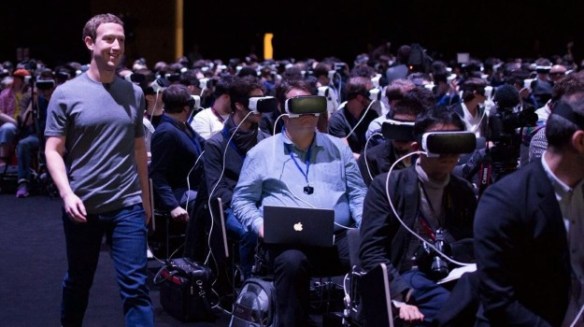
Algorithmic Control and the Revolution of Desire

zuckerberg_VR_people-625x350

By Alfie Brown

Source: ROAR Magazine

Last year, Stanford University published a study confirming what many of us may long have suspected: that your computer can predict what you want with more accuracy than your spouse or your friends. Your digital footprint betrays the truth not only about what you “like” but about what you really like — or so the argument goes. But what if our digital footprints, besides revealing our desires, are also responsible for the very construction of these desires? If that were the case, we would need to display a far deeper level of suspicion towards the complex patterns of corporate and state control found in contemporary cyberspace.

There is little doubt that innovations in mobile technologies are part of emerging methodologies of social control. In particular, games and applications that make use of the Google Maps back-end system — including Uber, Grindr, Pokémon Go and hundreds of others — which should be seen as one of the most important technological developments of the last decade or so, are particularly complicit in these new regulatory practices. Putting the well-publicized data collection issue aside, such applications have two powerful ideological functions. First, they construct the new “geographical contours” of the city, regulating the paths we take and mapping the city in the service of both corporate interest and the prevention of uprisings. Second, and more unconsciously, they enact what Jean-Francois Lyotard once called the “desirevolution” — an evolution and revolution of desire, in which that what we want is itself now determined by the digital paths we tread.

The Psycho-Geographical Contours of the City 

In 1981, the French theorist Guy Debord famously wrote of the “psycho-geographical contours” of the city that govern the routes we take, even when we may feel we are wandering freely around the physical space. At that time, it was Debord’s topic — architecture — that was the dominant force in re-organizing our routes through the city. Today, however, that role is increasingly taken up by the mobile phone. It is Uber that dictates the path of your taxi, Maps that dictates the route of your walks and drives, and Pokémon Go that (for a summer at least) determined where the next crowd would gather.

Other similar map-based application programing interfaces, or APIs, dictate our jogging routes (MapMyRun), our recreational hikes (LiveTrekker) and our tourist activities (TripAdvisor Guides). Pokémon Go attracted some publicity because it accidentally and humorously gathered crowds in weird places, but this should only alert us to its potential ability to gather crowds in the right places (to serve corporate interest) or to prevent the gathering of crowds in the wrong ones (to prevent organized uprisings, for instance). Such applications should be seen as a testing phase in the project of Google and its affiliated corporations as they work out how best to regulate the movements of large populations via their phones. Pokémon Go players were the early cyborgs, complete with hiccups and malfunctions — a beta version of Google’s future human. These future humans will go where instructed.

On a smaller scale, this point can be seen in concrete terms with a case study of London. A recent Transport for London talk discussed the possibility of “gamifying” commuting. In order to facilitate this possibility, Transport for London have made the internet API and data streams used to monitor all London Transport vehicles open source and open access, in the hope that developers will build London-focused apps based around the public transport system, thus maximizing profit. One idea is that if a particular tube station is at risk of becoming clogged up due to other delays, TfL could give “in-game rewards” for people willing to use alternative routes and thus smooth out the jam.

While traffic jam prevention may not seem like evidence that we have arrived in the dystopia of total corporate and state control, it does actually reveal the dangerous potentiality in such technologies. It shows that the UK is not as far away from the “social credit” game system recently implemented in Beijing to rate each citizen’s trustworthiness and give them rewards for their dedication to the Chinese state. While the UK media reacted with shock to these innovations in Chinese app development, a closer look at the electronic structures of mapping and controlling our own movements shows that a similar framework is already in its development phase in London too. In the “smart city” of the future, it won’t just be traffic jams that are smoothed out. Any inefficient misuse or any occupation of public space deemed dangerous by the authorities can be specifically targeted.

The Corporate Surveillance State

When it comes to these developments in technology, state and corporate forces work more closely with each other than ever before — and much more closely than they are willing to admit. Srećko Horvat has pointed out the short distance between the creators of Pokémon Go and Hillary Clinton, despite her odd and unsolicited recent public claim that she didn’t know who made the game. Likewise, Julian Assange’s strangely under-discussed 2014 book When Google Met WikiLeaks showed the shocking proximity of Google chief Eric Schmidt and the Washington state apparatus. In terms of surveillance and the use of big data, it has become impossible to sustain the distinction between state control and the production of wealth, since the two have become so irrevocably intertwined. As such, old arguments that “it’s all just about money” need to be treated with greater suspicion, since major firms today are so closely tied to the state. Various aspects of state organization should likewise be considered equally suspect because of their corporate underpinnings.

Of course, when it comes to the mapping applications that promise to help us access the best quality objects of our desire with the greatest efficiency and the least cost, these tempting forces of joint corporate and state control are entered into willingly by participants. As such, they require something else in order to function in the all-consuming way that they do. Far from simply channeling and transforming our movements, they also need to channel and even transform our desires.

We are now firmly within the world of the electronic object, where the mediation of everything from lovers and friends to meals and activities via our mobile phones and computers makes it virtually impossible to separate physical from electronic objectivity. Whilst the electronic Pokémon or the “in-game rewards” offered by many applications may not yet have the physicality of a lover who can be accessed via Tinder, or a burger that can be located via JustEat, the burger and the lover certainly have the electronic objectivity of the Pokémon. We can therefore see a transformation in the objects of desire taking place by and through our devices, so that we are confronted not only with a change in how we get what we want, but with a change in what we want in the first place.

Italo Calvino once wrote of the “amorous relationship” that “erases the lines between our bodies and sopa de frijoles, huachinango a la vera cruzana, and enchiladas.” While in such a moment food and lover become one in a kind of orgy of physical consumption, in the same novel Calvino warned of a time “when the olfactory alphabet, which made them so many words in a precious lexicon, is forgotten,” and in which “perfumes will be left speechless, inarticulate, illegible.”

It is this world that we find ourselves desiring in, where an orgy of electronic objects with no olfactory physicality blurs the distinction between lovers, meals and “in-game” rewards. The purpose of this shift, of course, is to increase the power of technological corporations by giving them a new sort of control over the way we relate to our objects of desire. If the boundaries between the way we search, desire and acquire our burgers, lovers and Pikachus are dissolving, it is not so much the old point that everything has become a commodity, but a new point that this kind of substitutional electronic objectivity endows corporate and state technologists with unprecedented power to distribute and redistribute the objects of the desire around the “smart city.”

Data Centralization in China and the West

There is, moreover, a significant centralization of power underpinning these developments. Like the social credit idea, the Chinese phenomenon of WeChat — developed in 2011 by Tencent, one of the largest internet and mobile media companies in the world — has received concerned media coverage in the West. WeChat is the first truly successful “SuperApp,” the basic premise of which is that all applications like WhatsApp, Facebook, Instagram, OpenRice, Tinder, TripAdvisor and many more, are rolled into one cohesive application. All for our convenience, of course.

As a result, however, there is now a new level of cohesion between the data-collection and movement monitoring going on in the mobile phone as a whole, where all data is now directly collected in a single place. More than half of the 1.1 billion WeChat users access the app over 10 times per day, and many users simply leave it on continuously, using it to map, shop, date and play. This means that the app sets a new precedent for continually monitoring the movements of a whole nation of citizens. WeChat’s incredibly strange “heat map” feature actually lets users — and authorities — see where crowds are forming. The claim is that this has nothing to do with crowd control: the objective is simply to help us access the least crowded shopping malls, doing nothing more than helping us get what we want.

WeChat is already the most popular social media application in China, but it will soon have huge significance worldwide, with an international version now available and many replica “SuperApps” in production. What the Western media finds to be so concerning about WeChat is once again something that already exists here in the West, at least in beta form, without us knowing it. WeChat actually offers us a glimpse into an Orwellian future in which companies and governments can track every movement we make. While in China the blocking of Google means that WeChat uses Baidu Maps as its API, the international version of WeChat simply taps into Google Maps, showing just how deeply integrated these corporate technologies already are.

What emerges from Western media coverage of these developments is the continued insistence on an apparent division between the public and the private sphere in the United States and Europe. When it comes to digital surveillance and the monitoring of movement, the situation is almost certainly better in the West than it is in China at this moment. Yet from an analysis of recent developments in China we learn not only that we need to be attentive to similar dangers here in the West, but also that there are powerful ideological mechanisms at play to obscure these developments by presenting China and the US as fundamentally opposed to one another. Whilst in China the links between the new SuperApps and the state are commonly accepted, in the US the illusion of privacy remains paramount. Although data is often shared between different corporations and between the public and the private sectors, this fact is generally obscured. The continued expressions of shock at the more openly centralized state control visible in China serve only to further consolidate the impression that these things are not happening in the US and Europe.

Furthermore, WeChat reveals more than the dangers of mass data collection and new levels of technological surveillance. It also embodies the power of the phone over the objects of desire. Since one single app can successfully market us food, lovers, holidays, events, blogs and even charities, the connections between such “objects” become more important than the differences. While the structural similarities between Grindr, Pokémon Go and OpenRice become apparent via analysis of both their surfaces and back systems, WeChat makes the connections plain to see. The various forms and objects of each individual’s desire no longer represent discreet and separable elements of a subject’s life. Instead we enter a fully cohesive libidinal economy in which we are increasingly regulated and mapped via the organization of what and how we desire.

The Desirevolution

So what do we do when faced with this revolution — a technological revolution that is not overthrowing any existing power structures but rather transforming the world in the service of private corporations and the state? Often, the response of those concerned by such developments is to express hostility or distrust towards technology itself. Yet to break this corporate organization of desire, we need not nostalgically yearn for a desire that is free of politics and technology, for no such desire is possible. On the contrary, what we need is to recognize that desire is necessarily and always controlled by both politics and technology.

This awareness would be the first step towards ensuring that the centralized corporate and state organization of desire malfunctions — and, ultimately, it would be the first step towards its potential reprogramming. The corporate desirevolution depends on our blindness to the politics of its technologies, asking us to experience our desires as spontaneous yearning and our mobile phone and its powerful apps as just tools for our convenience, helping us get what we want in the easiest way possible. We need to recognize that this is far from the case. The principal concern of those who own the apps — perhaps even more powerful than data collection — is to transform desire itself. At the very least, we can make visible the complicity of such technologies in producing the perfect conformist modern citizen.

The Philosophy of Westworld

By Jeremy D. Johnson

Source: Omni

Michael Crichton wrote and directed Westworld for the big screen in 1973. That same decade, in 1976, an adjunct professor named Julian Jaynes made the bestseller list with a surprising title: The Origins of Consciousness in the Breakdown of the Bicameral Mind. You wouldn’t think that a book with a name like that would become such a popular success. Yet, there it was. In 2016, when Westworld came to the small screen in the re-imagined HBO series, you wouldn’t imagine Jaynes getting heard from again. Especially since bicameralism wasn’t even mentioned in the Michael Crichton’s original film. Yet, there he was. Early on in Westworld’s first season Dr. Ford, one of the creators of the park, explains how he and his co-founder Arnold used a “debunked” theory about the origins of consciousness to bootstrap A.I. The scientific community didn’t recognize bicameralism as an explanation for the origins of the human mind, but, as Dr. Ford suggests, it could be useful for building an artificial one. Thousands of people—perhaps more—started Googling for “bicameral mind.” Bloggers and YouTube channels capitalized on the sudden interest by writing articles and introductory videos about this weird, arguably psychedelic theory of consciousness. Suddenly everyone was interested.

This article isn’t going to be one of those explanation pieces, but it’s worth mentioning a few, precursory details.

Looking Through the Mirror of Consciousness

According to bicameralism, human beings used to hear voices—auditory hallucinations—as a means for the right brain to “talk” with the left. Rather than having an inner monologue, the kind of self-consciousness we take for granted today, ancient people literally heard the voices of gods as their conscience, telling them what to do. This, Jaynes argues, accounts for the abundant descriptions from antiquity of gods and deities appearing all over the place, meddling directly in human affairs. Over time—about 3000 years ago—as various calamities occurred and societies got bigger, more complex, the bicameral mind broke down. The gods went silent. The modern, introspective self, quite literally, came to mind.

Jaynes may have been onto something, but even if he wasn’t, his book makes for a compelling and well-written read. The cultural zeitgeist of the 1970s, we must remember, was the high-water mark of psychedelic intrigue and “High Weirdness,” with writers like Philip K. Dick and Robert Anton Wilson both having their own inextricable experiences in 1974 (see “2-3-74”). Dick would turn this encounter into the semi-autobiographical VALIS trilogy as well as his Exegesis. This brings us back to our time.

Bicameralism would have been enough to place Westworld in good, present company: Netflix’s recent Stranger Things and OA, cerebral films like Arrival, and even the metaphysical, possibly D.M.T. inspired comic book movie Dr. Strange. Just to name a few. What connects any and all of these media is pop culture’s intensifying allure to the mysteries of our own consciousness. We’re having something, as The Atlantic recently suggested, like a “metaphysical moment.” Multiple realities intersecting with our own. Deep, dark structures of the psyche spilling up into the conscious mind in the form of auditory hallucinations. The emergence of consciousness buried somewhere in archaic chapters of history. All of these subjects are in a full saturation moment through hit T.V. series, and at least flirted with in Hollywood blockbusters. Consciousness is in. (Permit a moment of conjecture, but with the increased sense of global, existential malaise around issues like climate change and political nativism, that we’ve turned inward for solutions should come as no surprise. Western culture in the 1960s and 70s, despite, or because, of being under threat of a Cold War and nuclear armageddon, produced tremendously thoughtful and visionary art.)

Westworld is a show that celebrates the kind of weird prevalent in pop culture during the 1970s: a desire to connect with those hidden recesses of the psyche that each of us have experienced in dream, creative process, and revery. “O, what a world of unseen visions and heard silences,” Jaynes writes in The Origins of Consciousness, “this insubstantial country of the mind!” When Dolores, a “host” in the park, goes on her journey of self-discovery, there’s a part of us that goes with her. It helps that Dolores, along with the other hosts in the park, experience their memories as a kind of waking dreaming, navigating altered states of consciousness and auditory hallucinations in order to succeed in their quest for liberation. We’ve all felt, quite rightly, that there is more to ourselves than our waking, conscious minds, and that if there was some way to communicate with those occluded dimensions of ourselves we could gain some inkling of wisdom (hence, I think, all the self-described “psychonauts” around today). Westworld functions like a scrying mirror for the curious audience to embark on their own journeys of self-knowledge. It is this more intangible aspect of the show—and not just Western gunslinging androids—that made it such a hit.

Jeffrey Kripal, a religious scholar, writes about this intimate link between pop culture and consciousness in Mutants and Mystics: Science Fiction, Superhero Comics, and the Paranormal.

“What makes these particular forms of American popular culture so popular is precisely the paranormal. The paranormal here understood as dramatic physical manifestations of the meaning and force of consciousness itself.”

We are drawn to the weird because the weird is showing us something about ourselves.

Elaine Pagels published The Gnostic Gospels in 1979, a book which quickly became a classic in the American spiritual counter-culture. I mention it here because of the intriguing gnostic motifs embodied so well by Dr. Ford himself. For those of who you aren’t familiar with gnosticism, or The Gnostic Gospels, these were written by early Christian sects who, speaking very generally, believed in heretical ideas. There was no single gnostic church. Philip K. Dick was drawn to their darker, paranoid theme of the false world: the idea that our reality was somehow an illusory one—a trap—created by a lesser god. A “demiurge.” The demiurge would rule over its creation and keep human souls ignorant of their spiritual birthright, lest they break through themselves in states of elevated consciousness or “gnosis.” It was, in other words, up to the individual to liberate themselves, not through reason, or faith, but gnosis. Other popular films, like The Matrix Trilogy, would take this motif and run with it quite successfully. But Westworld’s Dr. Ford plays the perfect gnostic demiurge; having created the hosts in the first place, he ensures that they stay ignorant to their own potential for self-consciousness and liberation. Trapped in their loops, and wiped of their memories, the hosts remain blissfully unaware that they are existing inside of an amusement park. (To avoid any major spoilers I’ll simply leave this cryptic remark: we know this is only partly true by the end of season one. The gnostic trap becomes a different, albeit more violent, means toward freedom. Dr. Ford, by the final episode, becomes a triumphant expounder of the gnostic doctrine: the gods won’t help you liberate yourself. Those voices were you. You are the higher being waiting to become self-illuminated. Westworld is not only about consciousness, but liberation through personal gnosis.)

This Path is Never Linear

The maze is an image with deep significance. Hosts in the park, when they begin to develop nascent self-consciousness, are invited to partake in a puzzle—“The Maze.” The Man in Black is repeatedly told, much to his dismay, “the maze isn’t meant for you.” It doesn’t stop him from trying. The goal is to get to the center of it, but what does this mean? Carl Jung, the Swiss psychologist responsible for developing a theory of the unconscious, and for whom the 70s spiritual counterculture would help to popularize, would immediately recognize the maze as a symbol of both the labyrinth and the mandala. Let me explain.

By entering the maze, or synonymous labyrinth (the show dangles this myth in front of us with the strange appearance of a Minotaur host), an individual embarks on a perilous journey of self-discovery. It is through surviving the perilous twists and turns of the labyrinth that the adventurer gains some a form of self-realization. Think: Luke Skywalker and Yoda’s cave in Star Wars V: The Empire Strikes Back. In the case of Westworld, the maze leads to consciousness, and perhaps even freedom from the park itself. Jung, if he were alive today, might smile and nod. “The goal of psychic development,” he writes in Memories, Dreams, Reflections, “is the self.” Jung adds—echoing Dr. Ford—that consciousness isn’t a pyramid but a maze: “There is no linear evolution; there is only the circumambulation of the self.” When we see the image of the maze painted on the skull of a host, early on in the season, we’re looking at a mandala: those intricately patterned mazes often leading towards some center. Jung writes, “The mandala is the center. It is the exponent of all paths… to the center, to individuation.” It is through the messy, round-about series of wrong turns that we come to consciousness. “Mistake. Mistake.” There is no straight path to the center of the maze. There is no easy way towards self-discovery. No wonder we loved this show. It turns out the maze really is meant for us.

The West Is Becoming Irrelevant, The World Is Laughing

By Andre Vltchek

Source: TruePublica

I was recently told by an Asian friend of mine who is working in Paris: “Lately I stopped following almost all that is happening politically in the United States, in the UK and even here in France. It all feels suddenly so irrelevant, a waste of time.”

Statements like this would be unimaginable only one decade ago. In the past, what came from Washington and (to a smaller extent) from London was monitored with great attentiveness and fear, all over the world.

But all of a sudden, things have begun to change, rapidly. Despite the extremely violent nature of the Western-designed-and-manufactured global regime, which has been over-imposed on so many parts of the world for decades and centuries, increasing amounts of people in Asia, Latin America and Africa stopped worrying and went leisurely to the ‘barricades’, beginning to rebel against the perverseness of the ‘world order’.

Did it all really happen ‘all of a sudden’?

Or were there various catalysts at work, for already quite a substantial period of time?

It is a well-known fact that any deep-seated, chronic anxiety cannot disappear in just a short moment. People who are enslaved, humiliated, scared into obedience, people who are forced to feel uncertain and constantly frightened, cannot reverse their state of mind without some important external factor or set of factors.

It became obvious to me, as I have been working continuously on all continents and in almost all conflict zones of our Planet, that the renewed pride and courage which is now inspiring millions of oppressed human beings, actually came from the decisive and determined stand of just several brave and determined nations, big and small.

The myth about the omnipotence of the Empire has received a few significant blows.

The fable of invincibility has not completely disappeared yet, but at least it has got fractured and gravely injured.

The gate of the terrible prison began cracking. It has not collapsed, but the fractures were wide enough for at least some sunlight to enter the dark and dreadful cavities inhabited by billions of unfortunate and shattered beings.

Some victims stood up immediately; not many but at least some did. Others raised their heads in feeble hope, still lying down on the dirty ground, still chained, and still shaking. That weak light alone entering the dungeon was actually much brighter than what most people ever experienced in their entire life. It has been strong enough to provoke wonderful, brilliant sparks of hope

Except for some temporary setbacks (like in Brazil and Argentina), the anti-imperialist coalition is now steadier than ever; it is determined and constantly expanding.

And it is clearly winning!

It is truly a ‘rainbow coalition’ of countries, big and small, ‘red’ and ‘pink’, even ‘green’.

The only unifying factor is the shared determination not to be controlled by Western imperialism and neo-colonialism.

For decades, Cuba stood against the Empire, even after the Soviet block was broken to bits, even when all mutual agreements ceased to be honored by the criminal Yeltsin administration. The Cuban people never surrendered. It is because most of them always believed, from the bottom of their hearts, in socialism and internationalism. And also because they have been convinced that the Western Empire is a morally corrupt and illegitimate entity and therefore has to be resisted.

A small and relatively poor country – Cuba – demonstrated to the entire world that while the Empire is mighty, sadistic and brutal, it is not omnipotent, and it is possible to defy it. There is no reason why one should not dare, or one should not dream about a much better world, why one shouldn’t fight for true freedom, attempting to win.

Cuba inspired the world. Its daring Revolution took place just a few miles from the shores of the United States. Soon after, its teachers and doctors went to all parts of the earth, spreading optimism, solidarity and kindness. Its heroic revolutionaries went to fight against the most dreadful forms of colonialism, which were torturing people, is such places as Congo, Angola and Namibia.

After Obama’s attempts to water down the determination of the Cuban citizens, many enemies began to predict, cynically: “Now Cuba will compromise and sell its Revolution.”

It never did! I travelled to the Island last year, driving through the countryside, and speaking to people in Havana, Guantanamo and Santiago de Cuba. Almost no one was ready to compromise. A greatly educated nation, Cuba saw through the Empire’s tricks and deceptions.

Now almost nobody speaks about the “Cuban compromise”, anymore, simply because there isn’t any on the table.

China, one of the oldest and greatest civilizations on Earth, went through the terrible period of ‘humiliation’. Divided, occupied and plundered by the West, it has never forgotten nor forgiven.

Now the Chinese Communist state and its mixed economy are helping countries in virtually all parts of the world, from Oceania and Latin America, to the Middle East and especially Africa, to survive and to finally stand on their own feet. Despite all the vitriolic propaganda regurgitated by the West (those people in Europe or North America who know close to zero about Africa or China, habitually passing ‘confident’ and highly cynical ‘judgments’ about China’s involvement in the poor world; judgments based exclusively on the lies and fabrications produced by the Western media), China has been gaining great respect and trust in virtually all corners of the globe.

The Chinese people and their government are now standing firmly against Western imperialism. They will not allow any recurrence of the disgraceful and dreary past.

The West is provoking this mighty and optimistic nation, pushing it into a terrible confrontation. China doesn’t want any military conflict. It is the most peaceful, the most non-confrontational large nation on Earth. But it is becoming clear that if pushed against the wall, this time it will not compromise: it will fight.

In the last years I have spoken to many Chinese people, as I travelled to all corners of the country, and I’m convinced that by now the nation is ready to meet strength with strength.

Such determination gives hope to many other countries on our Planet. The message is clear: the West cannot do whatever it wants, anymore. If it tries, it will be stopped. By reason or by force!

Russia is ready again, too. It is standing next to China, enormous and indignant.

Go to Novosibirsk or Tomsk, to Khabarovsk, Vladivostok or Petropavlovsk in Kamchatka. Talk to Russian people and you will soon understand: almost nobody there believes or respects the West, anymore. Throughout history, Russia was attacked and ransacked from the West. Millions, tens of millions of its people were murdered, literally exterminated. And now, the nation is facing what some consider to be yet another imminent attack.

Like the Chinese people, Russians are unwilling to compromise, anymore. The old Russian forecast is once again alive, that very one professed by Alexander Nevsky:

Go tell all in foreign lands that Russia lives! Those who come to us in peace will be welcome as a guest. But those who come to us sword in hand will die by the sword! On that Russia stands and forever will we stand!

In Russia, as in China, and as in so many other nations that were devastated by the Western plunderers, nothing is forgotten and no one is forgotten. It only appeared for a while that the memory had fainted. It never does. You cannot burn down an entire land, ruin the cities, burn the fields, and still pose as one with the moral mandate. Or as we say in Chile: “Justice takes time, but it always comes!”

And the world is watching. It is suddenly clearly registering this determined and brave, epic stand of morally strong nations. Many of those who are watching are deeply impressed with what they are seeing. Perhaps not in London or in Paris, but go and ask those in Johannesburg or Beirut, or even in Calcutta, Cairo or Buenos Aires. Perhaps you suspect what answers you’d receive there!

Throughout modern history, not once has Iran invaded a foreign country. Yet its secular, progressive and democratic government (under the leadership of Mohammad Mosaddegh) was overthrown in 1953, in a CIA-backed coup. What followed was the monstrosity of the ‘pro-Western Shah’, and then a horrendous war, an invasion by Iraq, which was also fully backed by the West and which took hundreds of thousands of human lives. Since then, Iran has been suffering from targeted killings of its scientists (by the West and Israel), as well as terrorist attacks also backed from abroad.

Instead of falling on its knees and begging for mercy, Iran defied the West. On several occasions and when provoked, it sent its battleships to the neutral waters near the US coast, and it pledged to defend its land, in case it was to be attacked.

Iran also showed great solidarity towards Latin America, working closely with virtually all of the revolutionary governments there. It stood firmly by Venezuela in a time of great crises, building social housing in Caracas and supporting the Process by all other means.

In Latin America, no one will ever forget how former Iranian President Mahmoud Ahmadinejad came to Caracas to attend the funeral of Venezuelan leader Hugo Chavez, his dear friend. During the memorial, the aged mother of Chavez suddenly approached Ahmadinejad, in tears. Breaking all religious protocol of a Shi’a country that he was representing, the Iranian President embraced her, and held her against his heart, until she calmed down.

This moment was expressing one simple and powerful reality: all of us, the internationalists and anti-imperialists, are fighting for the survival of humanity and this planet. There is more that unites us than what is tearing us apart. Once we win, and we will win, the world will be able to find a common language. The West wants to divide us, by spreading hostilities and distrust, all through ‘false news’ and fabrications. But we understand its game. We will not break our ranks, anymore.

The West is clearly losing. It knows it. It is in panic.

Its nihilism, its propaganda and indoctrination tactics will soon be defeated.

I wrote a lot about the DPRK and how it joined the list of the ‘most hated nations on Earth’. It is a well known fact that North Korea was, for years and decades, much richer and more democratic than South Korea (ROK). But it embarked on one tremendous humanist ‘project’, and together with Cuba, the Soviet Union and to some extent China, it liberated almost the entire African continent, at great cost and sacrifice. And not only that: it sent its top educators and doctors to all corners of the most devastated continent on Earth. Its pilots also flew Egyptian MIGs against Israel, during the 1967 war. These facts have been silenced by Western propaganda, but they clearly explain why the DPRK has been ostracized, pushed to the corner, hit by senseless embargos, and forced to react the way it has been reacting for at least the last two decades.

North Korea has never surrendered either, and it never will.

Neither has Venezuela, for many years the great sentinel and engine of the Bolivarian Revolution, as well as of Latin Internationalism and solidarity. Surviving coups, embargos, plots and propaganda campaigns, surviving attacks, even terror, of the foreign-backed ‘opposition’, Venezuela has been injured but it is alive. Just a few days ago I spoke to an Italian Parliamentary delegation, consisting of  the“5-Star-Movement” MPs, which recently returned from Caracas. Their conclusion was simple: “The worst is over”.

The world knows it! Venezuela, DPRK, Cuba – they never fell. No matter how many knives penetrated their bodies, despite so much pain caused by the sanctions, coup attempts and direct acts of terrorism administered by the West and its monstrous Empire.

It is becoming clear and obvious: the West is helpless against determination, true courage and patriotic love. It is powerless when confronted with humanist ideologies, and with true loyalty!

And the world keeps watching, drawing its conclusions.

I wrote about Syria, comparing Aleppo to the 20th Century Stalingrad. This is where racism, terrorism, and the lowest forms of Western imperialism were decisively stopped. The price was terrible, but the message to the world extremely clear: The people who love their country with their entire hearts can fight and win against all odds, especially if by their side stand truly great and reliable friends and comrades!

One day the world will thank the Syrian people, profusely and properly. One day, everything will be understood. One day, perhaps soon.

This is one of the greatest moments in human history, perhaps the greatest.

It has arrived without big salvos announcing monumental revolutions.

Everything is happening fast, in an organized and determined manner.

The greatest minds of Russia, China, Latin America and the rest of the world, are feverishly, day and night, trying to determine what really brought our world, our civilization, to this ludicrous downfall.

The simplified and stripped-down answer is this: Western imperialism (military, economic and ‘intellectual’/ ’cultural’), colonialism and neo-colonialism, as well as that dreadful by-product of all the above combined – a set of unchecked and savage form of capitalism.

Simultaneously, new forms of government, of economy and social systems are being, once again, planned.

The military strategists of the countries that are refusing to kneel in front of the barbaric terror of the West, responsible for hundreds of millions of murders and billions of ruined lives, are planning how to defend their countries and the world.

Once again, the world is at work! It is building trenches, educating people, preparing them for the final showdown with the culture that has been tormenting our Planet for centuries.

It is the moment of great hope and renewed enthusiasm.

Of course, if seen from Western capitals, everything is bleak and depressing. There is no ‘hope’ at all.

I agree fully: there is no hope ‘for them’.

The logic, the ‘philosophy’ with which the Europeans and the North Americans have become accustomed to analyze the world, has arrived at a dead end.

Yes, it is ‘the end of philosophy’, or as they say, ‘the end of history’. I fully agree: it is the end of their philosophy and of their history.

That’s why, reading about their elections or statements produced by their politicians, is nothing less than a waste of time. The world realizes it, more and more.

Their ‘new tricks’ are actually very old. Their entire system is outdated. It should have been retired at least one hundred years ago. It survived only because of its savagery and cruelty. It will go soon, anyway.

These days, encountering people inhabiting the West is like encountering those zombies who were living in Nazi Germany during WWII. After the war was over, they were streetwalking for years, at least many of them, repeating the same refrains: “We didn’t know!” “We never realized”. The Nazi propaganda and the one, which has been used in the West and in the colonies (as Noam Chomsky and I defined in our book “On Western Terrorism”), are based on precisely the same roots, foundations and methods. Both are extremely effective, when it comes to the total brainwashing of the population.

To follow up the last chapter of the imperialist and turbo capitalist morass of the West is embarrassing and useless.

Both Europe and the United States are suffering from a series of devastating mental illnesses, as was defined by the great Swiss psychologist Carl Gustav Jung, right after WWII.

Getting too much involved in pathological behavior, constantly studying and analyzing it, could only break and deeply depress any healthy person’s mind.

There is nothing more to understand. Hundreds of millions of victims in all parts of the world are speaking for themselves.

The only rational issue here is this: how to stop this horror, as soon as possible? How to allow humanity to return to its natural development and evolution patterns?

I don’t believe in ‘punishments’ and ‘trials’ and other vehicles of intimidation and of spreading fear. I don’t care whether the West will ‘pay’ for all that it has done to the world. I only want it to be stopped, once and for all.

I work very hard for it to be stopped.

So are others.

And the world is watching, and all of a sudden enjoying what it sees.

Suddenly more and more people are daring to laugh at the global regime. Of course not in Paris, London or New York (here they are scared and obedient, even more than before). But outside, yes!

People on all continents want to see and hear about what ‘others do’, what ‘we do’, not what the Empire and its mental conditions are producing.

They are laughing and waiting impatiently for what a new day, a new year will bring. They are waiting for the true new beginning to arrive.


Andre Vltchek is a philosopher, novelist, filmmaker and investigative journalist. He has covered wars and conflicts in dozens of countries. Three of his latest books are revolutionary novel “Aurora” and two bestselling works of political non-fiction: “Exposing Lies Of The Empire” and  “Fighting Against Western Imperialism. View his other books here. Andre is making films for teleSUR and Al-Mayadeen. Watch Rwanda Gambit, his groundbreaking documentary about Rwanda and DRCongo. After having lived in Latin America, Africa and Oceania, Vltchek presently resides in East Asia and the Middle East, and continues to work around the world. He can be reached through his website and his Twitter

Lara Trace Hentz

INDIAN COUNTRY NEWS

In Saner Thought

"It is the duty of every man, as far as his ability extends, to detect and expose delusion and error"..Thomas Paine

ZEDJournAI

Human in Algorithms

Rooster Crows

From the Roof Top

Aisle C

I See This

The Free

blog of the post capitalist transition.. Read or download the novel here + latest relevant posts

अध्ययन-अनुसन्धान(Essential Knowledge of the Overall Subject)

अध्ययन-अनुसन्धानको सार