According to the Father of Propaganda an Invisible Government Controls Our Minds with a Thought Prison

By Sigmund Fraud

Source: Waking Times

“Who are the men who without our realizing it, give us our ideas, tell us whom to admire and whom to despise, what to believe about the ownership of public utilities, about the tariff, about the price of rubber, about the Dawes Plan, about immigration; who tell us how our houses should be designed, what furniture we should put in them, what menus we should serve on our table, what kind of shirts we must wear, what sports we should indulge in, what plays we should see, what charities we should support, what pictures we should admire, what slang we should affect, what jokes we should laugh at?” ~ Edward Bernays [b.11/22/1891, d. 3/9/1995]  Propaganda

Authored by Edward Bernays and published in 1928, the book Propaganda still holds its position as the gold standard for influencing and manipulating public behavior. Drawing on his expertise in psychology while using the language of manipulation, Bernays pioneered social engineering via mass media, and his work lives on in the distorted, statist, consumer world we have today.

But who are the ones behind the curtain telling us what to think by directing our attention onto the things which serve interests?

Interestingly, chapter III of Propaganda is titled, ‘The New Propagandists, and is devoted to explaining why the controls for mass manipulation are so closely guarded by a relatively tiny elite who sit in the shadows, out of the public eye, choosing what we are to see and to think, even controlling the politicians we elect to represent us.

If we set out to make a list of the men and women who, because of their position in public life, might fairly be called the molders of public opinion we could quickly arrive at an extended list of persons mentioned in “Who’s Who…”

Such a list would comprise several thousand persons. But it is well known that many of these leaders are themselves led, sometimes by persons whose names are known to few.

Such persons typify in the public mind the type of ruler associated with the phrase invisible government.

An invisible government of corporate titans and behind the scenes influencers who’s mark on culture cannot be understated today. Bernays continues:

The invisible government tends to be concentrated in the hands of the few because of the expense of manipulating the social machinery which controls the opinions and habits of the masses.

The public relations counsel, then, is the agent who, working with modern media communication and the group formation of society, brings an idea to the consciousness of the public. But he is a great deal more than that. He is concerned with courses of action, doctrines, systems and opinions, and the securing of public support for them.

Ultimately, the goal of this type of mass-produced, pop-culture propaganda is to weaken the individual’s ability to think critically, thereby creating an environment where many people look to one another for approval, always second-guessing their own faculties. When this happens, the strength of the collective group begins to take form and multiply, and ideas can be implanted into the popular culture, taking root in the form of widespread conformist behavior.

Thinking critically means making reasoned judgments that are logical and well thought out. It is a way of thinking in which one doesn’t simply accept all arguments and conclusions to which one is exposed without questioning the arguments and conclusions. It requires curiosity, skepticism and humility. People who use critical thinking are the ones who say things such as, “How do you know that?” “Is this conclusion based on evidence or gut feelings?” and “Are there alternative possibilities when given new pieces of information?””  [Source]

Final Thoughts

The takeaway here is that not much has changed in 100 years of corporate/statist American culture, other than the technical capacity to scale this ever upward. Our lives are still heavily influenced by the likes of the described by Bernays. There is one advantage we do have now, however, as technology has given us greater access to the truth and we are now free to split from the matrix psychologically by understanding what it is and how it influences our lives. If we choose to do so, that is, if we choose to take the red pill.

In order to understand your life and your mission here on earth in the short time you have, it is imperative to learn to see the thought prison that has been built around you, and to actively circumnavigate it. Free-thinking is being stamped out by the propagandists, but our human tendency is to crave freedom, and with the aid of truth, we are more powerful than the control matrix and the invisible government.

Our Bigoted Brains

Photo credit: Art Killing ApathyBigotry,

By Eleanor Goldfield

Source: Popular Resistance

If you’ve ever moved beyond small talk and vapid pleasantries in conversation then you’ve likely dealt with the infuriating occurrence of trying to convince someone of a fact they just don’t want to accept. Beyond just avoiding the information, they almost seem hardwired to reject your proof in a phenomenon that I like to call “fact fear.” I noticed a sharp rise in fact fear during the 2016 elections and levels continue to hover at disturbing heights today. So, what gives? Are we really in a new era of idiocy or are we just seeing our particularly vapid and anti-intellectual culture ping off the most base and stubborn aspects of the human psyche? Both, I think.

Daniel Patrick Moynihan famously said, “You are entitled to your own opinions but not your own facts.” But in the post-truth, anti-intellectual, “I read it in a blog post so it must be true” era, our opinions and beliefs run the ever-growing risk of being founded on complete bullshit. Filter bubbles (which we covered in Episode 132) and digital spheres protect us from ideas and facts outside our own personal shit heaps and only serve up the information we want to see – which is not always factually accurate. Our culture of quick “news” and a growing lack of intellectual curiosity drive us further into an echo chamber of our own ideas – facts and information be damned. In turn, a false but far from flimsy crust solidifies around our minds –- and the soft light of truth and knowledge can’t get in.

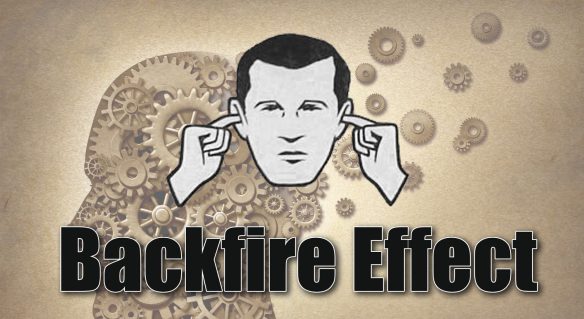
Our brains are wired to find comfort behind that crust. In what’s known as the backfire effect, our minds reject new information that clashes with our belief systems and opinions. As David McRaney, author of the books You Are Not So Smart and You Are Now Less Dumb explains it: “Once something is added to your collection of beliefs, you protect it from harm. You do this instinctively and unconsciously when confronted with attitude-inconsistent information. Just as confirmation bias shields you when you actively seek information, the backfire effect defends you when the information seeks you, when it blindsides you. Coming or going, you stick to your beliefs instead of questioning them. When someone tries to correct you, tries to dilute your misconceptions, it backfires and strengthens those misconceptions instead. Over time, the backfire effect makes you less skeptical of those things that allow you to continue seeing your beliefs and attitudes as true and proper.” In other words, that crust acts as a shield for facts that threaten your beliefs. And you’ve probably seen this in action online. Someone posts something like “climate change isn’t real” so you face palm and proceed to post ample proof that they’re wrong and that in fact, climate change is very real. The problem is that with each fact you post, the crust hardens – for both you AND the other person. Of course, it doesn’t help that you can find just as much if not more bullshit online than you can actual truth but much of it is actually tied to the inherent laziness of our brains. “The more difficult it becomes to process a series of statements, the less credit you give them overall…In experiments where two facts were placed side by side, subjects tended to rate statements as more likely to be true when those statements were presented in simple, legible type than when printed in a weird font with a difficult-to-read color pattern. Similarly, a barrage of counterarguments taking up a full page seems to be less persuasive to a naysayer than a single, simple, powerful statement.”

So does this mean that we should just stop pointing out when someone is wrong? That we should let all kinds of ridiculous notions from lizard people to “homeless people are dangerous” slide? Of course not. Rather, it means that if we want to educate and engage, if we want people to wake the fuck up then we have to consider how the human mind works – and how it doesn’t. Furthermore, our goal shouldn’t be to win an argument as if to suggest that as soon as we win the argument, justice is at hand. Indeed, if your goal is to simply be right, the religious zeal with which you defend your ideas will only turn you into the very monster you are trying to slay. Being right, in other words, is not the point. Progress is not a church. We are not looking for converts. Our aim should always be to engage and empower; to share our knowledge and embrace the knowledge of others. Seek and speak truth – then act on it. And do not think that because you found a nugget of information you hold moral superiority over those who don’t know it. Our minds are just as susceptible to that crust as anyone else’s. We are not special or better. Indeed, we must constantly question our opinions, compare them with facts and new information. By that I mean actual facts, not “alt facts” sourced from a single Google search or indeed even something from a “trusted” publication.

In an interview last March with Robert Scheer of Truthdig, author Joel Whitney discusses the 60 year history of fake news and how it was used in the Cold War era to sew distrust and hatred of all things “commie” and Russian. Major and well-trusted media outlets were a part of the propaganda ring and Whitney notes “that the fearful political atmosphere at the time led to “secrecy being used to preside over and rule over the free press — which we’re supposed to be the champions of.” “They drank the Kool-Aid and thought they were saving freedom,” Scheer agrees. The discussion underscores the need for analysis of Cold War-era media as a way to avoid propagandized journalism today. Scheer says, “I look at the current situation, where we don’t even have a good communist enemy, so we’re inventing Russia as a reborn communist power enemy.” “I call it superpolitics,” Whitney concludes, “where essentially there’s something that’s so evil and so frightening that we have to change how our democratic institutions work.” The latest red scare is but one example of how easy it is to mold minds when you use something like the hatred of Trump as a trigger. Blend some tried and true anti-Russia sentiment in there and you’ve got yourself a brand spanking new enemy – one that allows you to further mold those democratic institutions just as seamlessly as the minds you’ve now crusted and convinced. Russia aside, the same propaganda games go for mass media collusion on everything from fracking to the military industrial complex. For example, leaked email messages show that a writer from the LA times colluded with the CIA not only in terms of getting the CIA’s OK on forthcoming stories but actually offered to write stories for them that would put a positive spin on such issues as drone warfare, saying it would be quote “reassuring to the public” and a “good opportunity” for the CIA. Various other email messages show that the same was true for a list of other media outlets.

All this to say, if I may borrow a phrase: no investigation, no right to speak. Do your own research before you claim to know something. Incidentally this will also help steel you from the rumor mill AND infiltrators. Whether it’s taking someone to task on a rumor or engaging someone in discourse, be vigilant. Be vigilant in your drive, your actions, and be primarily vigilant in your own thinking. Release the flimsy beliefs that would just as soon sink you as keep you afloat. Arm yourself with knowledge and reach out to build and to engage, not to win a Facebook tiff. Consider the goal of engagement and empowerment rather than just being right. Consider the reaction you would have if someone came at you with a barrage of links followed by “read a fucking book, asshole!” You’d more than likely write them off as an unhinged asshole even if their information is solid. Try asking a question or perhaps as Ben Franklin suggested, ask them for a favor, something small that seeds trust, pinging off the human psychology that seeks appreciation and the feel of community. Push past political theory and get down to human connection – to start with. For instance, anarchists in several communities will often engage with would-be white supremacists via the common ground of distrust and disgust in the system. They’ll sit and talk; discuss the pitfalls of a system that’s left them behind and from there grow to a discourse on the roots of their discontent, i.e. not black people. In other words, knock on the door rather than trying to break down the wall. Because that wrought iron shit crust is stronger than steel.

Finally, keep in mind that this won’t always work and nor should it. We have to accept that in our grandiose imaginings of the revolution, many people will either be against us or sitting at home praying we all just shut up. But again, if you’re not looking for converts, if you’re engaging to empower, you’ll not only find more people willing to talk to you, you’ll also more than likely learn something in the process. You might even pick something up that’ll put a dent in your own mental crust.

Saturday Matinee: Stare Into The Lights My Pretties

Source: https://stareintothelightsmypretties.jore.cc/

Logline

A film about screen culture and its implications. While the world burns, where are we?

Introduction

We live in a world of screens. The average adult spends the majority of their waking hours in front of some sort of screen or device. We’re enthralled, we’re addicted to these machines. How did we get here? Who benefits? What are the cumulative impacts on people, society and the environment? What may come next if this culture is left unchecked, to its end trajectory, and is that what we want?

Stare Into The Lights My Pretties investigates these questions with an urge to return to the real physical world, to form a critical view of technological escalation driven by rapacious and pervasive corporate interest. Covering themes of addiction, privacy, surveillance, information manipulation, behaviour modification and social control, the film lays the foundations as to why we may feel like we’re sleeprunning into some dystopian nightmare with the machines at the helm. Because we are, if we don’t seriously avert our eyes to stop this culture from destroying what is left of the real world.

Purpose

This independent film was made with no budget (adding to its authenticity) with no affiliations, is not-for-profit, and is released to the world for free for the purposes of critical discourse, education, and for cultivating radical social and political change.

Philip K. Dick and the Fake Humans

(Editor’s note: on this 36th anniversary of the passing of Philip K. Dick, it seems an appropriate time to note the relevance of his work to our current dystopia as Henry Farrell does in the following essay. Unfortunately the author is less astute regarding the ways in which the dystopias of Orwell and Huxley are equally relevant to our current milieu.)

By Henry Farrell

Source: Boston Review

This is not the dystopia we were promised. We are not learning to love Big Brother, who lives, if he lives at all, on a cluster of server farms, cooled by environmentally friendly technologies. Nor have we been lulled by Soma and subliminal brain programming into a hazy acquiescence to pervasive social hierarchies.

Dystopias tend toward fantasies of absolute control, in which the system sees all, knows all, and controls all. And our world is indeed one of ubiquitous surveillance. Phones and household devices produce trails of data, like particles in a cloud chamber, indicating our wants and behaviors to companies such as Facebook, Amazon, and Google. Yet the information thus produced is imperfect and classified by machine-learning algorithms that themselves make mistakes. The efforts of these businesses to manipulate our wants leads to further complexity. It is becoming ever harder for companies to distinguish the behavior which they want to analyze from their own and others’ manipulations.

This does not look like totalitarianism unless you squint very hard indeed. As the sociologist Kieran Healy has suggested, sweeping political critiques of new technology often bear a strong family resemblance to the arguments of Silicon Valley boosters. Both assume that the technology works as advertised, which is not necessarily true at all.

Standard utopias and standard dystopias are each perfect after their own particular fashion. We live somewhere queasier—a world in which technology is developing in ways that make it increasingly hard to distinguish human beings from artificial things. The world that the Internet and social media have created is less a system than an ecology, a proliferation of unexpected niches, and entities created and adapted to exploit them in deceptive ways. Vast commercial architectures are being colonized by quasi-autonomous parasites. Scammers have built algorithms to write fake books from scratch to sell on Amazon, compiling and modifying text from other books and online sources such as Wikipedia, to fool buyers or to take advantage of loopholes in Amazon’s compensation structure. Much of the world’s financial system is made out of bots—automated systems designed to continually probe markets for fleeting arbitrage opportunities. Less sophisticated programs plague online commerce systems such as eBay and Amazon, occasionally with extraordinary consequences, as when two warring bots bid the price of a biology book up to $23,698,655.93 (plus $3.99 shipping).

In other words, we live in Philip K. Dick’s future, not George Orwell’s or Aldous Huxley’s. Dick was no better a prophet of technology than any science fiction writer, and was arguably worse than most. His imagined worlds jam together odd bits of fifties’ and sixties’ California with rocket ships, drugs, and social speculation. Dick usually wrote in a hurry and for money, and sometimes under the influence of drugs or a recent and urgent personal religious revelation.

Still, what he captured with genius was the ontological unease of a world in which the human and the abhuman, the real and the fake, blur together. As Dick described his work (in the opening essay to his 1985 collection, I Hope I Shall Arrive Soon):

The two basic topics which fascinate me are “What is reality?” and “What constitutes the authentic human being?” Over the twenty-seven years in which I have published novels and stories I have investigated these two interrelated topics over and over again.

These obsessions had some of their roots in Dick’s complex and ever-evolving personal mythology (in which it was perfectly plausible that the “real” world was a fake, and that we were all living in Palestine sometime in the first century AD). Yet they were also based on a keen interest in the processes through which reality is socially constructed. Dick believed that we all live in a world where “spurious realities are manufactured by the media, by governments, by big corporations, by religious groups, political groups—and the electronic hardware exists by which to deliver these pseudo-worlds right into heads of the reader.” He argued:

the bombardment of pseudo-realities begins to produce inauthentic humans very quickly, spurious humans—as fake as the data pressing at them from all sides. My two topics are really one topic; they unite at this point. Fake realities will create fake humans. Or, fake humans will generate fake realities and then sell them to other humans, turning them, eventually, into forgeries of themselves. So we wind up with fake humans inventing fake realities and then peddling them to other fake humans.

In Dick’s books, the real and the unreal infect each other, so that it becomes increasingly impossible to tell the difference between them. The worlds of the dead and the living merge in Ubik (1969), the experiences of a disturbed child infect the world around him in Martian Time-Slip (1964), and consensual drug-based hallucinations become the vector for an invasive alien intelligence in The Three Stigmata of Palmer Eldritch (1965). Humans are impersonated by malign androids in Do Androids Dream of Electric Sheep? (1968) and “Second Variety” (1953); by aliens in “The Hanging Stranger” (1953) and “The Father-Thing” (1954); and by mutants in “The Golden Man” (1954).

This concern with unreal worlds and unreal people led to a consequent worry about an increasing difficulty of distinguishing between them. Factories pump out fake Americana in The Man in the High Castle (1962), mirroring the problem of living in a world that is not, in fact, the real one. Entrepreneurs build increasingly human-like androids in Do Androids Dream of Electric Sheep?, reasoning that if they do not, then their competitors will. Figuring out what is real and what is not is not easy. Scientific tools such as the famous Voight-Kampff test in Do Androids Dream of Electric Sheep? (and Blade Runner, Ridley Scott’s 1982 movie based loosely on it) do not work very well, leaving us with little more than hope in some mystical force—the I Ching, God in a spray can, a Martian water-witch—to guide us back toward the real.

We live in Dick’s world—but with little hope of divine intervention or invasion. The world where we communicate and interact at a distance is increasingly filled with algorithms that appear human, but are not—fake people generated by fake realities. When Ashley Madison, a dating site for people who want to cheat on their spouses, was hacked, it turned out that tens of thousands of the women on the site were fake “fembots” programmed to send millions of chatty messages to male customers, so as to delude them into thinking that they were surrounded by vast numbers of potential sexual partners.

These problems are only likely to get worse as the physical world and the world of information become increasingly interpenetrated in an Internet of (badly functioning) Things. Many of the aspects of Joe Chip’s future world in Ubik look horrendously dated to modern eyes: the archaic role of women, the assumption that nearly everyone smokes. Yet the door to Joe’s apartment—which argues with him and refuses to open because he has not paid it the obligatory tip—sounds ominously plausible. Someone, somewhere, is pitching this as a viable business plan to Y Combinator or the venture capitalists in Menlo Park.

This invasion of the real by the unreal has had consequences for politics. The hallucinatory realities in Dick’s worlds—the empathetic religion of Do Androids Dream of Electric Sheep?, the drug-produced worlds of The Three Stigmata of Palmer Eldritch, the quasi–Tibetan Buddhist death realm of Ubik—are usually experienced by many people, like the television shows of Dick’s America. But as network television has given way to the Internet, it has become easy for people to create their own idiosyncratic mix of sources. The imposed media consensus that Dick detested has shattered into a myriad of different realities, each with its own partially shared assumptions and facts. Sometimes this creates tragedy or near-tragedy. The deluded gunman who stormed into Washington, D.C.’s Comet Ping Pong pizzeria had been convinced by online conspiracy sites that it was the coordinating center for Hillary Clinton’s child–sex trafficking ring [likewise, the masses may have been convinced by mainstream media that a real child-sex trafficking ring never existed].

Such fractured worlds are more vulnerable to invasion by the non-human. Many Twitter accounts are bots, often with the names and stolen photographs of implausibly beautiful young women, looking to pitch this or that product (one recent academic study found that between 9 and 15 percent of all Twitter accounts are likely fake). Twitterbots vary in sophistication from automated accounts that do no more than retweet what other bots have said, to sophisticated algorithms deploying so-called “Sybil attacks,” creating fake identities in peer-to-peer networks to invade specific organizations or degrade particular kinds of conversation.

Twitter has failed to become a true mass medium, but remains extraordinarily important to politics, since it is where many politicians, journalists, and other elites turn to get their news. One research project suggests that around 20 percent of the measurable political discussion around the last presidential election came from bots. Humans appear to be no better at detecting bots than we are, in Dick’s novel, at detecting replicant androids: people are about as likely to retweet a bot’s message as the message of another human being. Most notoriously, the current U.S. president recently retweeted a flattering message that appears to have come from a bot densely connected to a network of other bots, which some believe to be controlled by the Russian government and used for propaganda purposes.

In his novels Dick was interested in seeing how people react when their reality starts to break down. A world in which the real commingles with the fake, so that no one can tell where the one ends and the other begins, is ripe for paranoia. The most toxic consequence of social media manipulation, whether by the Russian government or others, may have nothing to do with its success as propaganda. Instead, it is that it sows an existential distrust. People simply do not know what or who to believe anymore. Rumors that are spread by Twitterbots merge into other rumors about the ubiquity of Twitterbots, and whether this or that trend is being driven by malign algorithms rather than real human beings.

Such widespread falsehood is especially explosive when combined with our fragmented politics. Liberals’ favorite term for the right-wing propaganda machine, “fake news,” has been turned back on them by conservatives, who treat conventional news as propaganda, and hence ignore it. On the obverse, it may be easier for many people on the liberal left to blame Russian propaganda for the last presidential election than to accept that many voters had a very different understanding of America than they do.

Dick had other obsessions—most notably the politics of Richard Nixon and the Cold War. It is not hard to imagine him writing a novel combining an immature and predatory tycoon (half Arnie Kott, half Jory Miller) who becomes the president of the United States, secret Russian political manipulation, an invasion of empathy-free robotic intelligences masquerading as human beings, and a breakdown in our shared understanding of what is real and what is fake.

These different elements probably would not cohere particularly well, but as in Dick’s best novels, the whole might still work, somehow. Indeed, it is in the incongruities of Dick’s novels that salvation is to be found (even at his battiest, he retains a sense of humor). Obviously, it is less easy to see the joke when one is living through it. Dystopias may sometimes be grimly funny—but rarely from the inside.

A False Agenda for Humanity

By Julian Rose

Source: Waking Times

Humanity has, for millennia, been led down the road of an entirely false agenda. So much so, that every aspect of society is almost the precise reverse of what it should be.

Just a glimmer of awareness reveals that the true potential of the majority of mankind remains locked away, unable to exert any influence on the course of events on our planet.

Given the scale of this imprisonment, it becomes apparent that the world has been moving on a trajectory invented and directed by a false intelligence, whose interests are diametrically opposed to the intelligence of natural planetary consciousness.

I use the word ‘intelligence’ because its hard to find the right word to describe that which is very clever, but lacks the ability to feel love or compassion; and is often ruthless without ever showing emotion. Intelligence should have a more human ring to it, but the word has been hijacked by the spying networks: the CIA, FBI, MI5 for example, all call themselves ‘intelligence agencies’. Not exactly warm-blooded institutions!

Within the hierarchies of banks, corporations, the military, governments, the media and various global trading organizations, one will find a plethora of quasi-humans in line to get their hands onto the levers of the central control system. The top-down pyramid which steers the daily agenda for millions of mortals caught-up in the 9 to 5 treadmill. Yet, those climbing the employment ladder within these same institutions, more often than not lack any awareness of what is going on above their heads.

We should consider the following question: at exactly what point within this typical corporate pyramid, does the ordinary mortal metamorphose into the ranks of the subhuman control master? Which floor serves as the subtle switch-point where the 9 to 5 worker ‘just doing a job’ shifts into a dedicated trainee in the art of ‘power over the people’ management?

I am not proposing to answer this, as it is a largely hypothetical question; but I suggest that the process whereby the false agenda for humanity is able to be maintained, year in year out, relies heavily on the unquestioning cooperation of those who, at some point, change their identity – or have their identity changed – from just ordinary workers to corporate clones. In other words those who see the world entirely through the lens of the corporation they work for.

The renowned social psychiatrist/psychologist Dr Erich Fromm, in his last major thesis ‘The Anatomy of Human Destructiveness’ traces the decline of the sentient human at the hands of a ‘corporate intelligence’ which is specifically designed to dehumanize those climbing up its ranks. So that by the time they reach the top, such people have become robotic, in virtually every action they undertake.

Here lies the mechanism whereby the human becomes less than human; the less than human becomes inhuman; and the inhuman becomes a biological robotic clone and proponent of Transhumanist Artificial Intelligence – which takes the false agenda for humanity ever nearer to its ultimate goal.

Perhaps not ultimate, but far enough to ensure that humanity as we know it, is superseded by another form of ‘intelligence’ that has nothing to do with nature or the exigence expressed in natural human emotions of love, joy, pain and sorrow.

Cyborgian artificial intelligence is just that: artificial. Art put in reverse so as to eliminate the godly, the beautiful, the spontaneous – all that which gives expression to what it really means to be human.

But consider the fact that it is people suffering these type of symptoms who are in the driving seat of world affairs; running governments, banks and technocratic institutions like the European Union. The mentality is that of a corporate trained control freak – and the greater the power on hand, the greater the ego fueled top-down control manipulation becomes.

The structural design of the neoliberal/neoconservative capitalist Leviathon is not an accident. It is a deliberate formula for the entrapment of mankind. One which puts into reverse – and thereby completely distorts – the true hierarchical themes of nature and the cosmos. In just the same way as Hitler inverted and reversed the design of the original swastika, an ancient peace symbol from Southern India, into a twisted symbol of war.

The symbols that adorn all top-end corporate chains and industries, follow this same pattern. They are nearly all based upon ancient archetypal forms. Forms that symbolized man’s desire to give expression to the powers of nature, as well as the cosmic influences that were mythologized into gods and pantheistic forces of power and influence. Symbols that expressed higher aspirations of bygone civilisations.

The big-chiefs of corporate globalization adorn their high-rise totems and plush office suites with the very same symbols, but what do they stand for now?

Quite simply, a crassly materialistic paradigm which has usurped the nature gods of old; declaring itself the new ‘supreme force’ to which mankind must go on its knees in unquestionoing obeisance.

And, as we know, the majority of mankind has been complicit in fulfilling this role, ensuring a self-inflicted avenue of slavery and passive acceptance of the role assigned by the prevailing status quo.

Indeed, there appears to be no end to the butchery and bullying in the cause of keeping the Leviathan rolling forward. The US military – backed by its European ‘allies’ – ranges the planet in support of the ceaseless profligate mining of valuable minerals, to make the fuels that fill the tanks of Big Pharma, Big Agro, Big Army and Big Business. While the public, rather than rising up against mammon, appear to be paralyzed by the spectacle, unable to imagine anything less destructively domineering that might take its place.

I used the words “appear to be” because there is, of course, another emergent energy that tells another story. That breaks through the deception that man is nothing more than a psychopathetic instrument in the hands of all dominant, aggressive and less than human oppressors.

It is not just ‘any’ other energy. It is the long-buried – and steadily more volcanic – energy of liberated spirit. A revivified spirit which is finding its way back into the arteries of an ever-growing number of ex hostages of the status quo, as well as new arrivals on this planet.

Everyday this spirit is gaining further momentum and a stronger equilibrium. Cracks in the false agenda are widening; the confidence of its perpetrators is wavering; the old power base is leaking.

Chinks of light glitter amongst the darkness; the sense of an upwardly rising change is in the air, counteracting the stench of stagnation and decline.

What is this?

We ‘the people’ have arrived at a critical point in this apocalyptic epoch, finding out that we are possessed of power we never knew we had; starting to believe in a Self we never knew we cradled; hearing a voice we never could hear before. Finding in each other, sources of mutual support, not just a shackled fellow prisoner.

As this process grows, so the false agenda is further revealed for what it is, and its chief perpetrators are exposed ever more clearly for what they are. The seemingly inexorable drive towards a cybernetic future, or one populated and run by gender-bent, micro-chipped mock-humans, is being infiltrated by warm-blooded, nature loving true humans. Trees are being planted where concrete was once the only landscape.

We are learning that where our thoughts go – energy follows. And that if these thoughts are full of creativity and life, so will our lives also be. We are learning that we can take charge of our destinies after all. That, at any moment, we could dispense with the false reality of the top down centralized command system, and be free to start our own version of reality. One informed by our love of Truth – a determination to act on this truth – and a growing aspiration to Be rather than to have.


Julian Rose is an early pioneer of UK organic farming, a writer, actor and international activist.

Alex Schlegel on Imagination, the Brain and ‘the Mental Workspace’

By Rob Hopkins

Source: Resilience

What happens in the brain when we’re being imaginative?  Neuroscientists are moving away from the idea of what’s called ‘localisationism’ (the idea that each capacity of the brain is linked to a particular ‘area’ of the brain) towards the idea that what’s more important is to identify the networks that fire in order to enable particular activities or insights.  Alex Schlegel is a cognitive neuroscientist, which he describes as being about “trying to understand how the structure and function of the brain creates the mind and the consciousness we experience and everything that makes us human, like imagination”.

He recently co-published fascinating research entitled “Network structure and dynamics of the mental workspace” which appeared in Proceedings of the National Academy of Sciences, which identified what the authors called “the mental workspace”, the network that fires in the brain when we are being imaginative.  I spoke to Alex via Skype, and started by asking him to explain what the mental workspace is [here is the podcast of our full conversation, an edited transcript appears below].

This is maybe just a product of the historical moment we’re in with cognitive neuroscience researching, that most of neuroscience research, I think I would say even now, is still focused on finding where is the neuro correlate of some function?  Where does language happen?  Where does vision happen?  Where does memory happen?  Those kinds of things.

It was very easy to ask those questions when fRMI came around, because we could stick someone in the scanner and have them do one task, and do a control test, and then do the real test, and see what part of the brain lights up, in one case rather than the other.  Those very well controlled reductionist kinds of paradigms behind these very clean blobs where something happens in one case versus the other.  I think that led a lot to the story of one place in the brain for every function and we just have to map out those places.

But in reality, the brain is a complex system.  It works in a real world which is a complex environment, and in any kind of real behaviour that we engage in, the entire brain is going to be involved in one way or the other.  Especially when you start to get into these more complex abilities that are very hard to reduce to this highly controlled A versus B kind of thing.

To really understand the behaviour itself, like imagination, it’s not that surprising that it’s going to be a complex, multi-network kind of phenomenon. I think why we were able to show that is maybe primarily because the techniques are advancing in the field and we’re starting to figure out how to look at these behaviours in a more realistic way. One of the big limitations of cognitive neuroscience research right now, because of fMRI, because of the techniques we’ve had, is that we tend of think of behaviour as activating, or not activating the brain.

When we’re doing analyses of brain activity, we’re looking for areas that become more active than another. This is changing a lot in the last few years, but at least for the first fifteen, twenty years, that was one of the only ways we would look at brain activity. So it simplistically thinks of the brain as of some other organ where it’s either buzzing, or it’s not buzzing, or it’s buzzing, or it’s not buzzing, or if it buzzes, the language happens. But really the brain is a complex computational system.

It’s doing complex computations and information processing and that’s not something you’re really going to see if you’re just looking for, in a large area, increased versus decreased activity. When we start to be able to look at the brain more in terms of the information that is processing, and where we can see information, how we can see communication between different areas, then you can start to look at things like imagination, or mental workspace, in a more complex light.

So how does that idea sit alongside the ideas firstly of the ‘Default Network’, which is often linked to creativity and imagination as well, and also to the idea that the hippocampus is the area that is essential to a healthy, functioning imagination?  Do those three ideas just fit seamlessly together, or are they heading off in different directions?

I can give you my opinion, that’s not very well founded in any kind of data, but this is something that we’ve talked about a lot in the lab.  I have a suspicion that actually we had been thinking about how to test for a while.  So the Default Mode Network was first seen as this network that would become more active in between tasks.  So when we’re doing an fRMI experiment what we’ll usually do is you’ll have some period where you’re doing the task, and then there’s a period where you’re just resting, so you can get the baseline brain activity when you’re not doing anything.  And this was a surprising result, is that actually during rest periods, some areas of the brain become more active.  And, you know, “Oh wow, it’s a surprise, the person’s not just sitting there blankly doing nothing.”  The brain doesn’t just totally deactivate.  They’re doing other stuff during those blank periods where there’s no stimulus on the screen.

From my personal experience, what you do in those rest periods is you daydream.  Your mind wanders.  You think about what you’re going to do afterwards, or stuff that’s happened during the day.  There’s a lot of research since then to back that up.  It seems to be this kind of network that’s highly involved in daydreaming like behaviour, or social imagination, those kinds of things.

My opinion, or my suspicion, is that this is illustrating how our term ‘imagination’ really encompasses a lot of different things.  When you try to lump it under this one term, this one mega term, you’re going to be missing out on a lot of the complexity, or subtlety.  So what I suspect is going on is that there’s this more like daydreaming mode of control over your inner space, where you’re not really consciously, volitionally, directing yourself to have certain experiences.  There’s a default control network that’s more taking over the daydreaming.

When I daydream I’m not trying to think about anything, it’s just letting the thoughts come.  That’s maybe part of what imagination is, but a very important part of imagination is you trying to imagine things, trying to direct yourself, thinking, “Well, what is the relationship between these two things?  Or “how can I build community?””  Or something like that.  In that case you’re taking active volitional control over these systems.  So that would be my suspicion of what’s going on.

How the results we found would differ from default mode network is that in our study we would show people some stimulus (see below) and we would say, “Rotate this 90 degrees clockwise”, so they had this fairly difficult task that they had to do and it was effortful.  This more frontal parietal network probably took over then.  And you see that a lot in other studies.  Our frontal parietal, I think they sometimes call it like an Executive Attention Network, that directs when you’re consciously trying to engage in some tests, that takes over, and if you’re not doing anything, the default mode network takes over.

So they’re both different manifestations of the imagination?  Like an active and a more passive, less conscious version?  They’re two versions of the same thing, in a sense?

Yeah, I would think that.  It fits well with what I’ve seen.  There have been studies that show that they’re in some ways antagonistic or mutually inhibiting, the default mode network and this executive attention network…

It’s like oil or water, it’s one or the other?  Or Ying and Yang, as I’ve read in some papers?

Right, but a simple way of describing these that people often resort to is that the Executive Attention Network is designed for attention to the outside world, and the Default Mode Network is attention to the inner space.  Where I would disagree with that, or suggest that that’s not the case, is that I think a better way to classify it would be that executive attention is more of this volitionally driven attention, which is usually associated with attention to the outside world.  And default mode network is more – I don’t know how to describe it exactly, but it’s more of this daydreaming network.  But the point is that your executive volitional attention can be driven to the inner space just as much as it can be driven to the outside world.

Is the mental space network the same kind of network that would be firing in people as when they’re thinking about the future and trying to be imaginative about how the future could be?

Yeah, I would think so.  I think an important difference, or an important additional part that you might start to see if you’re thinking about imagining the future, is that practically most of the time when you’re imagining the future, you’re thinking about people, and social groups, and how to navigate those kinds of dynamics.

So I would guess that then you would get added into the mix all the social processing networks that we have.  That’s actually another thing that we’re thinking about how to look at, is that practically a big chunk of human cognition is spent thinking about your relationship with other people, and how to navigate that.  There’s a good argument to be made that that kind of complex processing space was one of the main drivers of us becoming who we are.  Because social cognition is some of the most complex cognition we do, trying to imagine what somebody’s thinking by looking at their facial expression, or imagine how do I resolve a conflict between these two people who are fighting.  Things like that.

We do have very specialised regions and networks in the brain that have evolved to do that kind of processing.  So yeah, it’s a very interesting question.  That how would these other mental workspace areas, at least that we looked at, that had nothing to do with it, you know, it’s like, “Here’s this abstract shape.  What does it look like if you flip it horizontally here”, things like that.  How would they interact with these socially evolved areas?  It’s a very interesting question.

A lot of the research that I’ve been looking at is about how when people are in states of trauma, or when people grow up in states of fear, that the hippocampus visibly shrinks and that cells are burnt out in the hippocampus, and that people become less able to imagine the future.  People get stuck in the present, and it’s one of the indicators, particularly with post-traumatic stress, is that inability to look forward, and inability to imagine a future.  Do you have any knowledge of, or any speculation about, what happens to the mental workspace when people are in states of trauma or when people are in states of fear?

Definitely no data, only speculation.  As with anything real and interesting involving humans, it’s going to be incredibly complex.  So it would be very difficult, and may be impossible to distil it down to simple understandable things that are happening in the brain, but what I would guess is that, in people that are in stressful situations, and experiencing trauma, you tend to focus – like you were hinting at – you tend to focus on present.  What’s there immediately?  How do I survive this day?

You don’t tend to think much about planning for the future.  Synthesising everything that’s happened to you in the past, you just react in the moment because you don’t know what the next moments are going to be like.  It’s no more cognitive load that you can deal with because of all the stress you have.  So I would guess that for one you’re not really synthesising or processing your experiences into something brought to bear on decisions in the future as much.

And you’re not exercising those muscles of planning far into the future.  So just like any other muscle in the body, if you don’t practice the skills, and you don’t use various parts of your brain, they’re going to atrophy.  They’re not going to develop in the way that they would if you did use them.  In that sense it seems perfectly understandable and not that surprising that these areas and these networks that we found associated with these kinds of activities of projecting oneself in the future, or imaging that things don’t exist, in people for whatever reason aren’t doing that kind of thing regularly in their lives, they’re not going to be developed as much as they would from people that were happy and healthy and imaginative.

The paper that Kyung Hee Kim published in 2010, ‘The Creativity Crisis’ suggested that we might be seeing a decline in our collective imagination.  Do you have any thoughts on why that might be, or what might be some of the processes at work here?

I could speculate a couple of things.  The first thing that pops to mind obviously is education.  How we think about the educational system, how we train children.  And I don’t know about 1990 in particular but definitely starting in 1999 when we became test-crazed, that would be a very obvious culprit.

One thing to think about with the Torrance test and pretty much all tests, these standardised tests of creativity that we use, is that one of the major components that determines the outcome on the test is this divergent thinking idea.  How many ideas can you come up with?  So this has, I think, fairly detrimentally become one of the working definitions we have in psychology research of creativity, is “how much?”  And not really focusing on quality so much, and just using how many ideas you can think of as a stand in for how creative someone is.

The Torrance Test is better because it does get into other dimensions as well, but still some of the major dimensions determining the score are fluency, when you’re doing these drawings, how many components are there in the drawing?  That kind of thing.  So for instance if there were educational trends starting in the 1990s and continuing to now that were leading people to try to converge rather than diverge – you know, “What’s the one right answer?” versus, “What are lots of possible answers?” – then that could definitely lead to these changes we’ve been seeing in the tests.

Even if that were the case though, is that really a problem? Obviously we want people to be able to think of lots of possibilities but if it’s just, for instance, people who have been brought up in an educational system where they’ve been taking standardised tests all the time, and they’re trying to figure out which of the four bubbles is the right one to fill in, then that could just be a habit they’ve developed that carries over to these tests.  I don’t know exactly.

Another idea that maybe would be related to this is we’re definitely much less idle than we were in the past.  I guess we lament all the time how overscheduled kids are.  They go from soccer practice to band practice to art class, to blah, blah, blah, blah, trying to fill up their resume for college or whatever.  So if somebody is just constantly buzzing, busy, not really just stopping and daydreaming, and throwing rocks in creeks or whatever, then that’s again, it’s a habit they’re not going to have developed and they’re not going to be able to use as well.

This idleness, or giving up control to the Default Mode Network maybe, if you will, letting those ideas come in, exploring possibilities, those are things that I think often come out of boredom. And if you’re never bored, you’re never really letting those processes happen.  So that would be another thing to think about.

So if somebody is less imaginative, is that because that when the mental workspace fires, it’s including less places, or that it’s joining them up less vigorously? I don’t have all the terminology.  It all fires, but it fires to less places?  Or it fires less strongly to all those different places?

I think it would be basically everything, to give you a terrible answer.  For instance, this is where we’re really getting at how imagination is a very, very complex process that we’re distilling to a single word, and it’s really thousands of parts to come together.

For instance, if you can imagine visual experiences more or less vividly, then that’s going to play a role.  Somebody who can have very vivid mental images of things is going to probably have an easier time recombining things than somebody who really struggles to form a visual image.  Or on the flip side, there’s a lot of circumstantial evidence that people tend to go to one end or another of being very visual people, and I consider myself on those…  When I think, I tend to think a lot in terms of visual representations.  So it’s very easy for me to do the kinds of tasks that I ask subjects to do, where you know, “Here’s this weird random shape, what would it look like if it was rotated 90 degrees?”

Some people have a really hard time doing that kind of stuff though.  They’ve very smart people, but they’re just terrible at mentally manipulating images.  But if you have them think about other things, like more verbal kinds of verbal logical representations, they’re really good at that.  So even trying to talk about the mental workspace network as one static network of areas in the brain is probably not true, or probably not accurate because different people will have different connections, or different parts of it will be more active than others.

When I’m trying to mentally imagine things, for some people like me, that might involve mental or visual images, and that’s the way I think about it, but for other people it might involve much more the language areas of the brain, exercising that language network in a more mental way.  And that might lead to strengths for some people versus others, and vice versa, depending on what kinds of tests you’re trying to do, or whether you’re a verbal person that’s being forced to try to do something visual, or vice versa.

So given that these networks are involved are these complex information processing systems, there’s any number of ways where they can differ or fail, or become strengthened or become atrophied.

One of the questions I’ve asked everybody that I’ve interviewed has been if you had been elected last year as the President on a platform of ‘Make America Imaginative Again’, if you had thought actually one of the most important things we need is to have young people have a society that really cherishes the imagination, an education system where people come out really fired up and passionate, what might be some of the things you would do in your first 100 days in office?

First 100 days?  Well I think the real solutions are things that are more like 20 year solutions.  So you can start at a 100 days I guess but you definitely won’t solve it in 100 days.  For me it all comes down to how we choose to educate people.  I come at this all from a perspective of the US education system, so one thing is that we don’t view a teacher as a profession really, in the same way that we do as a medical doctor, or a lawyer.

I would say we need the equivalent training and residencies and professional degrees for teachers that we would have with anything else that’s as important a profession as teaching is.  Obviously we shouldn’t be focused on tests in the way that we are.  If you teach tests, and you teach to the kind of competencies a child should achieve by fifth grade, you’re going to be ignoring all the things that are hard to measure, for one thing, like imagination, creativity, curiosity.  How do you evaluate whether a kid’s curious?  I don’t know.

One of the changes I would want to see is that we trust more that the outcomes that we want will come rather than need to see them happen, because if you need to see a result, then you’ll only focus the things that you can see.   And for a lot of what education really does, it’s very hard to measure it in any reliable way.  If your goal is create a society of people that are civically engaged, that are curious, that are creative, compassionate, that’s all stuff that you just have to set up a system to do that, and hope that the outcome you measure will be the society you create, basically.  So that it frees you to focus on those things, and not focus on maths skills, reading skills, that kind of thing.

So in the first 100 days, what do you do? I don’t know. One concrete thing you could do is try to reorganise the teacher training system to make it more professionally aligned.

Like they have in Finland, where teachers are basically trained to Masters level, and then there’s no testing in schools of teachers.  They are then just empowered to teach, and they have the most amount of play and the shortest school hours of any country in Europe, and they constantly gain the best results and the brightest students.

Maybe that would be the first thing we could do, just copy Scandinavia.

Love and Let Love: Overcoming Egocentric Love

By Gary Z. McGee

Source: The Mind Unleashed

“Love could be labeled poison and we’d drink it anyway.” ~Atticus

Love is a tricky subject. It’s multifaceted, both subjectively and objectively. It’s both lost and found within the complex folds of our unique mind-body-spirit dynamic. It’s both a spiraling in and a spiral out. We all know the “feeling” of love, but we can’t seem to describe it to each other. But boy do we try: in poetry, in song, in dance, in bed. Even in art.

Unfortunately, the predominant love paradigm in our culture is egocentric, ownership-based love. We live in a world where relationships are mostly based upon materialism, ownership and immediate gratification. It’s almost like we’re conditioned to consume to the point that we “consume” each other. Even the words we use toward each other imply ownership.

It’s sad. But no condition is insurmountable. We can recondition ourselves to form healthy relationships based upon respect, honesty, and trust. We can update the love paradigm into one of soul-centric, relationship-based love. But first we need to recognize each other as opposite sides of the same being. Our yin-yang dynamic is more dynamic than we tend to allow it to be.

The thing is, our language is dreadfully inadequate to do the concept of love any justice. There are over seven-billion people on the planet and we each have a different psycho-physiological reaction to any given stimuli, however minute that difference. And with abstract stimuli such as Love, Consciousness, and God, that difference is magnified.

The fact is: we each have our own definition for the concept of love (ego), but that definition is written in a language older than words (soul). So how do we understand this language? Simply put: mindfulness. More complexly put: we must become aware of what our mind-body-spirit is telling us, and then be honest about that information regarding our relationships. And poetically put: “You only have to let the soft animal of your body love what it loves.” ~Mary Oliver

The ability to love (vulnerability):

“Vulnerability is not knowing victory or defeat, it’s understanding the necessity of both; it’s engaging. It’s being all in.” ~Brene Brown

Our ability to love another person is predetermined by our ability to love ourselves. Similar to the airplane-crash-landing analogy, “Always put the mask on yourself before assisting someone who may be less capable,” we must put the Mask of Love on ourselves before loving someone who may or may not be capable of authentic love.

The irony is that we must first learn self-love to understand that egocentric love isn’t the healthiest way to love. We must first love our ego in order to transform it into an ego that isn’t just in love with itself. An ego that isn’t loved tends to become self-serving and egocentric (codependent or merely independent), but an ego that is loved tends to become self-actualized and soul-centric (interdependent).

An ego that has learned interdependence through self-love is more likely to love authentically. It is more likely to be vulnerable with another ego. And vulnerability is the key to loving greatly. It’s the secret of deep authenticity. A crucial aspect of self-actualized love, as opposed to egocentric love, is to allow ourselves to be vulnerable so that we may be astonished by love, taken aback by it, in awe of it. As the great Rumi once said, “Close your eyes. Fall in love. Stay there.”

The ability to let others love (freedom):

“The only way of loving a person is to love them without hope.” ~Walter Benjamin

Have you ever caught yourself saying this, regarding love and relationships? “I just don’t want to get hurt.” Or heard someone else say it? We hear people say this, and we nod in empathy, followed by an understanding pat on the back, or a sympathetic hug.

But, wait a minute! Who ever said getting hurt wasn’t a part of love? Are not pain and love two sides of the same coin? If we love something deeply enough, does it not hurt when we lose it? The thing is, the ability to love another person takes an enormous act of courage. And if we are genuinely allowing ourselves to love another person, then we must open ourselves up to the possibility of being hurt. This is what it means to be vulnerable. If we’re not “all in,” then what’s the point of trying?

Pain should not be avoided at the expense of love. Love should be embraced at the risk of pain. Indeed.

If we’ve already learned to love ourselves, which we should have taken care of before attempting to love another person anyway, then insecurities be damned! It’s time to go for it. It’s time to move all in. Rejection happens. But if we don’t at least give it a shot, and that means getting vulnerable and laying our insecurities out on the table like a bad hand of poker, then we’ll never know if it could have been something magical or not.

A relationship is actually two uniquely different people who have gone from being independent dancers to becoming an interdependent dance. This is the beauty of romantic, soul-centric love. It becomes a dance. But, and here’s the rub, the dance can only be enjoyable if both parties are free to dance… or not.

This is where it gets difficult: allowing our partner to love the way they need to love. This sounds simple enough, but it is deceivingly simple. Because we might not like the way they love. It requires good communication skills, brutal honesty, and an exemplary trust in the other dancer.

One of the biggest assumptions we make about love is imagining that the other person loves the same way that we do. In other words, we assume that what the other person means by love means the same thing that we mean by it. But this simply cannot be true if we are genuinely allowing the other person to be an individual with their own unique tastes and opinions.

Letting our lover love the way they need to love is just as much a part of the dance as our unique way of loving is. But we must be honest, first with ourselves and then with our partners. Sometimes this honesty will hurt, but pain is necessary for growth. And if a relationship is what we’re trying to grow, then pain is par for the course.

If the way another person loves doesn’t jive with the way that you love, then the dance either needs to end or it needs to take on a new form. If this sounds counter-intuitive, that’s because it is. As the great Victor Hugo cryptically stated, “Love is never stronger than when it is completely unreasonable.”

The ability to let love go (compersion):

Everything we love is well-arranged dust.” ~Atticus

The ability to let love go is our ability to let go of our ego’s attachment to it.

Falling in love is both very easy and very difficult. It is easy when we are coming from a place of non-attachment and interdependence; when we’re allowing all things to mysteriously and majestically flow. But it is difficult when we are coming from a place of attachment and codependence, and we’re rigidly trying to control everything. It’s the difference between being Love, and vainly trying to pigeonhole love into the box of our expectation.

As Stephen Levine profoundly stated, “True love has no object. Many speak of their unconditional love for another. Unconditional love is the experience of being. You cannot unconditionally love someone. You can only be unconditional love. It is not a dualistic emotion. It is a sense of oneness with all that is. The experience of love arises when we surrender our separateness into the universal. It is a feeling of unity. You don’t love another, you are another.”

When we let love go, we’re not letting go of Love itself –not at all. We are letting go of the ego aspect of love. We’re letting go of the attachment, the need to cling. It’s not like we let go of love and then forget about it. No, it’s more like we are saying goodbye. Like proud parents who are sad that their child has left home, but are happy for their growth and open to the possibility of their return.

Love itself is never abandoned, nor is it forgotten. Only the needy, codependent, ego side of love that’s filled with unhealthy expectations and cultural predispositions about the way love should be is abandoned. Authentic love lasts forever, despite us, and even in spite of our egos. The more we let love go, the more we realize that we never owned it in the first place. It was never a thing that could be owned. It could only ever have been free, or it was never really love at all.

So, let’s learn to be Love in the face of expectation. Let’s be Love despite the love that thinks it needs validation. Let’s be Love even when others cannot. That is the heart of both compersion and forgiveness… Love, let others love, and then let go of your ego’s attachment to love. Do this, again and again, in a kind of loving life-death-rebirth process, and the ability of soul-centric, self-actualized love will not elude you.

Sacred Agency

By Kingsley L. Dennis

Source: Reality Sandwich

The following essay was originally published on KingsleyDennis.com


Transcendence is the only real alternative to extinction.

—Václav Havel, Independence Hall, Philadelphia, July 4, 1994

We are cosmologizing the human.

—Henryk Skolimowski, The Participatory Mind


Human consciousness has been on a long journey. Our awareness has shifted from the earlier archaic, animistic mode; to the religious and scientific; and then later to an industrial, mechanistic consciousness. Our ancestors did not live in the same world as we live in now, nor would they have exhibited the same kind of consciousness as we currently do. Consciousness is not a fixed phenomenon or static expression—it changes alongside the flows and fluxes of history, time, and environment.

An integral mode of consciousness began to emerge after the successive industrial revolutions that adapted a “machine style” perspective of control, power, and efficiency; and which eventually propelled global society toward excessive consumption and accelerated growth. This integral consciousness emerged parallel to a new era of technological innovation. That is, a consciousness that reflects dynamics of connection and communication across condensed time and space.

It can be said that we have gone from worshipping faith, then objective knowledge, to finally arriving at an understanding that everything depends upon the subjective self. Throughout this whole journey, like the hero that traverses through the underworld, we have ventured far in search of a mode of being – a state of consciousness and awareness – that can benefit us. A place of conscious self-awareness, which may be termed as sacred, has been present within humanity from the very beginning. It never went away – only we went away. This situation is similar to the behavior of individuals as observed by psychologist Abraham Maslow. Maslow noted how people step back from doing something important, believing others will do it instead. Somewhere along the way we made an internal agreement to stay back and not to overestimate our abilities. It appears that too many of us for too long have avoided being ‘fully human’ and content to remain as ‘only human.’

Regardless of how we may articulate it, the sacred presence within humanity cannot be denied as it is an expression of the evolutionary impulse. As such, it does not stop at transitional stages but is compelled to push toward ever higher states and degrees of consciousness. We are in the hands of a force that we can barely recognize. Throughout the long journey of our development human beings have been deeply involved in this sacred unfolding (for want of a better expression). What this means is that the transcendental yearning to go beyond one’s present state persists in each of us. All of this, our very humanism, should be an inherent part of our cultural mythology. Or at least should influence how we understand and perceive our reality.

Our experience of reality is never pure, but always mediated through consciousness in its various states of reception. The myths we hold as an individual, a culture, and as a collective species reflects our own state of mind. Unfortunately, humanity has for far too long considered itself separate from the cosmos. We feel as if exiled upon a dead planet somewhere upon the fringes of our galaxy. If we do not fully know ourselves it may be because our cultural myths (our narratives) place us within a cosmically isolated reality. To be truly integrated we must recognize that we participate not only upon the planet but also within a grander mythology. In other words, we should accept our responsibility as having sacred agency. After all, the history of human civilization is the history of ourselves as change agents.


Sacred Agency

The philosopher Karl Jaspers referred to the period from 800–200 BCE as the Axial Age. It was a time that, according to Jaspers, similar expressions of new thinking appeared in Persia, India, China, and the Western world. He indicated also that the Axial Age represented an in-between period, where old certainties had lost their validity and new ones were yet to emerge. The new religions that arose in this time—Hinduism, Buddhism, Confucianism, Taoism, and monotheism—influenced new thinking in terms of individuality, identity, and the human condition. These new emerging religions helped to catalyze new forms of thinking and expressions of human consciousness. And yet, over time, we have seen how they were not wholly successful in establishing permanent developmental change.

Social thinker Duane Elgin has referred to our present time as the Second Axial Age in that religions of separation are being replaced by a new spirit of communion. Elgin says that the world is moving into a spiritual communion and empathic connection with a living cosmos. Maybe we are in need of being reminded that there is nowhere else to go when the cosmos already exists within us. This empathic consciousness that Elgin speaks of can be related to the emerging integral consciousness that reflects our increased interconnectivity through our global networks. This connects with our innate, fundamental drive to seek out communion and coherence. A mode of human consciousness that seeks coherence is itself a reflection of a universal natural order. In other words, it is a self-referencing feedback loop. And so now allow me to speculate.

My suggestion is that a purpose for sentient human life upon this planet is as a driver toward establishing a coherent planetary consciousness. In other words, to act as a channel to ‘bring in’ – i.e., receive consciousness – from the consciousness field and to manifest it specifically (that is, to project it) within our earthly reality. There is a correlation here with Aurobindo’s concept of the Supermind/Overmind, in that a form of higher consciousness can be made immanent upon the material plane. Aurobindo referred to this as human evolution moving towards a suprarational or spiritual age that exhibits an intuitive or Gnostic mode of consciousness.

The finer channeling of the consciousness field would require the adequate preparation of human receptivity. That is, our minds and even perhaps our nervous system would need to be sufficiently prepared in order to successfully actualize this potential. By raising localized aspects of human consciousness through individual perceptions and awareness we may better increase the coherence of consciousness amongst the whole—a form of collective transcendence through species consciousness. And this can be made tangible by local agents – i.e., each one of us – becoming aware and conscious in everyday acts of right thinking, right behavior, and right being. It is a mode of sensitive and balanced consciousness that comes only with considerable effort and discipline. This discipline forms part of the developmental awakening within each individual, and which then influences our perceptions and life experiences.

As such, we can come to recognize that we are no longer either isolated individuals or an inarticulate mass. We are localized consciousness acting through aware individuals who consciously seek to connect, collaborate, and care about the future. Each one of us, as localized consciousness, is a reflection of the grander nonlocal consciousness. And in this way each one of us is also a reflection of the other. No individual lives within a shell separated from everybody else, but each is connected to all through our conscious humanity.

What we are seeing emerge across the world is the early stirrings of a planetary civilization; one that is driving toward diversity and coherence. And as we connect and share our thoughts, ideas, and visions we will be helping to strengthen the signal or reception of consciousness and thus the bringing in of the grander cosmic consciousness. A planetary consciousness spread across the Earth may not only be a real possibility, it may very well be a fundamental cosmic purpose.


Human Purpose in the Sacred Order

Recent scientific discoveries indicate that our reality is coded from beyond cosmic space-time; and as such our reality behaves in a way consistent with what we know as a holographic projection. That is, the totality of our reality is in-formed from a deep consciousness beyond it. The known cosmos thus acts as a nonlocal consciousness field, of which sentient life forms as localized manifestations. It has been inferred through various religious and sacred texts, and various wisdom traditions, that the universe (material reality) came into being as a way for its source to ‘know itself.’ This is reminiscent of ‘know thyself,’ the famous maxim from the Oracle of Delphi. Or, in modern language, we can say that we are the eyes through which the cosmos contemplates itself.

Self-consciousness is generally attributed to those sentient organisms at a high peak of mental development. Self-reflection is one of the prized attributes of self-consciousness. Furthermore, self-realization is something we credit to each attained individual consciousness. A realization of the self is part of the path of human actualization. It is a path in which purpose and meaning are core drivers and potentials. Human beings – or we could say human becomings – are naturally driven by a longing, a purpose, and this signifies a connection with a sacred impulse. In our times human civilization has shifted into an unprecedented era of self-actualization. The psychologist Abraham Maslow, who originated a scale of self-actualization, recognized that one of the characteristics of self-actualizers is that they have far less doubt about what is right and wrong than normal people do, and they act upon this inner knowing.

As we further speculate, what would self-realization upon a greater scale be like? That is, self-realization as a planetary consciousness? Or as a galactic consciousness? What would a fully realized and self-conscious cosmic consciousness operating through all of its localized manifestations be like? This would constitute a state of coherent self-aware consciousness beyond our imagination. We can only speculate, or internally gaze upon the possibility.

As a recap then, human consciousness is a localized expression of the greater nonlocal consciousness field. As sentient beings we receive aspects of this consciousness that pervades our space-time. We are animated by it, and we then manifest this through our own minds and human cultures. Our individual expressions of consciousness also reflect back into the greater nonlocal consciousness field. The greater our individual perceptions and conscious realization, the greater the total realization of the entire holographic field consciousness (as if in a feedback loop). To put it another way, cosmic consciousness is ‘in-formed’ through the emerging awareness of each of its conscious subparts, or components. The art of the sacred then is that we each have a role in bringing the unfinished world into existence through conscious participation.

As each one of us wakes up (to use a common metaphor) the cosmic net shines that little bit brighter. If enough individual consciousnesses awake upon this planet we may catalyze a localized planetary field into collective conscious awareness. In this case, we are each a conscious agent of cosmic realization and immanence. We each have an obligation in our existence on this planet to raise our individual, localized expressions of consciousness. In doing so, we both infect and inspire others in our lives to raise theirs, as well as reflecting back our conscious contribution into the cosmic consciousness. In this way, we can act as both citizens of the cosmos as well as caretakers for the sacred order.

We have now arrived at a place where we can recognize and accept that our reality is not a static affair but an active, fluid realm that makes demands upon us. And in knowing this we are compelled to embrace the obligations and responsibilities that come with this role. We are on a path of completion – of conscious completion and communion – which is the eternal path of the sacred. Through this sacred journey of completion we connect and commune with everything else in our reality, and beyond. As human beings we have been tasked with this sacred endeavor. We can become aware of our creative contribution to reality and this can give us meaning and purpose. Perhaps this will finally provide us with our place in the cosmos. And how can we walk this path?

We can take this journey through our small acts of conscious awareness – our thoughts, attitudes, behavior, and our everyday actions. Upon the next level, our social changes and emerging technologies may form part of this process, establishing an extended mind and empathic embrace across the face of the earth. Magic is alive; magic never died. Everything is ultimately a technology of the soul; and all magic, all science, and all human expression is a part of this soulful technology. And with each step forward we move closer to soulful communion with a grand conscious and sacred order.

The sacred impulse animates the expression of consciousness at the individual, collective, and planetary level. And one day we may witness a grand awakening, unprecedented upon this planet, and this may very well be the purpose for sentient life, as conscious agents of the sacred order. This is likely to be more reality than fantasy. The hidden treasure that is at the very core of our existence wishes to be known – for us to know ourselves – by our individual journeys of self-realization.  We are not alone. A great planetary future awaits us, as a great treasure that wishes for communion. Welcome to the new story.


Truth has to appear only once, in a single mind, for it to be impossible for anything ever to prevent it from spreading universally and setting everything ablaze.

—Teilhard de Chardin, The Heart of Matter