
The Child That Christmas Forgot: How Would Jesus Fare in the American Police State?

By John W. Whitehead

Source: The Rutherford Institute

“Once upon a midnight clear, there was a child’s cry, a blazing star hung over a stable, and wise men came with birthday gifts. We haven’t forgotten that night down the centuries. We celebrate it with stars on Christmas trees, with the sound of bells, and with gifts… We forget nobody, adult or child. All the stockings are filled, all that is, except one. And we have even forgotten to hang it up. The stocking for the child born in a manger. It’s his birthday we’re celebrating. Don’t let us ever forget that. Let us ask ourselves what He would wish for most. And then, let each put in his share, loving kindness, warm hearts, and a stretched out hand of tolerance. All the shining gifts that make peace on earth.”—The Bishop’s Wife (1947)

The Christmas story of a baby born in a manger is a familiar one.

The Roman Empire, a police state in its own right, had ordered that a census be conducted. Joseph and his pregnant wife Mary traveled to the little town of Bethlehem so that they could be counted. There being no room for the couple at any of the inns, they stayed in a stable (a barn), where Mary gave birth to a baby boy, Jesus. Warned that the government planned to kill the baby, Jesus’ family fled with him to Egypt until it was safe to return to their native land.

Yet what if Jesus had been born 2,000 years later?

What if, instead of being born into the Roman police state, Jesus had been born at this moment in time? What kind of reception would Jesus and his family be given? Would we recognize the Christ child’s humanity, let alone his divinity? Would we treat him any differently than he was treated by the Roman Empire? If his family were forced to flee violence in their native country and sought refuge and asylum within our borders, what sanctuary would we offer them?

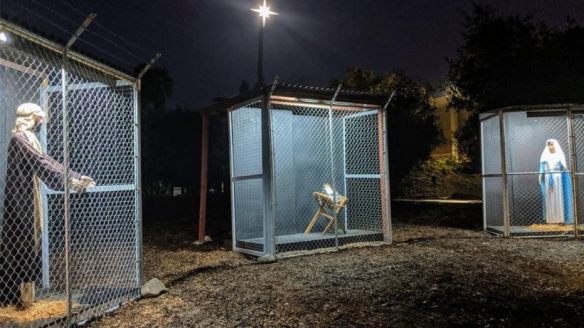
A singular number of churches across the country are asking those very questions, and their conclusions are being depicted with unnerving accuracy by nativity scenes in which Jesus and his family are separated, segregated and caged in individual chain-link pens, topped by barbed wire fencing.

These nativity scenes are a pointed attempt to remind the modern world that the narrative about the birth of Jesus is one that speaks on multiple fronts to a world that has allowed the life, teachings and crucifixion of Jesus to be drowned out by partisan politics, secularism, materialism and war.

The modern-day church has largely shied away from applying Jesus’ teachings to modern problems such as war, poverty, immigration, etc., but thankfully there have been individuals throughout history who ask themselves and the world: what would Jesus do?

What would Jesus—the baby born in Bethlehem who grew into an itinerant preacher and revolutionary activist, who not only died challenging the police state of his day (namely, the Roman Empire) but spent his adult life speaking truth to power, challenging the status quo of his day, and pushing back against the abuses of the Roman Empire—do?

Dietrich Bonhoeffer asked himself what Jesus would have done about the horrors perpetrated by Hitler and his assassins. The answer: Bonhoeffer risked his life to undermine the tyranny at the heart of Nazi Germany.

Aleksandr Solzhenitsyn asked himself what Jesus would have done about the soul-destroying gulags and labor camps of the Soviet Union. The answer: Solzhenitsyn found his voice and used it to speak out about government oppression and brutality.

Martin Luther King Jr. asked himself what Jesus would have done about America’s warmongering. The answer: declaring “my conscience leaves me no other choice,” King risked widespread condemnation when he publicly opposed the Vietnam War on moral and economic grounds.

Even now, despite the popularity of the phrase “What Would Jesus Do?” (WWJD) in Christian circles, there remains a disconnect in the modern church between the teachings of Christ and the suffering of what Jesus in Matthew 25 refers to as the “least of these.”

As the parable states:

“Then the King will say to those on his right, ‘Come, you who are blessed by my Father; take your inheritance, the kingdom prepared for you since the creation of the world. For I was hungry and you gave me something to eat, I was thirsty and you gave me something to drink, I was a stranger and you invited me in, I needed clothes and you clothed me, I was sick and you looked after me, I was in prison and you came to visit me.’ Then the righteous will answer him, ‘Lord, when did we see you hungry and feed you, or thirsty and give you something to drink? When did we see you a stranger and invite you in, or needing clothes and clothe you? When did we see you sick or in prison and go to visit you?’ The King will reply, ‘Truly I tell you, whatever you did for one of the least of these brothers and sisters of mine, you did for me.’ Then he will say to those on his left, ‘Depart from me, you who are cursed, into the eternal fire prepared for the devil and his angels. For I was hungry and you gave me nothing to eat, I was thirsty and you gave me nothing to drink, I was a stranger and you did not invite me in, I needed clothes and you did not clothe me, I was sick and in prison and you did not look after me.’ They also will answer, ‘Lord, when did we see you hungry or thirsty or a stranger or needing clothes or sick or in prison, and did not help you?’ He will reply, ‘Truly I tell you, whatever you did not do for one of the least of these, you did not do for me.’”

This is not a theological gray area: Jesus was unequivocal about his views on many things, not the least of which was charity, compassion, war, tyranny and love.

After all, Jesus—the revered preacher, teacher, radical and prophet—was born into a police state not unlike the growing menace of the American police state. When he grew up, he had powerful, profound things to say, things that would change how we view people, alter government policies and change the world. “Blessed are the merciful,” “Blessed are the peacemakers,” and “Love your enemies” are just a few examples of his most profound and revolutionary teachings.

When confronted by those in authority, Jesus did not shy away from speaking truth to power. Indeed, his teachings undermined the political and religious establishment of his day. It cost him his life. He was eventually crucified as a warning to others not to challenge the powers-that-be.

Can you imagine what Jesus’ life would have been like if, instead of being born into the Roman police state, he had been born and raised in the American police state?

Consider the following if you will.

Had Jesus been born in the era of the America police state, rather than traveling to Bethlehem for a census, Jesus’ parents would have been mailed a 28-page American Community Survey, a mandatory government questionnaire documenting their habits, household inhabitants, work schedule, how many toilets are in your home, etc. The penalty for not responding to this invasive survey can go as high as $5,000.

Instead of being born in a manger, Jesus might have been born at home. Rather than wise men and shepherds bringing gifts, however, the baby’s parents might have been forced to ward off visits from state social workers intent on prosecuting them for the home birth. One couple in Washington had all three of their children removed after social services objected to the two youngest being birthed in an unassisted home delivery.

Had Jesus been born in a hospital, his blood and DNA would have been taken without his parents’ knowledge or consent and entered into a government biobank. While most states require newborn screening, a growing number are holding onto that genetic material long-term for research, analysis and purposes yet to be disclosed.

Then again, had Jesus’ parents been undocumented immigrants, they and the newborn baby might have been shuffled to a profit-driven, private prison for illegals where they first would have been separated from each other, the children detained in make-shift cages, and the parents eventually turned into cheap, forced laborers for corporations such as Starbucks, Microsoft, Walmart, and Victoria’s Secret. There’s quite a lot of money to be made from imprisoning immigrants, especially when taxpayers are footing the bill.

From the time he was old enough to attend school, Jesus would have been drilled in lessons of compliance and obedience to government authorities, while learning little about his own rights. Had he been daring enough to speak out against injustice while still in school, he might have found himself tasered or beaten by a school resource officer, or at the very least suspended under a school zero tolerance policy that punishes minor infractions as harshly as more serious offenses.

Had Jesus disappeared for a few hours let alone days as a 12-year-old, his parents would have been handcuffed, arrested and jailed for parental negligence. Parents across the country have been arrested for far less “offenses” such as allowing their children to walk to the park unaccompanied and play in their front yard alone.

Rather than disappearing from the history books from his early teenaged years to adulthood, Jesus’ movements and personal data—including his biometrics—would have been documented, tracked, monitored and filed by governmental agencies and corporations such as Google and Microsoft. Incredibly, 95 percent of school districts share their student records with outside companies that are contracted to manage data, which they then use to market products to us.

From the moment Jesus made contact with an “extremist” such as John the Baptist, he would have been flagged for surveillance because of his association with a prominent activist, peaceful or otherwise. Since 9/11, the FBI has actively carried out surveillance and intelligence-gathering operations on a broad range of activist groups, from animal rights groups to poverty relief, anti-war groups and other such “extremist” organizations.

Jesus’ anti-government views would certainly have resulted in him being labeled a domestic extremist. Law enforcement agencies are being trained to recognize signs of anti-government extremism during interactions with potential extremists who share a “belief in the approaching collapse of government and the economy.”

While traveling from community to community, Jesus might have been reported to government officials as “suspicious” under the Department of Homeland Security’s “See Something, Say Something” programs. Many states, including New York, are providing individuals with phone apps that allow them to take photos of suspicious activity and report them to their state Intelligence Center, where they are reviewed and forwarded to law-enforcement agencies.

Rather than being permitted to live as an itinerant preacher, Jesus might have found himself threatened with arrest for daring to live off the grid or sleeping outside. In fact, the number of cities that have resorted to criminalizing homelessness by enacting bans on camping, sleeping in vehicles, loitering and begging in public has doubled.

Viewed by the government as a dissident and a potential threat to its power, Jesus might have had government spies planted among his followers to monitor his activities, report on his movements, and entrap him into breaking the law. Such Judases today—called informants—often receive hefty paychecks from the government for their treachery.

Had Jesus used the internet to spread his radical message of peace and love, he might have found his blog posts infiltrated by government spies attempting to undermine his integrity, discredit him or plant incriminating information online about him. At the very least, he would have had his website hacked and his email monitored.

Had Jesus attempted to feed large crowds of people, he would have been threatened with arrest for violating various ordinances prohibiting the distribution of food without a permit. Florida officials arrested a 90-year-old man for feeding the homeless on a public beach.

Had Jesus spoken publicly about his 40 days in the desert and his conversations with the devil, he might have been labeled mentally ill and detained in a psych ward against his will for a mandatory involuntary psychiatric hold with no access to family or friends. One Virginia man was arrested, strip searched, handcuffed to a table, diagnosed as having “mental health issues,” and locked up for five days in a mental health facility against his will apparently because of his slurred speech and unsteady gait.

Without a doubt, had Jesus attempted to overturn tables in a Jewish temple and rage against the materialism of religious institutions, he would have been charged with a hate crime. Currently, 45 states and the federal government have hate crime laws on the books.

Had anyone reported Jesus to the police as being potentially dangerous, he might have found himself confronted—and killed—by police officers for whom any perceived act of non-compliance (a twitch, a question, a frown) can result in them shooting first and asking questions later.

Rather than having armed guards capture Jesus in a public place, government officials would have ordered that a SWAT team carry out a raid on Jesus and his followers, complete with flash-bang grenades and military equipment. There are upwards of 80,000 such SWAT team raids carried out every year, many on unsuspecting Americans who have no defense against such government invaders, even when such raids are done in error.

Instead of being detained by Roman guards, Jesus might have been made to “disappear” into a secret government detention center where he would have been interrogated, tortured and subjected to all manner of abuses. Chicago police have “disappeared” more than 7,000 people into a secret, off-the-books interrogation warehouse at Homan Square.

Charged with treason and labeled a domestic terrorist, Jesus might have been sentenced to a life-term in a private prison where he would have been forced to provide slave labor for corporations or put to death by way of the electric chair or a lethal mixture of drugs.

Indeed, as I show in my book Battlefield America: The War on the American People, given the nature of government then and now, it is painfully evident that whether Jesus had been born in our modern age or his own, he still would have died at the hands of a police state.

Thus, as we draw near to Christmas with its celebrations and gift-giving, we would do well to remember that what happened on that starry night in Bethlehem is only part of the story. That baby in the manger grew up to be a man who did not turn away from evil but instead spoke out against it, and we must do no less.

This holiday season, American workers have little to celebrate

By Danny Haiphong

Source: Intrepid Report

Every year, much of the U.S. population celebrates Thanksgiving and Christmas to show appreciation for their families and friends. Thanksgiving normalizes the colonial origins of the United States and erases the brutality of the English settlers who massacred indigenous people to prepare the land for capitalist accumulation. Christmas is the annual holiday of big business. On no other day are workers more encouraged to spend their wages on the latest consumer product to gift to their loved ones. The holidays bring with them a deep pressure to be merry. Yet on this holiday season, workers have little to celebrate.

A new study by Brookings Institution provides a snapshot into the devastation wrought on the working class by American capitalism. Forty-four percent of all workers between the ages of 18-64 are employed in low-wage sectors and earn an average of $16 or less per hour. The study excluded workers who logged over 98 hours per week over the last year as well as certain sections of the college-educated population such as those living in dormitories and attending graduate school. Had these groups of workers been counted, the percentage of low-wage workers out of the total population would likely be even higher. This verifies prior datasets which proved that around half of the U.S. population makes less $30,000 per year.

The growing poverty of the American worker is a major contributor to the growth of toxic stress and mental illness. Half of all U.S. adults will develop a mental illness over the course of their life. Serious mental health conditions afflict nearly ten million people in the United States and over a quarter of these individuals live below the official poverty line. Suicide rates are at a thirty-year high. An obvious connection exists between rising poverty and the worsening mental health of the American worker.

Workers in the United States see no future under the current stage of capitalism. They struggle to afford rent in a nation where the federal minimum wage cannot pay for a two-bedroom apartment anywhere in the country. They indebt themselves in the trillions to attend college and obtain healthcare. They work in redundant, service sector jobs where hours are long and mistreatment, abuse, and injury are all too common. The American worker is increasingly alienated from themselves and each other. Union density rates in the U.S. have fallen to just ten percent of all workers since World War II.

The shrinking labor movement has followed a larger trend in U.S. society. Privatization has decimated the public sector. Workers have few places to socially convene independent of the machinations of consumer capitalism. Workers are competing for fewer jobs, most of which are not worth competing for at all. Homelessness, mass incarceration, and endless war remind workers that they can easily be turned into cannon fodder if they step out of line. In such an environment, addiction and self-destruction is encouraged while organizing for justice is discouraged.

Economic insecurity and alienation place more pressure on families to make up for stagnant wages and exorbitant amounts of debt. More young workers are living with their parents than at any other time in the last one hundred years. Older workers are not only forestalling retirement but also finding themselves without family or community support as siblings and adult children chase the highest paying jobs and the lowest rents and property values. Couples feel compelled to remain in toxic relationships for economic reasons. A strong link exists between domestic violence and poverty.

Contrary to the messages in Hallmark cards or the corporate media, the holidays are far from a time of celebration. Many workers view the holiday season as a harsh reminder of the loss, alienation, and despair that they’ve experienced over the course of their lives. Holidays place added pressure on workers to dismiss the ills of capitalism and the personal stressors associated with them. It should come as no surprise that most workers already struggling with mental health conditions report that the holidays only worsen their symptoms. Instead of embracing humanity, the holidays encourage workers to embrace rampant commercialism and the nuclear family.

To break from a culture steeped in the profit motive, workers will need to create their own traditions based upon solidarity and social transformation. Not everything about the holidays needs to be thrown out in the process. Spending time with family and friends during a day off from work can and should be rewarding to the psyche and to society. The conditions of capitalism prevent the holidays from serving a social purpose. Holidays under capitalism breed despair but brand themselves as moments of pure joy.

While workers may have little to celebrate this holiday season, there are reasons for the working class to be optimistic in the years to come. Teachers in cities such as Chicago and Los Angeles have won key gains in 2019 by using the most powerful weapon at the disposal of organized labor: the strike. At the beginning of the year, the Los Angeles Teachers won smaller class sizes and more support staff. The Chicago Teachers Union massively increased the number of nurses in the school district by forcing the city to hire nurses rather than continue the inefficient and harmful practice of hiring private contractors. The UAW’s strike of General Motors (GM) earlier this Fall made global headlines even if it was unable to win every demand that the workers put forth. These strikes reflect a growth of class consciousness in the United States. The continued growth of class consciousness will be critical toward building the kind of struggle capable of bringing about massive political and economic change for the working class.

Furthermore, workers around the world are leading the way in the struggle against class inequality and foreign-sponsored wars. Massive protests in Haiti, Chile, Honduras, and Algeria are just a few of many occurring around the globe. The protests have mainly targeted repressive U.S.-backed governments and their neoliberal economic agenda. China is leading the world in poverty reduction. Cuba is the most sustainably developed nation in the world. A vast majority of workers around the world want to see an end of the miseries imposed by global capital and are actively fighting to make their demands a reality.

The question is whether workers in the United States can decisively break from the despair, the racism, and the extreme alienation shaping their current condition. Being determines consciousness. At this moment, the neoliberal race to the bottom has rendered most workers too fearful, disorganized, and full of self-blame to fight back. However, millions of workers have rallied behind the political campaign of Bernie Sanders. Labor unrest is likely to continue as neither political party appears interested in implementing Bernie Sanders’ social democratic agenda. Workers in the United States are in desperate need of a revived labor movement to quench their thirst for a better life. Putting our energies into building this movement will go a long way toward shaking the Holiday Blues and giving workers something to really celebrate: a society run by workers, in the interests of workers.

Political Collapse: The Center Cannot Hold

By Kirkpatrick Sale

Source: CounterPunch

Have you noticed? From Hong Kong to Baghdad, Paris to Tehran, 2019 is shaping up to be, as the New York Times dubbed it, “the year of the protest.” Violent—and often deadly—anti-government protests are breaking out throughout the world in an unprecedented fashion, in rich countries as well as poor, as people everywhere are expressing their anger at corrupt, inefficient, brutal, and unresponsive regimes.

But what isn’t so much in the news is worse—worse enough that they don’t want to tell you. At the moment, there are no less than 65 countries are now fighting wars—there are only 193 countries recognized by the United Nations, so that’s a third of the world. These are wars with modern weapons, organized troops, and serious casualties—five of them, like Afghanistan, Libya, Syria, Somalia, and Yemen, with 10,000 or more deaths a year, another 15 with more than 1,000 a year—all of them causing disruptions and disintegrations of all normal political and economic systems, leaving no attacked nation in a condition to protect and provide for its citizens. From 2015 to 2019 more state-based conflicts were engaged in than at any time since World War II, with an estimated 1 million deaths in all.

In addition, there are at least 638 other conflicts between various insurgent and separatist militias, armed drug bands, and terrorist organizations, increasing each year as states fail or collapse completely.

What has made the wars and internal disputes even more egregious as the years go on is that chaotic weather has a direct effect on how societies function. Agriculture, of course, is impacted by higher temperatures, lack of rain, droughts, and wildfires, and crops have failed in many places over the last five years, including North and Central Africa, the Middle East, India, Pakistan, northern China, northern Europe, Argentina, Brazil, Central America, and even parts of North America. The collapse of Syria, for example, and subsequent civil wars were made more devastating if not directly caused by the drought of 2006-2011, in which 75 per cent of the farms failed and 85 per cent of the livestock died. And an official United Nations report in 2019, by 100 experts from 52 countries, warned that things will only get worse, with the world’s land and water resources exploited at “unprecedented rates,” threatening “the ability of humanity to feed itself.”

One obvious consequence, beyond death, famine, disease and starvation, is, as the U.N. report’s lead author says, “a massive pressure for migration,” a desperate attempt to find some refuge and relief when homes have been destroyed and families are uprooted. According to the United Nations, in what I regard as a certain undercount, in 2019 there were 272 million migrants worldwide, up from 258 million in 2017, with the weather in 2019 causing more refugees even than warfare. (The unprecedented crisis at the U.S. southern border in 2019 is only one manifestation of the porous and chaotic collapse of boundaries across the Americas, Africa, and most of Asia.) And meanwhile, the International Committee of the Red Cross in 2018 estimated that more than 100,000 people are simply “missing,” a figure it admits “represents only a fraction” of those who are unaccounted for by any government or organization.

Given the turmoil over wars and immigration threats, it is not surprising that half the world is without coherent government.

Organizations that track these things say that of the 174 covered nations, 76 are in various stages of collapse—that would be 43 per cent—and that excludes a dozen smaller nations that are locked into autocracy and poverty. These include seven completely failed states—Congo-Brazzaville, Central African Republic, Syria, Yemen, Somalia, South Sudan, and Venezuela—and another seven that are on the edge—Guinea, Haiti, Iraq, Zimbabwe, Afghanistan, Chad, and the Sudan—plus 19 that are in an “alert” category, meaning that some but not all government functions have failed, 15 in Africa and 4 in Asia.

In other words, many political systems in the world have effectively collapsed, people are dispossessed and without governments, and almost everywhere else, including the U.S. and Europe, governments are severely strained and political rifts abound. The vote for Brexit in the U.K., the election of Donald Trump (and the subsequent attempts to overturn it), the turmoil that erupted in December 2018 in France and Belgium, the continued protests in Poland were all examples of the population of developed nations coming to see that the attempt to establish capitalist-led democracies in an internationalist arrangement of benefit to corporate and banking interests just was not working, and a rising segment of what were called “deplorables” in America did not want any longer to be powerless, manipulated, and disdained. These turmoils also demonstrated that the established powers in these countries, especially the U.S. and Britain, resisted all of these attempts to change the status quo and in effect ignored or tried to thwart the popular will (cf. the “impeachment” farce)—the developed world’s form of the failed state. Those fissures have widened as the years have worn on, and as one astute observer, James Kunstler, put it in 2019, “The West is enduring paroxysms of political uproar and disenchantment.”

And here’s something weird that sums it all up. It is the opinion of two recent political scientists that “the state system seems to be failing all over the world,” and they have proposed a new study called “archy” to examine how to grow, maintain, and fund states so as to avert their collapse. No better evidence of the seriousness of the world’s “uproar and disenchantment” can there be when academics need to create a discipline to overcome it.

Yeats summed it up some years ago: “The center cannot hold. Mere anarchy is loosed upon the world.”


Kirkpatrick Sale’s new book The Collapse of 2020 will be published in January.

US government drops case against Max Blumenthal after jailing journalist on false charges

As the mysterious disappearance of Secret Service records and complete absence of evidence supporting its case came to light, the US government dropped its bogus charges against journalist Max Blumenthal.

By Ben Norton

Source: Grayzone

The US government has dropped its bogus charge of “simple assault” against journalist Max Blumenthal, after having him arrested on a 5-month-old warrant and jailed for nearly two days.

The Grayzone has learned that Secret Service call logs recorded during the alleged incident were either not kept or destroyed. The mysteriously missing evidence included print documents and radio recordings that may have exposed collusion between Secret Service officers operating under the auspices of the US State Department and violent right-wing hooligans in an operation to besiege peace activists stationed inside Venezuela’s embassy in Washington, DC.

Blumenthal, who is the editor of The Grayzone, was arrested at his home on October 25 by a team of DC cops who had threatened to break down his door. He later learned that he was listed in his arrest warrant as “armed and dangerous,” a rare and completely unfounded designation that placed Blumenthal at risk of severe harm by the police.

The government’s case rested entirely on a false accusation by a right-wing Venezuelan opposition activist, Naylet Pacheco, that Blumenthal and Benjamin Rubinstein had assaulted her while they were delivering food to Venezuela’s embassy in Washington, DC in the early morning on May 8. (Rubinstein is the brother of journalist and Grayzone contributor Alexander Rubinstein, who was reporting from inside the embassy at the time.)

The Grayzone has reported extensively on the corruption of coup leader Juan Guaidó, whom Washington recognizes as “interim president” of Venezuela, as well as the scandals plaguing Guaidó’s “ambassador” to the United States, Carlos Vecchio.

Vecchio personally presided over the weeks-long siege of Venezuela’s embassy in Washington, DC, stage-managing efforts by a mob of rabid right-wing activists to prevent peace activists from receiving deliveries of food and sanitary supplies.

As The Grayzone reported, the Donald Trump administration has diverted USAID funding originally intended to assist Central American migrants to pay the salaries of Vecchio and his team in Washington.

The US Department of Justice dismissed its case against Blumenthal on December 6. On the same day, it also dropped charges against Rubinstein, who had been arrested on May 8, hours after the food delivery.

“I’m relieved the government has finally decided to drop these phony charges against me. But I’m also disgusted,” Max Blumenthal said, “because I should never have been hauled out of my house and thrown in jail for an obviously politically motivated, false allegation that the police failed to investigate.”

Disappeared Secret Service call logs ‘highly unusual’

Lawyers representing Blumenthal and Rubinstein placed multiple and highly specified discovery requests to the prosecutor for Secret Service call recordings and reports logged on May 8 at the location of the embassy food delivery. The US prosecutor was unable to satisfy the request, verbally confirming that if the documents had existed, they no longer did.

“This is highly unusual and highly notable, almost inexplicable in the ordinary course of operations that these records were not maintained and preserved,” said Carl Messineo, the counsel to Rubinstein and a co-founder of the Partnership for Civil Justice Fund. “Given the false nature of allegations and that they advanced a prosecution based on these it is really questionable that this information was not produced.”

Beyond the mysterious disappearance of the call logs, there was a complete dearth of evidence on the prosecution’s side.

William Moran, who served as Blumenthal’s attorney, wondered why law enforcement trusted Pacheco, an accuser with such clear credibility issues. “The local police advanced a fraudulent case against a journalist on the word of a complainant who told at least six different, increasingly exaggerated stories and made identical accusations that night about at least three other individuals,” he said.

One Venezuelan opposition member whose identity remains under a protective order provided testimony to police attempting to corroborate Pacheco’s claims about Blumenthal and Rubinstein. According to Moran, that person had been convicted for the impeachable offense of writing fraudulent checks.

“The DC police wholly failed to conduct a proper investigation before calling for the arrest and imprisonment of a dissident journalist that they labeled without any cause whatsoever as ‘armed and dangerous,’ placing him in mortal danger,” Moran stated.

A pattern of false assault allegations and police collusion

The arrest of Blumenthal was part of a wider pattern of political persecution of those who resisted the seizure of the Venezuelan embassy by a US-backed coup administration.

On November 13, police appeared at the home of Medea Benjamin to threaten her with arrest, after she too was falsely accused of assault. Benjamin, a co-founder and leader of the anti-war group CODEPINK, had been a prominent figure in the Venezuelan Embassy Protection Collective.

Benjamin was accused by members of the Venezuelan opposition of assaulting Representative Debbie Wasserman-Schultz, who had joined Carlos Vecchio for a press conference on Capitol Hill. The police eventually left without arresting Benjamin, because they did not have a warrant.

Video of the incident revealed that it was, in fact, Benjamin who was assaulted by Vecchio’s notoriously violent minions.

During the same press conference, a member of the Venezuelan opposition seized the phone of journalist Wyatt Reed. When Reed complained to a Secret Service officer on site, the officer brushed him off.

Diliana Bustillos, a Venezuelan opposition lobbyist who participated in a May 8 press conference falsely accusing peace activists of violence, threatened Reed after the incident, warning that he would “end up like [Max Blumenthal] and Ben [Rubinstein].”

Mara Verheyden-Hilliard, a civil liberties lawyer with the Partnership for Civil Justice Fund, was present throughout much of the embassy siege. She noticed clear collusion between the right-wing opposition mob outside and the Secret Service, who were operating at the time under the watch of the State Department.

“Throughout the siege of the peace activists at the Venezuelan embassy,” Verheyden-Hillard said, “it was apparent to those on the scene that there was what looked like a facilitated effort between the government and the mob besieging the embassy.”

Mainstream media silence, demonization by regime change activists

The Washington Post reported extensively on the siege of the Venezuelan embassy, presenting the situation largely from the opposition’s perspective. The paper’s correspondent, Marissa Lang, uncritically conveyed Pacheco’s false charges, writing that “she said she was pushed against a wall and kicked by several men, then spent hours at a hospital being treated.”

However, the Washington Post did not report on Blumenthal’s arrest and imprisonment five months later or any of his public comments about the high-profile incident.

Meanwhile, an assortment of malicious regime-change cheerleaders seized on Blumenthal’s arrest to defame him with false and now-discredited claims on social media:

  • Bellingcat founder Elliot Higgins promoted a Medium post by an anonymous author who has routinely smeared Blumenthal, which featured his arrest warrant and a video of the complainant’s false testimony. He then repeatedly criticized skeptics who expressed doubts about the completely unfounded allegations against Blumenthal. Higgins’ website Bellingcat is funded by the National Endowment for Democracy, a regime change arm of the US government, and the UK Foreign Office via the Zinc Network, among other entities.
  • Foreign Policy senior editor and anti-China hawk James Palmer declared without a scintilla of evidence that Blumenthal “assault[ed] people freely.”
  • Freelance journalist and longtime Syria regime-change activist Danny Gold claimed falsely and without proof that Blumenthal “kicked an old woman in the stomach.”
  • Idrees Ahmad, a Stirling University professor of journalism who has obsessively denigrated Blumenthal and even phoned him to threaten him against publishing a factual investigative report on the Syrian White Helmets, falsely accused Blumenthal of “manhandling an elderly woman.”
  • Istanbul-based TRT World contributor Wilson Dizard suggested that Blumenthal was guilty before being proven innocent, insisting that a Grayzone account of his arrest “does not actually provide an alternative version of events.”
  • Oz Katerji, the notorious regime change fanatic who was recently fired from the Daily Mail for denigrating its columnist Peter Hitchens on social media, declared that he would “probably buy the guys who shackled pro-Assad war crimes denier Max Blumenthal to the floor for assaulting a Venezuelan protester a beer or two.” Katerji later insisted without any basis that “there’s video evidence” to support the false charge against Blumenthal.
  • Dutch regime-change activist Thomas van Linge, who fancied himself a Syria expert before moving on to advocate for Western-backed right-wing opposition groups in Iran, Bolivia, Hong Kong, and beyond, denied that Blumenthal’s arrest was political and instead outrageously claimed he was “arrested for kicking a pregnant woman.” Even in the totally fabricated accusations against Blumenthal, no one ever claimed that the alleged victim, right-wing Venezuelan activist Naylet Pacheco, who is 58 years old, was pregnant. As of the publication of this article, van Linge still has not deleted this patently false, defamatory claim.
  • Neil Hauer, a self-described “freelance analyst” who has previously consulted for the European Union and US Marines, called journalist Jeet Heer a “moron” for publicly advocating for Blumenthal.
  • UK liberal interventionist Sunny Hundal also attacked Heer for defending Blumenthal, asserting that “given the person in question I think you should exercise some judgement before accepting his story at face value.”
  • The anonymous right-wing Reagan Battalion Twitter account falsely claimed that Blumenthal was “arrested for kicking a pregnant woman,” misrepresenting the identity of the complainant while not even bothering to frame the non-existent incident as an alleged assault. In a previous spasm of mendacity, the Reagan Battalion declared that Blumenthal “works for” foreign socialist governments and smeared him as “a puppet for every dictator around the globe.”
  • Liberal feminist Mona Eltahawy falsely smeared Blumenthal as a supposed abuser of women and a “piece of shit.”
  • Right-wing pro-Israel lobby group StopAntisemitism.org defamed Blumenthal, who is Jewish, as an “antisemite,” cheered his arrest, and falsely asserted he “assault[ed] a Venezuelan opposition figure.” This pro-Israel organization has also smeared left-wing Jewish activist Ariel Gold and Muslim American progressives Ilhan Omar, Rashida Tlaib, and Linda Sarsour as supposed “antisemites.”
  • Joshua Holland, a liberal contributor to The Nation, publicly lashed out at media critic Joe Emersberger and implied the false, totally unsubstantiated allegations could be true.
  • Joshua Frank, an editor of the former-muckraking website CounterPunch, downplayed the attack on Blumenthal, whitewashed the state repression, and called on people “to not blow this all out of proportion, as Max is likely to do for his own gain.” Frank, who has viciously maligned journalists and activists who opposed the international proxy war on Syria, also derided this present reporter, Ben Norton, with superficial ad hominem insults.
  • Sean Davis, a co-founder of the hard-right website The Federalist and a longtime conservative activist who has worked for numerous Republican politicians, spread the fake accusations. Davis’ website The Federalist has been widely criticized for blatant racism (it once had a tag devoted specifically to “black crime“), and it published an article defending far-right Alabama judge Roy Moore after he was accused of dating teenage girls as young as 14.

Asked about the wave of libelous attacks spurred by his arrest on false charges, Blumenthal commented, “The outpouring of support I’ve received from around the world has been more profound and meaningful than any of the smears from the usual suspects. But that does not mean that I will let this campaign of lies go unanswered. This whole episode began with a false, defamatory accusation, and I plan to take the necessary actions to see it ends with a sense of justice.


They Live, We Sleep: Beware the Growing Evil in Our Midst

By John W. Whitehead

Source: The Rutherford Institute

“You see them on the street. You watch them on TV. You might even vote for one this fall. You think they’re people just like you. You’re wrong. Dead wrong.” — They Live

We’re living in two worlds, you and I.

There’s the world we see (or are made to see) and then there’s the one we sense (and occasionally catch a glimpse of), the latter of which is a far cry from the propaganda-driven reality manufactured by the government and its corporate sponsors, including the media.

Indeed, what most Americans perceive as life in America—privileged, progressive and free—is a far cry from reality, where economic inequality is growing, real agendas and real power are buried beneath layers of Orwellian doublespeak and corporate obfuscation, and “freedom,” such that it is, is meted out in small, legalistic doses by militarized police armed to the teeth.

All is not as it seems.

This is the premise of John Carpenter’s film They Live, which was released more than 30 years ago, and remains unnervingly, chillingly appropriate for our modern age.

Best known for his horror film Halloween, which assumes that there is a form of evil so dark that it can’t be killed, Carpenter’s larger body of work is infused with a strong anti-authoritarian, anti-establishment, laconic bent that speaks to the filmmaker’s concerns about the unraveling of our society, particularly our government.

Time and again, Carpenter portrays the government working against its own citizens, a populace out of touch with reality, technology run amok, and a future more horrific than any horror film.

In Escape from New York, Carpenter presents fascism as the future of America.

In The Thing, a remake of the 1951 sci-fi classic of the same name, Carpenter presupposes that increasingly we are all becoming dehumanized.

In Christine, the film adaptation of Stephen King’s novel about a demon-possessed car, technology exhibits a will and consciousness of its own and goes on a murderous rampage.

In In the Mouth of Madness, Carpenter notes that evil grows when people lose “the ability to know the difference between reality and fantasy.”

And then there is Carpenter’s They Live, in which two migrant workers discover that the world is not as it seems. In fact, the population is actually being controlled and exploited by aliens working in partnership with an oligarchic elite. All the while, the populace—blissfully unaware of the real agenda at work in their lives—has been lulled into complacency, indoctrinated into compliance, bombarded with media distractions, and hypnotized by subliminal messages beamed out of television and various electronic devices, billboards and the like.

It is only when homeless drifter John Nada (played to the hilt by the late Roddy Piper) discovers a pair of doctored sunglasses—Hoffman lenses—that Nada sees what lies beneath the elite’s fabricated reality: control and bondage.

When viewed through the lens of truth, the elite, who appear human until stripped of their disguises, are shown to be monsters who have enslaved the citizenry in order to prey on them.

Likewise, billboards blare out hidden, authoritative messages: a bikini-clad woman in one ad is actually ordering viewers to “MARRY AND REPRODUCE.” Magazine racks scream “CONSUME” and “OBEY.” A wad of dollar bills in a vendor’s hand proclaims, “THIS IS YOUR GOD.”

When viewed through Nada’s Hoffman lenses, some of the other hidden messages being drummed into the people’s subconscious include: NO INDEPENDENT THOUGHT, CONFORM, SUBMIT, STAY ASLEEP, BUY, WATCH TV, NO IMAGINATION, and DO NOT QUESTION AUTHORITY.

This indoctrination campaign engineered by the elite in They Live is painfully familiar to anyone who has studied the decline of American culture.

A citizenry that does not think for themselves, obeys without question, is submissive, does not challenge authority, does not think outside the box, and is content to sit back and be entertained is a citizenry that can be easily controlled.

In this way, the subtle message of They Live provides an apt analogy of our own distorted vision of life in the American police state, what philosopher Slavoj Žižek refers to as dictatorship in democracy, “the invisible order which sustains your apparent freedom.”

We’re being fed a series of carefully contrived fictions that bear no resemblance to reality.

The powers-that-be want us to feel threatened by forces beyond our control (terrorists, shootersbombers).

They want us afraid and dependent on the government and its militarized armies for our safety and well-being.

They want us distrustful of each other, divided by our prejudices, and at each other’s throats.

Most of all, they want us to continue to march in lockstep with their dictates.

Tune out the government’s attempts to distract, divert and befuddle us and tune into what’s really going on in this country, and you’ll run headlong into an unmistakable, unpalatable truth: the moneyed elite who rule us view us as expendable resources to be used, abused and discarded.

In fact, a study conducted by Princeton and Northwestern University concluded that the U.S. government does not represent the majority of American citizens. Instead, the study found that the government is ruled by the rich and powerful, or the so-called “economic elite.” Moreover, the researchers concluded that policies enacted by this governmental elite nearly always favor special interests and lobbying groups.

In other words, we are being ruled by an oligarchy disguised as a democracy, and arguably on our way towards fascism—a form of government where private corporate interests rule, money calls the shots, and the people are seen as mere subjects to be controlled.

Not only do you have to be rich—or beholden to the rich—to get elected these days, but getting elected is also a surefire way to get rich. As CBS News reports, “Once in office, members of Congress enjoy access to connections and information they can use to increase their wealth, in ways that are unparalleled in the private sector. And once politicians leave office, their connections allow them to profit even further.”

In denouncing this blatant corruption of America’s political system, former president Jimmy Carter blasted the process of getting elected—to the White House, governor’s mansion, Congress or state legislatures—as “unlimited political bribery… a subversion of our political system as a payoff to major contributors, who want and expect, and sometimes get, favors for themselves after the election is over.”

Rest assured that when and if fascism finally takes hold in America, the basic forms of government will remain: Fascism will appear to be friendly. The legislators will be in session. There will be elections, and the news media will continue to cover the entertainment and political trivia. Consent of the governed, however, will no longer apply. Actual control will have finally passed to the oligarchic elite controlling the government behind the scenes.

Sound familiar?

Clearly, we are now ruled by an oligarchic elite of governmental and corporate interests.

We have moved into “corporatism” (favored by Benito Mussolini), which is a halfway point on the road to full-blown fascism.

Corporatism is where the few moneyed interests—not elected by the citizenry—rule over the many. In this way, it is not a democracy or a republican form of government, which is what the American government was established to be. It is a top-down form of government and one which has a terrifying history typified by the developments that occurred in totalitarian regimes of the past: police states where everyone is watched and spied on, rounded up for minor infractions by government agents, placed under police control, and placed in detention (a.k.a. concentration) camps.

For the final hammer of fascism to fall, it will require the most crucial ingredient: the majority of the people will have to agree that it’s not only expedient but necessary.

But why would a people agree to such an oppressive regime?

The answer is the same in every age: fear.

Fear makes people stupid.

Fear is the method most often used by politicians to increase the power of government. And, as most social commentators recognize, an atmosphere of fear permeates modern America: fear of terrorism, fear of the police, fear of our neighbors and so on.

The propaganda of fear has been used quite effectively by those who want to gain control, and it is working on the American populace.

Despite the fact that we are 17,600 times more likely to die from heart disease than from a terrorist attack; 11,000 times more likely to die from an airplane accident than from a terrorist plot involving an airplane; 1,048 times more likely to die from a car accident than a terrorist attack, and 8 times more likely to be killed by a police officer than by a terrorist , we have handed over control of our lives to government officials who treat us as a means to an end—the source of money and power.

As the Bearded Man in They Live warns, “They are dismantling the sleeping middle class. More and more people are becoming poor. We are their cattle. We are being bred for slavery.”

In this regard, we’re not so different from the oppressed citizens in They Live.

From the moment we are born until we die, we are indoctrinated into believing that those who rule us do it for our own good. The truth is far different.

Despite the truth staring us in the face, we have allowed ourselves to become fearful, controlled, pacified zombies.

We live in a perpetual state of denial, insulated from the painful reality of the American police state by wall-to-wall entertainment news and screen devices.

Most everyone keeps their heads down these days while staring zombie-like into an electronic screen, even when they’re crossing the street. Families sit in restaurants with their heads down, separated by their screen devices and unaware of what’s going on around them. Young people especially seem dominated by the devices they hold in their hands, oblivious to the fact that they can simply push a button, turn the thing off and walk away.

Indeed, there is no larger group activity than that connected with those who watch screens—that is, television, lap tops, personal computers, cell phones and so on. In fact, a Nielsen study reports that American screen viewing is at an all-time high. For example, the average American watches approximately 151 hours of television per month.

The question, of course, is what effect does such screen consumption have on one’s mind?

Psychologically it is similar to drug addiction. Researchers found that “almost immediately after turning on the TV, subjects reported feeling more relaxed, and because this occurs so quickly and the tension returns so rapidly after the TV is turned off, people are conditioned to associate TV viewing with a lack of tension.” Research also shows that regardless of the programming, viewers’ brain waves slow down, thus transforming them into a more passive, nonresistant state.

Historically, television has been used by those in authority to quiet discontent and pacify disruptive people. “Faced with severe overcrowding and limited budgets for rehabilitation and counseling, more and more prison officials are using TV to keep inmates quiet,” according to Newsweek.

Given that the majority of what Americans watch on television is provided through channels controlled by six mega corporations, what we watch is now controlled by a corporate elite and, if that elite needs to foster a particular viewpoint or pacify its viewers, it can do so on a large scale.

If we’re watching, we’re not doing.

The powers-that-be understand this. As television journalist Edward R. Murrow warned in a 1958 speech:

We are currently wealthy, fat, comfortable and complacent. We have currently a built-in allergy to unpleasant or disturbing information. Our mass media reflect this. But unless we get up off our fat surpluses and recognize that television in the main is being used to distract, delude, amuse, and insulate us, then television and those who finance it, those who look at it, and those who work at it, may see a totally different picture too late.

This brings me back to They Live, in which the real zombies are not the aliens calling the shots but the populace who are content to remain controlled.

When all is said and done, the world of They Live is not so different from our own. As one of the characters points out, “The poor and the underclass are growing. Racial justice and human rights are nonexistent. They have created a repressive society and we are their unwitting accomplices. Their intention to rule rests with the annihilation of consciousness. We have been lulled into a trance. They have made us indifferent to ourselves, to others. We are focused only on our own gain.”

We, too, are focused only on our own pleasures, prejudices and gains. Our poor and underclasses are also growing. Racial injustice is growing. Human rights is nearly nonexistent. We too have been lulled into a trance, indifferent to others.

Oblivious to what lies ahead, we’ve been manipulated into believing that if we continue to consume, obey, and have faith, things will work out. But that’s never been true of emerging regimes. And by the time we feel the hammer coming down upon us, it will be too late.

So where does that leave us?

The characters who populate Carpenter’s films provide some insight.

Underneath their machismo, they still believe in the ideals of liberty and equal opportunity. Their beliefs place them in constant opposition with the law and the establishment, but they are nonetheless freedom fighters.

When, for example, John Nada destroys the alien hyno-transmitter in They Live, he restores hope by delivering America a wake-up call for freedom.

That’s the key right there: we need to wake up.

Stop allowing yourselves to be easily distracted by pointless political spectacles and pay attention to what’s really going on in the country.

The real battle for control of this nation is not being waged between Republicans and Democrats in the ballot box.

As I make clear in my book Battlefield America: The War on the American People, the real battle for control of this nation is taking place on roadsides, in police cars, on witness stands, over phone lines, in government offices, in corporate offices, in public school hallways and classrooms, in parks and city council meetings, and in towns and cities across this country.

The real battle between freedom and tyranny is taking place right in front of our eyes, if we would only open them.

All the trappings of the American police state are now in plain sight.

Wake up, America.

If they live (the tyrants, the oppressors, the invaders, the overlords), it is only because “we the people” sleep.

Ending Violence, Exploitation, Ecological Destruction and War: Creating a Culture of Peace

By Robert J. Burrowes

The date 11 November is well known and commemorated in many parts of the world because it marks the Armistice ending World War I – ‘the Great War’ – in 1918.

In the evocative words used by Kurt Vonnegut Jr., an atheist humanist, in his novel Breakfast of Champions, the day is remembered thus:

‘When I was a boy … all the people of all the nations which fought in the First World War were silent during the eleventh minute of the eleventh hour of Armistice Day, which was the eleventh day of the eleventh month. It was at that minute in nineteen-hundred and eighteen, that millions upon millions of human beings stopped butchering one another. I have talked to old men who were on battlefields at that minute. They have told me in one way or another that the sudden silence was the Voice of God. So we still have among us some men who can remember when God spoke clearly to mankind.’

And what, exactly, did God (by whatever name: Allah, Krishna, Yahweh…) or the Gods say? we might ask. Well even those who profess little more than scant knowledge of religious texts that purport to represent the word of God might suggest that s/he simply breathed a (silent) sigh of relief that the insanity of mass warfare had ended. For now at least.

For those of us concerned with the struggle to create cultures of peace or, even, a world culture of peace, there are some fundamental questions to consider including the classic question discussed by two of humanity’s greats – Albert Einstein and Sigmund Freud – when they tackled the question Why War?’

Of course, as many people now understand it, peace entails far more than simply a state without military (including terrorist) violence and war. Beyond these forms of violence, many exponents of peace seek the end of other dimensions of what I call ‘visible’ violence, including:

  1. Direct violence that goes beyond military violence, such as ‘biological violence’ (that is, violence against the body) in the family home and as a result of violent crime as well as ‘physical violence’ (that is, constraints on movement). See ‘Violence, Peace, and Peace Research’.
  2. Institutional violence: socially endorsed violence including that inflicted by parents, teachers, police, legal and prison systems – see ‘Punishment is Violent and Counterproductive’ and ‘The Rule of Law: Unjust and Violent’ – and which now manifests in a myriad other forms with the emergence of the surveillance state that spies on and gathers endless data on individuals to build substantial personal profiles on each – linking many personal records including those related to health and financial matters with political activities and consumption patterns – in violation of any basic understanding of, or commitment to, human rights in their many political, economic, social, cultural and other forms.
  3. Structural violence which Mohandas K. Gandhi originally identified when making his observation that ‘exploitation is violence’ and Professor Johan Galtung – see ‘A Structural Theory of Imperialism’ and ‘Violence, Peace, and Peace Research’ – later elaborated as violence built into structures, such as capitalism and imperialism, that deprive some people of the opportunities to live full and meaningful lives and manifest, for example, as poverty, homelessness and the economic exploitation of people who live in Africa, Asia and Central/South America. And
  4. Ecological violence: those activities ranging from destruction of the climate and rainforests to the killing of insects and wildlife that constitute destruction of the biosphere.

Of course, these categories are not mutually exclusive but they serve to illustrate categories of violence not always recognized as such.

Apart from these forms of ‘visible’ violence Professor Johan Galtung also identified the importance of psychological violence – ‘lies, brainwashing, indoctrination of various kinds, threats, etc. that serve to decrease mental potentialities’ see ‘Violence, Peace, and Peace Research’ – and coined the term ‘cultural violence’ to describe ‘those aspects of culture, the symbolic sphere of our existence – exemplified by religion and ideology, language and art, empirical science and formal science (logic, mathematics) – that can be used to justify or legitimize direct or structural violence’. See ‘Cultural Violence’.

Beyond these and other categories of violence – including patriarchy and racism as specific manifestations of violence that are, arguably, simultaneously direct, structural and cultural – which stand between humanity and a culture of peace, there are two other categories of violence which I will argue it is necessary to end before we can make profound inroads in ending those mentioned above.

These two categories – which I have labeled ‘invisible’ violence and ‘utterly invisible’ violence – describe vitally important categories of violence which human adults inflict on children. Moreover, complemented by the ‘visible’ violence that adults inflict on children, it is this ‘invisible’ and ‘utterly invisible’ violence which destroys the unique human individual who was created during a nine-month gestation period and turns them into a ‘socially constructed delusional identity’ who submissively fulfils the extraordinarily limited expectations of their particular adult world and, with only rare exceptions, willingly participates in many if not all of the other forms of violence that torment our world and certainly includes inflicting invisible and utterly invisible violence on their own children. Which is why the cycle of violence goes on.

Why is this?

Because society is preoccupied with producing submissively obedient students, workers, soldiers, citizens (that is, taxpayers and voters) and consumers. Hence, the last thing society wants is powerful individuals who are each capable of searching their conscience, feeling their emotional response to events, thinking critically and behaving strategically in response. For that reason our parenting and education models use a ruthless combination of visible, ‘invisible’ and ‘utterly invisible’ violence to ensure that our children become terrified, self-hating and powerless individuals like virtually all of the adults around them.

How does this happen? What is this ‘invisible’ and ‘utterly invisible’ violence?

Perpetrators of violence learn their craft in childhood. If you inflict violence on a child, they learn to inflict violence on others. The political leaders who decide to wage war, the military leaders who plan and conduct it, as well as the soldiers, sailors and aircraft personnel who fight war each suffered violence as a child. The terrorist suffered violence as a child. The man who inflicts violence on his partner suffered violence as a child. The corporate executive who exploits working class people and/or those who live in Africa, Asia or Central/South America suffered violence as a child. The racist or religious bigot suffered violence as a child. The individual who perpetrates violence in the home, in the schoolyard or on the street suffered violence as a child. The individual who overconsumes, or even consumes certain products, and/or otherwise destroys the biosphere, suffered violence as a child.

If we want to end violence in all of its manifestations and create a culture of peace, locally and globally, then we must finally end our longest and greatest war: the adult war on children. And here is an additional incentive: if we do not tackle the fundamental cause of violence, then our combined and unrelenting efforts to tackle all of its other symptoms must ultimately fail. And extinction at our own hand is inevitable.

How can I claim that violence against children is the fundamental cause of all other violence? Consider this. There is universal acceptance that behaviour is shaped by childhood experience. If it was not, we would not put such effort into education and other efforts to socialize children to ‘fit into’ their society. And this is why many psychologists have argued that exposure to war toys and violent video games shapes attitudes and behaviours in relation to violence.

But it is far more complex than this and, strange though it may seem, it is not just the ‘visible’ violence (such as hitting, screaming at and sexually abusing) that we normally label ‘violence’ that causes the main damage, although this is extremely damaging. The largest component of damage arises from the ‘invisible’ and ‘utterly invisible’ violence that we adults unconsciously inflict on children during the ordinary course of the day. Tragically, the bulk of this violence occurs in the family home and at school. See ‘Why Violence?’ and ‘Fearless Psychology and Fearful Psychology: Principles and Practice’.

So what is ‘invisible’ violence? It is the ‘little things’ we do every day, partly because we are just ‘too busy’. For example, when we do not allow time to listen to, and value, a child’s thoughts and feelings, the child learns to not listen to themSelf thus destroying their internal communication system. When we do not let a child say what they want (or ignore them when they do), the child develops communication and behavioral dysfunctionalities as they keep trying to meet their own needs (which, as a basic survival strategy, they are genetically programmed to do).

When we blame, condemn, insult, mock, embarrass, shame, humiliate, taunt, goad, guilt-trip, deceive, lie to, bribe, blackmail, moralize with and/or judge a child, we both undermine their sense of Self-worth and teach them to blame, condemn, insult, mock, embarrass, shame, humiliate, taunt, goad, guilt-trip, deceive, lie, bribe, blackmail, moralize and/or judge.

The fundamental outcome of being bombarded throughout their childhood by this ‘invisible’ violence is that the child is utterly overwhelmed by feelings of fear, pain, anger and sadness (among many others). However, mothers, fathers, teachers, religious figures and other adults also actively interfere with the expression of these feelings and the behavioral responses that are naturally generated by them and it is this ‘utterly invisible’ violence that explains why the dysfunctional behavioral outcomes actually occur.

For example, by ignoring a child when they express their feelings, by comforting, reassuring or distracting a child when they express their feelings, by laughing at or ridiculing their feelings, by terrorizing a child into not expressing their feelings (for example, by screaming at them when they cry or get angry), and/or by violently controlling a behavior that is generated by their feelings (for example, by hitting them, restraining them or locking them into a room), the child has no choice but to unconsciously suppress their awareness of these feelings.

However, once a child has been terrorized into suppressing their awareness of their feelings (rather than being allowed to have their feelings and to act on them) the child has also unconsciously suppressed their awareness of the reality that caused these feelings. This has many outcomes that are disastrous for the individual, for society and for nature because the individual will now easily suppress their awareness of the feelings that would tell them how to act most functionally in any given circumstance and they will progressively acquire a phenomenal variety of dysfunctional behaviors, including some that are violent towards themself, others and/or the Earth.

From the above, it should also now be apparent that punishment should never be used. ‘Punishment’, of course, is one of the words we use to obscure our awareness of the fact that we are using violence. Violence, even when we label it ‘punishment’, scares children and adults alike and cannot elicit a functional behavioural response. See ‘Punishment is Violent and Counterproductive’.

If someone behaves dysfunctionally, they need to be listened to, deeply, so that they can start to become consciously aware of the feelings (which will always include fear and, often, terror) that drove the dysfunctional behaviour in the first place. They then need to feel and express these feelings (including any anger) in a safe way. Only then will behavioural change in the direction of functionality be possible. See ‘Nisteling: The Art of Deep Listening’.

‘But these adult behaviors you have described don’t seem that bad. Can the outcome be as disastrous as you claim?’ you might ask. The problem is that there are hundreds of these ‘ordinary’, everyday behaviors that destroy the Selfhood of the child. It is ‘death by a thousand cuts’ and most children simply do not survive as Self-aware individuals. And why do we do this? As mentioned above, we do it so that each child will fit into our model of ‘the perfect citizen’: that is, obedient and hardworking student, reliable and pliant employee/soldier, and submissive law-abiding citizen (that is, one who pays their taxes and votes and/or lobbies politicians).

Moreover, once we destroy the Selfhood of a child, it has many flow-on effects. For example, once you terrorize a child into accepting certain information about themself, other people or the state of the world, the child becomes unconsciously fearful of dealing with new information, especially if this information is contradictory to what they have been terrorized into believing. As a result, the child will unconsciously dismiss new information out of hand.

In short, the child has been terrorized in such a way that they are no longer capable of learning (or their learning capacity is seriously diminished by excluding any information that is not a simple extension of what they already ‘know’). If you imagine any of the bigots you know, you are imagining someone who is utterly terrified. But it’s not just the bigots; virtually all people are affected in this manner making them incapable of responding adequately to new (or even important) information. This is one explanation why some people are ‘climate deniers’, most people do nothing in response to the climate catastrophe and even those people who do take action usually do so ineffectively. See ‘The Global Climate Movement is Failing: Why?’

But the same can be said for those working to end war – see ‘The War to End War 100 Years On: An Evaluation and Reorientation of our Resistance to War’ – end the nuclear weapons race or engage in other struggles, including liberation struggles, that are vital parts of the global struggle to create a culture of peace. See ‘Why Activists Fail’.

To briefly reiterate this vital point (that each child has been terrorized in such a way that they are no longer capable of learning or their learning capacity is seriously diminished): The multifaceted violence inflicted throughout childhood and adolescence ensures that the adult who emerges is suppressing awareness of an enormous amount of fear, pain, sadness and anger (among many other feelings) and must live in delusion to remain unaware of these suppressed feelings. This ensures that, as part of their delusion, the individual develops a strong sense that what they are doing already is functional and working (no matter how dysfunctional and ineffective it may actually be) while unconsciously suppressing awareness of any evidence that contradicts their delusion. They do this because, unconsciously, people learn to identify obedience with ‘functional and working’ (because they do not get punished for being obedient). See Why Violence?, Fearless Psychology and Fearful Psychology: Principles and Practice, ‘Do We Want School or Education?’ and ‘Love Denied: The Psychology of Materialism, Violence and War’.

As an aside, if you want to read more evidence of humanity’s ‘love’ for our children and get a clearer sense of just how deeply violence is buried in human society, see ‘Humanity’s “Dirty Little Secret”: Starving, Enslaving, Raping, Torturing and Killing our Children’.

Just one horrific outcome of this violence against children is that our planet is run by a global elite that is completely insane. See ‘The Global Elite is Insane Revisited’. And this elite plays a key role in driving many of the more obvious manifestations of violence in our world.

Responding to Violence Strategically to Create a World Culture of Peace

However we define the many positive elements of a culture of peace – which will presumably include an inclusive philosophy of society, a cooperative set of social relations, nonviolent methods for dealing with conflict and sustainable patterns of matter-energy use while allowing universal human access to the resources necessary to maintain health and well-being, opportunities for meaningful political and economic engagement as well as cultural opportunities in art, literature and music among its many other forms, while engaging sustainably with the biosphere to enhance life-opportunities for all other species – this culture of peace can only be achieved if we respond strategically to the violence in our world.

And this means that we must address the fundamental cause of human violence because this drives violence in each and all of its other dimensions. For those adults powerful enough to do this, there is an explanation in ‘Putting Feelings First’. And for those adults committed to facilitating children’s efforts to realize their potential and become self-aware (rather than delusional), see ‘My Promise to Children’.

Creating a culture of peace, therefore, relies fundamentally on understanding the critical role of suppressed feelings (emotions) in shaping deep culture and generating conflicts, including violent conflicts, and then taking action that addresses this cause.

This includes the need to understand and deal effectively with those emotions that are being acted out dysfunctionally and/or being projected – see ‘The Psychology of Projection in Conflict’ – in a particular context, which is standard human behaviour in many situations. See ‘Nisteling: The Art of Deep Listening’. Otherwise, that most fundamental of emotions – fear – will continue to drive most cultural predispositions and conflicts in all contexts and make genuine resolution of conflicts virtually impossible. This is because it is only if people are not afraid that discussions about ideas in relation to making culture evolve as we plan (rather than unconsciously or as elites direct) and to resolve conflict nonviolently, become easily possible.

Fundamentally, our parenting and education models fail utterly to produce people of conscience, people who are emotionally functional, people who are capable of critical analysis, people who care and people who can plan and respond to violence strategically. As Professor Galtung noted just recently, ‘While we are busy exploring whether there is intelligent life on other planets, we might spend more time – and intelligence – exploring whether there is [intelligent life] on ours.’ See ‘United States vs Moby Dick’. The problem is that once we terrorize a child, the terrified adult who emerges from childhood behaves as guided by their (unconscious) fear, not by any intelligence they may possess. Again, this is routinely illustrated by the failure of even those who self-label as ‘activists’ to think, plan and act strategically. See ‘Why Activists Fail’.

Of course, we do not need to work on ending violence against children in isolation. We can campaign to end other manifestations of violence – such as war, nuclear weapons and power, economic exploitation, ecological violence in its many forms including geoengineering and the deployment of 5G, violence against women and indigenous peoples, occupations and dictatorships – at the same time. See Nonviolent Campaign Strategy and Nonviolent Defense/Liberation Strategy.

But if we work to end the many manifestations of violence while failing to address the fundamental cause then, ultimately, we must fail, even if we elongate our timeframe a little. See ‘Human Extinction by 2026? A Last Ditch Strategy to Fight for Human Survival’.

If you are also interested in working locally to reduce your consumption and become more self-reliant, in order to reduce your ecological violence, consider participating in The Flame Tree Project to Save Life on Earth.

Alternatively, if you want something simpler, consider committing to:

The Earth Pledge

Out of love for the Earth and all of its creatures, and my respect for their needs, from this day onwards I pledge that:

  1. I will listen deeply to children (see explanation above)
  2. I will not travel by plane
  3. I will not travel by car
  4. I will not eat meat and fish
  5. I will only eat organically/biodynamically grown food
  6. I will minimize the amount of fresh water I use, including by minimizing my ownership and use of electronic devices
  7. I will not buy rainforest timber
  8. I will not buy or use single-use plastic, such as bags, bottles, containers, cups and straws
  9. I will not use banks, superannuation (pension) funds or insurance companies that provide any service to corporations involved in fossil fuels, nuclear power and/or weapons
  10. I will not accept employment from, or invest in, any organization that supports or participates in the exploitation of fellow human beings or profits from killing and/or destruction of the biosphere
  11. I will not get news from the corporate media (mainstream newspapers, television, radio, Google, Facebook, Twitter…)
  12. I will make the effort to learn a skill, such as food gardening or sewing, that makes me more self-reliant
  13. I will gently encourage my family and friends to consider signing this pledge.

And you might wish to join the worldwide movement of people working to end all violence by signing the online pledge of The Peoples Charter to Create a Nonviolent World.

Conclusion

The foundation of our violent world is the unending visible, invisible and utterly invisible violence that human adults inflict on our children. For that reason, it does not matter what superstructure we build on top of this foundation. Whether we use capitalism (and ‘democracy’), socialism or any other political-economic-social model, tack on a New Green Deal or a Just Transition, while the violent foundation on which society is built – violence against children – remains unaddressed, a culture of peace cannot be created.

So we need to raise children in a culture that does not involve terrorizing them so that they end up perceiving violence as the primary way to address conflict because they are too scared to simply perceive the power of, and use, principled nonviolent options.

Hence, until our parenting and teaching models are radically altered, a culture of peace will remain an impossible dream. And human extinction in the near term is inevitable.


Biodata: Robert J. Burrowes has a lifetime commitment to understanding and ending human violence. He has done extensive research since 1966 in an effort to understand why human beings are violent and has been a nonviolent activist since 1981. He is the author of Why Violence? His email address is flametree@riseup.net and his website is here.


Surviving on the Battlefield in the Information War

By Tony Cartalucci

Source: New Eastern Outlook

There is undoubtedly an information war raging. There are intentional liars, people who witlessly repeat these lies, poor research, and opinions spun to look as if it is research. To sort the ever increasing amount of information from disinformation, there are a few simple methods people can use.

But above all, people must personally dedicate themselves to following the truth no matter where it brings them, having the courage to accept a reality that may not necessarily mesh with their current perception. The inability to do this will render moot all other means of determining the veracity of any given report or piece of analysis.

Find the Original Source

This is fundamental. When anyone, anywhere makes a claim, whether it is in a historical documentary or book, or regarding current events, one must find the original source. Where did this information come from? Is it a direct quote? If so, can this quote be verified? If the quote is “alleged” or “leaked” or otherwise second-hand information or the sources never revealed, it is impossible to verify and therefore impossible to consider as verified.

Often conversations relayed by second-hand sources serve as the basis of propaganda. It is essentially the process of placing words into the mouths of people who never said anything of the sort. Media that repeatedly uses quotes that are impossible to verify may be engaged in disinformation.

If the quote is confirmed, that alone does not mean that what was said was “true.” It simply means that someone made a statement – the veracity of which must be determined through other means. Finding the source of a claim often helps shatter long-held myths. This is particularly true in regards to historical matters.

Follow the Money

All protests, political movements, and armed struggles require immense amounts of resources to start, perpetuate, and most importantly to succeed.  They also require leadership. If one finds themselves reading reports of events that do not mention funding or the names of specific leaders, either those reporting on the events don’t have these facts and should make note that such information is both missing and essential to find, or misdirection and disinformation is at play.

Omitting these facts has been done intentionally across the Western media to obfuscate Western involvement particularly in “political uprisings” and “armed rebellions” that are made to appear spontaneous and indigenous but are in fact long-planned, foreign-backed conspiracies. The so-called “Arab Spring” is perhaps the most notorious example of this, where the Western media failed intentionally and repeatedly to identify the funding and individuals involved in both street protests and subsequent armed attacks on security agencies across the Middle East and North Africa (MENA) region.

Had the public carefully read through reports, and followed the money, they would have found a combination of US State Department money and the Anglo-American-backed Muslim Brotherhood behind each and every “uprising” across the Middle East, with Al Qaeda forming the subsequent armed groups that overran Libya and are currently leading attempts to overthrow the government of Syria.

Look at What People Do, Not at What They Say…

There are media reports, government press releases, op-eds, analysis, and policy papers of every kind. Many times, these various sources contradict each other. How does one go about determining which is true and which is disinformation? It is quite simple, don’t simply listen to what reporters, analysts, and policymakers say, look at what they and those they have influence over are doing.

The United States claims that it is fighting the so-called “Islamic State” (ISIS) in Syria. However, if we “follow the money” and realize that it is impossible for ISIS to sustain its fighting capacity within Syria or Iraq alone, and requires an immense amount of resources from abroad to continue its operations, we realize those resources are undoubtedly passing through territory the US and its allies in fact control.

That the US is not interdicting these vital supplies, including additional fighters, weapons, and cash, is proof that claims in the media and amid government press releases that the US is “fighting ISIS” are false.

Conversely, in veteran journalist Seymour Hersh’s 2007 New Yorker article, “The Redirection,” he stated explicitly, citing US and Saudi officials, that the West and its regional allies planned to use sectarian extremists affiliated with Al Qaeda to wage a regional proxy war against Syria and Iran. This also so happens to be precisely what is now playing out across the MENA region. Hersh’s analysis can be tracked down through his sources, by following the money – as only state-sponsorship can explain Al Qaeda and ISIS’ fighting capacity in Syria, Iraq, and beyond – and by simply looking at what is now unfolding across the region.

None of what the current corporate media or government press releases say can be verified in a similar manner, and certainly, none of what is said by the West currently, matches what is actually happening on the ground.

Finally, let us consider policy papers released by corporate-funded think tanks like the Brookings Institution. Such policy papers have repeatedly laid out plans for arming extremists, incrementally invading and occupying Syria, and eventually toppling the Syrian government. This too, is precisely what we see happening on the ground, though the Western media and Western representatives claim the cause is not a  premeditated Western conspiracy, but a series of coincidences and unfortunate turns of fate.

Final Thoughts 

The truth is hard to arrive at, not only because people intentionally seek to fool others, but because often, many unintentionally fool themselves. Reality can be unpleasant. Watching a nation be destroyed can be heartbreaking and the desire to insulate oneself from the pain through cognitive dissonance can be overwhelming. However, one of the greatest maxims in human conflict is to truly know yourself and know your enemy. Truth isn’t just a matter of virtue, it is a factor that will make the difference between victory and defeat.

If victory over the forces of greed and hegemony is truly our goal, then we must face the facts no matter how unpleasant. Our failure to do so will cost us everything – and those driven by greed and hegemony know. That is why they have invested so much in clouding reality and obfuscating the truth. We must invest more in seeing through this clouded reality, and discover the truth, no matter how unpleasant.

The Pathocracy of the Deep State: Tyranny at the Hands of a Psychopathic Government

By John W. Whitehead

Source: The Rutherford Institute

Politicians are more likely than people in the general population to be sociopaths. I think you would find no expert in the field of sociopathy/psychopathy/antisocial personality disorder who would dispute this… That a small minority of human beings literally have no conscience was and is a bitter pill for our society to swallow — but it does explain a great many things, shamelessly deceitful political behavior being one.”—Dr. Martha Stout, clinical psychologist and former instructor at Harvard Medical School

Twenty years ago, a newspaper headline asked the question: “What’s the difference between a politician and a psychopath?

The answer, then and now, remains the same: None.

There is no difference between psychopaths and politicians.

Nor is there much of a difference between the havoc wreaked on innocent lives by uncaring, unfeeling, selfish, irresponsible, parasitic criminals and elected officials who lie to their constituents, trade political favors for campaign contributions, turn a blind eye to the wishes of the electorate, cheat taxpayers out of hard-earned dollars, favor the corporate elite, entrench the military industrial complex, and spare little thought for the impact their thoughtless actions and hastily passed legislation might have on defenseless citizens.

Psychopaths and politicians both have a tendency to be selfish, callous, remorseless users of others, irresponsible, pathological liars, glib, con artists, lacking in remorse and shallow.

Charismatic politicians, like criminal psychopaths, exhibit a failure to accept responsibility for their actions, have a high sense of self-worth, are chronically unstable, have socially deviant lifestyles, need constant stimulation, have parasitic lifestyles and possess unrealistic goals.

It doesn’t matter whether you’re talking about Democrats or Republicans.

Political psychopaths are all largely cut from the same pathological cloth, brimming with seemingly easy charm and boasting calculating minds. Such leaders eventually create pathocracies: totalitarian societies bent on power, control, and destruction of both freedom in general and those who exercise their freedoms.

Once psychopaths gain power, the result is usually some form of totalitarian government or a pathocracy. “At that point, the government operates against the interests of its own people except for favoring certain groups,” author James G. Long notes. “We are currently witnessing deliberate polarizations of American citizens, illegal actions, and massive and needless acquisition of debt. This is typical of psychopathic systems, and very similar things happened in the Soviet Union as it overextended and collapsed.”

In other words, electing a psychopath to public office is tantamount to national hara-kiri, the ritualized act of self-annihilation, self-destruction and suicide. It signals the demise of democratic government and lays the groundwork for a totalitarian regime that is legalistic, militaristic, inflexible, intolerant and inhuman.

Incredibly, despite clear evidence of the damage that has already been inflicted on our nation and its citizens by a psychopathic government, voters continue to elect psychopaths to positions of power and influence.

According to investigative journalist Zack Beauchamp, “In 2012, a group of psychologists evaluated every President from Washington to Bush II using ‘psychopathy trait estimates derived from personality data completed by historical experts on each president.’ They found that presidents tended to have the psychopath’s characteristic fearlessness and low anxiety levels — traits that appear to help Presidents, but also might cause them to make reckless decisions that hurt other people’s lives.”

The willingness to prioritize power above all else, including the welfare of their fellow human beings, ruthlessness, callousness and an utter lack of conscience are among the defining traits of the sociopath.

When our own government no longer sees us as human beings with dignity and worth but as things to be manipulated, maneuvered, mined for data, manhandled by police, conned into believing it has our best interests at heart, mistreated, jailed if we dare step out of line, and then punished unjustly without remorse—all the while refusing to own up to its failings—we are no longer operating under a constitutional republic.

Instead, what we are experiencing is a pathocracy: tyranny at the hands of a psychopathic government, which “operates against the interests of its own people except for favoring certain groups.”

Worse, psychopathology is not confined to those in high positions of government. It can spread like a virus among the populace. As an academic study into pathocracy concluded, “[T]yranny does not flourish because perpetuators are helpless and ignorant of their actions. It flourishes because they actively identify with those who promote vicious acts as virtuous.”

People don’t simply line up and salute. It is through one’s own personal identification with a given leader, party or social order that they become agents of good or evil.

Much depends on how leaders “cultivate a sense of identification with their followers,” says Professor Alex Haslam. “I mean one pretty obvious thing is that leaders talk about ‘we’ rather than ‘I,’ and actually what leadership is about is cultivating this sense of shared identity about ‘we-ness’ and then getting people to want to act in terms of that ‘we-ness,’ to promote our collective interests. . . . [We] is the single word that has increased in the inaugural addresses over the last century . . . and the other one is ‘America.’”

The goal of the modern corporate state is obvious: to promote, cultivate, and embed a sense of shared identification among its citizens. To this end, “we the people” have become “we the police state.”

We are fast becoming slaves in thrall to a faceless, nameless, bureaucratic totalitarian government machine that relentlessly erodes our freedoms through countless laws, statutes, and prohibitions.

Any resistance to such regimes depends on the strength of opinions in the minds of those who choose to fight back. What this means is that we the citizenry must be very careful that we are not manipulated into marching in lockstep with an oppressive regime.

Writing for ThinkProgress, Beauchamp suggests that “one of the best cures to bad leaders may very well be political democracy.”

But what does this really mean in practical terms?

It means holding politicians accountable for their actions and the actions of their staff using every available means at our disposal: through investigative journalism (what used to be referred to as the Fourth Estate) that enlightens and informs, through whistleblower complaints that expose corruption, through lawsuits that challenge misconduct, and through protests and mass political action that remind the powers-that-be that “we the people” are the ones that call the shots.

Remember, education precedes action. Citizens need to the do the hard work of educating themselves about what the government is doing and how to hold it accountable. Don’t allow yourselves to exist exclusively in an echo chamber that is restricted to views with which you agree. Expose yourself to multiple media sources, independent and mainstream, and think for yourself.

For that matter, no matter what your political leanings might be, don’t allow your partisan bias to trump the principles that serve as the basis for our constitutional republic. As Beauchamp notes, “A system that actually holds people accountable to the broader conscience of society may be one of the best ways to keep conscienceless people in check.”

That said, if we allow the ballot box to become our only means of pushing back against the police state, the battle is already lost.

Resistance will require a citizenry willing to be active at the local level.

Yet as I point out in my book Battlefield America: The War on the American People, if you wait to act until the SWAT team is crashing through your door, until your name is placed on a terror watch list, until you are reported for such outlawed activities as collecting rainwater or letting your children play outside unsupervised, then it will be too late.

This much I know: we are not faceless numbers. We are not cogs in the machine. We are not slaves.

We are human beings, and for the moment, we have the opportunity to remain free—that is, if we tirelessly advocate for our rights and resist at every turn attempts by the government to place us in chains.

The Founders understood that our freedoms do not flow from the government. They were not given to us only to be taken away by the will of the State. They are inherently ours. In the same way, the government’s appointed purpose is not to threaten or undermine our freedoms, but to safeguard them.

Until we can get back to this way of thinking, until we can remind our fellow Americans what it really means to be free, and until we can stand firm in the face of threats to our freedoms, we will continue to be treated like slaves in thrall to a bureaucratic police state run by political psychopaths.