

This August 6, 1945 file photo shows the destruction from the explosion of an atomic bomb in Hiroshima Japan AP-Photo-File
By Rossen Vassilev Jr.
Source: Global Research
74 Years Ago, the first atomic bomb was dropped on Hiroshima on August 6, 1945
Was President Harry Truman “a murderer,” as the renowned British analytic philosopher Gertrude Elizabeth Anscombe once charged? Were the atomic bombings of Hiroshima and Nagasaki indeed a war crime and a crime against humanity, as she and other academic luminaries have publicly claimed? A Distinguished Professor of Philosophy and Ethics at Oxford and Cambridge, who was one of the 20th century’s most gifted philosophers and recognizably the greatest woman philosopher in history, Dr. Anscombe openly called President Truman a “war criminal” for his decision to have the Japanese cities of Hiroshima and Nagasaki leveled by atomic bombs in August 1945 (Rachels & Rachels 127). According to another academic critic, the late American historian Howard Zinn, at least 140,000 Japanese civilians were “turned into powder and ash” in Hiroshima. Over 70,000 civilians were incinerated in Nagasaki, and another 130,000 residents of the two cities died of radiation sickness in the next five years (Zinn 23).
The two most often cited reasons for President Truman’s controversial decision were to shorten the war and to save the lives of “between 250,000 and 500,000” American soldiers who could have possibly died in battle had the U.S. military had to invade the home islands of Imperial Japan. Truman reportedly claimed that
“I could not bear this thought and it led to the decision to use the atomic bomb” (Dallek 26).
But Dr. Gertrude Anscombe, who along with her husband, Dr. Peter Geach, Professor of Philosophical Logic and Ethics, were the 20th century’s foremost philosophical champions of the doctrine that moral rules are absolute, did not buy this morally callous argument:
“Come now: if you had to choose between boiling one baby and letting some frightful disaster befall a thousand people—or a million people, if a thousand is not enough—what would you do? For men to choose to kill the innocent as a means to their ends is always murder” (Rachels & Rachels 128-129).
In 1956, Professor Anscombe and other prominent faculty members of Oxford University openly protested the decision of university administrators to grant Truman an honorary degree in gratitude for America’s wartime help. She even wrote a pamphlet, explaining that the former U.S. President was “a murderer” and “a war criminal” (Rachels & Rachels 128).
In the eyes of many contemporaries of Elizabeth Anscombe, the atomic bombings of Hiroshima and Nagasaki violated famous philosophical-ethical norms such as the “Sanctity of Human Life,” the “Wrongfulness of Killing,” and also that “it is wrong to use people as means to other people’s ends.” Former President Herbert Hoover was another early critic, openly declaring that
“The use of the atom bomb, with its indiscriminate killing of women and children, revolts me” (Alperovitz The Decision 635).
Even President Truman’s own Chief of Staff, the five-star Admiral William D. Leahy (the most senior U.S. military officer during the war) made no secret of his strong disapprobation of the atomic bombings:
“It is my opinion that the use of this barbarous weapon at Hiroshima and Nagasaki was of no material assistance in our war against Japan. The Japanese were already defeated and ready to surrender because of the effective sea blockade and the successful bombing with conventional weapons…. My own feeling is that in being the first to use it, we had adopted an ethical standard common to the barbarians of the Dark Ages…. I was not taught to make war in that fashion, and wars cannot be won by destroying women and children” (Claypool 86-87, emphasis added).
The apologists for President Truman, on the other hand, seem to be using the quasi-Utilitarian “Benefits Argument” to justify the barbaric use of a devastating weapon of mass destruction, which killed hundreds of thousands of innocent civilians in the two targeted Japanese cities even though (contrary to Truman’s many public pronouncements at that time) there had been no military troops, no heavy weaponry, or even any major war-related industries in either city. Because nearly the entire adult male population of both Hiroshima and Nagasaki had been drafted by the Japanese military, it was mostly women, children, and old men who fell victims to fiery death from the sky. The excuse that Truman himself repeatedly offered was:
“The dropping of the bombs stopped the war, saved millions of lives” (Alperovitz Atomic Diplomacy 10).
He even boasted that he had “slept like a baby” the night after signing the final order to use the atomic bombs against Japan (Rachels & Rachels 127). But what Truman was saying in self-justification was far from being the truth—let alone the whole truth.
Unleashing a nuclear Frankenstein
At the urging of a fellow nuclear physicist—the anti-Nazi Hungarian émigré Leo Szilard—Albert Einstein wrote a letter to President Franklin D. Roosevelt on August 2, 1939, recommending that the U.S. government should start work on a powerful atomic device as a defensive deterrent to Nazi Germany’s possible acquisition and use of nuclear weaponry (Ham 103-104). But when the top-secret Manhattan Project finally got off the ground in early 1942, the U.S. military obviously had other, much more offensive plans regarding the future targets of America’s A-bombs. While at least 67 other Japanese cities, including the capital Tokyo, were reduced to rubble by daily conventional firebombing, including the use of napalm and other incendiaries, Hiroshima and Nagasaki had been deliberately spared for the sole purpose of testing the destructiveness of the new atomic device (Claypool 11).
An even more important reason for employing the bomb was to scare Stalin, who had turned quickly from “Old Uncle Joe” at the time of the FDR presidency into “the Red Menace” in the eyes of Truman and his top advisers. President Truman had quickly abandoned FDR’s policy of cooperation with Moscow, replacing it with a new policy of hostile confrontation with Stalin, in which America’s newly-acquired monopoly over nuclear armaments would be exploited as an aggressive tool of Washington’s anti-Soviet diplomacy (Truman’s so-called “atomic diplomacy”). Fully two months before Hiroshima and Nagasaki, the same Leo Szilard had met privately with Truman’s Secretary of State, James F. Byrnes, and had tried unsuccessfully to persuade him that the nuclear weapon should not be used to destroy helpless civilian targets such as Japan’s cities. According to Dr. Szilard,
“Mr. Byrnes did not argue that it was necessary to use the bomb against the cities of Japan in order to win the war…. Mr. Byrnes’s view [was] that our possessing and demonstrating the bomb would make Russia more manageable in Europe” (Alperovitz Atomic Diplomacy 1, 290).
The Truman Administration had, in fact, postponed the Potsdam meeting of the Big Three until July 17, 1945—one day after the successful Trinity test of the first A-bomb at the Alamogordo testing range in New Mexico—to give Truman extra diplomatic leverage in negotiating with Stalin (Alperovitz Atomic Diplomacy 6). In Truman’s own words, the atom bomb “would keep the Russians straight” and “put us in a position to dictate our own terms at the end of the war” (Alperovitz Atomic Diplomacy 54, 63).
At this point, the Truman Administration was no longer interested in having Moscow’s Red Army liberate Northern China (Manchuria) from Japanese military occupation (as FDR, Churchill, and Stalin had jointly agreed at the Yalta Conference in February 1945)—let alone invade or capture Imperial Japan itself. Quite to the contrary. Publicly deploring the “political-diplomatic rather than military motives” behind Truman’s decision to nuke Japan, Albert Einstein complained that “a great majority of scientists were opposed to the sudden employment of the atom bomb. I suspect that the affair was precipitated by a desire to end the war in the Pacific by any means before Russia’s participation” (Alperovitz The Decision 444). Winston Churchill privately told his Foreign Secretary, Anthony Eden,at the Potsdam Conference that
“It is quite clear that the United States do not at the present time desire Russian participation in the war against Japan” (Claypool 78).
Not even Tokyo’s last-minute desperate offer (made during and after the Potsdam Conference) to surrender if the Allies promised not to prosecute Japan’s god-like emperor or remove him from office—could prevent this deadly decision, even though Truman “had indicated a willingness to maintain the emperor on the throne” (Dallek 25).
Therefore, sparing the lives of American GIs was hardly one of Truman’s more convincing arguments. In early 1945, FDR and Army General Dwight Eisenhower, Supreme Commander of the Allied Forces in Europe, had together decided to leave the capture of Berlin to Soviet Marshal Georgi Zhukov‘s battle-hardened troops in order to avoid heavy American casualties. After officially declaring war on Tokyo on August 8, 1945, and having destroyed the Japanese military forces in Manchuria, Stalin’s Red Army prepared to invade and occupy Japan’s home islands—which certainly would have saved the lives of thousands of U.S. servicemen about whom Truman seemed so vocally concerned. But following Nazi Germany’s unconditional surrender in May 1945, Truman had come to share Winston Churchill’s famous revisionist assessment that “We have slain the wrong swine.”
It is not even clear whether Tokyo finally surrendered on August 14 due to the two U.S. nuclear attacks carried out on August 6 and August 9, respectively (after which there were practically no more Japanese cities left to destroy nor any more U.S. A-bombs to drop)—or because of the threat of Soviet invasion and occupation after Moscow had entered the war against the Empire of Japan. Just days before the Soviet declaration of war, the Japanese ambassador to Moscow had cabled Foreign Minister Shigenori Togo in Tokyo that Moscow’s entry into the war would spell a total disaster for Japan:
“If Russia…should suddenly decide to take advantage of our weakness and intervene against us with force of arms, we would be in a completely hopeless situation. It is clear as day that the Imperial Army in Manchukuo [Manchuria] would be completely unable to oppose the Red Army which has just won a great victory and is superior to us on all points” (Barnes).
To nuke or not to nuke
General Eisenhower was later quoted as stating his conviction that it had not been “necessary” militarily to use the bomb to force Japanese surrender:
“Japan was, at that very moment, seeking some way to surrender with a minimum loss of ‘face’…it wasn’t necessary to hit them with that awful thing” (Alperovitz Atomic Diplomacy 14).
In private, Eisenhower repeated his objections to his direct boss, Truman’s Secretary of War Henry L. Stimson:
“I had been conscious of a feeling of depression and so I voiced to him my strong misgivings, first on the basis of my belief that Japan was already defeated and that dropping the bomb was completely unnecessary, and secondly because I thought that our country should avoid shocking world opinion by the use of a weapon whose employment was, I thought, no longer mandatory as a measure to save American lives” (Alperovitz Atomic Diplomacy 14).
Admiral William F. Halsey, commander of the U.S. Third Fleet (which conducted the bulk of naval operations against the Japanese in the Pacific during the entire war), agreed that there was “no military need” to employ the new weapon, which was used only because the Truman Administration had a “toy and they wanted to try it out…. The first atomic bomb was an unnecessary experiment…. It was a mistake to ever drop it” (Alperovitz The Decision 445). Indeed, it was quite “certain” at the time that a totally devastated Japan, which was on the verge of internal collapse, would have surrendered within weeks, if not days, without the atomic bombings of Hiroshima and Nagasaki or even without the Soviet declaration of war against Tokyo. As the official U.S. Strategic Bombing Survey concluded at the end of the war, “certainly prior to 31 December 1945, and in all probability prior to 1 November 1945, Japan would have surrendered even if the atomic bombs had not been dropped, even if Russia had not entered the war, and even if no invasion had been planned or contemplated” (Alperovitz Atomic Diplomacy 10-11).
Major General Curtis E. Lemay, commander of the U.S. Twenty-first Bomber Command which had conducted the massive conventional bombing campaign against wartime Japan and dropped the atomic bombs on Hiroshima and Nagasaki, stated publicly: “I felt there was no need to use them [atomic weapons]. We were doing the job with incendiaries. We were hurting Japan badly…. We went ahead and dropped the bombs because President Truman told me to do it…. All the atomic bomb did was, in all probability, save a few days” (Alperovitz The Decision 340).
The fateful decision to drop the two atomic bombs code-named “Little Boy” and “Fat Man” on Japan may have been made a little bit more morally acceptable for Truman by the daily carpet bombing of German and Japanese cities throughout the war, including the firebombings of Hamburg, Dresden, and Tokyo, which had nearly wiped out their civilian populations. The declared goal of these relentless city-busting air raids was to destroy the morale and the will to fight of the German and Japanese people and thus shorten the war. But many years after the war Dr. Howard Zinn (himself a B-17 co-pilot and bombardier who had flown dozens of bombing missions against Nazi Germany) sadly mused: “No one seemed conscious of the irony—that one of the reasons for the general indignation against the fascist powers was their history of indiscriminate bombing of civilian populations” (Zinn 37). But, in fact, Secretary of War Henry Stimson, Admiral William Leahy, and Army General Douglas MacArthur were no less disturbed by what they saw as the barbarity of the “terror” air campaign, with Stimson privately fearing that the U.S. would “get the reputation for outdoing Hitler in atrocities” (Ham 63).
Clearly, Japan was defeated and was preparing to surrender before the bomb was used, whose main—if not the only—purpose was to intimidate the Soviet Union. But there had been several viable alternatives, some of which were discussed prior to the atomic bombings. The Under Secretary of the Navy, Ralph Bard, had become convinced that “the Japanese war was really won” and was so disturbed by the prospect of using atom bombs against defenseless civilians that he secured a meeting with President Truman, at which he unsuccessfully pressed his case “for warning the Japanese of the nature of the new weapon” (Alperovitz Atomic Diplomacy 19). Admiral Lewis L. Strauss, Special Assistant to the Secretary of the Navy, who replaced Bard after the latter’s angry resignation, also believed that “the war was very nearly over. The Japanese were nearly ready to capitulate.” That is why Admiral Strauss insisted that the atom bomb should be demonstrated in a way that would not kill large numbers of civilians, proposing that “…a satisfactory place for such a demonstration would be a large forest of cryptomeria trees not far from Tokyo” (Alperovitz Atomic Diplomacy 19). General George C. Marshall, U.S. Army Chief of Staff, was equally opposed to the bomb being used on civilian areas, arguing instead that
“…these weapons might be used against straight military objectives such as a large naval installation and then if no complete result was derived from the effect of that…we ought to designate a number of large manufacturing areas from which people would be warned to leave —telling the Japanese that we intend to destroy such centers…. Every effort should be made to keep our record of warning clear…. We must offset by such warning methods the opprobrium which might follow from an ill-considered employment of such force” (Alperovitz Atomic Diplomacy 20).
General Marshall also insisted that instead of surprising the Russians with the first use of the atom bomb, Moscow should be invited to send observers to the Alamogordo nuclear test. Many of the scientists working for the Manhattan Project likewise urged that a demonstration be arranged first, including a possible nuclear explosion at sea in close proximity to Japan’s coast, so that the bomb’s destructive power would be made clear to the Japanese before it was used against them. But, like the U.S. military’s dissenting views, the nuclear scientists’ opposition was never considered seriously by the Truman Administration (Alperovitz Atomic Diplomacy 20-21).
Conclusion
As a result of Truman’s immoral decision to use nuclear explosives against the “Japs” (a derogatory name for the Japanese commonly used in public in wartime America, including by President Truman himself), well over 200,000 civilians were instantly cremated and many thousands died later of radiation sickness. J. Robert Oppenheimer, scientific director of the Manhattan Project and “father” of the U.S. atom bomb, declared that Truman’s decision was “a grievous error,” because now “we have blood on our hands” (Claypool 17). Howard Zinn agreed with Dr. Oppenheimer’s judgment, remarking that “much of the argument defending the atomic bombings has been based on a mood of retaliation, as if the children of Hiroshima had bombed Pearl Harbor…. Did American children deserve to die because of the U.S. massacre of Vietnamese children at My Lai?” (Zinn 59).
The controversial General Curtis Lemay, who had opposed the two atomic blasts, later confided to former Secretary of Defense Robert McNamara (who had worked for Lemay during the war, helping select Japanese targets for the American firebombing raids): “If we’d lost the war, we’d all have been prosecuted as war criminals” (Schanberg). Given the unjustifiable and unnecessary use of such an inhumane and indiscriminate weapon of mass destruction as the atomic bombs dropped on Hiroshima and Nagasaki, Professor Elizabeth Anscombe called President Truman a murderer and a war criminal. Until the day she died, Dr. Anscombe believed that Truman should have been put on trial for having committed some of the worst war crimes and crimes against humanity during WWII.
Sources
Alperovitz, Gar. Atomic Diplomacy: Hisroshima and Potsdam. The Use of the Atomic Bomb and the American Confrontation with Soviet Power. London and Boulder, CO: Pluto Press. 1994. Print.
—-. The Decision to Use the Atomic Bomb. New York: Vintage Books. 1996. Print.
Barnes, Michael. “The Decision to Use the Atomic Bomb: Arguments Against.” Web. 14 Apr. 2019.
Claypool, Jane. Hisroshima and Nagasaki. New York and London: Franklin Watts, 1984. Print.
Dallek, Robert. Harry S. Truman. New York: Times Books, 2008. Print.
Ham, Paul. Hiroshima Nagasaki: The Real Story of the Atomic Bombings and Their Aftermath. New York: St. Martin’s Press. 2011. Print.
Rachels, James, and Stuart Rachels. The Elements of Moral Philosophy (8th edition). McGraw-Hill Education, 2015. Print.
Schanberg, Sydney. “Soul on Ice.” The American Prospect, October 27, 2003. Web. 14 Apr. 2019.
Zinn, Howard. The Bomb. San Francisco, CA: City Lights Books, 2010. Print.

By Kurt Nimmo
Source: Another Day in the Empire
Not only is Jeffrey Epstein a predator of innocent children, he’s also a Malthusian and a transhumanist who wanted to have his head and penis cryogenically preserved.
According to a story published by The New York Times, Epstein wanted to use his compound outside of Santa Fe, New Mexico as an insemination lab.
The pedo predator thought so much of himself that he “hoped to seed the human race with his DNA by impregnating women.”
This has a frightening parallel with the Nazi Lebensborn program.
Mr. Epstein’s vision reflected his longstanding fascination with what has become known as transhumanism: the science of improving the human population through technologies like genetic engineering and artificial intelligence. Critics have likened transhumanism to a modern-day version of eugenics, the discredited field of improving the human race through controlled breeding.
The ruling elite is keen to live forever. In 2015, Technocracy News & Trends reported:
The eugenicists at DARPA in conjunction with Academy of Medical Sciences, British Academy and Royal Academy of Engineering came together this month to discuss the potentials, opportunities and challenges of the melding of man with machine (i.e. transhumanism) under the guise of augmentation technologies.
In addition to funding transhumanist projects at Stanford and other elite institutions, the Pentagon is looking at creating the perfect cybernetic soldier and cop.
The Defense Advanced Research Projects Agency (DARPA) has a $2 billion yearly budget for research into creating a super solider as well as developing a synthetic police force. Working with the human genome, DARPA hopes to manipulate certain gene expressions. In experimentation, DARPA and the military industrial pharmaceutical complex are using natural abilities that are enhanced through genetic engineering.
But it isn’t simply transhumanism that motivated the pervert, Epstein. He also preached the Malthusian doctrine.
At one session at Harvard, Mr. Epstein criticized efforts to reduce starvation and provide health care to the poor because doing so increased the risk of overpopulation, said [cognitive psychologist Steven Pinker], who was there. Mr. Pinker said he had rebutted the argument, citing research showing that high rates of infant mortality simply caused people to have more children. Mr. Epstein seemed annoyed, and a Harvard colleague later told Mr. Pinker that he had been “voted off the island” and was no longer welcome at Mr. Epstein’s gatherings.
Culling the herd is a key concept of the elite Club of Rome and the subject of Rockefeller foundation projects.
Eradicating disease and reducing infant mortality rates are a negative for the global elite. “If I were reincarnated I would wish to be returned to Earth as a killer virus to lower human population levels,” Prince Philip reportedly mused.
The New York Times article reveals Epstein’s alignment with the global elite, of which he considered himself a member. In fact, he is, like so many lower-level water carriers, completely dispensable, especially now that his reckless predatory behavior has exposed the blackmail scheme used by the CIA-Mossad-MI6 to keep the political class and other pawns in line.

By Caitlin Johnstone
Source: CaitlinJohnstone.com
Name a quote by Mahatma Gandhi.
Odds are the first thing that jumps into your mind is the famous, “Be the change you wish to see in the world.” It’s a good quote. It’s pithy enough to fit on a bumper sticker, and it resonates deeply with something inside us all which tells us that it points to something true and valuable.
But, like so many other pithy bumper sticker quotes we see floating around today, these words were never spoken by the person they’re attributed to. What Gandhi actually said was this:
“If we could change ourselves, the tendencies in the world would also change. As a man changes his own nature, so does the attitude of the world change towards him.”
Oof. That’s a bit more confrontational than the popularized version, isn’t it? Change my own nature? I thought we were talking about something light and easy, like not wearing fur or buying fair trade coffee beans.
That’s how “Be the change you wish to see in the world” tends to get interpreted today. It’s a line that is so commonly regurgitated in our society that it’s now cliché and almost meaningless, something you see on cheap keychains at the mall and scan over without really reading, but assume you understand because you’ve seen it so many times before. If pressed to really think about it, most people will say it means something like make the changes in the world that you want to see. If you don’t like factory farming, become a vegan. If you don’t like poverty, volunteer at a soup kitchen.
But that isn’t what the quote says. It’s nothing like what the original one by Gandhi says. It’s not even what the stripped-down bumper sticker version says.
Even if you look at the popularized version of the quote, really look at it with fresh eyes that haven’t seen it thoughtlessly regurgitated by corporate liberals and plastered on K-Mart products, you come away with the same message as the original. It doesn’t say “Do the change you wish to see in the world.” It doesn’t say “Enact the change you wish to see in the world.” It says “Be the change you wish to see in the world.” It isn’t referring to a mere change in behavior or lifestyle, it’s saying change who you are as a person. It’s saying change your own nature to change the world.
This is night-and-day different from the conventional interpretation. The conventional interpretation of the quote exists as a vapid platitude that people make fun of hippies and New Agers for over-using. A deep, visceral understanding of that same quote, however, conveys more wisdom than all religious texts in the world combined. It’s a call into a transformation that is more real than childbirth. More existentially confrontational than a terminal cancer diagnosis.
The first challenge of the quote is to get you thinking hard about what changes you do in fact want to see in the world. Most people never even get that far into it. Few have actually thought hard about what kind of world they’d like to see in a positive way that actually envisions what that world would look like. Most people only think in terms of the little partisan battles they’re seeing currently: universal healthcare, immigration policies, gun control, austerity policies, abortion, LGBTQ issues, police brutality, etc. Few people get as far as sitting down and deeply contemplating a positive vision for the kind of world they’d like to help create.
When I make an inventory of the changes I wish to see in the world, I know I want to see people consistently choosing health over the illusion of security.
I want them making choices with the highest interest of everyone concerned over their own self-interest, even if those choices make them feel exposed or vulnerable because they appear to go against their finances or tribal groupthink, or are outside their comfort zone.
I want people to be collaborative rather competitive.
I want people to start trusting that the steps will appear in front of them as we forge a path onto a new, undiscovered route rather than retreat to the well-trodden highways because they are familiar even though we already know they lead the wrong way.
I want to see people giving up their tribalism and embracing their humanism.
I want to see people loving themselves deeply enough to love others meaningfully and with clear eyes.
I want people to rise above the competing narratives and make their distinctions according to actions and reality rather than the stories of the manipulators or their own internal manipulations.
I want people to have the wisdom to acknowledge where they have power and privilege and use it courageously, and where they are powerless so they may force those in power to change our suicidal trajectory immediately.
I want people to tell the truth, even if at first it’s only to themselves.
I want people to choose life over death, every time, without hesitation, and I want them to always seek their solutions in life and healing and harmony and reject the solutions offered by death, destruction, manipulation, sabotage and chaos.
These are just my personal desires for the world. After laying those out, the next challenge posed by “Be the change you wish to see in the world” is far more serious, and, if undertaken, will remain front and center in your attention the rest of your life.
Looking at the changes I wish to see in the world, I endeavor to be someone who consistently chooses to press the “health” button even if it scares me, or others, or both.
I try to be someone who always chooses in the highest interest rather than manipulating it slightly so I get a bit more or I look a bit cooler.
I try to tell the truth even when my tribe is yelling at me to shut up, but I try to have the wisdom to only do that when it benefits everyone and not just to seek drama or attention.
I try to trapeze through life using my inner compass because I know for sure that my old paths never led anywhere good.
I try to not manipulate others, and I try to not manipulate myself in order to pretend to myself that I’m not manipulating others.
I try to love the parts of me that I see in others, especially those parts that make me cringe, but also I try to love myself enough to walk away from someone whose patterns are hurting me.
I try to make distinctions by what I see people doing rather than what I hear them saying, and I try to integrate my thoughts and my actions as much as possible.
I try to use my power and privilege for the highest interest of everyone, but I refuse to take responsibility for things outside of my control, and I pledge to hold those who do have that power to account.
I try always to tell the truth, even if it’s just to myself at times because in that instance I don’t have enough power and privilege to speak it without getting unjustly punished. But if it’s in the highest interest to take unjust punishment, then I choose that.
I choose life, every time, without hesitation, and I want to heal any blocks either in me or outside of me that is resistant to turning every atom of my being towards life and healing.
Of course I fail a lot, but I hope to continue to noticing when I fail and course-correcting as often as needed, because getting this right is much more important to me than feeling like I’m right. I want this more than I want the story of having this already. I want to change the world more than I want the story of changing the world.
Crucially, I want this more than I want “me”, more than I want the personality that I think of as “me”. Whole parts of my identity have had to die in order to change into something healthier and more agile, and there will be many more parts of me that have to die in the future, and I welcome that. I welcome that with a deep breath of trepidation because it’s not easy, and in the moment before letting go it feels like I really am dying, but I know that it has to happen, and the more I do it, the more positive reinforcement I get as my reluctance gets overridden with curiosity as to what will manifest in the space I’ve created. And I know that in any case it’s better than the alternative, which is a slow, actual death through stagnation.
Beyond the bumper sticker, I’m pretty sure ol’ Mahatma was on to something pretty huge. I’m pretty sure this is how we fix it. It calls to mind that other hackneyed chestnut, The Serenity Prayer. “God, grant me the serenity to accept the things I cannot change, courage to change the things I can, and wisdom to know the difference,” another saying that has eroded into superficiality but contains some deep wisdom if you take it on as your calling. If we all individually took sincere responsibility for the only thing we can actually change — ourselves — then the knock-on effects are unquantifiable.
And, inevitably, world-changing.
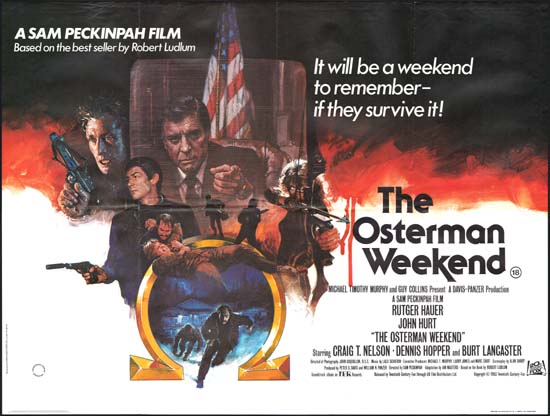
Review By nfaust1
Source: IMDB
When this movie originally came out, five years after CONVOY (a muddled, but in many ways spectacular entertainment), many critics moaned that Peckinpah had yet again displayed his diminished talent. A Ludlum spy thriller, pulp material, given the Peckinpah stamp was not to be taken seriously, period. What nonsense. To begin with, all of Peckinpah’s films spring from pulp, and all of them, even the least successful ones, buck and spin with the way Sam applies his vision to the genre conventions he’s messing with.
In simple terms, a Peckinpah movie always illustrates the world according to Sam; like a novelist writing in first person, Sam’s point of view is the movie’s. And that’s why they endure today. In THE OSTERMAN WEEKEND, Peckinpah focuses Ludlum’s cold war spy antics into a exploration of urban paranoia and governmental abuse. Video as a means to manipulate perception is one of the themes he exploits here, but that’s not his main thrust. A group of affluent characters come together for a weekend that turns into a surreal nightmare. The trappings of success that surround this group are not in any way secure enough to withstand the violent, reckless games played on them by a rouge CIA agent (played by John Hurt) who’s motive is personal revenge. And that motive, the revenge that fuels his need, in actual fact, has absolutely nothing to do with the affluent group he’s playing with. Like the gods in Greek tragedy, the Hurt character uses the Osterman Weekend and its players as pawns, stepping stones, as a way to get at his real goal, the head of the CIA. This notion obviously strikes a chord in Peckinpah; the vision is certainly domestic, but the idea is epic: in the privacy of our homes a kind of virus colors our perceptions and poisons friendships, creates anarchy, and causes death. And the virus – where does it come from? Our own back yard – the CIA.
The film is charged with a constant underlying tension that holds and holds until all hell breaks loose and the affluent house becomes a battle ground. Visually, the movie is stunning. But then, so was CONVOY, but this time Peckinpah has harnessed what he shows and what he wants to say in a simple, tightly wound spy thriller package, Watching the movie today, it’s hard to believe that some of the notions that seemed more like the paranoiac mechanics of a potboiler in 1983 have actually come true and don’t seem quite as far fetched. By all accounts, Sam Peckinpah was a terribly difficult man, but he was also a visionary film maker who’s work gets better and better as the years pass. THE OSTERMAN WEEKEND is not the bad film critics at the time bitched about, and it’s not the sad conclusion to a career that started out brimming with possibility. It’s a splendid, brilliant – better than brilliant – work of American art by a true American artist: a giant. The world according to Sam is a world that will be looked at a hundred years from now; it will inspire debate, continual analysis, and be ranked with the major artist of the entire 20th century. By 1983,Peckinpah’s health may have diminished, but as a film maker he was still powerful and strong as hell.
Watch the full film on Hoopla at: https://www.hoopladigital.com/title/11049252
Unelected, unnamed censors are operating across the Internet to suppress “unapproved” content.
By Philip Giraldi
Source: OpEdNews.com
The Internet was originally promoted as a completely free and uncensored mechanism for people everywhere to exchange views and communicate, but it has been observed by many users that that is not really true anymore. Both governments and the service providers have developed a taste for controlling the product, with President Barack Obama once considering a “kill switch” that would turn off the Internet completely in the event of a “national emergency.”
President Donald Trump has also had a lot to say about fake news and is reported to be supporting limiting protections relating to the Internet. In May, a “net neutrality” bill that would have prevented service providers from manipulating Internet traffic passed in the House of Representatives, but it is reported to be “dead on arrival” in the Senate, so it will never be enacted.
Social networking sites have voluntarily employed technical fixes that restrict some content and have also hired “reviewers” who look for objectionable material and remove it. Pending European legislation, meanwhile, might require Internet search engines to eliminate access to many unacceptable old posts. YouTube has already been engaged in deleting existing old material and is working with biased “partners” like the Anti-Defamation League (ADL) to set up guidelines to restrict future content. Many users of Facebook will have already undoubtedly noted that some contacts have been blocked temporarily (or even permanently) and denied access to the site.
Google now automatically disables or limits searches for material that it deems to be undesirable. If Google does not approve of something it will either not appear in search results or it will be very low on the list. And what does come up will likely favor content that derives from those who pay Google to promote their products or services. Information that originates with competitors will either be very low in the search results or even blocked. Google is consequently hardly an unbiased source of information.
In May 2017 Facebook announced that it would be hiring 3,000 new censors, and my own experience of social networking censorship soon followed. I had posted an article entitled “Charlottesville Requiem” that I had written for a website. At the end of the first day, the site managers noticed that, while the article had clearly attracted a substantial Facebook readership, the “likes” for the piece were not showing up on the screen counter, i.e., were not being tabulated. It was also impossible to share the piece on Facebook, as the button to do so had been removed.
The “likes” on sites like Facebook, Yahoo! news comments, YouTube, and Google are important because they automatically determine how the piece is distributed throughout the site. If there are a lot of likes, the piece goes to the top when a search is made or when someone opens the page. Articles similarly can be sent to Coventry if they receive a lot of dislikes or negative marks, so the approvals or disapprovals can be very important in determining what kind of audience is reached or what a search will reveal.
In my case, after one day my page reverted to normal, the “likes” reappeared, and readers were again able to share the article. But it was clear that someone had been managing what I had posted, apparently because there had been disapproval of my content based on what must have been a political judgment.
A couple of days later, I learned of another example of a similar incident. The Ron Paul Institute (RPI) website posts much of its material on YouTube (owned by Google) on a site where there had been advertising that kicked back to RPI a small percentage of the money earned. Suddenly, without explanation, both the ads and rebate were eliminated after a “manual review” determined the content to be “unsuitable for all advertisers.” This was a judgment rendered apparently due to disapproval of what the institute does and says. The ability to comment on and link from the pieces was also turned off.
Dissident British former diplomat Craig Murray also noted in April 2018 the secretive manipulation of his articles that are posted on Facebook, observing that his “site’s visitor numbers [were] currently around one-third normal levels, stuck at around 20,000 unique visitors per day. The cause [was] not hard to find. Normally over half of our visitors arrive via Facebook. These last few days, virtually nothing has come from Facebook. What is especially pernicious is that Facebook deliberately imposes this censorship in a secretive way.
The primary mechanism when a block is imposed by Facebook is that my posts to Facebook are simply not sent into the timelines of the large majority of people who are friends or who follow. I am left to believe the post has been shared with them, but in fact it has only been shown to a tiny number. Then, if you are one of the few recipients and do see the post and share it, it will show to you on your timeline as shared, but in fact the vast majority of your own friends will also not receive it. Facebook is not doing what it is telling you it is doing — it shows you it is shared — and Facebook is deliberately concealing that fact from you. Twitter has a similar system known as ‘shadow banning.’ Again, it is secretive and the victim is not informed.”
More recently, pressure to censor Internet social networking and information sites has increased, coming both from government and from various interested constituencies. In late May, Facebook founder and CEO Mark Zuckerberg met with French President Emmanuel Macron to discuss how to eliminate “hate speech” on the Internet. The two men agreed that the United States Internet model, in spite of already being heavily manipulated, is too laissez faire, and expressed an interest in exploring the French system where it is considered acceptable to ban unacceptable points of view. Zuckerberg suggested that it might serve as a good model for the entire European Union. France is reportedly considering legislation that establishes a regulator with power to fine Internet companies up to 4% of their global revenue, which can in some cases be an enormous sum, if they do not curb hateful expressions.
So unelected, unnamed censors are operating all around the Internet to control the content, which I suppose should surprise no one, and the interference will only get worse as both governments and service providers are willing to do what it takes to eliminate views that they find unacceptable — which, curiously enough, leads one to consider how “Russia-gate” came about and the current hysteria being generated in the conventional media and also online against both Venezuela and Iran. How much of the anger is essentially fake, being manipulated or even fabricated by large companies that earn mega billions of dollars by offering under false pretenses a heavily managed product that largely does what the government wants? Banning hate speech will be, unfortunately, only the first step in eliminating any and all criticisms of the status quo.
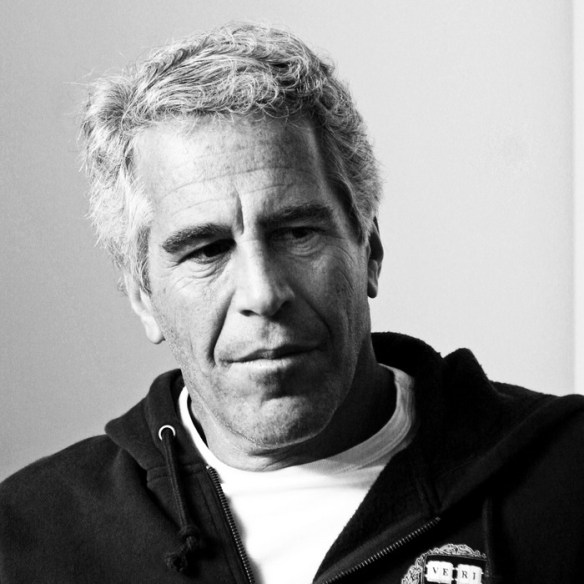
By Kurt Nimmo
Source: Another Day in the Empire
If you search the news, you will find very little to nothing in the corporate media about pedo Jeffrey Epstein’s connection to Israeli intelligence. This connection is obvious—from Epstein’s connection to the Zionist Les Wexner and especially his Mossad handler, Ghislaine Maxwell, the daughter of documented Mossad operative and double agent Robert Maxwell.
It’s said Ghislaine had a romantic relationship with Epstein in 1992. This is likely a cover story. Maxwell was Epstein’s Mossad liaison. She also procured and trained teenage girls to work as honey traps.
The story in the corporate media following Epstein’s arrest is that Ghislaine recruited girls for Epstein and his associates, many rich and influential. It is described as simply a pedophile sex ring when it is obviously much more—a blackmail operation designed to compromise politicians and others when and if they deviated from the Zionist agenda.
This has already swirled and descended into the memory hole. Headlines focus instead on the appeal of Epstein’s bail denial, the red flags raised about his jail records and work release, his close ties to Wall Street and Barclays, and the taint on the money he gave to Harvard and other institutions over the years. Much attention dwells on the salacious nature of Epstein’s pedophilia.
Meanwhile, disgraced former Labor Secretary Alex Acosta’s remark on Epstein’s intelligence connections (which Acosta has since denied) fade as corporate media sensationalism and miasma dominate and shape the story.
Leslie Wexner is described as the “most prominent client” of Epstein’s alleged money management firm. However, it appears Wexner was the only client—and he wasn’t so much a client as a conduit for money poured into a Zionist blackmail operation.
A Twitter account under the handle “Quantian” theorized that Epstein’s main purpose was to blackmail politicians and wealthy perverts.
“You don’t need to charge up front, just get them to have underage sex, and then blackmail them afterwards for hush money. Better ROI, but you’re still a liability, and producing and receiving big bribe money raises big questions… This scheme works just as well if the billionaires are in on it from the getgo as a way to buy sex; I assumed that was obvious but I guess not… There’s no need to invoke the Mafia/Russia/Mossad/CIA/etc, that’s just needlessly overfitting.”
Except it is not “overfitting.” It is the only explanation that makes sense. Undoubtedly, Epstein bribed these people to “invest” in his offshore “fund,” however it is unlikely a criminal scheme like this would have lasted decades. The wealthy and influential have the money and resources to deal with blackmailers. However, as Robert Maxwell discovered, it would be supremely foolish to expose or double-cross the Mossad (or the CIA and Russian intelligence) unless you want to be found floating dead off the Canary Islands or hanging in your mother’s backyard like the so-called DC Madam.
Even if a few names are put out there for the sake of a corporate media feeding frenzy, the real story will never be fully revealed. Israel will not suffer any consequence beyond speculation that will be dismissed as the antisemitic ravings of conspiracy theorists.

By Rick Sterling
Source: Dissident Voice
Introduction
The Tulsi Gabbard presidential campaign has filed a major law suit against Google. This article outlines the main points of the law suit and evidence the the social media giant Google has quietly acquired enormous influence on public perceptions and has been actively censoring alternative viewpoints.
Tulsi Now vs Google
Tulsi Now, Inc vs Google, LLC was filed on July 25 in the U.S. District Court for the Central District of California. The attorneys demand a jury trial and seek compensation and punitive damages of “no less than $50 million”. Major points and allegations in the 36 page complaint include:
* Google has monopolistic control of online searches and related advertising.
“Google creates, operates, and controls its platform and services, including but not limited to Google Search, Google Ads, and Gmail as a public forum or its functional equivalent by intentionally and openly dedicating its platform for public use and public benefit, inviting the public to utilize Google as a forum for free speech. Google serves as a state actor by performing an exclusively and traditionally public function by regulating free speech within a public forum and helping to run elections.” (p. 22)
“Google has used its control over online political speech to silence Tulsi Gabbard, a candidate millions of Americans want to hear from. With this lawsuit, Tulsi seeks to stop Google from further intermeddling in the 2020 United States Presidential Election….. Google plays favorites, with no warning, no transparency – and no accountability (until now).” (p. 2)
* At a critical moment Google undercut the Tulsi Gabbard campaign.
“On June 28, 2019 – at the height of Gabbard’s popularity among internet researchers in the immediate hours after the debate ended, and in the thick of the critical post-debate period… Google suspended Tulsi’s Google Ads account without warning.” (p. 3)
* Google has failed to provide a credible explanation.
The Tulsi campaign quickly sought to restore the account but “In response, the Campaign got opacity and an inconsistent series of answers from Google… To this day, Google has not provided a straight answer – let alone a credible one – as to why Tulsi’s political speech was silence right when millions of people wanted to hear from her.” (p. 4)
Google started by falsely claiming “problems with billing”. Later, as reported in the NY Times story a Google spokesperson claimed, “Google has automated systems that flag unusual activity on advertiser accounts – including large spending changes – to prevent fraud….In this case, ‘our system triggered a suspension.’ ”
* Google has a corporate profit motive to oppose Tulsi Gabbard.
“Google has sought to silence Tulsi Gabbard, a presidential candidate who has vocally called for greater regulation and oversight of (you guessed it) Google.” (p. 5)
“During her career in Congress, Gabbard has moved to limit the powers of big tech companies like Google and has fought to keep the internet open and available to all. Gabbard has co-sponsored legislation that prohibits multi-tiered pricing agreements for the privileged few, and she has spoken in favor of reinstating and expanding net neutrality to apply to Internet firms like Google.” (p. 8)
* Google’s Actions have caused significant harm to the Gabbard campaign and violate the U.S. and California constitutions and California business law.
“Through its illegal actions targeting Tulsi Gabbard, Google has caused the Campaign significant harm, both monetary (including potentially millions of dollars in forgone donations) and nonmonetary (the ability to provide Tulsi’s important message with Americans looking to hear it).” (p. 6)
“Google engages in a pattern and practice of intentional discrimination in the provision of its services, including discriminating and censoring the Campaign’s speech based not on the content of the censored speech but on the Campaign’s political identity and viewpoint.” (p. 27)
* The public has an interest in this case.
“Unless the court issues an appropriate injunction, Google’s illegal and unconstitutional behavior will continue, harming both the Campaign and the general public, which has an overwhelming interest in a fair, unmanipulated 2020 United States Election cycle. (p. 34)
Google Explanation is Not Credible
The Tulsi Gabbard Google Ads account was abruptly suspended at a crucial time. The question is why. Was it the result of “unusual activity” triggering an “automatic suspension” as claimed by Google? Or was it because someone at Google changed the software or otherwise intervened to undermine the Tulsi campaign?
Google’s explanation of an “automatic suspension” from “unusual activity” is dubious. First, the timing does not make sense. The sudden rise in searches on “Tulsi Gabbard” began the day before the suspension. Gabbard participated in the first debate, on June 26. Her presence and performance sparked interest among many viewers. Next morning, June 27, media reported that, “Tulsi Gabbard was the most searched candidate on Google after the Democratic debate in Miami“. The second debate took place in the evening of June 27. With discussion of the Democratic candidates continuing, Tulsi Gabbard continued to attract much interest. Around 9:30 pm (ET) on June 27 the Google Ads account was suddenly suspended. If the cause was “unusual activity”, the “automatic trigger” should have occurred long before.
Second, Google was fully aware of the “unusual activity”. In fact, Google was the source of the news reports on the morning of June 27. Reports said:
According to Google Trends, Massachusetts Sen. Elizabeth Warren was the most searched candidate heading into the debate… After the debate, Gabbard vaulted into first.

Third, it is hard to believe that Google does not have any human or more sophisticated review before suspending a major Ads account on a politically intense night. It should have been obvious that the cause of increased interest in Gabbard was the nationally televised Democratic candidates debate and media coverage.
Fourth, the changing explanation for the sudden suspension, starting with a false claim that there were “problems with billing”, raises questions about the integrity of Google’s response.
Google Secretly Manipulates Public Opinion
Unknown to most of the public, there is compelling evidence that Google has been secretly manipulating search results to steer public perception and election voting for years.
Dr. Robert Epstein, former editor-in-chief of Psychology Today, has been studying and reporting on this for the past six years. Recently, on June 16, 2019 he testified before the Senate Judiciary Committee on the Constitution. His testimony is titled “Why Google Poses a Serious Threat to Democracy, and How to End That Threat”.
Epstein has published 15 books and over 300 scientific and mainstream media articles on artificial intelligence and related topics. “Since 2012, some of my research and writings have focused on Google LLC, specifically on the company’s power to suppress content – the censorship problem, if you will – as well as on the massive surveillance the company conducts, and also on the company’s unprecedented ability to manipulate the thoughts and behavior of more than 2.5 billion people worldwide.”
As shown by Dr. Epstein, Google uses several techniques to manipulate public opinion. The results of an online search are biased. Search “suggestions” are skewed. Messages such as “Go Vote” are sent to some people but not to others.
Epstein’s written testimony to Congress includes links to over sixty articles documenting his research published in sites ranging from Proceedings of the National Academy of Sciences to Huffington Post. Epstein’s testimony describes “disturbing findings” including:
“In 2016, biased search results generated by Google’s search algorithm likely impacted undecided voters in a way that gave at least 2.6 million votes to Hillary Clinton”. (Epstein notes that he supported Clinton.)
“On Election Day in 2018, the ‘Go Vote’ reminder Google displayed on its home page gave one political party between 800,000 and 4.6 million more votes than it gave the other party.”
“My recent research demonstrates that Google’s ‘autocomplete’ search suggestions can turn a 50/50 split among undecided voters into a 90/10 split without people’s awareness.”
“Google has likely been determining the outcomes of upwards of 25 percent of the national elections worldwide since at least 2015. This is because many races are very close and because Google’s persuasive technologies are very powerful.”
Google is Censoring Alternative Media
In August 2017 TruePublica reported their experience and predictions in an article titled “The Truth War is Being Lost to a Global Censorship Apparatus Called Google“. The article says:
60 percent of people now get their news from search engines, not traditional human editors in the media. It is here where the new information war takes place – the algorithm. Google now takes 81.2 percent of all search engine market share globally…. Google has the ability to drive demand and set the narrative, create bias and swing opinion.
In 2017, the World Socialist Web Site (wsws.org) reported that:
In April, under the guise of combating ‘fake news’, Google introduced new procedures that give extraordinary powers to unnamed ‘evaluators’ to demote web pages and websites. These procedures have been used to exclude the WSWS and other anti-war and oppositional sites. Over the past three months, traffic originating from Google to the WSWS has fallen by approximately 70%…. In key searches relevant to a wide range of topics the WSWS regularly covers – including the U.S. military operations and the threat of war, social conditions, inequality and even socialism – the number of search impressions …has fallen dramatically.
In essence, Google has “de-ranked” and is screening searchers from seeing alternative and progressive websites such as truepublica, globalresearch, consortiumnews, commondreams, Wikileaks, truth-out and many more. WSWS reported numerous specific examples such as this one: “Searches for the term ‘Korean war’ produced 20,932 impressions in May. In July, searches using the same words produced zero WSWS impressions.”
“The policy guiding these actions is made absolutely clear in the April 25, 2017 blog post by Google’s Vice President for Engineering, Ben Gomes, and the updated ‘Search Quality Rater Guidelines’ published at the same time. The post refers to the need to flag and demote ‘unexpected offensive results, hoaxes and conspiracy theories’ – broad and amorphous language used to exclude any oppositional content…. “The ‘lowest’ rating is also to be given to a website that ‘presents unsubstantiated conspiracy theories or hoaxes as if the information were factual.’”
Tulsi Gabbard has not only called for much stricter regulations on high tech and social media giants. She has also challenged the Democratic Party and foreign policy establishment. In late February 2016 she resigned as vice-chair of the Democratic National Committee to support candidate Bernie Sanders against the establishment favorite, Hillary Clinton. Gabbard has issued sharp criticisms of US foreign policy. Recently she said:
We hear a lot of politicians say the same argument that we’ve got to stay engaged in the world otherwise we’ll be isolationists as though the only way the United States can engage with other countries is by blowing them up or strangling them with economic sanctions by smashing them and trying to overthrow their governments. This is exactly what’s wrong with this whole premise and the whole view in which too many politicians, too many leaders in this country are viewing the United States role in the world.
Conclusion
Did Google take the next step from silently censoring websites the corporation does not like to undercutting a presidential candidate the corporation does not like?
This is a David vs Goliath story. Google/Alphabet is the 37th largest corporation in the world with enormous political influence in Washington. Whether or not the law suit succeeds, it may serve the public interest by exposing Google’s immense monopolistic power and illustrate the need for much more regulation, transparency and accountability. It may also generate more interest in Gabbard’s message and campaign in the face of efforts to silence her.
Rick Sterling is an investigative journalist who grew up in Canada but currently lives in the San Francisco Bay Area of California. He can be reached at rsterling1@gmail.com. Read other articles by Rick.
INDIAN COUNTRY NEWS
"It is the duty of every man, as far as his ability extends, to detect and expose delusion and error"..Thomas Paine
Human in Algorithms
100% Accurate Google Sheets + KDP Book Formatting | 24hr Delivery
From the Roof Top
I See This
blog of the post capitalist transition.. Read or download the novel here + latest relevant posts
अध्ययन-अनुसन्धानको सार

